Irish Doodle vs. Goldendoodle: Size, Coat, and Temperament
Compare Irish Doodles and Goldendoodles using equivalent sizes, actual parent records, and everyday care needs. Understand what ancestry can suggest and what only the individual dog can tell you.

BVMS, MRCVS

Petful is reader supported. As an affiliate of platforms like Amazon and Chewy, we may earn a commission when you buy through links on this page. There is no extra cost to you.
An Irish Doodle vs. Goldendoodle comparison starts with one clear difference: Irish Doodles have Irish Setter ancestry, while Goldendoodles have Golden Retriever ancestry. Both have Poodle ancestry. That distinction provides useful background, but it cannot tell you which individual dog will be calmer, smaller, easier to groom, or better suited to your home.
Compare dogs of similar expected size, then examine their actual parents, upbringing, coat, and daily needs. A standard-size Irish Doodle and a miniature Goldendoodle may differ for reasons that have little to do with Setter versus Retriever ancestry. The most useful choice is the dog whose known needs fit your ordinary week.

Sign up for expert-backed reviews and safety alerts all in one place.
Irish Doodle vs. Goldendoodle: The Parent Breeds Matter
An Irish Doodle combines Irish Setter and Poodle ancestry; a Goldendoodle combines Golden Retriever and Poodle ancestry. For either mix, ask what the actual pairing was. The term can describe a first cross, a backcross, or later mixed ancestry, so a name alone does not identify every parent or grandparent.
The AKC describes the Irish Setter as a spirited sporting dog, while its Golden Retriever profile emphasizes a versatile gundog with a history of field work and cooperation with people. These are active parent breeds. Adding Poodle ancestry does not turn either background into a promise of effortless family companionship.
Equipment comparisons should also use the same measurements. The Frisco X-Large wire crate is a candidate only if the individual dog has room to stand naturally, turn and lie down. One dog’s fit cannot establish the other’s, and a crate must be introduced gradually rather than used to force separation.

X-Large wire crate only if your dog can stand, turn and rest naturally inside. Introduce gradually; no escape-proof or transport-safety claim.
Petful may earn a commission when you click through to Chewy, at no extra cost to you.
| Same-size comparison | Irish Doodle | Goldendoodle | Evidence to request |
|---|---|---|---|
| Non-Poodle ancestry | Irish Setter | Golden Retriever | Actual parents and pedigree information where available |
| Shared Poodle parent | Variety and individual traits matter | Variety and individual traits matter | Poodle variety, measurements, records, and temperament |
| Activity | Sporting ancestry can inform the plan | Sporting ancestry can inform the plan | Daily behavior of the individual dog and mature relatives |
| Coat | Texture and shedding vary | Texture and shedding vary | Current coat, grooming history, and care demonstration |
| Adult size | Depends on the pairing and individual growth | Depends on the pairing and individual growth | Measured parents and comparable mature offspring |
| Purchase decision | Assess breeder, records, contract, and fit | Assess breeder, records, contract, and fit | Like-for-like itemized quotes rather than a mix-wide price ranking |

Temperament is more than a parent-breed description
The shared Poodle parent deserves as much attention as the Setter or Retriever parent. Ask how each adult responds to visitors, unfamiliar places, handling, and quiet time. A breeder should be able to describe specific behavior rather than relying entirely on “smart,” “loving,” or “great with kids.”
An Irish Doodle may enjoy scent-led exploration, and a Goldendoodle may enjoy retrieving, but those interests overlap. Neither preference establishes a fixed temperament category. You may meet an outgoing Irish Doodle, a reserved Goldendoodle, or two dogs whose daily needs are remarkably similar.
Our Irish Doodle guide covers size, barking, lifespan, and the practical advantages and challenges of that mix in more detail. For this comparison, treat barking and settling as behaviors to ask about and train, rather than using the breed name as a reliable noise or calmness rating.
Compare price without inventing a winner
Price a resting setup for the individual dog as part of the continuing budget. The FurHaven sofa-style bed has a removable cover; compare its usable sleeping space and entry height with each dog’s resting posture. A Large label does not establish equivalent fit for both mixes.
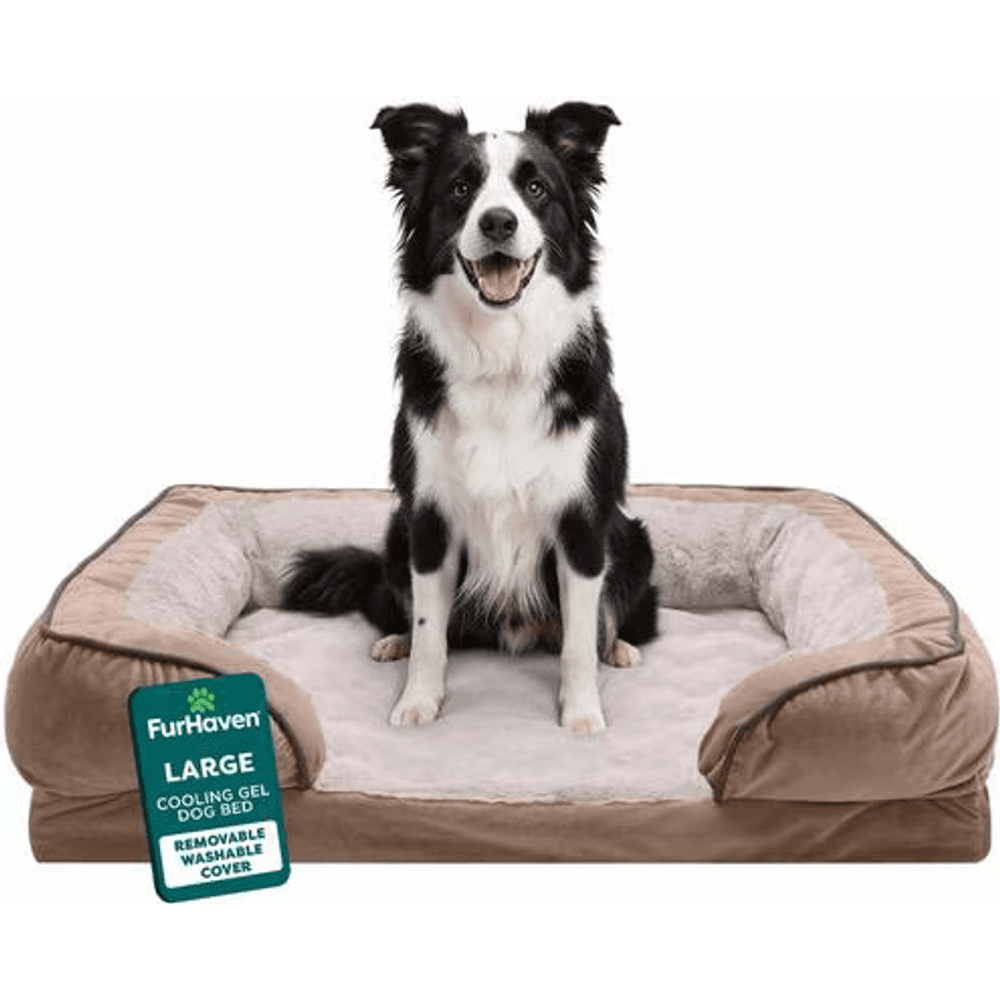
Removable-cover sofa bed. Check usable sleeping space and entry height against your dog’s posture and mobility; no medical or calming outcome promised.
Petful may earn a commission when you click through to Chewy, at no extra cost to you.
There is no reliable like-for-like national price comparison established here. A seller's quote can vary with the individual litter, location, age, services, and contract. A higher Irish Doodle or Goldendoodle price does not by itself prove better health screening, temperament, or care.
Request the same information from both sellers: the full purchase price, deposit terms, included veterinary care, collection costs, and support afterward. Then obtain local grooming and training estimates. A lower purchase quote can still lead to higher practical costs if the dog needs services or daytime care you have not budgeted for.
Make the comparison about two real dogs
If possible, observe each dog in more than one ordinary situation. A puppy may be sleepy during one visit and lively during another. Ask the person raising it what happens at mealtimes, during handling, after play, and when separated briefly from familiar people.
For an adult rescue, a foster carer's observations can be particularly useful. Clarify what ancestry is documented and what is only a visual estimate. A dog does not need a verified mix label to be a good match, but an appearance-based description should not become a medical or temperament prediction.
Size: Compare Like With Like
Start an Irish Doodle vs. Goldendoodle size comparison by matching the categories as closely as possible. Ask what “mini,” “medium,” or “standard” means to each breeder. The words are not enough unless they are connected to the parents' measured heights and weights and the actual breeding plan. For parent-breed orientation, the AKC weight chart lists Irish Setters at 60–70 pounds and Golden Retrievers at 55–75 pounds. The shared Poodle contribution can differ much more by variety: Miniature Poodles are listed at 10–15 pounds, compared with 40–70 pounds for Standards. These overlapping parent figures help explain why the Poodle variety and actual pairing matter; they are not adult-weight limits for either cross.
- 1Use a same-size comparison before attributing a difference to Setter or Retriever ancestry.
- 2Identify the shared Poodle parent variety and the actual pairing.
- 3Neither mix guarantees calmness, low shedding, or allergy compatibility.

Mini does not mean one fixed adult weight
A Mini Irish Doodle vs. Mini Goldendoodle comparison still needs parent measurements and individual growth information. Two breeders may use the same label for different pairings. Ask about the adult size of the relevant parents and, where available, previous mature offspring from comparable breeding.
Our Mini Irish Doodle guide explains how to interpret those estimates. A young puppy's current weight is useful as one observation, but no simple label or photograph can guarantee its final dimensions. If your housing or travel arrangements impose a strict size limit, acknowledge that uncertainty before choosing a puppy.
Weight is not the whole fit question
Consider height, length, strength, and the space the dog uses while resting. Two dogs at a similar weight may have different builds. A taller, leaner dog can need more crate height or vehicle space than a shorter dog of the same weight.
Check the practical constraints in your home:
- Can the dog travel securely in your vehicle?
- Can the adults manage it on a lead while training is still developing?
- Is there enough room for an appropriate resting area?
- Are stairs or carrying needs likely to create difficulties?
- Do rental or travel rules use weight, dimensions, or both?
- Is there room to adapt equipment if a puppy grows larger than expected?
Measure equipment against the dog
For everyday walking, consider a Frisco six-foot traffic leash only when its weight and fittings suit the dog and handler. It provides a close walking arrangement, not distance-recall space. The same lead may feel quite different with two dogs whose strength or training differs.
Use the manufacturer's measurements when choosing a harness, crate, or bed. A size word such as Large belongs to that product's sizing system, not to a universal dog category. Recheck fit during growth and after meaningful changes in condition.
A smaller adult may be easier to lift, but smaller size does not automatically reduce training, grooming, or companionship needs. Likewise, choosing a larger dog does not tell you how much activity it will comfortably enjoy. Discuss the individual dog's health and development with your veterinarian when planning exercise.
Coat Care and Allergy Expectations
Both mixes can have coats that differ in texture, density, length, and shedding. Do not choose an Irish Doodle or Goldendoodle on the assumption that one has a universally easier coat. A wavy coat may need frequent attention, and a curly coat can retain loose hair and conceal tangles beneath a fluffy surface.

Ask to see how the dog is brushed and combed, including behind the ears, beneath equipment, and around the legs. For a puppy, remember that the coat and maintenance demands may change. A generation label such as F1b does not replace an assessment of the individual coat.
Compare maintenance you can actually sustain
Obtain a groomer's estimate for the likely size, texture, and desired length. Explain how much home care you can provide and ask what a simpler trim would involve. Comparing a long, carefully shaped Goldendoodle coat with a short Irish Doodle trim tells you more about styling choices than about the mixes themselves.

Six-foot leash for supervised everyday walks when the clip and weight suit your dog. Not a long line for distance recall.
Petful may earn a commission when you click through to Chewy, at no extra cost to you.
The Irish Doodle haircut guide explains how to agree on length and maintain a combable coat. The same questions are useful when discussing a Goldendoodle with its groomer. Shedding level does not measure the amount of work needed to keep the skin and coat comfortable.
Separate allergy decisions from grooming preferences
Neither mix offers an allergy guarantee. The American Academy of Allergy, Asthma & Immunology identifies allergenic proteins in pet dander, saliva, and urine. A lower-shedding or shorter coat does not remove those sources.
If a household member has allergy or asthma concerns, involve their clinician before committing to a dog. Do not treat a brief meeting, a particular curl pattern, or a seller's “hypoallergenic” description as medical clearance. Grooming and household cleaning may be part of an individual plan, but choosing between these mix names cannot settle the question.
Give grooming practice a workable setting
Provide a quiet space with secure footing, short sessions, and rewards for comfortable participation. A suitable enrichment toy can help provide a separate settling activity after the session. For a dog whose mouth size and chewing behavior fit the product, a KONG Classic in Large is one option for supervised use; choose the appropriate size and inspect it regularly.
Do not use a toy or restraint to push through painful tangles. Tight matting and difficult clipping belong with a professional groomer, while sore or damaged skin needs veterinary assessment. The practical goal is comfortable care, not keeping the longest possible coat at any cost.
Health Records and Breeder Questions for Either Mix
Compare actual health records rather than assuming one cross is healthier. The relevant questions depend on both parents, including the Poodle variety. A generic DNA panel can provide useful information about some variants, but it does not replace every recommended joint, eye, heart, or other clinical evaluation.
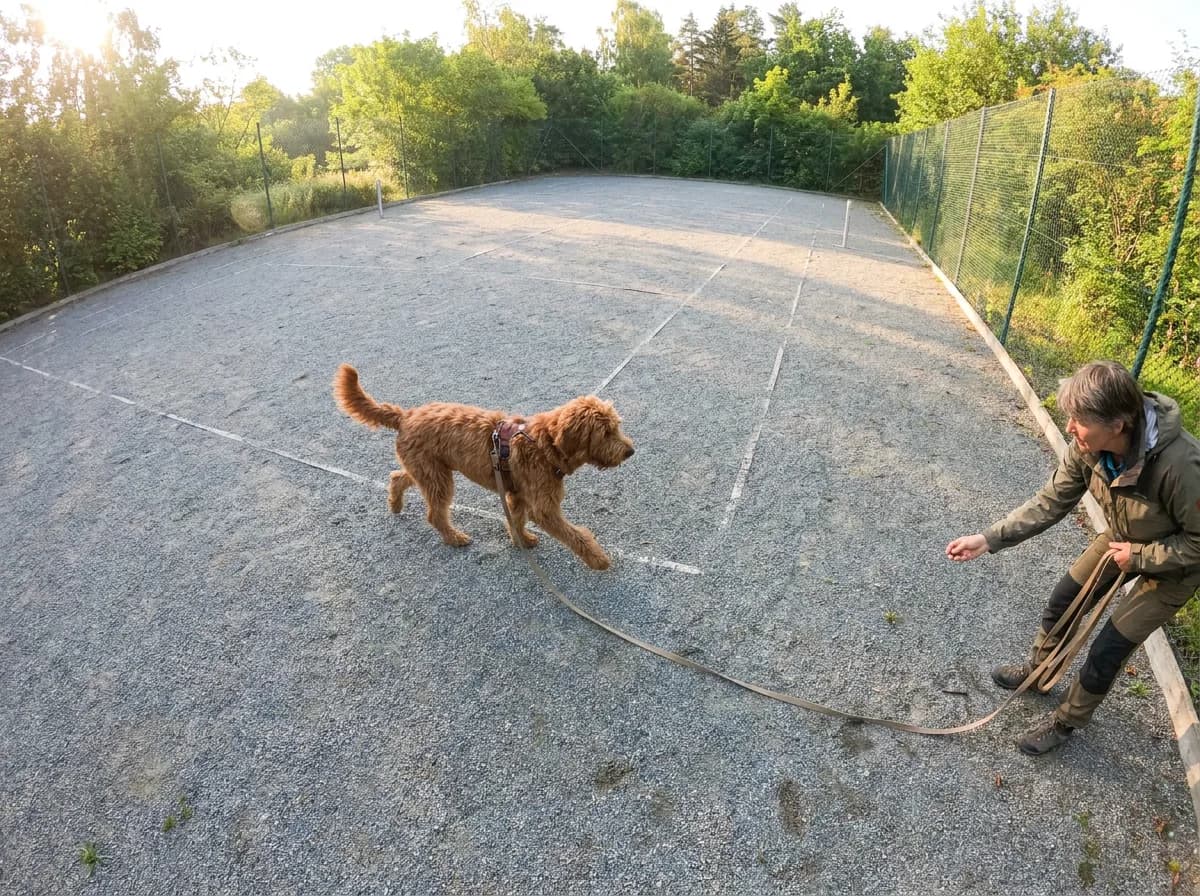
The Golden Retriever Club of America identifies hips, elbows, eyes, and heart screening among the key parent evaluations. Irish Setter and Poodle recommendations are different. Ask for the current parent-club guidance and records matched to the actual dogs, rather than using the Golden list for every pairing.
Ask the question that changes with the parent
For an Irish Setter parent, the parent-club statement includes hip, thyroid, and relevant progressive retinal atrophy screening. That is a different starting point from the Golden Retriever's list. Ask what was performed, why, and whether additional tests are appropriate for the particular family history.

Large rubber toy for supervised enrichment if sizing and chewing style suit. Follow the current size guide, inspect regularly and retire when damaged.
Petful may earn a commission when you click through to Chewy, at no extra cost to you.
The Poodle Club of America statement distinguishes varieties. Miniature Poodles have recommendations including hip, patellar, eye, and prcd-PRA testing, while Standard Poodles have a different set including hips, eyes, thyroid, NEwS, and vWD I testing or specified documented parentage routes. The breeder should explain which list applies to the actual dog.
This is why “both parents have DNA tests” is an incomplete comparison. Ask for the relevant clinical evaluations as well, and distinguish an absent report from an abnormal result. A veterinarian can help you assess a finding without assuming every difference between two sets of paperwork has the same significance.
Make records comparable
For each prospective puppy, collect the same basic information:
- The identities and ancestry of the parents.
- The Poodle variety and documented parent measurements.
- Screening reports, dates, and underlying results.
- Any documented clear-by-parentage explanation for a specific condition.
- The puppy's own examination and preventive-care records.
- A written contract and a clear lifetime return route.
Ask your veterinarian to interpret unclear findings. Completed screening reduces particular uncertainties; it cannot promise a lifetime without illness. Likewise, an adult that looks healthy in a photograph has not thereby demonstrated normal screening results.
Evaluate the care behind the paperwork
Ask how the puppies spend the day, who handles them, and what age-appropriate experiences they have had. Discuss how the breeder matches puppies to homes and what support is available if training or adjustment becomes difficult. Clear descriptions of individual puppies are more useful than a guarantee that every litter member will suit every family.
Our Irish Doodle puppy guide covers breeder checks, parent-specific screening questions, contracts, and first-year costs. Apply the same level of scrutiny to a Goldendoodle seller, while using the appropriate parent-breed screening guidance. A familiar mix name or polished listing is not a substitute for those checks.
Include adult dogs in the decision
An adult can offer more direct evidence of current size, coat, and everyday behavior. Ask a rescue or previous carer about grooming tolerance, time alone, visitors, other animals, and routines that help the dog settle. Be clear about gaps in the history so they can inform the transition plan.
Adult adoption still involves uncertainty and adjustment. Behavior in a new home can differ from behavior in a foster setting, and veterinary care remains individual. Its advantage for this comparison is a fuller picture of the present dog, not a guarantee that every future need is already known.
Which Daily Routine Fits Your Home?
Choose the individual dog whose activity, handling, and companionship needs you can meet consistently. Both mixes may enjoy walks, exploration, games, and training, but neither should be expected to exercise itself or remain content alone for an entire busy day without preparation and support.

Write down a realistic weekday, including work, school, transport, meals, and rest. Identify who will handle toilet opportunities, activity, grooming, and training. A plan that depends on one person doing everything before and after a long shift deserves a closer look, regardless of which mix you prefer.
Match interests without expecting a fixed personality
If you enjoy scent games and exploring varied routes, ask how each dog responds to those activities. If retrieving appeals to you, observe whether the individual enjoys bringing an object back and releasing it. Parent-breed history can suggest activities to try, but the dog decides what it finds rewarding.
Balance activity with learning to relax. Reward quiet behavior, provide predictable rest opportunities, and keep training manageable. Being energetic outdoors and able to settle indoors are not contradictory traits, but the routine and individual dog matter more than an online ranking of calm doodles.
Plan for children, visitors, and other pets
Supervise interactions with children and teach everyone how to give the dog space. A friendly dog can still jump, mouth, or knock someone over when excited. Choose management and training that fit the dog's actual size and behavior rather than assuming Retriever ancestry guarantees gentle greetings.
Introduce other animals gradually with appropriate separation and supervision. Ask about the dog's known history, but do not assume a positive experience with one household animal guarantees compatibility with another. Consider whether your home has the space and people needed to manage introductions patiently.
Compare your fallback plans
Think beyond the ideal week. Who covers care when work runs late, you are ill, or travel is necessary? Is a groomer available, and can you afford help if the coat or training becomes harder than expected? The answers often distinguish two suitable-looking dogs more clearly than their mix names.
Use ordinary scenarios to test the match
Consider a household that enjoys long weekend walks but has little weekday time. Either dog may enjoy the outings, yet the relevant question is who provides daily activity and companionship between them. Choosing the mix described as calmer does not solve an uncovered care gap.
For a household with young children, compare the actual dog's response to movement, noise, and gentle handling. Ask how you will separate rest from play and manage excited greetings. A smaller dog may be easier to manage physically, but it can still need the same careful supervision and training.
For someone who enjoys training and coat care, either mix may offer a rewarding partnership. The useful distinction might be an individual dog's enthusiasm for scent work, a known history of comfortable grooming, or an established ability to rest while the owner works. Write down those observations instead of turning them into a claim about every member of the mix.
Make the decision with the remaining uncertainty visible
If both dogs fit, choose using the quality of the records, the individual relationship, and a realistic care plan. If neither fits the routine you can provide, waiting or considering an adult with better-known needs is a reasonable decision. There is no need to declare one mix universally better to make a good choice for your household.
Irish Doodle vs. Goldendoodle Questions
Yes. A label such as mini or standard can cover different pairings, and parent measurements do not eliminate individual growth variation. Compare the actual parents and relevant mature relatives, then allow for uncertainty in a puppy's final height and weight. An adult dog's current measurements offer a more direct basis for equipment and space decisions.
No. Visible curl does not provide a reliable individual shedding ranking. Coat variation includes density, texture, and the way loose hair remains caught in the coat, so assess the actual dog and its grooming needs. There is also no allergy guarantee from either mix or a particular coat pattern; medical allergy questions need an individualized discussion with a clinician.
Neither name reliably identifies the calmer individual. Irish Setter, Golden Retriever and Poodle ancestry all bring an active background, and the dogs’ ages, experiences and daily routines matter. Compare how each dog settles after play, handles visitors and responds to brief separation, rather than judging a sleepy puppy at one meeting. If indoor calm is essential, an adult with a well-described routine may offer more useful evidence than a crossbreed ranking.
A reliable like-for-like national cost ranking is not available. Compare current itemized quotes for the actual dogs, then add local grooming, training, veterinary care and daytime support. A lower purchase price may be outweighed by a demanding coat or a routine that requires paid help. Match expected adult size and included services before comparing the totals; a mini-versus-standard comparison can otherwise be misleading.
BVMS, MRCVS
Dr. Pippa Elliott, BVMS, MRCVS, is a veterinarian with nearly 30 years of experience in companion animal practice. Dr. Elliott earned her Bachelor of Veterinary Medicine and Surgery from the University of Glasgow. She was also designated a Member of the Royal College of Veterinary Surgeons. Married with 2 grown-up kids, Dr. Elliott has a naughty Puggle named Poggle, 3 cats and a bearded dragon.
Sign up for expert-backed reviews and safety alerts all in one place.