Goldendoodle Grooming: A Complete Coat-Care Guide
A complete Goldendoodle grooming guide covering coat types, how often to brush and bathe, popular cuts like the teddy bear, how to prevent matting, and the exact tools that keep the coat plush, clean, and mat-free at home.
Petful is reader supported. As an affiliate of platforms like Amazon and Chewy, we may earn a commission when you buy through links on this page. There is no extra cost to you.
Goldendoodle grooming is the single biggest commitment that surprises new owners, because the soft, low-shedding coat that makes this Golden Retriever and Poodle cross so appealing is also the coat most likely to knot into a solid felt mat if it is left alone. Unlike a short-haired dog you can wipe down and forget, a Goldendoodle grows hair continuously, and that hair traps loose undercoat, dirt, and moisture against the skin. The reward for staying on top of it is enormous: a plush, clean, healthy coat that barely sheds and smells great. The penalty for falling behind is matting, skin irritation, expensive de-matting fees, and sometimes a full shave-down.
The good news is that a consistent home routine, paired with a professional groom every six to eight weeks, keeps almost every Goldendoodle comfortable. This guide walks through every coat type, how often to brush and bathe, the most popular cuts including the famous teddy bear, how to prevent matting before it starts, and the exact tools that make the job faster. Whether you own a mini, a medium, or a standard, the fundamentals are the same, and once you build the habit it takes only a few minutes a day.
- 1Brush a Goldendoodle to the skin every one to two days, not just over the surface, to stop mats forming near the roots.
- 2Book a professional groom every six to eight weeks and keep it consistent so the coat never gets out of control.
- 3The teddy bear cut is the most requested style because it keeps the fluffy look while shortening the coat enough to be manageable at home.

Sign up for expert-backed reviews and safety alerts all in one place.
Goldendoodle Coat Types (And Why Your Grooming Routine Depends on Them)
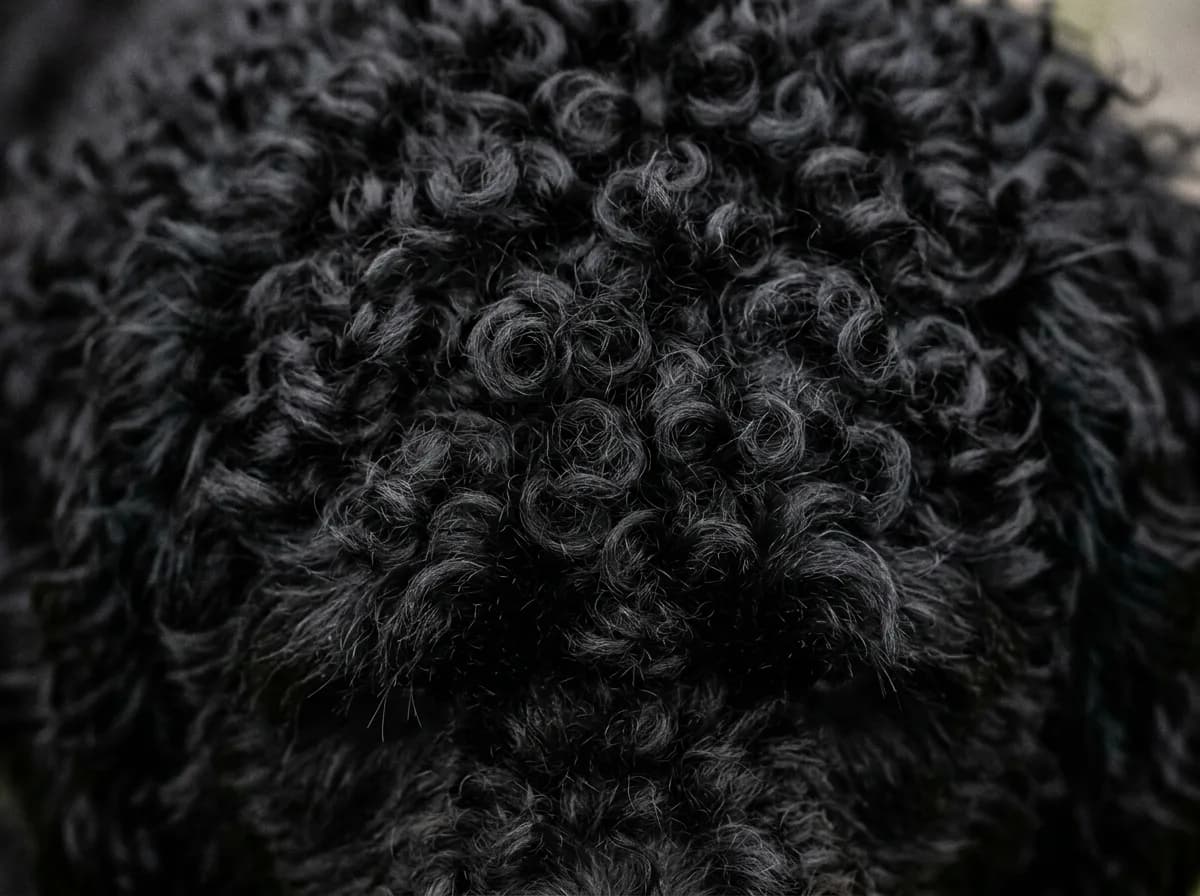
Before you buy a single brush, you need to know which coat your dog actually has, because grooming a straight-coated Goldendoodle is a very different job from grooming a tight curly one. Coat type is driven by genetics, specifically how much Poodle is in the mix, and it can even change as a puppy matures into its adult coat. The American Kennel Club recognizes three broad coat textures across doodle-type dogs, and Goldendoodles fall neatly into the same buckets.
The curly coat
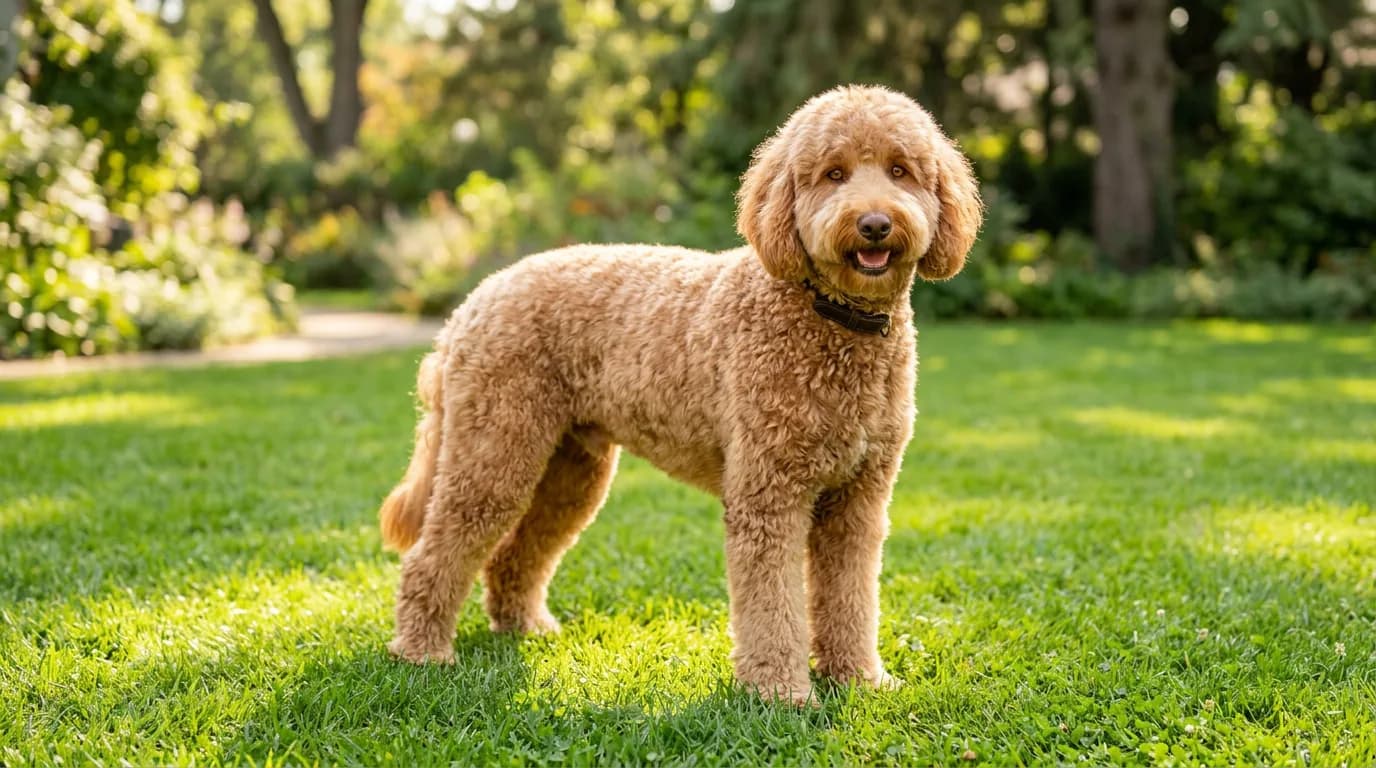
A curly Goldendoodle looks the most Poodle-like, with tight, springy curls and very little visible shedding. This coat holds a haircut beautifully and gives you that dense, teddy-bear plushness, but it is also the highest-maintenance texture you can own. Curls wrap around loose hair and pull it toward the skin, so a curly coat can mat close to the roots even when the surface looks fine. Curly dogs need daily attention and are the least forgiving if you skip a week. For more, see Petful’s guide to do goldendoodles shed.
The wavy or fleece coat
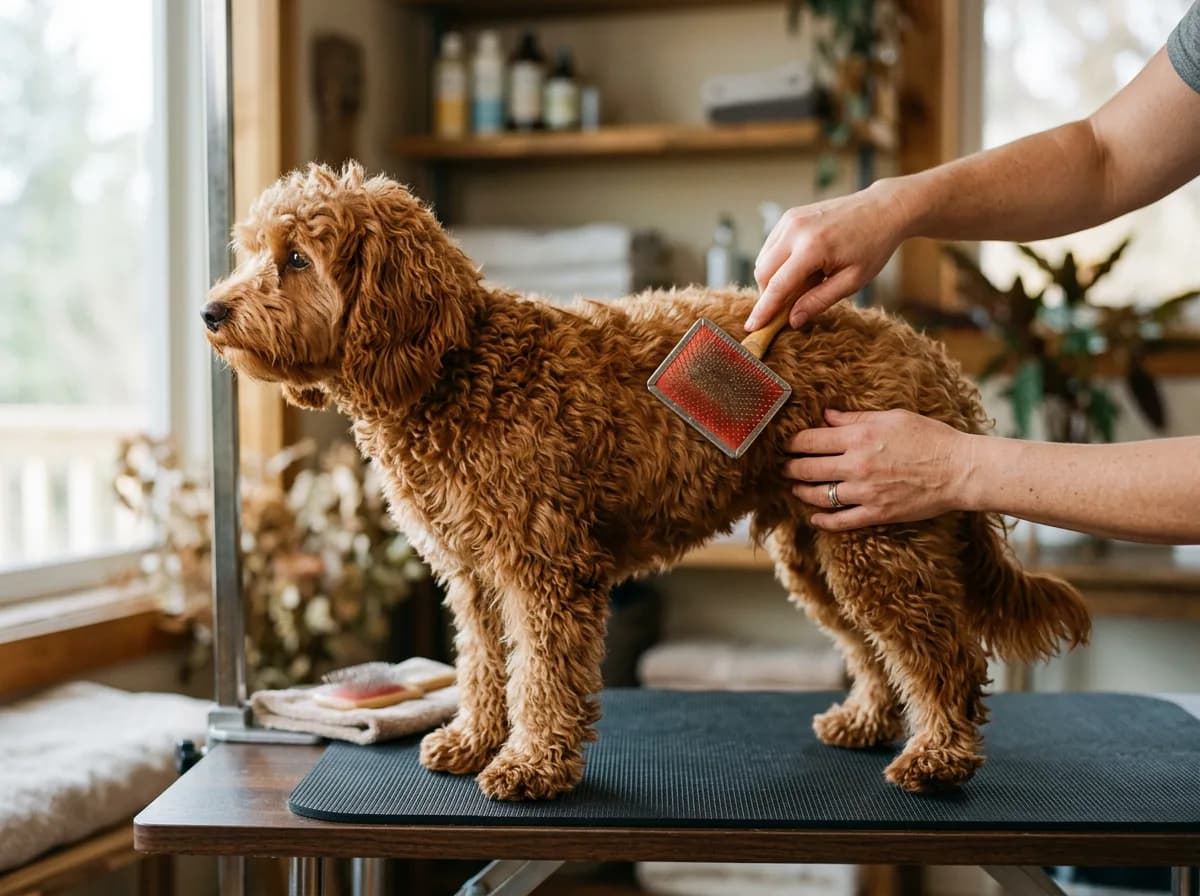
The wavy coat, often called a fleece coat, is the classic Goldendoodle look and the one most buyers picture: loose, flowing waves with a soft, cottony feel. It sheds slightly more than a curly coat but far less than a Golden Retriever. Wavy coats are the middle ground for maintenance. They still mat, especially in friction zones, but they are more forgiving than curls and easier for a beginner to keep clean with a slicker brush and a comb.
The straight or flat coat
A straight-coated Goldendoodle carries more Golden Retriever influence. The hair lies flatter, has an "improper" or open-faced look with less beard and eyebrow, and typically sheds the most of the three. The upside is that straight coats mat the least and are the easiest to brush. The trade-off is that they are the least hypoallergenic, so if allergies drove your choice, a straight coat can be a disappointment even though it is the simplest to maintain.
Petful may earn a commission when you click through to Chewy, at no extra cost to you.
Generation labels give you a rough forecast of what to expect, and they matter enough that reputable breeders list them. An F1 (first cross of Golden Retriever and Poodle) tends toward wavy and sheds a little. An F1b (an F1 bred back to a Poodle) leans curlier and lower-shedding. Multigen or F2b dogs are usually curliest of all. None of this is a guarantee, because littermates can differ, but it sets your expectations for the grooming workload ahead. If you are still choosing a puppy or want to understand how build affects coat care, our guide to Goldendoodle sizes breaks down how a mini versus a standard changes both the amount of coat and the time each session takes.
| Coat Type | Typical Generation | Shedding | Matting Risk | Home Effort |
|---|---|---|---|---|
| Curly | F1b, F2b, multigen | Very low | High | Daily |
| Wavy / fleece | F1, F1b | Low | Moderate | Every 1 to 2 days |
| Straight / flat | F1 with more Retriever | Moderate | Low | 2 to 3 times a week |
Coat texture is only half the picture. Color influences how visible dirt and tear stains are, and lighter dogs such as cream and apricot show staining around the eyes and mouth far more than a red or chocolate dog. If your dog's color is part of why you fell in love, our Goldendoodle colors guide covers which shades stay cleanest and which need a little extra face care.
How Often Do Goldendoodles Have to Be Groomed?
Goldendoodles need to be groomed constantly at home and professionally every six to eight weeks. That is the short answer, and it holds for almost every dog in the breed. The longer answer is that "grooming" is really two separate jobs on two separate clocks, and owners get into trouble when they only think about the second one.
The first job is brushing, and it happens at home every one to two days for most coats, daily for curly coats. Brushing is not optional between salon visits. A Goldendoodle that is professionally groomed on schedule but never brushed at home will still arrive matted, because mats form in the weeks between appointments, not during them. Think of the professional groom as a reset and your daily brushing as the maintenance that keeps the reset clean.
The second job is the full groom, which includes bathing, drying, a haircut or tidy, nail trim, ear cleaning, and sanitary trimming. Most Goldendoodles do best on a six to eight week cycle. Stretch it to twelve weeks and you are almost guaranteed to face matting and a higher grooming bill, sometimes with a shave-down as the only humane option.
- A coat that goes 10 to 12 weeks without a professional groom is the number one reason Goldendoodles end up shaved to the skin. Once mats form tight to the body, brushing them out is painful for the dog, and most groomers will refuse to de-mat rather than cause distress.
A realistic grooming schedule by coat type
Bathing frequency deserves its own note, because over-bathing strips natural oils and dries out the skin, while under-bathing lets oils and debris build up and encourage mats. For most Goldendoodles, a bath every three to four weeks is the sweet spot, with spot cleaning of muddy paws and dirty beards in between. Curly coats can go slightly longer between baths than straight coats because they hold less loose debris at the surface, but they demand more brushing in exchange.
| Task | Curly Coat | Wavy Coat | Straight Coat |
|---|---|---|---|
| Brush to the skin | Daily | Every 1 to 2 days | 2 to 3 times a week |
| Full bath | Every 4 weeks | Every 3 to 4 weeks | Every 3 weeks |
| Professional groom | Every 6 weeks | Every 6 to 8 weeks | Every 8 weeks |
| Nail trim | Every 3 to 4 weeks | Every 3 to 4 weeks | Every 3 to 4 weeks |
Puppies deserve special mention. The window from about seven to twelve months is when many Goldendoodles "blow" their soft puppy coat and grow in the coarser adult coat underneath. During this coat change, matting accelerates dramatically because the shedding puppy fluff gets tangled in the incoming adult hair. Owners who cruised through the first few months are often blindsided here. If your once-easy puppy suddenly mats overnight, you are almost certainly in the coat transition, and the answer is more frequent brushing, not less.
How Should You Groom a Goldendoodle? A Step-by-Step Home Routine
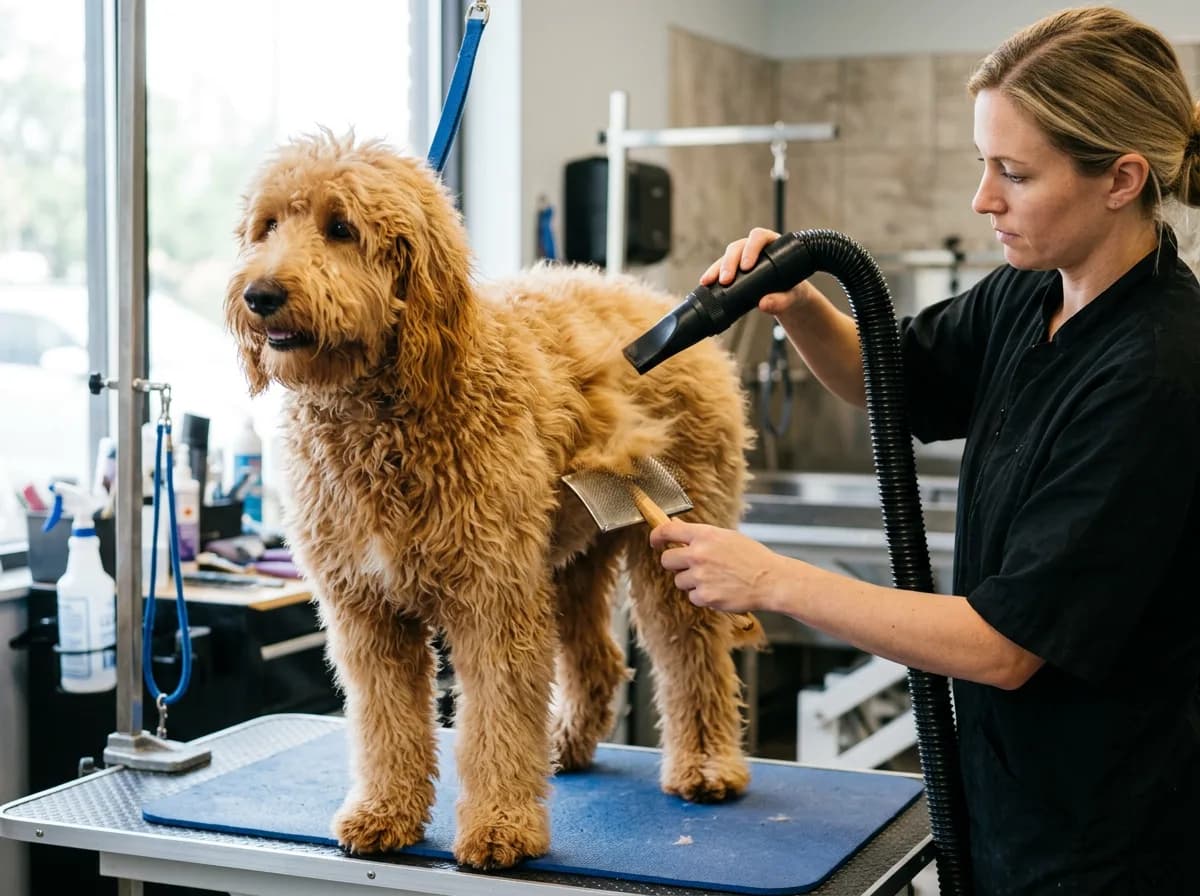
The best way to groom a Goldendoodle at home is to work in a fixed order every time: brush and de-tangle first, then bathe, then dry thoroughly, then handle the finishing tasks like ears, eyes, nails, and sanitary areas. Following the same sequence turns a chaotic chore into a calm ten-minute routine your dog learns to tolerate and even enjoy.
Step 1: Line brushing (the technique that actually prevents mats)
Most owners brush wrong. They glide the brush over the top of the coat, which smooths the surface while leaving the mats forming underneath completely untouched. The professional technique is called line brushing. You part the coat down to the skin with one hand, then brush the exposed hair from the skin outward in a thin "line," working in small sections from the belly up and the feet up. It is slower, but it reaches the roots where mats actually start.
Always line brush a dry or nearly dry coat, never a wet one, and never bathe a matted dog. Water tightens existing mats into hard knots that are far worse after they dry. Work through the whole coat with a slicker brush, then run a stainless steel comb through afterward. The comb is your test: if it glides from skin to tip without snagging anywhere, the section is truly mat-free. If it catches, that spot needs more work before the bath.
Petful may earn a commission when you click through to Chewy, at no extra cost to you.
Step 2: Bathing
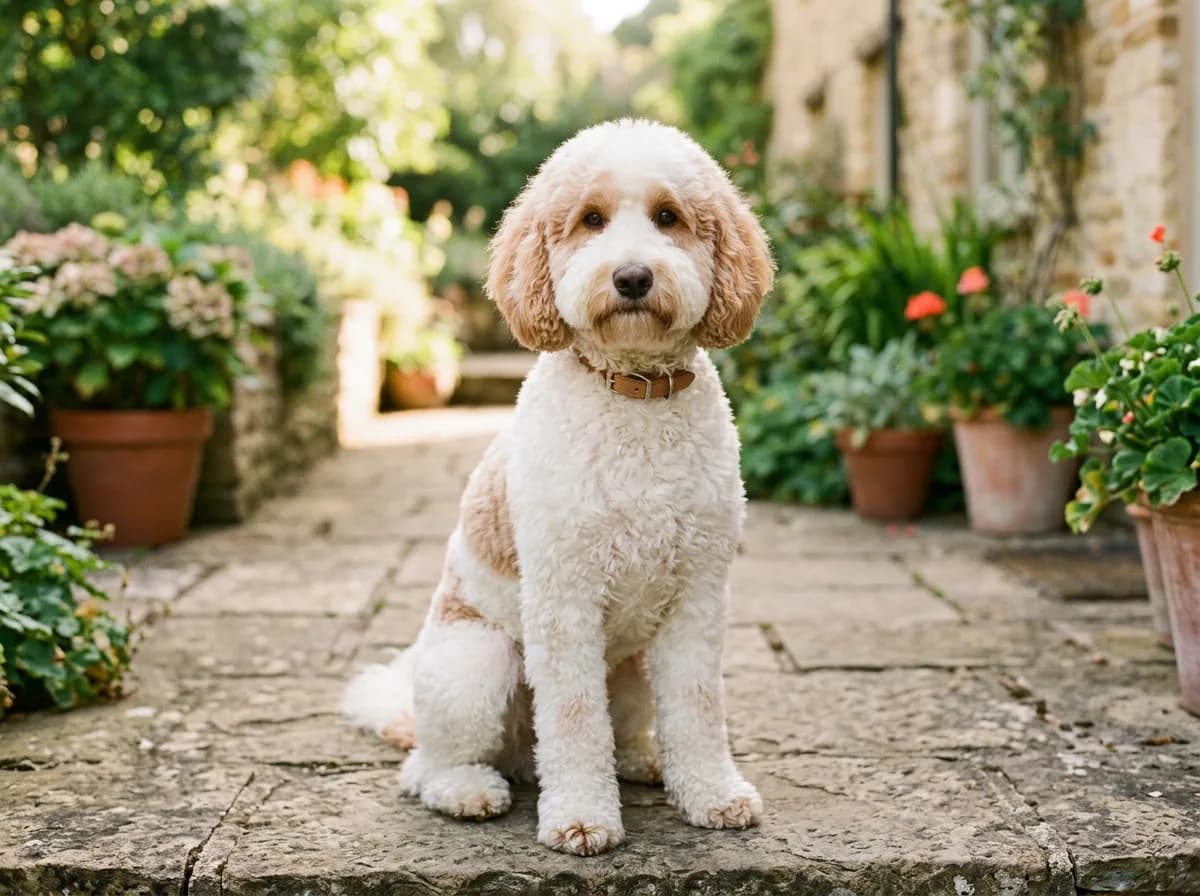
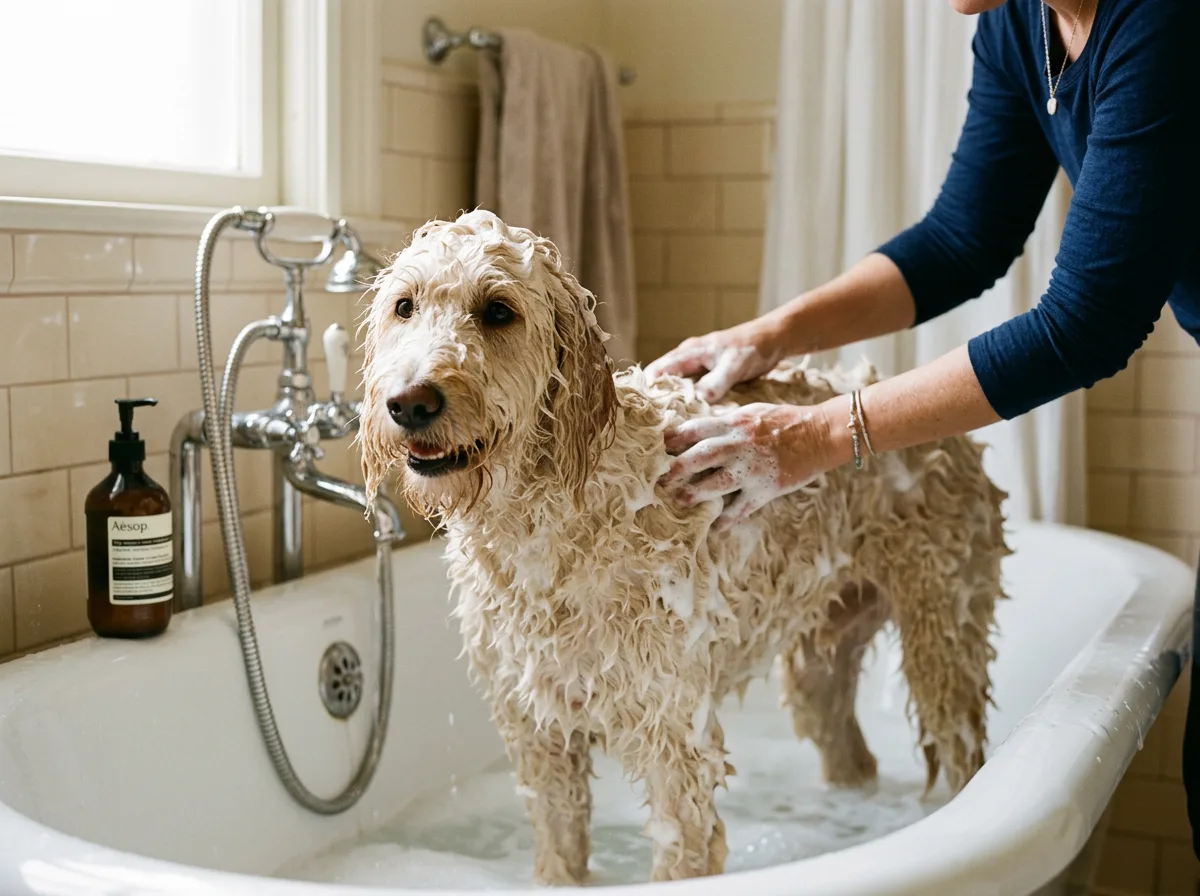
Once the coat combs through cleanly, it is time to bathe. Wet the dog thoroughly with lukewarm water, working the water down to the skin, which takes longer than you expect on a dense coat. Use a gentle dog shampoo (never human shampoo, which is the wrong pH for canine skin) and lather from the neck back, saving the face for a careful hand wash with a cloth to keep suds out of the eyes. Rinse far longer than feels necessary, because leftover shampoo residue irritates skin and dulls the coat. A conditioner made for dogs adds slip that makes the next brush-out easier and helps prevent static tangling.
Step 3: Drying
Drying is the step most home groomers skip, and it is where mats are born. A Goldendoodle that is towel-dried and left to air dry will have a curly, tangled, half-felted coat by morning, because the coat curls and knots as it dries on its own. The professional approach is to blow the coat dry, ideally with a dog-specific high-velocity or forced-air dryer on a low heat setting, brushing as you go so the hair dries straight and fluffy. If you only air dry, at minimum brush the coat out again once it is dry to break up any tangles that set.
- Brushing while you blow-dry (called fluff drying) is what gives a Goldendoodle that full, even, teddy-bear look. It also stretches the coat straight so your next home brushing reaches deeper. Skipping it is the most common reason a home groom looks flat or lumpy compared to a salon groom.
Step 4: Eyes, ears, nails, and sanitary areas
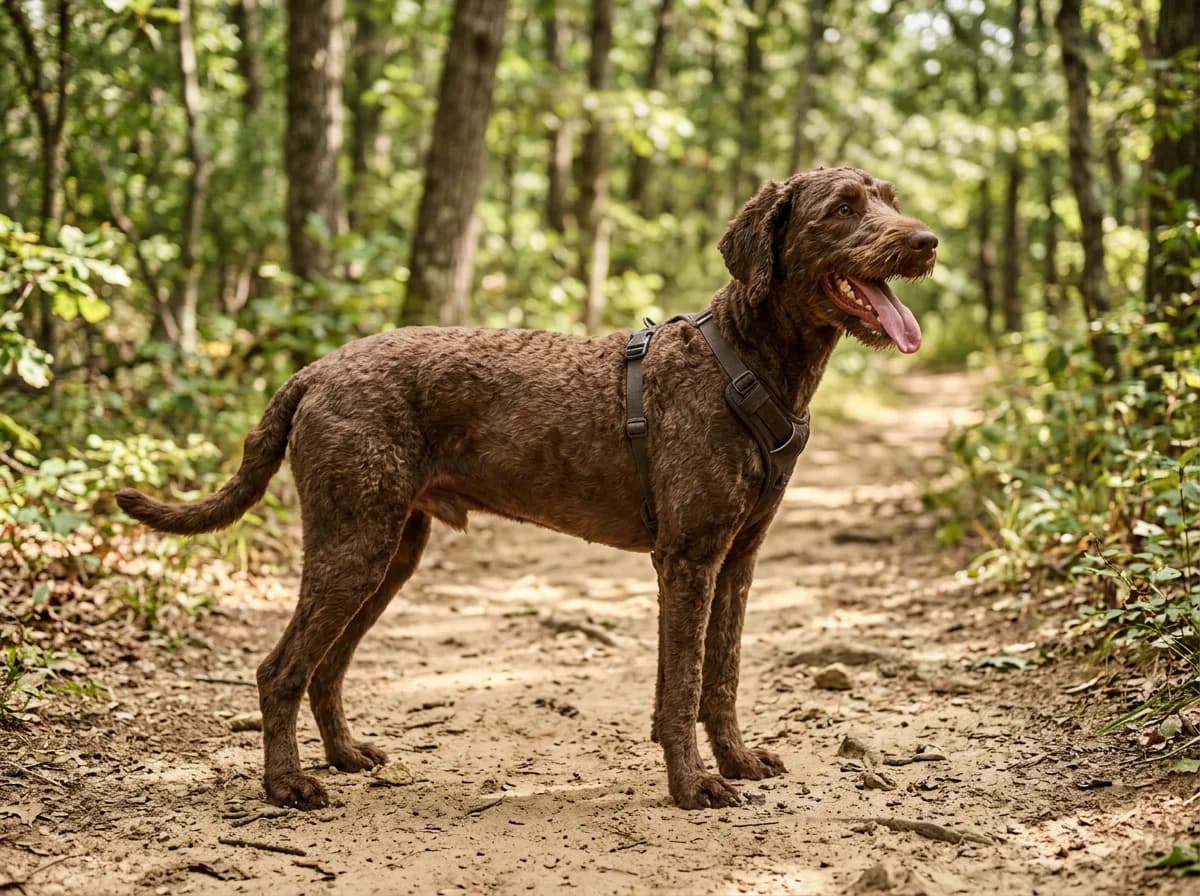
The finishing tasks are quick but they protect your dog's health, not just its looks.
- Eyes: Wipe the corners daily with a damp cloth and keep the hair trimmed short around the eyes so it does not poke or trap moisture. Light-colored dogs often develop reddish tear stains, which are usually a cosmetic issue tied to moisture and porphyrins in tears, not always a medical one.
- Ears: Goldendoodles have floppy, hairy ears that trap moisture and are prone to infection. Check them weekly, wipe the visible part with a vet-approved ear cleaner, and dry the ears well after every bath. Ask your groomer or vet whether the hair inside the ear canal should be plucked or left, since guidance has shifted and it is not right for every dog.
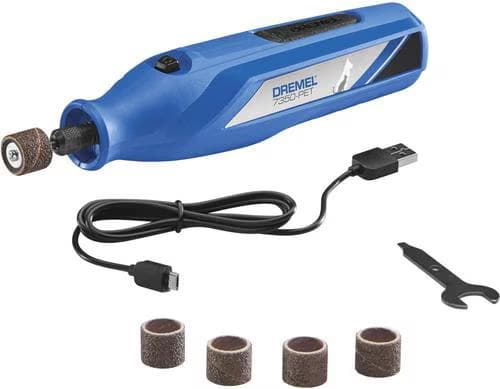
- Nails: Trim every three to four weeks. If you hear clicking on the floor, they are too long. Long nails splay the foot and cause joint strain over time.
- Sanitary and paw trim: Keep the hair around the rear, belly, and between the paw pads short for hygiene and traction. This is easy to do at home with a small pair of rounded scissors between full grooms.
- A yeasty smell, head shaking, redness, discharge, or a dog scratching one ear repeatedly points to an ear infection, which needs a veterinarian, not a groomer. Recurrent ear and skin issues are common in floppy-eared, dense-coated breeds, and veterinary dermatology guidance from a veterinary college such as Cornell University College of Veterinary Medicine stresses that early treatment prevents chronic problems.
What Is the Best Cut for a Goldendoodle?
The best cut for a Goldendoodle is the teddy bear cut for most owners, because it keeps the round, fluffy, plush-toy look the breed is famous for while shortening the coat to a length you can realistically maintain at home. That said, "best" depends on your climate, your dog's activity level, and how much daily brushing you are honestly willing to do. A longer cut looks stunning in photos and mats fast in real life. A shorter cut is easy to maintain but sacrifices some of the signature fluff. Here are the styles groomers cut most often.
The teddy bear cut
The teddy bear cut leaves the body at a medium length (commonly one to two inches) and rounds the face into a soft, full circle with the muzzle hair left long to blend into the cheeks. It is the most requested Goldendoodle style by a wide margin. It is flattering on every color and size, it photographs beautifully, and at one to two inches it is short enough to brush through quickly but long enough to still look like a doodle. If you are not sure what to ask for, ask for a teddy bear.
The puppy cut
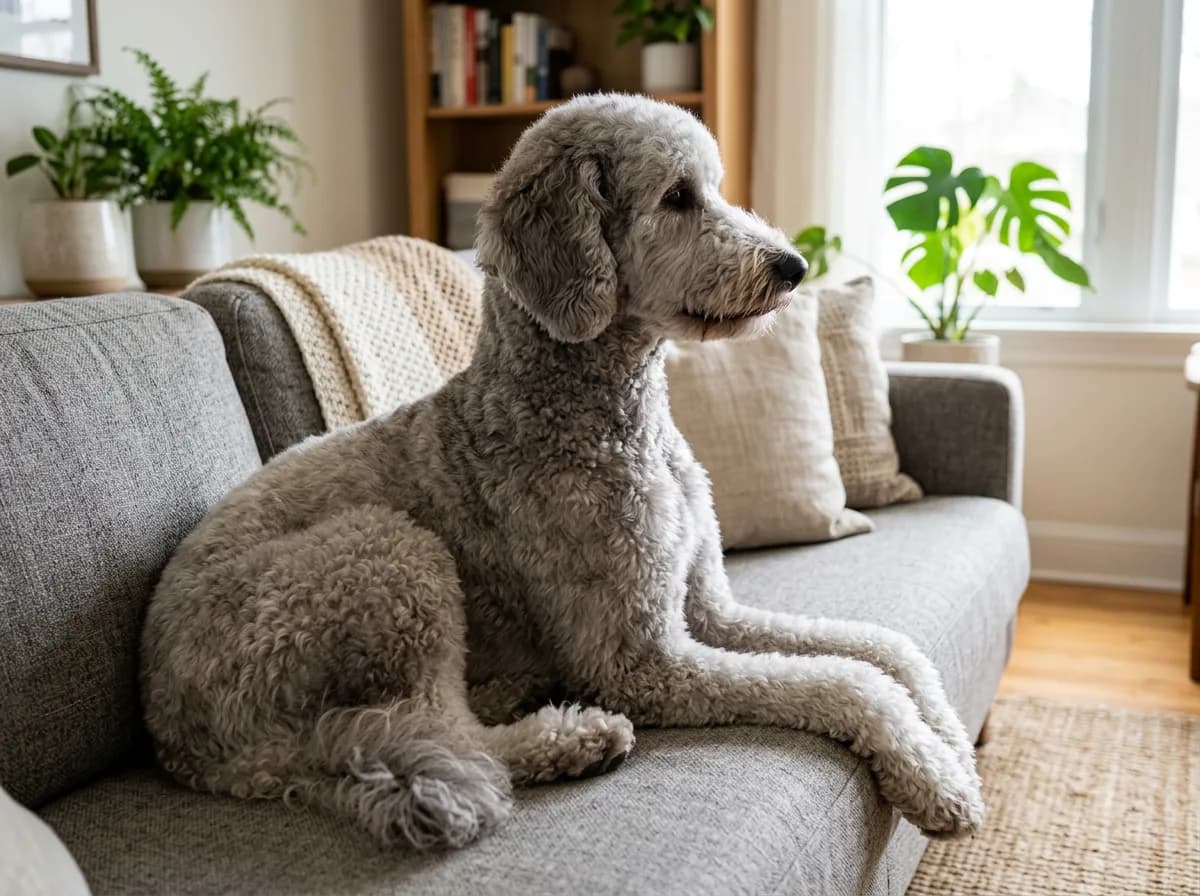
The puppy cut is a close cousin, an even, short-to-medium length all over the body and face with less emphasis on the ultra-round face shape. It keeps a youthful look, is very low maintenance, and is a smart default for active dogs that are in and out of water and mud. Many owners use "puppy cut" and "teddy bear cut" interchangeably, so bring a photo to your groomer to get exactly what you want.
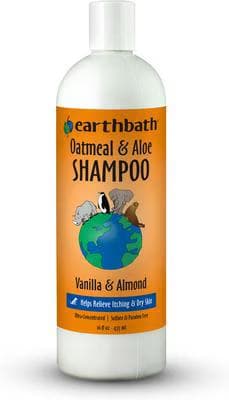
Petful may earn a commission when you click through to Chewy, at no extra cost to you.
The kennel or summer cut
The kennel cut (also called a summer cut) takes the body down short, often a half inch or less, for maximum easy maintenance and cooling in hot climates. It is the most practical cut for a heavily matted dog or an owner who cannot commit to daily brushing. The trade-off is that it removes almost all of the fluff, and on some dogs the coat grows back with a slightly different texture. It is a great reset, not necessarily a forever look.
The lamb cut and other styles
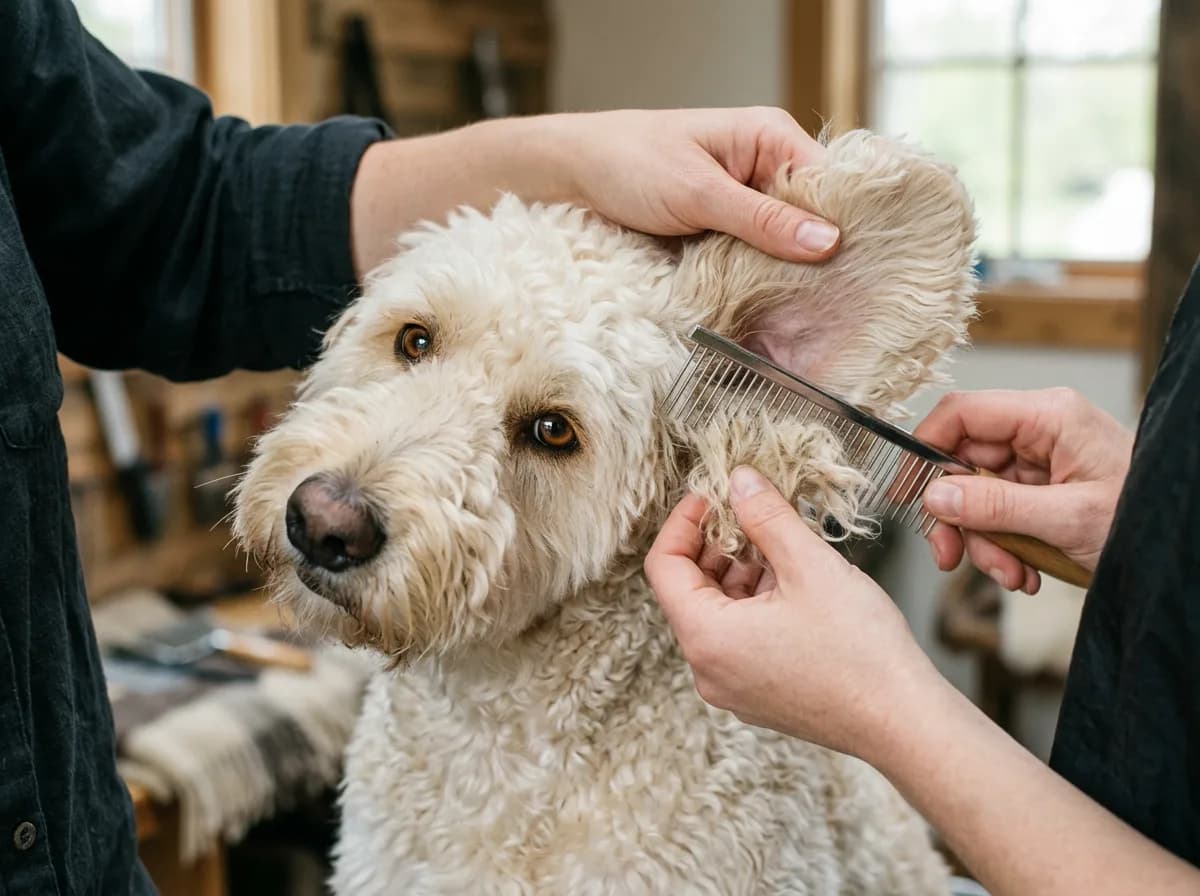
The lamb cut leaves the legs fuller and longer while keeping the body shorter, giving a leggy, elegant silhouette. Other variations include the mohawk (a strip of longer hair down the back), the show-inspired continental trims (rare on pet Goldendoodles), and simple face-and-feet tidies for owners who want to keep the coat long. Longer styles are gorgeous but demand the daily line-brushing described above, so be honest about your schedule before you commit.
| Cut | Typical Length | Maintenance | Best For |
|---|---|---|---|
| Teddy bear | 1 to 2 inches | Moderate | The classic fluffy doodle look |
| Puppy cut | 0.5 to 1 inch | Low to moderate | Active, outdoorsy dogs |
| Kennel / summer | Under 0.5 inch | Low | Hot climates and easy upkeep |
| Lamb cut | Short body, full legs | Moderate to high | An elegant, leggy silhouette |
Length is a genuine trade-off, not just a style choice. Ask your groomer for the longest length you will actually keep brushed, and go shorter if you are being optimistic about your time. A dog kept comfortably short is far better off than a dog kept long and matted. This is the same math owners of other doodle-type breeds face. If you are comparing curly crossbreeds, the coat-care principles carry straight over to a Cockapoo or similar Poodle mix.
What Are Common Goldendoodle Grooming Problems?
The most common Goldendoodle grooming problems are matting, ear infections, tear staining, and the coat blowout that hits during the transition from puppy to adult coat. Almost every one of them traces back to the same root cause: a dense, continuously growing coat that traps moisture and loose hair against the skin. Knowing what to watch for lets you catch small issues before they become expensive ones.
Matting
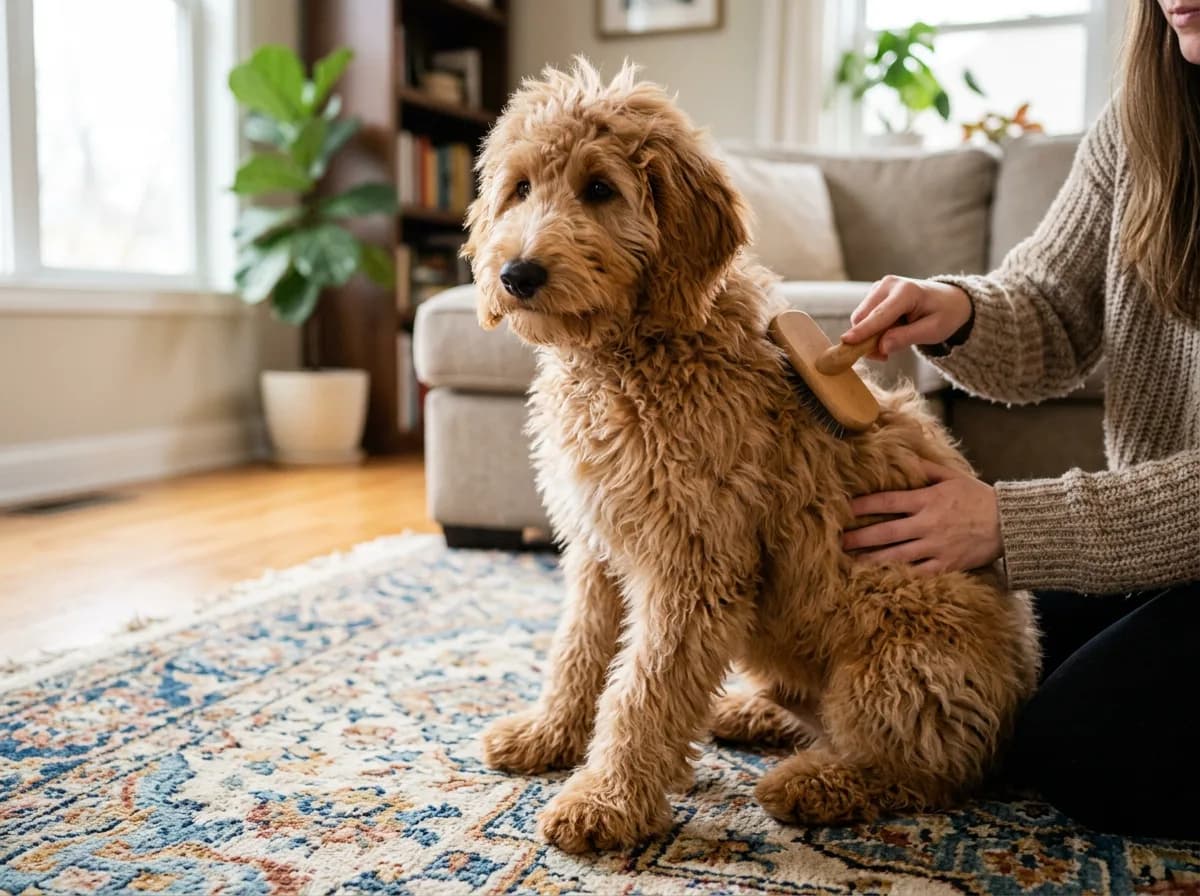
Matting is the number one problem, and it is entirely preventable with routine. Mats form fastest in high-friction, high-moisture zones: behind and under the ears, in the armpits and groin, around the collar and harness contact points, between the back legs, and on the feet. They start as small tangles you can barely feel and, if left, become a solid felted layer against the skin. That felt traps moisture and blocks air, leading to hot spots, sores, and skin infection underneath, which you often cannot see until the mats come off.
Prevention beats removal every time. Line brush to the skin on your dog's schedule, pay extra attention to the friction zones, remove the collar or harness during long lounging sessions to reduce rubbing, and always fully dry the coat after swimming or bathing. If you find a small mat, work it apart gently with your fingers and a comb, holding the base of the hair so you are not pulling the skin. Never cut a mat out with scissors blindly, because a Goldendoodle's skin can tent up into the mat and you can cut the dog. If a mat is tight to the skin, that is a groomer's job.
- Patting the top of the coat tells you nothing. A Goldendoodle can look flawless on the surface while matting solidly underneath. The only reliable check is running a metal comb from the skin outward through every section. If the comb stops, you have a tangle forming, no matter how good the coat looks.
Ear infections
Floppy, hairy ears plus a bath-heavy grooming routine is a recipe for trapped moisture, and the American Kennel Club and veterinary sources alike flag ear infections as a frequent issue in doodle-type dogs. Dry the ears thoroughly after every bath and swim, clean weekly with a vet-approved solution, and watch for the early signs: odor, head shaking, scratching, redness, or dark discharge. Ear infections are a veterinary matter, so do not try to solve a smelly, painful ear with grooming alone.
Tear stains
Reddish-brown tear staining under the eyes is mostly cosmetic and shows up most on cream, apricot, and white dogs. It is usually caused by chronic tear wetness rather than disease. Keep the hair around the eyes trimmed short, wipe the area daily with a damp cloth, and keep it dry. If staining appears suddenly or comes with squinting, discharge, or pawing at the eye, that warrants a vet visit to rule out a blocked tear duct or irritation.
Petful may earn a commission when you click through to Chewy, at no extra cost to you.
The adolescent coat change
As covered earlier, the seven to twelve month coat transition is a temporary but intense period of matting. The soft puppy coat sheds out while the adult coat grows in, and the two tangle together. The fix is simply to brush more often for a few months until the adult coat is fully in. Owners who understand this in advance ride it out. Owners who do not often end up with a shave-down that could have been avoided with a few extra brushing sessions a week.
The Essential Goldendoodle Grooming Toolkit
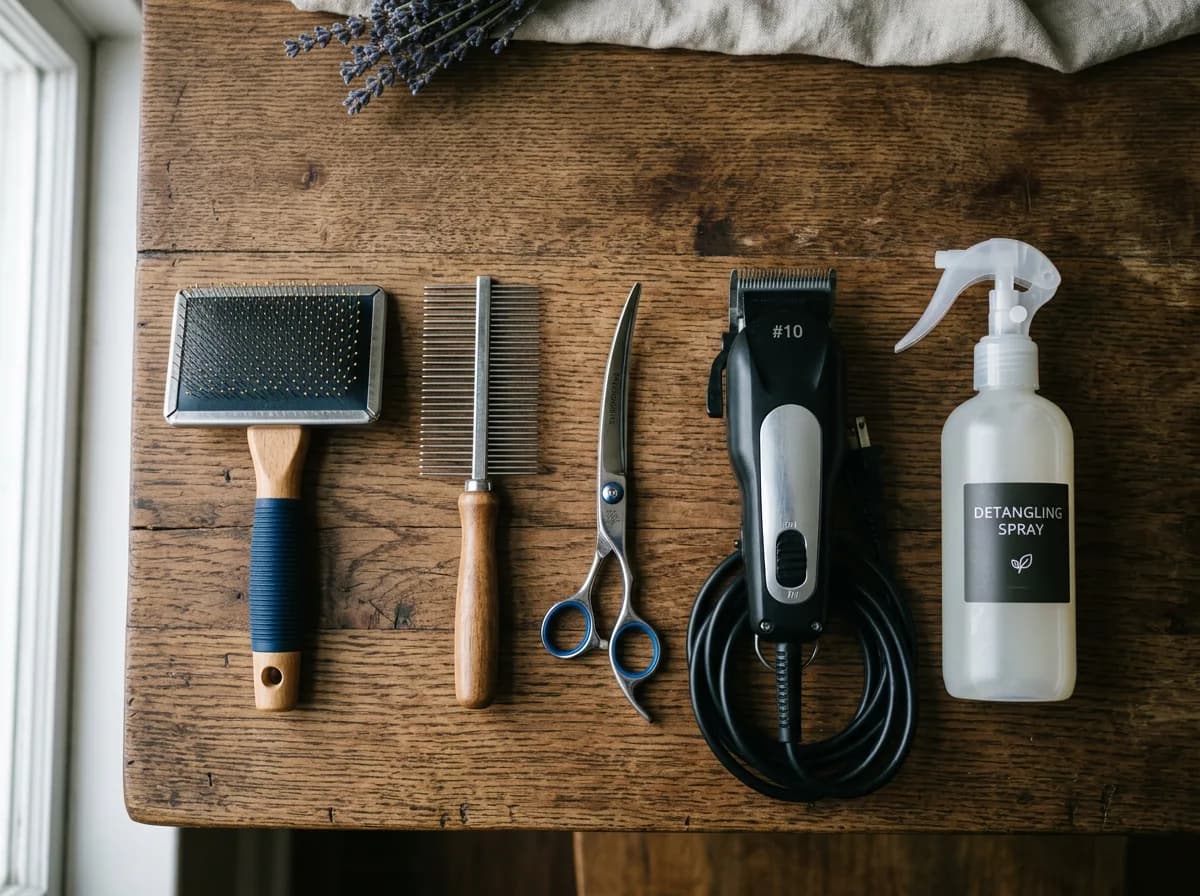
You do not need a salon's worth of equipment to keep a Goldendoodle at home, but the right handful of tools makes the difference between a five-minute job and a fight. Cheap tools that snag or scratch teach a dog to hate grooming, so buy quality on the pieces that touch the skin.
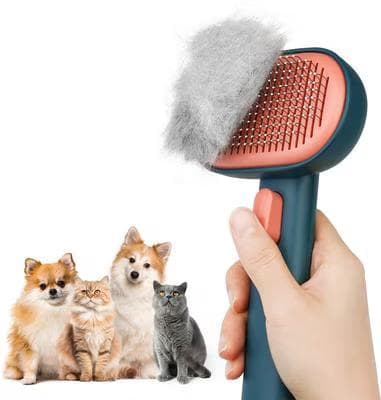
- Slicker brush: The workhorse for line brushing and removing loose hair and small tangles. Look for one with fine, bent wire pins and a comfortable handle. This is the single most important tool you will own.
- Stainless steel comb: The verification tool. A comb with both wide and narrow teeth lets you test that the coat is truly mat-free to the skin and finish areas the slicker misses, especially the face and feet.
- Detangling or grooming spray: A light mist of leave-in conditioner or detangler adds slip that helps the brush glide and reduces static and breakage. Never brush a bone-dry, staticky coat without it on a curly dog.
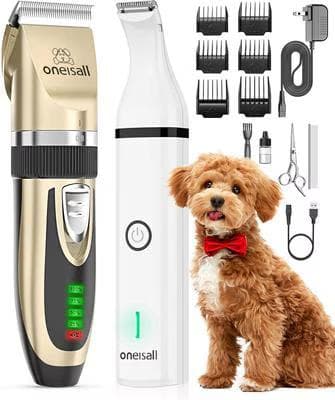
- Clippers and blades: Optional for owners who want to trim between grooms. A quality set with guard combs lets you maintain length safely, though most owners leave the full haircut to a professional.
- Rounded-tip scissors: For safe touch-ups around the eyes, paws, and sanitary areas between appointments. Rounded tips reduce the risk of poking a wiggly dog.
- High-velocity or forced-air dryer: The upgrade that most improves home results. It dries to the skin fast, prevents the air-dry mat problem, and delivers the fluff a towel never will.
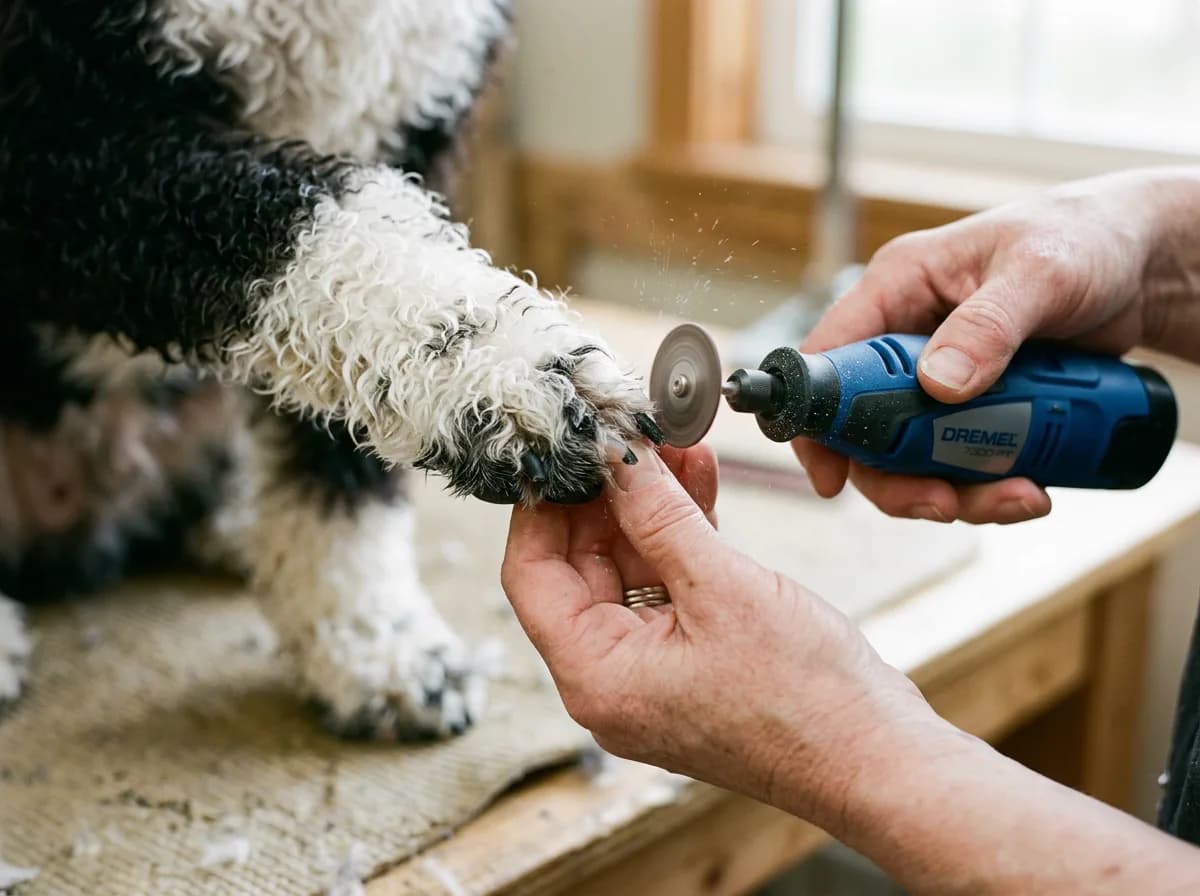
- Nail trimmer or grinder: A guillotine or scissor-style clipper, or a rotary grinder, to keep nails short every three to four weeks.
| Tool | Purpose | Priority |
|---|---|---|
| Slicker brush | Line brushing and de-tangling | Essential |
| Steel comb | Testing for mats to the skin | Essential |
| Forced-air dryer | Fluff drying, prevents air-dry mats | High value |
| Rounded scissors | Safe face and paw touch-ups | Nice to have |
| Clippers with guards | Maintaining length at home | Optional |
Professional Grooming vs. Doing It Yourself: The Real Cost
Many Goldendoodle owners land on a hybrid approach, and it tends to be the healthiest for the coat and the most sustainable for the owner: professional grooms every six to eight weeks for the bath, haircut, and finishing work, plus daily home brushing and quick touch-ups in between. Full DIY is absolutely possible and saves money, but it requires an investment in tools, a forced-air dryer, and the willingness to learn to scissor and clip a moving target.
Professional grooming costs vary widely by region, dog size, and coat condition, and a matted coat almost always costs more because de-matting is billed by time or triggers a shave-down fee. The single best way to keep your grooming bill low is to arrive with a well-brushed, mat-free dog. Groomers charge for the extra hour a matted coat demands, and understandably so.
| Dog Size | Weight Range | Typical Groom (well maintained) | Add-On If Matted |
|---|---|---|---|
| Mini Goldendoodle | 15 to 35 lbs | Lower end | De-matting or shave-down fee |
| Medium Goldendoodle | 35 to 50 lbs | Mid range | De-matting or shave-down fee |
| Standard Goldendoodle | 50 to 90 lbs | Higher end | De-matting or shave-down fee |
Whichever route you choose, the math is simple. Every minute you spend brushing at home saves money and, more importantly, keeps your dog comfortable. A Goldendoodle that is groomed on schedule and brushed at home is a clean, plush, happy dog. One that is not becomes a matting problem that eventually the dog pays for. Build the habit early, keep it consistent, and grooming becomes a pleasant few minutes of bonding rather than a dreaded battle.
Frequently Asked Questions About Goldendoodle Grooming
How to Get Your Goldendoodle Comfortable With Grooming
The best brush and the perfect schedule mean nothing if your dog fights every session. Because Goldendoodles need hands-on grooming for their entire lives, teaching a dog to accept it calmly is one of the most valuable things you can do, and it is far easier to build the habit in a young puppy than to fix a terrified adult later.
Start before the first haircut is even needed
Grooming tolerance is a trained skill, not a personality trait. Long before your puppy's coat actually needs work, spend a minute or two each day on gentle handling drills: hold and touch each paw, lift the floppy ears and look inside, part the muzzle hair, and run your hand along the tail and belly. Pair every touch with a small treat and calm praise so your puppy learns that being handled predicts good things. These are the exact body parts a groomer has to touch, and a dog that already accepts having its feet held is a dog that will not panic on the table.
Desensitize to the tools, especially the dryer
For most dogs the scariest part of grooming is not the brush, it is the noise and air of the forced-air dryer and the vibration of clippers. Introduce these gradually. Turn the clippers or dryer on across the room, reward your dog for staying relaxed, then slowly close the distance over several days. Let the puppy sniff a switched-off brush and clipper. Touch the body with the back of a running clipper so the dog feels the vibration without any cutting. The goal is for every tool to feel boring long before it is used for real.
Keep early sessions short and always positive
End each practice session while your dog is still calm, not after it has already gotten stressed and started to squirm. A stressed finish teaches the dog that struggling makes grooming stop, which is the opposite of what you want. Build duration slowly, a few extra seconds at a time. A grooming table or a raised, non-slip surface helps, since a dog that has learned to stand still in one spot is much safer to trim.
Timing the first professional groom
Most groomers want a puppy's vaccination series completed before its first salon visit, which usually lands somewhere after the last shots at around 12 to 16 weeks. Ask for a short "puppy introduction" appointment rather than a full haircut the first time: a bath, a blow-dry, a nail trim, and a light face-and-feet tidy. A gentle, positive first experience is worth far more than a perfect first cut, because it sets the tone for the hundreds of grooms to come.
- If your dog already fears the dryer, feed every meal for a week with the dryer running on low across the room, then gradually move it closer. Dogs that eat calmly near a running dryer stop bracing for it, and fluff drying at home suddenly becomes possible.
For an adult dog that already hates grooming, the same rules apply, just slower. Break a full groom into several short sessions across the week (feet one day, face the next), use very high-value treats or a licking mat smeared with something tasty, and enlist a second person to feed and reassure while you work.
Beard, Muzzle, and Face Care Between Grooms
The Goldendoodle beard is the single dirtiest, most neglected part of the whole dog, and it needs attention that has nothing to do with the six to eight week salon cycle. That long muzzle hair drags through the food bowl at every meal and soaks in the water bowl at every drink, so it stays damp and collects food particles all day. The result is the classic "doodle funk": a yeasty smell, reddish staining, and mats that form tight under the chin and at the corners of the mouth.
Keep the beard clean and dry
Wipe or rinse the beard after meals and after big drinks, then dry it, rather than letting it stay wet. Comb the muzzle and under-chin hair daily, because this friction-and-moisture zone tangles faster than almost anywhere else on the body. Switching to a shallow, wide stainless steel or ceramic bowl (or a purpose-made spill-and-splash-reducing bowl) keeps the beard from dunking at every drink. If the beard funk is chronic, ask your groomer to keep the muzzle hair shorter, since a shorter beard simply holds less moisture and food.
Trim the hair out of the eyes
Face hair is not only about looks. A Goldendoodle's forehead and cheek hair grows long enough to hang into the eyes, block its field of vision, and trap moisture that irritates the eye. Keeping that hair trimmed short is a genuine comfort and health issue, not vanity. Wipe the eye corners daily to manage the tear wetness that drives staining on light-colored dogs, and trim with care.
- Trimming face hair near the eyes is the easiest place to injure a dog that flinches. Use rounded-tip scissors, work with the points aimed away from the eye, hold the muzzle steady, and stop the moment the dog wiggles. If you are not fully confident, leave the eye trim to your groomer and only maintain the beard yourself.
Grooming Your Goldendoodle Through the Seasons
Coat care is not the same job in July as it is in January. Adjusting your routine to the weather prevents a surprising number of matting, skin, and paw problems.
Summer
Resist the urge to shave your dog to the skin to "cool it off." A Goldendoodle coat provides some insulation against heat and shields the skin from sunburn, so a moderate summer trim is smarter than a bald one. After walks in tall grass, check the coat, paws, armpits, and ears for burrs and grass awns, which burrow into a doodle's dense coat and skin. Rinse and fully dry the coat after any swim, since chlorine and lake water left in a damp coat drive both matting and ear infections.
Winter
Snow packs into hard ice balls in the fur between the toes and pads, which is uncomfortable and can make a dog limp. Keep the hair between the paw pads trimmed short in winter, and rinse and dry the paws after snowy walks. Road salt and chemical de-icers irritate the pads and are not safe to lick, so wiping the feet at the door protects both skin and stomach. Heated indoor air dries the skin and builds static, so do not over-bathe in winter, and lean on a dog conditioner or a light leave-in spray to keep the coat supple.
Spring and fall
Mud season means more frequent baths, plus quick paw and belly cleanups between them. Remember that a longer coat left on for warmth still needs the same to-the-skin brushing underneath, so do not let a fluffy winter coat lull you into skipping sessions.
How Is Grooming a Mini Goldendoodle Different?
A mini goldendoodle needs the same grooming routine as a standard, just scaled to a smaller dog. Coat type still drives everything, so how curly the coat is matters far more than the dog's size. The real differences are practical:
- Sessions run shorter and usually cost less at the groomer, because there is simply less dog to brush, bathe, and clip.
- Mats still form in the same friction zones (behind the ears, the armpits, the collar line, and the groin), but on a small frame those spots are tighter and easier to miss.
- Many minis carry a curlier coat, which tangles quickly and holds a teddy bear or lamb cut well.
- Face and ear hair grows into the eyes and ear canal fast on a small head, so trims and ear checks tend to come around sooner.
In practice, brush all the way to the skin 3-4 times a week with a slicker and a metal comb, keep the same clip length you would choose for a standard, and book professional grooms on the same 6 to 8 week cycle. The most popular mini styles are the teddy bear cut, the lamb cut, and a shorter puppy cut for lower maintenance. Smaller size shrinks the workload, it does not remove it.
How Do You Groom a Goldendoodle Puppy?
Puppy grooming is less about haircuts and more about getting through the coat change. The soft, forgiving coat you bring home is not the coat your dog keeps, and that matters more than any early trim.
- Puppy coat (roughly up to 6 months): soft, often wavy, and low-maintenance. A gentle daily brush is usually enough, because this coat rarely mats badly on its own.
- The coat change (about 6 to 12 months): the puppy coat is pushed out by a denser, coarser adult coat. Loose puppy hair gets trapped against the incoming adult hair, and mats can appear almost overnight on a dog that never tangled before.
- After the change: your dog settles into its adult coat (curly, wavy, or straight), and its long-term brushing and cut schedule is set by that coat type, not by age.
The one move that saves the coat change is simple: brush right down to the skin every day through that window, not just across the top, because mats build underneath while the surface still looks tidy. Many owners keep a puppy on a short puppy cut for the first year, which sharply reduces how much coat there is to mat while the adult hair grows in. If a mat has already tightened against the skin, have it clipped out rather than tugging at it.
Your Goldendoodle Grooming Schedule at a Glance
Most goldendoodles do best on a rolling mix of daily, weekly, and monthly tasks, anchored by a full haircut every 6 to 8 weeks. Use this as a quick reference chart:
- Daily: a fast brush-through of the high-friction spots (behind the ears, collar, and armpits) and a wipe of the beard and muzzle after meals and drinks.
- 2-3 times a week: a full brush down to the skin with a slicker, then a metal comb pass to confirm no mats are hiding underneath.
- Weekly: check and clean the ears, wipe the eye corners, and inspect the paws and sanitary areas.
- Every 2-3 weeks: trim the hair around the eyes so vision stays clear, and tidy the paw pads if they get slippery.
- Every 3-4 weeks: a bath with a doodle-appropriate shampoo, always fully brushed out first and then dried down to the skin.
- Every 6-8 weeks: a full haircut, at home or with a professional groomer.
- Monthly: trim or grind the nails, with teeth brushed several times a week year-round.
Lean toward the shorter intervals for curlier coats and longer cuts, and stretch them slightly for a short clip on a straighter coat.
Comb the tail from base to tip, then clip or scissor it into a natural plume or a shorter length that matches the body. Keep the underside and sanitary area trimmed so it stays clean, and comb the base weekly, since feathered tails mat there first.
Often yes. F1B and F2B doodles carry more poodle in the mix, so their coats tend to be curlier and mat faster than a wavier F1, which means more frequent brushing to the skin and a shorter working length. A flatter, more retriever-like coat sheds more but tangles less. Groom to the coat in front of you, not the label.
A fresh short cut removes the coat's insulation, so many dogs feel cooler, itch briefly from the clippers, or act a little timid for a day. It passes quickly, but check for clipper irritation if the scratching keeps up.
Goldendoodles need brushing at home every one to two days (daily for curly coats) and a full professional groom every six to eight weeks. The two schedules work together: home brushing prevents the mats that form between salon visits, and the professional groom resets the coat. Letting a full groom slide past eight weeks is the top cause of severe matting.
Work in a fixed order every time. Line brush to the skin first, then comb to confirm the coat is mat-free, then bathe with a dog shampoo and rinse thoroughly, then blow-dry while brushing (fluff drying) so the coat dries straight and full. Finish with the eyes, ears, nails, and sanitary areas. Never bathe a matted dog, because water tightens mats into hard knots.
The teddy bear cut is the most popular and the best choice for most owners. It keeps the round, fluffy, plush-toy look at a manageable one to two inch length. Choose a shorter puppy or kennel cut if you want lower maintenance or live in a hot climate, and a longer lamb cut only if you will commit to daily line brushing.
The most common problems are matting (especially behind the ears, in the armpits, and around the collar), ear infections from trapped moisture in floppy hairy ears, tear staining on light-colored dogs, and an intense burst of matting during the seven to twelve month puppy-to-adult coat change. Nearly all of them are prevented or reduced by consistent line brushing and thorough drying.
Consistency is the whole secret to Goldendoodle grooming. The breed does not ask for talent or expensive equipment, just a few honest minutes most days and a professional groom you never skip. Do that, and you get the low-shedding, huggable, photogenic dog you signed up for, with none of the matting headaches that catch unprepared owners by surprise.

Coreen Saito is a pet writer and longtime shelter volunteer with more than a decade in animal rescue. She covers cat behavior, breed care, and the small, ordinary science of sharing a life with companion animals, with a particular focus on honest takes about the products and decisions that actually matter. At home in Arizona, she's outranked by Mac (a dog with the loudest opinion in the house), Rebel (a cat who governs by quiet authority), and Meri (an orange tabby who runs the late shift and the laundry basket). She writes about all three, plus the rescues that keep coming through her life, at LifeWithMinty.com.
Sign up for expert-backed reviews and safety alerts all in one place.