Bergamasco Sheepdog: Coat, Temperament, Cost, and Care
The Bergamasco Sheepdog is a calm Italian herding dog with a felted flock coat. Learn how the coat forms, which health tests to ask for, what one costs, and which homes suit the breed.
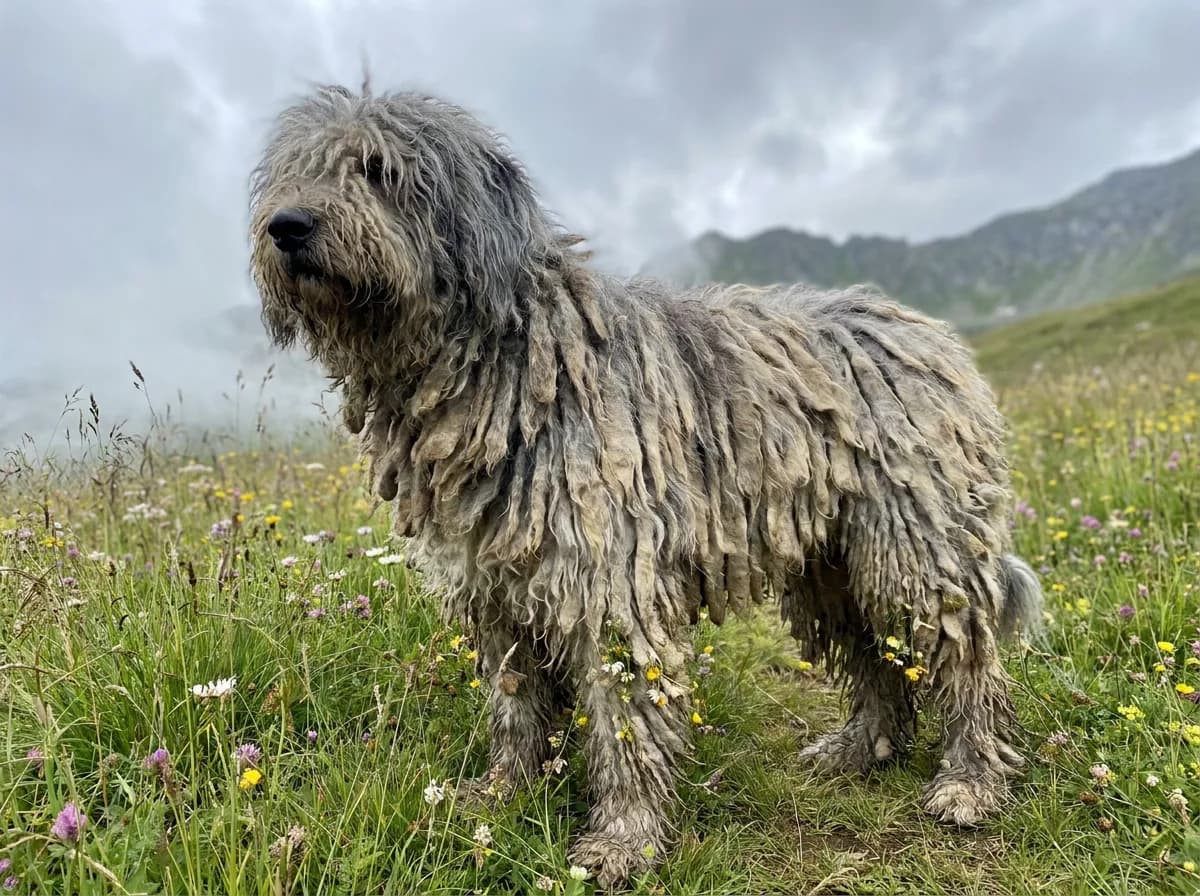
An adult Bergamasco Sheepdog with a full gray flocked coat standing in a wildflower meadow below mountain peaks.
Petful is reader supported. As an affiliate of platforms like Amazon and Chewy, we may earn a commission when you buy through links on this page. There is no extra cost to you.
The Bergamasco Sheepdog is a large Italian herding dog best known for its flock coat, the flat felted mats that cover its body and legs. It is calm, loyal, and independent, and its coat is far easier to live with than it looks once the first year is behind you. This guide covers what that coat really asks of you, which health tests to request, what one costs, and which households suit the breed.

Sign up for expert-backed reviews and safety alerts all in one place.
Bergamasco Sheepdog at a Glance
The Bergamasco Sheepdog is a muscular, medium-to-large shepherd dog from the Italian Alps, recognized by the American Kennel Club in the Herding Group since January 1, 2015. Males weigh 70 to 84 pounds and females 57 to 71 pounds, and the breed has a 13 to 15 year lifespan according to the AKC.
- 1A calm, independent Herding Group dog with a one-of-a-kind flock coat
- 2The flock coat needs a few hours to a few evenings of hand-separating around age one, then very little care
- 3Ask any breeder for a degenerative myelopathy DNA result plus hip and elbow evaluations
- 4Owner-fit verdict: yes for patient, active homes; maybe for apartments, hot climates, allergy households, and a first-time owner
- AKC group: Herding Group (since January 1, 2015). Origin: Italian Alps near Bergamo, with roots traced to Persia. Weight: 70 to 84 pound males, 57 to 71 pound females. Height: ideal 23.5 inches for males and 22 inches for females. Lifespan: 13 to 15 year lifespan per the AKC. Coat: a felted flock coat in shades of gray, from light gray to black.
You will see the breed under several names. The Bergamasco shepherd, Bergamasco dog, and Italian sheepdog Bergamasco all describe the same dog, and its native name is Cane da Pastore Bergamasco (the Italian plural is Bergamaschi). When people search for the Bergamasco breed, they are usually trying to learn the same three things: how big it gets, what that coat involves, and whether it suits their life.
On size, the Bergamasco Sheepdog Club of America breed standard sets an ideal height of 23.5 inches for males and 22 inches for females, with an accepted range of 21 to 25 inches. Some Bergamasco sheepdogs look larger than they are because the coat adds bulk. Underneath is a solid, well-muscled working dog, so plan for a crate, car space, and a vet visit routine sized for a big breed.

Petful may earn a commission when you click through to Chewy, at no extra cost to you.
History and Origin of the Bergamasco Sheepdog
The Bergamasco's country of origin is Italy, specifically the Alpine valleys around the town of Bergamo near Milan. Its deeper roots are older: the Bergamasco Sheepdog Club of America describes ancestors that worked with nomadic shepherds in Persia (now Iran) before some of those nomads settled in the Italian Alps. The AKC traces those origins back nearly 7,000 years.
That history explains the temperament you meet today. In the high valleys, one shepherd might manage hundreds of sheep with only a few dogs, so the dogs had to solve problems without step-by-step commands. The club describes a partnership in which the dog took its lead from the shepherd but decided for itself how to get the job done.
From Alpine Flocks to AKC Recognition
The breed nearly disappeared after World War II, when wool demand fell and fewer shepherding dogs were needed. Italian breeder and scientist Dr. Maria Andreoli is credited by the breed club with saving it through roughly 40 years of careful breeding at her Dell'Albera kennel, and her lines helped establish the Bergamasco in the United States.
Key dates in the breed's American history, per the AKC:
- February 2014: the Bergamasco Sheepdog Club of America became the AKC parent club.
- December 1, 2014: the breed became eligible for AKC registration.
- January 1, 2015: the Bergamasco began competing in the AKC Herding Group.
The Bergamasco Flock Coat and How to Care for It
The flock coat is the whole decision with this breed, so it is worth understanding before anything else. According to the AKC, the adult coat has three hair types, called "dog," "goat," and "wool," which weave together into flat, felted mats called flocks. Those felted flocks protected working dogs from cold and predators, and a mature flock coat is surprisingly practical: debris shakes out, there is no brushing, and bathing is rare.
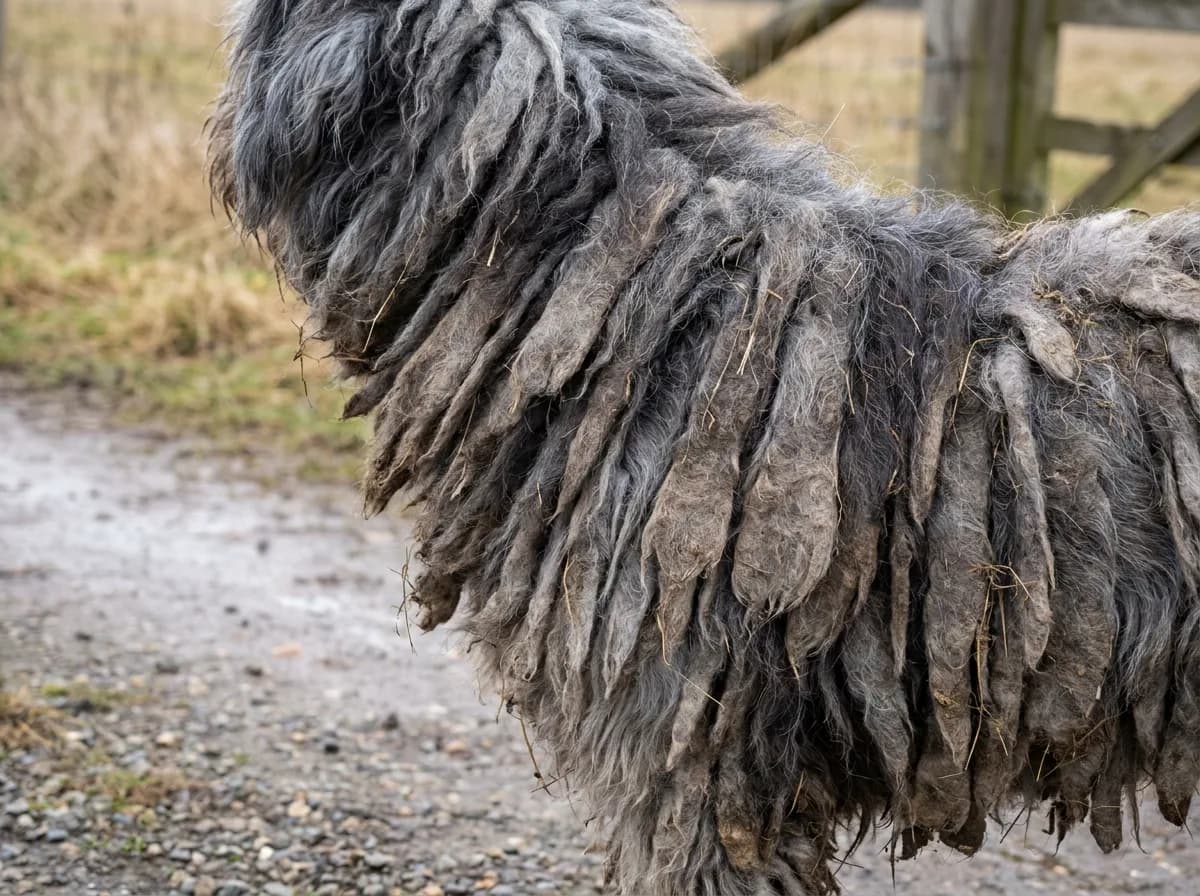
The work is concentrated in the first year or two. The breed club explains that once the coat is ripped into mats around age one, a weekly check for about six months keeps them from fusing back together. After that, the flocks lengthen slowly for years, and the full coat takes several years to develop.

Petful may earn a commission when you click through to Chewy, at no extra cost to you.
Here is the coat time-and-cost budget in owner terms, built from the AKC, the breed club, and a published cost guide:
| Task | Time commitment | What it costs |
|---|---|---|
| Puppy coat (birth to about 1 year) | Occasional light grooming only | Little beyond basic supplies |
| Ripping the forming flocks (around age 1) | The hours to separate the flocks: a few hours or a few evenings, per the AKC and breed club | Free if you do it yourself |
| Weekly flock check (next 6 months) | A few minutes a week to keep mats from rejoining | Free |
| Bathing (adult) | Two to three baths a year per the AKC (the club says 1 to 3) | Dog shampoo; a groomer who knows flock coats costs more |
| Drying after a bath | Grows with coat length; a long coat can take several hours | Box fans around a crate, per the breed club |
| Ongoing grooming | Nails and occasional trimming | $0 to $30 a month once flocks set, per Dogster's Bergamasco cost guide |
Bathing is the step owners underestimate. With two to three baths a year, each bath becomes an event: saturate the coat, rinse very thoroughly so shampoo does not sit inside the flocks, then dry completely. The breed club suggests a crate surrounded by box fans and notes that Bergamascos tend to enjoy the wind. A mild shampoo such as Buddy Wash Original Lavender and Mint Dog Shampoo and Conditioner works for those few full baths a year.
Between baths, spot clean muddy legs and faces rather than soaking the whole dog. Check the flocks after hikes for burrs, and trim nails regularly.
Coat color is part of what you are signing up for, too. The breed standard published by the Bergamasco Sheepdog Club of America allows only shades of gray and black:
- Bergamasco colors: puppies are born solid gray or in gradations of gray, up to and including solid black.
- Bergamasco merle: merle patterning is included within those accepted gray gradations.
- Black Bergamasco: many black puppies carry a "fading black" gene and lighten to gray as adults, though some stay black.
- White markings: allowed only if they cover no more than one-fifth of the body.
Why Do Bergamascos Have Dreadlocks?
Bergamascos have "dreadlocks" because their three hair types mat together naturally. The AKC and the breed club explain that the puppy coat is soft for the first year, then coarser goat hair and fuzzy wool hair appear as the dog nears its first birthday. That mix wants to felt, and the owner guides it by pulling the mats apart into separate flocks instead of letting them form one solid pelt. The result was a working coat that shielded shepherd dogs from Alpine weather and predators.
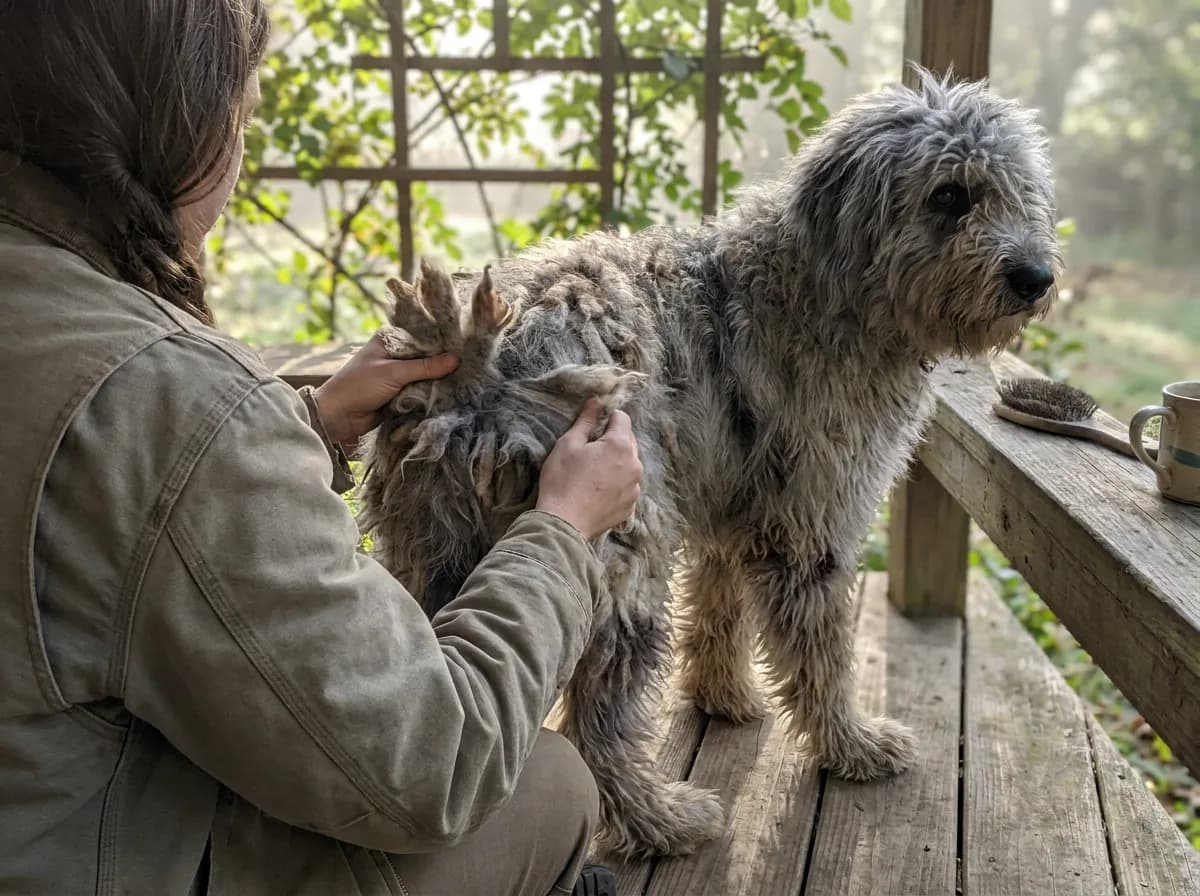
The forming flocks are the stage to see before you commit. Around the first birthday the coat looks untidy, with clumps joining at the base, and this is when an owner sits down with the dog and separates them by hand. It is not difficult, but it is a real test of patience. Most Bergamasco pictures show the mature flocked coat, while Bergamasco images of puppies show the soft, fluffy stage, so look for photos of young adults to see what this in-between year really looks like.
Readers who search for a Bergamasco without dreads or a short hair Bergamasco are usually asking whether they can skip this. The honest answer is a partial yes: the breed club says the coat can be trimmed to about 4 to 5 inches, as long as the flock structure stays in place. What you cannot do is shave it off.
- The AKC says a Bergamasco should never be shaved down because the coat regulates temperature. The breed club adds that a shaved coat grows back as a mess of mats and leaves the dog unable to regulate heat and cold. If you want less length, ask a groomer familiar with the breed to trim the flocks shorter instead.
Do Bergamascos Shed a Lot?
No, Bergamascos shed very little. The breed club explains that the dog does not "throw a coat" the way many double-coated breeds do, though you will still find the occasional hair on the floor or furniture. The AKC agrees that the breed does not shed and needs no brushing. For most owners, a Bergamasco means far less vacuuming than a typical heavy-shedding breed.
That does not make the Bergamasco shepherd hypoallergenic, and this is where older descriptions of the breed, including earlier versions of this page, overpromised. Dog allergens come mainly from dander, saliva, and urine, not from hair length, so no breed is truly allergen-free. Petful's vet-written guide to hypoallergenic dogs explains why. The breed club reports that many people allergic to other dogs are not bothered by the Bergamasco, which is encouraging, but an allergic household should spend real time with adult Bergamascos and talk with an allergist before committing.
A related worry is smell. Healthy flocks are kept clean by natural skin oils, so a well-kept Bergamasco should not smell strongly; a persistent odor usually points to a coat that stayed damp after a bath or a skin problem worth a vet visit.
Bergamasco vs. Puli vs. Komondor
The Bergamasco, Puli, and Komondor are the three matted or corded breeds people most often confuse. They look related, but they were built for different jobs and live differently.
- Bergamasco: Italian herding dog with flat, wide flocks rather than round cords. Large but athletic, calm, and a problem-solving partner.
- Puli: Hungarian herding dog, much smaller, with tight round cords. Quick and busy. See Petful's Puli breed profile for its full care picture.
- Komondor: Hungarian livestock guardian, very large, with heavy white cords. Bred to guard flocks on its own, so it is typically more territorial and wary of strangers. Petful's Komondor breed profile covers it in depth.
For coat care, the Bergamasco's flat flocks need little attention once set, while round cords are typically separated throughout life. For temperament, the Bergamasco sits between the energetic Puli and the more guarded Komondor. If you are weighing a Bergamasco vs. Komondor for a family home, the Bergamasco's gentler watchfulness is usually the easier fit; if you are choosing between a Puli and a Bergamasco, size and energy level are the deciding factors.

Fresh, human-grade meals made from vet-formulated recipes and 100% human-grade ingredients.
Petful may earn a commission when you click through to JustFoodForDogs, at no extra cost to you.
Bergamasco Sheepdog Temperament and Family Fit
The Bergamasco shepherd temperament is calm, watchful, and devoted. The AKC describes the breed as bright, loyal, loving, and trainable with "a dash of mountain-dog independence," wary of strangers until introduced and aggressive only as a last resort. The breed club adds that each dog tends to form an individual relationship with every person in the household.
That closeness is a strength and a caution for Bergamasco owners. Bergamascos bond deeply and like to stay near their people, so they do not thrive when left alone in a yard for long stretches.
Are Bergamascos Good Family Dogs?
Yes, Bergamascos are generally good family dogs for households that give them company and structure. The AKC describes the breed as generally happy with kids and other animals, patient but protective. Their calm, steady nature suits families who want a large dog that is not constantly frantic.
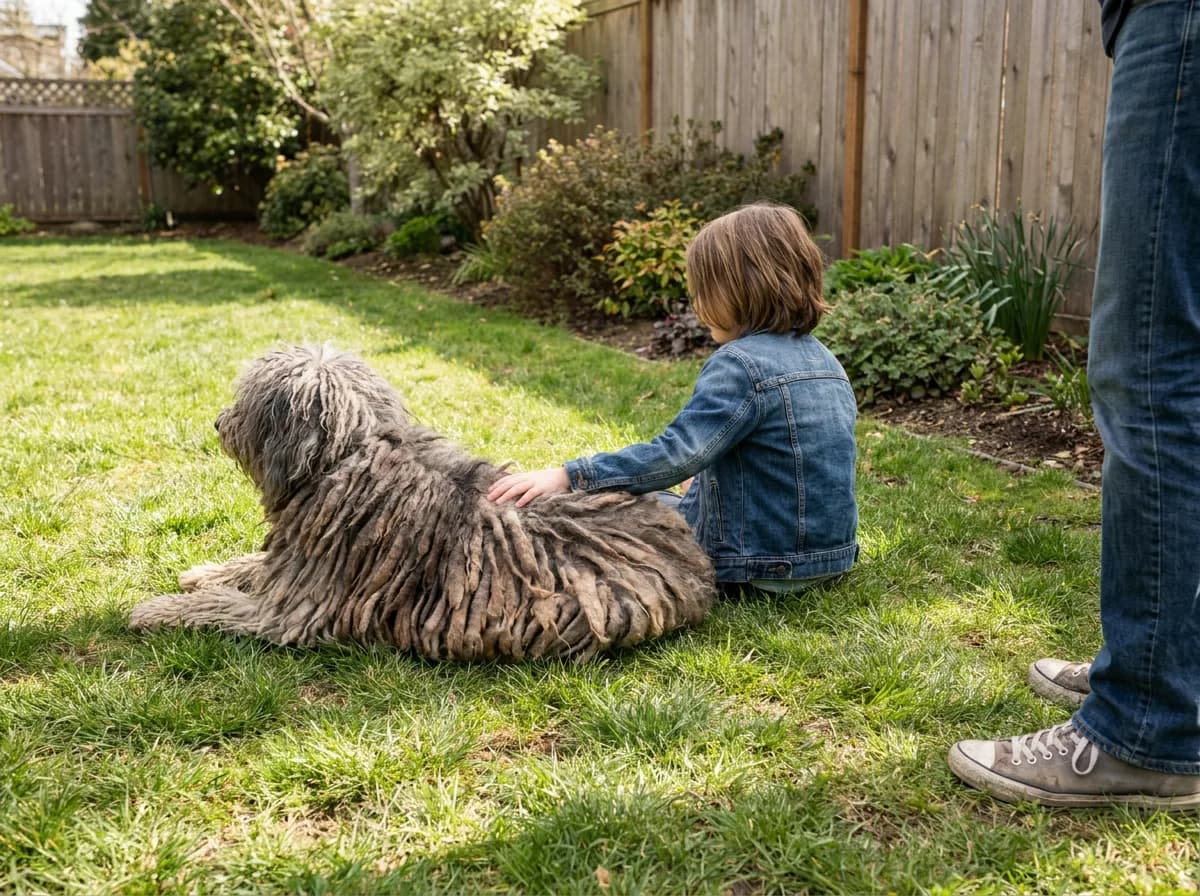
A few conditions make that "yes" hold up:
- Supervision with young children: a dog of 57 to 84 pounds can knock over a toddler, and the AKC advises supervising any dog around young children.
- Early socialization: introduce the puppy to many people, places, and sounds so its natural wariness of strangers does not harden.
- Shared activity: include the dog in family routines rather than leaving it outside alone.
- Coat realism: kids should know not to pull on flocks, and bath days mean a damp dog for hours.
Do Bergamascos Bark a Lot?
Bergamascos are not known as nuisance barkers, but they will alert you when someone approaches. Their watchdog instinct means a bark at the door or at unfamiliar movement outside, then a return to calm once they have judged the situation. Constant barking is more often a sign of boredom or isolation than of the breed itself, so daily activity and company usually keep noise modest.
Exercise, Training, and Living Situation
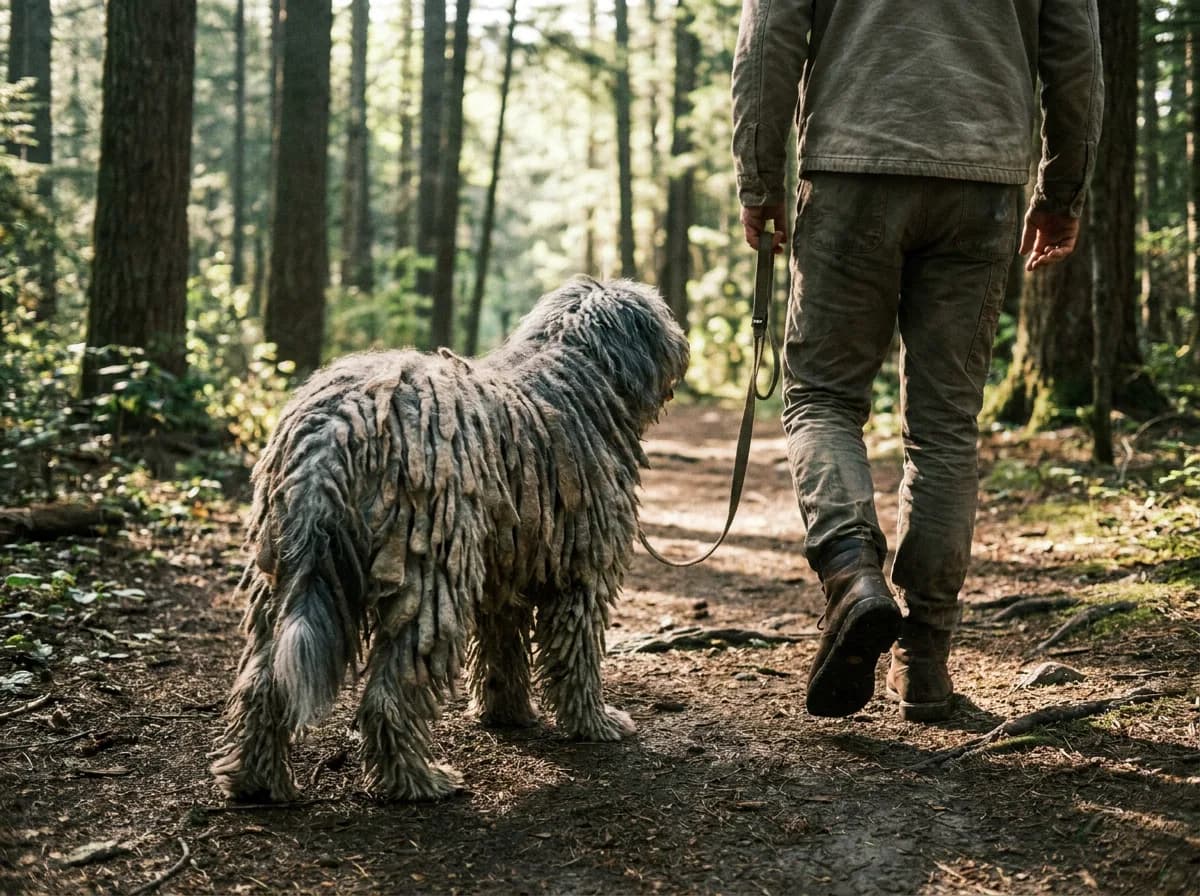
The Bergamasco needs moderate daily exercise, and the AKC stresses that it should be shared activity: a brisk walk, a hike, fetch, or time in an open field with you. A realistic baseline is a daily walk commitment plus some play or training, with longer outings when you can. The breed's energy level is steady rather than frantic.
Training works best when you explain rather than demand. The AKC notes the breed thinks independently and often sees itself as an equal partner rather than a subordinate, and the breed club traces that to its problem-solving work in the mountains. That makes the Bergamasco an independent problem-solver, not a dog that repeats a command just because it was told to. Short, reward-based training sessions with a clear purpose work well; harsh corrections tend to backfire.
If you are wondering where the breed sits on obedience or intelligence rankings, those lists usually reward fast compliance, which is not this breed's style. Petful's guide to the so-called dumbest, hardest-to-train dog breeds explains why "hard to train" often means "thinks for itself." A Bergamasco is highly intelligent, just unwilling to follow orders it sees no reason for.

Get a free quote in 90 seconds. Coverage for vet emergencies like obstruction surgery and allergic reactions.
- AI-powered claims paid in minutes
- Cancel anytime, no fees
- Covers accidents and illnesses
Petful may earn a commission when you click through to Lemonade, at no extra cost to you.
Living Situation and Climate
- Space: a house with a securely fenced yard is easiest, but a Bergamasco can manage in an apartment with daily outdoor exercise and plenty of time with its people.
- Hot weather: the breed club says the coat helps regulate heat as well as cold, so a Bergamasco in hot weather is workable, but plan shaded exercise in heat, walk early or late, and provide water and air conditioning on hot days.
- Swimming: a soaked coat takes hours to dry, so plan any swims around drying time.
- Weight: the AKC notes some dogs are prone to becoming overweight, so measure meals and count treats.
For owners who want a measured, fresh diet to help keep weight steady, JustFoodForDogs JustFresh Fresh Dog Food is one option to discuss with your veterinarian, who can set portions for your dog's size and activity.
Bergamasco Sheepdog Health and Lifespan
Bergamascos are generally a healthy breed, but that is not the same as having no health concerns. The AKC gives a Bergamasco Sheepdog life expectancy of 13 to 15 years, which is long for a dog of this size, and notes that like all breeds, some individuals will face health issues.
The Bergamasco Sheepdog Club of America, the breed's national club, recommends health testing that any responsible breeder should be able to document. The AKC Bergamasco Sheepdog page lists the club's recommended tests:
- Degenerative myelopathy (DM) DNA test: DM is a progressive spinal cord disease that causes hind-leg weakness in older dogs. The DNA test shows whether a dog is clear, a carrier, or at risk for the common variant, which helps breeders avoid producing affected puppies.
- Hip evaluation: screens for hip dysplasia, an abnormal hip joint that can lead to arthritis.
- Elbow evaluation: screens for elbow dysplasia, a developmental joint problem seen in large breeds.
- Ask to see the degenerative myelopathy DNA test result plus hip and elbow evaluations for both parents, not just a verbal assurance. Hip and elbow results are often registered with the Orthopedic Foundation for Animals, where you can look them up by the dog's registered name. Discuss any carrier or borderline result with your veterinarian.
You can check orthopedic results through the Orthopedic Foundation for Animals database. If you adopt a Bergamasco without records, an at-home DNA kit can screen for the DM variant; the Embark Breed and Health Dog DNA Test Kit includes health screening alongside breed identification. Petful's dog DNA test comparison explains how the major kits differ.
Everyday health care looks like any large dog's: keep a lean weight to protect joints, trim nails, check the skin under the flocks after baths, and bring in any lameness or hind-end weakness early. A thick coat can hide weight gain, so feel for ribs rather than judging by eye.
Bergamasco Sheepdog Cost and Where to Find One
A Bergamasco puppy from a breeder typically costs about $1,000 to $2,000, the breeder price range given in Dogster's Bergamasco cost guide; Hepper's cost guide gives a narrower $1,000 to $1,300. The breed is rare in the U.S., so expect waiting lists, and treat a much lower price as a warning sign rather than a bargain.
The first-year cost goes well beyond the puppy price. Published guides give these attributed ranges:
- Adoption fee: $50 to $300 (Dogster) or $50 to $400 (Hepper).
- Initial setup and supplies: $70 to $700 or more (Dogster) or $700 to $2,000 (Hepper), depending on crate, bedding, and first vet visits.
- Monthly care: $100 to $600 a month (Hepper); Dogster's range runs from $55 to more than $1,500 in a month with unexpected costs.
- Food: $15 to $65 a month (Dogster).
- Grooming: $0 to $30 a month once flocks are set (Dogster), matching the coat budget above.
Budget for the first year and for each year after it. The first year combines the puppy price or adoption fee, setup, and twelve months of care, while each later year is the monthly range alone. Hepper's $100 to $600 a month works out to a yearly cost range of roughly $1,200 to $7,200, before any emergency. Pair that budget with breeder-vetting questions (below), because a well-screened puppy is the best protection against the costliest joint problems.
- 1Published guides put the breeder price range at about $1,000 to $2,000
- 2Add setup costs plus roughly $100 to $600 a month (Hepper) to estimate your first-year cost
- 3Grooming is cheap once the flocks set, but vet care is the swing factor
- 4Check breed rescue first, then a club-referred breeder with health results
Veterinary care is the biggest variable, especially for a large dog screened for hip and elbow problems. Petful's guide to pet insurance cost by dog breed shows how breed and size affect premiums. Getting a quote from Lemonade Pet Insurance while your dog is young lets you compare plans before any condition becomes pre-existing.
Where to find a Bergamasco:
- Breed rescue first: the Bergamasco Sheepdog Club of America and the AKC Rescue Network are the places to ask about adult dogs needing homes, and general shelter searches occasionally list a Bergamasco or mix.
- Club-referred breeders: the Bergamasco Sheepdog Club of America is the best starting point for breeders who follow the club's health recommendations.
- Vetting questions: ask to meet a parent, see DM, hip, and elbow results, learn how puppies are socialized, and confirm the breeder will take the dog back at any age. Petful's list of questions to ask a dog breeder covers the rest.
Be wary of sellers who ship puppies sight unseen, cannot show health results, or always seem to have Bergamasco puppies for sale. With a breed this rare, constant availability rarely reflects careful breeding.
Is a Bergamasco Sheepdog Right for You?
The Bergamasco rewards patient owners who want a calm, loyal partner and can handle one intense coat year. Use this owner-fit verdict to check your own situation:
| Your situation | Verdict | Why |
|---|---|---|
| Active home with a fenced yard | Yes | Moderate daily exercise and close companionship suit the breed well |
| Apartment household | Maybe | Works with daily walks and company, but a large dog and long drying days need space and planning |
| Hot climate | Maybe | The coat helps regulate heat, but you need shade, early or late walks, and air conditioning |
| Allergy household | Maybe | Very low shedding, but no dog is hypoallergenic; spend time with adult dogs and ask an allergist |
| First-time owner | Maybe | Calm and loyal, but independent training and the first-year coat demand patience; lean on the breed club |
| Family with young children | Yes, with supervision | Patient and protective, but big enough to knock over a toddler |
| Wants a low-grooming dog | Yes, after year one | Minimal care once flocks set, but the first year requires hours to separate the flocks |
| Away from home most of the day | No | Bonds deeply and does poorly left alone for long stretches |
If most of your rows read "yes," or "maybe" with a plan you can commit to, a Bergamasco Sheepdog is worth pursuing. If you cannot give the dog company most of the day, or you want a dog that simply follows commands, a different breed will make you both happier.
Bergamasco Sheepdog FAQs
A healthy Bergamasco should not have a strong odor. Natural skin oils keep the felted coat clean, and with only two to three baths a year there is little shampoo buildup. Odor usually means the coat stayed damp after bathing or swimming, or a skin problem is developing under the flocks. Dry the coat fully, and if a smell persists, the veterinary next step is a skin check.
No. The breed is watchful but not aggressive: the AKC describes it as wary of strangers until introduced and aggressive only as a last resort. Early socialization with many people, places, and sounds keeps that natural wariness from becoming fearfulness. Any dog can react when frightened or cornered, so a sensible standalone owner decision is to supervise introductions and work with a reward-based trainer if you see growling.
Many live well with other pets, and the AKC describes the breed as generally happy with other animals. Results are best when a Bergamasco is raised together as a puppy with the household cat or dog. With an adult dog, use supervised introductions, separate feeding areas, and a retreat space for the cat, and move at the pace of the more nervous animal.
Yes, with conditions. In an apartment, you need a daily walk commitment, extra outings when you can, and room to dry a large wet dog on bath days. In a hot climate, the coat helps regulate temperature, but plan shaded exercise in heat, walk early or late, keep water available, and never shave the coat to cool the dog.
Not hard, but different. The Bergamasco is an independent problem-solver bred to work out tasks without constant commands, so it responds best to reward-based training that makes the reason clear. Keep sessions short and varied, and avoid harsh corrections, which erode trust. Owners who enjoy a thinking partner usually find the breed very trainable in its own way.
Watch these friendly Bergamascos as they meet and greet their adoring public:
[rawHtml]
Related Dog Breed Profiles You May Like
Additional Resources

Kristine Lacoste has been researching dog and cat breeds for nearly a decade and has observed the animals up close at dog shows in both the United States and the United Kingdom. She is the author of the book One Unforgettable Journey, which was named as a finalist for a Maxwell Award from the Dog Writers Association of America, and was host of a weekly pet news segment on the National K-9 Academy Radio Show. In addition, she was the New Orleans coordinator for Dogs on Deployment, a nonprofit that helps military members and their pets, for 3 years. Kristine has researched and written about pet behaviors and care for many years. She holds a bachelor’s degree in psychology, another bachelor’s degree in English and a Master of Business Administration degree.
Sign up for expert-backed reviews and safety alerts all in one place.