Best Dog Food for American Bulldogs: Choosing by Life Stage
Compare American Bulldog food by life stage, large-breed puppy suitability, and calories. Learn which label details matter, how to measure portions, and when health needs should guide the choice.

BVMS, MRCVS
Petful is reader supported. As an affiliate of platforms like Amazon and Chewy, we may earn a commission when you buy through links on this page. There is no extra cost to you.
The best dog food for American Bulldogs depends on the dog's life stage, expected adult size, body condition, and medical needs. A growing puppy may need a formula specifically suitable for large-size growth, while an adult needs a complete diet in an amount that maintains healthy condition. There is no single recipe that wins for every dog.
This comparison uses manufacturer nutrition information and practical feeding criteria. It is not a hands-on feeding trial. Where similarly named formulas or changing product pages leave an important detail unclear, that limitation matters more than assigning a confident ranking.

Sign up for expert-backed reviews and safety alerts all in one place.
How to choose dog food for an American Bulldog
Start with the AAFCO nutritional adequacy statement, then compare calories, the exact recipe, and how the food suits your dog. For a puppy expected to reach at least 70 pounds, look for wording including growth of large size dogs. For a healthy mature dog, complete and balanced adult maintenance is an appropriate starting point. AAFCO explains how to select food by life stage.
The examples below separate growth from adult feeding: Purina Pro Plan Large Breed Puppy Chicken & Rice is the puppy recipe, while Purina ONE Chicken & Rice is an adult-maintenance option. Open Farm Farmer's Table Pork & Ancient Grains is included for adults because its label excludes growth of large-size dogs. The Pro Plan Complete Essentials Adult Shredded Blend Chicken & Rice is another adult-maintenance option.
| Food | Intended place in the comparison | Calories per cup | Important limit |
|---|---|---|---|
| Purina Pro Plan Large Breed Puppy Chicken & Rice, 34 lb | Puppy option including growth of large size dogs | 419 | Match the Large Breed Puppy formula, not a similarly named adult or Sport recipe |
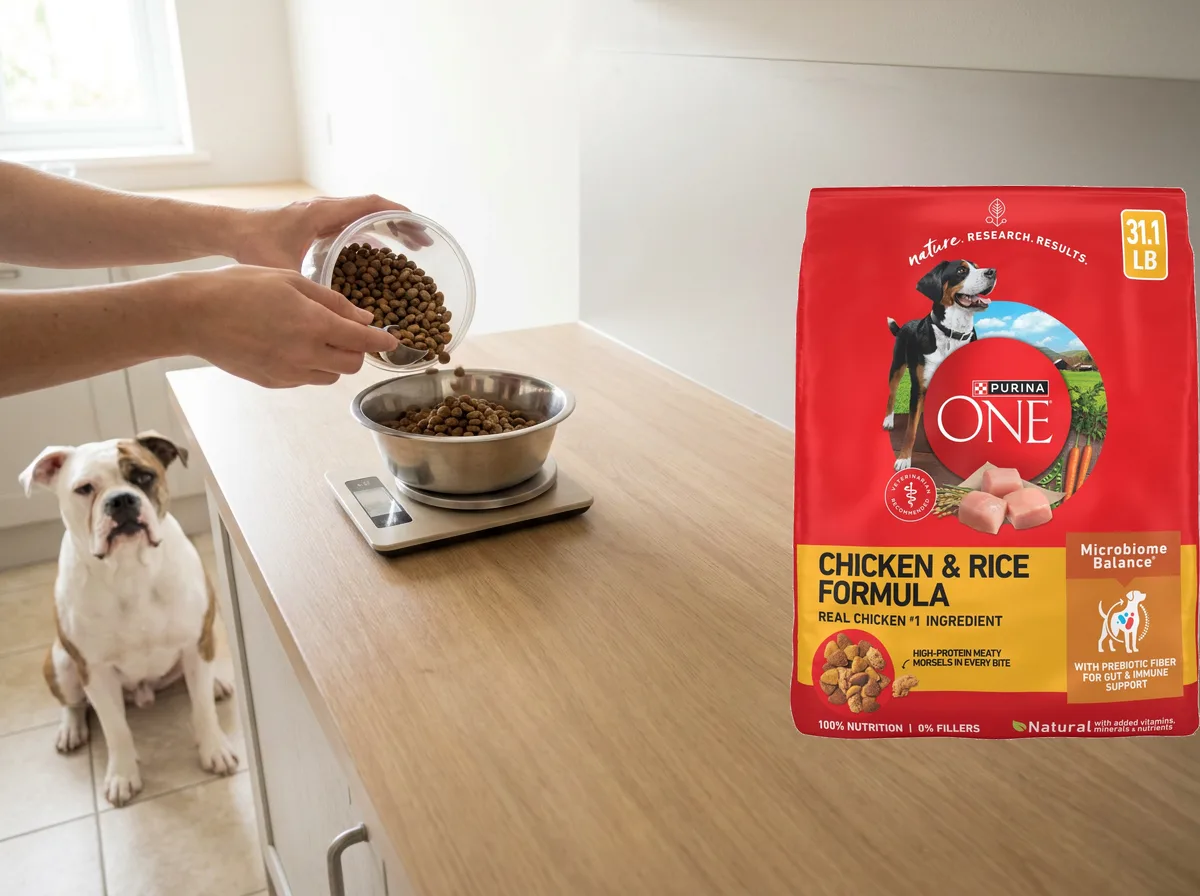
| Purina ONE Chicken & Rice, 31.1 lb | Complete and balanced adult maintenance | 383 | Not the puppy selection |
| Open Farm Farmer's Table Pork & Ancient Grains | Adult option with a different protein combination | 426 | Its all-life-stages statement excludes large-size growth |
| Purina Pro Plan Complete Essentials Adult Shredded Blend Chicken & Rice, 35 lb | Complete and balanced adult maintenance | 369 | Not the large-breed puppy formula |
The table separates life-stage suitability from brand preference. A formula's calorie concentration tells you how much energy a measured portion supplies; it does not by itself establish whether that food is better. Likewise, the biggest bag or lowest shelf price is not necessarily the lowest daily feeding cost.
- Match the full product name, flavor, bag size, and life stage.
- Read the adequacy statement on the actual package.
- Note calories per cup and per kilogram before calculating portions.
- Ask the manufacturer about formulation expertise and quality control if information is unclear.
- Discuss medical restrictions with your veterinarian before choosing a recipe.
The WSAVA nutrition resources offer tools for evaluating foods and the companies that make them. An ingredient list is only one part of the assessment. Attractive terms on the front of a bag do not replace information about nutritional adequacy, manufacturing, or suitability for a particular dog.
Royal Canin Bulldog food is another example of why the exact breed and recipe matter. Its Bulldog Adult page refers to the English Bulldog. That marketing is not evidence of a special American Bulldog dietary requirement. Evaluate any such food by its actual nutritional purpose and your dog's needs rather than the shared word Bulldog.
Choosing a large-breed puppy food
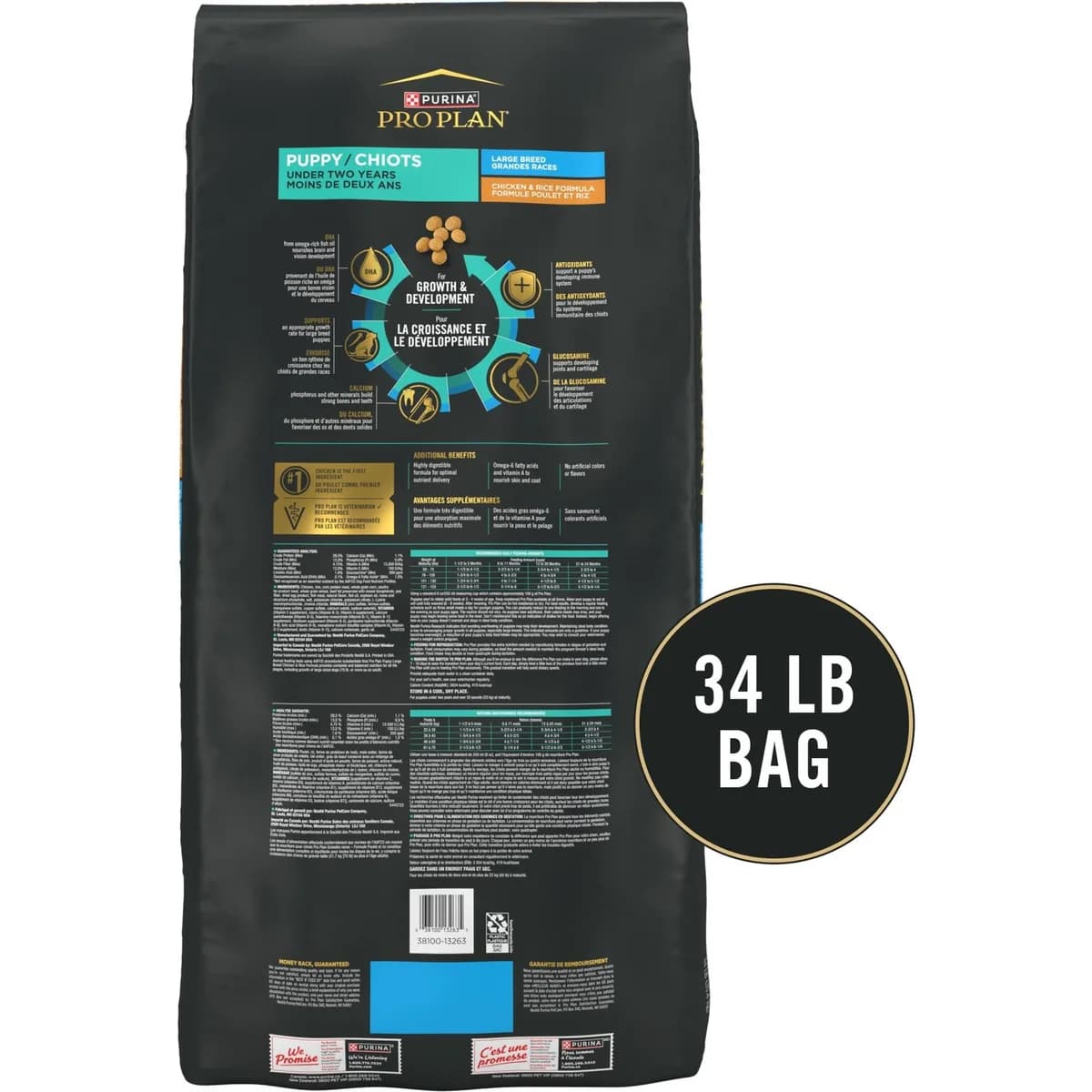
Purina Pro Plan Large Breed Puppy Chicken & Rice Formula is the puppy option in this comparison. The manufacturer lists 419 calories per cup and a feeding-test adequacy statement that includes growth of large-sized dogs. The specific retail option is the 34-pound bag, SKU 67488. It is distinct from Pro Plan Sport Development 30/18 and adult Chicken & Rice formulas. Read the manufacturer label.
- Useful fit: A growing American Bulldog whose expected adult size calls for large-breed growth nutrition.
- What to check: The full Large Breed Puppy Chicken & Rice name and the current bag's adequacy statement.
- Limitation: This is a chicken-containing recipe, not a veterinary elimination diet or a treatment for an undiagnosed allergy.
- Portion basis: Use the puppy's age and estimated mature weight in this formula's guide, then adjust with veterinary input.
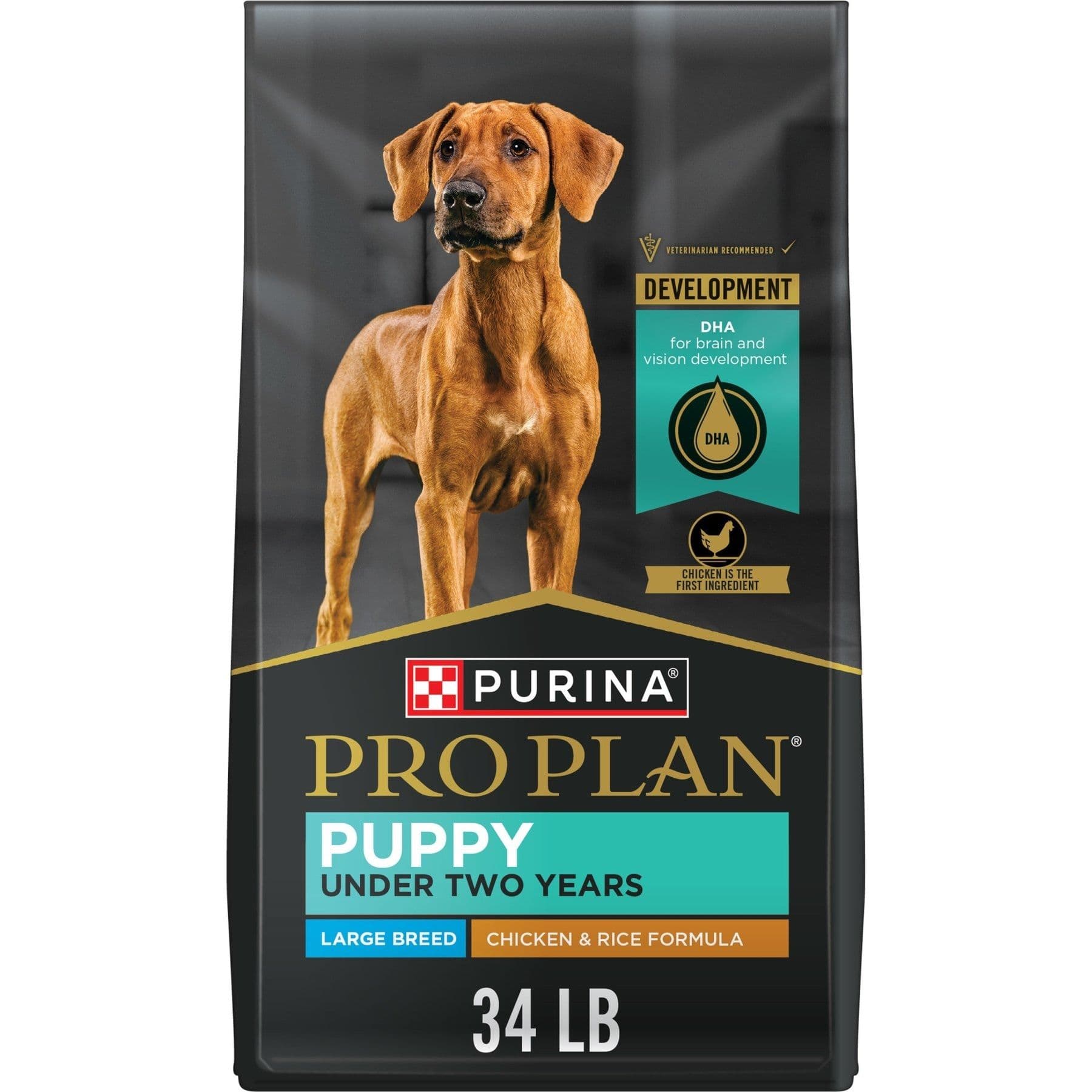
The exact Large Breed Puppy Chicken & Rice formula for growth-stage feeding. Use its label and veterinary guidance for portions; it is distinct from adult and Sport recipes.
Petful may earn a commission when you click through to Chewy, at no extra cost to you.
Purina ONE Chicken & Rice Formula: a straightforward adult option
The manufacturer's Chicken & Rice label lists 383 calories per cup and feeding-test support for adult maintenance. That makes this a reasonable adult option to discuss for a healthy dog who tolerates the recipe. It is not the large-breed puppy food in this guide.
- Useful fit: Adult maintenance with clearly stated calorie and adequacy information.
- What to compare: The actual price per day at your dog's portion, including delivery or subscription conditions.
- Limitation: Chicken & Rice is not a hypoallergenic designation, and a lower bag price alone does not establish the lowest feeding cost.
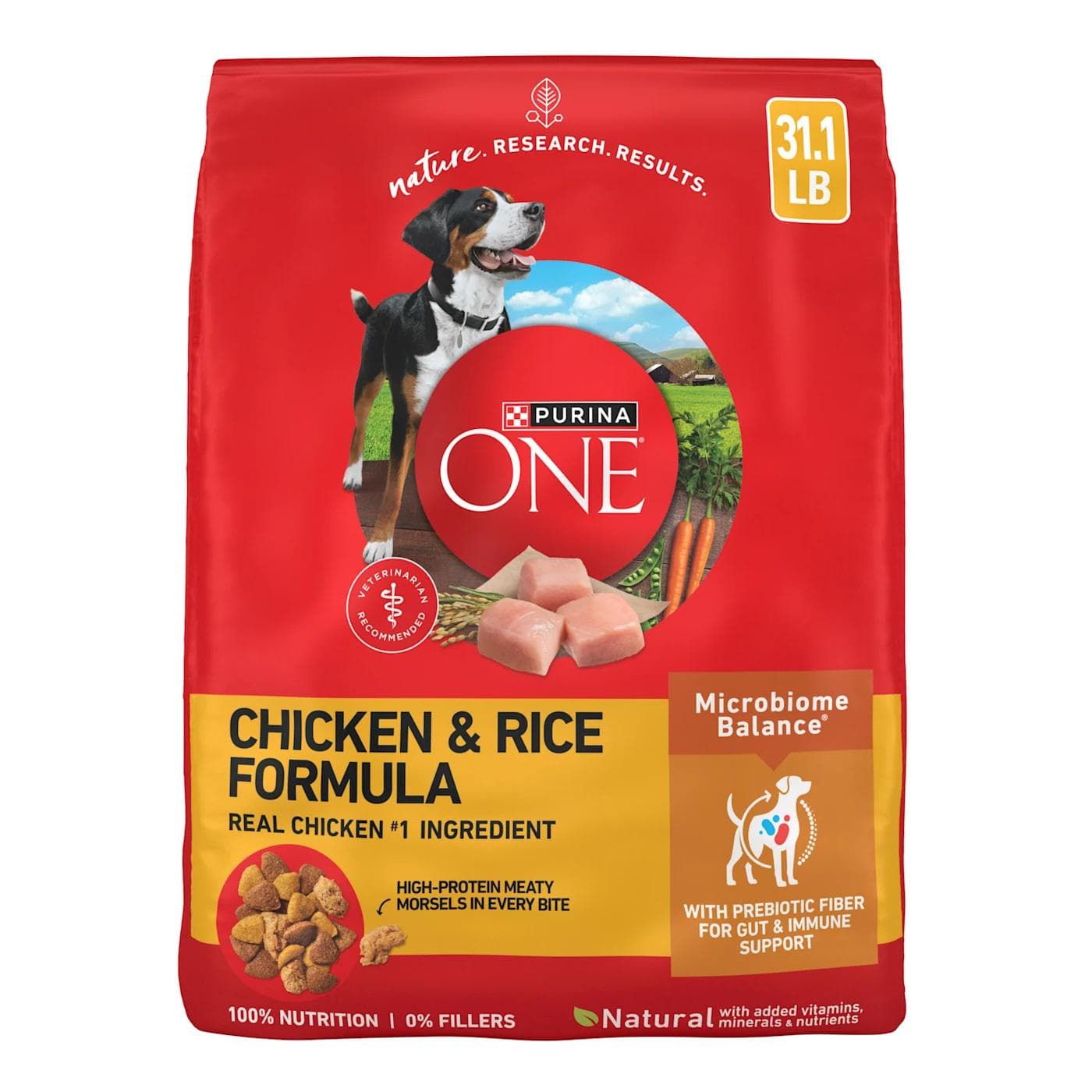
An adult-maintenance Chicken & Rice option to compare by daily calorie needs and tolerance. It is not the large-breed puppy selection.
Petful may earn a commission when you click through to Chewy, at no extra cost to you.
Open Farm Farmer's Table Pork & Ancient Grains: an adult alternative
The current manufacturer page lists 426 calories per cup. Its adequacy statement covers all life stages except growth of large-size dogs, so it is included here as an adult option, not the choice for an American Bulldog puppy expected to reach 70 pounds or more.
- Useful fit: An adult whose feeding plan suits this grain-inclusive recipe and calorie concentration.
- What to compare: The measured portion with the dog's current food before switching.
- Limitation: The recipe includes fish ingredients as well as pork. It should not be treated as a single-protein diagnostic diet because pork appears in the name.
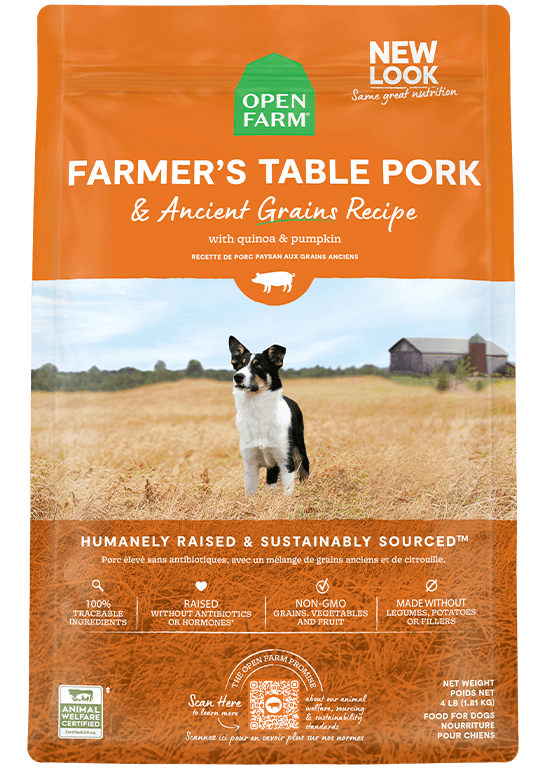
A grain-inclusive pork recipe for adults. Its label excludes large-size growth and includes other animal ingredients, so it is not a single-protein elimination diet.
Petful may earn a commission when you click through to Open Farm, at no extra cost to you.
Purina Pro Plan Adult Chicken & Rice: match the full recipe
The selected 35-pound bag is Purina Pro Plan Complete Essentials Adult Shredded Blend Chicken & Rice. Its manufacturer label lists 369 calories per cup and feeding-test support for adult maintenance. It combines crunchy kibble with tender shredded pieces. Compare its calorie concentration with the other adult options when measuring a daily allowance. Check the Shredded Blend label.
- Useful fit: A healthy adult whose feeding plan suits this grain-inclusive recipe and mixed kibble texture.
- Before choosing: Match the retailer's complete name and package to the manufacturer's label.
- Limitation: This adult-maintenance recipe is not the large-breed puppy selection or a veterinary elimination diet.
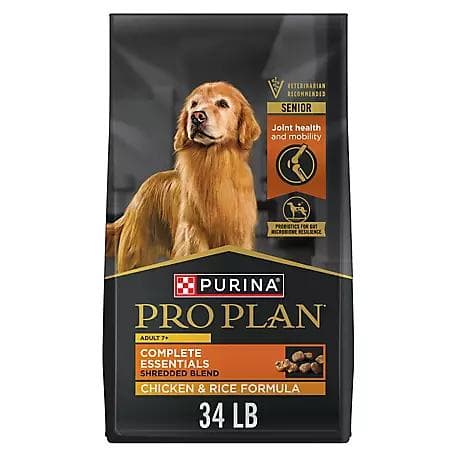
Complete Essentials Shredded Blend Chicken & Rice for adult maintenance, at 369 calories per cup. Compare portions with the other adult options.
Petful may earn a commission when you click through to Chewy, at no extra cost to you.
Food for American Bulldog puppies
A puppy's diet needs to support growth without encouraging excessive weight gain. If your American Bulldog is expected to reach 70 pounds or more, confirm large-size dog growth suitability in the adequacy statement. “Puppy,” “all life stages,” or a picture of a large dog on the front is not enough if the detailed statement excludes large-size growth.
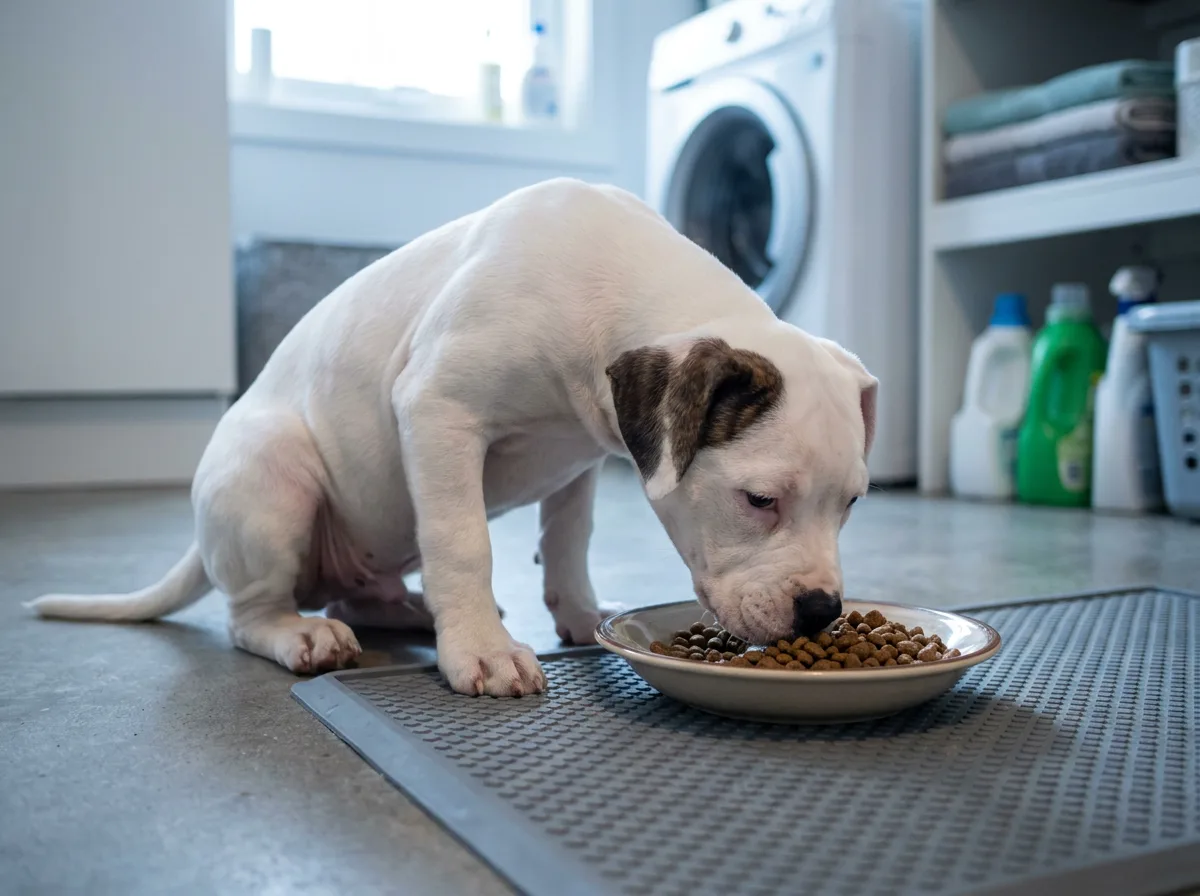
- 1For a puppy expected to reach 70 pounds or more, check for an adequacy statement including growth of large size dogs.
- 2Complete and balanced adult maintenance does not establish suitability for puppy growth.
- 3Use the exact recipe's feeding guide and monitor the puppy's condition with your veterinarian.
Building an American Bulldog puppy feeding schedule
An American Bulldog puppy feeding chart should identify the food it describes. Cup amounts from one recipe cannot be transferred automatically to another. Check whether the chart uses current weight or expected mature weight, and whether the amount is a daily total. Dividing a daily allowance into meals is different from feeding that allowance at every meal.
For this Pro Plan puppy formula, the manufacturer's directions describe three smaller meals for younger weaned puppies, moving toward morning and evening meals as the puppy gets older. Use that as product-specific guidance to discuss with your veterinarian. A puppy's appetite alone is not a reason to keep increasing portions.
- Record the exact food and the daily quantity offered.
- Weigh portions when practical, using the label's calorie information.
- Count training rewards and edible extras in the day's intake.
- Arrange growth and body-condition checks rather than aiming for the largest possible puppy.
- Ask before adding calcium, vitamins, or other supplements to a complete growth diet.
The AAHA guidance on life-stage diets emphasizes appropriate growth nutrition through skeletal maturity and avoiding excessive calcium intake in large puppies. Your veterinarian can help decide when adult food becomes appropriate. Reaching an adult-looking height does not necessarily mean growth is finished.
Planning the first year with a puppy
Food is one part of planning the first year with an American Bulldog puppy. Bring the breeder's or rescue's feeding information to the first veterinary visit, including the precise recipe and amounts. That makes it easier to distinguish a food change from other changes during the move into a new home.
Coordinate toilet breaks, reward-based training, exercise, and rest with the meal routine. If several people feed the puppy, use one shared record so meals and treats are not accidentally duplicated. Keep fresh water available and provide a quiet place to eat without competition from other animals.
Record the puppy's age, actual weight, and the parents' adult weights when known. A growth chart or weight predictor is not a promise of what this puppy should weigh at a particular week or month. Bring the individual growth record to veterinary checks so decisions about food and the transition to adult feeding follow the dog rather than a generic curve. Head growth is not a reason to add extra food or assume the puppy has finished growing.
Adult and senior food: calories, body condition, and health
For an adult American Bulldog, select a nutritionally complete food and adjust the amount to maintain suitable condition. Body weight alone does not tell the whole story. Ask your veterinary team to demonstrate body condition score and assess muscle condition, then use those observations alongside the scale and activity history.
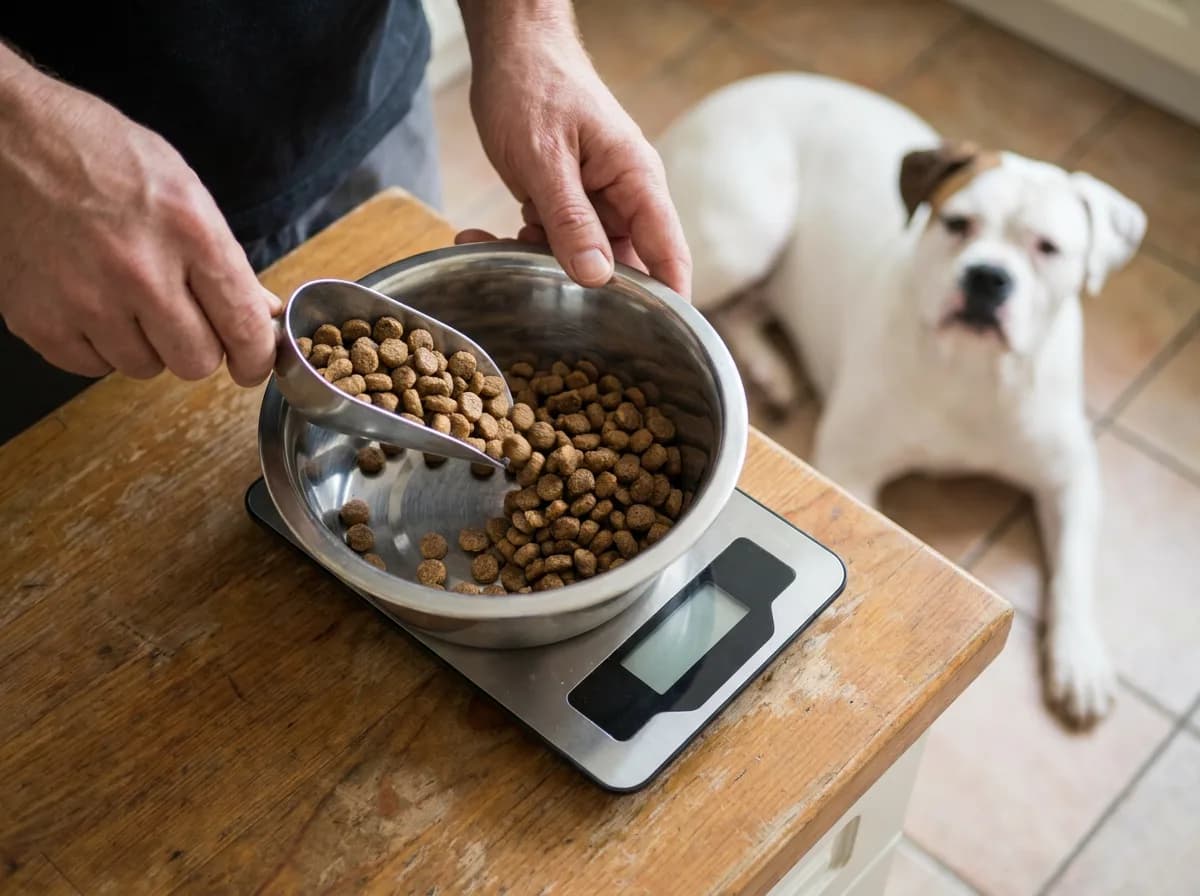
An American Bulldog feeding chart can be a starting guide, but the dog's food amount needs to reflect the recipe and the individual. Neutering, activity, environment, and health can affect the plan. If weight or condition changes unexpectedly, review both intake and health rather than assuming the food simply needs a larger or smaller scoop.
Comparing adult foods
Compare the exact adult recipes above by their labels and your dog's response. None is presented as a treatment for skin disease, a guaranteed way to build muscle, or the right choice for every senior. The current package takes precedence when a product listing or recipe has changed. For example, compare the current package of Purina Pro Plan Adult Shredded Blend Chicken & Rice with the calorie information used in your feeding plan.
When a product page changes
A familiar brand name does not establish that a replacement recipe is identical. For example, the former Wellness Chicken & Oatmeal page now leads to Complete Health+, described as kibble with freeze-dried morsels. Compare the exact package and its current nutrition information rather than copying calories or ingredients from a different product generation.
Turning calories into a portion
Once your veterinary team has helped establish a daily calorie target, divide the calories allocated to the main food by that food's calories per cup. A kitchen scale can make daily portions more repeatable, especially when several people feed the dog. The calculation must use the same recipe's current calorie information throughout.
- Illustrative calculation: If 1,200 daily calories are allocated to a food containing 400 calories per cup, the amount is 3 cups for the day.
- If the recipe changes: At 480 calories per cup, that same 1,200-calorie allocation would be 2.5 cups.
- What this is not: Those example numbers are arithmetic, not a calorie prescription for an American Bulldog.
The AAHA feeding-plan guidance includes treats and other extras in the total intake. It recommends that complete and balanced food supply at least 90% of calories, with treats and other foods making up no more than 10%. Ask how that allowance fits a therapeutic diet or a dog needing weight management.
- 1Match the exact recipe before using its calories per cup.
- 2Divide a daily food allowance into meals instead of repeating it at every meal.
- 3Reassess body condition and muscle condition when weight or activity changes.
Comparing daily feeding cost
To compare value, use the amount the dog will eat rather than bag price alone. Calculate the calories in the whole bag from its weight in kilograms and the listed calories per kilogram. Divide the price by that total, then multiply by the daily calories you expect to feed. Include delivery charges and compare recurring prices separately from introductory discounts.
- A hypothetical 10-kilogram bag at 4,000 calories per kilogram contains 40,000 calories.
- At a hypothetical price of $80, that is $2 per 1,000 calories.
- If 1,200 calories came from that food each day, the food cost would be $2.40 daily.
These are calculation examples, not current prices or a feeding prescription. A cheaper food that does not meet the dog's life-stage or medical requirements is not an equivalent option.
Does a senior need different food?
There is no separate AAFCO nutrient profile for senior dogs. A stable older American Bulldog does not automatically need a new food on a particular birthday. Changes should follow an assessment of weight, muscle, appetite, digestion, and diagnosed disease. AAHA explains the limits of senior diet labels.
Some older dogs need fewer calories; others struggle to maintain weight or muscle. Those situations call for different decisions. Ask your veterinarian before restricting protein or choosing a therapeutic recipe based only on age. A food that suits one senior's medical needs may be inappropriate for another.
Skin allergies, grain-free diets, and raw food
The best dog food for an American Bulldog with skin allergies depends on the diagnosis. Itching does not prove food allergy, and switching repeatedly among retail recipes can make a clear diet history harder to establish. A veterinary elimination diet trial, followed by the appropriate confirmation process, is different from choosing a bag labeled sensitive skin. AAHA's allergy guidelines describe that approach.
- Do not assume every American Bulldog needs grain-free food.
- Tell your veterinarian about treats, chews, supplements, and flavored medications during a diet assessment.
- Follow the prescribed trial diet closely if one is recommended.
- Avoid calling a recipe hypoallergenic solely because it uses a different main meat.
A raw diet is also not a breed requirement. The FDA describes contamination risks associated with raw pet food, including risks to people handling it. A homemade diet needs professional formulation to meet the dog's needs; meat, rice, and vegetables do not become complete simply because the ingredients seem wholesome.
When symptoms need a veterinary diagnosis
Persistent itching, recurrent digestive upset such as vomiting or troublesome flatulence, unexpected weight loss, or a marked appetite change warrants assessment rather than a succession of food purchases. The American Bulldog health guide explains why symptoms need an individual diagnosis. Bring the full diet history and photographs of package labels to the appointment.
Discuss when the problem began, any recent food changes, and what the dog receives outside meals. A food diary is useful evidence, but it cannot diagnose a disease. Your veterinarian can decide whether diet modification, testing, medication, or another intervention is appropriate.
Breed lifespan estimates do not predict an individual dog's remaining years or establish which senior food to buy. Changes in appetite, weight, comfort and diagnosed health conditions are more useful reasons to review the feeding plan with the veterinary team.
The wider American Bulldog care routine
Feeding works best within the wider American Bulldog care routine. Appropriate exercise, comfortable rest, preventive care, and consistent household feeding all help you judge how the plan is working. Review the diet when life stage, activity, or health changes rather than changing products simply to follow a new trend.
Keep the original packaging information so the exact recipe and lot can be identified if questions arise. When several people help with care, agree who measures meals and records extras. A suitable food fed consistently is more useful than an elaborate plan that no one can follow accurately.
Adult height and weight ranges describe the breed, not the right portion for every dog within that range. Record your dog's current weight and ordinary activity alongside body condition. Energy level and eating habits can vary between dogs of similar size, so a breed size chart cannot replace an individual feeding plan. Trying to bulk up a dog is not a substitute for assessing muscle and body condition. Agree on an appropriate goal with your veterinary team before increasing calories or adding supplements; more food can add unwanted weight without resolving the reason a dog looks thin.
Questions about best dog food for american bulldogs
Choose a complete and balanced formula for the dog's individual life stage, expected adult size, condition, and medical needs. If a current diet is suitable and your dog is doing well, a new brand is not automatically an improvement. Compare the exact label and daily feeding cost, then discuss any health-related reason for a change with your veterinarian.
There is no single best all-life-stages formula. Check the nutritional adequacy statement for the individual dog: the Open Farm Ancient Grains Pork recipe here excludes growth of large-size dogs expected to reach 70 pounds or more. For that puppy, choose a food whose statement includes large-size growth, such as the selected Pro Plan Large Breed Puppy recipe. Adults sharing a suitable food still need separately measured portions.
Keep chocolate, grapes and raisins, and xylitol-containing foods out of reach; these are examples of foods that can poison dogs. After a suspected exposure, contact your veterinarian or an animal poison service promptly rather than waiting for symptoms. Also avoid using an unbalanced homemade diet as the main food. Treats and toppers should not displace complete nutrition or conflict with a prescribed diet.
Examples of unsafe human foods include:
- Chocolate.
- Grapes and raisins.
- Products containing xylitol.
Consult the ASPCA's food-safety guidance for more examples and seek prompt advice after a possible ingestion rather than waiting for symptoms.
BVMS, MRCVS
Dr. Pippa Elliott, BVMS, MRCVS, is a veterinarian with nearly 30 years of experience in companion animal practice. Dr. Elliott earned her Bachelor of Veterinary Medicine and Surgery from the University of Glasgow. She was also designated a Member of the Royal College of Veterinary Surgeons. Married with 2 grown-up kids, Dr. Elliott has a naughty Puggle named Poggle, 3 cats and a bearded dragon.
Sign up for expert-backed reviews and safety alerts all in one place.