Singapura Cat Size: How Big Is the World's Smallest Cat Breed?
The Singapura is the world's smallest domestic cat breed, with females at 4 to 6 lb and males at 6 to 8 lb. Here is the full size breakdown, growth timeline, and how this tiny Singapore native compares to a normal house cat.
Petful is reader supported. As an affiliate of platforms like Amazon and Chewy, we may earn a commission when you buy through links on this page. There is no extra cost to you.
The Singapura cat size is the breed's calling card: the Cat Fanciers' Association lists adult males at just 6 to 7 pounds and females at a feather-light 4 to 5 pounds, which makes the Singapura the smallest domestic cat breed on record. Picture a grown cat that still fits in two cupped hands at maturity, and you have the Singapura. This guide breaks down the real numbers, the growth timeline from kitten to adult, how a Singapura stacks up against a normal house cat and the palm of your hand, and why this Singapore native wears the title of "world's smallest cat breed" with such confidence.
- 1Female Singapuras weigh about 4 to 6 lb and males about 6 to 8 lb, so most adults land in the 4 to 8 lb range.
- 2They stand roughly 6 to 8 inches at the shoulder and measure about 9 to 12 inches in body length, not counting the tail.
- 3The Singapura is widely called the world's smallest domestic cat breed, a reputation tied to the Guinness Book of World Records.
- 4A Singapura does not finish growing until 15 to 24 months, far later than the average cat, so its tiny adult frame is normal, not a sign of stunting.

Sign up for expert-backed reviews and safety alerts all in one place.
Singapura Cat Size at a Glance
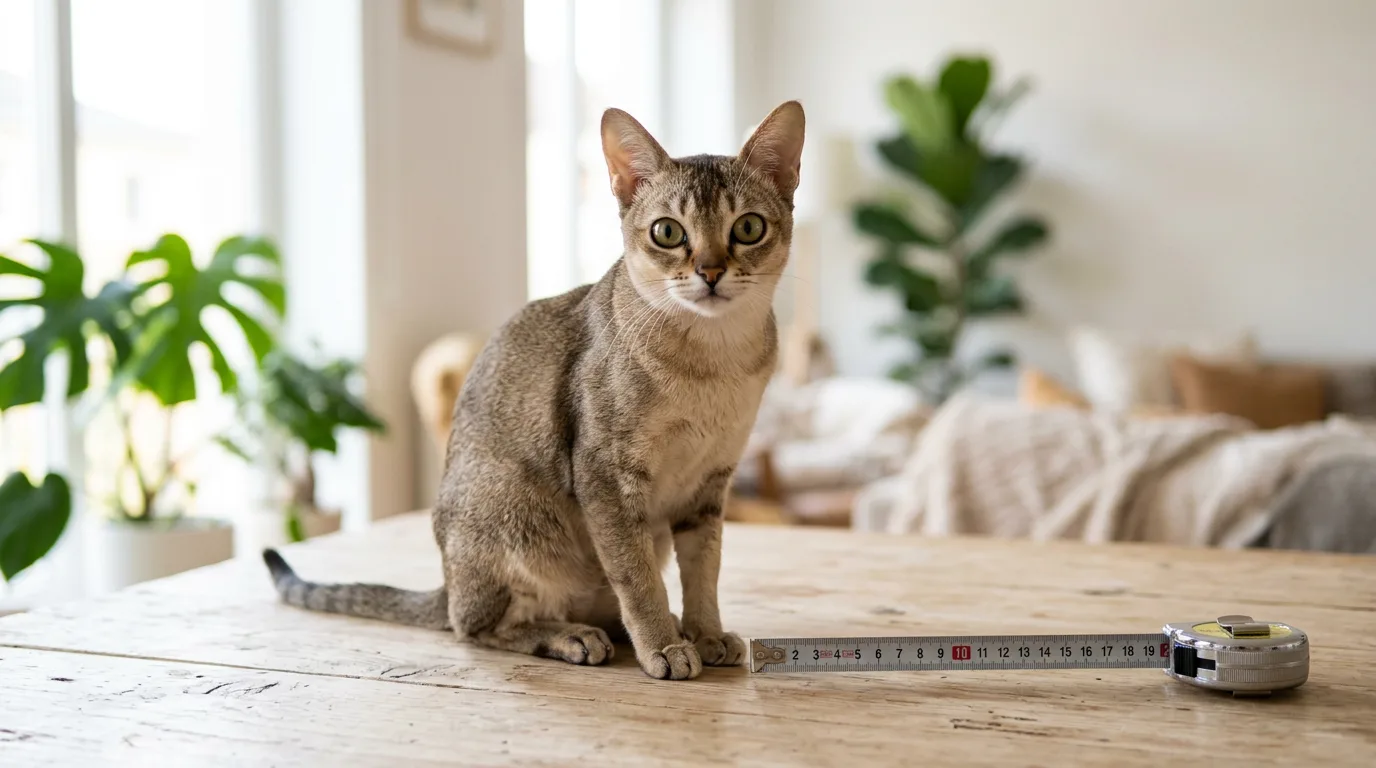
The fastest way to understand the Singapura is by the tape measure. Across the Cat Fanciers' Association (CFA), The International Cat Association (TICA), Hill's Pet Nutrition, and WebMD, the published figures cluster tightly. Adult females weigh roughly 4 to 6 pounds. Adult males weigh roughly 6 to 8 pounds. The CFA breed profile sets an even tighter range, listing males at 6 to 7 pounds and females at 4 to 5 pounds. Either way, a fully grown Singapura weighs about what a newborn human or a small bag of sugar weighs.
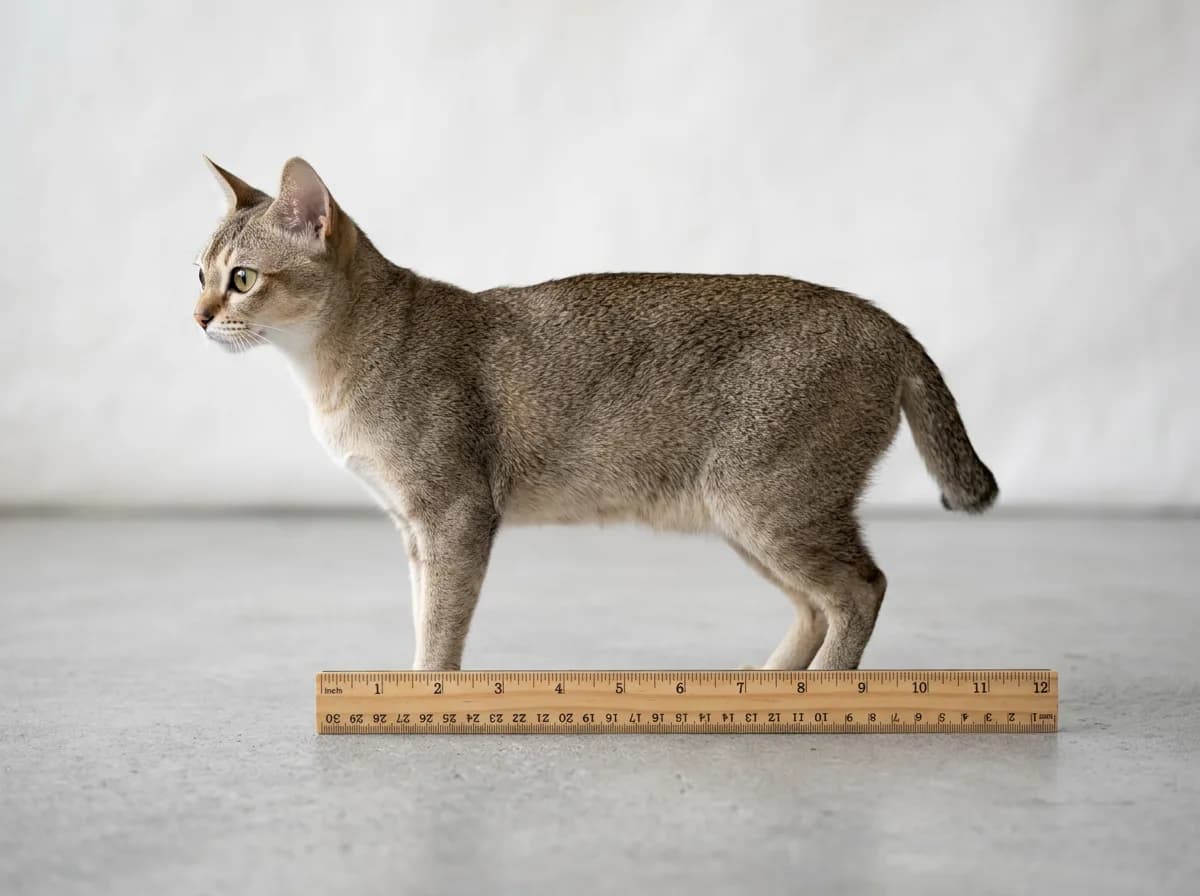
Height is the second piece of the picture. A Singapura stands about 6 to 8 inches (15 to 20 cm) at the shoulder. Body length runs about 9 to 12 inches from chest to base of tail. WebMD notes that the total size of a Singapura "doesn't exceed 12 inches," and the Guinness Book of World Records recognizes the breed as the smallest domestic cat breed in the world. For a sense of scale, the average house cat weighs around 10 pounds and stands 9 to 10 inches tall, so the Singapura is genuinely a half-size cat by weight, not just a slightly small one.
- A typical adult Singapura weighs 4 to 8 pounds, stands 6 to 8 inches tall, and measures 9 to 12 inches long, which is roughly half the body weight of an average 10-pound house cat.
Weight: Females vs Males
Like most cats, Singapuras show a sex difference in weight, but it is smaller than in many breeds. The Governing Council of the Cat Fancy describes "little size difference between the males and the females," with males at 6 to 8 pounds and females at 5 to 6 pounds. Hill's Pet Nutrition lists males as "Small: 6-8 lbs" and females as "Small: 4-6 lbs." The practical takeaway is that even the heaviest male Singapura tops out around the weight of a small adult Chihuahua, and a female can be lighter than a bag of apples.
Because the margins are so tight, a single pound matters more on a Singapura than on a larger cat. Catster makes this point directly: for a pet of this size, "a seemingly slight deviation is a big deal." A 1-pound gain on a 5-pound cat is a 20 percent jump in body weight, which is why owners are encouraged to weigh their Singapura regularly rather than eyeballing its condition.
Height and Length
Shoulder height for the breed sits in the 6 to 8 inch band, with body length of roughly 9 to 12 inches excluding the tail. The tail itself is short of the shoulder when laid along the torso, slender, and finished with a blunt tip, per the CFA standard. Add the tail and a stretched-out Singapura still rarely reaches much past a standard sheet of printer paper laid lengthwise. The breed is described by the CFA as "small to medium overall size," yet "moderately stocky and muscular," which is the paradox that surprises most first-time owners: a Singapura is tiny but dense, not delicate.
Why the Singapura Is Called the World's Smallest Cat Breed
The "world's smallest cat breed" title is not marketing. Wikipedia, WebMD, TICA, and the CFA all point to the same conclusion: among recognized pedigreed cats, no breed averages smaller. WebMD ties the claim directly to the Guinness Book of World Records, which recognizes the Singapura as the smallest domestic cat breed. The reputation has made the breed a social-media favorite and a national symbol in Singapore, where it is nicknamed "Kucinta," the Love Cat, and treated as a living national monument.
Never Scoop Again® with the Whisker Litter-Robot, the smart self-cleaning automatic litter box. Monitor visits and track weights for better overall care in the Whisker® app. Multi-cat friendly.
Petful may earn a commission when you click through to Whisker, at no extra cost to you.
It helps to separate two different ideas that often get blurred. The Singapura is the smallest cat breed by recognized average adult weight. The smallest individual cats ever recorded are usually not Singapuras at all but rare dwarf or runt cases in other breeds. So the honest framing is this: if you want a cat that is reliably, predictably small as a whole breed, the Singapura is your answer. If you want the single smallest cat in a record book, that is a different and much rarer story.
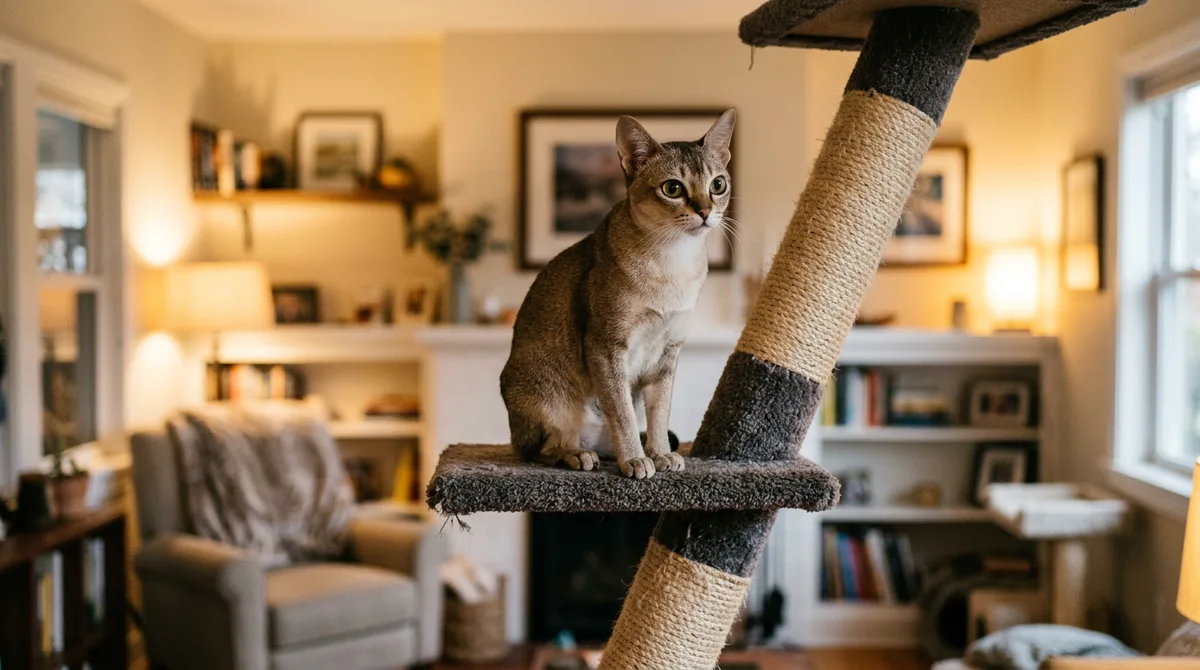
- Do not let the size fool you into babying a Singapura. They are athletic, love to climb, and need vertical space, scratching posts, and active play just like a full-size cat.
If you are weighing the Singapura against other compact breeds, it is worth seeing exactly where it sits among the genuinely small cats, which the next section breaks down breed by breed. The short version is that the Singapura is small in every dimension at once, and that combination is what truly sets it apart from cats that are merely short-legged or merely slender.
Singapura Size vs Other Small Cat Breeds
The Singapura is not the only cat marketed as small, so it helps to know where it truly ranks. The key distinction is that the Singapura is small in every dimension at once, where most "small" breeds are small in only one way. The Munchkin cat has famously short legs from a natural genetic mutation, which makes it look low and tiny, yet many Munchkins carry a normal 6 to 9 pound body on those short legs, so by weight they are not unusually small at all. The Oriental Shorthair is long, fine-boned, and light, but it is also tall and stretched out, the opposite of the Singapura's compact, stocky build. Even the Abyssinian cat, which shares the Singapura's ticked coat, is a normal-size cat at roughly 8 to 12 pounds.
By contrast, the Singapura packs a genuinely small skeleton, a light body weight, and a short stature into one cat. That is why breed registries and the Guinness Book of World Records single it out specifically rather than crowning a short-legged or slender breed. When someone says they want "the smallest cat," the Singapura, not a Munchkin or an Oriental, is the accurate answer. The Burmese, one of the breeds sometimes named in the Singapura's disputed ancestry, is also notably larger and heavier at around 8 to 12 pounds, which further underlines just how compact the Singapura really is.
How the Singapura Compares to a Normal Cat
A side-by-side comparison makes the difference concrete. The table below uses published averages for a typical domestic shorthair against the Singapura ranges from CFA, TICA, Hill's, and WebMD.
| Measurement | Singapura | Average House Cat |
|---|---|---|
| Adult weight | 4 to 8 lb | 8 to 12 lb |
| Shoulder height | 6 to 8 in | 9 to 10 in |
| Body length (no tail) | 9 to 12 in | 14 to 18 in |
| Time to full size | 15 to 24 months | 9 to 12 months |
In plain terms, a Singapura is roughly half the weight and about two-thirds the height of an average adult cat. That is why people often mistake a fully grown Singapura for a kitten or an adolescent. The breed simply never bulks up the way a standard cat does.
How the Singapura Compares to a Human Hand
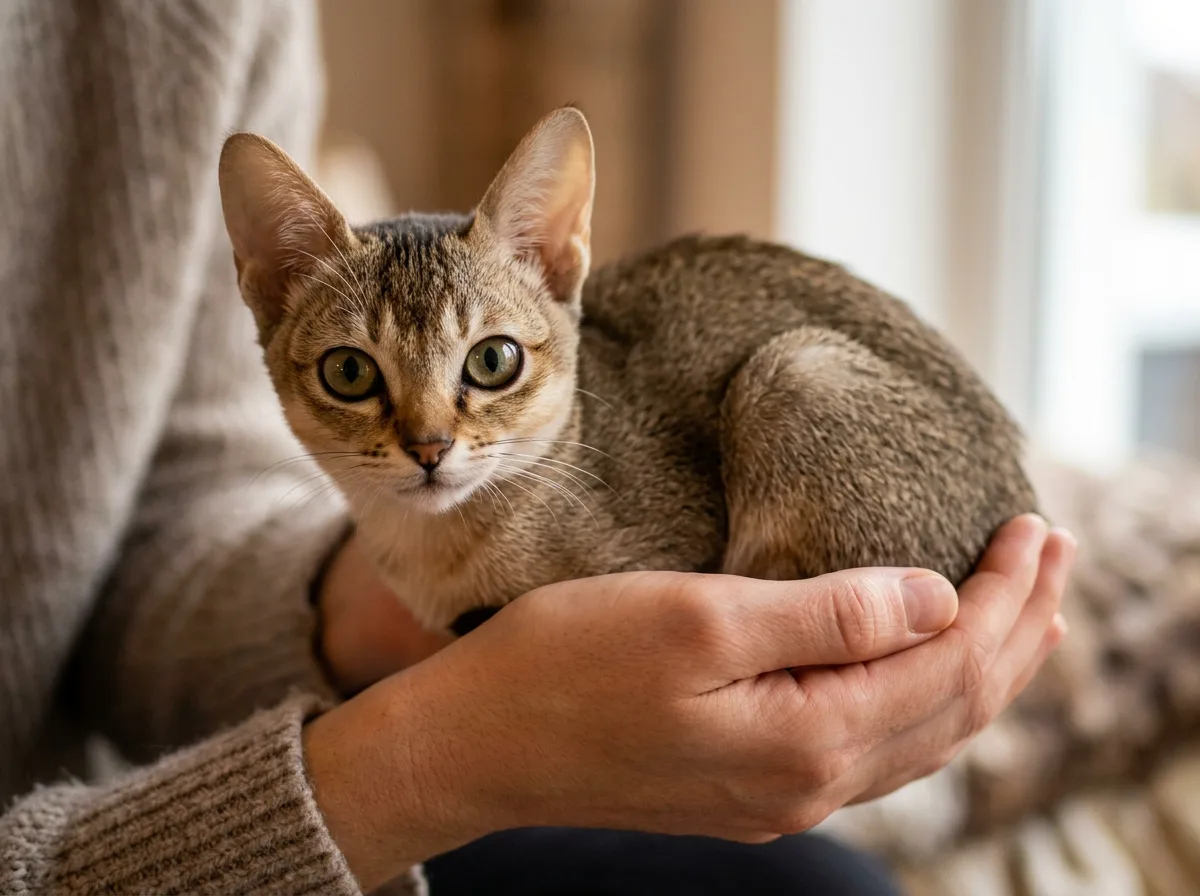
For a no-tape-measure gut check, the human hand is a handy ruler. An adult human hand is about 7 to 8 inches from wrist crease to fingertip. A Singapura kitten can curl up entirely in one palm, and even a grown female, at 4 to 6 pounds and roughly 6 to 8 inches tall, can be cradled in two hands with room to spare. Many breeders and owners describe holding a full-grown Singapura the way you would hold a teacup, which is exactly the visual that made the breed famous online.
Singapura Growth Timeline: Kitten to Full Size
One of the most reassuring facts for a new Singapura owner is that small is on schedule, not behind schedule. Singapuras are slow to mature. Weenect notes the breed reaches full size between 15 and 24 months, well past the 9 to 12 months it takes an average cat to finish growing. So a Singapura that looks kitten-sized at 8 or 10 months is doing exactly what the breed does.
Here is the typical arc. As newborns, Singapura kittens are extremely tiny, often smaller than a standard kitten of the same age, which is one reason the breed is associated with small-litter, careful breeding. Through the first 6 months they grow steadily but stay clearly petite, and an owner used to a regular kitten may worry the cat is undersized when it is simply a Singapura. Between 6 and 12 months they fill out their frame and gain muscle without adding the bulk a larger breed would, so the cat looks dense and athletic rather than chunky. From roughly 12 to 24 months they reach their final, modest adult weight and settle into the slightly leggy, kitten-like proportions they keep for life. This lifelong "eternal kitten" look is a documented breed trait, not an accident, and it shows up in temperament as much as in size: adult Singapuras stay playful, curious, and active well into their senior years.
Two practical points follow from this slow timeline. First, do not judge a Singapura's adult size until it is at least a year and a half old, because a 9-month-old is nowhere near finished. Second, because the cat is still developing through its second year, steady high-quality nutrition matters during that whole window, not just through the first few months as with faster-maturing breeds.
- A Singapura that seems small for its age is almost always normal. Overfeeding to push weight gain risks obesity, which is far more dangerous on a 5-pound frame than on a 10-pound one. Track weight with your vet instead of guessing.
Because the breed grows slowly and stays light, portion control matters from kittenhood. A measured feeding routine and regular weigh-ins keep a Singapura lean and athletic. If you want a deeper look at how this petite frame ages and what to expect across its years, see our guide to Singapura cat lifespan, which covers the breed's typical 11 to 15 year span.

63-inch multi-level cat tree with scratch posts, hammock, plush perches, and dangling toys. Vertical territory is non-negotiable for high-energy climbing breeds like the Bengal.
Petful may earn a commission when you click through to Chewy, at no extra cost to you.
What Makes a Singapura So Small? Breed Background
The Singapura's size is inseparable from its origin story, and that story deserves honesty rather than legend. The widely told version is that Americans Hal and Tommy Meadow brought five small brown ticked cats from Singapore to the United States in 1975, said to descend from the street and "drain" cats of Singapore, with a sixth cat following in 1980. The CFA accepted the breed for registration in 1981 and granted full championship status in 1988. TICA also recognizes the breed.
The honest caveat: a later CFA inquiry raised questions about whether the foundation cats were genuinely imported from Singapore or were derived from Burmese and Abyssinian cats already in the United States. The breed's true ancestry is still debated. What is not debated is the result. Through careful breeding, the Singapura was fixed as a uniformly tiny, single-colored cat, and Singapore later embraced it as a tourism mascot under the name Kucinta. So the size is a product of a small founding population and deliberate selection, regardless of which continent the first cats truly came from.
The Sepia Agouti Coat and Other Defining Features
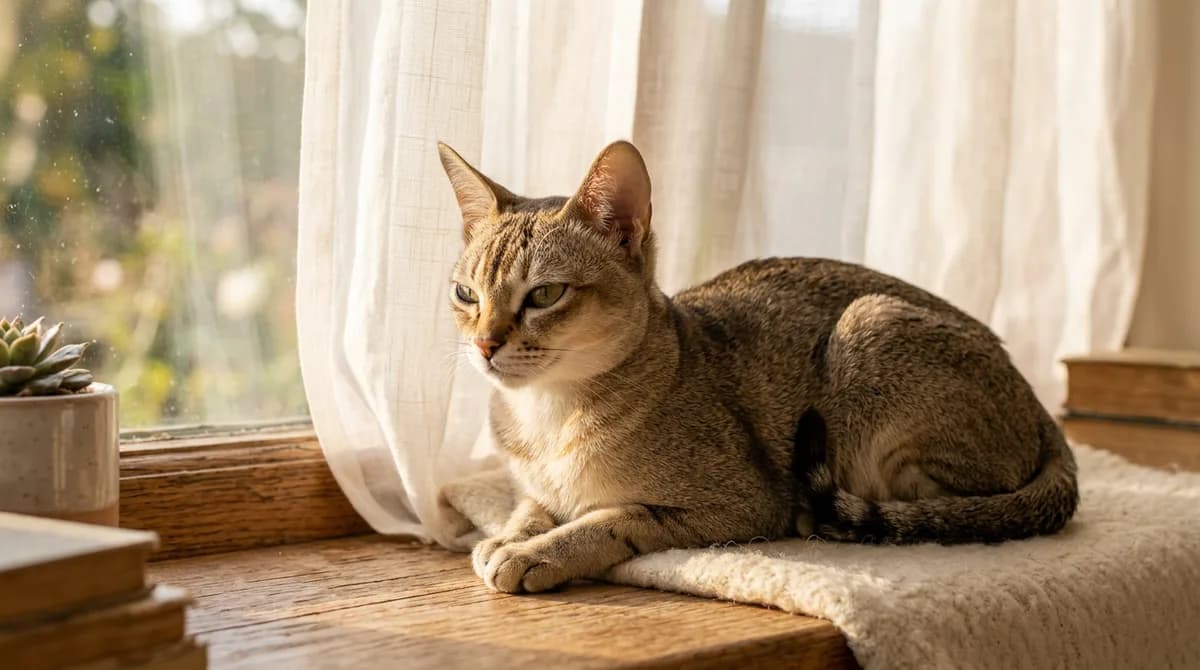
Part of what makes a Singapura instantly recognizable, beyond its size, is its single recognized color. The CFA registers the breed only in sepia agouti: "dark brown ticking on a warm old ivory ground color," where each hair carries multiple bands of color that catch the light. On top of that ticked coat sit the breed's signature features: very large almond-shaped eyes in hazel, green, or yellow, large cupped ears set wide at the base, a short blunt-tipped tail, and that small but muscular, stocky body. Compared with a lean, leggy ticked-coat breed like the Abyssinian, the Singapura is far smaller and more compact, and that size gap is one of the clearest tells between the two. The combination of a single sepia agouti color and a tiny stocky frame makes the Singapura almost impossible to confuse with any other cat once you know what to look for.
- Unlike most cat breeds, the Singapura is recognized in just a single color, sepia agouti. A "Singapura" in any other color is not showing the registered breed standard.
Living With a Pint-Sized Cat: Health and Care Notes
A small frame comes with a few size-specific care considerations, and being upfront about them is part of choosing the breed responsibly. The most notable breed-linked health issue is pyruvate kinase deficiency (often written PK deficiency or PKD), an inherited form of hemolytic anemia for which a DNA test now exists, so responsible breeders screen for it. Reputable sources including WebMD also flag uterine inertia, a small-breed birthing difficulty in which a queen may struggle to deliver kittens without help, which is logical given the breed's tiny pelvis. Some references additionally mention progressive retinal atrophy. Outside of these, the Singapura is generally a healthy, hardy little cat with a typical lifespan of about 11 to 15 years.
Day to day, the Singapura's size shapes care in practical ways. Food portions are small, so precision feeding and a kitchen-style scale or measured scoop matter more than they would for a big cat, where a little extra kibble barely registers. Litter boxes with a low entry side help a small cat get in and out comfortably, and kitten-safe toys and furniture sized for a light frame are a better fit than heavy cat trees built for a 12-pound animal. Because the breed is athletic and curious, vertical climbing space, window perches, and daily interactive play keep it both physically and mentally satisfied. The Singapura is also famously people-oriented, often called an eternal kitten in temperament as well as looks, so it wants company and engagement rather than to be left alone for long stretches. A second pet or a household where someone is usually home suits it well. For the full breed picture, including grooming, diet, and personality, start with the main Singapura cat breed guide.
- Before buying a Singapura, ask the breeder for proof of pyruvate kinase deficiency DNA testing on the parents. It is the single most important health screen for this breed and a fair question for any responsible seller.
Is the Singapura Right for Your Home?
The Singapura suits homes that want a small, interactive, lifelong-kitten cat and are happy to keep a close eye on weight and health. It is uncommon and can be pricey, typically running about 1,000 to 2,500 USD from a reputable breeder, a figure that reflects the breed's rarity rather than any luxury label. For a full breakdown of purchase price, breeder costs, and what drives the numbers, see our Singapura cat price guide. And if a tiny cat appeals but you also like a more unusual look, the werewolf-coated Lykoi cat is another small, distinctive breed worth a look.
Walnut shell clumping cat litter that excels at odor control, lasts up to 3x longer than clay, and is a top pick for multi-cat households.
Petful may earn a commission when you click through to Chewy, at no extra cost to you.
Singapura Weight by Age: A Kitten-to-Adult Chart
Because the Singapura matures so slowly, a month-by-month sense of weight is more useful for this breed than for almost any other cat. The figures below are approximate and pull from breed-profile averages rather than a single fixed standard, since individual kittens vary by litter, sex, and line. Treat them as a sanity check against your own vet's scale, not a target to force the cat toward. A male will usually track the top of each band and a female the bottom.
| Age | Female (approx) | Male (approx) | What to expect |
|---|---|---|---|
| Newborn | 2.5 to 3.5 oz | 3 to 4 oz | Tiny even by kitten standards |
| 8 weeks | 1 to 1.5 lb | 1.25 to 1.75 lb | Weaned, very small, ready to go home at 12 to 16 wk |
| 4 months | 2 to 2.5 lb | 2.5 to 3 lb | Leggy and lean, growing fast |
| 6 months | 2.5 to 3.5 lb | 3 to 4 lb | Still clearly kitten-sized |
| 12 months | 3.5 to 5 lb | 5 to 6 lb | Most of the frame is built, muscle still filling |
| 18 to 24 months | 4 to 6 lb | 6 to 8 lb | Final adult weight reached |
Read the chart as a curve, not a checklist. The single most common mistake new owners make is comparing a 6-month-old Singapura to a 6-month-old domestic shorthair and concluding the Singapura is underweight. It is not. A standard kitten is most of the way to its adult size by 8 or 9 months, while a Singapura is barely past the halfway mark. Plotting your cat's weight on a simple line and watching that the line keeps climbing month over month tells you far more than any single number does. A flat or falling line at any age is the real warning sign, and it is a reason to call your vet regardless of where the absolute weight sits.
When the Breed Stops Growing
Skeletal growth (length and shoulder height) finishes earlier than weight does. Most Singapuras reach close to their full body length and height by about 12 months, then spend the next 6 to 12 months adding the lean muscle that gives the breed its surprisingly solid, stocky feel. That is why a one-year-old Singapura can look its final length but still feel a touch light when you pick it up. By 18 to 24 months the cat has both its full frame and its full muscle, and the number on the scale should hold steady from there with good portion control.
How to Tell If a Small Singapura Is Healthy or Underweight
A naturally tiny cat creates a genuine diagnostic problem: how do you tell "small because it is a Singapura" from "small because something is wrong"? The answer is to stop trusting the number on the scale in isolation and start using body condition, the same hands-on method vets use for any cat. Weight tells you how heavy the cat is. Body condition tells you whether that weight is right for that particular cat's frame, and for a breed this small the second question is the one that matters.
Run your hands over the cat with light pressure. On a healthy-weight Singapura you should be able to feel the ribs easily, like feeling the back of your own hand through a thin glove, but not see them standing out. Looking down from above, there should be a visible waist that tucks in behind the ribs rather than a straight or bulging side. From the side, the belly should tuck up slightly toward the back legs rather than sag. A spine, hip bones, or ribs that are sharply visible, plus a belly that looks hollow and a coat that has gone dull or rough, point toward genuinely underweight, and that combination warrants a vet visit rather than just more food.
- For a tiny breed, learning the hands-on rib and waist check is more reliable than any weight chart. You should feel ribs with a thin fat cover, see a waist from above, and see a slight belly tuck from the side. Sharp, visible bones plus a dull coat means see your vet.
It also helps to rule out the ordinary causes of a too-light cat before assuming a breed quirk. A heavy worm or parasite load, dental pain that makes eating hurt, or simple competition at the food bowl in a multi-cat home can all keep a small cat lighter than it should be. None of these are unique to the Singapura, but each is easy to miss precisely because owners expect the breed to be tiny and write off the thinness as normal. A quick fecal test, a dental look, and feeding the Singapura separately for a week are cheap ways to separate "naturally petite" from "not getting enough."
Why the Singapura Is Naturally Small (Not a Dwarf)
It is worth being precise about the kind of small a Singapura is, because the breed gets lumped in with cats that are small for very different reasons. The Singapura is proportionately small. Every part of it (legs, body, head, tail) is scaled down together, so the cat looks like a normal cat seen at a distance, just genuinely petite up close. That is completely different from dwarfism, where a normal-length body sits on shortened legs. The Munchkin cat is the classic example of the dwarf pattern: its short legs come from a dominant genetic mutation that affects bone growth, while its torso stays a normal size and weight. A Munchkin is short, not small. A Singapura is small all over.

108-oz stainless steel pet fountain with quiet pump and water-level window. Bengals are notoriously water-obsessed; a flowing fountain encourages hydration and pulls them away from sinks and toilets.
Petful may earn a commission when you click through to Chewy, at no extra cost to you.
The Singapura's size instead traces to ordinary polygenic inheritance fixed by a very small founding population. The breed was built from only a handful of cats, and breeders selected consistently for a compact, lightweight body across the generations that followed. With such a narrow gene pool and steady selection in one direction, "small" became locked in as a reliable, heritable trait rather than a random outcome. There is no single dwarfism gene at work and no skeletal disorder driving the size. This distinction is not academic: it is the reassurance behind the whole breed. A healthy Singapura is small the way a Chihuahua is small next to a Labrador, through normal proportionate genetics, not through a condition that compromises the skeleton or the joints.
- The Singapura is proportionately small all over from normal polygenic genetics and a tiny founding gene pool. That is different from the Munchkin, whose short legs come from a true dwarfism mutation on an otherwise normal-size body.
Feeding and Weight Management for a Tiny Cat
Feeding a 5-pound cat is an exercise in precision that owners of bigger cats never have to think about. The core challenge is simple math: a Singapura needs far fewer daily calories than an average cat, so the margin for error on every meal is much smaller. A heaped scoop that would barely move the needle on a 12-pound cat can represent a significant overfeed on a Singapura. Most small adult cats at a healthy weight need only somewhere in the region of 150 to 220 calories a day depending on age and activity, but the only honest way to set the number is to ask your vet for a target based on your specific cat, then measure to it.
The practical tools matter here. Measure food with an actual gram scale or a proper measuring cup rather than estimating, because eyeballing kibble routinely overshoots, and on a tiny frame that overshoot adds up fast. Splitting the daily ration into two or three small meals suits the breed's metabolism and its food-motivated, interactive personality better than leaving a full bowl out, and free-feeding is the fastest route to a chubby Singapura. If you change foods, recalculate the portion, since calorie density varies a lot between a dense kibble and a watery wet food, and a like-for-like volume swap can quietly raise or lower intake. Weigh the cat on the same scale every couple of weeks and write it down, because on a 5-pound animal a trend shows up in the log long before it shows up to the eye.
- On a 5-pound Singapura, a single extra pound is a 20 percent weight gain, the human equivalent of a 150-pound adult putting on 30 pounds. Obesity strains joints and raises the risk of diabetes and other problems, so prevention through measured feeding is far easier than reversing it later.
The flip side of all this caution is reassuring: a Singapura kept lean through measured feeding and regular play tends to stay athletic and active well into its senior years, which fits the breed's eternal-kitten reputation. The goal is not to keep the cat thin, but to keep it at the lean, muscular condition the breed is built for, and on a frame this small that is achieved with a scale and a routine, not with guesswork.
Home Setup for a Very Small Cat
A tiny cat changes a handful of everyday choices around the house, and getting them right makes daily life easier for both of you. None of it is expensive, but it does mean resisting the default assumption that cat gear is one-size-fits-all.
Start with the litter box. A standard high-sided box can be a real obstacle for a cat that stands only 6 to 8 inches tall, especially a kitten or a senior. A box with at least one low entry side, or a shallower tray, lets a small Singapura step in and out without scrambling. The same logic applies to food and water stations: low, stable, shallow dishes suit a small face and short reach better than tall designer bowls, and a shallow or fountain-style water dish keeps a petite cat from having to stretch down into a deep bowl.
Furniture and play gear should match the frame too. The breed is athletic and loves to climb, so vertical space is non-negotiable, but the jumps between cat-tree platforms should be modest rather than the wide gaps built for a big cat, and a sturdy base keeps a tall tree from feeling tippy to a light animal. Choose toys sized for a small mouth and light paws, and skip the heavy, oversized kickers built for a 12-pound cat. One genuine safety note follows directly from the size: a 4-pound cat is small enough to be stepped on, shut in a reclining chair, or trapped in a closing door without being noticed, so a household with a Singapura is wise to build the habit of looking before sitting, reclining, or closing doors. For the full rundown on temperament, grooming, and daily routine that pairs with this size-specific setup, the main Singapura cat breed guide is the place to go next.
- A Singapura is light and quiet enough to go unnoticed underfoot, in a reclining chair, or in a closing door. Make a habit of checking before you sit, recline, or shut a door, especially in the cat's favorite napping spots.
Frequently Asked Questions
A Singapura kitten from a reputable breeder typically costs about 1,000 to 2,500 USD. The breed is uncommon, and that rarity, plus health screening and limited litters, is the main reason the price runs higher than for many common cats.
Yes. The Singapura is friendly, people-oriented, and affectionate. These cats rarely meet a stranger, prefer to be near their humans, and enjoy cuddling, playing, and simply being in the middle of the action, which is part of why the breed is so popular despite its rarity.
Black is often cited as the least adopted cat color. Shelters report that solid black cats, along with black-and-white cats, tend to wait longer for homes, a pattern usually blamed on superstition and on black cats photographing less distinctly. It has nothing to do with the cat's health or temperament. The Singapura sidesteps this entirely, since it comes only in warm sepia agouti.
Cats show affection through slow blinks, head bumps and cheek rubbing, purring, kneading with their paws, following you from room to room, and exposing their belly in trust. A people-oriented breed like the Singapura tends to do all of these often, since it actively seeks out human company.
A Singapura typically lives about 11 to 15 years, with some individuals reaching 18 or more when kept at a healthy weight and given good veterinary care. Its small size does not shorten its life, and the breed is generally hardy aside from a few inherited conditions worth screening for.
Among the most expensive cat breeds in the world, the Ashera and Savannah usually top the list, followed by breeds such as the Bengal, Persian, and Sphynx depending on pedigree and generation. The Singapura is not in that tier, but its rarity still makes it pricier than common house cats.
The Ragdoll is widely considered the floppiest cat breed, named for its tendency to go limp and relaxed when picked up. The Singapura is not floppy, but it is small enough to lift and hold easily, and its affectionate nature means it usually enjoys being carried.

Coreen Saito is a pet writer and longtime shelter volunteer with more than a decade in animal rescue. She covers cat behavior, breed care, and the small, ordinary science of sharing a life with companion animals, with a particular focus on honest takes about the products and decisions that actually matter. At home in Arizona, she's outranked by Mac (a dog with the loudest opinion in the house), Rebel (a cat who governs by quiet authority), and Meri (an orange tabby who runs the late shift and the laundry basket). She writes about all three, plus the rescues that keep coming through her life, at LifeWithMinty.com.
Sign up for expert-backed reviews and safety alerts all in one place.