Nebelung Cat Colors: The Shimmering Blue Coat Explained
Nebelung cat colors come down to one recognized shade: a silver-tipped blue that reads as shimmering grey. Learn why the coat glows, how the green eyes develop, and the truth about off-standard colors like the so-called black Nebelung.
Petful is reader supported. As an affiliate of platforms like Amazon and Chewy, we may earn a commission when you buy through links on this page. There is no extra cost to you.
Nebelung cat colors come down to a single recognized shade, and every major registry agrees on it: TICA, CFA, and the GCCF all accept exactly one color for the breed, a solid blue (which most people read as grey) carried evenly all the way to the roots. That one-color rule is not a marketing slogan. It is written into the breed standard, and it is the reason a true Nebelung looks like it is glowing in soft light while a plain grey housecat does not. The shimmer comes from silver-tipped guard hairs scattered through a semi-long double coat, a feature the breed inherited from its parent, the Russian Blue. In this guide you will learn what that single color actually looks like in person, why it shimmers, how the green eyes develop over the first two years, and the honest truth about the off-standard colors people keep searching for, including the famous "black Nebelung" that does not exist as a recognized variety.
- 1The Nebelung comes in ONE recognized color, a solid blue-grey carried evenly to the roots
- 2The signature shimmer comes from silver-tipped guard hairs over a dense double coat, the "mist" the breed is named for
- 3Adult eyes should be vivid green; kittens start with yellow or yellow-green eyes that deepen by roughly age two
- 4A "black Nebelung," white Nebelung, or tabby Nebelung is not a recognized color, it is a look-alike, a non-pedigree cat, or a fault

Sign up for expert-backed reviews and safety alerts all in one place.
What Color Is a Nebelung Cat?
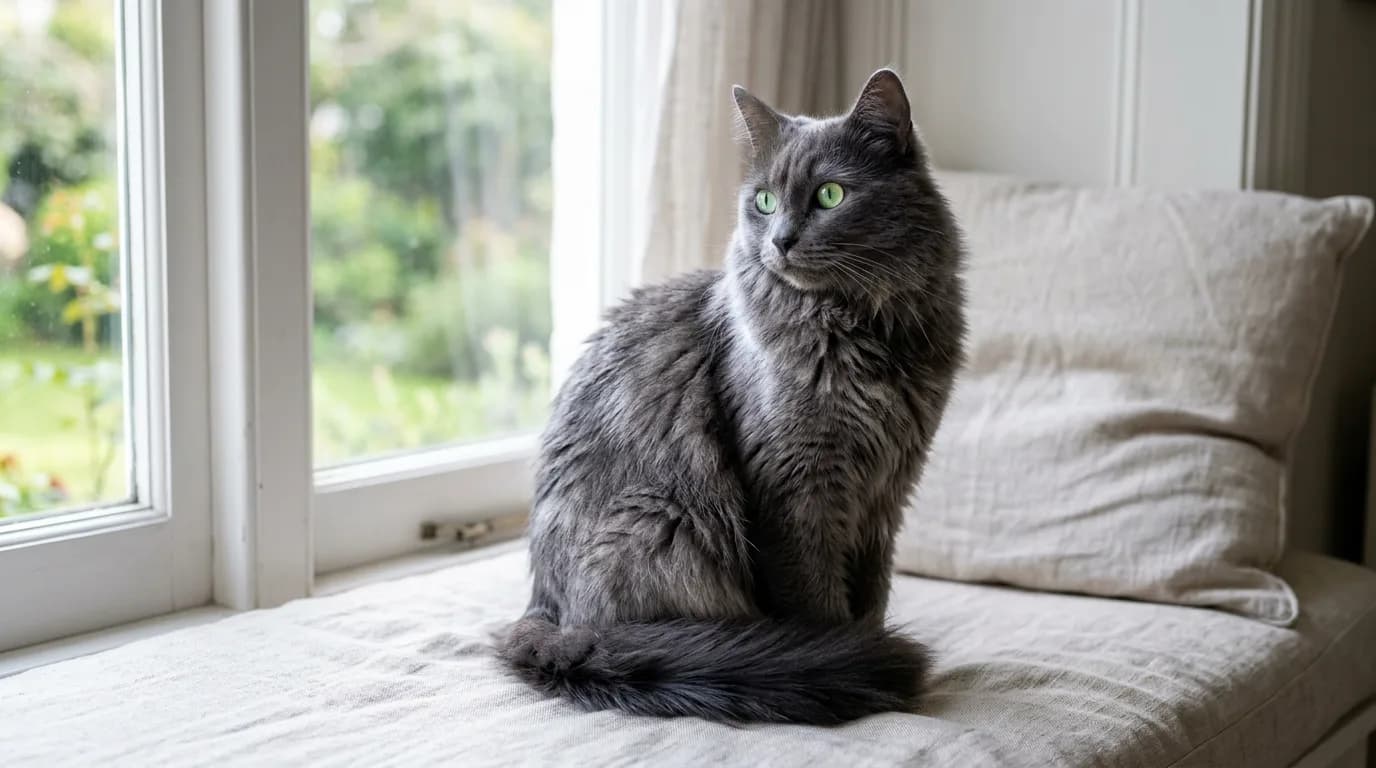
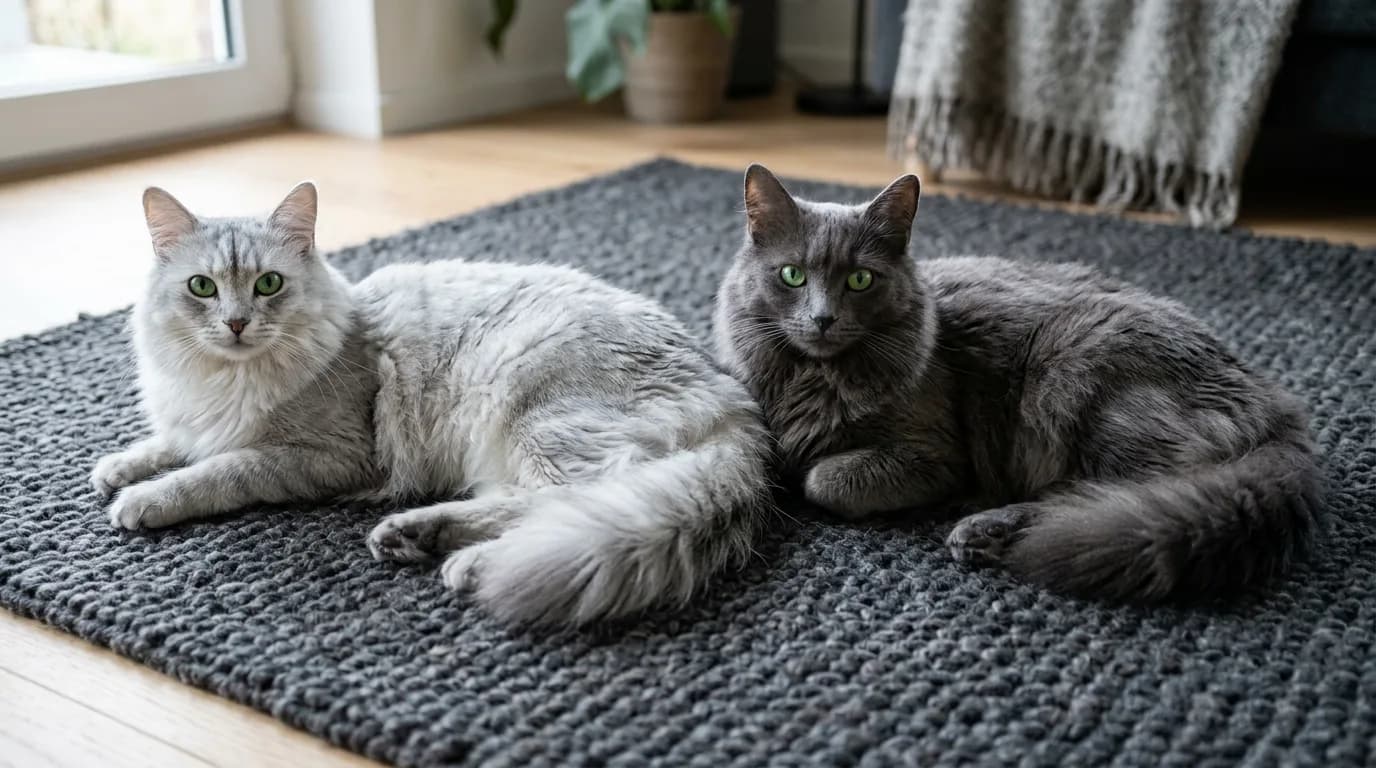
A Nebelung is a blue cat. In the cat fancy, "blue" is the term for a diluted black, which to the eye reads as a cool, soft grey somewhere between a light shimmering silver and a deeper slate. The GCCF standard describes it plainly: "an even, clear, medium blue," and the coat should be that same blue "all the way to the roots." There is no second color, no points, no patches, and no white anywhere on a show-quality Nebelung.
This is the part that trips people up. They see a grey cat and assume "grey" is the color name. In breed terms there is no "grey Nebelung," there is only blue, and the depth of that blue can range from a pale silvery tone to a richer slate without ever becoming a different color. Two Nebelungs can look noticeably lighter or darker than each other and both can be perfectly to standard, because the standard rewards evenness and clarity of the blue rather than one exact pantone.
The reason the breed reads as so distinct from an ordinary grey cat is the coat structure plus the silver tipping, which we break down in the next two sections.
Blue, Not Grey: The Cat-Fancy Color Name
"Blue" in feline genetics is the dilute form of black, produced by two copies of the recessive dilution gene. The same gene gives you a Russian Blue, a Chartreux, a Korat, and the blue version of dozens of other breeds. So when a registry calls the Nebelung blue, it is using a precise genetic label, not describing a sky-colored cat. To a casual observer the cat simply looks like an elegant, slightly silvery grey. If you have ever heard a breeder gently correct someone who said "grey," this is why: the word matters for paperwork, pedigrees, and show entries even though the everyday eye sees grey.
How Light, Medium, and Slate Blue Differ
Within the single accepted color, you will hear breeders describe a cat as light blue, medium blue, or slate. These are not separate colors, they are points on the same blue spectrum:
- Light or silver-blue: a pale, frosty tone where the silver tipping is most obvious and the cat seems to shimmer the most.
- Medium blue: the registry-preferred middle, even and clear, which most show Nebelungs sit at.
- Slate blue: a deeper, cooler grey-blue that can look almost charcoal in low light but still carries the silver sheen up close.
A cat at any point on that range can be to standard. What is NOT to standard is uneven color, rust or brown cast, or distinct lighter and darker zones across the body (slightly lighter blue behind the ears is the one common, accepted exception).

63-inch multi-level cat tree with scratch posts, hammock, plush perches, and dangling toys. Vertical territory is non-negotiable for high-energy climbing breeds like the Bengal.
Petful may earn a commission when you click through to Chewy, at no extra cost to you.
Why the Nebelung Coat Shimmers
The name says it all. Nebelung comes from the German word "Nebel," meaning mist or fog, and the breed was named for the way its coat seems to float in a silvery haze. That effect is not a trick of grooming. It is built into the hair itself.
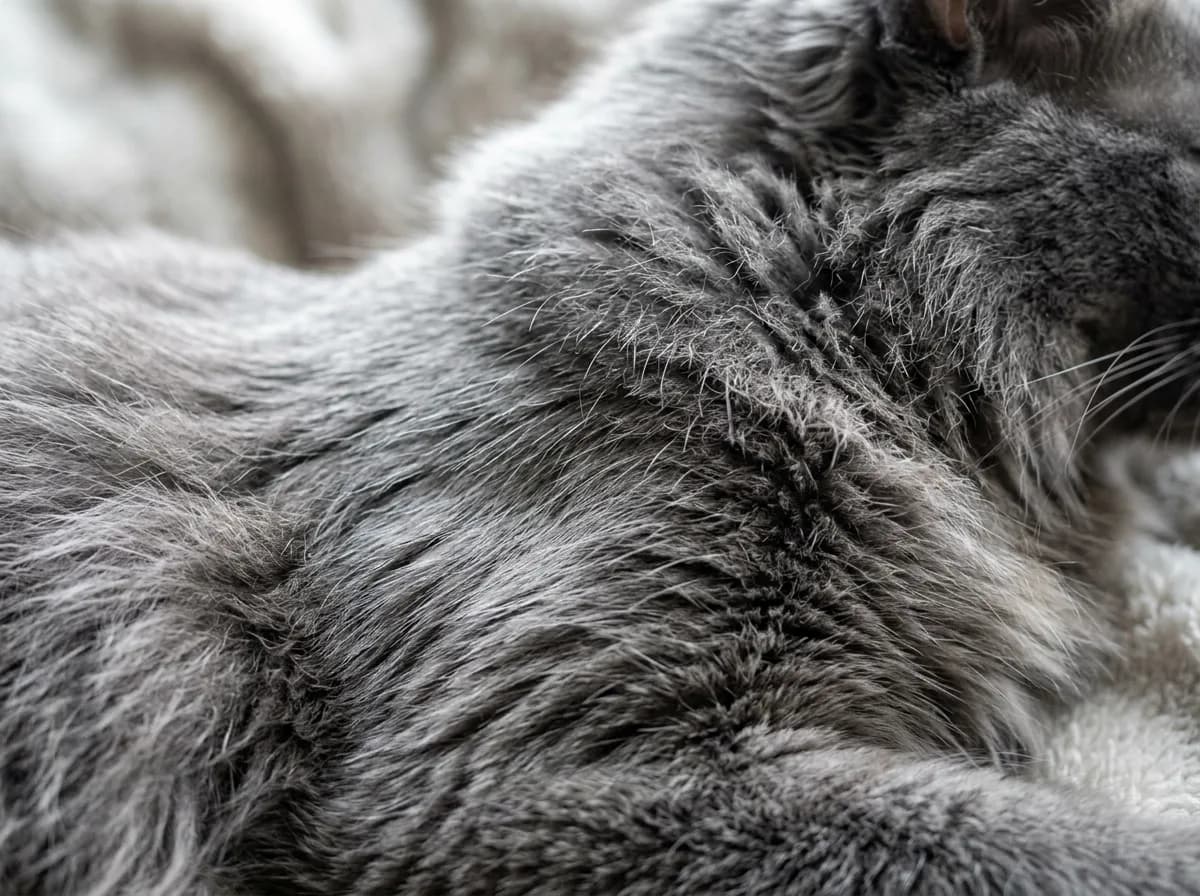
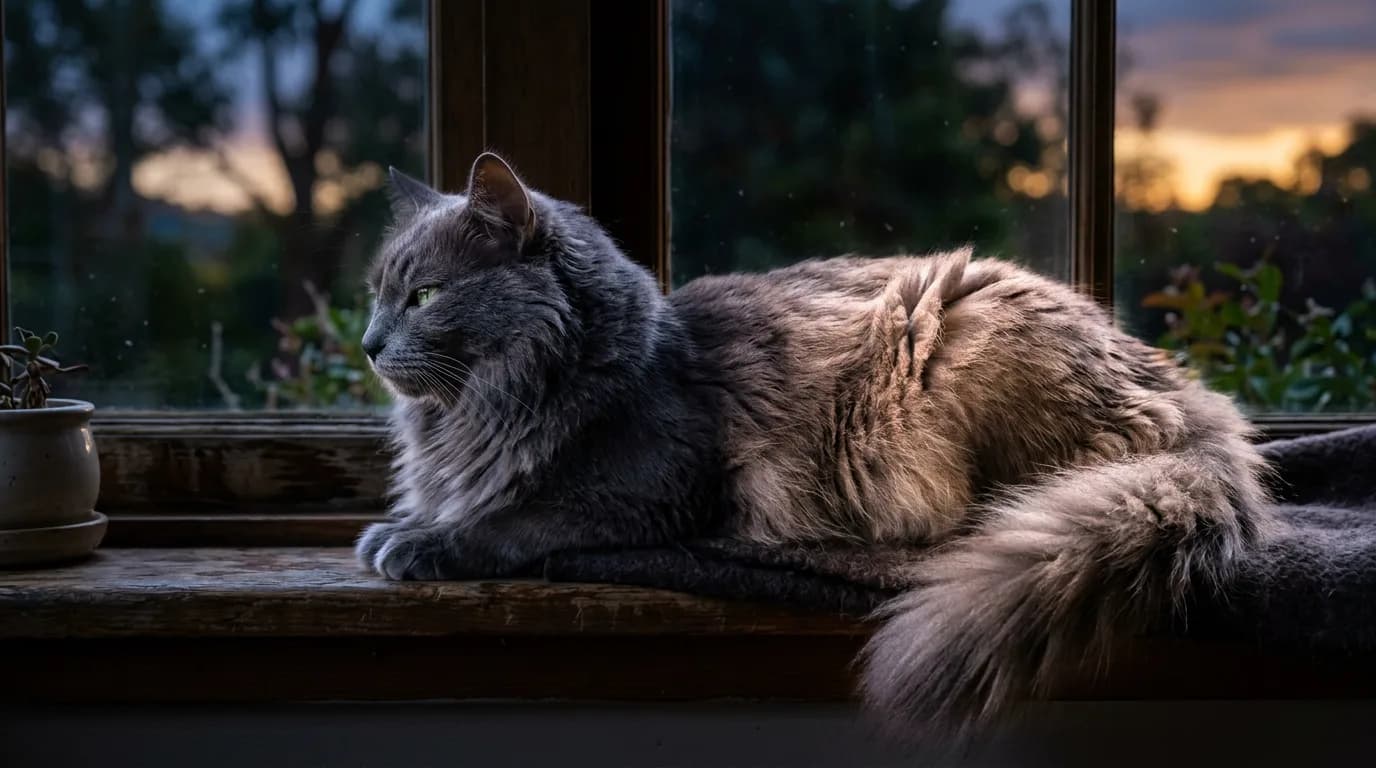
A Nebelung carries a semi-long double coat: a fine, soft undercoat covered by longer, thicker guard hairs. The guard hairs are tipped with silver, meaning the very ends of many hairs are a paler, almost white-silver shade while the shaft stays blue. When light hits the coat, those silver tips catch and scatter it, laying a faint silver dusting over the whole cat. The GCCF puts it well: ideally the fur is "silver-tipped which makes the coat seem to glisten with a silvery sheen," though in many cats the tipping shows up most strongly on the head and shoulders rather than uniformly.
- The silver-tipped guard hairs scatter light across a dense double coat, so a Nebelung reads as a blue cat wrapped in a faint silver haze, exactly the misty look the German name describes.
The Silver-Tipped Guard Hairs
Tipping is a specific coat genetics term. On a tipped coat, color is concentrated along the hair shaft and the tip carries a contrasting paler band, here a cool silver. Because the guard hairs sit above the softer undercoat, their silver ends form the outermost optical layer of the cat, which is what your eye reads first. The denser and longer the guard hairs, the more pronounced the shimmer, which is one reason a Nebelung shimmers far more than a short-haired blue cat with the identical base color.
Double Coat and Seasonal Change
That double coat is also why the shimmer can shift through the year. Nebelungs grow a heavier, plusher coat in winter and shed down to a sleeker one in summer. A winter coat often looks longer, fuller, and more dramatically silvered, while a summer coat can look closer to its Russian Blue cousin. The base blue does not change, but the amount of visible silver-tipped fur does, so the same cat can appear mistier in January than in July.
The Plumed Tail
One of the most striking color features is the tail. The Nebelung carries a long, plumed (feathered) tail where the guard hairs are at their longest, so the silver tipping pools there and the tail often looks like the most luminous part of the cat. A full, silvered plume is a hallmark of a well-coated Nebelung and a quick visual cue that separates the breed from a short-haired blue.
The Genetics Behind the Blue
If you want to understand Nebelung cat colors at the root, it helps to know the two genes doing the work, because they explain why the breed can only ever be one color.
The first is the dilution gene, written as little "d." Black pigment in cats is controlled by the dominant black allele, but when a cat inherits two copies of the recessive dilution allele (d/d), the black pigment clumps unevenly along each hair shaft instead of laying down densely. Your eye reads that diluted, light-scattering black as blue-grey rather than black. Every Nebelung is d/d, which is exactly why the breed is locked to blue: a cat without two dilution copies would not be blue, and therefore would not meet the Nebelung standard. This is the same mechanism that turns a black cat blue, a chocolate cat lilac, and a red cat cream.
The second factor is the silver, or inhibitor, influence that suppresses pigment at the base of the hair and concentrates it toward the tip. Combined with the breed's dense guard hairs, that is what produces the silver tipping. The two effects stack: dilution gives you the soft blue body color, and the silver tipping lays the luminous frost over the top. Take either away and you lose the signature look. A diluted cat with no tipping is just a plain blue; a tipped cat without dilution would be a different color entirely.
Because both traits are baked into the breeding program, reputable Nebelung breeders are not selecting among a palette of colors the way a Persian or Maine Coon breeder might. They are refining one color: making the blue as even and clear as possible, encouraging strong silver tipping, and pairing it with the deepest green eyes. That narrow focus is part of why a truly excellent Nebelung coat is hard to produce and easy to admire.
- Every Nebelung carries two copies of the dilution gene, which is what makes the coat blue rather than black. The breed cannot come in other colors without ceasing to be a Nebelung, so "rare color" Nebelungs are a contradiction in terms.
How the Color Reads Across Registries
The three big registries that recognize or work with the Nebelung describe the color in slightly different words but agree completely on the substance: one even blue, silver-tipped, with green eyes in the adult.
The GCCF (Governing Council of the Cat Fancy, the main UK registry) calls for "an even, clear, medium blue" carried "all the way to the roots," with guard hairs ideally "tipped with silver giving the overall appearance of light silver dusting," and adult eyes "green, as vivid as possible." TICA (The International Cat Association), which granted the Nebelung championship status, likewise recognizes the breed only in blue with the same silver-tipped, green-eyed profile and a semi-long coat. The CFA and other bodies that engage with the breed describe it in the same terms. None of them lists a second color, a pointed pattern, or a bicolor option.
The practical upshot for a buyer is reassuring: no matter which registry a pedigree is issued under, the expected color is the same. If a pedigree or advertisement describes a Nebelung in any color other than blue, that is a signal to ask hard questions, because no recognized standard supports it.
Nebelung Cat Colors and Eye Color: The Green Develops Over Time
Coat is only half the picture. The Nebelung's vivid green eyes are part of what makes the blue coat pop, and like the coat, the eye color is set by the standard: adults should have green eyes, as vivid as possible.
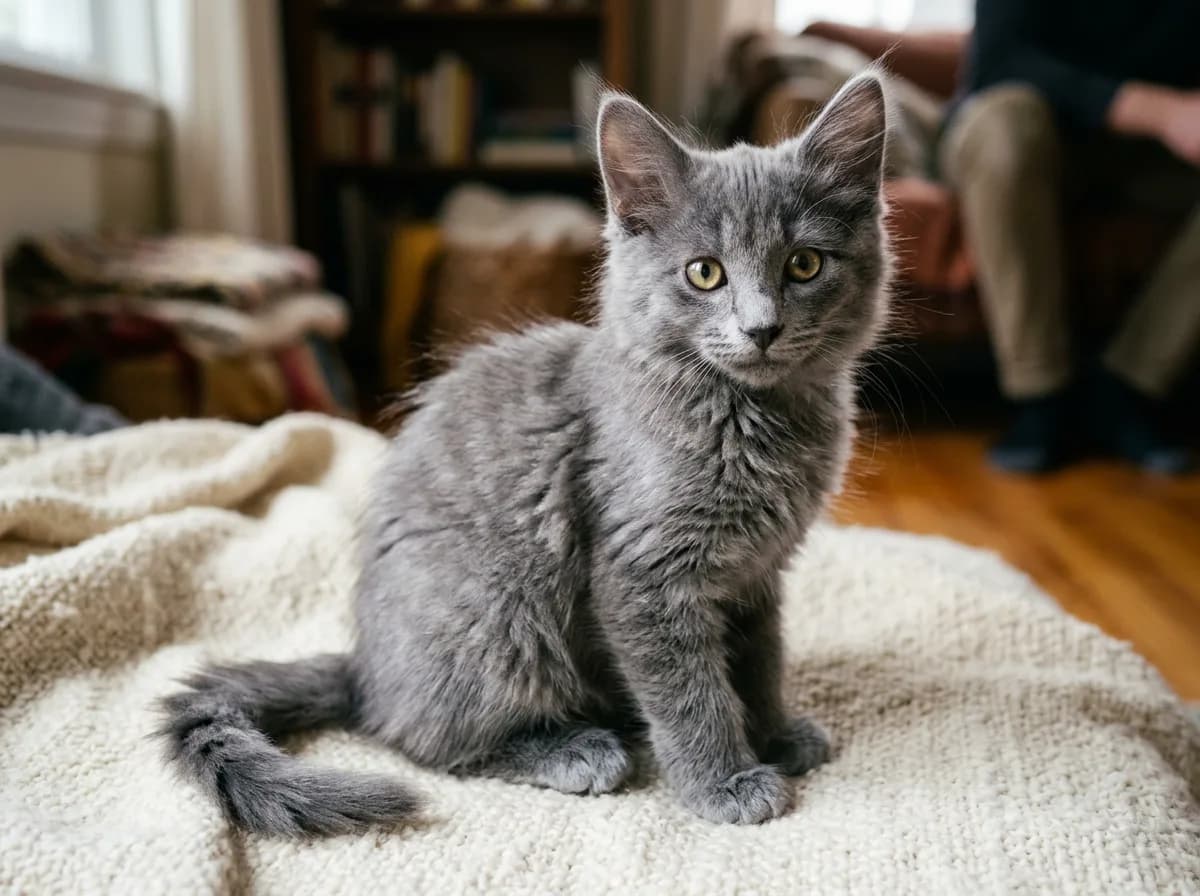
Here is the part owners of kittens need to know. Nebelung kittens are not born with green eyes. They typically start with yellow or yellow-green eyes, and the green deepens gradually over the first one to two years. The GCCF notes directly that adult eye color "should be green, as vivid as possible, although eye colour can be yellow in kittens." So a young Nebelung with golden or muddy-green eyes is not off-standard, it is simply not finished maturing. A faint yellow ring around the pupil can linger into early adulthood before the full green sets in.
- Do not write off a kitten because its eyes are yellow-green. Nebelung eyes deepen to vivid green by roughly age two, so the green you want in an adult is something the cat grows into, not something it is born with.
This developmental timeline is one of the most reliable ways to tell a young pedigree Nebelung from an adult: the deeper and more uniform the green, the more mature (and more to standard) the cat.
Why Green Eyes Matter So Much to the Look
Green is not an arbitrary preference. The vivid green sits opposite blue on the color wheel, so the eyes create a deliberate contrast that makes the cool blue coat read as even more silvery and refined. A Nebelung with muddy or yellowish adult eyes can have a flawless coat and still look less finished, because that signature blue-and-green pairing is part of the breed's whole identity. Breeders therefore select hard for eye color as well as coat, and a deep, clear green in an adult is a meaningful sign of careful breeding.
How Nebelung Color Changes From Kitten to Adult
The color you see on a Nebelung kitten is not the color you will live with. Three things shift as the cat matures, and knowing them prevents a lot of needless worry.
Walnut shell clumping cat litter that excels at odor control, lasts up to 3x longer than clay, and is a top pick for multi-cat households.
Petful may earn a commission when you click through to Chewy, at no extra cost to you.
First, the coat itself comes in over the first year or two. Kittens carry a softer, shorter coat with less obvious silver tipping, so a young Nebelung can look like a fairly ordinary grey kitten before the adult guard hairs grow in and the shimmer develops. The semi-long coat and feathered tail that define the breed visually are late arrivals, often not fully there until the second year.
Second, the ghost tabby markings fade. As described above, faint tabby ghosting is normal in kittens and usually melts into the even adult blue as the coat matures. If you fall for a striped-looking blue kitten, that striping is very likely temporary.
Third, the eyes deepen from yellow or yellow-green toward vivid green. So the "finished" Nebelung look, even silver-tipped blue with brilliant green eyes, is something the cat grows into across its first couple of years. A reputable breeder can usually show you the parents to give a realistic preview of how a kitten's color and coat will mature.
- Because a Nebelung's coat and eye color take up to two years to finish, the best preview of how a kitten will look as an adult is its parents. Ask to see both, and judge the coat shimmer and eye green on them.
The Truth About Off-Standard Nebelung Colors
This is where search interest gets the most confused, so let us be direct. People search for black Nebelungs, white Nebelungs, tabby Nebelungs, and "rare Nebelung colors." With one minor exception, none of these are recognized varieties. The breed standard accepts a single color, blue, and anything else is either a look-alike, a non-pedigree cat being marketed under the name, or a coat fault.
- If a seller advertises a black, white, cream, or tabby "Nebelung" as a rare or premium color, treat it as a warning sign. The breed has exactly one recognized color. A genuinely off-color cat is not a rare Nebelung, it is not a standard Nebelung at all.
Is There a Black Nebelung?
No. There is no recognized black Nebelung. The breed is defined as blue, the dilute of black, so a solid black cat by definition fails the color standard. What people usually mean by "black Nebelung" is one of three things: a very dark slate-blue Nebelung photographed in poor light (still blue, just deep), a black domestic longhair that happens to resemble the body type, or a black cat with no Nebelung pedigree at all. A cat that is genetically non-dilute black is not a Nebelung that turned black, it is simply a different cat.
White, Cream, Tabby, and Bicolor Nebelungs
White patches are not permitted. A Nebelung should show no white anywhere, so a cat with a white locket, white paws, or a white bib is, by definition, off-standard for the breed even if its body type looks right. Cream, red, chocolate, lilac, and pointed patterns are likewise outside the standard. Tabby markings are a special case worth understanding, covered next.
Ghost Tabby Markings in Kittens
Here is the one nuance. Nebelung kittens often show faint "ghost" tabby markings, soft tabby stripes or rings that are visible mostly because the blue dilution lets the underlying tabby pattern peek through. The GCCF explicitly allows for this: "kittens may show ghost tabby markings." These ghost markings normally fade as the adult coat comes in, leaving the even solid blue the standard wants. So a striped-looking blue kitten is usually fine. A grown adult with strong, persistent tabby bars, by contrast, is showing a color fault, not a feature.
Lighter Blue Behind the Ears
The other accepted "variation" is not really a different color at all: slightly lighter blue coloring behind the ears is common and acceptable in the breed. It is a normal feature of many blue cats and does not count against an otherwise even coat.
Nebelung vs Russian Blue: Same Color, Different Coat
Because the Nebelung was bred to be, in effect, a longhaired Russian Blue, the two share the exact same coat color: solid blue with silver tipping and green eyes. Cora Cobb developed the Nebelung in the United States in the mid-1980s with that goal, and the name nods to the misty, silvered look. So if color alone will not separate them, what does?
The answer is coat length and structure, not color. The Russian Blue wears a short, dense, plush double coat that stands out from the body. The Nebelung wears a semi-long version of the very same coat, with a feathered tail, a ruff around the neck, and longer guard hairs that exaggerate the shimmer. Side by side in the same light, they are the same blue, but the Nebelung looks softer, longer, and mistier. If you want the full breakdown, see our Nebelung vs Russian Blue comparison and the dedicated Russian Blue breed profile.
| Breed | Coat Color | Coat Length and Texture |
|---|---|---|
| Nebelung | Solid blue, silver-tipped | Semi-long double coat, plumed tail |
| Russian Blue | Solid blue, silver-tipped | Short, dense, plush double coat |
| Chartreux | Solid blue-grey | Short to medium, woolly water-resistant coat |
| Korat | Silver-blue, silver-tipped | Short, single, close-lying coat |
A couple of other blue breeds share the family resemblance. The Chartreux is a sturdier blue cat with a woolly coat and copper or gold eyes (not green), and the Korat is a smaller silver-blue with a single short coat and a heart-shaped face. Color overlaps; build, coat, and eye color tell them apart.

108-oz stainless steel pet fountain with quiet pump and water-level window. Bengals are notoriously water-obsessed; a flowing fountain encourages hydration and pulls them away from sinks and toilets.
Petful may earn a commission when you click through to Chewy, at no extra cost to you.
Telling a True Nebelung From a Grey Look-Alike
Because "blue" cats are common and the Nebelung is rare, a great many grey domestic longhairs get sold or rehomed as Nebelungs, sometimes innocently and sometimes not. Color alone will never settle it, because plenty of mixed-breed cats are a perfectly nice blue-grey. What separates a pedigree Nebelung is the specific combination of color, coat structure, and conformation, all confirmed by a registered pedigree.
Run through this checklist when you are trying to read a cat:
- Is the blue even and clear, with silver tipping that gives a misty sheen rather than a flat grey?
- Is the coat semi-long, dense, and double, with a feathered plume tail and a ruff at the neck, not short and not a single coat?
- Are the eyes vivid green in an adult (or maturing yellow-green in a kitten), rather than copper, gold, or orange?
- Is the body long, graceful, and lithe, echoing the Russian Blue type?
- Is there a documented pedigree from a recognized registry?
A cat can hit several of those cues and still be a beautiful mixed-breed look-alike, which is completely fine if you simply want a lovely grey cat. But if the breed itself matters to you, for showing, for breeding, or just for the certainty of the color and coat you are paying for, the pedigree is the only thing that confirms it. No amount of "looks just like one" substitutes for documented Russian Blue based ancestry.
This is also why bargain "Nebelungs" should make you cautious. A genuine pedigree Nebelung is uncommon and priced accordingly, so a cheap one advertised on the strength of its grey color alone is, far more often than not, a mixed-breed cat. The color can be identical to the eye; the breeding behind it is what you are actually buying.
Does the Color Affect Personality or Health?
No. The single blue color carries no behavioral or medical baggage of its own. Unlike a handful of breeds where a specific color or pattern is linked to a health risk, the Nebelung's color is simply dilute pigment and tells you nothing about temperament or longevity. Nebelungs are generally healthy and long-lived, commonly reaching about 13 to 18 years, with no signature genetic disease tied to the breed or its color. Their famously gentle, reserved nature, bonding closely to one or two people, is a temperament trait, not a color trait. So choose a Nebelung on health, parentage, and personality first, and treat the gorgeous silver-tipped blue as the bonus it is.
How the Blue Coat Behaves Day to Day
For a longhaired cat, the Nebelung is relatively low-maintenance, but the color and coat do have practical implications worth knowing before you bring one home.
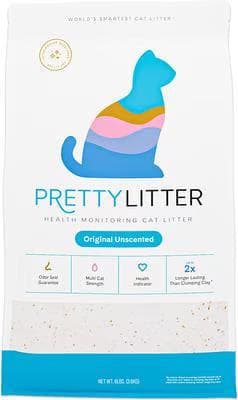
Color-changing crystal litter that flags pH shifts in your cat's urine, an early warning sign of UTIs, kidney issues, and more.
Petful may earn a commission when you click through to Chewy, at no extra cost to you.
Grooming the Double Coat
The semi-long double coat needs brushing roughly twice a week to keep the silver-tipped guard hairs free of mats and to spread skin oils that keep the shimmer looking its best. During spring and fall coat changes, more frequent brushing keeps shedding under control. A clean, well-brushed coat shows off the silver tipping far better than a neglected one, where the tips can look dull and the blue muddy.
Low-Shedding but Not Hypoallergenic
The Nebelung is often called low-shedding for a longhair, and relative to many long-coated breeds that holds up. But low-shedding does not mean hypoallergenic. No cat is truly hypoallergenic, because the main allergen, the Fel d 1 protein, lives in saliva and skin secretions, not just loose fur. Allergy-prone owners should spend time with an adult Nebelung before committing.
Lighting Changes How the Color Reads
If you have ever wondered why your Nebelung looks silver in one room and almost charcoal in another, that is the silver tipping at work. Under bright, cool daylight the tips flare and the cat reads pale and shimmery. Under warm indoor light or in shadow, the underlying blue dominates and the cat reads deeper, even slate. The color has not changed, the light has. This is also why "black Nebelung" photos circulate online: a deep slate cat shot in low light can look black until you see it in daylight.
- A glossy, evenly blue coat suggests good general condition, but color alone tells you nothing about health. Always evaluate a Nebelung on a full vet check, parentage, and temperament, not on how "rare" or deep its color looks.
Choosing a Nebelung by Color: What to Look For
If you are evaluating a kitten or adult and color matters to you, focus on the things the standard actually rewards:
- Evenness: the blue should be consistent across the body, with no rusty, brown, or patchy zones.
- Silver tipping: look for the silvery dusting, strongest on the head, shoulders, and plumed tail.
- No white: any white patch, locket, or stray white hairs are off-standard.
- Eye color for age: vivid green in an adult; yellow-green is normal and acceptable in a kitten.
- Ghost markings: faint tabby ghosting in a kitten is fine and should fade; strong bars in an adult are a fault.
Color quality tends to track with overall breeding quality and price. A well-bred pedigree Nebelung with an even, richly silvered coat and deep green eyes will sit toward the top of the price range, while pet-quality cats with minor color faults cost less. For the full breakdown of what you will pay, see our guide to Nebelung cat price, and if you are starting from a kitten, our Nebelung kitten guide walks through what to expect as the coat and eyes mature. For everything else about the breed, the full Nebelung cat profile is the place to start.
Other Semi-Longhaired Cats Worth Knowing
If the Nebelung's plush, shimmering coat appeals to you, a few other semi-longhaired breeds share that soft, dense quality even if they do not share the single-blue color rule. The Siberian cat is a hardy triple-coated breed that comes in nearly every color, the Norwegian Forest Cat is a large, weatherproof breed with a dramatic ruff, and the Burmilla carries its own shimmering silver-tipped coat from shaded and tipped genetics. None of them is a Nebelung, but each shows how silver tipping and dense coats create that luminous look people fall for.
Look for the full package, not just color: a solid blue (grey) coat carried evenly to the roots, silver-tipped guard hairs that give a misty shimmer, a semi-long double coat with a plumed tail and neck ruff, and vivid green eyes in an adult (yellow-green is normal in kittens). A short coat, white patches, copper eyes, or any non-blue color points away from a true pedigree Nebelung and toward a Russian Blue or a mixed-breed look-alike. Only a pedigree from a registered breeder confirms it for certain.
Cats show affection through slow blinks, head bunting, kneading, following you between rooms, and settling near or on you. The reserved Nebelung tends to express it quietly, bonding deeply with one or two people and showing trust through proximity and gentle slow blinks rather than loud, demanding behavior.
Yes. The Nebelung is one of the rarer pedigree breeds in the United States and worldwide, with relatively few registered breeders. Its single blue color and exacting coat standard make well-bred examples uncommon, which is part of why genuine pedigree Nebelungs command higher prices and why many "Nebelungs" sold cheaply are actually grey domestic longhairs.
The Nebelung was founded by breeding domestic cats with Russian Blue type, and the breed is essentially a longhaired Russian Blue. Breeders developed it in the United States in the mid-1980s, with Russian Blue used to lock in the signature blue color, green eyes, and elegant body while selecting for the semi-long coat.
A pedigree Nebelung kitten from a breeder typically runs about $600 to $1,500, with the deepest, most even color and best type at the top of that range. Adopting through a shelter or rescue, when one is available, is far cheaper, usually around $50 to $150, and that fee normally covers basics like vaccines, a health check, and spay or neuter.
The same answer as the breeds question: the Nebelung traces to Russian Blue crossed with domestic shorthair and longhair cats carrying the blue dilution, selected over generations for a semi-long, silver-tipped blue coat. In practice, a modern pedigree Nebelung comes from Nebelung-to-Nebelung breeding, with Russian Blue outcrosses allowed by some registries to maintain type.
Most cats dislike sudden loud noises, strong scents, dirty litter boxes, being grabbed or over-handled, and abrupt changes to their routine or territory. A sensitive, reserved breed like the Nebelung is especially put off by chaos and rough handling, so a calm, predictable home with quiet routines suits its temperament best.
Greet a cat the way another cat would: make slow, soft eye contact and give a slow blink, then let the cat approach and offer a finger at nose height to sniff. With a reserved Nebelung, a quiet, low-pressure greeting works far better than reaching in to pet, which the breed often prefers to initiate on its own terms.

Coreen Saito is a pet writer and longtime shelter volunteer with more than a decade in animal rescue. She covers cat behavior, breed care, and the small, ordinary science of sharing a life with companion animals, with a particular focus on honest takes about the products and decisions that actually matter. At home in Arizona, she's outranked by Mac (a dog with the loudest opinion in the house), Rebel (a cat who governs by quiet authority), and Meri (an orange tabby who runs the late shift and the laundry basket). She writes about all three, plus the rescues that keep coming through her life, at LifeWithMinty.com.
Sign up for expert-backed reviews and safety alerts all in one place.