Nebelung Cat: The Longhaired Russian Blue in the Mist
The Nebelung is a rare, shimmering blue-grey cat, essentially a longhaired Russian Blue. This full profile covers its silver-tipped coat, Cora Cobb origin, shy one-person temperament, grooming, long lifespan, the hypoallergenic question, and cost.
Petful is reader supported. As an affiliate of platforms like Amazon and Chewy, we may earn a commission when you buy through links on this page. There is no extra cost to you.
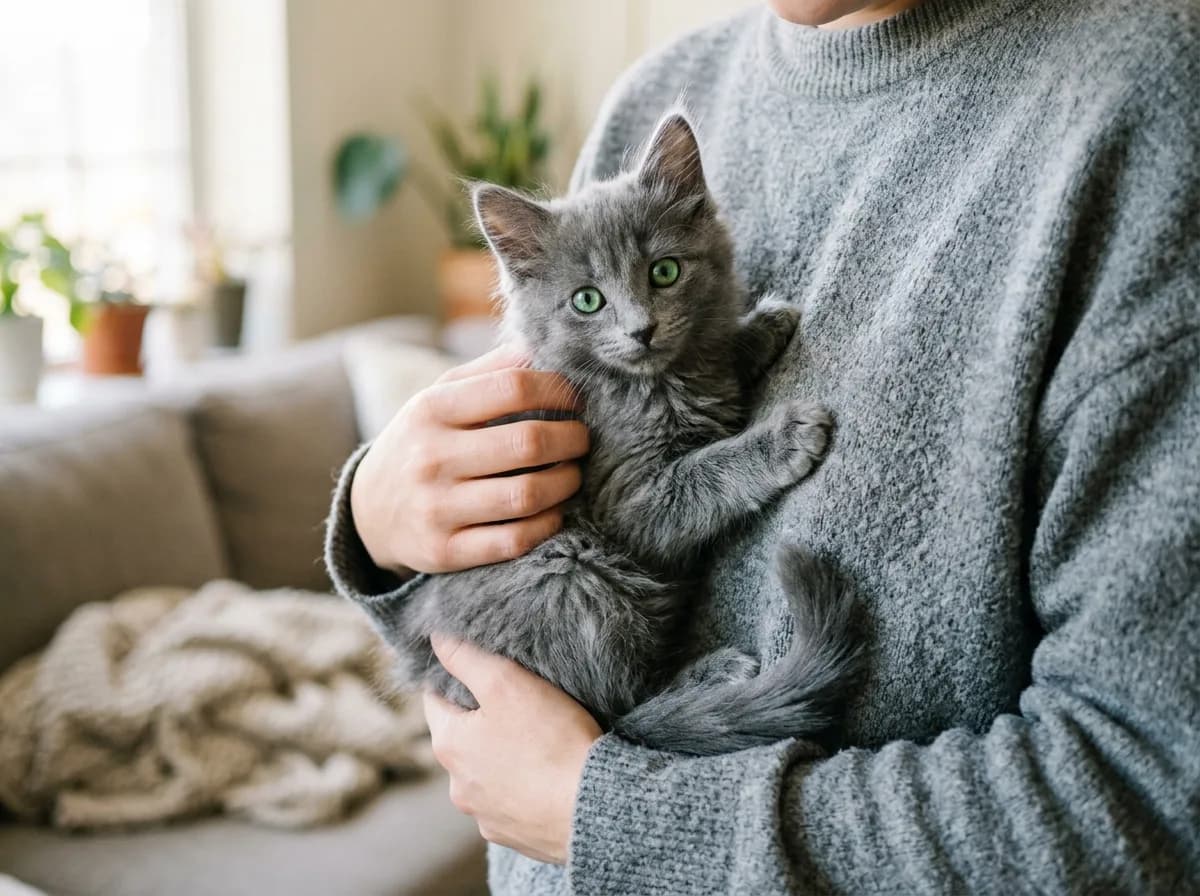
The nebelung cat is one of the rarest pedigree breeds recognized by The International Cat Association (TICA), with only a few hundred registered worldwide and active breeders you can count on two hands. If you have ever seen a shimmering blue-grey cat with a silvery sheen and wide green eyes and thought it looked like a Russian Blue wearing a longer coat, you were not far off. This is the breed that launched a thousand "is it just a fluffy Russian Blue?" questions, and the short answer is yes, essentially. Here is the long answer, from coat to cost.
- 1The Nebelung is a semi-longhaired blue cat, essentially a longhaired Russian Blue, developed in the United States in the mid-1980s by Cora Cobb.
- 2The name comes from the German word Nebel, meaning mist or fog, a nod to the coat's hazy silvery shimmer.
- 3They are gentle, reserved, and deeply bonded to one or two chosen people, often shy with strangers.
- 4Generally healthy and long-lived (roughly 13 to 18 years) with no signature genetic disease, but low-shedding does not mean hypoallergenic.

Sign up for expert-backed reviews and safety alerts all in one place.
Is the Nebelung Just a Longhaired Russian Blue?
This is the first question almost everyone asks, and it deserves a straight answer: functionally, yes. The Nebelung was built on Russian Blue foundation stock, shares the same solid blue coat color and emerald-green eyes, and most cat registries treat it as the semi-longhaired counterpart of the Russian Blue rather than an unrelated breed. TICA describes the Nebelung as resembling the longhaired cats imported from Russia in the late nineteenth and early twentieth centuries, and Russian Blues are routinely used in approved Nebelung breeding programs to keep the gene pool healthy.
The difference is coat length and the recessive long-hair gene the Nebelung carries. A Russian Blue has a short, dense, plush double coat. A Nebelung has a medium-to-long, silky double coat with a plumed tail and a ruff around the neck. Put them side by side and the body type, expression, and personality are strikingly similar. If you want the full head-to-head, see our Nebelung vs Russian Blue comparison, and for the shorthaired parent breed read our Russian Blue cat profile.
- The Nebelung carries the recessive longhair gene that a Russian Blue lacks, which is the single biggest physical difference between the two breeds.
Origin: Cora Cobb and a Cat Named in the Mist
The Nebelung is a young breed with a precise and well-documented beginning. In the early-to-mid 1980s, a Denver, Colorado computer programmer named Cora Cobb owned a black domestic shorthair named Elsa. Elsa was bred to a blue shorthaired tom that resembled a Russian Blue, and one of the resulting kittens was a striking blue-grey longhaired male. Cobb named him Siegfried after a character in Richard Wagner's opera cycle. A second litter produced a blue longhaired female, whom Cobb named Brunhilde, after another figure from the same operatic source, "Der Ring des Nibelungen."
Siegfried and Brunhilde became the founding pair of the breed. Cobb wanted a name that captured the cat's misty, silver-shimmered coat, and she drew on the German word "Nebel," meaning mist or fog. The breed name Nebelung therefore carries a double meaning: a nod to Wagner's "Nibelungen" through the founding cats' names, and a literal description of the soft, hazy sheen of the coat. TICA granted the Nebelung new breed status in 1987 and full championship status in 1997.
Because the breed traces to so few founding cats and remains genuinely rare, working with TICA-registered breeders matters more than usual. For the kitten search itself, see our guide to finding a Nebelung kitten.
The Shimmering Blue Coat: What Makes It Glow
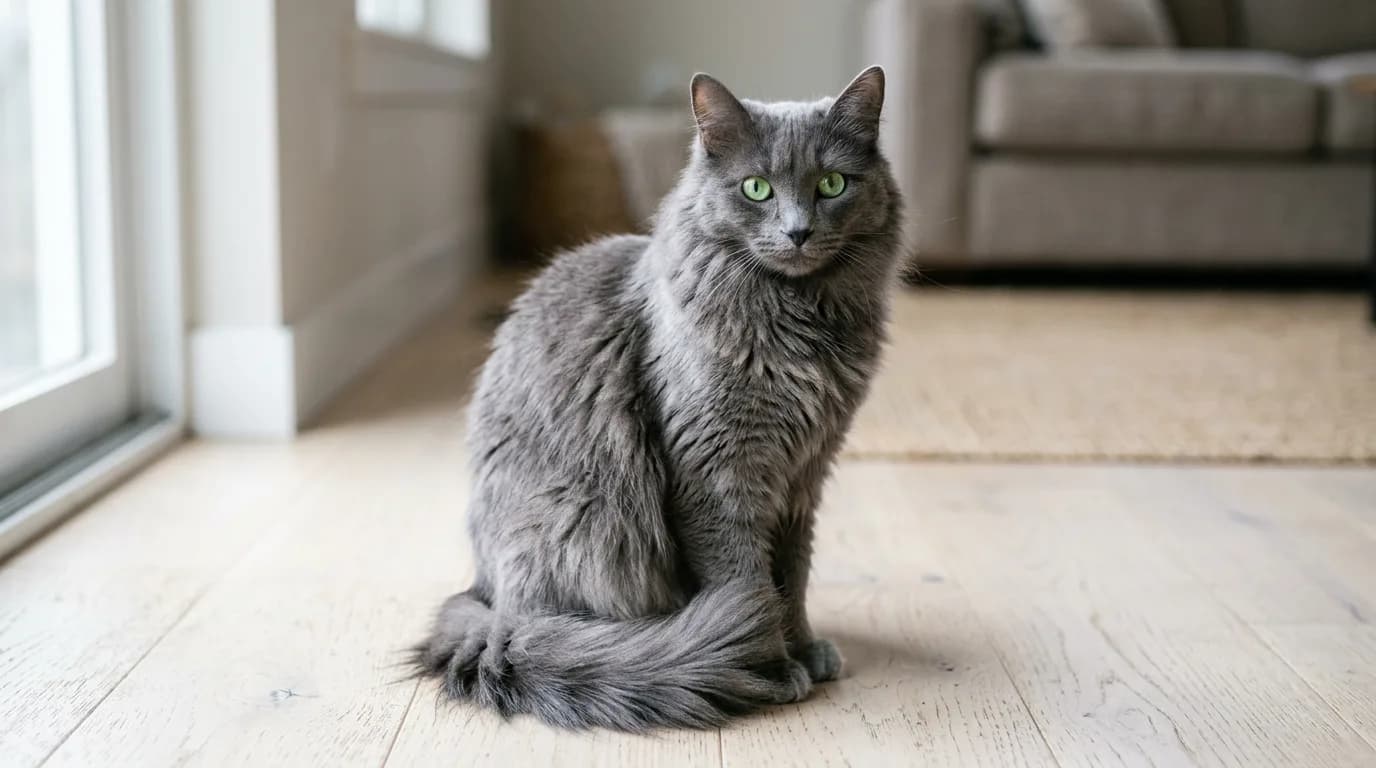
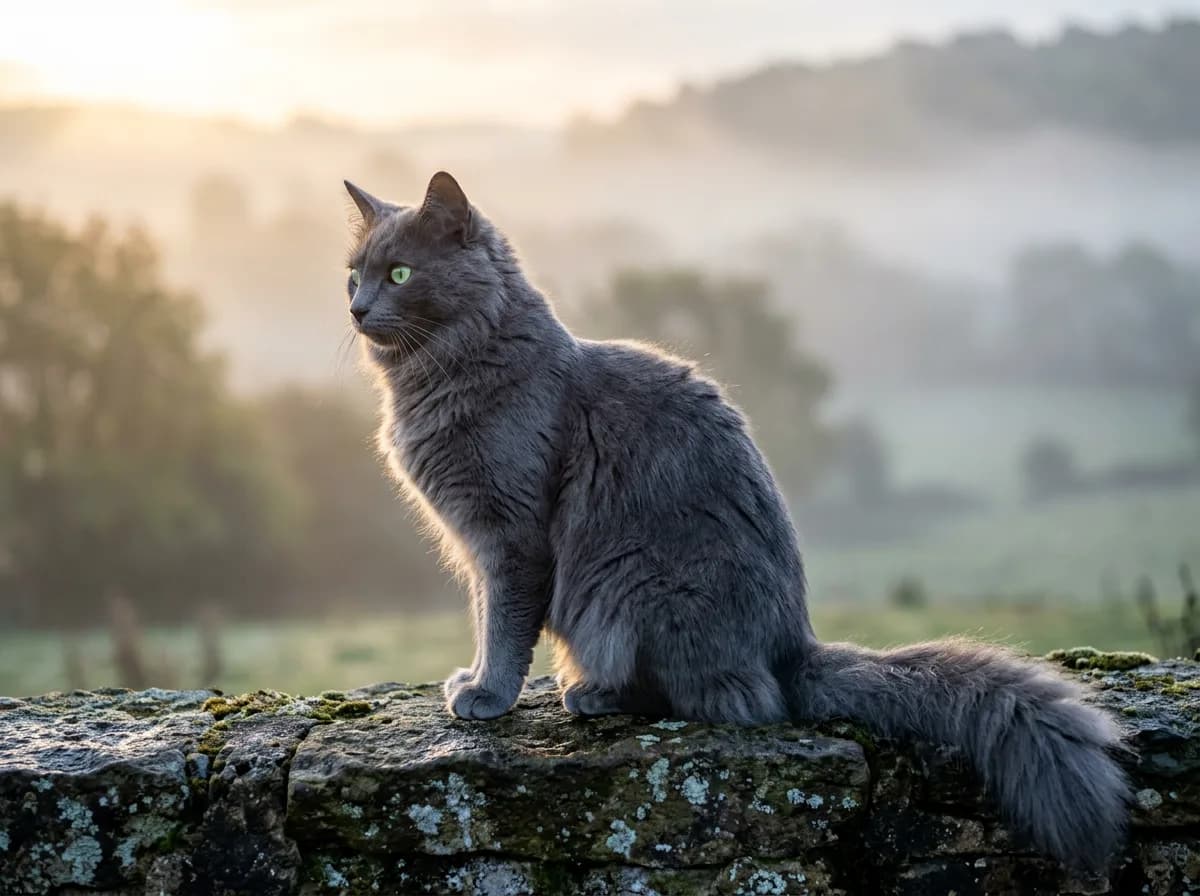
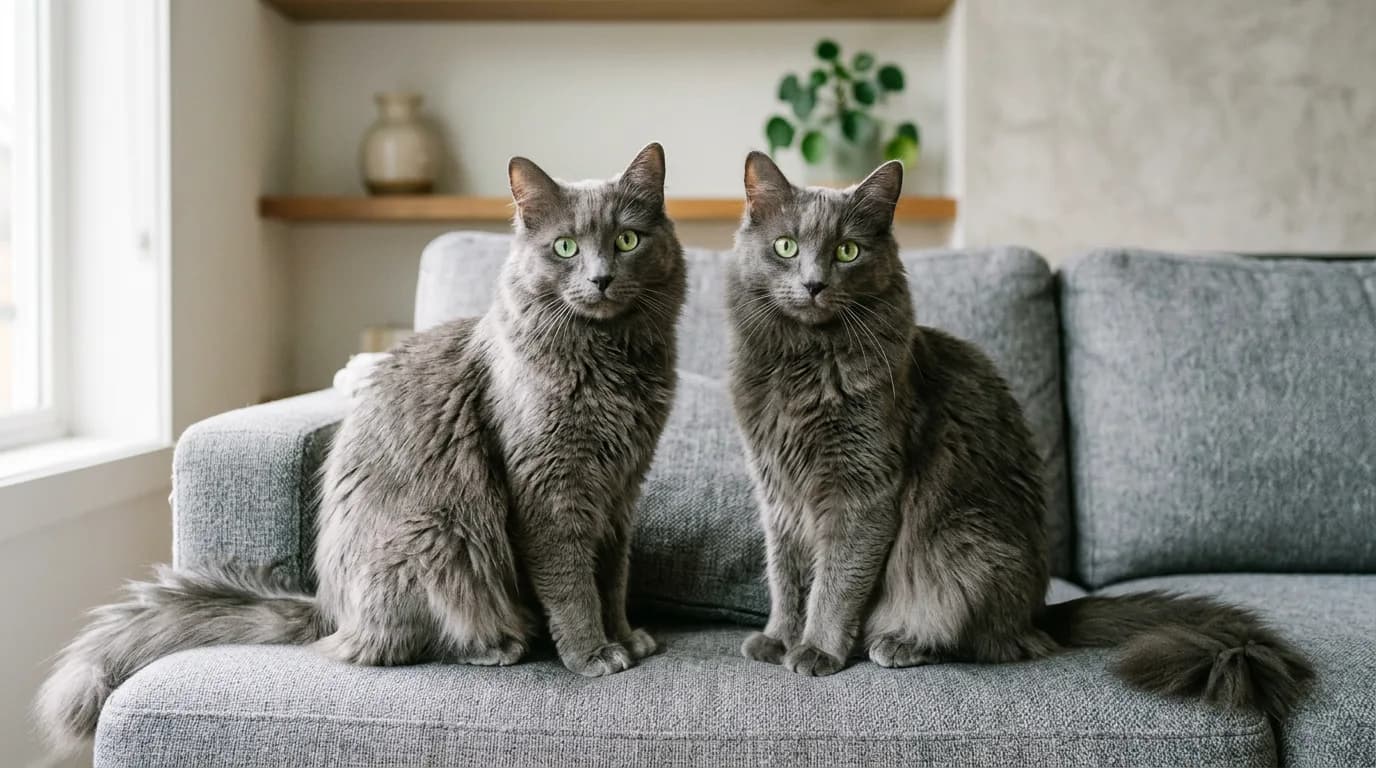
The coat is the Nebelung's signature, and it is worth understanding the structure behind the shimmer. The base color is a solid, even blue (the cat-fancy term for grey), the same dilute color seen on the Russian Blue. What sets it apart is the silver tipping: the longer guard hairs are tipped with lighter silver, and as light moves across the coat those tips catch and scatter it, producing the luminous, almost frosted "misty" effect that gives the breed its name.
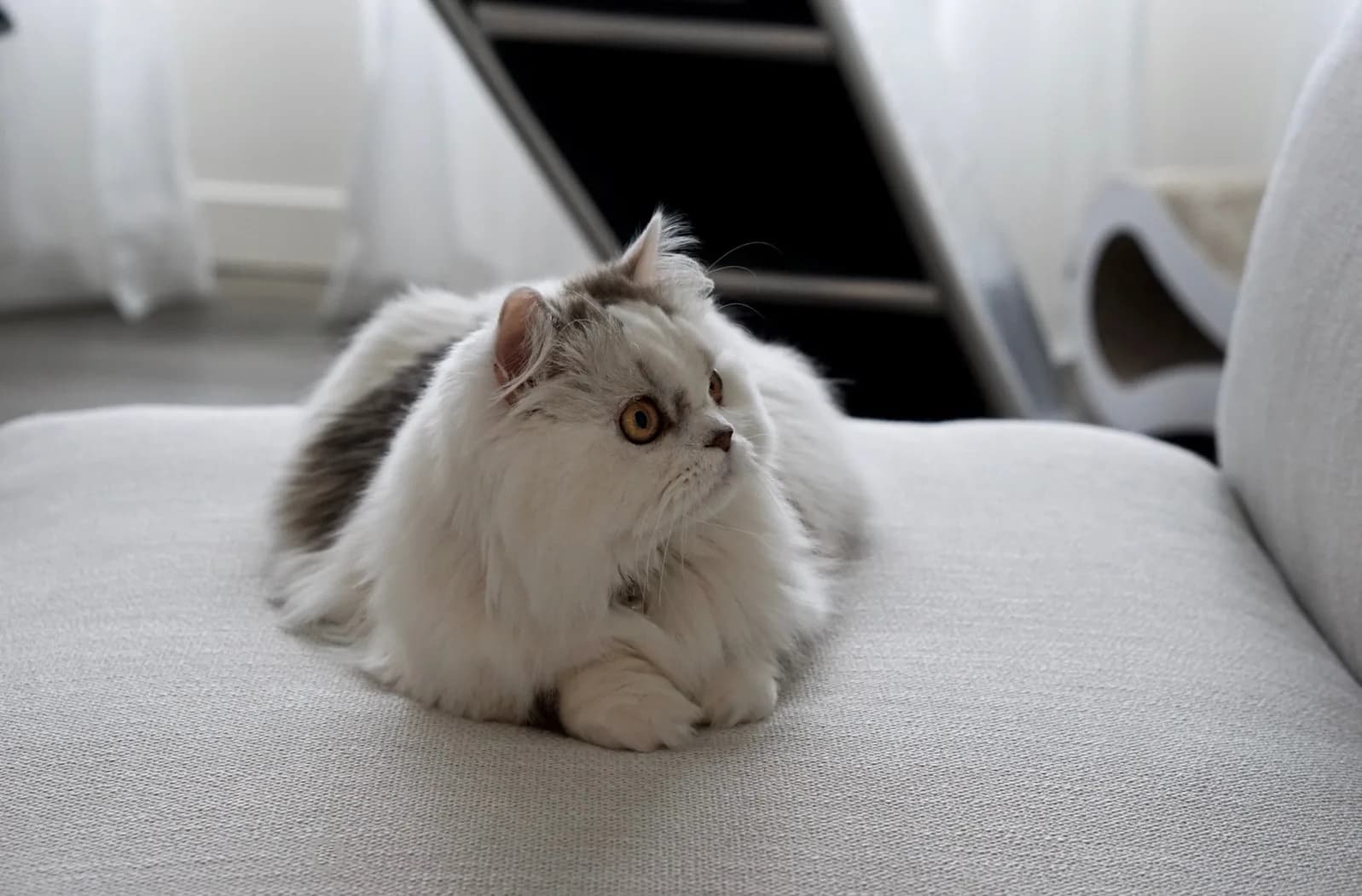
The coat is semi-long and double-layered, soft and silky rather than woolly, with a fine undercoat beneath the silver-tipped guard hairs. Mature cats develop a pronounced neck ruff and a fully plumed tail, with longer fur, called britches, on the hind legs. The eyes are a vivid green, ideally as deep as possible, and they finish the picture. Kittens are often born with yellower eyes that deepen to green as they mature.

63-inch multi-level cat tree with scratch posts, hammock, plush perches, and dangling toys. Vertical territory is non-negotiable for high-energy climbing breeds like the Bengal.
Petful may earn a commission when you click through to Chewy, at no extra cost to you.
Color and Coat Variations
By the formal breed standard, the Nebelung comes in one color: blue with silver tipping. There is no spectrum of accepted patterns the way there is in many breeds, which is part of why the look is so consistent and recognizable. The intensity of the silver sheen and the exact depth of blue can vary between individuals, and the full coat can take up to two years to develop. For the finer points of coat shade, tipping, and how it changes with age and season, see our deep dive on Nebelung cat colors.
- Silver-tipped guard hairs scatter light across a solid blue base, creating the hazy, frosted glow that gives the Nebelung its mist-inspired name.
Temperament: The Shy, One-Person Cat
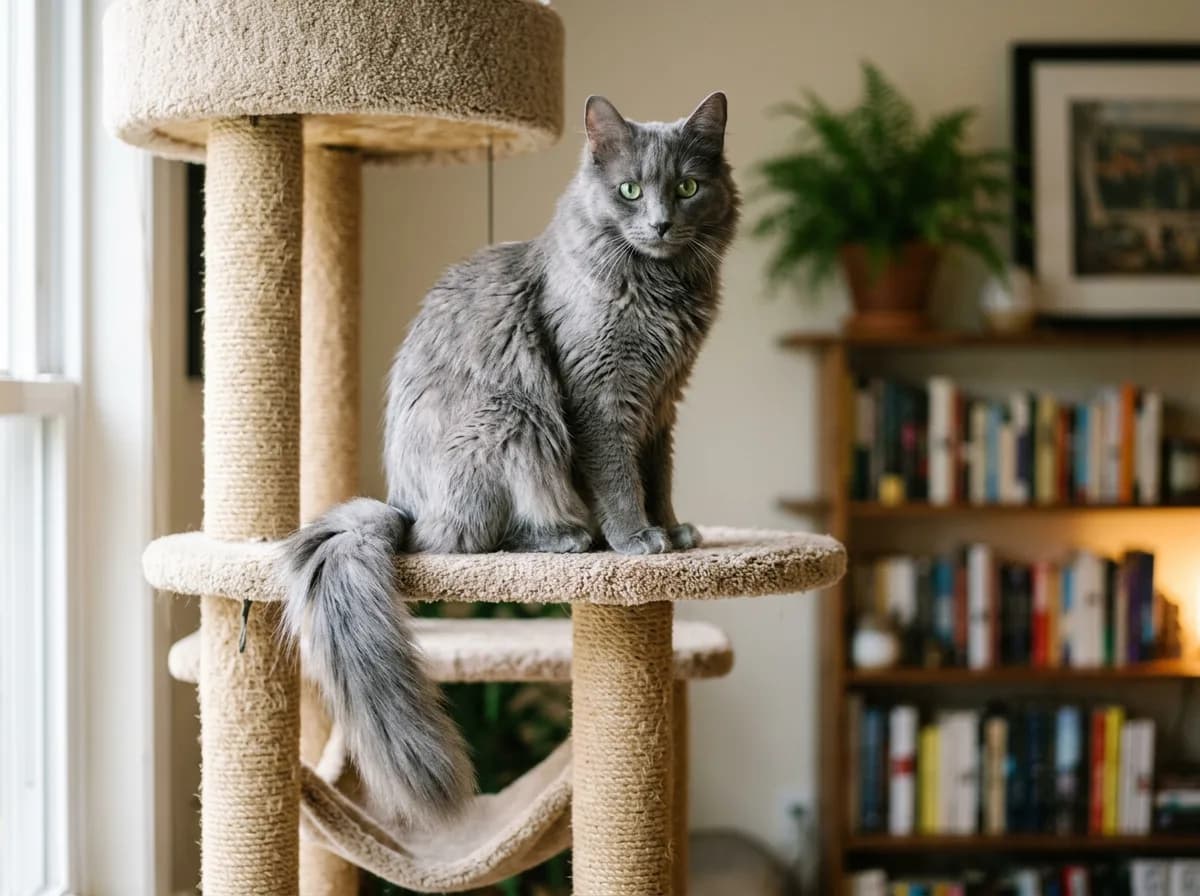
If the coat is the Nebelung's calling card, the personality is what makes owners so devoted. These are gentle, quiet, intelligent cats that form intense bonds, typically with one or two chosen people, and can be genuinely reserved with everyone else. TICA notes that while Nebelungs are devoted to their owners and family, they can be shy with strangers and young children. A Nebelung is the cat that disappears under the bed when guests arrive and then reappears to sit on your keyboard the moment the door closes.
Within their trusted circle they are affectionate, playful, and quietly communicative, with a notably soft voice. They like routine and calm households, dislike sudden change and chaos, and tend to follow their person from room to room rather than demanding constant lap time. They are active and agile enough to enjoy climbing and interactive play, but they are not frenetic. This combination, deeply loyal yet undemanding, is exactly what their fans mean when they call them the sweetest cats they have ever owned.
Are Nebelungs Good Family Pets?
They can be excellent family cats, with one caveat: they thrive best in calm, predictable homes. A busy household with very young, loud children is not their ideal setting, simply because the breed prizes quiet and routine. Older children who understand a cat's need for space, single owners, and quieter couples tend to be the best matches. They generally get along with other respectful pets once introductions are made slowly. Households that want a livelier, more rough-and-tumble longhair might look at a Norwegian Forest Cat or one of the Siberians instead.
- Nebelungs are sensitive to noise and disruption. Frequent loud commotion can make a shy Nebelung withdraw and stress, so match the breed to a calm home.
Winning a Shy Nebelung's Trust
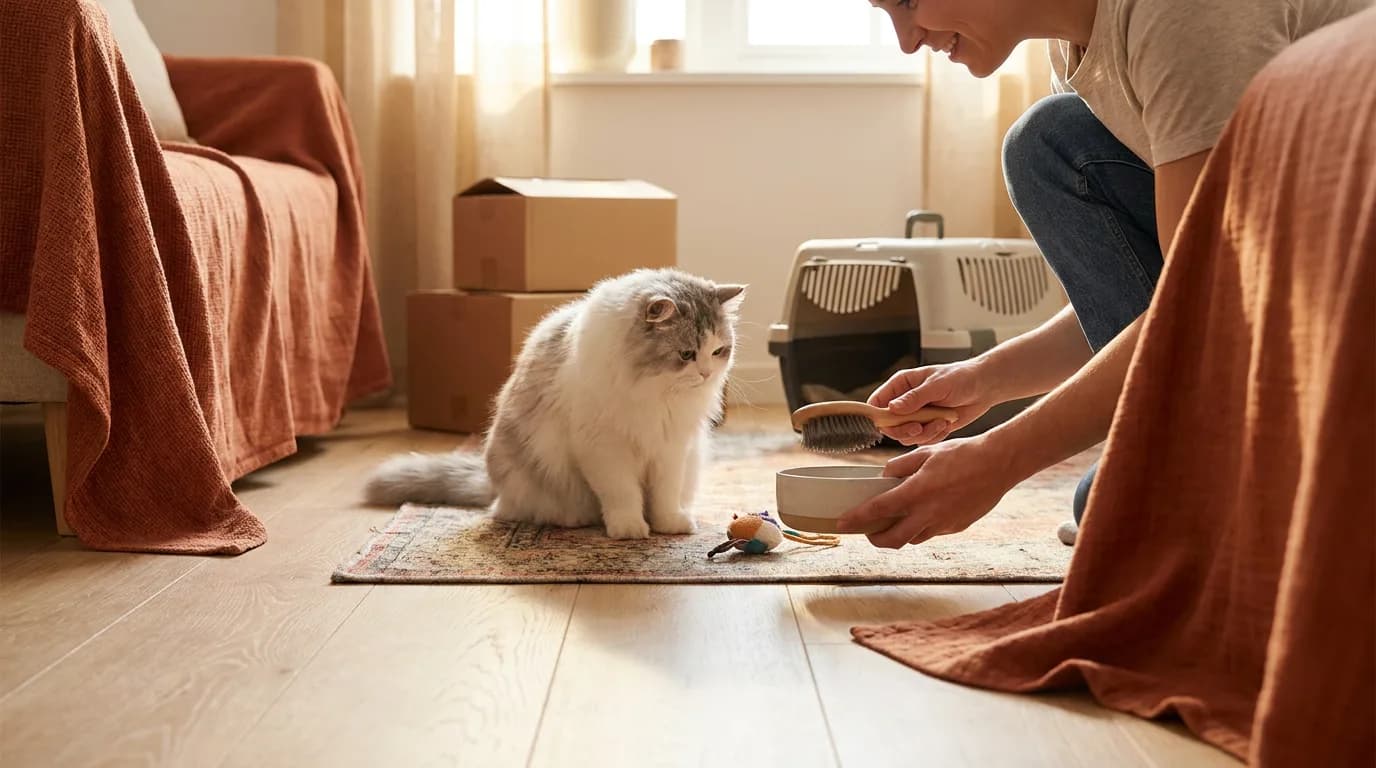
The reserve that makes a Nebelung hide from visitors is the same trait that makes its devotion feel earned. You do not win a Nebelung over by force or by chasing it, you win it over by being predictable and patient. A concrete plan, especially in the first few weeks with a new cat, pays off for years.
Start by shrinking the world. Drop a new Nebelung into a single quiet room with its litter box, food, water, a hiding spot, and a tall perch, rather than turning it loose in the whole house. A smaller territory feels safer and lets the cat learn one space, and your scent and rhythm, before facing the rest of the home. Let it come out of hiding on its own schedule and resist the urge to pull it from under the bed.
From there, build trust on the cat's terms with a handful of repeatable habits:
- Sit on the floor at the cat's level and read or work quietly, letting it approach you rather than reaching for it.
- Keep your voice low and even. Nebelungs are soft-spoken and respond to calm tones far better than to loud greetings.
- Use food and play as a bridge. Toss a treat a short distance away, then a little closer over days, and use a wand toy so interaction starts at a comfortable distance.
- Let the cat sniff your hand before any contact, and offer slow blinks, which cats read as a non-threatening signal.
- Keep a steady daily routine for feeding and play, because predictability is what a routine-loving breed reads as safety.
Progress is measured in small wins: the cat eating while you are in the room, then sitting in view, then following you between rooms, then finally choosing your lap. Pushing faster than the cat is ready for usually backfires and sends it back into hiding, so let each step settle before expecting the next. Owners who respect that pace almost universally end up with the velcro-close companion the breed is famous for.
- Let a shy Nebelung set the pace. A single quiet starter room, a steady routine, and approaches on the cat's terms turn a hider into a devoted shadow within weeks.
Living With a Nebelung: Children, Dogs, and Other Cats
Temperament on paper is one thing; what daily life actually looks like is another. The Nebelung's quiet, routine-loving nature shapes how it fits with the rest of a household, and knowing the specifics helps you set the cat up to thrive rather than retreat.
With children, the breed does best alongside older, gentler kids who understand that a cat is not a toy and that a hiding cat wants to be left alone. Toddlers and very young children, with their sudden movements and unpredictable noise, are the hardest match, not because a Nebelung is aggressive (it is the opposite, it withdraws rather than swats) but because constant startling keeps a sensitive cat stressed. A child taught to let the cat approach first, and to play with a wand toy rather than grabbing, can absolutely earn a Nebelung's friendship.
With dogs, success comes down to the dog's temperament far more than the cat's. A calm, cat-savvy dog that does not chase is usually accepted after slow, scent-first introductions, and many Nebelungs live happily with one. A high-energy dog that treats the cat as something to pursue is the wrong housemate, since it triggers exactly the flight-and-hide response the breed defaults to. Introduce the two gradually, with barriers and supervised sessions, and let the cat keep high perches and an escape route it can always reach.
With other cats, Nebelungs are generally sociable once the relationship is established, and a second calm, compatible cat can be good company, especially in homes where people are out for long stretches. Some Nebelung owners deliberately keep a pair. As with any cat, the introduction should be slow and scent-led rather than a sudden face-to-face meeting, and resources like litter boxes, water, and perches should be plentiful enough that no cat has to compete.
Apartments, Indoor Life, and Time Alone
The Nebelung is well suited to apartment and indoor living. It is active and agile but not hyper, so it does not need acres to roam, and as a relatively rare and valuable breed it should be kept indoors anyway for safety. What it does need is vertical space and engagement: a tall cat tree or shelf to survey the room from, window perches, puzzle feeders, and regular interactive play keep an indoor Nebelung physically and mentally satisfied. A bored, under-stimulated cat of any breed can turn restless, and the Nebelung's intelligence means it genuinely benefits from problem-solving toys.
On time alone, the Nebelung lands in the middle of the range. It is not as separation-prone as some of the clingiest breeds, and a well-adjusted adult handles an ordinary workday on its own without distress, provided it has enrichment and a predictable return. That said, this is a deeply people-bonded cat, and long, repeated absences are hard on it. For owners who travel often or work very long days, a compatible feline companion or a reliable visitor goes a long way toward keeping a Nebelung content.
- Vertical space, daily interactive play, and a steady routine keep a Nebelung happy in an apartment. Keep this rare breed indoors, and consider a second calm cat if you are often away.
Grooming the Semi-Longhaired Coat
For a longhaired cat, the Nebelung is refreshingly low-maintenance, but "low" is not "none." The silky double coat resists matting better than the woolly coats of some longhairs, yet it still benefits from regular attention to stay tangle-free and to manage shedding.
Walnut shell clumping cat litter that excels at odor control, lasts up to 3x longer than clay, and is a top pick for multi-cat households.
Petful may earn a commission when you click through to Chewy, at no extra cost to you.
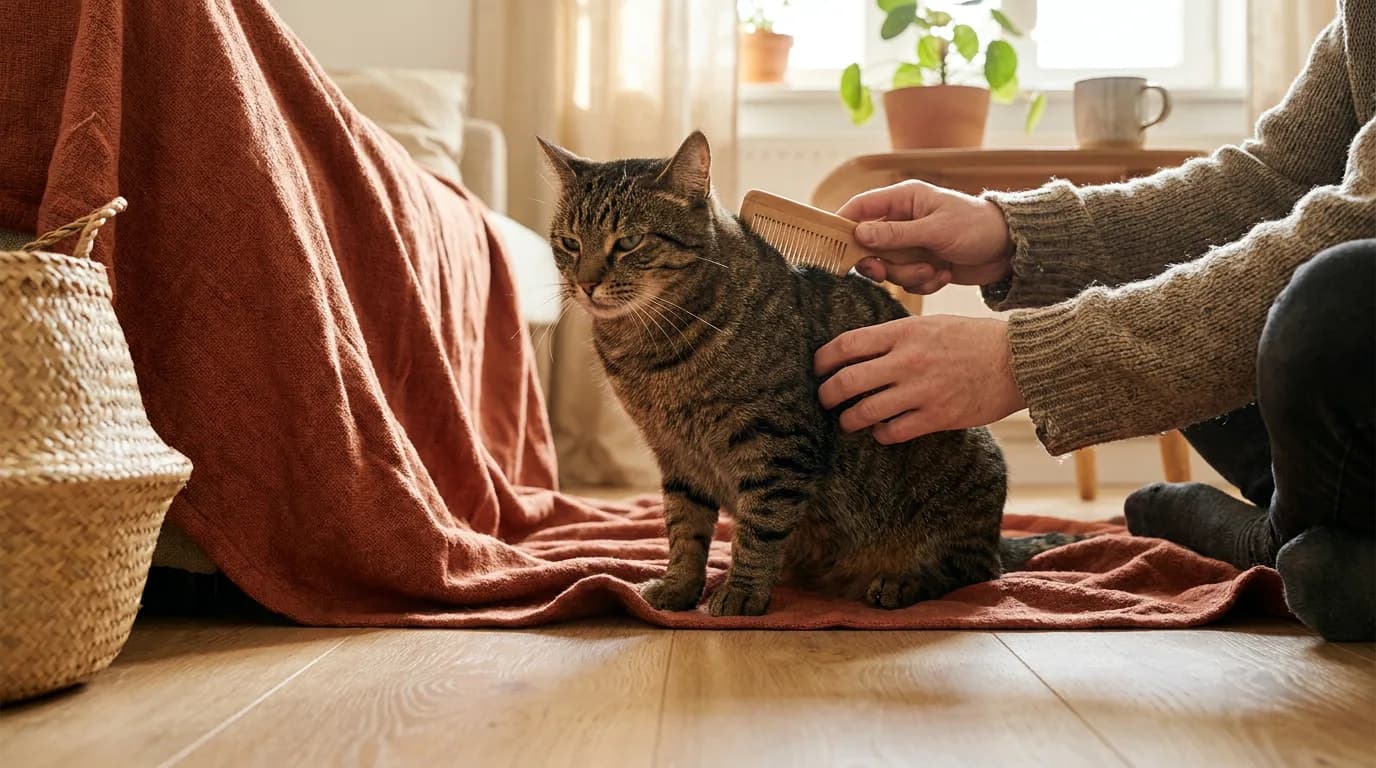
Aim to brush two to three times a week with a stainless-steel comb or a soft slicker, increasing to near-daily during the heavier spring and autumn seasonal shed. Pay extra attention to the ruff, the britches on the hind legs, and the area behind the ears, where mats form first. Routine care otherwise mirrors any well-kept cat: weekly nail trims, regular dental care, and ear checks.
Nebelung Grooming at a Glance
| Task | Frequency | Why It Matters |
|---|---|---|
| Comb the coat | 2 to 3 times per week | Prevents mats in the ruff and britches and lifts loose undercoat |
| Brush during shed season | Near-daily in spring and autumn | Controls the heavier seasonal blowout of the double coat |
| Trim nails | Every 2 to 3 weeks | Protects furniture and keeps claws healthy |
| Brush teeth | 2 to 3 times per week | Reduces the dental disease common in many cats |
| Check ears and eyes | Weekly | Catches early signs of infection or irritation |
A stainless-steel comb is worth more than any brush here, because it reaches the undercoat where mats actually start. A surface brush alone can glide over hidden tangles sitting against the skin.
The Seasonal Grooming Routine in Detail
The Nebelung's double coat does not shed at a steady rate year-round. It runs on a seasonal cycle, and the smartest grooming plan tracks that cycle rather than treating every week the same. Understanding the rhythm turns grooming from a chore into a short, predictable habit.
In late autumn and through winter, the coat is at its fullest. The undercoat thickens for insulation, the ruff around the neck reaches its densest point, and the plumed tail and britches carry the most fur. This is when mats are most likely to form deep against the skin, so a thorough comb-through twice a week, working all the way down to the skin rather than skimming the surface, keeps the dense winter coat in order.
In spring the cat blows that winter undercoat, and this is the heaviest shed of the year. For roughly three to four weeks you will see noticeably more loose fur, and daily combing earns its keep here. A fine-toothed comb followed by a wide-toothed pass lifts the dead undercoat before it can knot or end up across the furniture. Skipping this window is the single most common reason a Nebelung develops mats, because shed undercoat that is not combed out felts together against the skin.
Through summer the coat is at its lightest and grooming can drop back to once or twice a week. Then a second, usually milder shed arrives in autumn as the cat trades the summer coat for the incoming winter one. Building the routine around these four phases, dense winter, heavy spring blowout, light summer, and a modest autumn turnover, keeps the coat healthy with far less effort than a panicked detangling session after weeks of neglect.
- Comb hardest during the spring blowout (roughly three to four weeks of heavy shedding) and ease off in summer. Matching grooming to the seasonal cycle prevents almost all matting.
A few practical points smooth the whole process. Work in short sessions of five to ten minutes rather than one long marathon, since a reserved cat tolerates brief, calm handling far better than being pinned down. Comb in the direction the fur grows, lift gently at any tangle rather than dragging through it, and finish on a positive note with a treat or play so the cat associates the comb with something good. A Nebelung groomed this way from kittenhood will usually settle into the routine willingly for life.
Health and the Nebelung's Long Lifespan
Here is reassuring news for anyone weighing the breed: the Nebelung is generally a healthy, hardy cat with no signature breed-specific genetic disease. Both TICA and breed clubs describe it as a robust, naturally developed breed with few inherited problems, which is partly a benefit of its recent origin and its broad foundation in domestic and Russian Blue stock.
Lifespan is a genuine strong point. Nebelungs commonly live roughly 13 to 18 years, and reaching eighteen is not unusual for a well-cared-for indoor cat. Because they are not predisposed to a particular hereditary condition, the health priorities are the ordinary ones that apply to any cat: maintain a healthy weight to avoid obesity, keep up with dental care to prevent periodontal disease, provide fresh water and a complete diet, and keep current on routine veterinary checkups and vaccinations. Their love of routine actually helps here, since a stable, indoor, low-stress life suits both their temperament and their longevity.
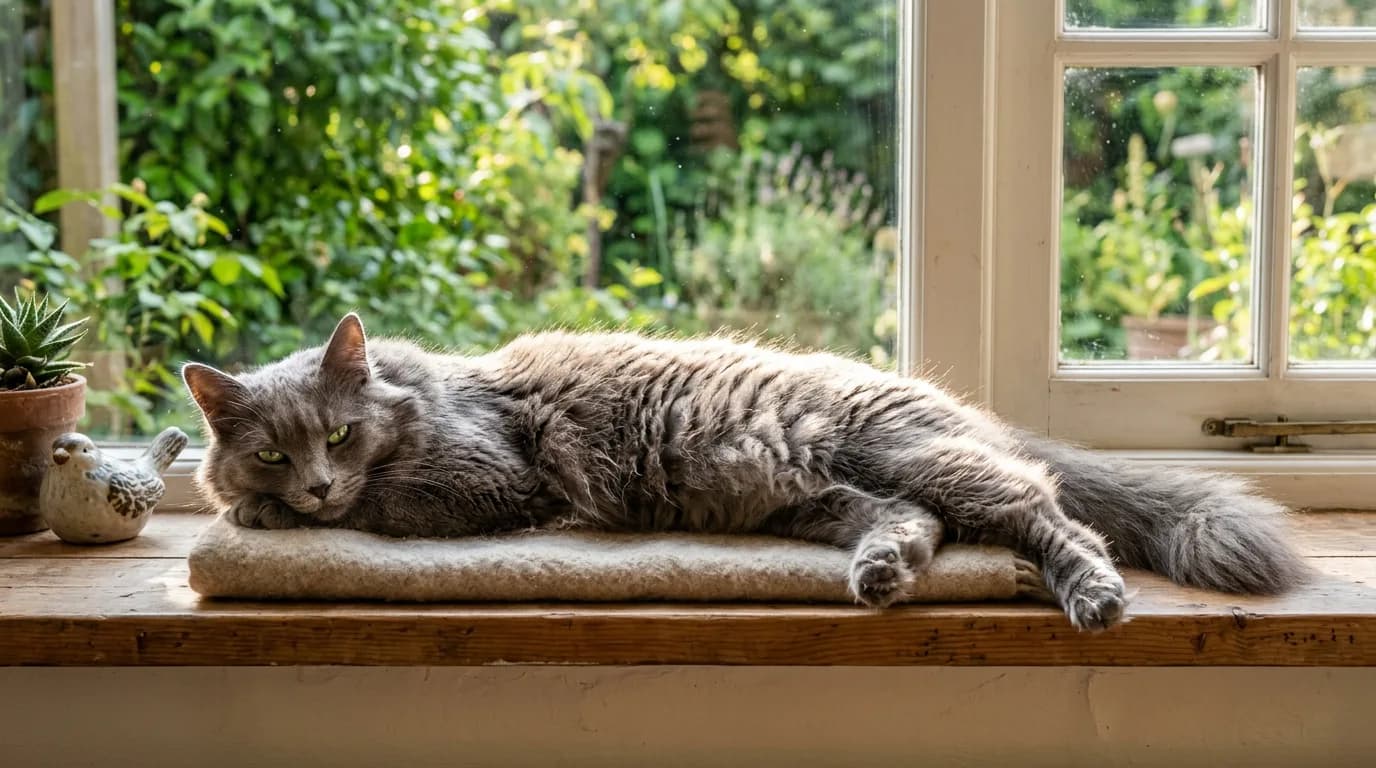
- With no breed-specific genetic disease and a typical lifespan of 13 to 18 years, the Nebelung is one of the healthier pedigree cats you can choose.
What to Watch Across a Long Life
A clean genetic record does not mean a Nebelung gets a free pass on health. It means the risks are the everyday ones common to all cats, and the owner's job is to manage those well across a long lifespan rather than to dread an inherited disease. A few areas deserve steady attention.
Weight is the first. The Nebelung's calm, indoor lifestyle and love of routine make it easy to overfeed, and obesity is the quiet driver behind a long list of feline problems, including diabetes, joint strain, and a shorter life. Measure meals rather than free-feeding a bowl that is always full, and keep the cat moving with daily play. A lean Nebelung is a long-lived Nebelung.
Dental disease is the second. Periodontal problems are among the most common health issues in cats overall, and they build silently over years. Regular tooth brushing, dental treats, and professional cleanings when your veterinarian advises them protect not just the mouth but the whole body, since chronic dental infection taxes other organs. Because the Nebelung often lives into its mid- or late teens, dental care compounds over a long horizon.

108-oz stainless steel pet fountain with quiet pump and water-level window. Bengals are notoriously water-obsessed; a flowing fountain encourages hydration and pulls them away from sinks and toilets.
Petful may earn a commission when you click through to Chewy, at no extra cost to you.
As the cat ages past about ten, the priorities shift toward the conditions of senior cats generally rather than anything breed-specific: kidney function, thyroid levels, blood pressure, and arthritis. None of these is a Nebelung peculiarity, but a long-lived breed simply spends more years in the senior window, so twice-yearly wellness exams and routine bloodwork in the later years catch problems early, when they are most manageable. Keeping a Nebelung indoors also removes the biggest external threats, from traffic to infectious disease to predators, which is a meaningful part of why the breed reaches the upper end of its lifespan range so often.
One responsible-breeding note ties back to the gene pool. Because the Nebelung descends from a small number of founding cats, ethical breeders deliberately outcross to Russian Blues to keep genetic diversity healthy and avoid the inbreeding depression that can creep into any rare breed. A buyer's best health insurance is therefore a breeder who can speak to their lines, their outcrossing, and the health of their breeding cats.
Is the Nebelung a Recognized Breed?
Registry status often confuses people shopping for a Nebelung, partly because recognition is not uniform across the cat-fancy world. The clearest way to understand it: the Nebelung is fully recognized by some major registries and treated differently, or not separately recognized at all, by others.
The Nebelung's home registry is The International Cat Association (TICA), which granted it new breed status in 1987 and elevated it to full championship status in 1997, meaning Nebelungs can compete for titles at TICA shows. Several other registries also recognize the breed, including bodies in Europe, and the World Cat Federation acknowledges it as well. This recognition is what lets a kitten carry genuine pedigree papers tracing back to the breed's documented lines.
Recognition is not universal, though. The Cat Fanciers' Association (CFA), the largest registry in the United States, has historically not recognized the Nebelung as a separate championship breed, in part because it is viewed as so close to the Russian Blue. This is exactly why pedigree paperwork matters when you buy: a "Nebelung" without registration tracing to recognized lines is, in practical terms, an unregistered longhaired blue cat rather than a documented pedigree. When evaluating a breeder, ask specifically which registry their cats are registered with and ask to see the paperwork.
- The Nebelung earned TICA championship status in 1997 and is recognized by several other registries, though not by every major body. Insist on pedigree papers from a recognized registry when buying.
Are Nebelung Cats Hypoallergenic?
This is one of the most common and most misunderstood questions about the breed, so let us be precise. No cat is truly hypoallergenic, and the Nebelung is not an exception. The allergen that affects most people is a protein called Fel d 1, produced in a cat's saliva and skin glands and spread onto the coat during grooming, not the fur or shedding itself.
The Russian Blue and, by extension, the Nebelung are sometimes described as more allergy-friendly because some lines appear to produce somewhat lower levels of Fel d 1, and the Nebelung's relatively low shedding means less allergen-laden hair drifting around the home. That can make a real, practical difference for some mildly allergic owners. But it is a reduction, not a guarantee. Anyone with a known cat allergy should spend extended time with an individual Nebelung before committing.
- The Nebelung sheds less than many longhairs and may carry lower Fel d 1, but it is not hypoallergenic. Test your own reaction in person before buying.
How Much Does a Nebelung Cat Cost?
Because the Nebelung is so rare, with very few active breeders, it is one of the pricier pedigree cats to acquire, and the cost does not stop at the purchase price. From a reputable, TICA-registered breeder, a Nebelung kitten typically runs in the range of roughly 1,000 to 2,000 US dollars, and show-quality or specially marked kittens can run higher. Waiting lists are common precisely because litters are few.
The bigger picture is lifetime cost. Over a 13 to 18 year life you are looking at food, litter, routine veterinary care, vaccinations, and the inevitable occasional illness or emergency. For a realistic breakdown of purchase price by quality, plus ongoing yearly costs and what drives them, see our full guide to Nebelung cat price.

Color-changing crystal litter that flags pH shifts in your cat's urine, an early warning sign of UTIs, kidney issues, and more.
Petful may earn a commission when you click through to Chewy, at no extra cost to you.
Typical Nebelung Costs
| Expense | Typical Range | Notes |
|---|---|---|
| Kitten from a registered breeder | 1,000 to 2,000 USD | Pet quality; show or rare lines cost more |
| Initial setup | 150 to 400 USD | Carrier, litter box, tree, bowls, and starter supplies |
| First-year vet care | 200 to 500 USD | Exams, vaccinations, spay or neuter if not done |
| Annual food and litter | 400 to 700 USD | Quality complete diet plus litter |
| Routine yearly vet care | 150 to 400 USD | Wellness exam, dental, parasite prevention |
- A Nebelung offered far below the typical breeder range is a red flag for a mislabeled domestic longhair or a poorly run operation. Verify TICA registration and meet the breeder.
How to Identify a Nebelung
Because the breed is rare and looks like a longhaired Russian Blue, plenty of blue-grey fluffy cats get hopefully labeled "Nebelung" when they are actually mixed-breed domestic longhairs. True breed identity comes down to documented pedigree, but the physical markers are clear. Look for a solid, even blue coat with distinct silver tipping on the guard hairs, a semi-long silky double coat with a plumed tail and neck ruff, vivid green eyes (not gold or copper), a long and graceful body, and the characteristically shy, gentle, one-person temperament.
The only way to confirm a cat is genuinely a Nebelung rather than a Russian-Blue-mix lookalike is registration papers from TICA or another recognized registry tracing back to the breed's lines. A grey longhaired shelter cat with green eyes may share the look, and may be a wonderful pet, but without that lineage it is a domestic longhair, not a pedigree Nebelung.
Nebelung vs the Other Blue Breeds
"Blue" cats, the soft slate-grey color the cat fancy calls blue, show up in several breeds, and the Nebelung is regularly mistaken for all of them. Sorting out who is who helps both with identification and with choosing the right cat for your home, because while several breeds share the color, their coats, builds, and personalities diverge sharply.
The closest relative by far is the Russian Blue, and the relationship is essentially parent to longhaired offshoot. Both share the solid blue coat, the silver-tipped sheen, the vivid green eyes, the elegant long body, and the gentle, reserved temperament. The decisive difference is coat length: the Russian Blue wears a short, dense, plush double coat, while the Nebelung carries the recessive longhair gene that gives it a semi-long silky coat, a neck ruff, a plumed tail, and britches. In daily life that means the Russian Blue needs only occasional grooming while the Nebelung needs regular combing, but their care, health profile, and personality are otherwise nearly interchangeable. For the full side-by-side, see our Nebelung vs Russian Blue comparison.
The Chartreux, a French breed, is another blue cat often confused with the Nebelung, but the two are easy to separate once you know what to look for. The Chartreux has a short, dense, water-resistant blue coat (never long), a notably round head with a smiling expression, a sturdy, robust build, and copper to gold eyes rather than green. Eye color alone usually settles it: a green-eyed blue longhair is not a Chartreux.
The British Shorthair appears in blue as well, often called the British Blue, and is sometimes mistaken for these breeds at a glance. It is the most physically different of the group: cobby and thickset with a very round face, dense plush short fur, and typically copper or orange eyes. Its build and face shape look little like the long, lean, green-eyed Nebelung once you see them together. There is also a longhaired British variant (sometimes called the British Longhair), but its heavy, rounded body type keeps it visually distinct from the Nebelung's slender elegance.
Beyond the dedicated blue breeds, many domestic longhairs and shorthairs are simply grey, and these are the lookalikes most often hopefully labeled Nebelung. The tells that point to a true Nebelung rather than a generic grey cat are the combination of an even solid blue coat with silver tipping, green (not gold or copper) eyes, the long graceful body, the reserved one-person temperament, and, ultimately, the pedigree papers no random grey cat will have. If your candidate is a fluffier, more rugged grey cat with a different build, a heavier-coated breed like the Norwegian Forest Cat or a Siberian may be closer to what you are actually looking at.
| Breed | Coat | Eye Color |
|---|---|---|
| Nebelung | Semi-long, silky, silver-tipped | Vivid green |
| Russian Blue | Short, dense, plush, silver-tipped | Vivid green |
| Chartreux | Short, dense, water-resistant | Copper to gold |
| British Blue (Shorthair) | Short, plush, cobby build | Copper to orange |
Finding a Nebelung Cat
Given the breed's rarity, finding a Nebelung takes patience. Start with TICA's breeder listings and breed-specific clubs, expect a waiting list, and be prepared to travel or arrange transport, since there may be no breeder nearby. A responsible breeder will health-screen their cats, raise kittens underfoot in the home, provide registration paperwork, and ask you plenty of questions in return. Rescue is also possible, though rare; breed-specific and Russian Blue rescues occasionally have Nebelungs or close mixes. Whichever route you take, prioritize health, temperament, and documentation over getting a kitten fast.
The Nebelung at a Glance
| Trait | Detail | Notes |
|---|---|---|
| Origin | United States, mid-1980s | Developed by Cora Cobb from Russian Blue stock |
| Coat | Semi-long, silky double coat | Solid blue with silver-tipped guard hairs |
| Eyes | Vivid green | Deepen from yellow-green with maturity |
| Temperament | Gentle, shy, one-person | Reserved with strangers, devoted to family |
| Lifespan | 13 to 18 years | No signature genetic disease |
| Grooming | Moderate | Comb 2 to 3 times weekly, more in shed season |
| Hypoallergenic | No | Low-shedding and possibly lower Fel d 1, not allergy-proof |
Frequently Asked Questions
The Nebelung was created from Russian Blue type stock crossed with domestic shorthairs that carried the recessive longhair gene. Founder Cora Cobb bred a black domestic shorthair to a blue shorthaired tom resembling a Russian Blue, and approved breeding programs still use Russian Blues today, which is why the Nebelung is essentially a longhaired Russian Blue.
Very rare. The Nebelung is one of the least common pedigree breeds, with only a few hundred registered cats worldwide and a small number of active TICA breeders, so waiting lists are normal.
Yes. Because so few breeders exist, a Nebelung kitten from a registered breeder typically costs roughly 1,000 to 2,000 US dollars, with show-quality cats running higher, plus ongoing food, litter, and veterinary costs over a long life.
Look for a solid blue coat with silver-tipped guard hairs, a semi-long silky double coat with a plumed tail and neck ruff, vivid green eyes, a long graceful body, and a shy, gentle, one-person temperament. True breed identity, however, can only be confirmed with TICA or other registry pedigree papers; without them a lookalike is a domestic longhair, not a Nebelung.
Yes, the Nebelung is one of the more expensive cats to buy, generally 1,000 to 2,000 US dollars for a pet-quality kitten from a reputable breeder, driven by how few breeders raise the breed.
The figure usually refers to the Ashera, a marketing-hyped designer hybrid that was advertised at around 100,000 dollars, and to high-end Savannah or Bengal hybrids, not to the Nebelung. A Nebelung is far more affordable, in the low thousands.
A Nebelung kitten from a registered breeder typically costs about 1,000 to 2,000 US dollars up front, then several hundred dollars a year for food, litter, and routine veterinary care across a 13 to 18 year lifespan.
Taylor Swift's cats are not Nebelungs. Her cats Olivia Benson and Meredith Grey are Scottish Folds, and Benjamin Button is a Ragdoll. The Nebelung is sometimes confused with grey longhaired breeds, but it is its own rare, Russian Blue derived breed.

Coreen Saito is a pet writer and longtime shelter volunteer with more than a decade in animal rescue. She covers cat behavior, breed care, and the small, ordinary science of sharing a life with companion animals, with a particular focus on honest takes about the products and decisions that actually matter. At home in Arizona, she's outranked by Mac (a dog with the loudest opinion in the house), Rebel (a cat who governs by quiet authority), and Meri (an orange tabby who runs the late shift and the laundry basket). She writes about all three, plus the rescues that keep coming through her life, at LifeWithMinty.com.
Sign up for expert-backed reviews and safety alerts all in one place.