Egyptian Mau vs Bengal: How to Tell These Two Spotted Cats Apart
Egyptian Mau vs Bengal compared: how to tell single spots from rosettes, gooseberry-green eyes vs gold, size, speed, temperament, health, and price, so you can pick the right spotted cat for your home.
Petful is reader supported. As an affiliate of platforms like Amazon and Chewy, we may earn a commission when you buy through links on this page. There is no extra cost to you.
In the egyptian mau vs bengal debate, the Cat Fanciers' Association (CFA) draws one clean line: the Egyptian Mau is the only naturally spotted domestic cat, an ancient landrace whose markings sit on individual hairs, while the Bengal is a modern hybrid engineered from a wild Asian leopard cat and recognized for rosettes the Mau never has. They look like littermates at a glance, both lithe, both wild-patterned, both fast, yet they sit on opposite ends of cat history. One was painted on tomb walls 3,000 years ago; the other was invented in a California breeding program in the 1960s. This guide breaks down every difference that matters: how to identify each by sight, how their temperaments diverge, what they cost, and which one fits your home.
- 1The Egyptian Mau is a natural breed with single random spots and gooseberry-green eyes; the Bengal is a hybrid with two-tone rosettes and gold or green eyes
- 2Bengals are larger (8-15 lb) and higher-energy; Maus are smaller (6-14 lb), faster in a sprint, and more reserved with strangers
- 3The Mau wears an M or scarab mark, mascara lines, and a loose belly flap that lets it run up to 30 mph (VCA)
- 4Bengals typically cost more (often $1,500-$3,000+) than Maus ($1,000-$2,500), though both are breeder-only specialty cats
- 5Bengal history actually includes the Egyptian Mau: per CFA, early Bengals were crossed with Maus and Ocicats

Sign up for expert-backed reviews and safety alerts all in one place.
Egyptian Mau vs Bengal at a glance
Before the deep dive, here is the side-by-side. Use it to settle the big questions fast, then read on for how to actually tell them apart in person and which one suits your household.
| Trait | Egyptian Mau | Bengal |
|---|---|---|
| Origin | Ancient natural breed, traced to Egypt | Modern hybrid, created in 1960s California |
| Wild ancestor | None (a true domestic landrace) | Asian leopard cat (Prionailurus bengalensis) |
| Coat pattern | Random single spots, M and scarab marks | Spots, two-tone rosettes, or marbling |
| Spots on skin? | Yes, on coat and skin (CFA, VCA) | No, on the coat only |
| Eye color | Gooseberry green, almond-shaped | Gold, green, or blue (snow Bengals) |
| Adult weight | 6-14 lb | 8-15 lb |
| Build | Lithe, cheetah-like, loose belly flap | Larger, longer, heavily muscled |
| Top sprint speed | Up to 30 mph (VCA) | Fast, but not Mau-fast |
| Energy level | High, but calmer than a Bengal | Very high, needs constant stimulation |
| With strangers | Reserved, bonds to its own people | Outgoing, social, vocal |
| Typical price | $1,000-$2,500 | $1,500-$3,000+ |
- The Egyptian Mau is widely described as the fastest domestic cat, clocked at up to 30 mph according to VCA Animal Hospitals. A loose flap of skin between the back leg and the belly extends its stride, the same trick the cheetah uses. If raw speed decides it for you, the Mau wins outright.
Origins: 3,000 years apart
The single biggest difference between these two cats is not how they look. It is where they come from.
The Egyptian Mau is a natural breed, meaning humans did not design its spots. According to the CFA, the Mau is the only naturally spotted breed of domestic cat, and its spotted ancestors appear in ancient Egyptian art going back thousands of years. The modern show Mau traces to cats imported to the United States in 1956 by exiled Russian princess Nathalie Troubetskoy, who built the Western bloodline from a handful of cats. The word "mau" itself is an old Egyptian word for cat.
The Bengal is the opposite story: a deliberate human invention. Breeders crossed a small wild cat, the Asian leopard cat (Prionailurus bengalensis), with domestic cats starting in the 1960s, and the modern Bengal program was driven forward by Jean Mill in California through the 1980s. The goal was a house cat with a wild look and a tame temperament. Here is the twist most people miss: per the CFA, those early Bengal crosses used domestic breeds including the Egyptian Mau and the Ocicat. So the Mau is literally part of the Bengal's family tree, which is exactly why the two are so easy to confuse. For the full background on each, see our Egyptian Mau breed profile and our Bengal cat breed guide.
Never Scoop Again® with the Whisker Litter-Robot, the smart self-cleaning automatic litter box. Monitor visits and track weights for better overall care in the Whisker® app. Multi-cat friendly.
Petful may earn a commission when you click through to Whisker, at no extra cost to you.
- If you remember one thing, remember this: the Mau's spots are ancient and accidental, the Bengal's are recent and engineered. Every other difference (rosettes, size, temperament, even the part-Mau ancestry of the Bengal) flows from that one fact. A natural landrace behaves and looks different from a wild hybrid.
How to tell an Egyptian Mau from a Bengal by sight
This is the question the search results are flooded with, including owners whose own vet papers got it wrong. Five features separate them reliably. Check them in order.
1. Spots vs rosettes
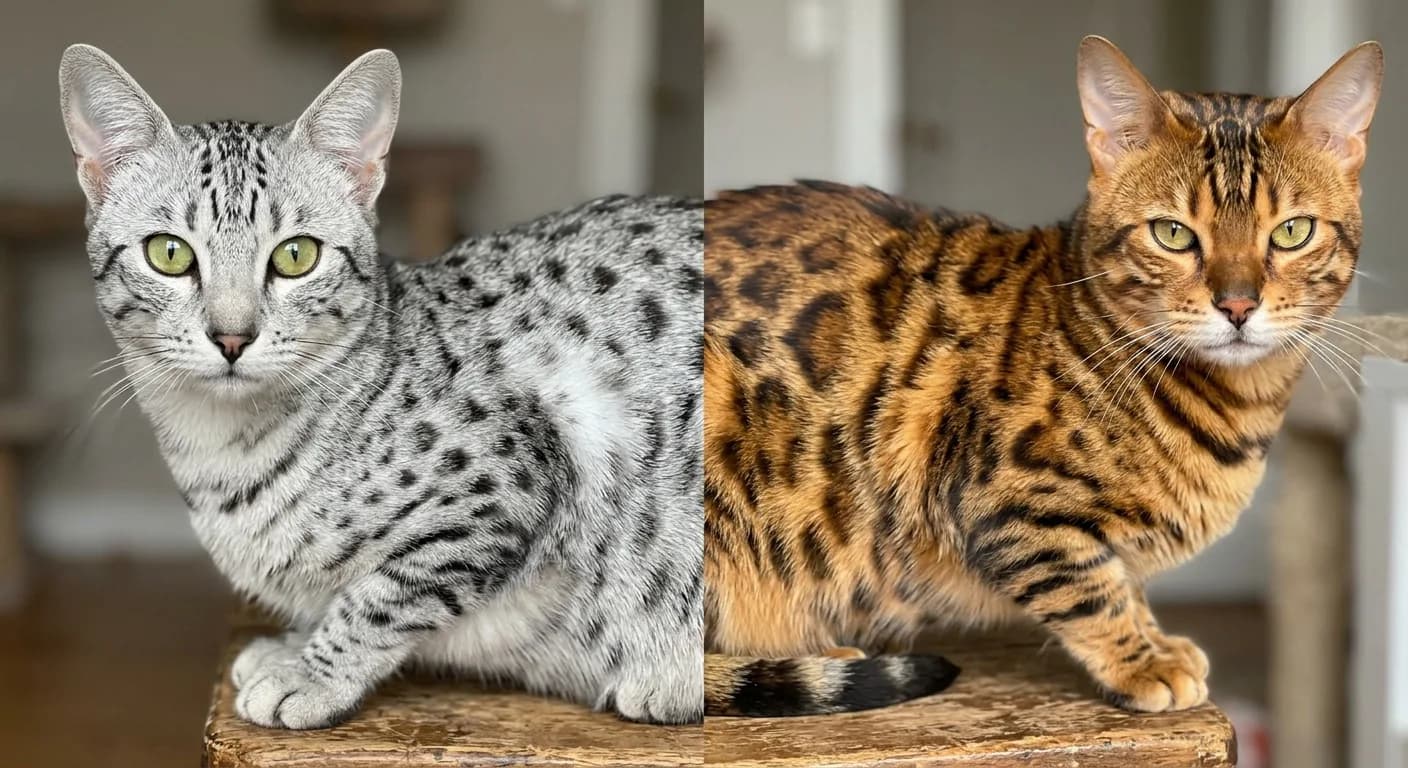
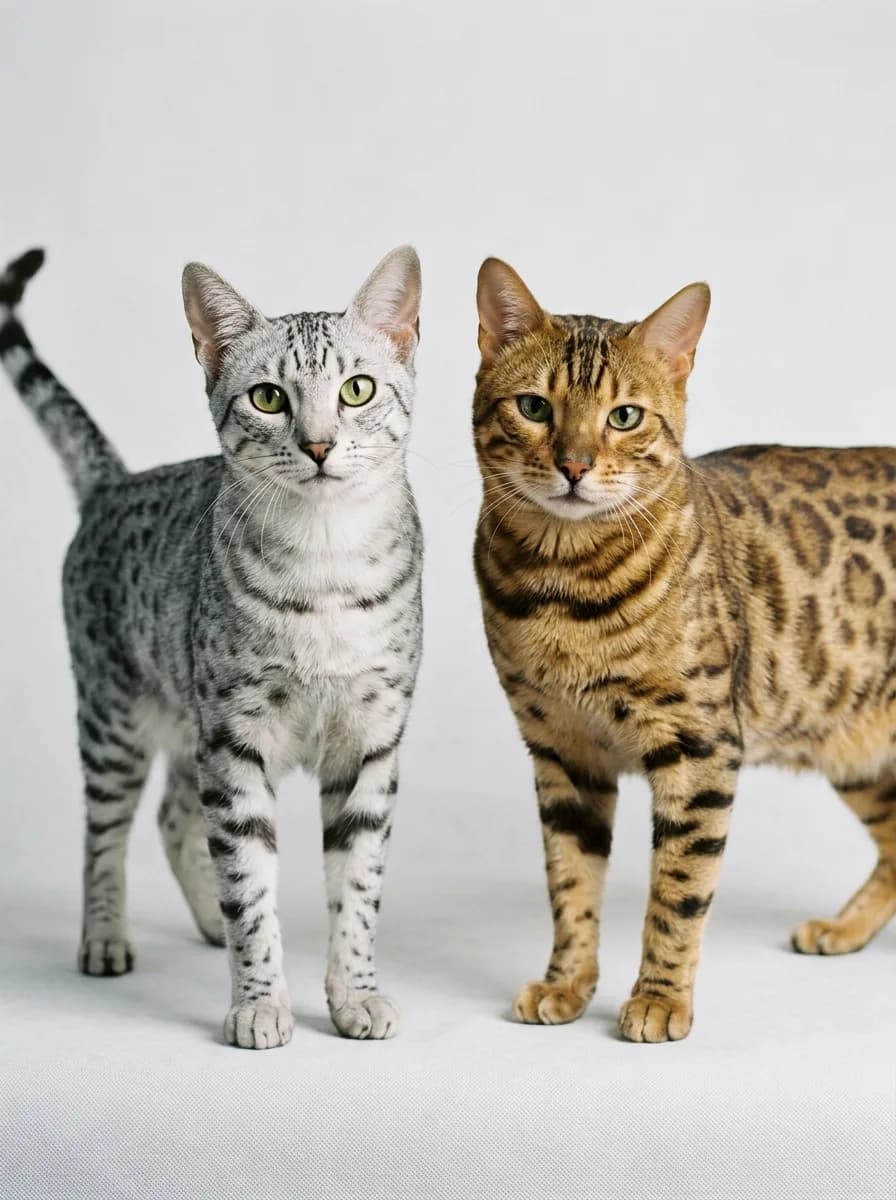
This is the fastest tell. The Egyptian Mau has random single spots, solid dots of dark color scattered over a lighter ground (silver, bronze, or smoke). The Bengal is famous for the rosette, a spot with a darker outline around a lighter center, like a paw print or a doughnut. Rosettes are a two-tone, leopard-style marking that the Mau does not produce. If you see clearly outlined, two-tone rosettes, you are looking at a Bengal. If the spots are simple solid dots, lean Mau. For the full spectrum of Bengal markings, our guide to Bengal coat colors and patterns shows rosetted, spotted, and marbled coats side by side. There is more on this in Petful’s guide to Egyptian Mau colors.
2. The face: mascara lines, M, and scarab
The Egyptian Mau wears distinctive facial markings the Bengal lacks in the same form. Look for the dark "mascara" lines that trail back from the outer corners of the eyes, an "M" shape on the forehead, and a "scarab" mark (a roughly beetle-shaped pattern) between the ears. These are signature Mau features. Bengals often have a clean white or pale belly and bold "mascara" eye liner too, but the combination of M plus scarab plus mascara on a silver or bronze ground points strongly to Mau.
3. Eye color
According to the CFA, the ideal Egyptian Mau eye is a distinctive "gooseberry green," a pale, slightly grey-tinged green, set in an almond shape. Bengals more often have gold, copper, or green eyes, and the snow Bengal varieties can have blue or aqua eyes. Gooseberry-green almond eyes with mascara lines are a near-lock for a Mau. Blue eyes rule the Mau out entirely and point to a snow Bengal.
4. Size and build
Hold the cat (or compare photos at scale). Per the CFA, the Bengal is "a large, long, muscular cat with substantial boning and large, round paws," and adults commonly reach 8-15 lb, with big males heavier. The Egyptian Mau is the smaller, lighter cat at 6-14 lb, with a build the CFA likens more to a cheetah than a leopard: racy, fine-boned, athletic. If the cat feels heavy and cobby with thick legs, lean Bengal; if it is light, leggy, and greyhound-sleek, lean Mau.
5. The belly flap and the sprint
The Egyptian Mau has a loose flap of skin running from the flank to the back knee. It is not a sign of being overweight; it is a breed feature that lengthens the stride and helps the Mau hit its famous top speed. Bengals are athletic and quick, but they do not have the Mau's specialized loose-skin sprint anatomy. A pronounced belly flap on a spotted cat is a strong Mau signal.
- Spots vs rosettes settles most cases in two seconds. Solid single dots equal Mau. Outlined two-tone rosettes equal Bengal. If you are still unsure, the gooseberry-green eyes and the M-plus-scarab face are your tiebreakers, and a DNA or pedigree check from the breeder is the only way to be certain.
Temperament: the bold hybrid vs the loyal shadow
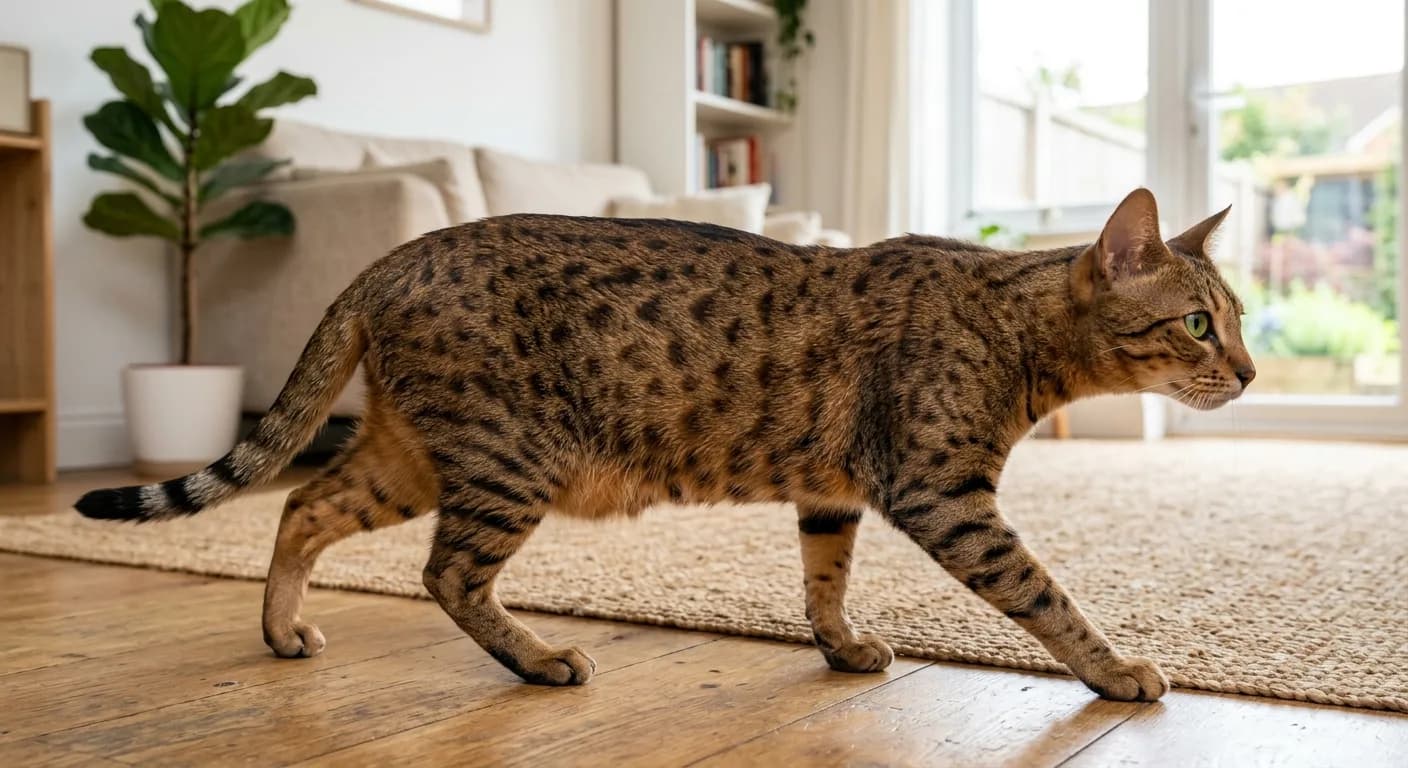
Both breeds are smart, playful, and far more active than the average house cat, but their social wiring differs in a way that matters day to day.

63-inch multi-level cat tree with scratch posts, hammock, plush perches, and dangling toys. Vertical territory is non-negotiable for high-energy climbing breeds like the Bengal.
Petful may earn a commission when you click through to Chewy, at no extra cost to you.
The Bengal is the extrovert. Bengals are typically outgoing, confident, vocal, and relentlessly busy. They tend to greet guests, demand interaction, learn tricks, take to leash walks, and get into everything. A bored Bengal will open cabinets, turn on faucets, and climb the curtains. They are social with the whole household and often other pets, but they do not do well left alone for long stretches.
The Egyptian Mau is the devoted introvert. Maus bond intensely with their chosen people and follow them room to room, but they are famously reserved with strangers and slow to warm up, an "aloof until they trust you" personality that VCA describes as taking their time forming friendships. They are playful and athletic, with a charming habit of "chortling" and tail-wiggling when happy, yet they are generally calmer and less in-your-face than a Bengal. For a household that wants a loyal companion rather than a four-legged tornado, the Mau is the gentler pick.
- Pick the Bengal if you want an interactive, dog-like cat and you are home (or have a second pet) to keep it busy. Pick the Egyptian Mau if you want a loyal, slightly reserved companion that bonds deeply to you and tolerates a calmer, more predictable home. Neither is a cat that wants to be ignored all day.
Energy, exercise, and enrichment
Both cats need real daily play, but the Bengal sets the higher bar. Plan on dedicated interactive sessions, vertical climbing space (tall cat trees, shelves), puzzle feeders, and rotating toys for either breed. The Bengal's water fascination is well known: many will join you at the sink or the tub, so a pet water fountain and even a cat-safe water dish to splash in can save your nerves. The Mau's energy comes in athletic bursts, sprinting, leaping, and stalking, then it settles. A Bengal's energy is closer to a steady all-day current that you must actively drain, or it will redirect into mischief.
For both, enrichment is not optional. An under-stimulated spotted cat becomes a destructive spotted cat. If you are weighing other active spotted breeds in the same shopping trip, the Ocicat breed profile is a useful comparison, since the Ocicat is frequently cross-shopped against the Mau and Bengal for its similar wild-but-domestic look with no wild ancestry at all.
Coat, grooming, and colors
Grooming is easy for both. Each has a short, fine coat that needs only weekly brushing to stay glossy and to cut down on shed hair; neither is hypoallergenic.
Where they differ is the look of the coat. The Egyptian Mau comes in a tighter set of recognized colors built around its silver, bronze, and smoke grounds, with the spots and facial marks in contrasting dark pigment, and crucially the spotting shows on the skin as well as the fur. The Bengal palette is broader and includes the famous "glittered" coat that looks dusted with gold, plus brown, silver, and the pale snow group. Bengals also come in three pattern families (spotted, rosetted, and marbled), which gives the breed far more visual variety than the Mau. A Mau-pattern cat with no pedigree is often just a spotted domestic shorthair or a tabby-Mau type mix, which is worth knowing before you pay a purebred price.

108-oz stainless steel pet fountain with quiet pump and water-level window. Bengals are notoriously water-obsessed; a flowing fountain encourages hydration and pulls them away from sinks and toilets.
Petful may earn a commission when you click through to Chewy, at no extra cost to you.
- Plenty of ordinary domestic shorthairs carry spotted or broken-mackerel tabby coats and get mislabeled as Egyptian Maus, sometimes even on vet paperwork. A true Egyptian Mau has a documented pedigree, gooseberry-green eyes, skin spots, and the scarab and mascara marks. Without papers, assume a spotted rescue is a beautiful mixed-breed tabby, not a pedigreed Mau.
Health and lifespan
Both are generally hardy, but each carries a few breed-linked concerns worth screening for with a reputable breeder.
The Egyptian Mau's known issues include pyruvate kinase deficiency (a blood disorder that DNA tests can screen for) and, less commonly, leukodystrophy and umbilical hernias. The Bengal's watch list includes progressive retinal atrophy (PRA), hypertrophic cardiomyopathy (HCM, the most common feline heart disease), patellar luxation, and pyruvate kinase deficiency as well. A responsible breeder of either breed should provide health-testing documentation for the relevant conditions.
Lifespan estimates for both breeds commonly fall in the low-to-mid teens, and many well-cared-for cats of either breed live longer; some sources cite notably long lives for the Mau in particular. Indoor living, dental care, weight management, and regular vet checkups do more for longevity than the breed label itself.
- Because both breeds command high prices, backyard sellers cut corners. Insist on written proof of PK-deficiency testing for the Mau and HCM and PRA screening for the Bengal, and meet the kittens with the mother on site. Wild-looking spots are never a substitute for a documented, health-tested pedigree.
Price: what each breed really costs
Both are specialty, breeder-only cats with significant startup costs, so neither is cheap. Exact prices vary by region, breeder reputation, color, and whether the kitten is pet, breeding, or show quality.
A pet-quality Egyptian Mau typically runs about $1,000 to $2,500, with rarer colors and show-quality lines higher. The Bengal usually costs more, frequently in the $1,500 to $3,000+ range, with the average commonly cited around $2,000 and early-generation or exceptionally marked Bengals climbing well beyond that. On top of the purchase price, budget for the same ongoing care either cat needs: quality food, enrichment gear, litter, and routine veterinary care. For a closer look at Mau pricing specifically, including what drives the range, see our Egyptian Mau price guide.
| Cost Factor | Egyptian Mau | Bengal |
|---|---|---|
| Pet-quality kitten | $1,000-$2,500 | $1,500-$3,000+ |
| What raises the price | Rare colors, show pedigree | Tight rosettes, early generation, glitter |
| Availability | Rare, waitlists common | More widely bred |
| Adoption/rescue odds | Low (seldom in shelters) | Low to moderate |
Which spotted cat should you choose?
There is no universally "better" breed, only the better fit for your home. Use this quick decision guide.
Choose the Bengal if you want a large, showy, interactive cat with a wild leopard look, you are home often or have another pet, and you can commit to heavy daily enrichment. Bengals reward active households and bore in quiet ones.
Choose the Egyptian Mau if you want a loyal, slightly reserved companion that bonds intensely to its people, you prefer a calmer (though still athletic) cat, and you love the idea of owning a living piece of ancient history that happens to be the fastest domestic cat alive. Maus reward patience with deep devotion.
If you simply love the spotted look and are flexible on the rest, weigh availability and budget: the Bengal is easier to find and the Mau is rarer and usually a bit cheaper. Either way, buy from a health-testing breeder, and let temperament fit, not just the coat, drive the decision.
- 1Spots vs rosettes is the fastest visual ID: solid dots equal Mau, outlined two-tone rosettes equal Bengal
- 2The Bengal is the larger, busier, more social extrovert; the Mau is the smaller, faster, more loyal-but-reserved cat
- 3The Mau (up to 30 mph per VCA) is the fastest domestic cat, thanks to its loose belly flap
- 4Expect to pay roughly $1,000-$2,500 for a Mau and $1,500-$3,000+ for a Bengal, both from breeders
- 5Whichever you choose, prioritize a documented, health-tested pedigree over the wild look
For another spotted or marbled option, see the Australian Mist guide and our Australian Mist vs. Bengal comparison. Compare the individual cat and the daily routine you can provide, as well as the appearance that first caught your attention.
Frequently asked questions: Egyptian Mau vs Bengal
Look for five things: random solid single spots (not outlined rosettes), dark "mascara" lines trailing from the eyes, an "M" on the forehead and a "scarab" mark between the ears, almond-shaped gooseberry-green eyes, and a loose flap of skin from the flank to the back knee. A true Egyptian Mau also has spots on its skin, not just its fur, and a documented pedigree. Without papers, a spotted cat is most likely a domestic shorthair tabby rather than a purebred Mau.
The reliable tells are gooseberry-green almond eyes, single random spots over a silver, bronze, or smoke coat, the M-plus-scarab forehead markings, mascara lines from the eyes, a lean cheetah-like build, and the signature loose belly skin flap. Spots that appear on the skin as well as the coat are a classic Mau trait noted by the CFA and VCA. The only way to be certain is a breeder pedigree or a feline DNA test.
The Egyptian Mau is an ancient natural breed with random single spots, gooseberry-green eyes, and no wild ancestor, while the Bengal is a modern hybrid descended from the wild Asian leopard cat and known for two-tone rosettes. Bengals are larger (8-15 lb) and higher-energy; Maus are smaller (6-14 lb), faster in a sprint (up to 30 mph), and more reserved with strangers. Notably, early Bengals were crossed with Egyptian Maus, which is why they look alike.
The cats most often confused with or compared to the Egyptian Mau are the Bengal (spotted but rosetted and hybrid), the Ocicat (a spotted breed with no wild blood), the Savannah (a serval hybrid), and ordinary spotted domestic shorthair tabbies. The ticked-coat Abyssinian is also frequently cross-shopped for its similar athletic, wild-but-domestic look, though it is not spotted.
Very few Egyptian Maus are registered each year because the modern Western bloodline was rebuilt from only a small number of imported cats in the 1950s, the gene pool stays limited, and responsible breeders produce relatively few litters. That scarcity, combined with strict breed standards, makes the Mau one of the rarer pedigreed cats and explains the waitlists at reputable catteries.
Quite rare. The Egyptian Mau consistently ranks among the least common pedigreed breeds by annual registrations, and you are unlikely to find one in a shelter. Most buyers join a breeder waitlist. Bengals, by contrast, are far more widely bred and easier to find, though both are specialty, breeder-sourced cats.
A pet-quality purebred Egyptian Mau typically costs about $1,000 to $2,500 from a reputable breeder, with rarer colors and show-quality lines priced higher. Because Maus are rare and breeder-only, expect a waitlist and additional startup costs for supplies and veterinary care on top of the kitten price.
Yes. The Bengal is the larger cat, commonly 8 to 15 pounds with muscular, substantial boning and large round paws, and big males can exceed that. The Egyptian Mau is lighter and leaner at 6 to 14 pounds with a fine-boned, cheetah-like build. Side by side, the Bengal looks heavier and more powerful, the Mau more racy and athletic.
The Egyptian Mau. It is widely described as the fastest domestic cat, clocked at up to 30 miles per hour according to VCA Animal Hospitals, helped by a loose flap of skin between its flank and back leg that lengthens its stride like a cheetah's. Bengals are athletic and quick, but they do not match the Mau's top sprint speed.
Neither the Bengal nor the Egyptian Mau is among the calmest breeds; both are active and need daily play. Between the two, the Egyptian Mau is the calmer, more low-key choice, energetic in athletic bursts but more settled than the perpetually busy Bengal. If you want a genuinely placid lap cat, gentler breeds like the Ragdoll or Persian are better suited than either spotted cat.

Coreen Saito is a pet writer and longtime shelter volunteer with more than a decade in animal rescue. She covers cat behavior, breed care, and the small, ordinary science of sharing a life with companion animals, with a particular focus on honest takes about the products and decisions that actually matter. At home in Arizona, she's outranked by Mac (a dog with the loudest opinion in the house), Rebel (a cat who governs by quiet authority), and Meri (an orange tabby who runs the late shift and the laundry basket). She writes about all three, plus the rescues that keep coming through her life, at LifeWithMinty.com.
Sign up for expert-backed reviews and safety alerts all in one place.