Egyptian Mau Tabby Mix: Is My Cat Part Egyptian Mau?
Wondering if your cat is an Egyptian Mau tabby mix? A spotted coat alone is not proof. This guide covers every true-Mau tell (random spots, green eyes, the scarab M, dorsal stripe, banded legs, belly skin flap) versus a common spotted tabby.
Petful is reader supported. As an affiliate of platforms like Amazon and Chewy, we may earn a commission when you buy through links on this page. There is no extra cost to you.
The Cat Fanciers' Association (CFA) calls the Egyptian Mau the only natural domesticated breed of spotted cat, and that single fact is why the "egyptian mau tabby mix" question is so confusing: a spotted coat alone proves almost nothing, because plain random-bred tabbies can be spotted too. Fewer than 200 Mau kittens are registered with the GCCF in a typical year, so the math is stacked against your shelter cat being part Mau. The good news is that a true Mau leaves a stack of specific tells (random spots on the coat, gooseberry-green eyes, the scarab "M," a dorsal stripe, banded legs, and a loose belly skin flap), and once you know all of them you can tell a genuine Mau influence from a look-alike domestic shorthair in a couple of minutes. This guide walks the full checklist, explains how Mau genetics actually pass on, and gives you the honest answer most owners are missing.
- 1A spotted coat alone does not make a cat part Egyptian Mau, because ordinary random-bred tabbies can also be spotted
- 2A true Mau influence shows up in a cluster of tells together: random (not striped) spots, gooseberry-green eyes by about 18 months, the scarab "M," a dorsal spine stripe, banded legs and tail, and a loose belly skin flap
- 3The Mau is the only naturally spotted domestic cat breed (CFA), and purebreds are genuinely rare (the GCCF registers fewer than 200 kittens a year)
- 4Most cats sold or described as "Mau mixes" are simply spotted domestic shorthairs with no documented Mau lineage
- 5A cat DNA test is the only way to confirm true Egyptian Mau ancestry; coat and eye color only build a strong case

Sign up for expert-backed reviews and safety alerts all in one place.
Why "is my cat part Egyptian Mau?" is the wrong first question
Almost every owner starts from the coat: my cat has spots, the Egyptian Mau has spots, so maybe my cat is part Mau. The problem is that the spotted look is one of the most common coat patterns in the entire domestic cat population. A "broken" mackerel tabby, where the stripes break apart into dots and dashes, reads as "spotted" to most people, and it shows up constantly in cats with zero pedigree behind them. So a spotted coat is the start of the investigation, never the conclusion.
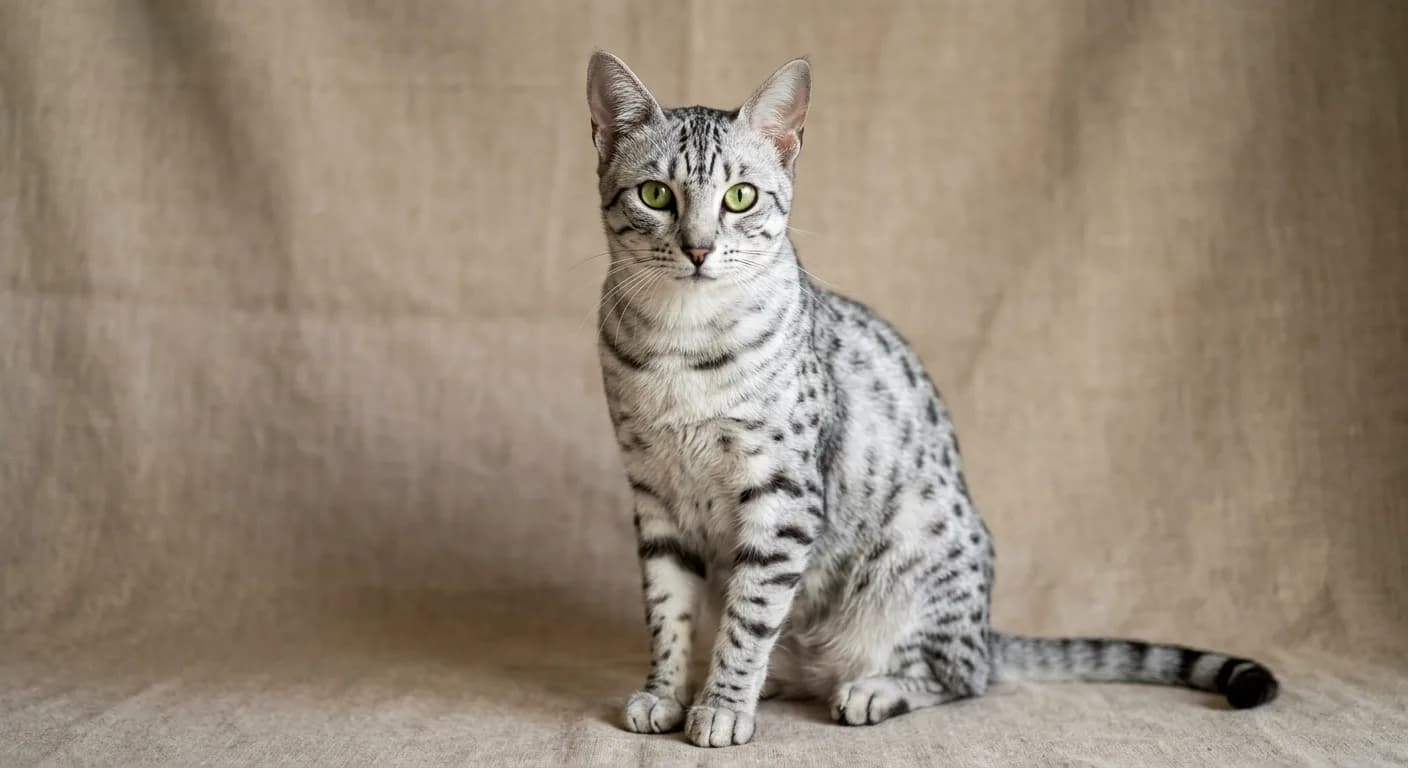
The Mau's real signature is not just that it has spots, but the kind of spots and the package they come in. According to the CFA breed standard, the markings on the torso are "randomly spotted, with variance in size and shape," and the spots sit on a ground color of silver, bronze, or smoke. Random placement is the key word. A classic domestic tabby tends to show organized, repeating stripes (the mackerel pattern) or marbled swirls (the classic blotched pattern). When those stripes fragment they can mimic spots, but the underlying order is still mackerel. A true Mau coat looks scattered and irregular, more like a small wild cat than a tidy tabby.
That difference matters because it reframes the whole question. Instead of "does my cat have spots," ask "does my cat carry the *whole set* of Mau traits at once." One trait in isolation is noise. Five or six together start to mean something. The rest of this guide is that checklist.
- A single Mau-like feature (just spots, or just green eyes, or just an "M" on the forehead) is weak evidence on its own, because each of those shows up in millions of ordinary cats. Mau ancestry is a pattern of traits appearing together, not any one box ticked.
The true-Mau tells: a head-to-tail identification checklist
Work through these one at a time on your own cat. The more boxes that line up, and the more they line up *together*, the stronger the case for genuine Mau influence. The descriptions here follow the CFA breed standard and the breed's documented physical traits. For the full breed picture beyond identification, our Egyptian Mau breed profile covers temperament, care, and history in depth.

Never Scoop Again® with the Whisker Litter-Robot, the smart self-cleaning automatic litter box. Monitor visits and track weights for better overall care in the Whisker® app. Multi-cat friendly.
Petful may earn a commission when you click through to Whisker, at no extra cost to you.
1. Random spots, not organized stripes
This is the headline trait. A Mau's spots are "randomly spotted with variance in size and shape" per the CFA, scattered across the torso rather than marching in neat rows. Look at your cat's flanks and back in good light. Do you see irregular, free-standing dots of different sizes, or do you see stripes that only *look* like dots because they are broken up? Organized, evenly spaced striping points toward an ordinary mackerel tabby. Truly random, varied spotting is far more Mau-like.
2. Gooseberry-green eyes (by about 18 months)
Eye color is one of the most reliable tells, and it is also why so many "Mau mixes" wash out on inspection. The CFA standard calls for a specific shade it names "gooseberry green," a light, slightly grayish green. Crucially, it does not appear overnight: the standard allows for changing eye color, with "some discernible green by eight months of age and full green eye color by one and one half years of age." Mau kittens often start with amber or yellow eyes that green up over the first year and a half. An adult cat marketed as a Mau that has settled into gold, copper, orange, or hazel eyes is, by the breed's own standard, not showing the signature trait. A mix may keep green eyes or may shift to hazel or amber, so green eyes strengthen the case while non-green eyes weaken it.
3. The scarab "M" and frown marks on the forehead
Every Mau wears a tabby "M" on the forehead. The CFA describes the forehead as "barred with the characteristic 'M' and frown marks, forming lines between the ears which continue down the back of the neck." The breed nickname for this is the "mark of the scarab," after the Egyptian beetle motif. Here is the honest caveat, though: the "M" is not unique to the Mau. Nearly every tabby on earth, pedigreed or not, has an "M" on its brow, because it is a universal tabby marking. So the "M" alone proves nothing. It only counts as supporting evidence when it appears alongside the random spots and the other tells.
4. Dark "mascara" lines from the eyes
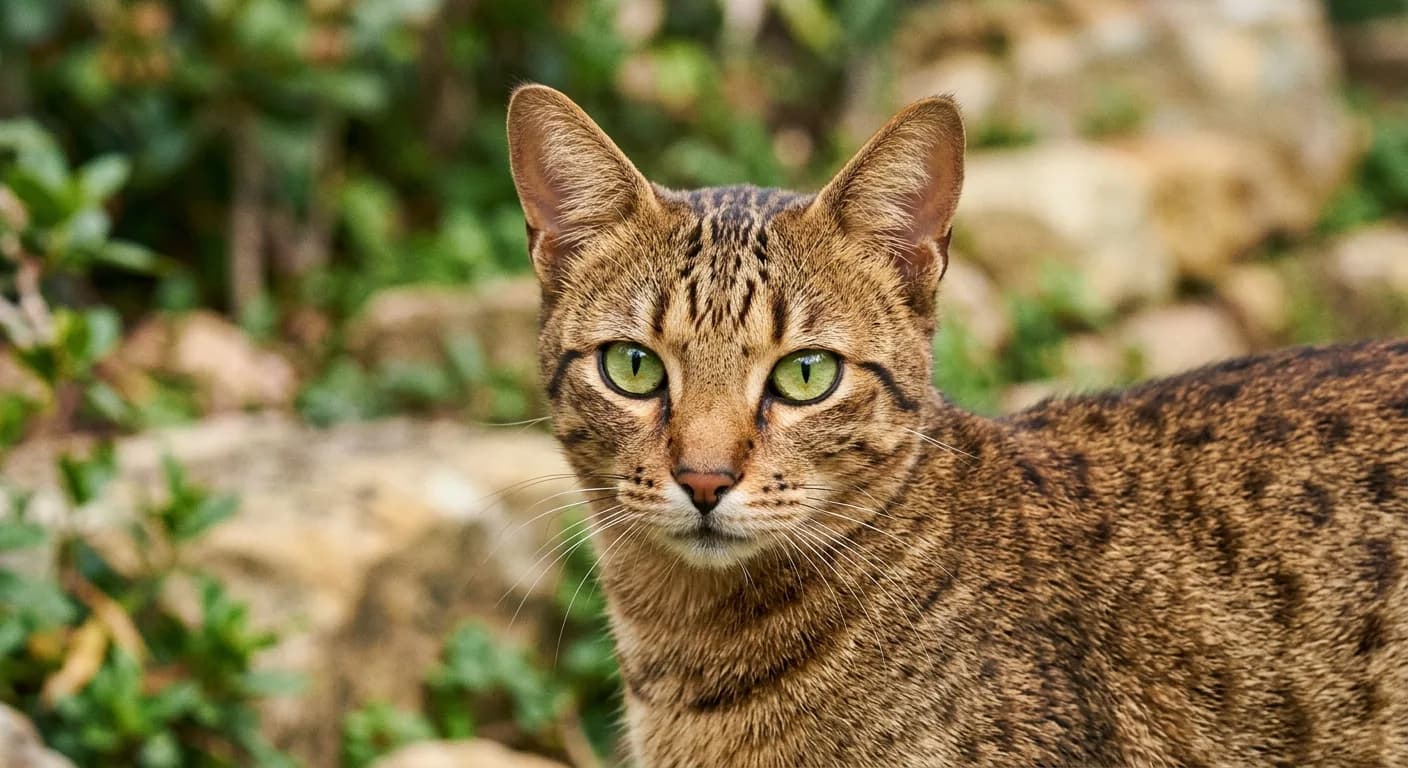
A genuine Mau has bold dark lines that look like applied eyeliner. The CFA standard describes "mascara" lines, with "the first starting at the outer corner of the eye and continuing along the contour of the cheek." Many spotted domestic shorthairs show faint cheek lines, but the Mau's are typically crisp and pronounced, framing those green eyes. Strong, well-defined mascara lines add to the case.
5. A dorsal spine stripe down the back and tail
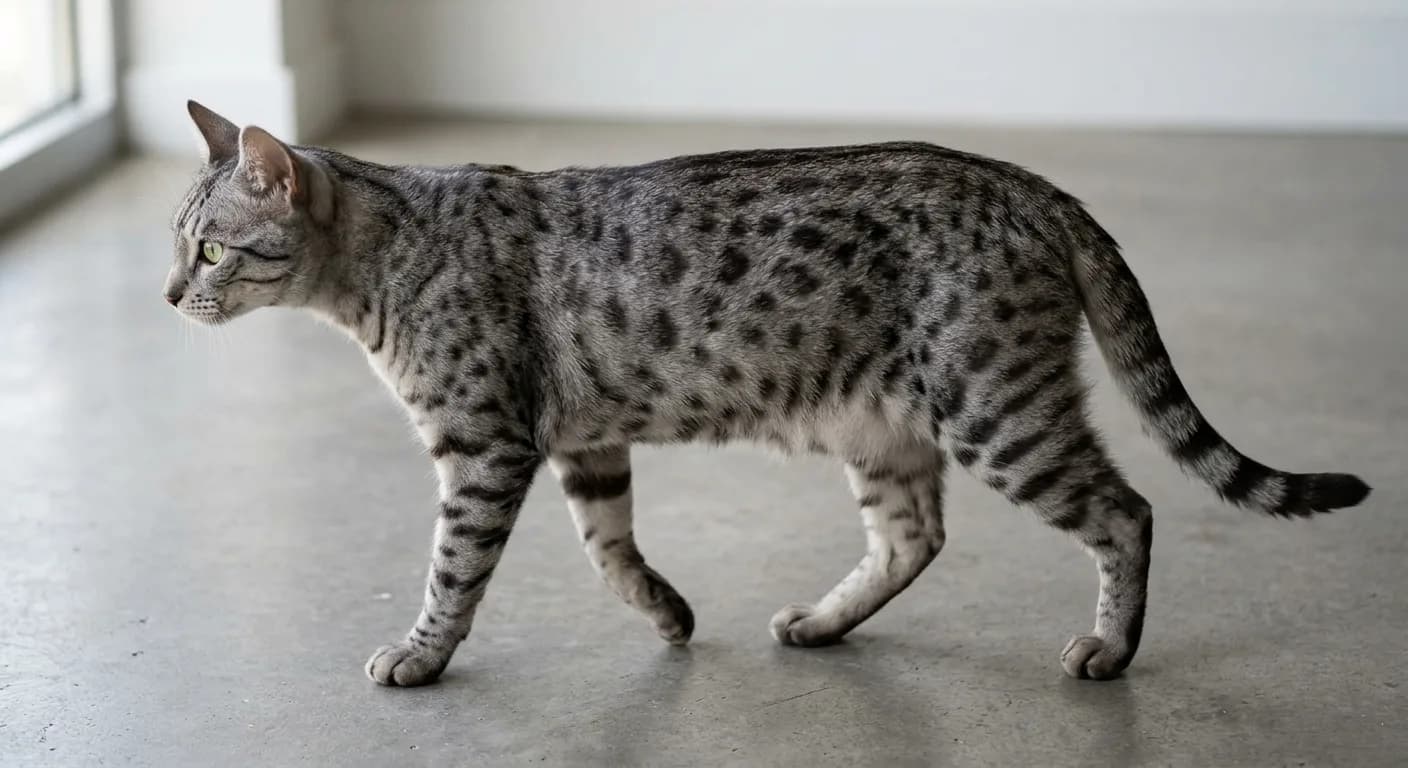
Run your eye (or a gentle hand) down your cat's spine. On a true Mau, the CFA notes that as the spinal lines reach the rear haunches, "they meld together to form a dorsal stripe which continues along the top of the tail to its tip." So you should see a single dark line running down the middle of the back and right out along the top of the tail. This is common in mackerel tabbies too, so again it is supporting evidence rather than a clincher, but its absence on a supposedly purebred Mau is a red flag.
6. Banded legs and a heavily banded, dark-tipped tail
A Mau's legs and tail carry clear bands. The CFA standard says the "upper front legs are heavily barred" and "the tail is heavily banded and has a dark tip." Look for distinct dark rings around the legs and multiple bands down the tail finishing in a solid dark tip. Crisp, heavy banding fits the breed; faint or absent banding is a point against.
7. The loose belly skin flap
This is one of the most distinctive and least-known Mau tells, and it is a structural trait, not a coat marking, so it is hard to fake. The Mau has a loose flap of skin extending from the flank to the knee of the hind leg. The CFA standard describes this "loose skin flap extending from flank to hind leg knee" and notes it "helps give them remarkable freedom and agility in twisting and jumping." It contributes to the breed's famous athleticism and its longer-strided, almost cheetah-like gait. Not every spotted cat has a pronounced belly flap, so a clear one is meaningful supporting evidence. (Note that many cats of any breed have a "primordial pouch" of loose belly skin; the Mau's flap specifically connects the flank to the hind knee and aids that twisting leap.)
8. Athletic build and the "tiptoe" stance
The Mau is built like a small athlete: muscular, with the hind legs slightly longer than the front, which can give it a tiptoe look when it stands and a bounding gait when it runs. The breed is widely cited as the fastest domestic cat. Guinness World Records lists the Egyptian Mau as the fastest breed of domestic cat, clocked at speeds frequently reported around 30 mph. A lanky, powerful, restless cat that climbs and sprints fits the profile; a stocky, placid couch cat is less likely to carry much Mau.

63-inch multi-level cat tree with scratch posts, hammock, plush perches, and dangling toys. Vertical territory is non-negotiable for high-energy climbing breeds like the Bengal.
Petful may earn a commission when you click through to Chewy, at no extra cost to you.
- Give your cat a point for each tell it clearly shows: random spots, greening eyes, mascara lines, dorsal stripe, banded legs and tail, the belly flap, and an athletic tiptoe build. One or two points means "probably just a handsome spotted tabby." Six or seven points means a genuine Mau influence is plausible, and a DNA test is worth doing.
Spots on the coat versus spots "in the skin": the deeper tell
Here is a nuance that separates a careful identification from a guess. On many spotted cats, the spotting is purely a coat-pattern effect: the visible dots come from banding on the hair shafts (the spots, as Wikipedia notes for the Mau, occur on the tips of the hairs). On a strongly marked true Mau, the pattern is so deeply set that the markings appear to read right down at the skin, so that even with the fur parted you can trace the spot layout, rather than the spots being a loose surface scatter that disappears when you push the coat aside.
The practical version for an owner is simple: part the fur over a clearly spotted area and look at how committed the pattern is. A pattern that holds its shape down toward the skin, on both the coat and the underlying markings, is more consistent with a genuinely spotted breed than a vague surface dusting of dots. This is supporting evidence, not proof, and it is easy to over-read, so weigh it alongside the rest of the checklist rather than on its own.
- Owners often point to spots on the belly as evidence of Mau blood. Plenty of ordinary tabbies have a spotted or speckled belly, so a spotted tummy on its own is not a Mau signature. It only matters in combination with random body spots, green eyes, banding, and the belly skin flap.
How Egyptian Mau genetics actually pass on
To understand why most "Mau mixes" are really just spotted tabbies, you have to understand how the spotted look is inherited. The spotted tabby pattern in cats is, in genetic terms, a *modifier* of the underlying tabby coat. Cats carry a tabby pattern gene, and the spotted appearance most commonly arises when a mackerel (striped) tabby pattern is broken up into spots. In other words, "spotted" is not a rare, exotic, Mau-only gene that a cat could only inherit from a Mau ancestor. It is a widespread pattern variation that exists throughout the ordinary domestic cat population.
That single fact is the whole reason the "egyptian mau tabby mix" label is so often wrong. If spotting were a unique Mau gene, then any spotted cat would, by definition, carry Mau ancestry. Because spotting is instead a common tabby variation, a spotted cat with no Mau in its family tree is not just possible, it is the *usual* case. The Mau's distinction, per the CFA, is that it is the only *natural breed* that was developed around that spotted pattern as a defined, heritable type with a fixed look, not that it owns the spots themselves.
It also helps to know which ground colors actually count: the Mau standard recognizes silver, bronze, and smoke, and our guide to Egyptian Mau colors shows how each one looks against the spots. A spotted cat in a non-Mau ground color (a brown classic tabby, say) is already a step further from the breed.
When a real Egyptian Mau is crossed with a domestic cat, the kittens inherit a blend. Some may pick up the random spotting, the green-tending eyes, the mascara lines, and the athletic build; others may favor the non-Mau parent and look like a generic tabby despite genuinely being half Mau. Coat genetics shuffle independently, so a true 50% Mau kitten can look strikingly Mau-like or barely Mau-like, which is exactly why visual ID can never be conclusive on a mix. The breed's spotted pattern is also why it sits in the same visual family as deliberately spotted hybrids like the Bengal and the Ocicat, even though those breeds arrived at the look by very different breeding routes.
- The Egyptian Mau developed its spots naturally over centuries (CFA). The Bengal and Savannah, by contrast, are modern hybrids created by crossing domestic cats with wild species, and the Ocicat is a domestic-only breed selectively bred to look wild. All can be spotted, but they got there by different genetic paths, which is why "spotted" never points to one breed.
Why most "Mau mixes" are simply spotted tabbies
Put the rarity and the genetics together and the conclusion is hard to avoid. Purebred Egyptian Maus are genuinely uncommon: the GCCF registers fewer than 200 kittens in a typical year, and registries report only modest numbers annually (113 cats were registered in one recent GCCF year). There simply are not many Maus in the breeding pool to throw mixes. Meanwhile, the spotted tabby pattern is everywhere. So when a random shelter cat shows spots, the overwhelmingly more likely explanation is "common spotted domestic shorthair," not "descendant of a rare Egyptian breed."

108-oz stainless steel pet fountain with quiet pump and water-level window. Bengals are notoriously water-obsessed; a flowing fountain encourages hydration and pulls them away from sinks and toilets.
Petful may earn a commission when you click through to Chewy, at no extra cost to you.
This is not a reason to love your cat any less. A spotted domestic shorthair with green eyes and an athletic streak is a beautiful animal whether or not a Mau sits anywhere in its lineage. It is simply a reason to be skeptical of the "Mau mix" label, especially when it is attached to a kitten for sale at a premium with no pedigree or DNA evidence behind it. If you are weighing a documented purebred instead, our Egyptian Mau price guide lays out the realistic cost ranges by color and quality.
- If a seller advertises a kitten as an Egyptian Mau or Mau mix at a premium price, ask for documented lineage or DNA evidence. A spotted coat is not proof of Mau ancestry, and "Mau mix" is a common label put on ordinary spotted domestic shorthairs. Adopting a spotted shelter cat for the look is great; paying breed prices on the strength of spots alone is not.
Egyptian Mau versus a common spotted tabby: a side-by-side
This table distills the checklist into a quick comparison. Remember that a real mix can land anywhere between these columns; the point is the *weight of evidence*, not any single row.
| Trait | True Egyptian Mau (per CFA) | Common Spotted / Mackerel Tabby |
|---|---|---|
| Spot pattern | Random spots, varied in size and shape | Often broken stripes in organized rows |
| Eye color | Gooseberry green by about 18 months | Any color: gold, green, amber, hazel |
| Ground colors | Silver, bronze, or smoke | Any tabby color |
| Mascara lines | Crisp dark lines from the outer eye | Often faint or absent |
| Dorsal stripe | Defined spine line onto the tail | Common in mackerel tabbies too |
| Leg and tail banding | Heavily barred legs, banded dark-tipped tail | Variable, often lighter banding |
| Belly skin flap | Loose flap from flank to hind knee | Usually a generic belly pouch only |
| Build and gait | Muscular, longer hind legs, tiptoe sprint | Any build |
| Confirmation | DNA test confirms lineage | DNA test usually shows domestic only |
Comparing your cat to the wilder-looking spotted breeds
If your cat is large, heavily spotted, and especially bold-patterned, the look-alike you are weighing might not be a plain tabby at all but one of the spotted "wild-look" breeds. These get confused with the Mau constantly, and telling them apart sharpens your read on what your own cat is.
The biggest source of confusion is the Bengal, which is bigger, often has rosetted (two-toned) rather than single-tone spots, and frequently shows a glittered coat. Our guide to Egyptian Mau vs Bengal breaks down the differences trait by trait, and if your cat is pale and frosty rather than warm-toned, the snow Bengal comparison is worth a look. The takeaway for identification is that Mau spots are random and single-toned over a silver, bronze, or smoke ground, while Bengal spots often cluster into rosettes over a warmer or snow-white ground. A genuinely rosetted, glittered cat is reading Bengal, not Mau.
- If the spots are two-toned outlines (a darker ring around a lighter center), that is a rosette, and rosettes are a Bengal hallmark, not a Mau one. The Egyptian Mau's spots are solid, single-tone dots scattered at random. This one detail quickly separates the two most-confused spotted breeds.
How to actually confirm Egyptian Mau ancestry
Visual identification, even a perfect 7-out-of-7 on the checklist, builds a strong case but cannot prove lineage. The only reliable confirmation is a cat DNA test. Modern feline DNA panels compare your cat's genetic markers against breed reference populations and report likely breed signatures plus a health-screening panel. For a cat that scores high on the checklist and came without papers, a DNA test is the honest way to settle the question, and it doubles as useful health information.
Two important caveats. First, breed detection in cats is less precise than in dogs, because most pedigreed cat breeds were developed from regional domestic populations fairly recently, so a "domestic shorthair" result is common even for genuinely Mau-looking cats. Second, a DNA test tells you about ancestry, not about whether your individual cat is a lovely pet, which it is regardless. Treat the test as the tiebreaker after the checklist, not as the first step.
- 1Score your cat against the full checklist first: random spots, greening eyes, scarab "M," mascara lines, dorsal stripe, banded legs and tail, belly skin flap, and athletic build
- 2The more tells that appear together, the stronger the case, but no single trait is proof
- 3Genetics explain the confusion: spotting is a common tabby variation, not a Mau-only gene, so most spotted cats are ordinary domestic shorthairs
- 4A cat DNA test is the only way to confirm true Mau lineage, and feline breed detection is less precise than canine
- 5Either way, a spotted, green-eyed, athletic cat is a wonderful companion whether or not a Mau is in its tree
Frequently asked questions about the Egyptian Mau tabby mix
In coat terms, yes. The Egyptian Mau's spotted pattern is itself a type of spotted tabby pattern, and the breed wears the universal tabby "M" on its forehead. So a Mau is, technically, a spotted tabby with a pedigree and a fixed breed type. The reverse is not true, though: most spotted tabbies are ordinary random-bred cats with no Mau ancestry, since the spotted look is a common tabby variation rather than a Mau-only trait.
Genuinely rare. The Egyptian Mau is the only naturally spotted domestic cat breed (CFA), and breeding numbers are small: the GCCF registers fewer than 200 kittens in a typical year, with only around 113 cats registered in one recent year. Because purebreds are so uncommon, the odds that a random spotted shelter cat is part Mau are low, and most "Mau mixes" are simply spotted domestic shorthairs.
The Egyptian Mau. Guinness World Records lists it as the fastest breed of domestic cat, with speeds commonly reported around 30 mph (roughly 48 km/h). Its long hind legs and the loose belly skin flap that runs from flank to hind knee give it an unusually long stride and a cheetah-like, twisting agility, which is part of why an unusually athletic, sprinting cat fits the Mau profile.
Among tabby patterns, the spotted and ticked patterns are generally less common than the classic (blotched) and mackerel (striped) patterns, and a clean, randomly spotted coat like the Egyptian Mau's is the rarest spotted look to find in a purebred form. In random-bred cats, broken-mackerel "spotted" coats are fairly common, but a true, naturally spotted breed standard like the Mau's is rare.
A few reasons stack up. The breed nearly disappeared around the mid-20th century and was rebuilt from a very small founding population, so the gene pool stayed narrow. Breeders register only a small number of kittens each year (fewer than 200 with the GCCF), and the breed's specific standard (random spots, gooseberry-green eyes, the belly flap) is hard to produce consistently. The result is one of the rarer pedigreed cats.
The five-figure price tags belong to wild-hybrid breeds, above all the Savannah, where high-percentage early-generation cats can reach $20,000 or more, and the Ashera marketing line that was sold at similar prices. The Egyptian Mau is far more affordable by comparison, typically ranging from roughly $500 to $3,500 from a breeder, so a true Mau is not a $20,000 cat.
Moderately, for a pedigreed cat. Egyptian Mau kittens generally cost in the range of about $500 to $3,500 depending on lineage, color, and whether the cat is pet or show quality. That is well below the wild-hybrid breeds but above an adopted domestic shorthair, which is part of why it pays to confirm a "Mau" is genuine before paying breed prices. For a full breakdown, see our Egyptian Mau price guide.
That title goes to the Ragdoll, named for its tendency to go limp and relaxed when picked up, not to the Egyptian Mau. The Mau is the opposite kind of cat: athletic, fast, and busy rather than floppy. If your spotted cat is also notably laid-back and goes limp when held, that temperament points away from Mau ancestry and toward a different breed influence.
Probably not a Mau mix, statistically, but check the full set of tells before deciding. Look for random (not striped) spots, gooseberry-green eyes by about 18 months, crisp mascara lines, a scarab "M," a dorsal spine stripe, heavily banded legs and a dark-tipped tail, a loose belly skin flap from flank to hind knee, and an athletic build. One or two of these means a handsome spotted tabby; six or seven together make Mau influence plausible, and a cat DNA test is the only way to confirm it.

Coreen Saito is a pet writer and longtime shelter volunteer with more than a decade in animal rescue. She covers cat behavior, breed care, and the small, ordinary science of sharing a life with companion animals, with a particular focus on honest takes about the products and decisions that actually matter. At home in Arizona, she's outranked by Mac (a dog with the loudest opinion in the house), Rebel (a cat who governs by quiet authority), and Meri (an orange tabby who runs the late shift and the laundry basket). She writes about all three, plus the rescues that keep coming through her life, at LifeWithMinty.com.
Sign up for expert-backed reviews and safety alerts all in one place.