Why Does My Kitten Follow Me Around? Reasons and Help
Following can reflect comfort, curiosity or a request for food and play. Learn how to read your kitten’s pattern, notice changes, and encourage confidence while preserving closeness.
Petful is reader supported. As an affiliate of platforms like Amazon and Chewy, we may earn a commission when you buy through links on this page. There is no extra cost to you.
If you are wondering, “why does my kitten follow me around,” the answer may be companionship, curiosity, or a familiar request for food and play. Comfortable following can be normal behavior. What matters is whether your kitten can also eat, explore, rest and settle without staying on your heels.
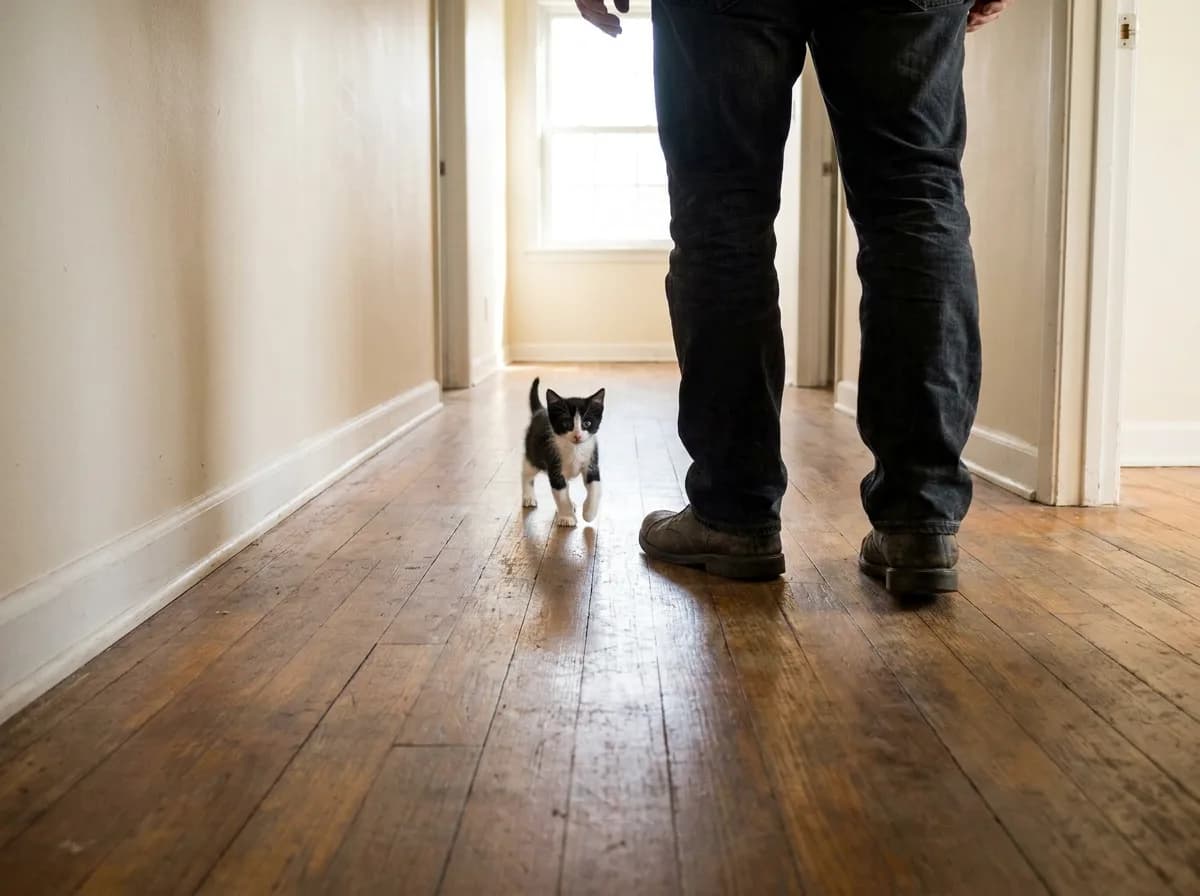
Jason, my fluffy tuxedo kitten, was a devoted little shadow. After playing with the hearth broom, he once climbed onto my chest, stretched along my neck and fell asleep. In the following weeks, wherever I went, he was close behind.
- 1Following alone does not prove imprinting, anxiety or a single emotion.
- 2Notice the timing, your kitten’s other behavior and whether they settle again.
- 3A sudden change, persistent distress or physical symptoms deserves veterinary attention.

Sign up for expert-backed reviews and safety alerts all in one place.
Why Your Kitten Follows You Around
A kitten that follows you everywhere may want to join whatever happens next. Your movements predict meals, an opening door, a toy or a comfortable place to sit. Following can also maintain contact with a familiar caregiver while the kitten explores a new home. Several of these explanations can apply on the same afternoon.
If you need to observe what happens during a brief absence, an optional INSTACHEW Purrsight camera can record behavior to discuss with your veterinarian. A camera cannot diagnose separation anxiety, feed a kitten or replace a caregiver. Start with ordinary observations while you are home.

360-degree Wi-Fi pet camera so you can watch your cat's resting breathing rate and behavior from your phone and catch worrying changes early.
Petful may earn a commission when you click through to Chewy, at no extra cost to you.
Kittens may persistently follow people when that reliably leads to something they need or enjoy. Notice whether a predictable meal, play session or quiet nearby resting spot helps the kitten settle. Persistent following becomes a concern when needs are met but the kitten remains distressed or cannot resume normal activities.
Look for a pattern before deciding what the behavior means. Does following start when you approach the kitchen? Does your kitten bring a toy, explore the room with you, or curl up once you sit down? Those outcomes tell you more than counting how many rooms you visit together.
- Around meals: check that feeding meets the kitten’s age and needs instead of assuming every request is affection.
- During activity: offer appropriate play and safe exploration, then let the kitten rest.
- In an unfamiliar home: provide a manageable safe base and predictable contact.
Signs Your Kitten Feels Attached to You
A kitten may show attachment by seeking proximity, greeting you or returning to you after exploring. In a study described by Oregon State University, researchers found attachment patterns between cats and their caregivers. That supports taking feline bonds seriously; it does not mean constant following is the strongest bond or the only sign of one.
An accessible resting place near you can offer company without constant movement. Put a Meow Hut covered bed or another suitable bed where the kitten can enter and leave freely. Some prefer an open bed instead; a purchased hiding place is useful only if the kitten chooses it.
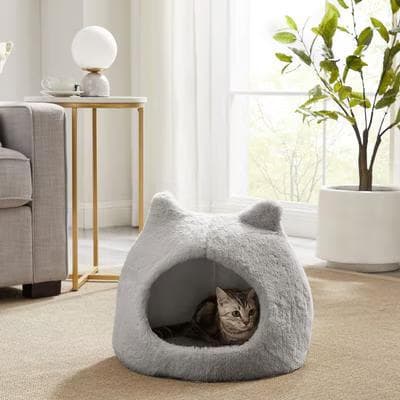
Covered, igloo-style cat bed in soft plush with a water-resistant bottom, giving cats a cozy enclosed spot to curl up. Grey.
Petful may earn a commission when you click through to Chewy, at no extra cost to you.
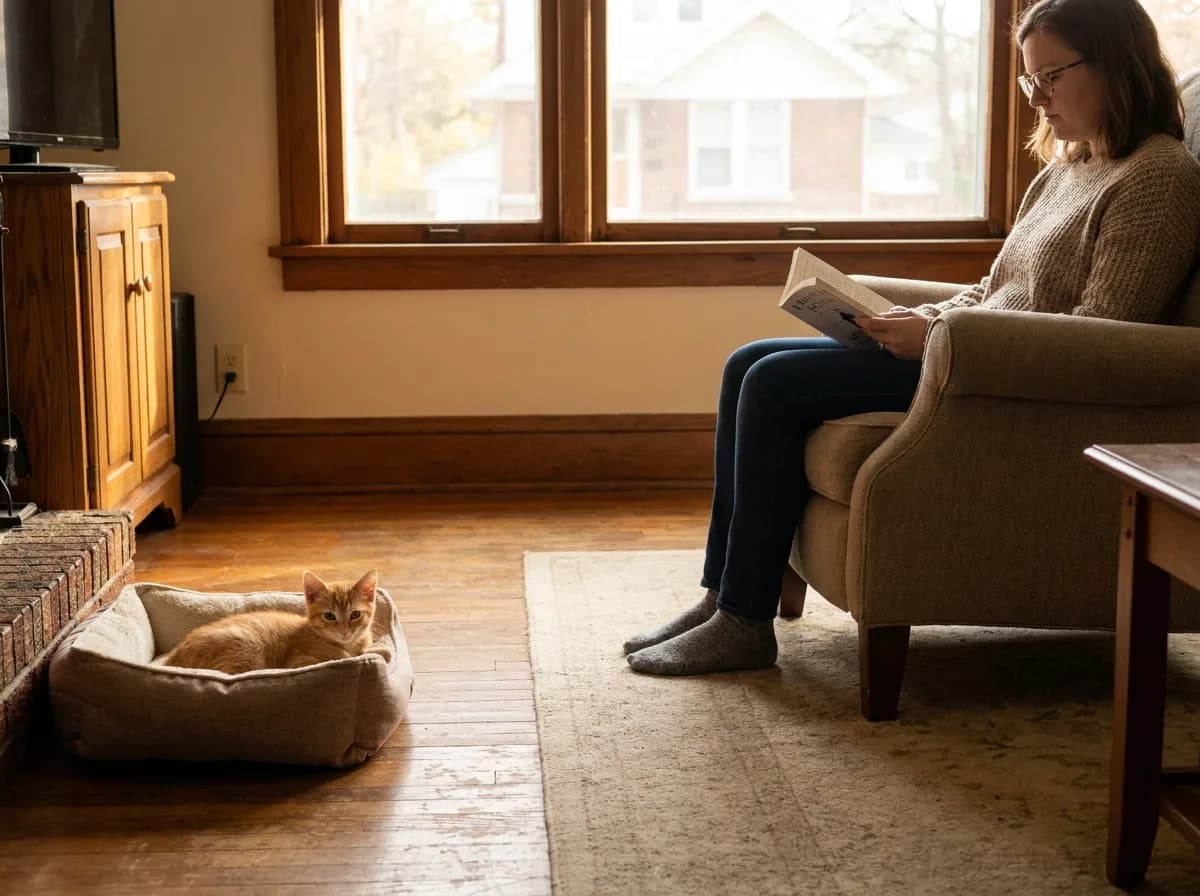
Look for comfortable choice: your kitten approaches, spends time nearby and can move away again. A relaxed rest beside you may be just as meaningful as climbing into your lap. Conversely, frantic pursuit and an inability to settle call for closer attention rather than praise for being exceptionally attached.
| What you notice | What it may mean | What to do |
|---|---|---|
| Following before a familiar meal or game | A learned request or expectation | Meet normal needs on a predictable routine. |
| Exploring, checking back and then resting | Comfortable contact with a familiar person | Allow closeness and independent activity. |
| Repeated crying or agitation when you leave | An unmet need or difficulty coping may be involved | Record what happens before you leave and whether the kitten settles again; seek help if distress persists. |
| A sudden change alongside reduced eating or other symptoms | A health assessment may be needed | Contact your veterinarian rather than trying to train the change away. |
Does Following Mean a Kitten Has Imprinted on You?
Following does not tell you that a kitten has “imprinted” on you in the same sense as a newly hatched bird following a moving object. You can recognize a close relationship without claiming an irreversible process or treating yourself as the kitten’s biological mother. Following, resting nearby and seeking contact are observations; imprinting is an interpretation those observations cannot establish.
Does your kitten see you as its mom? We cannot establish that from following, even though you provide care and reassurance. Rescued kittens may seem to bond quickly when they approach a new caregiver, but an immediate approach is not proof of an unusually strong attachment or a particular history. Give each kitten time to choose contact. Care, familiarity and a predictable routine matter more than assigning a parental identity or a bonding deadline.
What Does Imprinting Mean for Kittens?
People sometimes say a kitten has imprinted on them when it seeks them out for company. You can tell that the kitten chooses contact, but you cannot infer a bird-like imprinting process from that behavior. Attachment and socialization are more useful ideas: relationships develop through experience, and early encounters help shape comfort with people. Cats Protection’s socialization guidance emphasizes gentle, positive experiences during early development. This is not a reason to remove a kitten from its mother early or force handling to create a stronger bond.
My Siamese-cross Magwitch also followed closely after losing his mother, even clinging to my sneaker. That is a memory of one kitten seeking proximity, not proof of a universal developmental mechanism. With an underfoot kitten, stop moving, check where they are and guide them toward a safe resting or play area before walking on.
How to Tell Whether Your Kitten Enjoys Your Company
To tell whether your kitten enjoys your company, notice what happens when they have a choice. Voluntary approaches, relaxed nearby rest and returning for another interaction are more informative than holding them still for a cuddle. A kitten can like you and prefer a short game to being picked up.
A short, supervised game with a Frisco feather teaser wand may meet a request for activity when the kitten is well and ready to play. Keep the moving toy away from your hands, allow pauses, and store the string and feathers after the game. Do not leave a wand out as an unsupervised substitute for company.

Feathered teaser wand with catnip-stuffed bird. Pairs perfectly with the no-bite training policy: redirect Bengal play drive into a 10-minute interactive session with the wand.
Petful may earn a commission when you click through to Chewy, at no extra cost to you.
If your kitten wants to be held all the time, offer comfortable contact while also providing a nearby resting place. Kittens differ in whether they like to be petted and how long an interaction lasts. Calling these behaviors love can express what the relationship means to you, but they are not a way to rank affection. Notice whether the kitten freely chooses contact and relaxes afterward.
- Offer contact, then pause rather than continually reaching after the kitten.
- Let the kitten walk away without following or lifting them back.
- End handling when their body becomes tense or they try to leave.
Petful’s guide to building trust with a cat goes into consent and pacing in more detail. The aim is a relationship your kitten can participate in willingly. Do not use following as a loyalty test or compare your kitten with a more demonstrative animal online.
Bathroom Trips, Meowing and Constant Following
Following you to the bathroom usually does not need a special explanation. You moved to an interesting room, perhaps closed a door, and interrupted access to your company. Check the practical details: keep the toilet lid closed, secure cleaning products and avoid letting the kitten become trapped behind a door or appliance.
If your kitten follows and meows, consider the whole sequence. A meow beside an empty food bowl is different from persistent vocalizing while the kitten appears unwell. Meet ordinary needs first, then notice whether the kitten moves on. Following and meowing alone do not identify a medical condition or prove that you should feed an extra meal.
- Check the destination: food, water, litter, a door or a favorite play spot.
- Check the timing: before meals, after waking, during work or only when you leave.
- Check the outcome: does meeting the need allow the kitten to settle?
Helping Your Kitten Feel Secure Without Following Every Step
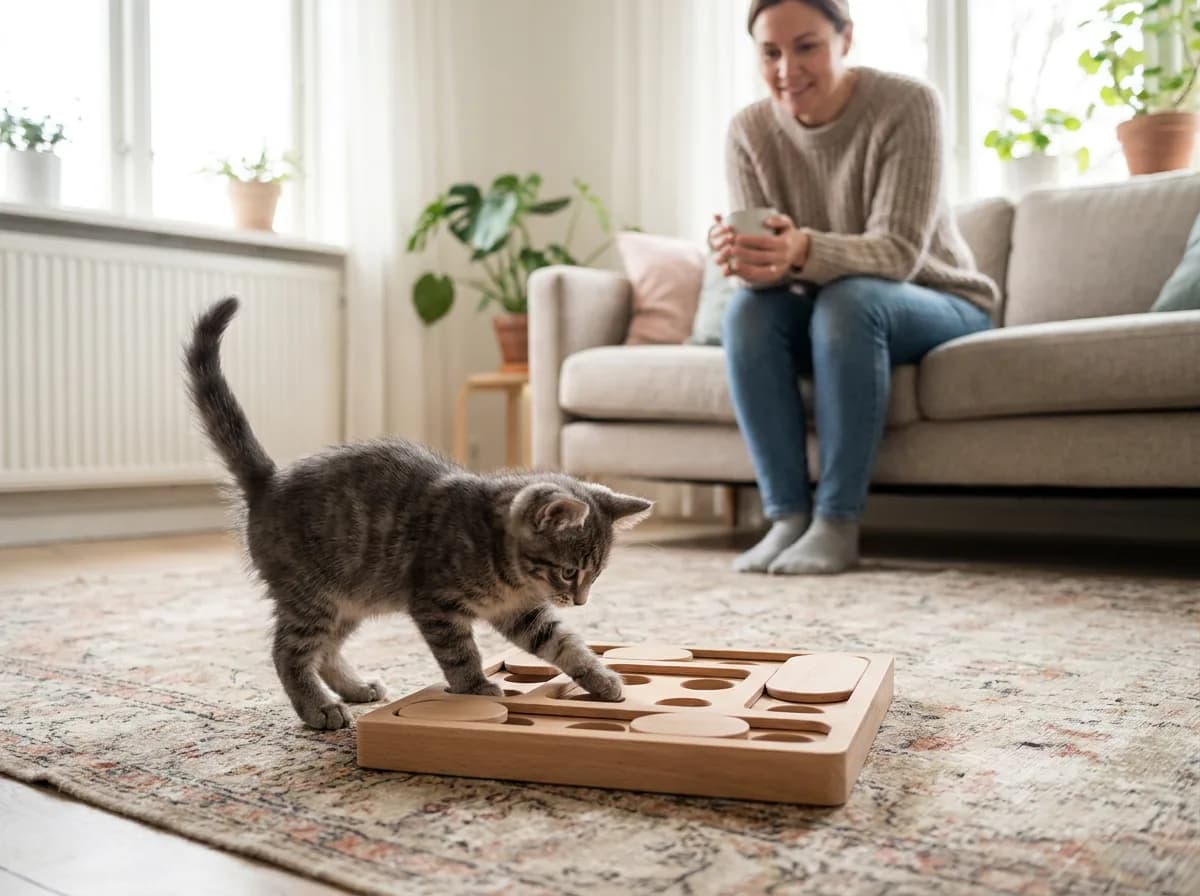
Help your kitten practice comfortable independence while keeping reliable contact. Begin when needs have been met and the kitten is already calm. A bed nearby, a safe toy or an easy food activity gives them another option while you remain accessible. You are building choices, not teaching a kitten that calling for help never works.
An easy Catit Play treat puzzle can be introduced under supervision using part of the kitten’s normal ration. Start with food that is easy to reach. Stop if the kitten becomes frustrated, and provide normal meals separately as needed. Difficulty is not the goal, and the puzzle should not limit a growing kitten’s access to adequate nutrition.

Petful may earn a commission when you click through to Chewy, at no extra cost to you.
- Use a predictable rhythm of meals, short play sessions, quiet contact and rest.
- Reward calm use of a nearby resting place without continually disturbing sleep.
- Practice only very brief separations initially, with another caregiver available when needed.
- Increase time gradually only while the kitten remains comfortable; persistent distress needs individualized advice.
Cats Protection’s new-kitten guidance explains preparing a safe home and meeting a kitten’s needs. Appropriate care is more than supplying equipment. Arrange hands-on help for absences, and ask your veterinarian about an age-appropriate routine if the kitten is especially young, newly adopted or medically vulnerable.
Clinginess, Sudden Changes and Time Alone
A clingy or seemingly needy kitten is not automatically anxious. If your kitten always wants to be near you, that preference does not mean it is obsessed with you. A new arrival may need reassurance while learning the household. The more important concern is a pattern that prevents normal activity: repeated distress whenever you move away, inability to rest, or a sudden increase in following alongside other changes.
- Note what happens before you leave, how your kitten behaves while you are away, and whether they settle again afterward. Tell your veterinarian about a sudden change and any change in eating, drinking, litter use, movement or sleep.
Do not wait for a behavior experiment to work if the kitten seems ill. Contact your veterinarian promptly when following is accompanied by reduced appetite, unusual weakness, repeated vomiting or other concerning symptoms. Breathing difficulty, collapse or inability to urinate requires urgent veterinary help. A young animal’s care needs should guide your response, not an assumption that the behavior is merely attention seeking.
Helping a Frightened Kitten Settle
No toy or touch is guaranteed to calm a cat down immediately. For a frightened kitten, reduce noise and activity, allow access to a safe hiding place and stop pursuing or holding them. Stay nearby only if that seems comfortable for the kitten. Avoid cornering them to offer reassurance. If distress does not ease, recurs frequently or comes with illness signs, ask your veterinarian what to do next.
What If an Adult Cat Follows You?
Adult cats follow people too. One of our foster cats, Dulcie, began following me soon after arriving and continued until her adoption. That observation does not show that she underwent a “second imprinting” or tell us exactly how her earlier experiences affected her. Calling an adult cat obsessed does not explain why it follows. Look at what starts the behavior and whether the cat can move on after its needs are met.
If your cat follows you from room to room, familiar routines, social contact and learned requests may still be involved. An adult cat that is very attached to you may choose nearby rest without needing constant handling. Life stage matters when evaluating a new change, especially in an older cat. WebVet’s adult-cat following guide covers that context in more detail.
For kittens and adults alike, following does not establish a guarding motive. Our explanation of whether cats protect their owners separates closeness and alertness from claims about keeping a person safe. Enjoy the company while paying attention to the animal’s actual needs.
Questions About Following Kittens
It can be a pleasant, normal part of living together if your kitten also eats, plays, rests and explores comfortably. It is not automatically better than a kitten choosing more space. Look at the behavior context and the individual cat. Distress, an inability to settle or a sudden change deserves attention even when the following seems affectionate.
Do not assume a kitten can manage an overnight absence because food and a camera are available. Age, health, feeding needs and experience alone all matter, and young kittens need frequent care. Arrange a suitable caregiver and discuss the routine with your veterinarian or adoption organization. Sleeping in your home while the kitten rests safely nearby is a different situation from leaving the home unattended overnight.
There is no single age when every kitten is “naughtiest.” Play, exploration and learning household routines vary with development and the individual. Treat jumping, chasing or underfoot play as needs to manage safely, rather than evidence of spite. Provide appropriate outlets and ask for advice if activity is suddenly different, difficult to interrupt or accompanied by other concerning changes.
There is no universal highest form of feline affection. A kitten may seek touch, greet you, play with you or simply rest close by. Consider the whole pattern and whether contact is voluntary. A kitten that dislikes being held can still have a strong relationship with you; constant following is not a required proof of love.

T.J. Banks is the author of several books, including Catsong, which received a Merial Human–Animal Bond Award. A contributing editor to laJoie, T.J. also has received writing awards from the Cat Writers’ Association (most recently a Certificate of Excellence in 2019), as well as from ByLine and The Writing Self. Her work has appeared in numerous anthologies, including Chicken Soup for the Single Parent’s Soul and A Cup of Comfort for Women in Love, and T.J. has worked as a stringer for the Associated Press, as an instructor for the Writer’s Digest School and as a columnist.
Sign up for expert-backed reviews and safety alerts all in one place.