Best Cat Strollers: Safe Outings for Every Cat
A cat stroller gives indoor, senior, and leash-averse cats safe fresh air. Compare our top no-zip picks, what a cat stroller costs, and how to acclimate your cat.
Petful is reader supported. As an affiliate of platforms like Amazon and Chewy, we may earn a commission when you buy through links on this page. There is no extra cost to you.
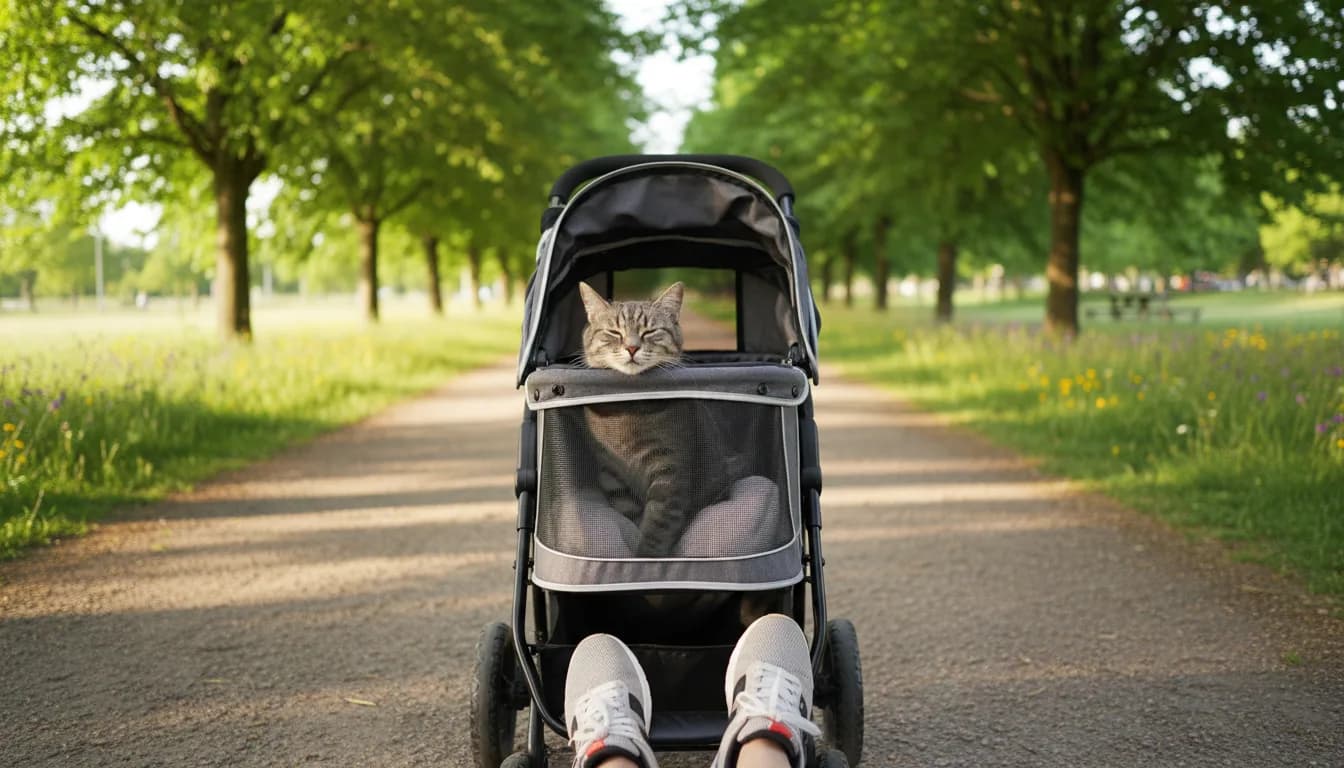
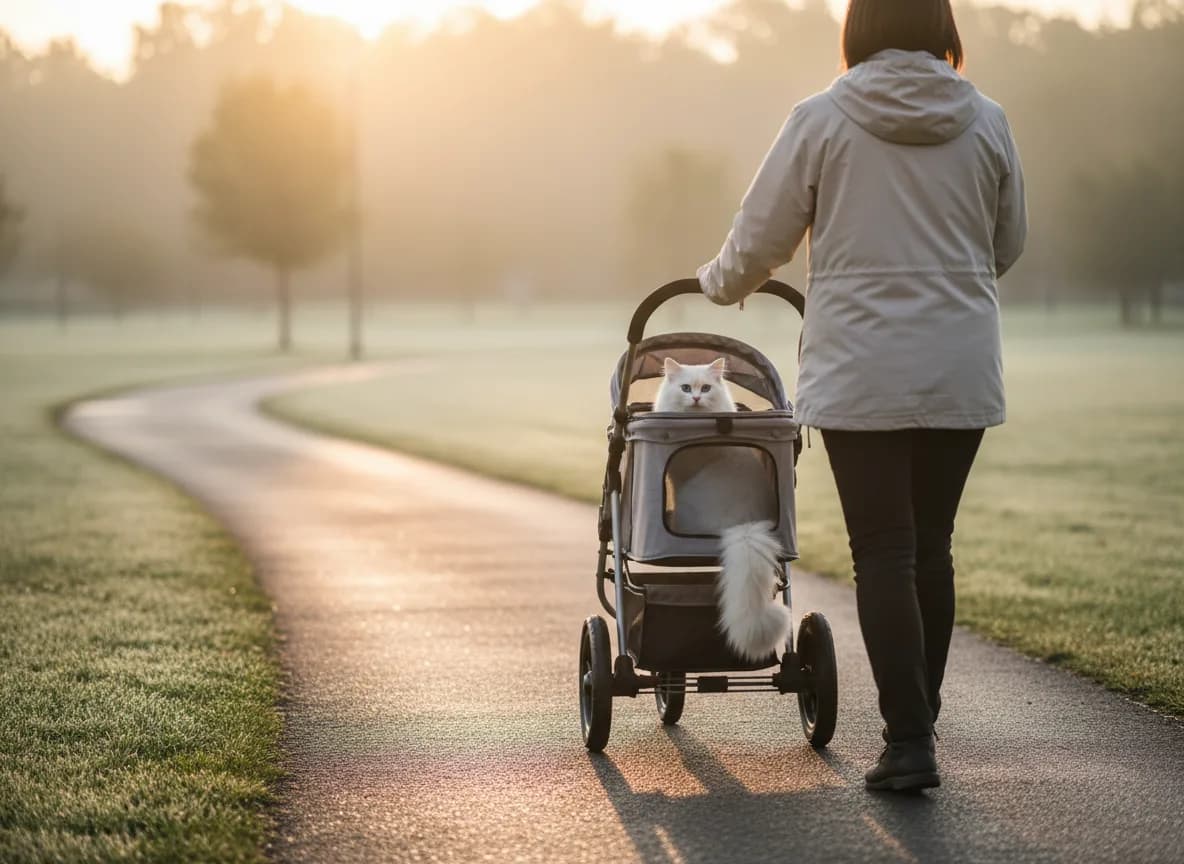
A cat stroller sounds like a punchline until you meet the cat it was built for. For a senior cat with stiff joints, a cat recovering from surgery, a cat who flatly refuses a harness walk, or an indoor-only cat who presses at the window every morning, a stroller is the safest way to hand them the outdoors without the traffic, dogs, and parasites that come with it. It is fresh air and enrichment inside a secure, screened cabin, and for a lot of cats it becomes the best part of the week.
Here are our top four picks, each built for a different kind of cat and route:
- Pet Gear Happy Trails Lite: the Pet Gear Happy Trails Lite No-Zip is the lightweight, no-zip cat stroller most owners should start with, at around $130.
- Pet Gear Excursion: the Pet Gear Excursion No-Zip rides on air-ride tires that smooth out gravel, dirt, and trails.
- Pet Gear Expedition: the Pet Gear Expedition No-Zip has a 150 lb frame rating and room for two cats with twin tethers.
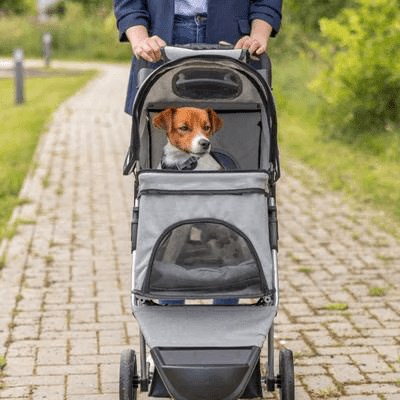
- TRIXIE Foldable Cat & Dog Stroller: the TRIXIE Foldable Cat & Dog Stroller is a $66 foldable 3-wheeler for occasional, smooth-path outings with a smaller cat.

Sign up for expert-backed reviews and safety alerts all in one place.
Our top cat stroller picks at a glance
- 1Best overall: the Pet Gear Happy Trails Lite No-Zip is the lightweight, no-zip cat stroller most owners should start with, at around $130.
- 2Best for rough terrain: the Pet Gear Excursion No-Zip rides on air-ride tires that smooth out gravel, dirt, and trails.
- 3Best for multiple cats: the Pet Gear Expedition No-Zip has a 150 lb frame rating and room for two cats with twin tethers.
- 4Best budget pick: the TRIXIE Foldable Cat & Dog Stroller is a $66 foldable 3-wheeler for occasional, smooth-path outings with a smaller cat.
- 5Safety rule: always clip the interior safety tether to a fitted harness before every outing, never to a collar.
- 6Acclimation is everything: introduce the stroller slowly over days at home before the first real walk, or your cat may never settle.
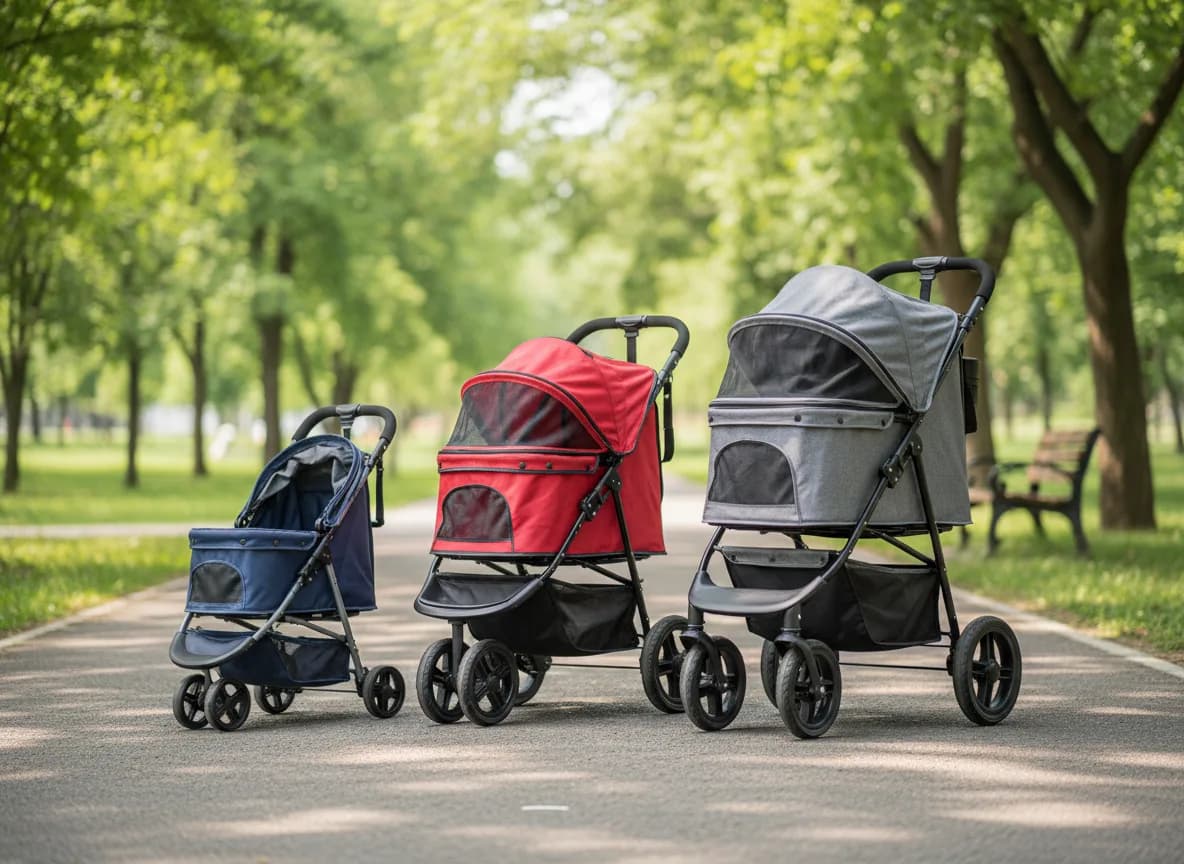
The right stroller depends almost entirely on your cat and your routine, not on the flashiest spec sheet. How many cats are you pushing? Where do you actually walk, smooth sidewalks or gravel trails? How much can you lift and store? Answer those first, and the pick gets easy. Below are four picks for the most common needs, three proven Pet Gear models plus a budget option, followed by a plain-English guide to choosing, using, and living with one.
Best overall cat stroller: Pet Gear Happy Trails Lite No-Zip Stroller
If you want one stroller that covers most owners without draining your wallet, the Pet Gear Happy Trails Lite No-Zip is the easy pick. It weighs around 15 pounds, folds down in seconds, and pops back up with one hand, which matters a lot when you are juggling a cat, a leash, and a coffee. The no-zip entry is the headline feature: instead of fiddling with a zipper that a determined paw can nose open, the mesh windows release with a push-button latch and snap shut on their own. You get both front and top access, so a shy cat can be loaded from above without being pushed through a narrow door. For a first stroller, or for a small-to-average cat under about 30 pounds combined with any gear, it hits the sweet spot of light, simple, and genuinely affordable at roughly $130.
Inside, there is a built-in interior safety tether that clips to your cat's harness, so even if the cabin is open the cat is anchored and cannot leap out. Mesh ventilation wraps three sides plus the top, which keeps airflow moving on warm days and gives a nervous cat a full view of the world without exposing them to it. The cabin is roomy enough for one cat to sit, turn, and lie down, and there is a removable, washable pad for the inevitable muddy-paw day. Underneath sits a storage basket for treats, wipes, and a folded towel, and the push handle has a cup holder tray. None of this is luxury-grade, but everything works, and nothing on it feels like it will crack the first time you fold it into a trunk.
This is the model I would hand to an indoor cat's owner who wants safe fresh air on sidewalks and smooth park paths a few times a week. The wheels are small and firm, so they roll beautifully on pavement and get bouncy on gravel, tree roots, or grass. If your walks are mostly flat and paved, that trade is easy to live with. If you already know you want trails, or you have two cats, size up to one of the picks below. For the classic use case, a single senior or homebody cat getting a low-stress outing, the Happy Trails Lite is hard to beat on value, and the no-zip entry alone makes it worth the money.
- Featherweight and one-hand fold: at about 15 pounds it lifts into a car easily and collapses fast for storage.
- Push-button no-zip entry: mesh windows latch shut on their own, closing the paw-nudge escape route.
- Front and top loading: you can lower a skittish cat in from above instead of pushing through a door.
- Strong value: built-in interior tether, storage basket, and cup holder at roughly $130.
- Small firm wheels: smooth on pavement, jittery on gravel, grass, or trail.
- One-cat cabin: fine for a single cat, tight for two.
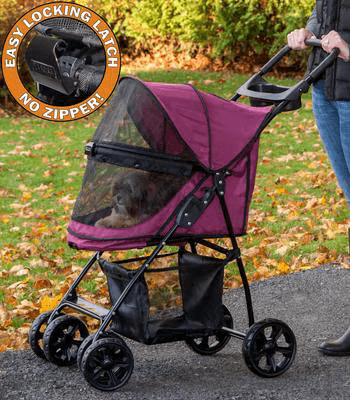
Petful may earn a commission when you click through to Chewy, at no extra cost to you.
Best for rough terrain: Pet Gear Excursion No-Zip Stroller
When your walks leave the sidewalk, the Pet Gear Excursion No-Zip is built for it. The difference you feel first is the wheels: large air-ride tires that actually absorb bumps instead of transmitting every crack and root straight into the cabin. On gravel paths, packed dirt, and grassy park edges, that cushioning is the whole ballgame, because a jarring ride is exactly what turns a curious cat into a stressed one. The frame is taller and more planted than the Happy Trails Lite, with a front swivel wheel that can lock straight for stability on rougher ground. It is heavier and pricier at around $258, but you are paying for suspension and a chassis that shrugs off terrain a lightweight stroller would rattle across.
Like the rest of this lineup, the Excursion uses no-zip entry, with mesh panels that pop open by latch and close by magnet so there is no zipper for a paw to work loose. Ventilation is generous on all sides, and the mesh is dense enough to keep the airflow up without letting claws find purchase. Inside you get the same interior safety tether to clip to a harness, plus a larger cabin than the entry model, which suits a bigger cat or a cat who likes to sprawl. Storage is better too: a deep basket underneath and dual cup holders on the parent tray. The pad lifts out for washing, and the raised sides give a wind-shy cat a den-like corner to settle into on a breezy day.
The honest trade with the Excursion is bulk. It is heavier to lift and takes more trunk space folded than the Happy Trails Lite, so if your outings are all smooth pavement, you are carrying capability you will not use. But if you live near trails, unpaved greenways, or a gravelly neighborhood, the air-ride tires change the experience for both of you. A senior cat with achy joints especially benefits, because the suspension takes the sting out of surfaces that would otherwise make every walk a rough ride. For one cat who wants real terrain rather than city blocks, this is the stroller I would spend up for, and the smoother ride pays you back in a calmer passenger.
- Air-ride tires: large cushioned wheels soak up gravel, roots, and dirt for a smooth ride.
- Rugged, planted frame: a lockable front swivel keeps it stable on uneven ground.
- No-zip entry with full-side mesh: secure closure and strong ventilation together.
- Roomy cabin and real storage: deep basket, dual cup holders, washable pad.
- Heavy and bulky: harder to lift and takes more trunk space than a lightweight model.
- Overkill on pavement: you pay for terrain features flat-sidewalk walkers will not use.
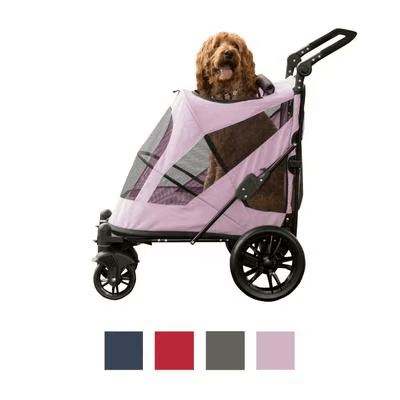
Petful may earn a commission when you click through to Chewy, at no extra cost to you.
Best for multiple cats: Pet Gear Expedition No-Zip Stroller
If you are pushing two cats, or one very large cat, the Pet Gear Expedition No-Zip is the heavy-duty answer. Its headline number is capacity: the frame is rated to handle up to 150 pounds, which is not about a 150-pound cat but about a robust chassis that does not flex or wobble under a loaded cabin. That structural margin is what lets it carry two cats side by side, or a single big cat plus the gear, without the frame feeling stressed. It rides on air-ride tires like the Excursion, so the smooth-ride benefit carries over, and it holds a straight line well even when it is full. At around $259, it costs about the same as the Excursion but trades some nimbleness for sheer carrying strength.
The cabin is the reason to buy it. It is tall and wide enough for two cats to sit without crowding, which cuts down on the tension that makes shared rides go sideways. No-zip entry is standard, with latch-and-magnet mesh panels front and rear, so you can load one cat from each end rather than wrestling both through a single opening. Twin interior safety tethers let you clip each cat to its own harness, which is the non-negotiable move for a multi-cat stroller: two cats loose in one cabin is how a door-opening turns into a double bolt. Mesh ventilation runs the full height of the cabin, storage underneath is deep, and the whole thing still folds flat, just not as compactly as the lightweight pick.
This is more stroller than a single homebody cat needs, and it is the biggest and heaviest of the three, so a one-cat household on flat sidewalks should not default to it. Where it earns its keep is a genuine multi-cat home, a bonded pair who tolerate each other, or an owner who wants one stroller that will never feel undersized. The build quality matches the rating: this is a haul-it-for-years frame, not a seasonal buy. If you have the cats to fill it and the storage space to park it, the Expedition gives you room, stability, and the same no-zip, air-ride features that make the rest of this lineup easy to recommend, just scaled up for a bigger job.
- Up to 150 lb frame rating: a rock-solid chassis that carries two cats without flexing.
- Twin interior tethers: clip each cat to its own harness for safe shared rides.
- Front and rear no-zip entry: load one cat from each end, no single-door wrestling.
- Air-ride tires and deep storage: a smooth ride plus room for all the gear.
- Big and heavy: the largest, least compact stroller here, overkill for one cat.
- Needs storage space: folds flat but still takes real room in a trunk or closet.
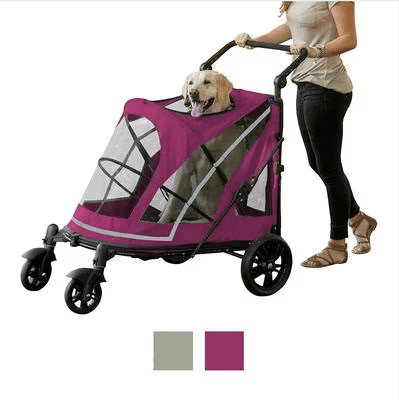
Petful may earn a commission when you click through to Chewy, at no extra cost to you.
Best budget cat stroller: TRIXIE Foldable Cat & Dog Stroller
If your budget is the deciding factor, the TRIXIE Foldable Cat & Dog Stroller is the value pick that still covers the basics. At around $66 it costs roughly half of our Pet Gear favorites, yet it earns a solid 4.5-star average across more than 400 reviews. It is a lightweight three-wheel design that folds down compact in seconds for a closet or a car trunk, which makes it an easy first stroller for someone who wants to test whether their cat takes to the idea before spending more. The mesh cabin holds a cat up to about 24 pounds, so it suits a single small-to-average cat rather than a big tom or a bonded pair.
For the money, the feature list is generous. A zip-on weather cover shields your cat from wind and light rain, a roomy storage basket underneath swallows treats and a folded towel, and there is a cup holder on the handle for you. Mesh panels on the front and sides keep the cabin ventilated and give a nervous cat a clear view out. The main cabin runs roughly 13 by 22 by 24 inches, enough for one cat to sit up and turn around. The honest trade against our Pet Gear picks is the entry: the Trixie uses zippered mesh rather than self-latching no-zip panels, so double-check the zippers are fully closed and clip your cat's harness to the interior leash ring before you roll.
This is the stroller I would hand to a budget-minded owner with one calm cat and mostly smooth sidewalks or park paths. The single front wheel steers tightly and turns easily, but like any three-wheel jogger it can feel a little tippy on a hard, sharp turn, and it is not built for gravel or rough trails the way the air-ride Pet Gear models are. Buy it to find out whether your cat enjoys stroller life without a big outlay, and if the answer is an enthusiastic yes, you can always graduate to a sturdier frame later. For occasional, low-stakes outings with a smaller cat, the value here is genuinely hard to beat.
- Budget-friendly price: around $66 is roughly half the cost of the premium picks.
- Weather cover, storage basket, and cup holder: practical extras that make outings easy.
- Lightweight, foldable frame: collapses compact for a closet or car trunk in seconds.
- Well-rated 3-wheel design: 4.5 stars across 400-plus reviews, with tight, easy steering.
- Zippered mesh, not no-zip: less foolproof than the self-latching Pet Gear panels, so check closures.
- Best for one smaller cat on smooth paths: a 24-pound limit and a jogger frame not made for trails.
Petful may earn a commission when you click through to Chewy, at no extra cost to you.
What to look for in a cat stroller
Once you have the shortlist, the buying decision comes down to a handful of features that actually change your cat's experience. Price matters, but a cheap stroller your cat can escape from is no bargain. Here is what to weigh, roughly in order of how much it affects safety and comfort. Our overall pick, the Pet Gear Happy Trails Lite, covers most of them for around $130. If you have two cats, look for a double or multi-cat pet stroller like the Pet Gear Expedition. A detachable carrier that lifts out for vet trips is worth the premium for a travel-heavy household, though none of our four picks include one, so that feature means shopping for a 3-in-1 travel system instead.
- Interior safety tether: a built-in clip that anchors your cat to a harness inside the cabin is the single most important escape-prevention feature, and multi-cat models like the Pet Gear Expedition give each cat its own. Never buy without one.
- Secure no-zip or lockable entry: no-zip panels that latch and self-close beat a plain zipper a paw can nose open. If it zips, make sure the pulls lock.
- Mesh ventilation on multiple sides: airflow keeps the cabin cool and lets an anxious cat see out. Look for dense mesh on at least three sides plus the top.
- Wheel type matched to your terrain: small firm wheels roll great on pavement, while air-ride tires like those on the Pet Gear Excursion handle gravel and trails. Buy for the ground you actually walk.
- Weight capacity and cabin size: check that the rating covers your cat plus gear, and that the cabin is tall enough for your cat to sit up and turn around.
- Storage basket and cup holder: a basket for treats, wipes, and a towel, plus a cup holder, turns a short outing into an easy one. Small features, big daily difference.
- Folds for car and storage: a one-hand or near-one-hand fold that lies flat is the difference between a stroller you use and one that lives in the garage.
Are cat strollers a good idea?
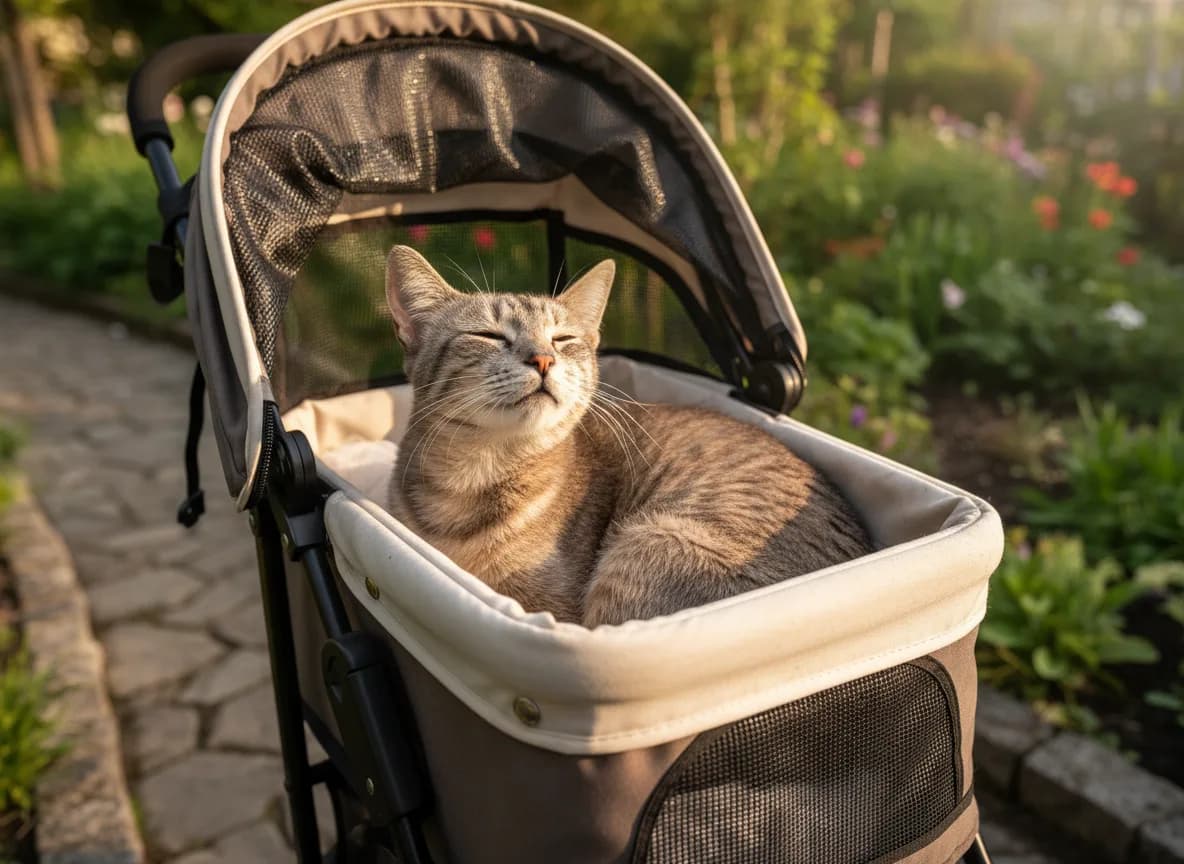
For the right cat, a stroller is a genuinely good idea. It gives an indoor or senior cat safe outdoor stimulation without the risks of free-roaming: no traffic, no loose dogs, no fights, no fleas picked up in the bushes. A cat who is recovering from surgery, or who simply refuses to walk on a leash, can still get sights, smells, and fresh air from behind a mesh window. That enrichment is real, and for a lot of cats it becomes the highlight of the day.
What a stroller cannot do is fix fear. A cat who genuinely panics in an enclosed, moving space is not going to be won over by a nicer stroller, at least not without slow, patient acclimation, and sometimes not at all. Forcing a terrified cat into a stroller is stressful for everyone and can set back your relationship. The goal is a calm, curious passenger, so match the tool to the cat and be willing to accept that some cats are homebodies for life. If yours leans nervous, our realistic take on traveling with an anxious cat is worth reading first.
- Gives indoor cats safe outdoor stimulation: new sights and smells with none of the traffic, dog, or parasite risk of free-roaming.
- Protects seniors and post-surgery cats: fresh air and enrichment without asking stiff joints or healing incisions to do the walking.
- Keeps a leash-averse cat contained: cats who refuse a harness walk can still get out safely behind mesh.
- A bad fit for a cat that panics: a truly terrified cat in an enclosed space needs patience, not pressure, and may never enjoy it.
Do cats enjoy being in a stroller?
Plenty of cats do enjoy the stroller once they are used to it, but enjoyment is earned, not assumed. A cat who likes it will settle in, watch the world go by, groom, or even doze, with a relaxed body and forward ears. Some cats chirp at birds or lean toward the mesh to take in a new smell. That calm curiosity is the sign you are looking for, and it usually shows up only after a proper introduction.
A stressed cat tells you the opposite story, and it is worth learning to read. Flattened ears, a tucked or crouched posture, dilated pupils, heavy panting, constant meowing, or frantic attempts to dig at the mesh all mean the outing is too much right now. Those are not signs to push through. They are signs to stop, head home, shorten the next session, and rebuild confidence more slowly before you try again.
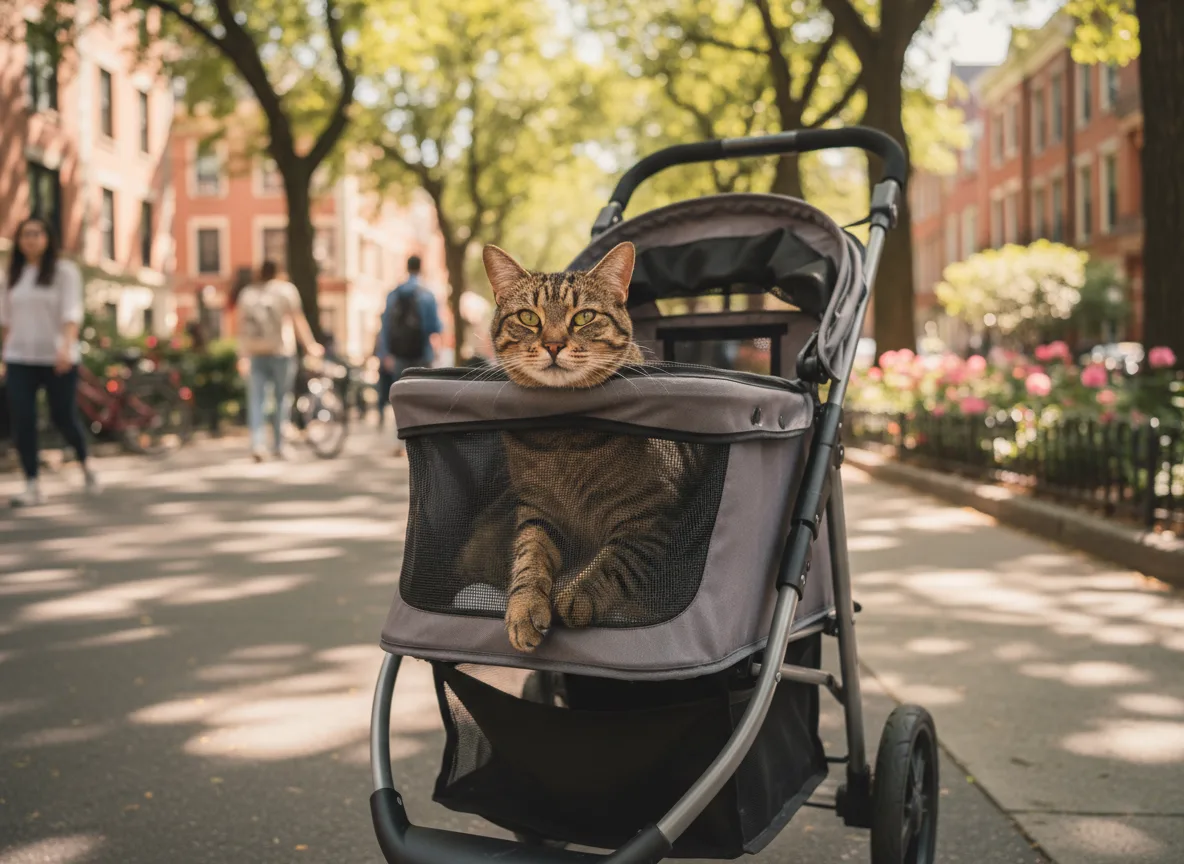
The single biggest predictor of whether a cat enjoys the ride is how you start. Cats that were rushed into a first walk often decide the stroller is a trap, while cats that met it slowly at home, on their own terms, tend to accept it as just another cozy perch that happens to move. Start slow, keep the early sessions short and positive, and let your cat set the pace. Patience up front buys you years of easy outings.
How much does a cat stroller cost?
The short answer on cat stroller cost is that you can spend anywhere from about $50 to $300, and the price mostly tracks wheels, cabin size, and build quality. Budget models in the $50 to $90 range get you a basic frame and lighter fabric that is fine for occasional flat-sidewalk strolls. The $100 to $160 mid-range is where most owners should shop, adding no-zip entry, sturdier wheels, and real storage. Premium strollers from $200 to $300 buy air-ride tires, big rugged cabins, and multi-cat capacity for people who walk hard surfaces or push two cats. The cheapest pet strollers start near $50, and the budget TRIXIE Foldable Cat & Dog Stroller sits just above at $66, but a rock-bottom cheap stroller often skimps on the latches and mesh that actually keep a cat contained, so the mid-range is the smarter floor. For rough ground, the premium Pet Gear Excursion with air-ride tires is where the money goes.
| Tier | Price range | What you get |
|---|---|---|
| Budget | $50-90 | Basic 3-wheel or 4-wheel, lighter fabric, smaller cabin |
| Mid-range | $100-160 | No-zip entry, better wheels, storage basket |
| Premium | $200-300 | Air-ride tires, large cabin, multi-cat capacity, rugged frame |
Cat stroller types: 3-wheel, 4-wheel, and travel systems
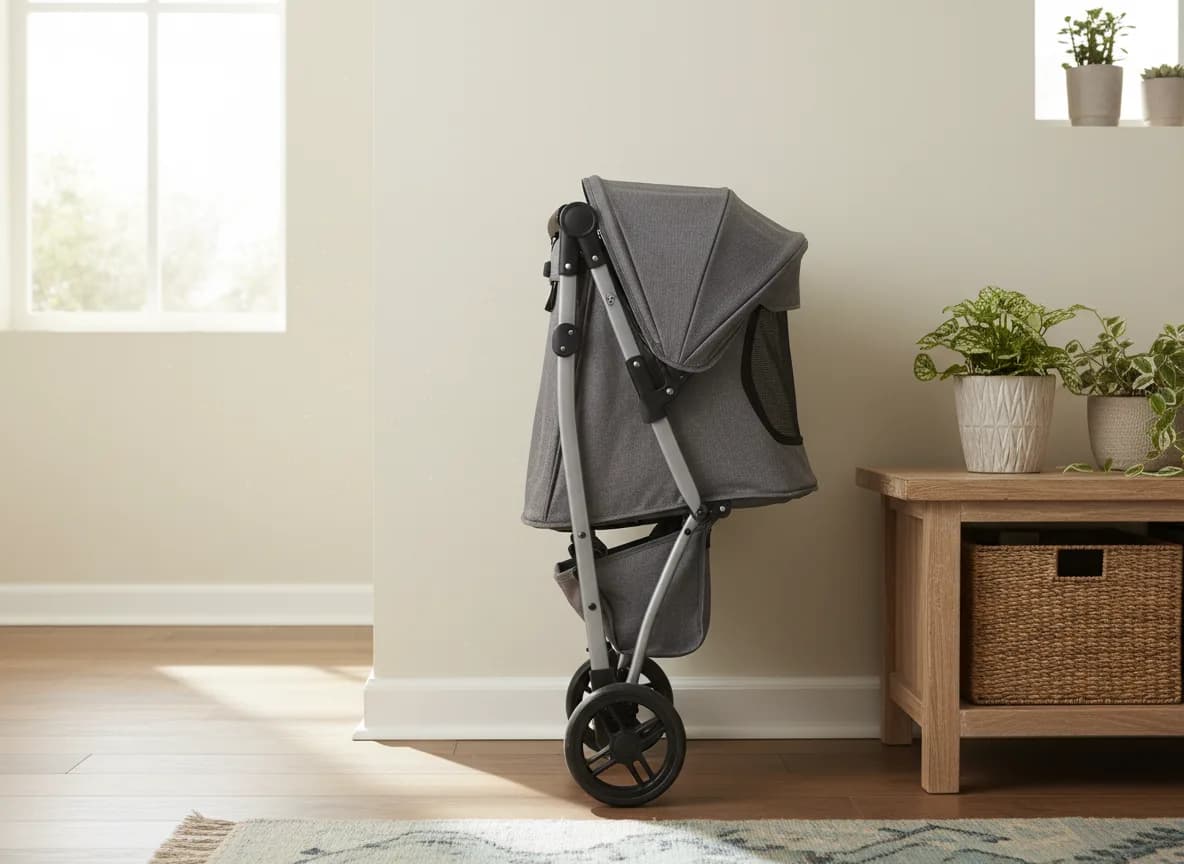
Cat strollers come in a few core shapes, and the right one depends on where you walk and how many cats you are carrying. You do not need the fanciest type, you need the one that matches your ground and your household. A foldable or collapsible pet stroller that folds flat is easiest to store in an apartment or a car trunk. Here are the main styles and who each one suits.
- 3-wheel jogging: a single front wheel makes for smooth, tight turns and easy steering, great for active owners on paths and light trails.
- 4-wheel standard: four wheels give the most stable, tip-resistant base, ideal for flat sidewalks and owners who want maximum steadiness.
- Double or multi-cat: a bigger cabin or a two-level design carries two cats or a big cat plus gear without crowding.
- Travel-system: a detachable carrier clicks out of the frame and straight into the car, which makes vet trips and transfers seamless.
- Compact folding: a small, light frame that folds tight for apartment closets and car trunks, best where storage space is at a premium, like the budget TRIXIE Foldable.
| Type | Best for | Watch-outs |
|---|---|---|
| 3-wheel jogging | Paths, light trails, active walkers | Can feel tippy on sharp turns |
| 4-wheel | Everyday flat sidewalks, stability | Heavier, wider turns |
| Travel system | Vet trips and car transfers | Costs more, extra parts |
Are cat strollers good for indoor-only cats?
Yes, cat strollers are a genuinely good idea for indoor-only cats, arguably better for them than for any other group. Indoor cats miss out on the sensory buffet that outdoor cats take for granted: moving air, birdsong, rustling leaves, the smell of grass after rain. A stroller delivers all of that enrichment while a mesh cabin keeps them fully contained, so they get the stimulation without a single one of the outdoor risks, which is a big part of what keeps indoor cats happy over a long life.
The catch is that indoor cats have often never been outside, so the world can be overwhelming at first. Introduce it gradually, on quiet streets or your own backyard, before anywhere busy. Keep the first outings short, bring high-value treats, and let your cat retreat into the cabin's covered corner whenever they want. A slow ramp turns a scary novelty into a familiar, welcome routine over a few weeks.
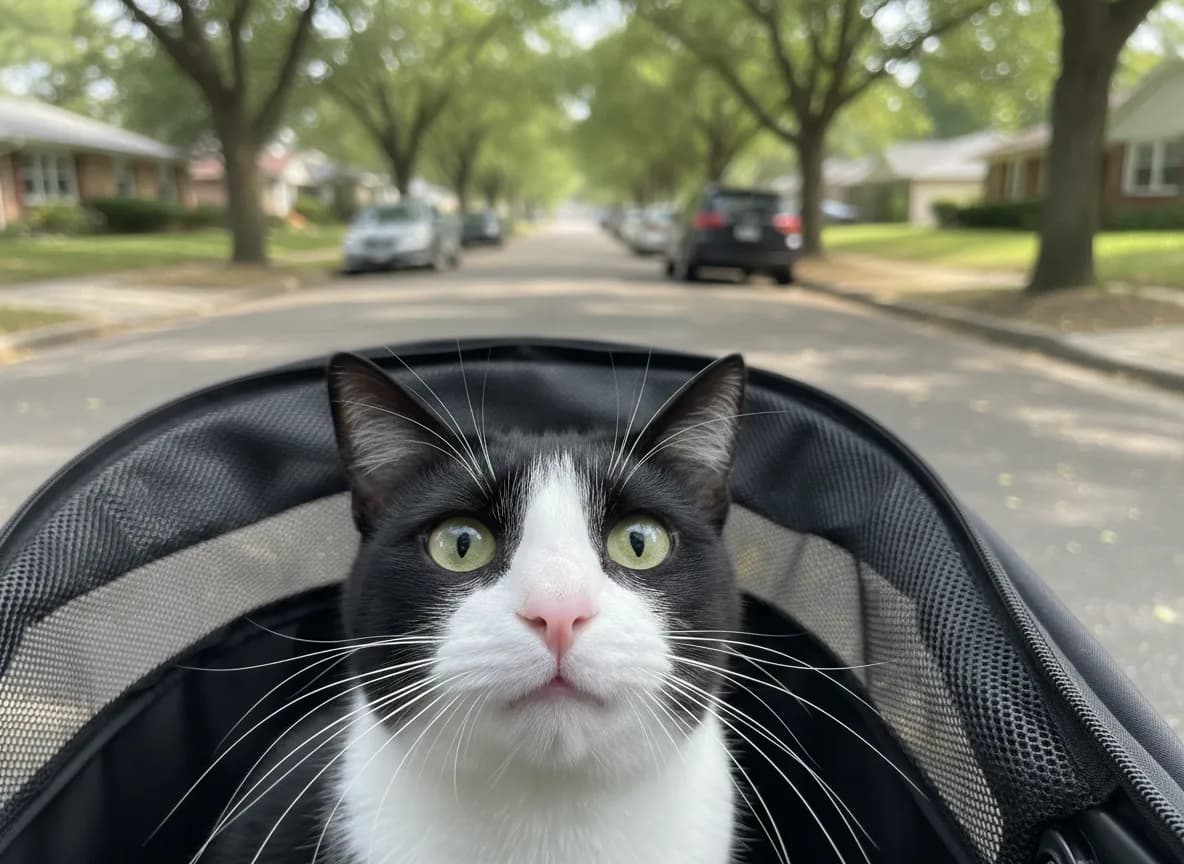
A screened, secure cabin is what makes this safe, so do not cut corners on the enclosure. The mesh should be intact and dense, the entry should latch firmly, and the interior tether should always be clipped to a harness before you roll. Done right, a stroller lets an indoor cat safely experience the outdoors for years, which is a real quality-of-life upgrade for a cat that would otherwise only ever see it through a window. Pair it with the rest of our indoor cat care guide for a fuller enrichment routine.
How to get your cat used to a stroller
Acclimation is not optional, and it is not a five-minute job. Plan to leave the stroller out and let your cat investigate it on their own terms for several days before you ever attempt a walk, then build up in small, rewarding steps. The sequence below is the short version, and our full acclimation guide walks through each stage in detail.
- Leave the stroller out: set the open stroller in a room your cat already likes and let them sniff, rub, and ignore it with zero pressure for a few days.
- Feed and treat inside it: place meals, catnip, or favorite treats in the stationary cabin so your cat chooses to climb in and builds good associations.
- Short stationary sits with the cabin closed: once they settle inside, close the mesh for a minute or two while stationary, rewarding calm, then let them out.
- A first slow loop: push a gentle lap indoors or around a quiet yard, keeping it short and ending before your cat gets anxious.
- Build up to real walks: extend distance and time gradually over days, always stopping while your cat is still relaxed rather than pushing to overwhelm.
For the full step by step, read our guide on how to get a cat used to a carrier.
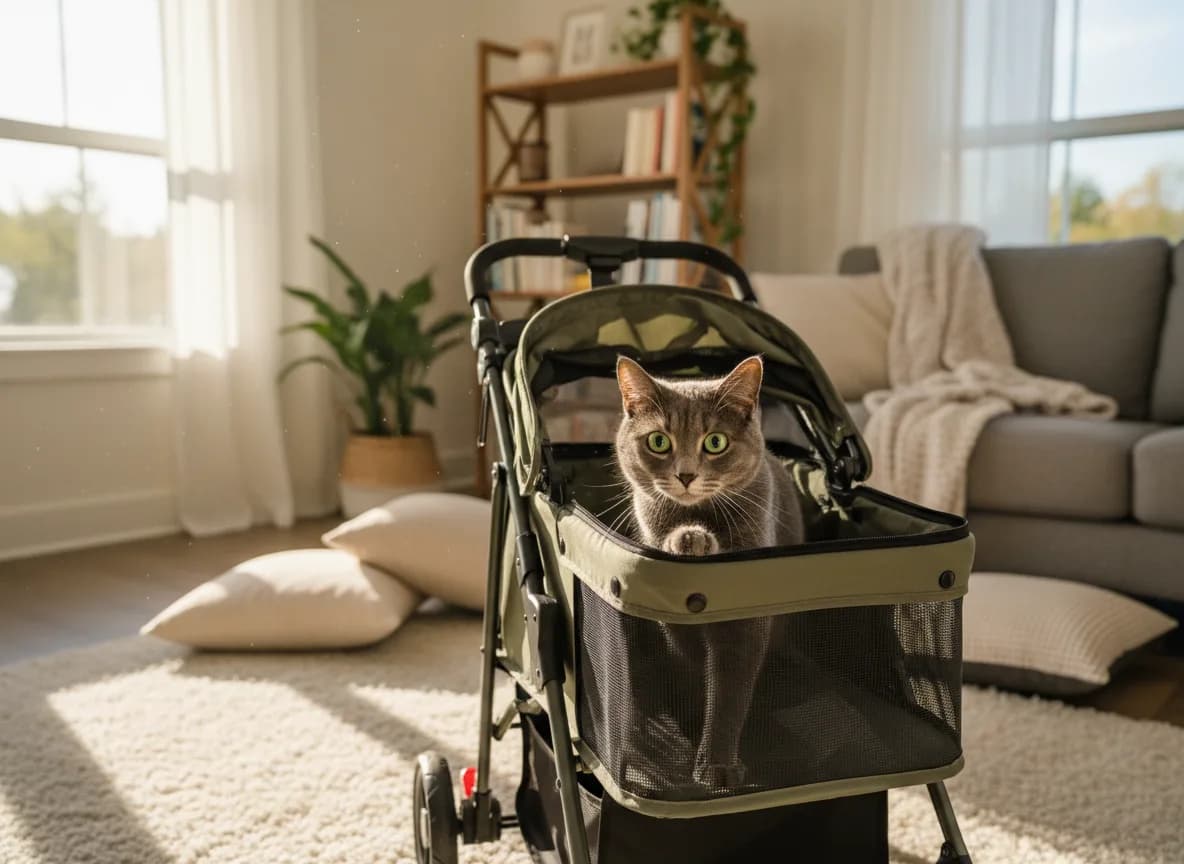
Escape prevention and safety on stroller walks
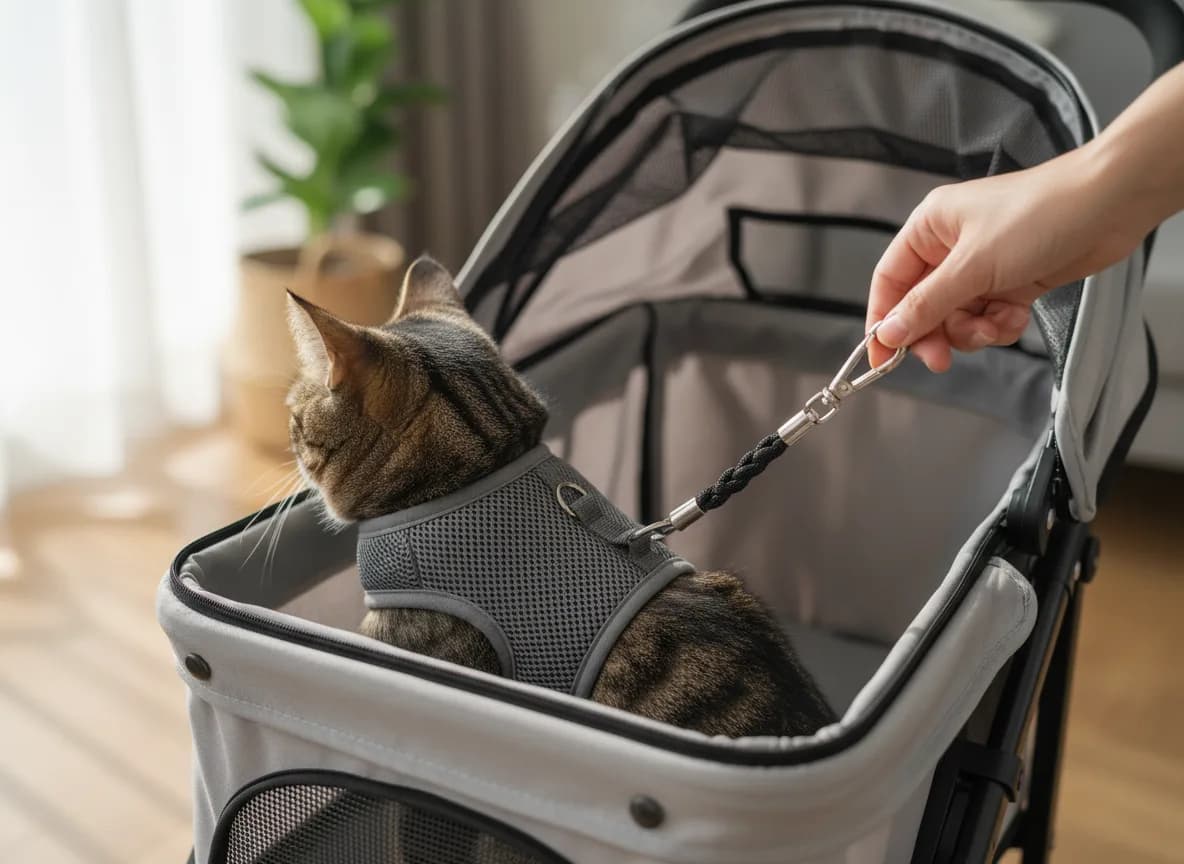
Escape prevention is the one area where there is no room to improvise. Before every single outing, clip the interior safety tether to a properly fitted harness on your cat, not to a collar, which can slip over the head or choke. That tether is your backup for the moment a latch fails or you open the cabin without thinking. A harness plus tether means that even a startled cat has a hard limit on how far they can go. If your cat is new to wearing one, our guide to cat leashes and harnesses walks through choosing and fitting the right size.
Double-check the closures every time you set out and again whenever you stop. Zips should be fully seated and, if the model allows, locked; no-zip panels should be snapped shut and sitting flush. It only takes one half-closed window for a determined cat to squeeze through, and a squeeze-through on a busy street is the nightmare scenario every one of these features exists to prevent. Thirty seconds of checking is cheap insurance.
- Before every outing, clip the interior safety tether to a properly fitted harness, never to a collar. That backup is what keeps a startled cat contained if a latch fails or you open the cabin outdoors.
Never open the cabin outdoors without the interior safety tether still clipped. If you need to reach in, do it in a fully enclosed space like a closed car or your own home, not curbside. And if your cat makes a genuine bolt attempt, do not chase or grab over the top, which only escalates the panic. Stay calm, lower the stroller to the ground, block the opening with your body, and let your tethered cat hit the end of the tether and settle before you reposition.
Cat strollers vs. backpacks vs. carriers
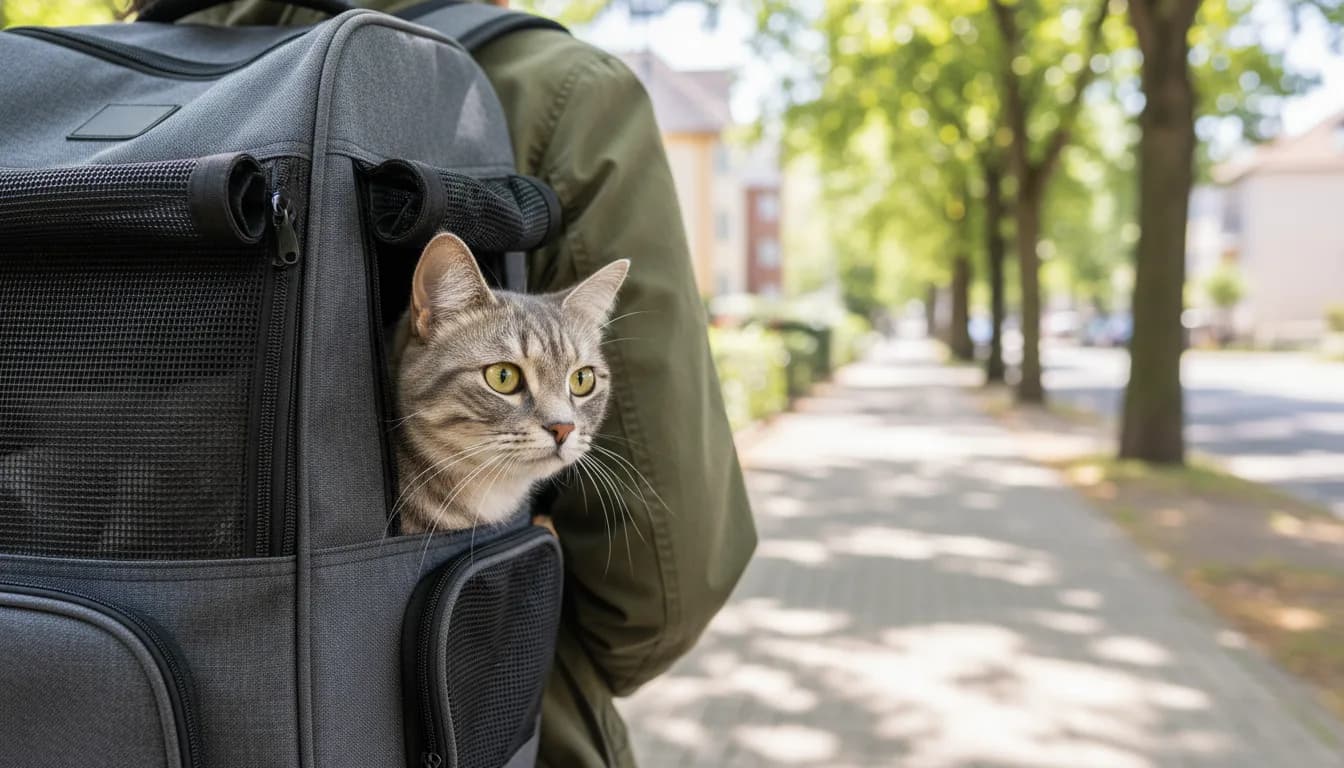
Whether cats prefer backpacks or strollers comes down to the outing, since backpacks free your hands for transit while strollers give a longer, roomier ride. A stroller is not the only way to give a cat a change of scenery, and it is not always the best one. A cat backpack sits high on your body, keeps your hands free, and shines on public transit, in crowds, or on a short hike where a wheeled frame would be a hassle. The trade is space: even a roomy backpack is a small, warm bubble, so it suits quick trips rather than the long, relaxed sit-and-watch outings a stroller does best. Our cat backpack guide breaks down the ventilated and bubble-window options if that fits your life better.
A standard carrier, meanwhile, is a transport tool, not an enrichment one. It is the right call for the car ride to the vet or a flight, where containment and a small, secure space actually help a cat feel safe, but it is not built for leisurely walks. Think of it this way: a carrier gets your cat somewhere, a backpack carries your cat with you, and a stroller lets your cat experience a place at their own pace. Our broader cat carrier guide covers choosing the right transport carrier for travel and vet days, and our tips on traveling with cats in the car help for longer drives.
Frequently asked questions about cat strollers
Two cats can share one stroller, but only if the cabin is big enough and the two cats genuinely get along. A cramped shared space or a tense pairing invites squabbles and stress, so size up to a multi-cat model like the Pet Gear Expedition, which has room for two and twin interior tethers. Clip each cat to its own harness so a single open door can never become a double escape, and introduce shared rides slowly rather than dropping both cats in at once.
Cats do need a harness in a stroller, and on any stroller with an interior safety tether it is essential, because the tether clips to the harness rather than a collar. A collar can slip over a cat's head or choke under sudden pressure, while a well-fitted harness spreads the force across the chest. The harness plus tether combination is what keeps a startled cat contained if a latch fails or the cabin is opened outdoors, so treat it as standard equipment, not an optional extra.
Most cat strollers use a squeeze-lever or push-button fold that collapses the frame flat in a few seconds, often one-handed once you get the knack. Read the manual first, since forcing the wrong lever is how frames get bent. Remove the washable pad and any loose gear, fold the frame down, and store it upright in a closet or flat in the trunk. Lightweight models like the Happy Trails Lite pack smallest, while heavy-duty frames like the Expedition need more room.
How much weight a cat stroller holds varies by model, and there are two numbers worth checking. The pet capacity is what the cabin is rated to carry, usually around 20 to 40 pounds, while the frame rating describes what the whole chassis can handle without flexing. The budget TRIXIE Foldable tops out near 24 pounds and suits one smaller cat, while the heavy-duty Pet Gear Expedition carries a 150 lb frame rating with room for two. Add up the combined weight of your cats plus the gear you actually carry, then leave a margin rather than buying right at the limit.
How long a cat can ride in a stroller depends almost entirely on how acclimated they are. Begin with short loops of 10 to 15 minutes around your own block, then build toward 30 to 60 minutes as your cat settles into the routine. Plenty of relaxed, experienced cats happily ride for an hour or more. Bring water and offer a water break on longer outings, especially in warm weather, and park in the shade when you stop. End the trip early if your cat starts pacing, panting, vocalizing, or pawing at the mesh.
Cat strollers are not only safe for senior cats, they are one of the best reasons to buy one. An older cat with stiff joints or arthritis still gets fresh air, sunshine, and new smells without being asked to walk for it, and a padded cabin is far kinder than being carried. Ride quality matters more here than anywhere else, because jolts are hard on aching joints, so a model with air-ride tires like the Pet Gear Excursion is worth the money. Keep outings short and gentle, and check with your vet first if your cat has a specific health condition.
You only need a stroller with a detachable carrier if you regularly drive to vet visits or travel with your cat, because that is exactly where the feature earns its price. The carrier lifts out of the frame and buckles into the car, so your cat is never transferred between two containers at the curb. None of our four picks include one, so if a travel system is a genuine must-have, shop for a 3-in-1 model instead. For neighborhood walks, backyard time, and everyday enrichment, a fixed cabin is simpler, lighter, and noticeably cheaper.

Coreen Saito is a pet writer and longtime shelter volunteer with more than a decade in animal rescue. She covers cat behavior, breed care, and the small, ordinary science of sharing a life with companion animals, with a particular focus on honest takes about the products and decisions that actually matter. At home in Arizona, she's outranked by Mac (a dog with the loudest opinion in the house), Rebel (a cat who governs by quiet authority), and Meri (an orange tabby who runs the late shift and the laundry basket). She writes about all three, plus the rescues that keep coming through her life, at LifeWithMinty.com.
Sign up for expert-backed reviews and safety alerts all in one place.