How to Get a Cat in a Carrier: 5 Vet-Backed Methods That Work
Wrestling your cat into a carrier always blows up at the worst moment. Here is how to get a cat in a carrier the calm way: a fast butt-first method, a towel trick for fighters, and acclimation that ends the struggle for good.
Petful is reader supported. As an affiliate of platforms like Amazon and Chewy, we may earn a commission when you buy through links on this page. There is no extra cost to you.
You have a vet appointment in 20 minutes, the carrier is out, and your cat has just vanished under the bed like a furry magician. Sound familiar? Getting a cat into a carrier is one of the most stressful parts of cat ownership, and it usually ends in scratches, a missed appointment, or both. The good news is that there is a calm, repeatable way to do it that veterinary behavior experts actually recommend, and it does not involve chasing or scruffing a panicked cat across the house.
This guide walks you through exactly how to get a cat in a carrier without the drama. We start with a fast method for right-now situations, then move to the longer game that makes every future trip easier. Along the way we cover the cat that simply will not go, the cat that hates its carrier, how to put a cat in a carrier for the vet, and how to keep travel and vet stress low once you are on the road.
- 1Fastest reliable method: stand the carrier on its end with the door facing up, then lower your cat in rear-end (butt) first so it cannot brace its paws against the opening.
- 2For fighters: drape a large towel over your cat like a loose burrito to cover the paws, then lower the whole bundle in.
- 3Buy smart: a top-loading carrier with a removable top is the single biggest upgrade for an easy load.
- 4The real fix is prevention: leave the carrier out as everyday furniture and feed treats inside so it stops being a trap and starts being a bed.

Sign up for expert-backed reviews and safety alerts all in one place.
How to get a cat in a carrier in 60 seconds (quick steps)
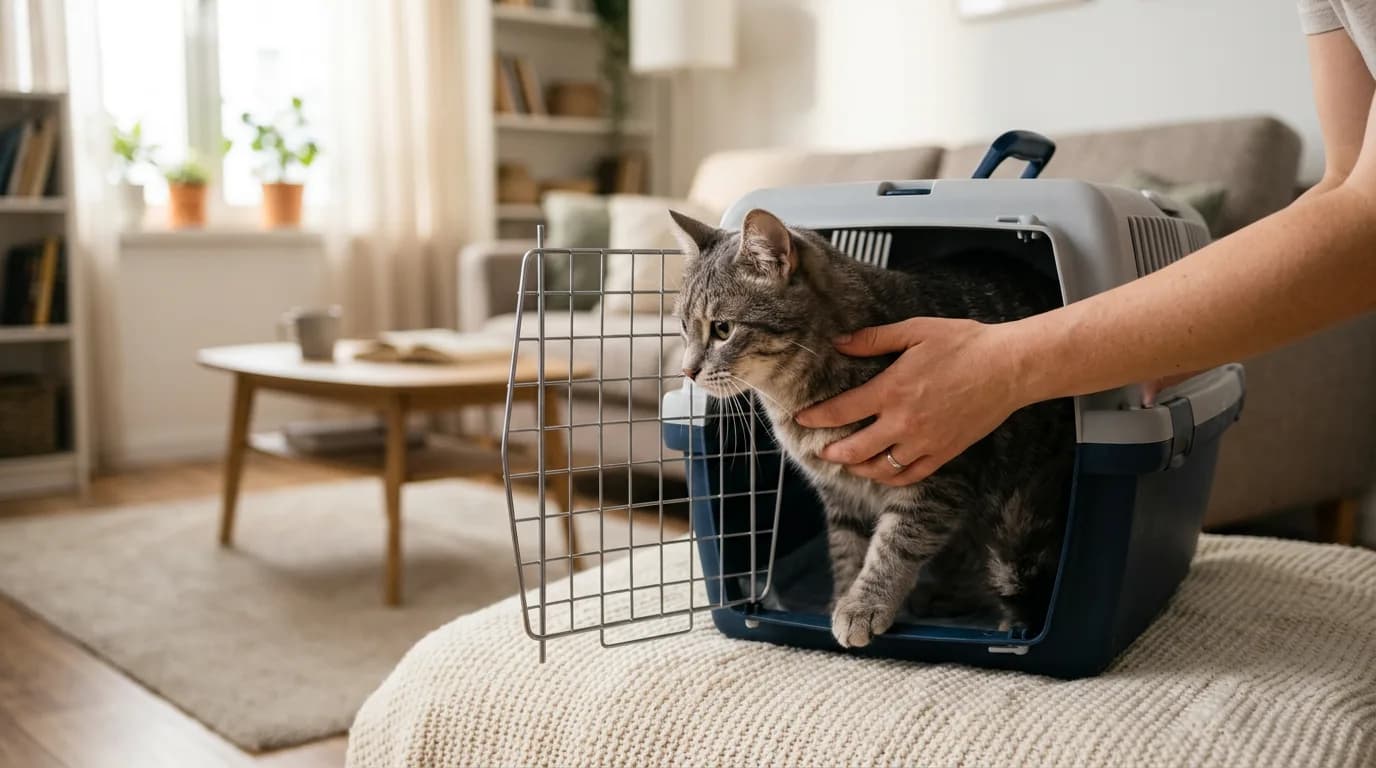
How to get a cat in a carrier fast: stand a top-loading or hard-sided carrier upright on its end so the door faces the ceiling, then lower your cat in rear-end first. Hill's Pet Nutrition and the Cat Fanciers' Association both recommend this upright load because it uses gravity instead of fighting it, stopping the cat from splaying all four paws against the door frame. Most cats that resist a horizontal door go in within seconds when the carrier is vertical.
The butt-first method, step by step
- Set up first. Stand the carrier on its back end so the open door points straight up. If the carrier has a removable top, you can also unclip it and use just the bottom half (see method 2).
- Pick your cat up calmly. One hand under the chest and front legs, the other supporting the back legs and bottom. Hold your cat snug against your body so it feels secure, not dangling.
- Lower rear-end first. Bring your cat down into the upright carrier back feet and bottom first, so it is facing up toward you. Gravity keeps the paws from grabbing the rim.
- Tuck and close. As the cat settles to the bottom, tuck the tail in, swing the door shut, and latch it before your cat reorients.
- Tip the carrier level. Gently lay the carrier back down to horizontal. Drape a towel over the top to block the view, which calms most cats almost immediately.
- You can do the butt-first method by yourself with a top-loading carrier. For a strong or panicky cat, a second person makes it far easier: one holds the carrier steady and works the door while the other lowers the cat. If you are alone, brace the upright carrier against a wall or a piece of heavy furniture so it cannot tip.
Head-first or bottom-first? Which loading direction to use
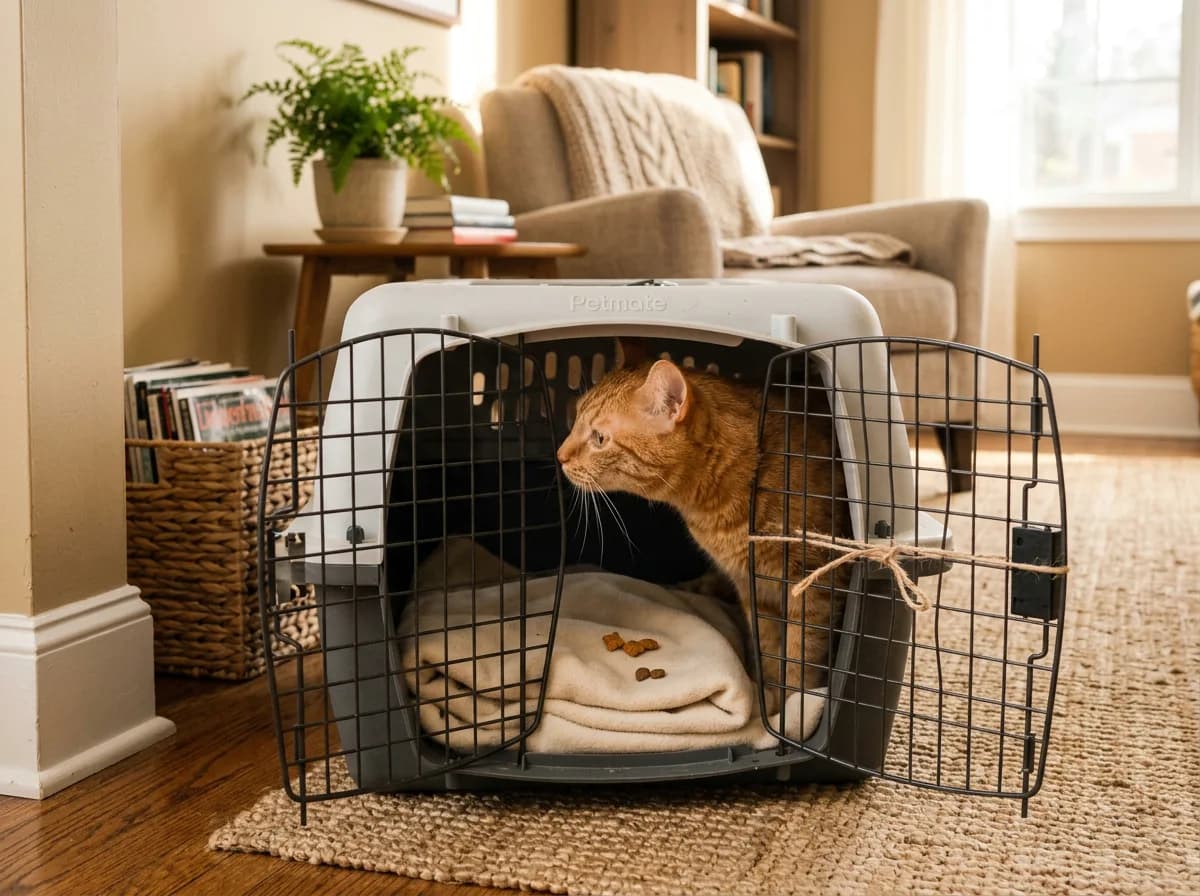
There are two standard ways to put a cat in a carrier, and Blue Cross names both: head-first and bottom-first. Head-first works for a calm, carrier-trained cat that will walk or be guided in through a front door on level ground. Bottom-first (the upright butt-first method above) is the go-to for any cat that resists, because a cat facing up cannot see the opening to fight it and cannot anchor its front paws on the frame.
- Head-first, front-door: best for an acclimated cat. Line the carrier with a familiar non-slip blanket, point a treat or toy toward the back, and let your cat walk in. Calm and low-stress when it works.
- Bottom-first, upright: best for a reluctant, scared, or wriggly cat. Stand the carrier on end, lower rear-end first, latch fast. This is the method that wins when a cat says no.
- When in doubt, go bottom-first. It fails far less often, and a failed head-first attempt teaches your cat that the carrier is a trap, which makes the next try harder.
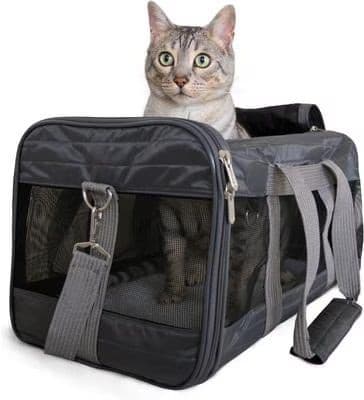
An airline-approved soft-sided carrier with mesh ventilation windows, a top-rated travel pick for cats and small dogs.
Petful may earn a commission when you click through to Chewy, at no extra cost to you.
Why your cat hates the carrier (it is the smell and the memory)
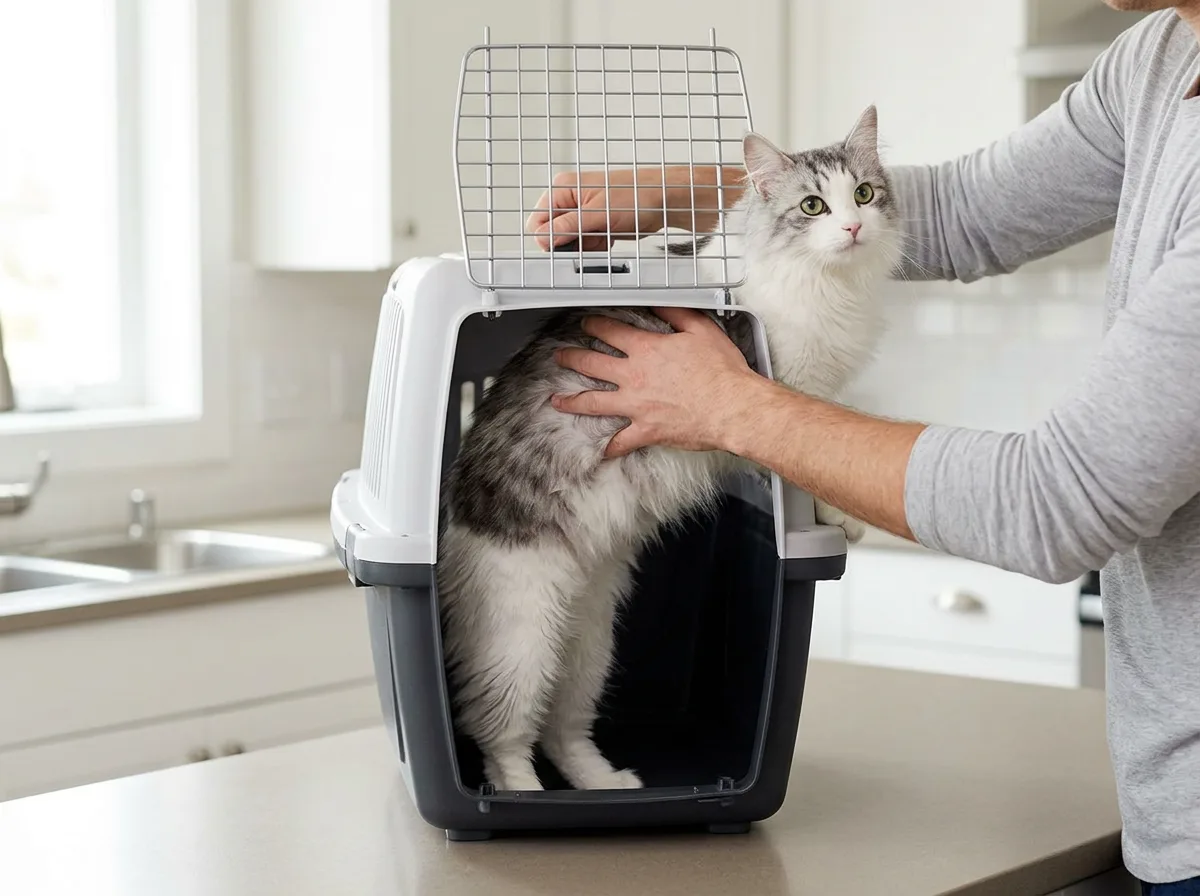
Cats do not hate the carrier itself. They hate what it predicts. For most cats the carrier appears once or twice a year, gets stuffed with a frightened cat, and ends at the one place full of strange smells and pokes. Your cat learns the pattern fast: carrier equals vet. That association, not the plastic box, is why your cat hates its carrier.
Scent makes it worse. Cats experience the world through smell far more than we do, and a carrier that smells like a stressful past trip (or like cleaning chemicals) signals danger before your cat ever sees it. A carrier wiped down with a citrus or pine cleaner is actively repellent to many cats. The fix is to make the carrier smell neutral and familiar: line it with a blanket or a worn t-shirt that carries your scent and your cat's own scent, and skip the harsh cleaners.
- If your cat is newly adopted, give it time before carrier training. The common 3-3-3 guideline describes a rough adjustment arc for many rescued cats: about 3 days to decompress, 3 weeks to settle into a routine, and 3 months to feel fully at home. A cat still in its first few days is far too stressed for carrier practice. Build trust first, then start acclimation.
Carrier prep and acclimation: the long-game fix
The single biggest predictor of an easy carrier trip is whether the carrier is a normal part of your home. The ASPCA's own carrier-training guidance is built on exactly this: reward your cat for any voluntary interaction with the carrier, work up to closing the door and moving it, and practice in short sessions so the carrier becomes ordinary rather than alarming. The goal is for your cat to walk into the carrier on its own almost every time, with a vet visit being the rare exception. Start at least two to four weeks before a planned trip whenever you can.
How to acclimate your cat to the carrier
- Leave it out. Set the carrier in a room your cat already likes, door removed or tied open. Treat it like furniture, not an event.
- Make it cozy. Add a soft blanket or a worn piece of your clothing so it smells safe and familiar.
- Feed the association. Toss high-value treats, catnip, or even daily meals just inside, then deeper in over several days. Let your cat choose to enter.
- Reward calm. When your cat sits or naps inside on its own, quietly reward it. Never shut the door during these early sessions.
- Add the door back. Once your cat is relaxed inside, briefly close the door for a few seconds, reward, and open it. Build up slowly to a minute or two.
- Practice motion. Lift the carrier a few inches, set it down, reward. Later, carry it around the house, then take a short calm car ride that does not end at the vet.
This is the same desensitization logic that helps anxious cats in other situations, from car travel to litter box avoidance. If your cat is generally jumpy, working on overall confidence helps here too. Our guide to traveling with cats in the car long distance builds directly on a cat that already tolerates its carrier.
- A sprinkle of catnip inside the carrier turns a scary box into a fun one for cats that respond to it. Sensitivity to catnip is genetic, and roughly half to two-thirds of cats react to it. It is non-addictive and generally safe, though eating too much can cause mild stomach upset, so cats usually self-regulate. See our explainer on whether cats can overdose on catnip for sensible limits.
How to get a cat in a carrier when they won't go in
When acclimation has not happened yet and your cat simply will not go in, switch to a method that limits the paws and the panic. The two most reliable options for a cat that won't go are the towel burrito and the top-removal method. Both protect you from scratches and give your cat fewer things to grab. Before you start, take a breath: a calm, deliberate handler beats a fast, frantic one every time.
The towel-burrito method (for a scared cat)
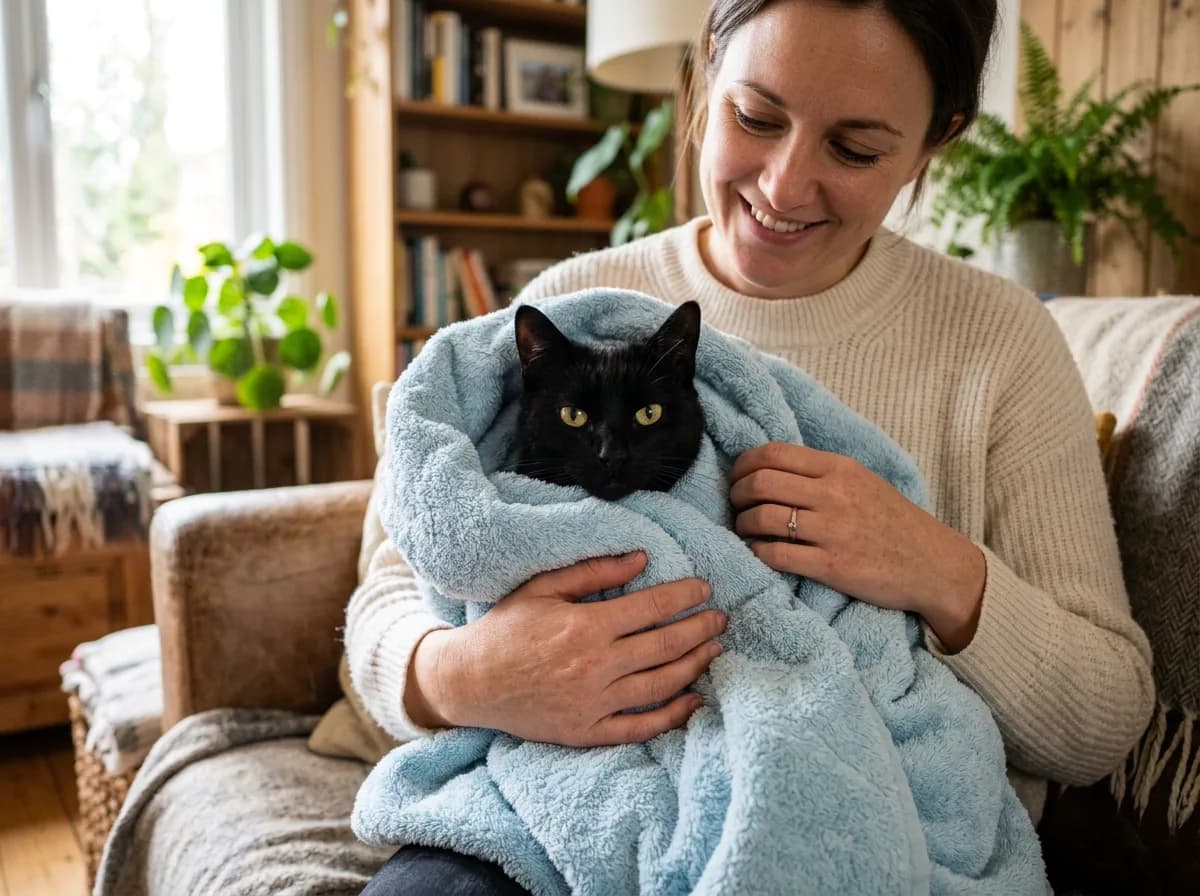
To get a scared cat in a carrier, the towel wrap is the technique vets and shelters reach for most. Cats Protection, which holds the featured-snippet answer for this query, describes the same move: approach calmly, place the towel over the whole cat in one smooth motion, gently secure the shoulders through the towel, then place the wrapped cat straight into the carrier. The towel covers the paws so your cat cannot brace or scratch, and the gentle wrapping pressure itself helps many scared cats settle.
Towel-wrap, step by step
- Lay a large bath towel flat near the upright carrier.
- Approach your cat calmly and drape the towel gently over its whole body, including the legs. Do not chase.
- Scoop the wrapped cat up like a loose burrito, snug enough to cover the paws but never tight enough to restrict breathing.
- Lower the bundle rear-end first into the upright carrier, then ease the towel away (or leave it in as bedding) and close the door.
- Older advice (and a lot of Reddit threads) says to grab a cat by the scruff and drop it in. Modern feline-friendly handling, taught through the AAFP Cat Friendly and Fear Free programs, discourages scruffing as a restraint method for anything but a brief lift, because it increases fear in most adult cats. A towel wrap controls the body more safely and is far less frightening. If a cat is so aggressive that you cannot safely towel it, stop and call your veterinary clinic for guidance rather than risking a serious bite.
The top-removal method (when your cat hates being lifted in)
Many hard-sided carriers unclip into a top and bottom half. Take the top off entirely, set the open bottom on the floor, and place (or towel-wrap and place) your cat into the base. Then lower the top back on and re-latch it around your already-seated cat. This is often the calmest option of all for a cat that hates being lifted into a narrow opening, because there is no opening to fight at all. A top-loading carrier with a removable top, covered next, makes this trivially easy.

A ventilated backpack carrier that keeps your cat secure and close, ideal for walks, vet trips, and travel.
Petful may earn a commission when you click through to Chewy, at no extra cost to you.
How to get a cat in a carrier to go to the vet (and stay calm there)
Getting a cat in a carrier for the vet has an extra layer: the carrier itself has become the vet's warning bell. Break that link by making the carrier appear for happy reasons too, and by lowering arousal before you ever pick your cat up. The AAFP Cat Friendly Practice program recommends spraying a synthetic feline facial pheromone (the Feliway type) on the bedding 10 to 15 minutes before loading and covering the carrier so your cat cannot see the trip unfolding.
- Withhold breakfast (if your vet allows it). A slightly hungry cat is more food-motivated and less likely to vomit on the drive, and it makes treat-luring into the carrier work better.
- Confine first. Calmly move your cat to a small room like a bathroom with nowhere to hide, with the upright carrier ready by the door, before you start.
- Pheromone and cover. Spritz Feliway on the bedding, let it dry, load your cat, then drape a towel over the carrier.
- Ask for a cat-friendly clinic. Practices certified as Cat Friendly or Fear Free are trained to handle anxious cats with less restraint and shorter waits.
What to do with a truly resistant, feral, or aggressive cat
Some cats are beyond a towel on a bad day: feral, semi-feral, injured, or simply terrified to the point of danger. For these cats, contain the room before you start. Move the cat to a small bathroom with nowhere to hide, remove anything it can wedge under, and keep the upright carrier ready by the door. For a genuinely feral or unhandleable cat, a humane live trap with the carrier ready at the destination is sometimes the only safe option, and your local shelter or TNR group can lend one.
For a cat with a true panic or aggression pattern at the vet, do not white-knuckle it every visit. Talk to your veterinarian about pre-visit anti-anxiety medication. Gabapentin is widely used off-label in cats to ease fear and anxiety around veterinary visits; according to VCA Hospitals it takes effect in about 1 to 2 hours, so it is typically given before you leave home, and a landmark JAVMA study (van Haaften et al., 2017) found a single 100 mg dose given about 90 minutes before transport significantly lowered cats' stress scores at the visit. It can turn a thrashing fight into a sleepy, manageable one. This is a prescription decision that has to come from your vet, but it is a normal, well-studied tool, not a last resort to feel guilty about.
- Do not give your cat any human sedative, leftover medication, or over-the-counter sleep aid. Many common human drugs are toxic to cats: VCA Hospitals states plainly that acetaminophen (Tylenol) should never be given to a cat under any circumstances, and cats poison at far lower doses than dogs. Only use a calming medication that your own veterinarian has prescribed for your specific cat, at the dose they specify.
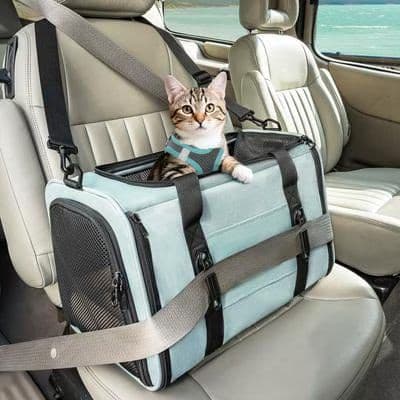
An airline-approved soft-sided carrier with patent safe buckles and mesh ventilation panels, sized for cats and small dogs.
Petful may earn a commission when you click through to Chewy, at no extra cost to you.
How to reduce travel and vet stress once your cat is in
Getting your cat in is half the battle. Keeping it calm on the way is the other half, and a calm trip makes the next carrier session easier because it weakens the carrier-equals-terror association.
- Cover the carrier. A towel or blanket over the top blocks scary sights and muffles sound, which settles most cats fast.
- Keep it level and stable. Carry the carrier with two hands against your body, and seatbelt it in the car footwell or seat so it does not slide or tip.
- Use pheromones. A synthetic feline facial pheromone spray (the Feliway type) on the bedding 10 to 15 minutes before loading can lower anxiety for many cats.
- Stay quiet and calm. Soft voice, slow movements, low music. Cats read your stress, so the calmer you are, the calmer the trip.
- Never leave the carrier on a high surface. A panicking cat can tip it off a counter or table, so set it on the floor or seat.
If your cat's stress shows up as litter avoidance, hiding, or other behavior changes around trips, that is worth its own attention. Our guide on what to do when a cat refuses to use the litter box covers the anxiety angle in depth. And if a clinic visit itself is the trigger, a pet telehealth service like PangoVet can handle some questions from home without a carrier at all.
Happy cat vs. stressed cat: reading the signals
Forcing a frightened cat backfires and teaches it the carrier is dangerous. Learning to read your cat lets you slow down before a session turns into a fight. Use this quick reference.
| Signal | Relaxed and ready | Stressed, back off |
|---|---|---|
| Body | Loose, sitting or lying calmly | Crouched low, tense, trying to bolt |
| Ears | Forward or neutral | Flattened sideways or back |
| Tail | Still or gently swishing | Thrashing, thumping, or tucked tight |
| Pupils | Normal, slit in bright light | Wide and round (dilated) |
| Sound | Quiet, soft chirps, or purring | Growling, hissing, or yowling |
| Best move | Continue calmly with treats | Pause, give space, try again later or use a towel |
Choosing a top-loading carrier that makes this easier
The carrier you own changes how hard this whole job is. If you are buying one, the best choice for easy loading is a hard-sided, top-loading carrier that has both a front door and a top opening, with a top half that fully unclips. That single feature lets you use the upright butt-first method, the top-removal method, or a simple front-door walk-in, whichever your cat tolerates on a given day. A top-loading carrier is the single most common upgrade vets recommend for owners who dread this task.
- Top-loading and removable-top: the most flexible for resistant cats and the easiest for solo loading.
- Hard-sided over soft for nervous cats: it holds shape and cannot be clawed open or collapsed.
- Right size: big enough to stand, turn, and lie down, but not so cavernous that your cat slides around in the car.
- Secure latches you trust: test them before the trip, not in the parking lot.
Whatever carrier you use, the principles are the same: make it smell safe, leave it out so it stops being scary, load rear-end first when you can, and reach for a towel or the top-removal trick when your cat says no. Do that and how to get a cat in a carrier stops being a yearly battle and becomes a 60-second routine.
Frequently asked questions
Stand the carrier on its end with the door facing up, then lower your unwilling cat in rear-end (butt) first so it cannot brace its paws against the opening. If it still fights, drape a large towel over the whole cat, scoop it up like a loose burrito, and lower the bundle in. Cover the carrier with a towel afterward to calm it down.
The easiest reliable way is the butt-first method: turn the carrier upright so the door points at the ceiling, hold your cat snug with one hand under the chest and one under the back legs, and lower it in rear-end first. Gravity keeps the paws from grabbing the rim, so most cats go in within seconds. A top-loading carrier makes this even simpler.
When your cat won't go in, stop pushing it through the front door and switch tactics. Stand the carrier upright and lower your cat in rear-end first, or take the top off a removable-top carrier and set your cat into the open base, then clip the top back on. For a cat that fights or scratches, wrap it in a towel first to cover the paws, then place the bundle in.
To get a scared cat in a carrier, work calmly and limit its paws. Place a large towel over your cat's whole body in one smooth motion, gently secure the shoulders through the towel, then lower the wrapped cat into an upright carrier rear-end first. Cover the carrier once your cat is in. For a cat that panics severely every visit, ask your vet about a pre-visit calming medication such as gabapentin.
Make the carrier appear before vet days, not only on them, so it stops being a warning bell. On the day, confine your cat to a small room, spray a Feliway-type pheromone on the bedding 10 to 15 minutes ahead, load your cat rear-end first into the upright carrier, and cover it. Withhold breakfast if your vet allows, and for a cat that always panics, ask about pre-visit gabapentin.
Cover the carrier with a towel or blanket to block scary sights, line it with bedding that smells like home, and spray a synthetic feline pheromone (Feliway type) on the bedding 10 to 15 minutes before loading. Keep the carrier level and stable, speak softly, and for cats with severe panic ask your vet about a pre-visit calming medication such as gabapentin.
The 3-3-3 guideline is a rough adjustment arc for newly adopted or rescued cats: about 3 days to decompress and feel less overwhelmed, 3 weeks to learn the routine and settle in, and 3 months to feel fully at home. A cat still in its first few days is too stressed for carrier training, so build trust first and start carrier acclimation once it has settled.
Use a top-loading or removable-top carrier so you have both hands free and no narrow opening to fight. Stand the carrier upright (or take the top off entirely), towel-wrap your cat if needed, lower it in rear-end first, and close the door before it reorients. Bracing the upright carrier against a wall keeps it from tipping when you are working solo.
No, scruffing is no longer recommended as a way to restrain a cat for the carrier. Modern feline-friendly handling, taught through the AAFP Cat Friendly and Fear Free programs, shows that scruffing increases fear and stress in most adult cats. A towel wrap that gently covers the body and paws controls the cat more safely. Reserve any brief scruff lift for emergencies only, and stop and call your vet if a cat is too aggressive to handle safely.
Stand the carrier on its end so the opening faces up, then lower your cat in back-end first and close the door before they can turn around. A top-loading or removable-top carrier makes this far easier than pushing a cat through a small front door.
Yes. How to get a cat in a pet carrier is the same whether it is hard-sided or soft: load back-end first, support the hindquarters, and stay calm. With a floppy soft carrier, brace it against a wall or have a second person hold it open and steady.
Related on Petful
- traveling with cats in the car long distance
- cats can overdose on catnip
- what to do when a cat refuses to use the litter box
- pet telehealth service like PangoVet

Coreen Saito is a pet writer and longtime shelter volunteer with more than a decade in animal rescue. She covers cat behavior, breed care, and the small, ordinary science of sharing a life with companion animals, with a particular focus on honest takes about the products and decisions that actually matter. At home in Arizona, she's outranked by Mac (a dog with the loudest opinion in the house), Rebel (a cat who governs by quiet authority), and Meri (an orange tabby who runs the late shift and the laundry basket). She writes about all three, plus the rescues that keep coming through her life, at LifeWithMinty.com.
Sign up for expert-backed reviews and safety alerts all in one place.


