Travel Dog Crate: Easily Find the Best for Your Pet
Compare four travel dog crates by their actual role: documented vehicle protection, flight planning, single-seat containment or accommodation. Check dog fit, vehicle space and product limitations before buying.
Petful is reader supported. As an affiliate of platforms like Amazon and Chewy, we may earn a commission when you buy through links on this page. There is no extra cost to you.
Choose a crate for the journey
The best travel dog crate depends on the job: protection during car travel, preparation for an airline journey or a familiar resting space at your destination. A crate that folds neatly into luggage may be useful in a hotel without providing crash protection. A substantial vehicle kennel may be unsuitable for your flight or impossible to fit through your car's opening.
Start with the journey, then check your dog's measurements and the product's documented limits. The best travel kennel for dogs is the one that fits those requirements together, rather than the model with the broadest “travel” claim.
- 1The best travel dog crate depends on whether you need vehicle protection, an airline-compatible kennel or portable accommodation.
- 2Choose the best travel kennel for dogs by checking the exact model, dog fit, exterior footprint and installation or acceptance requirements.
- 3Containment, crash-test certification and airline acceptance are different claims.
| Selected product | Main reason to consider it |
|---|---|
| GUNNER G1 Double-Walled Dog Kennel, Gunmetal, Medium | Documented vehicle-crash certification with the specified anchoring configuration |
| Petmate Sky Dog & Cat Kennel, Gray, 32-in, 30-50-lbs | Hard-sided candidate to check against your airline's requirements |
| EliteField 3-Door Collapsible Soft-Sided Dog Crate, Beige, 36 inch | Folding accommodation for a dog already comfortable in a soft crate |
| PetSafe Happy Ride Collapsible Cat & Dog Travel Crate, Gray & Blue | Collapsible, single-seat containment with an explicit restraint limitation |
| Product choice | Selected size | Useful function | Main limitation | Product SKU |
|---|---|---|---|---|
| GUNNER G1 Double-Walled Dog Kennel, Gunmetal | Medium | CPS-certified configuration with strength-rated anchor straps | Approximately 38 pounds empty; certification does not cover every installation | 1733998 |
| Petmate Sky Dog & Cat Kennel, Gray | 32-inch; listed for dogs 30–50 pounds | Hard-sided flight-planning candidate | Airline acceptance and individual dog fit must be confirmed | 73692 |
| EliteField 3-Door Collapsible Soft-Sided Dog Crate, Beige | 36-inch | Portable resting space at a destination | Fabric and zippers are unsuitable for persistent chewing or escape attempts | 130442 |
| PetSafe Happy Ride Collapsible Cat & Dog Travel Crate, Gray & Blue | 27 × 19 × 28 inches expanded | Single-seat containment | Manufacturer identifies containment, not restraint; vehicle fit still matters | 372330 |
Match the format to the task
A hard-sided plastic kennel, folding wire crate and soft-sided enclosure can all contain a dog, but the material alone does not establish suitability for transport. For a determined chewer or escape-prone dog, fabric is a poor starting point. A heavy-duty appearance also does not prove crash performance.
If a crate is impractical for your car, consider a properly fitted vehicle harness with documented testing and compatible installation instructions. Our guide to dog car accessories covers that alternative. At a destination, a suitable room or managed resting area may serve a different purpose from a transport enclosure.
GUNNER G1 Double-Walled Dog Kennel, Gunmetal, Medium
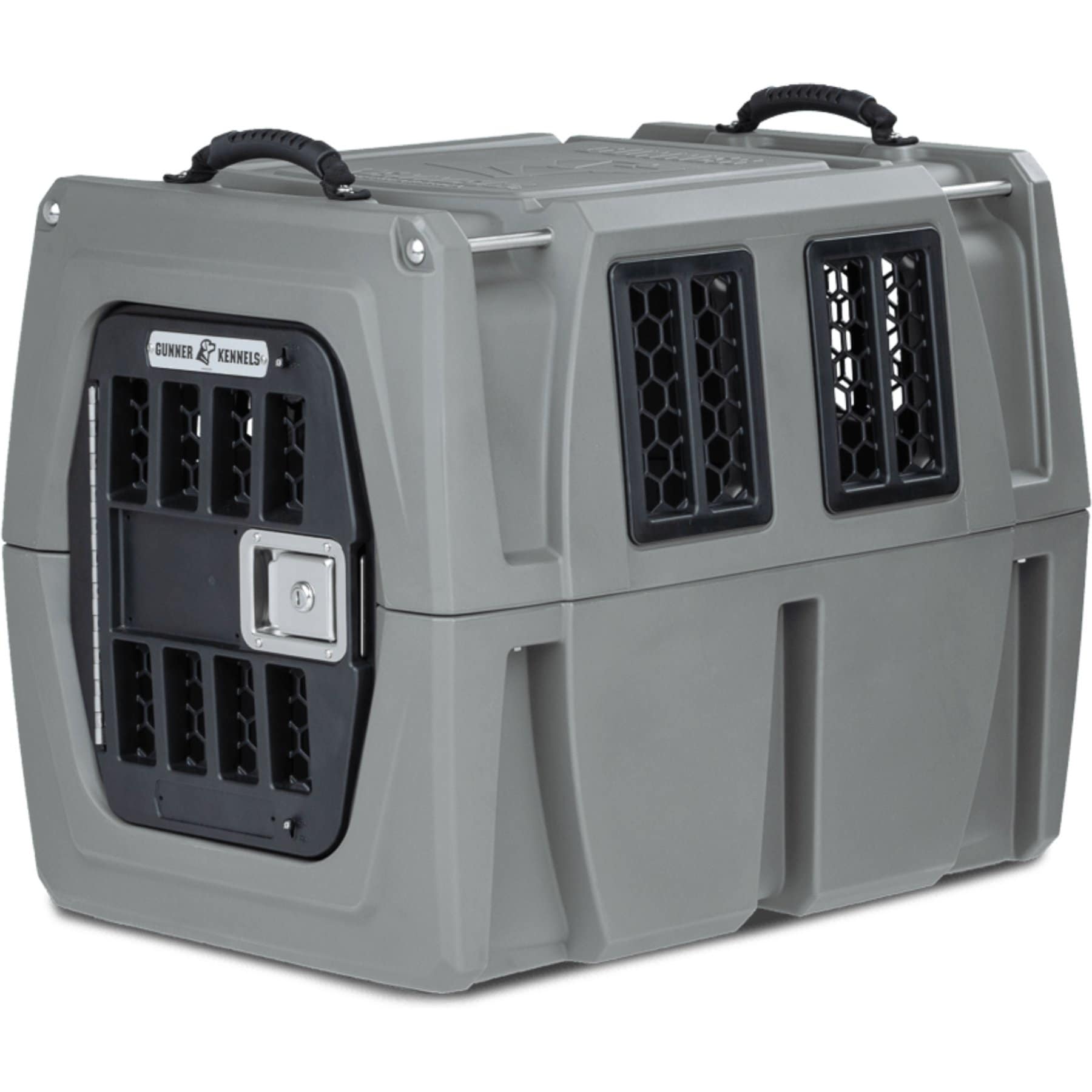
Documented car-crash certification configuration. Heavy, substantial footprint and cost; certification requires the documented anchoring configuration.
Petful may earn a commission when you click through to Chewy, at no extra cost to you.
The GUNNER G1 Medium is the strongest evidence-led vehicle option in this selection. The Center for Pet Safety's certification record identifies this size with strength-rated anchor straps and a 45-pound test dog. Those details belong with the recommendation, rather than being replaced by a blanket “crash-proof” description.
Its substantial construction brings practical tradeoffs. The kennel weighs approximately 38 pounds before adding the dog, bedding or other permitted contents. You need enough space for its exterior, access to its door and an installation that follows the documented requirements.
- Consider it when documented vehicle performance is your priority.
- Check the exact anchoring equipment and vehicle compatibility before purchase.
- Do not treat the test dog's weight as a universal dog-fit recommendation.
- Plan how you will move and clean the empty kennel.
Petmate Sky Dog & Cat Kennel, Gray, 32-in, 30-50-lbs
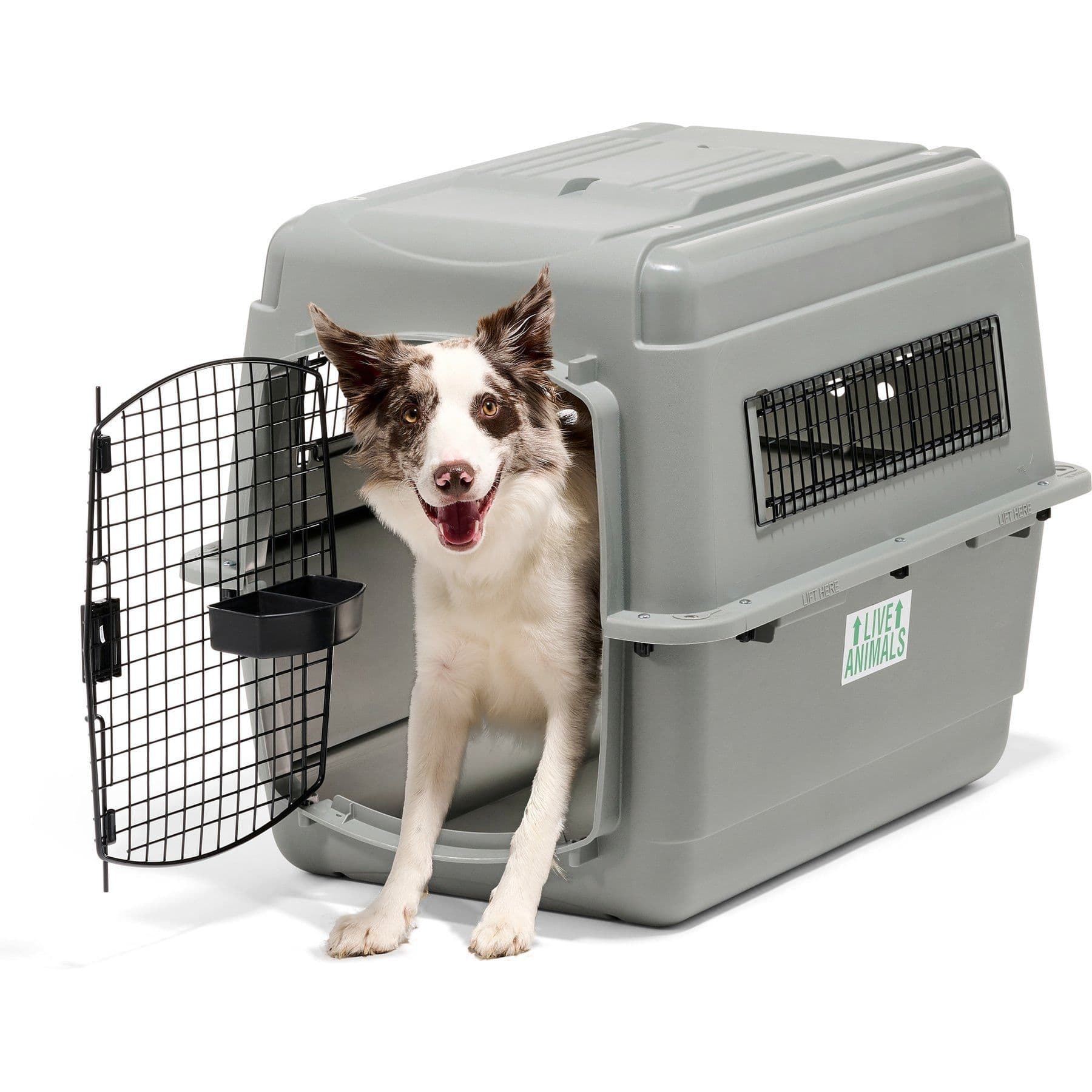
Hard-sided flight-planning candidate. Confirm airline requirements and actual dog fit; the listed weight range is not a fit guarantee.
Petful may earn a commission when you click through to Chewy, at no extra cost to you.
The 32-inch Petmate Sky Kennel is a hard-sided flight-planning candidate. Petmate's product information describes the kennel's construction and ventilation, but the operating airline still decides whether your particular dog and crate are acceptable for the journey.
This selection is the 32-inch version labeled for dogs weighing 30–50 pounds. That weight range does not guarantee room for every dog in it. A tall, narrow dog and a shorter, broader dog can weigh the same while needing different interior dimensions.
- Consider it after obtaining the airline's current requirements.
- Compare the interior measurements with your dog's natural posture.
- Check the assembled door, ventilation and fasteners against the airline's instructions.
- Do not assume the same model name means the same size.
EliteField 3-Door Collapsible Soft-Sided Dog Crate, Beige, 36 inch
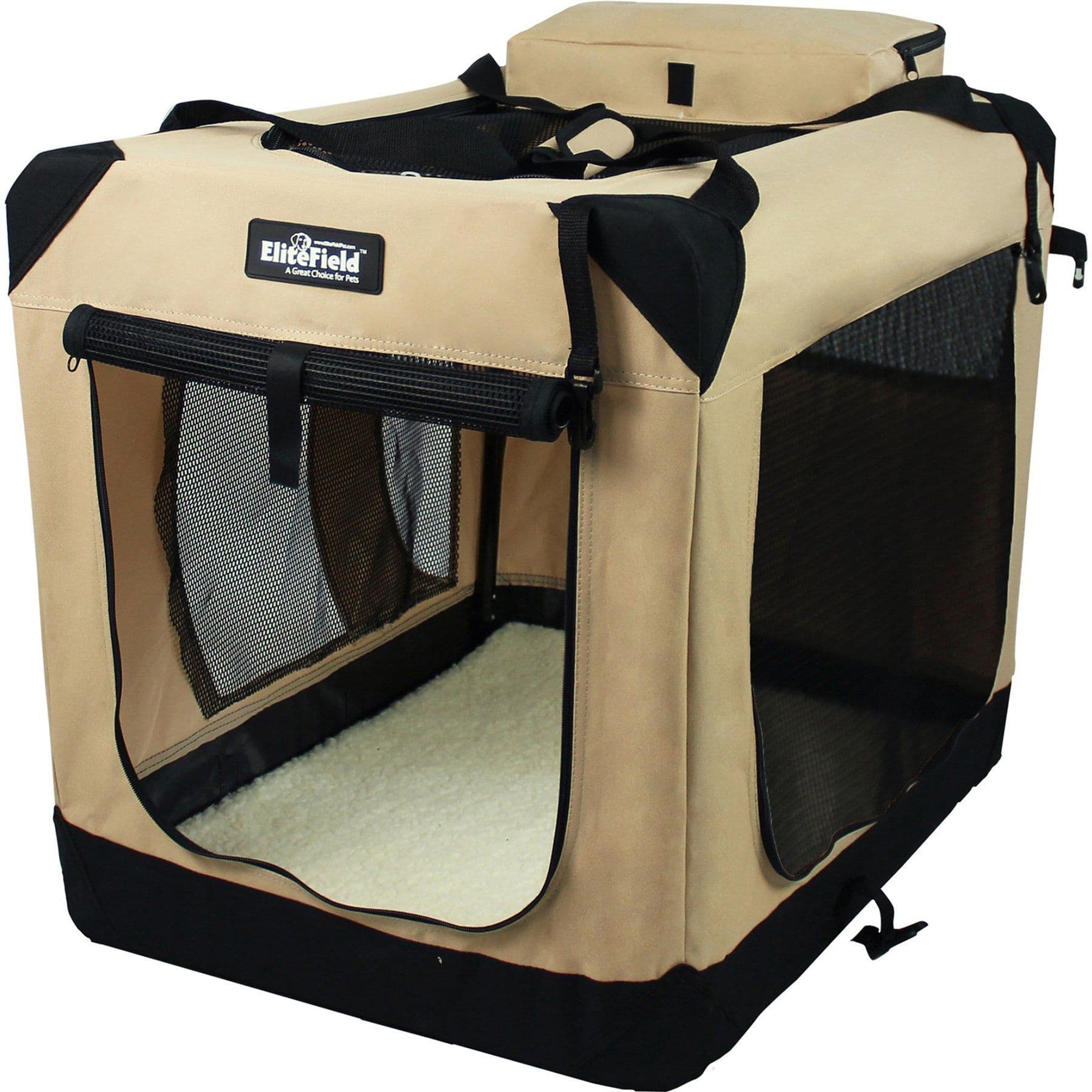
For supervised confinement of crate-comfortable dogs. Unsuitable for persistent chewing or escape attempts. For vehicle crash protection, choose a crash-tested restraint.
Petful may earn a commission when you click through to Chewy, at no extra cost to you.
The 36-inch EliteField 3-Door Soft-Sided Dog Crate is suited to portable accommodation for a dog that already settles comfortably in a fabric enclosure. EliteField's specifications describe a steel-tube frame, fabric and mesh construction, and top, front and side access.
The frame folds for storage, and the removable cover and bed support routine cleaning. These conveniences matter when a resting space needs to travel between home and a temporary room.
Its limits are equally relevant:
- Fabric and zippers are poor choices for persistent chewing or escape attempts.
- Mesh ventilation does not regulate the temperature around the dog.
- A folding structure is not evidence of crash protection.
- The selected 36-inch size still needs an individual fit check.
PetSafe Happy Ride Collapsible Cat & Dog Travel Crate, Gray & Blue
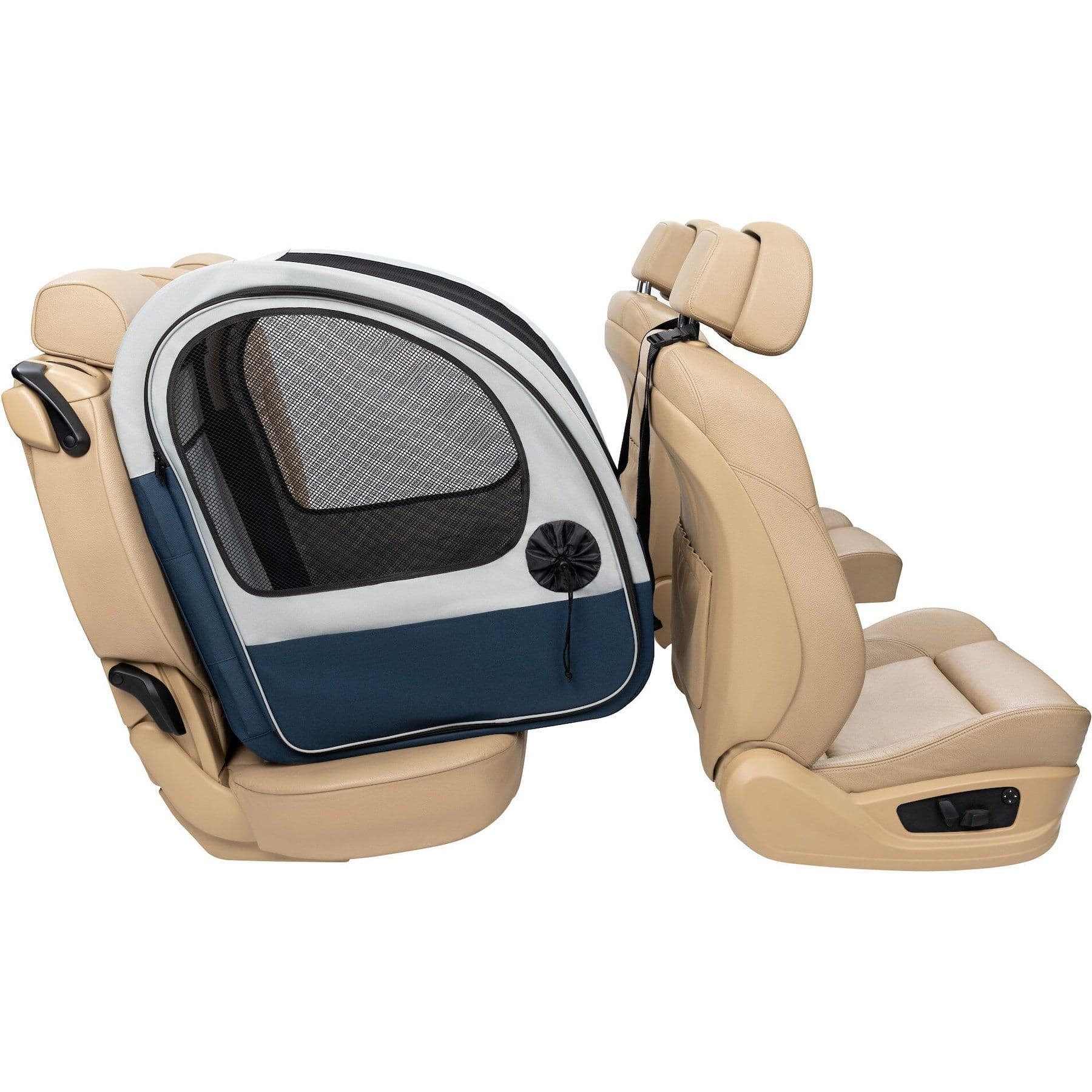
Single-seat containment. Headrest strap and seatbelt stabilize the enclosure; manufacturer explicitly distinguishes containment from restraint.
Petful may earn a commission when you click through to Chewy, at no extra cost to you.
The PetSafe Happy Ride Collapsible Travel Crate provides a single-seat containment arrangement. Its headrest strap and seat-belt routing help stabilize the enclosure, while the collapsible frame makes storage more convenient than a permanently assembled kennel.
The crucial qualification comes from PetSafe's own product information: this is containment, not restraint. Keeping a dog within an enclosure and demonstrating protection during a collision are different functions.
PetSafe lists expanded dimensions of 27 × 19 × 28 inches and a dog-weight limit of up to 60 pounds. Neither figure guarantees that the enclosure fits your vehicle or that a particular dog has enough usable room.
- Check the seat, headrest and belt arrangement before buying.
- Confirm dog fit separately from the weight limit.
- Choose it for its stated containment function, without adding a crash-protection claim.
Measure the dog and the space available
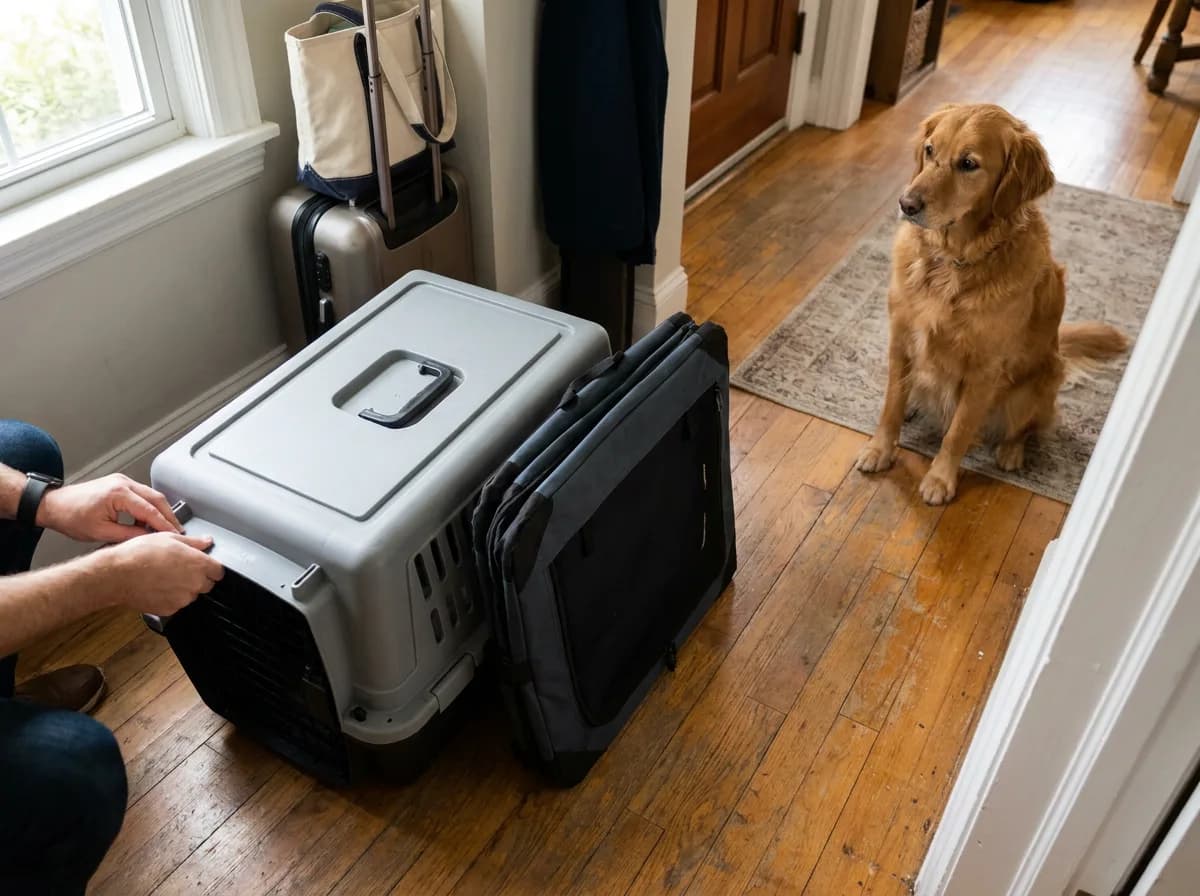
Measure your dog before choosing a size name. “Medium,” “large,” “XL” and “XXL” are manufacturer labels, not shared dimensions. A travel crate advertised for a German Shepherd or another breed also cannot account for every individual's height, length or build.
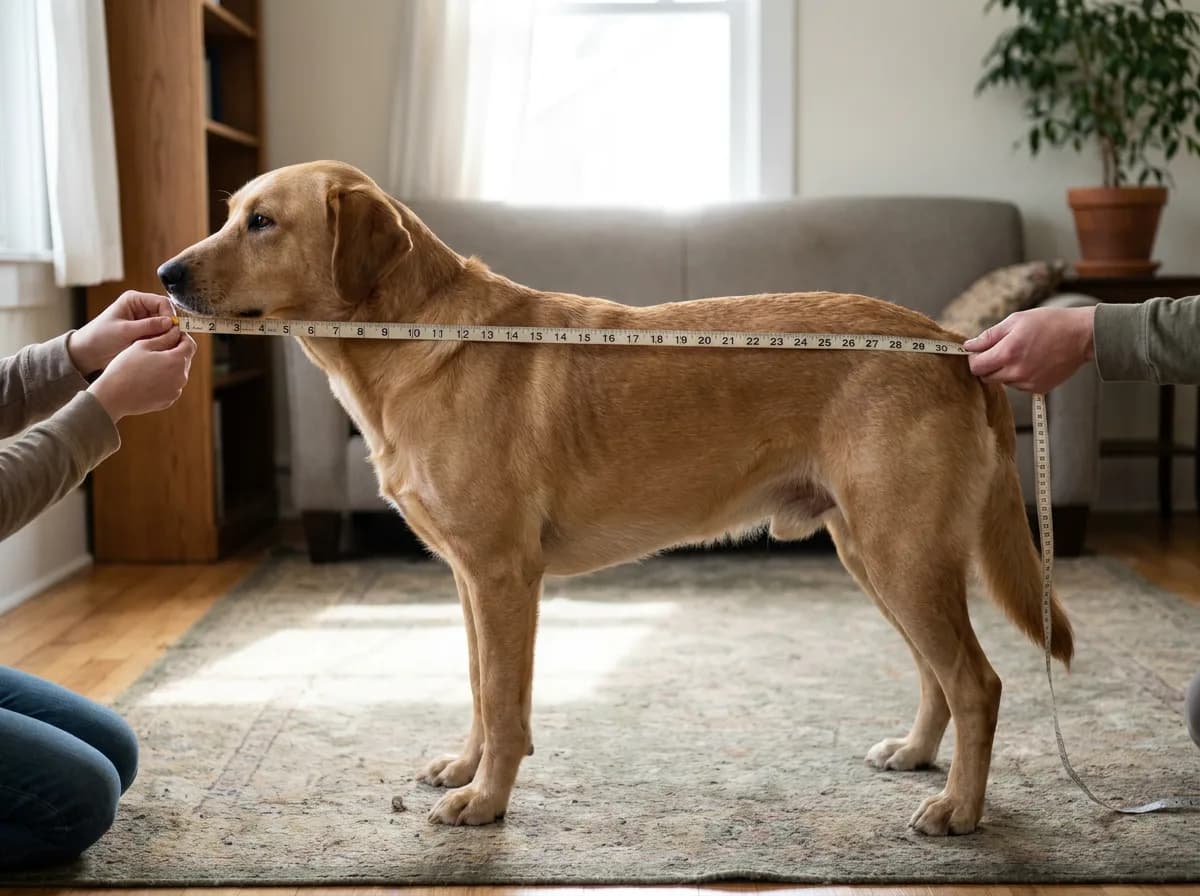
Record natural posture before consulting the size guide
Have the dog stand comfortably on a level surface. Avoid measuring a crouched, stretched or seated posture because it can give a misleading impression of the space needed. A second person can help keep the dog relaxed while you note measurements.
Record:
- Body length from the nose toward the base of the tail, following the selected manufacturer's method.
- Standing height, including the head and ears as required by the relevant sizing instructions.
- Body width at the widest point.
- Current weight.
- The room needed to turn and lie in a natural position.
Use those observations with the product's sizing instructions and, for flights, the airline's requirements. Do not apply one homemade “add a few inches” formula to every crate and travel mode. A vehicle kennel's fit guidance and an airline's animal-space requirements may differ.
For a puppy, recheck measurements close to departure. Buying a much larger enclosure for eventual adult use does not automatically create the right current travel setup. Any divider or size adjustment must be appropriate for the exact product and intended use.
Compare interior dimensions with exterior dimensions
Interior dimensions describe the space your dog can use. Exterior dimensions determine whether the crate fits through an opening and sits in the intended location. A thick shell, tapered walls, door frame or protruding handle can make those two sets of measurements meaningfully different.
The selected models illustrate why both matter:
- GUNNER G1 Medium: The published interior floor is 25 × 18 inches, with 19.75 inches of interior height. Exterior dimensions are 29.5 × 20.5 × 23.5 inches, rising to 25 inches with the handles.
- Petmate Sky Kennel, 32-inch: Published exterior dimensions are 32 × 22.5 × 24 inches; interior dimensions are 29.5 × 19.75 × 23.5 inches.
- EliteField, 36-inch: Published overall dimensions are 36 × 24 × 28 inches. Do not relabel those overall measurements as clear interior space.
- PetSafe Happy Ride: Published expanded dimensions are 27 × 19 × 28 inches. Check the usable space and seat installation rather than treating those figures as an interior guarantee.
These figures come from the manufacturers' documentation. Compare them with the exact variant in your cart and the current assembly instructions. A similar photograph or shared product-family name is not enough to establish that you are buying the measured size.
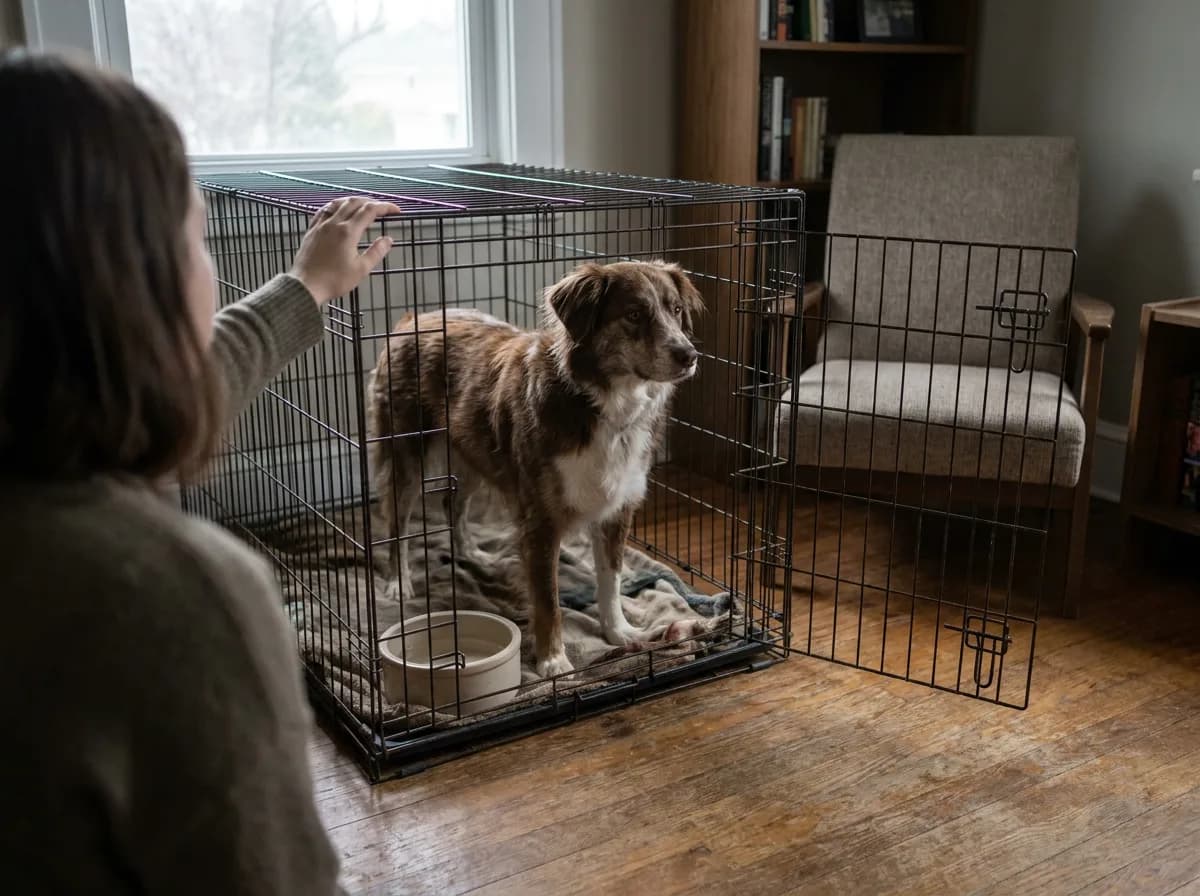
Check the actual enclosure
When practical, assemble the crate and let your dog enter voluntarily before travel. Observe whether the dog can stand naturally, turn and settle in the positions required for the intended journey. Look at the doorway as well as the main compartment: a suitable interior is less useful if entry requires an uncomfortable squeeze.
Bedding changes usable space. A thick pad raises the dog toward the roof, while an oversized bolster can reduce floor area. Assess fit with the bedding you actually plan to use and with the door in its normal travel position.
Do not use a quiet dog as the only measure of fit. A dog may remain still in an unfamiliar crate even when the dimensions are unsuitable. Compare posture with the measurements and requirements you recorded, rather than assuming a lack of protest settles the question.
Account for the empty crate weight
Empty crate weight affects lifting, storage and the total load you must manage. The GUNNER Medium's published weight is approximately 38 pounds. Consider where you will assemble it, whether you can move it safely and how often it must leave the vehicle.
Confirm the empty weight of the exact selected size for other models before making a portability comparison. A weight quoted for a larger Sky Kennel, for example, should not be assigned to this 32-inch version. Shipping weight is also not necessarily the same as the assembled product's weight.
For air travel, ask the carrier how it calculates any combined animal-and-kennel limit. For car travel, make sure the crate, dog and other cargo fit the vehicle's requirements. Keep practical handling separate from assumptions that a heavier crate must be safer in every configuration.
Car travel: containment versus crash-tested protection
Containment keeps the dog within a defined space and can help prevent movement into the driver's area. Crash protection requires evidence about how the product and its attachment system perform under collision forces. One function does not establish the other.
A crate resting steadily during normal driving may still move during a sudden stop or collision. Likewise, straps that make an enclosure feel secure are not automatically rated for the forces relevant to a crash. Evaluate the crate and its installation together.
Read the certification conditions
The Center for Pet Safety record for the GUNNER G1 Medium identifies a five-star certified configuration using strength-rated anchor straps and a 45-pound test dog. The exact model, size and anchoring conditions are central to that evidence.
That record does not establish that every GUNNER size, every attachment strap or every vehicle arrangement performs identically. It also does not turn a certified product into a “crash-proof dog crate.” Crash testing evaluates stated conditions; it cannot promise an injury-free outcome in every real collision.
Before relying on a certification claim, verify:
- The product name and size listed in the certification.
- The required rated anchor straps and other installation components.
- The current manufacturer's installation instructions.
- Whether the vehicle provides appropriate attachment locations.
- Whether the dog fits the selected kennel under the relevant guidance.
The PetSafe Happy Ride belongs in a different evidence category. Its manufacturer describes containment rather than restraint. Its headrest strap and seat-belt arrangement should not be presented as equivalent to the GUNNER configuration simply because both involve attachment to a vehicle.
Measure the installed location
Vehicle fit has several parts: getting the crate through the opening, placing it in the intended orientation, opening its door and completing the specified attachment arrangement. A cargo compartment can be large enough on paper while the hatch opening is too narrow or low.
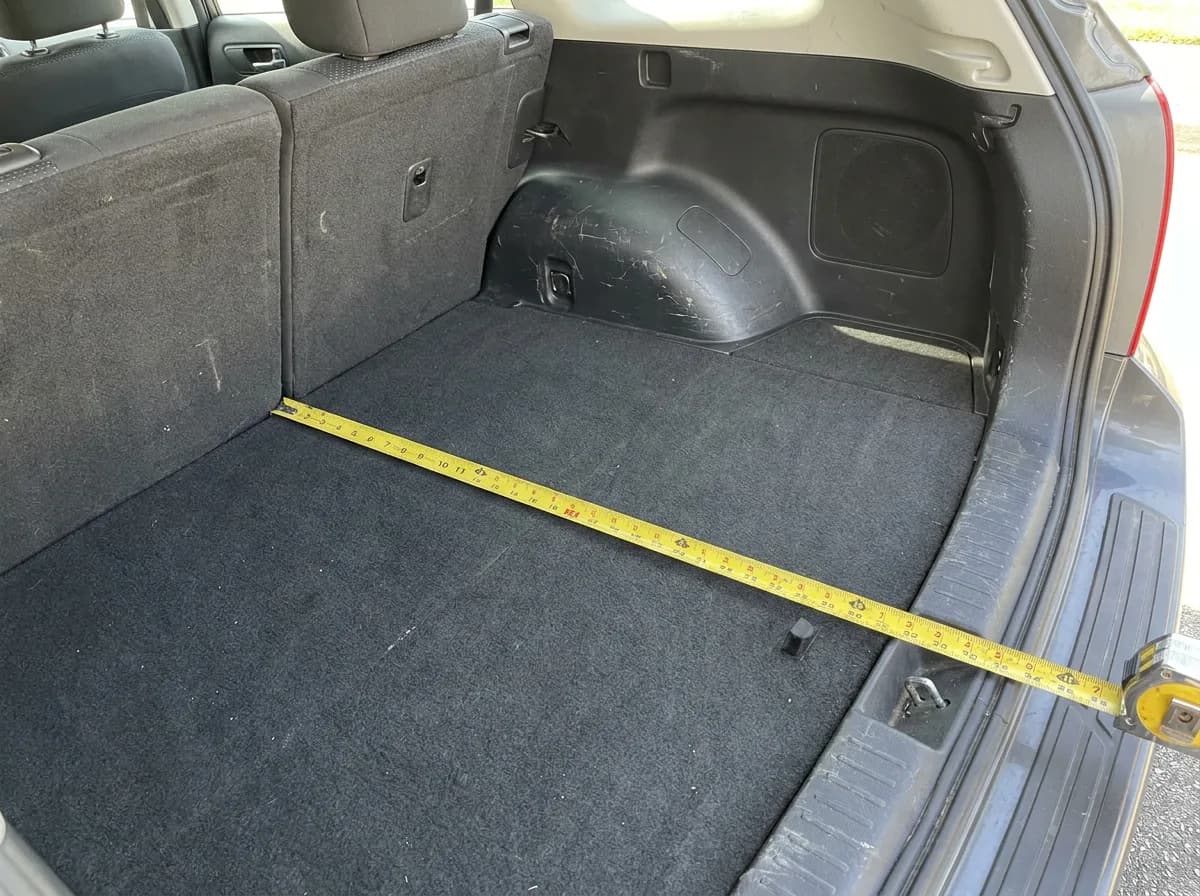
Measure the usable floor depth from the upright seatback toward the hatch threshold, then check width and height where the crate will actually sit. Wheel arches, sloping seatbacks, roof taper and trim can reduce the available space. Include handles, hinges and other projections in the exterior measurement.
Also check how the door opens with the kennel installed. You need to reach the latch and manage the dog at a stop without dismantling the arrangement. Do not select a crate that only fits when its entrance is blocked by luggage or another seat.
- The attachment points require their own check. A convenient hook is not necessarily an appropriate rated anchor. Ask the crate manufacturer and consult the vehicle documentation if the intended arrangement is unclear; avoid improvising around an installation requirement.
Keep ventilation and access usable
Packing around a kennel can change its environment. Leave ventilation openings unobstructed and preserve the access needed to inspect and care for the dog. Do not assume mesh, vent holes or insulated walls make an occupied vehicle safe at an unsuitable temperature.
Separate loose luggage and equipment from the dog's space and secure cargo appropriately. A well-chosen crate does not make the rest of the load irrelevant. Plan the complete travel arrangement, including what happens when passengers enter, seats move or the hatch opens.
If the required kennel cannot fit or be installed correctly, a vehicle harness with documented testing may be the more workable approach. Use the fit and installation guidance in our dog car accessories guide. A seat cover or barrier serves a different purpose and should not be substituted for a restraint decision.
Flights: verify the airline's requirements
“Airline approved” is not a universal pass attached to a crate. Acceptance depends on the operating airline, aircraft, route, travel method and the individual dog. A product may be a useful starting point without being acceptable for every flight.
First establish whether your dog can travel on the planned service and whether the relevant arrangement is cabin travel or another form of animal transport. Then obtain the crate requirements for that arrangement. Buying a kennel before those questions are resolved can leave you with equipment you cannot use.
Confirm the journey before buying the crate
Contact the operating carrier with the dog's measurements, weight and any information it requests. For connecting or shared flights, establish which carrier's requirements apply at each stage. Do not assume a booking website's general pet page resolves every part of the itinerary.
Ask about:
- Permitted animal and kennel dimensions for the actual service.
- How the dog must be able to stand, turn and lie within the enclosure.
- Accepted shell, door, ventilation and fastening arrangements.
- Required feeding, watering, identification or labeling provisions.
- Limits affecting the dog's breed, age, health or travel conditions.
- Check-in procedures and any required documents.
For international travel, crate acceptance is only one part of planning. Confirm destination and transit requirements through the appropriate authorities and discuss health documentation with your veterinarian. An acceptable kennel does not replace those requirements.
The Petmate Sky Kennel is a hard-sided candidate to compare with the answers you receive. Its product-family name and 30–50 lb listing do not guarantee that the 32-inch model meets your dog's space needs or the airline's conditions.
If your dog needs an extra-large crate for air travel, confirm that the airline can accept both the dog and the assembled kennel on the planned aircraft before buying. A larger model in the same product family does not automatically qualify. Compare its exact dimensions with the carrier's limits and your dog's required space.
Inspect the assembled hardware
Review the exact kennel as assembled, rather than relying only on a retailer photograph. Confirm that the door operates properly, fasteners are complete and ventilation is unobstructed. Ask the airline about any required changes before departure, then follow the relevant instructions.
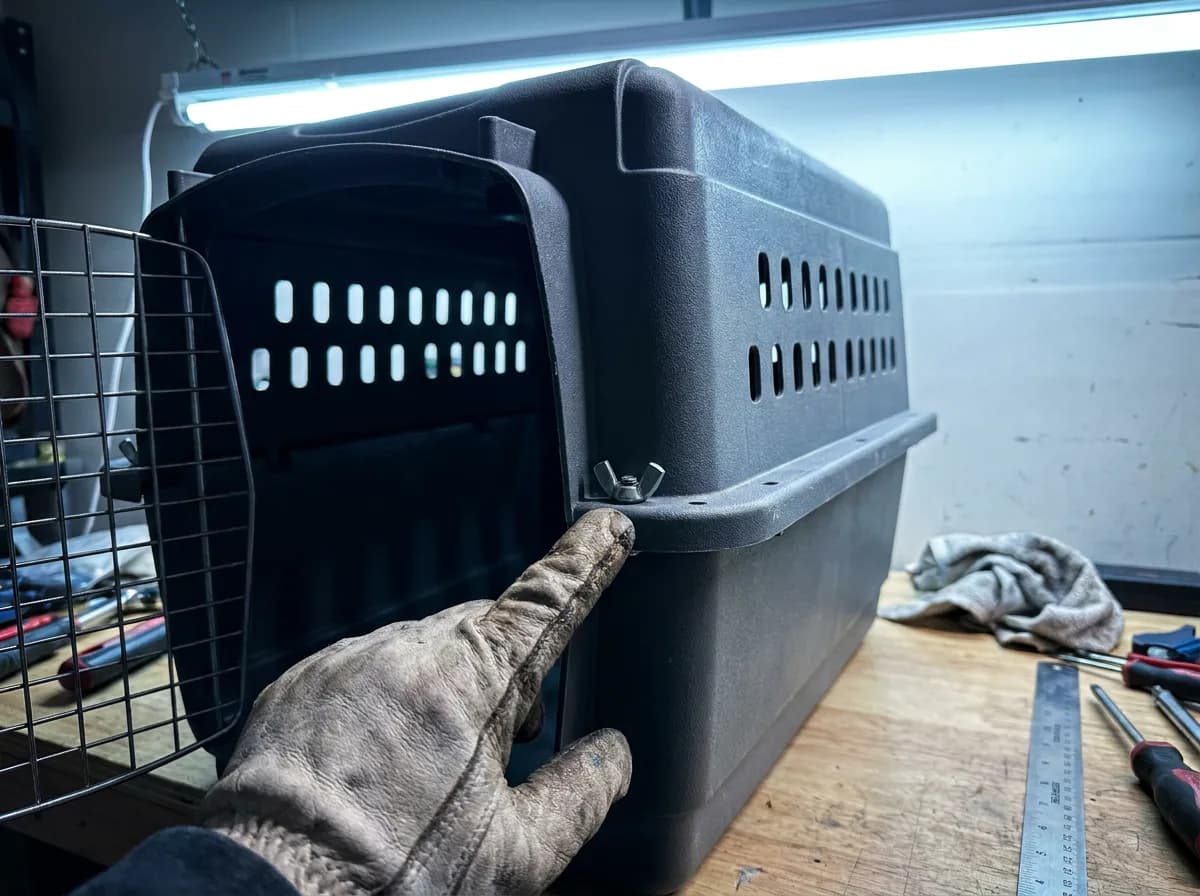
A kennel that seems sturdy at home may still fail an airline's specific requirements. Conversely, an enclosure accepted for a flight does not automatically have documented vehicle-crash performance. Keep those approvals and evidence claims separate when the trip includes both a car journey and a flight.
- Airline acceptance and vehicle crash testing answer different questions. GUNNER's cited Medium configuration uses rated anchor straps for its documented vehicle certification. That configuration does not establish airline acceptance, and an airline-compatible kennel is not automatically a crash-tested vehicle restraint.
Buy for the verified requirement
Airline-travel kennels are available through pet retailers and manufacturers, including the linked Sky Kennel option. The useful buying question is whether the exact model and size meet the requirements already confirmed for your dog and route.
Compare the listing with the manufacturer's current dimensions and the operating airline's instructions before checkout. Leave time to assemble the crate, identify missing parts, assess the dog inside it and make any permitted correction. A last-minute purchase leaves little room to resolve a mismatch.
Keep the product instructions and relevant airline guidance accessible during preparation. If the itinerary or aircraft changes, check whether the animal arrangements change too. An earlier conversation about a different service should not be treated as a guarantee.
Separate cabin-carrier requirements
For a small dog potentially traveling in the cabin, see our airline-approved dog carrier guide. Cabin carriers have a different fit problem from the larger hard-sided kennels discussed here, especially around the space available under a seat.
Soft crates for stays away and easy packing
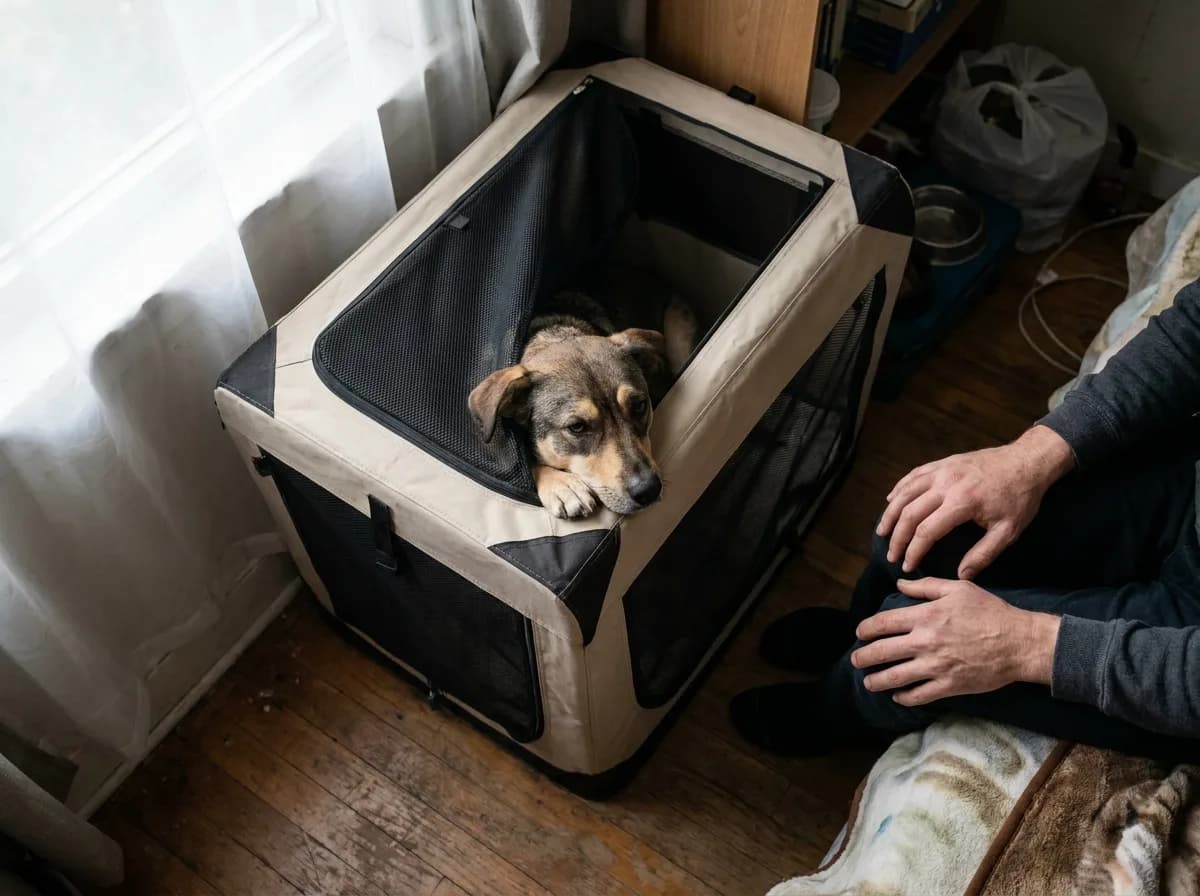
A soft travel crate can be useful at a hotel, holiday rental, family home or other destination when the dog is already comfortable in it. Folding construction reduces storage bulk, and fabric panels make the enclosure easier to pack than a substantial rigid kennel.
The EliteField 36-inch soft crate is the destination-focused option in this selection. Its three access points offer flexibility when arranging a temporary room, and its removable components support cleaning. Those features do not make it appropriate for every dog or every setting.
Match the enclosure to the dog's behavior
Soft fabric, mesh and zippers depend on the dog remaining reasonably settled. A dog that repeatedly claws, bites or pushes at the enclosure needs a different management plan. Do not expect a new folding crate to solve distress or escape behavior by being more convenient for the owner.
An enclosure that works with you sitting nearby may not work when you leave the room. Practice the relevant situation gradually before relying on the crate away from home. If the dog becomes distressed, reconsider the plan rather than treating damage as a reason to choose heavier fabric alone.
A soft crate is a more suitable candidate when:
- The dog has already practiced entering and resting in that type of enclosure.
- The size accommodates the dog's natural posture.
- The location allows ventilation and comfortable temperature.
- You can provide appropriate supervision and respond to problems.
- The accommodation permits the intended use.
Set it up as a resting area
Choose a stable location away from opening doors, busy walkways and anything that blocks the mesh. Check the floor beneath it and follow the manufacturer's setup instructions so the frame is fully assembled before the dog enters.
Keep bedding practical. It should fit without folding into a bulky obstruction or covering ventilation. Use only items appropriate for your dog and the enclosure. A familiar object can be useful, but it should not reduce usable space or create a chewing hazard.
The PetSafe Happy Ride also collapses, but its documented single-seat containment purpose should not be confused with the EliteField's destination role. Similarly, a hard-sided Sky Kennel may be portable in the everyday sense without folding flat. “Portable” describes a convenience, not one common performance standard.
Confirm supervision and accommodation rules
Before leaving your dog at an accommodation, check both the property's rules and your dog's demonstrated ability to settle there. A travel crate does not create permission to leave a pet unattended, and familiarity with a crate at home does not guarantee comfort in an unfamiliar room.
Pack for repeat use
Clean and dry the enclosure before folding it away. Inspect the fabric, seams, zipper path and frame joints while it is open, when damage is easiest to see. Follow the manufacturer's care instructions for removable covers and mats.
Store any removable components together so the next setup is complete. Repeated travel can make small omissions easy to overlook, especially when packing in a hurry. A brief setup check at each destination is more useful than assuming the crate is ready because it worked on the previous trip.
Prepare the dog and plan the trip
Choosing a crate is only one part of making it usable. Give your dog time to become familiar with the enclosure, check its condition and plan how you will meet the dog's needs while traveling. Avoid making the first closed-door experience coincide with departure.
Build comfort in small steps
For a puppy’s first introduction, WebVet’s gradual crate-training plan explains how to build comfort before travel.
Begin in a quiet, familiar place with the crate assembled and its entrance accessible. Let the dog investigate without being pushed inside. Keep early experiences manageable so you can observe whether the dog is comfortable approaching, entering and remaining nearby.
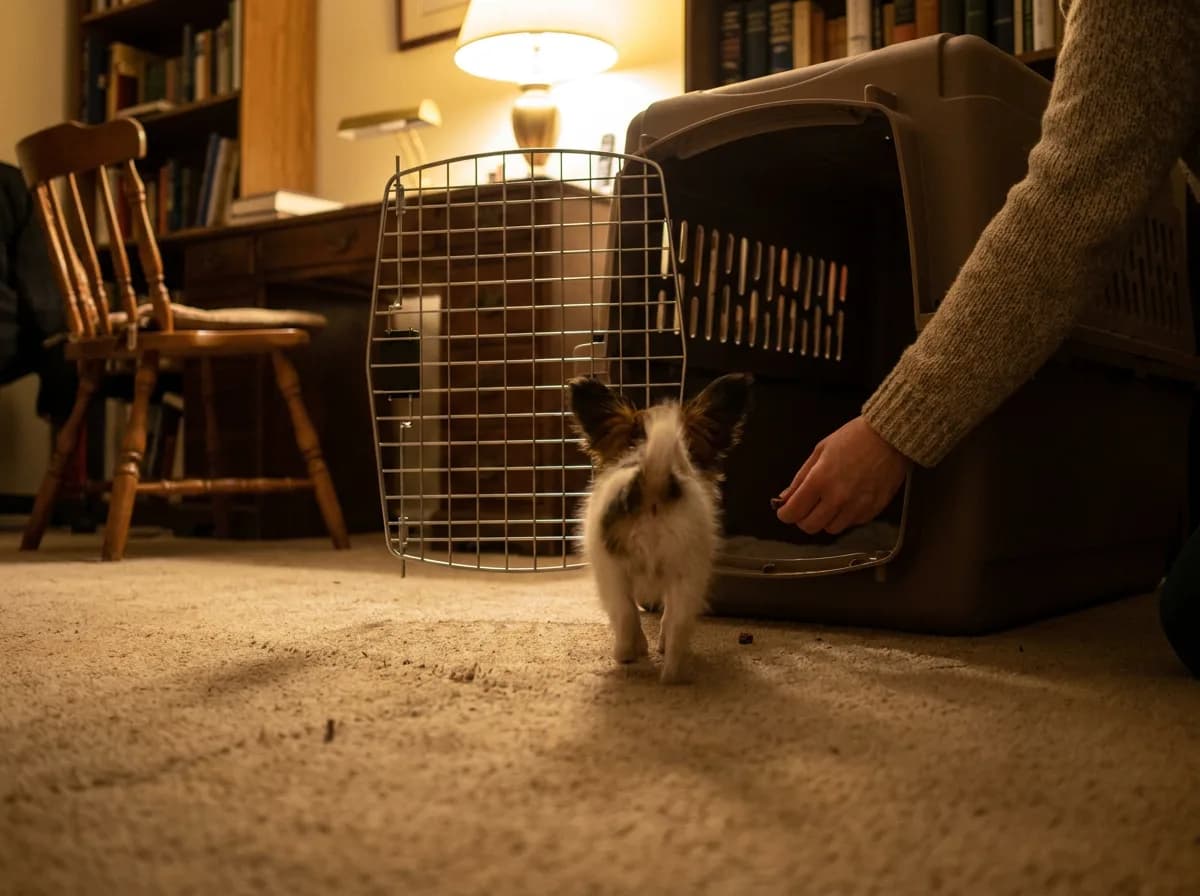
A practical progression is to introduce the separate parts of the experience:
- Approaching and entering the open crate voluntarily.
- Resting inside while you remain nearby.
- Brief, manageable periods with the door closed.
- Becoming familiar with the correctly installed vehicle arrangement, where relevant.
- Short journeys before a longer planned trip.
Advance according to the dog's response rather than a fixed calendar. A dog that readily enters may still be uncomfortable with a closed door, vehicle movement or separation. Those are separate experiences to practice, not evidence that the earlier step was pointless.
Reward-based training can support this process. AVSAB's humane-training position recommends reward-based methods rather than aversive approaches. If the dog shows persistent distress, get appropriate help instead of forcing longer confinement in the hope that the reaction will disappear.
For a puppy, older dog or animal with a health condition, discuss travel suitability and individual needs with your veterinarian before departure. Do not assume a crate purchase resolves motion sickness, pain or anxiety. Those concerns may affect whether and how the dog should travel.
Plan water, movement and toilet opportunities
There is no universal answer to whether a dog can stay in a crate for four hours. Age, health, comfort, prior experience, temperature and the opportunity for breaks all matter. Four hours should not be treated as a target that every dog must tolerate.
For a road trip, build in opportunities to check the dog, offer water and provide appropriate movement and toilet breaks. Plan for delays as well as the expected driving time. A timetable that only works if traffic is perfect leaves little flexibility for the animal's needs.

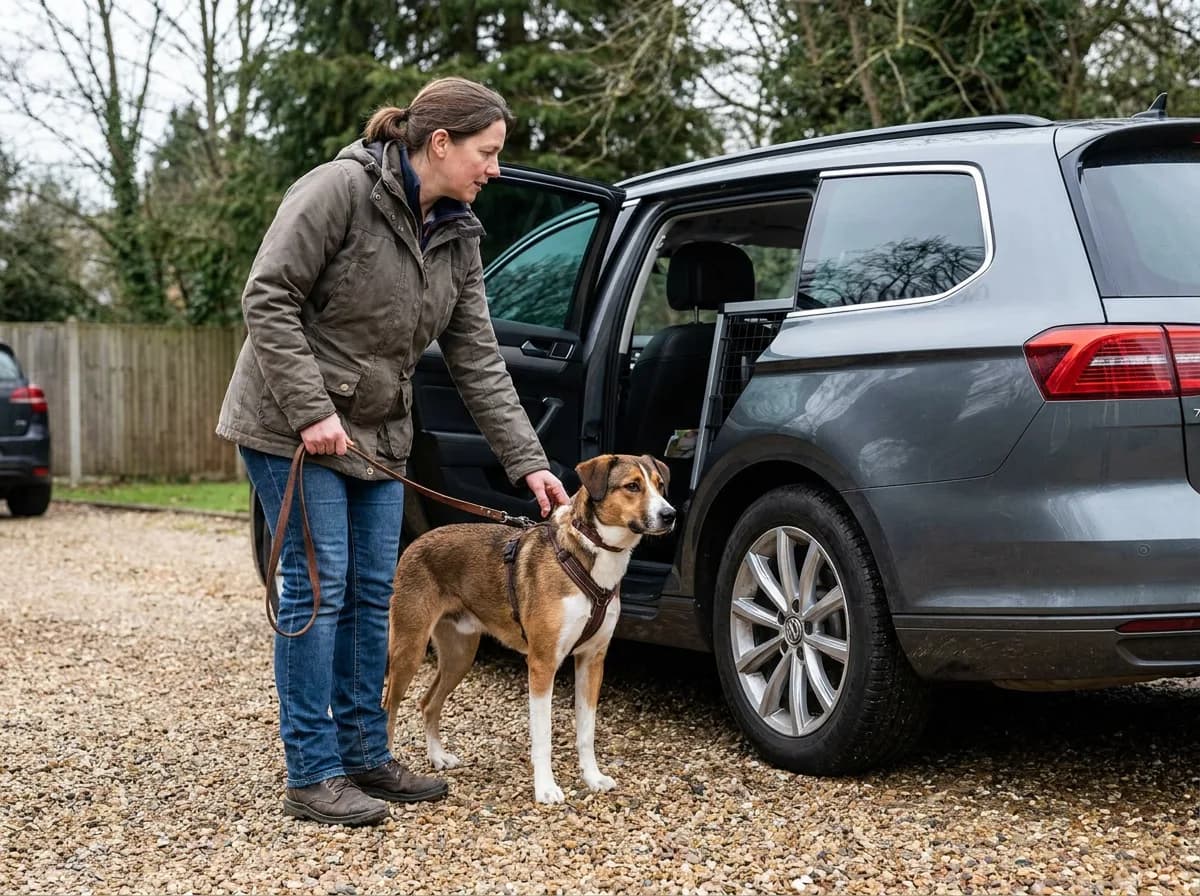
Choose stopping places where you can manage the dog away from traffic. Before opening the crate, arrange the lead or harness and the exit procedure so the dog cannot rush out into an unfamiliar area. Keep the vehicle stationary while attending to the animal.
Pack the supplies needed for the actual route:
- Drinking water and an appropriate bowl.
- The dog's usual food and any feeding instructions relevant to the journey.
- Lead, suitable harness or collar, and identification.
- Waste bags and cleaning materials.
- Necessary medication and travel documents.
- Contact information for help along the route and at the destination.
For flights, water, feeding and access arrangements must follow the carrier's requirements. Do not apply a road-trip routine to a period when you will not be able to reach the dog. Resolve those arrangements before booking and confirm them again during preparation.
Check ventilation throughout the setup
Ventilation needs attention after packing, not only when the empty crate is assembled. Bags, bedding, seatbacks or a cover can obstruct openings that were clear during your first inspection. Recheck the occupied travel arrangement without crowding the dog.
A well-ventilated crate does not make an unattended vehicle safe. Keep the dog's environment appropriate throughout the journey and include the crate's position when considering airflow and sun exposure. Do not rely on construction claims to replace active care.
At a destination, inspect the proposed resting location before moving the dog into it. A convenient corner may be beside a heater, in direct sun or in a busy route through the room. Adjust the room arrangement rather than compromising ventilation to make the crate fit.
Clean and inspect before every trip
Check the crate while empty. Look for damage to the shell or frame, incomplete fasteners, a latch that does not engage properly, worn mesh and a zipper that catches or separates. Inspect attachment equipment according to its manufacturer's instructions.
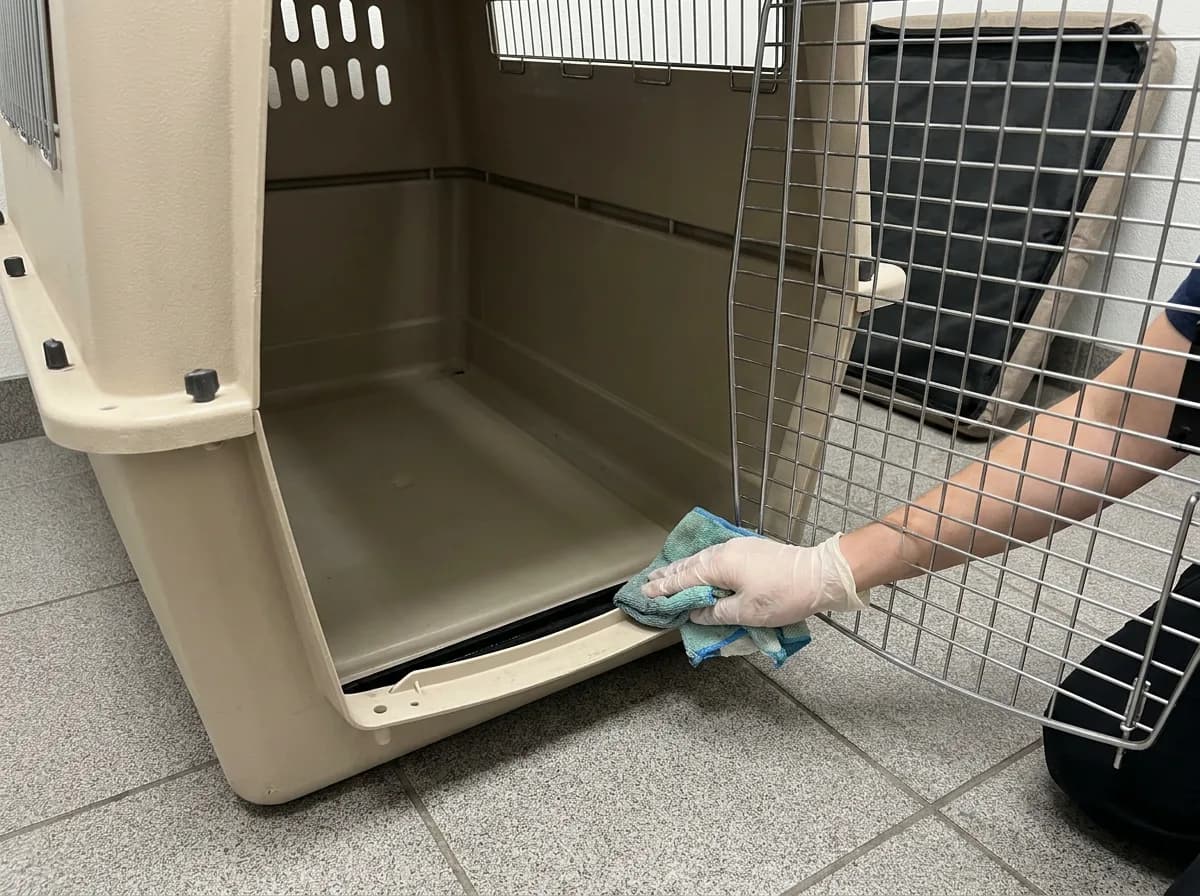
Clean the interior and allow it to dry before adding bedding. Pay attention to floor seams and removable components, using products and methods compatible with the materials. A fresh pad should not conceal damage or leave the latch, doorway or ventilation obstructed.
For a collapsible model, confirm that the frame is fully set up each time. For a rigid kennel, check that every required assembly component remains present. For a certified vehicle setup, include the specified anchoring equipment in the inspection rather than treating it as a separate accessory.
Repeat the fit check when the dog grows, the bedding changes or the crate moves to another vehicle. Also reconsider the arrangement if the dog's mobility or comfort changes. A successful trip months ago does not establish that every part of the current setup still works.
Complete the departure check
Before departure, make one complete check: dog fit, crate condition, installation or airline acceptance, ventilation, access and care supplies. Choose the product only after those requirements agree. The useful travel crate is the one you can use correctly for this dog on this journey.
Questions readers ask
Measure the dog standing naturally on a level surface: body length from nose toward the tail base, standing height including the head and ears, width at the widest point, and current weight. Compare those numbers with the manufacturer’s published interior dimensions and sizing method, not the size name. For a flight, use the airline’s own measuring instructions, and recheck a puppy close to departure.
There is no universal answer. Age, health, temperature, prior crate experience and the chance to take breaks all change what an individual dog tolerates. For a road trip, plan stops to check the dog, offer water and allow movement and toilet breaks, and build in time for delays. Four hours is not a target every dog must meet. For flights, follow the carrier’s feeding, water and access arrangements.
Hard-sided flight kennels such as the Petmate Sky Kennel are sold through pet retailers and manufacturers, but “airline approved” is not a universal pass. The operating airline decides whether your dog and the exact assembled crate are acceptable for that aircraft and route. Get the airline’s current requirements first, then buy the model and size that meets them, leaving time to assemble and check it.
In the car, the practical alternative is a vehicle harness with documented crash testing and installation instructions compatible with your seat belts. Seat covers, barriers and hammocks serve different purposes and are not a restraint decision. At a destination, a quiet room or managed resting area can replace a transport enclosure for a dog that settles without one.
No. Crash testing is evidence about one exact configuration. The Center for Pet Safety record for the GUNNER G1 Medium covers that size with its rated anchor straps and a 45-pound test dog; it does not transfer to other sizes, straps or vehicles. The PetSafe Happy Ride is described by its maker as containment, not restraint, and a kennel accepted for a flight has no vehicle crash evidence by default.

Sign up for expert-backed reviews and safety alerts all in one place.

Mary Siobhan Brier is a writer, SEO expert, and managing co-founder of Inkless Writing Agency. She shares book reviews and writing advice on her YouTube channel, @siobhanbrieraguilar. An avid animal lover, she lived for one year on the Galapagos Islands, meeting all sorts of creatures. She has traveled and lived throughout much of the Americas, birdwatching all the while. She is the proud mother to a dignified, long-haired jack russel named Argo. You can sign up for her newsletter at siobhanbrier.com, get writing advice from inklessagency.com, or follow her on LinkedIn.
Sign up for expert-backed reviews and safety alerts all in one place.