Best Cat Shampoo: Practical Picks for Bath Time
Choose a cat-labeled shampoo for the cleaning task, with clear comparisons of rinse-off formulas, waterless foam, contact times, kitten suitability, and the limits of skin-care claims.
Petful is reader supported. As an affiliate of platforms like Amazon and Chewy, we may earn a commission when you buy through links on this page. There is no extra cost to you.
The best cat shampoo is one your cat actually needs and that you can use exactly as directed. Most healthy adult cats rarely need a bath. When cleaning is necessary, choose a cat-labeled formula for the job: a rinse-off wash, skin-support shampoo within a care plan, or waterless foam for limited-area cleaning.
A bottle that sounds gentle still may require thorough rinsing, a specific contact time, or an age check. Those practical differences matter more than choosing the largest bottle or the most appealing scent.

Sign up for expert-backed reviews and safety alerts all in one place.
Pick a shampoo for the next bath
Among these shampoos for cats, Vetoquinol offers a general rinse-off option, Virbac Epi-Soothe is formulated for dry or sensitive skin, DOUXO S3 CALM has a specific 5–10 minute contact time, and Hyponic offers a foam you massage into a dirty area and wipe with a dry cloth.
A veterinarian-recommended cat shampoo should be a specific formula chosen for that cat's cleaning or skin-care needs, with clear directions for its use. Our comparison uses manufacturer directions and feline-use information, not a hands-on bathing trial. Start with the cleaning task, then check whether your cat and your bath setup fit the instructions.
For a rinse-off formula, plan to rinse thoroughly rather than leaving a little shampoo behind for extra softness. For a waterless product, follow its removal directions. Neither format turns an ordinary grooming product into a treatment for fleas, infection, or an undiagnosed skin problem.
- 1Compare shampoos for cats by species suitability, application, removal directions, and the reason for cleaning.
- 2The best cat shampoo fits a necessary grooming task. Most healthy adult cats do not need routine full baths.
| Quick pick | Practical fit | Selected bottle |
|---|---|---|
| Vetoquinol Aloe & Oatmeal | General cleansing when a rinse-off bath is needed | 16 oz |
| Virbac Epi-Soothe | Soap-free cleansing for dry or sensitive skin | 8 fl oz |
| DOUXO S3 CALM | Skin-support washing with a defined contact time | 6.7 fl oz |
| Hyponic Waterless | Foam for cleaning a dirty area without a full rinse-off bath | 6.4 fl oz |
| Product choice | Application and removal | Contact-time decision | Useful distinction | Main limitation |
|---|---|---|---|---|
| Vetoquinol Aloe & Oatmeal, 16 oz | Rinse-off shampoo; follow the bottle directions and rinse thoroughly | Use the exact label; do not borrow another formula’s timing | Soap-free, scented formula labeled for dogs and cats | Weekly-use permission does not mean every cat needs a weekly bath |
| Virbac Epi-Soothe, 8 fl oz | Rinse-off shampoo; follow the product directions | Use the exact label’s contact time | Soap-free oat-grain derivative formula; manufacturer includes cats of any age | Skin support does not diagnose or cure the cause of itching |
| DOUXO S3 CALM, 6.7 fl oz | Wet coat, apply as directed, then rinse | Leave for 5–10 minutes before rinsing | Cat-labeled skin-support formula with Ophytrium | Lightly scented; dog-study results are not feline outcome evidence |
| Hyponic Waterless, 6.4 fl oz | Dispense foam, massage the dirty area, wipe with a dry cloth | Follow foam application and wiping directions rather than a rinse-off shampoo timer | Limited-area cleaning option labeled for dogs and cats | No minimum kitten age verified; not a substitute for removing heavy contamination |
Vetoquinol Aloe & Oatmeal: a general rinse-off option
Petful may earn a commission when you click through to Chewy, at no extra cost to you.
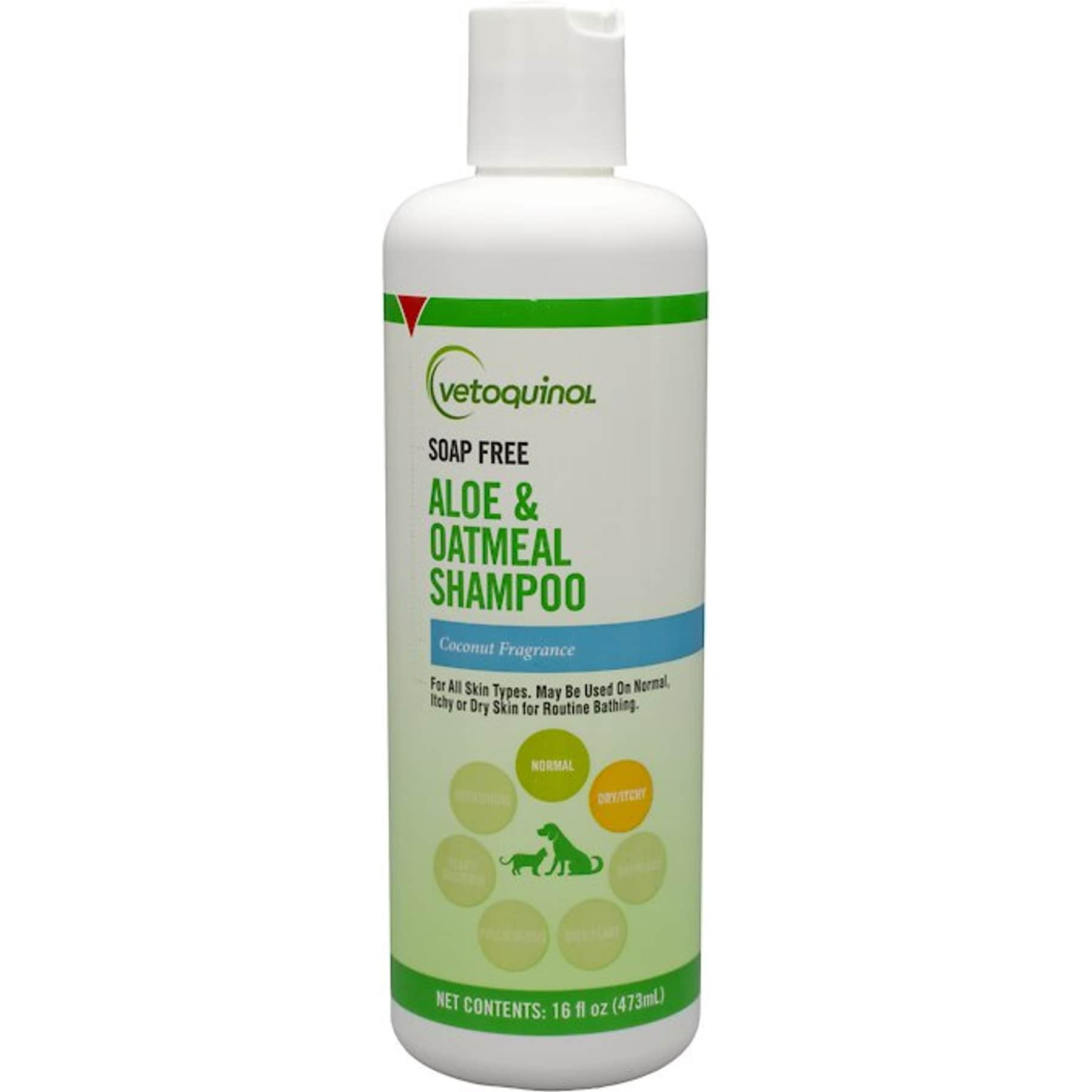
Vetoquinol Aloe & Oatmeal Shampoo, 16 oz, is labeled for dogs and cats. The manufacturer describes a soap-free formula containing aloe and oatmeal, with no parabens or silicone. It is scented, so it should not be presented as a fragrance-free choice.
This is a practical candidate when a cat needs general cleansing and you can complete a rinse-off bath. Vetoquinol permits weekly use or use as directed by a veterinarian, but that is not a reason to begin weekly baths for a healthy cat. Follow the bottle’s directions and establish that cleaning is needed first.
Virbac Epi-Soothe: cleansing for dry or sensitive skin
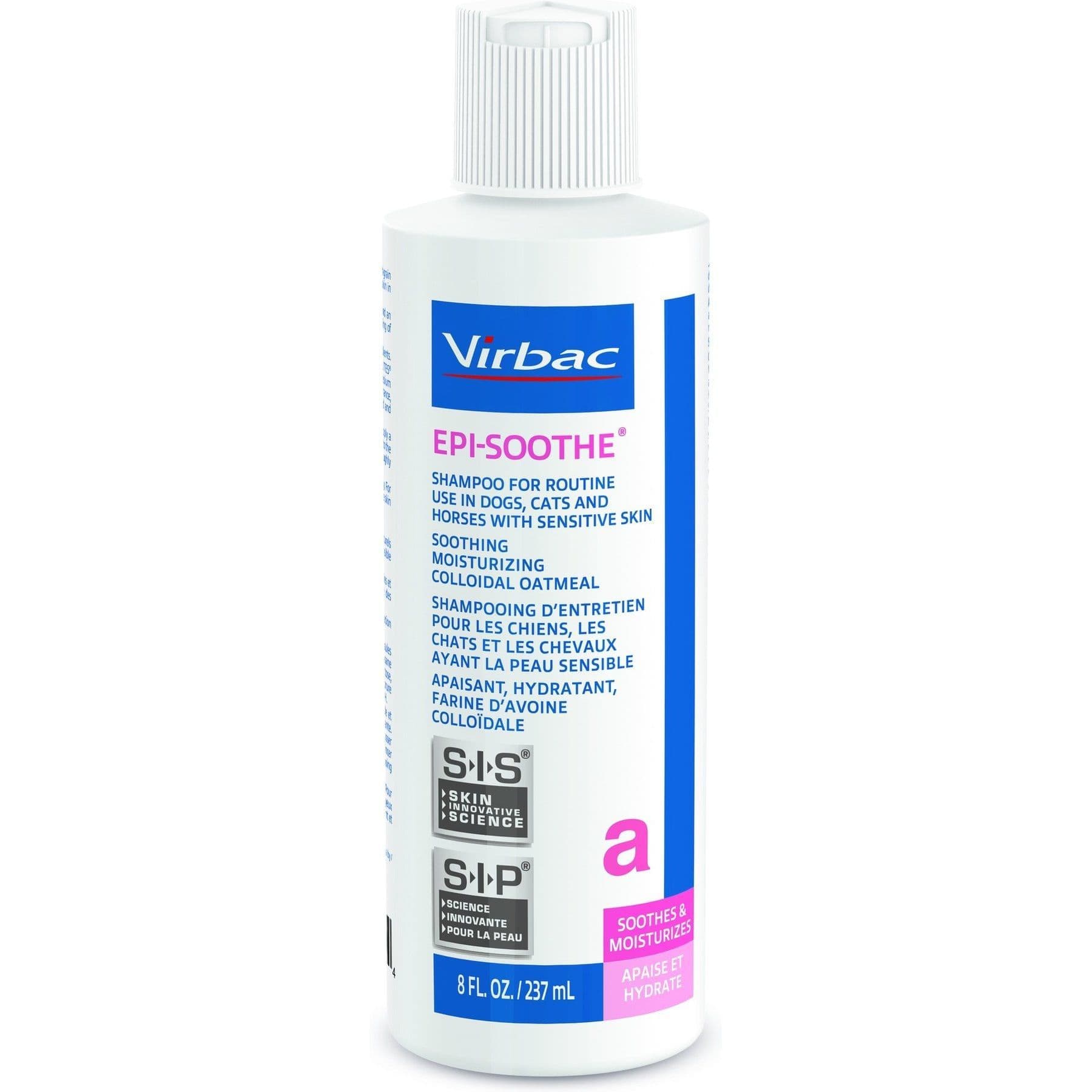
Petful may earn a commission when you click through to Chewy, at no extra cost to you.
Virbac Epi-Soothe Shampoo, 8 fl oz, is a soap-free, oat-grain derivative shampoo. Virbac’s product information includes dogs, cats, and horses of any age and describes soothing cleansing for dry or sensitive skin.
That makes the species and age language clearer than a generic “pet shampoo” label. It does not establish that every itchy kitten needs a bath or that shampoo will resolve the cause of dermatitis. Choose it within a sensible skin-care plan, follow its own contact and rinsing directions, and distinguish it from a separate conditioner or cream rinse.
DOUXO S3 CALM: a defined contact-time routine
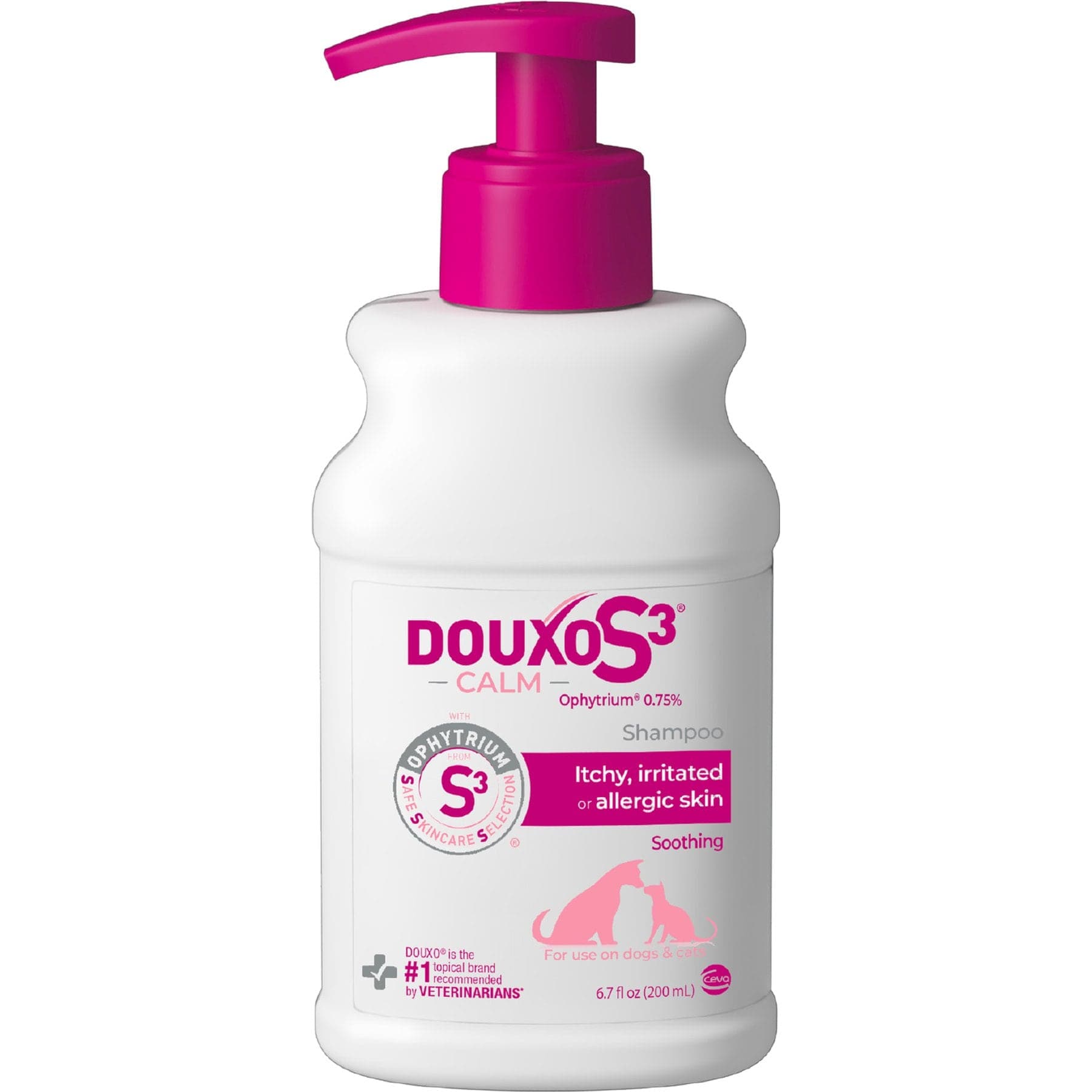
Petful may earn a commission when you click through to Chewy, at no extra cost to you.
DOUXO S3 CALM Shampoo, 6.7 fl oz, is labeled for dogs and cats and contains Ophytrium. Its current US product directions specify leaving the shampoo on for 5–10 minutes before rinsing. It is lightly scented, not unscented.
The waiting period is a real handling requirement. Choose it only when you can follow the intended routine or have discussed an alternative with your veterinarian. The manufacturer’s dog-study results should not be represented as measured results in cats. CALM also is not interchangeable with other formulas in the DOUXO range.
Hyponic Waterless: foam for a smaller cleaning task
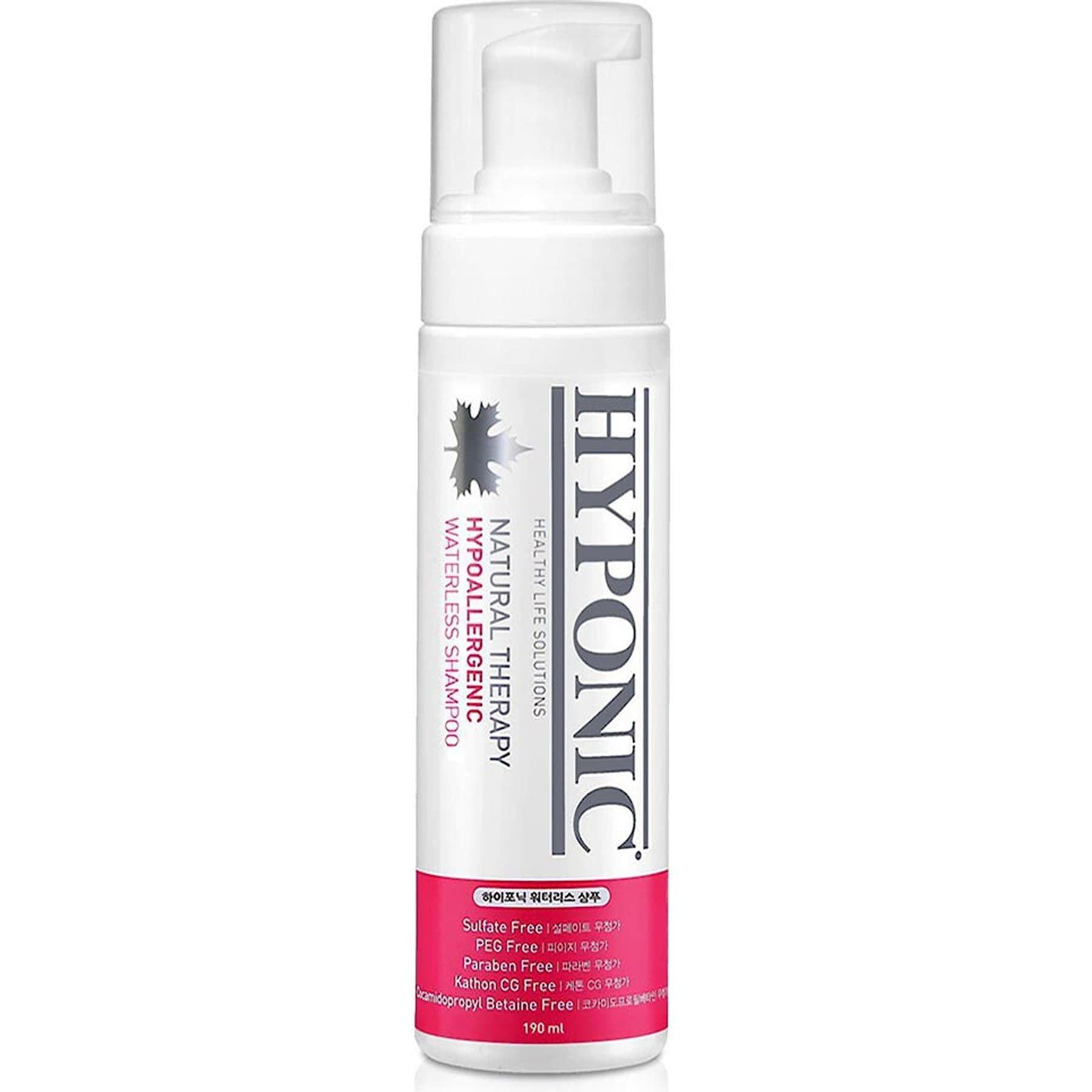
Petful may earn a commission when you click through to Chewy, at no extra cost to you.
Hyponic Hypoallergenic Waterless Dog & Cat Shampoo, 6.4 fl oz, offers a different process from the three rinse-off choices. The manufacturer’s waterless-shampoo directions say to dispense foam, massage the dirty area, and wipe with a dry cloth.
That may fit a limited cleaning task when a full bath is unnecessary. “Waterless” does not mean apply and forget: wiping is part of the directions. A minimum kitten age was not established in the manufacturer information reviewed for this option. Check the current package or ask the manufacturer before treating it as a kitten-friendly product.
Compare familiar brands by the exact formula
Burt’s Bees Hypoallergenic Cat Shampoo is a rinse-off cleanser with shea butter and honey. Its manufacturer includes cats and kittens but does not state a numerical minimum age on that page. Earthbath 2-in-1 Conditioning Cat Shampoo in Light Wild Cherry combines cleansing and conditioning, is scented, and specifies animals over six weeks with at least 90 seconds on the wet coat.
For a Chris Christensen cat shampoo, identify the formula: Top Cat Shine has its own wet-coat routine, up-to-five-minute contact time, and thorough rinse. These distinctions matter when comparing it with the selected Vetoquinol or Virbac cleansers. Do not transfer those directions to DOUXO CALM’s 5–10-minute routine or Hyponic’s foam-and-dry-cloth process. Choose by the cleaning task and directions you can complete.
Read the cat-specific label
Read the back of the bottle before opening the tap. A familiar brand name, a cat pictured on a shopping page, or a “gentle” description is less useful than directions that clearly apply to the animal and the formula in front of you.
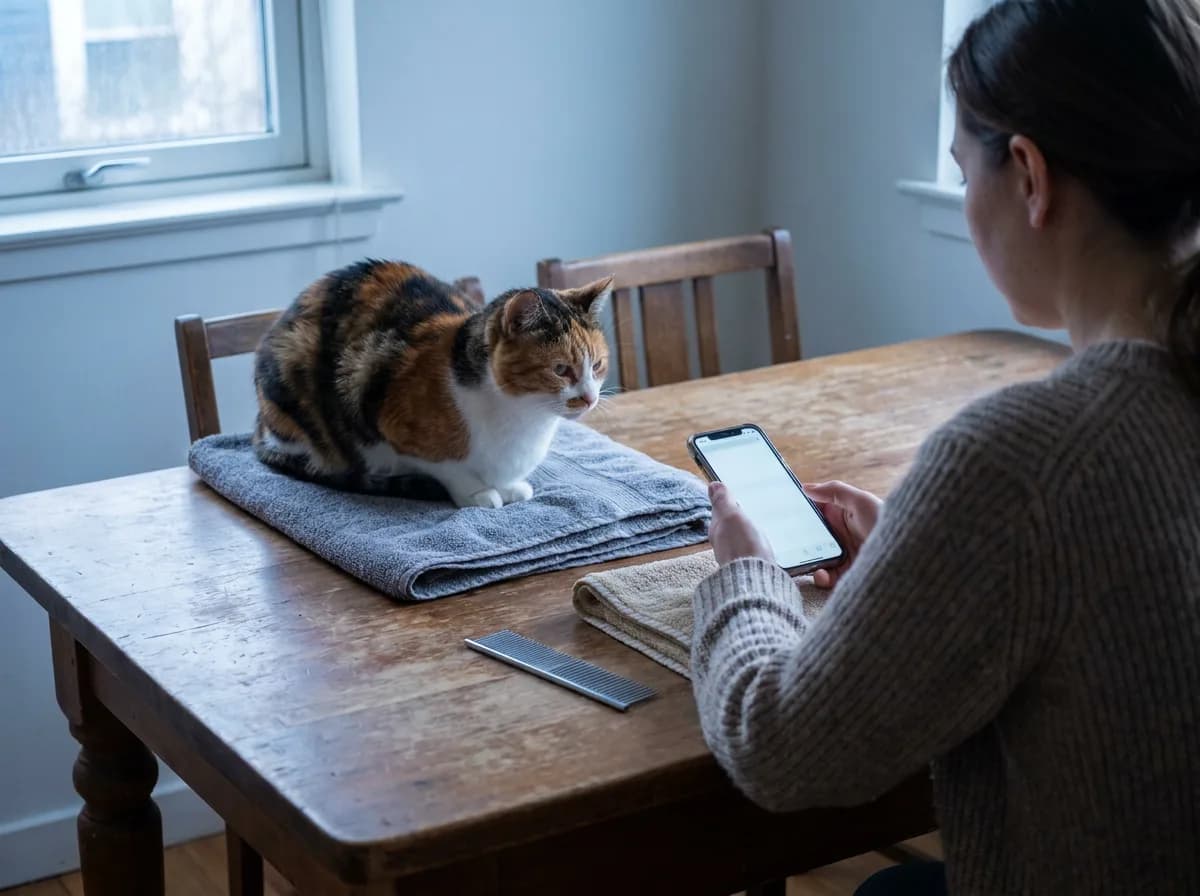
Start with the full product name. Shampoo, cream rinse, conditioner, mousse, and waterless foam may sit beside one another in the same range. A similar label design does not make their application or removal steps interchangeable. Check that the item in your basket is the formula you intended to buy.
A useful label check covers:
- Species: Cats must be included in the product’s directions.
- Age: Look for a minimum age or an explicit kitten-use statement.
- Purpose: Distinguish ordinary cleansing from a veterinarian-directed skin-care routine.
- Application: Check wet versus dry coat, amount, dilution, and contact time.
- Removal: Determine whether the product must be rinsed off or wiped away.
- Precautions: Read instructions about eyes, ears, damaged skin, storage, and unwanted reactions.
A cat label and a kitten label answer different questions
An adult-cat product is not automatically the best kitten shampoo. Kitten suitability must come from the formula’s directions, not from the assumption that a smaller amount makes it appropriate. The same applies to a bottle described as hypoallergenic or fragrance-free: neither term supplies a missing minimum age.
Virbac explicitly includes cats of any age in its Epi-Soothe product information. That is a manufacturer statement about the product, not a recommendation to routinely bathe newborn or very young kittens. Age suitability and the decision to bathe remain separate. For Vetoquinol and Hyponic, the manufacturer material reviewed here did not establish a minimum kitten age. Treat that as a question to resolve, not permission to make up an age cutoff. When the label is unclear, give the manufacturer or your veterinarian the exact product name and the kitten’s age before using it.
A kitten that needs cleaning because of repeated soiling may also need help with the reason for that soiling. Product shopping can answer what belongs on the coat, but it does not answer why the problem keeps occurring. Avoid turning a small grooming problem into a standing bath schedule without understanding the need.
Understand what the descriptive words establish
“Soap-free” describes a formulation feature. It does not mean the product contains no cleansing agents or can be left on after a rinse-off bath. The selected Vetoquinol and Epi-Soothe shampoos are soap-free, yet their use still depends on following their own wash and removal directions.
“Hypoallergenic” is not a guarantee that no cat can react. A cat’s prior reaction to a product is relevant even when the next bottle uses reassuring language. Keep the exact name and ingredient information available when discussing an alternative. Likewise, “non-toxic,” “natural,” or “organic” should not replace the practical questions on the label checklist. A product can have a pleasant-sounding ingredient list and still be unsuitable for a particular use. The useful question is whether this formulation is intended for this cat and can be applied and removed correctly.
For a fragrance-sensitive household, distinguish an explicit fragrance-free claim from a mild-smelling or lightly scented product. DOUXO S3 CALM and Vetoquinol Aloe & Oatmeal are scented. Do not infer that Hyponic is unscented from the word hypoallergenic or from the absence of a strong scent description.
Read the amount and dilution instructions literally
The correct amount is product-specific. A pump count from one bottle cannot be transferred to another bottle with a different pump, concentration, or formula. Similarly, a dilution ratio intended for a professional concentrate is not a general recipe for every shampoo.
Before the bath, establish:
- Whether the bottle says to shake it.
- Whether it is used directly or diluted.
- Whether the coat should be wet before application.
- How much to use for the intended area or animal.
- How long it should remain before removal.
If a direction is missing or unreadable, resolve it before starting. Adding extra water may change how you apply a product, but it does not create a manufacturer-approved dilution. Adding extra shampoo does not reliably make a bath more effective and gives you more product to remove.
Keep any veterinarian’s instructions with the exact formula they concern. A schedule written for one medicated product should not become the schedule for an oatmeal cleanser simply because both are sold as shampoo.
Check storage and age of the bottle
Cat shampoo should not be assumed usable indefinitely. Look for an expiration date, period-after-opening instruction, or storage directions. If you cannot interpret the date or batch information, contact the manufacturer with a photograph of the bottle rather than guessing.
A missing printed expiry date is not proof of unlimited shelf life. If a bottle has been open for an unknown period, stored improperly, or changed noticeably in appearance or smell, ask the manufacturer whether it remains suitable. Do not try to restore an old formula by mixing in water or another product.
Keep the original container and close it after use. That preserves the directions, ingredient list, and identifying information needed for later questions. Decanting several shampoos into similar unlabeled bottles removes precisely the information that helps prevent a mix-up.
Check a replacement bottle against the one you know
When reordering, compare the full name and form rather than relying on the bottle color or a saved shopping thumbnail. A shampoo, mousse, and conditioner can share prominent branding while requiring different handling. A retailer’s category label also may be broader than the species directions on the actual bottle.
If the packaging or directions have changed, read them again before the next bath. Keep the new instructions with the new product. Do not assume an old dilution note, contact time, or application amount remains correct just because the brand is familiar.
Compare value without inventing a cost per bath
The selected bottles range from 6.4 fl oz to 16 oz, but volume alone does not tell you which costs less per use. A small area cleaned with foam is a different task from a full rinse-off bath. Product amount, coat coverage, and any permitted dilution affect how quickly a bottle is used.
Price per fluid ounce can compare package costs. It cannot establish equal cost per bath unless the formulas have comparable application amounts and uses. For a cat that rarely needs bathing, a larger bottle also may be more product than you expect to use.
Buy for the next realistic cleaning need. A correctly labeled bottle that you can use as directed is more useful than a bulk purchase whose purpose, age suitability, or removal steps remain uncertain.
Itchy or flaky skin changes the decision
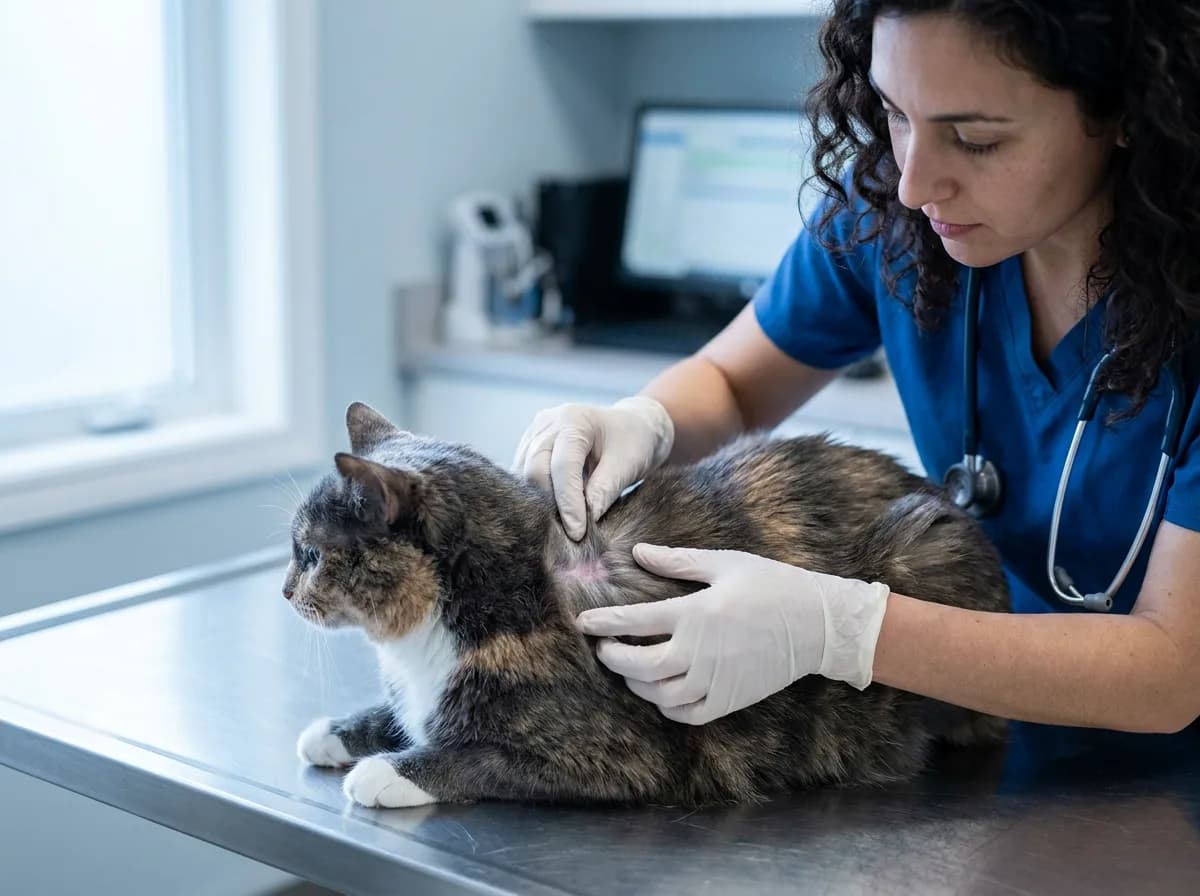
A cat with visible flakes or repeated itching needs a different decision from a cat with a dirty paw. The goal is no longer simply to remove ordinary dirt. You need to know whether cleansing is helpful, what skin support is appropriate, and whether the signs require assessment before another bath.
“Dandruff shampoo for cats” describes what someone hopes to improve, not a diagnosis. Flakes, a greasy coat, redness, hair loss, and scratching are observations to report. They do not identify one cause or establish that the strongest-sounding shampoo will be the right treatment.
Before choosing a shampoo for itchy skin, note:
- When the change began and whether it is getting worse.
- Whether the whole coat or one area is affected.
- Whether there is redness, broken skin, odor, or hair loss.
- Whether the cat is scratching, licking, or avoiding handling.
- Whether a new grooming product was used shortly before the change.
- Whether the cat’s normal grooming habits have changed.
These details make a consultation more useful than a general description such as “sensitive skin.” A photo taken before cleaning can help you describe what you saw. Do not scrub away an irritated patch just to make the coat look normal before asking for advice.
Skin support is not a disease-treatment claim
A moisturizing cat shampoo may support a dry-feeling coat, and an oat-based cleanser may be selected for gentle washing. That does not establish that either treats an infection, eliminates parasites, or resolves the cause of dermatitis. Those are separate claims requiring an appropriate diagnosis and treatment.
Virbac describes Epi-Soothe as a soap-free oat-grain derivative shampoo for soothing cleansing of dry or sensitive skin. Keep the benefit at that level. “Supports comfortable cleansing” is not the same as “cures your cat’s allergy.”
The same care applies to a search for medicated shampoo for cats. “Medicated” is not one universal formula. Different products can have different intended uses, contact times, and precautions. A veterinarian’s recommendation should identify the actual product and how it fits the cat’s care plan. If the recommendation is unclear, ask for the exact name, the reason for using it, and what change you should expect. That is more actionable than buying a product because the front label uses clinical language.
What DOUXO S3 CALM can and cannot establish
DOUXO’s cat-use information supports feline use of CALM. The current US product page describes Ophytrium and gives a 5–10 minute contact time before rinsing. These are useful facts when deciding whether the product and process fit your cat.
The same page’s dog-study material is not evidence that an identical result has been measured in cats. Do not expect a particular percentage reduction in feline itching or a guaranteed timeline based on a dog trial. The cat-specific claim and the study population should remain distinct.
CALM is also a specific formula. Another DOUXO product with a different name is not automatically a substitute, and a recommendation for CALM is not permission to choose a different bottle from the same shelf. Keep the name, form, and directions together when following a skin-care plan. The contact time creates a practical question as well as a product question. If your cat cannot comfortably tolerate the recommended process, tell the veterinarian. Shortening the contact time on your own or leaving the shampoo incompletely rinsed is not an equivalent way to use it.
Make a skin-care plan you can actually follow
Ask for instructions that cover the whole bath, not just the product name:
- Which areas should be washed?
- How often should the product be used for this cat?
- What contact time and rinsing steps apply?
- Should other grooming products be paused or avoided?
- What changes should prompt a call before the next bath?
- When should the plan be reassessed?
These are especially useful questions when a cat is receiving other skin care. You should not have to guess whether a waterless foam, conditioner, and rinse-off shampoo belong in the same routine. Keep the plan simple enough to follow consistently.
A label that permits frequent use does not determine how often a particular skin problem needs washing. Conversely, a veterinarian-directed treatment schedule is different from deciding to bathe a healthy cat because a bottle says “gentle.” Follow the instructions matched to the reason for treatment.
Observe the skin, not just the scent or softness
After a necessary bath, pay attention to how the cat and skin respond. A pleasant smell or soft coat is not proof that the underlying problem has resolved. It is also not a reason to repeat the bath sooner than advised.
Useful observations include whether the cat is comfortable, whether scratching has changed, and whether visible irritation persists. Keep the product name and the date of use with those notes. If a concern appears, that record is more useful than trying several new formulas and losing track of what changed.
Do not treat a worsening problem by progressively adding more products. A second shampoo, a scented spray, and a homemade rinse make it harder to identify what the cat encountered. If skin signs persist or worsen, return to the assessment and care plan. VCA’s grooming guidance distinguishes routine coat care from situations requiring medical advice. Use shampoo as one tool when it has a defined role, rather than expecting it to answer every question raised by flaky or itchy skin.
Waterless versus rinse-off
Choose the format by the cleaning task and the directions you can complete. A full rinse-off bath may be appropriate for broader ordinary soiling. A small dirty area may need only spot cleaning. A waterless foam provides another option, but it has its own application and wiping steps.
These formats do not form a simple ranking from gentle to harsh. A rinse-off product used correctly is different from a rinse-off product left behind because the cat would not tolerate water. Likewise, a foam is not automatically appropriate for every material that ends up on the coat.
- Read the cat label and product directions before choosing a format. Rinse-off shampoo must be rinsed off; waterless foam must be used and removed according to its own instructions.
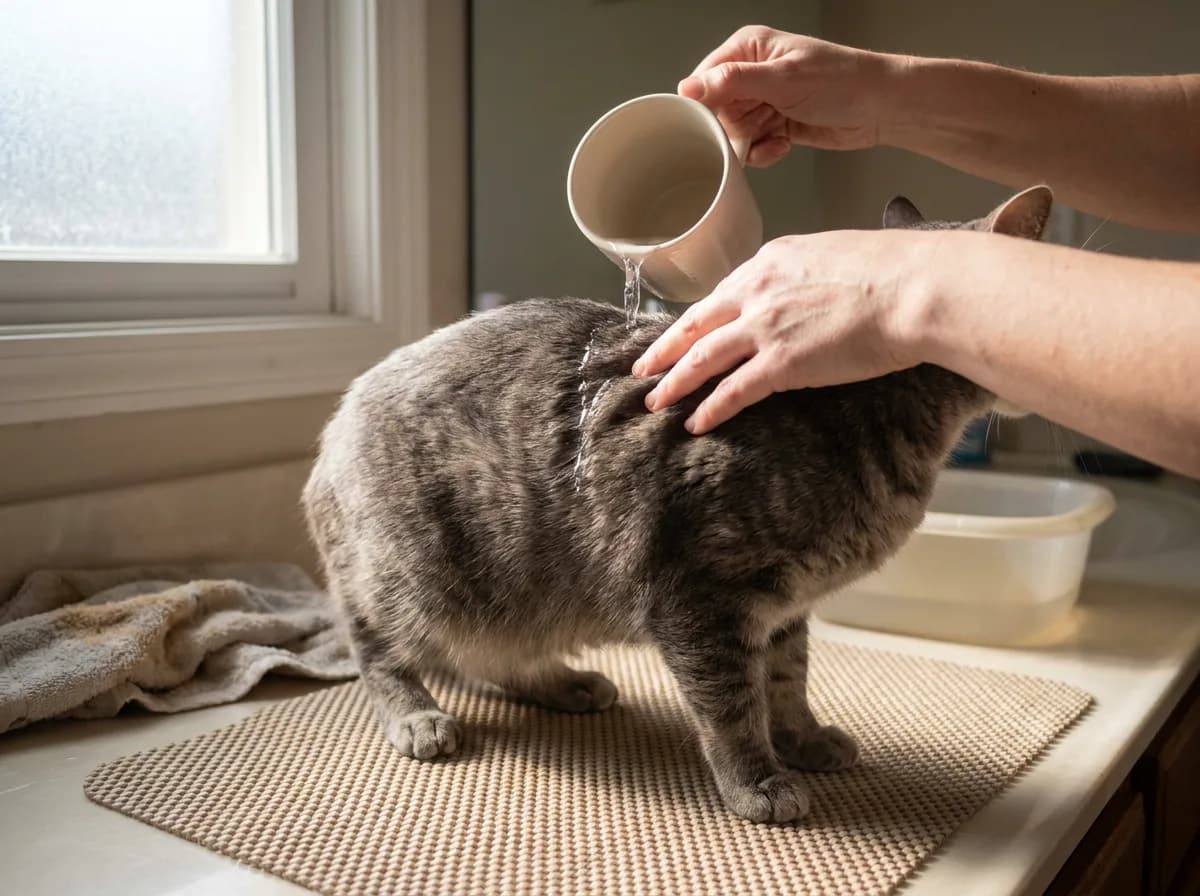
Prepare for the full process before wetting the coat
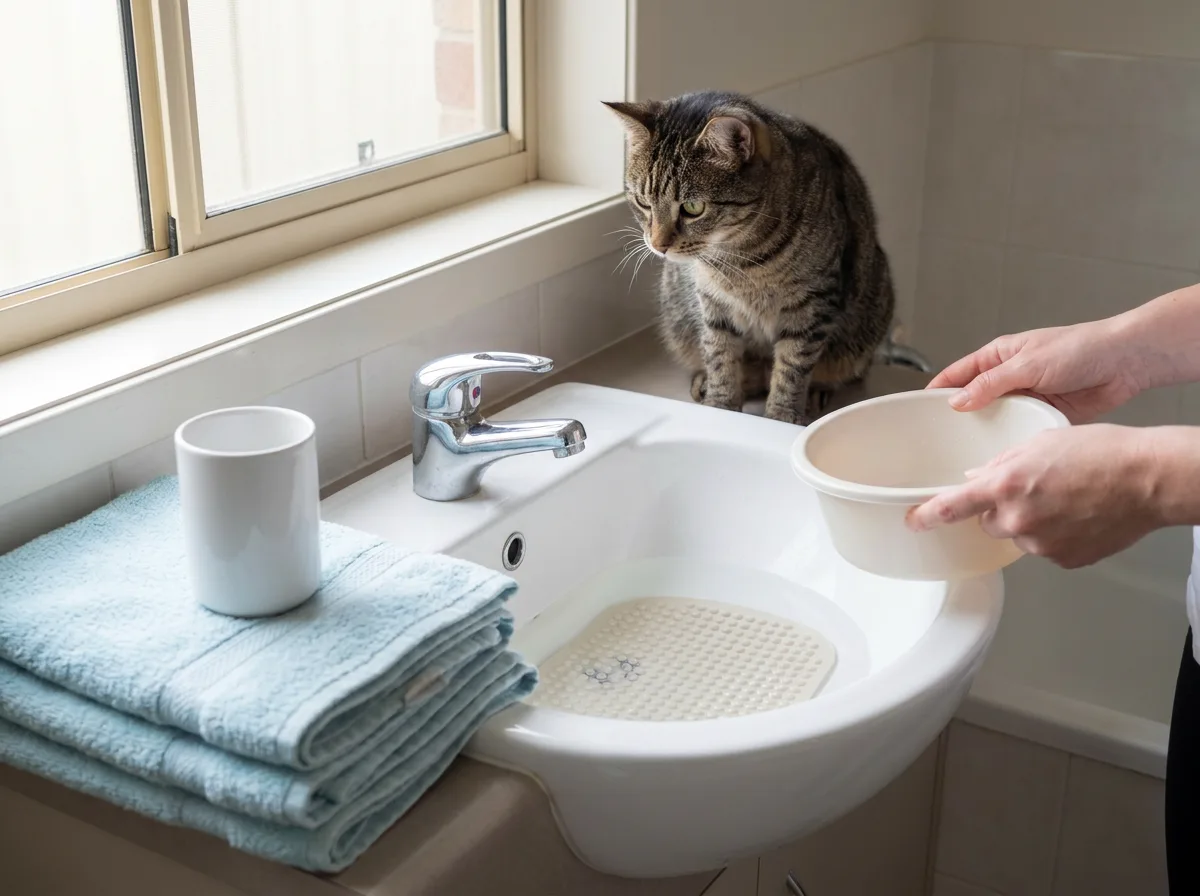
A useful bath setup lets you move from washing to rinsing to drying without leaving the cat unattended or searching for supplies. Choose a quiet place with enough room to work and a surface that gives the cat secure footing. Keep the area comfortable and free of clutter.
Have the essentials ready:
- The correct shampoo in its original bottle.
- A nonslip surface appropriate for the sink or bathing area.
- Lukewarm water and a controllable rinsing method.
- Clean, absorbent towels within reach.
- A clean cloth for limited-area wiping.
- A way to track contact time if the product requires it.
Read the directions while your hands are dry and you can concentrate. If you need to measure or dilute anything, complete that preparation according to the label before bringing the cat into the bathing area. Avoid improvising quantities while trying to keep hold of a wet animal.
Think through where the cat will go afterward. A towel-lined, comfortable area is more useful than finishing the rinse and then discovering that every dry towel is in another room. If another person is helping, agree on who handles the cat and who manages water and supplies.
A setup that works for a relaxed cat may not work for one that strongly resists handling. Do not rely on force to compensate for an impractical plan. A professional groomer or veterinary team can help determine whether home bathing is appropriate and how to approach a cat that cannot be managed comfortably.
Wet and wash only as the formula directs
For a rinse-off shampoo, follow the bottle’s directions for wetting the coat and applying the product. Work methodically so that you know which areas have been cleaned. Keep the face and ears out of the washing stream and avoid directing shampoo toward sensitive areas.
Do not assume that more lather means better cleaning. The aim is the labeled application, not a dramatic covering of foam. Excess product creates more rinsing work and may extend the time the cat has to tolerate the bath. Use your hands gently rather than scrubbing an irritated patch. If you find an area that appears painful, damaged, or unexpectedly difficult to handle, stop treating the task as an ordinary wash. The right next step may be assessment rather than continued cleaning.
A cat’s coat can also hide areas you have not reached. For a longhaired animal, work carefully through the coat you can handle without pulling. A shampoo bath is not the time to force apart a tight mat or discover that a grooming problem needs professional help.
Make room for contact time
Contact time is the interval a product is directed to remain before removal. It is different from the total time spent getting the cat wet, applying shampoo, rinsing, and drying. Plan the whole process rather than treating the number on the label as the entire bath length.
- DOUXO S3 CALM requires 5–10 minutes before rinsing. Do not transfer that contact time to Vetoquinol, Epi-Soothe or Hyponic. Each formula has its own application and removal directions.
A timer can keep you from guessing while managing a moving cat. Stay with the animal during the interval and keep the process calm. If your cat cannot tolerate the required routine, discuss another approach instead of changing the directions on the fly.
Rinse the product out, including less obvious areas
VCA emphasizes thorough rinsing because cats groom themselves after a bath. Do not leave rinse-off shampoo on the coat as though it were a leave-on conditioner. The removal step matters even when the formula is described as moisturizing or soap-free.
Use a controllable flow or a rinsing cup, keeping water away from the face and ears. Work through the washed areas systematically rather than rinsing only the visible top of the back. Check the areas that received shampoo, including places where wet fur lies against the body.
Do not use scent as your rinsing test. A scented formula may still smell after correct use, and a mild-smelling product can still require more rinsing. Follow the label and attend to whether wash product remains rather than trying to wash away every trace of fragrance. The coat should not be intentionally left coated with a rinse-off product to make it feel softer. If you are unsure whether a formula has been removed adequately, consult its directions rather than applying a second product to mask the feel.
Use waterless foam as a specific procedure
Hyponic’s directions are to dispense foam, massage the dirty area, and wipe with a dry cloth. The wiping step is the practical distinction: it is not a full rinse-off wash, but neither is it simply a perfume sprayed over an odor.
For a small ordinary cleaning task, identify the area first. Use the product as directed on that area rather than automatically coating the entire cat. Have the dry cloth ready before applying foam so you can finish the process promptly.
A waterless shampoo may be useful when the size of the task does not justify soaking the coat. It should not be treated as an answer to every reason a cat cannot have a conventional bath. An animal with painful skin, repeated soiling, or a handling problem still needs a plan suited to that issue. Sprays, powders, and foams are not interchangeable formats. A cat dry-shampoo powder can have different application and removal requirements from the selected foam. Do not copy directions from a social-media recommendation or another waterless brand onto the bottle you own.
Match spot cleaning to the material on the coat
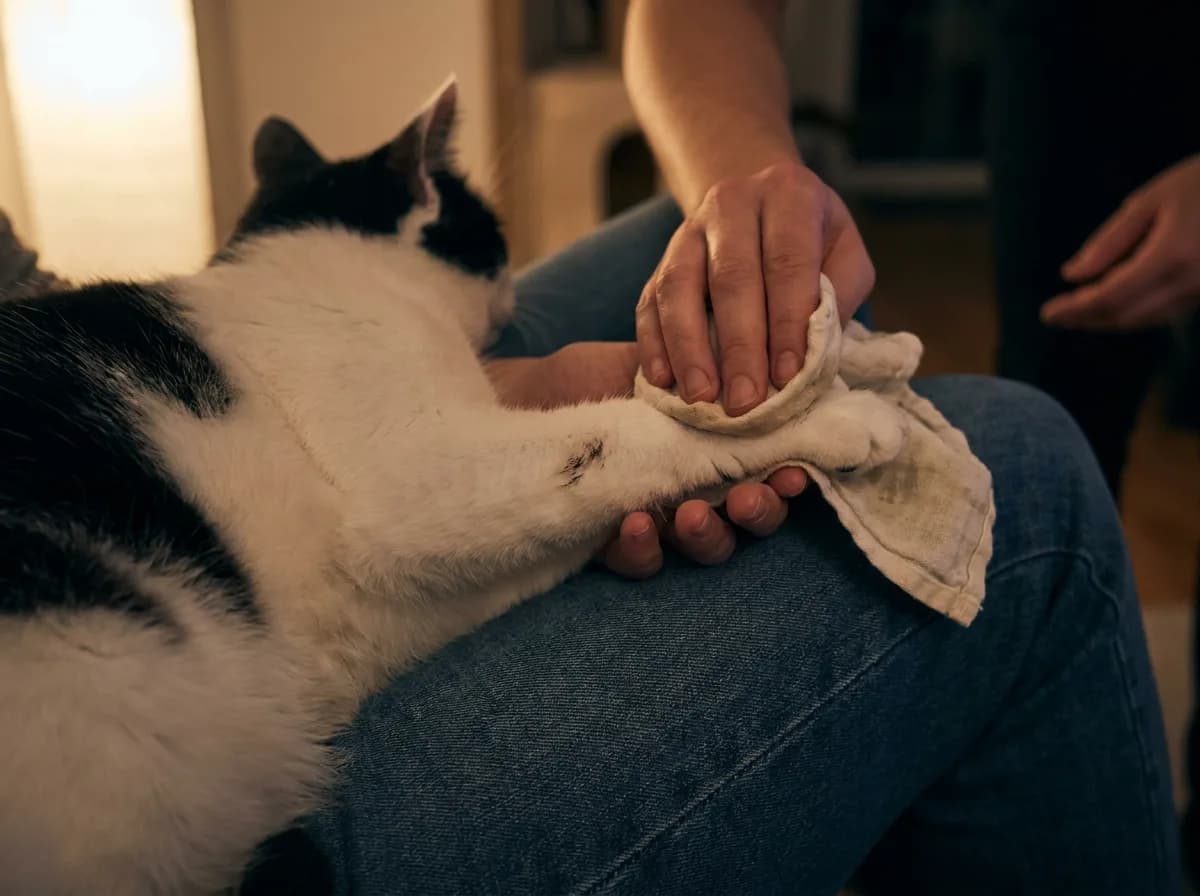
For a little ordinary dirt on a paw or a small patch of coat, start by considering whether a clean damp cloth is enough. You may not need shampoo at all. Use gentle wiping and assess the area again before turning a small task into a whole-body wash.
Use a clean part of the cloth as you work, and change cloths when needed rather than repeatedly spreading loosened dirt across the coat. Keep the cleaning cloth separate from the towel reserved for drying. This is a simple way to make a small cleaning session more controlled without adding another product. In a home with several cats, finish and tidy one animal’s cleaning setup before starting another. Return the bottle to its original place and keep the relevant directions available. Avoid leaving open containers or used cloths among the supplies for the next cat.
If the material does not come away easily, avoid escalating through several household cleaners. Identify what is on the coat and choose an appropriate next step. An unknown chemical, sticky substance, or potentially harmful contaminant is a different problem from garden dirt. Fecal soiling also calls for judgment. A little material on accessible fur may allow careful local cleaning, but heavy contamination, soiling close to sensitive tissue, or repeated episodes can require professional help. Do not assume a product marketed as waterless can adequately handle every mess. Keep these distinctions clear:
- Ordinary small-area dirt: Consider gentle wiping before buying another product.
- A larger ordinary cleaning task: A cat-labeled rinse-off bath may be appropriate if it can be completed safely.
- Repeated fecal soiling: Address both cleanup and the reason it keeps happening.
- An unknown or hazardous substance: Seek product-specific advice before applying a cleanser.
If a cat repeatedly needs cleaning around the rear, explain that pattern to your veterinarian. The solution may involve more than finding the strongest shampoo. Avoid trimming close to skin or pulling contaminated, tangled fur as an improvised shortcut.
Decide whether a conditioner has a defined job
Cats do not automatically need a separate conditioner after shampoo. A conditioning step should come from the formula instructions or a grooming recommendation for that cat, not from copying a human hair-care routine.
A shampoo with a moisturizing claim is still the product described on its label. It does not tell you whether another product should follow it. Likewise, a cream rinse or conditioner in the same brand family is a separate formula with its own instructions.
If your veterinarian or groomer recommends a conditioner, clarify whether it is rinsed out, how it is applied, and whether it belongs with the shampoo already selected. Do not assume two cat-labeled products have been evaluated for use together merely because they are sold beside one another. Conditioner also is not a way to leave a difficult rinse unfinished. Remove the shampoo as directed before following the next step of an established routine. If the cat cannot tolerate that much handling, simplify the plan with professional guidance.
Finish with gentle drying
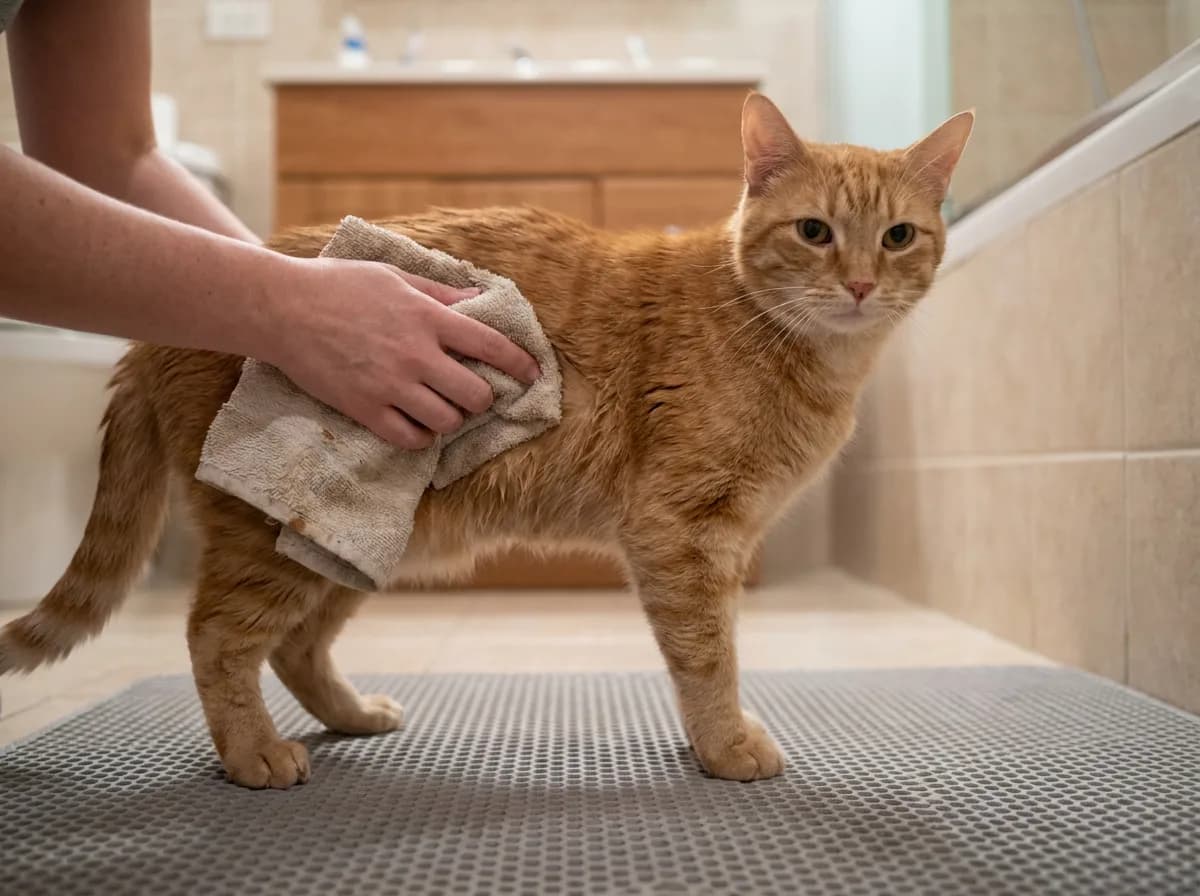
After a rinse-off bath, use a clean towel to absorb moisture gently. Keep the face uncovered and support the cat comfortably. Change to a dry towel when the first one becomes too wet to be useful. Blotting and gentle wrapping are preferable to vigorous rubbing of a tangled or sensitive coat. The aim is to remove water while keeping the cat comfortable, not to polish the fur. Pay attention to whether the cat is becoming more distressed as handling continues.
Keep the drying area comfortably warm and free from drafts. A wet cat should not have to search for a suitable place to settle while you clear the sink. If your cat needs special drying or grooming because of its coat or health, ask a professional for an appropriate method rather than improvising with high heat.
If a groomer will handle the bath, explain the reason for cleaning and provide any product-specific instructions from your veterinarian. Mention previous reactions and the areas your cat does not tolerate being handled. Ask which formula and process will be used so you can keep an accurate record afterward. Do not assume that a general grooming booking includes a prescribed skin-treatment routine. Drying is not a replacement for rinsing. A towel does not convert a rinse-off formula into a waterless one, and allowing the cat to groom itself does not complete a skipped removal step. Finish each part of the chosen product’s process before putting the bottle away.
Substitutions to avoid
The useful distinction is between a product explicitly labeled for cats and one you hope will be close enough. A dog-and-cat shampoo can be appropriate because cats are included in its directions. A dog-only shampoo does not become cat-appropriate because the ingredients sound gentle.
This is why the Vetoquinol and Virbac choices can include several species without contradicting the advice to avoid dog-only substitutions. The species statement belongs to the exact formula. It cannot be transferred to every shampoo made by that brand.
Human shampoo and baby shampoo
Do not use your regular human shampoo or baby shampoo to wash a cat. VCA recommends a shampoo formulated for cats. A product does not become an appropriate substitute because it is mild, unscented, or already in the bathroom.
The answer does not change when the human product is sold for sensitive skin or dandruff. Those descriptions concern its intended human use. They do not establish feline directions, kitten suitability, or the correct contact and removal procedure for a cat.
Avoid choosing a human brand by comparing only one ingredient with a pet formula. Complete formulations differ. A shared ingredient does not supply evidence that the finished products can be used in the same way. You also do not need to assume that every accidental contact with human shampoo has the same outcome. The relevant questions are the exact product, amount, exposure, and the cat’s condition. If an unsuitable product has already been applied, obtain product-specific veterinary advice rather than relying on a blanket internet reassurance or a frightening general claim.
Dog-only and puppy shampoos
A puppy shampoo is not automatically kitten-friendly. “Puppy” identifies a different intended animal, not a universal level of gentleness. Look for cats in the actual directions instead of treating the word as a substitute for a species check.
Oatmeal creates a similar source of confusion. An oatmeal dog shampoo may sound comparable to a cat-labeled oatmeal formula, but the ingredient theme is not the whole product. Confirm feline use before applying it.
Take particular care with any dog flea shampoo. A parasite-treatment product has its own active ingredients, species limits, and directions. Do not use a dog-only flea product on a cat because you want a bath to perform two jobs at once. If you have already used a dog shampoo, keep the container and check whether its label actually includes cats. If it does not, contact your veterinarian with the exact name and ingredient information. Do not attempt to “neutralize” it with another cleaner or a homemade mixture.
- A shampoo substitution cannot diagnose skin disease. Persistent itching, damaged skin, or an uncertain product exposure calls for appropriate veterinary care, not a stronger household cleaning recipe.
Homemade shampoo is not a shortcut around formulation
A DIY cat-shampoo recipe may combine familiar ingredients, but familiarity does not establish an appropriate finished cleanser. Home mixing does not give you verified species directions, a suitable concentration, a removal method, or a supported storage life.
Adding a soothing-sounding ingredient to a household detergent does not turn it into the equivalent of a cat-labeled product. The same principle applies to homemade dry shampoo: a powder you can sprinkle is not automatically a safe grooming formula for a cat.
Avoid recipes that invite you to adjust proportions until the mixture “feels right.” That approach measures texture, not feline suitability. It also makes it difficult to tell a veterinarian exactly what was applied if a problem occurs. For an ordinary, nonurgent mess, waiting until you have a suitable product is often the more practical choice. Small-area wiping may be enough in the meantime. There is no requirement to improvise a shampoo merely because the cat needs a little help with its coat.
When there is no cat shampoo at home
First identify the task. A dusty paw, a spot of ordinary dirt, and an unknown substance spread through the coat should not all lead to the same response. Decide whether gentle spot cleaning is adequate or whether you need advice before proceeding.
For a minor ordinary cleaning task:
- Use a clean cloth dampened with water.
- Wipe gently rather than scrubbing.
- Stop if the cat resists strongly or the area seems painful.
- Reassess whether any further cleaning is necessary.
If the mess is extensive or cannot be removed gently, arrange suitable supplies or professional help. Do not keep trying different products from the kitchen and bathroom.
This distinction prevents a small inconvenience from becoming a larger exposure problem. “I do not have cat shampoo” is a shopping problem when the bath can wait. It is a veterinary question when the coat carries a potentially harmful substance or the animal is unwell.
When shampoo is not the solution
Most healthy adult cats rarely need bathing, according to VCA’s coat-care guidance. If a cat is grooming normally and the coat is clean, a shampoo purchase may not solve an existing problem. Begin with what you are trying to change.
A new odor, a change in grooming, repeated soiling, loose hair, tangles, and household allergy concerns are different issues. Some involve coat maintenance; some need a veterinarian or another professional. They should not all be treated as evidence that the cat needs a stronger cleanser.
Shedding and long coats need a grooming plan
A deshedding or anti-shedding shampoo should not be assumed to stop normal hair loss. Removing some loose coat during a bath is different from preventing future shedding. The four products compared here were not tested by us for a reduction in shedding.
For a longhaired cat, the practical work includes keeping the coat manageable between any necessary baths. A breed name such as Persian or Maine Coon does not select the shampoo by itself. Coat condition, skin health, grooming tolerance, and the label remain the relevant factors.
Before a bath, assess whether the coat can be handled comfortably. Loose fur that can be combed gently is different from tight tangles or mats. Do not expect shampoo to release a mat painlessly, and do not pull hard to force a comb through it. When arranging professional help, describe where the tangles are, whether handling seems uncomfortable, and whether the cat has recently been washed. Mention any skin-care products already used. That gives the groomer or veterinary team a clearer starting point and helps you prepare for the appointment without attempting another bath first.
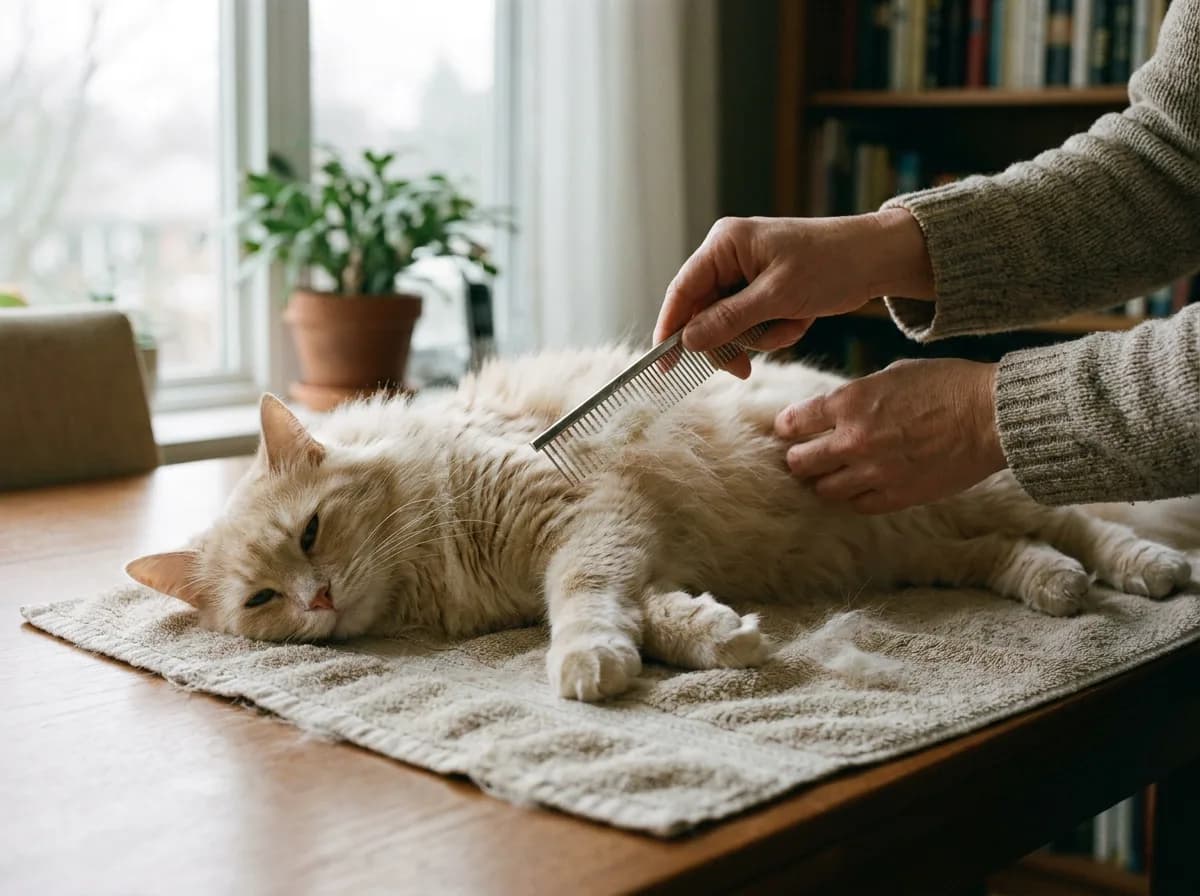
Petful’s guide to how to groom a cat covers broader coat-care decisions. Use that routine to address maintenance rather than repeatedly washing a coat that needs a different kind of attention.
If a mat is tight, close to the skin, or associated with discomfort, ask a groomer or veterinarian to assess it. Avoid cutting close to skin as a home shortcut. A shampoo described as conditioning does not make an unsafe detangling task safe.
A manageable routine is more useful than a one-time dramatic bath. Consider how much handling your cat tolerates and whether you can keep up with the necessary coat care. If the routine consistently becomes a struggle, seek help adapting it rather than increasing the amount of product.
Hairless cats still need individual skin-care decisions
A search for Sphynx cat shampoo concerns a different grooming situation from washing a densely coated cat. It still does not establish one universal product or schedule for every Sphynx. Skin condition, existing care instructions, and the individual cat’s needs should guide the decision.
Avoid copying a frequent bathing schedule from another owner without knowing why it was recommended for that cat. A routine described online may reflect a particular animal, formulation, or veterinary plan. The label’s permission for use and the cat’s actual need remain separate.
If your cat already has a successful care routine, check before replacing a product solely because another bottle is described as “best for the breed.” A consistent, appropriate process is more valuable than changing several variables at once. For any breed, tell the veterinarian about persistent changes rather than trying to wash them away repeatedly. The absence of a thick coat does not turn shampoo into a diagnostic tool.
Fleas and ticks need parasite-specific control
None of the four shampoos selected here is being recommended as a flea or tick treatment. Aloe, oatmeal, Ophytrium, and a waterless format do not by themselves establish parasite-killing or prevention claims.
A product specifically labeled as flea shampoo is a different decision. Its species, age, active ingredients, and parasite directions matter. Do not assume that a “natural” flea shampoo is necessarily appropriate for a kitten or that a dog-and-cat grooming shampoo has any flea indication. A bath also should not be mistaken for a complete household flea-control plan. Washing the cat does not address every source of continued exposure. If you see fleas or suspect parasites, discuss a cat-appropriate treatment and prevention plan rather than using ordinary shampoo more frequently.
Questions about whether flea shampoos work need the name of an actual labeled product and the intended outcome. Killing some adult fleas during treatment is not the same claim as providing ongoing prevention. This comparison does not establish either outcome for the four grooming products selected. Keep parasite treatment and grooming instructions coordinated. If a veterinarian has recommended another product for the cat, ask how bathing fits that plan before adding a shampoo or changing the bathing schedule.
Dander and household allergy concerns are separate claims
A shampoo marketed for sensitive feline skin addresses a different concern from a product intended to reduce allergens affecting people. “Hypoallergenic” on a grooming bottle does not mean the cat will become nonallergenic to the household.
Likewise, washing away visible flakes is not proof of a measured reduction in human allergy symptoms. None of the four selected shampoos is being recommended here on the basis of a verified household-allergen reduction study.
If allergies are the reason you are considering frequent cat baths, discuss the goal with the appropriate health professional and your veterinarian. The cat’s comfort and skin care need to remain part of the decision. Do not assume that bathing more often improves the outcome simply because the coat appears cleaner. This is another reason to identify the intended result before choosing a bottle. Routine cleanliness, support for dry skin, flea control, and allergen reduction are not interchangeable claims.
A change in self-grooming deserves attention
Some cats need help maintaining their coats, but a new inability or unwillingness to groom should not be treated only as a shampoo problem. Describe the change to your veterinarian, especially if it accompanies other changes in comfort, movement, appetite, or behavior.
You can help by explaining where the coat is becoming dirty or tangled and how often assistance is needed. That information is more useful than simply reporting that the cat no longer looks tidy. It can guide a practical care plan suited to the animal.
The goal may be a combination of manageable grooming, limited-area cleaning, and care for the underlying issue. A full bath is only one possible tool. Do not make it the default when a smaller intervention or professional assessment better addresses the problem. For the next cleaning session, choose the least complicated appropriate process: no bath when none is needed, gentle spot cleaning for a small ordinary mess, or a correctly performed cat-labeled wash when a bath has a clear purpose.
Questions readers ask
Choose a product labeled for cats and follow its product directions for application, contact time, and removal. A dog-and-cat formula can qualify; a dog-only or human shampoo does not qualify simply because it sounds gentle. Select the product for a necessary cleaning task rather than assuming every cat needs regular baths.
Check the exact formula’s minimum age and kitten suitability. An adult-cat label or a hypoallergenic claim is not enough to establish use in a young kitten. If the manufacturer does not clearly state age suitability, ask before use. The decision to bathe also depends on the kitten’s condition and the reason for cleaning.
Directions differ by formula. For the Hyponic option compared here, dispense and massage the foam into the dirty area, then wipe with a dry cloth. That is a defined cleaning procedure, not permission to leave any shampoo on the coat. Use the current package directions and keep the task within the product’s intended use.
For a small amount of ordinary dirt, a clean damp cloth may be enough for gentle spot cleaning. A nonurgent full bath can wait until you have a suitable product. Unknown substances, extensive contamination, or painful skin require a different decision; seek advice rather than improvising a household shampoo recipe.
A separate conditioner is not an automatic requirement. Follow the formula instructions or a specific recommendation from your veterinarian or groomer. If one is recommended, check whether it must be rinsed out and how it fits the existing routine. Do not use conditioner to compensate for incomplete shampoo rinsing.

C.D. Watson has been researching and writing about pets for many years. She is a freelance writer and a corporate refugee. C.D. lives on a farm in the beautiful Great Smoky Mountains of East Tennessee with her husband, 3 dogs and a variety of other pets.
Sign up for expert-backed reviews and safety alerts all in one place.