Dog Teeth Cleaning Cost: 2026 Price Guide
Dog teeth cleaning cost often starts around $300 to $800 before extractions. Learn what a professional procedure includes, why quotes vary, how to compare estimates, and which lower-cost options preserve essential veterinary care.

BVMS, MRCVS
Petful is reader supported. As an affiliate of platforms like Amazon and Chewy, we may earn a commission when you buy through links on this page. There is no extra cost to you.
Dog teeth cleaning cost usually starts around $300 to $800 for a straightforward professional cleaning, but the final bill can rise above $1,000 when a dog needs extensive X-rays, longer anesthesia, periodontal treatment, or tooth extractions. The useful number is not a single national average. It is a written estimate that separates the base cleaning from work your veterinarian may discover only after your dog is anesthetized and dental radiographs reveal hidden disease.
That uncertainty can feel frustrating, especially when two clinics quote very different totals. A lower quote may exclude pre-anesthetic testing, full-mouth dental radiographs, monitoring, or pain medication that another clinic includes. This guide shows what to compare line by line, which cost-cutting options are reasonable, and why an anesthesia-free cosmetic cleaning is not an equivalent substitute.

Sign up for expert-backed reviews and safety alerts all in one place.
How much does dog teeth cleaning cost?
A practical 2026 planning range is about $300 to $800 for an uncomplicated veterinary dental cleaning before extractions. This typical price range is a planning baseline, not a universal veterinary dental cleaning charge. A 2025 US cost study published by CareCredit reported a $388 national average for dog dental cleaning, with a range of $307 to $702. The estimate can change because radiographs reveal hidden disease, so that dataset should not be treated as an all-inclusive quote for every hospital or every dog.
The average cost of dog teeth cleaning changes when the estimate includes services such as bloodwork, intravenous access, fluids, dental X-rays, local nerve blocks, medications, or extractions. Regional labor and facility costs matter too. Specialty hospitals and emergency facilities may charge more than a general practice because they have different staffing, equipment, and referral responsibilities.
For planning, think in three scenarios rather than expecting one universal price:
- Straightforward cleaning: Roughly $300 to $800 when the mouth has mild disease, the procedure is routine, and no teeth need extraction. Ask which diagnostics and medications are included.
- Cleaning with added diagnostics or longer monitoring: Often $800 to $1,500 when the patient needs a broader pre-anesthetic workup, the procedure takes longer, or the hospital's base package includes comprehensive imaging and support.
- Dental treatment with extractions: Commonly $1,500 to $3,000 or more when multiple teeth, difficult roots, advanced periodontal disease, or specialist care add substantial surgical and anesthesia time.
These are budgeting scenarios, not fee schedules. Your veterinarian's examination and written estimate are more meaningful than any online range. Even then, the estimate may need a low and high treatment total because disease below the gumline cannot always be seen in an awake dog.
- 1A typical price range for straightforward professional dog teeth cleaning is about $300 to $800 before extractions
- 2Compare what each quote includes, especially anesthesia monitoring and full-mouth dental radiographs
- 3Extractions change the estimate because their number and difficulty may not be known until the anesthetized exam
The question “How much does a vet charge to clean dog teeth?” therefore has a two-part answer. The base charge may land in the mid-hundreds, while the treatment total depends on what the exam and X-rays reveal. Request an itemized low-to-high estimate, ask how the clinic handles unexpected findings, and confirm whether staff will call before exceeding your authorized amount.
What a professional dog dental cleaning includes
The professional dog teeth cleaning cost reflects much more than removing visible brown tartar. When you compare the cost of professional dog teeth cleaning between clinics, begin with the procedure components rather than the final number. According to the AAHA Dental Care Guidelines for Dogs and Cats, complete veterinary dental care combines an oral assessment, anesthesia, intraoral radiographs, cleaning above and below the gumline, periodontal probing, polishing, charting, and treatment planning.
Your dog's package may include all of the following:
- A pre-procedure physical examination and review of current health problems
- Pre-anesthetic bloodwork, and sometimes additional heart, chest, urine, or blood-pressure testing
- An intravenous catheter, fluids when indicated, and medications for sedation, anesthesia, pain, or nausea
- A breathing tube that helps maintain the airway while water and debris are used in the mouth
- Dedicated monitoring of heart rate, breathing, blood pressure, oxygenation, temperature, and anesthetic depth
- Full-mouth intraoral dental radiographs to examine roots and the supporting bone
- Scaling above and below the gumline, followed by polishing and subgingival irrigation
- Tooth-by-tooth probing, mobility assessment, dental charting, and a treatment plan
- Local nerve blocks, extractions, periodontal therapy, or other oral surgery when medically indicated
- Recovery monitoring, discharge instructions, medications, and a home-care plan
| Estimate line | What it covers | Why it affects price |
|---|---|---|
| Examination and bloodwork | Health assessment before anesthesia | Testing varies with age and medical history |
| Anesthesia and monitoring | Drugs, airway control, IV access, equipment, and trained staff | Time and patient complexity change resource needs |
| Full-mouth dental radiographs | Images of roots and bone below the gumline | Hidden disease can change the treatment plan |
| Scaling, polishing, probing, and charting | Complete cleaning and tooth-by-tooth assessment | This is the core professional procedure |
| Extractions or periodontal treatment | Removal or treatment of diseased teeth and tissues | Number, tooth type, and surgical difficulty vary |
| Pain medication and recovery care | Local blocks, take-home medication, and monitoring | Needs depend on the treatment performed |
The table is a comparison tool, not a requirement that every hospital use identical billing labels. One clinic may bundle anesthesia, X-rays, and cleaning into a package. Another may list every component separately. Compare the scope of care, not merely the number at the bottom.
The existing complete dog dental care guide explains prevention and oral-health basics in greater depth. This page stays focused on the cost decision and the questions that make two estimates comparable.
A line-item dental estimate: the questions to ask
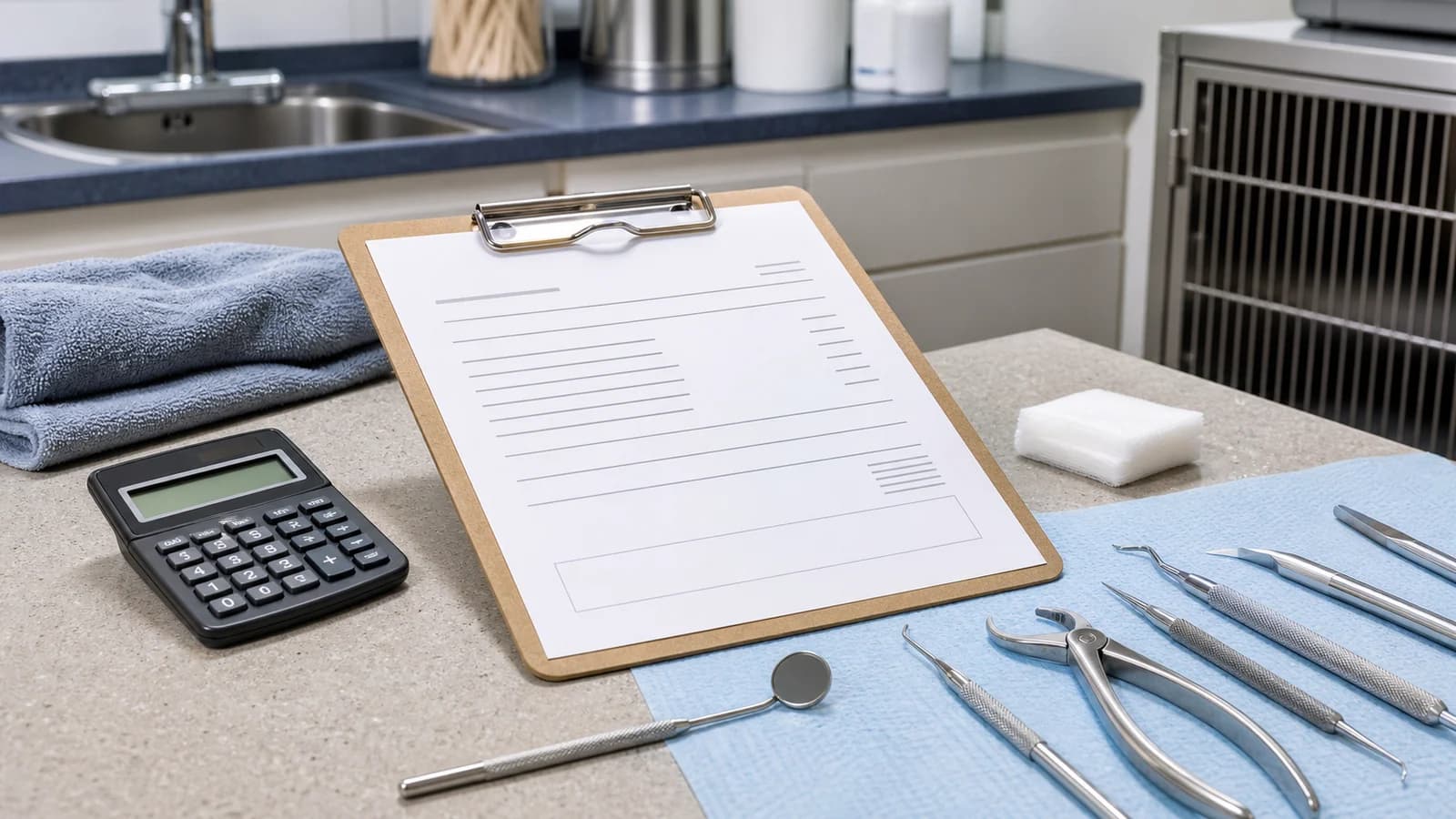
The strongest way to avoid a surprise bill is to ask for a line-item dental estimate with both an expected total and an authorized ceiling. This line-item cost framework separates the base procedure from diagnostics, anesthesia, radiographs, and extractions, while making the distinction between the base cleaning versus extractions visible instead of hiding every possibility inside one broad range. It also gives the clinic and owner a shared plan for findings that cannot be priced precisely before anesthesia.
Use this checklist when you call or review the paperwork:
- Is the initial examination included, or billed at a separate visit?
- Which pre-anesthetic tests are standard for my dog, and what finding would trigger additional testing?
- Are full-mouth dental radiographs included for every patient or charged separately?
- Does the anesthesia fee include an IV catheter, fluids, a protected airway, warming, and continuous monitoring?
- Are scaling below the gumline, polishing, periodontal probing, and charting part of the base package?
- How are simple and surgical extractions priced, and are local nerve blocks included?
- Will someone call me before performing treatment outside the original estimate?
- What happens if I cannot be reached while my dog is anesthetized?
- Are pain medication, antibiotics when indicated, rechecks, and take-home instructions included?
- What deposit, payment-plan, or financing rules apply on the procedure date?
Three common planning conversations show why this matters. A young dog with light tartar may stay near the base package. A senior dog with stable chronic disease may need extra testing and monitoring even if no teeth are removed. A dog with loose teeth, deep periodontal pockets, or abnormal roots may require several extractions, nerve blocks, and a longer recovery. The dental disease, not simply the cleaning, creates much of the difference.
- Ask the clinic to record the maximum amount you authorize without a phone call and what treatment will be prioritized if findings exceed it. This protects the medical plan and your budget without forcing the team to guess about your wishes while your dog is anesthetized.
This checklist is designed to be useful to dog owner communities and veterinary client education teams. A clinic can adapt it to explain its package, while an owner can use it to compare estimates without assuming that the cheapest quote provides the same procedure.
Why anesthesia changes the dental cleaning price
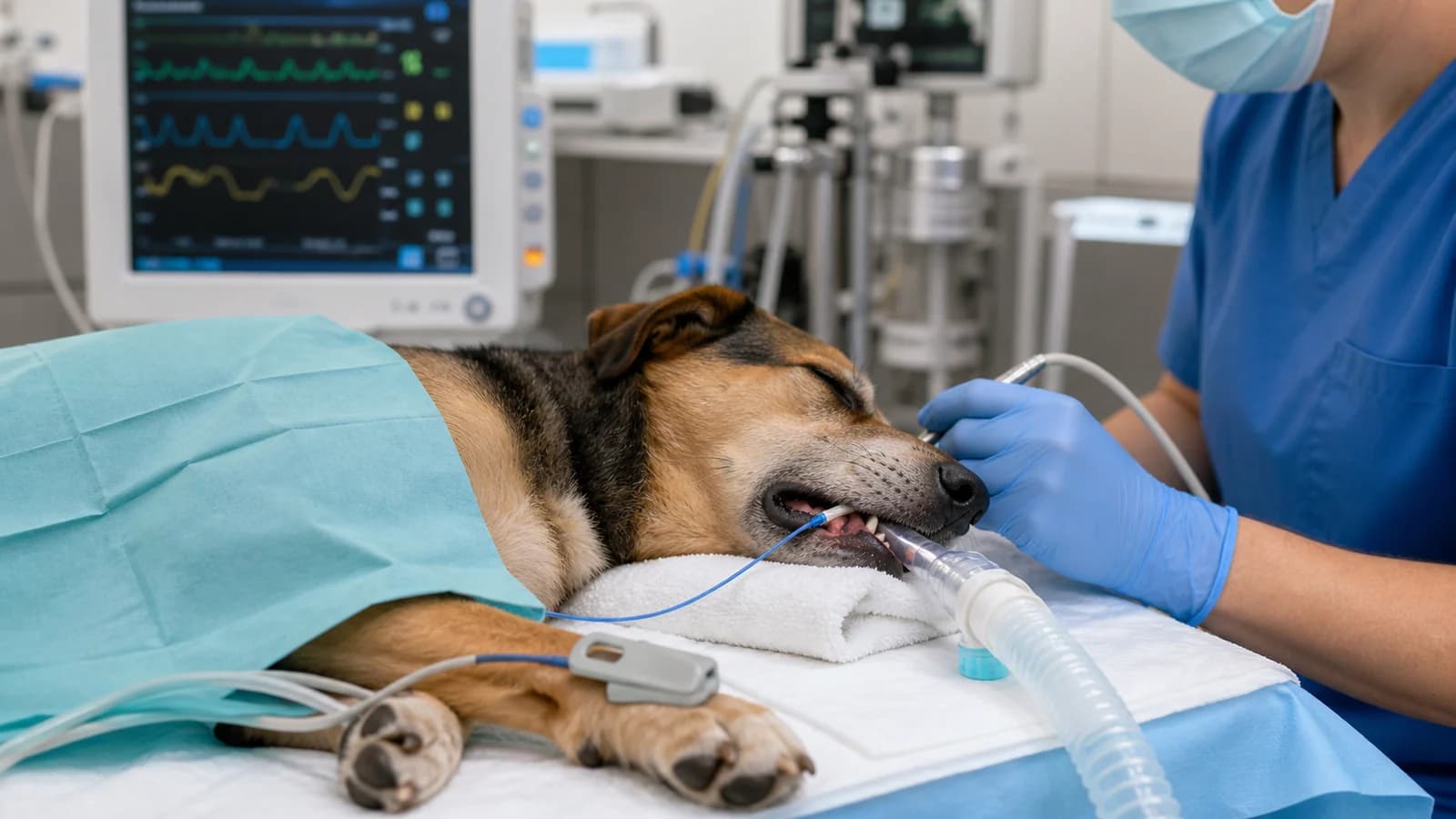
General anesthesia adds trained personnel, medications, airway equipment, monitoring, warming, and recovery care to the invoice. It also makes the meaningful parts of the procedure possible. An awake dog cannot understand why a sharp instrument is moving under the gumline, remain motionless for diagnostic X-rays, or safely tolerate probing around every tooth.
The American Veterinary Medical Association's pet dental care guidance explains that anesthesia allows a more complete cleaning and reduces movement-related injury. The AAHA guidelines also emphasize that accurate assessment depends on anesthetized probing and intraoral radiography. Those steps reveal disease an awake visual check can underestimate.
Anesthesia is not risk-free. A responsible clinic reduces avoidable risk by tailoring drugs and monitoring to the individual patient, protecting the airway with an endotracheal tube, tracking vital signs, supporting body temperature, and watching recovery closely. The relevant comparison is not “anesthesia versus no risk.” It is the managed risk of anesthesia versus the pain, infection, aspiration, injury, and missed disease that can come with inadequate care or continued delay.
- An anesthesia-free service can remove some visible tartar, but it cannot provide a complete exam, full-mouth radiographs, reliable periodontal probing, safe subgingival treatment, or a protected airway. A lower cosmetic-cleaning price should not be compared with a comprehensive veterinary dental procedure as if the services were the same.
Dog teeth cleaning cost with anesthesia
The dog teeth cleaning cost with anesthesia is higher because the fee supports a full medical procedure, not just restraint or sleep. Ask who monitors the patient, which vital signs are tracked, whether a breathing tube is placed, how body temperature is supported, and how pain is controlled. These details are more useful than a vague statement that anesthesia is “included.”
Dog teeth cleaning cost without anesthesia
A search for dog teeth cleaning cost without anesthesia may produce a lower number because the service omits many diagnostic and safety components. AAHA says nonanesthetic dentistry is inappropriate because it can cause stress or injury, creates aspiration risk, and cannot adequately diagnose or treat disease below the gumline. Cosmetic improvement is not proof that the mouth is healthy.
What changes the final dental bill?
The largest cost drivers are procedure time, anesthesia complexity, imaging, and treatment discovered after the anesthetized examination. A $400 estimate and a $1,400 estimate may describe different scopes of care rather than simple price markup.
Location and type of practice
Costs tend to be higher in major metropolitan areas and regions with higher staffing and facility expenses. A general veterinary hospital, low-cost nonprofit clinic, referral dental practice, and university teaching hospital also have different operating models. A board-certified veterinary dentist may be the right choice for complicated fractures, jaw disease, root-canal candidates, oral masses, or extractions near important structures.
Do not assume that a specialist quote is excessive merely because it is higher. It may include advanced imaging, specialty anesthesia support, or treatment intended to save a tooth that another clinic would extract. Conversely, a routine cleaning for a healthy patient often does not require referral-level care.
Dog size and procedure time
Body size can affect drug quantities and supplies, but mouth condition and procedure length are usually more important than weight alone. A small dog may have severe crowding and advanced periodontal disease, while a large dog may need only a routine cleaning. Ask what the clinic expects based on the oral exam rather than trying to calculate cost per pound.
Pre-anesthetic health assessment
Age by itself does not make anesthesia impossible. Older dogs are more likely to have kidney, liver, heart, endocrine, or respiratory conditions that influence testing and the anesthetic plan. A veterinarian may recommend bloodwork, urinalysis, blood-pressure measurement, chest imaging, an electrocardiogram, or other tests based on the dog's examination and history.
Additional testing can raise the upfront bill, but its purpose is to identify risks and tailor care. If you do not understand why a test is recommended, ask what decision its result will change.
Dental radiographs
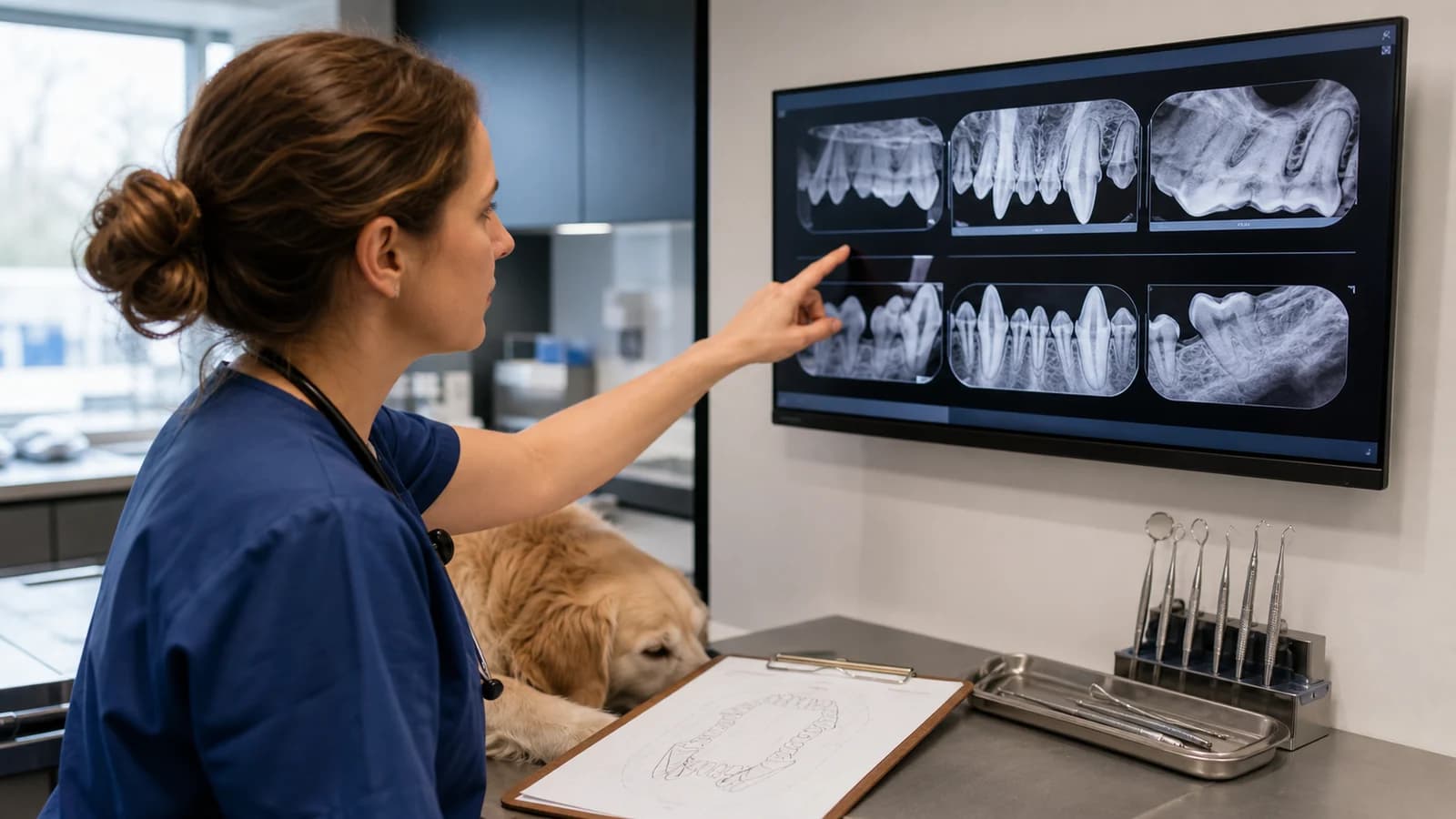
Full-mouth dental X-rays add equipment and interpretation time, yet they are central to a complete assessment. Much of each tooth lies below the gumline. Radiographs can reveal bone loss, retained roots, dead teeth, resorptive changes, fractures, abscesses, and other conditions that are not obvious from the crown.
A quote that excludes X-rays can appear cheaper while leaving the team without essential information. Ask whether full-mouth views are standard, whether additional images are charged separately, and whether the clinic will show you important findings.
Extractions and periodontal treatment
Extractions are the most unpredictable part of many invoices. The main extraction cost drivers are the number of teeth, root anatomy, fracture or infection, surgical difficulty, procedure time, imaging, local nerve blocks, and recovery needs. A loose single-rooted incisor can require far less time than a large multi-rooted tooth with curved or fractured roots. Surgical extraction may involve a gum flap, removal of a small amount of bone, sectioning the tooth, smoothing the site, suturing, and post-extraction radiographs.
Other added treatments may include periodontal surgery, treatment of an infected socket, biopsy of a mass, repair of an oral injury, or referral for an advanced procedure. Ask the clinic how each service is priced and what findings would make it necessary.
Age, breed, and disease factors that change the bill
Dogs' teeth do not begin “rotting” at one normal age. Plaque and periodontal inflammation can develop in young adults, and AAHA notes that most dogs and cats have some level of periodontal disease by age three. The pace varies with genetics, tooth alignment, home care, diet, chewing behavior, and previous dental treatment.
Small and short-muzzled dogs often have crowded teeth that trap plaque, so they may need earlier or more frequent professional care. Retained baby teeth and malocclusion can create additional problem areas. Greyhounds and some other breeds may also be prone to significant periodontal disease, while any dog can fracture a tooth or develop infection at any age.
Age changes the bill indirectly when it brings more accumulated disease or a need for additional pre-anesthetic assessment. It does not provide a diagnosis. A clean-looking young mouth can still hide a damaged root, and an older dog with consistent preventive care may need less treatment than expected.
How to find lower-cost dog dental care safely
People searching for low cost dog teeth cleaning or dog teeth cleaning cost near me are often trying to solve a real access problem. Saving money is reasonable, but the safe goal is a lower price for comprehensive veterinary care, not a cheaper service that omits diagnosis or treatment below the gumline.
Start with these options:
- Ask your regular veterinarian whether February dental promotions, wellness plans, or bundled preventive-care packages reduce the routine portion of the bill.
- Request estimates from two or three licensed veterinary hospitals and compare included services line by line.
- Check local humane societies, nonprofit veterinary clinics, and municipal programs for income-qualified dental assistance.
- Contact accredited veterinary schools to ask whether their teaching hospital offers general-practice dentistry, payment assistance, or referral options.
- Ask whether the clinic can stage treatment safely, addressing painful or infected teeth first and scheduling lower-priority work later.
- Review charitable grant programs, employer pet benefits, dedicated medical credit, and clinic payment plans before the procedure date.
- Build a monthly dental fund after treatment so the next recommended cleaning is less disruptive.
Before choosing a lower quote, confirm that a licensed veterinarian oversees the procedure and that anesthesia, airway protection, appropriate monitoring, intraoral radiographs, subgingival cleaning, and pain control are available. If one of those components is missing, ask the clinic to explain why and how it can still diagnose the whole mouth.
Use a decision path that distinguishes safe financing questions from unsafe anesthesia-free cleaning shortcuts. Safe cost questions cover itemized estimates, payment timing, staged medically appropriate care, insurance, and assistance programs. Red flags include a guarantee that no anesthesia is needed, a promise to remove all tartar from an awake dog, no plan for X-rays, no discussion of pre-anesthetic health, or an unwillingness to explain who performs and monitors the procedure. A visibly whiter smile is not the same as treated periodontal disease.
Financing questions to ask before booking
Payment options differ, so settle the financial plan before fasting your dog or arriving for the procedure. The front-desk or treatment coordinator should be able to explain deposits, payment timing, financing, and what happens if the total changes.
Ask these questions:
- Is payment due at booking, admission, or discharge?
- Does the clinic accept third-party medical credit or offer an internal installment plan?
- Is there a discount for paying the estimate in full before the procedure?
- Which services might not be covered by a wellness plan or pet insurance policy?
- Will the clinic submit records directly to an insurer, or must I seek reimbursement?
- Can the team create a prioritized treatment plan if the high estimate is beyond my budget?
- Is a recheck included, and what could generate a second fee?
Routine dental cleaning is often considered preventive care and may be excluded from accident-and-illness insurance. Treatment for a fractured tooth, infection, or dental injury may be handled differently. Read your own policy and request a written preauthorization when available instead of assuming “dental coverage” includes every line.
Is professional dog teeth cleaning worth the cost?
Yes, when a veterinarian recommends it to diagnose and treat disease that home care cannot reach. Professional cleaning can remove plaque and calculus above and below the gumline, expose hidden problems through radiographs, reduce oral pain, and allow treatment before infection and bone loss progress. Its value comes from medical assessment and treatment, not simply better-smelling breath.
The best timing depends on the individual dog. Paying for a thorough procedure before disease becomes severe may reduce the number of extractions and the length of anesthesia, but no cleaning can guarantee that future disease will not occur. Daily home care and regular oral examinations still matter afterward.
If cost is the only barrier, ask about a staged plan and financing rather than substituting a cosmetic service. If anesthesia risk is the concern, ask the veterinarian what specific risk factors your dog has, how the protocol will be adjusted, and whether referral to a dentist or anesthesiologist would change the balance.
- The goal is not perfectly white teeth. It is a comfortable mouth, an accurate diagnosis, treatment of painful disease, and a prevention plan that fits your dog.
When extractions or urgent dental treatment are needed
You cannot safely get rid of a dog's “rotten teeth” at home. A loose, fractured, infected, or severely diseased tooth needs veterinary assessment. Depending on the tooth and problem, the appropriate treatment may be extraction, root-canal therapy, periodontal treatment, restoration, or referral to a board-certified veterinary dentist.
Contact a veterinarian promptly if your dog has any of these signs:
- Facial swelling, swelling below an eye, or a draining wound near the mouth
- Bleeding from the mouth that is not caused by a minor known injury
- Refusal to eat, dropping food, crying while chewing, or chewing on only one side
- A broken tooth, visibly loose tooth, or tooth that has changed color
- Heavy drooling, pawing at the mouth, or sudden resistance to having the face touched
- Bad breath accompanied by appetite, behavior, or energy changes
- Pus, a foul discharge, or a suspected object lodged in the mouth
Do not pull a tooth, scrape around it, give human pain medication, or wait for it to fall out. Dental infection can be painful even when a dog continues eating. A veterinarian can provide appropriate pain relief, examine the mouth, plan imaging, and explain whether treatment is urgent or can be scheduled.
An emergency visit may cost more than a planned examination, but facial swelling, uncontrolled bleeding, breathing difficulty, major trauma, or inability to eat or drink should not be delayed for a promotional cleaning price.
How often do dogs need professional dental cleaning?
There is no safe universal schedule. Many veterinary teams assess the mouth at least once a year, then recommend professional cleaning based on periodontal findings, breed, tooth crowding, age, home-care effectiveness, and previous disease. Some small dogs need cleaning more often than once a year, while a dog with excellent daily brushing and favorable anatomy may go longer between procedures.
An awake examination can identify visible tartar, gingivitis, broken teeth, odor, pain, or masses, but it cannot fully assess roots and bone. That is why the next-cleaning date should remain a clinical recommendation, not a promise based only on the dog's birthday or the appearance of the front teeth.
After a procedure, ask the veterinarian:
- What periodontal stage was recorded?
- Were any pockets, missing teeth, fractures, or bone changes found?
- When should home brushing restart?
- Which sites need rechecking?
- When should the next oral examination occur?
- What change at home should trigger an earlier visit?
What home dental care can and cannot do
No natural substance reliably dissolves established tartar below a dog's gumline. Coconut oil, raw bones, antlers, hard nylon chews, and homemade scraping do not replace a professional assessment. Very hard chews can fracture teeth, while acidic or abrasive remedies may irritate tissues or damage enamel.
Home care is most useful for slowing new plaque accumulation after the mouth has been evaluated and painful disease has been treated. Daily brushing is generally the most direct mechanical approach when a dog tolerates it. Dental diets, chews, wipes, gels, and water additives may help with plaque or tartar when their specific claims are supported, but they cannot repair a loose tooth, eliminate a root abscess, or reverse advanced bone loss.
If your dog's gums bleed easily, the mouth smells markedly worse, chewing has changed, or touching the face causes pain, stop experimenting and arrange an examination. “Natural” does not mean harmless, and a dog who resists brushing may be protecting a painful area rather than being stubborn.
Why scraping tartar at home is unsafe
Do not scrape tartar off your dog's teeth with a dental scaler or household tool. A sharp instrument can cut the gums, scratch enamel, fracture a tooth, introduce infection, or cause an awake dog to jerk and injure the person holding it. Removing a visible chip of calculus also leaves disease below the gumline undiagnosed.
Professional scaling is followed by polishing because scaling creates microscopic surface irregularities that can retain plaque. Veterinary teams also use probing, charting, and radiographs to evaluate each tooth instead of treating tartar as the disease itself. The AVMA and AAHA do not recommend anesthesia-free dental cleaning as a substitute for a complete anesthetized procedure.
If a piece of tartar breaks off during brushing or chewing, do not assume the tooth is clean. Check for bleeding, a loose tooth, exposed root, fracture, odor, or pain, and ask your veterinarian whether the mouth needs assessment.
Home care between professional cleanings
You can clean a dog's teeth at home without going to the vet only as preventive maintenance for a comfortable mouth. Home care cannot diagnose disease or replace a recommended professional procedure. Ask your veterinary team to show you where and how to brush after any extraction sites have healed.
A practical brushing routine looks like this:
- Choose a pet toothpaste such as Virbac C.E.T. Enzymatic Toothpaste and a soft dog toothbrush such as the Virbac C.E.T. Dual-Ended Toothbrush. Never use human toothpaste.
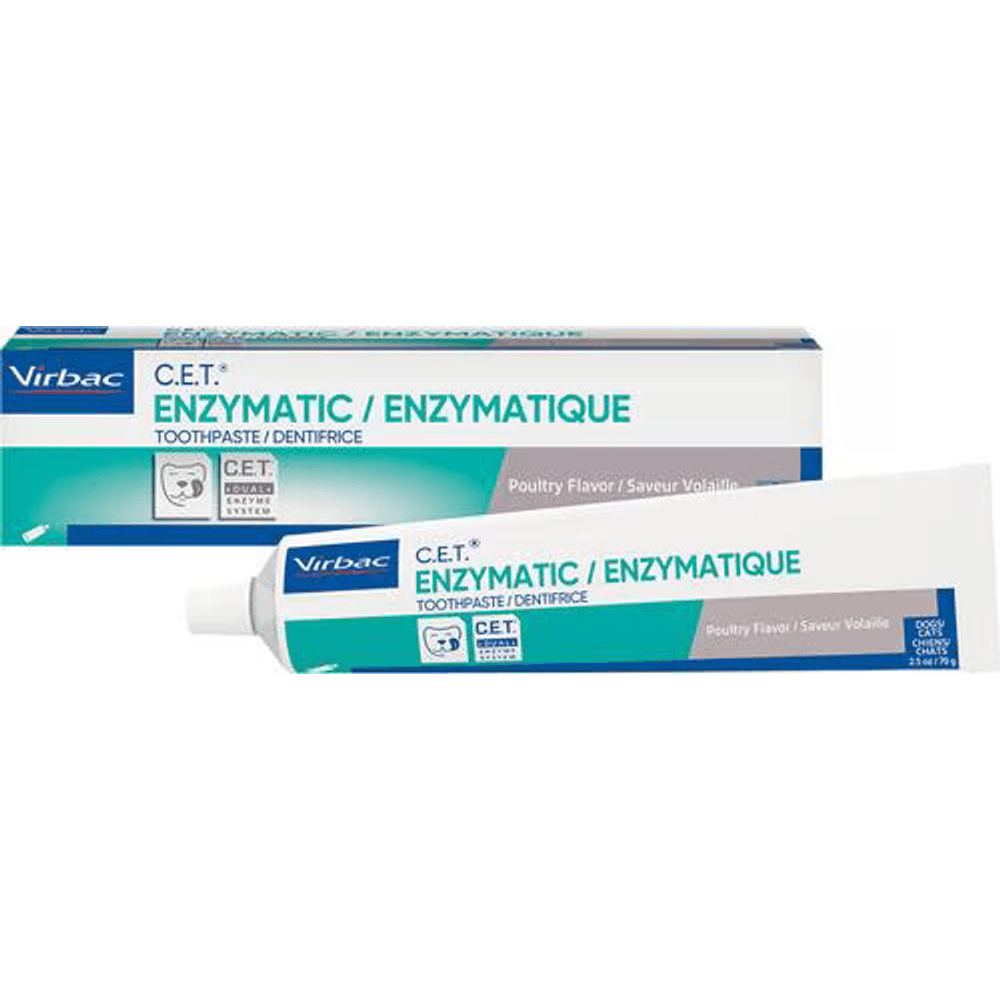
The vet-favorite enzymatic toothpaste. Its dual-enzyme system keeps working between brushings to control plaque and freshen breath, and the poultry flavor makes daily brushing easy.
Petful may earn a commission when you click through to Chewy, at no extra cost to you.
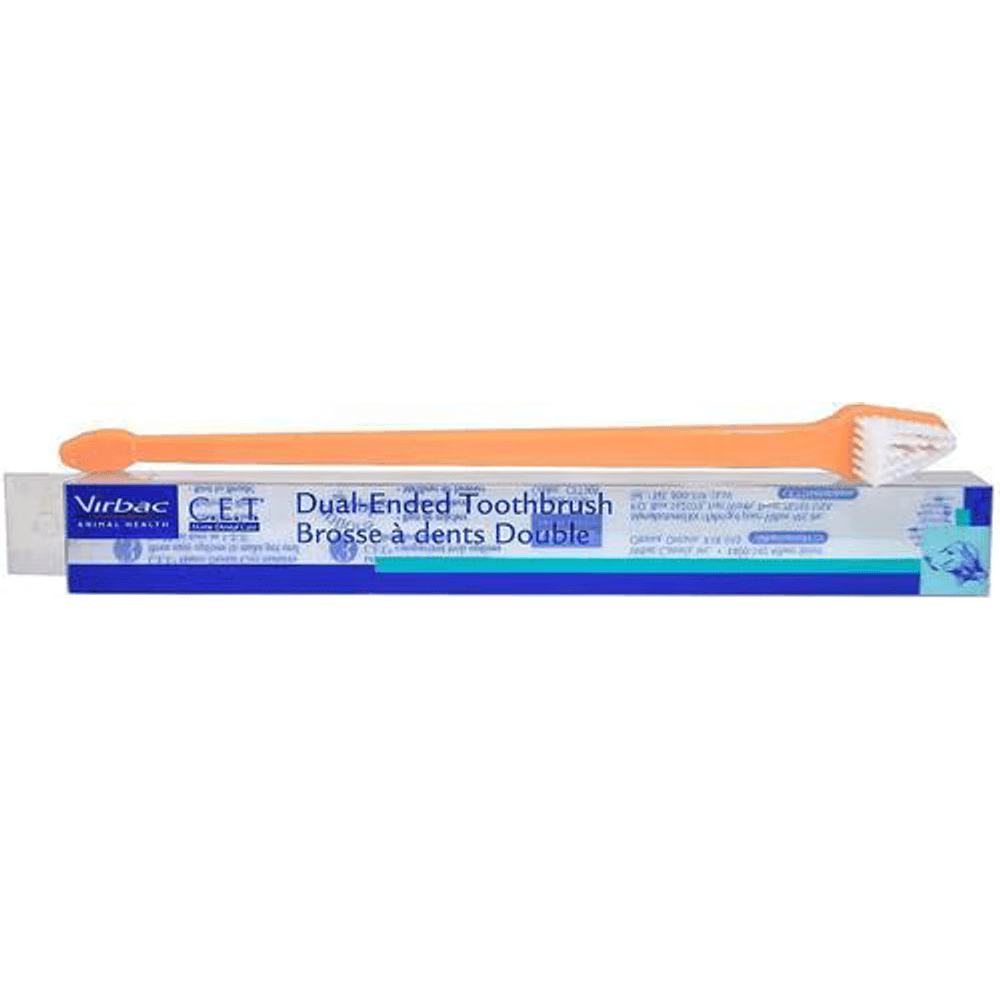
A dual-ended toothbrush with a large and a small head to fit different mouth sizes and reach the back molars where plaque hides. Soft bristles angled for the gumline.
Petful may earn a commission when you click through to Chewy, at no extra cost to you.
- Let the dog taste a small amount of paste, then reward calm contact around the muzzle.
- Lift the lip briefly and brush the outer surfaces with light pressure.
- Start with a few teeth and extend the session over several days.
- Aim for daily brushing, because plaque returns quickly after cleaning.
- Stop if the dog shows pain, bleeding, sudden avoidance, or aggression, and arrange an examination.

Brushing works best when it becomes a short, predictable routine. Do not pry the mouth open or try to scrub the inner surfaces at first. Most plaque-control benefit comes from regularly cleaning the outer surfaces where the cheek meets the teeth. Your veterinarian can modify the plan for missing teeth, crowded mouths, oral surgery recovery, or a dog who cannot safely tolerate handling.
Choosing evidence-supported dental products
The best tartar remover for dogs is not one universal product. The right choice depends on whether the goal is controlling plaque, slowing tartar accumulation, encouraging chewing, supporting a prescribed diet, or adding a backup option for a dog who will not accept brushing.
Look for the VOHC accepted dental products and verify the claim printed for that exact product. The Veterinary Oral Health Council awards acceptance for plaque control, tartar control, or both after reviewing submitted evidence. A product accepted for tartar should not automatically be described as proven to control plaque.
The official VOHC accepted-products directory includes categories such as toothbrushes and wipes, edible chews, dental diets, water additives, oral gels, sprays, and toothpastes. Use the correct dog size, supervise chews, account for calories, and ask a veterinarian about products for dogs with food restrictions, swallowing problems, fractured teeth, or gastrointestinal disease. For an edible chew option, Virbac C.E.T. VeggieDent Fr3sh Dental Chews are available in size-specific formats.
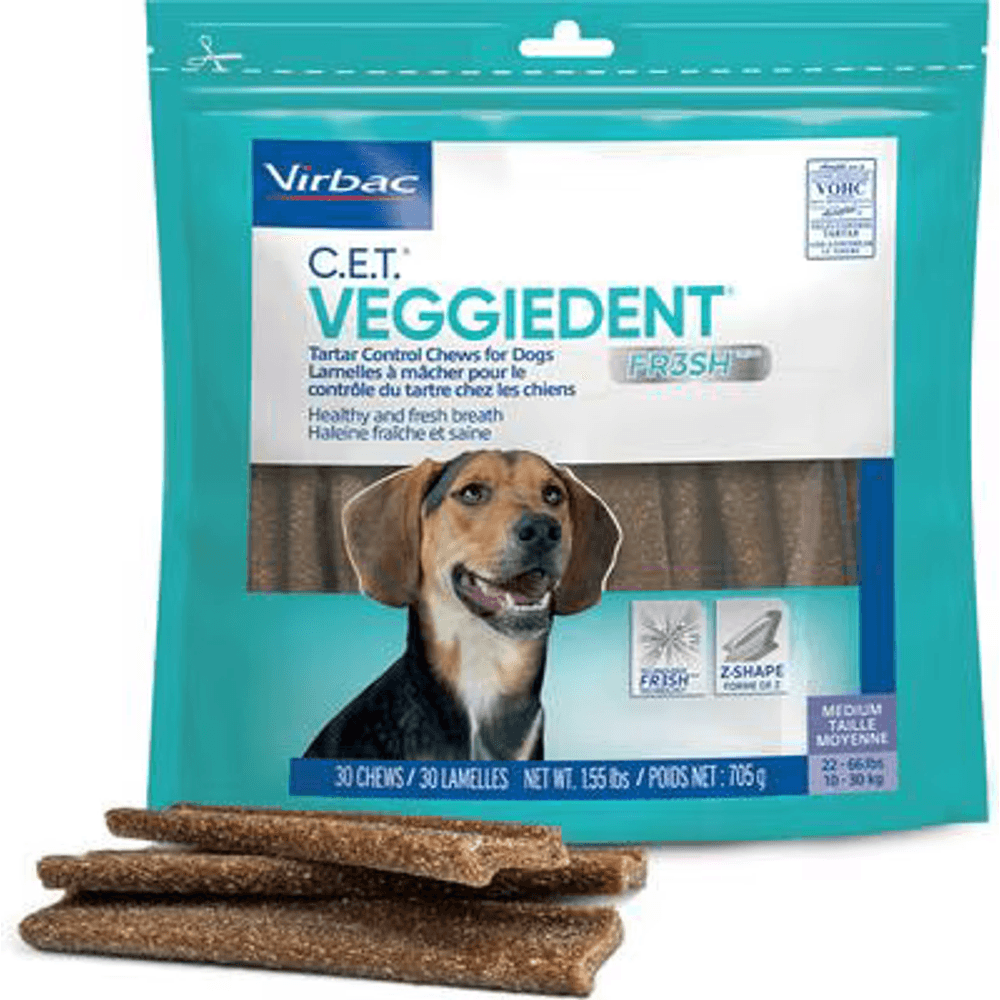
VOHC-accepted dental chews clinically shown to reduce plaque and tartar. The Z-shape and texture clean as your dog chews and freshen breath. A plant-based daily chew for medium dogs.
Petful may earn a commission when you click through to Chewy, at no extra cost to you.
For readers comparing chew formats, Petful's guide to dog dental chews compared goes deeper into size, texture, ingredients, and household fit.
Water additives and other alternatives can be helpful when brushing is difficult, but they should be treated as supplements to a dental plan rather than invisible replacements for examination. Introduce one product at a time, follow the label, keep fresh water available, and stop if your dog refuses water or develops vomiting, diarrhea, mouth irritation, or another adverse change. If your veterinarian agrees that a water additive fits the plan, TropiClean Fresh Breath Dental Water Additive is one current option.
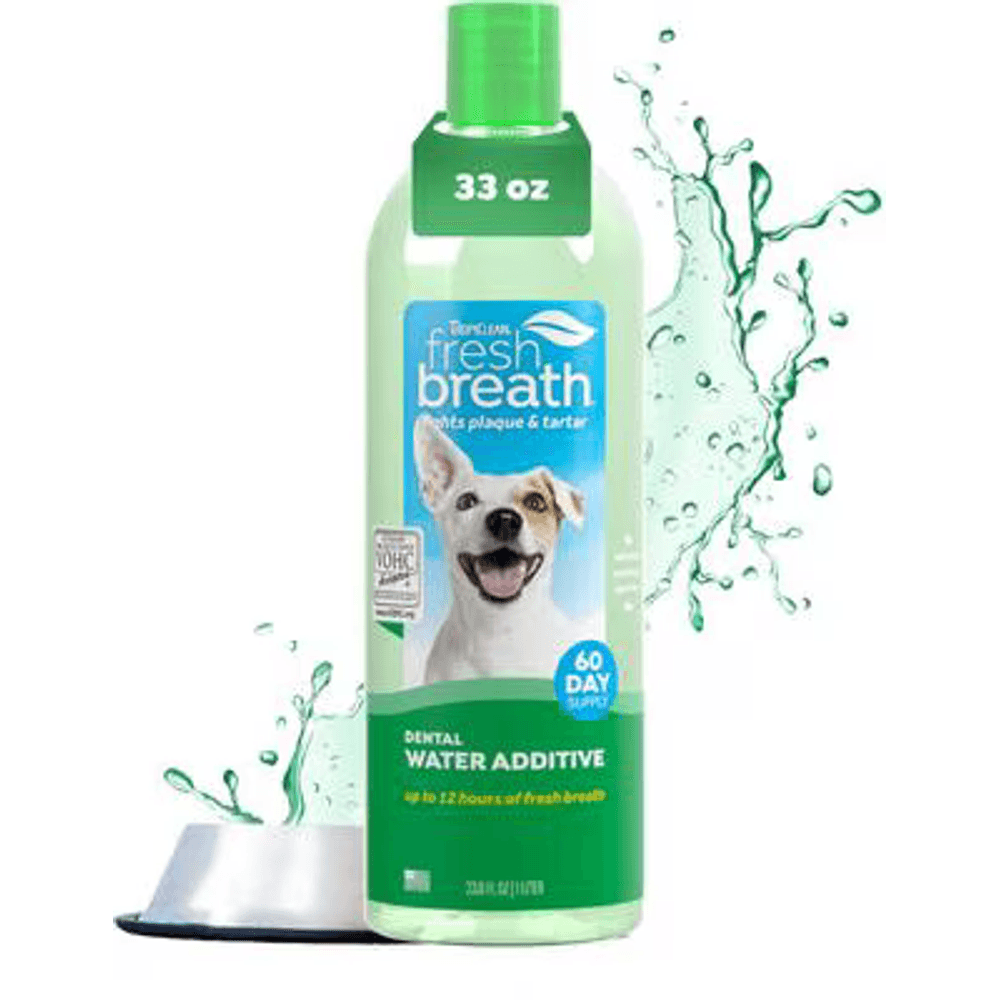
A no-brushing dental water additive: add one capful to your dog's water bowl daily to fight plaque and tartar and freshen breath for up to 12 hours. One 33.8-oz bottle is about a 60-day supply.
Petful may earn a commission when you click through to Chewy, at no extra cost to you.
After the cleaning: protect the result
Ask for written discharge instructions before leaving the clinic. A dog who had only cleaning and polishing may resume normal activity quickly, while a dog with extractions may need soft food, medication, restricted chewing, and a scheduled recheck. Follow the clinic's directions because extraction type and closure method change aftercare.
During the first day, monitor your dog's alertness, breathing, walking, interest in water, and comfort. Mild sleepiness can follow anesthesia, but worsening weakness, repeated vomiting, breathing trouble, uncontrolled bleeding, collapse, severe swelling, or pain that is not controlled warrants an immediate call to the clinic or an emergency veterinarian.
Before routine brushing restarts, confirm that the mouth has healed enough for contact. Then choose a sustainable plan rather than an ambitious routine that disappears after a week. Daily brushing plus one appropriate evidence-supported adjunct is often easier to maintain than several overlapping products.
- Record the procedure date, dental findings, extracted teeth, next examination date, and products recommended for your dog. That record helps future clinics interpret the mouth and helps you budget for the next visit before dental disease becomes painful.
Frequently Asked Questions
A vet may charge around $300 to $800 to clean dog teeth before extractions in a straightforward case, but the veterinary dental cleaning charge varies by location, pre-anesthetic examination and bloodwork, monitoring, full-mouth radiographs, procedure time, and disease found under anesthesia. Ask for a written low-to-high estimate that separates the base cleaning from extractions, medications, and other treatment, and confirm when the clinic will call before exceeding the amount you authorized.
A dental cleaning for a dog is worth it when a veterinarian recommends the procedure to diagnose and treat disease that home care cannot reach. An anesthetized cleaning allows work below the gumline, full-mouth dental radiographs, periodontal probing, charting, and treatment of painful teeth. Its value is a healthier, more comfortable mouth and an informed prevention plan, not merely whiter teeth or better-smelling breath.
Dog teeth cleaning cost is easiest to manage when you compare the actual scope of care, authorize a clear treatment range, and plan home maintenance before the procedure. The cheapest number is not automatically the best value, and the highest estimate is not automatically the right one. A transparent clinic should explain what is included, what could change, and how each recommendation protects your dog's comfort and oral health.
BVMS, MRCVS
Dr. Pippa Elliott, BVMS, MRCVS, is a veterinarian with nearly 30 years of experience in companion animal practice. Dr. Elliott earned her Bachelor of Veterinary Medicine and Surgery from the University of Glasgow. She was also designated a Member of the Royal College of Veterinary Surgeons. Married with 2 grown-up kids, Dr. Elliott has a naughty Puggle named Poggle, 3 cats and a bearded dragon.
Sign up for expert-backed reviews and safety alerts all in one place.