Best Flea Medicine for Cats Without Vet Prescription
Yes, you can fight fleas without a vet visit. Dr. Pippa Elliott ranks the best cat-safe OTC flea treatments, from Advantage II to Capstar, explains what still requires a prescription, and flags the one dog ingredient that can kill your cat.

BVMS, MRCVS
Petful is reader supported. As an affiliate of platforms like Amazon and Chewy, we may earn a commission when you buy through links on this page. There is no extra cost to you.
The best flea medicine for cats without vet prescription requirements comes down to a handful of proven, cat-safe active ingredients you can buy today at any pet store or online retailer. According to the Companion Animal Parasite Council, the adult fleas you can see on your cat represent only about 5% of the total infestation, so choosing a product that actually breaks the flea life cycle matters far more than grabbing whatever is closest on the shelf.
Here is the catch that trips up cat owners: several popular "no prescription needed" lists on the internet quietly include products that legally require a veterinary prescription, and some even include dog products that can kill a cat. This guide fixes both problems. Every pick below is truly over the counter, labeled for cats, and permethrin free.
- 1Advantage II, Cheristin, Frontline Plus, and Capstar are truly over-the-counter and cat-safe
- 2Never use a dog flea product on a cat: permethrin is toxic to cats
- 3Longer-lasting preventives like Revolution Plus (topical, monthly) and Bravecto (topical, every 12 weeks) still require a vet prescription

Sign up for expert-backed reviews and safety alerts all in one place.
Best Flea Medicine for Cats Without a Vet Prescription: Our Picks
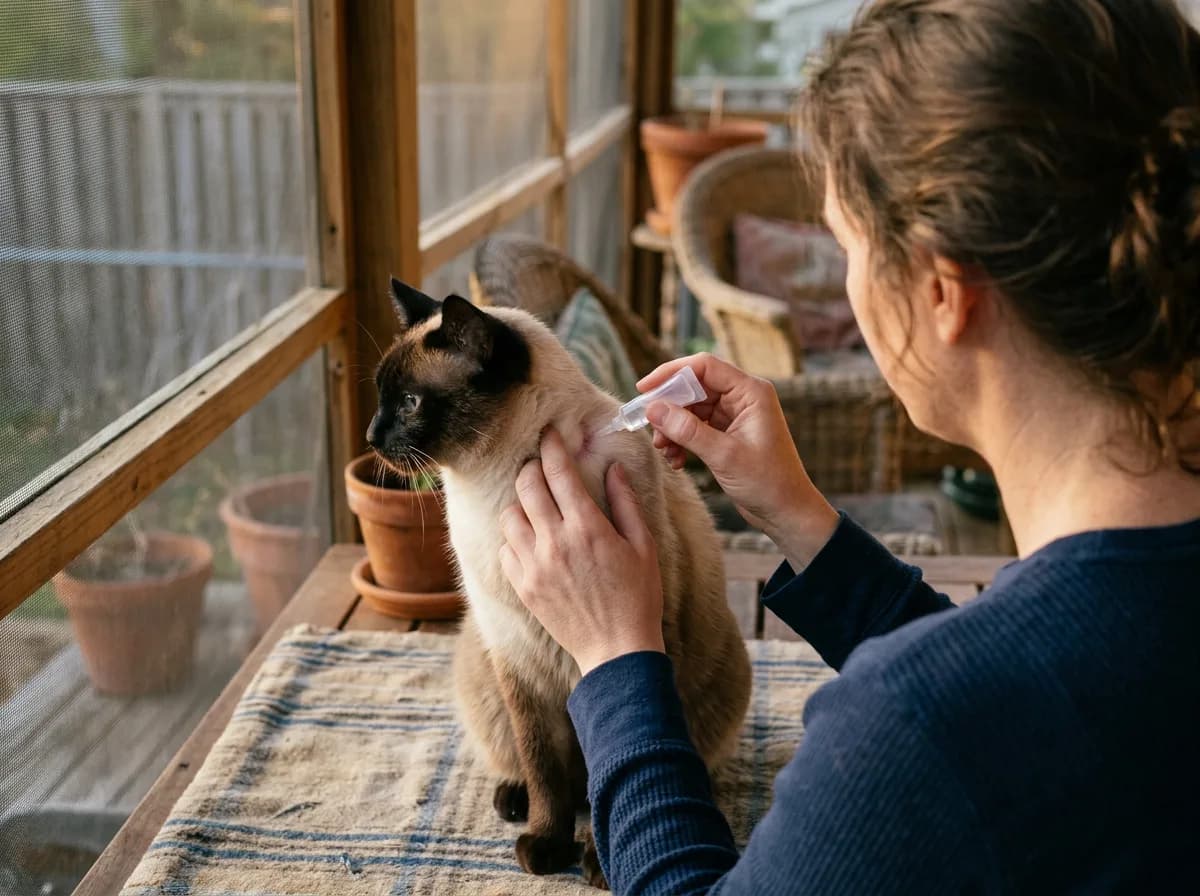
Our top OTC picks for cats are Advantage II for Cats, Cheristin for Cats, Frontline Plus for Cats, and Capstar, with Adams Plus Flea & Tick Shampoo as a budget bath-day option. Advantage II kills adult fleas within 12 hours through contact, so fleas do not need to bite your cat to die. Capstar starts killing adult fleas in about 30 minutes, making it the fastest option you can buy without a prescription. The Seresto collar is also sold over the counter, and we cover it separately in our collar roundup later in this article.
Before we get to the individual reviews, here is how we chose. We compared every product's active ingredient, its kill speed against adult fleas, how long one dose protects your cat, and the minimum age and weight printed on the label. Those four factors are the ones that actually predict whether a product will clear your problem or leave you re-treating in three weeks.
- Active ingredient: determines what the product kills (adults only, or eggs and larvae too)
- Kill speed: how fast adult fleas start dying after application
- Protection length: one day, one month, or somewhere in between
- Minimum age and weight: the hard safety line for kittens and small cats
| Product | Active Ingredient(s) | Kill Speed | Protection | Minimum Age |
|---|---|---|---|---|
| Advantage II for Cats | Imidacloprid + pyriproxyfen | Kills adult fleas within 12 hours | 1 month | 8 weeks, 2 lbs |
| Cheristin for Cats | Spinetoram | Starts killing in 30 minutes | 1 month | 8 weeks, 1.8 lbs |
| Frontline Plus for Cats | Fipronil + (S)-methoprene | Kills adult fleas within 24 hours | 1 month, plus ticks and lice | 8 weeks, 1.5 lbs |
| Capstar | Nitenpyram (oral tablet) | Starts killing in about 30 minutes | About 24 hours | 4 weeks, 2 lbs |
| Adams Plus Flea & Tick Shampoo | Pyrethrins + piperonyl butoxide + (S)-methoprene | Kills on contact during the bath | No lasting residual | 12 weeks |

 Sponsored
Need flea, tick, or parasite care for your cat?
A licensed vet at Dutch can recommend the right preventive and prescribe it when it's appropriate. Annual members get 20% off their first flea and tick order.
Use code Pets60
Plans start at $12/month · covers up to 5 pets
- Licensed vets in most states
- Rx for 150+ conditions
- 4.7 on Trustpilot
1. Advantage II for Cats: Best OTC Flea Treatment Overall
Advantage II earns the top spot because it attacks the flea life cycle at two points with no prescription and no bite required. The imidacloprid kills adult fleas and larvae on contact through the flea's nervous system, while the pyriproxyfen (an insect growth regulator) stops eggs and larvae from ever maturing into biting adults.
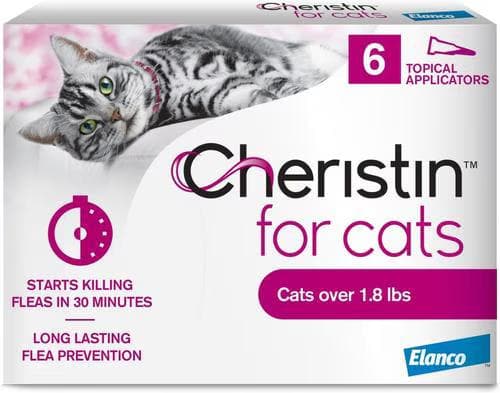
OTC spot-on that starts killing fleas in 30 minutes with long-lasting monthly prevention for cats.
Petful may earn a commission when you click through to Chewy, at no extra cost to you.
Because it works on contact, fleas do not need to bite your cat before they die. That matters for flea-allergic cats, where every single bite triggers itching and scabbing. One application protects for a full month, and the product is EPA-registered for cats 8 weeks and older weighing at least 2 pounds.
- Best for: most cats with an active flea problem or ongoing exposure
- Kills: adult fleas, larvae, and eggs (via the growth regulator)
- Watch for: fleas only; it does not cover ticks
Apply it to the skin at the base of the skull, where your cat cannot reach to lick. Repeat monthly during flea season, or year-round in warm climates.
2. Cheristin for Cats: Best for Fast Monthly Knockdown
Cheristin is one of the few topicals developed specifically for cats rather than adapted from a dog product, and it makes a strong case as the best flea treatment for cats non prescription shelves can offer. Its active ingredient, spinetoram, is a semi-synthetic derivative of a soil bacterium compound, and it starts killing fleas within 30 minutes of application.
In label studies, Cheristin killed effectively within 12 hours and kept working for a full month. It is approved for cats and kittens 8 weeks and older weighing at least 1.8 pounds, one of the lowest weight cutoffs of any monthly topical.
- Best for: heavy adult-flea burdens where you want visible results the same day
- Kills: adult fleas
- Watch for: no insect growth regulator, so pair it with environmental cleanup
Cheristin for cats is sold over the counter at major pet retailers, no vet authorization needed.
3. Frontline Plus for Cats: Best OTC Coverage Beyond Fleas
Frontline Plus is the pick if your cat goes outdoors or lives where ticks are a real concern, because it is the only monthly topical on this list that covers fleas, ticks, and chewing lice without a prescription. Fipronil spreads across the skin's oil layer and kills adult fleas within 24 hours, while the (S)-methoprene growth regulator sterilizes flea eggs and stops larvae from developing.
The combination gives you the same two-stage life cycle attack as Advantage II, plus tick coverage that matters for outdoor and indoor-outdoor cats. It is labeled for cats and kittens 8 weeks and older weighing 1.5 pounds or more.
- Best for: outdoor and indoor-outdoor cats needing flea plus tick protection
- Kills: adult fleas, eggs, larvae, ticks, and chewing lice
- Watch for: slightly slower initial adult-flea kill than Cheristin or Capstar
4. Capstar: Fastest Relief You Can Buy Without a Prescription
Capstar is the emergency button of flea control. This small oral tablet's active ingredient, nitenpyram, reaches the bloodstream fast: adult fleas start dying in about 30 minutes, and the vast majority are dead within 6 hours. Capstar is also the rare oral flea product approved by the FDA for over-the-counter sale, and it is safe for kittens as young as 4 weeks that weigh at least 2 pounds.
The trade-off is duration. A Capstar flea tablet only works for about 24 hours, so it is a knockdown tool, not a monthly preventive. Use it to clear a visible infestation immediately, then start a monthly topical the same day for lasting protection. The label allows once-daily dosing if new fleas keep jumping on.
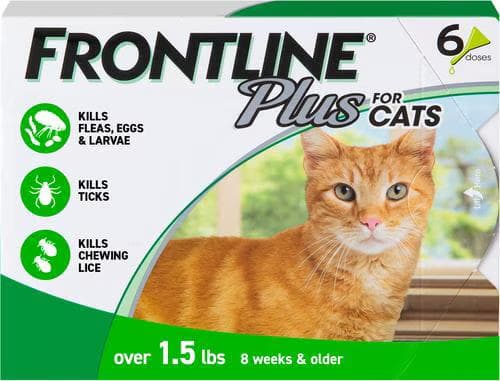
OTC spot-on that kills fleas, flea eggs and larvae, ticks, and chewing lice for cats 8 weeks and older.
Petful may earn a commission when you click through to Chewy, at no extra cost to you.
- Best for: instant relief, new-cat quarantine, and heavily infested cats
- Kills: adult fleas only
- Watch for: no residual protection after 24 hours
5. Adams Plus Flea & Tick Shampoo: Best Budget Bath-Day Option
If your cat tolerates a bath, Adams Plus Flea & Tick Shampoo is a low-cost way to physically clear a flea load in one session. It combines pyrethrins and piperonyl butoxide to kill adult fleas on contact with (S)-methoprene to keep flea eggs on the coat from hatching, and it is labeled for cats and kittens 12 weeks and older.
Important distinction: pyrethrins at the low concentrations in cat-labeled shampoos are not the same thing as permethrin, the concentrated synthetic version found in dog spot-ons that is dangerous to cats. Always confirm the label says "for cats" and follow the dilution and contact-time directions exactly.
A shampoo leaves no meaningful residual protection once the cat is dry, so treat it as step one and follow with a monthly topical.
- Best for: budget knockdown on bath-tolerant cats and barn cats
- Kills: adult fleas, ticks, and lice on contact
- Watch for: no month-long protection; never use dog-strength formulas
How to Choose: Match the Product to Your Cat's Situation
Every flea treatment for cats without vet prescription requirements on this list works as labeled, so the real question is which one fits your household. The decision usually comes down to your cat's age, lifestyle, and how bad the problem already is.
Use this quick decision guide:
- Indoor adult cat, active fleas: Advantage II. The contact kill plus growth regulator handles both the fleas you see and the eggs they have already laid.
- Heavy infestation, cat visibly miserable: Capstar today for the knockdown, then Advantage II or Cheristin the same day for month-long cover.
- Outdoor or indoor-outdoor cat: Frontline Plus, because tick coverage stops being optional the moment your cat crosses the doorstep.
- Multi-cat home where cats groom each other: Cheristin or Capstar. Cheristin dries fast, and Capstar bypasses the coat entirely because it is oral.
- Young kitten (4 to 8 weeks): Capstar only, at 2 pounds or more, alongside daily flea combing.
- Tight budget, bath-tolerant cat: Adams Plus shampoo for the initial cleanout, then save toward a monthly topical, since the shampoo alone cannot hold the line.
Whatever you pick, commit to it for at least 3 consecutive months. Fleas already developing in your home will keep emerging for weeks after the first dose, and stopping early is the single most common reason owners conclude a perfectly good product "did not work."
One budget note worth knowing: imidacloprid and fipronil are both off-patent, so store-brand generics with identical active ingredients and concentrations exist at lower prices. If you go generic, match the active ingredient percentages on the label to the name brand and confirm the packaging carries an EPA registration number.
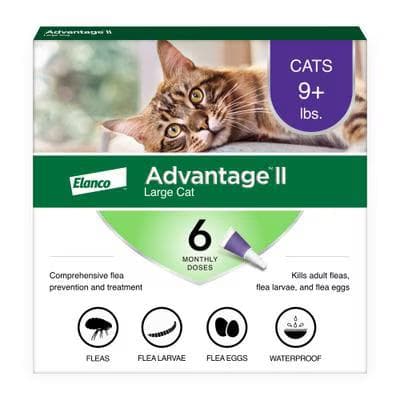
Monthly OTC spot-on that kills adult fleas, flea larvae, and flea eggs, and stays effective when wet.
Petful may earn a commission when you click through to Chewy, at no extra cost to you.
Best OTC Topical Flea Treatments for Cats
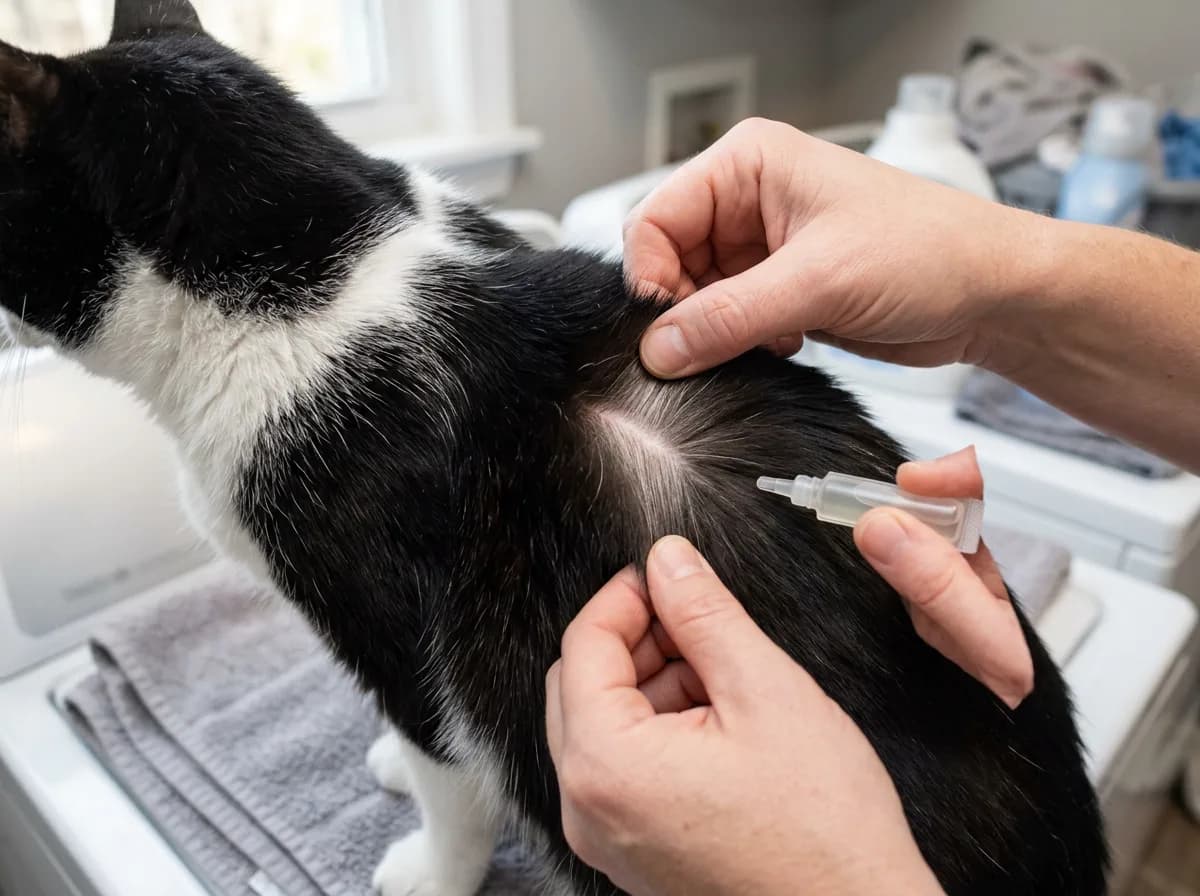
The strongest over the counter flea treatment for cats is an imidacloprid topical such as Advantage II, which kills adult fleas and larvae on contact within 12 hours and adds an insect growth regulator to break the life cycle. If raw kill speed on adult fleas is your priority, the spinetoram topical Cheristin starts working in 30 minutes. Both beat any shampoo, powder, or flea comb for sustained control because they keep killing for a full month.
Topicals dominate the over the counter flea treatment for cats market for a simple reason: they separate the medicine from the cat's tongue. A spot-on applied correctly sits where the cat physically cannot groom it off, which is why application technique matters as much as the product you choose.
Here is how to apply any OTC flea treatment for cats so it actually works:
- Part the fur at the base of the skull or between the shoulder blades until you see skin.
- Squeeze the entire tube's contents directly onto the skin, not the fur.
- Do not rub it in; the product spreads on its own through the skin's oils.
- Keep the cat from getting wet for 24 to 48 hours (check your product's label).
- Separate treated pets from housemates who groom each other until the spot dries.
- Topical protection fades on a schedule. Most spot-on failures are actually late reapplications, so set a fixed monthly reminder the day you apply the first dose.
One more shopping note: buy from established retailers. Counterfeit flea topicals are a documented problem in third-party marketplaces, and the EPA registration number on genuine packaging is your best authenticity check. The EPA regulates spot-on flea topicals, shampoos, and collars, while oral flea products fall under the FDA.
Weight bands matter more than owners expect, too. Topicals are dosed by the cat's body weight, and a tube sized for a 9-pound cat is both the wrong dose and the wrong economics for a 5-pound cat. Weigh your cat (step on a scale holding the cat, then subtract yourself) before you buy, and re-check kittens monthly because they can outgrow a weight band between doses.
Finally, know what a topical cannot do. A spot-on kills fleas on the cat, but it does not sanitize your carpet, and it cannot compensate for an untreated dog sharing the couch. If you apply a well-reviewed OTC flea treatment for cats correctly and still see fleas after two weeks, the survivors are almost always coming from the environment or another animal, not from product failure.
SponsoredVet care that's always there
Unlimited video calls and messaging with licensed vets for less than a typical vet visit. One membership covers up to five pets.
Use code Pets60
Plans start at $12/month · covers up to 5 pets
- Licensed vets in most states
- Rx for 150+ conditions
- 4.7 on Trustpilot
Best OTC Oral Flea Treatment: Capstar (Nitenpyram)
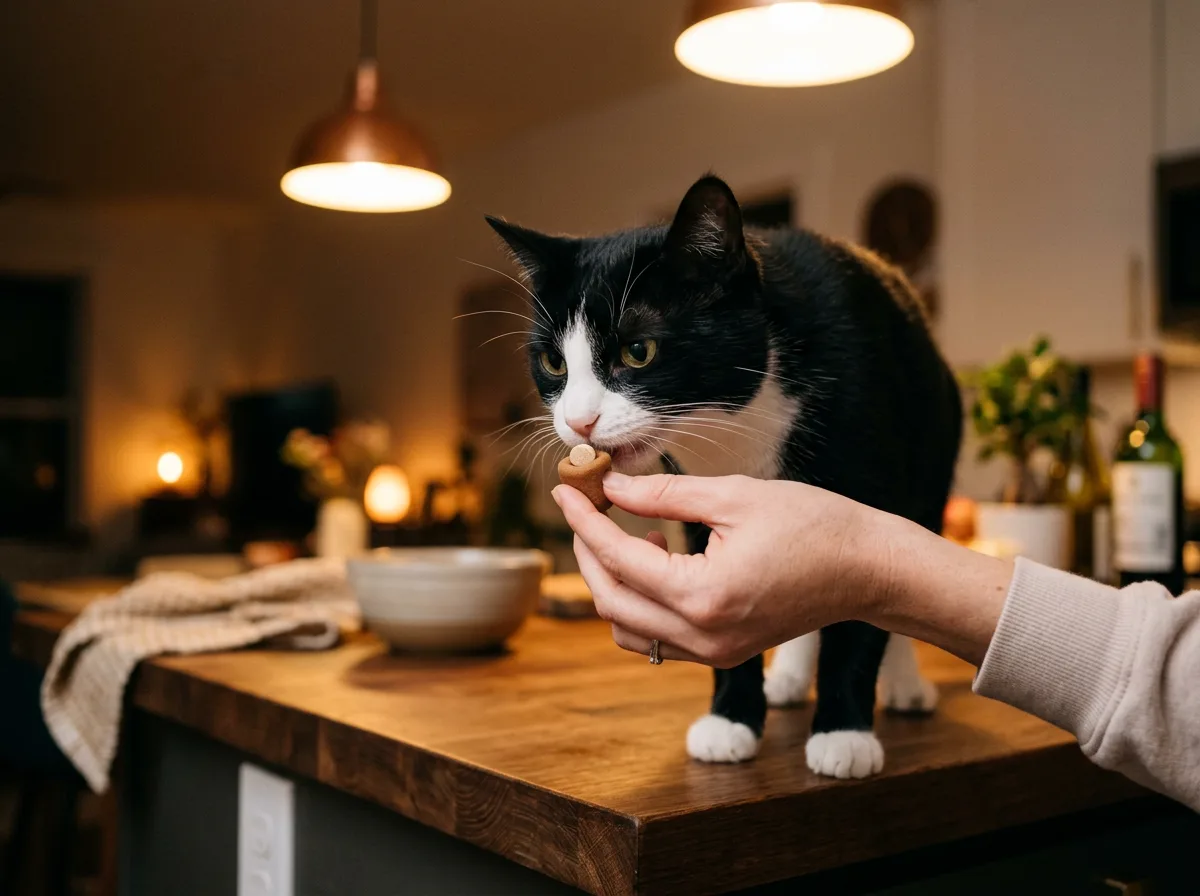
Capstar is the best oral flea treatment for cats without vet prescription requirements, and it is genuinely the only one in its class. Nearly every other oral flea product on the market, from monthly chews to six-month tablets, legally requires a veterinarian's authorization. Nitenpyram earned its unusual OTC status through decades of safety data: it enters and leaves the bloodstream within about a day and only affects insects actively feeding on the cat.
Dosing is simple. One tablet, sized by your cat's weight band, given by mouth. You can hide it in a soft treat, in a spoon of wet food, or give it directly.
Where Capstar shines is speed and flexibility:
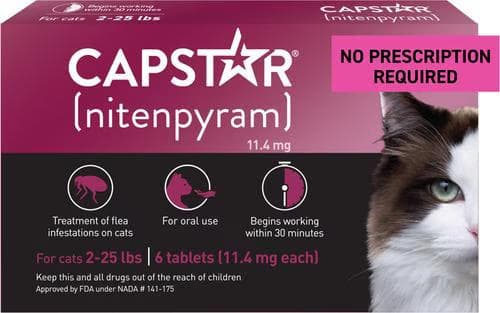
The fastest over-the-counter knockdown: nitenpyram tablets start killing adult fleas within 30 minutes, no prescription needed.
Petful may earn a commission when you click through to Chewy, at no extra cost to you.
- New arrivals: dose a newly adopted or rescued cat before it walks into your home
- Pre-treatment: clear adult fleas before a bath, grooming visit, or boarding stay
- Kittens: safe from 4 weeks of age and 2 pounds, earlier than any monthly topical
- Flare-ups: the label permits one dose per day when fleas keep reappearing
You may see your cat scratch more during the first hour or two after dosing. That is the fleas reacting to the medication before dying, not an allergic response, and it settles as the fleas die off.
It also helps to understand what nitenpyram does not do. It has no effect on flea eggs, larvae, or pupae, and it leaves the cat's system quickly by design, which is exactly why it is safe enough to sell without a prescription and why it cannot serve as your only flea product. Think of it as the fire extinguisher, not the smoke detector.
Remember the 24-hour ceiling. Searching for flea treatment for cats oral options that last a full month will lead you to prescription products, which we cover next. Capstar's job is the knockdown; a monthly topical's job is the follow-through.
What Flea Meds Still Require a Vet Prescription (and Why)
The number one vet recommended flea treatment for cats is typically a prescription product such as Revolution Plus or Bravecto, because these treat fleas plus ticks, ear mites, and internal parasites in one monthly or 12-week dose. That does not make OTC products second-rate; it means vets prefer one product that covers everything a clinic patient might carry. For flea control specifically, the OTC picks above perform their labeled job well.
When owners ask what vets recommend for cats with fleas, the honest answer has two parts: kill the fleas on the cat with a proven product (OTC or prescription both qualify), and treat every pet in the household for at least three consecutive months to break the life cycle. Consistency beats brand choice almost every time.
So which products are actually prescription-only? The prescription only actives fall into two families:
- Isoxazolines: fluralaner (Bravecto for Cats), lotilaner (Credelio CAT), sarolaner (in Revolution Plus). These systemic products require a prescription partly because the FDA issued a 2018 advisory noting rare neurologic side effects (tremors, ataxia, seizures) in some pets, so a vet should screen for seizure history first.
- Selamectin: the active in Revolution and Revolution Plus, which also treats heartworm, ear mites, and roundworms. Anything that prevents heartworm requires a prescription by law.
A monthly oral flea treatment for cats such as Comfortis (spinosad) sits in the same category: effective, but prescription-gated because systemic drugs need dosing oversight. If a website sells you NexGard, Simparica, Bravecto, Credelio, or Revolution Plus without asking for your vet's information, that is a red flag for a gray-market or counterfeit product, not a loophole.
This is also where some competing "no prescription" roundups get it wrong: several widely shared lists include Revolution Plus or Bravecto as over-the-counter picks. They are not OTC in the United States, and a roundup that says otherwise is not reading the label. The distinction is worth being picky about, because an owner who orders a "no prescription" product and then hits a pharmacy verification wall at checkout has lost days of treatment time while the fleas kept laying eggs.
- Permethrin, the ingredient in many dog spot-ons like K9 Advantix II, is toxic to cats even in small amounts. Never apply any dog-labeled flea product to a cat, and keep cats away from treated dogs until the application site is fully dry.
Dog permethrin products cause one of the most common and preventable poisonings that veterinarians see: tremors, twitching, and seizures that can turn fatal without emergency treatment. Cats lack the liver enzyme pathway needed to break permethrin down, which is why a product that is perfectly safe on your dog is an emergency on your cat. If you ever apply a dog product to a cat by mistake, wash it off with dish soap immediately and call your vet; our full guide to permethrin poisoning in cats covers the warning signs and treatment.
Prescription Oral Flea and Tick Meds for Cats
If your cat needs tick coverage, has a flea-allergy problem that OTC products cannot stay ahead of, or you simply want one dose that lasts up to 12 weeks, the prescription oral and systemic options are worth the vet visit. Products like Bravecto and Revolution Plus combine flea and tick control with broader parasite protection, and Merck Veterinary Manual notes that systemic isoxazolines are among the most effective flea adulticides available. We break down every option, dosing intervals, and safety screening in our guide to the best oral flea and tick medicine for cats.
What About Flea Collars for Cats?
A modern flea collar for cats is a legitimate OTC option, but it is a different product category with its own fit, safety, and breakaway considerations, so we keep the deep dive separate. The short version: the Seresto cat collar (imidacloprid + flumethrin) is the standout, releasing low doses of its active ingredients continuously for up to 8 months, and it is sold without a prescription. If a set-and-forget option appeals more than monthly applications, the best flea collar for cats can genuinely replace a topical for low-risk indoor cats.
Older-style flea collars that rely on tetrachlorvinphos or naphthalene are a different story and worth skipping entirely. Collar shoppers should also confirm any collar has a breakaway or quick-release safety mechanism, since cats and collars and tree branches are a bad combination.
For fitted-and-tested picks, sizing guidance, and how Seresto compares with budget collars, see our full roundup of the best flea collars for cats.
Common Mistakes That Make OTC Flea Treatment Fail
Most "this product did not work" stories trace back to how the product was used, not what was in the tube. Veterinary dermatologists see the same handful of errors on repeat, and every one of them is fixable for free.
The big ones:
- Applying to fur instead of skin. A spot-on pooled on top of the coat never reaches the skin oils that distribute it. Part the fur until you see skin, every time.
- Splitting one large dose between two cats. Dosing is calibrated by weight band, and eyeballing half a tube gives both cats an unknown dose. Buy the right size for each cat.
- Bathing right after application. Most topicals need 24 to 48 hours to spread and bind. A same-day bath, or a swim-prone cat, washes your money down the drain.
- Treating only the itchy cat. Fleas do not respect favorites. Every dog and cat in the home needs treatment on the same schedule, or the untreated pet becomes the reservoir.
- Stopping after one good month. Pupae in the environment keep hatching for weeks. One clean month means the product is working, not that the job is done.
- Doubling up products out of frustration. Stacking a shampoo, a collar, and a spot-on in the same week multiplies chemical load without multiplying kill. Pick one system and give it time, and ask your vet before combining anything beyond Capstar plus a topical.
If you have genuinely avoided all six mistakes for two full months and fleas persist, stop spending on OTC repeats. That is the signal to escalate.
When OTC Is Not Enough: Call Your Vet
Over-the-counter products solve most routine flea problems, but there are situations where skipping the vet costs you more time, money, and cat misery than the appointment would.
Book a veterinary visit instead of (or alongside) an OTC product when:
- Your kitten is under 8 weeks old or under the label weight. Almost no OTC product is safe below these lines; Capstar's 4-week floor is the exception. Our kitten flea treatment guide covers safe options for the youngest patients, including flea combing and warm-water baths.
- Your cat is elderly, pregnant, nursing, or chronically ill. Labels are written for healthy adult cats. Liver or kidney disease changes how a cat processes any medication.
- The infestation is heavy. Pale gums, lethargy, or visible flea dirt everywhere can signal flea anemia, which is a medical emergency in kittens and small cats.
- Your cat is scabby and overgrooming. Flea allergy dermatitis needs its own treatment plan on top of flea control, and only a vet can prescribe it.
- Two full months of correct OTC use has not worked. At that point you likely need a prescription product, an environmental strategy, or both.
None of this contradicts the premise of this article. It defines its limits, which is exactly what the muddled "no prescription needed" roundups fail to do.
Fleas Keep Coming Back? Treat the Whole Problem
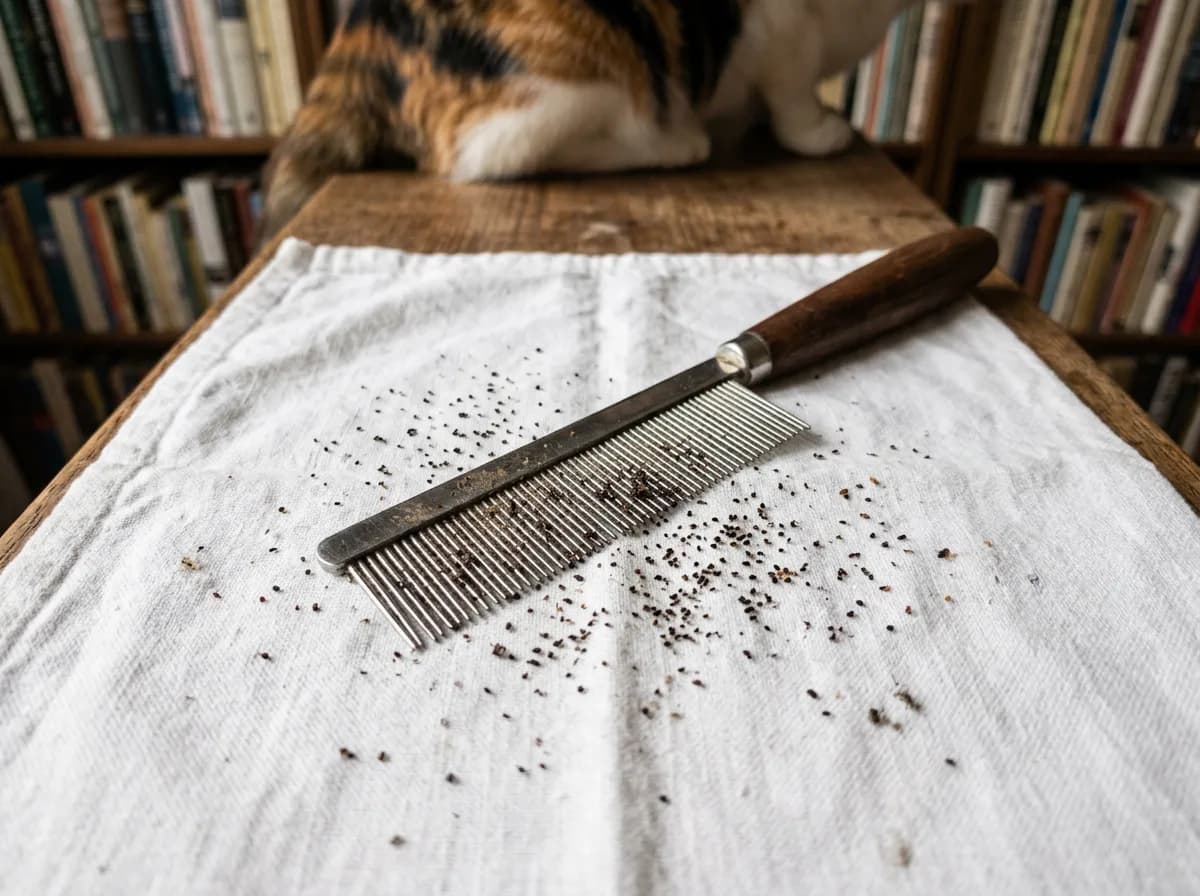
Remember the number from the top of this article: the adult fleas on your cat are roughly 5% of the infestation. The other 95% (eggs, larvae, and pupae, per the Companion Animal Parasite Council's flea life cycle guidance) is living in your carpet, bedding, baseboards, and couch cushions. Kill every adult flea on your cat today, and the pupae in your carpet will restock the problem within days.
The pupal stage is the part that breaks people's patience. Flea pupae are wrapped in a sticky, vacuum-resistant cocoon and can sit dormant for weeks, then hatch in seconds when they sense warmth and vibration from a passing animal. No product you apply to your cat can touch them until they hatch and jump aboard, which is why a correctly treated cat can still pick up new fleas in its own living room for a month or more.
That is why the best flea treatment for cats is really a system, not a single product:
- Treat the cat monthly with one of the OTC picks above, for at least 3 consecutive months.
- Treat every pet in the household on the same schedule, including the dog (our dog OTC flea medicine roundup mirrors this one, and remember dog products stay on dogs).
- Vacuum daily for the first two weeks, especially where pets sleep, and empty the canister outside.
- Wash bedding weekly in hot water, both pet bedding and any human bedding cats sleep on.
Consistency is the whole game, and it is where most flea plans quietly fail. Tracking each pet's product, dose date, and next due date in a free MyPetID profile keeps a multi-pet household on schedule with automatic reminders, which matters when Capstar is daily-as-needed, topicals are monthly, and a Seresto collar runs 8 months.
Indoor cats are not exempt, by the way. Fleas ride in on dogs, shoes, secondhand furniture, and even rodents, which is why prevention beats reaction even for a windowsill-only cat. For the complete playbook covering environmental treatment, prevention through winter, and what to do when nothing seems to work, read our full flea treatment for cats guide.
Frequently Asked Questions
Yes. Advantage II, Cheristin, Frontline Plus, Capstar, and the Seresto collar are all sold over the counter and are labeled for cats. What you cannot buy without a prescription are systemic products like Revolution Plus, Bravecto, Credelio, and Comfortis.
Capstar (nitenpyram) is the fastest OTC option, starting to kill adult fleas in about 30 minutes with most dead within 6 hours. Cheristin also begins killing fleas within 30 minutes of application and then protects for a month.
Yes. Frontline Plus for Cats is EPA-registered and sold without a prescription for cats 8 weeks and older weighing at least 1.5 pounds. It covers fleas, flea eggs and larvae, ticks, and chewing lice for one month per dose.
The usual culprits are late reapplication, treating only one pet in the household, skipping environmental cleanup, or applying the product to fur instead of skin. Fleas emerging from pupae in carpet for weeks after treatment is normal and not product failure.
Only above each label's minimum age and weight. Capstar is safe from 4 weeks and 2 pounds, most monthly topicals start at 8 weeks, and Adams Plus shampoo starts at 12 weeks. Below those lines, use flea combing and ask your vet.
The bottom line: you have real, vet-respected options at the pet store. Match the active ingredient to your cat's situation, apply it correctly and on schedule, treat the house and every pet in it, and save the prescription products for the jobs that genuinely need them.
BVMS, MRCVS
Dr. Pippa Elliott, BVMS, MRCVS, is a veterinarian with nearly 30 years of experience in companion animal practice. Dr. Elliott earned her Bachelor of Veterinary Medicine and Surgery from the University of Glasgow. She was also designated a Member of the Royal College of Veterinary Surgeons. Married with 2 grown-up kids, Dr. Elliott has a naughty Puggle named Poggle, 3 cats and a bearded dragon.
Sign up for expert-backed reviews and safety alerts all in one place.