Golden Retriever Health Issues and Lifespan
Golden Retrievers can face inherited and acquired health risks. Learn what screening can show, what owners can monitor and when to call a veterinarian.

BVMS, MRCVS
Petful is reader supported. As an affiliate of platforms like Amazon and Chewy, we may earn a commission when you buy through links on this page. There is no extra cost to you.
Golden Retriever health issues include inherited risks, acquired disease, injuries, and ordinary changes that can affect any dog. Breed information helps owners ask better questions, but it cannot diagnose a symptom or predict one dog's outcome. Screening records, family history, preventive care, and current veterinary findings each answer a different part of the health decision.
Golden Retriever lifespan is commonly summarized as about 10 to 12 years in veterinary breed references, including the PetMD Golden Retriever profile. That is a population planning range, not a deadline or promise. Genetics, disease, accident risk, body condition, dental and preventive care, environment, and access to timely treatment all influence an individual life.

Sign up for expert-backed reviews and safety alerts all in one place.
Golden Retriever Health Issues and Lifespan at a glance
- 1A practical evaluation separates inherited screening, current clinical findings, preventive care, and individual variation
- 2Golden Retrievers have important breed health concerns, but a predisposition is not a diagnosis
- 3A lifespan range describes a population and cannot predict one dog's age at death
- 4Individual dogs can vary in symptoms, disease risk, response to treatment, mobility, and healthy aging
- 5Breed tendencies describe populations, not every individual dog. Records, direct observation and professional findings answer different questions, and the household routine determines what will be practical.
The Golden Retriever Club of America health and research hub is a parent-club starting point for breed health, screening, and research. The OFA CHIC program overview explains how breed-specific health testing can be organized and made public. These sources support verification, not certainty.
Seek urgent veterinary help for emergency signs
Contact a veterinarian or emergency clinic promptly for difficulty breathing, collapse, pale or blue gums, repeated unproductive retching, a rapidly enlarging or painful abdomen, uncontrolled bleeding, a seizure lasting several minutes or repeated seizures, inability to urinate, suspected poisoning, severe trauma, extreme weakness, or rapid decline. Do not wait for a breed-specific explanation or try to diagnose the cause at home.
New lumps, unexplained weight loss, reduced stamina, persistent cough, recurrent vomiting or diarrhea, increased thirst or urination, limping, skin changes, eye pain, or behavior change also deserve veterinary assessment, even when the dog otherwise seems well. Many signs are nonspecific. Early contact allows the veterinarian to judge urgency based on the individual dog.
Golden Retriever health at a glance
Golden Retriever health issues and Golden Retriever health problems are population-level prompts for questions, not a diagnosis for one dog. Review current symptoms, documented family history, screening records, body condition and veterinary findings together before deciding what the individual dog needs. Separate breed prevalence, parent screening, routine prevention, current clinical signs and veterinary assessment because each answers a different question. Screening can refine risk, while examination and diagnostic testing guide care for the dog in front of you.
Golden Retriever health problems are easiest to understand with separate categories. Careful distinctions separate a breed-level research concern from a parent screening result, and both from a symptom occurring in one dog today. The table shows what each evidence type can and cannot establish.
| Evidence | What it can support | What it cannot establish | Next step |
|---|---|---|---|
| Breed health guidance | Which risks and screening questions deserve attention | That one dog has or will develop a condition | Discuss relevance with the dog's veterinarian |
| Parent screening record | The named parent's result for a defined test at a defined time | Lifelong health of the parent or offspring | Verify identity, method, date, result, and limitations |
| Family history | Patterns of diagnoses and ages in known relatives | A diagnosis in the current dog | Share specific records with the veterinarian |
| Current examination and diagnostics | The individual dog's findings now | Every future outcome | Follow the veterinary plan and reassessment schedule |
| Home observation log | Timing, frequency, triggers, and change over time | Cause or diagnosis by itself | Use it to support timely clinical evaluation |

Petful may earn a commission when you click through to Chewy, at no extra cost to you.
What to verify before you decide
Records and professional guidance should be matched to the correct dog. Appearance is not documentary proof of ancestry, health, or screening. Ask for original reports with the registered name, identifier, date, test method, provider, and complete result. Ask a veterinarian to interpret unfamiliar language rather than relying on a seller summary or a consumer app.
- Breed guidance identifies questions, screening reports describe defined results, family history adds context, and veterinary examination evaluates the individual dog. None of these sources should be substituted for another, and no product or home observation can diagnose disease.
For a puppy source, verify parent records under the exact registered identities and match them to the pedigree. For an adult, collect prior veterinary records, medications, surgeries, allergies, weight history, and diagnostic results. A missing record is uncertainty, not automatic proof that disease is present.
 Sponsored
Have a health question about your pet?
Talk to a licensed vet at Dutch over video or message, including nights and weekends.
Use code Pets60
Plans start at $12/month · covers up to 5 pets
- Licensed vets in most states
- Rx for 150+ conditions
- 4.7 on Trustpilot
Golden Retriever lifespan and healthy aging
How long do Golden Retrievers live? A planning range of about 10 to 12 years is common in veterinary breed summaries, but the more useful question is how to support the current dog at each life stage. A 10-year-old with stable health and comfortable mobility may have very different needs from a younger dog with chronic disease.

Measure function over time
Track changes that affect daily life:
- Appetite, drinking, urination, stool, and body weight.
- Ease of rising, walking, using stairs, and getting into a vehicle.
- Interest in play, walks, family contact, and familiar routines.
- Nighttime rest, pacing, confusion, or house soiling.
- Vision, hearing, skin, coat, mouth, and grooming tolerance.
- Recovery after ordinary activity.
A written monthly snapshot makes slow change easier to see. It should include the date and context rather than a broad label such as "slowing down." Bring the record to preventive visits and contact the clinic sooner when a change is sudden, painful, or progressive.
Interpret lifespan numbers carefully
Life expectancy at birth, median age at death, and a breed-guide range are different measures. A 10 to 12 year summary does not mean most dogs die exactly within those two birthdays, nor does reaching the upper end reveal how much time remains. A study population, geography, time period, referral pattern, and cause-of-death recording can all affect a published estimate.
For an individual Golden Retriever, current health and function are more useful than counting down from a range. Ask the veterinarian which findings are stable, which trends deserve monitoring, and which preventive or comfort changes fit the dog's life stage. Do not compare two senior dogs by age alone when their diagnoses, mobility, body condition, and daily quality of life differ.
Senior comfort is not a diagnosis
Environmental changes can reduce effort: non-slip paths, easy access to water, controlled stairs, shorter activity sessions, and a warm resting area. If you are comparing a supportive resting surface, the FurHaven Velvet Waves Perfect Comfort Orthopedic Sofa Bed in Large is one tracked option to measure against the dog's sleeping posture, mobility, temperature preference, and tendency to chew.
The FurHaven Velvet Waves Perfect Comfort Orthopedic Sofa Bed cannot treat pain or establish why a dog is stiff. Check current dimensions, step-on height, cover care, and support. Reluctance to rise, limping, yelping, weakness, or a sudden change in sleep position should prompt veterinary assessment rather than a bed purchase alone.
Quality of life is individual
Quality-of-life discussions should cover comfort, appetite, hydration, toileting, mobility, breathing, interaction, sleep, and the balance of good and difficult periods. No online checklist replaces a veterinarian who knows the dog. Ask for a plan that defines what to monitor, which changes are urgent, and when to reassess.
Health screening and breeder records
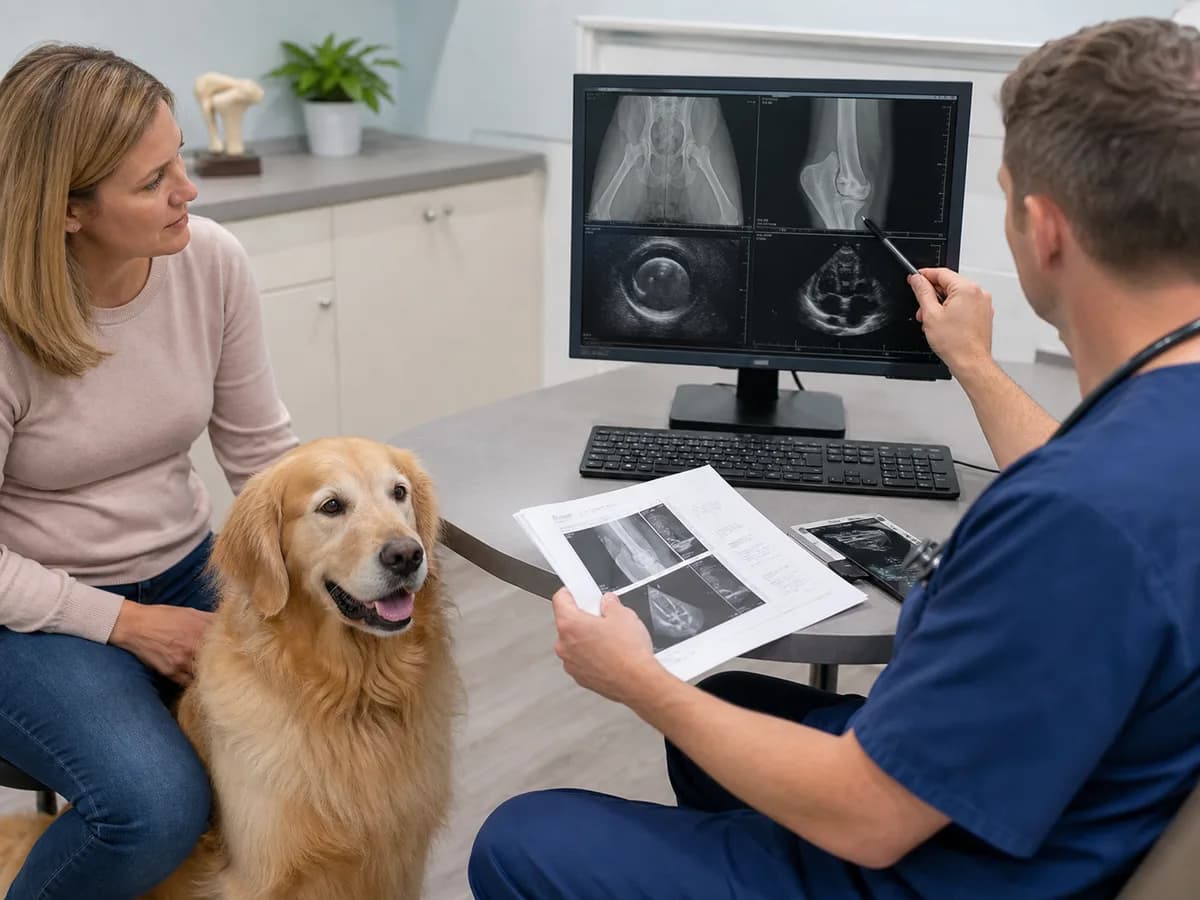
Golden Retriever health testing should be verified as a set of specific results, not a badge. Parent-club and OFA resources can help readers identify current screening expectations. Common Golden screening conversations include hips, elbows, eyes, and heart, but requirements, methods, and timing should be confirmed through current official guidance.
Read the complete report
For each test, record:
- Registered name and unique identifier of the dog tested.
- Test, examination, imaging, or laboratory method.
- Date and the dog's age at testing.
- Laboratory, specialist, or registry involved.
- Full result, not only the word "clear."
- Recommendations, limitations, or required follow-up.
A CHIC number means the breed's required testing was completed and results were made public under the program's rules. It does not mean every result was normal, and it cannot guarantee an offspring's health. Review the individual results.
Make family history specific
"Healthy lines" is not a usable family history. Ask about named close relatives, confirmed diagnoses, age at diagnosis, age and cause of death when known, and whether records can be shared. Distinguish a veterinary diagnosis from a family recollection or suspected cause.
Family history may reveal patterns worth discussing with a veterinarian, but it has limits. Relatives can have incomplete records, different environments, or no confirmed diagnosis. An absent history may mean information was not collected, not that a risk is absent. Record the uncertainty instead of converting it into reassurance or alarm.
For a current dog, update the family history when new information arrives and keep it with the medical record. The veterinarian can decide whether it changes screening, examination frequency, or the threshold for investigating a sign.
Consumer DNA results have a narrower role
If a household wants ancestry or selected genetic-variant information, the Embark Breed and Health Dog DNA Test Kit is one tracked consumer option to evaluate. Its current test panel, sample requirements, breed relevance, privacy policy, and limitations should be reviewed before purchase.
An Embark Breed and Health Dog DNA Test Kit does not replace hip or elbow imaging, a cardiology or eye examination, pedigree review, family history, or veterinary diagnostics. A negative result for tested variants does not mean a dog is free from all inherited or acquired disease. Discuss actionable findings with a veterinarian and, when appropriate, a genetics professional.
Prepare for the veterinary visit
Bring a concise timeline rather than a list of internet diagnoses. Note when the change began, how often it occurs, what the dog was doing, whether appetite or medication changed, and what makes the sign better or worse. Short videos can help when a limp, cough, collapse-like event, or unusual behavior does not occur in the clinic, provided filming does not delay care.
Also bring:
- All current medications, preventives, and supplements with doses.
- Prior screening and diagnostic reports.
- Recent weight and feeding information.
- A list of specific questions and the household's practical constraints.
- The name and contact information of prior clinics or specialists.
Ask the veterinarian what the leading possibilities are, what each recommended test can answer, what must happen today, and which changes require emergency reassessment. A shared plan is clearer when it includes a date or trigger for follow-up.

An orthopedic sofa bed with three bolstered sides for dogs who like to rest their head and joints against a cushion. The supportive foam base cradles hips and elbows, a comforting spot for an older or shaky dog to settle.
Petful may earn a commission when you click through to Chewy, at no extra cost to you.
Hip, elbow and mobility concerns
Golden Retriever hip dysplasia and elbow disease are important screening and clinical topics, but screening and diagnosis are not interchangeable. Parent imaging can inform breeding decisions. A dog with stiffness or lameness needs its own examination because soft-tissue injury, arthritis, neurologic disease, paw pain, infection, and other conditions can produce overlapping signs.

Changes worth recording
Note the date, surface, duration, and side when you observe:
- Limping or shortened stride.
- Difficulty rising, sitting, or lying down.
- Reluctance on stairs or when entering a vehicle.
- Reduced willingness to run, jump, or retrieve.
- Stiffness after rest or activity.
- Slipping, scuffing nails, weakness, or loss of coordination.
- Pain with handling or a sudden behavior change.
Do not force exercise to test the dog or give human pain medication. Some human medicines are dangerous to dogs, and pain treatment should follow veterinary guidance.
 Sponsored
Vet care that's always there
Unlimited video calls and messaging with licensed vets for less than a typical vet visit. One membership covers up to five pets.
Use code Pets60
Plans start at $12/month · covers up to 5 pets
- Licensed vets in most states
- Rx for 150+ conditions
- 4.7 on Trustpilot
Exercise should match current function
Regular controlled activity can support muscle, coordination, and body condition, but the type and dose must fit the individual. Sudden high-impact fetching, sharp turns, slippery floors, forced running, and weekend-only intensity may be inappropriate for a dog with pain, poor conditioning, or developmental concerns.
If a veterinarian recommends discussing a joint supplement, the Nutramax Cosequin Joint Health Supplement with glucosamine, chondroitin, and MSM is one tracked product to review by exact ingredients, dose, other medications, and the veterinarian's goal. It should not be used to delay examination or replace diagnosed-disease treatment.
The Nutramax Cosequin chewable tablets for dogs cannot establish whether a dog has hip dysplasia, arthritis, or another mobility problem. Ask how benefit would be measured and when to stop or reassess. Monitor for adverse effects and follow veterinary instructions for the individual dog.

304 food-grade stainless steel pet water fountain, 101 oz. The circulating, filtered water encourages cats to drink more, which supports urinary tract and kidney health.
Petful may earn a commission when you click through to Chewy, at no extra cost to you.
Cancer, heart, eye and skin concerns
Golden Retriever cancer is an important research and veterinary topic, but dramatic phrases and unsupported percentages can mislead. The GRCA health hub includes cancer research among its breed-health resources. That establishes a reason for awareness and research, not a diagnosis or exact probability for one dog.
Cancer signs are not cancer-specific
New or changing masses, unexplained weight loss, reduced appetite, persistent lethargy, bleeding, abdominal enlargement, pale gums, collapse, or a decline in stamina can occur with cancer and with many other conditions. A veterinarian may recommend examination, blood work, imaging, sampling, or referral depending on the dog. Watching a lump for months without professional advice can lose useful time.
Measure masses with veterinary guidance and photograph them beside a ruler only when safe. Record location, date, size, surface change, and whether the dog licks or reacts. Do not squeeze, puncture, or treat a mass at home.
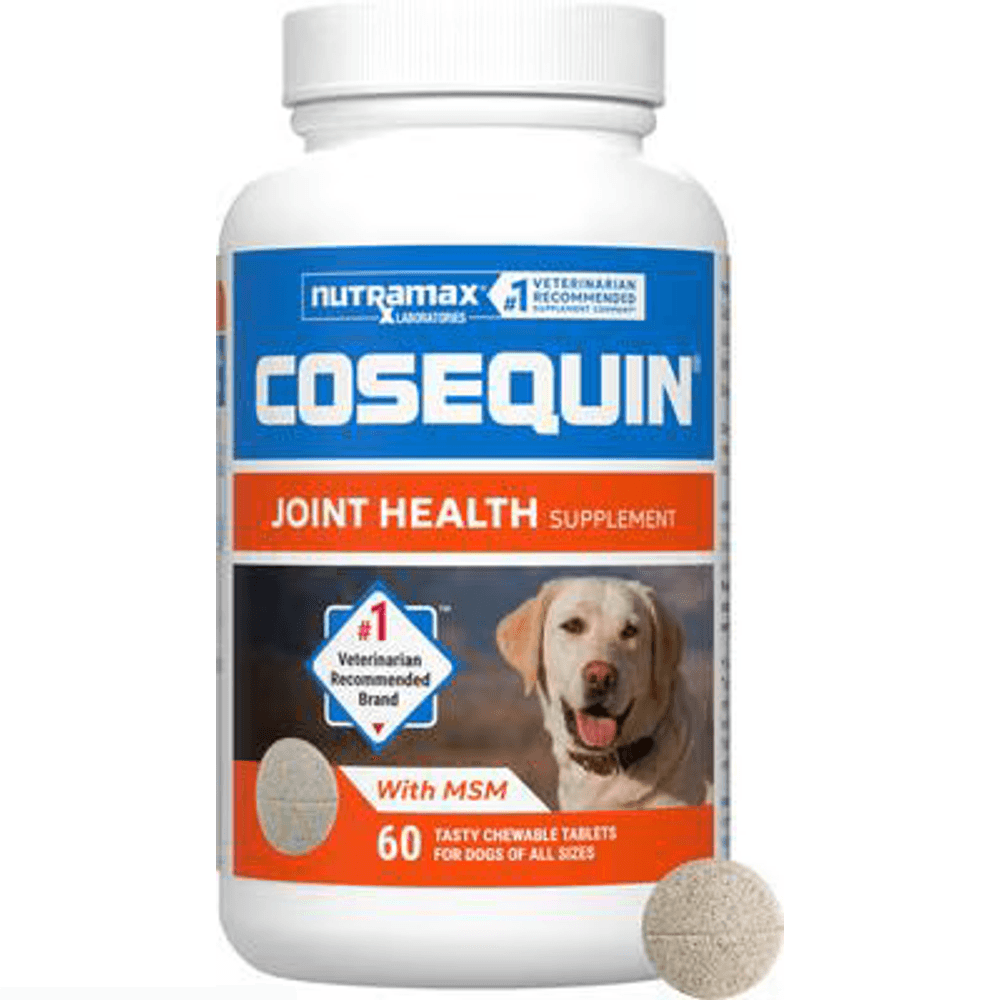
The number-one veterinarian-recommended joint supplement brand. Glucosamine, chondroitin, and MSM support cartilage and cushion the joints, easing the stiffness and hind-end weakness that can leave an older or arthritic dog trembling.
Petful may earn a commission when you click through to Chewy, at no extra cost to you.
Heart concerns
Golden Retriever heart disease is another area where screening and clinical findings differ. A breeder's cardiac screening record pertains to a named dog at a defined time. An owner should contact a veterinarian for fainting, collapse, cough, breathing change, marked exercise intolerance, weakness, or a swollen abdomen. Emergency breathing difficulty or collapse needs immediate care.
A murmur is a sound, not a complete diagnosis. The veterinarian may assess its grade and context and may recommend imaging, electrocardiography, blood pressure, or referral. Do not use a normal parent record to dismiss symptoms in an offspring.
Eyes, ears, and skin
Eye redness, squinting, cloudiness, discharge, vision change, or rubbing can be painful and may need prompt assessment. Eye screening in breeding dogs does not replace evaluation of an individual symptom.
Golden coats can hide skin changes. During gentle grooming, look for redness, odor, damp sores, parasites, scale, hair loss, and lumps. Repeated ear shaking, strong odor, discharge, swelling, or pain deserves veterinary care. Avoid putting unapproved products into an inflamed ear or eye.
Medication and supplement safety
Keep one current list of every prescription, over-the-counter product, preventive, and supplement. Include brand, active ingredients, dose, frequency, start date, and reason. Share the list with each veterinarian because products can overlap, interact, or complicate interpretation of a new sign.
Never give a dog a human pain reliever or another pet's prescription unless a veterinarian specifically directs it. "Natural" does not mean risk-free, and a supplement that is reasonable for one dog may be inappropriate with another diagnosis, diet, or medication. If vomiting, diarrhea, facial swelling, weakness, rash, or another new sign follows a product, contact the clinic and keep the package available for identification.
Weight, exercise and preventive care
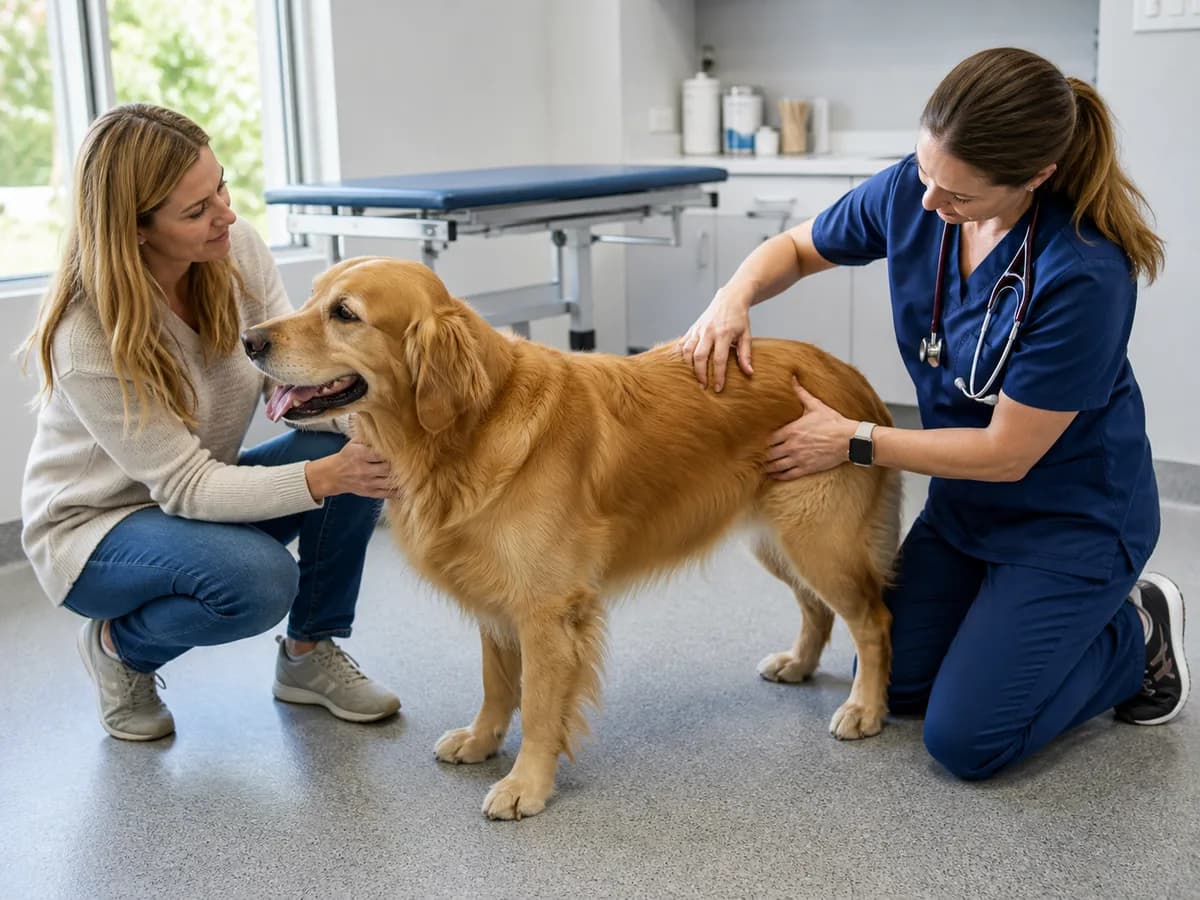
Golden Retriever healthy weight is better assessed through body condition, muscle condition, weight trend, and veterinary judgment than through a single breed number. The AVMA healthy-weight guidance encourages owners to work with a veterinarian on healthy weight and feeding.
Build a prevention record
Track:
- Weight on a consistent scale and body-condition assessment.
- Food product, calories, measured amount, and treats.
- Activity type, duration, intensity, and recovery.
- Preventive examinations, vaccines, dental care, and parasite plan.
- Medication and supplement names, doses, and response.
- New symptoms and the clinician's follow-up plan.
Weight loss and weight gain can reflect feeding, activity, illness, pain, medication, or fluid change. Do not assume that every heavier Golden simply needs more exercise or that every leaner dog is fit.
Plan prevention by the individual dog
Preventive schedules are not identical for every Golden. Age, location, travel, exposure, reproductive status, prior disease, medication, and lifestyle shape the plan. At routine visits, ask about examination frequency, vaccines, parasite prevention, dental care, nutrition, exercise, screening, and any breed-relevant concern supported by the dog's history.
Between visits, record trends without repeatedly testing or manipulating a painful area. A stable baseline photo of body shape, a monthly weight, and notes about mobility or appetite can be useful. More data is not always better if it creates anxiety or delays calling the veterinarian about a meaningful change.
Hydration setup and monitoring
Fresh water should be accessible and cleaned regularly. The Petlibro Stainless Steel Dog and Cat Fountain, 101-ounce is one tracked circulating-water option to compare for capacity, filter cost, cleaning, power access, and the dog's willingness to use it. Keep a backup bowl available.
The Petlibro Stainless Steel 101-ounce Fountain cannot correct dehydration or diagnose why drinking changed. Increased thirst, reduced drinking, repeated vomiting, weakness, or urinary change should prompt veterinary guidance. Track approximate intake only when the veterinarian asks and when it can be measured without restricting access.
Healthy growth and body condition
Golden Retriever size and puppy growth deserve their own measurement framework. A growth chart cannot diagnose disease or predict final adult size. Petful's Golden Retriever size, weight and growth guide explains how to record trends without forcing a puppy to match one line.
For health decisions, focus on whether growth is steady for the individual, the puppy maintains an appropriate body condition, movement is comfortable, and veterinary examinations remain current. Sudden weight change, poor growth, persistent digestive signs, lameness, or reduced energy needs clinical assessment.
Is this the right dog for your household?
Health planning is one part of household fit. A Golden may need screening records reviewed before acquisition, routine prevention, weight management, grooming that reveals skin changes, and a financial plan for diagnostics or treatment. Individual dogs can vary, so no owner should assume the lowest-support scenario.
- Parent-club and OFA resources provide a structured starting point for screening verification
- Written health and function logs can reveal meaningful changes over time
- Healthy-weight care, controlled activity, and preventive visits are actionable supports
- Early veterinary assessment can clarify nonspecific signs before home assumptions harden
- Screening reduces some uncertainty but cannot guarantee lifelong health
- Breed risk information can create fear when it is treated as an individual diagnosis
- Cancer, mobility, heart, eye, skin, and other concerns may require diagnostics and referral
- Lifespan and disease outcomes cannot be predicted from breed averages
Budget for routine care and unexpected findings before bringing home a dog. The main Golden Retriever breed guide explains the broader daily fit, and Petful's Golden Retriever puppy guide covers records and source verification.
Golden Retriever Health Issues and Lifespan FAQs
There is no medically sound single condition that should be labeled the silent killer for every Golden Retriever. Some serious diseases can develop before obvious signs appear, which is why routine examinations, recommended screening and attention to subtle changes matter. Contact a veterinarian promptly about unexplained weight loss, collapse, breathing changes, persistent lethargy, swelling or altered appetite.
Cancer is an important health concern in Golden Retrievers, but population risk does not predict what will happen to an individual dog. Family history, age and the specific disease all matter. Ask breeders for verifiable health information, keep routine veterinary appointments and report new lumps, unexplained weight loss, persistent lameness or changes in energy and appetite promptly.
The most common cause of death in Golden Retrievers cannot be stated responsibly without defining the population, country, time period and data source. Cancer is a major breed-health concern, but individual outcomes vary and other conditions also matter. Focus on regular veterinary care, healthy body condition, current screening guidance and early evaluation of changes rather than assuming one inevitable cause.
The most common cancer type in Golden Retrievers varies among studies and populations, so naming one without context can be misleading. Owners should know that lymphoma, mast cell tumors and hemangiosarcoma are among the cancers discussed in breed-health literature, while remembering that this is not a diagnosis. Any new mass or unexplained clinical change deserves veterinary evaluation.
There is no single first sign. Possible warning signs can include a new or changing lump, unexplained weight loss, persistent lameness, abdominal enlargement, reduced stamina, abnormal bleeding or lasting changes in appetite and behavior. Many noncancerous conditions can cause similar signs, so an examination and appropriate diagnostic testing are needed instead of trying to identify cancer at home.
The average life expectancy of a Golden Retriever is often described with a practical planning range of roughly 10 to 12 years, but no range predicts an individual dog's lifespan. Genetics, body condition, preventive care, environment and disease all influence outcomes. Use the estimate to plan long-term finances and senior care, then rely on your veterinarian for guidance tailored to the dog in front of you.
Whether male or female Goldens live longer cannot be predicted reliably from sex alone. Health history, inherited risk, body condition, preventive care, environment and access to veterinary treatment are more useful considerations. Choose a dog based on verified records and household fit, and discuss sex-specific health decisions with a veterinarian rather than expecting a lifespan guarantee.
There is no fixed age when every Golden Retriever slows down. Changes can occur gradually with maturity or aging, but a sudden decline in energy, reluctance to move or reduced interest in normal activities can also signal pain or illness. Track the dog's usual pattern and ask a veterinarian about meaningful or persistent changes instead of assuming they are normal aging.
Sources
BVMS, MRCVS
Dr. Pippa Elliott, BVMS, MRCVS, is a veterinarian with nearly 30 years of experience in companion animal practice. Dr. Elliott earned her Bachelor of Veterinary Medicine and Surgery from the University of Glasgow. She was also designated a Member of the Royal College of Veterinary Surgeons. Married with 2 grown-up kids, Dr. Elliott has a naughty Puggle named Poggle, 3 cats and a bearded dragon.
Sign up for expert-backed reviews and safety alerts all in one place.