Best Dog Food for Shih Tzu: 5 Picks by Need
The best dog food for a Shih Tzu must fit life stage, body condition, chewing comfort, and medical needs. Compare five options and learn how to read adequacy and calorie labels.

BVMS, MRCVS
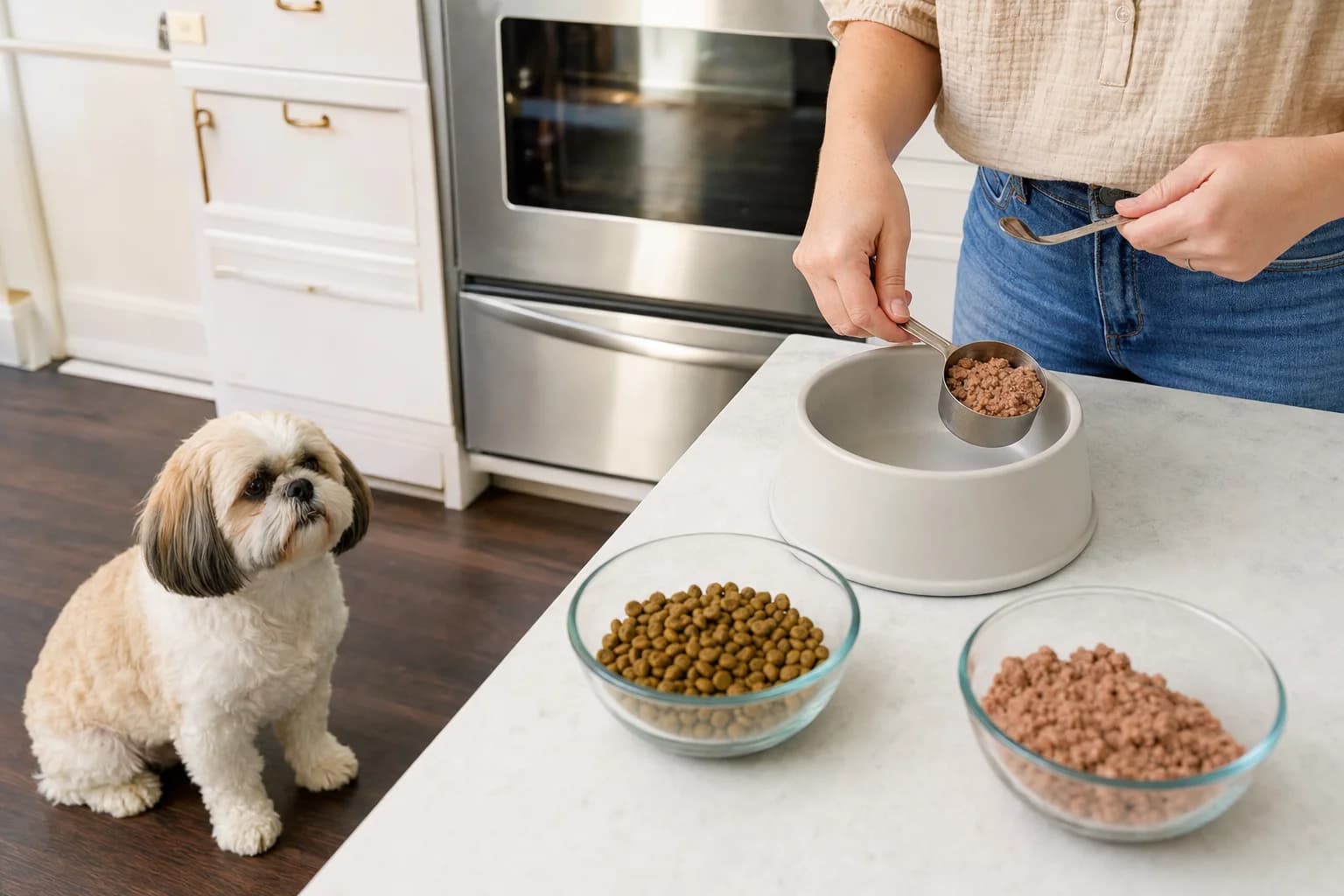
The best dog food for Shih Tzu dogs is a complete diet that matches life stage, calorie needs, body condition, chewing comfort, and medical history. No brand is best for every dog. This veterinarian-authored guide compares five adult options by use case and shows how to verify the label before buying. Petful’s guide to best dog food for American Bully has the full breakdown.
We did not select a monetized puppy pick because Petful's current affiliate catalog does not contain a suitable stable-SKU Shih Tzu puppy formula. Puppies still receive a full selection framework below. For breed size, temperament, and care, see the complete Shih Tzu guide.

Sign up for expert-backed reviews and safety alerts all in one place.
How we chose the best dog food for a Shih Tzu
- 1Start with a nutritional-adequacy statement for the dog's life stage.
- 2Compare calories per cup, can, pouch, or gram before comparing serving sizes.
- 3Manufacturer expertise, quality control, and ability to answer questions matter more than ingredient-list marketing.
- 4Disease, recurrent digestive signs, obesity, dental pain, and food reactions need veterinary guidance.
Our picks are not ranked by the prettiest ingredient list. The WSAVA nutrition toolkit encourages owners to ask who formulates the food, what quality-control processes exist, whether the company conducts research, and whether it can provide complete nutrient information. Those questions reveal more than marketing phrases such as premium, holistic, or ancestral.
The AAFCO label guide explains the nutritional-adequacy statement, ingredient list, guaranteed analysis, calorie content, feeding directions, and manufacturer information. The adequacy statement tells you whether the food is complete and balanced for adult maintenance, growth, reproduction, or all life stages, or whether it is for intermittent or supplemental feeding only.
We evaluated each pick on:
- A distinct adult use case.
- Clearly identified product and affiliate offer.
- Format and feeding practicality for a small dog.
- Ability to verify life-stage adequacy and calories on the current label.
- Tradeoffs, including cost, calorie density, storage, and transition.
- Fit with a veterinarian-led decision process rather than a breed-wide guarantee.
What is the healthiest dog food for a Shih Tzu? No brand or format is healthiest for every dog. Our best dog food for Shih Tzu selection criteria start with life-stage adequacy, calorie fit, formulation and quality-control expertise, eating comfort, and the dog's demonstrated response. The best food for a Shih Tzu with persistent digestive signs, itching, obesity, dental pain, or diagnosed disease may require veterinary testing or a therapeutic diet. Those medical boundaries matter more than an online ranking.
Formulas can change. Check the package you receive, not only an old product page. Contact the manufacturer when the adequacy statement, calories, feeding trial, or nutrient information is unclear.
What should an adult Shih Tzu eat?
A healthy adult can eat dry, wet, fresh, or a correctly combined diet as long as the total plan is complete and balanced for adult maintenance and the calories fit. The dog's photograph on a small-breed package is not the deciding evidence.
What food is good for Shih Tzu dogs? Start with a complete and balanced product for the correct life stage, then confirm calories, texture, body condition, stool quality, appetite, skin, and medical fit. Shih Tzu dog food does not need a breed picture on the package. Dog food for Shih Tzu adults should be chosen from the exact label and the individual dog's needs, not one ingredient-list slogan.

Small kibble may be easier for a short-muzzled dog to pick up, but tooth disease, jaw pain, missing teeth, or individual preference can matter more. Wet food can add meal moisture and a softer texture. Dry food is often convenient to measure and store. Fresh subscriptions can simplify portioning but require refrigeration or freezer space and cost more.
The healthiest dog food for a Shih Tzu is the one that:
- Meets the correct life stage.
- Provides an appropriate daily calorie amount.
- Can be eaten comfortably.
- Produces stable stool and supports a healthy body condition.
- Fits any veterinary diagnosis.
- Can be purchased, stored, and fed consistently.
An adult label is not appropriate for a growing puppy. A healthy-food claim is not a treatment claim. A product suitable for one adult may be a poor choice for another with pancreatitis history, urinary disease, kidney disease, heart disease, food-responsive enteropathy, or another condition.
Our 5 Shih Tzu food picks at a glance
| Pick | Best use | Format | Main tradeoff |
|---|---|---|---|
| Wellness Complete Health Adult Chicken and Oatmeal | Everyday grain-inclusive adult kibble | Dry | Verify calorie fit for a small dog |
| Purina ONE Chicken and Rice | Budget-conscious adult feeding | Dry | Larger bags require fresh storage |
| ORIJEN Original | Carefully selected higher-protein adult option | Dry | Richer and calorie-dense for some dogs |
| Wellness Protein Bowls | Softer wet format and meal moisture | Wet pouches | Higher cost per calorie and package waste |
| The Farmer's Dog | Pre-portioned fresh-food delivery | Fresh subscription | Cost, freezer space, and delivery dependence |
The picks serve different decisions. They are not five interchangeable winners. Confirm current availability, label adequacy, calories, ingredients relevant to the individual dog, package condition, and transition plan.

Wellness Complete Health: Best overall adult kibble
Wellness Complete Health Adult Chicken and Oatmeal is our everyday adult dry-food pick because it fills a straightforward grain-inclusive maintenance role. It is not a veterinary diet and is not automatically suitable for a dog with a diagnosed food reaction.
- Grain-inclusive adult-maintenance role for everyday feeding
- Dry format is convenient to measure and use for training rewards
- Stable identified Chewy product with merchant SKU 34361
- Formula and calories still require label verification
- Chicken-based formula will not suit every dog
- Bag size and storage may be excessive for one small dog
Who it may suit
A healthy adult whose veterinarian has not prescribed a therapeutic diet, who maintains good stool and body condition on a chicken-based food, and whose owner wants a conventional dry format. Kibble can be weighed precisely and part of the daily amount can be reserved for training.
Who should look elsewhere
A puppy, a dog with a medically documented need for another nutrient profile, a dog with recurrent signs on the formula, or a dog unable to chew it comfortably. Do not infer a chicken allergy from one loose stool; diet trials need veterinary structure.
How to use it
Find calories per cup and ideally per kilogram on the current label. Convert the veterinarian's daily calorie target into grams or cups, then subtract treats and toppers. Store the bag sealed in its original packaging inside a clean container so the lot code and date remain available.
Check Wellness Complete HealthPurina ONE: Best budget-friendly pick
Purina ONE Chicken and Rice High-Protein Dry Dog Food fills the budget role. A lower price per pound can make consistent complete feeding more achievable than rotating boutique foods or relying on unbalanced home additions.
- Distinct budget-conscious adult role
- Widely recognized dry-food format
- Stable identified Chewy product with merchant SKU 42212
- Large package may lose freshness before one small dog finishes it
- Chicken and rice profile is not appropriate for every medical need
- High-protein wording does not determine suitability by itself
Who it may suit
A healthy adult who tolerates the formula and whose owner needs predictable cost. Compare cost per day using calories and the dog's actual portion, not only the bag price. A food that costs more per pound can sometimes cost less per day if calorie density differs, so do the arithmetic.
Who should look elsewhere
A dog with a prescribed diet, a growth requirement, chewing difficulty, or recurrent symptoms requiring veterinary evaluation. Ingredient familiarity is not proof that a formula treats sensitive stomach or skin disease.
Storage for a small household
Large bags can become stale or contaminated when left open for months. Buy a size the dog can finish within the manufacturer's freshness guidance. Keep the original bag closed, dry, and protected from heat and pests. Wash and completely dry the storage bin between bags.
Check Purina ONE Chicken and RiceORIJEN Original: Best higher-protein option
ORIJEN Original Grain-Free Dry Dog Food is the richer, higher-protein pick in this comparison. That does not make it universally healthier. Protein percentage, fat, calories, fiber, mineral balance, life stage, and the dog's medical history all matter.
- Distinct higher-protein adult option
- Dry format allows precise weighing
- Stable identified Chewy product with merchant SKU 101296
- May be calorie-dense for a sedentary small dog
- Grain-free positioning is not medically necessary for most dogs
- Rich formulas may not suit dogs with certain gastrointestinal or metabolic histories
Who it may suit
A healthy adult whose calorie allowance, digestion, and body condition fit the formula after veterinary review. Owners must measure carefully because a small difference in grams can represent a meaningful portion of a Shih Tzu's daily energy.
Who should look elsewhere
A dog needing a lower-fat plan, a therapeutic diet, a growth formula, or a diet trial with strict ingredient control. A dog that gains weight easily may receive an impractically small volume of a calorie-dense food.
Grain-free context
Grain-free is a formulation choice, not a synonym for hypoallergenic or superior. Most food-responsive adverse reactions involve proteins, and diagnosis requires a controlled elimination trial. Discuss grain-free feeding and cardiac risk questions with the veterinarian rather than changing food based on fear or social media.
Check ORIJEN OriginalWellness Protein Bowls: Best wet-food option
Wellness Protein Bowls Beef, Potato and Green Beans provides a soft wet format. Wet food may help a dog that prefers softer texture or benefits from more meal moisture, but the current label must confirm whether the product is complete and balanced for adult maintenance rather than supplemental only.
- Softer wet texture for dogs that dislike or cannot manage dry pieces
- Adds water within the meal
- Stable identified Chewy product with merchant SKU 4052726
- Higher cost per calorie than many dry foods
- Individual pouches create more packaging
- Once opened wet food needs prompt refrigeration and safe discard timing
Who it may suit
A healthy adult who needs or prefers a wet format and whose calorie target can be met with a practical number of pouches. It can also be combined with a complete dry food, provided total calories and nutritional balance remain appropriate.
Who should look elsewhere
A dog that requires a therapeutic texture or nutrient profile, a puppy unless growth adequacy is explicitly present, or a household that cannot store and handle opened food safely. "Wet" is a format, not a medical treatment for dehydration or urinary disease.
Mixing wet and dry
Calculate calories from both components. Do not fill a normal dry portion and add a full wet portion on top. If both foods are complete and appropriate, decide the calorie split first. Introduce the combination gradually and track stool and weight.
Check Wellness Protein BowlsThe Farmer's Dog: Best fresh-food service
The Farmer's Dog is our fresh subscription pick for owners who value delivered, pre-portioned food and can manage refrigeration, freezer space, recurring delivery, and a higher cost. Verify the recipe's current adequacy statement for the dog's life stage.
- Pre-portioned delivery can simplify routine
- Fresh refrigerated format appeals to some dogs and owners
- Service model can adjust shipments
- Higher recurring cost than many dry foods
- Requires cold storage and delivery planning
- Recipe changes and medical needs still require veterinary review
Who it may suit
A healthy adult whose veterinarian agrees that the recipe and calories fit, in a household that wants portioned delivery and can maintain the cold chain. The service may reduce measuring errors if the package portion matches the dog's true calorie target.
Who should look elsewhere
A dog requiring a veterinary therapeutic diet, a household with unreliable cold storage or delivery, or an owner who cannot sustain the subscription cost. A fresh format does not automatically make a food more digestible, safer, or nutritionally superior.
Handling
Follow refrigeration, thawing, handwashing, bowl-cleaning, and discard instructions. Do not leave perishable food at room temperature for long periods. If travel or power outages are common, maintain a veterinarian-approved backup plan and transition strategy.
Check The Farmer's DogChoosing food for a Shih Tzu puppy
Shih Tzu puppies need food labeled as complete and balanced for growth, including the appropriate growth category on the adequacy statement. Adult maintenance food is not designed to support all puppy requirements. "All life stages" food is formulated to meet growth needs and may be calorie-dense, so portioning still matters.
We intentionally did not force a puppy product into the roundup without a stable, suitable catalog offer. Choose by adequacy, calories, manufacturer information, digestibility for the individual, and veterinary guidance. Continue the breeder or rescue's food during the first transition unless the veterinarian advises otherwise.
Puppies usually need multiple measured meals because of small stomach capacity and training demands. Very young small puppies that refuse food, vomit, have diarrhea, become weak, tremble, or seem unusually sleepy need prompt veterinary advice.
When to use the puppy guide
The detailed Shih Tzu puppy guide covers the first month, socialization, grooming, and veterinary intake.
How much should a Shih Tzu eat?
There is no correct breed-wide cup amount. Daily energy depends on body weight, body condition, age, neuter status, activity, environment, health, and the food's calories. Two foods can have very different calories per cup.
What should a Shih Tzu eat in a day? Feed a measured amount of complete food that meets the correct life stage, divide it into a practical meal schedule, and count treats and toppers within the daily calories. How much to feed a Shih Tzu must be calculated from the dog's body condition and the food's calorie density, then adjusted from weight and condition trends. What food is good for a Shih Tzu with a sensitive stomach depends on the cause, so a sudden or persistent problem needs veterinary assessment rather than repeated diet guessing.

Start with calories
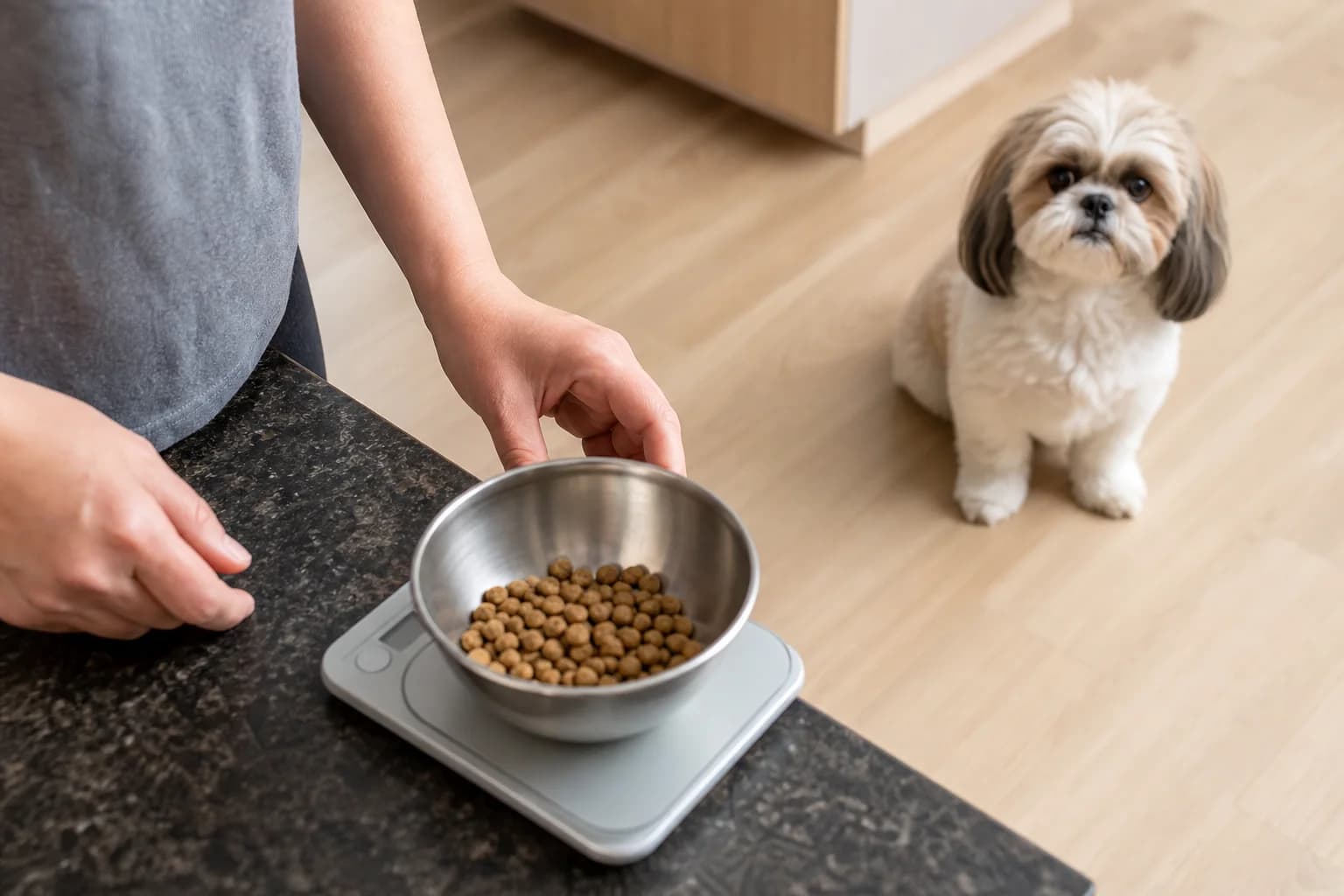
Ask the veterinarian for a starting daily calorie target or calculate one with the veterinary team. Find kilocalories per cup, can, pouch, or kilogram on the label. Use a kitchen scale when possible because grams are more repeatable than a rounded scoop.
For example, if a dog is assigned 320 calories per day and 40 calories are reserved for treats, meals must supply about 280 calories. If the food provides 400 calories per cup, 280 calories equals 0.7 cup for the day. That example is arithmetic, not a recommendation for a particular dog.
Divide and measure
Many adults do well with two meals, while puppies need more frequent feeding. Weigh the full daily portion each morning, then divide it. Remove training rewards from the same allowance or count them separately.
Reassess body condition
Feel ribs through the coat, look for a waist from above, and assess the abdominal tuck. A thick coat can hide both weight gain and muscle loss. Record weight every few weeks during a change, then less often when stable.
If weight rises, confirm measuring accuracy and treat calories before making a large cut. If weight falls unexpectedly, appetite changes, or muscle is lost, schedule an examination rather than simply increasing food.
Treats, toppers, and table food
Extras can unbalance a carefully selected diet and add substantial calories to a small dog. Keep treats and unbalanced additions to a modest portion of daily energy, often described by veterinary nutrition guidance as no more than about 10%, unless the veterinary plan says otherwise.
Use part of the complete food for training. Break treats into tiny pieces. The dog values repetitions more than treat size. Track dental chews, pill pockets, lick mats, and family handouts.
Toppers are not automatically benign. Meat, broth, cheese, oils, supplements, and freeze-dried pieces add calories and nutrients. A dog who refuses plain food but waits for escalating toppers may be learning a pattern, while a dog with sudden appetite change may be ill. Separate behavior from medical assessment.
Foods and feeding patterns to avoid
What should you not feed a Shih Tzu? Avoid known dog toxins and unsafe feeding practices, not one universal ingredient list.
- Chocolate.
- Grapes and raisins.
- Xylitol.
- Onions, garlic, and concentrated allium products.
- Alcohol and caffeine.
- Macadamia nuts.
- Cooked bones and objects that splinter or obstruct.
- Moldy food and unsecured trash.
- Human medicines and unprescribed supplements.
This list is not exhaustive. Call a veterinarian or animal poison service after a suspected exposure. Do not induce vomiting unless directed because it is unsafe in some situations.
Also avoid rapid food changes, free-pouring calorie-dense food, unbalanced home recipes, and switching repeatedly without evaluating the cause of symptoms.
Sensitive stomach, itching, and suspected food reactions
"Sensitive stomach" is a description, not a diagnosis. Vomiting, diarrhea, gas, appetite change, weight loss, and abdominal discomfort can come from diet amount, rapid transitions, parasites, infection, pancreatitis, foreign material, endocrine disease, medication, stress, or other conditions.
Food allergy usually involves an immune reaction to proteins and is less common than many owners assume. Itching can come from fleas, environmental allergy, skin infection, ear disease, or several causes at once. An ingredient list cannot diagnose the source.
A veterinary elimination trial uses a selected therapeutic diet, strict duration, and controlled re-challenge when appropriate. Flavored medicines, treats, chews, and shared bowls can invalidate the trial. Over-the-counter "limited ingredient" labels may not provide the manufacturing controls needed for diagnosis.
When stomach signs are urgent
Seek prompt care for repeated vomiting, blood, black stool, severe diarrhea, weakness, abdominal swelling, unproductive retching, dehydration, pain, or suspected obstruction or toxin exposure.
How to switch foods safely
Change gradually when the dog is stable and the veterinarian has not directed an immediate switch. A seven-day outline might use 25% new food for two days, 50% for two days, 75% for two days, then 100%, but some dogs need longer.

Keep total calories similar during the change. Measure both foods because equal cup volumes may not contain equal calories. Monitor appetite, stool, vomiting, itching, and energy. Stop and call the veterinarian for significant symptoms.
If a food is part of a diagnostic diet trial, follow the clinic's exact transition and feeding rules. If the dog has pancreatitis risk, severe disease, or recent hospitalization, generic transition advice may not apply.
When food choice needs your veterinarian
Veterinary input is particularly important for:
- Puppies and pregnant or nursing dogs.
- Unexplained weight change or muscle loss.
- Obesity that has not responded to accurate portioning.
- Recurrent vomiting, diarrhea, constipation, or appetite loss.
- Itching, ear disease, or a planned elimination trial.
- Kidney, liver, heart, urinary, endocrine, or gastrointestinal disease.
- Pancreatitis history or need for fat restriction.
- Dental pain or swallowing difficulty.
- Multiple medications or supplements.
- Home-prepared diets.
A board-certified veterinary nutritionist can formulate a complete home-prepared diet for dogs whose needs cannot be met conveniently with commercial food. Recipes must be followed exactly; substitutions change nutrient balance.
- Trouble breathing, collapse, repeated unproductive retching, severe weakness, suspected toxin ingestion, inability to keep water down, a swollen painful abdomen, or major bleeding needs urgent veterinary care. Do not wait for a food switch to work.
Manufacturer questions worth asking
The WSAVA selection questions are designed to help owners assess the company behind a food. Useful questions include:
- Who formulates the diet, and what are their qualifications?
- Where is the food manufactured?
- What quality-control checks apply to ingredients and finished products?
- Does the company conduct and publish nutrition research?
- Can it provide a typical nutrient analysis, not only guaranteed minimums and maximums?
- How are complaints and potential recalls handled?
A company should be able to answer clearly. Refusal, vague marketing language, or dependence on ingredient buzzwords lowers confidence.
Reading a dog-food label in five minutes
First, identify the exact product and life-stage adequacy. Second, find calories. Third, check feeding directions only as a starting point. Fourth, confirm manufacturer contact information and lot/date codes. Fifth, scan ingredients for a known veterinary reason, not to rank the food by where one appealing ingredient appears.
Guaranteed analysis values are minimums or maximums on an as-fed basis and can be difficult to compare across wet and dry foods because moisture differs. For medical nutrient comparison, ask for dry-matter or calorie-basis data and let the veterinary team interpret it.
The ingredient list is ordered by weight before processing. It does not show ingredient quality, digestibility, final nutrient contribution, or manufacturing control. Splitting one ingredient into several names can also change where items appear.
Dry, wet, fresh, and mixed feeding compared
Format changes convenience, moisture, cost, storage, and sometimes calorie density. It does not override nutritional adequacy.
Dry food
Dry food is easy to weigh, store, use in puzzle toys, and reserve for training. Larger packages can be economical, but one Shih Tzu may take too long to finish a large bag. Keep the food in its original packaging, seal it, and protect it from heat, humidity, pests, and air.
Kibble does not clean every dog's teeth sufficiently. Ordinary dry pieces can fracture and crumble without scraping the gumline. Daily brushing and veterinary dental care remain necessary.
Wet food
Wet food contains more water and offers a soft texture. It can be useful for preference, chewing comfort, or a planned mixed diet. Once opened, it needs refrigeration and prompt use according to the label. Calculate calories per can or pouch because volume can look generous while energy varies.
Fresh subscription food
Fresh services often provide portion recommendations and recurring delivery. Confirm the exact recipe's life-stage adequacy, calories, formulation expertise, and quality control. Plan freezer and refrigerator space, delivery interruptions, travel, and backup food.
Mixed feeding
Dry and wet foods can be combined when both are appropriate. Decide the calorie proportion first. A 50-50 visual bowl is not necessarily a 50-50 calorie split.
| Question | Dry | Wet | Fresh subscription |
|---|---|---|---|
| Easy to weigh | Excellent with a gram scale | Good by pouch or can weight | Good when portions are clearly labeled |
| Meal moisture | Lower | Higher | Varies but generally higher than dry |
| Storage before opening | Simple in cool dry conditions | Simple but cans and pouches need space | Freezer or refrigerator planning |
| Storage after opening | Seal and protect the bag | Refrigerate and use promptly | Maintain cold chain |
| Cost per calorie | Often lower | Often higher | Commonly highest |
| Travel | Usually easiest | Manage opened containers | Requires cold-chain or backup plan |
Adult, senior, and geriatric food decisions
"Senior" is not one AAFCO life stage with a universal nutrient profile. Senior formulas vary. Some reduce calories, some adjust fiber, and some emphasize other nutrients. Choose based on the dog's body condition and health, not the age word alone.
A healthy older Shih Tzu may still digest and use high-quality protein well. Unnecessary protein restriction can make it harder to preserve muscle. Dogs with certain kidney, liver, or other diseases may need a specific veterinary diet, but that decision follows diagnosis and laboratory assessment.
Watch for:
- Unplanned weight loss.
- Loss of muscle over the spine, hips, or skull.
- Difficulty picking up or chewing food.
- Longer meal times or food dropping.
- Increased thirst or urination.
- Nausea, lip licking, or turning away.
- Constipation, diarrhea, or vomiting.
These signs are not solved by buying a senior bag without assessment. The veterinarian-authored Shih Tzu lifespan guide explains senior stages and monitoring.
Feeding a dog with dental pain
Soft food may reduce immediate chewing difficulty, but it does not treat periodontal disease, a fractured tooth, or an oral mass. A dog that suddenly prefers soft food, chews on one side, drops kibble, or has facial swelling needs a dental examination.
After a procedure, follow discharge instructions. The dog may need a temporary texture change, medication, or calorie support. Do not resume hard chews simply because the dog asks for them.
Protein, fat, fiber, and carbohydrate
Dogs need nutrients, not a social-media ranking of ingredient groups. Protein supplies amino acids, fat supplies essential fatty acids and concentrated energy, and carbohydrates can supply energy and fiber. Vitamins and minerals must remain balanced.
Protein
The guaranteed analysis gives a minimum crude protein percentage, not protein quality, amino-acid balance, or digestibility. Comparing wet and dry percentages directly is misleading because water differs. For clinical comparison, ask for dry-matter or calorie-basis data.
More protein is not automatically better. A healthy active adult may do well on a higher-protein formula, while a small sedentary dog may receive too many calories from a rich food if portioning is loose. Medical conditions can change the decision.
Fat
Fat improves palatability and supplies energy. It also makes a food calorie-dense. Dogs with pancreatitis history or certain gastrointestinal conditions may need veterinary fat restriction. The ingredient list cannot tell you the full fat profile; request nutrient information when it matters.
Fiber
Fiber type and amount influence stool, satiety, and gut function. A higher-fiber food may help one weight plan and worsen stool volume or tolerance in another. Pumpkin added by spoon is not a universal digestive treatment and adds calories and variability.
Carbohydrate and grain
Grains can provide digestible carbohydrate, protein, fatty acids, vitamins, minerals, and fiber. A grain-free label does not mean low carbohydrate. Potatoes, peas, lentils, and other ingredients can provide starch. Choose grain-free only for a clear reason discussed with the veterinarian.
Weight loss without malnutrition
A Shih Tzu's full coat can hide gradual weight gain. Before reducing food, confirm the current weight, body-condition score, muscle-condition score, and actual calorie intake. Include every treat, chew, topper, and family handout.
The safest plan maintains essential nutrients while reducing calories. Simply feeding half the normal amount of an adult maintenance food can underdeliver nutrients if the cut is large. A veterinary weight-management diet may provide more protein, fiber, vitamins, and minerals per calorie.
A measured process
- Weigh the dog and obtain a target from the veterinary team.
- Calculate current food and extra calories.
- Select a calorie target and appropriate diet.
- Weigh meals in grams.
- Recheck weight and body condition at the recommended interval.
- Adjust based on trend.
Aim for gradual change. Rapid weight loss, weakness, refusal to eat, or muscle loss requires reassessment.
Keep rewards while cutting calories
Use pieces of the complete food, very small low-calorie treats, play, sniff access, and praise. Reserve a daily treat container so everyone sees what remains. A small dog does not know that a reward is tiny; it notices frequency and timing.
Food safety, storage, and bowls
Food can become stale, contaminated, or damaged after purchase. Inspect packaging for tears, swelling, broken seals, moisture, pests, or unusual odor. Record the lot code, best-by date, and purchase source before discarding the bag.
Wash food bowls after meals and water bowls daily. Biofilm can build even when a bowl looks clear. Stainless steel is durable and easy to sanitize; cracked plastic can harbor residue.
Dry-food storage
Keep kibble in the original bag because the packaging is designed for the product and preserves traceability. Place the closed bag inside a clean sealed container. Do not pour a new bag on top of old crumbs and oils. Wash and fully dry the container between bags.
Wet and fresh storage
Refrigerate opened food promptly and use within label directions. Use clean utensils. Thaw fresh food under refrigeration, not on the counter. Discard food left out beyond safe guidance, especially in warm weather.
When a product may be recalled
Stop feeding when the manufacturer or regulator identifies the exact product and lot, or when the package appears unsafe. Save packaging, receipts, and a sample if the veterinarian or authority requests it. Contact the veterinarian when the dog has symptoms.
A recall does not prove every product from a company is unsafe forever, and absence of a recall does not prove perfect quality. Evaluate how the company communicates, traces lots, and corrects problems.
Home-cooked and raw diets
Home preparation gives ingredient control but creates a high risk of nutrient imbalance when recipes are improvised. Meat, rice, and vegetables do not automatically provide the right calcium, phosphorus, trace minerals, vitamins, fatty acids, and amino acids.
A board-certified veterinary nutritionist can formulate a recipe for the dog's life stage and medical needs. Follow the recipe by gram weight and use the exact supplement. Substituting one meat, oil, grain, or supplement can change the nutrient profile.
Raw-food considerations
Raw animal products can contain pathogenic bacteria and parasites that affect the dog and people handling food or feces. Risk matters especially in homes with young children, older adults, pregnant people, or immunocompromised people.
Bones can fracture teeth, obstruct, or injure the gastrointestinal tract. Grinding does not eliminate microbial risk. A shiny coat or eager appetite does not prove a diet is complete or safe.
If an owner chooses raw feeding despite these concerns, discuss pathogen control and nutritional adequacy with veterinary professionals. Do not feed raw as an unmonitored treatment for itching or digestive signs.
Supplements and functional ingredients
A complete diet should already provide essential nutrients in appropriate amounts. Adding multivitamins or minerals can create excess or imbalance. Calcium is especially risky in growing puppies when added without a formulated need.
Fish oil, joint ingredients, probiotics, dental additives, and skin products may have specific uses, but product quality, dose, evidence, and interaction matter. Ask:
- What problem are we treating?
- What evidence supports this ingredient for that problem?
- What dose applies to this product?
- How will we know it works?
- Could it duplicate the food or another supplement?
- When should it be stopped?
Do not use a supplement to delay diagnosis. Weight loss, diarrhea, itching, pain, or mobility change deserves assessment.
A 30-day food evaluation
When a healthy dog changes to a nontherapeutic food, define success before starting.
Baseline
Record weight, body condition, meal amount in grams, treat calories, stool frequency and consistency, appetite, vomiting, itch, ear signs, and current medications. Photograph the body from above and the side.
Transition week
Change gradually, keep total calories similar, and avoid introducing new treats or supplements. Track which proportions were fed. One loose stool after a rich treat should not be blamed automatically on the base food.
Stable feeding weeks
Feed measured amounts at consistent times. Monitor stool, appetite, comfort, and weight. Do not change the portion every day. A trend needs enough time, while significant symptoms need immediate veterinary advice.
Review
At day 30, ask whether body condition is moving correctly, stool and appetite are stable, the dog eats comfortably, the budget is sustainable, and the household can purchase and store the food consistently. A food can be nutritionally sound but operationally wrong for a family.
If the goal was diagnosis of an adverse food reaction, this generic evaluation is not sufficient. Follow the veterinarian's elimination-trial protocol.
Cost per day and package planning
Price per bag can mislead. Calculate cost per usable feeding day.
Example:
- Package price: $64.
- Package contains 12,000 calories.
- Dog's food allowance: 300 calories per day.
- Package lasts about 40 days.
- Food cost is about $1.60 per day before treats, tax, shipping, or waste.
Use label calories, not an online estimate for another formula. For wet pouches, multiply pouches per day by price per pouch. For subscriptions, include delivery and compare the actual billed portion.
Avoid false economy
The cheapest package is not economical if it is too large to stay fresh, the dog cannot tolerate it, or portions are overfed. The most expensive format is not automatically more nutritious. Choose a food the household can maintain without sacrificing veterinary care.
Selecting among the five picks
Use a decision order:
- Does the dog need a veterinary diet? If yes, use the prescribed plan rather than this roundup.
- Is the dog a puppy? If yes, choose verified growth adequacy; none of the five adult picks is our puppy recommendation.
- Does the dog need a soft format? Consider Wellness Protein Bowls or a veterinarian-selected alternative after evaluating dental disease.
- Is budget the main constraint? Compare Purina ONE Chicken and Rice cost per day with local prices and portion needs.
- Do you want conventional grain-inclusive dry food? Wellness Complete Health fills that everyday role.
- Are you specifically evaluating a richer higher-protein food? ORIJEN Original is the distinct option, subject to calories and medical fit.
- Do delivery and pre-portioned fresh food justify higher cost and cold storage? Review The Farmer's Dog.
This order prevents a product badge from outranking life stage or disease.
Feeding during travel, boarding, and emergencies
Pack enough food plus several extra days in labeled, sealed portions. Keep the original product name, lot, calorie information, and feeding instructions. Tell the caregiver how treats and medication affect the allowance.
Do not start a new food immediately before travel or boarding. Stress and routine change already affect appetite and stool, making a food reaction difficult to interpret.
Maintain a small rotation-safe backup only if the dog has used it successfully and the veterinarian approves. For therapeutic diets, ask the clinic what to do when supply is interrupted. Do not substitute another prescription product based only on a similar name.
Cold-chain emergencies
In a power outage, protect refrigerated food according to food-safety guidance. When in doubt about a perishable product, discard it. A temporary safe complete alternative is better than feeding spoiled food.
Common dog-food marketing myths
"The first ingredient proves quality"
Ingredient order reflects pre-processing weight. Water-rich meat can appear first while contributing differently after cooking. Overall formulation and nutrient delivery matter.
"By-products are always poor quality"
Named animal by-products can include nutrient-rich organs. Quality and processing matter; the word alone does not establish inferiority.
"Human-grade means best for the dog"
The term relates to ingredient and processing standards under specific conditions, not whether the final nutrient profile is ideal for this dog.
"Natural means safer"
Natural substances can be toxic, contaminated, excessive, or nutritionally unbalanced. Safety requires formulation, manufacturing control, and appropriate use.
"A rotating diet prevents allergy"
Unstructured rotation exposes the dog to more proteins and can make a future elimination trial harder. There is no guarantee it prevents allergy. Change food for a reason, not novelty.
"Breed-specific food is required"
Breed labels may offer useful kibble size or calorie positioning, but a Shih Tzu does not require a product with its picture. Nutritional adequacy and individual fit come first.
Veterinary therapeutic diets
Therapeutic diets are formulated for specific clinical goals such as kidney disease, urinary conditions, gastrointestinal disorders, adverse food reactions, obesity, or other diagnosed needs. They are not simply premium versions of ordinary food.
A dog may look healthy while laboratory results or imaging support a diet change. Conversely, an owner should not choose a kidney, low-fat, or urinary diet because a breed seems prone to a condition. Restricting nutrients without a diagnosis can be inappropriate.
Make the prescription workable
Ask the veterinarian:
- What condition and outcome is this diet addressing?
- Must it be fed exclusively?
- Which treats, chews, and flavored medicines are compatible?
- How quickly should the dog transition?
- What improvement or laboratory change should occur?
- When will the plan be reassessed?
- What is the backup if the product is unavailable?
Cost and acceptance matter. Tell the clinic if the dog refuses the food, the household cannot store it, or the price is unsustainable. Another appropriate formulation or format may exist. Quiet nonadherence helps no one.
Do not combine therapeutic diets casually
A kidney diet and a urinary diet may pursue different nutrient targets. Mixing two prescribed foods can dilute both goals. When a dog has several diseases, the veterinarian must prioritize and sometimes consult a veterinary nutritionist.
Food refusal and picky eating
Some Shih Tzus learn that waiting produces cheese, meat, or a new flavor. Others refuse food because of dental pain, nausea, airway difficulty, stress, medication effects, or disease. The pattern and the dog's overall state distinguish a training issue from a medical one.
Schedule care promptly when refusal is sudden, lasts beyond the veterinary team's safe interval, occurs with weakness, vomiting, diarrhea, pain, weight loss, excessive thirst, or behavior change. Puppies and dogs with certain diseases have less margin for missed meals.
For a medically well adult:
- Offer measured meals at predictable times.
- Keep the environment calm.
- Limit extras between meals.
- Avoid changing foods every time the dog pauses.
- Track actual intake and weight.
- Use veterinary advice before appetite stimulants or supplements.
Do not create a contest of will with a vulnerable dog. The veterinarian should establish whether it is safe to use a structured meal routine.
Environmental impact and practical waste
Food choices also create packaging, shipping, refrigeration, and food-waste considerations. Buy a package size the dog can finish safely. Recycle only where local rules accept the material. Avoid overordering a subscription before confirming acceptance.
Accurate portioning reduces both cost and waste. A dog that needs 80 grams should not receive a rounded cup because the scoop is convenient. Store leftovers safely and discard spoiled food rather than trying to save it.
Sustainability claims vary in definition and verification. Ask for specific evidence instead of assuming local, natural, or recyclable means lower impact. Nutritional adequacy and food safety remain the first obligations to the dog.
A final pre-purchase label audit
Before ordering any pick, save a photograph or screenshot of the current product name, package size, adequacy statement, calories, ingredient list, guaranteed analysis, lot information location, and manufacturer contact. Confirm that the listing and delivered package match.
Then write the intended role in one sentence: "This is an adult maintenance dry food for a healthy dog," or "This is a complete wet adult food used for 40% of daily calories." If the sentence cannot be completed, the plan is not yet clear.
Check the arithmetic with the actual package:
- Daily calorie target from the veterinary plan.
- Calories reserved for treats and extras.
- Calories that meals must supply.
- Grams, cups, cans, pouches, or packs needed.
- Days per package.
- Cost per day.
Finally, set the review date. A new diet should be reassessed using weight, body and muscle condition, stool, appetite, comfort, and the original goal. Continuing indefinitely because the bag says premium is not evidence-based feeding.
Questions for the veterinary appointment

Bring the package label or exact product link, measured daily amount, treat list, supplement list, and three-day food diary. Ask the clinician to show you the dog's body- and muscle-condition scores rather than only stating the weight.
Useful questions include:
- Is this diet complete for the current life stage?
- Does the calorie amount match the dog's target?
- Are any current signs likely to be food-related, or should other causes be tested first?
- Does a medical condition change fat, protein, phosphorus, sodium, fiber, or other priorities?
- Are the treats and dental chews compatible?
- When should weight or laboratory work be rechecked?
- What change would justify switching again?
If the answer involves a nutrient not published on the label, contact the manufacturer for typical analysis. A veterinarian may compare nutrients per 1,000 kilocalories or on a dry-matter basis, depending on the clinical question.
When online advice conflicts
Bring the claim to the appointment and ask what evidence applies to this dog. A recommendation can sound scientific while relying on another species, a laboratory study, an unrepresentative case, or a marketing survey. The veterinarian can explain whether the concern changes the plan.
Do not stop a therapeutic diet or add a supplement because a social post names one ingredient as toxic. Equally, do not ignore a new symptom because a brand community says it is detox or adjustment. Clinical change deserves clinical assessment.
Shih Tzu feeding FAQs
There is no single healthiest brand for every Shih Tzu. Start with a food that is complete and balanced for the dog's life stage, then evaluate calorie needs, body condition, chewing comfort, stool quality, health conditions, and veterinary guidance. A marketing label such as premium, natural, or breed-specific does not replace nutritional adequacy or individual fit.
Feed a measured amount of a complete diet divided into a schedule that suits the dog's age and medical needs. The correct daily calories depend on body weight, body condition, age, activity, neuter status, treats, and the food's calorie density. Use the package guide only as a starting point and adjust with veterinary help based on weight trend.
Small pieces can be easier for a Shih Tzu to pick up and chew, but the adequacy statement, calories, body condition, dental comfort, and medical fit matter more than the small-breed label. Choose a texture the dog can eat safely. Coughing, gagging, dropping food, mouth pain, or a sudden eating change deserves veterinary assessment.
Either format can work when it is complete and balanced for the dog's life stage. Wet food may be easier for some dogs to eat and adds water, while dry food can be convenient and calorie dense. Dental claims require scrutiny, and ordinary kibble does not replace brushing. The best choice depends on health, calories, preference, budget, and veterinary advice.
Avoid known dog toxins including chocolate, grapes or raisins, xylitol, onions, garlic, alcohol, and macadamia nuts. Cooked bones, very fatty scraps, and unbalanced homemade diets also create avoidable risks. This is not a complete toxin list. After a possible exposure, contact a veterinarian or animal poison service promptly rather than waiting for symptoms.
Choose a complete and balanced food labeled for growth, with calories and piece size the puppy can manage. Feed measured meals and let the veterinarian monitor growth and body condition. Supplements, raw diets, and improvised home recipes can unbalance a growing puppy unless formulated for that individual by a qualified veterinary nutrition professional.
First distinguish preference from pain, nausea, stress, dental disease, or another medical problem. A sudden appetite change, weight loss, vomiting, diarrhea, lethargy, or difficulty chewing needs veterinary attention. For a healthy selective eater, use measured meals, limit extras, keep a consistent routine, and avoid repeatedly escalating toppers until the balanced diet becomes a minor part of intake.
Sensitive stomach is a description, not a diagnosis. Recurrent vomiting, diarrhea, gas, poor appetite, or weight loss can have many causes. Keep a food and symptom record and ask the veterinarian whether testing or a structured diet trial is appropriate. Randomly rotating boutique foods can obscure the pattern and make it harder to identify what helped.
When the dog is stable, transition gradually over about a week or longer while keeping total calories consistent. Increase the new food in steps and monitor appetite, stool, vomiting, skin, and energy. Follow veterinary instructions when illness or a diagnostic diet trial is involved. Stop and seek advice if significant symptoms develop during the change.
Treats and extras should usually remain a small share of daily calories so they do not displace complete nutrition or cause weight gain. Because Shih Tzus are small, several ordinary treats can represent a large calorie load. Use tiny pieces, count dental chews and table food, and subtract treat calories from the daily allowance when practical.
Compare foods on a calorie basis
Package price alone gives a poor comparison because formulas vary in moisture, calorie density, and serving size. First calculate the dog's meal calories after treats. Then determine how many grams, cups, cans, pouches, or packs supply that amount and how many days the package will last.
Use the same worksheet for every candidate:
- Current price for the exact package.
- Total package weight or number of units.
- Calories per kilogram and per cup, can, pouch, or pack.
- The dog's planned meal calories per day.
- Product amount used per day.
- Days supplied by one package.
- Cost per day and approximate cost per month.
This comparison can reveal that a lower bag price is not always a lower daily cost. It also exposes impractical plans, such as a small dog taking months to finish a large bag after opening.
What successful feeding looks like
A food earns its place through results in the individual dog, not through the strongest label language. Define success before the transition so normal day-to-day variation does not drive constant switching.
Track these outcomes:
- Stable weight and appropriate body condition.
- Preserved muscle over the spine, shoulders, hips, and thighs.
- Comfortable chewing and reliable appetite.
- Formed stool at a frequency normal for the dog.
- No repeated vomiting, regurgitation, excessive gas, or abdominal discomfort.
- Skin and ears that are not progressively inflamed or itchy.
- Energy and exercise recovery appropriate for age and health.
Record the measured amount and every meaningful extra. If the plan changes, adjust one factor at a time when medically safe. Otherwise the owner cannot tell whether the formula, portion, treats, transition speed, illness, or another change affected the result.
Buying and receiving food safely
Use a retailer that identifies the exact product and package size and provides reasonable storage and return conditions. When food arrives, inspect the seal, package damage, date code, lot code, odor, appearance, and whether the listing matches the delivered formula.
Before opening:
- Photograph the front, adequacy statement, calorie statement, date, and lot.
- Confirm the life stage and intended use.
- Check that the package was not swollen, torn, wet, or exposed to temperature abuse.
- Compare the product name with the one used in the feeding calculation.
- Keep the receipt and retailer information until the food is accepted.
If the food looks or smells abnormal, do not feed it to test whether it is safe. Isolate the package from children and animals, contact the manufacturer and retailer, and follow veterinary advice if the dog ate it or has signs.
Reordering without accidental formula drift
Names, bag designs, sizes, calorie values, and recipes can change. Recheck the label when a new package arrives instead of assuming the previous calculation still applies. A subscription reduces ordering effort but does not remove the need to inspect each shipment.
Update the portion whenever calorie density changes. A cup is a volume, not a fixed calorie unit. For the most repeatable measurement, weigh the daily amount in grams and use the cup only as a convenient transfer tool.
Confirm the plan after 30 days
At the review point, compare current weight, body condition, muscle condition, stool, appetite, chewing comfort, skin, ears, and energy with the baseline. Include the measured food, treats, dental chews, toppers, supplements, and table food. The best food for a Shih Tzu is the plan that remains complete, practical, and appropriate when every calorie is counted.
If the dog is doing well, avoid switching for novelty. If the goal is not being met, define the problem before changing products. A portion adjustment, dental examination, diagnostic workup, slower transition, or different texture may be more appropriate than choosing a formula with stronger marketing language.
For persistent digestive or skin signs, keep the history clean enough for the veterinarian to interpret. Repeated unstructured food changes add ingredients and erase timelines. A controlled plan with a start date, exact product, measured amount, and follow-up criteria produces better evidence than trial-and-error feeding.
Bottom line
The best dog food for a Shih Tzu is not one ingredient list or brand badge. It is a complete life-stage-appropriate diet, measured to the dog's calorie needs, tolerated well, supported by a transparent manufacturer, and adjusted with body-condition and veterinary evidence.
Use the five picks as distinct adult starting points. Verify the current label, calculate portions, count extras, transition carefully, and seek veterinary advice when symptoms or disease make a generic recommendation unsafe.
BVMS, MRCVS
Dr. Pippa Elliott, BVMS, MRCVS, is a veterinarian with nearly 30 years of experience in companion animal practice. Dr. Elliott earned her Bachelor of Veterinary Medicine and Surgery from the University of Glasgow. She was also designated a Member of the Royal College of Veterinary Surgeons. Married with 2 grown-up kids, Dr. Elliott has a naughty Puggle named Poggle, 3 cats and a bearded dragon.
Sign up for expert-backed reviews and safety alerts all in one place.