Best Dog Food for Belgian Malinois: 4 Picks by Need
Compare four existing dog-food options for Belgian Malinois by life stage, workload, calorie density, availability, and practical tradeoffs for active dogs.
Petful is reader supported. As an affiliate of platforms like Amazon and Chewy, we may earn a commission when you buy through links on this page. There is no extra cost to you.
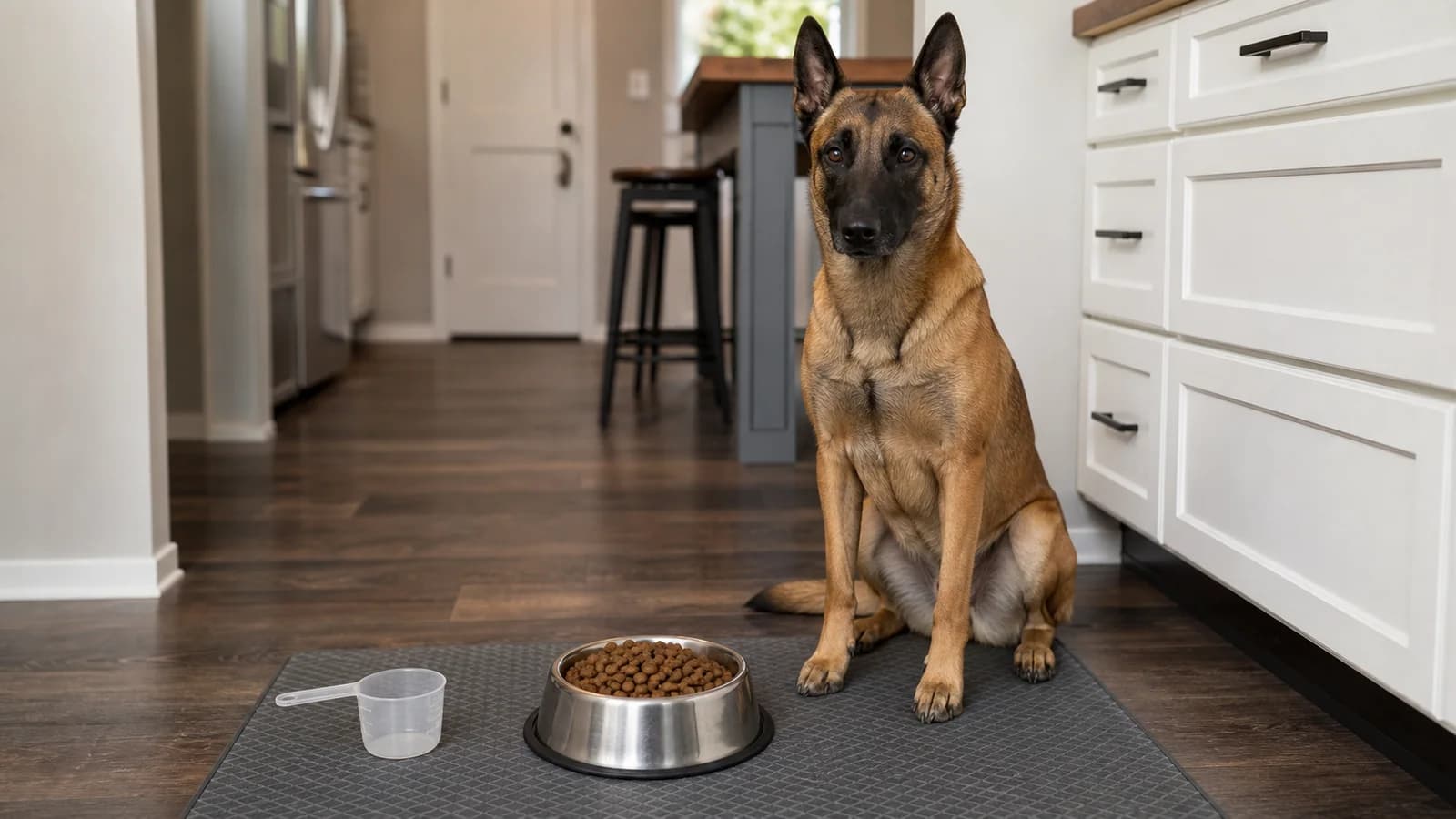
The best dog food for Belgian Malinois is a complete-and-balanced formula that matches the individual dog's life stage, actual workload, body condition, digestive tolerance, and household budget. Breed intensity does not automatically require the highest protein number or the richest performance food. A companion who takes structured walks needs a different energy intake from a working dog training for hours, even when both are healthy adults of the same breed.
Our four practical adult picks are ORIJEN Original for a calorie-dense premium option, Hill's Science Diet Adult Chicken & Barley for grain-inclusive adult maintenance, VICTOR Hi-Pro Plus for genuinely active adults, and Purina Pro Plan Adult Chicken & Rice for wide availability. Each comes from Petful's existing offer library. None is universally best, and none replaces advice from a veterinarian who knows your dog's health.
This guide shows how to compare the AAFCO nutritional adequacy statement, calorie density, manufacturer transparency, feeding practicality, and the main tradeoff of each food. It also covers puppies, portion adjustments, raw and homemade diets, foods to avoid, and a gradual seven-day transition. For the broader breed baseline behind those choices, see Petful's Belgian Malinois breed guide.

Sign up for expert-backed reviews and safety alerts all in one place.
Best dog food for Belgian Malinois: our four picks
The best food to feed a Belgian Malinois is the complete-and-balanced option your dog digests well, will eat reliably, and can maintain an appropriate body condition on. That is the direct answer. Among the four compared here, ORIJEN best fits an active adult who tolerates a rich, grain-free formula; Hill's is the grain-inclusive adult-maintenance pick; VICTOR is intended for very active adults needing a more energy-dense option; and Purina Pro Plan is the widely available all-rounder.
- 1Confirm that the bag says complete and balanced for your dog's life stage
- 2Compare calorie density and portion size instead of choosing by protein percentage alone
- 3Puppies need a growth-appropriate food, while adult-maintenance formulas are not for growth
- 4Use body condition, measured portions, and actual workload to guide adjustments with veterinary input
- 5Our four adult picks differ in richness, grain choice, availability, and price rather than forming one universal ranking
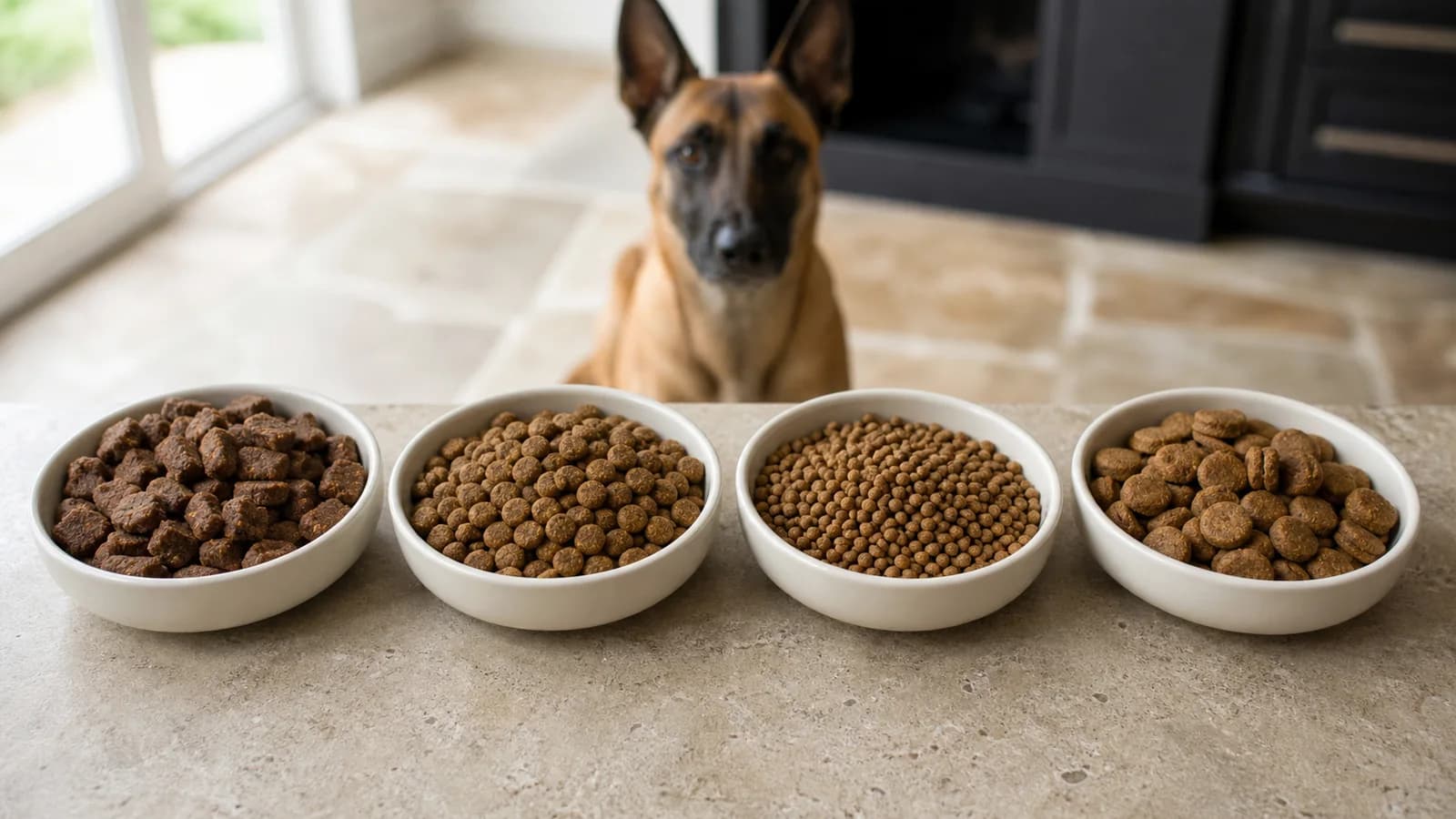
| Food | Best use | Main protein source | Main tradeoff |
|---|---|---|---|
| ORIJEN Original | Active adult needing a rich premium formula | Multiple named animal proteins | Calorie dense, grain free, and premium priced |
| Hill's Science Diet Adult Chicken & Barley | Healthy adult needing grain-inclusive maintenance | Chicken | Less energy dense than a performance formula and sold at a premium price |
| VICTOR Hi-Pro Plus 30/20 | Genuinely active adult with higher energy demand | Multi-protein formula | Richness requires careful portion control and may not suit a sedentary dog |
| Purina Pro Plan Adult Chicken & Rice | Adult needing a widely available grain-inclusive formula | Chicken | Ingredient preferences and individual tolerance may lead some owners elsewhere |
The table is a shortlist, not a prescription. Read the exact bag before buying because formulas, calorie values, package sizes, and label statements can change. Check that the life-stage statement fits your dog, compare calories per cup or per kilogram, and confirm that your veterinarian has not recommended a therapeutic diet or other restriction.
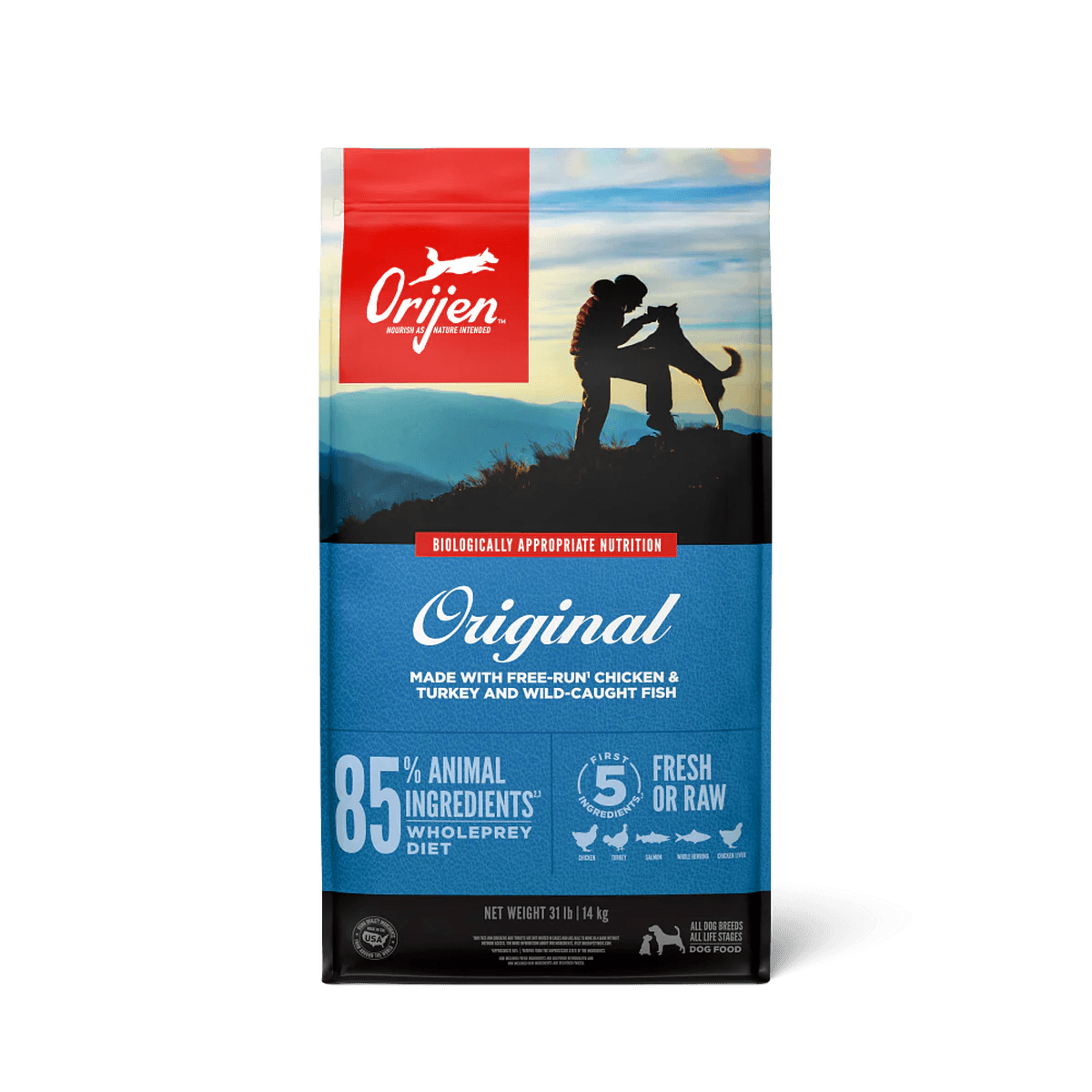
A grain-free kibble built around named whole-protein sources. Best for active adult dogs; the high fat content is more than many sedentary pets need.
Petful may earn a commission when you click through to Chewy, at no extra cost to you.
How we chose these Belgian Malinois foods
Our reader decision rubric uses four questions: Is the food nutritionally adequate for the intended life stage? Is the calorie density clear enough to measure portions? Is the manufacturer information and product availability practical? Does the food offer a useful use case without hiding its main tradeoff? That practical method creates a more responsible comparison than ranking foods by meat imagery or a single guaranteed-analysis number.
We also kept the shortlist deliberately comparable. These are shelf-stable dry foods already present in Petful's offer library, not a claim that kibble is the only valid format. Comparing the same format makes calorie density, life-stage statements, bag size, restocking, and portion control easier to evaluate. We did not promote a food because its package shows a working dog, because it uses a fashionable ingredient, or because its protein percentage is highest. The use-case labels below describe why an owner might investigate each option; they are not medical recommendations or guarantees that an individual dog will tolerate it.
- Look for the AAFCO nutritional adequacy statement. It should say that the food is complete and balanced for a named life stage, such as adult maintenance, growth, or all life stages. The statement may indicate that the food was formulated to meet a nutrient profile or substantiated through feeding tests. That wording is more important than front-of-bag terms such as "premium," "ancestral," or "high protein."
- Review calorie density. Two cups of one food can supply a very different amount of energy from two cups of another. A calorie-dense food can be useful for a dog doing sustained work, but it can oversupply energy quickly for a companion with a moderate routine. The feeding chart is a starting estimate, not an individual prescription.
- Ask the WSAVA nutrition questions rather than looking for a WSAVA approval badge. WSAVA publishes questions owners can use to evaluate manufacturers, including who formulates the food, what qualifications those people hold, where the food is made, how quality control works, and whether the company can provide typical nutrient analysis. WSAVA does not simply certify the four bags in this article.
- Account for household practicality. A food that repeatedly runs out locally, costs more than the family can sustain, or requires a portion so small that the dog is never satisfied may not be the best long-term choice. Consistency, safe storage, the dog's acceptance, and the ability to monitor results all matter.
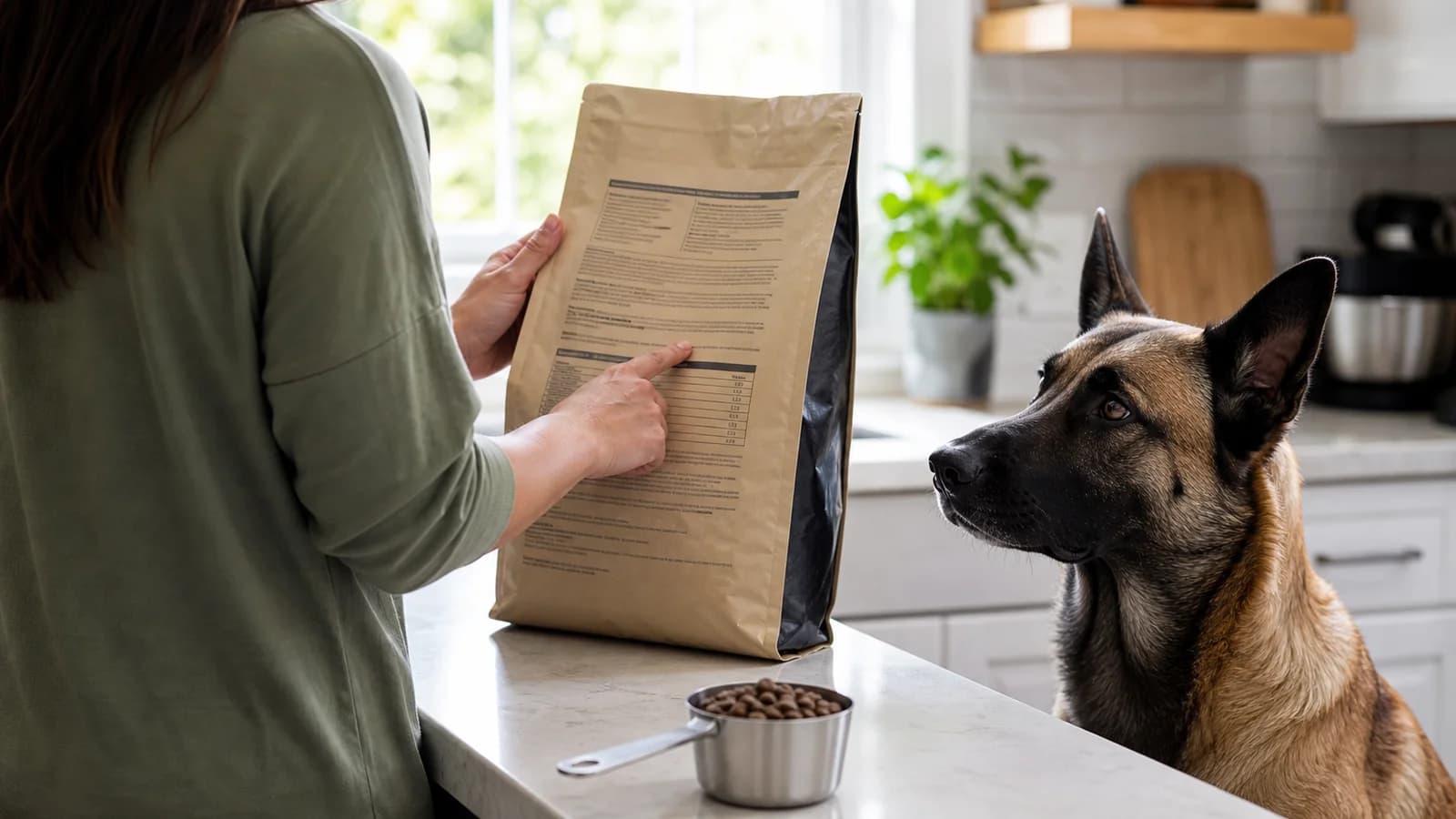
Use this label checklist:
- Complete-and-balanced statement for the correct life stage
- Calories listed per cup, can, or kilogram
- Feeding directions that can be translated into measured daily portions
- Manufacturer name and contact information
- Lot code and best-by date that remain visible after opening
- Guaranteed analysis reviewed in context rather than as a quality score
- Ingredient list checked for known individual intolerances
No front label can identify a food allergy, diagnose digestive disease, or determine the right calories for one dog. If your Belgian Malinois has persistent gastrointestinal signs, significant itch, unexplained weight change, a medical diagnosis, or a veterinarian-directed diet, use professional advice instead of switching among general retail foods.
Best overall: ORIJEN Original
ORIJEN Original Dry Dog Food is our best overall pick for an active adult Belgian Malinois whose owner wants a rich, meat-forward dry food and is comfortable with a premium price. It uses multiple named animal ingredients and is more calorie dense than many ordinary adult-maintenance recipes, so a smaller measured portion may deliver substantial energy.
That density is both the advantage and the main caution. In the right owner context, a dog doing sustained training, outdoor work, or demanding sport may maintain condition without an impractically large volume of food. A companion dog whose activity is moderate may gain weight if the serving is copied from a less dense food. Measured guidance means reading the current kcal figure on the bag, starting from the manufacturer's chart, and changing intake gradually based on body condition with veterinary input.
ORIJEN Original is grain free. A Belgian Malinois has no breed-specific requirement for grain-free food, and grain free is not a synonym for higher quality. Owners who prefer grain-inclusive feeding have three alternatives in this shortlist. Discuss diet choice with a veterinarian, especially if a dog has a health condition or a clinician has raised concerns about a particular formulation.
- Best-fit boundary: The use case is a healthy adult, real activity demand, good tolerance, and an owner willing to measure carefully. It is not our automatic choice for a puppy, a sedentary dog, a dog on a therapeutic plan, or a household that wants the most economical calories.
- Multiple named animal protein sources
- Calorie-dense option for an active adult
- Premium formulation for owners who value a meat-forward ingredient profile
- Existing-library offer with online availability
- Premium price
- Grain-free formula is not necessary for the breed
- Richness and calorie density make portion control important
- May be more food than a moderately active companion needs
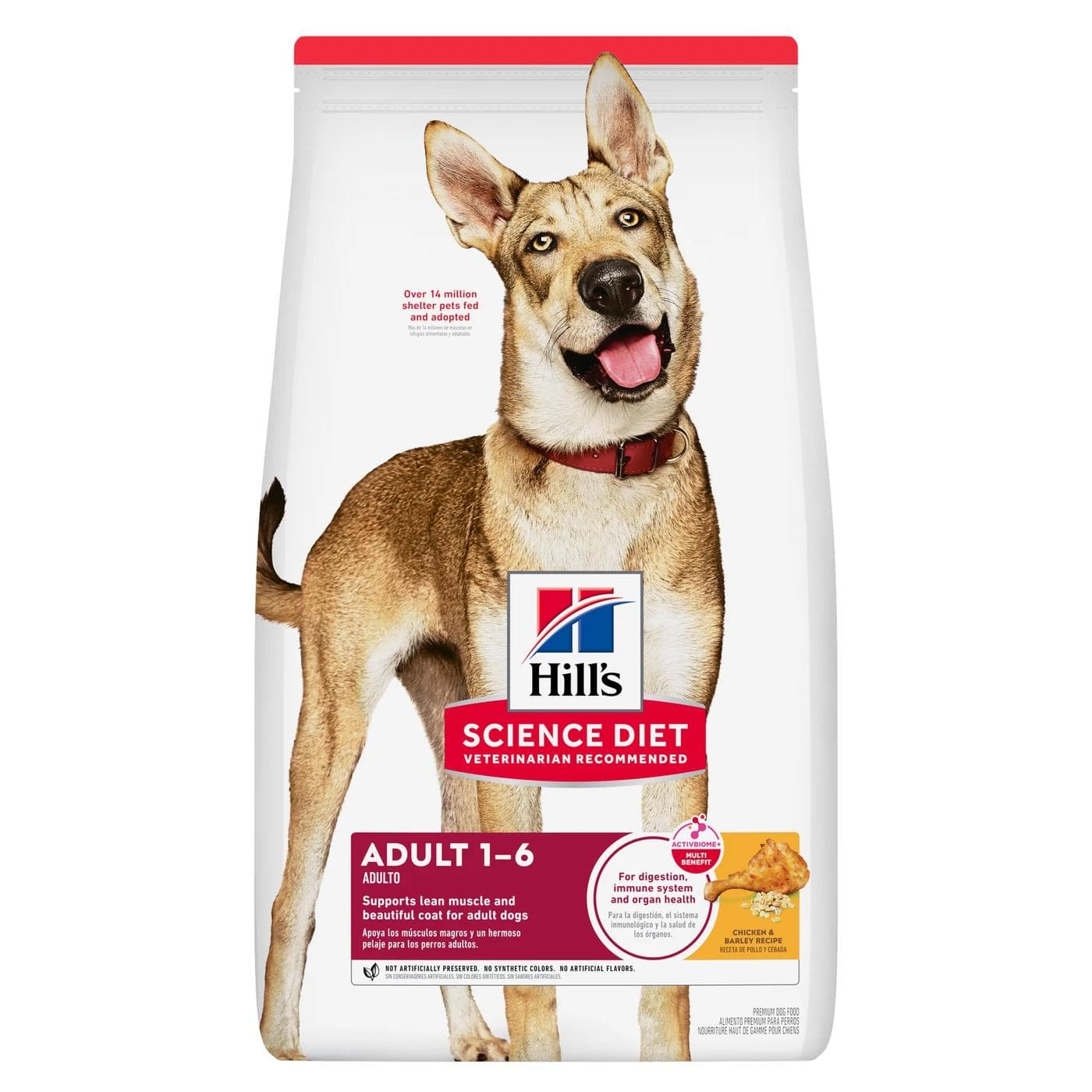
A vet-channel adult-maintenance kibble backed by AAFCO feeding trials. Leaner protein and fat than many competitors at a comparable price.
Petful may earn a commission when you click through to Chewy, at no extra cost to you.
Best grain-inclusive adult food: Hill's Science Diet Adult
Hill's Science Diet Adult Chicken & Barley Recipe is our grain-inclusive adult-maintenance pick. Its clearest role is feeding a healthy adult whose workload is moderate and whose owner values a conventional chicken-and-grain formula from a widely recognized veterinary-channel brand.
The nutritional boundary is important: "adult maintenance" means adult food, not puppy food. It also does not mean a retail maintenance formula treats allergies, digestive disease, kidney disease, or another condition. Hill's makes separate veterinary diets, but this pick is the ordinary retail Chicken & Barley recipe in the existing Petful library. Do not substitute it for a prescribed product because the brand name looks familiar.
Compared with the richest performance-style options, a maintenance formula can make portioning easier for a dog that trains daily but is not doing prolonged hard work. The responsible choice is still based on the individual. One adult may maintain ideal body condition on the bag's starting range, while another needs an adjustment because of size, neuter status, weather, activity, treats, or metabolism.
- Ingredient boundary: Owners sometimes treat corn, wheat, barley, or other grains as automatic negatives. Ingredient presence alone does not tell you whether a complete food is well formulated or whether an individual dog will tolerate it. Unless a veterinarian has identified a reason to avoid a specific ingredient, evaluate the finished food, the adequacy statement, the manufacturer's process, and the dog's real outcome.
- Comparison boundary: Hill's offers a useful contrast to ORIJEN. The decision is not "premium versus basic." It is rich grain-free feeding versus grain-inclusive adult maintenance, with different calorie profiles, ingredient approaches, and prices. That clear boundary helps an owner select for need rather than brand prestige.
- Grain-inclusive chicken-and-barley adult formula
- Clear adult-maintenance use case
- Familiar manufacturer with established nutrition and quality-control resources
- Less calorie dense than many performance-style foods, which can suit moderate activity
- Not formulated for puppy growth
- Premium price for an everyday maintenance food
- Chicken formula will not fit every individual tolerance
- Retail maintenance food is not a substitute for a veterinary therapeutic diet
Best for very active adults: VICTOR Hi-Pro Plus
VICTOR Hi-Pro Plus 30/20 Dry Dog Food is the shortlist's performance-oriented choice for a genuinely active adult. The "30/20" name refers to its listed protein and fat percentages, but those numbers are not the reason to buy it by themselves. The useful distinction is a richer formula designed for dogs with meaningful energy demand.
"Very active" should describe work performed, not a breed stereotype. A Belgian Malinois attending a short training class twice a week may be mentally busy without burning performance-dog calories. A dog completing long search sessions, repeated conditioning work, or sustained outdoor activity has a different energy budget. Petful's Belgian Malinois exercise guide can help separate productive workload from the impulse to chase an arbitrary exercise number.
Start with the current bag label, measure the daily amount, count training rewards, and watch body condition. A performance formula can make it easier to deliver more calories without an extremely large meal. The same feature makes accidental overfeeding easier. Portion control is therefore central to the recommendation.
- Transition carefully: Rich foods can create a rough transition if introduced too quickly. Do not change to VICTOR on the eve of a competition, boarding stay, long trip, or unusually demanding week. Make the transition while routines are stable, and contact a veterinarian if digestive changes are persistent, severe, or accompanied by other signs.
- Keep the use case narrow: This pick is not automatically appropriate for puppies, and it is not a weight-gain treatment for a dog that looks thin. The nutritional adequacy statement on the exact bag determines life-stage suitability. A veterinarian should evaluate unexpected weight loss or poor condition rather than having the owner simply pour more high-calorie food.
- Performance-oriented option for adults doing substantial work
- Higher fat profile can support greater energy demand in a smaller volume
- Large existing-library bag offers practical feeding for high-use households
- Clear by-need contrast with ordinary maintenance formulas
- Too rich for many companion dogs
- Measured portions and body-condition checks are essential
- Multi-protein formula may complicate avoidance for a dog with a known ingredient issue
- Not a solution for unexplained weight loss
Best widely available option: Purina Pro Plan Adult
Purina Pro Plan Adult Chicken & Rice Formula is our widely available grain-inclusive pick for a healthy adult. Availability is not a trivial advantage. A food that can be found through multiple channels is easier to replace during travel, supply interruptions, or a missed delivery, and consistency can matter more than chasing a theoretically perfect bag.
This chicken formula has a straightforward adult-maintenance role. It is not the richest option in the group, and it is not intended to win an ingredient-list beauty contest. Owners who object to particular grain or plant ingredients may prefer another food. The more useful evaluation asks whether the formula is complete and balanced for adult maintenance, whether the company answers the WSAVA nutrition questions, whether the dog tolerates it, and whether the household can sustain it.
Purina's research and manufacturing resources are part of the appeal for owners who prioritize established feeding expertise and quality systems. That does not make every Purina recipe right for every dog. Brand scale cannot override individual tolerance, veterinarian guidance, or a required therapeutic diet.
- Availability advantage: This option is especially practical for families who travel or use autoship but want a backup source. Keep enough food for a gradual transition if a formula changes or becomes unavailable, and store the bag information so lot and date details remain accessible.
- Widely available through multiple retail channels
- Grain-inclusive chicken-and-rice adult formula
- Manufacturer has substantial nutrition, feeding, and quality-control resources
- Practical choice for households that value consistent restocking
- Ingredient profile may not match every owner's preference
- Chicken formula is not appropriate for every individual tolerance
- Adult-maintenance use only unless the exact label states otherwise
- Availability does not make it a therapeutic or universal food
How to compare the four picks for your dog
Begin with life stage. If the dog is a puppy, skip this adult shortlist and choose a growth-appropriate food as described below. If the dog is a healthy adult, remove any formula that conflicts with veterinarian guidance or a known intolerance. Then compare actual workload, calorie density, grain preference, budget, availability, and how the dog has responded to similar foods.
A simple decision path looks like this:
- Active adult needing a rich formula: Consider ORIJEN, while recognizing its grain-free approach, premium price, and calorie density.
- Moderately active adult and grain-inclusive preference: Consider Hill's Science Diet Adult.
- Adult doing sustained hard work: Consider VICTOR Hi-Pro Plus, with precise portion control.
- Adult needing easy restocking and a conventional grain-inclusive formula: Consider Purina Pro Plan Adult.
Do not rotate all four in search of a perfect result. Every switch introduces a new ingredient and transition variable. Give a suitable food time to show a stable pattern unless a veterinarian says to stop, and keep notes on stool, appetite, body condition, coat, training rewards, and any recurring sign. A food journal makes veterinary conversations more useful than a vague statement that one bag "did not agree" with the dog.
Price should be compared by daily feeding cost, not bag price alone. A more expensive, calorie-dense food may require fewer cups. A lower-cost large bag may be economical only if it stays fresh and the dog tolerates it. Use the bag's current calorie information and feeding range to estimate how long it will last, then reassess once the dog's real portion is established.
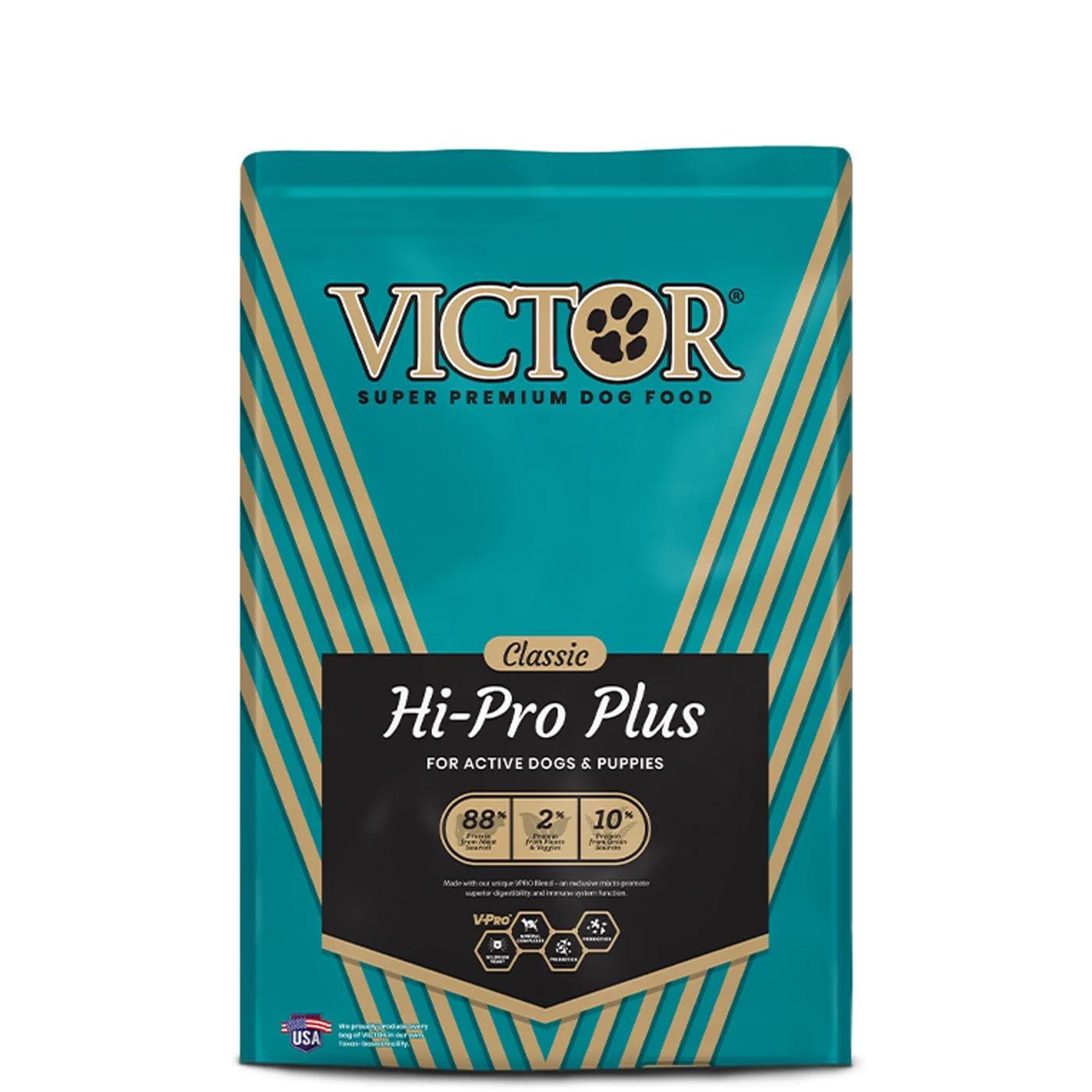
A 30/20 performance formula from a single Texas plant at an unbeatable price per pound. Built for genuinely active and sporting dogs, not couch companions.
Petful may earn a commission when you click through to Chewy, at no extra cost to you.
Best food for a Belgian Malinois puppy
The best food for a Belgian Malinois puppy is a complete-and-balanced formula whose AAFCO nutritional adequacy statement includes growth. If the puppy is expected to mature at or above the label's large-size threshold, the statement should also say it is appropriate for the growth of large-size dogs. Ask the veterinarian and breeder about expected adult size rather than choosing from paw size or a generic internet chart.

Puppies are building bone, muscle, organs, and nervous tissue. More calories or more calcium do not make that process better. Growth food is formulated around the nutrient balance required for development. Adding calcium, vitamins, meat, or other supplements to a complete puppy food can unbalance it unless a veterinarian has identified a specific need.
Most puppies do well with measured meals divided across the day rather than one very large feeding. Meal frequency changes as the puppy matures, and the exact timing should fit age, house-training, total daily calories, and veterinary advice. Training treats count toward the daily intake. For a highly food-motivated Malinois puppy, reserve part of the measured kibble for reinforcement instead of layering unlimited treats on top.
Use body condition and steady growth rather than trying to maximize size. A puppy should not be intentionally kept heavy. Extra body weight increases load on a developing frame, while unexpected poor growth or weight loss deserves veterinary evaluation. Petful's Belgian Malinois puppy guide covers the broader early-care and household questions.
- Do not chase a one-meal appetite change: Puppies can have medical problems that need prompt attention, and reduced appetite is not always a preference issue. Contact a veterinarian for concerning changes, especially when appetite loss occurs with vomiting, diarrhea, weakness, pain, or unusual behavior.
- Time the adult transition individually: Use maturity and veterinary guidance rather than a fixed birthday copied from another breed. Growth rates vary, and a mixed or unusually large individual may need a different timeline. Once the transition is appropriate, make it gradually.
How much to feed a Belgian Malinois
There is no safe universal cup amount for every Belgian Malinois. The right portion depends on the food's calorie density, the dog's weight and body condition, age, reproductive status, health, environment, training treats, and actual workload. Start with the current package's feeding chart, measure the amount, and adjust gradually from observed condition with veterinary input.
A portioning routine is more reliable than visual guessing:
- Find calories per cup or per unit on the current label.
- Choose the manufacturer's starting range for the dog's current weight and life stage.
- Divide the daily amount into an appropriate number of measured meals.
- Subtract calories used for training rewards and chews.
- Weigh the dog consistently when possible and assess body condition regularly.
- Make small changes, then allow time to observe the trend.
Measuring cups are better than a free pour, but a kitchen scale is more consistent because kibble pieces and scoop technique vary. Record the daily amount in grams if the label provides a useful weight measure. Everyone in the household should know the plan so the dog does not receive a full dinner from two different people. For a dog who gulps meals, an Outward Hound four-cup slow feeder can change eating pace when its capacity and channels fit the measured portion and muzzle. It does not determine how much to feed or treat digestive signs. An Arf Pets 18-cup automatic feeder can support a consistent dry-food schedule, but every dispensed amount still needs to be checked against the dog's daily calorie plan.
Exercise changes energy use, but not every exciting session represents a major calorie burn. A dog can be behaviorally intense during a 20-minute class without doing the sustained work of a search, patrol, or endurance session. Increase food only in response to a real change in workload and body condition, not because the breed is famous for activity.
Treats can quietly become a large share of intake in a training-heavy home. Use small pieces, reserve some kibble, and consider nonfood rewards such as toy play or access to sniffing when those are appropriate. A complete diet works as designed only when extras do not displace too much of it.
Using size and body condition to adjust portions
Use Belgian Malinois size and body condition as feedback, not as a homemade calorie prescription. Petful's same-release Belgian Malinois size and growth guide owns the height, weight, and growth-chart detail. This food guide uses that information only to support portion decisions.

A body condition score evaluates shape and palpable fat rather than comparing the dog with one target number. In general, an appropriate condition includes ribs that can be felt under a light covering, a waist visible from above, and an abdominal tuck from the side. Coat, posture, and athletic build can mislead the eye, so ask a veterinarian to demonstrate the score on your dog.
Measured guidance works as a loop:
- Record the food, treats, and measured daily amount.
- Record body weight and body condition at consistent intervals.
- Note any meaningful change in workload.
- Ask whether the trend is stable, rising, or falling.
- Adjust modestly with veterinary input and recheck.
Do not respond to unexplained weight loss by moving directly to the richest food. Weight change can reflect inaccurate portions, dental pain, digestive disease, parasites, metabolic problems, or other causes that require assessment. Likewise, a rapidly gaining dog may need more than a smaller scoop if activity or health has changed.
The goal is not to keep a working-looking breed as lean as possible. It is to maintain an individual condition that supports movement, health, and daily function. A veterinarian can account for muscle, frame, age, and medical history more accurately than a breed photo.
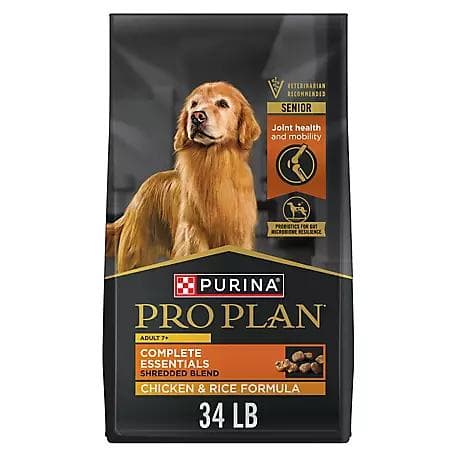
A vet-backed adult kibble with full WSAVA alignment and AAFCO feeding trials. Budget-friendly, though corn gluten and soybean meal sit in the top ingredients.
Petful may earn a commission when you click through to Chewy, at no extra cost to you.
Raw and homemade diets for Belgian Malinois
A raw or homemade diet is not inherently better for a Belgian Malinois. It can be made complete, but ingredient variety and good intentions do not guarantee nutrient balance. A recipe can provide plenty of protein while still supplying the wrong amount or ratio of calcium, phosphorus, vitamins, trace minerals, essential fatty acids, or total energy.
- If you want to feed raw or homemade food, work with a board-certified veterinary nutritionist on a complete recipe for the individual dog and follow it exactly. Ingredient substitutions can change the nutrient balance. Raw animal products also create pathogen and cross-contamination risks for the dog, people, surfaces, and other animals in the home.
The neutral decision is not raw versus kibble as an identity. It is whether a diet is nutritionally complete, safely prepared, practical enough to follow every day, and appropriate for the dog. A responsible choice includes the cost and availability of ingredients, storage, travel, sanitation, and the willingness to weigh components precisely.
Puppies have even less room for improvisation because errors occur during growth. A Belgian Malinois puppy raw diet or homemade plan should not be assembled from online ratios, social media bowls, or a list of ingredients that "looks balanced." Growth requires exact formulation and ongoing veterinary oversight.
- Follow the recipe exactly: If a veterinarian-directed home-prepared plan is chosen, do not swap meats, oils, supplements, or carbohydrate sources casually. Batch preparation does not make an incomplete recipe complete. Recheck the plan as the dog moves from growth to adulthood, workload changes, or a health issue develops.
- Control food-safety risk: Handle raw food as carefully as raw meat intended for people. Prevent contact with ready-to-eat food, clean preparation surfaces, wash hands, store it at safe temperatures, and keep bowls away from vulnerable household members. Families with very young children, older adults, pregnant people, or immunocompromised people should discuss the household risk with health and veterinary professionals.
- Check commercial products too: Commercial fresh or raw products need a nutritional adequacy statement. "For supplemental or intermittent feeding only" does not mean complete-and-balanced daily food. A topper can make a meal appealing, but it should not silently replace a large share of the balanced base diet.
Foods Belgian Malinois should not eat
What can Belgian Malinois not eat?
Belgian Malinois should not eat foods known to be toxic to dogs, including chocolate, xylitol, grapes and raisins, onions and garlic in unsafe amounts, alcohol, caffeine, macadamia nuts, and unbaked yeast dough. They should also be protected from medications, nicotine products, cannabis products, moldy food, and other household substances that can cause poisoning. This is practical context, not a complete toxicology list.
Prevention is more reliable than trying to memorize every hazard. Store food, gum, supplements, medications, trash, compost, and training bait behind a closed barrier the dog cannot defeat. Check the ingredient list on peanut butter and other reward foods for xylitol or birch sugar. An athletic Malinois can reach a counter or open a light cabinet quickly, so management should account for the dog's real reach and persistence rather than an average kitchen setup.
What to do after possible ingestion
If a dog eats a potentially toxic item, contact a veterinarian or veterinary poison service promptly with the product, amount, time, and dog's weight. Do not wait for signs and do not induce vomiting unless a veterinary professional specifically directs it. Risk can change with dose, formulation, and the individual dog.
Cooked bones can splinter or obstruct, while very hard chews can fracture teeth. Fatty table scraps can cause digestive trouble and may create more serious problems in some dogs. Large amounts of unfamiliar food can also upset the digestive system even when the ingredient is not toxic.
- Prevent access: Keep food, gum, candy, supplements, and medication behind closed doors.
- Check ingredient labels on nut butters and low-sugar products for xylitol.
- Use a lidded trash container the dog cannot open.
- Keep rising dough, cooling pans, and party food out of reach.
- Ask guests not to feed the dog.
- Teach a trade and leave-it cue without depending on it as the only safeguard.
High food motivation and athletic reach can make counters and bags easy targets. Management is not an admission that training failed. It prevents a fast, clever dog from being rewarded by one successful raid.
How to switch foods over seven days
Switch a healthy Belgian Malinois to a new food gradually over about seven days unless a veterinarian gives a different plan. A common starting pattern is mostly old food with a small amount of new food, then an even mix, then mostly new food before the final change. The exact pace can be slower for a dog with a sensitive digestive history.
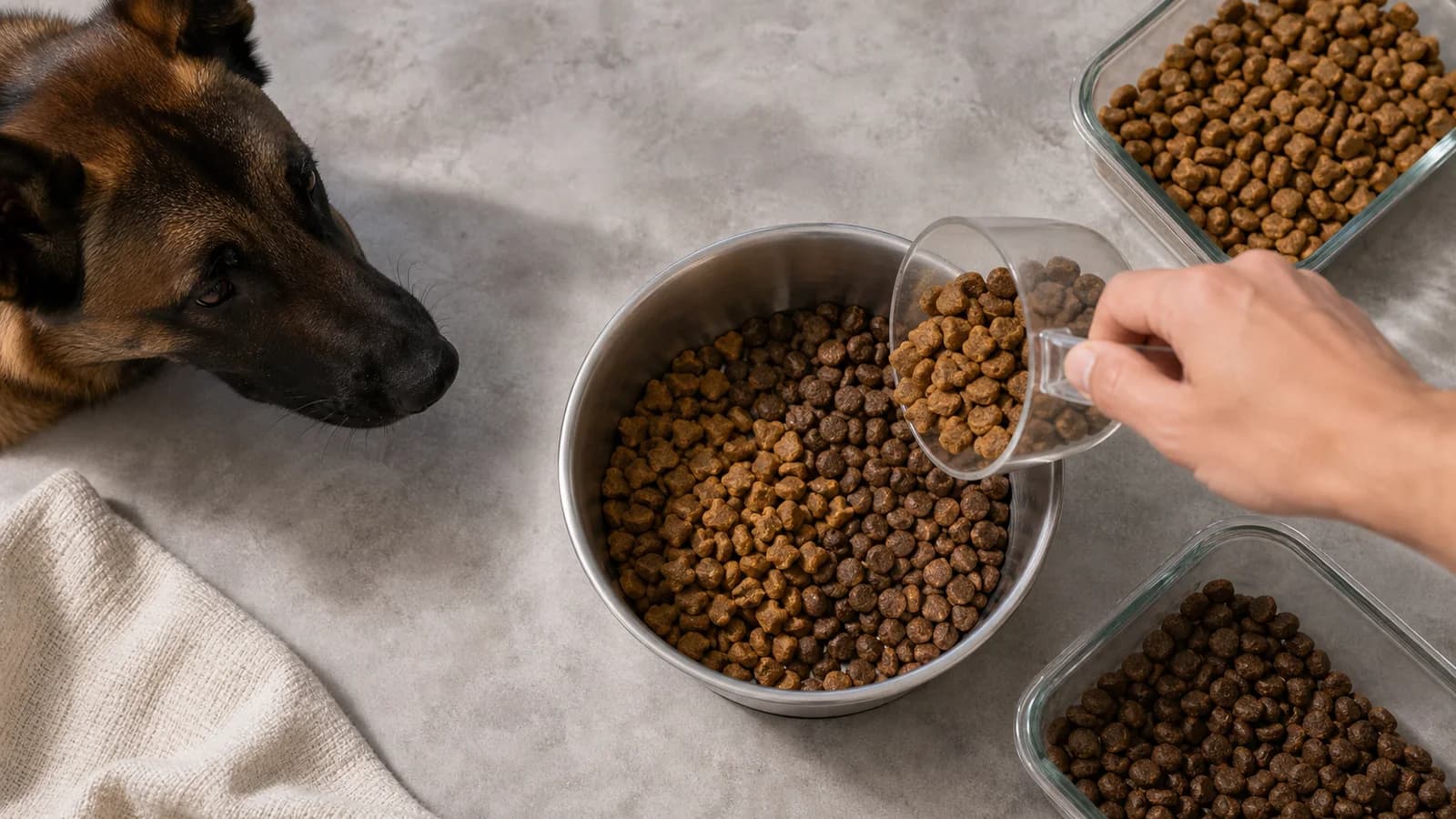
One practical schedule is:
- Days 1 and 2: About 75% old food and 25% new food
- Days 3 and 4: About 50% old food and 50% new food
- Days 5 and 6: About 25% old food and 75% new food
- Day 7: New food
Those percentages describe the food mix, not a reason to increase total daily calories. Because the two foods may have different calorie density, compare labels and keep the overall intake measured. Mixing equal cups can unintentionally increase or decrease energy.
Make only one major diet change at a time when possible. Avoid adding new treats, toppers, supplements, and chews during the same week because they make any response harder to interpret. Record appetite, stool, vomiting, itch, and energy. Mild short-lived stool change can occur during a transition, but persistent or concerning signs require veterinary advice.
Do not use a standard seven-day plan when a veterinarian has directed an immediate change for a medical reason. Do not continue a food that appears associated with a serious reaction while waiting for a calendar day. Individual conditions take priority over a generic schedule.
- Preserve traceability: Once the new food is established, store it in a cool, dry place and retain the original package or at least the lot code, best-by date, product name, and manufacturer contact information. If using a storage bin, placing the closed bag inside helps preserve traceability and reduces residue from old food.
Feeding during training and work days
Belgian Malinois owners often deliver a meaningful share of the day's food through training. That can be practical, but only when the household knows how much is being used. Fill a daily container with the total measured kibble and rewards allocated for that dog. Everyone trains from the same container, so rewards do not become invisible extra meals. A Pet Parents Forager snuffle mat can use part of that measured ration for supervised sniffing, provided the dog does not tear or swallow the fabric.
Kibble may be valuable enough for calm repetitions at home, name response, mat work, and ordinary leash check-ins. More difficult environments may require a higher-value reward. Cut soft treats into small pieces and judge them by the total calories used, not by how tiny each piece looks. Play, sniffing access, and movement can also reinforce behavior when the dog finds them rewarding.
Work days do not automatically justify a much larger dinner. Consider the duration and physical intensity of the task, weather, travel stress, and the dog's current condition. A long day that includes waiting in a vehicle or crate may be mentally tiring without producing the energy expenditure an owner imagines. Conversely, sustained field work in demanding conditions can create a real change that deserves a planned discussion with the dog's veterinarian or performance team.
- Plan meal timing: Avoid one enormous meal immediately before or after strenuous activity. Meal timing, portion division, hydration, and recovery should be discussed with a veterinarian for dogs doing demanding work, especially when there is any individual health concern. This article does not prescribe a sport-feeding protocol.
- Provide ordinary hydration: Water should be available routinely, with sensible planning around travel and work. A Frisco collapsible travel bowl can make water easier to offer away from home when its 1.5-cup capacity suits the outing. Do not force a dog to drink a large volume quickly, and do not add electrolyte products or supplements designed for people without veterinary guidance. Ordinary hydration and a complete food are enough for many companion activities.
- Review recovery: The day after unusual work, note appetite, stool, movement, sleep, and willingness to train. Repeated fatigue, soreness, appetite loss, or digestive upset is not proof that the dog merely needs richer food. It is a reason to reduce demand and seek professional assessment.
Buying, storing, and tracking a dog food
Buy a bag size the household can use while the food remains fresh. A 50-pound bag may offer a lower price per pound, but that savings disappears if a smaller dog takes months to finish it or if storage is warm, damp, or exposed to pests. Follow the manufacturer's storage instructions and close the package after each use.
Keep the original bag even when using a bin. The package protects the food, and its lot code, best-by date, ingredient list, calorie statement, and feeding instructions are essential if there is a quality question or recall. Pouring every new bag onto crumbs and oils from the last one can also make the container harder to keep clean.
When a familiar food arrives, compare the new bag with the old one:
- Product and recipe name
- Package weight
- Ingredient list
- Guaranteed analysis
- Calorie content
- Nutritional adequacy statement
- Feeding directions
- Kibble appearance and odor
- Lot code and best-by date
Manufacturers may update a formula or package without the owner noticing immediately. A changed calorie value can alter the energy supplied by the same scoop. A new protein or fat source can also matter to a dog with a documented intolerance. If the change is meaningful, a gradual transition may still be useful even though the brand name stayed the same.
Autoship reduces missed purchases but should not eliminate inspection. Check for package damage, moisture, insects, an unusual smell, or a product mismatch before feeding. Contact the seller or manufacturer when something seems wrong and retain photographs plus the lot information.
Maintain a small practical buffer without stockpiling far beyond use. If a preferred formula becomes unavailable, call local retailers and the manufacturer before making a rushed substitution. Choose the closest appropriate life-stage alternative, compare calorie density, and transition when time allows. A widely available pick such as Purina Pro Plan earns part of its place in this guide by making that continuity easier.
Monitoring results without chasing perfection
Judge a food through a stable pattern rather than one enthusiastic meal. Useful outcomes include consistent appetite, formed stool appropriate for the individual, stable body condition, comfortable skin and coat, and energy that fits the dog's routine. None of those outcomes proves the food prevents disease, but they help show whether an ordinary diet is working in daily life.
Avoid treating every normal fluctuation as evidence that the food has failed. Activity, stress, travel, weather, treats, scavenging, and minor routine changes can affect appetite and digestion. A simple log can separate a repeated diet-associated pattern from a one-day event.
Review the choice when the dog enters a new life stage, the workload changes substantially, body condition trends away from the target, the formula changes, or a veterinarian identifies a health need. Senior dogs are not all alike, and age alone does not specify one protein or calorie level. A healthy older athlete and an older dog with disease may need very different plans.
- Keep the goal ordinary: Marketing can make feeding feel like a constant optimization contest. The goal is not to find the most dramatic ingredient list. It is to provide complete nutrition reliably, in an amount that maintains appropriate condition, while leaving room for safe training rewards and a household budget that can continue.
Frequently asked questions about feeding Belgian Malinois
Many healthy adult Belgian Malinois do well on two measured meals per day, with the full day's calories divided between them and training rewards counted in the total. Puppies usually need more frequent meals based on age. An individual dog's schedule may differ because of health, workload, or veterinary guidance, so meal frequency should support the whole feeding plan rather than an arbitrary breed rule.
No breed requirement makes grain-free food necessary for a Belgian Malinois. Some dogs may eat a grain-free formula for an individual reason, but many do well on complete-and-balanced grain-inclusive foods. Choose based on the full formulation, life stage, tolerance, and veterinary advice rather than assuming that removing grains makes a diet higher quality.
A performance food can be useful when a healthy adult has an actual workload that raises energy needs, but the working-breed label alone is not enough. Compare calorie density, measure portions, and monitor body condition. A dog doing occasional classes may not need a rich 30/20 formula, while a dog performing sustained work may benefit from more energy in a smaller volume.
No. Protein is essential, but the highest percentage does not make a food best. Nutritional adequacy, calorie density, fat, life-stage suitability, manufacturer quality controls, digestibility, individual tolerance, and portion size all matter. A very rich food can oversupply calories to a moderately active dog even when its marketing sounds appropriate for the breed.
Small extras can fit some feeding plans, but adding substantial meat, calcium, vitamins, oils, or supplements can dilute or unbalance a complete-and-balanced diet. Training treats and toppers also add calories. Ask a veterinarian before supplementing, especially for a puppy, a dog with a medical condition, or any dog already eating a therapeutic diet.
The best choice is a complete-and-balanced food for the dog's life stage that fits its real workload, calorie needs, tolerance, availability, and household budget. No single formula is best for every Malinois. Compare the adequacy statement and calories, then monitor body condition, stool, appetite, coat, and performance instead of choosing from breed marketing alone.
Choose a complete-and-balanced growth formula. If the puppy is expected to reach the food label's large-size threshold, the adequacy statement should also cover growth of large-size dogs. Ask the veterinarian and breeder about expected adult size, measure portions, track steady body condition, and avoid trying to speed growth with extra calories or supplements.
There is no safe universal cup amount. Start with the current food's calorie content and feeding range, then account for the dog's weight, body condition, age, environment, health, actual workload, treats, and chews. Measure the total daily ration, follow the trend, and make modest adjustments with veterinary input.
Raw food is not automatically better for this breed. A diet must be nutritionally complete, appropriate for the individual, practical to follow, and handled safely. Raw animal products create pathogen and cross-contamination risks, while homemade recipes can be unbalanced despite using varied ingredients. Work with a board-certified veterinary nutritionist if choosing a home-prepared plan.
For an ordinary elective change, gradually replace the old food over about seven days while keeping total calories measured. A common sequence is 25%, 50%, then 75% new food before completing the switch. Change one major variable at a time and record appetite, stool, vomiting, itch, and energy. Follow a veterinarian's different instructions when a medical reason requires them.
Final verdict
For an active healthy adult that tolerates a rich grain-free food, ORIJEN Original is the premium overall pick. Hill's Science Diet Adult Chicken & Barley is the grain-inclusive adult-maintenance choice. VICTOR Hi-Pro Plus is reserved for genuinely active adults whose energy demand justifies its richness, and Purina Pro Plan Adult Chicken & Rice is the widely available grain-inclusive option.
The better SEO answer is also the better feeding answer: there is no one bag for every Belgian Malinois. Confirm the AAFCO statement, ask the WSAVA nutrition questions, compare calorie density, measure the daily amount, and watch the individual dog's body condition and tolerance. Puppies, unexpected weight change, persistent digestive or skin signs, and medical conditions deserve veterinary input rather than a generic retail ranking.

Coreen Saito is a pet writer and longtime shelter volunteer with more than a decade in animal rescue. She covers cat behavior, breed care, and the small, ordinary science of sharing a life with companion animals, with a particular focus on honest takes about the products and decisions that actually matter. At home in Arizona, she's outranked by Mac (a dog with the loudest opinion in the house), Rebel (a cat who governs by quiet authority), and Meri (an orange tabby who runs the late shift and the laundry basket). She writes about all three, plus the rescues that keep coming through her life, at LifeWithMinty.com.
Sign up for expert-backed reviews and safety alerts all in one place.