Sphynx Cat With Hair: Why "Hairless" Cats Are Rarely Fully Bald
A sphynx cat with hair is the norm, not a defect. Learn the degrees of coat from rubber bald to brush, why some Sphynx grow more hair, whether a fuzzy one is still purebred, and how it differs from a Devon Rex.
Petful is reader supported. As an affiliate of platforms like Amazon and Chewy, we may earn a commission when you buy through links on this page. There is no extra cost to you.
The Cat Fanciers' Association (CFA) breed standard describes the Sphynx as having "the appearance of hairlessness," and that one careful word is the whole story, because a sphynx cat with hair is not a defect or a mixed breed but the norm for the breed. Most Sphynx carry a fine, downy peach fuzz that gives their skin a warm suede or chamois feel, and short hairs commonly show up on the nose, ears, tail, and toes. The truly billiard-ball-bald Sphynx is actually the exception, not the rule. This guide busts the totally-bald myth, walks through the recognized degrees of coat from ultra-bare to a full brush coat, explains exactly why some Sphynx grow more hair than others, and answers whether a fuzzier cat still counts as a real Sphynx (it does). You will also learn how to groom a downier Sphynx and how this hairless-but-not-quite trait differs from genuinely coated cousins like the Devon Rex.
- 1"Hairless" is a description of appearance, not a guarantee of zero hair: the CFA standard says short fine hair may be present on the feet, ear edges, tail, and scrotum, with the nose bridge normally coated
- 2Most Sphynx have a fine peach-fuzz down that feels like warm suede or chamois, not bare rubber skin
- 3Coat ranges by degree, from ultra-bald to flocked to a heavier brush coat, and a true brush coat is a show fault but still a real Sphynx
- 4Genetics, the brush-coat variant, plus seasonal, hormonal, and age changes all explain why one Sphynx is fuzzier than another
- 5A Sphynx with hair is still a Sphynx by ancestry, and it is not more hypoallergenic than a balder one

Sign up for expert-backed reviews and safety alerts all in one place.
Are Sphynx cats actually hairless? The myth, busted
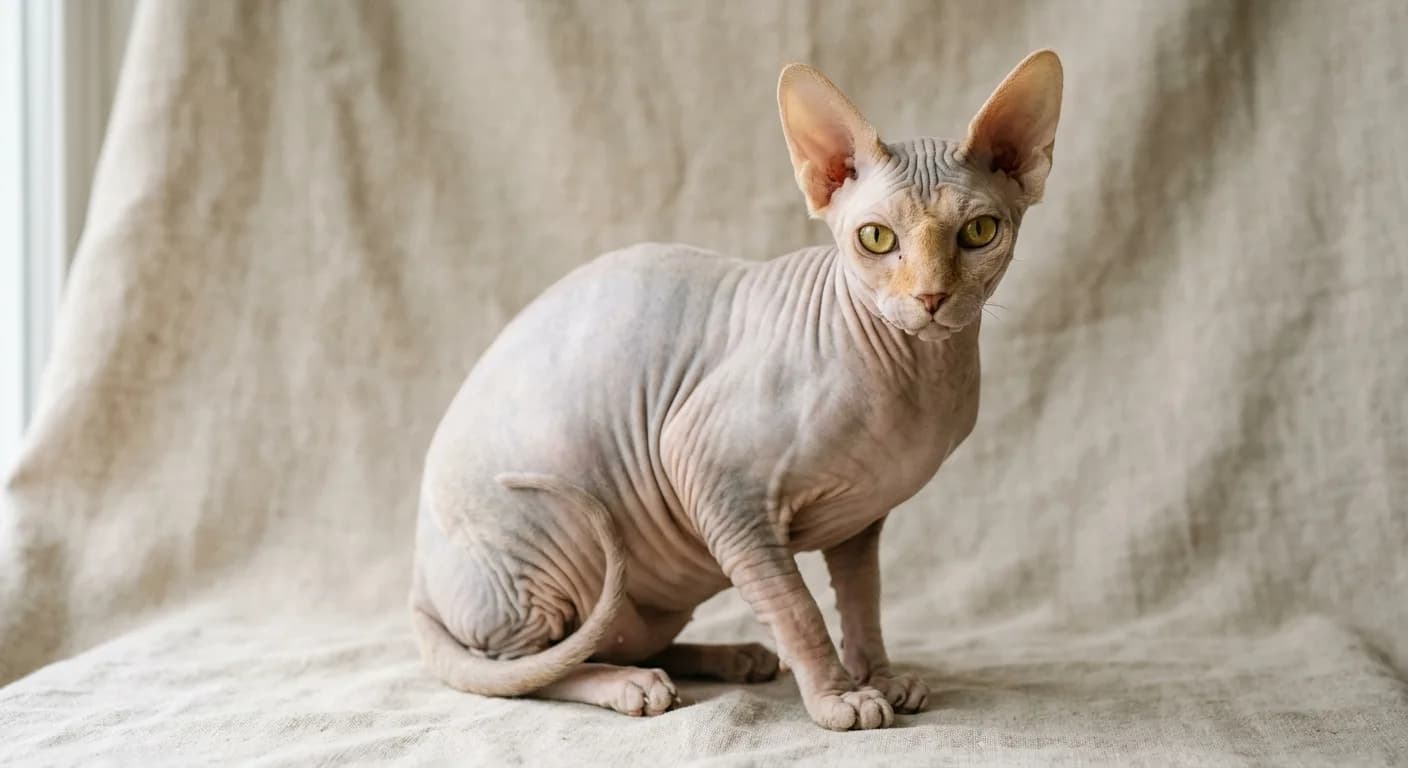
Ask most people to picture a Sphynx and they imagine a completely bald, wrinkled cat with skin like a warm rubber hot-water bottle. That image is half right. Sphynx do lack a normal protective coat, but "hairless" is shorthand, not a literal anatomical fact. The breed's defining gene suppresses the normal coat, yet it rarely removes hair entirely. Run your hand over a typical Sphynx and you feel a faint, velvety down, the texture the CFA compares to "warm suede" and "either a soft peach or a smooth nectarine."
The veterinary and breed sources that rank for this topic agree. PetMD notes that the Sphynx "is actually covered in fine fur," with breeder April Arguin describing skin that "feels like chamois." A veterinary clinic blog on the breed puts it plainly: Sphynx "aren't completely hairless," and stroking one is like "holding a wrinkly suede pillow." The CFA standard itself lists exactly where short hair usually survives: the feet, the outer edges of the ears, the tail, and the scrotum, with the bridge of the nose "normally coated."
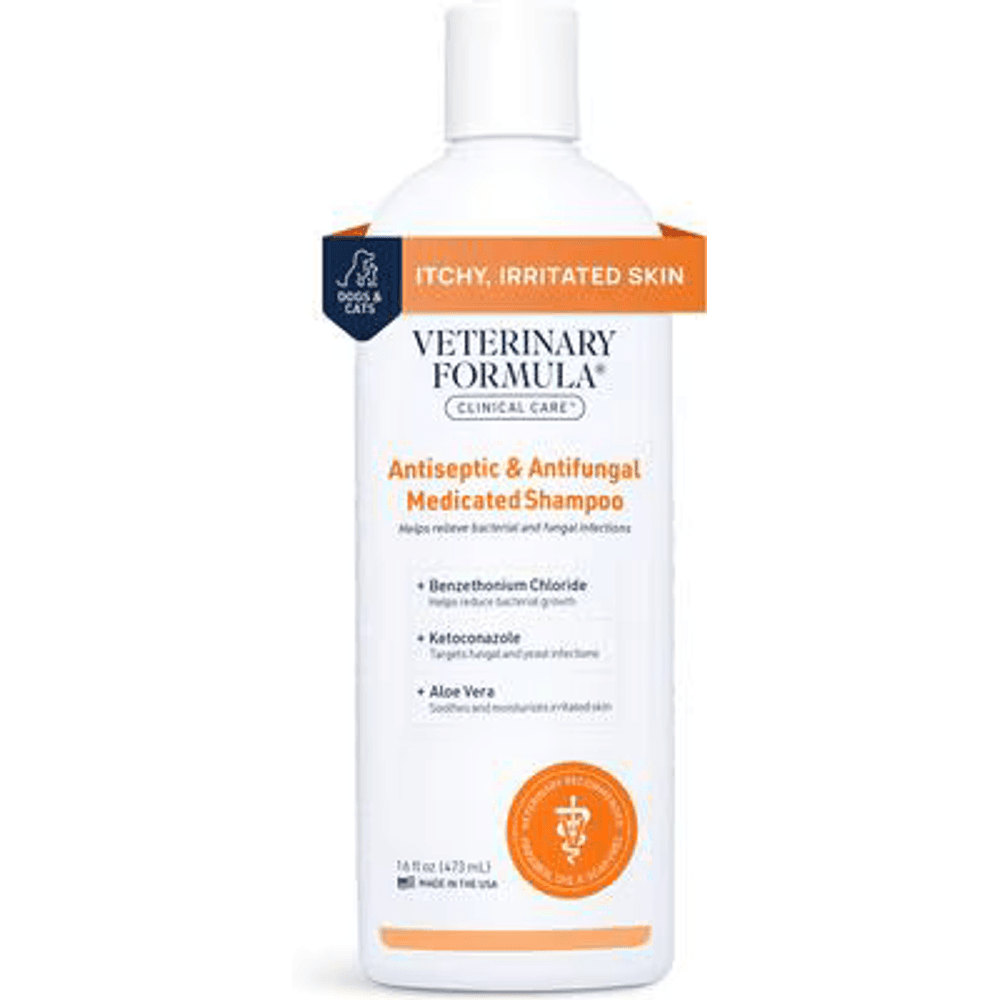
A budget-friendly medicated shampoo with ketoconazole and benzethonium chloride that helps control the fungal and bacterial skin infections behind ringworm, with aloe to soothe irritated skin. A common vet-recommended bath option.
Petful may earn a commission when you click through to Chewy, at no extra cost to you.
So the honest answer to "are Sphynx hairless" is: functionally yes, literally usually no. They have no protective topcoat, which is why they feel warm and need the special skin care covered below, but a sphynx cat with hair (a little fuzz, a hairy tail tip, fluffy ear edges) is completely standard. For the complete breed picture beyond the coat, see our Sphynx cat breed profile.
- Breed registries describe the Sphynx by appearance. The gene removes the normal protective coat, but a fine down and short hairs on the nose, ears, toes, and tail are expected. A faintly fuzzy Sphynx is a textbook Sphynx, not a fault to worry about.
The degrees of hairlessness, and the term for each
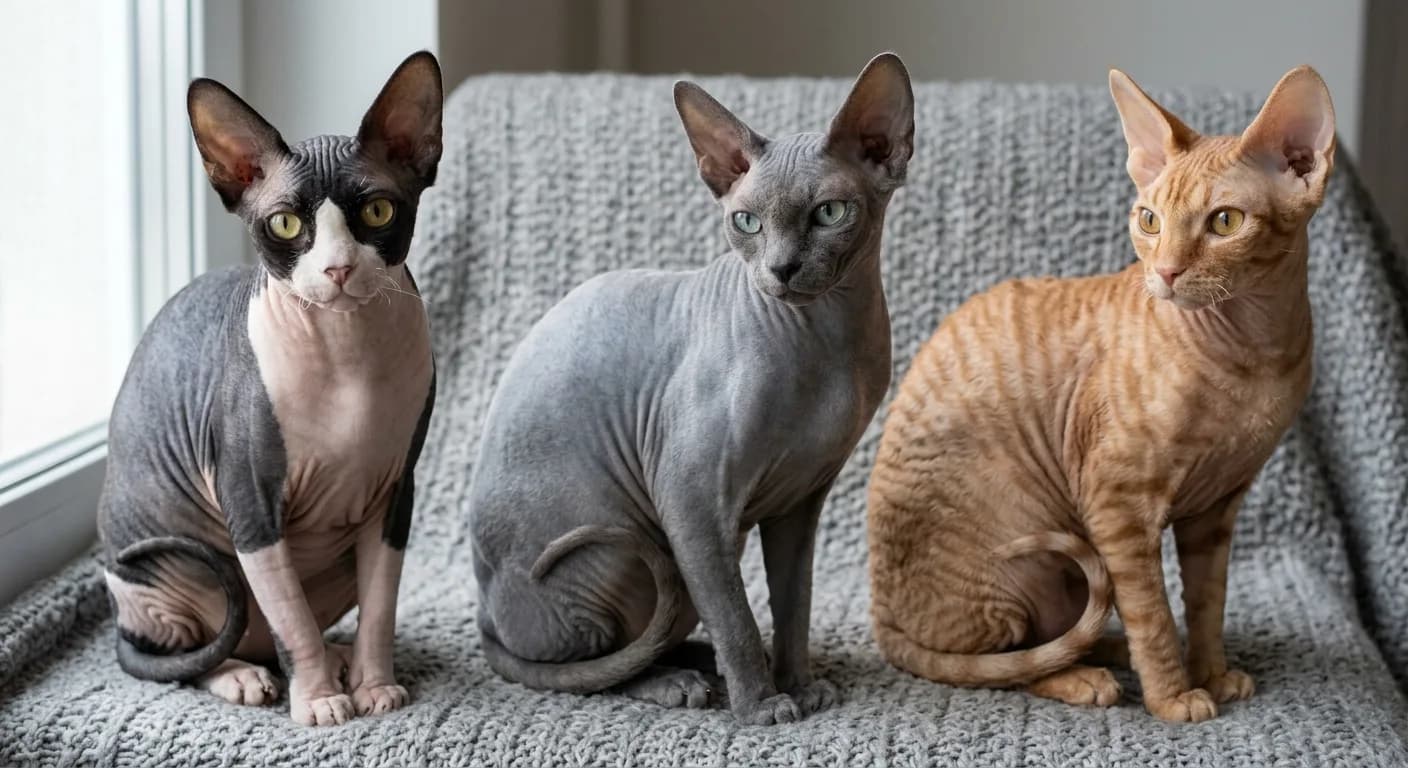
Hairless cats are not all bald to the same degree, and breeders use a tidy vocabulary borrowed from the closely related Donskoy to describe the range. These four terms map cleanly onto how much hair a hairless-type cat carries, and they are the easiest way to place where any individual Sphynx falls on the bald-to-fuzzy spectrum.
Never Scoop Again® with the Whisker Litter-Robot, the smart self-cleaning automatic litter box. Monitor visits and track weights for better overall care in the Whisker® app. Multi-cat friendly.
Petful may earn a commission when you click through to Whisker, at no extra cost to you.
Rubber bald (ultra-hairless)
A rubber-bald cat has completely hairless skin that is hot and soft to the touch and stays that way for life. This is the look most people mean by "hairless," but it sits at the extreme bare end of the range and is less common than the fuzzier types. The skin shows every wrinkle and the full pigment pattern with nothing to soften it.
Flocked (the classic peach fuzz)
Flocked is the most common Sphynx presentation and the one the breed standard is really describing. The cat appears hairless but is covered in very short, soft, almost invisible hairs, the chamois-textured peach fuzz that gives the warm-suede feel. From a few feet away a flocked Sphynx reads as bald; up close and in raking light you can see and feel the down. If you have a "hairless" cat that is clearly a little fuzzy, it is almost certainly flocked.
Velour (downy, often fading)
A velour cat carries a slightly heavier, wavier soft coat, frequently with a bald patch on top of the head, and that coat often thins out over the first year of life. Velour sits between flocked fuzz and a full brush coat. Many Sphynx kittens look velour-ish and then "go bald" as they mature, which is one reason a cat's coat at eight weeks does not predict its adult coat.
Brush (the heaviest, a show fault)
A brush coat is the hairiest end of the spectrum: a relatively long, sparse, wiry, curly or wavy coat, often with bald areas on the head, neck, or back, like a worn-out brush. A genuine brush coat is a show fault under the Sphynx standard (the CFA penalizes "hair other than described"), but a brush-coat Sphynx is still a Sphynx. It just would not finish well in the show ring. Pet owners with a fuzzier "hairy hairless" cat very often have a flocked or brush-leaning individual.
- From balder to fuzzier the order is rubber bald, flocked, velour, brush. If your Sphynx feels like bare warm skin it is rubber bald; if it has an almost-invisible suede down it is flocked; if it has a soft wavy down that is thinning it is velour; if it has obvious wiry or curly patches it is brush. Most pet Sphynx are flocked.
Why does my Sphynx have hair? Five real reasons
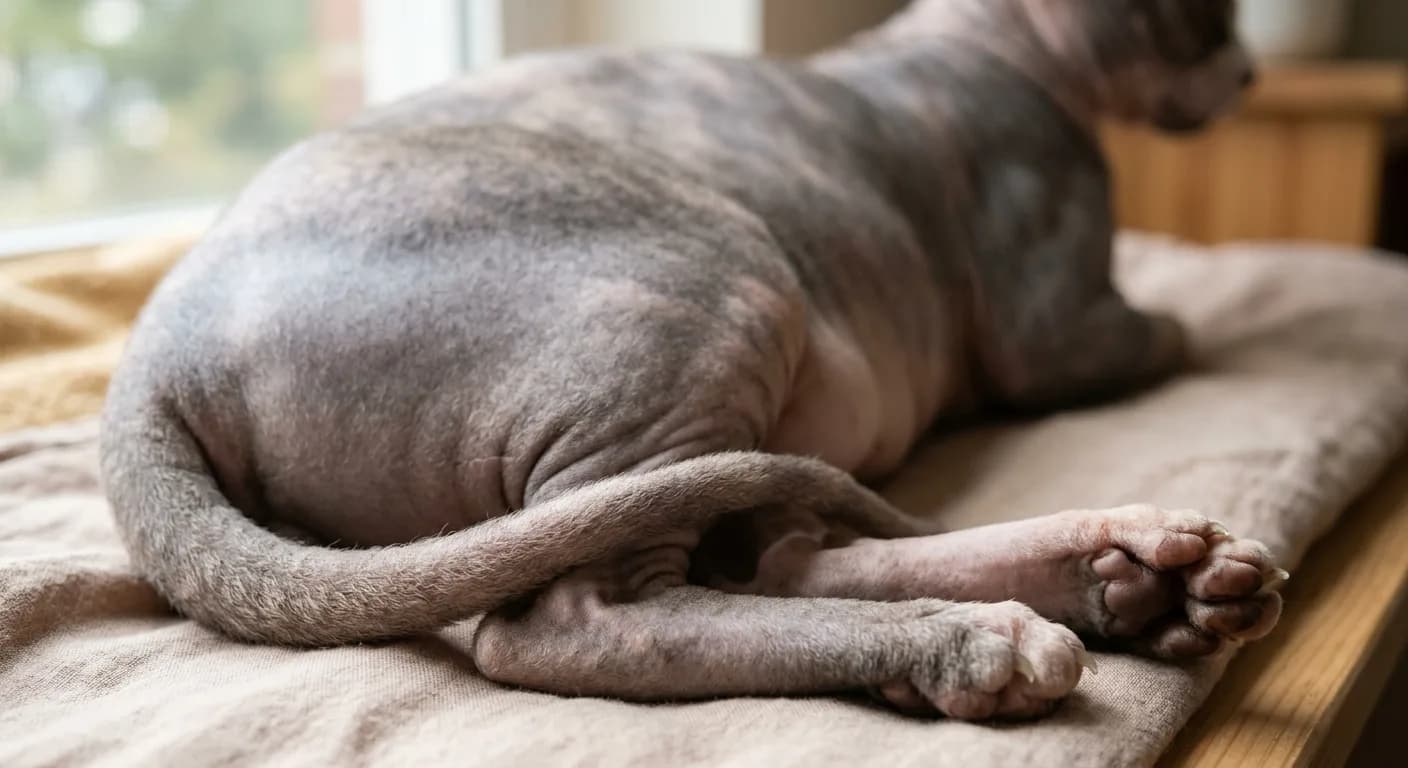
"Why does my Sphynx have hair?" is one of the most common questions owners ask, and there is rarely anything wrong. Hair on a Sphynx is driven by a handful of overlapping factors, and most cats show more than one at once.
Genetics and the specific lines behind the cat. Hairlessness in the Sphynx comes from a recessive mutation (in the KRT71 gene, the same family of genes that shapes hair in other rex breeds), and the exact amount of down a cat carries varies by its breeding lines. Two minimally fuzzy parents can still produce a fuzzier kitten, and vice versa, because coat density is influenced by more than the single on-or-off hairless switch.
The brush-coat variant. Some Sphynx simply inherit the brush-coat end of the range. These cats grow noticeably more hair, sometimes wiry or curly patches, throughout life. It is a normal variation within the breed, not a sign of cross-breeding, though a true brush coat is a show fault.
Seasonal changes. Coat can come and go with the seasons. The CFA explicitly notes that "seasonal and hormonal changes may also affect hair development," so a Sphynx can grow a bit more fuzz heading into a cold winter and shed it back in warmer months.
Hormonal shifts. Hormones move the needle too. Intact cats, cats in heat, pregnant or nursing queens, and cats with thyroid or other endocrine changes can all sprout extra hair. A sudden change in a previously bald adult is worth a quick mention to your vet to rule out an underlying hormonal cause, but it is frequently benign.
Age. Coat shifts across a lifetime. Many Sphynx are fuzziest as kittens, lose much of that down by adulthood, and then some grow scattered hair again as seniors. The cat you bring home at twelve weeks may look quite different by its second birthday.
- A Sphynx growing extra fuzz with the seasons is normal. But if a previously bald adult cat suddenly grows a noticeable amount of hair, mention it at your next vet visit, because hormonal and thyroid changes can drive new hair growth and are worth ruling out. Most cases are harmless, but it is cheap peace of mind.
Is a Sphynx with hair still a real Sphynx?
Yes. A Sphynx is defined by ancestry and pedigree, not by how bald any single cat happens to be. If a cat descends from registered Sphynx lines, it is a Sphynx whether it is rubber bald or carries a soft brush coat. Coat degree affects show eligibility, not breed identity.
Where it matters is the show ring. The Sphynx standard rewards the near-bare, suede-textured look and penalizes "hair other than described," so a true brush coat is scored as a fault and such a cat would not be competitive in conformation. That is a judging rule, not a verdict on whether the animal is a Sphynx. Plenty of beloved, fully pedigreed pet Sphynx are too fuzzy to show and are 100 percent Sphynx all the same.
One nuance for buyers: because a heavier coat is a fault, ethical breeders generally place fuzzier kittens as pets rather than as show or breeding cats, often at a lower price. If a breeder markets a noticeably hairy cat as "rare" at a premium, treat that as a sales angle rather than a mark of quality. The coat does not make the cat better or worse, just less suited to the show bench.

63-inch multi-level cat tree with scratch posts, hammock, plush perches, and dangling toys. Vertical territory is non-negotiable for high-energy climbing breeds like the Bengal.
Petful may earn a commission when you click through to Chewy, at no extra cost to you.
- A brush-coated or extra-fuzzy Sphynx is a fully legitimate Sphynx that simply will not win in the show ring. These cats are frequently placed as pets and make wonderful companions. A fuzzy coat is a reason to adjust your show expectations, never a reason to question the pedigree.
Sphynx coat types at a glance
Use this table to translate what you are feeling under your hand into the right term, and to see how each coat type behaves over time. Most pet Sphynx land in the flocked row.
| Coat Type | Feel and Look | What It Does Over Time | Show Status |
|---|---|---|---|
| Rubber bald | Bare, hot, smooth wrinkled skin, no down | Stays hairless for life | Ideal, fully standard |
| Flocked | Almost-invisible peach-fuzz, warm suede or chamois feel | Usually stable, may shift with season | Standard, the classic Sphynx look |
| Velour | Soft, slightly wavy down, often a bald patch on the head | Frequently thins out in the first year | Acceptable but heavier than ideal |
| Brush | Longer, sparse, wiry or curly patches with bald spots | Tends to persist through life | Show fault, still a real Sphynx |
How to groom a fuzzier Sphynx
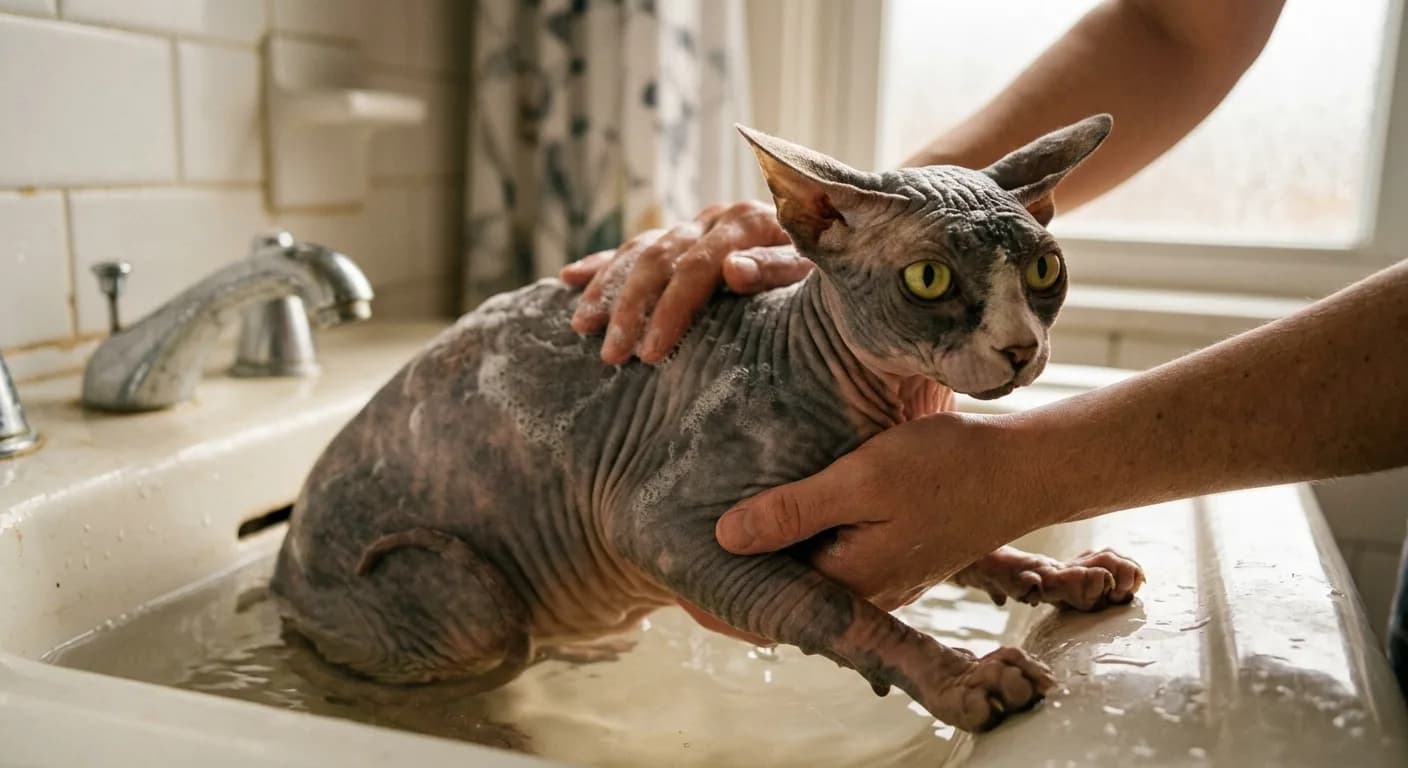
Every Sphynx needs skin care, because with no real coat to wick it away, the skin's natural oil (sebum) builds up and can leave a greasy, sometimes sticky film along with brown gunk in the skin folds, ears, and nail beds. A fuzzier Sphynx needs the same routine, with a couple of small tweaks for the down.
- Bathe regularly but gently. A bath every week to a few weeks, with a mild, cat-safe or hypoallergenic shampoo, keeps the oil and grime in check. Over-bathing strips the skin and makes it produce even more oil, so find the lightest schedule that keeps your cat clean. On a fuzzier coat, work the lather down into the down so you are cleaning skin, not just the surface fuzz.
- Dry thoroughly into the fuzz. Pat dry and make sure the down and skin folds are fully dry, since trapped moisture under fuzz can irritate skin. Keep the cat warm right after a bath.
- Clean ears and nail folds. Sphynx build waxy ear discharge and dark debris between the toes and around the claws quickly. Wipe ears with a vet-approved cleaner and clean the nail folds on a regular schedule.
- Wipe between baths. A gentle damp cloth or pet wipe a few times a week handles oil and keeps skin-fold areas fresh without a full bath.
- Mind the skin under any hair. A flocked or brush coat can hide early skin issues. Part the fuzz now and then to check for redness, blackheads (Sphynx are prone to a feline acne-like buildup), or scaly patches, and loop in your vet if anything looks off.
Beyond cleaning, the no-coat trade-off cuts both ways on temperature. A Sphynx can sunburn through a window and chills easily, so sun protection and warm spots matter regardless of how much fuzz the cat carries. A bit more down offers only marginal protection and is no substitute for warmth and shade.

108-oz stainless steel pet fountain with quiet pump and water-level window. Bengals are notoriously water-obsessed; a flowing fountain encourages hydration and pulls them away from sinks and toilets.
Petful may earn a commission when you click through to Chewy, at no extra cost to you.
- With little or no coat, a Sphynx is exposed to sunburn, cold, and skin infections, and a thin layer of fuzz does not meaningfully shield it. Provide shade and warm bedding, keep up the bathing and skin-fold cleaning routine, and have any persistent rash, scab, or dark lesion checked, since the breed is also prone to specific skin conditions.
Sphynx with hair versus genuinely coated cousins
A fuzzy Sphynx is sometimes confused with cats that have a true, if unusual, coat. The difference is that the Sphynx fuzz is a remnant on an essentially coatless cat, while these relatives carry a real (often curly or sparse) coat by design.
The Devon Rex is the classic mix-up. The Devon is not hairless at all; it has a full but short, soft, wavy, curly coat that can look thin or "pixie-like," and it sheds and feels different from Sphynx suede. Devon and Sphynx breeding programs are historically linked (the rex mutations are related), which is partly why a heavily flocked Sphynx can superficially resemble a sparse Devon, but they are distinct breeds with different coats. Our Cornish Rex versus Devon Rex comparison breaks down how those curly-coated breeds differ from each other and, by extension, from a Sphynx.
The elf cat is a newer experimental breed: a Sphynx crossed with the American Curl, so it has the Sphynx hairless-type skin (down and all) plus distinctive backward-curling ear tips. An elf cat's "hair" situation mirrors the Sphynx, the curled ears are the giveaway. Other hairless-type relatives like the Donskoy, Peterbald, Bambino, and Ukrainian Levkoy each carry their own coat ranges, and the broader family is covered in our guide to hairless cat breeds.
- A Sphynx feels like warm suede with at most a faint down and no real coat. A Devon Rex has an actual short, soft, curly coat you can see and that sheds. If you can run your fingers through a visible wavy coat, you are likely holding a Devon Rex, not a hairy Sphynx.
Does a hairy Sphynx shed less or trigger fewer allergies?
This is the costliest myth to get wrong. A Sphynx with hair is not more hypoallergenic, and neither is a balder one. Cat allergies are driven mainly by the Fel d 1 protein, which lives in saliva and skin oil and is spread when a cat grooms and sheds skin cells (dander), not by fur length. A Sphynx still produces Fel d 1, deposits it on its skin and in its environment, and because its oily skin is so exposed, direct skin contact can actually increase your exposure rather than reduce it.
So whether your Sphynx is rubber bald or carries a brush coat makes little difference to an allergy sufferer. Some people do tolerate a Sphynx better simply because there is less shed fur carrying allergen around the home, but "no fur" is not "no allergen." If allergies are the reason you are drawn to the breed, spend real time with an adult Sphynx first, and read our honest take in are Sphynx cats hypoallergenic before you commit.
- The Fel d 1 allergen comes from saliva and skin, not fur, so a Sphynx (fuzzy or bald) still produces it, and skin contact can worsen exposure. Never buy a Sphynx assuming it solves a cat allergy. Test your real-world reaction with an adult cat over several visits first.
A note on color: the "hair" you see is often skin
Worth clearing up, because it confuses the hair question: a lot of what looks like patterned fur on a Sphynx is actually pigment in the skin. Because there is no coat to carry the color, solid, tabby, tortoiseshell, pointed, and bicolor patterns all show up directly on the skin, with any fine down picking up a hint of the same shade. A "tabby-striped" Sphynx is usually showing skin pigment, not a striped coat. For the full palette and how patterns read on bare skin, see our guide to Sphynx cat colors.
Health and lifespan: the bigger picture behind the coat
The coat conversation matters partly because the lack of a coat ties into the breed's health profile. Hypertrophic cardiomyopathy (HCM), a thickening of the heart muscle, is the leading health concern in the Sphynx, and responsible breeders screen breeding cats by echocardiogram. The breed is also associated with skin conditions (including urticaria pigmentosa), dental and periodontal disease, and the sun, cold, and skin-infection vulnerabilities that come with minimal coat.
On longevity, lifespans for the breed are commonly cited in the range of roughly 8 to 15 years, but a large 2024 Royal Veterinary College VetCompass study of UK cats reported a notably short median life expectancy for the Sphynx compared with other breeds, which the researchers linked to the breed's elevated disease risks. The exact figure should be read as a sobering signal rather than a fixed prediction for any individual cat, and good genetics, HCM screening, indoor living, and attentive care all matter. None of this is changed by how much fuzz a cat carries; coat degree is cosmetic, while heart and skin health are what actually drive quality of life.
- On welfare grounds tied to the no-coat trade-offs (cold sensitivity, skin disease), the Netherlands has acted on hairless cats: breeding the Sphynx has been restricted there since 2014, and from January 1, 2026 the keeping, breeding, and sale of the breed is banned, with exemptions for cats already owned and documented. Rules differ by country, so check your local law if this affects you.
Frequently asked questions about a Sphynx cat with hair
Yes, most do. "Hairless" describes the Sphynx's appearance, not a literal absence of hair. The CFA standard says short fine hair may be present on the feet, the outer edges of the ears, the tail, and the scrotum, with the nose bridge normally coated, and most Sphynx are covered in a fine peach-fuzz down that feels like warm suede or chamois. A truly bare, hairless Sphynx is the exception, not the rule.
Usually for one or more normal reasons: its genetic lines (coat density varies even within the breed), the brush-coat variant, seasonal changes, hormonal shifts (intact, in-heat, pregnant, nursing, or thyroid changes can add hair), and age (many Sphynx are fuzziest as kittens, balder as adults, and may grow scattered hair as seniors). The CFA specifically notes that seasonal and hormonal changes affect hair development. A sudden new coat in a previously bald adult is worth a quick vet check to rule out a hormonal cause, but it is often harmless.
A Sphynx can grow more fuzz or hair, but not a normal full protective coat. Its hairless gene suppresses the regular coat for life, so any hair stays as down, short hairs, or at most a sparse brush coat rather than the dense fur of a typical cat. The amount can increase with cold seasons, hormones, age, or the brush-coat variant, then change again, but a Sphynx will not turn into a fully furred cat.
Yes, and they are common and completely normal. Sphynx coats range by degree from rubber bald (no hair) to flocked (peach-fuzz down) to velour (a soft thinning coat) to brush (a heavier wiry or curly coat). Most pet Sphynx are flocked and carry a faint suede-like down, and a "hairy hairless" Sphynx with obvious fuzz is simply at the brush-leaning end of that range.
Yes. Breed identity comes from ancestry and pedigree, not from how bald a cat is. A Sphynx from registered lines is a Sphynx whether it is rubber bald or carries a brush coat. The only catch is the show ring: a true brush coat is a show fault under the standard, so fuzzier cats are typically placed as pets, but they are fully pedigreed Sphynx.
No meaningful difference. The Fel d 1 allergen that triggers cat allergies comes from saliva and skin oil, not fur, so a Sphynx produces it regardless of fuzz, and its exposed oily skin can even raise contact exposure. A balder Sphynx is not more hypoallergenic than a fuzzier one. If allergies are your concern, spend time with an adult Sphynx before committing.
A Sphynx has essentially no coat, just at most a faint suede-like down, while a Devon Rex has a real short, soft, wavy, curly coat that you can see and that sheds. The two breeds are historically related, which is why a heavily flocked Sphynx can resemble a sparse Devon, but if you can run your fingers through a visible wavy coat you are almost certainly holding a Devon Rex.
The Sphynx is prone to several serious health issues, led by hypertrophic cardiomyopathy (HCM, a thickening of the heart muscle), along with skin conditions, dental disease, and the cold, sun, and infection risks of having little coat. A large 2024 Royal Veterinary College VetCompass study reported a notably short median life expectancy for the breed relative to others, tied to these elevated disease risks. Choosing a breeder who screens for HCM, plus indoor living and attentive care, all help.

Coreen Saito is a pet writer and longtime shelter volunteer with more than a decade in animal rescue. She covers cat behavior, breed care, and the small, ordinary science of sharing a life with companion animals, with a particular focus on honest takes about the products and decisions that actually matter. At home in Arizona, she's outranked by Mac (a dog with the loudest opinion in the house), Rebel (a cat who governs by quiet authority), and Meri (an orange tabby who runs the late shift and the laundry basket). She writes about all three, plus the rescues that keep coming through her life, at LifeWithMinty.com.
Sign up for expert-backed reviews and safety alerts all in one place.