Sphynx Cat Colors: A Visual Guide to Every Skin Color and Pattern
A visual guide to every sphynx cat color and pattern, from the popular black sphynx to white, blue, red, cream, chocolate, and rare lilac, plus tabby, tortie, calico, pointed, and mink, with a color chart, rarity ranking, and the truth about price.
Petful is reader supported. As an affiliate of platforms like Amazon and Chewy, we may earn a commission when you buy through links on this page. There is no extra cost to you.
The Cat Fanciers' Association (CFA) accepts every one of the sphynx cat colors and patterns that exist in any cat, "in any combination," which is why this hairless breed can show up in well over 30 named looks from solid black to calico. Here is the twist that makes the sphynx unlike any other color guide you will read: because the cat has almost no coat, the color and pattern live in the skin pigment (and a faint peach-fuzz down) rather than in fur, so you read the color straight off the skin. This guide walks through the headline colors led by black (by far the most searched), then white, blue, red, cream, chocolate, and lilac, plus the patterns (solid, tabby, tortoiseshell, calico, pointed, bicolor, van, and mink), a color chart, a rarity ranking, and clear answers on eye color, price, and the rarest shade of all.
- 1Because the sphynx is hairless, color and pattern appear in the SKIN pigment (and a fine peach-fuzz down), not in a fur coat, so you read the color off the skin
- 2The CFA accepts all colors and patterns in any combination, and does NOT judge a sphynx on color at all, only on skin quality, body type, and health
- 3Black is the single most popular and most searched sphynx color; white, blue, red, cream, chocolate, and lilac round out the main solids
- 4Patterns include solid, tabby, tortoiseshell, calico, pointed (colorpoint), bicolor, van, and mink, all visible on bare skin
- 5Color does NOT affect a sphynx cat's price or health, and it does NOT make the cat hypoallergenic

Sign up for expert-backed reviews and safety alerts all in one place.
Why sphynx color lives in the skin, not the coat
On a furred cat, the color you see is the color of millions of pigmented hairs. The sphynx has almost none of that. What looks like bare skin up close is usually covered in an extremely fine, soft down (people describe it as warm suede or peach fuzz), but there is no real coat to carry pigment. So the same color genes every cat carries, the genes for black, red, dilution, tabby striping, white spotting, and pointing, express directly in the skin and in that faint fuzz instead.
The practical result is that a sphynx wears its genetics on the outside. A black sphynx has charcoal-to-true-black skin. A tabby sphynx shows its stripes or swirls as darker pigment patterns right on the body. A tortoiseshell shows mottled patches of dark and red skin. Nothing is hidden under a coat, which is part of why so many owners struggle to "read" their cat's color: you are looking at pigment on skin, often softened by a pale fuzz, rather than the crisp coat colors you would see on a typical cat.
- Unlike most breeds, the sphynx standard treats color as cosmetic. Judges award points for skin texture, the sturdy body, the wedge head, and large ears, not for which color a cat happens to be. Every color and pattern is equally "correct," so pick the look you love.
One more myth worth clearing up early: a hairless cat is not hypoallergenic. The main cat allergen, Fel d 1, is produced in saliva and skin and sebaceous (oil) secretions, not in fur, so a sphynx still makes it. Because there is no coat between you and the skin, direct contact can actually increase exposure rather than reduce it. If allergies are your reason for considering the breed, read our guide to hairless cat breeds before assuming bare skin solves the problem.
Black sphynx cat: the most popular color
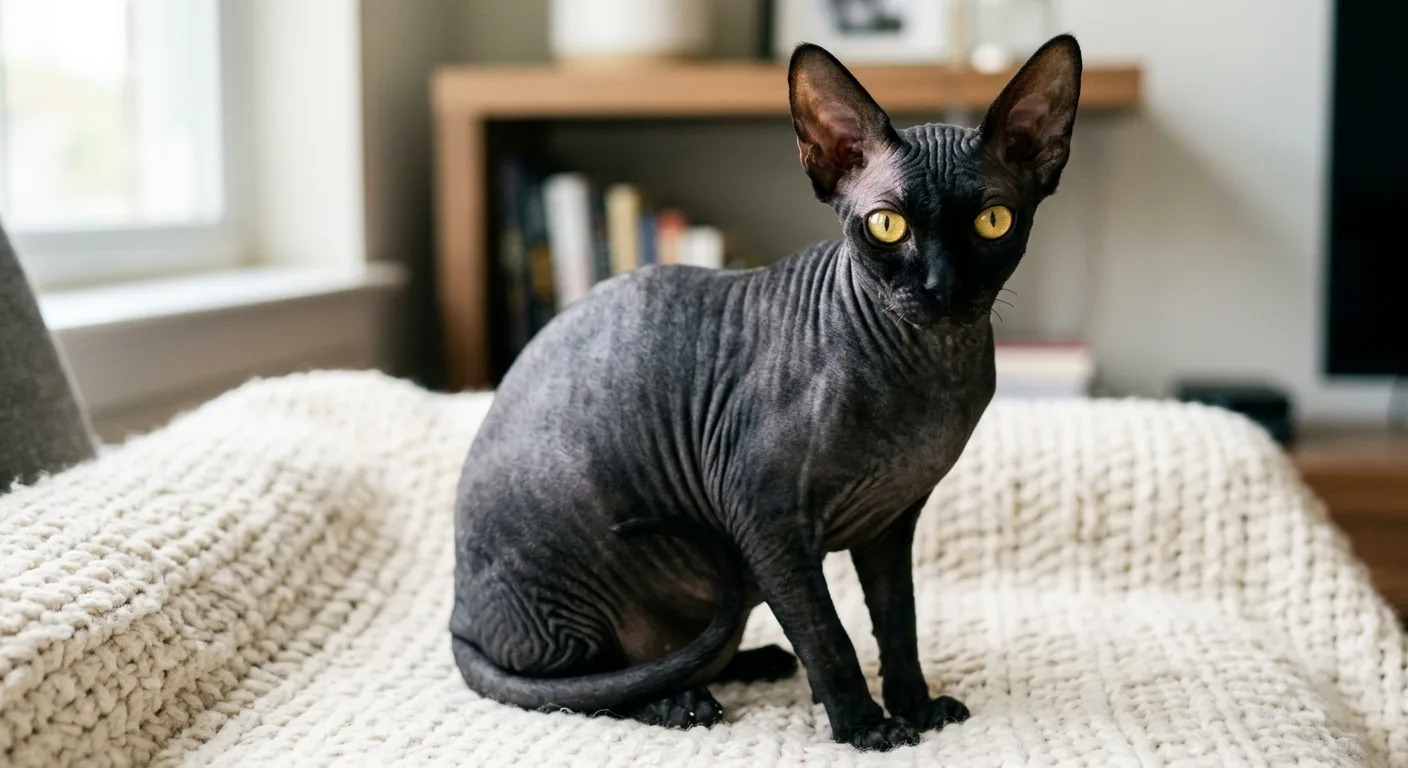
Black is the color most people picture (and most people search for) when they think of a hairless cat, and a black sphynx is striking: deep charcoal-to-true-black skin stretched over those dramatic wrinkles, wide ears, and big eyes, with a look that owners affectionately call "naked little gargoyle." Genetically it is the same dense black (eumelanin) that produces a black coat on a furred cat, just expressed in the skin.
A few things to know about black sphynx cats specifically. First, true jet black is less common than it looks in photos, because that fine down and regular sun exposure can lift the skin toward a dark slate or "rusty" charcoal rather than pure black. A black sphynx that spends time in sunlight can look noticeably grayer or browner than one kept out of strong sun. Second, "black" with any visible warmth or brown is still black genetically, and the CFA describes black skin as "dense coal black, sound from the roots." Black sphynx cats are not officially rare, they are one of the more common and most in-demand looks, though a flawless solid-black with no white markings and bright skin is harder to find than the casual buyer expects.

Never Scoop Again® with the Whisker Litter-Robot, the smart self-cleaning automatic litter box. Monitor visits and track weights for better overall care in the Whisker® app. Multi-cat friendly.
Petful may earn a commission when you click through to Whisker, at no extra cost to you.
- With no coat to shield it, a black sphynx's skin reacts to sunlight much like ours does. Strong sun can fade dense black toward a dusty slate or give it a rusty cast, and it can also cause sunburn. Keep a black sphynx out of harsh midday sun and the color stays richer and deeper.
White sphynx cat
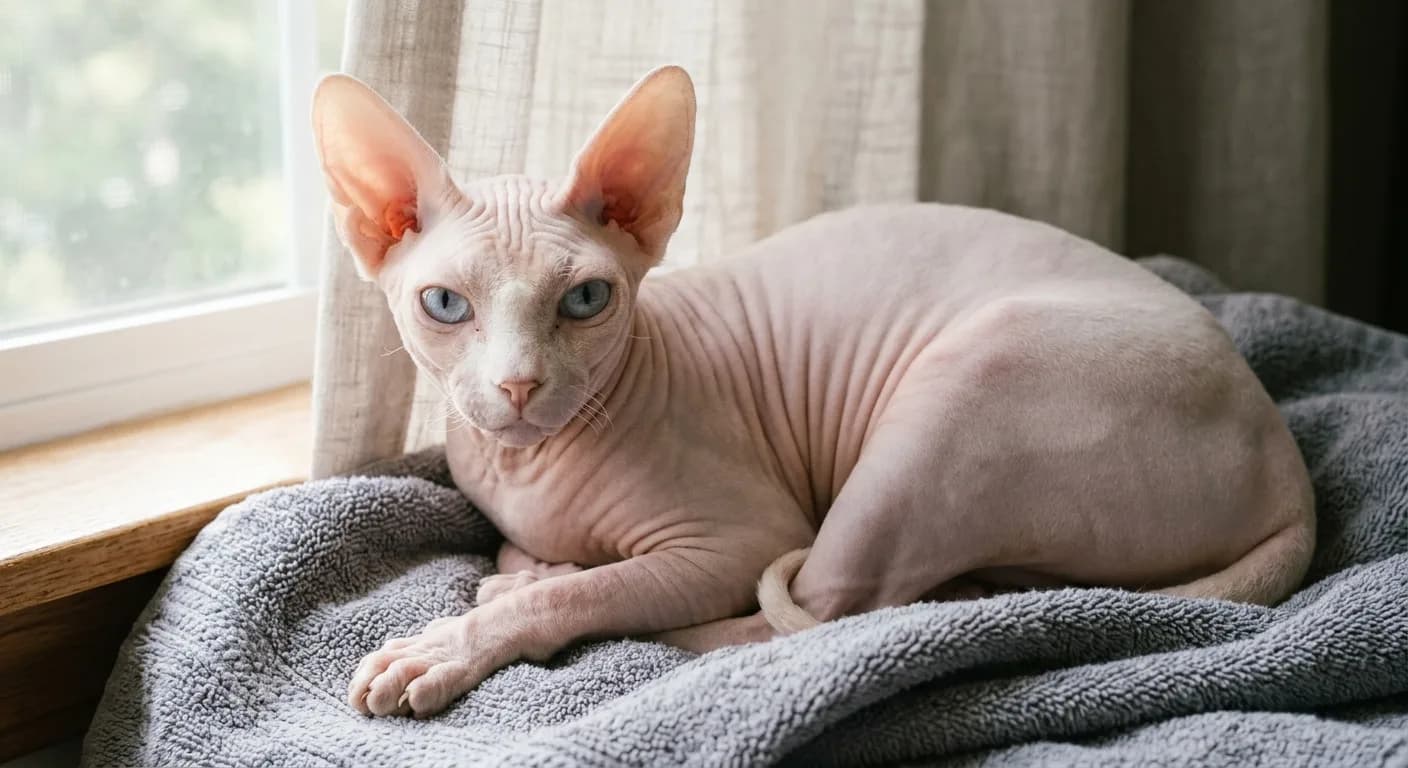
A white sphynx has pale, pinkish skin with no visible pigment, often the most "naked" looking of all because there is no color to read at all, just the natural pink of the skin and a whisper of white down. Genetically a white cat carries a masking gene that hides whatever color is underneath, so a white sphynx may be "genetically" black or red and you would never see it.
White sphynx cats are the most sun-sensitive of all, since pink, unpigmented skin sunburns fastest, so sunscreen-safe shade and limited window-sunbathing matter even more here. As with white cats of any breed, some white-and-blue-eyed individuals can carry a higher chance of deafness, so a reputable breeder will mention hearing status.
Blue (gray) sphynx cat
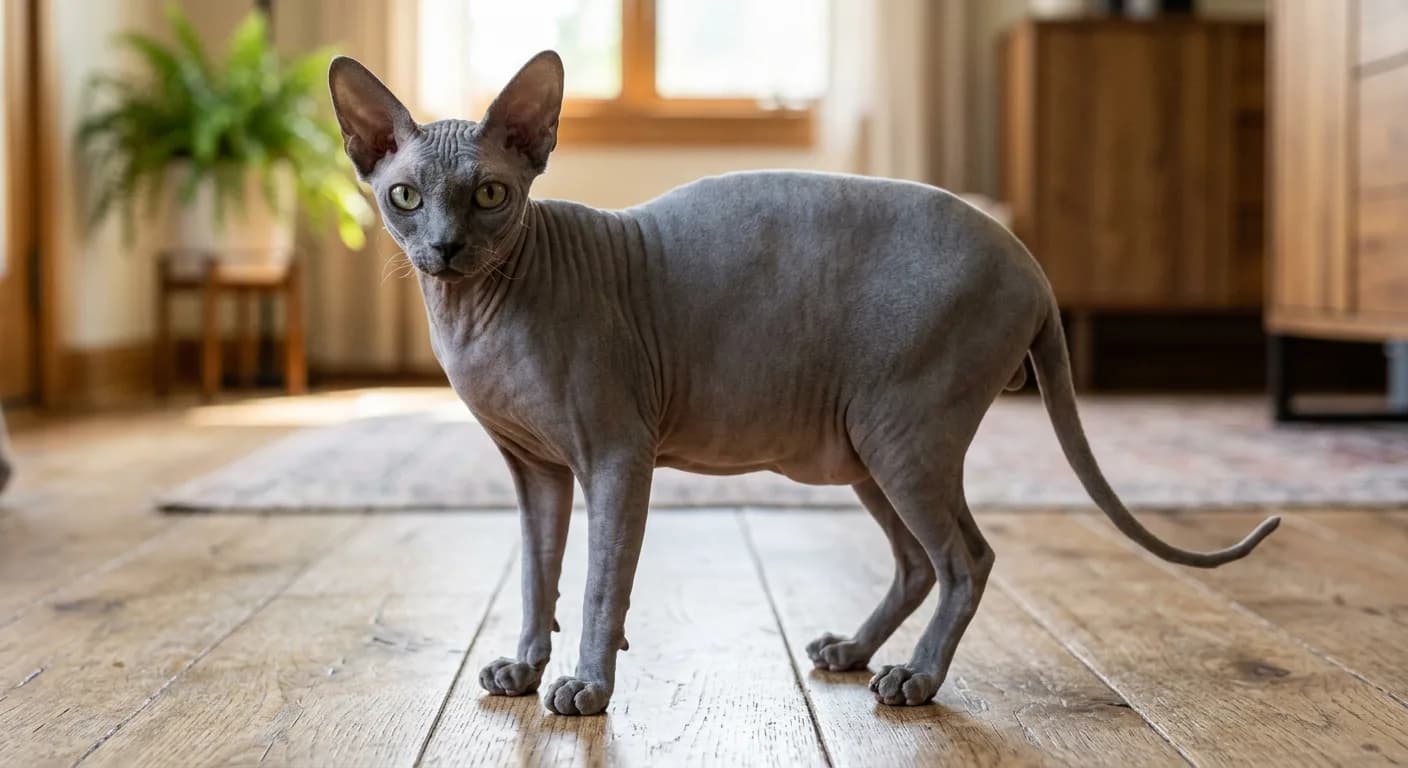
"Blue" in cat language means a soft, cool slate gray, the dilute version of black. A blue sphynx shows smooth gray skin with a faintly bluish, almost lavender-tinged cast in good light. This is the color most casual owners call simply a "gray sphynx," and it is one of the most popular solids after black because the cool tone flatters the breed's wrinkly, sculptural look.
Because blue is a diluted black, the same pair of dilution genes that turns a black cat blue also turns red into cream and chocolate into lilac. That single fact (dilution softens every base color) is the key to half the color names on a breeder's list.
Red and cream sphynx cats
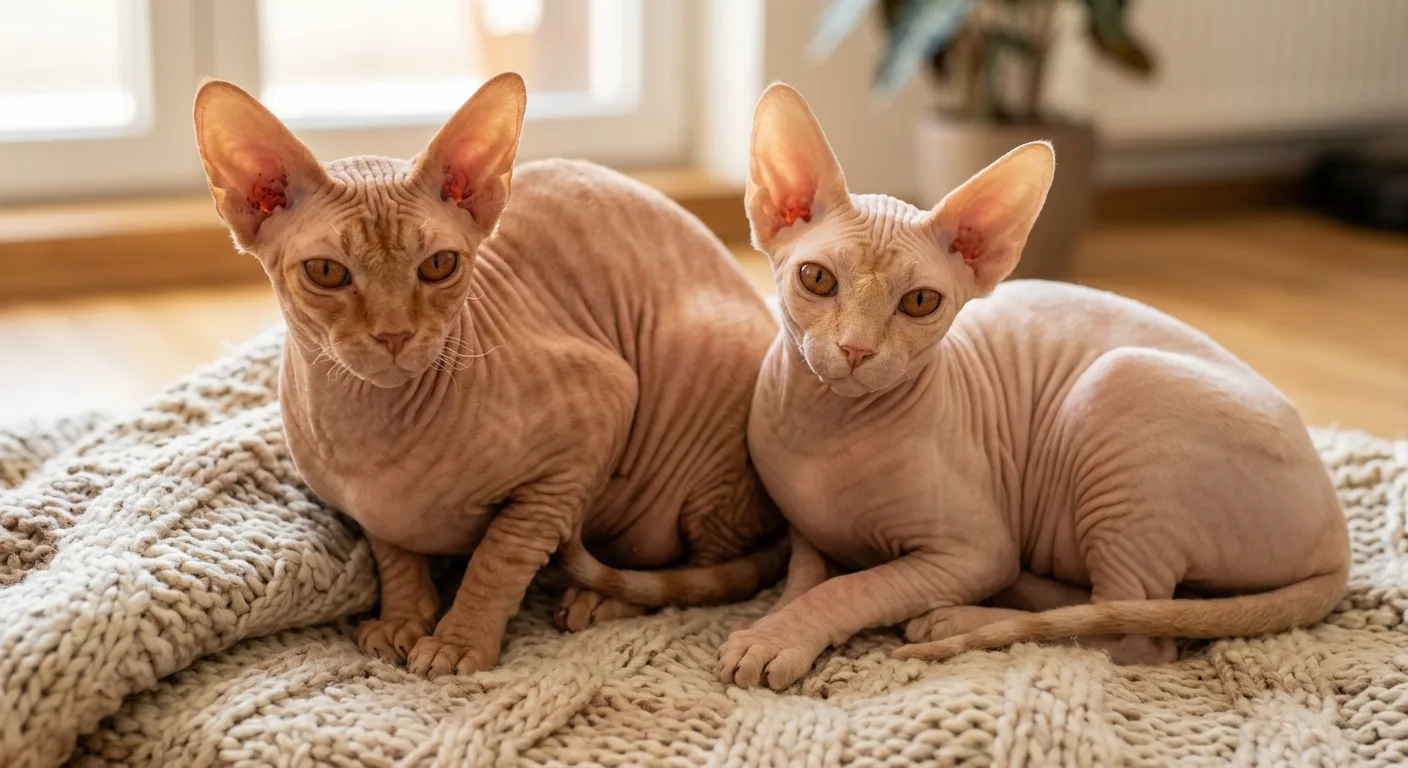
Red (sometimes called orange or flame) shows as warm reddish-peach to ginger skin, often with faint tabby-like striping even on a cat that is not formally a tabby, because the red gene almost always lets some striping show through. Red is sex-linked, carried on the X chromosome, which is why most solid red cats are male and why red interacts with the tortoiseshell pattern (more on that below).
Cream is the dilute of red: a soft, pale peachy-buff that can read almost off-white in some light, the most delicate of the warm tones. A cream sphynx often looks like a barely-there wash of peach over pink skin. Both red and cream are well-loved but a touch less common than black, white, and blue simply because fewer breeding lines focus on them.
Chocolate and lilac (lavender) sphynx cats
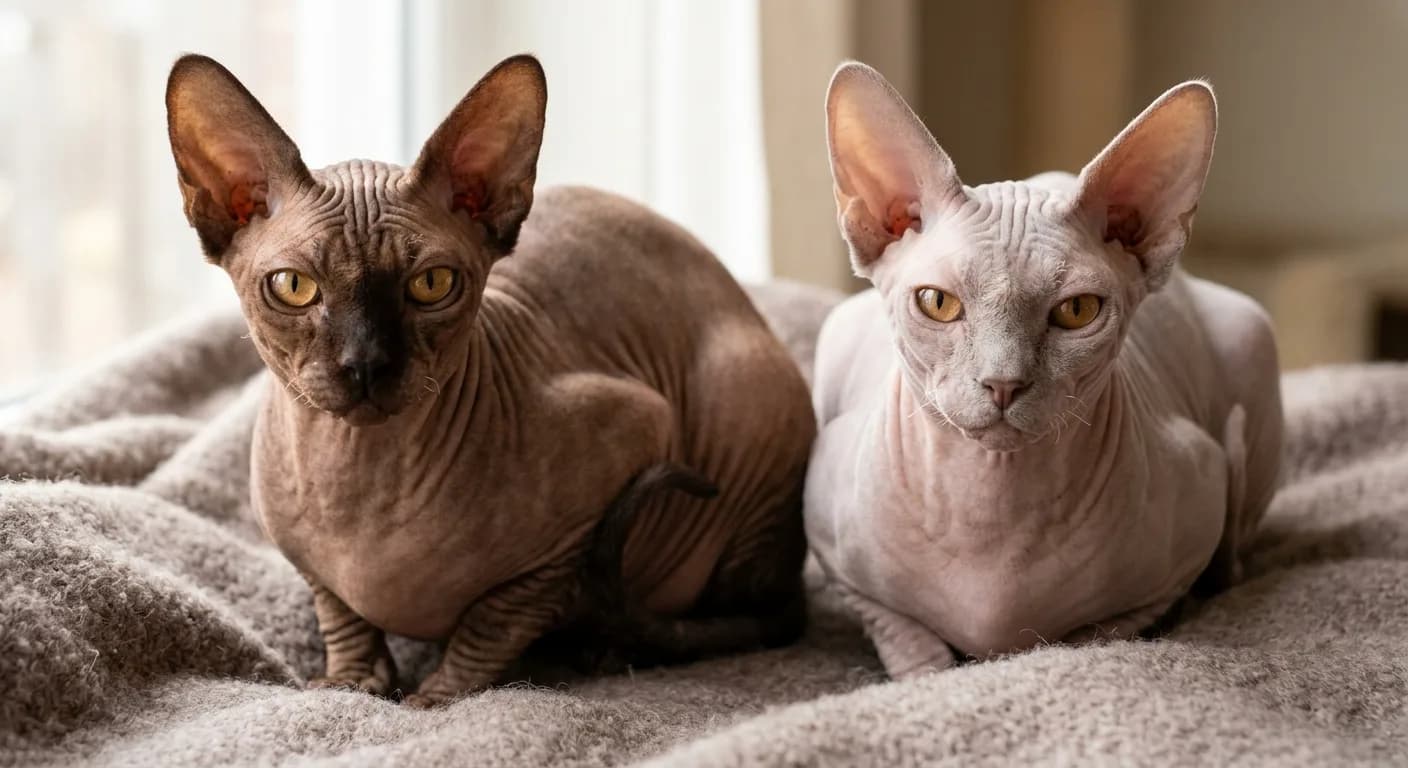
Chocolate is a rich, warm brown, like milk chocolate, and it is a genuinely uncommon color because it relies on a recessive gene that both parents must carry. A chocolate sphynx shows even, warm-brown skin without the cool undertone of black.
Lilac (also called lavender) is the dilute of chocolate: a pale, frosty gray with a distinct pinkish or faint purple cast. Because lilac needs the recessive chocolate gene plus the dilution gene, it is one of the rarest of the standard solid colors, prized by breeders for its delicate, almost otherworldly tone on bare skin. Cinnamon and its dilute fawn are even more unusual warm browns that show up in some lines and the CFA standard, rounding out the rarest end of the solid spectrum.
- Learn them in pairs and the whole palette clicks: black and its dilute blue, red and its dilute cream, chocolate and its dilute lilac, and cinnamon and its dilute fawn. White sits apart because it masks whatever color is underneath. Knowing the pairs lets you decode any name on a breeder's list.
Sphynx patterns: how markings show on bare skin
Color tells you the base hue. Pattern tells you how that color is arranged on the skin. Every pattern that exists in cats can appear on a sphynx, just rendered in pigment-on-skin rather than in fur.

63-inch multi-level cat tree with scratch posts, hammock, plush perches, and dangling toys. Vertical territory is non-negotiable for high-energy climbing breeds like the Bengal.
Petful may earn a commission when you click through to Chewy, at no extra cost to you.
Tabby
The tabby pattern adds darker stripes, swirls, or spots over a lighter base, complete with the classic "M" marking on the forehead. On a sphynx you see it as darker pigment patterns directly on the skin: mackerel (narrow vertical stripes), classic (bold swirls), spotted (broken into spots), and ticked. Tabby can layer over almost any base color, giving brown tabby, blue tabby, silver tabby, red tabby, and so on.
Tortoiseshell and calico
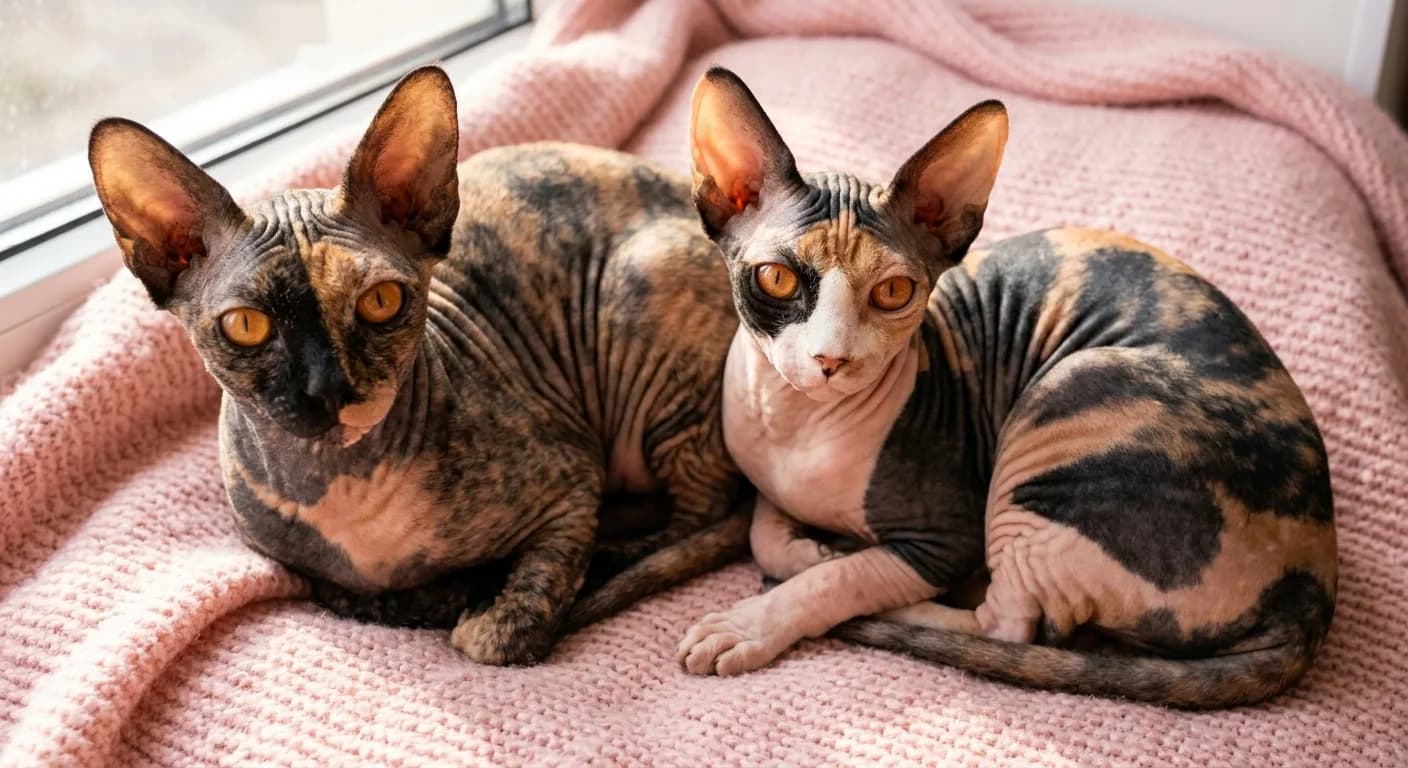
A tortoiseshell ("tortie") sphynx shows a mottled, marbled mix of black (or another dark base) with patches of red or cream, all on bare skin, with no white. A calico adds white into the mix: distinct patches of black and red over a white base. Both patterns are almost exclusively female, because they require two X chromosomes to display two colors at once. A male tortie or calico is a true genetic rarity (it needs an extra X chromosome) and is usually sterile.
Pointed (colorpoint) and mink
A pointed sphynx wears the Siamese pattern: a pale body with darker "points" on the cooler extremities (ears, mask, feet, and tail). It comes from the same temperature-sensitive gene seen in Siamese and Himalayan cats, where pigment only develops in the cooler parts of the body. Pointed sphynx cats often show very little point color in youth and darken as they age. Pointed sphynx cats also tend to have blue eyes, a tell of the pointing gene. The mink pattern is a closely related look (a warmer, less-contrasted version of pointing) and mink sphynx cats are known for distinctive aqua or blue-green eyes. Sepia is the most muted version, where the body and points are nearly the same depth.
Bicolor and van
Bicolor simply means a base color combined with white, in patches anywhere on the body. The van is the most extreme version, where color is restricted to just the head and tail while the rest of the cat is white (with a related harlequin pattern sitting between standard bicolor and van). The CFA groups many of these less-typical combinations under "OSC," or Other Sphynx Colors, a catch-all for any color or pattern that does not fit a named class.
- Sphynx color names stack: base color, then any modifier, then the pattern. "Blue tabby bicolor" means a blue (gray) base, with tabby striping, plus white spotting. Break the label into those parts and you can decode any listing, however long it looks.
Sphynx eye colors
Eye color in the sphynx is independent of skin color and ranges widely: blue, green, gold, yellow, copper, orange, and hazel all occur. Pointed and mink sphynx cats lean blue or aqua because of the pointing gene, while solid colors can carry almost any eye color. The breed is also known for heterochromia (two different-colored eyes, such as one blue and one gold), which is striking but purely cosmetic and does not affect vision or health. The CFA does not tie eye color to coat color in the sphynx, so any color eyes can pair with any color skin.

108-oz stainless steel pet fountain with quiet pump and water-level window. Bengals are notoriously water-obsessed; a flowing fountain encourages hydration and pulls them away from sinks and toilets.
Petful may earn a commission when you click through to Chewy, at no extra cost to you.
Sphynx color chart: read your cat's color off its skin
Use this chart to translate the skin you are looking at into its proper color name. Match the skin tone in the first column, then check the notes to confirm.
| Color | How it looks on the skin | Notes |
|---|---|---|
| Black | Dense charcoal to true black skin | Most popular; can look slate or rusty in sun |
| White | Pale pink, unpigmented skin | Most sun-sensitive; masks the color underneath |
| Blue (gray) | Smooth cool slate gray | Dilute of black; the common "gray" sphynx |
| Red (orange) | Warm reddish-peach to ginger | Sex-linked, mostly male; faint striping common |
| Cream | Pale peachy-buff, nearly off-white | Dilute of red; soft and delicate |
| Chocolate | Even warm milk-chocolate brown | Recessive, uncommon |
| Lilac (lavender) | Frosty pinkish-gray | Dilute of chocolate; among the rarest solids |
| Cinnamon and fawn | Light warm reddish-brown to pale buff | Rare warm browns seen in some lines |
Sphynx color rarity ranking
Rarity comes down to genetics: dominant colors are common, recessive and dilute colors are rare, and the more elements you stack (a recessive base plus a dilution plus an unusual pattern) the rarer the exact combination. Treat the order below as a practical guide rather than a census, since frequencies vary by breeding line and country.
| Color or Pattern | Relative Rarity | What Drives It |
|---|---|---|
| Black, white, blue | Most common | Dominant or popular base colors, widely bred |
| Red and cream | Common to moderate | Sex-linked; fewer dedicated lines |
| Tabby and bicolor | Common | Everyday patterns layered on any base |
| Chocolate | Uncommon | Needs a recessive gene from both parents |
| Tortoiseshell | Uncommon | Requires two X chromosomes, nearly all female |
| Lilac (lavender) | Rare | Recessive chocolate plus the dilution gene |
| Cinnamon and fawn | Rare | Unusual warm-brown genetics |
| Calico | Rare | White spotting plus a tortie base, almost all female |
| Pointed, mink, sepia | Varies | Depends on the temperature-sensitive gene in the line |
- Lilac, chocolate, and odd-eyed sphynx cats are rarer only because the genetics are harder to line up, not because the cats are healthier or better quality. Never let a trendy or "rare" color substitute for proof of HCM heart screening and a responsible, health-testing breeder.
Does color affect a sphynx cat's price or health?
For most buyers this is the real question, and the answer is reassuring: color does not change a sphynx cat's health, temperament, or true value. The sphynx's known health priorities (especially hypertrophic cardiomyopathy, or HCM, the leading heart concern that responsible breeders screen for by echocardiogram, plus skin conditions like urticaria pigmentosa and dental disease) apply to every color equally. A black sphynx and a lilac sphynx face the same breed risks, and a reputable breeder screens for them regardless of coat color.
Color can nudge price, but only through supply and demand, not quality. Common, in-demand looks like black, white, and blue sit in the middle of the range, while genuinely rare colors and patterns (lilac, chocolate, odd-eyed, or unusual pointed combinations) sometimes carry a premium simply because fewer are available. That premium reflects scarcity and marketing, never a healthier or "better" cat. For realistic numbers and what actually drives the cost, see our full sphynx cat price guide.
It is also worth a reminder that some lines are not truly hairless: a sphynx cat with hair (a downy or "brush-coat" individual) carries the same colors and patterns, just under a heavier layer of fuzz that can mute how the pigment reads. For the full picture on temperament, grooming, and care across every color, our sphynx cat breed profile ties it all together.
- No sphynx color is immune to hypertrophic cardiomyopathy (HCM) or the breed's skin and dental issues. Choose a breeder who screens breeding cats for HCM by echocardiogram and is transparent about it, and treat coat color as the very last item on your checklist, well behind documented health testing.
How sphynx color develops and changes with age
A sphynx's color is not always fixed from kittenhood. Pointed and mink kittens are born very pale and develop their darker points slowly over the first months and years, so a faint kitten can become a clearly pointed adult. Even solid colors can shift in appearance: sun exposure can lighten or "rust" a black or blue sphynx, while the fine down a cat carries can soften how saturated the skin looks. Judge a sphynx's final color at maturity and in neutral light, not from a young kitten photo or a sunbathing snapshot.
- 1Black is the most popular sphynx color, then white, blue, red, cream, chocolate, and the rarer lilac, cinnamon, and fawn
- 2Patterns (tabby, tortie, calico, pointed, mink, bicolor, van) all show as pigment on bare skin
- 3Tortie and calico are almost always female; red is mostly male; pointed and mink lean toward blue or aqua eyes
- 4Lilac and chocolate are the rarest standard solids because they rely on recessive plus dilution genes
- 5Color never affects health or temperament and only nudges price through supply and demand, so prioritize HCM screening over coat color
Frequently asked questions about sphynx cat colors
Sphynx cats come in almost every color and pattern found in cats, because the CFA accepts all colors and patterns in any combination. The main solid colors are black, white, blue (gray), red, cream, chocolate, and the rarer lilac, cinnamon, and fawn. Patterns include tabby, tortoiseshell, calico, pointed (colorpoint), mink, bicolor, and van. Since the cat is hairless, every color shows in the skin pigment and faint down rather than in fur.
Among the standard solid colors, lilac (lavender) is generally the rarest because it requires both the recessive chocolate gene and the dilution gene, with chocolate, cinnamon, and fawn close behind. Among patterns, a true male tortoiseshell or calico is rarer still, since those patterns are almost always female and a male needs an extra X chromosome. Odd-eyed (heterochromia) sphynx cats are also uncommon and prized.
No, black is actually one of the most common and most popular sphynx colors, not a rare one. A flawless solid black with no white markings and rich, even skin can be harder to find than the casual buyer expects, and a black sphynx often looks slate-gray or rusty after sun exposure because there is no coat to shield the skin, but black itself is widely bred and in high demand rather than rare.
Only through supply and demand, not quality. Common, in-demand colors like black, white, and blue sit in the middle of the price range, while genuinely rare colors and patterns such as lilac, chocolate, odd-eyed, or unusual pointed combinations sometimes carry a premium simply because fewer are available. That premium reflects scarcity, never a healthier or better cat, so color should be the last factor in your decision.
Read the color directly off the skin and the fine peach-fuzz down, since there is no coat. Look at the base skin tone (charcoal for black, pink for white, slate for blue, peach for red), then check for patterns like darker tabby striping, mottled tortie patches, white spotting, or darker points on the ears, face, feet, and tail. View the cat in neutral light at maturity, because sun and age can change how the pigment reads.
Sphynx eye color is independent of skin color and ranges across blue, green, gold, yellow, copper, orange, and hazel. Pointed and mink sphynx cats tend toward blue or aqua eyes because of the temperature-sensitive pointing gene, while solid colors can have almost any eye color. The breed is also known for heterochromia, two different-colored eyes, which is harmless and purely cosmetic.
No. The main cat allergen, Fel d 1, is produced in saliva and skin oils, not in fur, so a hairless sphynx still produces it regardless of color. Because there is no coat between you and the skin, direct contact can actually increase allergen exposure. No sphynx color or pattern is hypoallergenic, so allergy sufferers should spend time with the breed before committing.
No. The sphynx is one of the few breeds where color is treated as purely cosmetic. CFA judges award points for skin texture, the sturdy body, the wedge-shaped head, and the large ears, not for which color a cat is. Every color and pattern, in any combination, is equally acceptable in the show ring, so you can choose any look purely on personal preference.

Coreen Saito is a pet writer and longtime shelter volunteer with more than a decade in animal rescue. She covers cat behavior, breed care, and the small, ordinary science of sharing a life with companion animals, with a particular focus on honest takes about the products and decisions that actually matter. At home in Arizona, she's outranked by Mac (a dog with the loudest opinion in the house), Rebel (a cat who governs by quiet authority), and Meri (an orange tabby who runs the late shift and the laundry basket). She writes about all three, plus the rescues that keep coming through her life, at LifeWithMinty.com.
Sign up for expert-backed reviews and safety alerts all in one place.