Hairless Cat Breeds: Every Bald and Near-Bald Cat Compared
A complete guide to hairless cat breeds: profiles of the Sphynx, Donskoy, Peterbald, Bambino, Elf, Dwelf, Lykoi, and the near-hairless rex cats, plus a price comparison table, shared care needs, and why no bald cat is hypoallergenic.
Petful is reader supported. As an affiliate of platforms like Amazon and Chewy, we may earn a commission when you buy through links on this page. There is no extra cost to you.
The Cat Fanciers' Association and TICA together formally recognize only a handful of true hairless cat breeds, yet there are at least 9 distinct bald and near-bald varieties a buyer can actually find, and almost every one traces back to a single accidental genetic mutation rather than any lab. The flagship is the Sphynx, born from a hairless Toronto kitten in 1966, but the family now includes the Donskoy, Peterbald, Bambino, Elf, Dwelf, the patchy "werewolf" Lykoi, and the sparse-coated Cornish Rex and Devon Rex. This guide profiles each one, lines them all up in a single comparison table, busts the stubborn hypoallergenic myth, and walks through the bathing, warmth, and sun care that every hairless cat shares, so you can decide which naked (or nearly naked) cat fits your home.
- 1There are roughly 9 hairless and near-hairless cat breeds, led by the Sphynx, plus the Donskoy, Peterbald, Bambino, Elf, Dwelf, and Lykoi
- 2Most are not truly bald; many have a fine peach-fuzz down, and the "rex" breeds (Cornish and Devon) have a thin wavy coat rather than no coat
- 3Hairlessness comes from a natural recessive mutation, and the different breeds carry different genes (the Sphynx and Donskoy mutations are not the same)
- 4No hairless cat is hypoallergenic, because the Fel d 1 allergen lives in saliva and skin oils, not fur
- 5Every hairless cat needs regular bathing, sweaters or warm spots in winter, and shade or pet-safe sunscreen in summer

Sign up for expert-backed reviews and safety alerts all in one place.
What is a hairless cat, and are they truly bald?
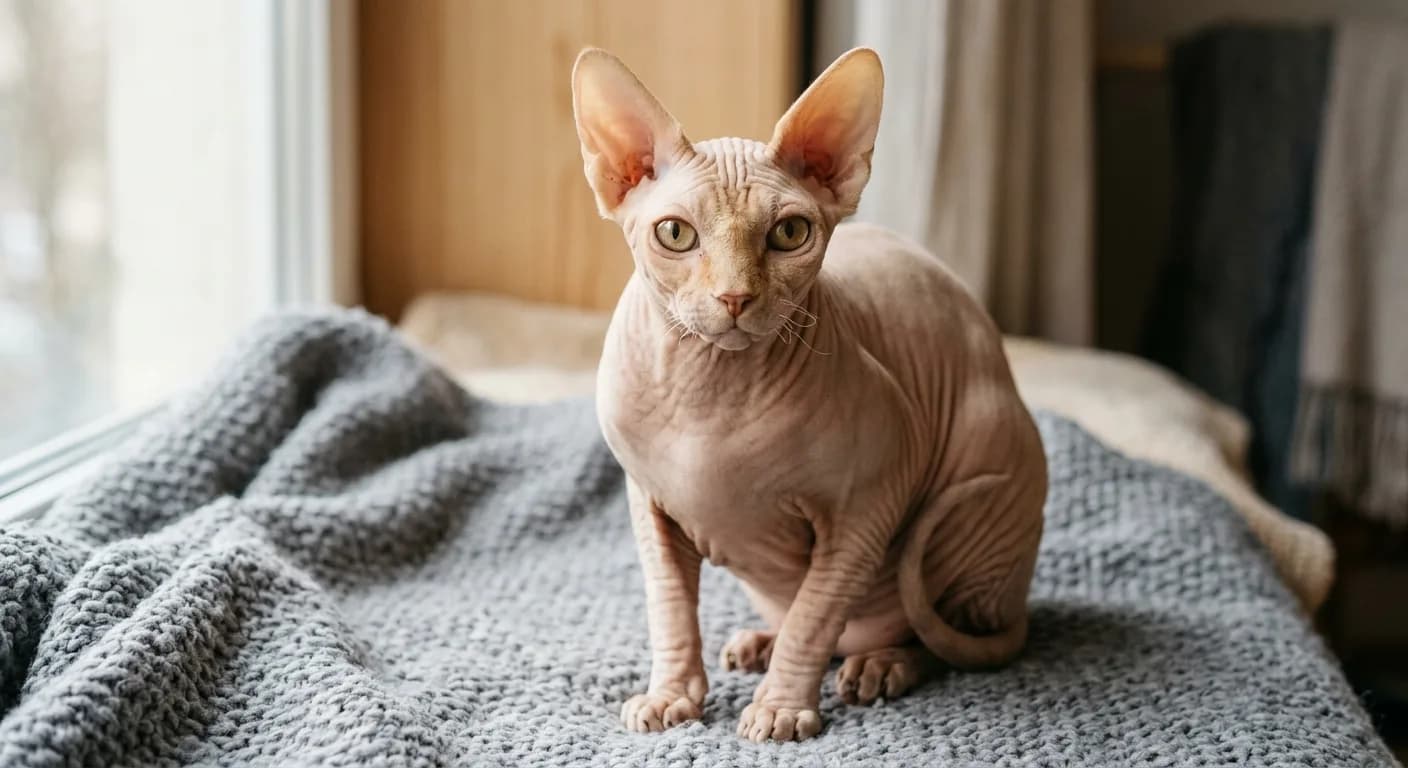
A hairless cat is any cat breed whose defining trait is little to no fur, the result of a natural genetic mutation that disrupts normal hair growth. The key word is "little." Very few hairless cats are completely, glassy-smooth bald. Most are covered in a fine, downy peach fuzz so short it is easier to feel than see, which is exactly why people describe a Sphynx as feeling like warm suede or a chamois cloth. The color and pattern you would normally see in a coat (solid, tabby, tortoiseshell, pointed, bicolor) still show up, but in the pigmented skin itself rather than in fur.
Why are they hairless in the first place? In the Sphynx, hairlessness is a recessive mutation in a gene called KRT71, which is involved in building the hair shaft. Because the trait is recessive, a kitten needs two copies (one from each parent) to be hairless, which is part of why these cats stayed rare for decades. Crucially, not all hairless breeds share the same mutation: the Sphynx mutation is recessive, while the Donskoy and its descendant the Peterbald carry a different, dominant hairless gene. That genetic split is why crossing a Sphynx with a Donskoy does not reliably produce more hairless cats, and it is the single most important fact separating the two main hairless lineages. There is more on this in Petful’s guide to Sphynx cat with hair.
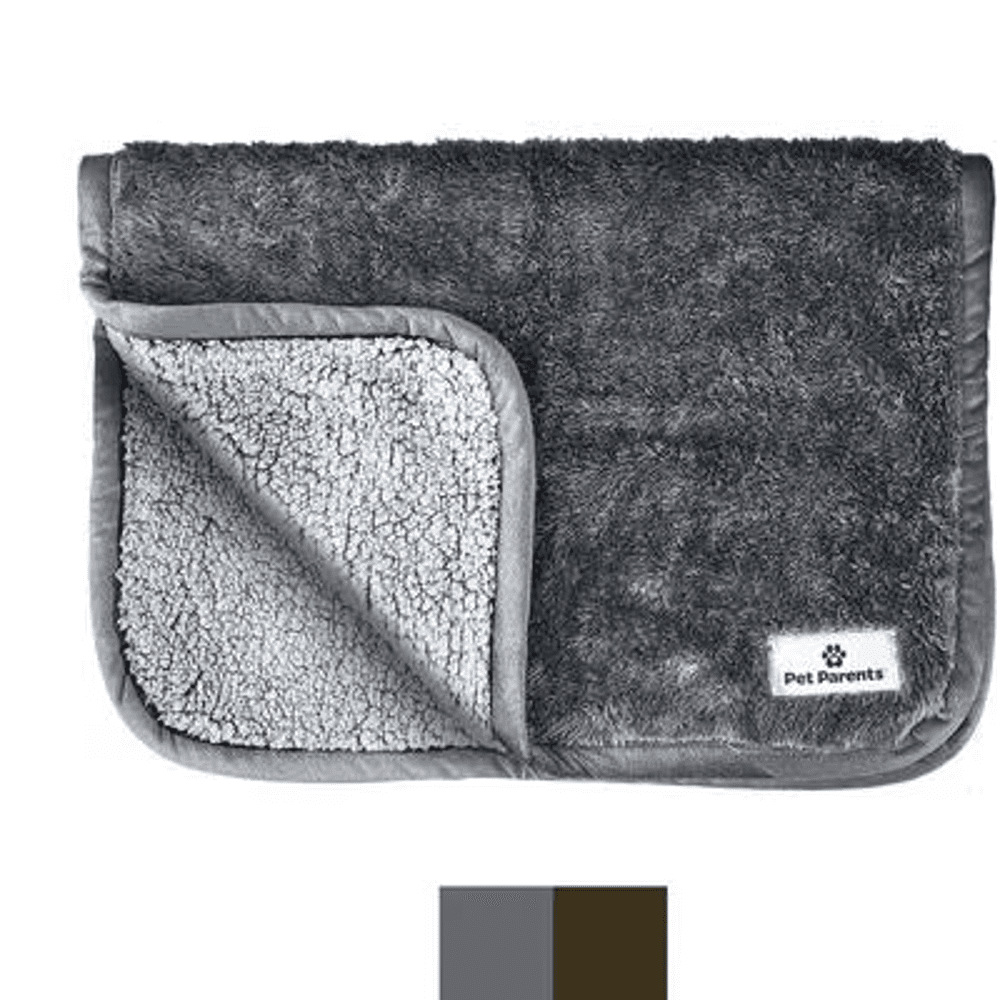
A plush, waterproof sherpa blanket that gives a cold or shivering dog a warm, cozy layer to curl into. The hidden waterproof lining protects the bed, couch, or car seat, and the whole thing is machine washable.
Petful may earn a commission when you click through to Chewy, at no extra cost to you.
- Most hairless cats carry a fine, invisible down and have normal-to-sparse whiskers and eyebrows. A cat that is truly slick and shiny with zero fuzz is the exception, not the rule, even among Sphynx.
The hairless cat breeds, profiled
Below is every hairless and near-hairless breed worth knowing, from the famous to the obscure. A few are recognized championship breeds; several are newer "experimental" or designer breeds created by crossing the Sphynx with another cat for a specific look (short legs, curled ears, a partial coat). We note which is which so you know what you are actually buying.
Sphynx (the original and most popular)
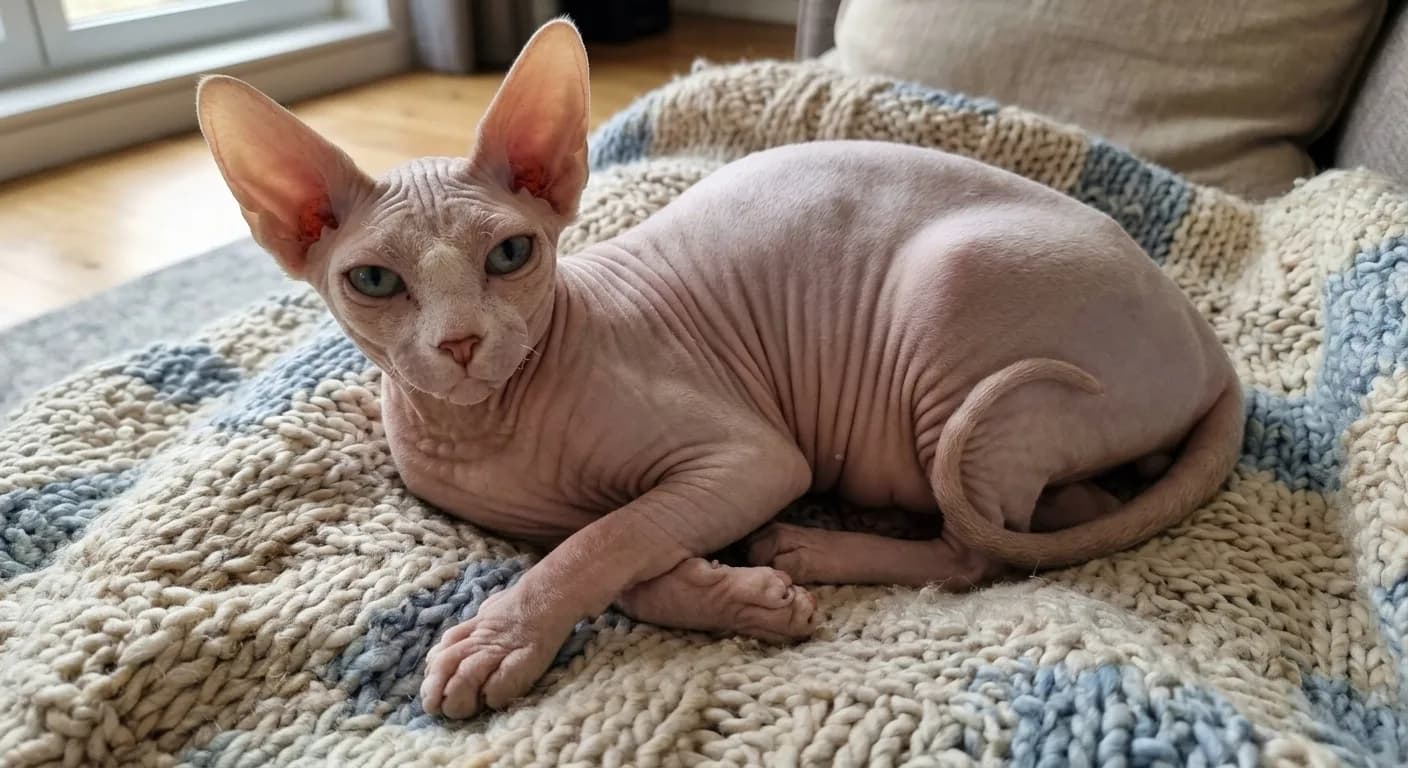
The Sphynx is the cat almost everyone pictures when they hear "hairless." It descends from a hairless kitten named Prune born in Toronto, Canada, in 1966, with the modern breed built out through later Canadian and European lines in the 1970s and 1980s. It is a medium-sized, surprisingly heavy and muscular cat with a wedge-shaped head, dramatically large ears, a round "pot belly," and that signature wrinkled, warm-to-the-touch skin. Temperament is the real selling point: Sphynx are famously extroverted, dog-like, attention-demanding lap cats that will follow you room to room. Because it is the deepest, most documented breed of the bunch, we keep the Sphynx detail light here and hand you off to the full breakdown. For everything on personality, health, colors, and cost, see our complete Sphynx cat breed profile.

Never Scoop Again® with the Whisker Litter-Robot, the smart self-cleaning automatic litter box. Monitor visits and track weights for better overall care in the Whisker® app. Multi-cat friendly.
Petful may earn a commission when you click through to Whisker, at no extra cost to you.
Donskoy (the Russian original)
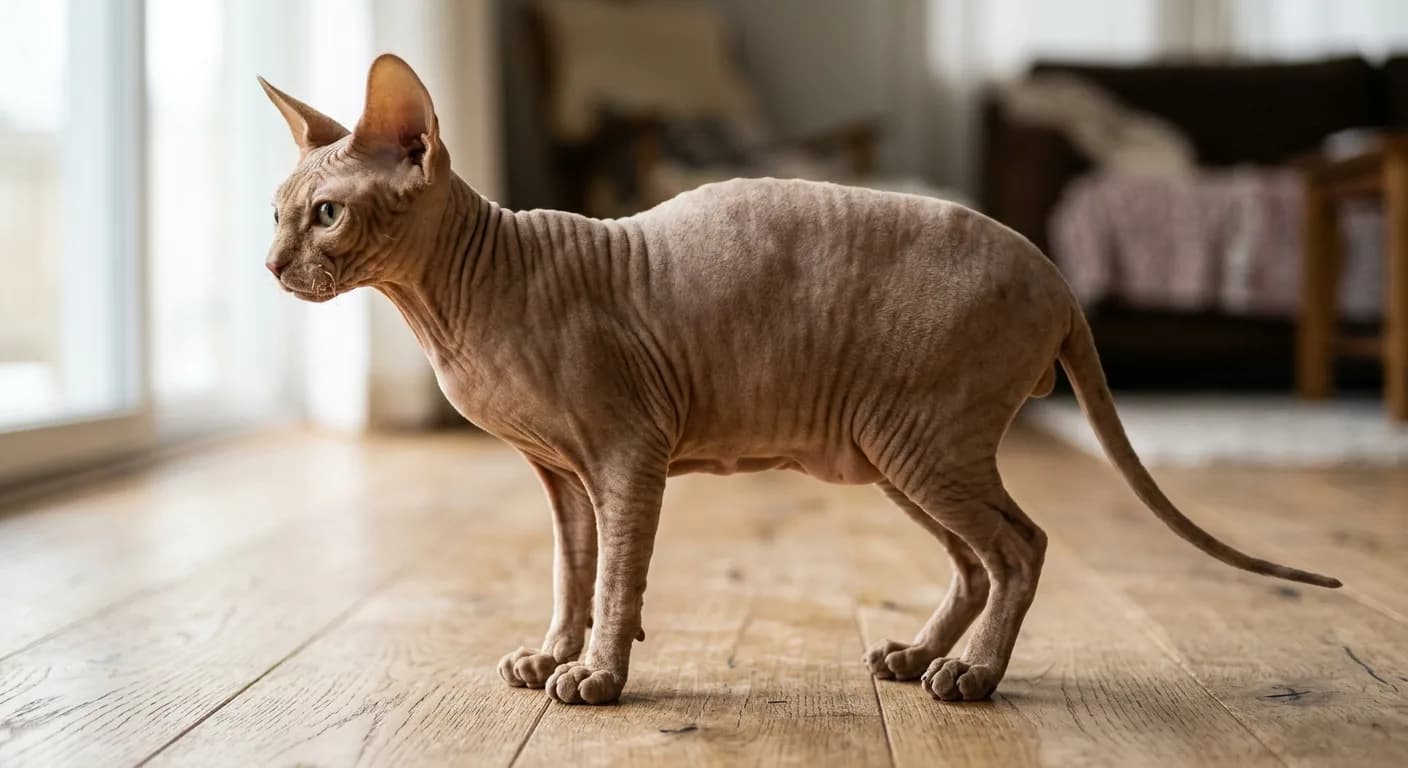
The Donskoy (also spelled Don Sphynx or Don Hairless) is a separate hairless breed that originated in Rostov-on-Don, Russia, in the late 1980s, after a rescued kitten began losing her coat. Unlike the Sphynx, the Donskoy's hairlessness is caused by a dominant gene, and the breed is known for a unique quirk: some Donskoys grow a partial winter coat and shed it again in warm weather. Donskoys tend to have a more angular head, larger almond eyes, and notably long, webbed, almost hand-like toes. They are affectionate, social, and intelligent. The Donskoy is the genetic foundation of the Peterbald, so the two are closely linked. For a deeper look at this Russian breed, read our dedicated Donskoy cat profile.
Peterbald (the elegant Russian)
The Peterbald comes from St. Petersburg, Russia, created in 1994 by crossing a Donskoy with an Oriental Shorthair. The result is a slender, fine-boned, elegant cat with a long whippy body, a narrow head, and huge ears, carrying the Donskoy's dominant hairless gene. Peterbalds famously come in several coat types on a spectrum: from bald ("ultra bald" or "rubber bald") to "flock" (peach fuzz), "velour," "brush," and even a near-normal "straight" coat in some litters. They are people-oriented, talkative, and athletic, very much the "velcro cat" of the hairless world.
Bambino (the short-legged one)
The Bambino is a designer breed created in the early 2000s by crossing a Sphynx with a Munchkin, combining hairlessness with the Munchkin's short legs (dwarfism). The name means "baby" in Italian, a nod to its small, low-slung, kitten-like look that it keeps for life. Bambinos have the Sphynx's wrinkled skin, big ears, and outgoing, affectionate personality, on stubby legs. Because they pair two structural mutations, the short-leg "dwarf" cat breeds (Bambino, Dwelf, Minskin) are controversial: some registries decline to recognize them, and responsible buyers should ask the breeder directly about mobility and skeletal health.
Elf (the curled-ear one)
The Elf cat is a rare experimental breed that crosses a Sphynx with an American Curl, giving a hairless cat with whimsical backward-curling ear tips. The body is essentially Sphynx (wrinkled skin, wedge head, sturdy build, sociable temperament); the curled ears are the signature. Elf cats are not yet recognized as a championship breed by the major registries and exist mostly in the hands of a few dedicated breeders, which keeps both supply and prices toward the higher, novelty end.
Dwelf (curled ears plus short legs)
The Dwelf stacks three traits at once: the Sphynx's hairlessness, the American Curl's curled ears, and the Munchkin's short legs. The name is a blend of "dwarf" and "elf." The outcome is a tiny, low, big-eared, hairless cat that looks almost mythical, with the friendly, lap-loving Sphynx temperament. As with the Bambino, combining dwarfism with other mutations raises welfare and joint-health questions, so the Dwelf remains an unrecognized, niche breed best sourced from a breeder who is transparent about health screening.
Lykoi (the "werewolf" cat)
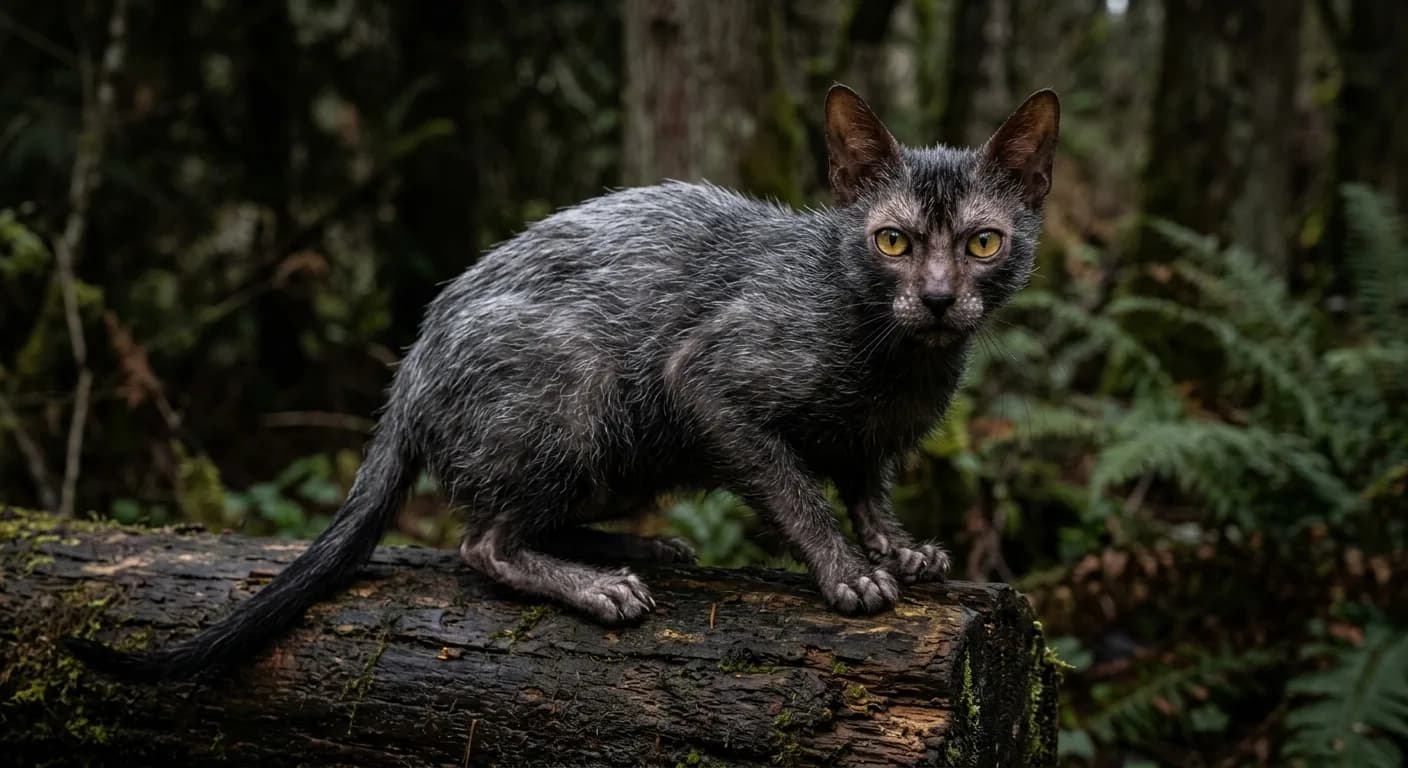
The Lykoi is the odd one out: it is not bald but partially hairless, with a thin, patchy coat and bare areas around the eyes, nose, ears, and muzzle that give it an uncanny "werewolf" look (the name comes from the Greek for wolf). It arose from a natural mutation in domestic shorthairs (the first breeding pairs were established around 2010 to 2011) that causes a roan, sparse coat and periodic molting, where a Lykoi can shed most of its fur and grow it back. Despite the spooky appearance, Lykoi are described as friendly, playful, and dog-like. Because the coat is partial, a Lykoi is a good middle ground for someone who wants the hairless look without a fully naked cat.
Cornish Rex and Devon Rex (the near-hairless honorable mentions)
Not every "barely any fur" cat is hairless in the Sphynx sense. The Cornish Rex and Devon Rex are coated cats whose fur is so short, fine, and wavy that they feel nearly bald and shed very little, which lands them on most hairless-adjacent lists. The Cornish Rex (originating in Cornwall, England, in 1950) has a soft, marcel-waved down coat and an athletic greyhound-like body. The Devon Rex (Devon, England, 1960) has a looser, sparser wavy coat, a pixie-like face, and enormous ears. Both are playful, people-obsessed, and a smart pick if you love the rex look but want a little coat. Learn more in our Cornish Rex breed profile, and see how the two compare head to head in our Cornish Rex vs Devon Rex guide.
- If a fully naked cat feels like too much grooming or fragility, a Devon or Cornish Rex gives you the big-eared, low-shed, velvety appeal with a thin protective coat that needs far less bathing.
Hairless and near-hairless cat breeds compared
Use this side-by-side to compare origin, coat, size, temperament, and a realistic price range across the family. Prices are typical ranges from reputable breeders in the United States and vary widely by pedigree, bloodline, region, and demand. Treat them as ballparks, not quotes.

63-inch multi-level cat tree with scratch posts, hammock, plush perches, and dangling toys. Vertical territory is non-negotiable for high-energy climbing breeds like the Bengal.
Petful may earn a commission when you click through to Chewy, at no extra cost to you.
| Breed | Origin | Coat | Size | Temperament | Approx Price (USD) |
|---|---|---|---|---|---|
| Sphynx | Toronto, Canada (1966) | Hairless with fine down | Medium, muscular | Extroverted, dog-like, cuddly | $1,500-$3,500 |
| Donskoy | Rostov-on-Don, Russia (1980s) | Hairless (some grow winter coat) | Medium | Affectionate, social, smart | $1,500-$3,000 |
| Peterbald | St. Petersburg, Russia (1994) | Bald to peach-fuzz to brush | Medium, slender | Talkative, loyal, athletic | $1,700-$3,500 |
| Bambino | United States (early 2000s) | Hairless, short-legged | Small, low-slung | Playful, affectionate | $1,500-$3,000 |
| Elf | United States (2000s) | Hairless, curled ears | Medium | Sociable, gentle | $1,800-$3,500 |
| Dwelf | United States (2000s) | Hairless, curled ears, short legs | Small | Friendly, lap-loving | $1,500-$4,000 |
| Lykoi | United States (2010-2011) | Partial, patchy "werewolf" coat | Small-medium | Playful, dog-like | $1,500-$2,500 |
| Cornish Rex | Cornwall, England (1950) | Short wavy down, near-hairless feel | Small-medium | Active, affectionate | $800-$1,800 |
| Devon Rex | Devon, England (1960) | Sparse wavy coat, pixie look | Small-medium | Mischievous, people-loving | $800-$1,800 |
- Hairless kittens cost more than typical cats largely because of careful, low-volume breeding and health screening, not because being bald is inherently valuable. A higher price should buy you genetic testing and a health guarantee, so ask what it includes.
Caring for a hairless cat: what all of them share
Whatever breed you choose, a hairless cat is a higher-maintenance pet than a typical coated cat. The missing fur changes everything about skin care, temperature, and sun exposure. Here is what the whole family needs.
Bathing and skin care
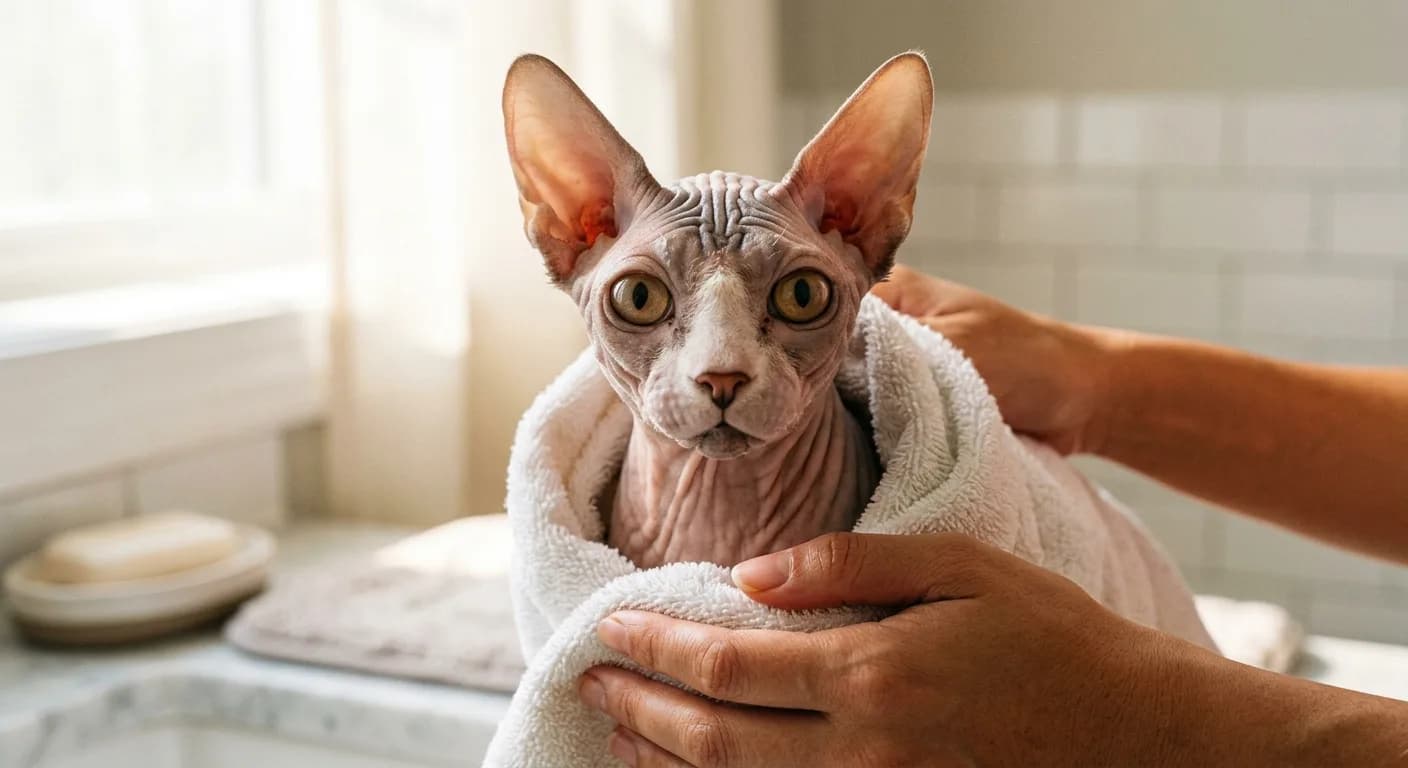
A coat normally wicks away the oily sebum a cat's skin produces. With no coat to absorb it, that oil builds up on hairless skin and in the folds, so most hairless cats need a regular wipe-down or bath (often weekly, depending on the individual) with a gentle, cat-safe shampoo to prevent greasy buildup, blackheads, and skin infections. The ears produce wax quickly and need routine cleaning, and the nail beds and skin folds should be checked and gently cleaned too. Always dry the cat thoroughly and keep it warm afterward.
Keeping them warm
With no insulating coat, hairless cats lose body heat fast and actively seek warmth, which is why they pile onto laps, radiators, warm laptops, and under blankets. In cooler homes and in winter, many owners use cat sweaters and provide heated beds or cozy hideaways. A chilly hairless cat is not just uncomfortable, it can become genuinely cold-stressed, so a warm indoor environment is non-negotiable.
- Without a coat for insulation or sun protection, these breeds should not free-roam outdoors. They chill quickly in cold weather and sunburn fast in summer, so a climate-controlled indoor home is the only safe setup.
Sun protection
Bare skin sunburns, and hairless cats are genuinely prone to it. A hairless cat lounging in a sunny window can burn, and chronic sun exposure raises the risk of skin damage over time. Limit direct sun through windows, provide shaded resting spots, and ask your veterinarian about a pet-safe sunscreen for any exposed-skin sunbathers (never use human sunscreen, which can contain ingredients toxic to cats).

108-oz stainless steel pet fountain with quiet pump and water-level window. Bengals are notoriously water-obsessed; a flowing fountain encourages hydration and pulls them away from sinks and toilets.
Petful may earn a commission when you click through to Chewy, at no extra cost to you.
Health conditions to know
Hairless breeds, especially the Sphynx, are screened for hypertrophic cardiomyopathy (HCM), the most common feline heart disease and the leading health concern in the breed, which responsible breeders test for by echocardiogram. Other issues seen across hairless cats include skin conditions such as urticaria pigmentosa, periodontal (dental) disease, and the skin and eye irritations that come with having no protective coat or full eyelashes. A reputable breeder should be able to show you health-testing records for the parents.
- Hypertrophic cardiomyopathy is the number one health risk in hairless cats, particularly the Sphynx. Never buy a hairless kitten without proof that the parent cats were heart-screened by echocardiogram, and budget for ongoing veterinary monitoring.
Are hairless cats hypoallergenic? Busting the biggest myth
This is the single most common misconception about hairless cats, so let us be direct: no, hairless cats are not hypoallergenic. People assume "no fur" means "no allergies," but the main cat allergen, a protein called Fel d 1, is produced in a cat's saliva and skin (sebaceous) secretions, not in the fur itself. Cats spread Fel d 1 over their bodies when they groom, and it then sheds into the environment on skin flakes (dander). A hairless cat still produces Fel d 1, still grooms, and still sheds dander, and because the skin is exposed and oily, direct skin contact can actually increase your exposure rather than reduce it.
If anything, the lack of a coat can be a mixed bag for allergy sufferers: there is no fur to trap and slowly release allergen, but there is also no fur as a barrier between you and the allergen-rich skin. The honest takeaway is that no cat is truly hypoallergenic, hairless ones included, and anyone with a known cat allergy should spend extended time with the specific cat before committing. For the full, evidence-based breakdown of why a bald cat still triggers allergies, read our guide on whether the Sphynx cat is hypoallergenic.
- Fel d 1 levels vary cat to cat, even within a breed. Before bringing home any hairless cat, spend a few hours with that individual animal over more than one visit to see how your body reacts.
Are hairless cats legal everywhere? The breeding-ban question
Hairless breeds have become a focus of animal-welfare debate, and the legal picture is changing. The Netherlands has moved toward banning the breeding of cats with extreme, welfare-affecting traits, a category that includes hairless cats (along with flat-faced and short-eared breeds), on the grounds that the missing coat deprives the animal of natural protection. As of this writing the Dutch measure has been announced and advanced as policy, but you should confirm its current legal status (proposed versus fully in force) before drawing conclusions, as the details and effective dates have been evolving. The broader point for prospective owners is real: ethical concerns about breeding for hairlessness are mainstream now, which is one more reason to choose a breeder who prioritizes health and welfare over novelty.
How long do hairless cats live?
Lifespan varies by breed, but hairless cats are commonly cited as living roughly 8 to 15 years with good care, comparable to many other cats, though the picture is more complicated than that range suggests. A large 2024 VetCompass study from the Royal Veterinary College in the UK reported a notably shorter median lifespan for the Sphynx than for cats overall, a finding that has drawn real attention to the breed's health vulnerabilities (especially heart disease). We are not citing a single precise figure here because reported averages differ between sources and studies, but the responsible summary is this: hairless cats can live long, full lives, but the breed-level data flags real health risks, so screening, indoor living, and consistent veterinary care matter more for these cats than for the average house cat.
- Individual hairless cats vary a lot, and the biggest levers you control are heart screening from the breeder, an indoor lifestyle, dental care, and regular vet visits. Those choices move the needle far more than the breed label does.
Which hairless cat is right for you?
If you want the classic, well-documented, easy-to-find hairless cat with a big personality, the Sphynx is the default starting point. If you are drawn to a more elegant, slender build, the Peterbald delivers that with a coat spectrum to choose from. Love a quirky look? The Elf (curled ears), Bambino (short legs), and Lykoi (partial "werewolf" coat) each lean into novelty, though the dwarf breeds come with extra health questions worth raising. And if a fully naked cat feels like too much, the Devon Rex and Cornish Rex give you the velvety, low-shed appeal with a thin coat and easier upkeep. Whichever you pick, the care commitments (bathing, warmth, sun protection, and HCM-aware veterinary care) are the same across the board, so choose for personality and ethics first and looks second.
- 1Start with the Sphynx if you want the classic, available, big-personality hairless cat
- 2Choose the Peterbald for elegance and a coat-type spectrum, or a rex (Devon or Cornish) if you want the look with a little fuzz and easier care
- 3Approach the dwarf and triple-mutation breeds (Bambino, Dwelf) with extra health questions for the breeder
- 4Budget for higher upfront cost plus lifelong bathing, warmth, and vet care
- 5No hairless cat is hypoallergenic, so test your allergies on the individual cat first
Frequently asked questions about hairless cat breeds
There are about 9 hairless and near-hairless cat breeds commonly recognized by buyers: the Sphynx, Donskoy, Peterbald, Bambino, Elf, Dwelf, and the partially hairless Lykoi, plus the near-hairless Cornish Rex and Devon Rex. Some lists also include the Ukrainian Levkoy and Minskin. Only a few are recognized as championship breeds by the major registries; several are newer experimental or designer breeds.
The Sphynx is the best-known hairless cat breed, but it is rarely 100 percent bald, most have a fine peach-fuzz down. Other essentially hairless breeds include the Donskoy, Peterbald, Bambino, Elf, and Dwelf. The Lykoi is partially hairless with a patchy coat, and the Cornish Rex and Devon Rex are near-hairless with a thin wavy coat rather than no coat at all.
The Sphynx is by far the most popular hairless cat breed. It was the original, it is the most widely available, and its extroverted, dog-like, attention-loving personality has made it the face of hairless cats. Every other hairless breed is rarer and harder to find than the Sphynx.
No. The main cat allergen, Fel d 1, is produced in saliva and skin oils, not fur, so a hairless cat still makes it, spreads it by grooming, and sheds it as dander. Direct contact with the exposed, oily skin can even increase exposure. No cat is truly hypoallergenic, hairless breeds included, so allergy sufferers should test their reaction on the specific cat first.
Most hairless kittens from a reputable breeder cost roughly $1,500 to $3,500, with rarer breeds like the Elf or Dwelf sometimes reaching $4,000 and the near-hairless rex breeds running lower at about $800 to $1,800. Beyond purchase price, budget for ongoing costs: frequent bathing supplies, sweaters or heated beds, and HCM-aware veterinary care.
A Sphynx kitten from a reputable, health-testing breeder typically costs about $1,500 to $3,500 in the United States, with show or rare-color kittens priced higher. The lifetime cost is higher than the sticker price, since Sphynx need regular bathing, warmth in winter, and heart screening and monitoring for hypertrophic cardiomyopathy. See our full Sphynx breed profile for a detailed cost breakdown.
The Sphynx has a reputation as the friendliest and most dog-like hairless cat, craving constant attention and lap time. That said, most hairless breeds are notably social and people-oriented: the Peterbald is a loyal "velcro cat," and the Lykoi and Donskoy are playful and affectionate too. Personality varies by individual, so meet the specific cat before deciding.
No hairless cat costs $100,000. That figure usually refers to the Ashera, a controversial hybrid marketed at extreme prices (and later linked to the Savannah cat), or to top Savannah and Bengal cats. Hairless breeds like the Sphynx are far more attainable, generally $1,500 to $3,500 from a reputable breeder.
The "$13 million cat" is Tommaso, a black stray cat in Italy who inherited an estimated 13 million dollar fortune from his wealthy owner in 2011. It has nothing to do with purchase price or hairless breeds, it is simply the most famous example of a cat inheriting money.
The 3-3-3 rule is a guideline for helping any newly adopted cat adjust: roughly 3 days to decompress and feel safe, 3 weeks to settle into a routine and show personality, and 3 months to feel fully at home and bonded. It applies to hairless cats just like any other, though a hairless cat will also need a warm, draft-free space from day one.
Common cat stressors include loud noises, strong smells, dirty litter boxes, sudden changes, and being petted in unwanted spots or for too long. For hairless cats specifically, add cold drafts and rough handling of sensitive skin to the list, so keep them warm and handle them gently.

Coreen Saito is a pet writer and longtime shelter volunteer with more than a decade in animal rescue. She covers cat behavior, breed care, and the small, ordinary science of sharing a life with companion animals, with a particular focus on honest takes about the products and decisions that actually matter. At home in Arizona, she's outranked by Mac (a dog with the loudest opinion in the house), Rebel (a cat who governs by quiet authority), and Meri (an orange tabby who runs the late shift and the laundry basket). She writes about all three, plus the rescues that keep coming through her life, at LifeWithMinty.com.
Sign up for expert-backed reviews and safety alerts all in one place.