Cornish Rex vs Devon Rex: Two Very Different Curly Cats
Cornish Rex and Devon Rex look alike but carry different, incompatible curl genes. This guide compares coat texture, head shape, ear set, body type, temperament, health risks, and price across 15+ traits to help you choose the right rex breed.
Petful is reader supported. As an affiliate of platforms like Amazon and Chewy, we may earn a commission when you buy through links on this page. There is no extra cost to you.
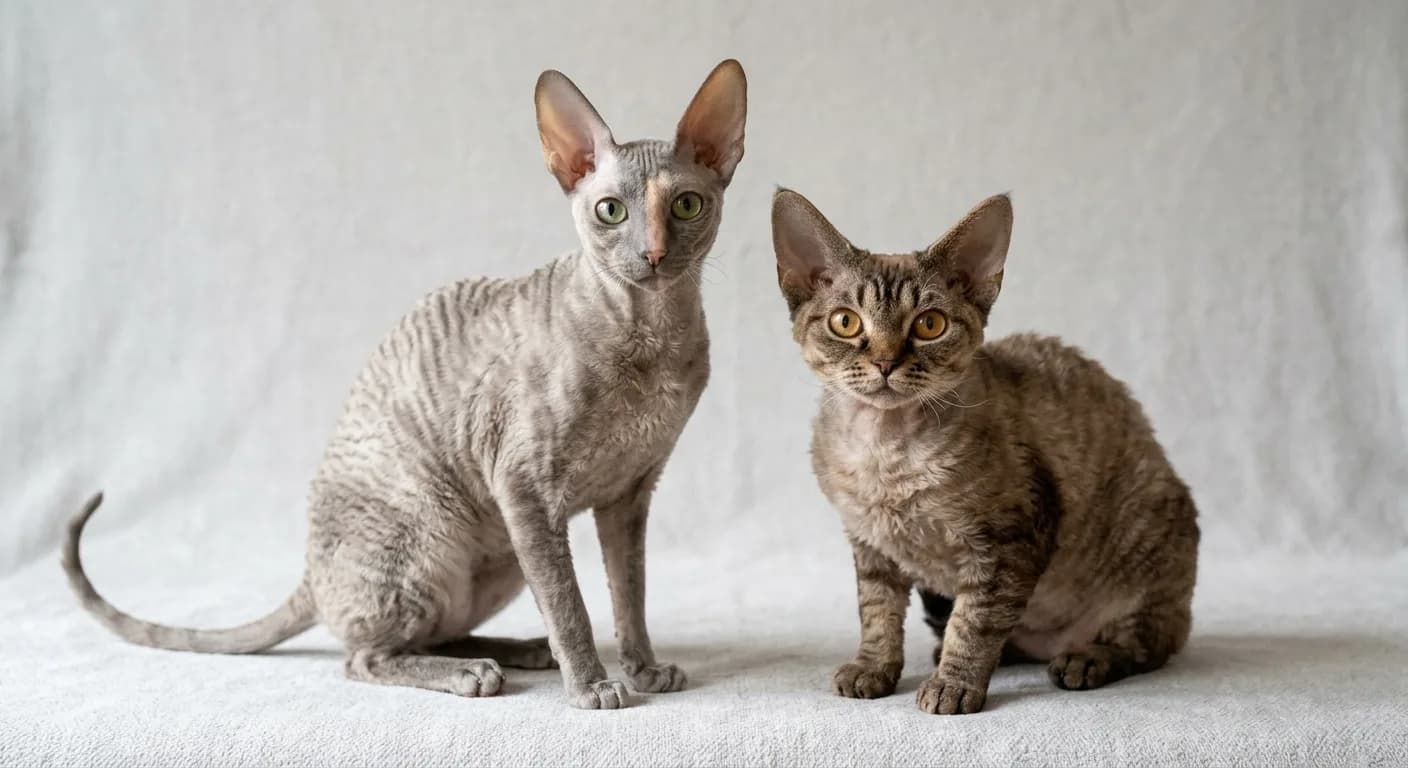
When you first see a Cornish Rex and a Devon Rex side by side, both wearing their signature curly coats, it is easy to assume they are closely related. They are not. The Cat Fanciers' Association (CFA) confirmed in 1979 that the cornish rex vs devon rex mutation is a completely separate genetic event: cross-breeding the two produces straight-coated kittens, because the recessive genes do not overlap. Understanding those differences helps you choose the right curly cat for your household, whether you want a whippet-fast acrobat or a warm-lapped, bat-eared cuddle companion.
- 1Cornish Rex and Devon Rex carry different, non-compatible curl genes
- 2Cornish has ONLY soft down hair with no guard hairs; Devon has some guard hairs for a looser, suede-like wave
- 3Cornish Rex features high-set ears and an egg-shaped head; Devon Rex has huge low-set bat ears and a pixie face
- 4Both breeds are warm-bodied, people-oriented, and low-shedding
- 5Devon Rex also risks patellar luxation and hereditary myopathy; Cornish Rex is especially cold-sensitive

Sign up for expert-backed reviews and safety alerts all in one place.
The Genetic Story: Why They Are Not the Same Breed
The Cornish Rex mutation appeared first, in 1950, when a curly-coated kitten named Kallibunker was born in a litter on a Cornwall, England farm. Geneticist A.C. Jude confirmed the coat was caused by a recessive gene that eliminates all guard and awn hairs, leaving only the soft undercoat, called down. When Cornish Rex cats were brought to Devon, breeders attempted to cross them with a curly-coated Devon kitten named Kirlee, discovered in 1960 by Beryl Cox. Every kitten in those crosses came out straight-coated, proving the Devon mutation (later named gene 2 or the "de" allele) was entirely different from the Cornish mutation (gene 1, or the "rc" allele).
The CFA officially recognized the Cornish Rex in 1964 and the Devon Rex in 1979, and TICA recognizes both as distinct breeds today. No registry treats them as a single breed, and the genes remain incompatible: you cannot breed a Cornish Rex to a Devon Rex and produce curly kittens without introducing another curl gene from a third breed.

Never Scoop Again® with the Whisker Litter-Robot, the smart self-cleaning automatic litter box. Monitor visits and track weights for better overall care in the Whisker® app. Multi-cat friendly.
Petful may earn a commission when you click through to Whisker, at no extra cost to you.
- A Cornish Rex x Devon Rex cross produces only straight-coated kittens. The curl mutations are on different genes and do not complement each other, which is why the CFA and TICA register them as separate, unrelated breeds.
Cornish Rex vs Devon Rex: Full Comparison Table
| Trait | Cornish Rex | Devon Rex |
|---|---|---|
| Curl gene | rc allele (gene 1) | de allele (gene 2) |
| Compatible for cross-breeding? | No | No |
| Coat type | Down only, no guard or awn hairs | Down + sparse guard hairs |
| Coat texture | Tight, fine "marcel" waves; very silky | Loose, open waves; suede-like; can be patchy |
| Head shape | Egg-shaped (oval), long | Short, pixie face with full cheeks |
| Nose | Straight Roman profile | Short muzzle with distinct "stop" |
| Ear set | High-set, upright, large | Very low-set, extremely wide, "bat" ears |
| Body type | Long, racy, arched like a whippet | Shorter, cobby, broad chest |
| Legs | Long, fine-boned | Shorter, muscular; "bulldog" front stance |
| Weight | 5-10 lbs | 6-11 lbs |
| Coat grooming | Gentle wipe or soft brush; minimal bathing | Occasional bath every 2-4 weeks for oil buildup |
| Shedding | Very low | Very low |
| Cold sensitivity | High; needs warm spaces | High; needs warm spaces |
| Allergen profile | Reduced (not hypoallergenic) | Reduced (not hypoallergenic) |
| Energy level | Extremely high; kitten-like into adulthood | High but more lap-cat oriented |
| Vocalization | Moderate to high | Moderate; chirpy |
| HCM risk | Yes (screen parents) | Yes (screen parents) |
| Devon-specific health risks | None | Patellar luxation, hereditary myopathy |
| Lifespan | 10-16 years | 9-15 years |
| Typical price (USA) | $800-$2,000 | $800-$2,500 |
| CFA recognition | 1964 | 1979 |
Coat: The Most Important Difference
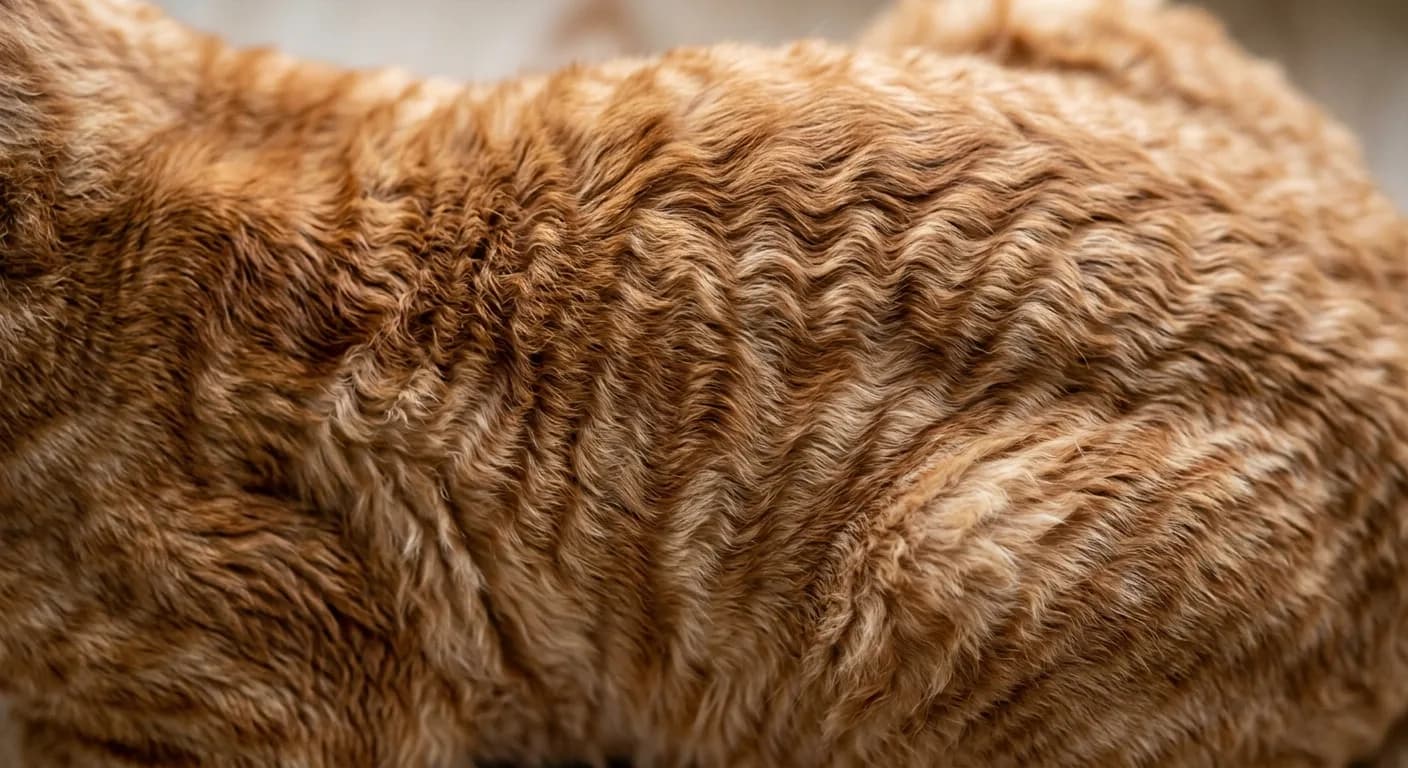
- Touch a Cornish Rex and you feel warm silk. Touch a Devon Rex and you feel warm suede with a looser, irregular ripple. The distinction is subtle in photos but unmistakable in person.
This is where the two breeds diverge most clearly. Most cats have three coat types growing from each follicle: long guard hairs on the outer layer, medium awn hairs in the middle, and short down hairs close to the skin. The Cornish Rex mutation silences production of guard and awn hairs entirely. What remains is pure down, so dense and even that it forms the tight, uniform "marcel" wave (named after the Marcel hair-waving iron popular in the early 1900s) that runs parallel to the body from head to tail tip.
The Devon Rex mutation is different. Devon Rex cats do grow some guard hairs, though they are sparse and often fragile. Devon whiskers are also shorter and may break or curl tightly, appearing kinked. The resulting coat is looser, with a more open, ocean-wave texture that can look patchy in spots, especially on the belly and behind the ears. Some Devon Rex individuals have very thin coats in those areas, which is considered normal for the breed according to the CFA breed standard.
Because Cornish Rex down is so densely packed, it actually traps body heat efficiently, making the coat feel warm to the touch. Devon Rex, with fewer hair shafts overall, feels similarly warm but the coat sits less uniformly on the body.
Head and Ears: The Easiest Way to Tell Them Apart
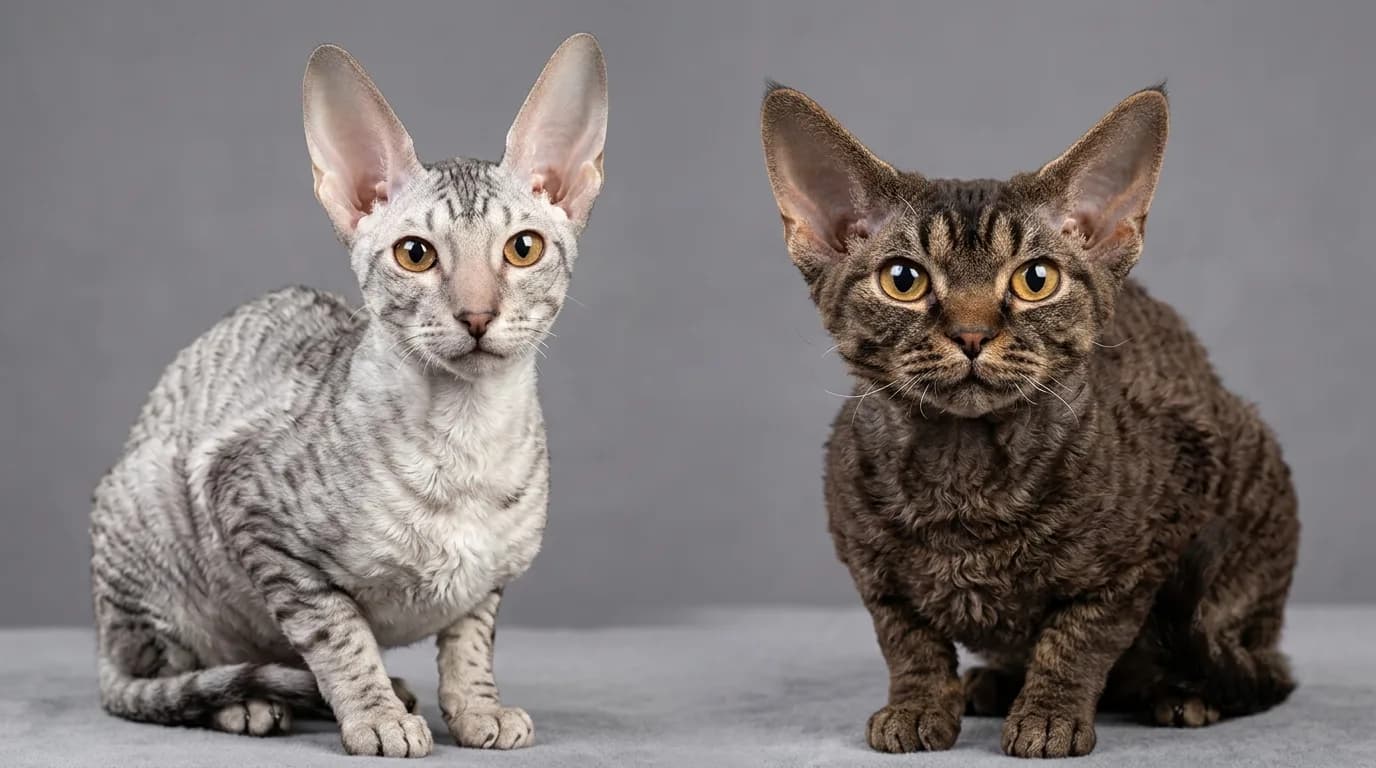
If coat texture is the biological difference, head shape is the visual shortcut.
The Cornish Rex has a classic egg-shaped head: long, oval, gently tapered from the forehead toward the chin. The nose runs in a straight Roman line from the brow without any break. Ears are large but mounted high and upright on the skull, continuing the narrow, elegant silhouette. The overall impression is aristocratic, almost greyhound-like in its refinement.
The Devon Rex looks like a different planet. The head is short and wide, with full, rounded cheeks and a short muzzle separated from the forehead by a distinct stop (a visible indentation at the nose bridge). The cheekbones are prominent and high, giving the face a heart shape. And then there are the ears: enormous, placed extremely low on the sides of the head rather than the top, and so wide at the base that they dominate the entire face. This ear placement is the breed's most famous trait, earning it nicknames like "poodle cat" and "alien cat" in addition to "bat cat." The large, widely-spaced eyes amplify the pixie-elf expression.
Looking at a side profile: the Cornish Rex profile is long and unbroken; the Devon Rex profile shows a clear nose break and much rounder, shorter skull.

Certified True HEPA air purifier that captures 99.97% of airborne dust, dander, pollen, and smoke, reducing the airborne triggers behind feline asthma and respiratory irritation.
Petful may earn a commission when you click through to Chewy, at no extra cost to you.
Body Type and Size
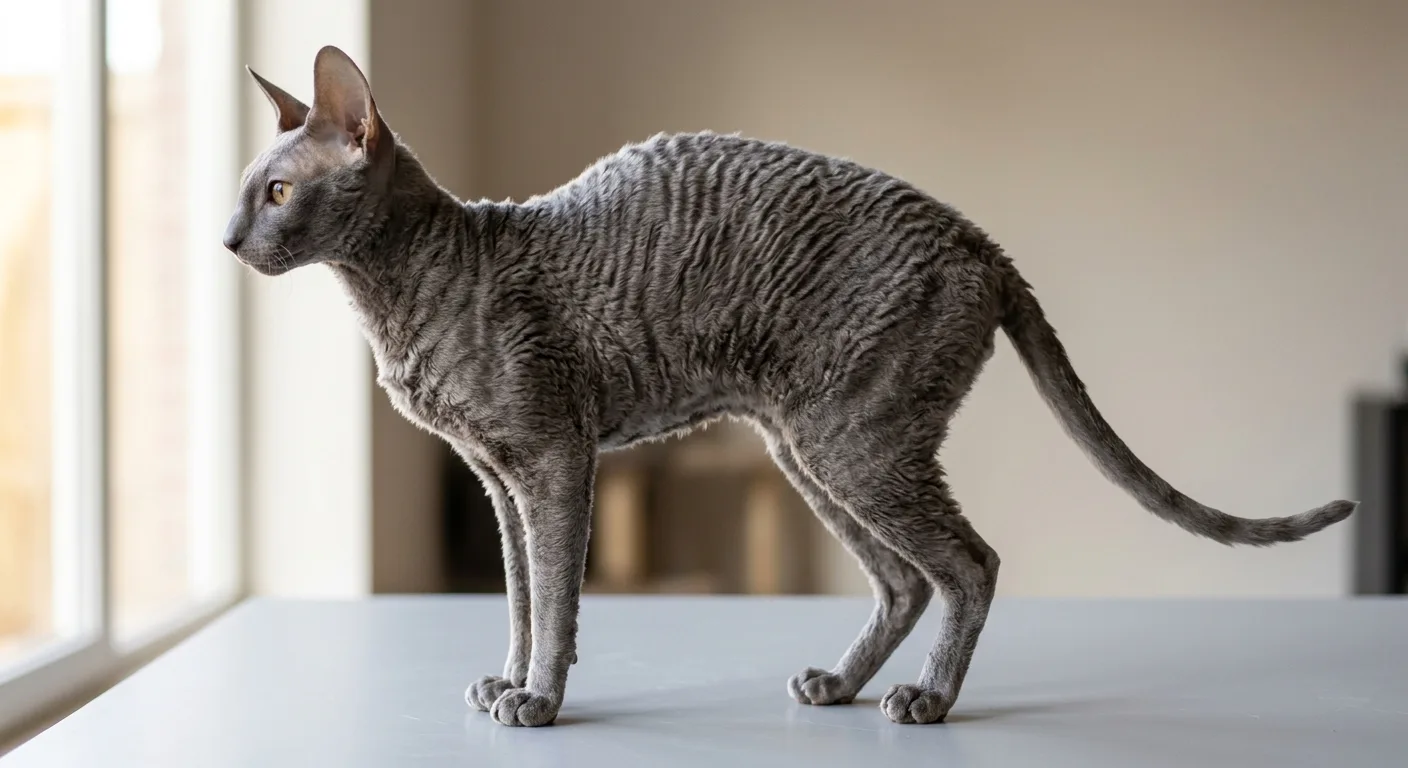
The Cornish Rex body is one of the most distinctive in the cat world. It is long, lean, and arched from the shoulders to the rump, resembling a whippet or a sighthound in shape. The legs are long and fine-boned, and the waist is tucked up like a racing dog's. The chest is wide, the ribcage hard and muscular despite the lean frame. This architecture makes the Cornish Rex an exceptionally fast, high-jumping cat that can cover surprising distances in a single bound.
The Devon Rex is built for something different: a shorter body with a broad, barrel-like chest and shorter, more muscular legs. The CFA standard notes that Devon Rex front legs are often held in what it calls a "bulldog stance" because the broad chest pushes them slightly outward. The overall impression is sturdy and compact rather than elongated. Devon Rex cats are not built for the extreme speed of a Cornish Rex, but they are agile, bouncy, and surprisingly strong for their compact frame.
Both breeds weigh roughly 5-11 lbs at maturity, with females smaller than males, so the size difference is in shape rather than raw weight.
Temperament: Perpetual Kitten vs Velcro Cuddle Bug
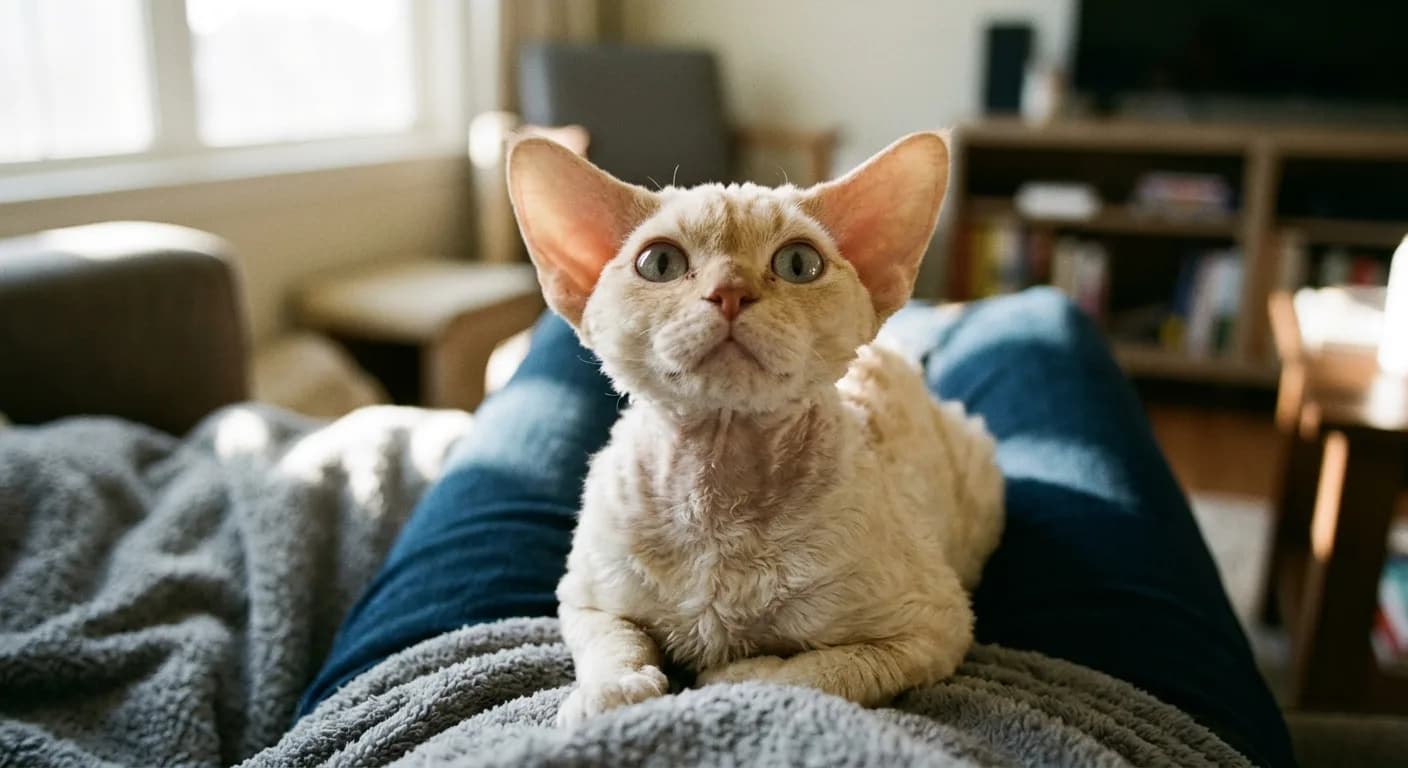
Both breeds are people-oriented, social, and categorically unsuited to being left alone for long stretches. They both follow their humans from room to room, and neither will tolerate being ignored. Beyond those shared traits, the personalities diverge.
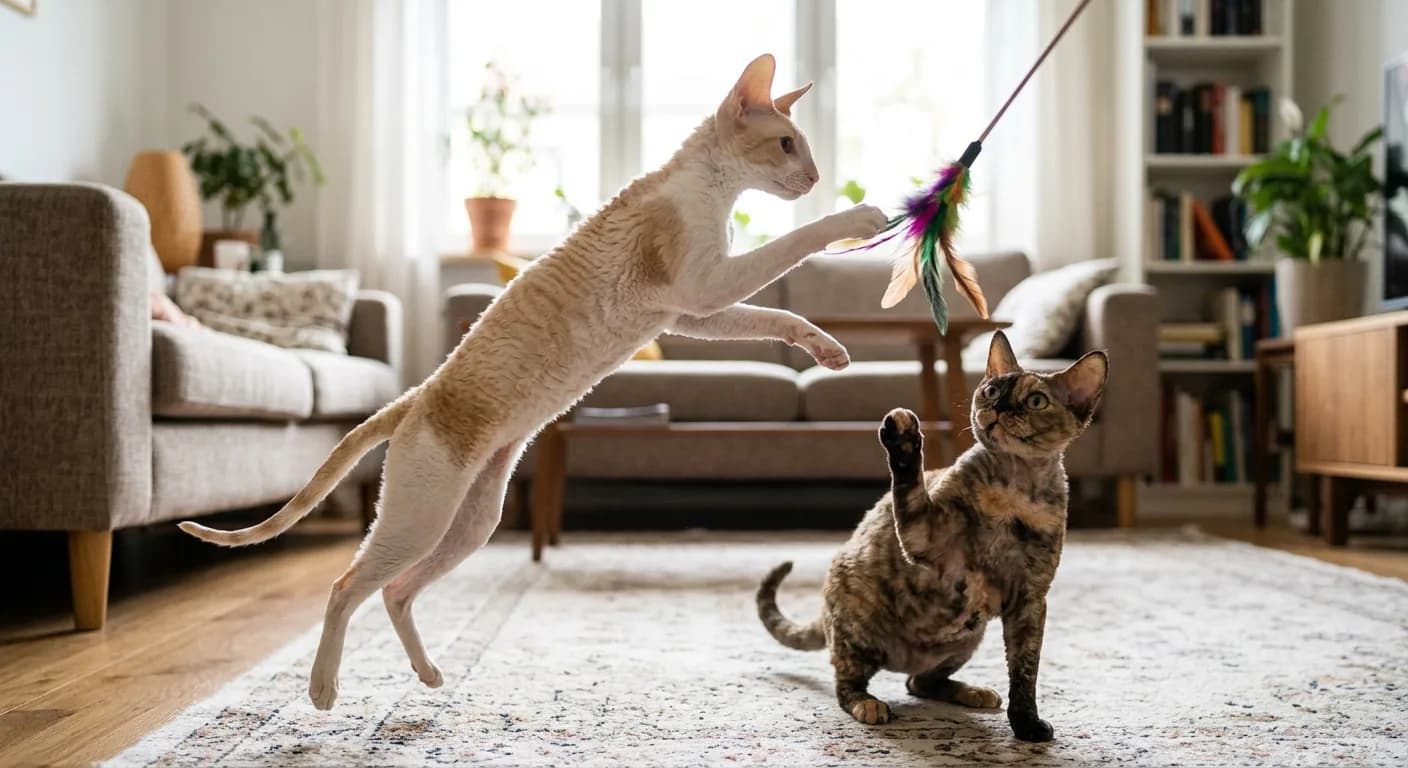
The Cornish Rex has been described as a "perpetual kitten" by the CFA, and the description is accurate. These cats retain kitten-level play drive into middle age and beyond. They are acrobatic jumpers and sprinters, they retrieve toys, they invent games, and they have a mischievous streak that can lead them to open cabinet doors, climb curtains, or steal small objects. They are intelligent enough to learn their names and come when called. Cornish Rex cats also tend to be more vocal than average, expressing themselves with a range of chirps, trills, and outright meowing when they feel ignored.
The Devon Rex tilts slightly toward the lap-cat end of the spectrum without losing its playfulness. Devon Rex owners commonly describe them as "shoulder cats" or "lap cats" who actively seek body contact and will wedge themselves between a person and whatever that person is trying to do. They are warm-bodied (feel feverishly warm due to the thin coat losing heat less efficiently, which makes them attracted to warm humans), affectionate, and they bond intensely with their primary person. They are also mischievous and playful but tend to decompress with cuddle sessions in a way the more restless Cornish Rex rarely does.
Both breeds do well with children and with other pets, including dogs, provided introductions are managed. Neither breed is suited to living as the sole companion animal in a home where owners are out most of the day. If you are away frequently, getting two cats of either breed is strongly recommended by breeders.
- Both breeds are sturdy enough to handle gentle handling by older children and social enough to make friends with dogs. Cornish Rex will initiate play; Devon Rex will choose to snuggle next to the dog on the couch. Supervise introductions with toddlers for any cat.
Grooming and Care
Both breeds are often marketed as low-grooming, and that is mostly accurate, but with different caveats.

63-inch multi-level cat tree with scratch posts, hammock, plush perches, and dangling toys. Vertical territory is non-negotiable for high-energy climbing breeds like the Bengal.
Petful may earn a commission when you click through to Chewy, at no extra cost to you.
The Cornish Rex coat is so fine that harsh brushing will break the fragile waves. Most Cornish Rex owners use either a rubber grooming glove or simply run their hands along the coat to remove loose down. The ears should be checked weekly and cleaned gently because both breeds produce more ear wax than average-coated cats, due to their large, open ear canals. Bathing is only needed occasionally (perhaps once a month) because the skin can become slightly greasy over time. Use a gentle, unscented cat shampoo and dry thoroughly; this breed is extremely cold-sensitive and must not sit damp.
The Devon Rex is even more prone to skin oil buildup. The sparse, fragile coat cannot absorb skin oils the way a thick coat does, so oiliness accumulates on the skin, particularly under the chin, around the neck, and in skin folds. Devon Rex cats typically need a bath every two to four weeks using a gentle hypoallergenic cat shampoo. Again, drying is critical.
Both breeds must be kept strictly indoors. Their thin coats provide no meaningful protection from cold, and cold exposure can cause hypothermia in conditions that would be merely chilly for a typical domestic cat. Warm beds, heated spots, and draft-free spaces are essential. In cool climates, many owners provide a cat-specific self-warming pad.
Allergen Profile: Low Shedding, Not Hypoallergenic
- No domestic cat is truly hypoallergenic because the primary cat allergen (Fel d 1 protein) is produced in saliva and skin glands, not fur. Both Rex breeds shed less, which reduces airborne dander, but they still produce Fel d 1. People with severe cat allergies should do an allergy test visit before committing to either breed.
Both the Cornish Rex and Devon Rex are frequently promoted as hypoallergenic, but this is an oversimplification. The primary allergen in cats is not cat hair itself; it is the Fel d 1 glycoprotein produced in the salivary glands and sebaceous skin glands. Because both rex breeds have minimal shedding, less dander travels through the air, which does reduce allergic reactions for people with mild sensitivities. However, anyone with a moderate to severe cat allergy can still react strongly to a Rex cat.
If allergies are a concern, spend time with an adult of the specific breed (not a kitten, which produces less Fel d 1) before bringing one home. Some sources suggest the Cornish Rex may produce slightly less airborne dander due to the extremely dense down not releasing hair shafts readily, but no peer-reviewed study has confirmed a meaningful Fel d 1 concentration difference between the two breeds. Read our full breakdown on Cornish Rex hypoallergenic claims for the detailed allergy science.
Health: What to Watch For in Each Breed
Both breeds share a predisposition to hypertrophic cardiomyopathy (HCM), the most common heritable heart disease in cats, where the walls of the heart's left ventricle thicken over time, reducing the heart's ability to pump blood efficiently. Responsible breeders screen breeding cats with annual echocardiograms. Ask any breeder for recent echo results on both parents before purchasing a kitten. HCM can develop at any age, and an all-clear echo today does not guarantee the cat will never develop it, so annual vet check-ups remain important throughout the cat's life.
Beyond the shared HCM risk, the two breeds diverge in their breed-specific health concerns.
Cornish Rex: The main health concern beyond HCM is cold sensitivity. The complete absence of guard and awn hairs means the Cornish Rex has almost no insulation. Hypothermia can develop quickly in drafty rooms or after bathing if the cat is not dried and warmed immediately. Some lines also carry the gene for congenital hypotrichosis (progressive hair loss), though responsible breeding has reduced its prevalence.

108-oz stainless steel pet fountain with quiet pump and water-level window. Bengals are notoriously water-obsessed; a flowing fountain encourages hydration and pulls them away from sinks and toilets.
Petful may earn a commission when you click through to Chewy, at no extra cost to you.
Devon Rex: The Devon Rex faces two additional breed-specific risks that the Cornish Rex does not share:
1. Patellar luxation (loose kneecaps) is seen with higher frequency in Devon Rex than in most cat breeds. Mild cases may cause intermittent lameness; severe cases may require surgical intervention. Ask breeders if their lines have been screened.
2. Devon Rex hereditary myopathy (also called Devon Rex spasticity or muscular dystrophy) is a congenital muscle weakness caused by a separate recessive gene. Affected kittens show neck muscle weakness and a distinctive head tremor beginning around 3 weeks of age. A DNA test is available; responsible breeders test breeding cats and can provide certificates. Avoid any breeder who cannot provide myopathy test results for both parents.
A DNA test for the Devon Rex myopathy mutation has been available since around 2015, so there is no excuse for a reputable breeder not to test. The Cornish Rex does not carry this mutation.
- Devon Rex hereditary myopathy is a serious, progressive muscle disease. A DNA test exists for the causative gene. Before purchasing a Devon Rex kitten, require proof that BOTH parents have been tested negative or are known "clear" carriers. A breeder who cannot provide this is a red flag.
Price and Availability
Both breeds are considered rare-to-moderate in availability in the United States, and both carry similar price ranges.
Cornish Rex: Expect to pay $800-$2,000 from a reputable CFA or TICA registered breeder. Show-quality cats or those from champion bloodlines may run higher. Cornish Rex breeders exist in most states but are not abundant; a waiting list of several months is common.
Selkirk Rex and Sphynx are sometimes compared to both breeds as alternative rex-family or hairless options. Our Selkirk Rex breed guide and Sphynx profile walk through those differences in detail.
Devon Rex: Prices are similar at $800-$2,500, with the upper range reflecting show-line pedigrees and the cost of DNA testing programs. Devon Rex breeders are slightly more numerous in the United States than Cornish Rex breeders, but demand remains high. Reputable breeders are listed through CFA (cfa.org) and TICA (tica.org) breeder referral pages.
Rescue is an option: both breeds appear occasionally in general cat rescues and sometimes in breed-specific rescues. Check Petfinder and the Cornish Rex Society's rescue listings if you are open to an adult cat.
Which Rex Breed Is Right for You?
The choice between a Cornish Rex and a Devon Rex largely comes down to activity level and physical interaction preference.
Choose a Cornish Rex if you want a highly athletic, perpetually playful cat that will entertain itself and its humans with acrobatic feats, bring you toys, and keep kitten energy well into middle age. This is a cat for active households that can match its energy with interactive play sessions. Also the better match if you prefer a cat that is more independent day-to-day (while still being affectionate) rather than demanding constant physical contact.
Choose a Devon Rex if you want an intensely affectionate companion that wants to be physically close to you at almost all times, loves to sleep on laps and shoulders, and balances play sessions with genuine downtime. The Devon Rex is slightly more adaptable to calmer households, but still needs daily play. Households that want a warm, loyal shadow that will curl under the covers with them every night should look at the Devon Rex first.
For deeper reading on the Cornish Rex specifically, our Cornish Rex breed profile covers the full history, show standards, and owner experience in detail. If price is a primary consideration, our Cornish Rex price guide breaks down what drives kitten costs. For the full rex-family picture, including the Selkirk Rex, browse our cat breeds hub.
- If you are away from home more than 8-10 hours a day, seriously consider getting two cats rather than one, regardless of which rex breed you choose. Both Cornish and Devon Rex cats develop separation anxiety and may become destructive or vocal when chronically under-stimulated.
No. The Cornish Rex mutation (gene rc) and the Devon Rex mutation (gene de) are completely different recessive genes on different loci. Crossing the two breeds produces only straight-coated kittens, which is why the CFA and TICA recognize them as entirely separate breeds.
The quickest visual tell is the ear set: Cornish Rex ears are large and mounted high on the skull; Devon Rex ears are enormous and placed very low on the sides of the head, creating the iconic bat-eared or pixie look. The Cornish Rex also has a longer, egg-shaped head with a Roman nose, while the Devon Rex has a short, round face with a distinct nose stop.
Both breeds shed very little compared to typical domestic cats. The Cornish Rex, having only soft down hair with no guard or awn hairs, may release slightly less hair in the environment. The Devon Rex has a few sparse guard hairs that can shed, but overall both are among the lowest-shedding cat breeds available.
Neither breed is truly hypoallergenic. Cat allergies are primarily caused by the Fel d 1 protein in saliva and skin secretions, not by cat hair itself. Both rex breeds produce less airborne dander due to minimal shedding, which reduces reactions in people with mild sensitivities. People with moderate to severe cat allergies should spend time with an adult Rex before committing, since reactions are still possible.
Cornish Rex are low-maintenance in terms of grooming (no brushing, only occasional baths) but high-maintenance in terms of attention and play. They need at least 30-60 minutes of active interactive play daily and do not cope well with solitude. Their cold sensitivity also means owners must keep the home warm and dry them thoroughly after any bathing.
Devon Rex kittens typically cost $800-$2,500 because responsible breeders invest significantly in health testing (echocardiograms for HCM, DNA tests for hereditary myopathy and patellar luxation screening), maintain TICA or CFA registration, and the breed has a smaller breeder population relative to demand. Show-line pedigrees and tested bloodlines command the higher end of that range.
Yes, Devon Rex cats are among the most affectionate and physically demonstrative cat breeds. They commonly sleep on their owner's chest or under the covers, ride on shoulders, and follow their person throughout the home. They have been described as "velcro cats" for their desire to maintain body contact.
The main drawbacks are: high social needs (they do not tolerate being left alone for long hours), cold sensitivity requiring a warm indoor environment, the need for regular baths every 2-4 weeks to manage skin oil buildup, and breed-specific health risks including patellar luxation and hereditary myopathy. Buyers should also verify DNA test results for the myopathy gene before purchasing.
Both breeds work well in family homes with children who know how to handle cats gently. The Cornish Rex suits active older children who will match its energy with play sessions. The Devon Rex, being slightly more laid-back and physically affectionate, may tolerate toddlers and varied household energy a bit more calmly, but all cat-child interactions should be supervised.
Yes, they can cohabitate well because both breeds are social, dog-friendly, and non-territorial compared to many breeds. Their personalities complement each other: the Cornish Rex provides play energy while the Devon Rex brings cuddling. However, remember that breeding them together will not produce curly kittens.

Coreen Saito is a pet writer and longtime shelter volunteer with more than a decade in animal rescue. She covers cat behavior, breed care, and the small, ordinary science of sharing a life with companion animals, with a particular focus on honest takes about the products and decisions that actually matter. At home in Arizona, she's outranked by Mac (a dog with the loudest opinion in the house), Rebel (a cat who governs by quiet authority), and Meri (an orange tabby who runs the late shift and the laundry basket). She writes about all three, plus the rescues that keep coming through her life, at LifeWithMinty.com.
Sign up for expert-backed reviews and safety alerts all in one place.