Crate Training a Puppy: A Day-by-Day Plan
A calm, den-loving puppy starts with a plan. This day-by-day guide walks you through crate setup, the reward sequence, night one, the crying, and how long a puppy can safely stay crated by age.
Petful is reader supported. As an affiliate of platforms like Amazon and Chewy, we may earn a commission when you buy through links on this page. There is no extra cost to you.
Crate training a puppy is one of the highest-return things you can do in your first month home, and done right it takes far less drama than most new owners expect. A crate is not a cage or a time-out box. It is a portable den that gives your puppy a predictable, safe place to settle, and it makes house-training, travel, vet rest, and quiet nights dramatically easier. The catch is that a crate only works when the puppy chooses it, and that choice is built one short, rewarded session at a time.
This guide gives you a full day-by-day plan you can follow from the moment your puppy walks in the door. You will get the sizing and setup right the first time, learn the exact reward sequence that builds a happy crate association, and know how to handle night one, the 3 a.m. whining, and the accidents that come with an eight-week-old bladder. Everything here reflects the same reward-based methodology used by the Humane Society, the American Kennel Club, and guide-dog training programs, adapted into a schedule you can actually run in a busy household.
- 1A crate is a den, never a punishment, and every second inside it should be paired with something good.
- 2Size the crate so your puppy can stand, turn, and lie down, and no larger, using a divider as they grow.
- 3Go at the puppy's pace over 7 to 14 days, never flooding them with long stretches before they are calm at short ones.

Sign up for expert-backed reviews and safety alerts all in one place.
Why crate training a puppy is worth doing
Before the schedule, it helps to know what you are buying with the effort. A crate-trained puppy gives you four things a loose puppy cannot.

Petful may earn a commission when you click through to Chewy, at no extra cost to you.
- Faster house-training. Dogs instinctively avoid soiling the space where they sleep. A correctly sized crate leverages that instinct, so the puppy learns to hold it and to signal when they need out.
- A safe place to leave them. When you cannot supervise, a crate prevents chewed cords, swallowed socks, and the dozen household hazards a curious puppy finds in seconds.
- Easier vet visits, travel, and recovery. A dog who already loves their crate handles car rides, boarding, and post-surgery crate rest without added stress.
- A built-in off switch. Overtired puppies get frantic, not sleepy. A calm crate routine gives them a place to actually wind down, which cuts biting and zoomies.
The goal from day one is a puppy who walks into the crate on their own and settles. That is the finish line every step below is aiming at.
- Never send your puppy to the crate as a consequence for chewing, accidents, or barking. If the crate becomes the place bad things happen, the puppy will fight it every time, and you will undo weeks of work. Corrections and the crate must stay completely separate in your puppy's mind.
Step 1: Choose and set up the right crate
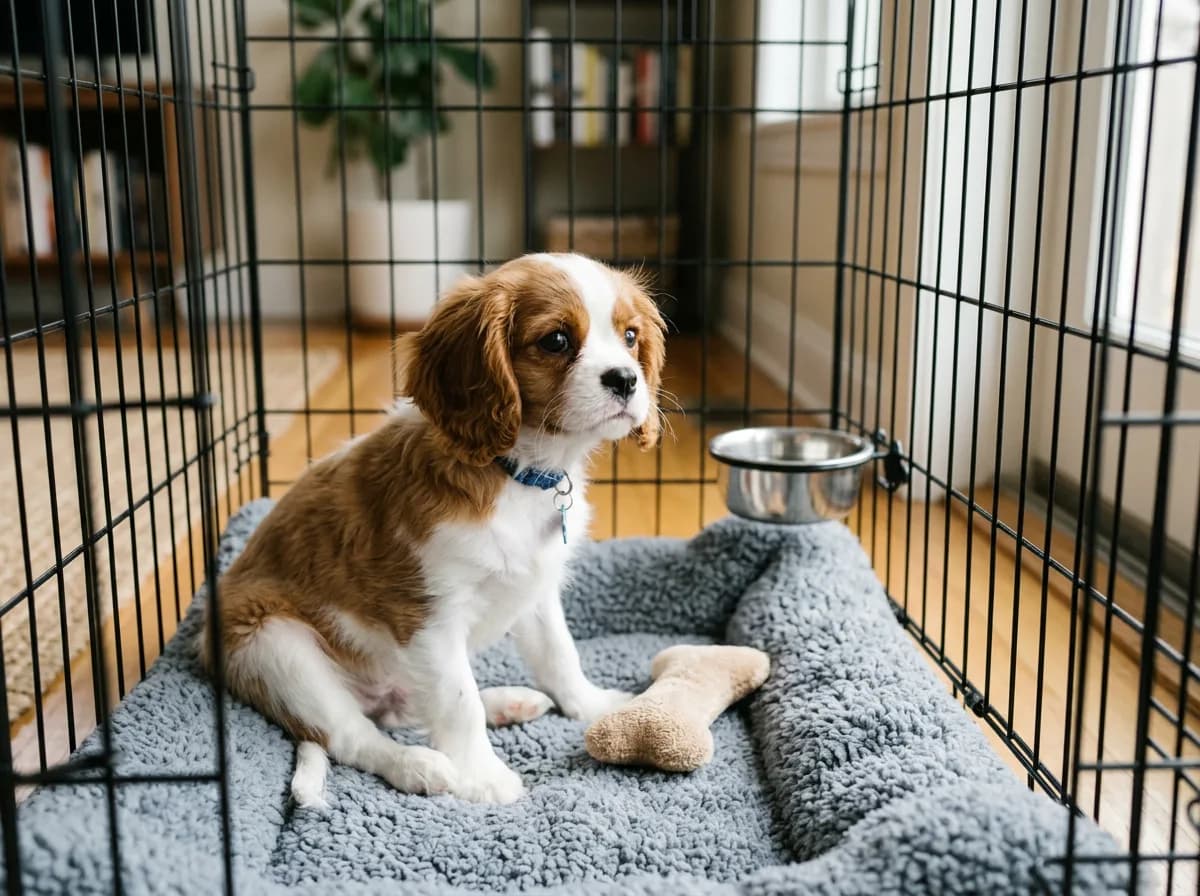
Sizing is the single most common thing new owners get wrong, and getting it right makes everything downstream easier.
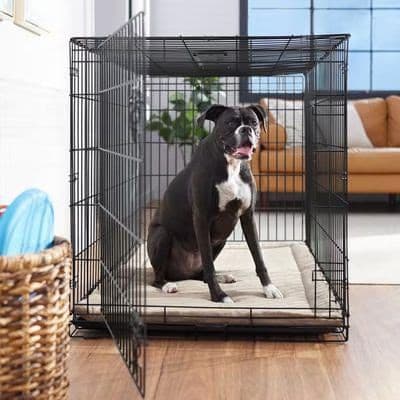
The crate should be just large enough for your puppy to stand up without hunching, turn around, and lie down fully stretched. That is it. A crate sized for the adult dog gives an eight-week-old puppy room to sleep at one end and eliminate at the other, which quietly sabotages house-training. Buy the crate that fits the grown dog, but use the divider panel to wall off the extra space and expand it as the puppy grows.
You have three main crate styles, and each has a place.
| Crate type | Best for | Watch out for |
|---|---|---|
| Wire crate with divider | Everyday home use and house-training; grows with the puppy | Can feel exposed, so drape a light cover for a den feel |
| Plastic airline-style crate | Travel, car rides, and dogs who like an enclosed cave | Harder to resize; check airflow on warm days |
| Soft-sided fabric crate | Trips and calm, already-trained dogs | A chewer or puller will destroy it; not for the training phase |
Set it up to feel like a den, not a holding pen:
Petful may earn a commission when you click through to Chewy, at no extra cost to you.
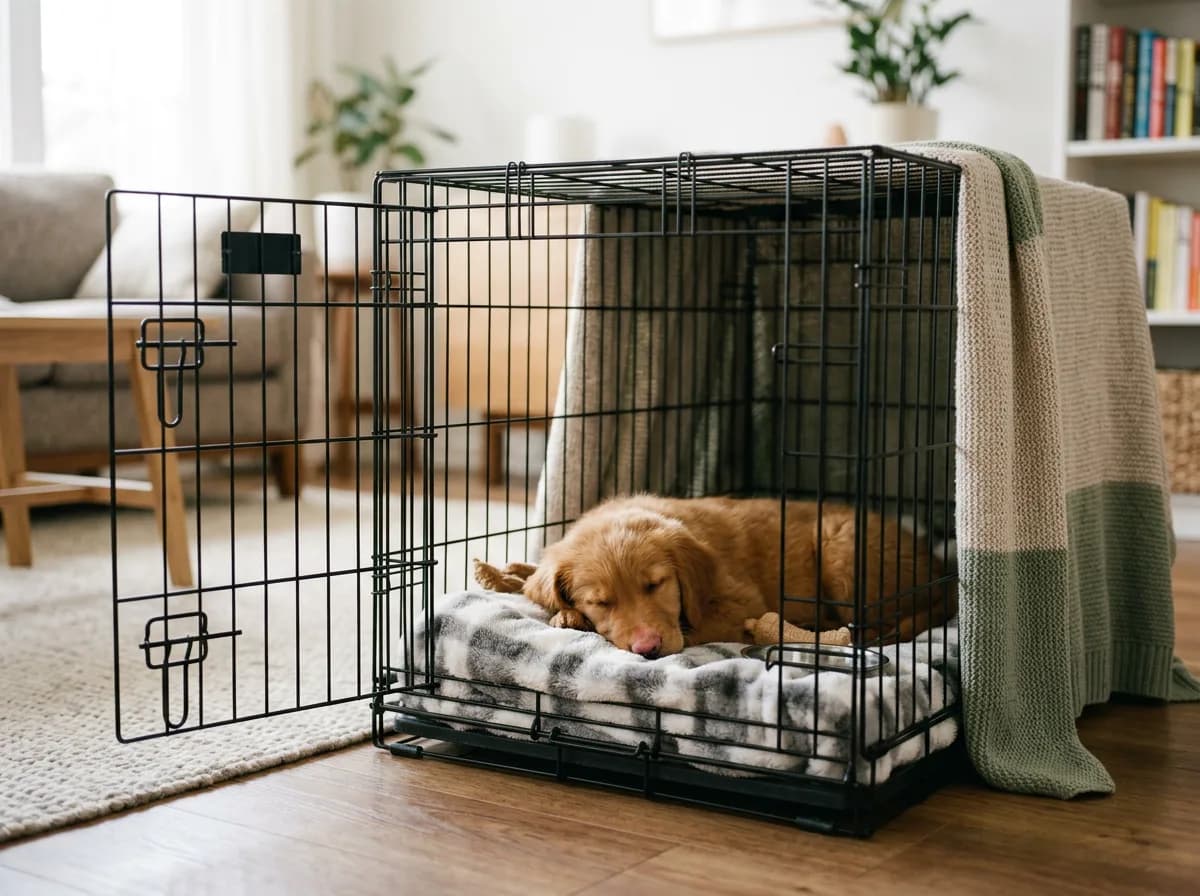
- Place it in a busy, central room like the living room so the puppy is near the family and does not feel isolated, but tucked into a corner where they get a quiet retreat.
- Add a soft, washable blanket or crate pad. Skip loose bedding for heavy chewers who may ingest it, and switch to a chew-proof mat if yours shreds fabric.
- Keep the door open and secured back so it cannot swing and startle the puppy in these first days.
- Leave a couple of safe chew items inside so the crate is where the good stuff lives.
- For the first two or three days, prop or tie the crate door fully open. A door that drifts shut or clangs can spook a puppy at the exact moment you want them relaxed, and a single scare can set you back days. Only start closing it once the puppy walks in and out freely on their own.
Step 2: The reward sequence that builds a happy crate
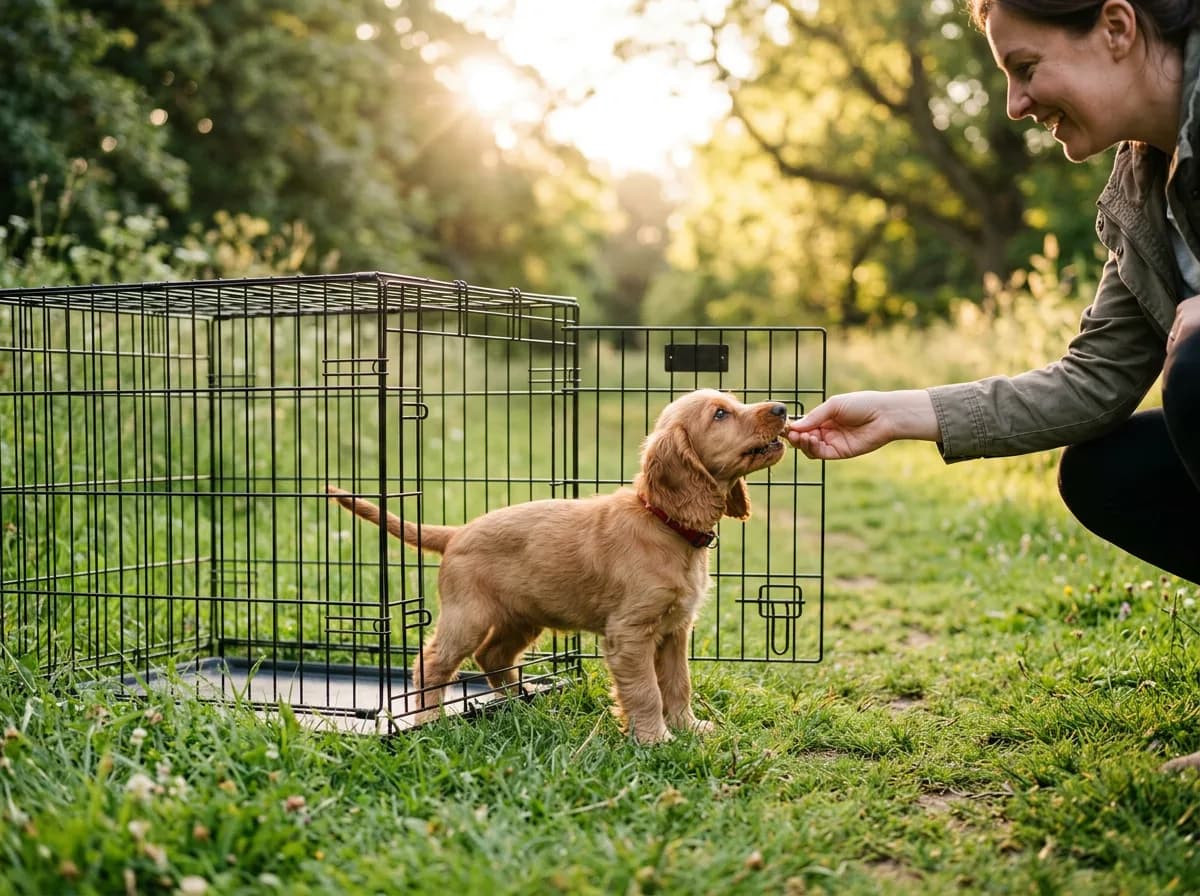
Every successful crate program runs on the same loop: the puppy does something near or in the crate, and something good immediately happens. Master this sequence and the schedule almost runs itself.
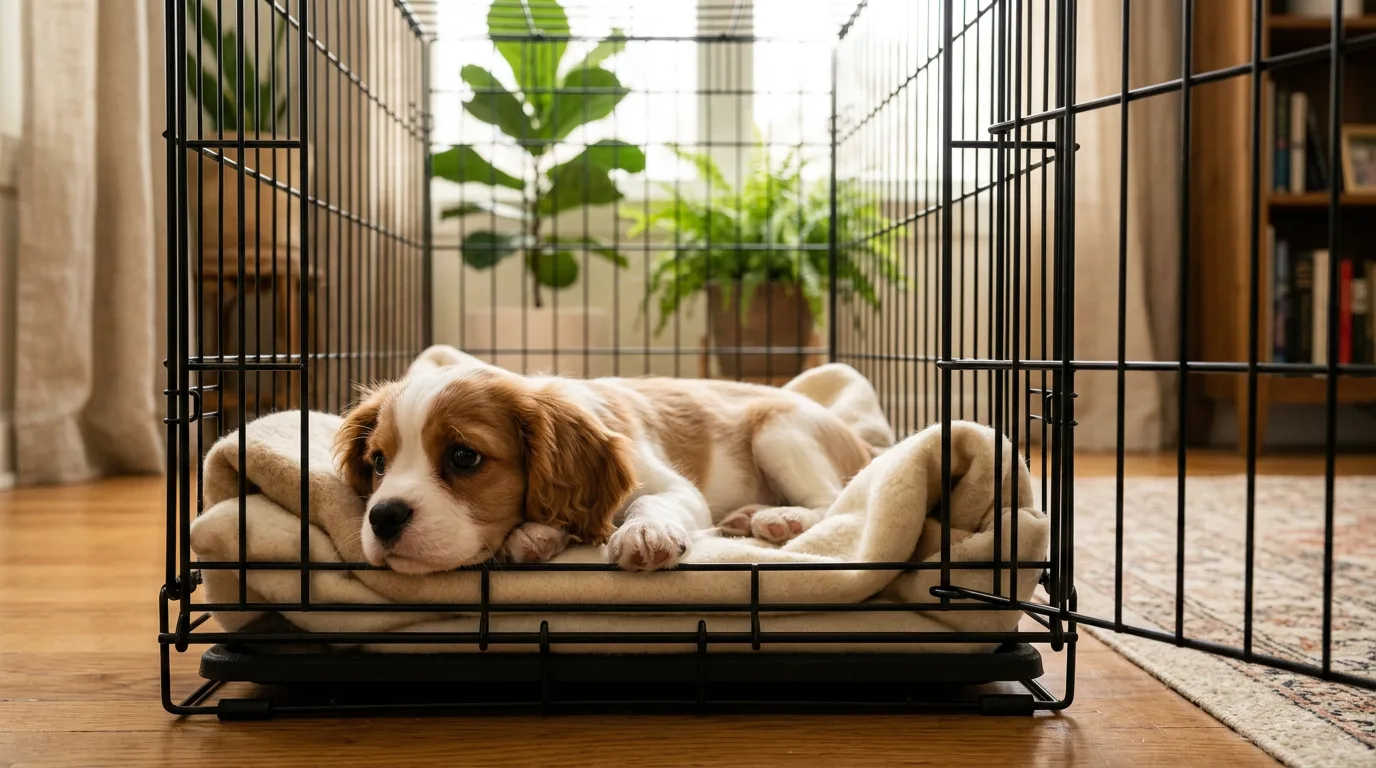
1. Lure with food. Toss a high-value treat just inside the crate. Let the puppy walk in, eat it, and walk back out with no pressure. Repeat until they trot in happily.
2. Add a cue. Once they are going in for the treat, say your word ("crate," "bed," "kennel") as they cross the threshold, then reward. The puppy learns the word predicts a treat inside.
Petful may earn a commission when you click through to Chewy, at no extra cost to you.
3. Feed meals inside. Move the food bowl into the crate, first at the doorway, then progressively toward the back. Meals become a daily positive crate association with zero effort from you.
4. Close the door for seconds. With the puppy eating or chewing, gently close the door for a few seconds, then open it before they finish. Build up to a closed door for the whole meal.
5. Extend in tiny increments. Add time only while the puppy is calm. If they get anxious, you moved too fast; drop back to the last duration they nailed and progress more slowly.
- Only ever raise the difficulty from a calm, quiet puppy. Let out a puppy who is whining and you have taught them that whining opens the door. Wait for even two seconds of quiet, then open. Calm gets rewarded, fussing does not.
The day-by-day crate training plan
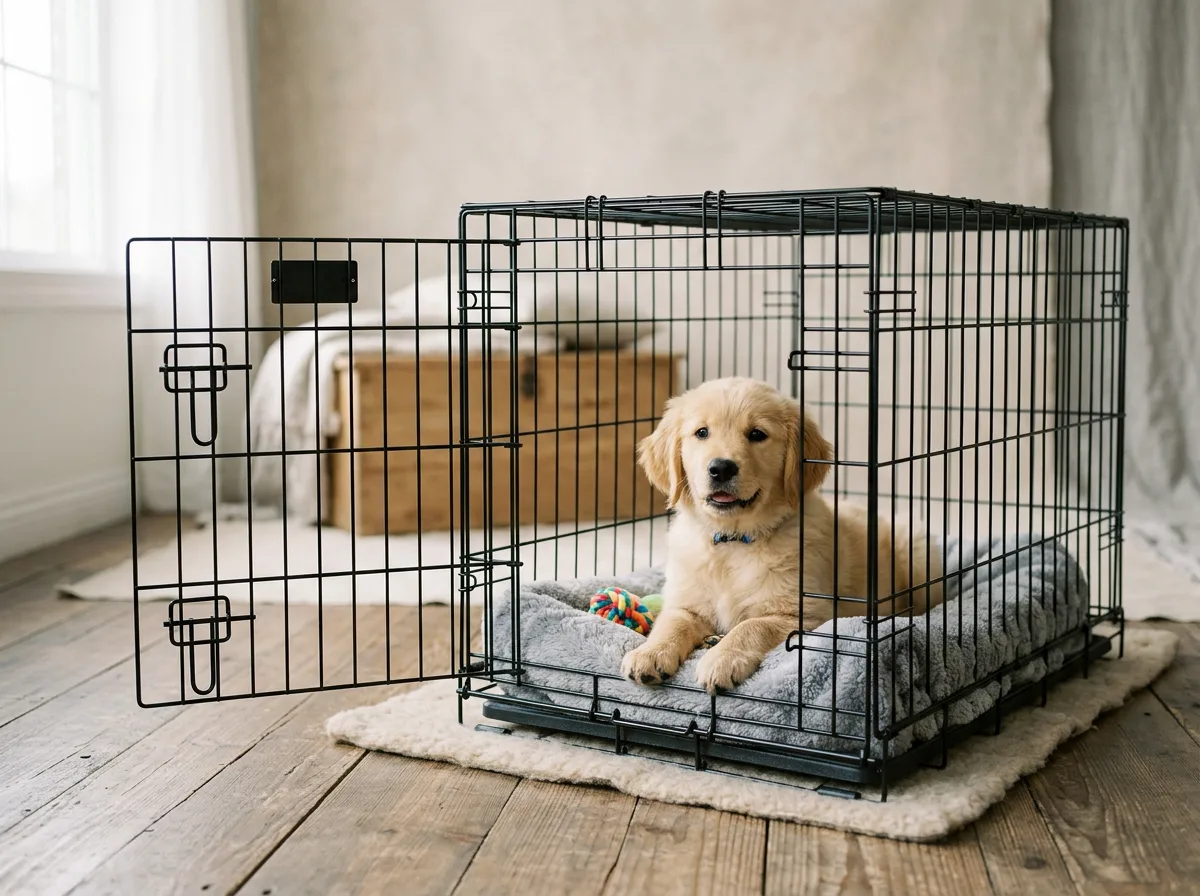
Here is the premise of this guide: a concrete schedule you can run from the day your puppy arrives. Treat these as flexible day ranges, not hard deadlines. A confident pup may compress two days into one; a nervous rescue may need a week on a single step. Never advance until the current step is calm and boring for your puppy.

Peanut butter soft chews with L-theanine, chamomile, and ashwagandha to ease hyperactivity and support calm, relaxed behavior.
Petful may earn a commission when you click through to Chewy, at no extra cost to you.
| Day / phase | What you do | Success looks like |
|---|---|---|
| Days 1 to 2 | Crate open, door tied back. Toss treats in and out, drop meals at the doorway. No closing the door. | Puppy walks in on their own to grab a treat and comes back out relaxed |
| Days 3 to 4 | Feed full meals inside. Add your cue word. Close the door for a few seconds during the meal, then open. | Puppy eats a whole meal inside with the door briefly shut and stays calm |
| Days 5 to 7 | Close the door after a meal for 1 to 5 minutes while you sit nearby with a chew inside. Add a stuffed food toy. | Puppy settles or chews for a few minutes behind a closed door with you in the room |
| Days 8 to 10 | Leave the room for 1 to 10 minutes with the puppy crated and busy on a chew. Return calmly, no fuss. | Puppy stays quiet when you step out of sight for short stretches |
| Days 11 to 14 | Extend alone-time to 30 minutes in daytime naps. Begin overnight crating beside your bed. | Puppy naps in the crate during the day and settles at night with minimal fuss |
| Ongoing | Gradually build daytime stretches toward the age-appropriate maximum. Keep sessions positive. | Puppy trots in on cue and treats the crate as their own space |
- 1The plan is a guide, not a stopwatch; advance only from a calm puppy.
- 2Days 1 to 4 build the association, days 5 to 10 add a closed door and brief absences, days 11 to 14 add real duration and nights.
- 3If any step produces panic, drop back one step and slow down. There is no prize for finishing early.
How long can a puppy stay in a crate?
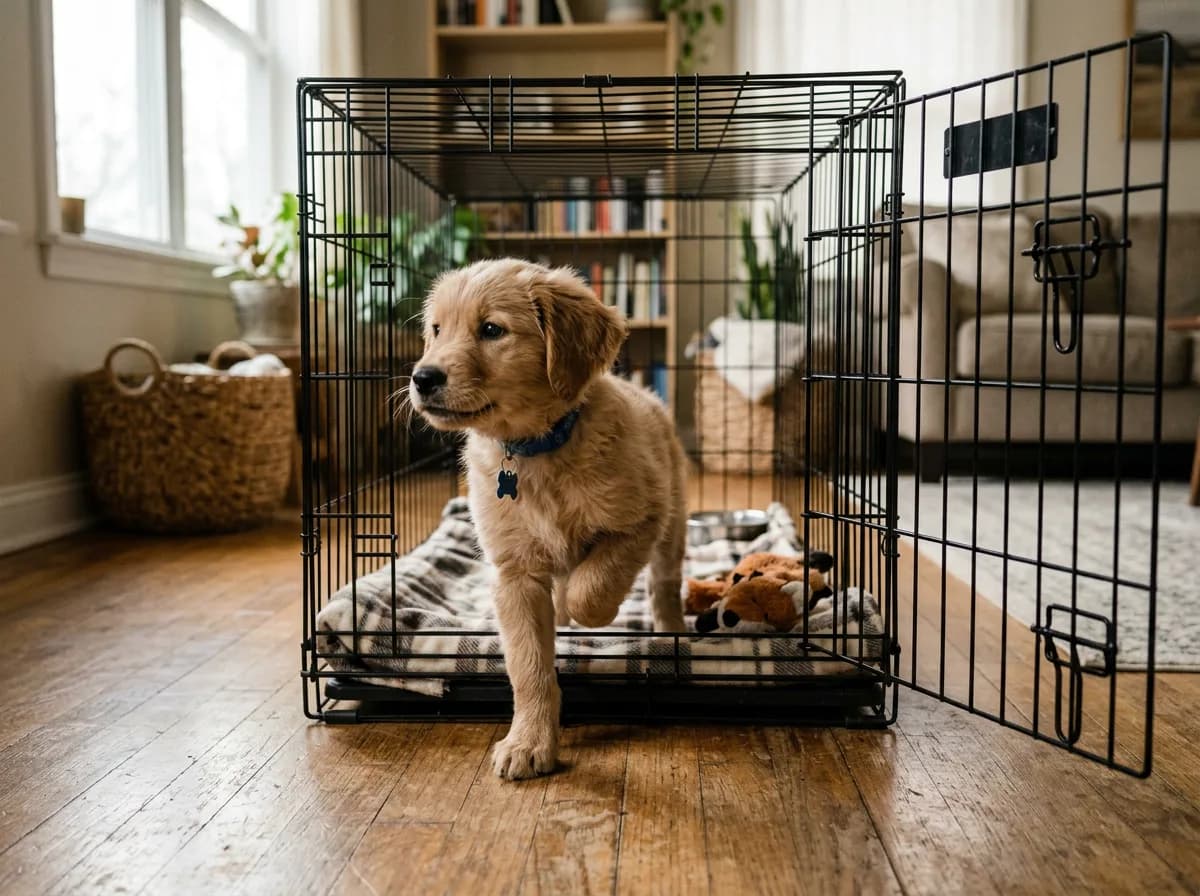
A puppy's bladder sets the ceiling, and it is small. The common rule of thumb is that a puppy can hold their bladder for roughly one hour per month of age, plus one, up to a maximum of six to eight hours for an adult dog. An eight-week-old (two-month) puppy therefore tops out around three hours during the day, and that is a ceiling, not a target. Overnight, puppies can often hold slightly longer because their systems slow during sleep, but young puppies will still need at least one middle-of-the-night potty trip.
| Puppy age | Approx. daytime maximum | Note |
|---|---|---|
| 8 to 10 weeks | 30 to 60 minutes at a stretch | Frequent potty breaks; never a full workday |
| 11 to 14 weeks | 1 to 3 hours | Build up slowly; watch for signals |
| 15 to 16 weeks | 3 to 4 hours | Bladder control improving |
| 17+ weeks | 4 to 5 hours | Approaching adult capacity |
| Adult dog | 6 to 8 hours maximum | Not every day, and never the norm |
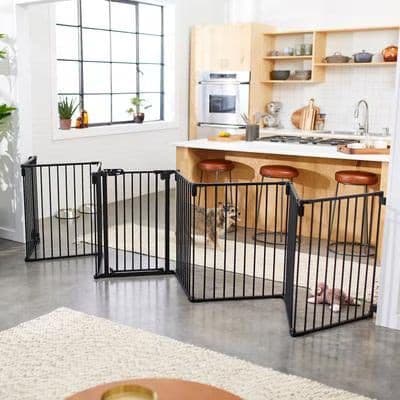
No dog of any age should live in a crate. The crate is a training and safety tool for defined stretches, paired with plenty of exercise, play, potty breaks, and human time out of it. A puppy crated for a full eight-hour workday will not learn to love it, and forcing them to soil their den undermines house-training. If your schedule requires long absences, use a puppy-proofed playpen or a midday walker so crate time stays humane.
Night one and beyond: crate training a puppy at night
Nights are where most owners wobble, so plan for them.
Put the crate right beside your bed for at least the first week or two. A puppy who can smell and hear you settles far faster than one alone in a distant room, and you will hear the genuine "I need out" whimper the moment it starts. You can gradually move the crate toward its permanent spot once nights are calm.
Run a tight bedtime routine: last meal a few hours before bed, water pulled a bit earlier, a final potty trip right before the crate, and a calm, boring lights-out. A stuffed food toy or a safe chew gives the puppy something to do as they drift off.
Expect at least one overnight potty break for a young puppy. When they wake and whimper in a way that reads as "I need to go," take them out on-leash, let them potty, and return them to the crate with as little fuss, talk, or play as possible. Keep it boring so they learn night is for sleeping, not socializing.
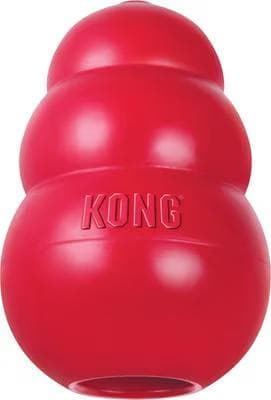
A durable rubber dog toy that can be stuffed with treats and selected by the manufacturer's size guide; supervise use and retire it when damaged.
Petful may earn a commission when you click through to Chewy, at no extra cost to you.
- A potty whine usually starts abruptly after some sleep and escalates; the puppy is restless and alert. A protest or boredom whine tends to come right after you have crated them and fades if you wait. When in doubt with a very young puppy, a quick, silent, business-only potty trip is the safe call. You can always shorten these as they mature.
This is also the moment to start your records. From day one, keep a simple log of feeding times, potty successes and accidents, and how each crate session went, alongside vaccine dates and vet notes. A running record makes patterns obvious (that 2 a.m. wake-up is tracking a late dinner, say) and gives your vet real data at checkups. A free tool like MyPetID lets you keep vaccine and training records together from the very first night, so nothing important lives only in your memory during the blur of the first month.
Handling the crying without breaking your training
The hardest question every new owner asks: do I let the puppy cry?
The honest answer is that it depends on why they are crying, and learning to tell the difference is the whole skill. There are two broad reasons a crated puppy fusses.
- A need. They have to potty, they are too hot or cold, or they are genuinely frightened. These get answered. Ignoring a real need is both unkind and counterproductive, and it can turn into a lasting fear of the crate.
- A protest. They would simply rather be with you. If the puppy has recently pottied and is safe and comfortable, a few minutes of grumbling that settles on its own is normal, and rushing in to soothe every squeak teaches them that noise summons you.
The practical middle path: rule out a real need first (offer a potty trip if it has been a while), then, for pure protest, wait for a brief pause in the noise and reward the quiet, either by opening the door on a calm puppy or simply by your calm presence. Never let a puppy "cry it out" for hours; that is flooding, and it can create real anxiety. The aim is short, tolerable stretches that you extend only as the puppy proves they can handle them.
- Escalating panic that does not ease at all, frantic biting or clawing at the crate bars, drooling, injured paws or a bloodied nose, refusing all food, or soiling in a previously reliable puppy are signs of real distress or possible separation anxiety, not ordinary fussing. Stop pushing duration, go back several steps, and if it persists, loop in your veterinarian or a certified trainer. Forcing a panicking dog to stay crated makes the fear worse.
The most common crate training mistakes
Most crate training that "fails" traces back to a short list of avoidable errors. Sidestep these and you are most of the way there.
- Using the crate as punishment. The fastest way to make a puppy hate the crate. Keep it 100% positive.
- Too much, too fast. Jumping from open-door treats to an eight-hour workday in the crate floods the puppy and teaches panic. Build duration in small steps.
- A crate that is too big. Extra room becomes a bathroom and stalls house-training. Size it right and use a divider.
- Rewarding the whining. Opening the door while the puppy fusses teaches them that fussing works. Wait for a pause.
- Skipping exercise first. A puppy with pent-up energy cannot settle. Walk and play before you expect calm crate time.
- Going cold turkey overnight. Banishing a new puppy to a far room on night one almost guarantees a rough night. Keep them close at first.
- Inconsistency between people. If one family member enforces the rules and another caves to every whimper, the puppy learns to hold out. Get everyone on the same plan.
Once the crate is a happy place
When your puppy is trotting in on cue, napping in the crate by choice, and staying calm at night, crate training is working. From here you slowly extend daytime stretches toward the age-appropriate maximum, keep every session positive, and let the crate stay a permanent, welcome part of your dog's world. Many adult dogs keep using their crate for life as a favorite spot to rest, exactly the outcome you want.
Crate training pairs naturally with the rest of your early puppy plan. For a broader look at settling a new dog into your home, see our guide on general dog health and care basics for how routine, environment, and structure shape a well-adjusted puppy.
Be patient, keep it positive, and let the puppy set the pace. A crate your dog genuinely loves is worth every one of these small, careful steps.
Frequently asked questions about crate training a puppy
Related on Petful
- Crate Training a Puppy at Night: Survive Night One
- Crate Training Schedule by Age: 8 Weeks to 6 Months
- How to Crate Train an Adult Dog
- How to Potty Train a Puppy: The Schedule-First Guide
- Puppy Training 101: A Week-by-Week Guide
The "2 1" idea is a bladder guideline: a puppy can typically hold it for about one hour per month of age plus one, so a two-month-old (8-week) puppy maxes out around three hours between potty breaks during the day. Use it as a ceiling, not a target, and never crate a young puppy for a full workday.
The 10:1 rule is a reward ratio some trainers use in the early days: aim for roughly ten positive, rewarded crate moments (treats tossed in, meals fed inside, calm praise) for every one time the door is closed or duration is pushed. The point is to keep the crate overwhelmingly positive so the puppy builds a strong happy association before you ask anything hard of them.
The biggest ones are using the crate as punishment, moving too fast and flooding the puppy with long stretches, choosing a crate that is too big so it becomes a bathroom, opening the door while the puppy is whining (which rewards the whining), skipping exercise before crate time, and being inconsistent between family members. Avoiding these covers most crate-training failures.
Yes, crating an 8-week-old at night is fine and helpful, with two conditions: put the crate right beside your bed so the puppy can sense you, and plan for at least one overnight potty trip since an 8-week bladder cannot last the whole night. Keep those night trips calm and business-only so the puppy learns that night is for sleeping.
A few minutes of settling grumble that fades on its own is normal and fine. What is harmful is ignoring a genuine need (a potty trip, fear, or discomfort) or letting a puppy "cry it out" in escalating panic for a long time, which can create lasting anxiety. Rule out a real need first, then reward the quiet rather than the crying.
Red flags in the crate include escalating panic that never eases, frantic biting or clawing at the bars, drooling, injured paws or a bloodied nose, refusing all food, or a housetrained puppy suddenly soiling the crate. These point to real distress or possible separation anxiety rather than ordinary fussing. Stop increasing duration, go back several steps, and consult your vet or a certified trainer if it continues.
Not blindly. First rule out a real need by offering a potty break if it has been a while and checking she is comfortable. For pure protest crying, wait for a brief pause and reward that quiet moment, rather than rushing in at every squeak (which teaches her noise works) or leaving her to panic for hours (which creates fear). The goal is short, tolerable stretches you extend only as she proves she can handle them.
A 10-week-old puppy can usually manage roughly three to four hours overnight before needing a potty trip, and systems slow during sleep so nights often stretch a little longer than daytime. Plan on at least one middle-of-the-night potty break, keep the crate beside your bed, and expect the overnight stretch to lengthen naturally over the coming weeks as bladder control develops.

Coreen Saito is a pet writer and longtime shelter volunteer with more than a decade in animal rescue. She covers cat behavior, breed care, and the small, ordinary science of sharing a life with companion animals, with a particular focus on honest takes about the products and decisions that actually matter. At home in Arizona, she's outranked by Mac (a dog with the loudest opinion in the house), Rebel (a cat who governs by quiet authority), and Meri (an orange tabby who runs the late shift and the laundry basket). She writes about all three, plus the rescues that keep coming through her life, at LifeWithMinty.com.
Sign up for expert-backed reviews and safety alerts all in one place.