Crate Training a Puppy at Night: Survive Night One
Crate training a puppy at night is the part nobody warns you about until you are on the floor at 2 a.m. with a crying eight-week-old. This night-one guide covers where to put the crate, how to answer the crying, and how to reach sleeping through.
Petful is reader supported. As an affiliate of platforms like Amazon and Chewy, we may earn a commission when you buy through links on this page. There is no extra cost to you.
Crate training a puppy at night is the part nobody warns you about until you are sitting on the floor at 2 a.m. listening to a brand new eight-week-old cry. The good news: that first night of noise is normal, it is short-lived, and a few specific choices about where the crate goes, when the last potty break happens, and how you answer the crying will decide whether tomorrow night is quieter. This guide is built for the exact moment you are in right now, the crisis of night one, and then walks you through the two to three weeks it takes for a puppy to sleep through.
Most puppies settle far faster than exhausted new owners expect. The crying is not manipulation and it is not a training failure. It is a young animal who has just left its litter, its mother, and everything warm and familiar, and is now alone in the dark for the first time in its life. Your job on night one is not to "win," it is to make the crate feel safe enough that the puppy chooses to sleep in it.
- 1Put the crate right next to your bed for the first 1-2 weeks so your puppy can see, hear, and smell you
- 2Do a final potty break immediately before lights-out and expect one or two more potty trips overnight for a puppy under 12 weeks
- 3Answer genuine potty cries calmly and silently, but do not reward attention-seeking crying, this is the single most important night-one skill

Sign up for expert-backed reviews and safety alerts all in one place.
Why the First Few Nights Are So Hard
A puppy at eight to ten weeks has a tiny bladder, no concept of "nighttime," and a powerful instinct to stay with its pack. Drop all three facts into a dark, quiet house and crying is the predictable result. Understanding the biology takes the panic out of it.
Bladder capacity is the biggest limiter. A rough rule of thumb from most veterinary behavior sources is that a puppy can hold its bladder for about one hour per month of age, plus one, during the day, and slightly longer overnight when metabolism slows. That means an eight-week-old (two months) can realistically hold it for roughly three hours at a stretch at night. Expecting an eight-week-old to sleep eight uninterrupted hours is setting both of you up to fail.
The second factor is isolation stress. Until this week your puppy slept in a pile of littermates. Sudden solitude triggers distress vocalization, the same instinct that keeps a lost puppy calling until the mother finds it. This is why crate placement matters more than almost anything else on night one.

Petful may earn a commission when you click through to Chewy, at no extra cost to you.
- Nighttime crying in a new puppy almost always fades within 3 to 10 nights as the crate becomes familiar and a routine sets in. If crying is escalating rather than easing after two weeks, or is paired with not eating, lethargy, or diarrhea, call your veterinarian, because persistent distress can signal a health issue rather than an adjustment period.
Where to Put the Crate on Night One
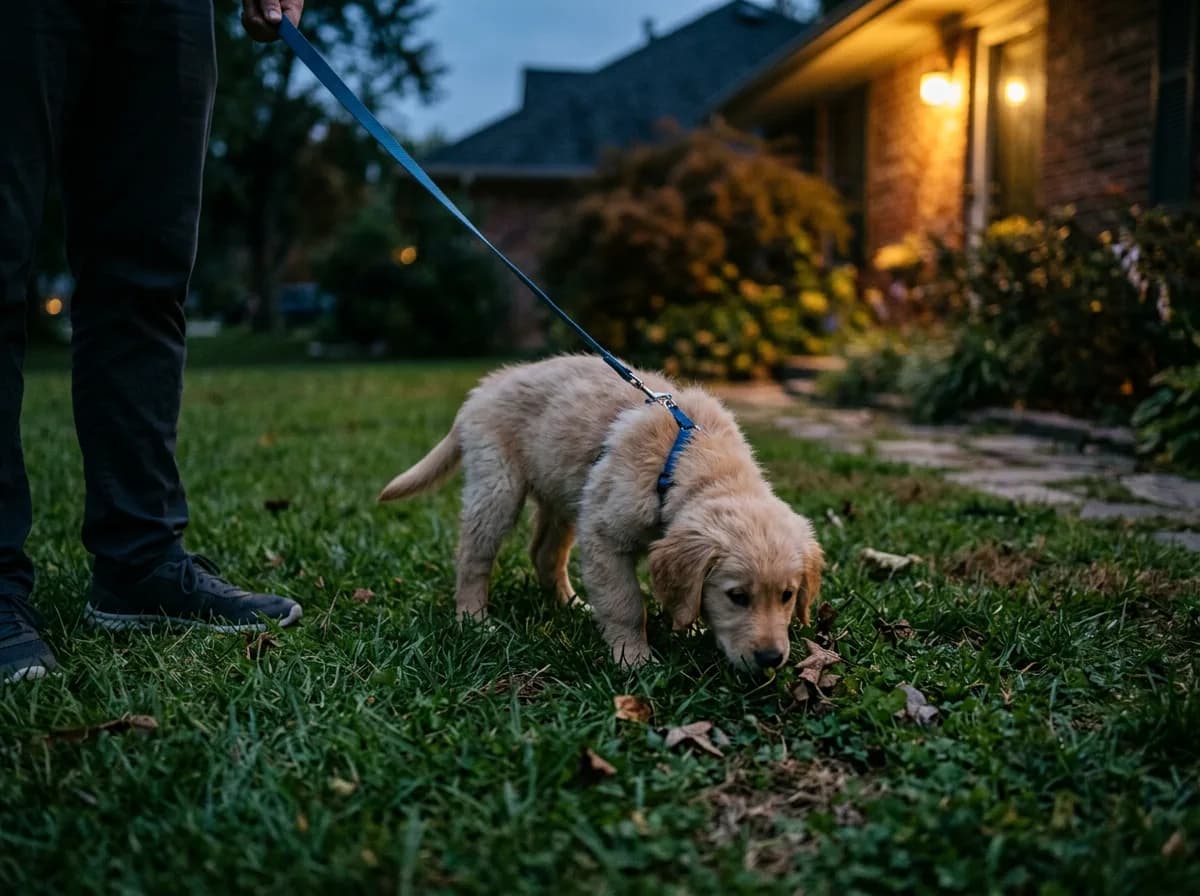
Put the crate in your bedroom, right next to your bed. This is the highest-leverage decision you will make, and it is what nearly every reputable source, from the Animal Humane Society to professional trainers, now recommends for the first stretch of nights.
The Animal Humane Society is direct about it: keep the crate in or near your bedroom when crating overnight so your dog does not associate the crate with social isolation. When the puppy can see your outline, hear you breathe, and smell you a few feet away, the raw panic of being alone drops dramatically. Many trainers go a step further and elevate the crate onto a sturdy nightstand or low table so the puppy is at eye level with the bed and you can drop a reassuring hand toward the bars without getting up.
What you want to avoid on night one is banishing the crate to the laundry room, the kitchen, or a distant crate in the garage. A puppy left to "cry it out" in total isolation on its first night learns that the crate means abandonment, which is the opposite of the association you are building.
The gradual move-out plan
The bedside crate is a starting point, not a permanent address (unless you are happy to keep it there). Once your puppy is sleeping through most nights without distress, usually somewhere between weeks two and four, you can begin moving the crate a few feet at a time toward its final location: farther across the bedroom, then to a hallway, then to the room where you ultimately want the dog to sleep. Move in small steps over several nights and watch for a return of crying, which is your signal you moved too fast.
| Stage | Where the crate goes | Why |
|---|---|---|
| Nights 1-14 | On or beside your bed, ideally elevated to eye level | Kills isolation panic, lets you hear genuine potty cries |
| Weeks 2-4 | Gradually farther across the bedroom | Weans the puppy off constant proximity without a shock |
| Week 4 and beyond | Its permanent spot (bedroom corner, hall, family room) | Puppy is now confident the crate is safe wherever it sits |
The Night-One Routine That Prevents Most Crying
Crate training a puppy at night gets dramatically easier when the hours before bed are structured. A puppy who is genuinely tired, recently emptied, and calm is a puppy who sleeps. Run this sequence every single night and be boringly consistent, because consistency is what a puppy's brain latches onto.
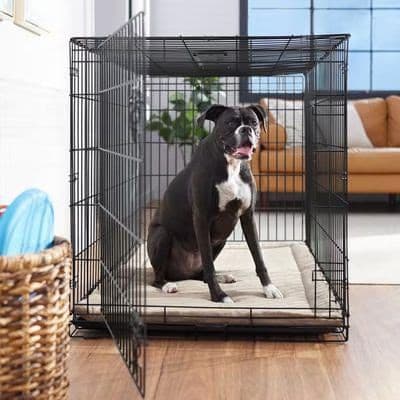
Petful may earn a commission when you click through to Chewy, at no extra cost to you.
- 90 minutes before bed: last full meal is already done and dinner was served early enough to digest. Pick up the water bowl for the night so the bladder is not refilling right before sleep. Do not restrict water during the day, only for the final stretch before bed.
- 60 minutes before bed: a calm play or gentle sniff-walk to burn the last of the day's energy. Tire the body and the brain. A puppy who has had a satisfying, tiring evening settles far faster than one who was napping on the couch until 10 p.m.
- 30 minutes before bed: wind everything down. Dim the lights, lower your voice, stop the roughhousing. You are signaling that the day is ending.
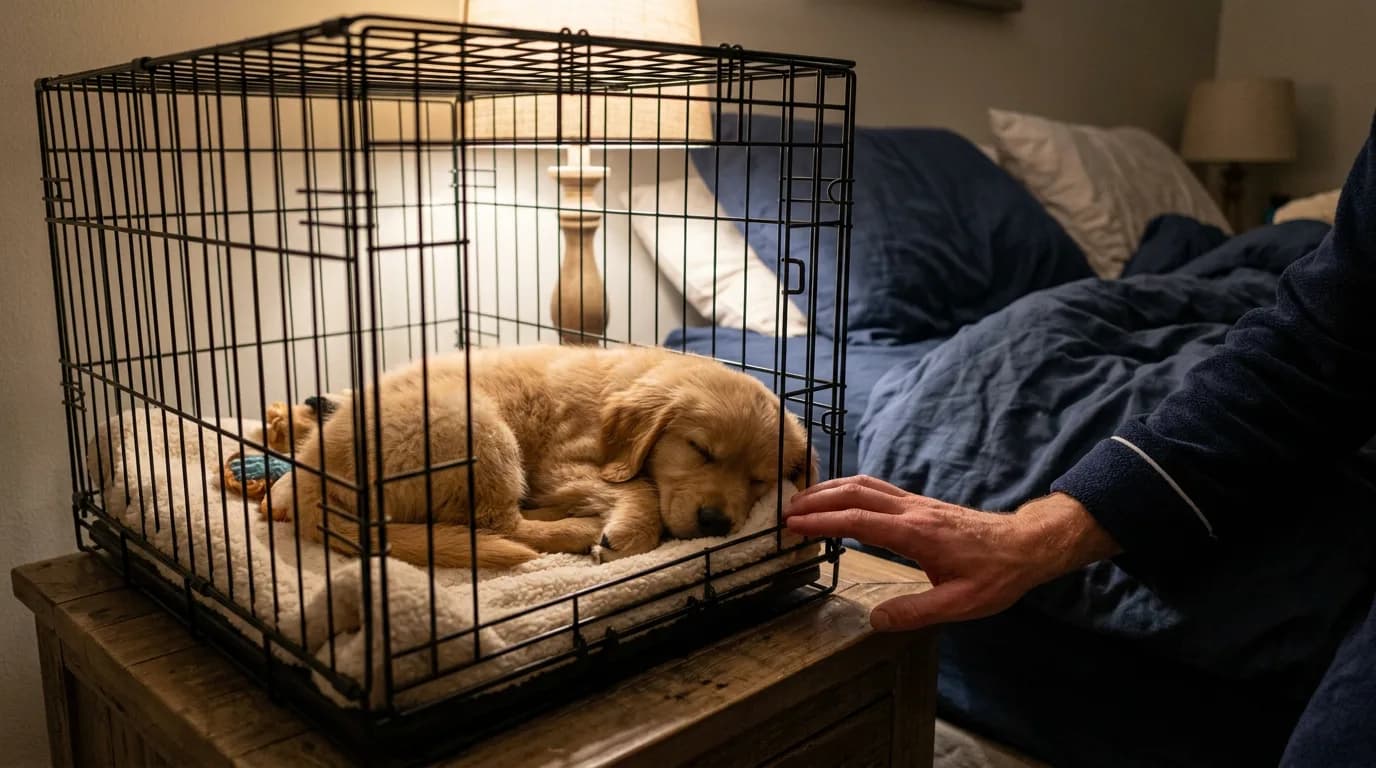
- Right before lights-out: the final potty break. Take the puppy out on a leash, wait for a full empty, then straight inside. No play, no excitement, just the job done.
The final potty break is non-negotiable. A puppy crated with a full bladder will cry, and it will be right to cry. Get the last successful potty in and you remove the most common legitimate reason for a 1 a.m. wake-up.
- Serving the last meal at least 3 hours before bed gives the food time to move through, which means the puppy is more likely to poop on that final potty break rather than at 3 a.m. inside the crate. An early dinner is one of the simplest overnight-accident preventers there is.
Making the Crate a Place a Puppy Wants to Sleep
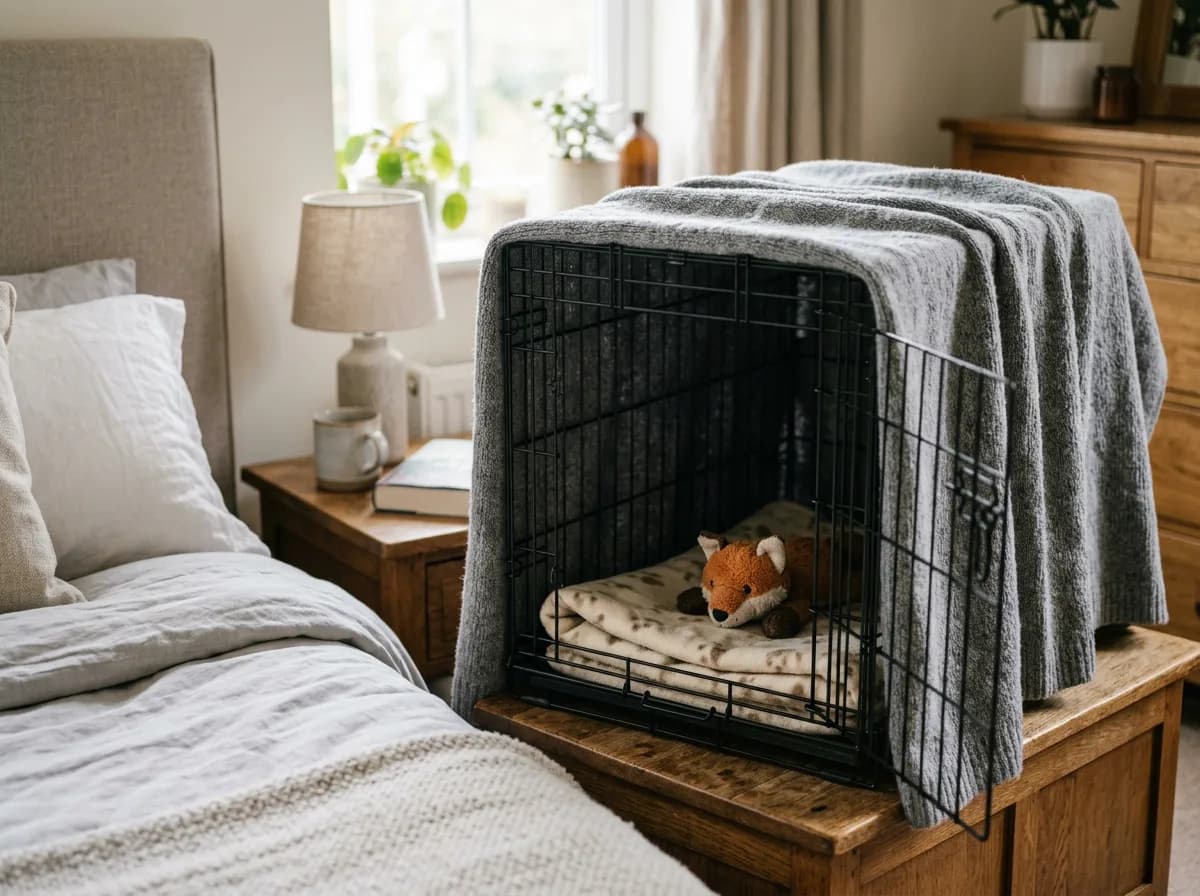
The crate should read as a cozy den, not a cage. A few cheap touches transform how a puppy feels about going in.
Drape a light blanket or towel over the top and sides of a wire crate to cut drafts, block distracting light, and create a burrow-like enclosed feeling. Leave the front partly open for airflow. Tuck in something that smells like you, an unwashed t-shirt is perfect, so your scent is with the puppy all night. Many owners also add a soft toy or a snug, warm object to stand in for the missing warmth of littermates.

Peanut butter soft chews with L-theanine, chamomile, and ashwagandha to ease hyperactivity and support calm, relaxed behavior.
Petful may earn a commission when you click through to Chewy, at no extra cost to you.
One important caveat on bedding: if your puppy is a chewer or is still having accidents, skip the plush blankets and bedding at first. A puppy who shreds fabric can swallow pieces (a real intestinal-blockage risk), and soft bedding wicks urine away so the puppy stays comfortable lying in a wet crate, which quietly sabotages potty training. Start with a chew-proof mat or bare crate pan if needed, and add soft bedding once chewing and accidents are behind you.
Size the crate correctly. It should be just big enough for the puppy to stand up, turn around, and lie down fully, and no bigger. A crate that is too large lets the puppy potty in one corner and sleep in the other, which defeats the housebreaking instinct that makes crates work. If you bought a large crate to grow into, use a divider panel to shrink the usable space to puppy-size for now.
Handling the Crying: The Skill That Makes or Breaks Night One
Here is the hard part, and the part that trips up almost every new owner. When your puppy cries at night, you have to answer one question fast: is this a "I need to potty" cry or an "I want out and I want company" cry? Getting this call right, over and over, is the actual skill of crate training a puppy at night.
The distinction matters because your response teaches the puppy what crying accomplishes. Answer every whimper by lifting the puppy out for cuddles and you train a puppy to cry for attention indefinitely. Ignore a genuine bathroom cry and you get a crate accident plus a puppy who learns the crate is where it is forced to soil itself. Neither extreme works. You need to read the cry.
Reading the two kinds of cries
A potty cry usually comes after the puppy has been asleep for a stretch, tends to be urgent and escalating, and often includes restlessness, circling, or scratching. An attention cry tends to start the moment the door closes, before any sleep has happened, and is more of a steady protest. Timing is your best clue: crying two or three hours after lights-out, especially in a young puppy, is very likely a real bathroom need.
The correct response to a potty cry
Take the puppy out calmly, on a leash, with as little talk and light as possible. Walk straight to the potty spot, wait, let it eliminate, praise quietly, and go straight back to the crate. No playing, no treats beyond a quiet "good," no turning on the overhead lights, no conversation. The whole trip should be boring and businesslike so the puppy does not learn that a 2 a.m. cry earns a party.
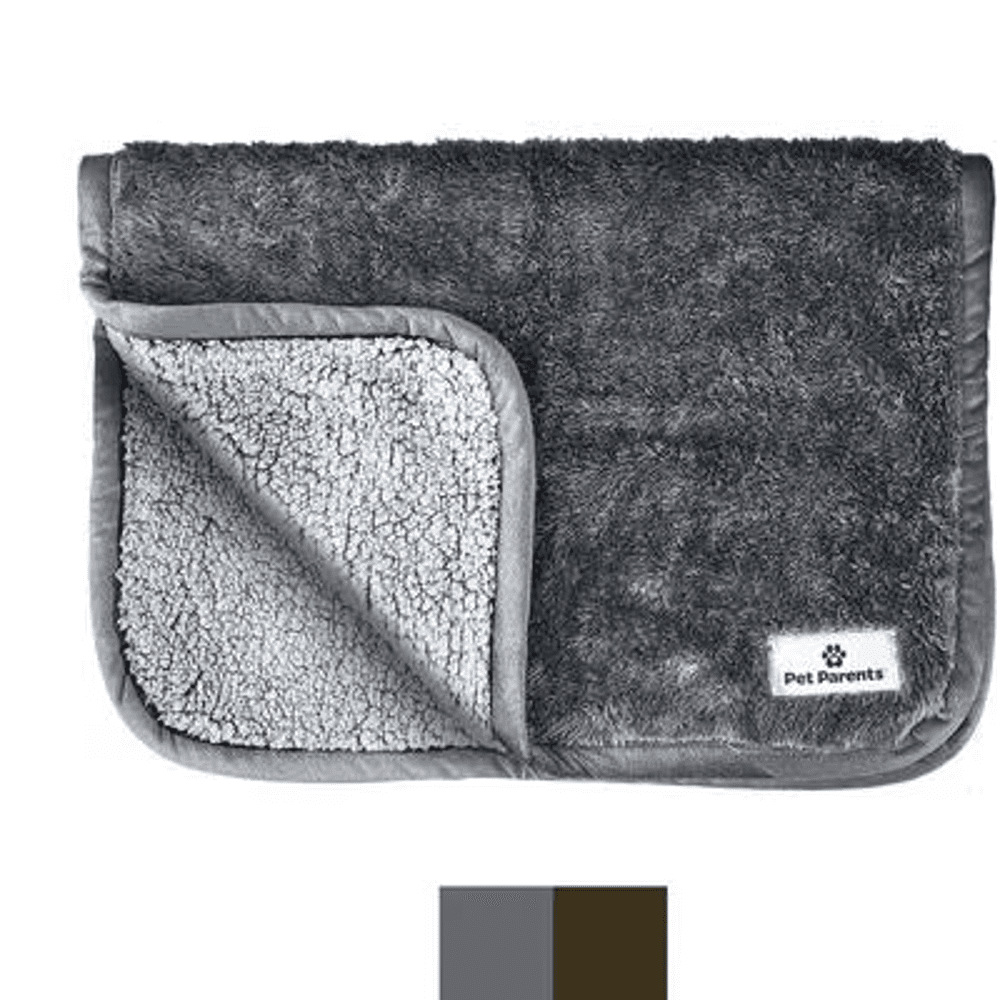
A plush, waterproof sherpa blanket that gives a cold or shivering dog a warm, cozy layer to curl into. The hidden waterproof lining protects the bed, couch, or car seat, and the whole thing is machine washable.
Petful may earn a commission when you click through to Chewy, at no extra cost to you.
The correct response to an attention cry
If you are confident the puppy is empty (recent potty, only been in a few minutes, no sleep yet) and is simply protesting, do not open the door. Opening it teaches that crying works. Instead, you can reassure without releasing: a soft "shh," or slipping a couple of fingers through the bars, or resting your hand where the puppy can smell it, all of which calm without rewarding the demand to be let out. Most attention crying fades within a few minutes once the puppy realizes the door stays shut and you are right there.
- If the crate becomes the place a puppy gets sent when it is in trouble, it will fight going in every night. Keep every crate association neutral-to-positive: meals near it, treats tossed inside, calm praise for entering. The crate is a bedroom, not a time-out cell.
A Realistic Night-by-Night Timeline
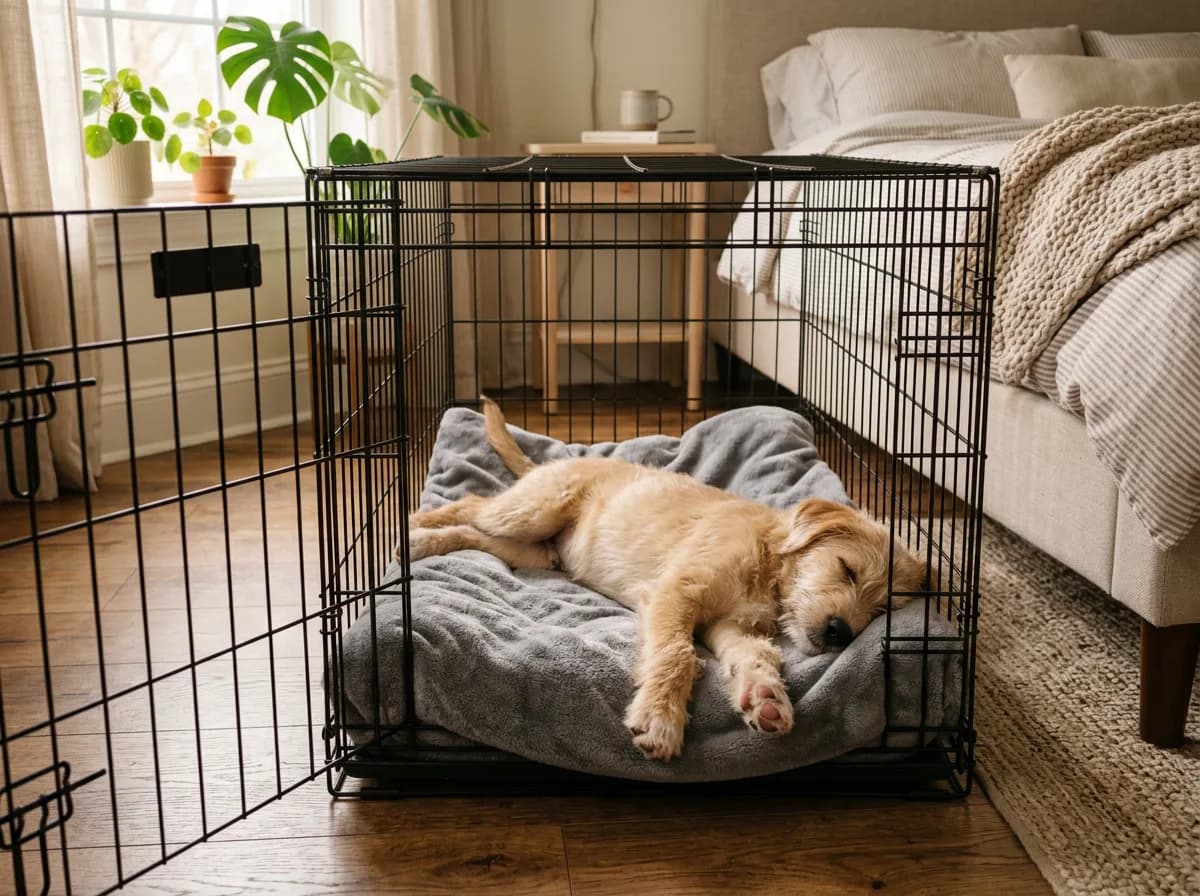
Knowing what "normal" looks like keeps you from panicking on the rough nights. Every puppy is different, but this is the arc most families experience.

A large fabric-covered dog toy for supervised tug and fetch; choose the size for your dog and retire it if seams or material begin to fail.
Petful may earn a commission when you click through to Chewy, at no extra cost to you.
- Nights 1-3: the worst of it. Expect crying at lights-out and one or two genuine potty wakeups. The bedside crate and a rock-solid routine are doing the heavy lifting here.
- Nights 4-7: crying at bedtime shortens or stops as the crate becomes familiar. You may still have one overnight potty trip for a young puppy.
- Weeks 2-3: most puppies now settle quickly and are stretching sleep toward five or six hours. Overnight potty trips drop as bladder capacity grows.
- Weeks 3-6: many puppies sleep through the night, and you can begin the gradual crate move-out if you want the crate somewhere other than your bedside.
Age matters enormously. An eight-week-old simply cannot hold it as long as a four-month-old, so a lot of "progress" is really just your puppy's bladder growing up. Do not compare your ten-week-old to a friend's six-month-old dog.
| Puppy age | Realistic overnight stretch | Overnight potty trips to expect |
|---|---|---|
| 8-10 weeks | About 3-4 hours | 1-2 |
| 11-14 weeks | About 4-5 hours | 1 |
| 4-5 months | 6-7 hours | 0-1 |
| 6 months and up | Usually through the night | 0 |
Common Crate Training Mistakes to Avoid
Most crate-training struggles trace back to a handful of avoidable errors. Steering clear of these will spare you nights of unnecessary crying.
- Crate too big. Extra space becomes a bathroom corner. Use a divider to keep it puppy-sized.
- Crate isolated on night one. Banishing a brand new puppy to a distant room guarantees panic crying and a bad crate association. Keep it bedside first.
- Skipping the final potty break. A full bladder is a legitimate reason to cry. Never crate a puppy without a last empty.
- Answering every cry by letting the puppy out. This trains attention crying. Reassure without releasing when the puppy is genuinely empty.
- Using the crate as punishment. Poisons the one place you need the puppy to love.
- Leaving water in the crate all night. Refills the bladder you just emptied. Pick it up before bed.
- Going too fast. Rushing a puppy from short daytime sessions straight to a locked eight-hour night invites failure. Build crate comfort during the day first.
Building Positive Crate Associations During the Day
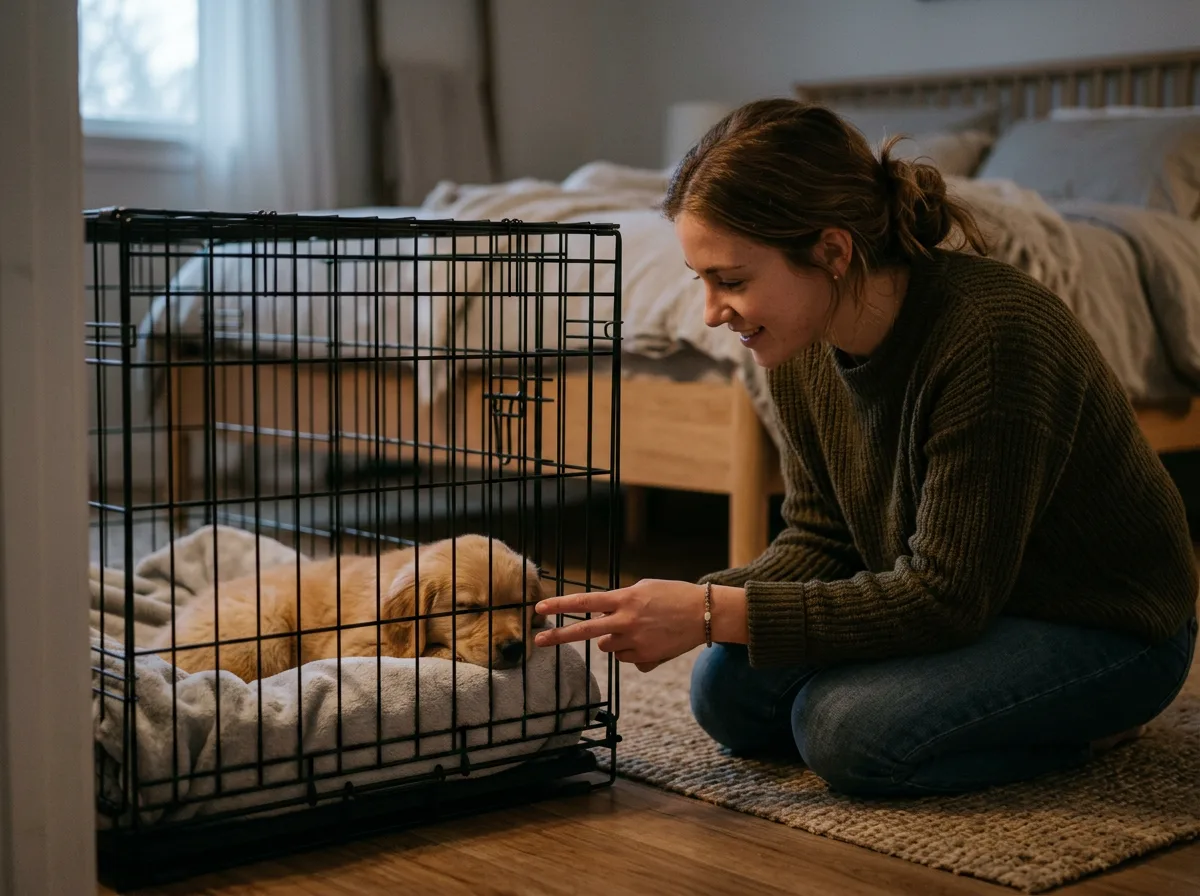
Nighttime goes better when the crate is not brand new at bedtime. Spend the daytime, even just the afternoon before the first night, making the crate a good place. Toss treats inside and let the puppy find them. Feed meals at the crate door, then just inside, then fully inside. Praise calmly any time the puppy chooses to go in on its own. Leave the door open during these sessions so the puppy learns that going in is always its choice and never a trap.
The goal is a puppy who trots into the crate voluntarily because good things happen there. A puppy with even a day of positive crate exposure walks into night one with far less fear than one meeting the crate for the first time at bedtime.
If you want a deeper foundation on reading your dog's signals and building calm routines, our library of dog behavior guides covers everything from separation anxiety to settling a reactive dog, and the same calm-consistency principles that work at night carry over to every other training challenge. For owners choosing a puppy and thinking ahead about temperament and trainability, breed-specific profiles like our Rhodesian Ridgeback color and temperament guide show how much a dog's background shapes what to expect during training.
When to Loosen the Rules
Crate training a puppy at night is a temporary structure, not a life sentence. Once your dog is reliably sleeping through the night, house-trained, and past the destructive-chewing stage (usually well into adulthood), many owners choose to leave the crate door open, move to a dog bed, or let the dog sleep loose. There is nothing wrong with a crate-loving adult dog who keeps using its den by choice, and there is nothing wrong with graduating away from it. The crate did its job: it got you both through the hardest weeks safely.
The through-line of every step above is the same. Meet your puppy's genuine needs (a nearby human, an empty bladder, a cozy den), refuse to reward the demands that are not needs (attention crying from an empty puppy), and stay boringly consistent night after night. Do that, and the 2 a.m. crying you are dreading tonight will be a memory within a couple of weeks.
Frequently Asked Questions
Related on Petful
- Crate Training a Puppy: A Day-by-Day Plan
- Crate Training Schedule by Age: 8 Weeks to 6 Months
- How to Crate Train an Adult Dog
- Puppy Training 101: A Week-by-Week Guide
The fastest path is to place the crate right beside your bed, run a consistent pre-bed routine (early dinner, water picked up an hour before bed, a tiring evening, and a final potty break at lights-out), make the crate a cozy den with a cover and your scent, and answer only genuine potty cries while calmly reassuring (not releasing) an empty puppy who is protesting. Puppies who get bedside placement plus a rigid routine often settle within 3 to 7 nights, which is about as fast as it gets without shortcutting the puppy's real bladder and comfort needs.
The 10-10-10 rule is a simple socialization framework: expose your puppy to 10 different people, 10 different places, and 10 different surfaces or experiences in a positive, low-pressure way during the critical early socialization window (roughly up to 12-16 weeks). It is not a crate or nighttime rule, it is about building a confident, well-adjusted dog, but a confident puppy generally handles the crate and being alone at night more easily, so the two goals reinforce each other.
The most common mistakes are using a crate that is too large (which lets the puppy potty in one corner), isolating the crate in a distant room on the first nights, skipping the final potty break before bed, letting the puppy out every time it cries (which trains attention crying), leaving water in the crate overnight, using the crate as punishment, and rushing from short daytime sessions straight to a locked all-night stay. Fixing these removes most nighttime crying.
For most owners the hardest stretch is the first few weeks home (roughly the 8-to-12-week period), when nighttime crying, frequent potty needs, and constant supervision collide with your own sleep loss. A second tough phase is adolescence, often around 6 to 12 months, when a previously well-behaved puppy tests boundaries and seems to forget its training. Both phases pass, and crate consistency helps you through each.
Not blindly. You should never ignore a cry that is a genuine bathroom need, especially in a young puppy a couple of hours after lights-out, because ignoring it causes a crate accident and teaches the puppy the crate is where it is forced to soil itself. What you can decline to reward is attention crying from a puppy you know is empty and safe: reassure it with a soft voice or a hand near the bars without opening the door. The skill is telling the two cries apart, not ignoring all crying.
Red flags that warrant a call to your veterinarian or a professional trainer include crying or distress that escalates rather than eases after two weeks, refusing to eat, lethargy, or diarrhea alongside the distress, frantic panic and self-injury when left alone (a possible sign of separation anxiety rather than normal adjustment), and any aggression such as growling, snapping, or biting that seems fearful or out of proportion. Normal night-one crying is not a red flag, persistent or worsening distress is.

Coreen Saito is a pet writer and longtime shelter volunteer with more than a decade in animal rescue. She covers cat behavior, breed care, and the small, ordinary science of sharing a life with companion animals, with a particular focus on honest takes about the products and decisions that actually matter. At home in Arizona, she's outranked by Mac (a dog with the loudest opinion in the house), Rebel (a cat who governs by quiet authority), and Meri (an orange tabby who runs the late shift and the laundry basket). She writes about all three, plus the rescues that keep coming through her life, at LifeWithMinty.com.
Sign up for expert-backed reviews and safety alerts all in one place.