Crate Training Schedule by Age: 8 Weeks to 6 Months
The crate training schedule that works at 8 weeks looks nothing like the one for a 6-month-old. This printable, by-age guide gives the exact crate-time limits, potty intervals, and nap blocks for every puppy stage from 8 weeks to 6 months.
Petful is reader supported. As an affiliate of platforms like Amazon and Chewy, we may earn a commission when you buy through links on this page. There is no extra cost to you.
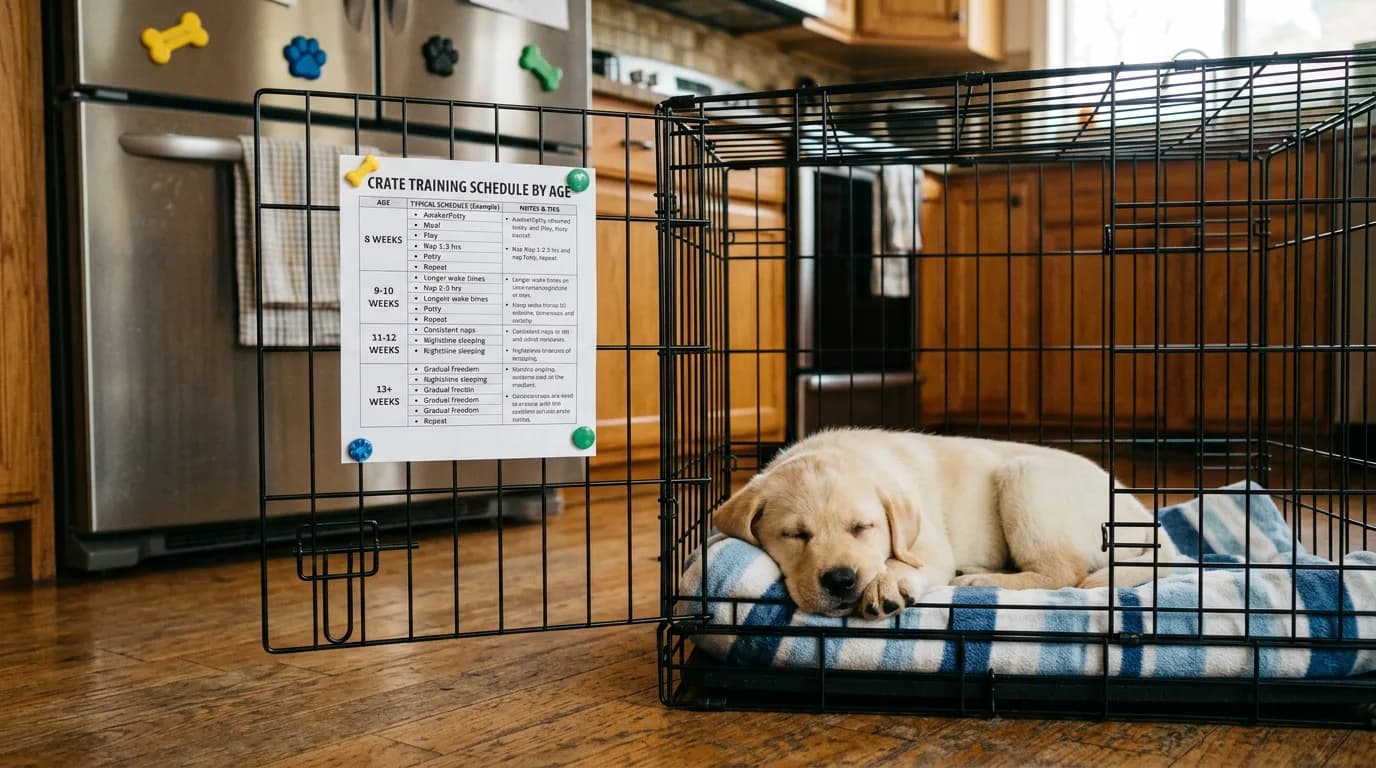
A good crate training schedule is the single fastest way to turn a chaotic new puppy into a calm, house-trained dog, and the schedule you use at 8 weeks looks nothing like the one you use at 6 months. This guide gives you a printable, by-age crate training schedule from 8 weeks through 6 months, with the exact crate-time limits, potty intervals, and nap blocks that match how a puppy's bladder and brain actually develop. Print the age band you are in, tape it to the fridge, and follow it day by day.
Puppies are not being stubborn when they cry, chew, or have accidents. They are working with a bladder that can only hold so long and a body that needs 18 to 20 hours of rest a day. When your daily rhythm respects those limits, the crate stops being a fight and becomes the place your puppy chooses to nap. When it ignores them, you get whining, accidents, and a puppy who hates the crate. The schedules below are built around the limits, not against them.
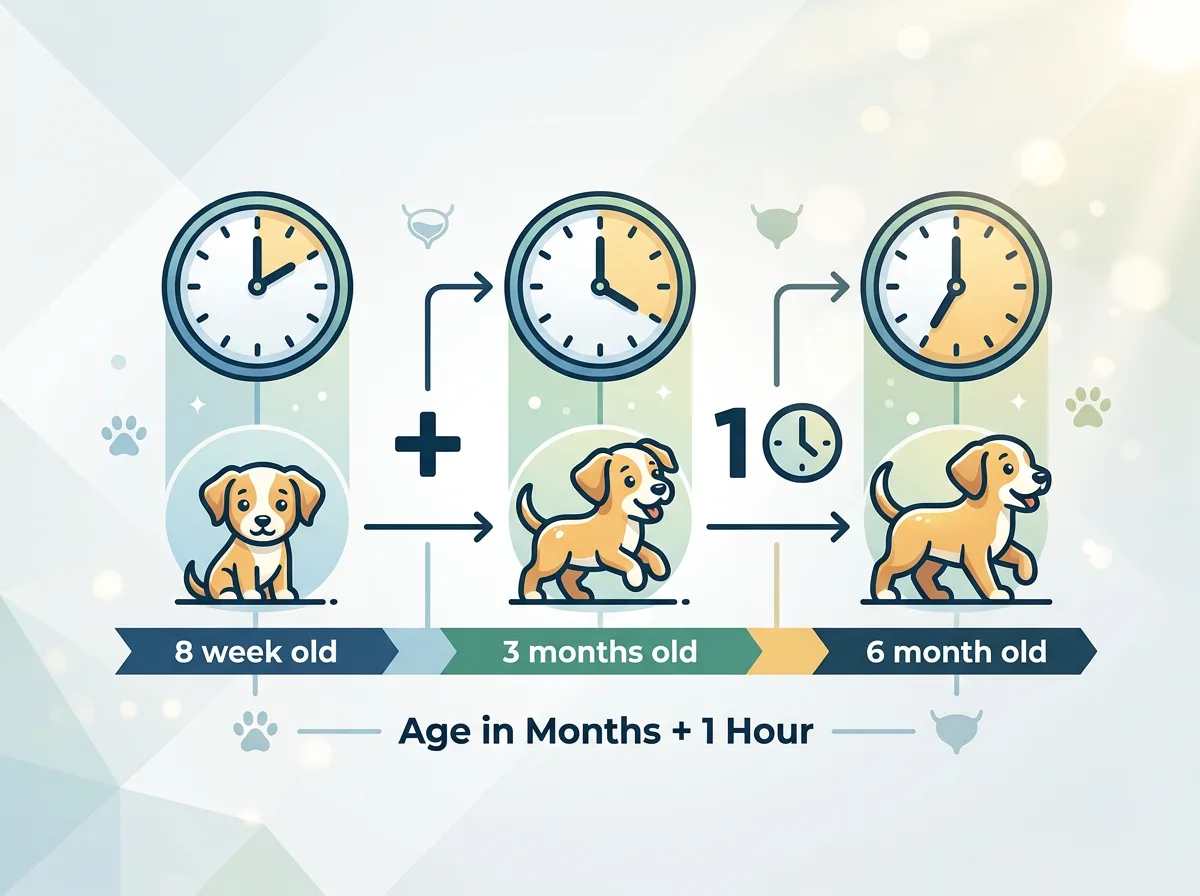
- 1A puppy can hold their bladder for roughly their age in months plus one, so an 8-week-old maxes out around 2 to 3 hours between potty breaks.
- 2The 2:1 rule (two hours in the crate for every one hour out) keeps a young puppy rested and prevents the overtired meltdowns that ruin crate training.
- 3Crate time limits stretch as the puppy grows: 30 to 60 minutes at 9 to 10 weeks, up to 4 to 6 hours past 17 weeks, per ASPCA guidance.

Sign up for expert-backed reviews and safety alerts all in one place.
How to read this by-age crate training schedule
Every puppy is an individual, so treat these as starting templates you adjust, not stopwatches. Three numbers drive the whole plan, and once you understand them the schedule builds itself.

Petful may earn a commission when you click through to Chewy, at no extra cost to you.
The bladder rule. A rough guide vets and shelters use is that a puppy can hold their bladder for about their age in months plus one hour. An 8-week-old (2 months) tops out near 2 to 3 hours; a 4-month-old near 5 hours. This is a daytime, awake-and-active estimate. Overnight, when the puppy is asleep and not drinking, they can usually hold longer.
The rest rule. Puppies need 18 to 20 hours of sleep a day. An overtired puppy does not get calm, they get frantic: more biting, more zoomies, more crying in the crate. Scheduled naps are not optional downtime, they are the load-bearing wall of the whole plan.
The crate-time limit. Separate from how long a puppy can hold their bladder is how long they should be crated at a stretch. The ASPCA publishes a clean by-age limit that this schedule follows.
| Puppy age | Max crate stretch (awake, daytime) | What it means for your schedule |
|---|---|---|
| 9 to 10 weeks | 30 to 60 minutes | Short naps only, a potty break the moment they wake |
| 11 to 14 weeks | 1 to 3 hours | Longer single naps, still frequent breaks |
| 15 to 16 weeks | 3 to 4 hours | Can bridge a school run or an errand |
| 17+ weeks | 4 to 6 hours | Approaching a workday with a mid-day break |
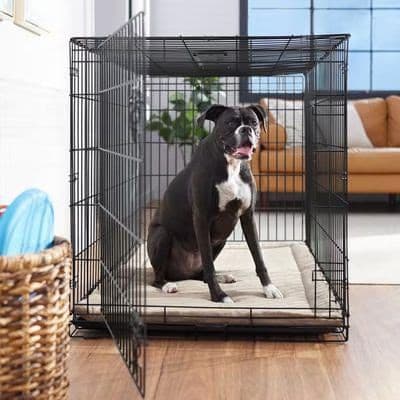
A quick note on the crate itself before we get into times. Size it so your puppy can stand up, turn around, and lie down, but no bigger. A crate the size of a studio apartment lets a puppy potty in one corner and sleep in the other, which is exactly what you are trying to prevent. Most owners buy one adult-sized crate with a divider panel and move the divider back as the puppy grows.
Petful may earn a commission when you click through to Chewy, at no extra cost to you.
Crate training schedule at 8 to 10 weeks
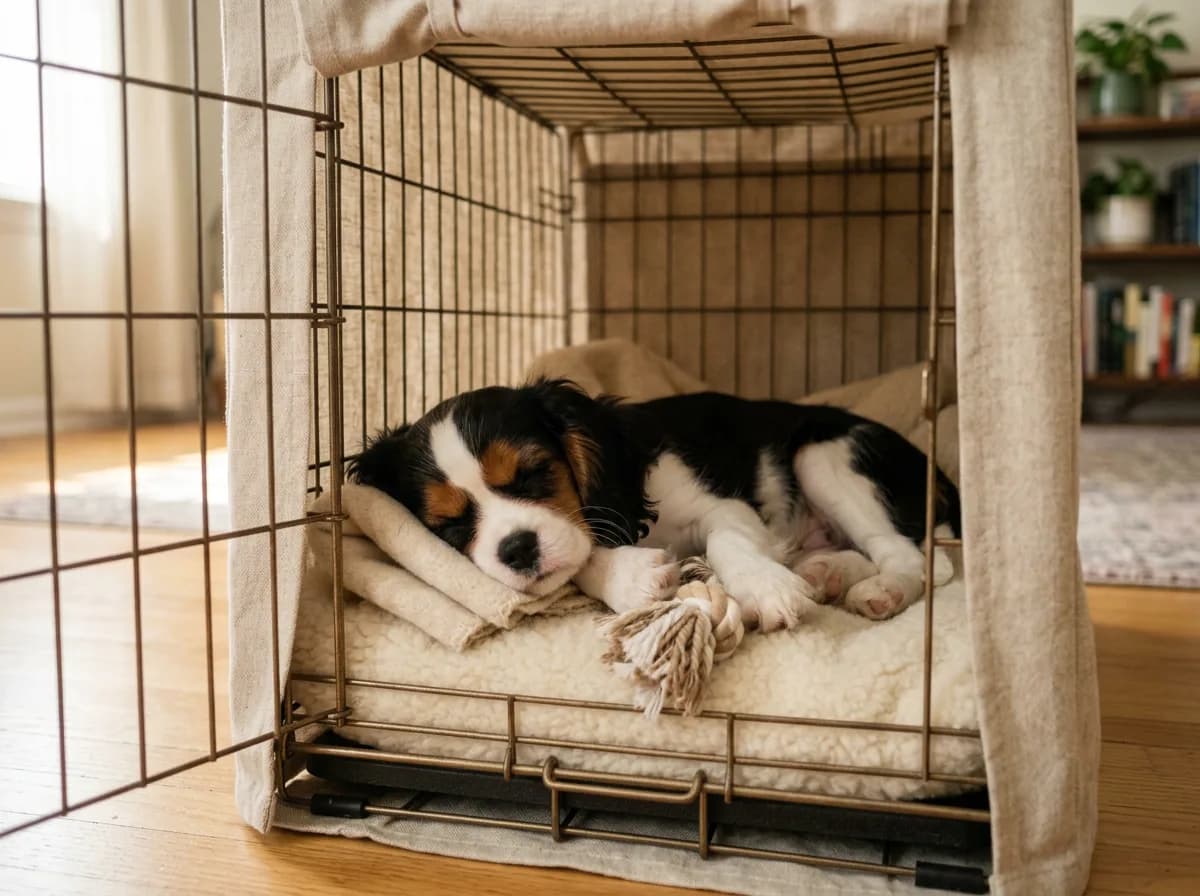
This is the hardest and most hands-on stage, and it is short. Your 8-week-old puppy sleeps most of the day, needs a potty break every 1 to 2 hours while awake, and can only be crated for 30 to 60 minutes at a stretch. Overnight you should expect one, possibly two, potty trips. The rhythm here is simple: wake, potty, a short window of play or feeding, then back to a nap in the crate before the puppy gets overtired.
| Time | Activity | Crate? |
|---|---|---|
| 6:30 AM | Wake, carry straight outside to potty | Out |
| 7:00 AM | Breakfast in or beside the crate, then a 15-min play and training window | Out |
| 7:45 AM | Potty, then nap with a stuffed chew | In (45 min) |
| 9:00 AM | Potty, supervised floor time and a short training rep | Out |
| 9:45 AM | Nap | In (45 to 60 min) |
| 12:00 PM | Potty, lunch, gentle play | Out |
| 1:00 PM | Nap | In (60 min) |
| 3:00 PM | Potty, play, socialization at a window or on a step | Out |
| 4:00 PM | Nap | In (60 min) |
| 5:30 PM | Dinner, potty, calm family time | Out |
| 7:30 PM | Potty, wind-down, last small drink | Out |
| 9:00 PM | Final potty, into the crate for the night | In |
| 2:00 AM | One overnight potty trip, then straight back to the crate | In |
Keep every crate exit calm. If you throw a party each time the door opens, you teach the puppy that crying and pawing produce a celebration. Open the door, clip the leash, walk to the potty spot, reward the pee outside, and move on.
- Most 8-week-old puppies can only stay happily awake for about 60 to 90 minutes before they tip into overtired. If your puppy suddenly gets bitey, frantic, or can't settle, that is not misbehavior, it is a nap cue. Put them in the crate before the meltdown, not after.
Crate training schedule at 10 to 12 weeks
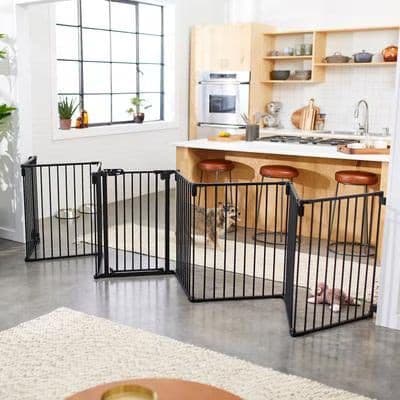
By 10 to 12 weeks your puppy can hold a little longer, nap in slightly bigger blocks, and follow a more predictable daytime rhythm. Potty breaks stretch to roughly every 2 to 3 hours while awake. Many puppies start sleeping through the night in this window, though an early-morning potty trip is still normal. This is the stage where the 2:1 rule really earns its keep: aim for about two hours in the crate for every one hour out during the working part of the day.
Petful may earn a commission when you click through to Chewy, at no extra cost to you.
| Time | Activity | Crate? |
|---|---|---|
| 6:30 AM | Wake, potty outside | Out |
| 7:00 AM | Breakfast, 20-min play and training | Out |
| 8:00 AM | Potty, then nap | In (up to 2 hr) |
| 10:00 AM | Potty, supervised play, short outing or socialization | Out |
| 11:00 AM | Nap | In (up to 2 hr) |
| 1:00 PM | Potty, lunch, play | Out |
| 2:00 PM | Nap | In (up to 2 hr) |
| 4:00 PM | Potty, walk or yard play | Out |
| 5:30 PM | Dinner, potty, family time | Out |
| 7:00 PM | Calm chew time, place training near the crate | Out |
| 9:00 PM | Final potty, bedtime in the crate | In |
At this age you can begin closing the crate door during meals and leaving it closed a little longer each day. The goal is for the closed door to become a non-event. Feed the meal inside, let the puppy finish, wait for a calm moment, then open the door.
Crate training schedule at 3 to 4 months
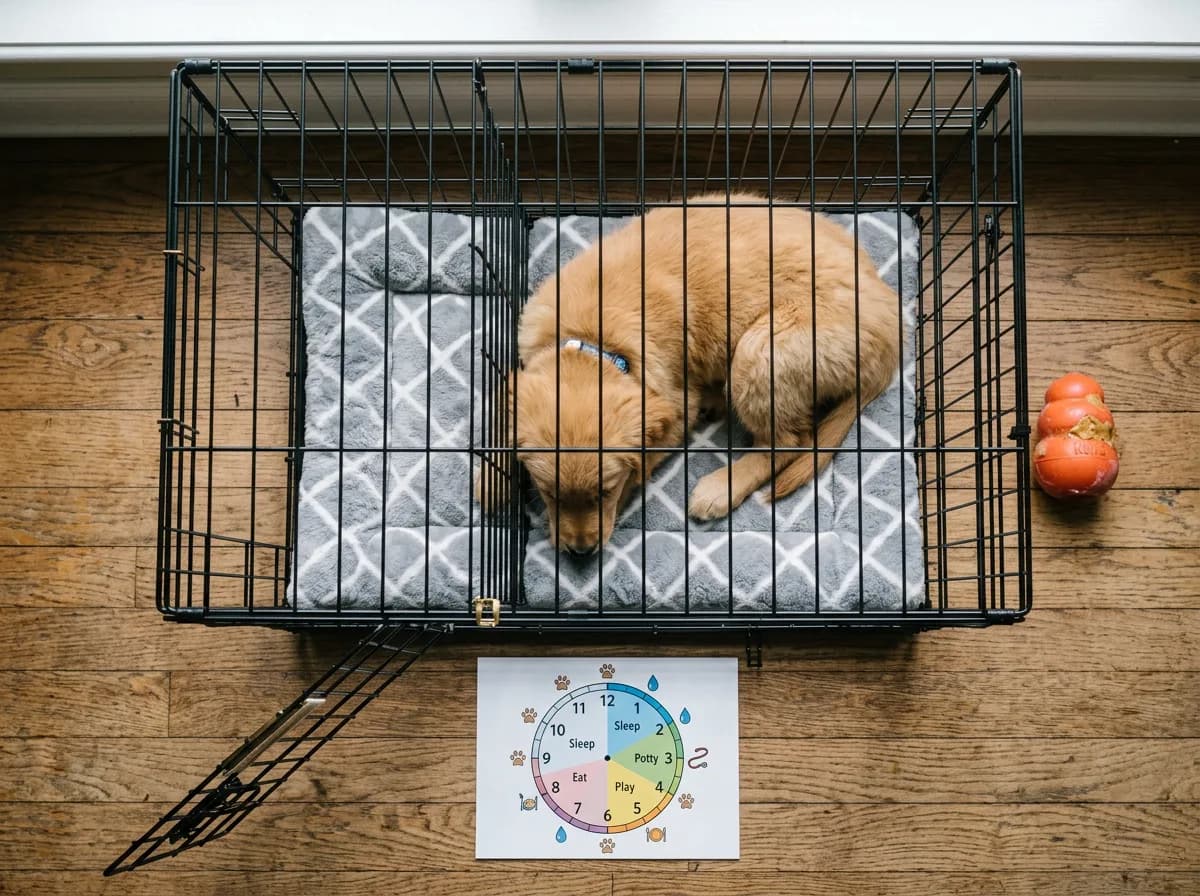
Three to four months is when the plan starts to look like a life you can actually sustain. Crate stretches reach 3 to 4 hours, most puppies are reliably sleeping through the night, and daytime potty breaks settle to roughly every 3 to 4 hours. You can now bridge a school drop-off, a grocery run, or a stretch of work-from-home focus with a single crated nap.
| Time | Activity | Crate? |
|---|---|---|
| 6:30 AM | Wake, potty | Out |
| 7:00 AM | Breakfast, training, play | Out |
| 8:00 AM | Potty, crated nap or work block | In (3 to 4 hr) |
| 11:30 AM | Potty, lunch, walk | Out |
| 12:30 PM | Crated nap or outing in the crate | In (3 hr) |
| 3:30 PM | Potty, exercise, enrichment | Out |
| 5:30 PM | Dinner, potty | Out |
| 6:30 PM | Calm evening, chew, light training | Out |
| 9:30 PM | Final potty, bedtime | In |
Teething peaks around now, so the crate should always contain a legal, satisfying chew. A frozen stuffed rubber toy does double duty: it soothes sore gums and gives the puppy a reason to love crate time. This is also the age to layer in short absences. Leave the house for five minutes, then fifteen, then thirty, so alone-time in the crate never becomes a shock.

Multiple ridges and valleys slow eating, reduce gas and bloating, and turn mealtime into a fun puzzle. Non-skid base, dishwasher safe, 4-cup capacity.
Petful may earn a commission when you click through to Chewy, at no extra cost to you.
Crate training schedule at 4 to 6 months
By 4 to 6 months you are approaching an adult-style routine. A puppy past 17 weeks can typically manage 4 to 6 hours in the crate, which means a real workday becomes possible with a mid-day break from you, a neighbor, or a dog walker. Potty breaks stretch to every 4 to 6 hours for many puppies, though a growing bladder is not a license to skip breaks entirely.
| Time | Activity | Crate? |
|---|---|---|
| 6:30 AM | Wake, potty, brisk walk | Out |
| 7:00 AM | Breakfast, quick training | Out |
| 7:45 AM | Potty, into the crate before you leave | In (up to 4 to 5 hr) |
| 12:00 PM | Mid-day potty and play break (you, a walker, or a neighbor) | Out |
| 12:45 PM | Back into the crate | In (up to 4 hr) |
| 5:00 PM | Home, potty, decompression walk | Out |
| 6:00 PM | Dinner, potty | Out |
| 7:00 PM | Training, play, calm chew time | Out |
| 10:00 PM | Final potty, bedtime | In |
This is the stage to start testing short stretches of freedom. Leave the crate door open during a nap and see whether your puppy chooses it. Give them access to one puppy-proofed room while you are home and watching. Crate training does not end with a slammed door forever, it ends with a dog who is trustworthy loose and still treats the crate as their den.

Clinically tested vet-formulated chews with a colostrum calming complex, L-theanine, and thiamine to quickly ease everyday stress, thunderstorms, and anxiety.
Petful may earn a commission when you click through to Chewy, at no extra cost to you.
- Between 8 weeks and 6 months your puppy is racking up vaccine dates, deworming rounds, and training milestones. A digital pet profile like the one at [MyPetID](https://mypetid.ai) keeps the puppy's vaccine schedule and training records in one place, so your vet, boarding facility, or a future dog walker can see them at a glance instead of you digging through paperwork.
The rules behind the schedule
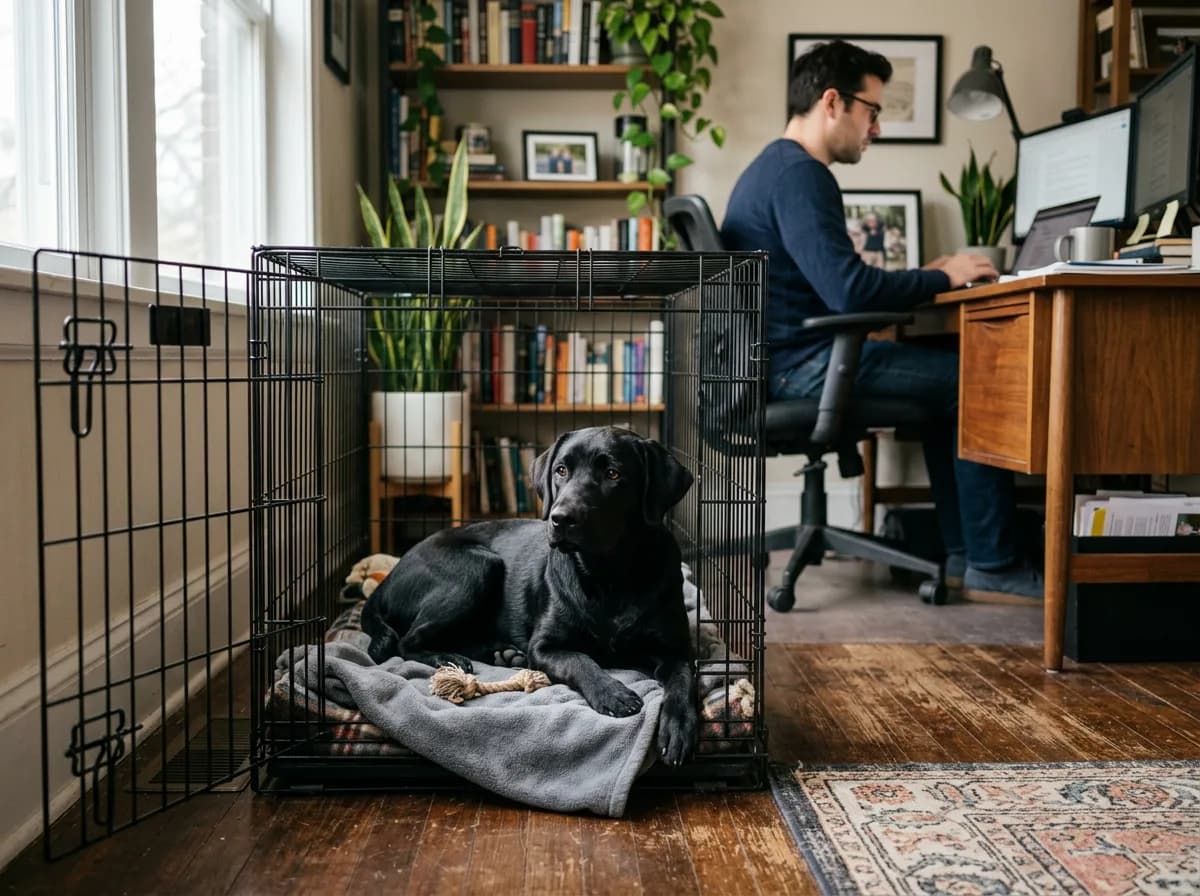
The times above only work if the habits behind them are right. Four principles do most of the heavy lifting.
Never use the crate as punishment. The crate has to stay a good place. If you banish the puppy there after an accident, you poison the one tool that prevents accidents. Every trip into the crate should come with a chew, a treat, or a meal, per AKC crate training guidance.
Feed meals in the crate. Nothing builds a positive crate association faster than dinner. Once your puppy walks in happily to eat, you can start closing the door while they finish.
Reward the walk-in, ignore the fuss. Toss a treat in and let the puppy choose to enter. When they whine, wait for even a two-second pause before you open the door, so the lesson is "quiet opens the door," not "crying opens the door."
Match the schedule to potty training. The crate is your best house-training partner because puppies avoid soiling where they sleep. Right after every crate exit, go straight outside. Our guide to potty training a puppy walks through the outdoor half of this routine, and you can find more step-by-steps in the Petful behaviors library.
- Constant water access late in the evening sets a young puppy up for an overnight accident. Offer a small drink at the last potty break, then pick up the bowl. This is about setting the schedule up to succeed, not restricting a thirsty puppy during the day.
Common crate training mistakes to avoid
Most crate training problems trace back to a handful of avoidable errors. Skipping naps until the puppy is overtired, then wondering why they scream in the crate. Buying a crate so large the puppy can potty in one end. Rushing the timeline and leaving an 8-week-old crated for four hours because an older dog could handle it. Opening the door mid-cry, which teaches the puppy that noise works. And using the crate as a time-out after an accident, which turns the den into a punishment box.
- 1Overtired, not stubborn, is the usual reason a puppy melts down in the crate, so protect the naps.
- 2Right-size the crate with a divider so it stays a den, not a bathroom.
- 3Wait for a pause in the crying before you open the door, every single time.
Frequently asked questions
Adjust the schedule for your puppy's size and breed
Age is the main driver of this plan, but body size and breed shift the fine print. Small and toy breeds carry tiny bladders and are famously slower to gain full control, so trim time off every interval and add an extra potty break, especially overnight.
- Toy and small breeds (Chihuahuas, Yorkies, Dachshunds): shorter potty intervals, one more overnight trip than the age band suggests.
- Large and giant breeds: often hold longer at the same age, but growing joints do not thank you for hours of crate stillness, so favor more frequent movement over marathon naps.
- High-drive working breeds (Border Collies, Huskies, Malinois): settle only after their brains are tired, so front-load each out-of-crate window with training and enrichment, not just a walk.
- Start at the 8-to-10-week routine no matter their age, then advance a band every few days as they prove they can hold longer and settle quietly. A puppy who never learned the crate needs the foundation first, not the timeline for their calendar age.
When crate crying is more than protest
Most crate crying is ordinary protest that fades once the schedule stays consistent. A few patterns are not, and they call for a professional rather than a tougher door. Watch for a puppy who panics the moment you leave the room, drools heavily, injures paws or teeth trying to escape, or soils the crate despite an empty bladder and a right-sized den. Those can signal separation anxiety, which worsens with forced isolation and needs a veterinarian or a certified behaviorist, not more crate time. Also call your vet if a previously reliable puppy suddenly cannot hold their bladder, because a urinary tract infection, not a training gap, may be the real cause.
Related on Petful
- Crate Training a Puppy: A Day-by-Day Plan
- Crate Training a Puppy at Night: Survive Night One
- How to Crate Train an Adult Dog
- Puppy Training 101: A Week-by-Week Guide
There is no single number, because a puppy is crated in short blocks across the day, not one long session. Use the age-based limits: 30 to 60 minutes at 9 to 10 weeks, 1 to 3 hours at 11 to 14 weeks, 3 to 4 hours at 15 to 16 weeks, and 4 to 6 hours past 17 weeks, per the ASPCA. Total crated time (including overnight sleep) can be most of the day for a young puppy who needs 18 to 20 hours of rest, but it should be broken up with frequent potty and play breaks, never one unbroken stretch.
The 2:1 rule says that for every two hours a puppy spends in the crate, they get about one hour of supervised time out of it. It is a rhythm, not a law: it keeps a young, growing puppy well rested and prevents the overtired state that fuels whining and accidents. As the puppy matures and can hold longer, the ratio naturally relaxes.
Not entirely. First rule out a real need: a 9-week-old often genuinely has to potty, especially overnight, so take them out calmly to the potty spot and straight back. If the puppy is fed, empty, and simply protesting, wait for a brief pause in the crying before you open the door, so they do not learn that noise gets them out. Never respond to crying with play or a party, and never let a puppy scream for an hour, which only builds fear of the crate.
The 10:1 rule is a play-to-crate guideline some trainers use: for roughly every 10 minutes of active engagement, play, or training you give your puppy, they are better able to settle for a crated rest. It is a reminder that crate calm is earned by meeting the puppy's needs first: a puppy who has been exercised, fed, and toileted settles far more easily than one crated out of the blue. Treat it as a nudge to fill the tank before the door closes, not a rigid formula.
The big ones are letting the puppy get overtired before a nap, buying a crate too large so the puppy can soil one end, crating a young puppy longer than their age allows, opening the door while the puppy is crying, and using the crate as punishment after an accident. Each one either breaks the potty-training logic or teaches the puppy that the crate is a bad place.
There is no fixed age. Most dogs are ready for gradual freedom somewhere between 6 months and 18 months, once they are reliably house-trained and no longer destructive when loose. Start by leaving the crate door open during naps, then allow access to one puppy-proofed room while you supervise, and expand from there. Many owners keep the crate available for life as an optional den, because a well-trained dog often still chooses it.
Dogs show affection through body language, not words: soft relaxed eyes, a loose wagging tail, leaning into you, gentle licking, and bringing you a toy. In the crate context, a puppy who walks in willingly, settles with a sigh, and sleeps deeply is telling you they feel safe with you. That trust is exactly what a good crate training schedule is designed to build.
Print it and stick to it
The whole point of a by-age crate training schedule is to stop guessing. Find the age band your puppy is in, follow the sample day, and adjust the exact clock times to your household. The crate stretches will grow on their own as the puppy matures, so your job is simply to protect the naps, keep the potty breaks frequent, and never let the crate become a place your puppy dreads. Do that from 8 weeks to 6 months and you will end up with the thing every owner wants: a calm, house-trained dog who treats the crate as home base.

Coreen Saito is a pet writer and longtime shelter volunteer with more than a decade in animal rescue. She covers cat behavior, breed care, and the small, ordinary science of sharing a life with companion animals, with a particular focus on honest takes about the products and decisions that actually matter. At home in Arizona, she's outranked by Mac (a dog with the loudest opinion in the house), Rebel (a cat who governs by quiet authority), and Meri (an orange tabby who runs the late shift and the laundry basket). She writes about all three, plus the rescues that keep coming through her life, at LifeWithMinty.com.
Sign up for expert-backed reviews and safety alerts all in one place.