Invisible Fence Training: Teach Your Dog a GPS Boundary in 2 Weeks
A complete 14-day invisible fence training plan built on tone, treats, and a long line, with a day-by-day calendar, collar fit and battery guidance, distraction proofing, and an honest look at which dogs are poor candidates.
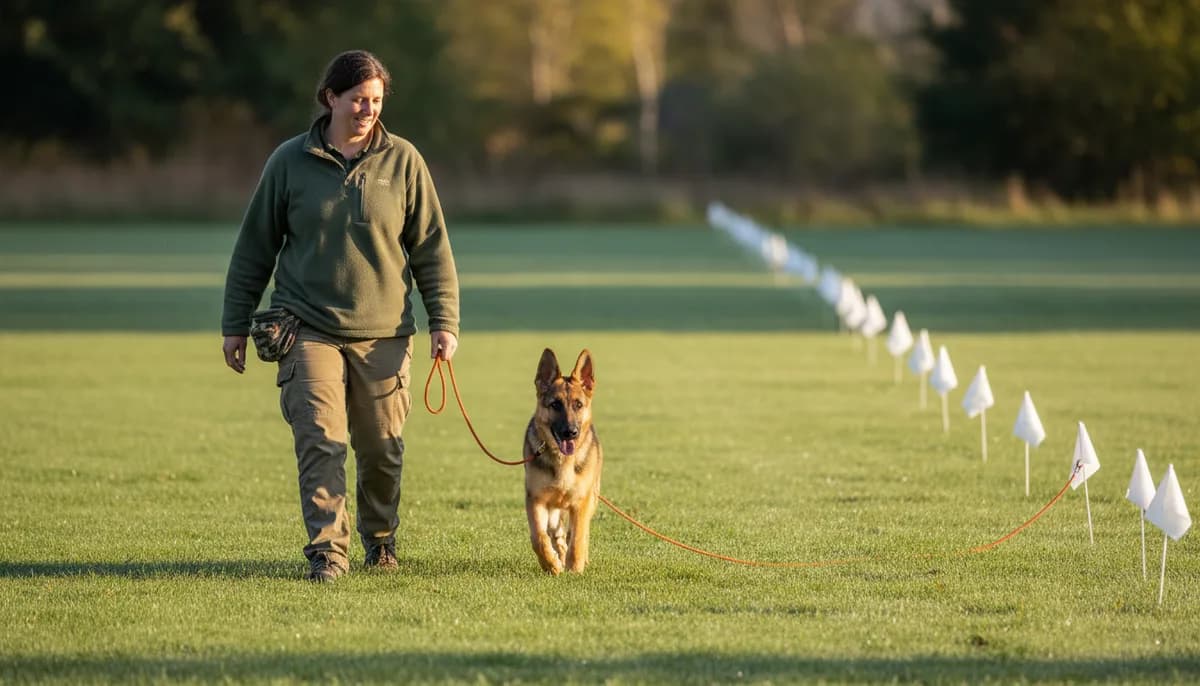
Invisible fence training is the step most owners underestimate. The hardware arrives, the app pairs in a few minutes, and then the dog stands in the middle of the yard with no idea that a line exists at all. A boundary is not a fence to your dog until somebody teaches it, and teaching it takes about two weeks of short positive sessions rather than one frustrating weekend of trial and error.
The reassuring part is how small the actual workload is. Run two short sessions a day at ten minutes each for fourteen days and your total training time comes to 280 minutes, which is 4 hours and 40 minutes. That is under five hours spread across two weeks, and almost all of it happens in your own yard while you are already outside with your dog.
The method below is tone first, treat heavy, and long line backed, which means your dog learns where the edge is by being rewarded for turning away from it, not by being startled into it.
- 1Plan on 14 days, two ten minute sessions per day, roughly 4 hours 40 minutes of total training time.
- 2Teach the boundary with tone and treats on a long training line before any correction level is ever introduced.
- 3Keep daily collar wear to 8 to 12 hours and rotate the collar position to protect the skin.
- 4Flags are a temporary visual aid, not the lesson: the dog is learning that the warning tone means turn back, so thin the flags gradually once that response is fluent.
- 5Check fit before you buy: the SpotOn collar fits necks of 10 inches or larger, usually a dog of about 25 pounds and up, and no containment system suits every dog.
We recommend SpotOn for this plan because the training sequence depends on a clean, predictable warning zone. You can set up a SpotOn GPS fence and check the current partner pricing here before day one, so the boundary is mapped and the flags are already up when training starts. Petful is compensated when readers buy through that link, and this article is sponsored by SpotOn, but the training protocol below is the same one we would teach on any brand of system.
Check Price on SpotOn Exclusive - $75 Off
Sign up for expert-backed reviews and safety alerts all in one place.
The 2-Week Invisible Fence Training Plan, Day by Day
Invisible fence training takes about two weeks for a typical adult dog with normal focus and a reasonable recall. That is the honest answer to how long invisible fence training takes, and it is a schedule, not a guess:
- fourteen consecutive days
- two short sessions a day
- ten minutes per session
Held to that structure, the total training time comes to 280 minutes, which is where the two week estimate actually comes from rather than from a rule of thumb. Some dogs are reliable on day ten. A few need a third week of proofing. Almost none need a month, and any program that tells you to expect months is either training in hour-long marathons or skipping the long line that makes the early phase safe.
Almost every guide to how to train a dog on an invisible fence agrees on the phases, but very few of them publish actual dates, and that is the gap this calendar fills.
What follows is a dated, phase by phase training calendar a reader can actually follow, with a numbered day attached to every step instead of a vague sequence of stages. Invisible fence training for dogs works best when the owner:
- can see the whole arc at once
- knows which day sits where
- checks off a written standard instead of guessing whether the dog is ready to move on
The whole method runs tone first, and the technique underneath it is positive reinforcement. In practice that means you mark the exact moment your dog chooses to turn away from the boundary, with a cheerful word or a clicker, and you pay for that choice immediately, rather than waiting for a mistake and correcting it. Your dog hears a warning tone, learns that the tone predicts a reward for turning back toward the house, and repeats that turn several hundred times over two weeks until it is automatic. Static correction is not the teaching tool here. It is a backstop that most well-trained dogs on a well-mapped boundary rarely encounter, and it never gets introduced before the tone response is already fluent.
It is worth saying plainly that the flags you will plant in phase two are scaffolding for this process, not the process itself: dogs learn boundaries through consistent training and consistent feedback from the collar, and the long-term goal is a dog who responds to the warning cue whether or not a single flag is still standing.
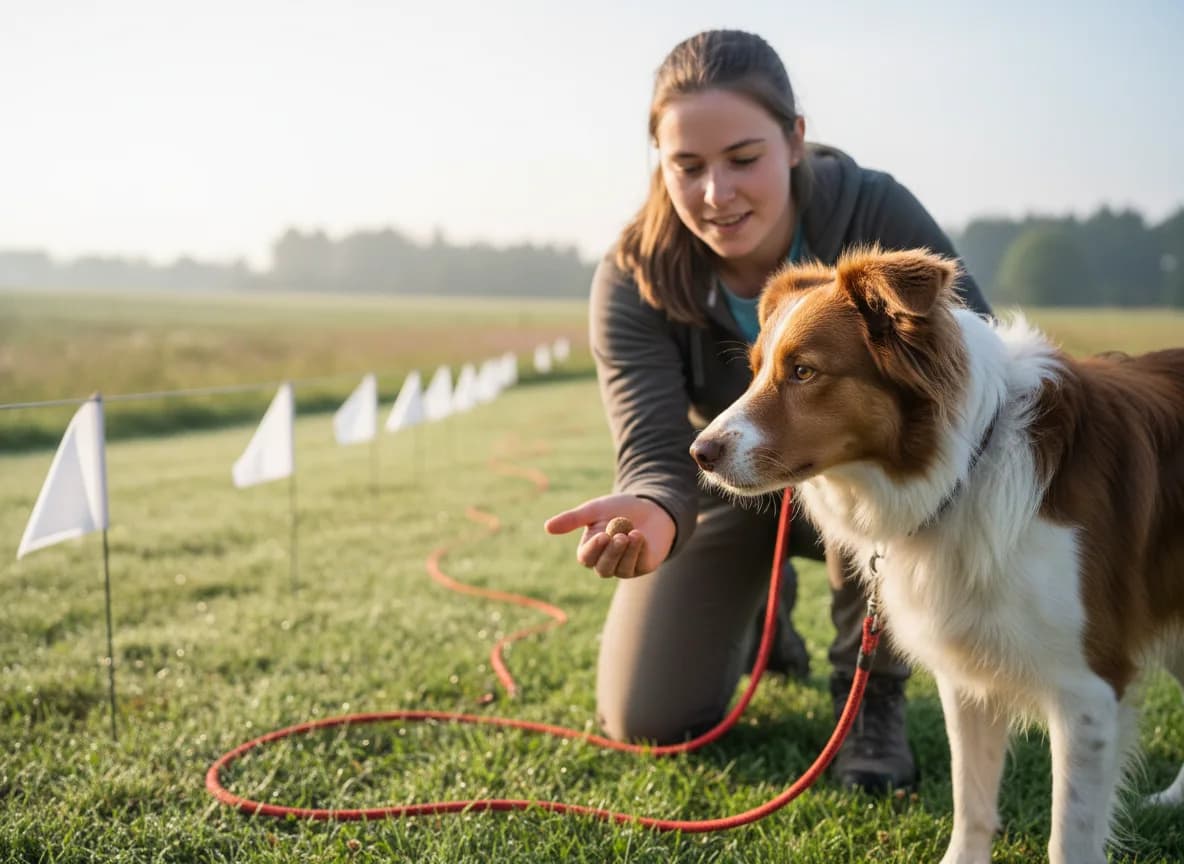
The five phases inside the fourteen days
- Days 1 to 2, collar acclimation. The system stays off. The dog simply wears the receiver collar during meals, play, and walks so it becomes furniture rather than an event.
- Days 3 to 4, flag and tone introduction. The dog walks the flag line on a long line, hears the tone, and is immediately lured back toward the center of the yard and paid.
- Days 5 to 7, boundary pressure with the line. You add gentle temptation toward the boundary while the long line guarantees the dog cannot cross it.
- Days 8 to 10, distraction proofing. Helpers, balls, and a second dog appear beyond the line so the boundary holds under real conditions.
- Days 11 to 14, supervised freedom. The line drags, then comes off, and the flags start thinning while you stay outside with the dog.
Each phase has a pass criterion, and that is the part that separates this plan from generic advice. The rule is simple: your dog has to hit the written standard twice, in two separate sessions, before you advance to the next phase. You do not move on because the calendar says day five, and there is no penalty for repeating a day.
| Day | Phase | Sessions | Where | Distraction | Pass Criterion |
|---|---|---|---|---|---|
| Day 1 | Collar acclimation | 2 x 10 min | Indoors, system off | None | Dog wears the receiver calmly for a full session |
| Day 2 | Collar acclimation | 2 x 10 min | Indoors and yard, system off | None | Dog ignores the collar during play and meals |
| Day 3 | Flag and tone intro | 2 x 10 min | Yard center to flag line, long line on | None | Dog turns back toward you on tone within two seconds |
| Day 4 | Flag and tone intro | 2 x 10 min | All four sides of the flag line | None | Three clean turns per side with no hesitation |
| Day 5 | Boundary pressure | 2 x 10 min | Flag line on a 20 foot long line | Low | Dog retreats from the warning zone without a leash cue |
| Day 6 | Boundary pressure | 2 x 10 min | Flag line, handler stepping past the edge | Low | Dog holds the boundary while you cross it |
| Day 7 | Boundary pressure | 2 x 10 min | Full perimeter loop | Low | Dog self interrupts at every flag on the loop |
| Day 8 | Distraction proofing | 2 x 10 min | Flag line, helper walking past outside | Medium | Dog turns on tone with the helper visible |
| Day 9 | Distraction proofing | 2 x 10 min | Flag line, ball rolled beyond the edge | Medium | Dog leaves the ball and returns to you |
| Day 10 | Distraction proofing | 2 x 10 min | Flag line, friendly dog beyond the edge | High | Dog holds the line with another dog in view |
| Day 11 | Supervised freedom | 2 x 10 min | Yard, long line dragging | Medium | No line contact needed for a full session |
| Day 12 | Supervised freedom | 2 x 10 min | Yard, line dragging, half the flags pulled | Medium | Dog holds the boundary with fewer flags |
| Day 13 | Supervised freedom | 2 x 10 min | Yard, off line, handler present | High | Dog ignores a planned distraction off leash |
| Day 14 | Graduation check | 2 x 10 min | Full perimeter, flags thinned | High | Two clean sessions with no boundary test |
What the first training day actually looks like
The first training day is deliberately boring. Buckle the receiver collar on, feed a handful of treats, play a normal game, and take the collar off after ten minutes. Repeat in the afternoon. Nothing beeps, nothing corrects, and your dog learns only that this new object is unremarkable. Owners who skip acclimation create a dog that associates the collar itself with confusion, which then contaminates every session that follows.
From day three onward, every session follows the same four beat rhythm, and it is worth memorizing because you will run it roughly fifty times:
- Walk the dog on a long line from the center of the yard toward a flag.
- Let the collar tone sound on its own, without saying anything.
- Call cheerfully, turn, and jog back toward the house together.
- Pay with three or four small high value treats the instant the dog commits to the turn.
You never drag the dog back and you never scold at the boundary. The tone should feel like a starting pistol for a fun retreat, not a scolding. Dogs that get corrected verbally at the flag line often begin avoiding the whole yard, and untangling that avoidance costs more days than the original training would have.
- Ten minutes is a ceiling, not a target. If your dog nails three clean turns in four minutes, stop there and bank the win rather than drilling until the dog gets bored.
Why the total time is smaller than owners expect
The arithmetic is worth doing out loud. Two sessions a day at ten minutes each is twenty minutes daily, twenty minutes multiplied by fourteen days is 280 minutes, and 280 minutes is 4 hours and 40 minutes. That is the total training time in minutes across the two weeks, so the effort is a known number before you start rather than an open commitment of unclear size.
Written as a weekly figure it is roughly 140 minutes per week, less than most people spend on a single Saturday morning dog park trip, and splitting the total training time into ten minute sessions is also what makes it stick, because dogs consolidate boundary learning far better in frequent short reps than in occasional long ones.
That arithmetic matters commercially as well as practically. The most common objection to a GPS or invisible fence is not the price, it is the imagined training burden, and a system like the SpotOn GPS fence with its walk-the-perimeter boundary setup removes the wire-burying weekend that used to sit on top of those 280 minutes.
Check Price on SpotOn Exclusive - $75 OffCollar Fit and Settings: Getting the Contact Points Right
Most invisible fence training failures are not training failures at all. They are fit failures. An invisible fence collar that sits loose on the neck rotates as the dog moves, the contact points lose skin contact, and the dog experiences an inconsistent signal that teaches nothing. The single highest leverage thing you can do in week one is get the invisible fence collar for dogs fitted correctly and then check it every single morning.
The standard is the two finger rule at the throat. The receiver sits high on the neck, just below the jaw line, with the contact points pointing down into the skin. You should be able to slide two fingers snugly between the strap and the neck, and no more. If the collar slides freely around the neck when you rotate it with one hand, it is too loose.
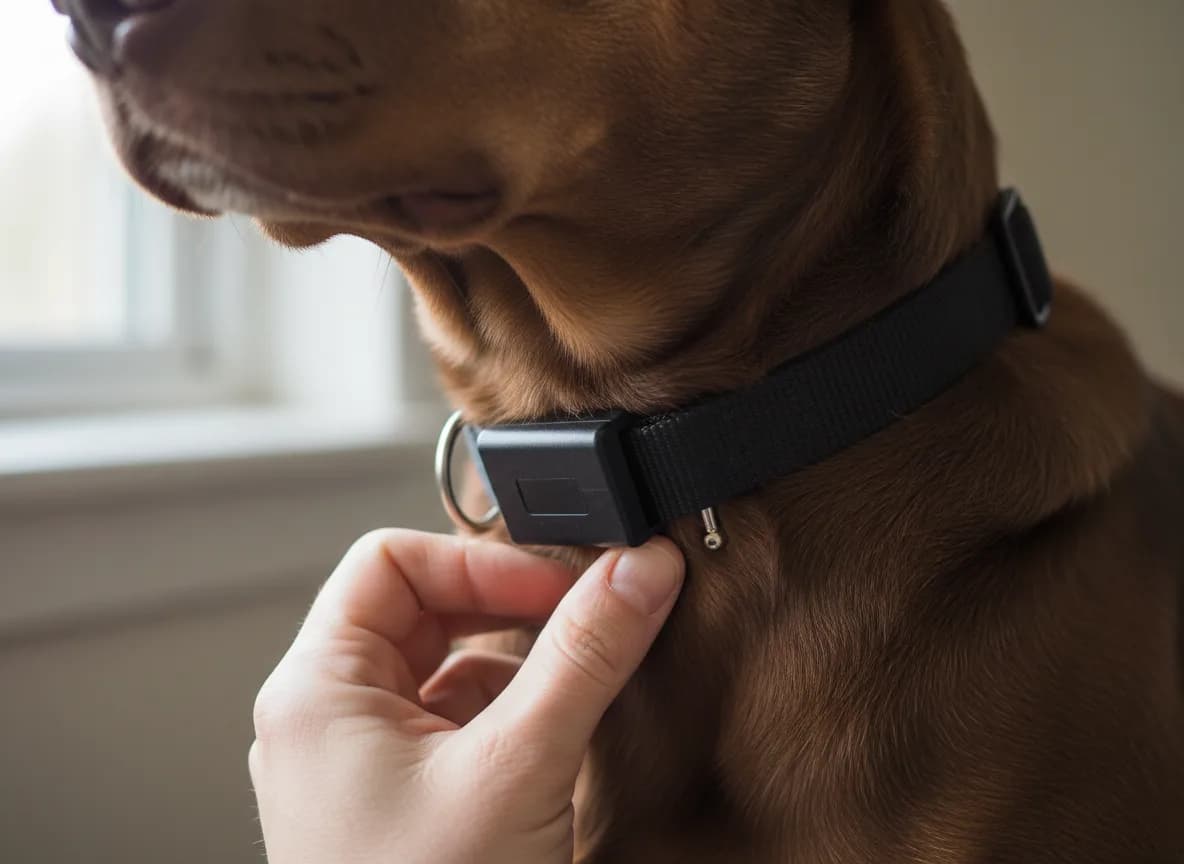
Fit checks that take thirty seconds
- Fit the collar with the dog standing, not sitting, because a sitting dog's neck skin bunches and gives a false reading.
- Confirm both contact points touch skin, not just fur, by parting the coat with your fingers.
- Choose contact point length by coat, not by dog size: short points for smooth coats, long points for double coats and thick ruffs.
- Measure the neck before you order a strap, high up where the receiver will sit, because collar sizes are sold by neck circumference rather than by the dog's weight.
- Check the neck under the points every morning for redness before you start the day's sessions.
- Rotate the collar position an inch or two in each direction between wears so the same two spots never carry pressure all day.
Daily wear should be capped. Eight to twelve hours is the commonly cited safe window for any invisible fence collar receiver, and staying at the lower end during the training weeks is smart because the collar is on during your most active outdoor time.
Treat those daily wear limits as a rule rather than a suggestion, and pair them with rotating the collar position between wears, which is how you avoid concentrating pressure on one patch of skin for an entire day. Overnight wear is never necessary and is the single most common cause of pressure sores, which are compression injuries from a snug collar left on too long rather than burns from the contact points.
- If you see redness, bare skin, or a scab under either contact point, take the collar off entirely, rotate to the other side once it heals, and call your veterinarian if the area is open or weeping. Pause boundary sessions until the skin is clean.
Settings: start lower than you think
Every modern system has a range of warning and correction levels. The order of operations is the same regardless of brand.
Start with tone only for the first several days. If your system offers vibration, that becomes the second step, and many dogs never need anything past it. Only after the dog is fluently turning on tone does a low static level come into play at all, and it should be set at the lowest setting the dog notices at all, which is usually an ear flick or a head turn rather than a yelp.
A dog that yelps, tucks, or freezes is telling you the level is too high, and continuing at that level does real damage to the dog's confidence in your yard. One of the practical reasons we point readers toward SpotOn's GPS collar system for this training method is that you can set the perimeter by drawing it in the app or by walking it yourself, so the line you flag on day three is the line you defined rather than one the hardware handed you.
| What You See | Likely Cause | The Fix |
|---|---|---|
| Dog never reacts to the tone or contact | Collar too loose or coat too thick | Tighten to two finger snugness and switch to longer contact points |
| Redness or a bald patch under a point | Collar worn too long in one position | Remove for the day, rotate position, cap wear at 8 to 12 hours |
| Dog reacts in some corners but not others | Receiver rotating around the neck during movement | Refit high on the throat and recheck snugness mid session |
| Dog scratches or paws at the collar | Contact points too long for a smooth coat | Switch to short points and repeat two days of acclimation |
| Collar warns well inside the yard | Flags were planted inside the warning zone during setup | Walk the line on foot, then move the flags to where the tone actually starts |
Where Flags Go and When to Take Them Down
Be clear with yourself about what the flags are before you plant one: a temporary visual reference for the first weeks, not the thing your dog is actually learning. What your dog is learning is the warning cue, and that the cue means turn back.
The flags simply give a young boundary lesson something visible to hang on while that association forms, which is also why the flag line matters more with an in-ground wired fence, where the wire never moves, than with a GPS system, where the collar's consistent tone is the real teacher. During the early sessions they still earn their keep, so place them close enough that the dog can always see the next two flags from wherever it is standing along the perimeter.
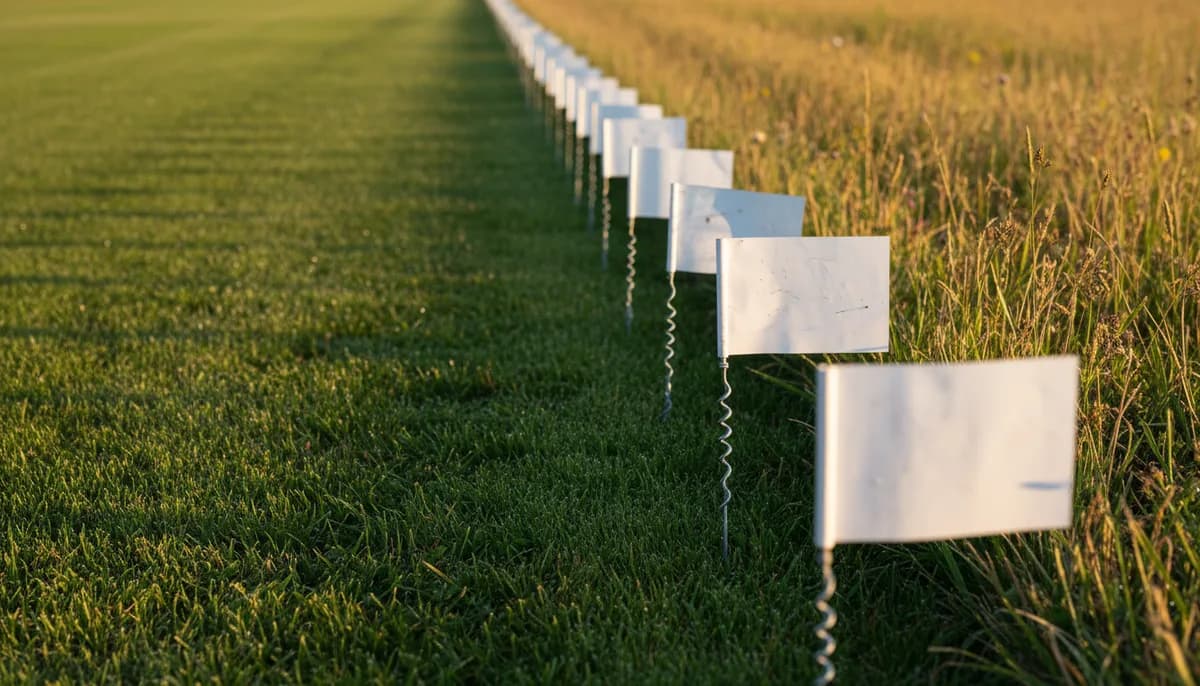
Flag placement rules that hold up in real yards
- Space flags roughly 8 to 10 feet apart along the entire boundary, tightening to 5 or 6 feet on curves and corners.
- Set the flag line exactly where the warning tone begins, not where the boundary itself sits, so the visual cue and the audible cue fire together.
- Add extra flags at the two or three spots your dog already targets, usually the driveway, the gate, and the sight line toward the neighbor's dog.
- Keep the flags in a straight, obvious line rather than a scattered field, because dogs read a line as a wall and read scatter as noise.
- Walk the flag line yourself on foot before session one and confirm the tone fires at the flags, not five feet past them.
Flags come down slowly, and the schedule for taking them down deserves as much thought as the original flag placement.
- On day twelve, pull every second flag.
- On day fourteen, pull every second one again so a sparse ring remains.
- Then leave that sparse ring standing for another two to three weeks of normal yard life before you remove the last flags.
Removing every flag the moment the calendar hits day fourteen is the most common cause of a dog testing a boundary in week four, because the dog was still leaning on the visual cue that you just deleted overnight.
- Anytime the boundary changes, the yard gets a new gate, or your dog blows through the line once, put twenty flags back up for a week and rerun days five through seven. Re-teaching a known boundary is fast. Repairing a broken one from scratch is not.
Proofing Against Real Distractions
A dog that holds a boundary in an empty yard on a Tuesday morning has learned almost nothing about the boundary that matters. Real containment is tested by the UPS truck, the rabbit, the neighbor's kids, and the loose dog trotting down the sidewalk. Days eight through ten exist entirely to build that reliability under pressure, and skipping them is how owners end up with a dog that "knows the fence" right up until the moment it does not.
Proofing means you manufacture the distraction on purpose, while the long line is still attached, so the first hard test happens on your terms instead of by accident. The whole point is to meet real distractions on a leash before trusting your dog with off leash freedom in the yard, because a boundary that has only ever held in silence has not actually been tested.
Every rung of the ladder below is run with the leash or the long line still clipped on, and it stays clipped on until the dog is winning that argument without any help from you.
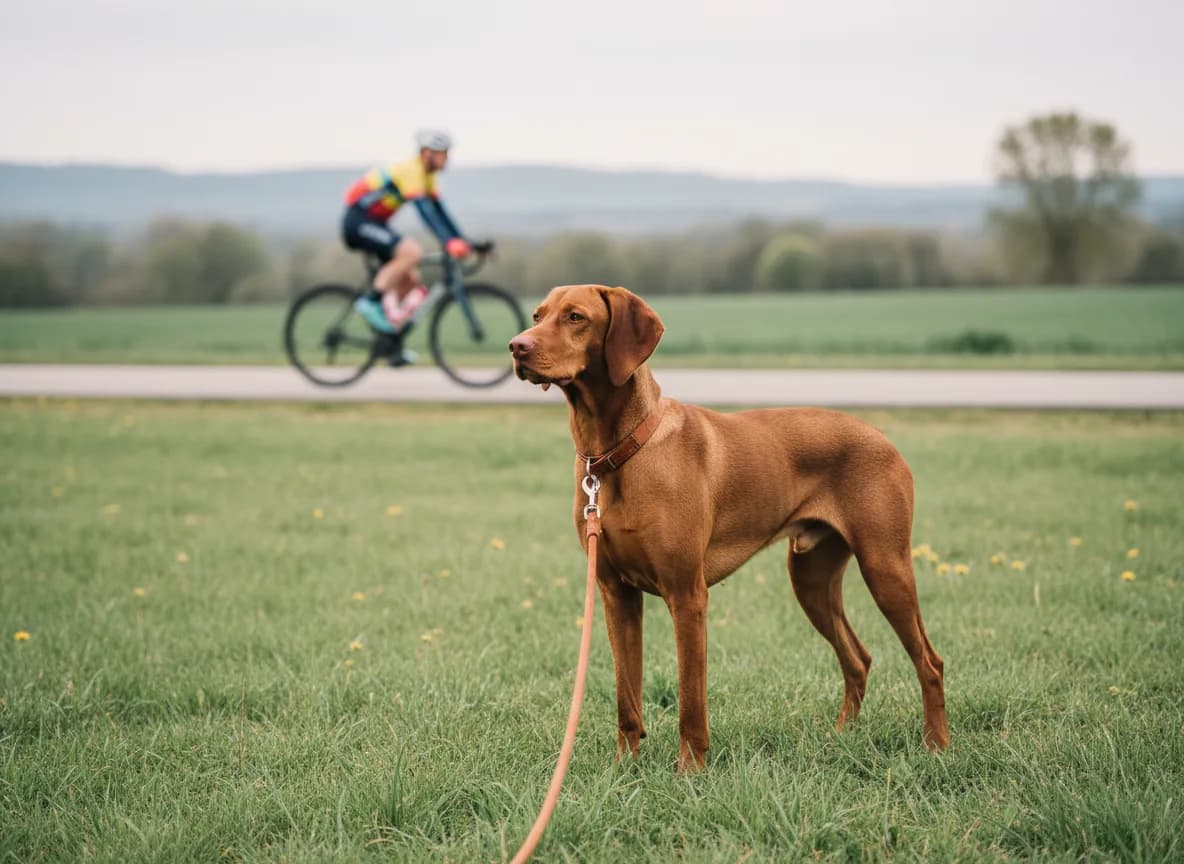
The distraction ladder
- A person walking past on the sidewalk. Neutral, predictable, and boring enough for a first rep.
- A person walking past who calls the dog's name. Adds social pull without adding motion.
- A ball or frisbee rolled slowly across the boundary. This is the first genuine motion test.
- A helper with a calm, familiar dog outside the line. Social pull plus motion together.
- A helper jogging past with a dog on leash. The closest safe simulation of the real event.
Run each rung twice, and only move up when the dog turns back on tone without you saying a word. If the dog fails a rung, drop back one level rather than repeating the failure, and shorten the session. Two clean reps at an easier level rebuild more reliability than six sloppy reps at a hard one.
Once the dog holds the line through a jogging dog, you can start the supervised freedom phase.
- Even then, stay outside with your dog for the first several unsupervised-looking sessions, because a boundary that has never been tested while you are indoors has not really been tested at all.
If your dog is one of the ones that keeps hunting for a way out despite a clean training record, our guide on how to stop a dog escaping the yard covers the management side of escape behavior, which is a different problem from boundary training and needs a different fix.
The consistency of the warning zone matters enormously at this stage, and a wobbly boundary is the enemy of proofing. A fair containment system gives the dog a clear, predictable warning before the boundary, every time, so the dog always has the chance to make the right choice and turn back. This is the biggest reason trainers gravitate to SpotOn as a virtual fence: its accuracy is under 5 feet, independently tested and verified, which is what keeps the warning zone sitting in the same place session after session.
SpotOn still recommends setting your perimeter at least 15 feet away from hazard areas as a common-sense safety margin, so read the setup guidance on the SpotOn system this plan is built around with that buffer in mind before you plant a single flag. A perimeter drawn tight to a road leaves you no margin at all, while the same perimeter pulled back gives your dog a warning zone that behaves the same way under trees as it does in the open.
Check Price on SpotOn Exclusive - $75 OffBatteries and Replacement Collars During the Training Weeks
Nothing sabotages a training plan faster than a dead collar in the middle of a session. Two weeks of daily use is the heaviest the system will ever get worked, and an invisible fence collar battery that dies at minute six of a boundary rep teaches your dog exactly the wrong lesson: that the flags sometimes mean nothing.
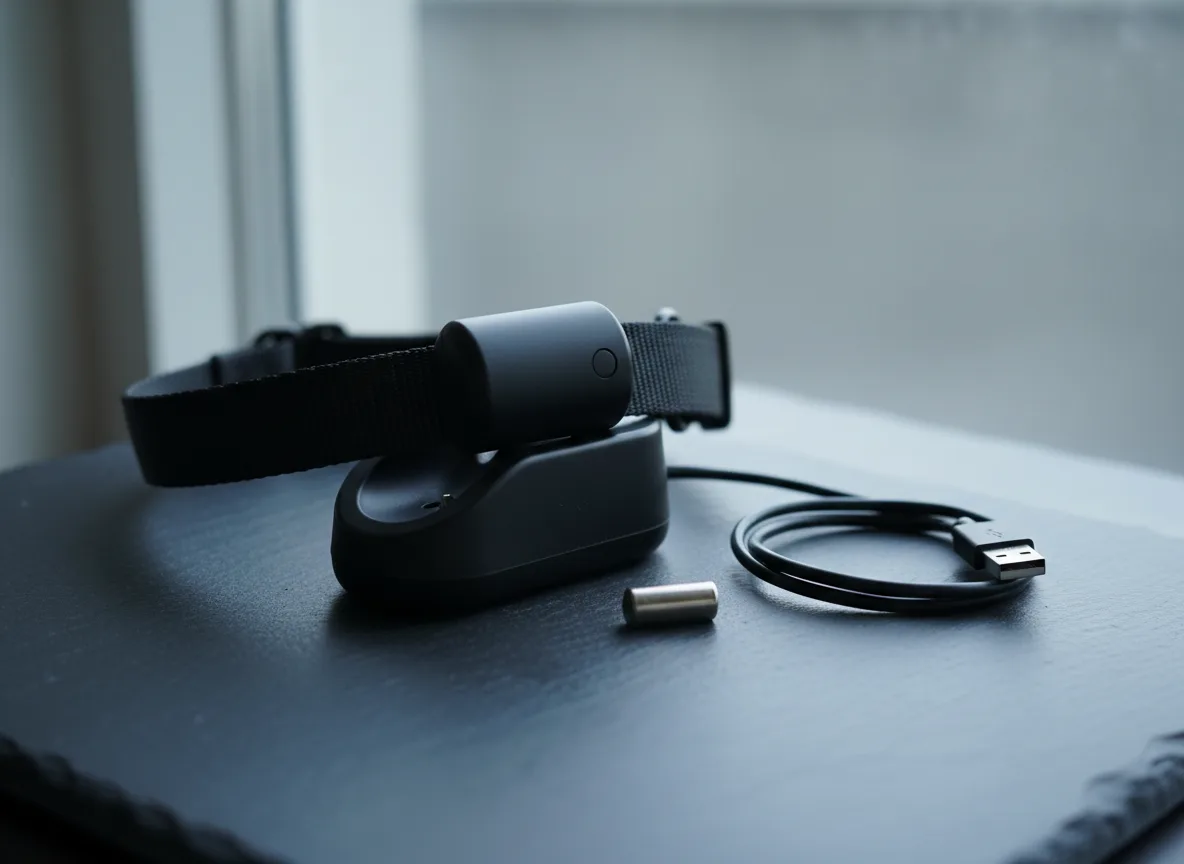
A charging routine that survives two weeks
- Charge or swap the battery every single night during the training weeks, regardless of what the indicator says.
- Keep the collar on the charger during the midday off period, which enforces your 8 to 12 hour wear cap automatically.
- If your system uses replaceable cells rather than a rechargeable pack, buy a full spare set before day one so a dead battery never costs you a session.
- Wipe the contact points and the charging pins with a dry cloth daily, because grass, dirt, and saliva build up fast in a working week.
- Log which sessions felt inconsistent, because two vague sessions in a row usually means a battery, not a dog.
| Time of Day | What Happens | Why It Matters |
|---|---|---|
| Morning | Fit check, skin check, contact point wipe | Catches redness before it becomes a pressure sore |
| Mid morning | First ten minute session on the long line | Dog is fresh and the reps are clean |
| Midday | Collar off and onto the charger | Enforces the 8 to 12 hour daily wear cap |
| Late afternoon | Second ten minute session | Repetition without fatigue or frustration |
| Evening | Collar off overnight, charging to full | Guarantees a full battery for tomorrow's sessions |
A second point worth planning for: an invisible fence replacement collar is a normal purchase, not a sign that something went wrong. Receiver collars are outdoor electronics worn by an animal that swims, rolls, and scratches, and straps wear out well before the electronics do. Households with more than one dog need one receiver per dog regardless of brand, and it is far cheaper to budget for that at purchase than to try running two dogs off one collar on alternating days, which slows both dogs' training to half speed.
If you are still shopping, SpotOn's current collar and pricing details are worth comparing against whatever else is on your list before you commit to a platform. The system is listed at $999, and containment does not sit behind a monthly plan: SpotOn states that all core features work without a subscription, with an optional paid subscription unlocking tracking extras such as seeing your dog's location anytime and getting an alert if your dog leaves the fence.
Whatever brand you shortlist, ask the same two questions before you pay: what a spare receiver costs, and whether the containment you are buying keeps working if you never subscribe to anything.
Where the 7-7-7 Rule Fits Into Boundary Training
The 7-7-7 rule is a puppy socialization guideline, not a fence rule, and it is worth clearing that up because it surfaces constantly in containment searches.
The rule says that by seven weeks of age, a puppy should have experienced:
- seven new surfaces
- seven new objects
- seven new locations
- seven new people
- seven new challenges
- seven different eating containers
- seven different play surfaces
It comes from breeder and early-socialization practice, and it has nothing to do with warning zones or correction levels.
It still matters here, though, because it predicts how easy boundary work will be later. A puppy raised on the 7-7-7 framework arrives at training age already comfortable with novelty, which is exactly the trait that makes the distraction proofing phase quick.
How early socialization shows up in fence training
- Puppies exposed to many surfaces move confidently across grass, gravel, and mulch at the flag line instead of balking at the footing.
- Puppies exposed to many people and dogs are less likely to fixate on a helper during days eight through ten.
- Puppies exposed to novel objects treat the flags as ordinary yard furniture rather than something to chew or fear.
- Puppies exposed to mild, safe challenges recover faster from a startling tone and get back to work in the same session.
None of this means an under-socialized adult dog cannot learn a boundary. It means that dog will likely need a longer distraction phase, and you should plan for a third week rather than forcing the calendar.
Readiness matters too, and it is behavioral rather than a birthday. A young dog that cannot yet hold a sit while a helper walks past the yard is not ready for boundary pressure no matter what the calendar says, so build that impulse control first, confirm the receiver collar actually fits the neck you are putting it on, and follow whatever guidance your specific system publishes about young dogs.
Dogs and Breeds That Need a Different Approach
Here is the honest part that manufacturer training pages tend to leave out: no containment system holds every dog, and a properly trained boundary is a strong behavioral agreement, not a physical wall. Some dogs will take a correction and keep going because whatever is on the other side matters more to them in that moment. Working out whether your dog is a good fit for a boundary, and what to run instead if it is not, before you buy anything is better for your dog, your wallet, and your peace of mind.
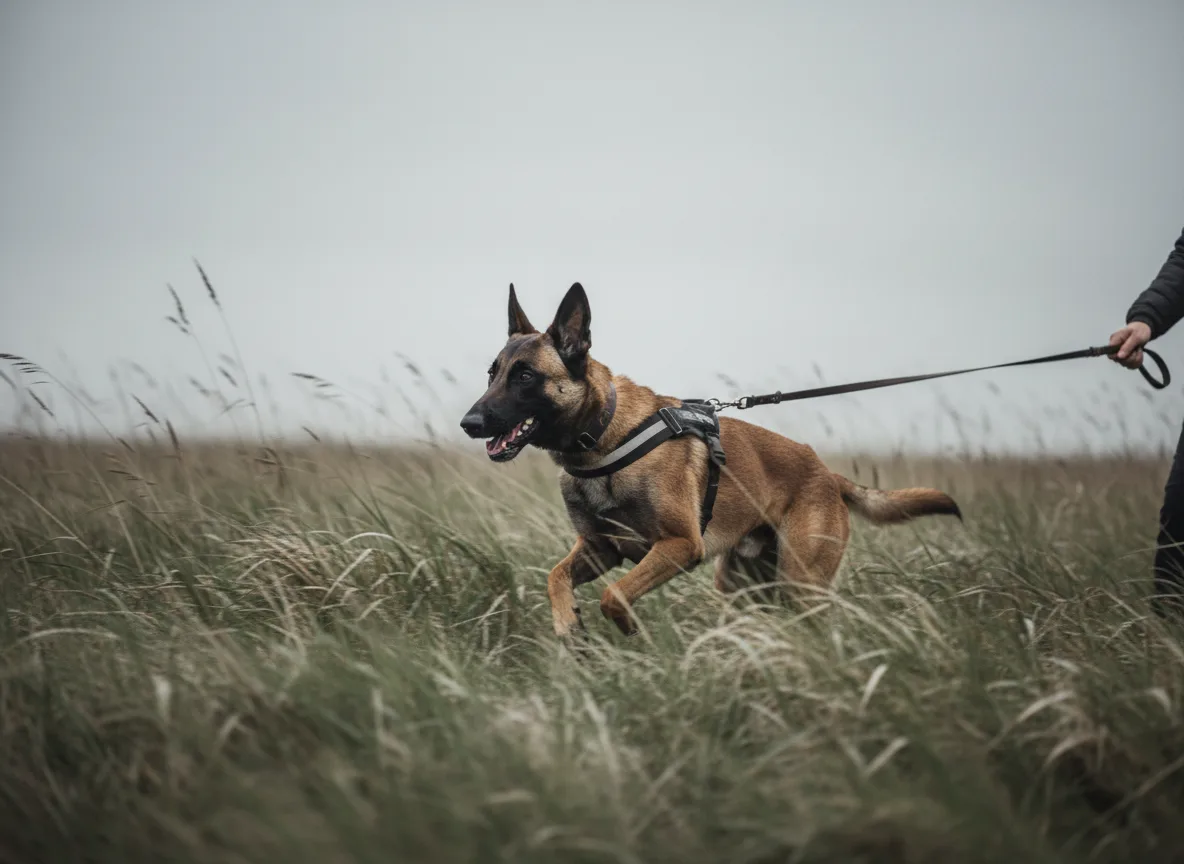
There is no single list of breeds that are hard to train with invisible fences, because temperament predicts outcomes far better than breed does. That said, the traits that predict trouble cluster in recognizable places: sighthounds and many terriers bring high prey drive, livestock guardians are bred to patrol wide territory, and northern breeds like huskies are famously self-directed about where they would like to be.
Knowing which dogs are poor candidates and what to run instead is worth more than any amount of extra training time, so the four profiles below each name the trait that makes a dog a poor candidate and pair it with a concrete alternative, whether that is a physical barrier, a long line, or supervised access to the yard rather than free run of it.
None of these is a verdict on the dog, and none of them means the system is at fault. It simply means that for that particular dog, a boundary agreement is the wrong fit for this system and something else will work better.
The four profiles that need a different plan, and what to run instead
- Very high prey drive. A dog that will cross any boundary for a deer, a rabbit, or a cat is the classic hard case. Sighthounds, many terriers, and hunting-bred sporting dogs sit here. Alternative: a physical fence for unattended time, plus long line work and a paid recall for everything else.
- Severe noise reactivity or escape anxiety. A dog that panics at fireworks or thunder is not making a decision at the boundary, it is fleeing. Training cannot outrun panic, and this profile is simply the wrong fit for this system as a sole containment method. Alternative: indoor safe space during storms and a physically enclosed yard.
- A neck the collar does not fit yet. This one is a measurement rather than a judgment, and it takes a minute to settle before you spend anything. The SpotOn collar fits necks of 10 inches or larger, which usually means a dog of about 25 pounds and up, and the straps cover 10 to 14 inches in small, 12 to 18 inches in medium, and 19 to 26 inches in large. Run a soft tape measure high on the neck where the receiver would sit, and if that number lands in the range, your dog is covered. If it comes in under 10 inches, this is not the right containment plan for that dog today. Alternative: a small physical pen or exercise fence, or supervised access to the yard on a line.
- Unreliable recall under distraction. If your dog ignores a known recall cue with a squirrel in view, the boundary will lose that same argument. Alternative: three or four weeks of dedicated recall work first, then start the fourteen day plan from day one.
For every profile above, the alternative is not "give up on the yard." It is supervised access: the dog is outside with you, on a long line or inside a physical barrier, until the underlying behavior changes or the household accepts that this dog needs a fence you can touch. A dog that repeatedly beats a boundary needs the escape-behavior playbook in our guide to keeping a determined dog from getting out of the yard, not a higher correction level.
- If your dog is crossing the line for prey or out of panic, cranking the correction up does not fix the behavior, it just adds fear to an already stressed dog. That dog needs a different containment plan, and the responsible move is to say so rather than escalate.
How Wired, Wireless, and GPS Fences Differ for Training
All three containment categories teach the same boundary lesson, but they hand you very different raw material to teach with. An invisible fence for dogs in the classic sense means buried wire: you trench a loop around the property, and the boundary is exactly where you dug. It is precise and unaffected by trees or terrain, but changing it means digging again, and a wire break is invisible until the dog finds it.
A traditional wireless dog fence broadcasts a radio circle from a base unit in the house. Setup is fast, but the shape is always a circle, and the signal is affected by walls, slopes, and metal. That matters for training because the circle can breathe in and out by several feet as conditions change, and a wireless dog fence collar that warns in different places on different days undermines the consistency the whole plan depends on. If your yard is a rectangle, a circle also either excludes usable yard or overshoots into a road.
A GPS wireless dog fence uses satellite positioning instead of a broadcast circle, so the boundary can be any shape you like and it is defined in software rather than in wire. For a wireless invisible fence for dogs owner who wants a custom shape without trenching, this is the meaningful upgrade, and it is why we structure this training plan around a stable, mapped boundary.
What each category means for your fourteen days
- Wired: the most physically consistent line, but the flag placement has to be measured against the buried loop rather than guessed.
- Traditional wireless: the fastest setup, but expect to re-verify the tone location weekly during training because the circle shifts.
- GPS: custom boundary shapes and no trenching, so the flag line can follow the actual usable edge of your property.
For a genuine head-to-head on how the premium GPS systems handle accuracy and correction behavior, our SpotOn vs Halo comparison breaks down the differences that actually change the training experience. That comparison is the right next read if you are choosing between the two flagship GPS platforms rather than between categories.
Check Price on SpotOn Exclusive - $75 OffChoosing a Fence That Makes Training Easier
If you have not bought yet, buy for trainability rather than for the spec sheet. Shoppers searching for the best wireless dog fence or the best invisible fence for dogs usually sort by range and price, and the roundups answering which is the best invisible dog fence tend to rank on the same two numbers. The features that actually shorten your fourteen days are less glamorous than either, and they are the ones we weighed most heavily before landing on SpotOn.
The five features that shorten training
- A long, distinct warning tone. The tone is your teaching signal, so it needs to be unmistakable and it needs to give the dog room to turn before anything else happens.
- A stable boundary that does not drift. Every foot of day-to-day drift is a foot of confusion, and drift is the top reason owners repeat phases.
- A training or tone-only mode. Being able to lock the system to tone for the first week is genuinely useful and not universal.
- Per-dog profiles. Multi-dog households need independent settings, because two dogs almost never need the same level.
- A phone app with live location. Seeing where the dog is when it warned tells you whether the problem is training or setup.
The reason SpotOn keeps coming up in this particular plan is fit rather than favoritism, and it comes down to how the boundary gets made. You define the perimeter yourself, either by drawing it in the app or by walking it for extra precision, there is no digging and no wire to bury or break, and containment works without a subscription, with the optional plan reserved for tracking extras like live location and leave-the-fence alerts.
Those are the exact ingredients the tone-first calendar above is built on, which is why it is the system we would put in front of an owner starting day one this week. Its boundary accuracy has been independently tested and verified, which is precisely the consistency a fair, dog-friendly training plan depends on. You can check what the SpotOn system currently costs with the Petful reader discount and see how it lines up with your yard and your dog's neck measurement.
The support around the hardware matters as much as the hardware, and it is the part shoppers rarely think to compare. Three things that come with SpotOn map directly onto the fourteen days above:
- An in-app training program built with input from professional trainers. It walks you through the process step by step inside the app, so the plan you follow on day six is the same one you started on day one.
- A free 30-minute virtual session with a certified dog trainer, included with every purchase. Use it early: having a professional look at your boundary setup and sketch a plan for your specific dog is worth more in week one than in week four.
- Custom Voice Commands. Recording your own voice and sending it through the collar is a genuinely useful recall reinforcer during distraction proofing, because the cue your dog hears at the boundary is the one it already knows from you.
Subscription structure is worth checking on everything else you shortlist too, because the best wireless dog fence without subscription is a real search for a reason: some GPS trackers bundle a monthly plan, and buyers reasonably want to know the total cost before committing. If you do want to widen the field before deciding, our best GPS dog fences roundup carries the brand-by-brand picks, current model lineups, and how the other systems score on those trainability features, so this guide can stay focused on the method.
- Fourteen consecutive days of outdoor sessions is much easier to complete in fair weather. Starting a plan you cannot finish because of a cold snap is how a two week program becomes a two month one.
Then commit to the fourteen days, because that is the part that turns a mapped boundary into one your dog actually respects. The calendar above is small, specific, and finishable, it is written around the SpotOn system we recommend for this plan, and a dog that has genuinely been through all five phases is a dog you can trust in the yard rather than one you supervise forever.
About two weeks. Two ten minute sessions a day for fourteen days totals 280 minutes, or roughly 4 hours and 40 minutes of structured work. Some dogs are reliable by day ten and some need an extra week of distraction proofing.
Many dogs never need more than tone and vibration, especially if you complete all five phases and never skip the long line. Correction is a backstop, not the teaching tool, and it should always be introduced at the lowest level the dog notices.
Cap daily wear at 8 to 12 hours, rotate the collar position slightly between wears, and take it off overnight. Check the skin under the contact points every morning.
Check the neck rather than the scale. The SpotOn collar fits necks of 10 inches or larger, which usually means a dog of about 25 pounds and up, and the straps cover 10 to 14 inches, 12 to 18 inches, and 19 to 26 inches. Measure high on the neck where the receiver would sit, and if that number falls inside the range, your dog is covered.
Pull every second flag on day twelve, thin them again on day fourteen, then leave a sparse ring up for another two to three weeks of normal yard time before removing the rest.
Put twenty flags back up, reattach the long line, and rerun days five through seven. One breakthrough is a training gap, not a failure, but ignoring it teaches the dog that the boundary is negotiable.
Yes. Every dog in the household needs its own receiver so each one can have its own settings and train on its own schedule.

Coreen Saito is a pet writer and longtime shelter volunteer with more than a decade in animal rescue. She covers cat behavior, breed care, and the small, ordinary science of sharing a life with companion animals, with a particular focus on honest takes about the products and decisions that actually matter. At home in Arizona, she's outranked by Mac (a dog with the loudest opinion in the house), Rebel (a cat who governs by quiet authority), and Meri (an orange tabby who runs the late shift and the laundry basket). She writes about all three, plus the rescues that keep coming through her life, at LifeWithMinty.com.
Sign up for expert-backed reviews and safety alerts all in one place.


A Final Word (Disclaimer)
At Petful, our review integrity is paramount; we never exchange special treatment in our reviews for monetary or material rewards.
Nonetheless, when our readers click through to online merchants (including Chewy or Amazon), we receive a referral commission. This supports the running of our free blog, and we appreciate your backing.