How to Keep Your Dog From Jumping the Fence: An Escape Artist's Guide
How to keep your dog from jumping the fence, for good. Learn why dogs escape the yard, which physical fixes actually work, and when a GPS dog fence is the right answer for an escape artist.
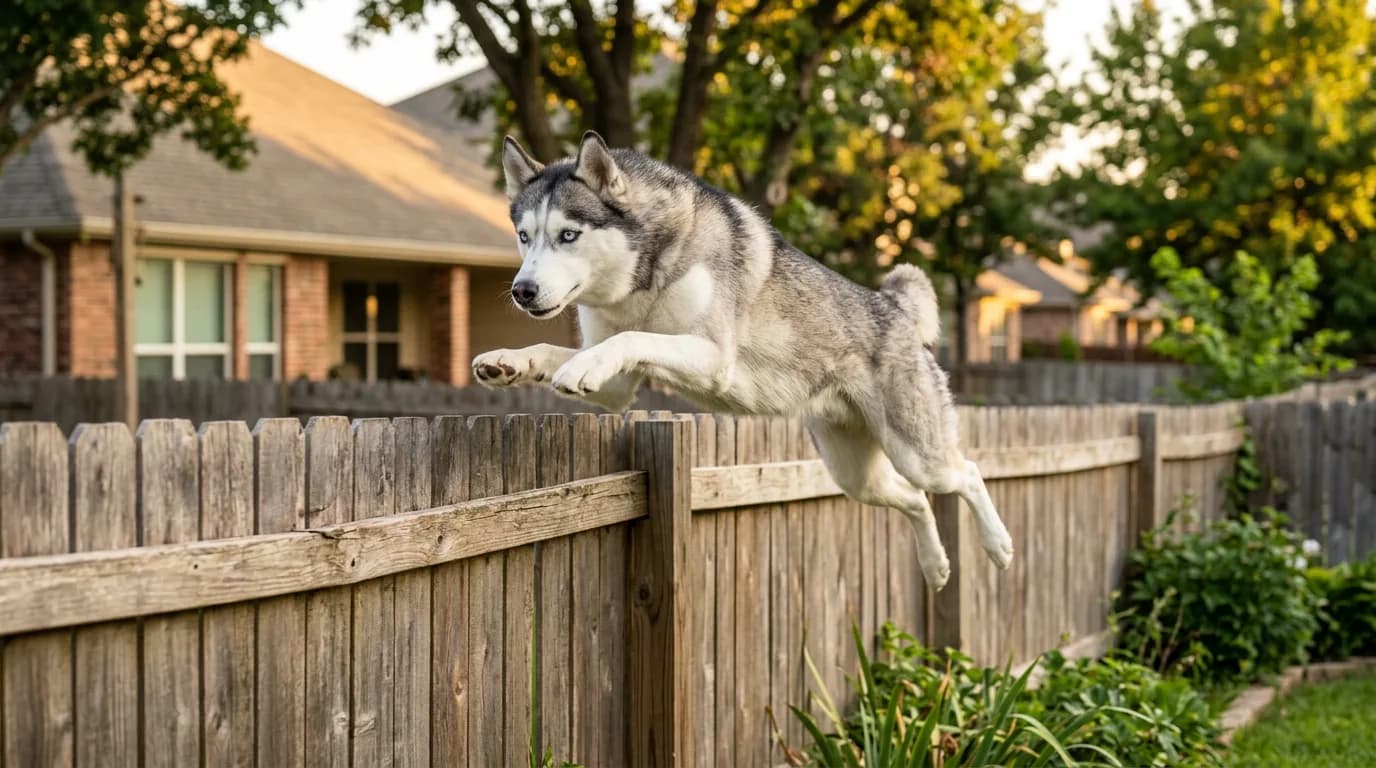
Learning how to keep your dog from jumping the fence usually starts after the first great escape, when you realize a determined dog treats a backyard barrier as a challenge rather than a limit. Some dogs jump, some climb, some dig under, and a few do all three. The good news is that fence escaping is a solvable problem once you understand why your dog is doing it and match the fix to the cause. This guide covers the behavioral root, the physical fixes that actually work, the breeds most likely to bolt, and when a GPS dog fence is the right backstop.
If your dog keeps escaping yard boundaries, you are not alone. How to keep dog from jumping fence lines is one of the most common questions owners ask, whether the dog goes over, under, or through. This escape proof guide covers dogs that run away, the fixes that actually hold, and the breeds most likely to bolt.
- 1Most fence escaping is driven by boredom, excess energy, prey drive, separation anxiety, or social and mating instinct.
- 2Physical fixes like inward-angled extenders, coyote rollers, and dig barriers work, but rarely on their own.
- 3Addressing the underlying cause with exercise, enrichment, and training is what makes the fix stick.
- 4Certain breeds are notorious escape artists and need a more serious containment plan.
- 5For large or hard-to-fence properties, a GPS dog fence adds a reliable boundary a jumper cannot clear.

Sign up for expert-backed reviews and safety alerts all in one place.
Why Dogs Escape the Yard in the First Place
To understand why a dog is escaping, pay attention to the circumstances surrounding each escape, not just the escape itself. A dog that only escapes when left alone, then turns up at the front door or a neighbor's porch, is almost certainly anxious or seeking company, and a taller fence will not touch the real problem. A dog that escapes mid-afternoon when the yard is full of squirrels is prey-driven, and needs a boundary it physically cannot rush plus impulse-control work. A dog that escapes within days of you adopting it, before any bond has formed, is often just under-stimulated and testing the limits. The time of day, the trigger, and where the dog goes afterward are the clues that tell you which fix to reach for.
Before you reinforce anything, figure out the motive. The right solution depends on it, and reinforcing the fence without addressing the cause usually just moves the escape to a new spot.
Boredom and excess energy: an under-exercised dog goes looking for its own entertainment, and the fence is the last obstacle between it and something more interesting.
Prey drive: squirrels, rabbits, cats, and joggers trigger a chase instinct that can override training in a heartbeat, especially in herding and hunting breeds.
Separation anxiety: some dogs escape to find their people, not to roam. This comes with other signs like pacing, barking, and destruction when left alone.
Social and mating drive: intact dogs in particular will go looking for a mate, and friendly dogs simply want to greet the neighbors.
Fear: thunderstorms, fireworks, and loud machinery can panic a dog into bolting through or over a fence it normally respects.
- A bored dog needs more exercise and enrichment. An anxious dog needs a behavior plan, not a taller fence. A prey-driven dog needs a boundary it cannot rush. Diagnose the motive first, then choose the fix.
Escape-Artist Dog Breeds to Watch
Any dog can learn to escape, but some breeds are famous for it because of how they were bred. If you own one of these, plan for containment more seriously from day one.
| Breed | Escape style | Driver |
|---|---|---|
| Siberian Husky | Digging and jumping | High energy, strong roaming instinct and prey drive |
| Border Collie | Jumping and problem-solving gates | Intelligence and need for a job |
| Jack Russell Terrier | Digging under | Bred to go to ground after prey |
| Australian Shepherd | Jumping and climbing | Athleticism and herding drive |
| Beagle | Following a scent under or through | Nose-led prey drive |
| Greyhound and sighthounds | Bolting after movement | Explosive chase instinct |
| Livestock Guardian Dogs | Climbing or digging under fences | Need to patrol and protect their property and livestock |
| Bird Dogs German Shorthaired Pointers, Vizslas | Scaling/jumping, climbing, or digging | Driven by the urge to hunt or chase passing wildlife |
| Labrador Retrievers | Jumping, digging and chewing through wire and wooden fences | Boredom, separation anxiety, or natural prey drive |
If your dog is on this list, lean toward a layered plan: a secure physical barrier plus a behavioral routine, and for larger properties, a GPS boundary as a backstop.
Check Price on SpotOn Exclusive - $75 OffHow to Stop a Dog From Jumping the Fence
Add height the right way
A dog that clears a fence needs the effective height raised, but a taller flat fence can still be scaled. Angled extenders that lean inward at roughly 45 degrees are far more effective than vertical height alone, because they remove the landing spot a jumper aims for. Coyote rollers along the top rail spin when gripped, denying the purchase a climber needs.
Remove the launch points
A few more tactics earn their keep for jumpers specifically. Privacy fencing (solid panels rather than chain-link or pickets) removes the visual triggers on the other side, so a dog that launches at passing dogs or people has less to launch at in the first place. Double-gating, an airlock-style enclosure at the main gate, gives you a buffer so a bolter cannot clear the property in one move when you come and go. And for a dog that has already learned jumping pays off, you may need to combine the physical fix with management: supervised yard time only, until the new barrier plus training has broken the habit. A dog that has succeeded at escaping once is far more motivated to try again, so the first job is making the next attempt fail.
Walk the fence line and look at it from your dog's perspective. Woodpiles, AC units, planters, deck rails, dog houses, and even tall snowbanks become launch pads. Move anything climbable at least several feet from the fence.
How to Stop a Dog From Digging Under the Fence
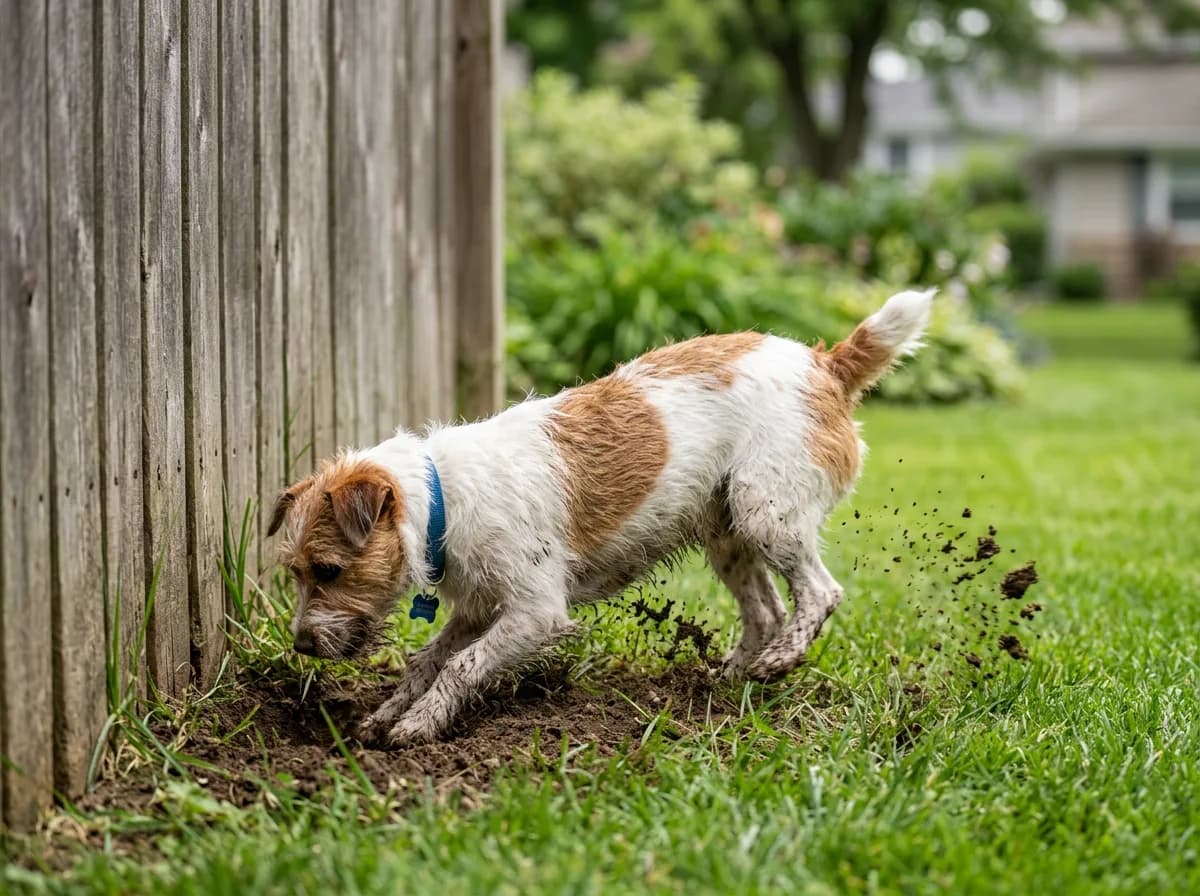
One detail people miss with digging: dogs usually dig at a consistent spot, often a corner or the shadiest stretch of fence. Before you barrier the entire perimeter, watch where your dog actually starts, and reinforce that section first. Filling a favorite dig hole with the dog's own droppings or large rocks set in the soil removes the reward, and redirecting the digging instinct to a sanctioned dig pit elsewhere in the yard gives a determined digger a legal outlet, which works better than pure suppression for breeds bred to dig.
Diggers go under, not over. Bury chicken wire or hardware cloth at the base of the fence angled inward, or sink an L-shaped footer so the barrier turns back toward the yard underground. A line of partially buried rocks or pavers along the fence base also discourages digging at the seam, and concrete footers stop the most determined diggers entirely.
Climbing, Gates, and Other Weak Points
Chain-link is a ladder to a motivated climber; adding a smooth panel or angled topper removes the footholds. Gates are the most common failure point, so add a self-closing hinge and a dog-proof latch the dog cannot nose open, and check the gap at the bottom of every gate. Many escapes happen not because the fence failed but because a gate was left ajar or a latch was within paw reach.
Common Mistakes That Make Escaping Worse
A few well-meaning moves backfire. Tying a dog out on a cable is not a containment fix; it raises frustration, can cause injury, and often makes the underlying drive to escape stronger. Punishing a dog after it has already escaped and come back teaches it that returning to you is what gets punished, which makes the next recall harder, not easier. And relying on height alone against an athletic breed is a losing game, because a determined dog clears more fence than most owners expect. The pattern behind all three mistakes is the same: treating the symptom (the escape) instead of the cause (the unmet need or the rewarding behavior), which is why the lasting fixes in this guide all pair a physical barrier with addressing why the dog wants out.
Check Price on SpotOn Exclusive - $75 OffThe Part That Actually Works: Address the Cause
How to teach the boundary, step by step
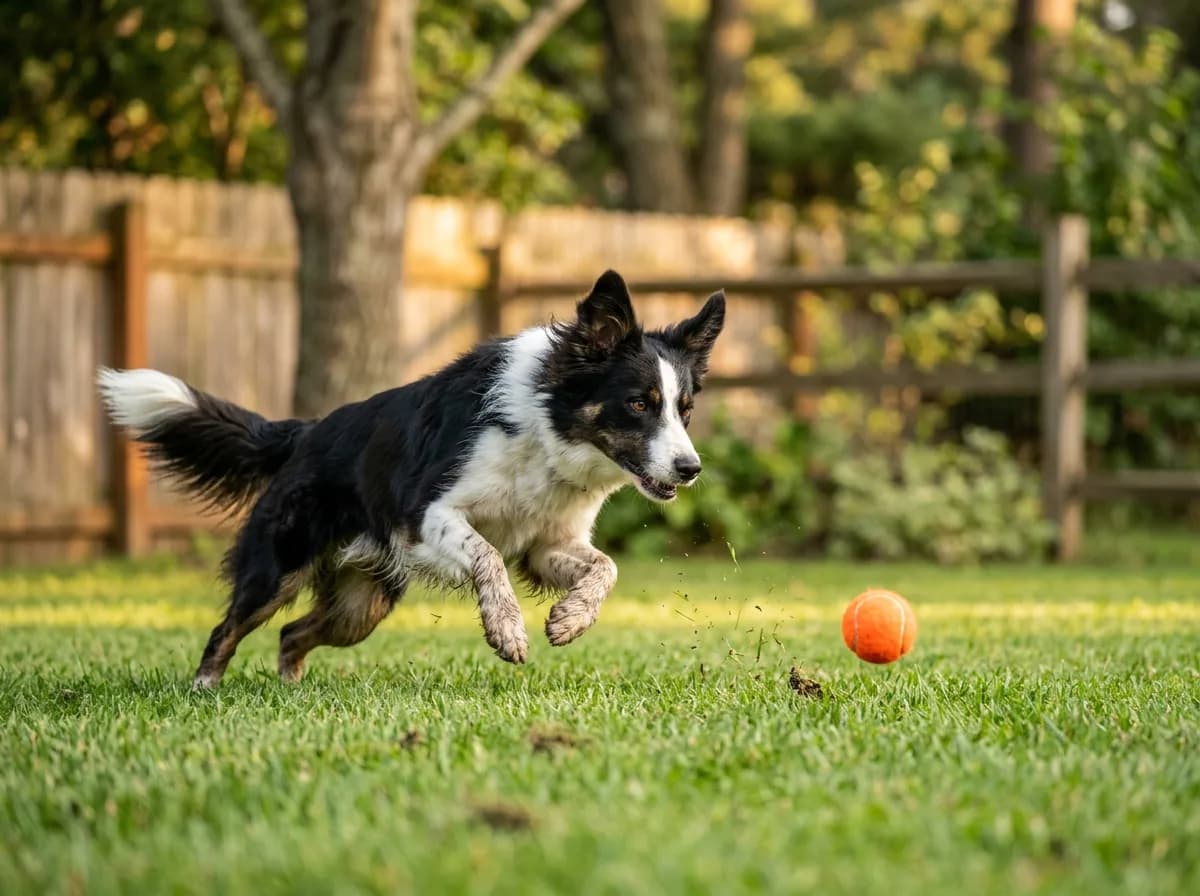
Boundary training is the single highest-value habit for an escape-prone dog, and it follows a predictable arc. Start by walking the perimeter on a long line and marking the boundary with flags the dog can see. Reward heavily any time the dog stops, looks at you, or turns back near the line. Over a week or two, add mild distractions (a tossed toy near the edge, a person walking past) and keep rewarding the choice to stay. Only once the dog reliably turns back on its own do you practice off-leash, and even then you supervise. The goal is a dog that treats the boundary as its own decision, not a rule it follows only when you are watching.
If you are using a GPS or wireless collar, the same arc applies, with the collar's tone or vibration layered in as the warning cue once the dog already understands the visual boundary. The technology reinforces the training; it does not replace it.
Physical barriers buy you time, but the lasting fix is reducing the urge to leave. That means meeting the dog's needs and teaching boundary behavior.
- Increase daily exercise, especially aerobic activity, before you leave the dog alone in the yard
- Add enrichment: puzzle feeders, scent games, and rotating toys to occupy a busy mind
- Never leave an escape-prone dog unsupervised in the yard for long stretches
- Spay or neuter, which reduces roaming driven by mating instinct
- Work on recall and boundary training so the dog chooses to stay even when tempted
- For fear-driven escapes, manage the triggers (bring the dog inside during storms and fireworks)
- No fence and no collar replaces an engaged owner. The most reliable plan pairs a physical or virtual boundary with supervised yard time and a dog whose needs are met, so the urge to escape fades.
When a GPS Dog Fence Is the Right Answer
If you go the GPS route for an escape artist specifically, two specs matter more than the rest: accuracy under whatever cover your property has (trees, structures, hills), and the consistency of the warning so the dog gets the same signal in the same place every time. An inconsistent boundary actively undermines training, because a dog that gets corrected in a spot that felt safe yesterday learns to distrust the system. That is why hardware quality, not just the feature list, is what separates a GPS fence that contains a committed escaper from one that frustrates both of you.
See our hands-on SpotOn GPS fence review for how it performs with a determined escaper.
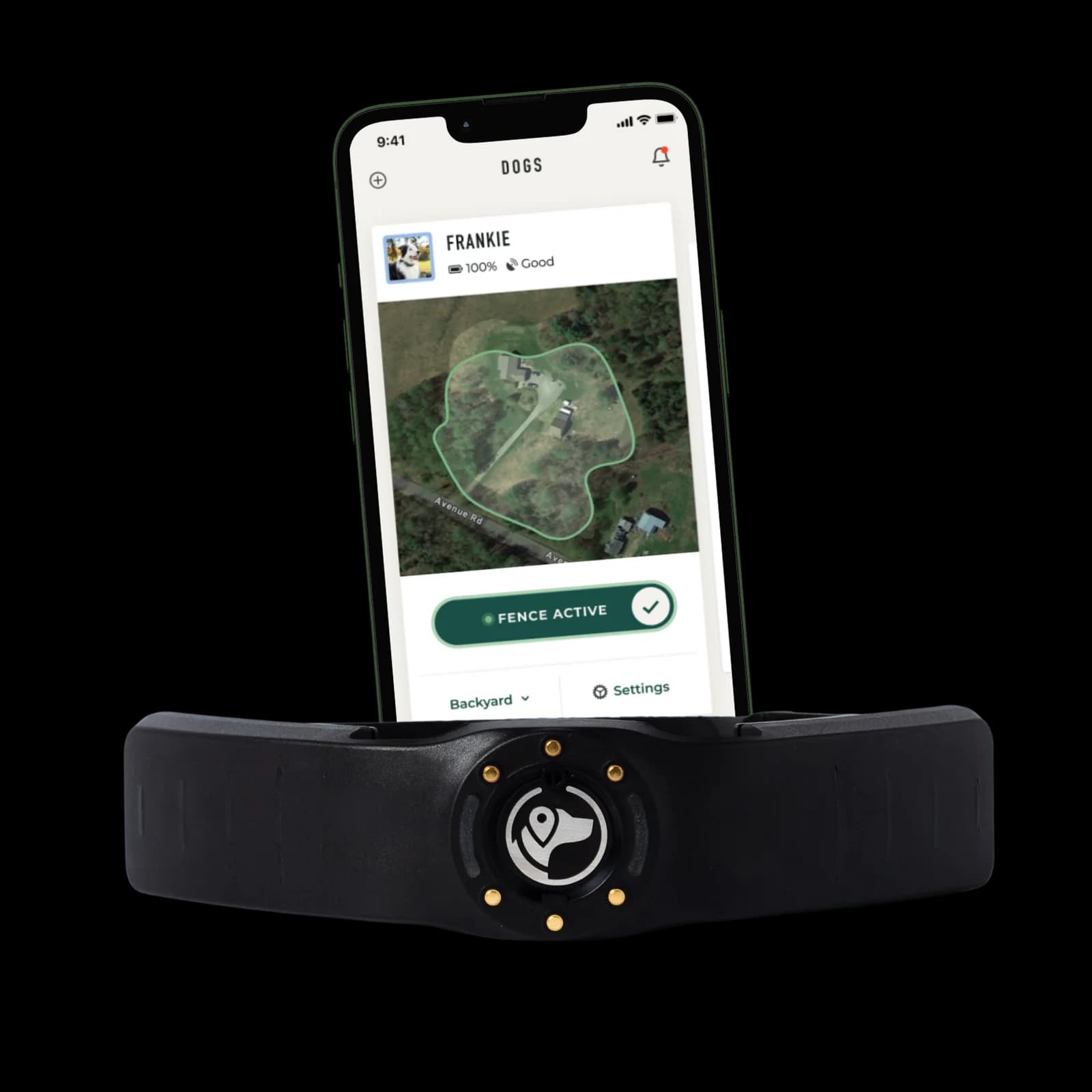
For large properties, wooded lots, or places where a tall physical fence is impractical or banned by an HOA, a GPS dog fence adds a dependable boundary layer that a determined jumper cannot simply clear. These systems pair a GPS-enabled collar with a virtual boundary set in a mobile app to warn the dog with a tone or vibration as it approaches the edge, and they can cover acreage no physical fence could affordably enclose. Because the boundary is virtual, there is nothing to jump over or dig under.
A GPS fence is not a substitute for training. These systems are only effective when paired with consistent training that teaches a dog to understand and respect the boundary. For escape artists on large properties, however, a GPS fence can be one of the most reliable containment tools available, with the added benefit of traveling wherever you go, from campsites to second homes.
See our roundup of the best GPS dog fences of 2026 to compare the top systems, including our pick for escape-prone dogs, and our
SpotOn vs. Halo comparison if you have narrowed it to the two leaders. For wired options, see our
electric fence for dogs guide.
Check Price on SpotOn Exclusive - $75 OffKeeping Your Dog in the Yard: FAQs
A layered approach works best: boundary training on a long line, plenty of exercise and enrichment so the dog is not motivated to leave, supervision during yard time, and a GPS or wireless containment collar that warns the dog as it nears the edge. No single tactic is reliable alone, but together they keep most dogs safely home.
The most common reasons are boredom, excess energy, prey drive, separation anxiety, and social or mating drive. Identifying which one applies is the key to a fix that works, because reinforcing the fence without addressing the motive usually just shifts the escape elsewhere.
Many athletic dogs can clear a 6-foot fence, so height alone is not a reliable fix. An inward-angled extender or a coyote roller along the top is more effective, because it removes the landing spot a jumper needs rather than just adding height to scale.
The 7-7-7 rule is a socialization guideline suggesting that by 7 weeks a puppy should have experienced 7 surfaces, 7 objects, 7 locations, and so on, to build confidence. A well-socialized, confident dog is generally less anxious and less driven to escape, though the rule itself is about early development, not containment.
Train a reliable boundary or wait cue at thresholds, add a self-closing gate with a dog-proof latch, and consider a secondary airlock area by the gate. For a dog that bolts the instant a gate opens, a GPS or wireless boundary collar adds a layer that does not depend on the gate being latched.
It can be a strong layer, especially on large or wooded properties where a physical fence is impractical. A GPS fence warns the dog as it nears the boundary, but it still requires proper training to be reliable. For determined escapers on real acreage, it is one of the most dependable options available.
Not for long stretches. An unsupervised escape artist will eventually find the gap. Supervise yard time, address the underlying cause with exercise and enrichment, and use a reliable containment system as a backstop rather than a babysitter.
The Bottom Line
Keeping a dog from jumping the fence is rarely about one tall barrier. It is about understanding why your dog wants out, meeting that need, and backing it up with a boundary the dog cannot simply clear. Reinforce the fence, remove the launch points, block the dig routes, address the cause with exercise and training, and for big or hard-to-fence properties, consider a GPS dog fence as a dependable layer that keeps even a committed wanderer safely home.
Check Price on SpotOn Exclusive - $75 Off
Coreen Saito is a pet writer and longtime shelter volunteer with more than a decade in animal rescue. She covers cat behavior, breed care, and the small, ordinary science of sharing a life with companion animals, with a particular focus on honest takes about the products and decisions that actually matter. At home in Arizona, she's outranked by Mac (a dog with the loudest opinion in the house), Rebel (a cat who governs by quiet authority), and Meri (an orange tabby who runs the late shift and the laundry basket). She writes about all three, plus the rescues that keep coming through her life, at LifeWithMinty.com.
Sign up for expert-backed reviews and safety alerts all in one place.


A Final Word (Disclaimer)
At Petful, our review integrity is paramount; we never exchange special treatment in our reviews for monetary or material rewards.
Nonetheless, when our readers click through to online merchants (including Chewy or Amazon), we receive a referral commission. This supports the running of our free blog, and we appreciate your backing.