Dog Dental Powder vs. Dental Chews: Which Fits Your Dog’s Routine?
Powders and chews add different steps to a dog’s dental routine. Compare convenience, ingredients, calories, and product evidence, using ProDenta’s label as a practical powder example.

BVMS, MRCVS
Petful is reader supported. As an affiliate of platforms like Amazon and Chewy, we may earn a commission when you buy through links on this page. There is no extra cost to you.
A dog dental powder may fit naturally into mealtime, while a dental chew adds a separate chewing activity. The better fit depends on how your dog eats and chews, what their diet allows, and the evidence behind the individual product. Daily brushing and veterinary dental care remain the foundation; neither format removes the need for them.
Here, we compare those practical differences using Pup Labs’ ProDenta as the powder example. Start with the routine you can maintain, then check the product’s ingredients, directions, and dental claims. A convenient format is useful only when the particular product also suits your dog.

Sign up for expert-backed reviews and safety alerts all in one place.
Powder versus chews: what changes in your routine?
Dental powder for dogs generally adds a measured serving to food or, when its instructions allow, water. An edible dental chew asks your dog to spend time chewing a separate item. That difference affects preparation, supervision, and how easily you can tell whether your dog consumed the intended portion.
With powder, consider who prepares meals and whether your dog usually finishes them. With chews, consider chewing behavior: a dog who swallows treats quickly presents a different selection problem from one who works through them gradually. Neither a larger scoop nor an extra chew is a shortcut to better results.
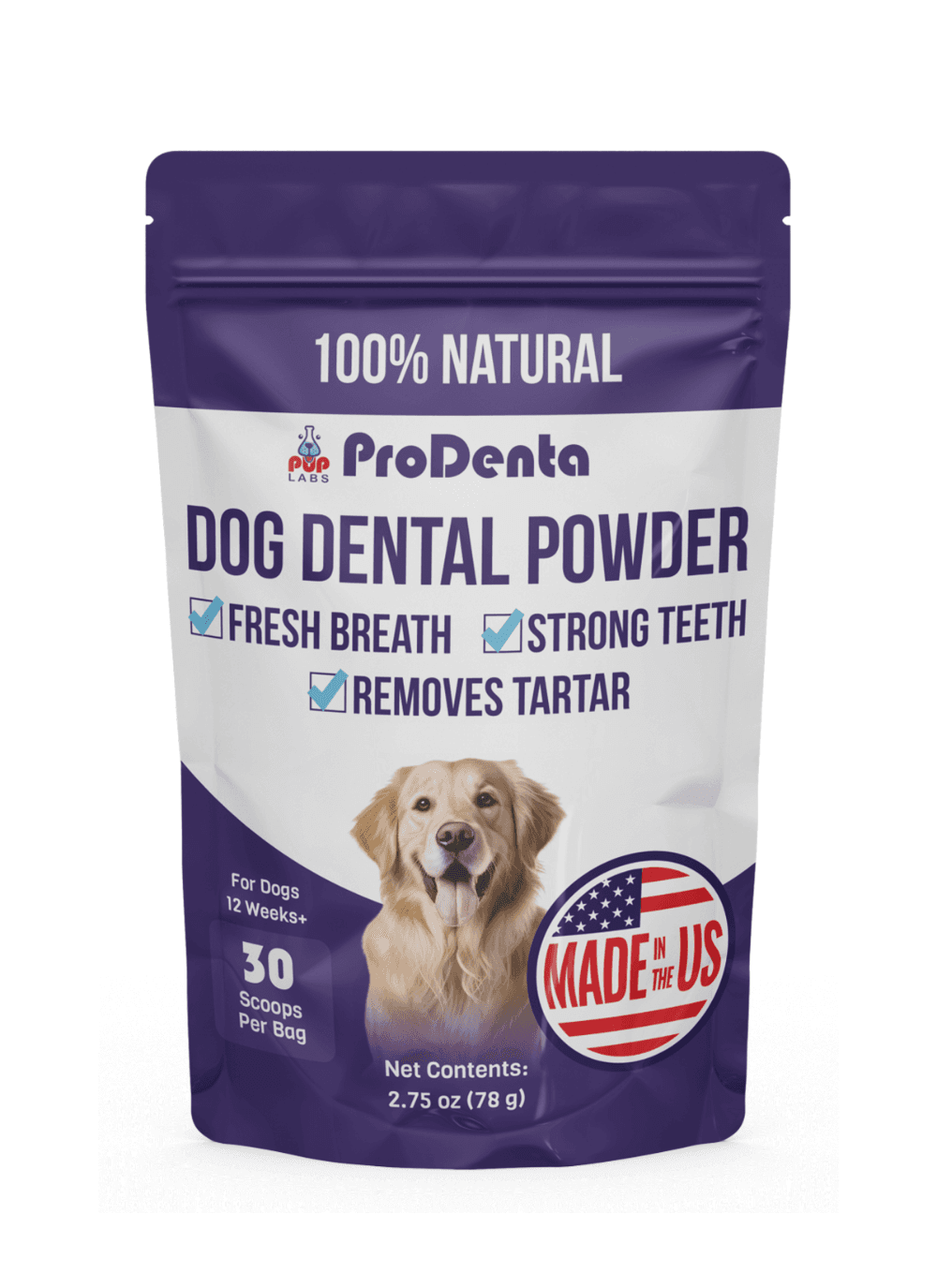
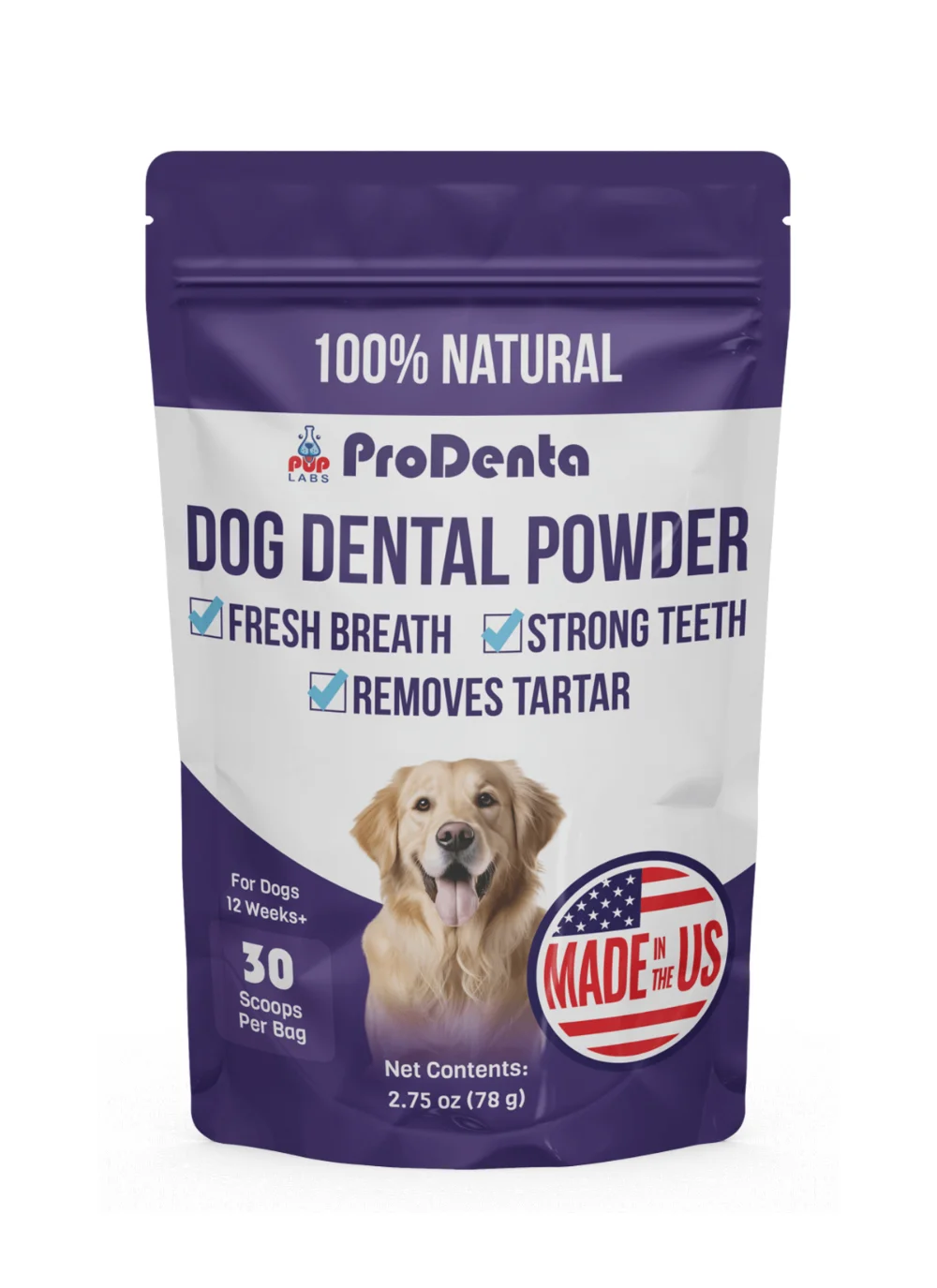
A dental powder format to consider as part of your dog’s regular oral-care routine.
Petful may earn a commission when you click through to Pup Labs, at no extra cost to you.
Use this format-choice decision table to compare the five practical differences. The linked guides later in the article help owners move from this choice to specific chew buying decisions or clinical dental-care questions.
| Decision | Dental powder | Edible dental chew |
|---|---|---|
| Daily preparation | Measure the serving and use it only in the way the product directs. | Select the correct product size and follow its feeding directions. |
| Consumption | A measured serving in an unfinished meal may not be fully consumed. | Chewing behavior matters; watch how your dog handles the item. |
| Diet fit | Check all ingredients, including carriers, and calories per daily portion. | Check ingredients and calories per daily portion, including other treats. |
| Dental evidence | Look for evidence for the exact product and the claim being made. | Look for evidence for the exact product; shape or hardness alone is not proof. |
| Place in the routine | Add to a routine built around daily brushing and veterinary care. | Add to that same routine with appropriate supervision. |
Also consider tolerance. Possible side effects of a dental powder depend on its formula and the individual dog; the powder format alone cannot establish safety. A familiar mealtime habit can make administration easier, but it does not tell you whether a new ingredient suits your dog.
Where ProDenta fits a powder routine
Pup Labs describes ProDenta dog dental powder as a product that can be added to food or water. That offers a way to connect its use to an existing feeding routine rather than adding another chew. Check the current package instructions before deciding how to use it for your dog.
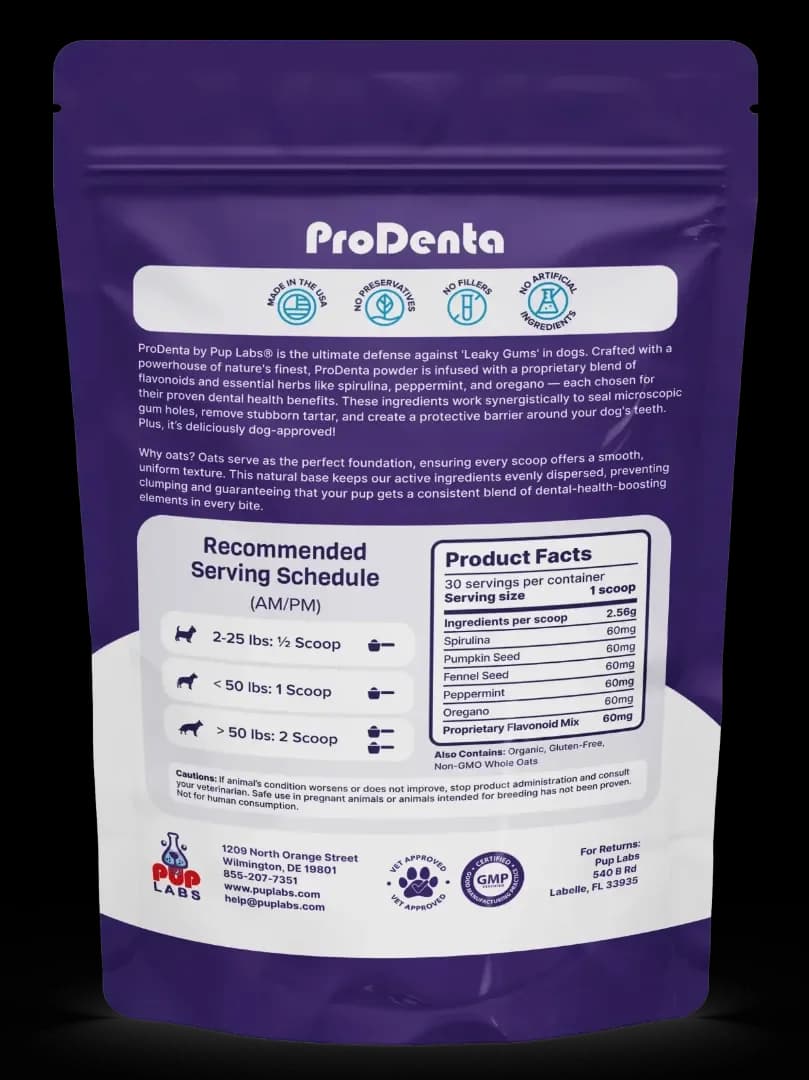
The official ProDenta ingredient panel provides a concrete example of why reading beyond the front of a package helps. It lists a serving of one scoop, a total of 2.56 g per scoop, and the following composition:
| Label entry | Amount or description |
|---|---|
| Spirulina | 60 mg per scoop |
| Pumpkin Seed | 60 mg per scoop |
| Fennel Seed | 60 mg per scoop |
| Peppermint | 60 mg per scoop |
| Oregano | 60 mg per scoop |
| Proprietary Flavonoid Mix | 60 mg per scoop |
| Also contains | Organic, gluten-free, non-GMO whole oats |
A dental powder format to consider as part of your dog’s regular oral-care routine.
Petful may earn a commission when you click through to Pup Labs, at no extra cost to you.
Those six listed ingredients total 360 mg. They do not account for the entire 2.56 g scoop, which also includes the oats carrier. This distinction lets you compare what is actually listed without mistaking scoop weight for the amount of any one ingredient.
This label-reading example separates ProDenta’s printed composition from outcome claims and serving directions. The ingredient panel describes one scoop; it does not establish a clinical result or the appropriate daily amount for your dog. Read the current package for the weight range and schedule. If any serving directions seem ambiguous, ask Pup Labs to clarify them before you begin.
Before adding ProDenta to the routine:
- Check the ingredient panel on the package you receive, including whole oats.
- Confirm the serving directions and use the product’s measuring scoop.
- Decide who will prepare the serving so two household members do not give it twice.
- Keep the package available if your veterinarian needs to assess the ingredients or directions.
These practical checks make a measured powder serving easier to include in an existing feeding routine. Keep that routine consistent with the package directions and your veterinarian’s home-care advice.
Think through one ordinary day before choosing the format. If one person serves breakfast and another serves dinner, agree who handles the powder and where that is recorded. Keep the original package with its directions rather than relying on an unmarked container or a household spoon. This makes the routine easier to repeat and the label easier to find when questions arise.
The same planning matters in a home with several dogs. A shared food or water bowl makes it harder to know which dog consumed an addition. Discuss an individually managed serving method that follows the product’s confirmed instructions instead of assuming every dog received an equal share.
Compare the evidence on the exact product
For plaque removal, choose a powder with evidence for that exact product and claim; the format alone cannot identify a most effective powder. A powder and a chew can both be easy to use without having the same supporting evidence. Freshening breath, reducing plaque and controlling tartar are different claims.
The Veterinary Oral Health Council’s accepted-products list identifies products with acceptance for specified plaque or tartar claims. Check the exact product name and claim. Acceptance of one formula does not establish acceptance of another powder, another chew, or every item sold by the same company.
Does tooth powder actually work for dogs?
The answer depends on the exact product and what “work” means. A powder’s ingredients or ease of use cannot establish how effectively it reduces plaque or tartar. Look for product-specific evidence that supports the outcome you want, then consider whether you can follow the directions consistently. Evidence for a different powder does not transfer to ProDenta.
For an owner considering ProDenta, separate two useful decisions: whether its listed ingredients fit the dog’s diet, and whether a measured powder serving fits the household’s routine. Then discuss the specific dental outcome you want with your veterinarian, using the exact product information rather than a general claim about powders.
A dental powder format to consider as part of your dog’s regular oral-care routine.
Petful may earn a commission when you click through to Pup Labs, at no extra cost to you.
When reading a study summary, check whether it concerns the finished product, an individual ingredient, or a different formula. Also distinguish a measured plaque or tartar outcome from an owner’s impression of breath. Those forms of evidence answer different questions. A testimonial can describe someone’s experience, but it cannot establish the result your dog will have.
Do vets recommend dog dental powder?
A veterinarian may recommend a particular dental product as part of an individual dog’s home-care plan. That is different from recommending every powder. Bring the exact label and explain your dog’s current food, treats, brushing routine, and any medicines or supplements.
When a product is described as vet recommended or vet approved, ask what that statement refers to. It may describe professional involvement or an endorsement; it is not automatically a VOHC acceptance claim. The AAHA dental-care guidelines direct readers toward specific home-care recommendations and VOHC-accepted products rather than treating a format as sufficient evidence.
Compare ingredients, calories, and your dog’s diet
Whether dog dental powder is safe for a particular dog depends on more than its texture. Read the full ingredient list and directions, consider the dog’s health and diet, and check with the veterinarian when those factors create uncertainty. The same approach applies to chews.
“Natural” and “all natural” descriptions do not replace those checks. For example, a seaweed-based dog dental powder and ProDenta should not be assumed to contain the same ingredients or work in the same way. Compare their actual labels instead of treating all powders as interchangeable.
ProDenta’s listed whole oats matter if your dog follows a restricted diet. So do any ingredients in a chew, even when the item is being given for dental care rather than as a reward. If your veterinarian has prescribed an elimination diet or another restricted feeding plan, confirm whether either addition is appropriate before introducing it.
Make the calorie comparison on a daily basis:
- Find calories per scoop, chew, or other stated serving on each product’s information.
- Match that figure to the product’s actual daily directions for your dog.
- Include other treats and toppers when reviewing the day’s total intake.
- Ask the manufacturer when calorie information is missing instead of assuming the addition contributes none.
A dental powder format to consider as part of your dog’s regular oral-care routine.
Petful may earn a commission when you click through to Pup Labs, at no extra cost to you.
Ask Pup Labs for ProDenta’s calorie information when planning your dog’s daily intake, rather than treating a powder as calorie-free. Likewise, a small chew is not automatically the lower-calorie choice. Compare the specific daily portions and account for either addition within the feeding plan.
For possible dog dental powder side effects, follow the product’s cautions rather than a category-wide promise. ProDenta’s label says to discontinue use and consult a veterinarian if the animal’s condition worsens or fails to improve; it also states that safety in pregnant or breeding animals has not been proven. Do not use the presence of familiar plant ingredients as a substitute for that advice.
When a chew fits better
A chew may fit well when your dog enjoys an appropriate chewing activity and you have time to supervise it. It also keeps the dental addition separate from the main meal, which can be useful if changing food’s texture or flavor makes mealtime more difficult.
Choose dental chews for dogs according to their directions, including the stated size and any age restrictions. Watch the dog’s actual handling of the chew rather than assuming that an item labeled for dental care suits every chewing style. Stop and reassess a choice that your dog cannot manage as intended.
Petful’s dental chew format comparison covers the next level of selection, including ingredients, size, calories, and safety. Use that guide to compare dental treats within the chew category after deciding that a separate chewing activity fits your household.
Choosing a specific dental chew
The best dental chews for dogs need to fit the dog, not just a shopping list. Start with the appropriate size, the claim you want supported, the ingredient list, and the calories your dog’s feeding plan can accommodate. Then consider whether the product will be practical to give consistently.
Petful’s guide to the best dental chews for dogs provides the ranked buying comparison. It is the more useful next step when you are choosing specific teeth-cleaning treats or discussing vet-recommended dental chews. Here, the decision remains whether that format fits better than a powder added to the feeding routine.
Keep brushing at the center of the routine
The powder-versus-chew choice sits within a larger home-care plan. It does not resolve the separate question of dog dental chews versus brushing. A product that is easy to give is not automatically an equivalent alternative to brushing your dog’s teeth.
What do vets recommend for dog teeth cleaning?
AAHA recommends daily brushing as part of home dental care, with specific products selected for the animal. Its guidance also makes clear that daily brushing does not eliminate the need for veterinary oral examinations and treatment. If the gums are already inflamed, brushing can be painful; ask the veterinarian how to proceed rather than pushing through resistance.
What is the difference between plaque and tartar?
Plaque is the soft bacterial film that develops on teeth. Tartar, also called calculus, is hardened deposit. The distinction matters because AAHA specifically states that brushing removes plaque, not calculus. A home routine should not be judged by whether it can remove already-hardened deposits.
What dissolves plaque on dog's teeth?
For routine home care, focus on removing plaque regularly rather than finding something to dissolve visible buildup. Daily brushing provides that mechanical removal. A product’s claim to reduce plaque needs evidence for that product; it is not a reason to assume that powder, chews, or a liquid can dissolve established tartar.
See Petful’s comparison of brushing, chews, and water additives for their different roles. If your dog already has deposits, discomfort, or trouble eating, the dog dental-care guide explains the broader veterinary-care context. Changing formats should not delay an assessment of a new problem.
How to check a dental chew’s VOHC claim
When looking for VOHC-approved dental chews for dogs, use the council’s own wording and records: the distinction is its Seal of Acceptance. Match the exact product to the current list and read whether its accepted claim concerns plaque, tartar, or both. A logo or endorsement on an unrelated product is not enough.
Then check size, ingredients, calories, and directions. Acceptance provides information about the listed dental claim; it does not choose the right daily routine for your individual dog. Petful’s VOHC dental-chew guide explains how to make that check before buying.
Powder and chew questions
Do not assume that combining formats provides extra benefit. Check both product labels and ask your veterinarian whether the combination suits your dog. Consider combined daily intake, including ingredients and calories, rather than assessing each addition separately. Keep daily brushing in place, and avoid increasing either product beyond its directions to compensate for the other.
An unfinished meal makes it difficult to know how much powder your dog consumed. Do not guess a replacement amount or automatically add another full serving. Ask the manufacturer how to handle an incomplete serving and discuss repeated meal refusal with your veterinarian. If unfinished meals are common, account for that when choosing a format you can use consistently.
A sudden change in chewing deserves veterinary assessment, especially if your dog also drops food, seems uncomfortable, or eats differently. Switching to powder would change the format without explaining that change. Once the cause has been assessed, you and your veterinarian can choose an appropriate routine. A longstanding preference for one format is a different situation from a new refusal to chew.
BVMS, MRCVS
Dr. Pippa Elliott, BVMS, MRCVS, is a veterinarian with nearly 30 years of experience in companion animal practice. Dr. Elliott earned her Bachelor of Veterinary Medicine and Surgery from the University of Glasgow. She was also designated a Member of the Royal College of Veterinary Surgeons. Married with 2 grown-up kids, Dr. Elliott has a naughty Puggle named Poggle, 3 cats and a bearded dragon.
Sign up for expert-backed reviews and safety alerts all in one place.
A Final Word (Disclaimer)
At Petful, our review integrity is paramount; we never exchange special treatment in our reviews for monetary or material rewards.
Nonetheless, when our readers click through to online merchants (including Chewy or Amazon), we receive a referral commission. This supports the running of our free blog, and we appreciate your backing.