Camping With Dogs: The Complete Off-Leash Freedom Guide
A complete, practical guide to camping with dogs: how to verify a campground really allows dogs, what to pack, where your dog sleeps, how to handle heat and ticks, and how to give real freedom at camp.
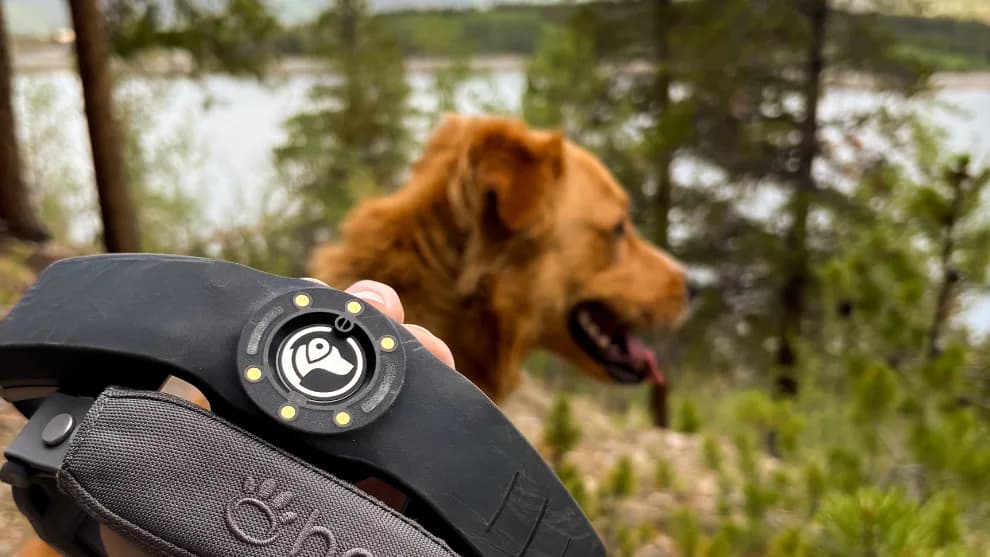
Camping with dogs looks effortless in other people's photos and goes sideways in your own first attempt. The dog who is perfect in the backyard barks at every headlamp that passes the site. The dog who never wanders at home discovers that a forest smells considerably more interesting than you do. None of that means the trip was a mistake. It means the preparation happened at the campground instead of at home, and the campground is the expensive place to figure things out.
This guide is the preparation. It covers how to confirm a campground actually allows dogs and whose rules you are reading, what to pack and why, where your dog physically sleeps, how much water to carry, how to handle heat and hot ground, what to do about ticks and wildlife, and how to give your dog real freedom at camp without breaking a single posted rule. It is written to be followed in order, starting weeks before you leave.
- 1Confirm the specific campground's pet policy by phone, not by a third-party listing, because land managers set very different default rules.
- 2Run a three-stage readiness ramp at home before you book anything, so the first night out is not the first test.
- 3Plan sleeping deliberately: an insulated pad, a defined spot, and a plan for cold ground matter more than any other piece of gear.
- 4A SpotOn boundary gives real off-leash freedom where you have the room for it, meaning dispersed sites, private land, and rentals rather than a developed campground pad, and it never replaces a posted leash rule.

Sign up for expert-backed reviews and safety alerts all in one place.
Camping With Dogs: Planning Your First Trip
Yes, taking your dog camping is a good idea for most dogs, with real conditions attached.
A good candidate is a dog who:
- settles in unfamiliar places
- tolerates strangers walking past without escalating
- has reliable recall in open space
- is physically fit enough for the terrain you picked
A dog who is reactive to other dogs on leash, panics in confined spaces, guards food or a sleeping spot, or has never spent a night outside your house is not disqualified forever, but that dog needs the ramp below before a two-hour drive into the woods. Not every dog enjoys camping, and the honest version of this advice is that some dogs are happier boarding with a sitter while you hike.
The mistake almost everyone makes is treating the first trip as the test. It is not. The test happens at home, in three stages, and each stage has a clear pass or postpone decision so you are not guessing.
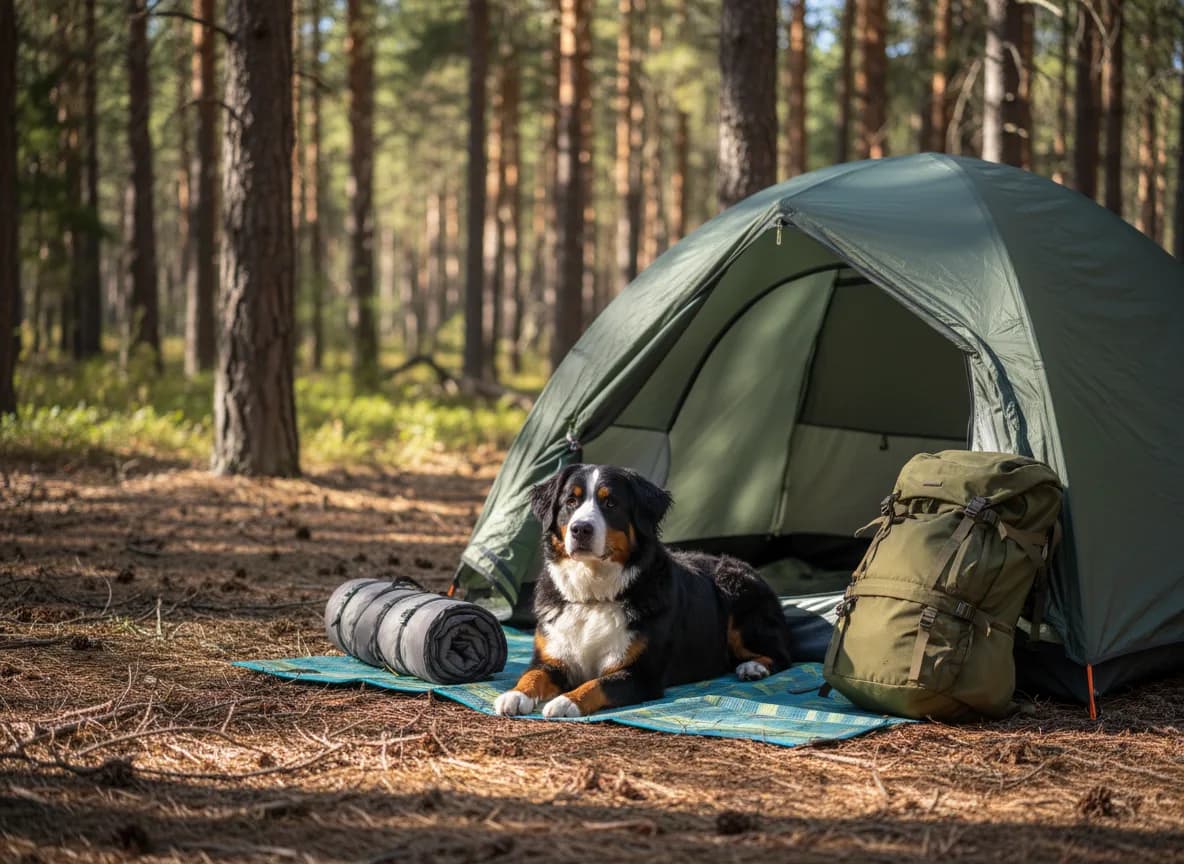
The three-stage readiness ramp
A staged readiness ramp that tells a first timer whether their dog is ready before they book beats any amount of guessing at the campground. Run these three stages in order. Each one ends in a plain pass or postpone decision, so you are not reading tea leaves on a Friday afternoon. Do not skip ahead because one stage went well, and do not book a site until stage three is behind you.
- The backyard tent night. Pitch the tent you will actually use in your own yard and sleep in it with your dog for one full night. You are testing whether your dog will settle in a nylon room instead of patrolling it.
- The nearby day trip. Drive 45 to 90 minutes to a dog-friendly trailhead or day-use area, hike, eat lunch on site, and drive home. You are testing car tolerance, trail manners, and whether your dog will drink and eat away from home.
- The single overnight. Book one overnight at a campground within an hour of your house, ideally on a weeknight when it is quiet. You are testing everything at once with a short escape route.
| Stage | What You Do | Pass Criterion | Postpone If |
|---|---|---|---|
| Stage 1: Backyard tent night | Sleep one full night in your real tent, in your yard | Dog settles within 30 minutes and stays down most of the night | Dog paces, whines, or scratches at the tent wall for hours |
| Stage 2: Nearby day trip | Drive out, hike 2 to 4 miles, eat on site, drive home | Dog drinks water on the trail and rests calmly at the picnic area | Dog refuses water, overheats early, or cannot settle around strangers |
| Stage 3: One overnight | A single night at a close campground, weeknight preferred | Dog sleeps, eats breakfast, and greets passing campers without escalating | Dog barks through the night or cannot be left on a tie-out for five minutes |
Two of these stages cost nothing, and the third costs one night's site fee. That is a very small price to learn, before you book a holiday weekend three states away, that your dog will not sleep in a tent.
The readiness ramp also tells you which kind of trip fits.
- Tent camping with dogs is the most immersive option and the one most dogs adapt to fastest, because you are physically next to them all night.
- RV camping with dogs solves temperature control and gives your dog a familiar den, but it introduces its own problems: a dog left inside a hot RV when the power pedestal trips is a genuine emergency, and many parks explicitly prohibit leaving a pet unattended inside a vehicle or trailer.
- Car camping in between the two is often the easiest first trip, because you can retreat to a climate-controlled vehicle while you are physically present.
Freedom is the part people underestimate. The whole appeal of taking a dog outdoors is watching them move without a six-foot leash spooling behind them, and on land where that is legal and you have space to work with, the portable SpotOn GPS fence is what makes it practical.
Space is the qualifying test: SpotOn recommends a third of an acre or more with at least 80 feet across at the narrowest point, which points this squarely at dispersed camping, private land, a large or rural site, and the cabin or vacation rental you are staying on, rather than a numbered pad in a developed campground. You draw the boundary in the app or walk the perimeter yourself, and your dog gets a defined area instead of a tether radius. On land where leash rules apply, it becomes a second layer behind the leash rather than a replacement for it.
Check Price on SpotOn Exclusive - $75 OffBook the vet homework before you book the site
Two things belong on the list before you book anything: a dog first aid kit that you have actually opened and restocked, and the nearest emergency vet before leaving, saved to your phone as an image rather than a bookmark. Neither is fun to think about, and both take about twenty minutes to sort out at home. Spend those twenty minutes now, because the alternative is hunting for a phone number in a gravel parking lot with one bar of signal and a hurt dog in the back seat.
- Confirm your dog's flea, tick, and heartworm prevention is current for the region and season you are traveling into.
- Ask your vet whether your destination has exposure risks your dog is not covered for, such as leptospirosis in standing water or rattlesnake habitat.
- Save the address and phone number of the nearest 24-hour emergency veterinary hospital to your destination, and screenshot it, because you will not have signal when you need it.
- Photograph your dog's vaccination record and store the image on your phone. Some private campgrounds ask to see proof of rabies vaccination at check-in.
- Update the microchip registry with your current phone number and put a physical tag on the collar with a number that someone can actually reach.
- Cell coverage at most campgrounds is unreliable or absent. A bookmark to an emergency clinic's website is useless without a signal, but a screenshot of the address and phone number works offline and can be shown to a ranger or a neighboring camper who does have service.
The 7-7-7 Rule and What It Means Before You Camp
The 7-7-7 rule is a puppy socialization guideline, not a camping rule. It is a checklist breeders and trainers use in a puppy's early weeks, and the usual version asks that by roughly seven weeks of age a puppy has experienced:
- seven different surfaces
- seven different objects
- seven different locations
- seven different people
- seven challenges or obstacles
- seven different eating containers
- seven separate opportunities to be somewhere new
If you searched for it in a camping context, you probably found a forum thread where someone applied a dog-training term to a trip plan, which is where the confusion starts.
It is still worth knowing, because it explains a lot about why some dogs handle a campground easily and other dogs do not. A dog who never met a bicycle, a tarp flapping in wind, a gravel surface, or a stranger in a wide-brimmed hat during that early window is more likely to find a campground overwhelming. That is not a life sentence. It just means you build the exposure now, deliberately, instead of assuming it happened.
Applying the idea to an adult dog
If you have a puppy, run the real 7-7-7 checklist and bias the seven locations toward outdoor ones. If you have an adult dog, the useful translation is a short exposure list built specifically for camping:
- Surfaces: gravel, wet grass, pine needles, a wooden boardwalk, a metal picnic-table bench, and a nylon tent floor.
- Sounds: a zipper, a camp stove igniting, a generator, an axe splitting wood, and children on bikes.
- Sights: headlamps at night, people in rain shells, kayaks on car roofs, and campfires.
- Handling: having paws touched, being lifted into a vehicle, and wearing a harness for hours at a time.
- Restraint: settling on a long line, settling in a crate, and settling while tied near you at a picnic table.
Work through that list in low-stakes places over a few weeks. A dog who has seen all of it in a city park before the trip is a dramatically calmer dog at a campsite.
The 3-3-3 Rule: What Campers Actually Mean
There is no official 3-3-3 rule for camping. The 3-3-3 rule is a rescue and adoption guideline that describes how a newly adopted dog settles into a home: roughly three days to decompress from the shelter, three weeks to learn the household routine, and three months to feel genuinely at home and show their real personality. Campers borrow it because the shape of the idea fits, and because a search for "3-3-3 rule" surfaces the adoption version.
The borrowed version people actually mean is a decompression curve for the trip itself, and it is a genuinely useful way to set expectations for a first-timer.
- The first three hours at a new site are the loudest. Your dog is cataloguing smells, sounds, and neighbors. Expect alert barking, poor recall, and refusal to lie down. Do not judge the trip on this window.
- The first three days are when a routine forms. Feed at the same times you feed at home, walk the same loop each morning, and put the dog bed in the same spot every evening. Most dogs visibly downshift by day two or three.
- The first three trips are when camping becomes normal rather than novel. By the third outing, most dogs recognize the tent going up as the start of something good and settle before you have the stakes in.
- The single most effective calming tool is not a supplement or a thunder shirt. It is sameness. Same feeding times, same bowl, same bed, same evening walk, same bedtime cue. A dog who recognizes the sequence relaxes into it even when everything around the sequence has changed.
If you adopted your dog recently, honor the real 3-3-3 rule before you try camping. A dog who is still inside their first three weeks in your home does not yet have the bond or the baseline routine that a campground will stress-test. Give it a season.
Finding Campgrounds That Actually Allow Dogs
Searching for camping sites that allow dogs returns thousands of results, and a meaningful share of them are wrong, outdated, or technically true in a way that ruins the trip. A listing that says "pet friendly" can mean dogs are welcome at your site but banned from every trail in the park, which is a very different trip than the one you booked.
The fix is to know who owns the land, because the land manager sets the default policy and the individual unit modifies it.
Check Price on SpotOn Exclusive - $75 OffWho makes the rules where you are going
| Land Manager | Typical Leash Rule | Typical Trail Access | Where Dogs Are Usually Excluded |
|---|---|---|---|
| National Park Service | Leash no longer than 6 feet, always | Limited. Many parks restrict pets to roads, campgrounds, and paved areas | Backcountry, most trails, boardwalks, many water bodies, buildings |
| US Forest Service | Leash generally required in developed campgrounds and day-use areas | Broad. Dogs are permitted on most trails | Some designated swim beaches and posted wildlife closures |
| Bureau of Land Management | Leash generally required in developed recreation sites | Broad, and the most permissive for off-leash on open land | Posted sensitive habitat and developed facility interiors |
| State Parks | Varies by state, commonly a 6-foot leash | Varies widely by state and by individual park | Swim beaches, cabins, buildings, sometimes backcountry sites |
| Private Campgrounds | Leash required, and often a specific maximum length | Property-specific, usually fine on internal roads and trails | Pools, playgrounds, food service areas, sometimes specific loops |
That table is a starting point, not an answer. Those are named land agencies whose dog and leash rules differ from one another in ways that change a trip, so check your own destination against the agency that manages it before you commit. A single national forest can have a district with a posted seasonal closure that the forest as a whole does not have, and a state park system can be permissive statewide while one park bans dogs from its entire trail network.
The National Park Service is the most commonly misunderstood of these, and it is the one that catches people out on a bucket-list trip. Most NPS units require pets to be on a leash no longer than 6 feet at all times, and many parks restrict pets from trails, boardwalks, backcountry areas, and bodies of water entirely. National parks also state plainly that you should never leave a pet unattended, and especially never in a hot vehicle.
If your dream trip is a famous national park, check the pet page for that specific park before you commit, because "we drove eleven hours and the dog cannot leave the parking lot" is a real outcome.
The two details that decide the trip
Start with the fact that leash laws are set by the land manager, not by the campground host, and they are enforceable regulations rather than campground etiquette. A leash law is written into the regulations for that specific unit, which is why the rule can change between two campgrounds twenty minutes apart. A ranger or officer can issue a citation for an off-leash dog in a leashed area, and at some units a repeat violation ends your stay, so the posted length is a legal limit and not a suggestion you can negotiate.
Two things then determine whether a trip works: leash length and trail access.
- Leash length decides how you physically manage your dog around camp, and a 6-foot maximum rules out the retractable leads a lot of people default to.
- Trail access decides whether the dog comes on the hike or waits in the car, and it is the single most important thing to verify before booking, because it changes the entire shape of the trip.
Dispersed camping on national forest or BLM land is the other end of the spectrum, and it is where camping with a dog gets genuinely relaxing. Dispersed camping means camping outside a developed campground, on public land where it is permitted, with no facilities, no neighbors thirty feet away, and usually no leash requirement outside developed recreation sites. It comes with real responsibilities around fire, waste, and wildlife, and it demands a dog with reliable recall, but it is the setting where a dog can legitimately be off leash.
How to actually verify a campground
When you search camping with dogs near me and find a promising site, run this sequence before you pay.
- Find the official page for that exact unit, not an aggregator listing, and read the pet section.
- Call the ranger station or campground office and ask three specific questions: are dogs allowed on the trails, is there a leash length limit, and is there a limit on the number of dogs per site.
- Ask whether dogs may be left unattended at a site at all, even crated, because many properties say no under any circumstances.
- For private campgrounds, ask about the pet fee, which commonly runs a few dollars per pet per night, and about any breed or size restrictions.
- Ask which loops or sites are pet-designated, because some campgrounds confine dogs to specific loops and those sites book out first.
- Third-party booking sites and aggregator directories are frequently out of date on pet policy, and a stale "pet friendly" tag is not a defense at check-in. One five-minute phone call to the campground office or ranger station replaces every listing you read, and it is the only source that reflects a policy that changed last season.
Book early either way. Pet-designated loops and the quiet end sites that suit a reactive dog are the first things gone on any popular weekend.
The Dog Camping Packing List
A packing checklist organized by category is far easier to work from than one long list, so the camping with dogs gear below divides into six groups. Pack each category into its own stuff sack and you can tell at a glance what is missing before you close the tailgate, instead of discovering it two hours down the highway. Everything here fits in a single medium duffel for most dogs.
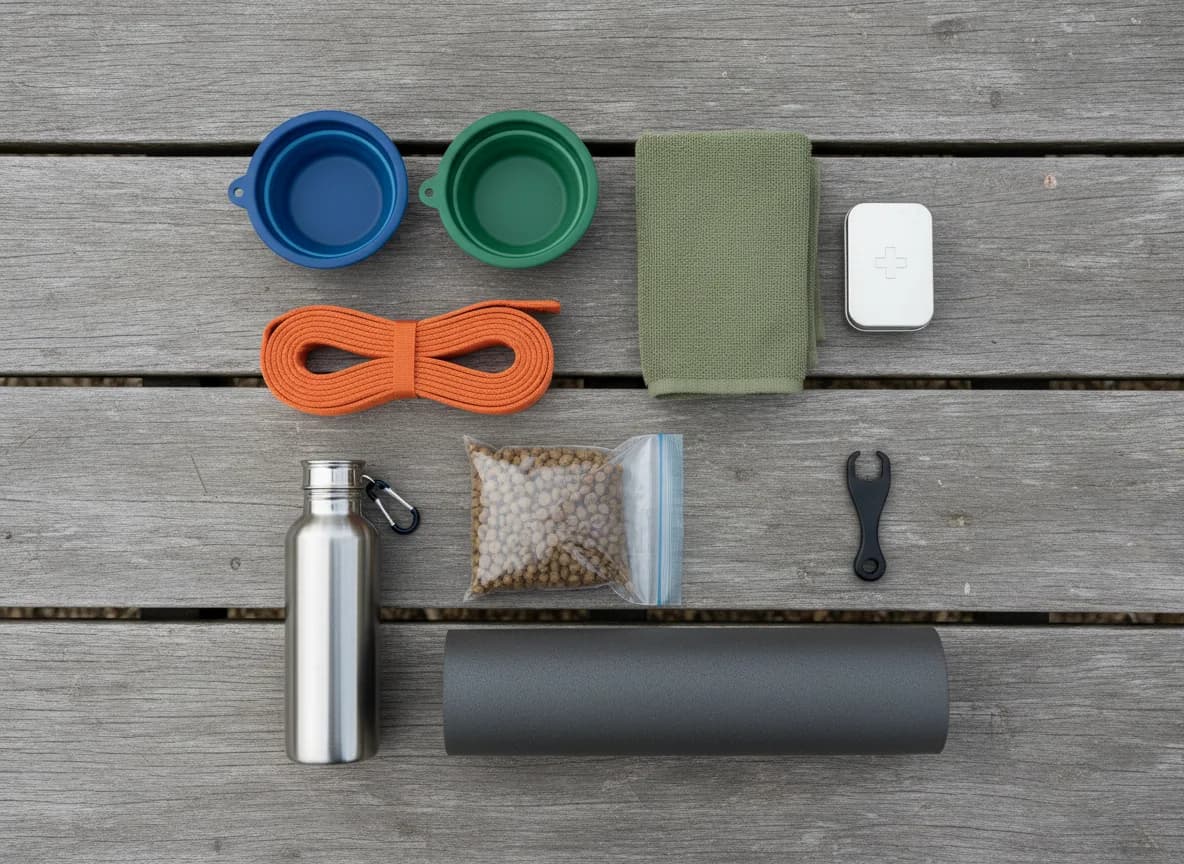
Food, water, and feeding
- Measured food in a sealed, rodent-proof container, plus two extra days' worth in case you get weathered in.
- A collapsible bowl for the trail and a heavier, tip-resistant bowl for camp.
- More water than you think, carried in a dedicated container that is not the human water jug.
- A water filter or purification method if you plan to refill from a stream, because your dog should not drink untreated surface water any more than you should.
- Familiar treats for recall practice, which will be harder in a place full of new smells.
Sleeping and comfort
- A dog camping bed or a packable foam pad that insulates from the ground.
- A portable dog bed for camping that rolls small is worth the money over folding a spare blanket, because a blanket flattens and stops insulating by midnight.
- A blanket the dog already sleeps on at home, unwashed, because the smell is the point.
- A dog-specific sleeping bag or fleece layer for shoulder-season nights.
- A towel for wet paws, mud, and the inevitable creek incident.
Leashes, restraint, and identification
- A fixed-length dog camping leash of 6 feet or shorter that satisfies the strictest rule you might encounter.
- A 20 to 30 foot long line for controlled freedom around camp.
- A well-fitted harness, because a collar alone is easier for a startled dog to back out of.
- A tie-out stake or a cable run rated well above your dog's weight.
- ID tags with a working phone number, plus a light-up or reflective collar for after dark.
Health, hygiene, and cleanup
- A dog first aid kit: gauze, self-adhesive wrap, blunt scissors, tweezers or a tick remover, antiseptic wipes, saline eye wash, a digital thermometer, and a spare set of your dog's medications.
- Waste bags, more than you think, and a sealable bag or container for packing them out where there is no trash service.
- A brush, because pulling burrs and foxtails out of a coat at night is easier with a tool.
- Paw balm or wax for hot ground and rough rock.
- Any prescription medication in its original labeled container.
Weather and terrain add-ons
- A rain shell if your dog has a thin coat and you are traveling into wet weather.
- Booties if the terrain is sharp lava rock, hot sand, or ice, introduced at home first so they are not a novelty on the trail.
- A cooling mat or a wet bandana for hot afternoons.
- A headlamp with a red mode so you can check on your dog at night without lighting up the whole campsite.
Containment and freedom
- A portable exercise pen or soft-sided crate for the site.
- A GPS collar or tracker if you are going anywhere with poor cell coverage.
- A SpotOn GPS boundary that travels with you if your trip includes land where off-leash is permitted and you have at least a third of an acre to map, which is the single biggest quality-of-life upgrade for both of you on that kind of site.
Containment is the one category worth deciding before you leave rather than improvising at the site. A stake and a cable weigh almost nothing and cost almost nothing, so pack them regardless. If your trip includes land where off-leash is legal and open enough to map a boundary on, packing a SpotOn GPS fence collar alongside the leash means you are not choosing between total control and no control, which is the choice most campers end up stuck with by the second afternoon.
- Load your dog's duffel into the vehicle after everything else so it comes out first at the site. Setting up your dog's bed, water, and shade before you pitch the tent gives your dog somewhere to be while you work, and a dog who has a defined place is a dog who is not underfoot around stakes, guy lines, and a hot stove.
Where Your Dog Sleeps: Tents, Pads, and Crates
Where the dog actually sleeps at camp comes down to three realistic setups: tents, insulated pads and crates. Your dog should sleep inside the tent with you, on an insulated sleeping pad, in a defined spot you set up before dark, and that is the answer for the large majority of dogs and trips.
Sleeping in the tent keeps your dog warm, keeps them from reacting to every sound outside, keeps wildlife from investigating them, and prevents the barking that gets people asked to leave. The pad matters as much as the tent, because cold ground pulls heat out of a sleeping dog far faster than cold air does.
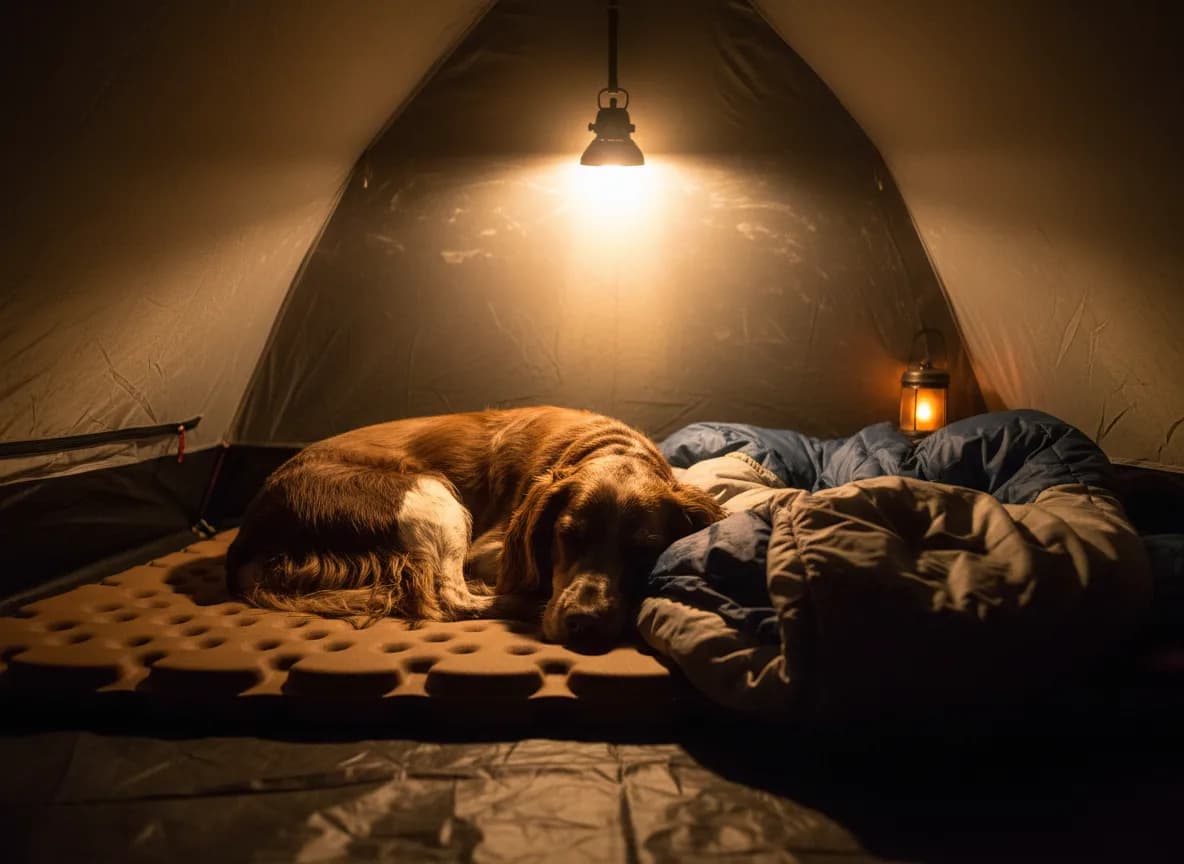
This is the part four of the six top-ranking guides on this topic barely mention, despite it being the thing that decides whether anyone sleeps. Here is how the realistic options compare.
| Setup | Best For | Watch Out For |
|---|---|---|
| Inside your tent on an insulated pad | Almost every dog and almost every trip | Claw damage to the floor, so bring a groundsheet or a thick pad |
| A separate dog tent alongside yours | Large dogs, multi-dog households, very muddy trips | Dogs who panic when separated, and cold nights with no shared body heat |
| A soft-sided crate inside the tent vestibule | Dogs who are crate-trained and settle better enclosed | Fabric crates are not escape-proof for a determined dog |
| A hard crate in an RV or trailer | RV camping, hot or cold weather, dogs who need a den | Temperature failure when power drops, and unattended-pet rules |
| The vehicle, with you present | Emergency weather, or a dog who cannot settle in nylon | Never as a substitute for supervision, and never in heat |
Making the tent work
Measure before you buy. A dog needs the floor space of roughly one extra person, so a two-person tent with a medium dog is a two-person tent with no gear space. Sizing up one person over your headcount is the simplest fix, and it also gives you a vestibule for muddy paws.
A dedicated dog tent is a real category and it solves specific problems. An outdoor dog tent gives a large or double-coated dog their own shaded space during the day, keeps a wet dog out of your sleeping area, and gives multi-dog households a second room. The catch is separation. A dog who is anxious alone will not settle in a separate shelter, and on a cold night, two bodies in one tent is meaningfully warmer than one body in each.
Crates are the other reliable answer, and a dog camping crate does more than contain. For a crate-trained dog, the crate is the familiar object that makes a strange place feel normal, which is exactly what you want on night one. A soft-sided crate packs down and is fine for a settled dog. An RV dog crate should be a hard-sided model that is strapped or braced so it cannot slide in transit, positioned away from windows that get direct afternoon sun.
Cold ground is the actual enemy
Three practical rules cover almost all of it.
- Put something between your dog and the ground, always, even in summer. A closed-cell foam pad costs very little and does most of the work.
- Add a layer over the dog, not just under, once overnight lows drop below the mid-40s Fahrenheit, and pay extra attention to thin-coated, small, senior, and very young dogs.
- Set the spot up before dark and let your dog investigate it while there is still light, so bedtime is not the first time they see it.
A dog who wakes up cold at 2 a.m. will pace, whine, or try to get into your sleeping bag, and every one of those outcomes ends the night for both of you. The pad is not an accessory.
Keeping Your Dog Safe at Camp Without a Fence
Camp has no fence, and that single fact drives most of the stress of the first trip. Your options are a leash in hand, a tie-out, a long line, a pen, a portable boundary, or some combination, and each of them suits a different kind of site, a different kind of dog, and a different set of rules.
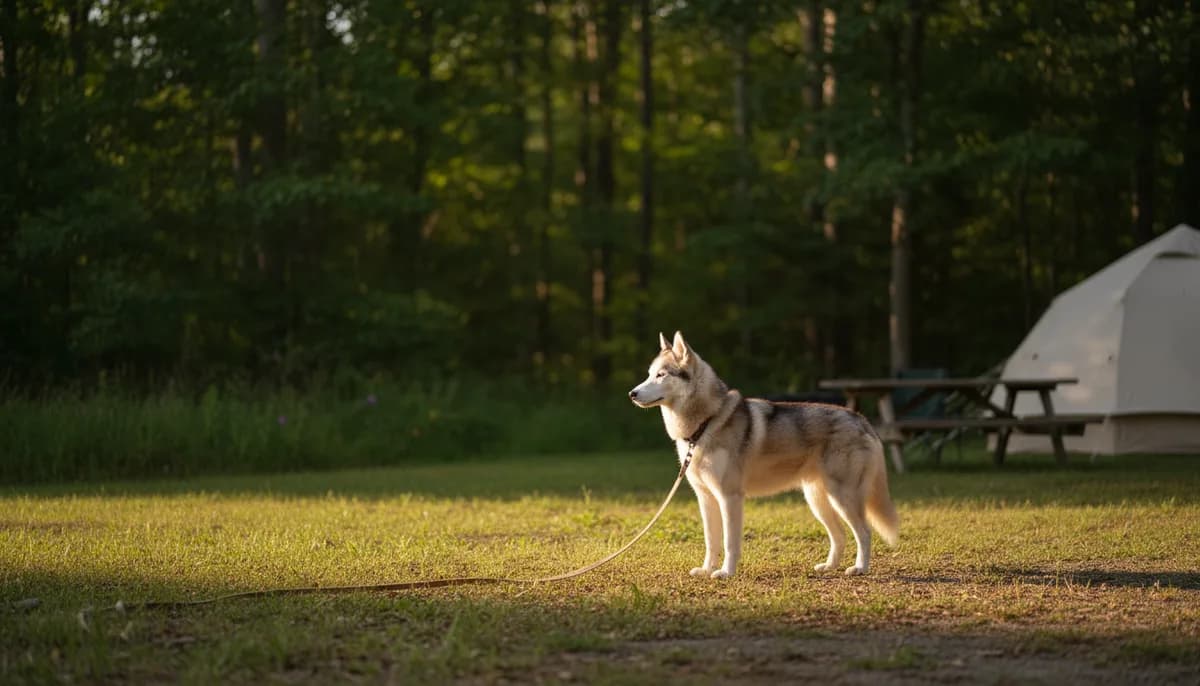
The honest comparison
- Leash in hand. Total control, universally legal, and exhausting. It works, but it means one adult is always physically attached to the dog, which is not realistic across a full weekend.
- Tie-out stake or cable run. Cheap and simple. A tie-out is fine for a calm dog in soft ground, but stakes pull out under a hard lunge, cables wrap around table legs and human ankles, and a tangled dog can panic. Never leave a dog on one unattended.
- Long line. A 20 to 30 foot long line is the most universally legal option, because it still counts as a leash almost everywhere while giving your dog real movement, which is why it works on a developed pad where nothing else does. The downside is that it collects dirt, tangles in brush, caps your dog's range at its own length, and will trip you at least once per trip.
- Exercise pen or portable kennel. A pen gives your dog a contained area they can move around in without dragging anything, and it is the right answer for a dog who does not settle tethered. It is bulky, it does not contain a climber, and it takes up site space.
- Portable boundary. A SpotOn GPS fence collar lets you map a custom area on the spot, so your dog moves freely inside a shape you chose rather than a circle around a stake. It needs real ground to work with, so it is the answer for dispersed, rural, private, and rental stays rather than for a numbered campground pad. If you're camping beyond cell service, SpotOn's Off-Grid Mode lets you create and use a virtual fence without cellular coverage or Wi-Fi, making it especially useful for overlanding, boondocking, and remote BLM or National Forest camping. On those stays, it is the closest thing to a fence you can carry.
Where SpotOn genuinely wins
The containment-hardware category is bigger than one article can cover well. An outdoor dog kennel panel system, a permanent kennel run, a trailer-mounted hitch tie-out, and the various RV dog kennel ideas people build into their rigs all solve versions of this problem, and they differ enormously in price, portability, and how much of your payload they eat.
If GPS containment is the route you are weighing, start with our hands-on SpotOn GPS fence review, which is the system we have actually put through setup, training, and real use, and treat our best GPS dog fences roundup as the wider-category reference alongside it. This section is about which approach fits which trip.
Start with the space test, because it decides everything else. SpotOn recommends a third of an acre or more, with at least 80 feet across at the narrowest point, and the perimeter set at least 15 feet back from hazards. That rules out a standard developed campground pad. What it describes almost exactly is:
- dispersed camping on national forest or BLM land
- private property
- large or rural sites
- cabin or vacation rentals where you have the run of the grounds
If your stay clears that bar, the SpotOn GPS fence collar earns its keep: you draw the boundary in the app or walk the perimeter yourself, there is no digging and no wire to bury, and containment works with no subscription required. At $999 it is a real purchase, so run the space test honestly before you buy rather than after. If your stay does not clear it, the leash, the long line, and the pen are the setup, and they are perfectly good answers on a developed site.
- This is a safety and a legal line, and it is not negotiable. If a campground, park, trail, or land manager posts a leash requirement, your dog must be on a physical leash, regardless of what collar they are wearing. A GPS boundary is freedom on dispersed and private land, and a backup containment layer everywhere else. Using one to justify an off-leash dog in a leashed area risks a citation, an incident with wildlife or another camper, and the access that dog-friendly campgrounds extend to all of us.
The legal part deserves to be said plainly: leash rules still apply regardless of containment technology, and leash laws written by a land manager are not waived by anything your dog is wearing around their neck. A GPS boundary never overrides a posted rule.
In a developed campground your dog is on the leash because that is the rule, and the portable boundary is a second layer rather than a first one, sitting behind the leash as insurance for the moment the leash is dropped, the door is left open, or a startled dog slips a harness. That is a real benefit, and it is worth having, and it is worth being clear with yourself that it is a different benefit than off-leash freedom so you buy for the trips you actually take.
Check Price on SpotOn Exclusive - $75 OffThe dogs who bolt
The dog most likely to disappear from a campsite is not the wanderer. It is the dog who bolts once, from a specific trigger: a firework, a thunderclap, a deer breaking cover, or another dog charging the site. That is the same escape behavior that shows up at home as fence-jumping and door-dashing, and the fixes overlap almost entirely.
Our guide on how to stop a dog escaping a fenced yard covers the trigger work that matters here too, and it is worth reading before a trip if your dog has ever gotten out at home.
Practical bolt-proofing at camp comes down to a short list.
- Use a harness, not just a collar, and check the fit with the dog standing and pulling backward.
- Keep a second point of attachment, so a slipped collar is not a loose dog.
- Feed and settle your dog inside the tent or vehicle during fireworks-heavy holiday weekends rather than at the picnic table.
- Practice recall on the long line at the site, with high-value food, before you need it in an emergency.
- If you are on land where off-leash is legal and open enough to map, layer a SpotOn boundary that defines the area for you rather than relying on recall alone in an unfamiliar environment.
The pattern behind all of that is layering. One point of failure is a loose dog, and two points of failure almost never happen at the same moment. A harness plus a leash is a layer. A leash plus a long line at camp is a layer. On dispersed or private land with the acreage to support it, recall training plus a mapped SpotOn boundary is a layer, and it is the one that keeps working when a deer breaks cover and your voice stops being the most interesting thing in the forest.
- Most land managers, including the National Park Service, prohibit leaving a pet unattended, and every one of them prohibits leaving a dog in a hot vehicle. Beyond the rule, an unattended dog barks, and barking is the number one reason dog owners get asked to leave a campground. If someone in your group cannot stay with the dog, the dog comes with you or the outing does not happen.
Heat, Water, and Paw Safety on the Trail
Heat is the hazard most likely to actually hurt your dog on a camping trip, and it is the one people underestimate because they are judging the temperature by how they feel in a t-shirt while wearing shoes.
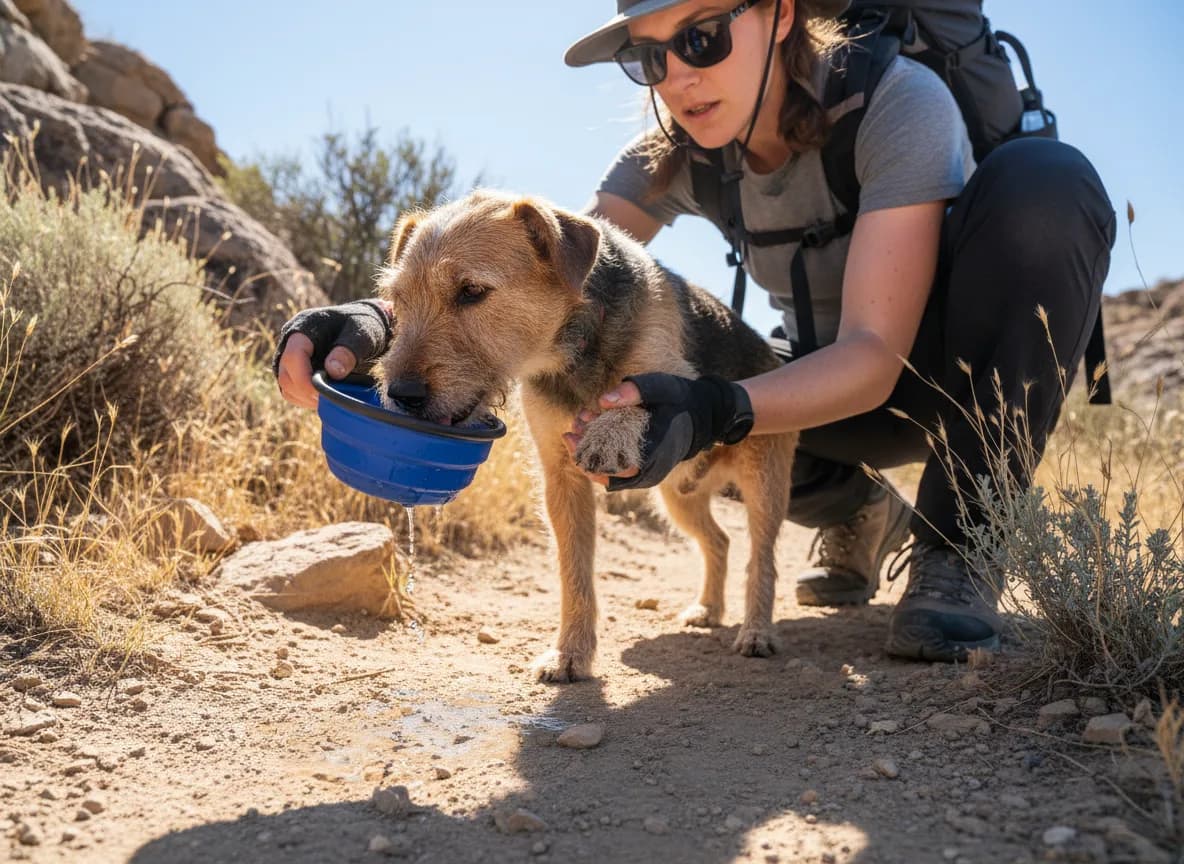
How much water to actually carry
Food and water planning is the one part of the pack worth doing on paper, including how much extra water to carry for the dog specifically rather than assuming you can share out of the human jug. A widely used rule of thumb is roughly one ounce of water per pound of body weight per day for a dog at rest, and meaningfully more on a hot, active day. Treat this as a packing baseline rather than a medical prescription, and ask your vet if your dog has a condition that changes their needs.
| Dog Weight | Baseline Daily Water (Rest) | Plan For a Hot, Active Day |
|---|---|---|
| 20 lb | About 20 oz, roughly 0.6 liters | Around 1 to 1.2 liters |
| 40 lb | About 40 oz, roughly 1.2 liters | Around 2 to 2.4 liters |
| 60 lb | About 60 oz, roughly 1.8 liters | Around 3 to 3.6 liters |
| 80 lb | About 80 oz, roughly 2.4 liters | Around 4 to 4.8 liters |
Carry that volume in a container that is dedicated to the dog, so nobody has to ration. Offer water every twenty to thirty minutes on the trail rather than waiting for your dog to look thirsty, because many dogs will keep working past the point where they should have stopped to drink.
Recognizing overheating early
Heat exhaustion becomes heat stroke faster than most people expect, and the early signs are easy to explain away as normal excitement. Heat stroke in a dog usually announces itself as heavy panting that does not slow down once you stop walking, gums that look bright red rather than healthy pink, and unsteadiness on their feet. If you see that combination, stop the hike immediately, get your dog into deep shade, and start cooling them with water while you call the emergency vet. Stop and cool your dog if you see:
- Heavy, frantic panting that does not slow down when you stop moving.
- Thick, ropey drool, or gums that look bright red or unusually dry.
- Slowing down, lagging behind, or lying down and refusing to get up.
- Wobbling, a drunken gait, or any loss of coordination.
- Vomiting, diarrhea, or vacant staring.
If you see the last two groups, this is an emergency. Move to shade immediately, pour cool (not ice-cold) water over the belly, armpits, groin, and paws, offer small amounts to drink, and get to the emergency vet you screenshotted before you left. Do not wrap a hot dog in a wet towel and leave it on, because a saturated towel traps heat once it warms up.
- Press the back of your hand flat against the ground and hold it. If you cannot keep it there for seven seconds, the surface is too hot for paw pads. Asphalt, bare rock, sand, and metal boat ramps hold heat long after the air has cooled, so a 7 p.m. walk on a road that baked all afternoon can still burn. Grass, dirt, and shaded trail are almost always the safer route.
Paws, pads, and terrain
Paw pads are tough but they are not armor, and the two failure modes are heat and abrasion. Hot surfaces cause burns that show up hours later as red, blistered, or peeling pads. Sharp rock, lava, ice crust, and long miles on gravel cause wear that shows up as a limp on day two.
Check your dog's paw pads every single evening, with a headlamp, one foot at a time. You are looking for:
- cracks
- embedded gravel
- foxtails wedged between toes
- torn nails
- any redness at the pad edges
Apply paw balm before a long day on abrasive terrain, not after. If you plan to use booties, buy them well in advance and let your dog wear them around the house until walking in them is boring, because a dog experiencing booties for the first time on a trail will spend the day shaking their feet instead of hiking.
Build the day around the heat rather than fighting it. Hike early, take a long midday break in real shade, and go out again in the evening. A cooling mat or a soaked bandana helps at camp, but shade and rest do more than any product. The freedom part matters here too: on a site with the room to map one, a dog with the run of a SpotOn boundary that includes both sun and shade will self-regulate by moving between them, which a dog clipped to a stake in one spot cannot do.
Check Price on SpotOn Exclusive - $75 OffTicks, Wildlife, and the Post-Trip Check
Wildlife encounters make the better stories, but ticks are the thing that will actually follow you home. Managing wildlife and tick exposure comes down to the same two habits: control where your dog can go, and check them thoroughly every night. Build that check into a routine you run at the same point every evening, then repeat it as a post-trip check when you unpack at home, because tick exposure picked up on one trip can show up days after the trip itself is over.
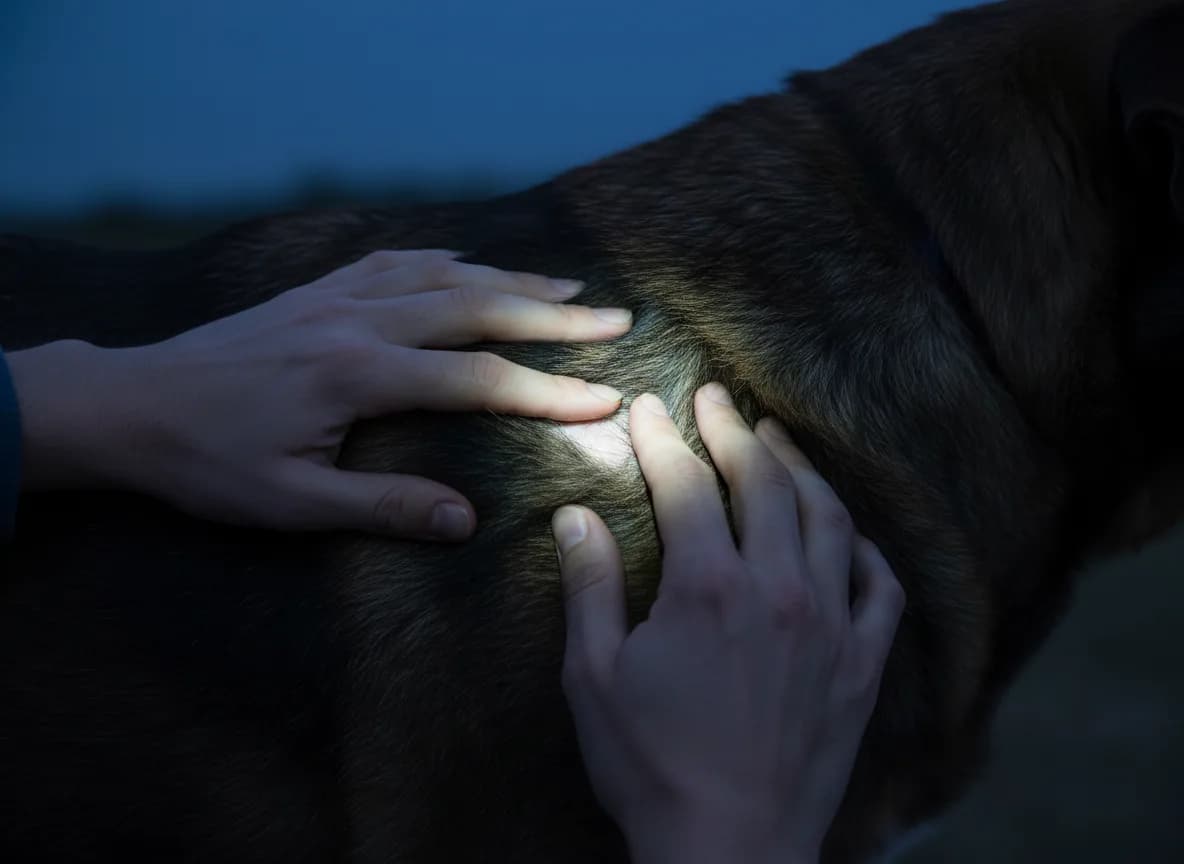
Wildlife: keeping the encounter from happening
The goal is never to win a wildlife encounter. It is to not have one.
- Store food, dog food, treats, and dishes exactly the way the campground tells you to, in a locker, a hard-sided vehicle, or a hang. Dog food is bear food.
- Wash bowls after every meal and do not leave a full bowl out overnight. A dish of kibble is an invitation to raccoons, and raccoons carry parasites your dog does not want.
- Keep your dog leashed or inside a defined boundary at dawn and dusk, when most wildlife moves.
- Never let your dog chase anything, even something small and apparently harmless. A dog who chases a deer can run themselves miles from camp in minutes.
- Learn the specific local risks before you go: rattlesnakes, porcupines, skunks, moose, and coyotes all have different avoidance strategies and different first-response steps.
- Sleep your dog inside the tent, which removes the entire category of overnight encounters.
Dawn and dusk are the windows that matter most, and they are also the windows when you are cooking, packing, or half asleep and least able to watch closely. On dispersed or private land with enough open ground to map, this is exactly where a SpotOn boundary you map on arrival does the watching for you, holding your dog inside the area you defined while you have both hands on a camp stove.
If your dog does tangle with wildlife, get them under physical control first, then assess. Porcupine quills and snake bites are both emergency vet visits, not roadside fixes, and pulling quills yourself usually makes the extraction worse.
The nightly tick check
Do this every night at camp and again the day you get home. It takes four minutes with a headlamp and it is the highest-value habit in this entire guide.
- Run your hands slowly over the whole dog, against the direction of the coat, feeling for bumps.
- Check inside and behind both ears, and along the ear margins.
- Check between every toe and around the pads.
- Check the armpits, the groin, and the base of the tail.
- Check under the collar and harness, which is where ticks are most often missed.
- Check the eyelids and lips, which people almost never think to look at.
To remove a tick, use fine-tipped tweezers or a tick remover, grasp as close to the skin as possible, and pull straight out with steady pressure. Do not twist, do not burn it, and do not smother it in petroleum jelly. Clean the area, wash your hands, and note the date. If your dog develops lethargy, lameness that shifts between legs, a fever, or loss of appetite in the following weeks, tell your vet about the tick and the region you were in.
The post-trip check, and leaving the site right
Camping with dogs is a privilege that campgrounds extend, and it survives on how the last group behaved. Pick up every single piece of waste, including the ones at the far edge of the tie-out radius that nobody sees. Pack it out where there is no trash service. Do a fur sweep of your tent and vehicle before you drive off, and walk the site perimeter one final time for chew toy fragments, food, and bag corners.
When you get home, run one more full tick check, wash the bedding, rinse and inspect the paws, and give your dog a quiet day. Note what worked and what did not while it is fresh: the pad that was too thin, the leash that was too long for the rule, the bowl that tipped. That list is what makes the second trip twice as easy as the first, and it is why most people say their third trip was the one where they finally relaxed.
Almost never. Most developed campgrounds and nearly all public land agencies require a physical leash, commonly no longer than 6 feet. Legal off-leash time generally happens on dispersed public land where no leash rule is posted, or on private property. A SpotOn boundary gives your dog freedom in those places, provided you have the ground to map one, and works as a backup layer everywhere else, but it does not change a posted rule.
Not around a standard developed campground pad, because the space is not there. SpotOn recommends a third of an acre or more with at least 80 feet across at the narrowest point, plus a perimeter set at least 15 feet back from hazards, which is far more room than a numbered site gives you. Where a GPS fence does fit is dispersed camping, private land, large or rural sites, and cabin or vacation rentals where you have the run of the grounds. On a developed site, plan on a 6-foot leash, a 20 to 30 foot long line, or an exercise pen instead.
Inside the tent, on an insulated pad, for almost every dog and trip. It keeps your dog warm, reduces overnight barking, and removes the risk of a wildlife encounter while you are asleep.
A common planning rule of thumb is about one ounce per pound of body weight per day at rest, and roughly double that on a hot, active day. Carry it in a container dedicated to the dog so nobody has to ration.
Private campgrounds commonly charge a small per-pet, per-night fee and may limit the number or size of dogs. Public campgrounds usually do not charge a pet fee but often have stricter rules about where dogs may go. Ask when you book.
Barking is the most common reason dog owners are asked to leave. Sleep your dog inside the tent, keep the routine identical to home, exercise them well before dark, and run the backyard and single-overnight stages of the readiness ramp before booking a longer trip.
Wait until your puppy has completed their core vaccination series and your vet has cleared them for public spaces, and keep the first trips short, close, and warm. Puppies lose body heat quickly and tire fast.

Coreen Saito is a pet writer and longtime shelter volunteer with more than a decade in animal rescue. She covers cat behavior, breed care, and the small, ordinary science of sharing a life with companion animals, with a particular focus on honest takes about the products and decisions that actually matter. At home in Arizona, she's outranked by Mac (a dog with the loudest opinion in the house), Rebel (a cat who governs by quiet authority), and Meri (an orange tabby who runs the late shift and the laundry basket). She writes about all three, plus the rescues that keep coming through her life, at LifeWithMinty.com.
Sign up for expert-backed reviews and safety alerts all in one place.



A Final Word (Disclaimer)
At Petful, our review integrity is paramount; we never exchange special treatment in our reviews for monetary or material rewards.
Nonetheless, when our readers click through to online merchants (including Chewy or Amazon), we receive a referral commission. This supports the running of our free blog, and we appreciate your backing.