Best Dog Ear Wipes: When Wipes Beat a Rinse
Compare four dog ear wipes by format, ingredients, age guidance, and practical limits. Learn when a surface wipe is useful, when liquid cleaning differs, and when your dog needs a vet.

BVMS, MRCVS
Petful is reader supported. As an affiliate of platforms like Amazon and Chewy, we may earn a commission when you buy through links on this page. There is no extra cost to you.
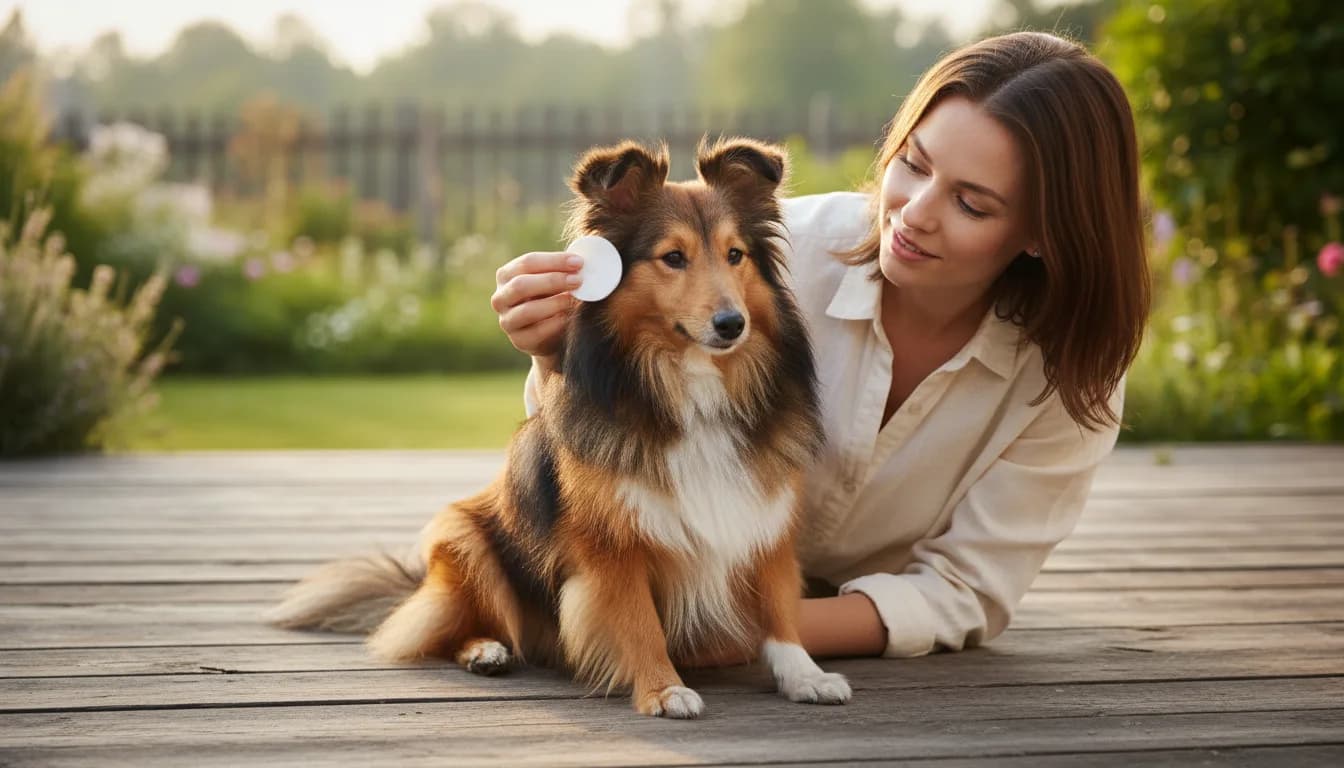
Dog ear wipes can make a small outer-ear cleanup simpler. The best choice depends on the format you can handle gently, the exact ingredients, and your dog's age and ear history. Pet MD offers a familiar flat pad; ZYMOX provides another pre-moistened pad option; Vet's Best uses a finger sleeve; and Scrubby offers a larger-count textured wipe package.
Wipes are for accessible surfaces. They cannot flush debris from the ear canal or diagnose the cause of odor, pain, or discharge. This comparison uses manufacturer information and veterinary guidance, with a clear reason to consider each pick. We have not conducted a hands-on comparison or used these products to treat dogs.

Sign up for expert-backed reviews and safety alerts all in one place.
Which dog ear wipes fit your routine?
The best dog ear cleaning wipes fit the task, so start with where the dirt is. A wipe can suit a little visible debris on a comfortable dog's ear flap. Reviews can describe someone's experience but cannot tell you whether your dog needs a liquid cleaner, medical assessment, or no additional cleaning. If material comes from deeper in the ear, keeps returning, or accompanies discomfort, choosing a different wipe is not the first decision.
| Ear wipe | Format and selected count | Reason to consider it | Label detail to check |
|---|---|---|---|
| Pet MD Aloe Vera & Eucalyptus | Flat pads, 100 count | Straightforward accessible-surface cleanup | Dogs over 12 weeks; fragrance and benzyl alcohol listed |
| ZYMOX Advanced Enzymatic Ear Wipes | Pre-moistened pads, 100 count | An alternative pad formulation | Ingredient list includes witch hazel and benzyl alcohol; do not reuse |
| Vet's Best Ear Relief Finger Wipes | Finger sleeves, 50 count | A format you wear on a finger for visible surfaces | Contains Alcohol; never insert the covered finger into the canal |
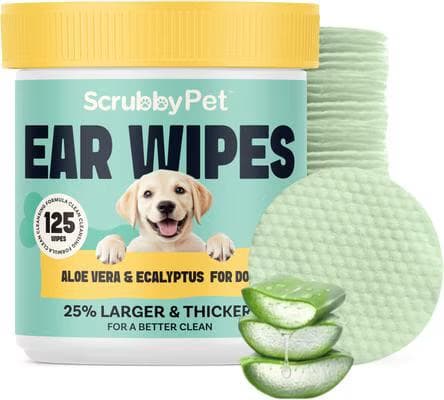
| Scrubby Aloe Vera & Eucalyptus | Textured wipes, 125 count | More wipes per selected package | Obtain the full ingredient list and age guidance if those affect your choice |
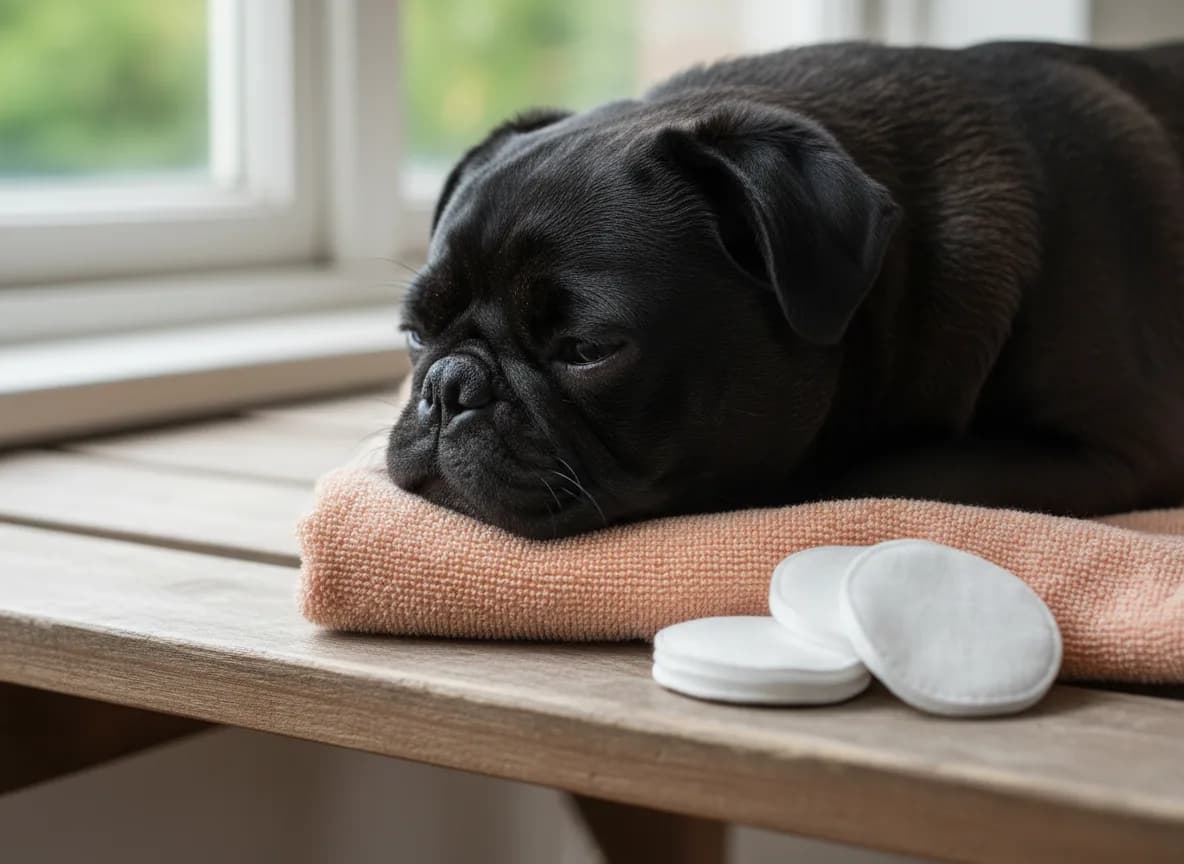
All four can be compared as ear-wipe purchases, but they are not identical products. The count tells you how many wipes are supplied; it does not tell you how many cleaning sessions the pack will provide. The formula and the accessible area you need to clean matter before pack size or scent.
- Choose a flat pad if you prefer holding or folding a wipe against the broad visible ear flap.
- Consider a finger sleeve if that format helps you control a light surface movement without pushing toward the ear opening.
- Check the complete label when your dog is young, has reacted to grooming products, or follows an existing ear-treatment plan.
- Pause shopping for a new wipe when the actual problem is a newly painful ear, recurring discharge, or a change that needs veterinary advice.
The useful comparison is which product fits a defined task. A thicker wipe does not authorize firmer rubbing, and a finger-shaped design does not extend the area that is safe to reach. Keep those limits in view as you compare the individual picks.
Our dog ear wipe picks
Compare all four products by format, ingredient information, and label limitations before choosing a pack. These choices cover flat pads and finger sleeves, with a practical reason to consider each and a limitation that may lead you elsewhere. No ranking here means a wipe has been shown to prevent infection in your dog or to outperform a veterinarian's prescribed care.
Pet MD Aloe Vera & Eucalyptus: a familiar flat pad
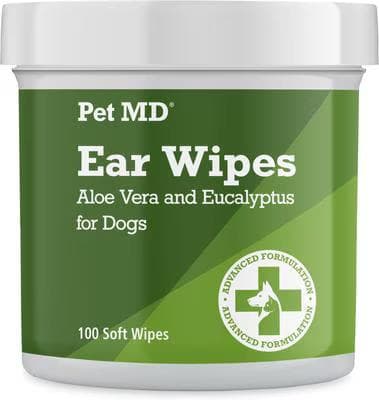
Pet MD Aloe Vera & Eucalyptus Ear Wipes are our straightforward flat-pad option for an owner who wants to clean a small amount of accessible outer-ear dirt. The selected pack contains 100 wipes. The key question is whether that simple pad format and its formulation suit the dog and the surface being cleaned.
The manufacturer's label information specifies dogs over 12 weeks of age and wiping the accessible portion of the ear. Its ingredients include fragrance and benzyl alcohol as well as aloe and eucalyptus. Those details are useful limits, not reasons to assume that any young puppy or dog with sensitive skin can use the product.
- Best fit: A dog who meets the age labeling and needs an occasional accessible-surface cleanup with an appropriate formula.
- Practical advantage: A flat pad gives you a visible cleaning surface you can hold without fitting it onto a finger.
- Tradeoff: A pad still needs to be held securely, and a scented formulation may not be the right choice for a dog with a known ingredient sensitivity.
- Choose differently when: Your puppy is below the labeled age, the ear hurts, or the task requires cleaning inside the canal rather than wiping the flap.
Pet MD's daily-use directions should not be mistaken for proof that your individual dog needs daily wiping. Match use to your veterinarian's advice and the ear's actual condition. If the goal is simply to keep a clean ear smelling like the product, reconsider whether there is a cleaning need at all.
This is a format-based recommendation, not a claim about softness measured in our own test. If you already know that a flat pad is convenient for your hands and your dog tolerates this formulation, replacement buying can be straightforward. If either point is uncertain, avoid purchasing several tubs before discussing the choice.
Petful may earn a commission when you click through to Chewy, at no extra cost to you.
ZYMOX Advanced Enzymatic Ear Wipes: another pad formulation
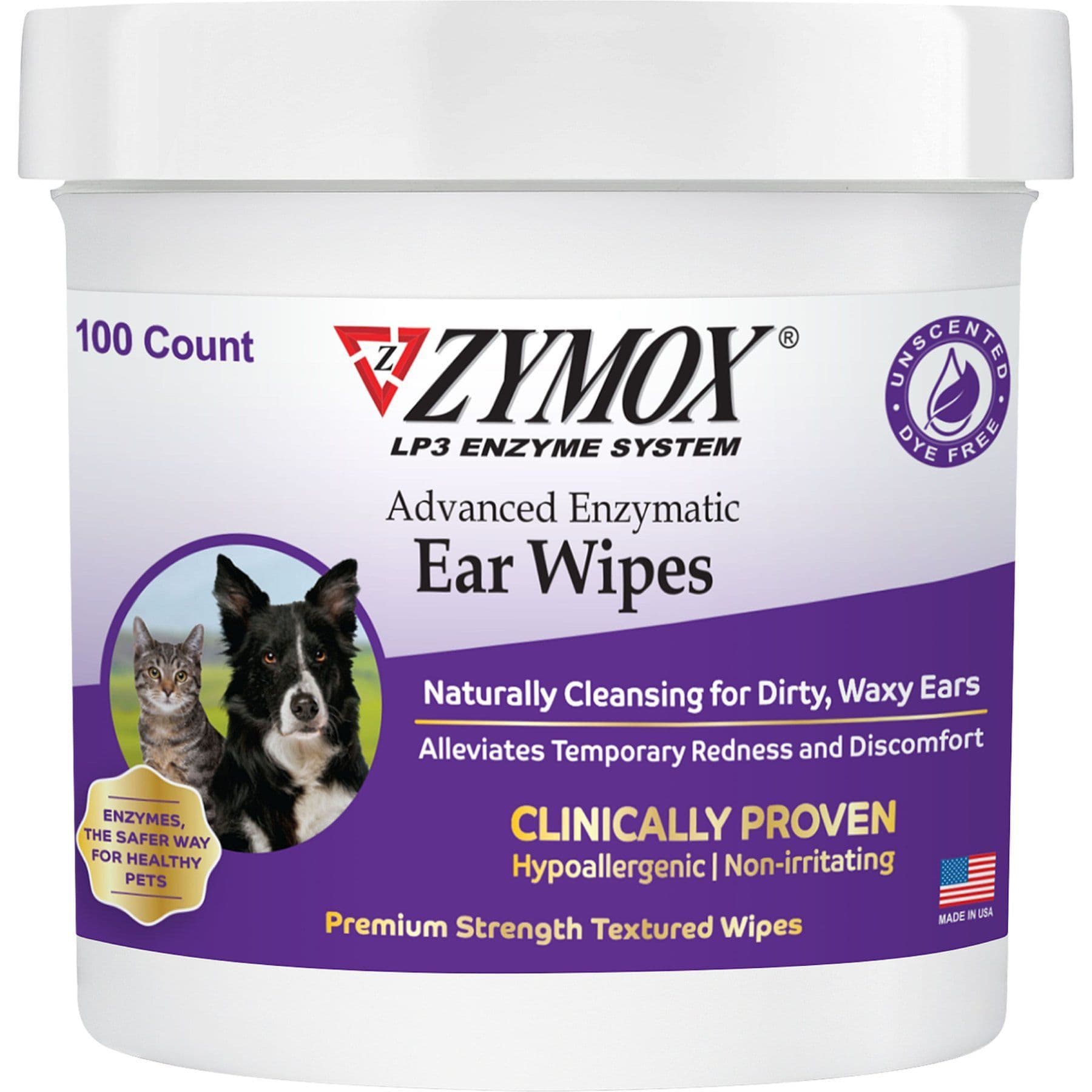
ZYMOX Advanced Enzymatic Ear Wipes are an alternative when you prefer a pre-moistened pad and want to compare a different formulation. The selected pack has 100 wipes. The name should be read in full: these wipes are different from ZYMOX Ear Cleanser, Ear Solution, and Otic products.
The manufacturer's wipe directions specify accessible ear areas and a new wipe when another pass is needed. Its ingredient list includes witch hazel and benzyl alcohol. We therefore do not describe this pick as having no alcohol ingredient, even though the page also uses broad alcohol-free marketing language.
- Best fit: An owner comparing labeled pad formulations for a routine surface-cleaning task, with the dog's tolerances and care plan checked first.
- Practical advantage: It offers a wipe option within the ZYMOX range when a wipe, rather than a liquid, is the appropriate format.
- Tradeoff: Brand familiarity can obscure meaningful product differences. The wipe is not a miniature version of an ear-treatment bottle.
- Choose differently when: You need a canal-cleansing product, are seeking infection treatment, or cannot confirm compatibility with an existing ear regimen.
The enzyme description is a formulation detail, not evidence from a side-by-side trial in this article. We have not measured a benefit over the other wipes. Choose it for a clearly understood role and suitable label, rather than assuming a technical-sounding ingredient system makes every other consideration less important.
If your veterinarian has recommended a ZYMOX treatment, ask separately whether wipes belong in that course. Do not add them because the logo matches. Product-specific instructions matter more than a general expectation that products from one company should work together, and some ear regimens specifically restrict other preparations.
Fragrance-free enzymatic wipes for routine outer-ear cleaning. Wipes do not diagnose or treat a painful ear infection.
Petful may earn a commission when you click through to Chewy, at no extra cost to you.
Vet's Best Ear Relief Finger Wipes: controlled surface wiping
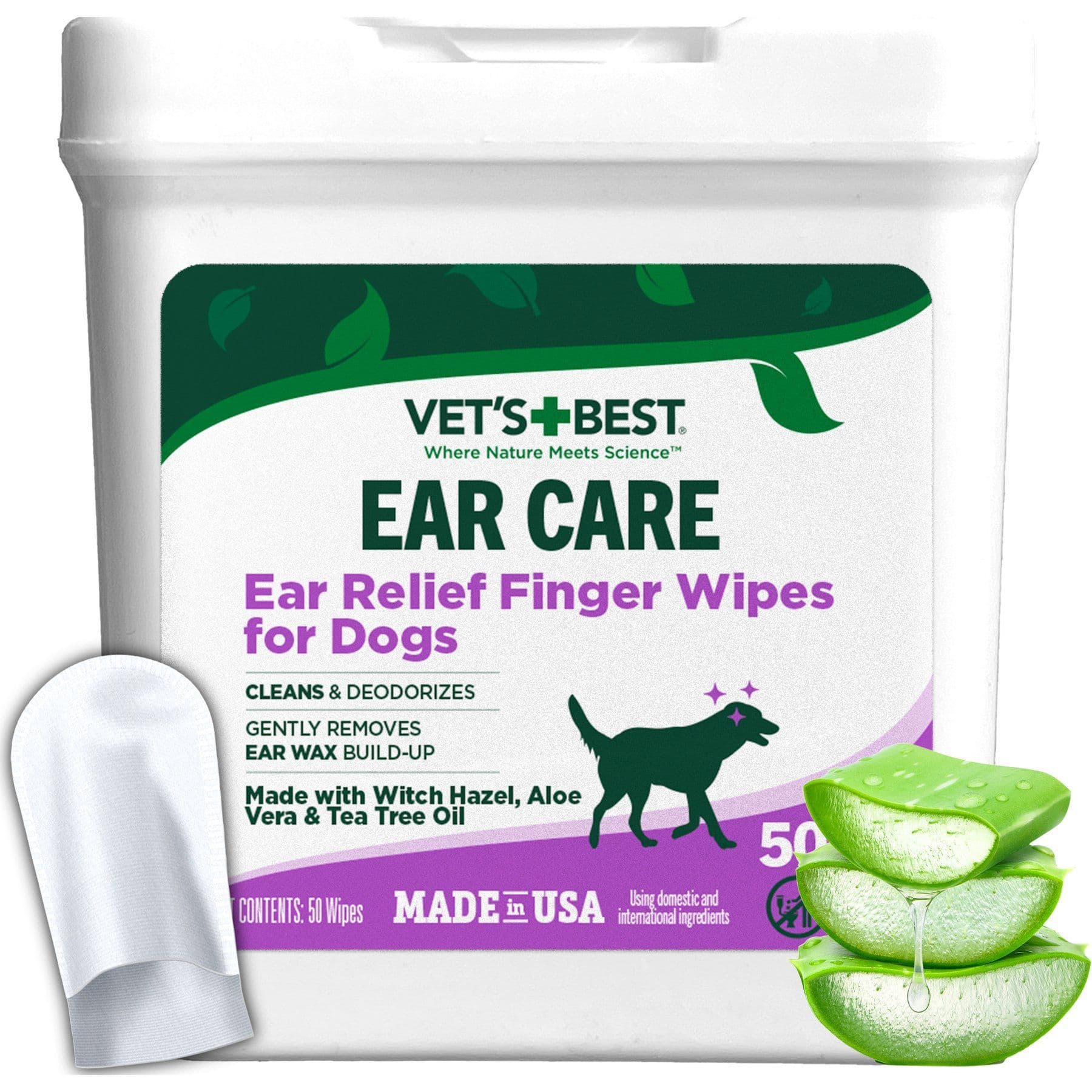
Vet's Best Ear Relief Finger Wipes suit the owner who prefers a sleeve over a loose pad for wiping the visible ear flap. The selected container holds 50 finger wipes. The shape changes how you hold the material, not which parts of the ear you should reach.
The manufacturer's ingredient list includes Alcohol, witch hazel, aloe vera, and tea tree oil. These wipes are not alcohol-free. That is an important distinction from the same company's Ear Relief Wash + Dry formulas. The manufacturer also states that its ear-care products are not intended to treat ear or yeast infections.
- Best fit: Someone who finds the finger-sleeve format easier to control for a gentle, visible surface movement and whose veterinarian considers the formula appropriate.
- Practical advantage: The cleaning material sits on the finger rather than being pinched as a flat pad.
- Tradeoff: A covered fingertip can create a misleading sense that it should be pushed into the opening. Keep it on the accessible outer surface.
- Choose differently when: You need to avoid this formula's ingredients, cannot keep the movement shallow and visible, or are attempting to remove material you cannot readily see.
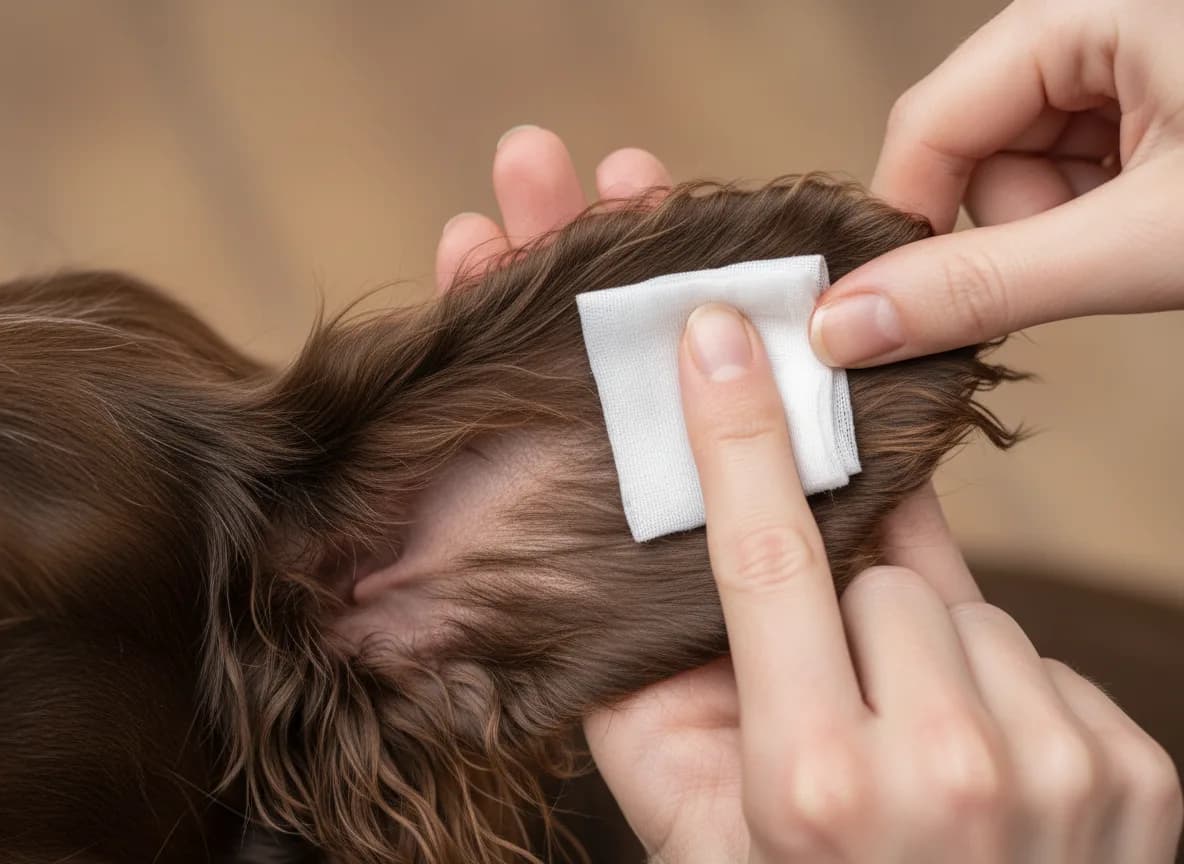
Do not use the finger's reach as the limit of the cleaning area. The relevant boundary is the visible, accessible ear surface. If you find yourself trying to follow a fold toward the canal or sweep around inside an opening, stop and ask your veterinarian to demonstrate the appropriate method.
We have not compared sleeve fit across hand sizes or measured whether users find this easier than a flat pad. Treat format preference as something to evaluate gently, not a guaranteed advantage. An owner who already handles ordinary pads confidently may have no reason to change just because a finger design looks more specialized.
Finger-shaped wipes for cleaning visible outer-ear surfaces. Keep fingers out of the ear canal and stop if your dog shows pain.
Petful may earn a commission when you click through to Chewy, at no extra cost to you.
Scrubby Aloe Vera & Eucalyptus: a larger-count textured option
Scrubby Aloe Vera & Eucalyptus Ear Wipes offer 125 wipes in the selected container, the largest count among these four packs. The official product page describes a textured wipe with aloe and eucalyptus. Consider the product when you want to compare that package size and format, after confirming the formula and age guidance suit your dog.
There is a limit to what can be concluded from the manufacturer's published product description. It uses a hypoallergenic claim but does not provide a complete ingredient list or a numerical minimum age in the text we reviewed. That leaves an important check for owners of young puppies or dogs with known reactions: inspect the current package or ask the manufacturer before buying.
- Best fit: An owner who has confirmed the full label is suitable and expects to use a larger-count container within its storage guidance.
- Practical advantage: More wipes in the selected pack may reduce how often you need to reorder an established product.
- Tradeoff: A larger count is not automatically better value if wipes dry out, the dog needs very little cleaning, or the formulation proves unsuitable.
- Choose differently when: You need a complete published ingredient list or precise age limit before deciding and cannot obtain that information.
Texture should not be interpreted as permission for a deeper clean. It describes the material against the accessible surface, not the depth you should enter the ear. Likewise, the hypoallergenic description does not promise that no individual dog will react.
This pick is included as a distinct package and format option, with those information limits visible. We are not calling it the safest choice for puppies or a superior choice for sensitive ears. The right decision may be to seek the missing label detail before comparing its count or current price with another tub.
Petful may earn a commission when you click through to Chewy, at no extra cost to you.
Ear wipes versus liquid cleaner
Ear wipes suit visible outer ear dirt; a liquid cleanser serves a different role when an appropriate ear-cleaning plan requires fluid to loosen and carry out ear canal debris. A wipe cannot perform that flushing job. Neither format tells you whether an ear is healthy, and neither should be chosen solely because an odor is unpleasant.
Consider three separate questions: where the material is, whether the ear is comfortable, and what your veterinarian has advised. Those questions create a useful decision framework for owners and anyone explaining routine ear care. Start there instead of dividing products into convenient and inconvenient categories.
- 1Use a suitable wipe for the visible outer ear when surface cleanup is appropriate.
- 2Ear canal debris may need a liquid cleanser or veterinary care; a wipe cannot flush it out.
- 3Pain, recurring discharge, or other new symptoms change the task from routine grooming to assessment.
| Situation | Wipe or liquid? | Next decision |
|---|---|---|
| A little visible dirt on a comfortable outer ear flap | A suitable wipe may be sufficient | Confirm label fit and use a light surface movement |
| Veterinarian recommends cleansing for ear canal debris | Use the recommended liquid and method | A wipe does not replace the prescribed cleaning step |
| New pain, redness, odor, or recurring discharge | Do not choose by format alone | Ask the veterinarian to assess the cause |
| The ear is already clean and comfortable | Additional cleaning may be unnecessary | Check whether the dog needs an individual routine |
| Ear medication is being used | Follow the exact treatment instructions | Confirm whether any cleaning product belongs in the course |
For a practical example, imagine a dog with a small patch of dry surface dirt on the broad ear flap after an outing. If routine wiping is appropriate for that dog, a flat pad can target the visible patch. There is no need to turn that local task into a search for material farther inside the ear.
Now consider an owner who was taught to use a liquid cleanser as part of an established care plan. Replacing the liquid with wipes because the dog dislikes a wet feeling changes the task being performed. Ask the practice for help with the method or an alternative plan instead of assuming the convenient format is equivalent.
- Wipe advantage: A pre-moistened surface is ready for a small, accessible task without pouring liquid.
- Wipe limitation: Its reach is limited to what you can safely and comfortably see and wipe.
- Liquid advantage: The appropriate formulation and method can address a canal-cleaning task that a pad cannot perform.
- Liquid limitation: Product selection and instructions still matter; a liquid is not a reason to flush an undiagnosed painful ear at home.
Our dog ear cleaner comparison separates routine liquids such as Virbac Epi-Otic, wash-and-dry products, and veterinarian-directed flushes. Use it when the task calls for a bottle rather than a wipe. It also explains why similarly named ZYMOX products and other ear formulations should not be treated as interchangeable. Confirm the exact product and task before making that switch.
The best format is therefore the one that performs the intended job with clear limits. An owner may appropriately use wipes for one task and a liquid for another, but that does not mean every dog needs both. Keep the plan simple enough that each product has a specific purpose and nobody applies an extra step just because the container is available.
What are vet-recommended ear wipes for dogs?
Vet-recommended ear wipes are wipes that suit the individual dog's ear condition, age, ingredient tolerances, and intended cleaning task. There is no single format that makes those checks unnecessary. The most useful recommendation identifies an exact product and explains where, when, and why to use it, rather than relying on a brand name alone.
The four picks here give you concrete options to discuss, with their differences made explicit. Pet MD has a published over-12-weeks limit. Vet's Best uses a finger format and includes Alcohol. ZYMOX has its own wipe formulation, distinct from the brand's liquid products. Scrubby's larger count comes with a need to confirm label information that is not complete in its online description.
Bring the product name or a clear package photograph when asking for advice. That is especially helpful if you already have an ear-care plan and want a more convenient way to perform one part of it. A photograph avoids ambiguity between wipes, cleaners, and treatment bottles sold under the same brand.
- Ask whether a wipe is appropriate for the area you are trying to clean.
- Confirm the exact formulation, especially when your dog has previously reacted to a grooming product.
- Ask whether the product can be used while any prescribed ear medication is being applied.
- Request a demonstration if you are uncertain about the boundary between the ear flap and the canal opening.
- Confirm what change should make you stop wiping and call the practice.
For an established flat-pad routine, Pet MD Ear Wipes are one option to discuss if the age and ingredients fit. For a format question, bring the name of the Vet's Best finger wipes rather than asking about a generic “finger cleaner.” The answer may still be to keep the product you already use, change the technique, or leave a clean ear alone.
Read the ingredients and age limits before choosing
The ingredient list and directions belong to the exact product, not the whole brand. Do not assume a product is alcohol-free because a related brand product is labeled that way, or that natural ingredients guarantee safe use. Read the full label, especially when comparing wipes for a puppy, a dog with a past reaction, or a dog currently being treated for an ear problem.
For age, look for a specific limit rather than assuming that small size means puppy suitability. Pet MD's published threshold is over 12 weeks. The absence of a numerical limit in another product's online description is missing information, not proof of unlimited use. Obtain the current label or contact the manufacturer when that distinction affects your decision.
Ingredient comparisons need the same precision. These checks help avoid common shortcuts:
- Alcohol claims: Vet's Best finger wipes list Alcohol. Their composition cannot be inferred from the alcohol-free claim on the brand's separate Wash + Dry products.
- Benzyl alcohol: It appears in the published lists for Pet MD and ZYMOX wipes. Report the actual ingredient rather than describing either product as containing no alcohol ingredient.
- Botanical ingredients: Aloe, eucalyptus, witch hazel, or tea tree oil do not establish that the complete formula suits a particular dog.
- Fragrance: A scent preference should not be mistaken for evidence that the ear is healthier after use.
- Hypoallergenic wording: Treat it as a product description, not a guarantee against an individual reaction.
You do not need to decide whether every unfamiliar ingredient is good or bad by itself. The useful question is whether the finished product is appropriate for your dog's history and the intended surface. If your veterinarian has told you to avoid a particular ingredient or formulation, use that information to narrow the choice.
When contacting a manufacturer, ask a specific question that can be answered from the current label. For example: “What is the full ingredient list for this exact 125-count ear wipe?” or “What minimum age does the current package specify?” Keep the response with a picture of the package, particularly if you reorder online and the product description changes.
- Do not assume a retailer's abbreviated ingredient list is complete.
- Check that the label photograph matches the product and count you are buying.
- Recheck the package when replacing a product after a long interval or a formulation change.
- Avoid substituting body wipes or household wipes because their packaging looks similar.
If your dog has already shown discomfort after a wipe, record the exact product and stop experimenting with other formulas. A history of what was applied, where, and when is more useful to the veterinarian than a list of marketing claims. Bring the container if practical so the ingredients can be reviewed directly.
How to use dog ear wipes on visible surfaces
Use dog ear wipes only to clean surfaces you can readily see and reach without entering the ear canal. Ordinary wet wipes are not interchangeable with an ear-specific formula. Follow the product's directions and your veterinarian's advice. A gentle surface cleanup should remain a small task; it should not become a prolonged attempt to chase every trace of material or make a wipe appear perfectly white.
Stop if rubbing hurts or the ear has recurrent discharge, and seek advice before trying to clean it again. VCA's ear-cleaning guidance advises veterinary assessment before cleaning painful or inflamed ears and cautions against cotton-tipped applicators in the canal. A finger covered by a wipe is not an alternative probing tool, even when some dirt remains visible.
- If rubbing causes pain, your dog pulls away in distress, or discharge keeps returning, stop the cleanup and contact your veterinarian. Do not press harder or insert a finger wipe to reach farther.
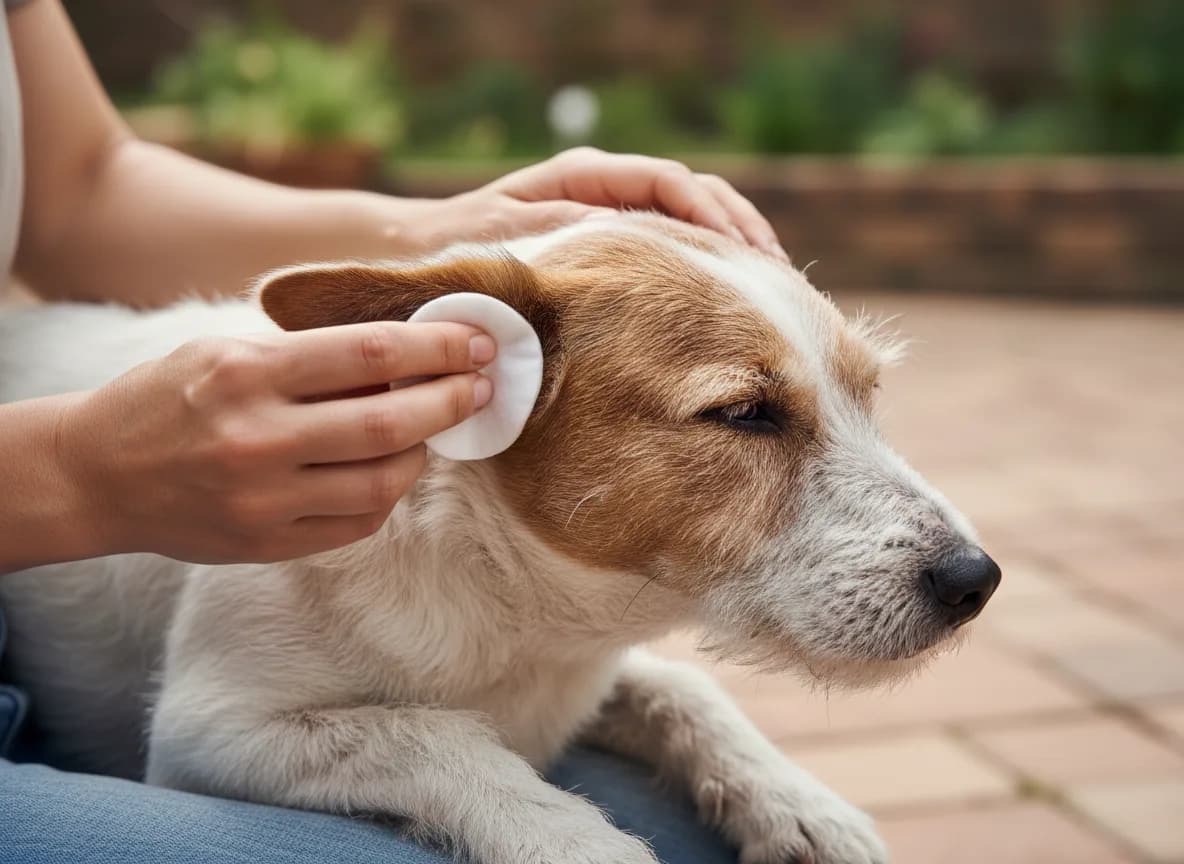
A simple sequence keeps the product within its intended role:
- Check the task first. Look at the accessible ear surface and decide whether you are addressing a small amount of visible dirt or a change that needs advice.
- Read the exact label. Confirm that this product suits the dog's age and current care plan. Do not carry directions over from another brand or format.
- Prepare a fresh wipe. Set up where you can see clearly, with the container within easy reach so you do not have to search for supplies while holding the ear.
- Make a light surface pass. Keep the movement on the broad visible flap or other accessible area permitted by the label. Avoid pushing toward the opening.
- Stop and reassess. If the small task is complete, finish. If material cannot be removed comfortably or appears to come from inside the ear, seek guidance instead of extending the session.
- Discard the used wipe. Follow the package's disposal instructions and close the container as directed.
With a finger wipe, the same limits apply. Fit the sleeve as its label directs, then use it as a covered surface against the ear flap. Do not curl the finger into the canal, use the fingernail edge to scrape, or increase pressure because the material feels secure on your hand.
Our guide to cleaning a dog's ears covers the broader method, including when a liquid is appropriate. If you are uncertain which area should be wiped, ask your veterinary team to show you on your dog. A demonstration is more useful than trying to translate “as far as you can reach” into a safe boundary.
For a dog that dislikes ear handling, do not assume the solution is a faster wipe or firmer restraint. Tell the practice what happens when you approach or touch the ear so pain and handling concerns can be addressed. The convenience of a pre-moistened pad is only an advantage when the dog can be handled comfortably and the task is appropriate.
How often should you wipe your dog's ears?
More frequent wiping is not automatically better care. Use an individual routine rather than a universal daily schedule. A package may permit frequent use, but that does not establish how often your dog's ears need it. Checking the ears, noticing changes, and applying a product are separate actions. You can remain attentive without automatically wiping every time you look.
For a dog with an established maintenance plan, ask what should trigger wiping and whether the plan changes after bathing, swimming, or treatment. Keep those instructions somewhere the people caring for your dog can find them. If the advice is unclear, clarify it before turning a manufacturer's suggested frequency into a fixed household habit.
- When the ear is already clean: Ask whether there is any reason to apply another wipe.
- When a small surface task appears: Use the agreed method without extending it into a deeper clean.
- When debris returns unusually quickly: Report the change instead of simply increasing the frequency.
- When treatment is underway: Follow the treatment plan, including any restrictions on other ear preparations.
Avoid measuring success by how many wipes you use or whether the container is being finished on schedule. Those are purchasing details, not goals for ear care. A suitable routine may use very few wipes. If the product is needed so rarely that a large pack becomes inconvenient, choose a more practical package at the next purchase rather than inventing extra cleaning sessions.
Households with several caregivers benefit from a short record. Note the product, the intended task, and when it was last used. This prevents one person from repeating a cleanup performed by another. If you are also tracking symptoms for the veterinarian, keep that record distinct from an assumption that additional cleaning will solve them.
Keep the wipes identifiable and usable
Storage is part of choosing a convenient product. Follow the package directions, keep the container properly closed, and retain the original label. A wipe that has dried out should not be revived by pouring in water, oil, or another ear product: that creates a mixture that no longer matches the purchased formulation or its directions.
Keep different grooming products easy to distinguish. Ear wipes, body wipes, and household cleaning wipes can all arrive in resealable containers, but their purposes are not interchangeable. The simplest arrangement is to keep the ear product in its labeled package alongside the instructions for the dog's routine, rather than decanting it into an unmarked travel tub.
- Check the package for expiry or other storage guidance before stocking up.
- Close the lid or seal after taking out a wipe, according to the instructions.
- Keep the full product name visible so another caregiver can identify it.
- Discard used wipes; do not return them to the container for a later session.
For travel, decide whether a wipe is actually needed during the trip. Convenience does not require creating a new care schedule. If you take the product, bring the original instructions or a clear photograph and keep it separate from similar-looking wipes in your bag. If space is limited, ask the manufacturer about an appropriate travel package instead of altering the formula to keep repacked wipes moist.
If the container becomes damaged or the label is unreadable, seek the manufacturer's advice. Replacing a questionable package is a clearer decision than guessing whether a changed-looking wipe still meets its intended use. This is especially relevant when a large-count container will be kept for a long time.
Compare value without buying more care than your dog needs
Compare the current price only after narrowing the products to those that suit your dog. The selected counts are 100 for Pet MD, 100 for ZYMOX, 50 for Vet's Best finger wipes, and 125 for Scrubby. Those differences are useful for shopping, but counts alone do not make the products equivalent or establish the cheapest care routine.
Price per wipe is a simple starting calculation: divide the current pack price by the number of wipes. Then ask whether the formula, format, and likely rate of use make that comparison relevant. A less expensive pad is not better value if it is unsuitable, and a larger pack is not a saving if much of it is discarded.
- Compare matching jobs: Flat pads and finger sleeves may appeal for different handling reasons. Do not assume the lower unit price makes one preferable for every owner.
- Check the exact listing: A multipack, different count, or similarly named product can change what appears to be a straightforward price comparison.
- Consider realistic use: Use the veterinarian's plan, not the package count, to estimate how long a container might last.
- Start with one suitable option: Buying several formulas at once is rarely necessary to carry out a defined surface-cleaning task.
For example, an owner who already uses and tolerates Scrubby's 125-count wipes may appreciate the larger count at replacement time. A first-time buyer who still needs full ingredient information has a different priority. The larger package should not move that unresolved question below a unit-price calculation.
Similarly, ZYMOX's 100-count wipes should be compared as that specific wipe product. A cheaper ZYMOX listing for a liquid cleanser or ear solution is not simply another size of the same purchase. Keep the full name and count beside the price when ordering a replacement.
Value ultimately means buying an appropriate product in an amount you can reasonably use. It does not mean increasing the cleaning frequency to justify a bulk purchase or selecting a more complex formula because it sounds more capable. A clear purpose and a current label make price comparisons more useful.
When wipes are not enough for yeast or infection
Wipes are not a treatment for an active ear infection. A dog with pain, repeated head shaking, abnormal odor, or recurring discharge needs assessment of the cause. Removing some visible material does not establish whether yeast, bacteria, a foreign object, or another problem is involved, and it does not show that the problem has resolved.
VCA's explanation of ear infections describes the role of an ear examination and microscopic assessment in directing treatment. The veterinarian also checks the ear drum when assessing which products can be used safely. That is why “wipes for yeast” should not become a diagnosis made from a shopping description. The product format tells you how it is applied, not which condition your dog has.
- Pause routine wiping if it causes discomfort or the ear looks inflamed.
- Tell your veterinarian which products have already been used and when.
- Do not add another ear preparation to an existing treatment without checking the instructions.
- Ask about repeated episodes instead of treating each return of discharge as a need for more wipes.
Our guide to ear cleaners for yeast and infections explains the differences between routine cleaners, targeted flushes, and treatment products. Use that distinction to understand the veterinary plan. The goal is to choose the right role for each product, not to find a wipe with the strongest infection-related wording.
Can homemade wipes replace a labeled product?
Homemade wipes do not provide the same product identity, ingredient information, and instructions as a labeled dog ear-care formulation. Soaking a pad in vinegar, peroxide, oils, or a mixture found online also does not establish that the liquid is appropriate for your dog's ear. A familiar household ingredient is not a substitute for knowing the condition of the skin and ear canal.
Our guide to homemade dog ear cleaner examines common recipes and “natural” yeast claims. It explains why those claims do not resolve either diagnosis or product suitability. If the reason for making wipes is persistent odor or recurring debris, clarify that problem with your veterinarian before trying a different mixture.
- Do not assume a homemade pad is gentler because it contains fewer named ingredients.
- Do not use household or ordinary body wipes in place of a product with an ear-specific label.
- Do not add another liquid to commercial wipes to create a personal version of the formula.
If cost or convenience is the concern, explain that directly to the veterinary team. The appropriate response may be a simpler routine, a different suitable product, or a demonstration of how little surface cleanup is needed. It does not require experimenting inside a dog's ear.
How we compared the wipes
This is an expert analysis of product roles and label information, not a hands-on trial. We compared the exact selected products for format, published ingredients, age information, count, and application limits. Primary veterinary guidance supplies the boundary between routine surface cleaning and a problem that needs examination.
The criteria focus on decisions an owner can actually make:
- Format: Flat pad or finger sleeve, and whether that format fits a visible surface task.
- Identity: Whether the full product name clearly distinguishes the wipe from a cleaner, drying product, or treatment under the same brand.
- Label transparency: Whether the ingredient list and age guidance provide the information relevant to a particular dog.
- Use limits: Whether the recommendation keeps wiping on accessible surfaces and avoids implying infection treatment.
- Practical value: Whether the count and current price make sense once suitability has been established.
We did not measure wipe thickness, moisture retention, grip, scent strength, cleaning speed, or individual dogs' acceptance. Those factors require an appropriate test before they can support performance rankings. Manufacturer descriptions of texture or hypoallergenic formulation are identified as label information, not presented as results obtained by Petful.
That distinction also explains why a product can be included with a reason to choose differently. A reader who needs a complete ingredient list has a different decision from someone replacing an already suitable pack. The useful recommendation exposes that difference and lets you ask a precise question before buying, rather than treating every reassuring label as equivalent.
Frequently asked questions
Use ear wipes on dogs only when a suitable product is needed to remove a little visible dirt from an accessible surface of a healthy ear. It is not necessary to wipe an ear just because you are checking it. Confirm the label suits your dog's age and care plan, keep the movement gentle and visible, and stop if your dog is uncomfortable.
To get brown gunk out of a dog's ear safely, first establish where the brown debris is and whether there is pain or odor. A small amount on an otherwise comfortable outer flap may be appropriate for gentle wiping under your dog's care plan. Material that comes from deeper in the ear, returns repeatedly, or accompanies other symptoms needs veterinary advice. Do not diagnose it as ordinary wax from its color or push a wipe farther in to reach it.
An appropriate liquid cleanser helps loosen and carry out ear wax when your veterinarian recommends cleaning; do not use a tool that pulls or scrapes it from the canal. A wipe only addresses accessible surfaces. Use no cotton swabs or other probing tools inside the canal, and do not attempt to pull out material you cannot safely see. Packed debris, pain, or repeated buildup should be assessed rather than tackled with a deeper-reaching tool.
Do not use ordinary wet wipes to clean a dog ear unless the exact product has an ear-specific label and instructions appropriate for your dog. Body wipes, baby wipes, and household wipes have different intended uses; being moist and soft does not make their formulas interchangeable. If you do not have the appropriate product, ask your veterinarian whether the task can wait or what method to use instead of improvising.
A hypoallergenic ear wipe can still irritate your dog. A hypoallergenic label is not a guarantee against individual sensitivity. Review the complete formulation and any previous reactions, and do not continue rubbing if discomfort develops. Keep the package so your veterinarian can identify the exact product. An irritated or painful ear needs attention to the cause, even when the wipe carries reassuring marketing language.
BVMS, MRCVS
Dr. Pippa Elliott, BVMS, MRCVS, is a veterinarian with nearly 30 years of experience in companion animal practice. Dr. Elliott earned her Bachelor of Veterinary Medicine and Surgery from the University of Glasgow. She was also designated a Member of the Royal College of Veterinary Surgeons. Married with 2 grown-up kids, Dr. Elliott has a naughty Puggle named Poggle, 3 cats and a bearded dragon.
Sign up for expert-backed reviews and safety alerts all in one place.