How Is Cat Food Made? Discover the Secrets
See how kibble, wet, dehydrated and fresh cat foods are made, what ingredients contribute, and how processing differs from the nutritional adequacy shown on the label.
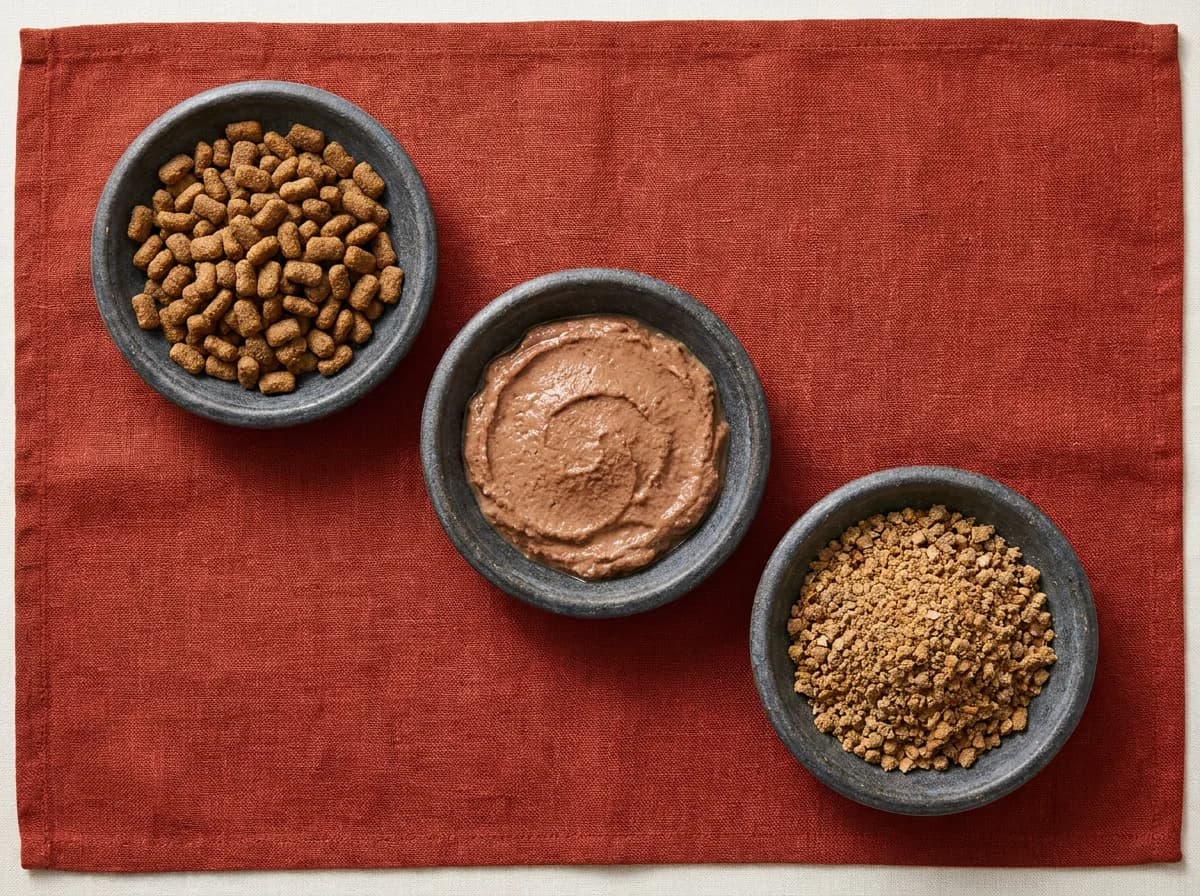
Cat food formats differ in texture, moisture and how they are processed.
Petful is reader supported. As an affiliate of platforms like Amazon and Chewy, we may earn a commission when you buy through links on this page. There is no extra cost to you.
How is cat food made? Most kibble is mixed, cooked under pressure, shaped and dried. Wet food is mixed, sealed in its container and heat processed. Dehydrated food loses moisture through drying, while freeze-dried food loses ice under vacuum. Fresh cooked food usually depends on refrigeration or freezing after cooking.
Those differences explain what you see in the bowl. They do not, by themselves, tell you whether a food supplies everything your cat needs. Here is how the main processes work and what to check on the finished label.

Sign up for expert-backed reviews and safety alerts all in one place.
How Is Cat Food Made? Types and Processes
Commercial cat food combines protein sources, fats, carbohydrates or fiber, vitamins, minerals and moisture in different proportions. A qualified formulator has to account for the nutrients supplied by those ingredients, processing effects and the intended life stage. A kitten's food and an adult maintenance food are not interchangeable simply because both contain chicken.
It helps to separate three questions: What happened to the ingredients? How is the food preserved? Is the finished recipe nutritionally adequate? A manufacturing term answers only part of that picture. For example, “freeze-dried” describes a moisture-removal process, while “complete and balanced” addresses the diet's nutritional purpose.
How is pet food manufactured from those ingredients? The factory weighs and prepares them for a specified recipe, combines them, and follows the production method for that format. Extrusion mixes and cooks the prepared recipe and shapes the pieces; the rest of the line dries, cools and coats the kibble. Wet-food production instead fills and seals packages before the heat treatment. Ingredient checks and process monitoring accompany these operations. After packaging, batch identification lets the manufacturer trace the finished food through distribution. Each stage has a different job, from forming a consistent texture to controlling moisture or protecting the food during storage.
| Format | Heat processing | Moisture removal and storage | Nutritional adequacy |
|---|---|---|---|
| Dry kibble | Commonly extrusion; some foods are baked | Dried for shelf storage; keep sealed and dry | Check the adequacy statement and life stage |
| Wet cans, trays or pouches | Typically heat processed in a sealed package | Retains moisture; refrigerate after opening as directed | A wet meal and a supplemental topper can look similar |
| Dehydrated | Drying uses heat; exact preparation varies | Moisture is removed; water may be added before feeding | Follow the finished product label |
| Freeze-dried | Freeze-drying itself is not a cooking step | Ice is removed under vacuum; rehydrate if directed | Can be a complete diet or a supplemental product |
| Fresh cooked | Cooked using the maker’s specified process | Usually refrigerated or frozen; follow cold-storage directions | Fresh appearance does not establish completeness |
The examples below illustrate formats, rather than a ranking of the healthiest foods. For a familiar dry-food label to compare with the process, Iams Indoor Weight & Hairball Care chicken and turkey kibble is one available example. Choose a recipe for your own cat's needs, not because it shares a manufacturing method with another product.
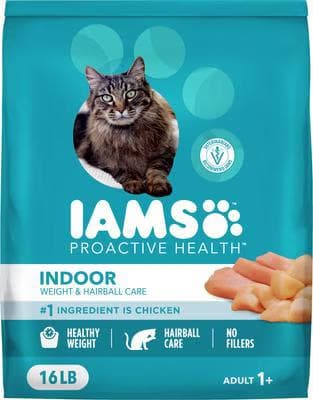
Explore a dry-kibble example and compare its feeding directions, ingredients and nutritional adequacy statement.
Petful may earn a commission when you click through to Chewy, at no extra cost to you.
How Dry Cat Food Is Made
Kibble is the dry, shaped food sold in bags. The common production method is extrusion, although some dry foods are baked. FEDIAF's dry-food manufacturing explanation describes the main stages; equipment, recipes and exact operating conditions differ between manufacturers.
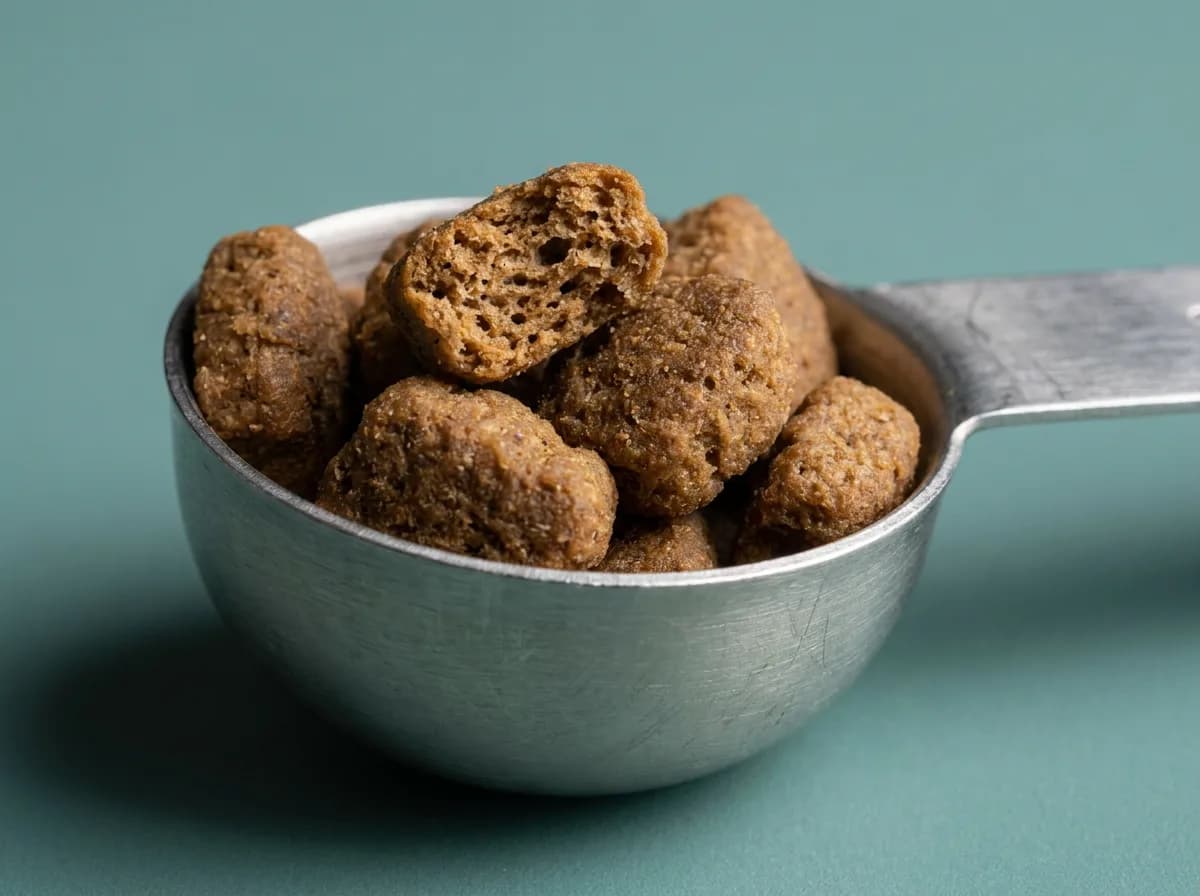
From mixture to shaped pieces
- Mixing: Prepared ingredients are weighed and blended so the recipe is distributed through the mixture.
- Preconditioning and cooking: Water or steam helps prepare the mixture before it moves through the extruder, where heat, pressure and mechanical action cook it.
- Shaping: The mixture passes through a shaped opening called a die. A cutter makes the individual pieces.
- Drying and cooling: These steps reduce moisture and prepare the pieces for later handling and packaging.
- Coating: Fats or palatability ingredients may be applied to the outside before the finished food is packed.
This sequence explains why a bag can contain consistently shaped pieces even when the recipe includes several different ingredients. A fish-shaped kibble is a shape chosen during manufacture, not evidence that the piece is made entirely from fish. The ingredient declaration is where you check the named sources.
What is dry cat food made of?
Recipes may contain animal proteins, grains or other starch sources, fats, fiber and a vitamin-and-mineral mixture. Ingredients can do more than one job: contributing nutrients while also helping the mixture hold together. A “chicken” recipe can therefore contain other ingredients without that fact alone making it unsuitable.
The finishing steps also explain why the surface may smell different from the interior or feel slightly oily. A surface coating is a separate stage from forming the piece itself. The entire piece, including that coating, contributes to the finished food your cat eats.
Wet food takes a different route to a shelf-stable package. If you want to compare a clearly identified gravy format with kibble, The Honest Kitchen’s minced turkey in bone broth gravy provides a concrete label example.
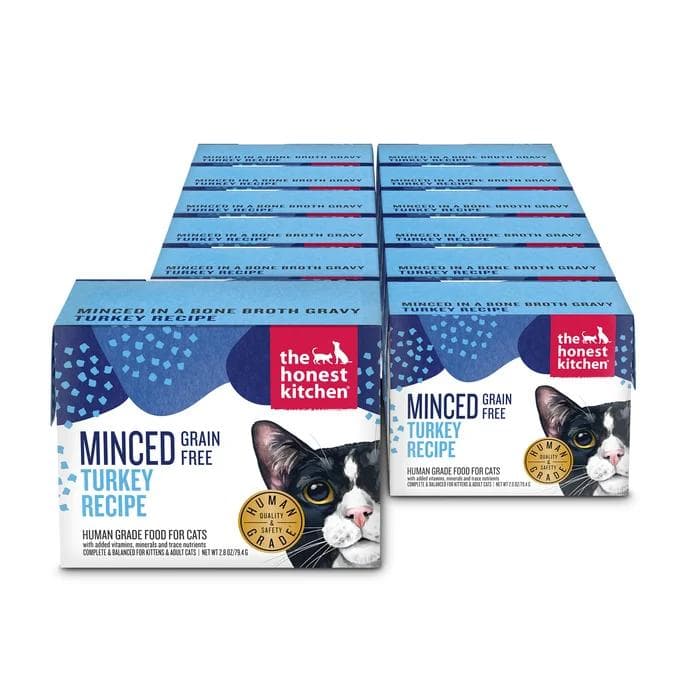
Compare a minced wet-food format with dry kibble, including moisture, serving directions and the life-stage statement.
Petful may earn a commission when you click through to The Honest Kitchen, at no extra cost to you.
How Wet Cat Food Is Made
Wet cat food keeps much more of its moisture than kibble. Ingredients are prepared and mixed into the intended recipe, portioned into cans, trays or pouches, sealed and heat processed. The sealed packages are heated in equipment called a retort. The sealed package is part of the preservation system, not merely a serving container.
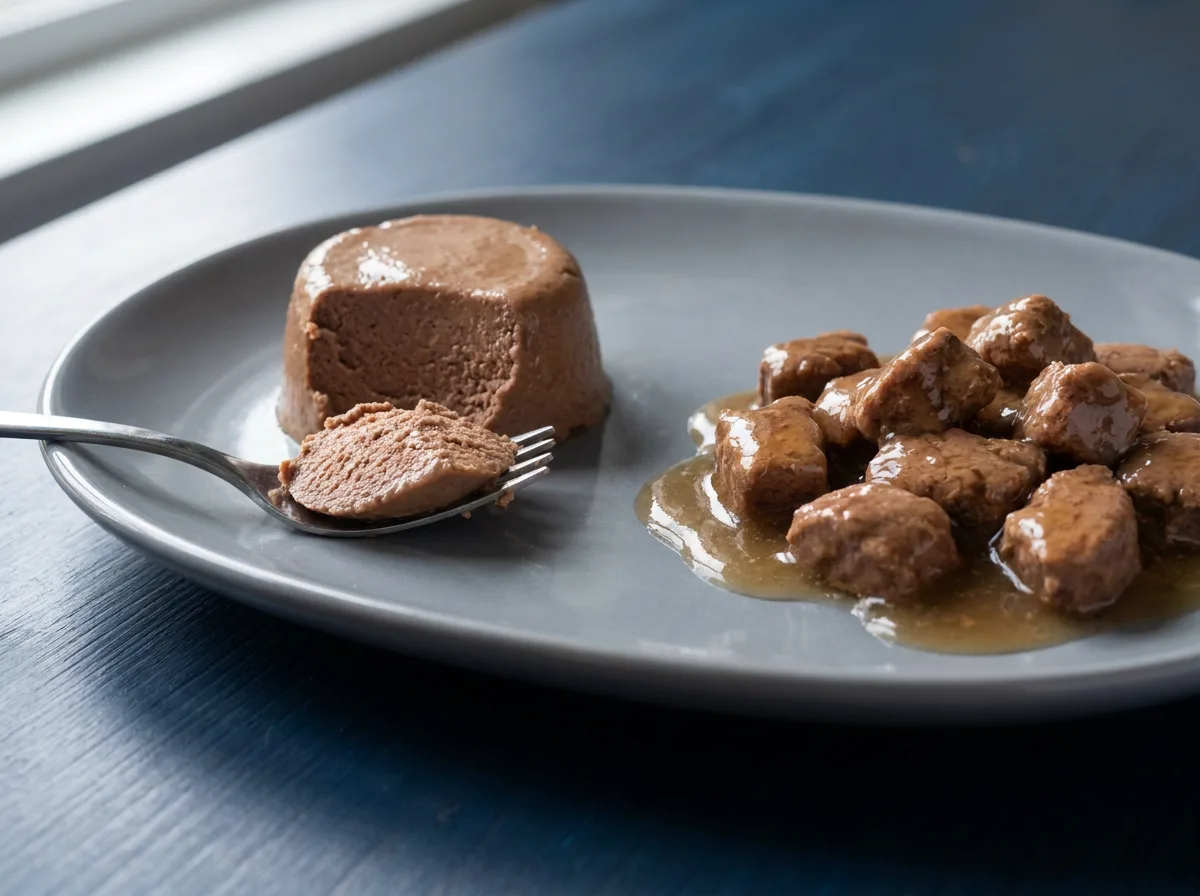
Purina's account of wet-food production explains preparation and sterilization in its manufacturing process. The details of a particular company's line should not be treated as proof that every maker uses identical temperatures, ingredients or testing. The useful general distinction is that conventional shelf-stable wet food combines heat treatment with a sealed package.
Pâté, chunks, gravy and jelly
A smooth pâté and chunks in gravy can start with comparable ingredient categories but undergo different preparation. FEDIAF’s wet-food manufacturing guide explains that animal ingredients can arrive fresh or frozen. They may be chopped into the recipe or minced, combined with other ingredients, formed into ribbons and cut into chunks. A manufactured chunk can therefore contain a blend of ingredients.
The jelly in some wet foods is a water-containing gel. A mixture of water, thickening ingredients and flavorings can be added before sealing, developing its final texture during cooking. Gravy is a more fluid sauce, often using starches or gums for consistency. There is no single jelly recipe shared by all cat-food brands.
If your cat licks up the sauce and leaves the solids, do not assume the eaten portion contains the nutrition of the whole serving. The manufacturer's feeding directions and nutrient information apply to the product as formulated. Selectively eating only one part can change both the amount eaten and the balance of that meal.
Is jelly better than gravy?
Neither texture is automatically healthier. Compare complete diets suitable for the same life stage, then consider what your cat will reliably eat. A cat that accepts pâté but refuses chunks may do better with a suitable pâté simply because the food is eaten. Texture preference and nutritional adequacy are separate questions.
For readers looking to buy “just the jelly,” a gravy, broth or topper may seem similar, but it is not necessarily equivalent to the gel from a particular food. Check whether the product is intended as a complete meal or for supplemental feeding. Adding an appealing sauce should not quietly turn a balanced meal into mostly extras.
What are cat-food cans made of?
Metal cans commonly use steel or aluminum; packaging manufacturer Crown lists both materials for food cans, including pet-food uses. Wet food is also sold in other sealed packaging formats. The material alone does not tell you the food's nutritional quality. Package integrity matters: a leaking or damaged container is a different issue from whether the recipe comes in a can, tray or pouch.
Once opened, the package no longer provides the same protected storage environment. Follow the manufacturer's refrigeration and use-by directions, and serve with clean utensils. Transfer or cover leftovers as instructed rather than assuming a shelf-stable unopened product can sit out indefinitely after opening.
After the heat treatment
Once the controlled cooking cycle is finished, packages are cooled and labeled before being boxed for distribution. Cans may receive separate labels; trays and pouches often carry information printed on the packaging. The process gives unopened shelf-stable wet food a different storage requirement from a fresh chilled meal.
The FDA’s pet-food storage guidance recommends promptly refrigerating or discarding unused canned and pouched food and washing feeding utensils. Choose a package size you can use within its stated storage period. The amount in a pouch is not necessarily the amount your cat should eat at one meal.
Freeze-Dried, Dehydrated and Fresh Cat Food
These terms are sometimes grouped together as alternatives to kibble, but they describe different processes. Two foods that both need water added before serving can have very different production histories. Read the preparation directions and whether the maker identifies the food as raw or cooked.
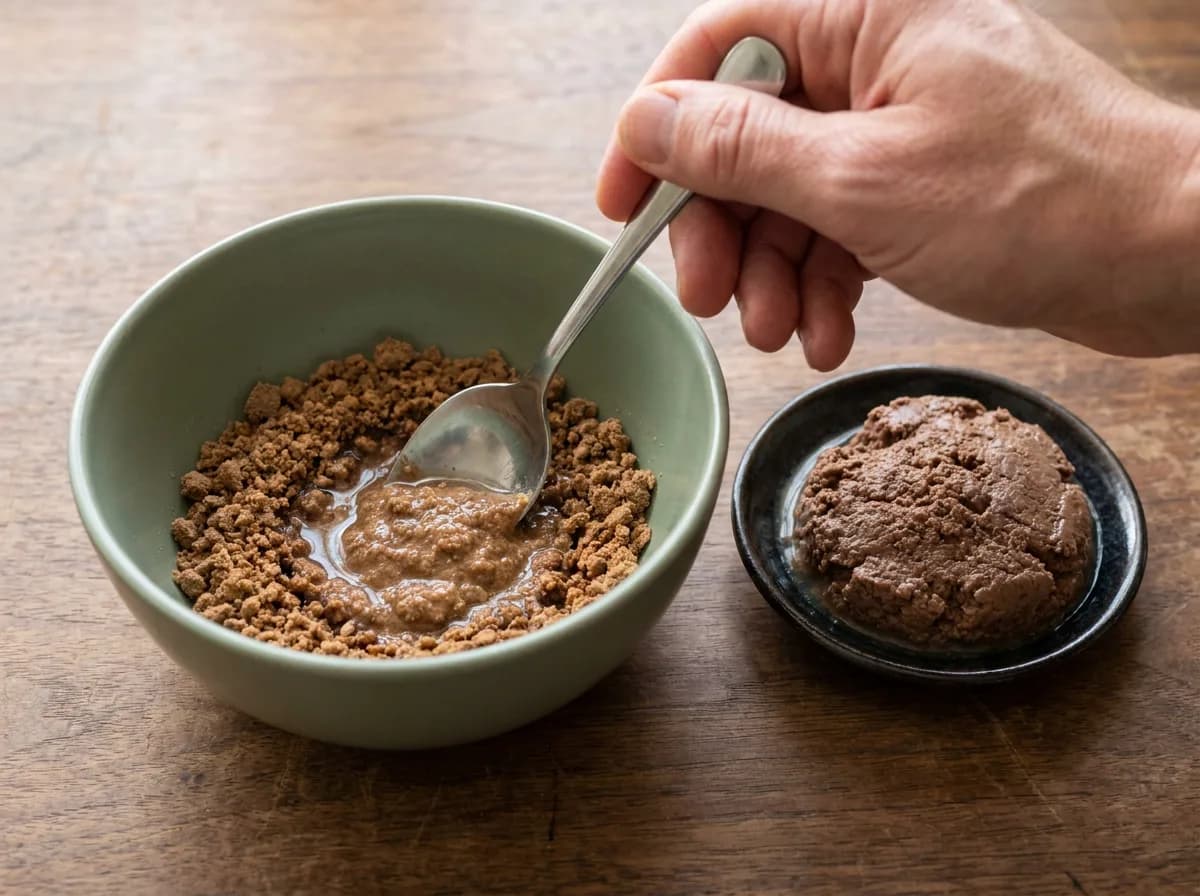
Dehydration removes water through drying
Dehydrated food loses moisture using a drying process involving heat. The finished food may look like small pieces, flakes or a dry mixture. Some recipes are designed to be mixed with water to produce a softer meal; others are served according to different instructions. “Dehydrated” alone does not tell you the exact cooking conditions or serving ratio.
The Honest Kitchen's dehydrated chicken and fish cat food illustrates a format prepared with added water. Use the directions on the current package to measure both food and water. Adding water changes the weight and volume in the bowl, but it does not add calories or replace nutrients missing from an incomplete product.
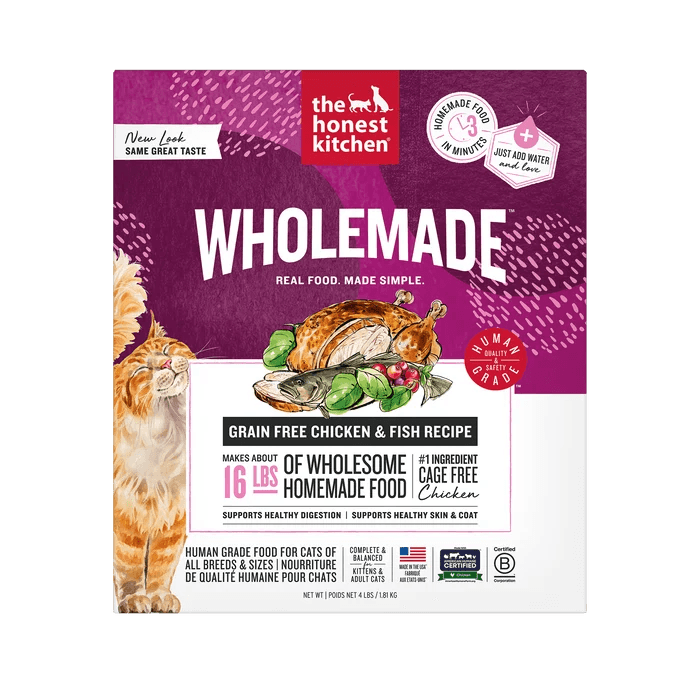
See a dehydrated cat-food example and check its current water-to-food ratio and preparation directions.
Petful may earn a commission when you click through to The Honest Kitchen, at no extra cost to you.
For a closer look at this brand’s formats and serving characteristics, see Petful’s Honest Kitchen cat-food article.
Freeze-drying removes ice under vacuum
Freeze-drying begins with frozen food and removes moisture under vacuum, allowing ice to pass into vapor. It is a preservation method, not the same process as hot-air dehydration. Crucially, freeze-drying itself is not cooking. The food may have other processing steps, so the manufacturer's full description matters.
In technical terms, that change from ice directly to vapor is sublimation, as described in the FDA’s explanation of freeze-drying. Removing water and applying a microbial kill step are separate manufacturing questions.
To serve freeze-dried cat food, first check whether it is a complete diet, a topper or a treat. If the directions call for rehydration, use the stated amount and temperature of water and allow the recommended preparation time. Do not borrow a ratio from a different brand: piece size and formulation can change how the food absorbs water.
- Measure the dry portion before adding water if that is how the package defines a serving.
- Prepare the amount you intend to feed and follow the maker's directions for handling leftovers.
- Wash hands, bowls and utensils, especially when the product is labeled raw.
Dry appearance does not make raw food sterile. The FDA warns that raw frozen and freeze-dried pet foods can contain Salmonella. A cat can carry or shed the organism without appearing ill, exposing people and other animals. Rehydrating a raw product is not a substitute for a validated pathogen-control process.
Fresh cooked food depends on its storage directions
Fresh cooked cat food is prepared with a cooking step and is commonly supplied chilled or frozen. Unlike a sealed shelf-stable can, it generally depends on a cold-storage system after production. “Fresh” does not mean raw.
Before choosing this format, work through the ordinary logistics: how much freezer or refrigerator space the delivery needs, how portions are thawed, and how quickly an opened package must be used. A food's handling instructions are part of feeding it correctly. Convenient packaging cannot compensate for repeatedly leaving a refrigerated meal at room temperature.
A fresh-food example
Smalls' fresh cat-food service is one example to explore if a delivered cooked format suits your household. Petful's Smalls cat-food review discusses that brand separately; its feeding observations should not be generalized to every fresh diet. Compare the current recipe, life-stage suitability and storage directions before ordering.

Protein-first recipes made from human-grade ingredients, portioned for cats and delivered frozen to your door on a flexible subscription.
- Fresh, protein-first recipes made with human-grade ingredients
- Portioned for cats and delivered frozen to your door
- Flexible subscription — pause, adjust, or cancel anytime
50% off your first order for new customers
Petful may earn a commission when you click through to Smalls, at no extra cost to you.
Common Ingredients Used in Cat Food
What is cat food made of beyond the named meat on the package? Most complete recipes combine ingredients with different nutritional and practical roles. The important question is what the finished diet provides, not whether every ingredient looks like something you would put on your own dinner plate.
Proteins, fats and carbohydrates
Cats need specific nutrients supplied by an appropriately formulated diet. Cornell's feeding guidance explains their needs as obligate carnivores. Meat, poultry, fish and other animal-derived ingredients can supply protein and other nutrients; the word “byproduct” does not automatically make an ingredient nutritionally unsuitable.
Animal byproducts can include nutrient-containing tissues other than the cuts typically displayed at a butcher counter. Likewise, a named meal is a processed ingredient, not proof of low nutritional value. Those names do not independently establish digestibility, supplier standards or whether the complete formula is appropriate for your cat.
Fats contribute energy and essential fatty acids and can influence how appealing food smells and tastes. Grains, potatoes, legumes or other carbohydrate sources may contribute nutrients, fiber or structure. The presence of one of these ingredients does not reveal its amount in the finished recipe or justify a universal “good” or “bad” verdict.
Taurine, vitamins and minerals
Taurine is an essential nutrient for cats. Complete foods also need the right provision of vitamins, minerals and other nutrients, with formulation accounting for the ingredients and processing. A vitamin-and-mineral supplement listed near the end of the ingredients can have an important role even though it represents a small amount by weight.
This is why a short ingredient list is not automatically better. Meat alone is not the same thing as a nutritionally complete cat diet. Nor should you add supplements to a complete food simply because a nutrient's name looks unfamiliar or appears low on the ingredient list. Unplanned additions can change the overall balance.
Preservatives and texture ingredients
Ingredients used to thicken a sauce, maintain texture or protect fats from oxidation serve different functions. An antioxidant that helps limit fat deterioration is not a promise that the food cannot contain bacteria. Similarly, a gel-forming ingredient tells you something about texture, not whether the whole recipe is suitable as a sole diet.
If an ingredient concerns you, ask a specific question: What does it contribute? Is the concern an established allergy, a veterinary dietary restriction or unfamiliar terminology? A precise question is more useful than rejecting every long name. For suspected allergies, Cornell describes controlled dietary investigation, rather than assuming all affected cats need grain-free food.
- 1Protein sources supply amino acids; fats contribute energy and essential fatty acids.
- 2Vitamins and minerals can be needed in small quantities, so a low position on the ingredient list does not make them unimportant.
- 3Texture ingredients and antioxidants have different jobs: making a gravy gel and protecting fats from oxidation are separate functions.
Quality Control and Safety Measures
A recipe and a manufacturing method are only part of producing dependable food. Ingredient sourcing, equipment controls, handling after processing and packaging checks all matter. The Pet Food Institute describes supplier checks and manufacturing controls used in the industry. That account is useful background, not independent verification of every manufacturer's practices.
Checks along the production line
Controls start before the ingredients enter the mixer. Depending on the ingredient, manufacturers may inspect delivery seals, transport temperatures and cleanliness, then assess whether the incoming material meets nutrient and safety specifications. A vitamin premix, a tanker of oil and refrigerated meat present different handling needs.
During production, checks can include operating temperature, pressure, moisture, equipment function and screening for metal. Environmental sampling looks for contamination in the facility, while product testing examines the food itself. These are different checks: a correctly shaped kibble does not demonstrate that the surrounding equipment or finished batch passed every safety test.
Traceability connects those operations to a specific package. FEDIAF’s safety guidance describes recording ingredients by batch and tracking finished products through distribution. That is why keeping a lot code matters if a company later investigates a problem. The useful question is whether the manufacturer can identify and investigate the food you bought.
Questions a manufacturer should be able to answer
- Who formulates the food, and what are their qualifications?
- How is the finished recipe assessed for nutritional adequacy?
- What checks apply to ingredient suppliers and finished products?
- Can the company explain its storage instructions and identify a product by lot code?
WSAVA's nutrition resources help owners ask these kinds of questions. A clear answer about formulation and quality control is more informative than a package adjective such as “premium.” Be careful with broad claims that a particular process eliminates every possible risk; contamination can also occur after a cooking step.
At home, preserve the product name, lot information and best-by date so you can identify what your cat ate. Follow storage directions and check relevant recall notices. If the packaging is compromised, the food smells unexpectedly different or your cat becomes unwell, stop feeding that product and seek advice appropriate to the situation.
Testing matters because contaminants can enter through ingredient streams at any stage; our guide to heavy metals in cat food explains what the 2026 study found and how to read the results.
Tips for Choosing High-Quality Cat Food
Cat food can be a healthy daily diet when it supplies the appropriate nutrition for the cat eating it. There is no universal top-three list that follows from manufacturing method alone. An adult cat, a growing kitten and a cat needing a veterinary diet may require different choices even when all three prefer the same texture.
Start with the nutritional adequacy statement
Look for a statement explaining whether the food is complete and balanced and the life stage it is intended to support. The FDA explains that nutritional adequacy can be substantiated through nutrient profiles or feeding trials. AAFCO does not approve cat-food brands. Its name in an adequacy statement is not an endorsement seal.
A product intended for intermittent or supplemental feeding has a different role from a complete daily diet. This distinction matters particularly for broths, gravies, treats and toppers, where attractive packaging can make a small addition look like a replacement meal. Read the full statement rather than relying on the word “food.”
- 1Find the complete and balanced statement and match the stated life stage to your cat.
- 2Distinguish a full meal from a product intended for intermittent or supplemental feeding.
- 3Check preparation, portion and storage instructions for this exact product.
- 4Use manufacturer expertise and quality-control information alongside the label; an ingredient list alone cannot establish food quality.
Compare moisture fairly
The guaranteed analysis on a food label reports nutrients as fed, meaning moisture is included. That makes direct comparisons between a dry bag and a wet can misleading: water changes the denominator. A lower printed protein percentage on wet food does not necessarily mean less protein relative to its dry ingredients.
For a simple dry-matter calculation, subtract the moisture percentage from 100, divide the nutrient percentage by that result, then multiply by 100. These are illustrative numbers, not measurements of the products shown here: a food with 10% protein and 75% moisture contains about 40% protein on a dry-matter basis. A food with 30% protein and 10% moisture works out to about 33%.
Those figures still do not rank the diets' overall quality. Guaranteed values are minimums or maximums, not a full nutrient analysis, and a medical comparison may need calories or other nutrient data. Ask the manufacturer or your veterinarian for the appropriate information instead of selecting food on this calculation alone.
Avoid the wrong product for the situation
If you are looking for “five cat foods to avoid,” a fixed blacklist of brands is less useful than checking five practical mismatches: a supplemental food used as the sole diet, the wrong life stage, a recalled product, spoiled or improperly stored food, and a diet that conflicts with your cat's prescribed nutritional needs.
Finally, compare ingredients with realistic expectations. They are listed by weight, but the list does not disclose every ingredient's quality, digestibility or contribution to the finished diet. Use it to identify ingredients relevant to your cat, then combine it with the adequacy statement, feeding directions and the manufacturer's answers. That connects how the food is made with what actually matters at mealtime.
If you want a checklist for spotting risk instead of chasing a brand list, our guide to cat food brands to avoid walks through the label and recall signals that matter.
Cat Food Manufacturing Questions
It is a water-containing gel whose ingredients vary by recipe. Gelling agents or other components help create its texture. Check the exact ingredient list, and do not assume the jelly alone supplies the nutrition of the complete serving.
No. “Grain-free” describes the absence of grains, not ingredient quality or nutritional adequacy. An ingredient list alone cannot establish how well a complete food meets your cat’s needs. Suspected food allergies need a veterinarian-guided investigation rather than a blanket grain-free switch.
Yes. Freeze-drying is not the same as cooking, and raw freeze-dried foods can contain Salmonella. Follow the product’s handling instructions and wash hands, bowls and utensils. Adding water before serving does not make a contaminated raw food safe.

Kaitlyn Arford is an award-winning freelance journalist whose work has appeared in the AKC, Pumpkin, and more. As a lifelong animal lover, she is passionate about educating pet owners.
Sign up for expert-backed reviews and safety alerts all in one place.