Cat Food Brands to Avoid: How to Spot Risk Instead of Chasing a List
The 2026 Clean Label Project study named no failing cat food brands. Use seven practical questions to compare recipe evidence, ingredient claims, nutritional suitability and recall history, including Friskies versus Fancy Feast.
Petful is reader supported. As an affiliate of platforms like Amazon and Chewy, we may earn a commission when you buy through links on this page. There is no extra cost to you.
If you went looking for cat food brands to avoid after the October 2026 contamination headlines, here is the part the headlines skipped: the Clean Label Project study behind them named no failing brands. It tested 100 products from 62 brands, found lead in 99 percent of them, and still published no list of foods that failed. What it published instead was a set of patterns, which are far more useful than any blacklist.
This guide turns those patterns into something you can use on the food already in your cupboard. You will get seven questions to ask about a cat food, an explanation of what ingredient labels can and cannot tell you, an honest answer on Friskies versus Fancy Feast, and a practical way to review recall history.

Sign up for expert-backed reviews and safety alerts all in one place.
Cat food brands to avoid: why the honest answer is a checklist, not a list
Here is the direct answer: this study does not provide a brand blacklist. It reports associations between contaminant levels and protein source, food format, packaging and ingredient-list patterns. It also discusses ingredient splitting, but counting ingredient names cannot reveal their combined weight or establish that an individual food is unsafe. Use the seven questions below to check the exact recipe's evidence, nutritional suitability and recall status.
That answer frustrates people who want a short list of bad cat food brands to avoid, and it is still the right one. Why a checklist beats a list:
- The study covers only the products it tested. The seven questions below help you review other foods, but cannot reveal an untested product's contaminant concentration.
- A list ages badly. Recipes change, factories change, and a brand that was fine in 2024 can have a problem in 2027. Signals do not expire.
- A list invites the wrong confidence. Several brands that appear on popular "worst" lists had products ranked in the study's Clean Sixteen, which is the opposite of what the lists claim.
- The package can answer questions about ingredients and feeding suitability. Contaminant concentrations require testing information beyond the label.
- 1The 2026 Clean Label Project study named no failing brands, so no honest page can hand you a blacklist
- 2Use seven questions about ingredients, packaging, nutritional suitability, recall history and testing; none is a standalone safety score
- 3Dry food averaged more lead; DEHP occurred across formats but reached higher levels in cans and pouches. Neither finding determines an individual food's result
- 4Check real recall history on the brand recall pages before you drop a food
- 5Switch over 7 to 10 days and call your veterinarian if your cat stops eating
- There were no failing brands named in the Clean Label Project 2026 cat food study, and absence from the Clean Sixteen is not evidence that a product exceeds federal or state contaminant regulations. The study published patterns and a list of its top performers. It did not publish a list of products to avoid, and it is not an FDA recall.
So what cat food brands should you avoid? This study does not supply a brand blacklist. Check the exact product's current recall status, nutritional suitability and available testing. Fish ingredients or generic ingredient names alone do not establish that a food is harmful. For the full study, sample and explanation of the Clean Sixteen, read our Clean Label Project cat food study breakdown. This page stays on the practical question of risk.
One more note before the method. Threads asking for cat food brands to avoid on Reddit tend to pass around the same handful of names from older listicles. Treat those as a starting point for a recall check, not as a verdict, because the study's data contradicts several of them.
Dry versus wet: the risks differ
The most common follow-up question is whether to look for dry cat food brands to avoid or wet cat food brands to avoid, as if one format were the safe one. The study's answer is that each format carries a different risk, so the choice is a trade-off rather than a verdict.
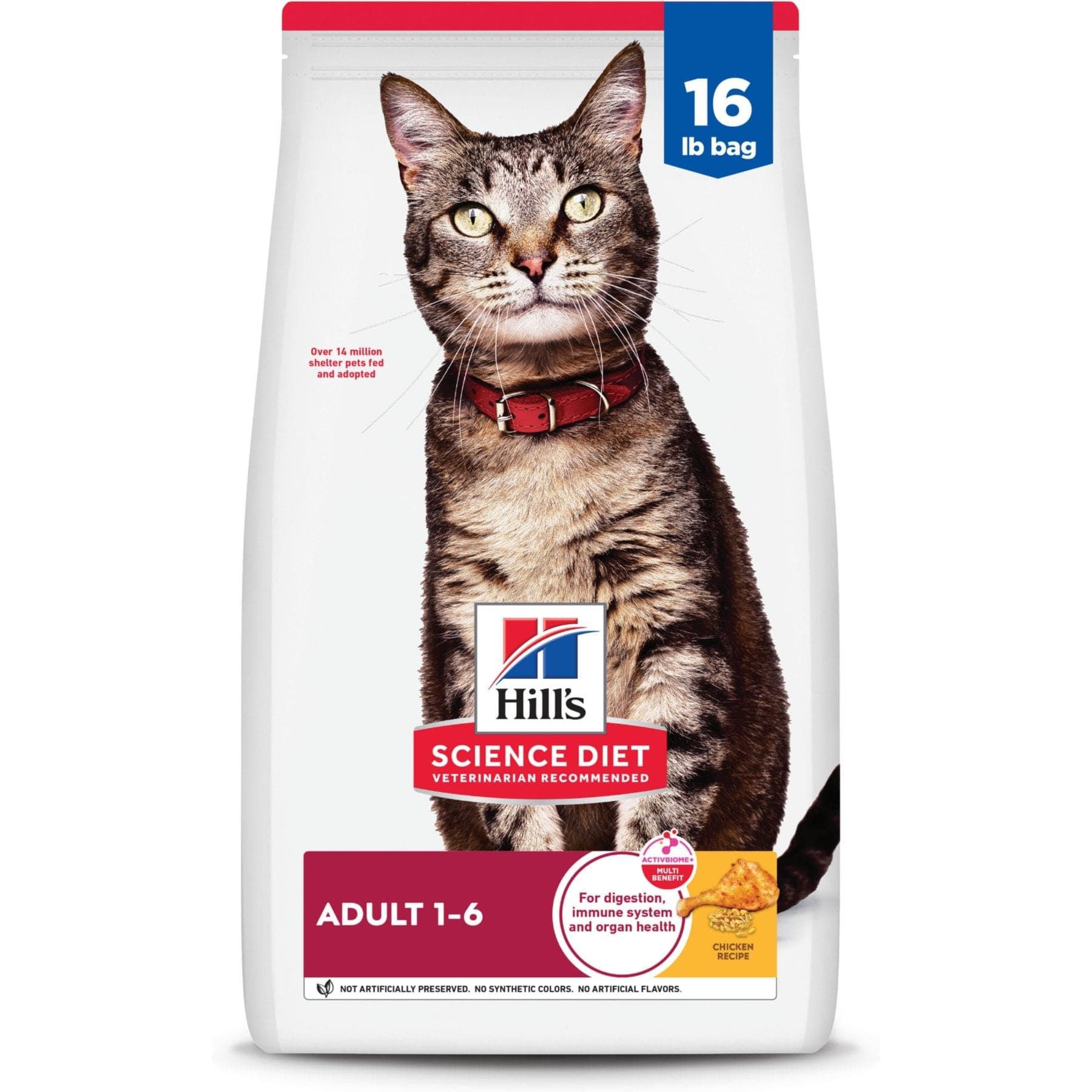
Hill’s Science Diet Adult Chicken dry cat food in a 32-pound bundle. An adult dry-food option to compare for nutritional suitability and the named study recipe.
Petful may earn a commission when you click through to Chewy, at no extra cost to you.
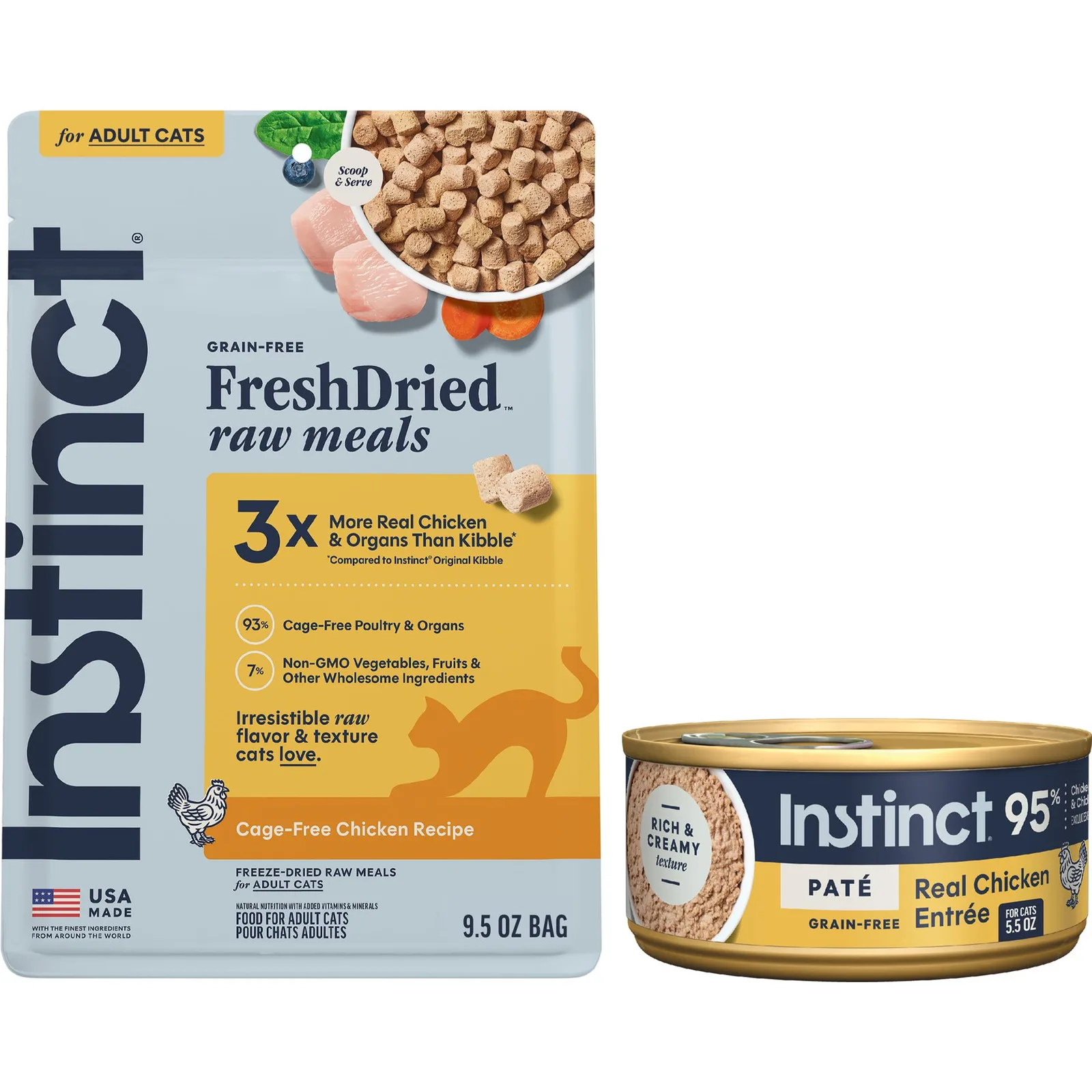
Here are the study's comparisons across its 100 products, with contaminant levels expressed per 1,000 kcal:
- Dry food carried about three times the lead of wet or air-dried products. Lead was detected in 99 percent of all products, so this is a matter of degree.
- DEHP levels were higher in cans and pouches. DEHP was detected in 48 of 100 products, at similar frequencies across formats. Where detected, levels were about five times higher in cans and pouches than in bags. BPA was detected in two products and BPS in one.
- Fish recipes drove the mercury finding. Fish-based foods carried about 18 times the mercury and about 2.5 times the cadmium of other recipes, in both wet and dry formats.
- Glyphosate appeared in 37 percent of products, with no format escaping it.
In this sample, 84.8 percent of poultry products met CLP's standard, compared with 25.7 percent of fish and seafood products. That supports comparing protein sources, but not assuming that poultry-first or short ingredient lists guarantee a better result. The study also found an association between plant-ingredient counts and glyphosate, and between certain ingredient-count patterns and lead. Those counts do not measure a recipe's combined plant-protein contribution. For either dry or wet food, seek results for the exact recipe.
A practical way to use this:
- If you feed dry, compare a listed option such as Hill's Science Diet Adult Chicken Recipe, whose Adult 1-6 Chicken Recipe was ranked in the Clean Sixteen. A suitable wet food is another format to compare, but adding it does not establish a reduction in lead exposure without results for both foods and the amounts fed.
- If you feed fish exclusively, the study suggests considering other protein sources. Compare complete diets your cat will eat and any exact-recipe testing; neither a poultry flavor nor a broth texture establishes nutritional suitability or low contaminant levels.
- Feeding both formats does not by itself establish lower contaminant exposure.
For what the metal findings mean for your cat's kidneys and long-term health, our veterinarian-authored guide to heavy metals in cat food covers the clinical side, including why cadmium is the quiet one to watch. Our companion piece on mercury in cat food explains the tuna question and the 18x finding fish by fish.
Mainstream brands: Friskies, Fancy Feast, Purina and Meow Mix
Most people asking about cat food brands to avoid are really asking about the five names in their local supermarket. Here is what the study actually found about them, product by product, because the brand name alone tells you very little.
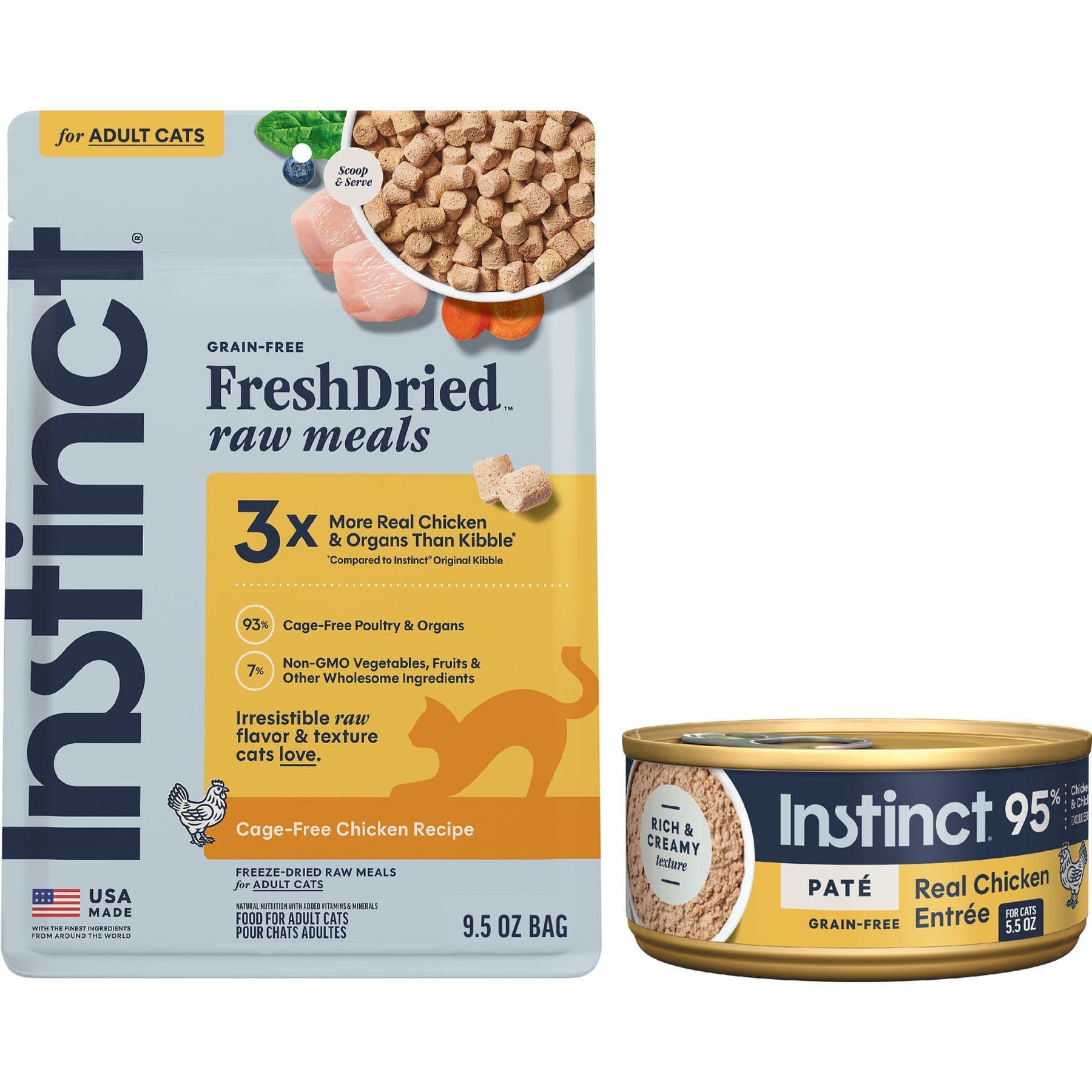
A bundle containing Instinct Original Chicken Pate cans and a separate freeze-dried chicken product. The article distinguishes the ranked pate from the other bundled food.
Petful may earn a commission when you click through to Chewy, at no extra cost to you.
Which is better for my cat, Friskies or Fancy Feast? Both are Purina lines, and each had a wet product ranked in the Clean Sixteen: Friskies Salmon Dinner Pate and Fancy Feast Grilled Turkey Feast in Gravy. Both named recipes earned the study's ranking. Compare their nutritional suitability, calories, texture and current recall status; the category-wide poultry finding does not establish which of these two ranked recipes is better for your cat.
That answer surprises people, so here is the detail:
- Friskies. Friskies Salmon Dinner Pate was ranked in the Clean Sixteen. Friskies Seafood Sensation and Gravy Swirlers were tested but not ranked, which is not evidence they exceed any regulation. The pattern inside one brand matches the study's category-wide finding: recipe matters more than name. See the Friskies recall history for the incident record.
- Fancy Feast. Fancy Feast Grilled Turkey Feast in Gravy was ranked in the Clean Sixteen. Fancy Feast Grilled Chicken and the Petites line were tested but not ranked. Again, the turkey recipe is the one with the study's mark, and the Fancy Feast recall history page documents no recalls.
- Purina Cat Chow. The Purina Cat Chow lines were tested but not ranked. That is not a failure and it is not a pass; it means the products did not reach the top-performer tier, and the study itself says absence from that tier is not an indicator of a regulatory problem. Is there a recall on Purina Cat Chow? Our Cat Chow recall page tracks every incident, and the broader Purina recall history covers the parent company's lines, including Purina Pro Plan, whose White Meat Chicken & Vegetables Entree was ranked in the Clean Sixteen.
- Meow Mix. Meow Mix Original Choice was tested but not ranked. It is the brand most often named on "worst" lists, and the honest reading of the study is that it was not condemned by it either. What you can check is the Meow Mix recall history, and whether the recipe passes the signals below.
- Sheba. Sheba Cuts in Gravy Roasted Chicken Entree was ranked in the Clean Sixteen, while the Sheba Salmon and Turkey cuts were tested but not ranked. Is there a recall for Sheba cat food in 2026? The Sheba recall page is the place that stays current.
The rankings apply to named products, not every recipe sold by their brands. For another chicken wet-food option to compare, Instinct Original Grain-Free Pate Real Chicken Recipe can be considered alongside the two Purina recipes. CLP lists Instinct Original Grain Free Pate; confirm the exact recipe matches that entry before applying the ranking to a purchase.
Seven questions to ask before choosing a cat food
These questions combine the study's measured associations with separate nutrition, labeling and recall checks. They are not a weighted safety score. Use them to identify missing information and compare suitable foods, including products outside the study.
| Question | Evidence behind it | Label cue | Useful next step |
|---|---|---|---|
| Does the recipe contain fish? | 25.7 percent of fish and seafood products met the study standard versus 84.8 percent of poultry; fish recipes carried about 18x the mercury | Named fish ingredients identify a source, not its contaminant concentration | Ask for exact-recipe testing; compare suitable complete alternatives if feeding fish exclusively |
| Is the animal source clear? | A broad ingredient name does not establish contamination or nutritional quality | Meat by-products, animal fat, fish, poultry, or meat meal with no species named | Ask the manufacturer which species are used and what testing it performs |
| What can the ingredient order tell you? | Ingredients are listed by weight; counting separate names does not reveal their combined weight or protein contribution | One meat first, then pea protein, pea flour, pea fiber, corn gluten meal and similar listed separately | Ask about formulation and nutritional adequacy rather than calculating a meat-to-plant ratio from names |
| What does the packaging comparison establish? | DEHP was detected in 48 of 100 products at similar frequencies across formats; where detected, levels were about 5x higher in cans and pouches than in bags | Package type identifies a category, not the result for an individual food | Compare exact-product evidence alongside storage and feeding needs |
| Is it nutritionally suitable as the main diet? | A food labeled for supplemental or intermittent feeding is not a complete everyday diet | Check the nutritional adequacy statement for the cat's life stage | Confirm suitability before comparing contaminant rankings |
| What happened in the recall history? | Cause, date, affected products and corrective action matter more than an arbitrary recall count | Check the brand's recall page and the FDA list before buying | Match current notices to the exact product and lot |
| Can the maker answer testing questions? | Published testing can be useful; absent public results do not prove a food is unsafe or untested | No testing statement, no reachable contact, no answer to where the food is made | Request recent results, methods and the exact recipes or lots covered |
Here is how to read the table in the store, in the order that gives you the fastest answer:
- Read the ingredient panel to identify the ingredients and questions you want the maker to answer. A named meat first or no fish in the top three does not establish the food's contaminant levels.
- Read ingredient names without adding them up as a ratio. The list is ordered by weight, and several plant ingredients do not tell you their combined weight or protein contribution relative to meat. Ask the maker for formulation information if that distinction matters to your choice.
- Find the AAFCO statement, usually in small print near the guaranteed analysis. No statement, no daily diet.
- Note the format, then distinguish a group finding from an individual result. The study found higher lead in dry food and higher DEHP concentrations in cans and pouches where DEHP was detected; neither identifies the concentration in the food you hold.
- Look up the brand on its recall page before you pay. This is the step that beats any list, and it takes under a minute.
- Check whether the brand publishes testing. A statement on the package or website that it tests for heavy metals is worth more than any marketing word on the front.
Two distinctions matter when using the checklist. First, the format findings concern group averages, so neither a can nor a poultry pate establishes an individual food's result. Compare its nutritional adequacy and exact-product evidence. Second, tested but not ranked means a product was outside the Clean Sixteen tier; CLP says that absence does not establish that it exceeds contaminant regulations.
The phrase 'silent killer' can refer to disease that is difficult to recognize early. This study did not show that the sampled foods caused kidney disease. Our heavy metals in cat food guide explains what the results do and do not establish about exposure and health.
Brands that are good: what the study ranked
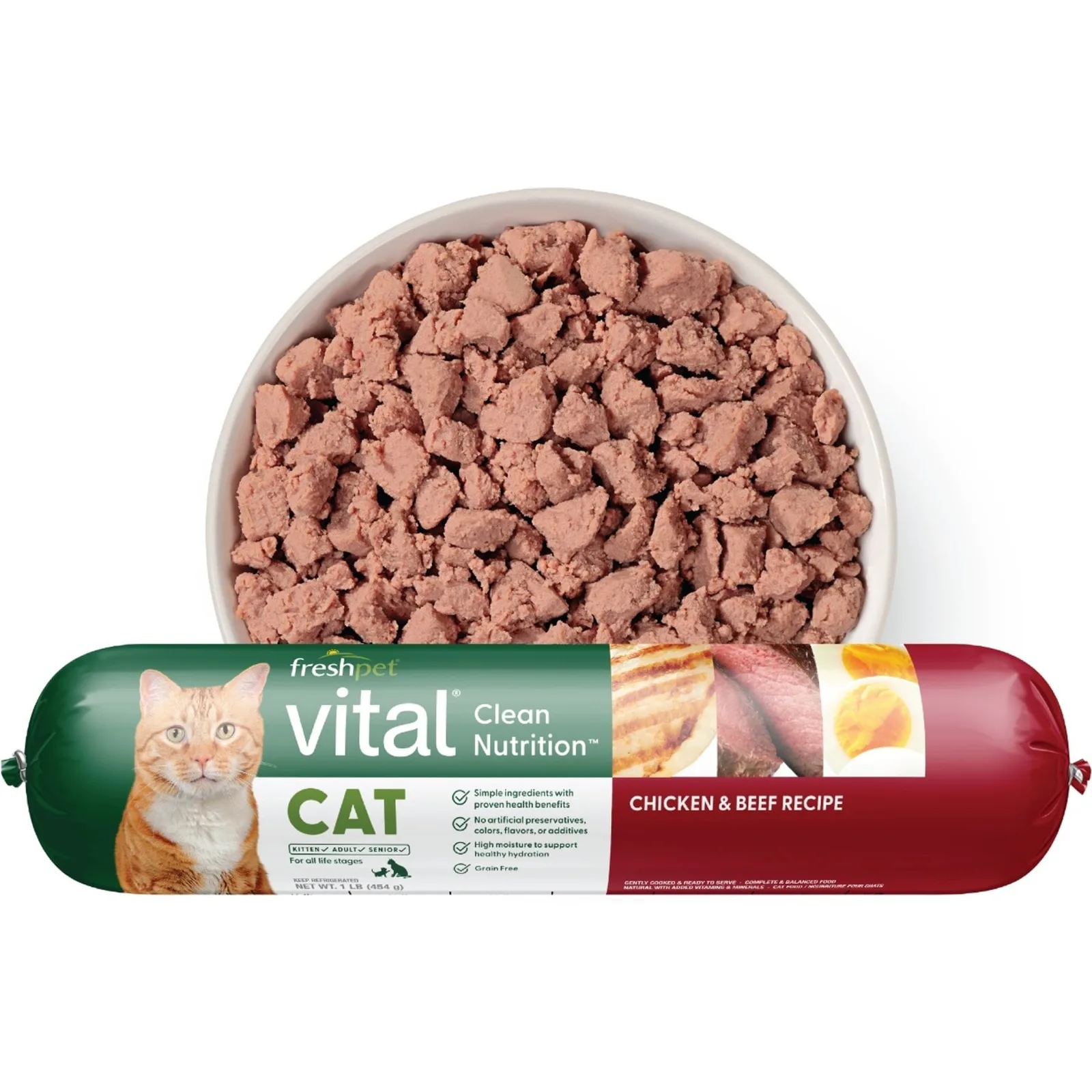
Readers who came here for cat food brands to avoid usually want the opposite list too, and that one does exist. The study published Clean Sixteen rankings and highlighted certified examples from Bixbi, Freshpet and Smalls. Certification is a separate program, with more cat recipes in its directory. Freshpet's Chicken & Beef recipe is certified, but current CLP sources disagree on which Freshpet recipe made the wet list. Our roundup of the safest cat food brands takes those picks product by product, which is where the best cat food brands and healthiest cat food questions belong.
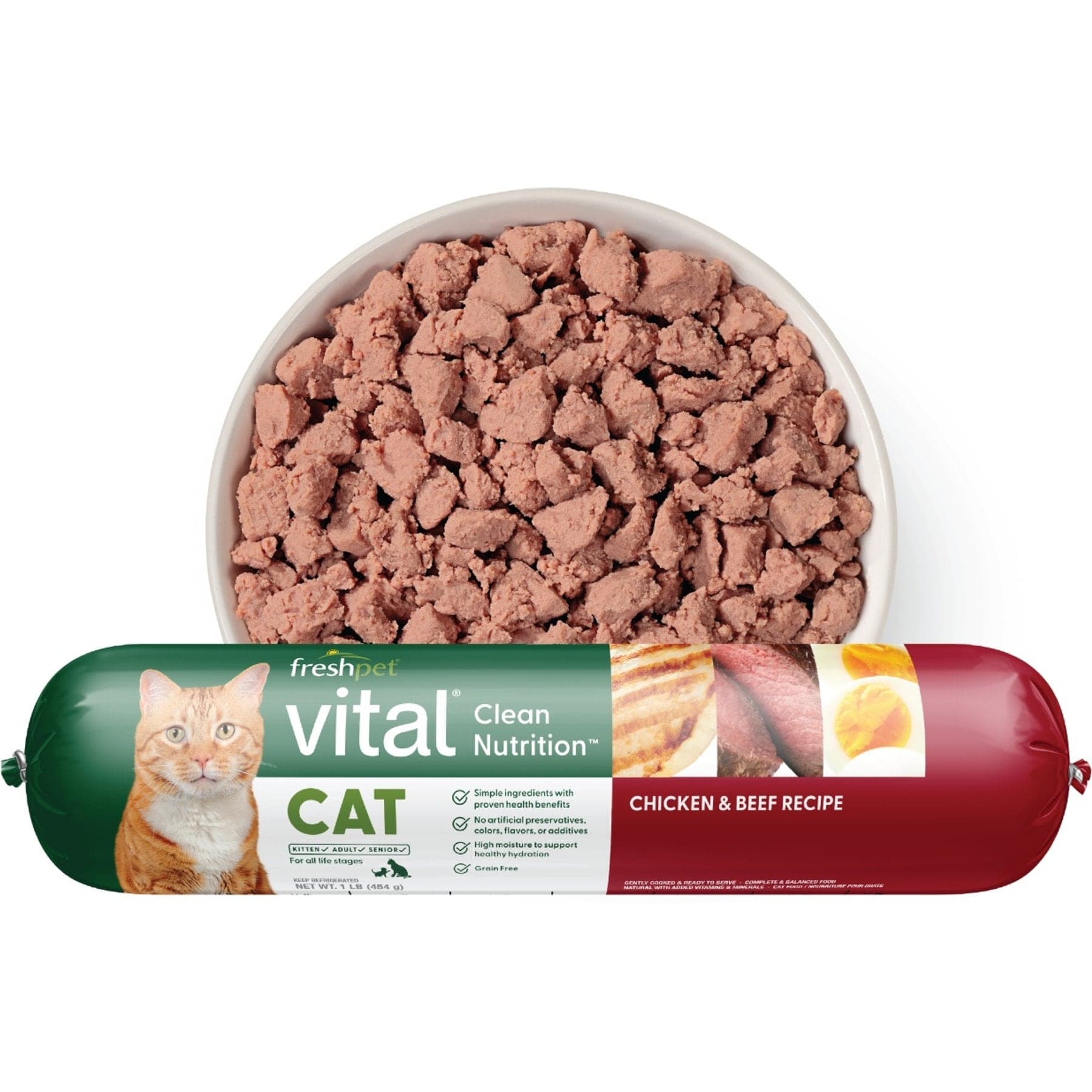
Freshpet Vital Chicken & Beef in eight 1-pound rolls. Compare this exact recipe and package with the certification evidence discussed in the article.
Petful may earn a commission when you click through to Chewy, at no extra cost to you.
A few points from that ranking that matter for this page, because they change how you should read any "best and worst" list:
- The ranked list is not a premium-only club. Kirkland Signature Chicken & Rice, Hill's Science Diet Adult 1-6 Chicken Recipe, Purina Pro Plan White Meat Chicken & Vegetables Entree, Friskies Salmon Dinner Pate, Fancy Feast Grilled Turkey Feast in Gravy and Sheba Cuts in Gravy Roasted Chicken Entree all appear alongside boutique brands. Purina cat food, which many lists dismiss wholesale, has three lines represented.
- Poultry dominates. Chicken, turkey and duck recipes from Weruva, Tiki Cat, Nulo, Applaws, Stella & Chewy's, Instinct, Reveal and others make up most of the list, which is the same lesson as the fish finding read from the other direction.
- Certified options include fresh and freeze-dried recipes. Freshpet Vital Chicken & Beef Recipe is a certified refrigerated chicken-and-beef recipe. CLP's wet PDF names Tender Chicken & Garden Vegetable Recipe, while its tested-products page names Chicken & Beef Pate, so we do not assign this roll an unqualified Clean Sixteen rank. BIXBI Rawbble Turkey Recipe freeze-dried food was certified as well.
For product-by-product choices, the linked safest-food roundup compares certified and Clean Sixteen recipes, including dry options such as Hill's and Kirkland. For an indoor cat, start with a complete diet appropriate to its life stage and health needs, in a format it will eat. Then compare exact-recipe evidence and current recall status. Poultry-first ingredients and an absence of past recalls do not establish that a food is the healthiest choice.
Worst cat food brands: what the lists get wrong
Search for the worst cat food brands and you will find the same structure on every page: a top 10 worst cat food brands countdown, a list of ingredients under each one, and no measured data. Older worst-brand pages predate the 2026 study, and many still name supermarket brands such as Friskies and Meow Mix in their worst dry cat food brands and worst wet cat food brands sections. Both brands had products in the study, and Friskies had a product ranked in the Clean Sixteen.
Here is what those lists get wrong, in order of how much it matters:
- A brand-level verdict can hide product differences. The study ranks named recipes, and a brand can have both ranked and unranked products. It also reports associations with format, packaging and ingredient patterns, so poultry versus fish is not the only distinction in the data.
- They confuse cheap ingredients with measured contamination. Corn, by-products and artificial colors alone do not establish a reason to reject a nutritionally suitable food. Their names do not reveal its lead, cadmium or mercury concentrations. Compare the formulation and available test results rather than treating an ingredient preference as a contamination measurement.
- They never mention recall history. A repeating recall pattern is one of the heaviest signals a buyer has, and the worst-brands posts skip it entirely.
- They never update. Several lists still cite products that were reformulated or discontinued years ago.
What is the lowest quality or most unhealthy cat food? These sources do not establish one universal winner or loser. Check whether the exact food suits the cat's nutritional needs, whether its lot is recalled, and what the maker can document. Fish, by-products or several plant ingredients alone cannot establish a bad food.
The same caution applies to the worst cat food brands Reddit threads. They are useful for one thing, which is hearing about a palatability problem or a formula change before the brand announces it. They are not useful for contamination claims, because nobody in the thread has the lab data, and the lab data that does exist points to recipes rather than brands. If you want a best and worst cat food brands comparison that holds up, run both the best and the worst candidate through the seven signals and the recall check, and let the results speak.
Ingredients to avoid in cat food
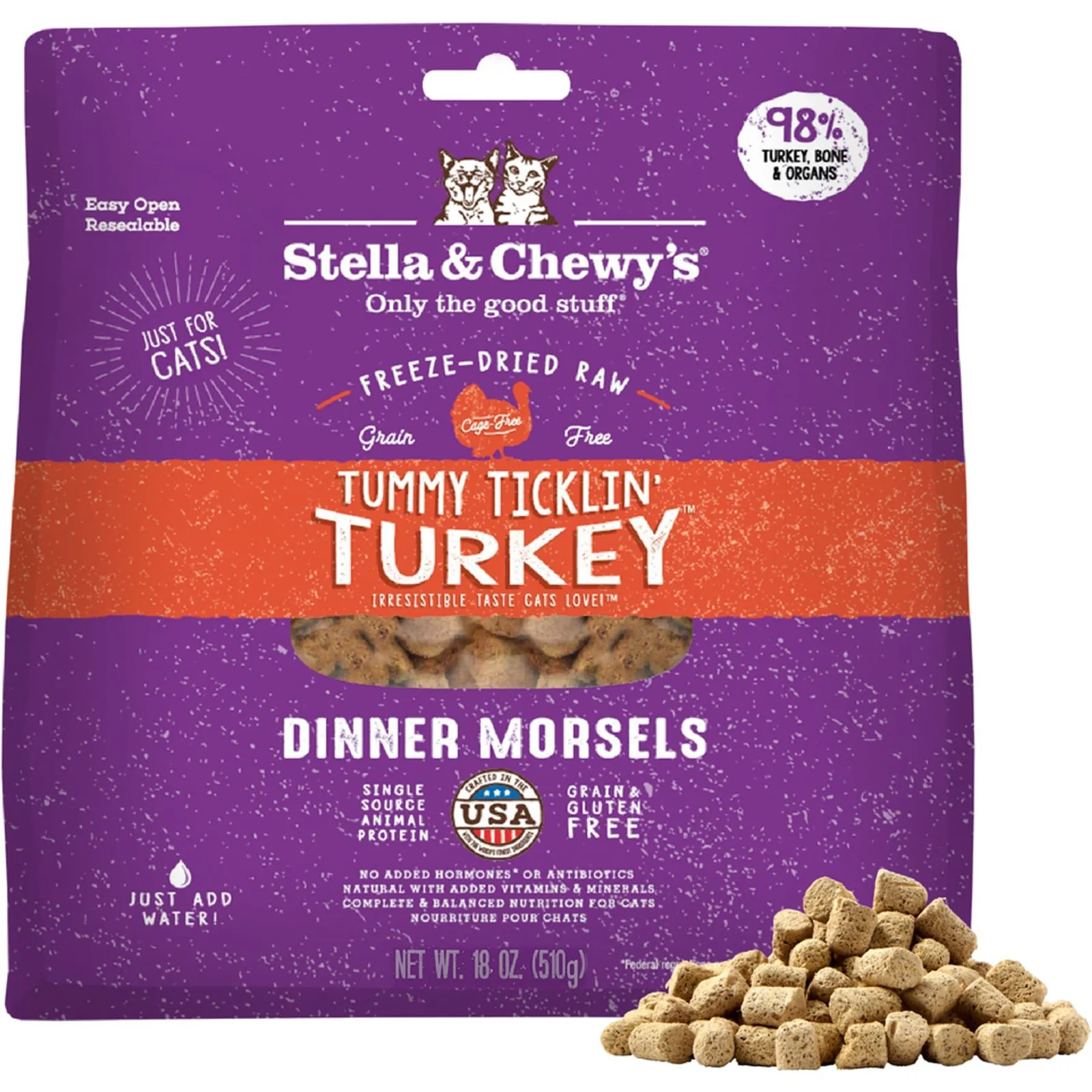
Every "cat food ingredients to avoid" list online reads like a chemistry exam, and most of the entries deserve less fear than they get. The ingredients below are sorted by what they actually tell you about a food, with a moderation verdict on each, so you can read a label without being scared off every mainstream product in the aisle.
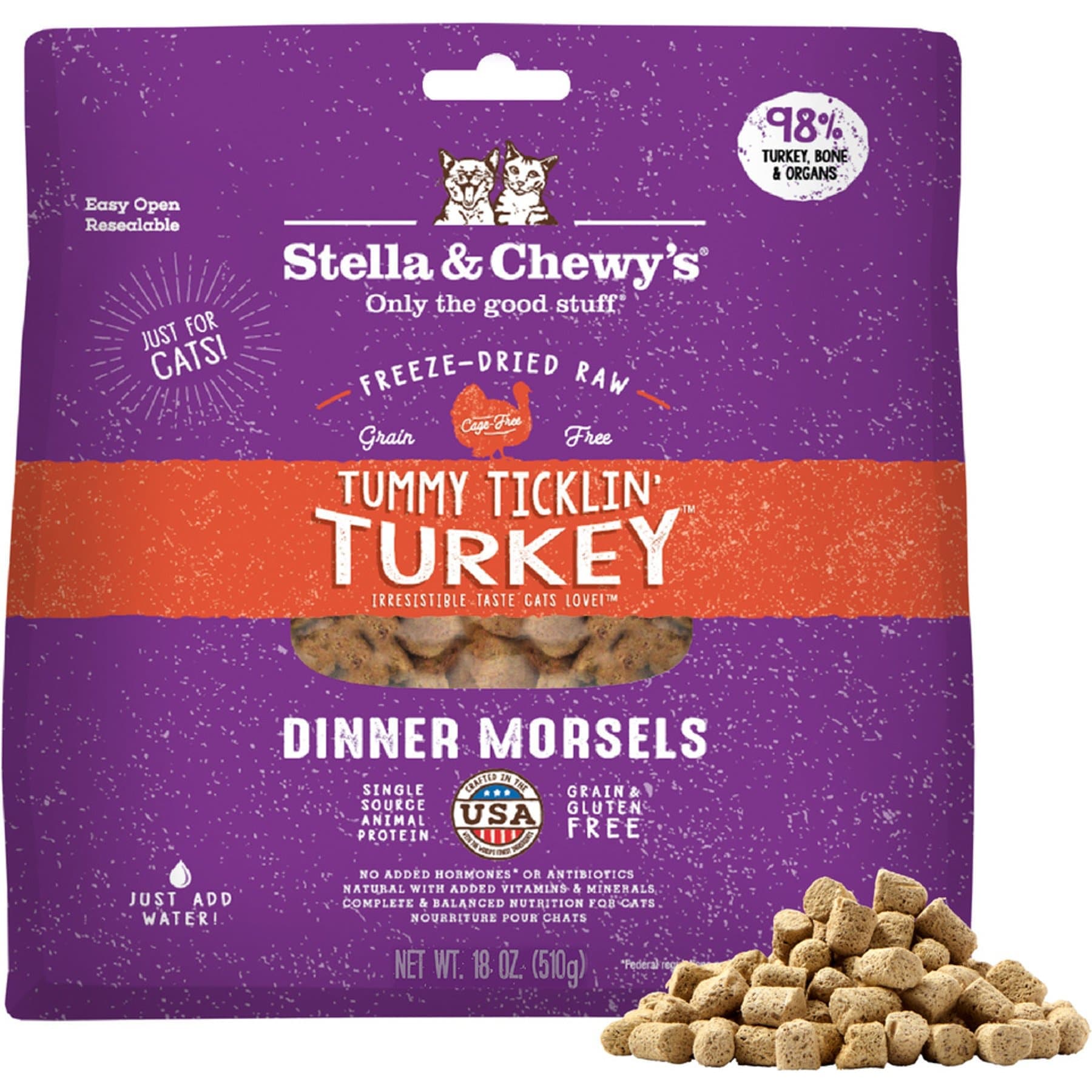
Stella & Chewy’s Tummy Ticklin’ Turkey freeze-dried cat food in an 18-ounce bag. Compare the named recipe, feeding directions and suitability for your cat.
Petful may earn a commission when you click through to Chewy, at no extra cost to you.
Before the ingredient-by-ingredient entries, two rules that cover most of the list of bad ingredients in cat food:
- The study reported associations involving marine ingredients, plant-ingredient counts and food format. It did not establish that the preservatives or colors discussed here caused those findings. Nor does that establish that every contaminant came from a known source: the report did not identify one ingredient type that explained the higher lead in dry food.
- Use the ingredient list to identify ingredients you need to ask about, not to calculate a safety score. A complete-and-balanced statement, suitable life stage, current recall check and meaningful testing information answer different questions that ingredient order alone cannot.
Here is the short version of which ingredients to avoid and which worries are overblown, before the detail:
- Worth investigating: the food's nutritional adequacy and the purpose of ingredients you do not recognize. Ingredient names alone do not establish a weak recipe.
- Mostly overblown: artificial colors and flavors, carrageenan, menadione, and BHA and BHT are label signals or tiebreakers, not proof a food is dangerous.
- Moderation note: a mainstream food with one of these ingredients on an otherwise sound label is still a reasonable choice, so weigh the whole panel instead of dropping every grocery brand.
Artificial colors
Dyes such as Red 40, Yellow 5 and Blue 2 exist to make kibble look like meat and vegetables to the person buying it. Color is an appearance feature, not a measurement of nutritional adequacy or contamination. If you prefer a food without added colors, check the ingredient list, but do not use bright versus brown kibble as a safety ranking.
Artificial flavors
Flavor ingredients affect palatability. Their presence does not reveal a recipe's meat content, amino-acid balance or contaminant concentration. Ask the maker about formulation if those details are important to your choice.
Carrageenan
A seaweed-derived thickener used in pates to hold their shape. The debate centers on a degraded form that is not the food-grade version used in pet food, and the evidence in cats is thin. The cat-food contamination study did not establish a safe serving frequency for carrageenan or compare health outcomes with and without it. If you choose to exclude it, read the exact ingredient list; a broth or shredded texture does not guarantee its absence.
Menadione sodium bisulfite
A synthetic vitamin K source, listed as menadione sodium bisulfite complex. Its presence alone does not show that the complete formula supplies too much or too little vitamin K. Ask the manufacturer why it is included and how the recipe's nutritional adequacy was established; this study did not compare the health effects of foods with and without it.
BHA and BHT
Synthetic preservatives used to keep fats from going rancid. The study did not establish that choosing mixed tocopherols instead produces a better contaminant result or a healthier diet. If preservative choice matters to you, compare the exact labels and ask the maker about its formulation and testing.
Plant-protein ingredients
Pea protein, corn gluten meal, soybean meal and wheat gluten are protein ingredients. Their names and number do not reveal the finished diet's amino-acid balance or how much protein each contributes. Ask about formulation and nutritional adequacy rather than treating a plant-protein ingredient as proof of deficiency.
Sugar and sweeteners
Sugar, corn syrup and caramel appear mostly in gravies and semi-moist foods for texture and color. Cats cannot taste sweetness. Verdict: ask what the ingredient contributes and judge the complete formulation; its name alone does not establish that the recipe is deficient.
For a ranked freeze-dried option to compare, Stella & Chewy's Tummy Ticklin' Turkey freeze-dried food was ranked in the Clean Sixteen. Check the exact recipe and feeding statement rather than treating a shorter ingredient list as the reason for its ranking. For the full method of reading a panel, including guaranteed analysis and feeding statements, see our guide to how to read a pet food label.
A cat food ingredients checker or scanner app is useful only for the information it actually provides. Distinguish an ingredient-based score from a laboratory result or certification record, and check whether the exact recipe matches. CLP itself offers an app for finding verified products, so it would be inaccurate to say that no app carries testing information. A scanner score alone does not replace the nutritional adequacy statement or a current recall check.
Recall history: the check that beats any list
A recall is the one piece of brand-level evidence that is public, dated and specific. The 2026 study is not a recall, and it produced none; recalls come from the FDA and the manufacturer, and they name the exact product and lot. That makes recall history the single most useful thing you can check on a brand before you decide to avoid it.
How to run the check:
- Open the brand's page on Petful. We keep a page for each major cat food brand, including Purina, Friskies, Fancy Feast, Meow Mix, Cat Chow and Sheba, with every incident, the cause and the lots.
- Review the cause, date, affected products and lots, and the company's corrective action. No arbitrary recall count establishes safety or a process failure; match current notices to the exact food you own.
- Check the cause against the food you feed. A recall on a dog treat line tells you little about a cat pate from the same company.
- Check the date. A recall from years ago that was followed by a clean record is weaker evidence than a recent one.
Which cat food is being recalled in 2026? Our pet food recalls hub lists every active recall as it is announced, and it is the page to bookmark rather than any brand list, because the study produced no recalls and a list cannot tell you what was pulled last week. The FDA's own recalls and withdrawals page is the primary source behind it.
One more distinction that saves a lot of worry. "Tested but not ranked" in the study and "recalled" are two completely different categories of information. The first is a lab ranking with a stated caveat that it is not an indicator of a regulatory problem. The second is a documented safety action on a specific lot. Follow the recall's instructions for the specified product and lot; a notice does not automatically apply to every product from that brand.
How to switch if you decide to move on
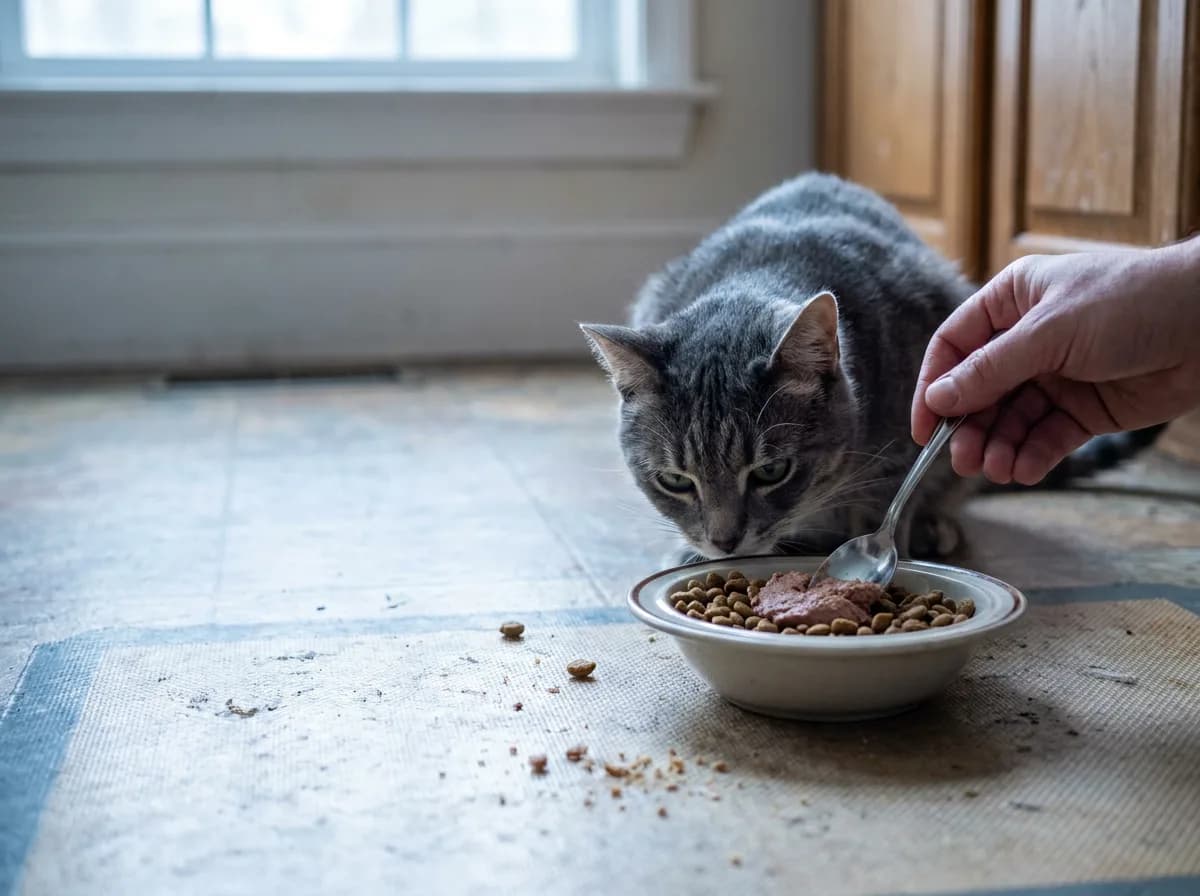
If the signals and the recall check convince you to move off a food, the switch itself carries a risk that catches owners off guard. Cats are far more likely than dogs to refuse a new food outright, and a cat that stops eating can develop hepatic lipidosis, a liver condition that can become serious within days. The gradual 7 to 10 day transition below applies only when the old food is not recalled or suspected of causing illness. For an affected recalled lot, stop feeding it and follow the recall notice and your veterinarian's replacement-feeding advice. Keep a low threshold for calling your veterinarian if your cat eats poorly.
The transition that works for most cats:
- Days 1 to 3: mix roughly one part new food into three parts old food, served at the usual times.
- Days 4 to 6: move to half and half. If your cat is picking out the old food and leaving the new, hold here an extra day or two.
- Days 7 to 9: three parts new to one part old.
- Day 10: fully switched. If your cat eats, holds weight and has normal stools, you are done.
Will a cat starve rather than eat food it doesn't like? Yes, some will, and that is why the hepatic lipidosis warning matters. If your cat eats nothing for more than a day, or eats only a fraction of normal for two days, call your veterinarian promptly and ask what to offer. Do not return to an old food that was recalled or suspected of causing illness. Do not wait it out. Fasting a healthy adult cat is not a training technique; it is a medical risk, and a veterinarian can advise on appetite support and whether the old food is the right fallback.
A few things that make the switch easier:
- Match the format first. Moving from a dry food to a dry food, or a pate to a pate, is easier than crossing formats.
- Warm wet food slightly to bring out the smell, which is what a cat's appetite responds to.
- Keep feeding times and bowls the same so the only change is the food.
- Switch one cat at a time in a multi-cat home so you can tell who is eating what.
The study alone does not establish that your current food needs replacing. Use the checklist to identify a specific reason to act, such as an affected recalled lot, unsuitable feeding instructions or relevant exact-product results. A satisfactory label and no past recalls do not constitute a contaminant test.
Frequently asked questions about cat food brands to avoid
The questions below come up as standalone searches on the same topic. They are answered on their own, so you can read one without needing the rest of the page.
Not by the evidence available. Friskies had a Clean Sixteen wet product in the 2026 study, Friskies Salmon Dinner Pate, while its Seafood Sensation and Gravy Swirlers recipes were tested but not ranked, which the study says is not an indicator of a regulatory problem. Judge the recipe you are buying with the seven signals and check the Friskies recall history before deciding, rather than relying on the brand's reputation on worst-brand lists.
The 2026 study does not say so. Meow Mix Original Choice was tested but not ranked, which means it did not reach the Clean Sixteen top tier and nothing more; the study's own caveat is that absence from that tier is not evidence a product exceeds regulations. Check the exact recipe's nutritional adequacy, current recall status and available testing information. Generic ingredient names alone do not establish that it is harmful.
A grain-free claim does not establish contaminant levels or nutritional suitability. Ingredient names and their count also cannot reveal the recipe's combined meat or plant-protein contribution. Compare the nutritional adequacy statement and actual product evidence instead.
No recall count alone settles the question. Review the cause, date, affected products and lots, and the company's corrective action. Check current FDA notices against the food you own; do not wait for a brand to reach an arbitrary number of recalls.
No. This study does not establish that a higher price means a better contaminant result. The Clean Sixteen ranked inexpensive products from Kirkland, Friskies, Fancy Feast and Sheba alongside boutique brands, while some premium products were tested but not ranked. Poultry recipes performed better on average in this sample, but that is not a prediction for every product. Compare affordable foods that meet your cat's nutritional needs, then consider exact-recipe evidence and recall history.

Coreen Saito is a pet writer and longtime shelter volunteer with more than a decade in animal rescue. She covers cat behavior, breed care, and the small, ordinary science of sharing a life with companion animals, with a particular focus on honest takes about the products and decisions that actually matter. At home in Arizona, she's outranked by Mac (a dog with the loudest opinion in the house), Rebel (a cat who governs by quiet authority), and Meri (an orange tabby who runs the late shift and the laundry basket). She writes about all three, plus the rescues that keep coming through her life, at LifeWithMinty.com.
Sign up for expert-backed reviews and safety alerts all in one place.