Best Dog Food for English Bulldogs
Compare seven foods for English Bulldogs by life stage, calorie density and dietary needs, with practical guidance on portions, food allergies and gradual transitions.
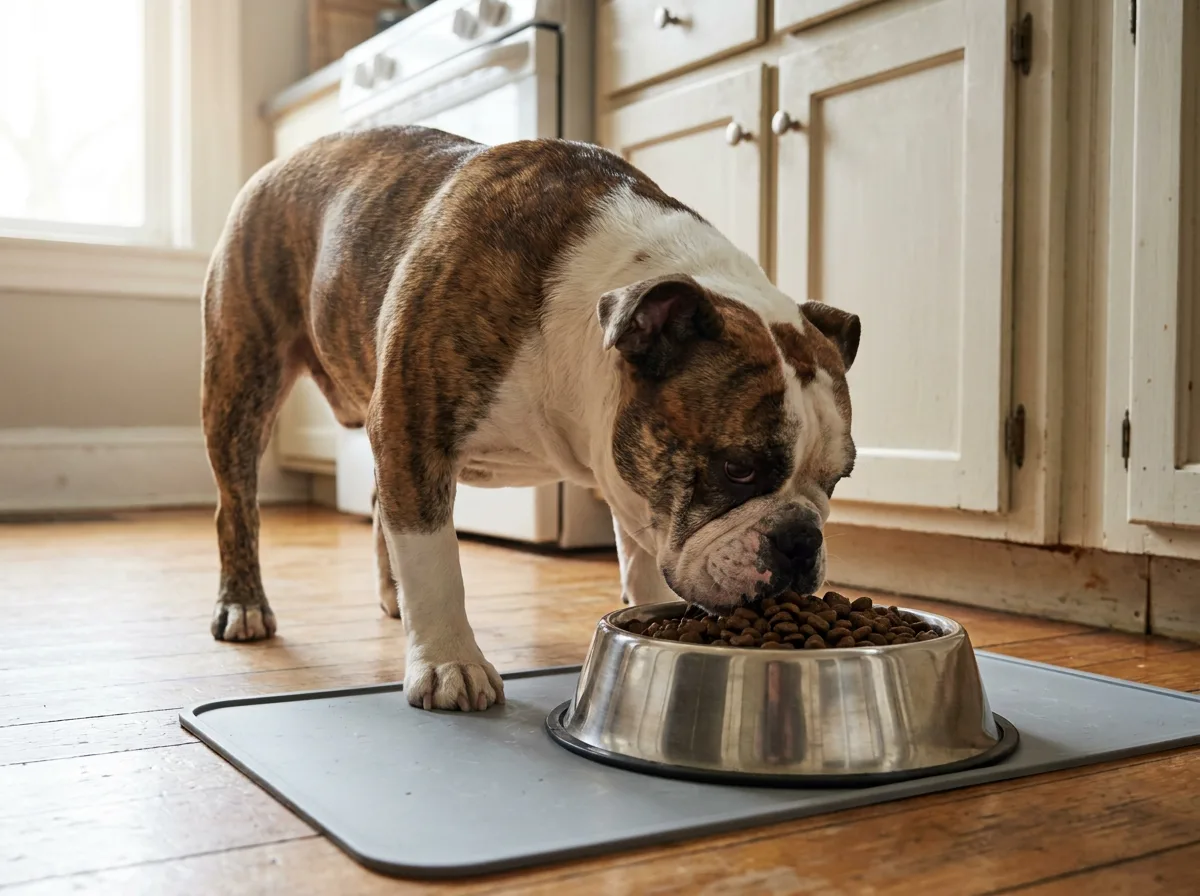
Choose a bowl your Bulldog can reach comfortably, and measure the meal separately.
Petful is reader supported. As an affiliate of platforms like Amazon and Chewy, we may earn a commission when you buy through links on this page. There is no extra cost to you.
The best dog food for English Bulldogs is a complete diet that matches the dog's life stage, body condition and medical needs. A growing puppy, an overweight adult and a dog undergoing a veterinary food trial need different things from dinner. The breed name on the bag cannot settle those decisions for you.
Our seven choices start with Wellness Complete Health for grain-inclusive adult kibble and JustFoodForDogs JustFresh for a cooked, fresh-food format. Open Farm offers another grain-inclusive choice. Diamond CARE focuses on adult weight management, while BLUE Natural Veterinary Diet NP Alligator belongs in a veterinarian-directed plan. Badlands Ranch and Canidae offer air-dried and fish-based adult options, respectively.
Start with the comparison, then use the feeding guidance to narrow the choice. If your Bulldog is thriving on an appropriate diet, a new brand is not automatically an improvement. Comfortable digestion, a suitable body condition and a workable long-term feeding routine matter more than buying the most expensive food.
- 1Match the food’s nutritional adequacy statement to growth or adult maintenance before comparing ingredients.
- 2Use calorie density and a measured portion to manage intake; cups of different foods are not interchangeable.
- 3Investigate suspected food allergies with your veterinarian rather than assuming Bulldogs need a particular protein or grain-free food.
Petful may earn a commission if you click on our links and make a purchase. This comes at no extra cost to you.

Sign up for expert-backed reviews and safety alerts all in one place.
The Best Dog Foods for English Bulldogs
These foods serve different needs. Compare the nutritional adequacy statement and energy density before considering flavor, packaging or ingredient preferences. The calories below come from the manufacturers' published information; check the current bag because formulas and labels can change.
| Food | Potential fit | Nutritional adequacy | Calories per cup | Calories per kilogram | Important limit |
|---|---|---|---|---|---|
| Wellness Complete Health Chicken & Oatmeal | Grain-inclusive adult kibble | Adult maintenance | Check current package | Check current package | Contains chicken; choose puppy food separately |
| JustFoodForDogs JustFresh Chicken | Cooked food in resealable pouches | Chicken recipe: adult maintenance | Check current package | Check current package | Check the exact recipe and opened-pouch storage directions |
| Open Farm Pork & Ancient Grains | Grain-inclusive regular diet | All life stages except large-size growth of 70 lb or more | 426 | 3,750 | Not a weight-loss formula |
| Diamond CARE Weight Management | Adult weight-management plan | Adult maintenance | 304 | 2,979 | Not a growing-puppy diet |
| BLUE NP Alligator | Veterinarian-directed novel-protein plan | All life stages including large-size growth | 372 | 3,568 | Requires individual veterinary direction |
| Badlands Ranch Superfood Complete Beef | Air-dried adult food | Adult maintenance | 430 | 4,300 | High energy density; 30% minimum fat |
| Canidae Under the Sun Whitefish | Fish-based adult recipe | Adult maintenance | Check current package | 3,398 | Grain-free does not mean hypoallergenic |
Manufacturer energy information is not a daily calorie recommendation. Use the exact current package and an individual feeding plan.
An adult-maintenance diet is not a puppy food. An all-life-stages statement does not mean every adult needs that food's calorie density. A veterinary diet also requires a reason to use it, even when its nutritional adequacy statement includes growth. Those distinctions are more useful than assigning every Bulldog the same winner.
We compare calories per cup where the current information is usable, and calories per kilogram for a consistent weight-based comparison. Cups describe a volume; grams describe an amount of food. Kibble shape, density and how the cup is filled can change the weight in a serving. A kitchen scale makes a prescribed portion easier to repeat.
1. Grain-Inclusive Adult Choice: Wellness Complete Health Chicken & Oatmeal
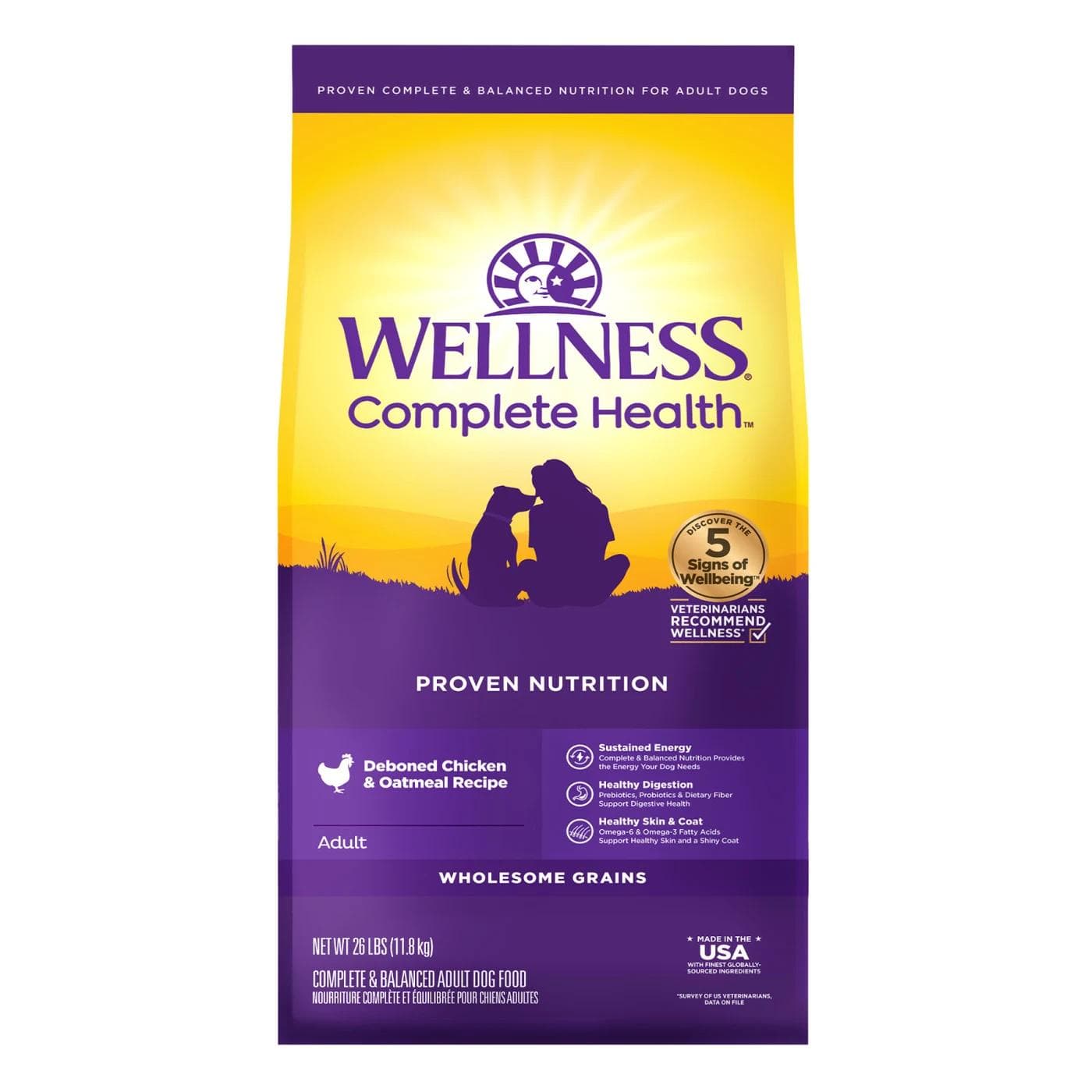
Deboned chicken and whole grains with guaranteed probiotics, taurine, and omegas. The sensible middle of the premium aisle for everyday adult dogs.
Petful may earn a commission when you click through to Chewy, at no extra cost to you.
Wellness Complete Health Chicken & Oatmeal is an adult dry-food option for owners who want chicken with grains in an everyday feeding routine. The manufacturer lists deboned chicken, chicken meal, oatmeal and barley among its ingredients. Its dry format makes it straightforward to weigh a daily ration and reserve part of that portion for training.
This is the adult Chicken & Oatmeal recipe, not the separately formulated puppy food. Compare the current bag's feeding directions and calorie information with your Bulldog's daily allowance. Chicken is part of this formula, so a chicken restriction calls for a different choice; the veterinary-diet options below serve a separate purpose.
Wellness ingredient and feeding information
2. Fresh-Food Adult Choice: JustFoodForDogs JustFresh Home-Cooked Chicken
Petful may earn a commission when you click through to JustFoodForDogs, at no extra cost to you.
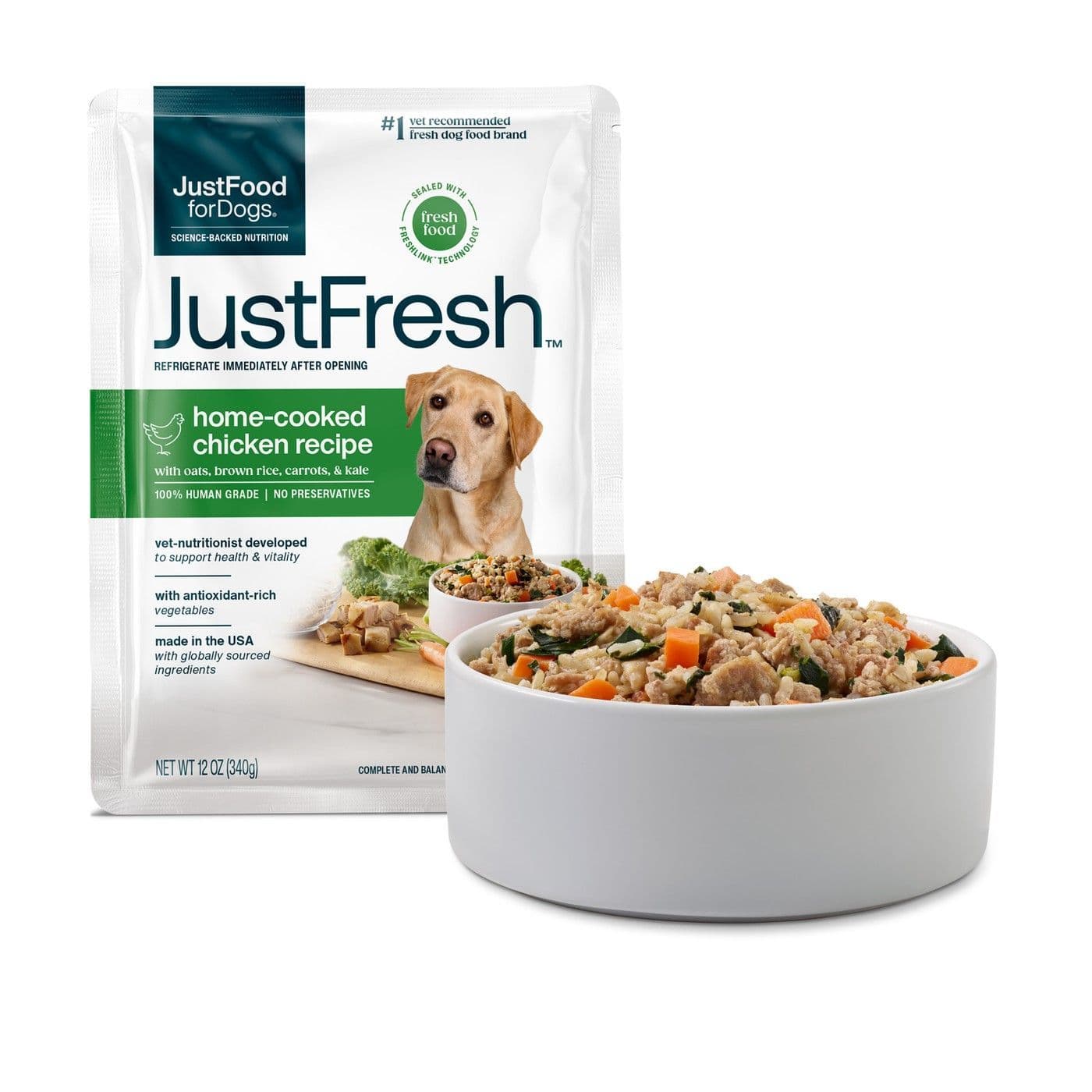
JustFoodForDogs JustFresh offers cooked meals in resealable pouches for owners who prefer a fresh-food format with pantry storage before opening. The Home-Cooked Chicken recipe is a complete and balanced adult-maintenance option. It can be served as a main meal or used as a topper, making it a practical alternative to an all-kibble routine.
The offer here is for Home-Cooked Chicken. Other JustFresh recipes can differ in ingredients and calories. Use the pouch's calories and feeding directions rather than substituting it cup for cup for kibble. When using it as a topper, account for that food in the daily total and follow the package's instructions for opened pouches.
JustFoodForDogs JustFresh Chicken product information
3. Grain-Inclusive Choice: Open Farm Farmer's Table Pork & Ancient Grains
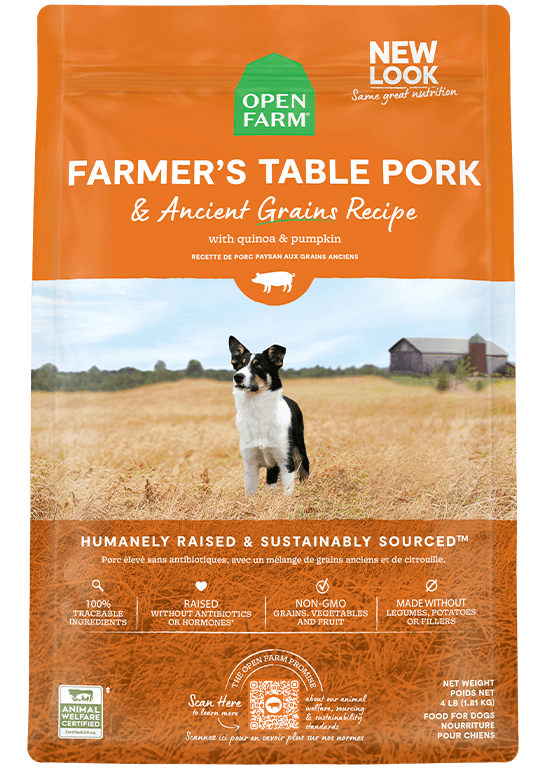
A grain-inclusive pork recipe to compare with your dog’s life stage, calorie target and tolerance. Choose the bag size at the retailer.
Petful may earn a commission when you click through to Open Farm, at no extra cost to you.
Open Farm Farmer's Table Pork & Ancient Grains is a dry pork recipe for owners who want a grain-inclusive option. The current manufacturer information lists 426 calories per cup, 3,750 calories per kilogram, at least 26% crude protein and at least 15% crude fat. It is a regular complete food, not a veterinary weight-loss formulation.
The life-stage statement deserves a close read. Open Farm identifies this recipe for all life stages except the growth of large-size dogs expected to reach 70 pounds or more as adults. That is a specific growth limitation, not a statement that all Bulldogs are too large for the food. For a puppy, discuss expected mature size with the veterinarian and check the exact bag's adequacy statement before choosing it.
Portion Size and Practical Fit
For a healthy adult, the main practical question is portion size. At 426 calories per cup, this recipe supplies more calories by volume than Diamond CARE Weight Management. Replacing a cup of the latter with a cup of Open Farm would increase calories, even if the bowl looked equally full. A switch should use the dog's calorie allowance and the new food's energy information, not the previous number of scoops.
This may suit an owner who prefers pork and grains and can consistently measure the portion. It is a less obvious choice when the dog needs a specific therapeutic diet, a tightly controlled fat intake or a substantial weight-loss plan. In those situations, choose the nutritional requirements first and see whether the food meets them.
Pork also does not make a food hypoallergenic. Whether a protein is new to your dog depends on previous meals, treats, chews and flavored products. A dog who has eaten pork treats has already encountered pork, even if the main food was chicken. The complete ingredient list matters during a diet investigation; the recipe's front-of-bag protein is only part of that history.
The manufacturer offers several bag sizes, including a 22-pound bag. When comparing cost, use the same recipe and size, then account for the amount your dog would eat. A smaller bag can be sensible when first trying a food or when a larger bag would remain open too long. A discount is useful only if the food suits the dog and can be stored and used appropriately.
4. Adult Weight-Management Choice: Diamond CARE Weight Management
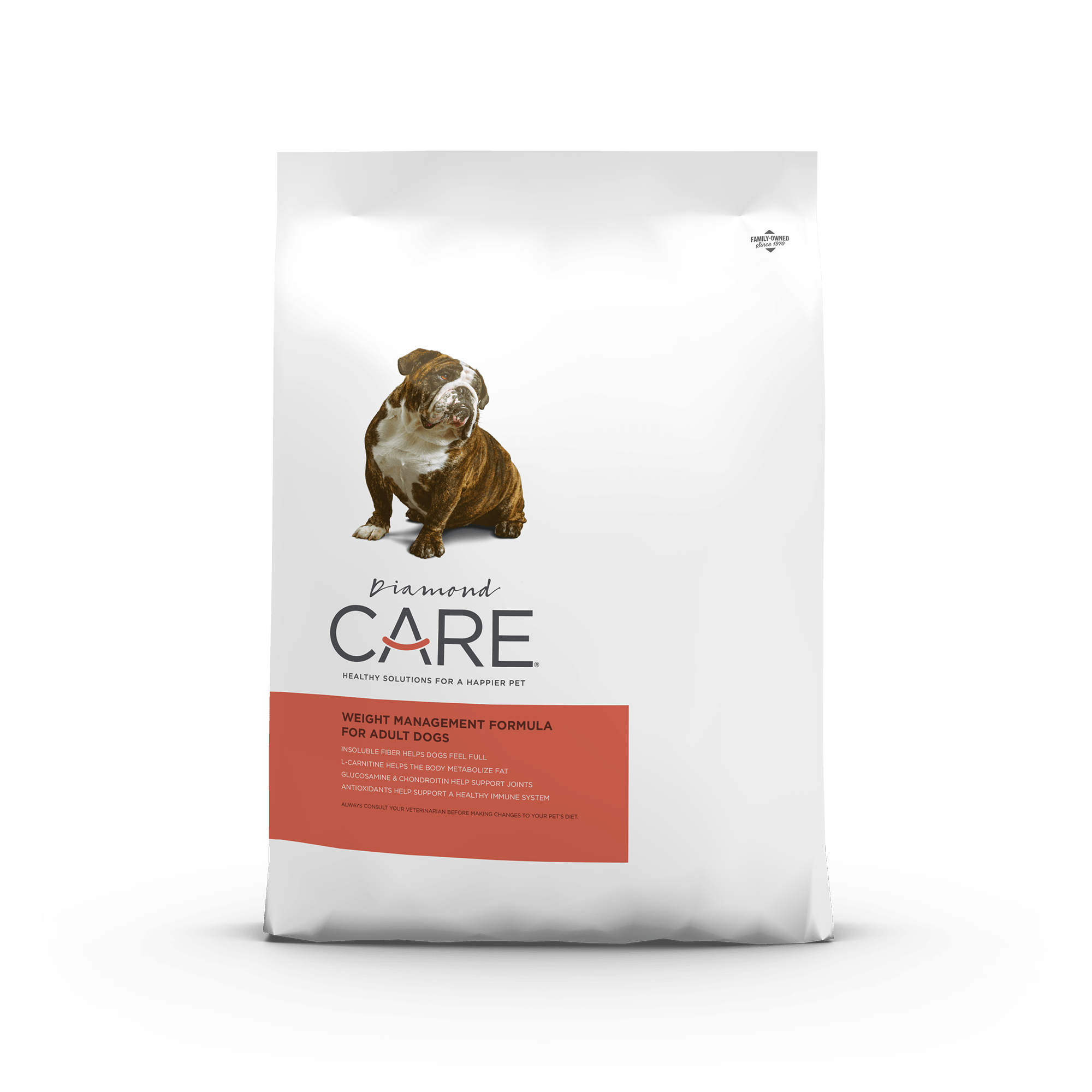
An adult-maintenance weight-management formula with 304 kcal per cup. Ask your veterinarian to set portions for your Bulldog’s target weight.
Petful may earn a commission when you click through to Chewy, at no extra cost to you.
Diamond CARE Weight Management Formula for Adult Dogs is the most clearly weight-focused option in this comparison. The manufacturer lists 304 calories per cup and 2,979 calories per kilogram. Its guaranteed analysis specifies at least 22% crude protein, a minimum of 6% and maximum of 8% crude fat, and a maximum of 10% crude fiber.
Those figures explain the decision better than a general “healthy weight” label. Compared with a more energy-dense food, a lower-calorie formula can allow a larger measured volume for the same calories. That may make the feeding routine more manageable, but it does not guarantee that a particular dog will feel satisfied or lose weight. Total intake and the individual plan still determine what happens.
The adequacy statement is for adult maintenance. Do not select this formula for a growing Bulldog puppy simply because the puppy looks broad or stocky. Growth and weight management are different nutrition problems. A veterinarian can distinguish normal development from excess body fat and choose an appropriate plan without treating a puppy like an overweight adult.
Managing the Complete Ration
For an adult already carrying excess weight, bring the current food amount and every extra to the appointment. A weight-management kibble cannot compensate for uncounted treats, table food or a second person filling the bowl. It is easier to judge a food's usefulness when the daily ration is known and the household follows the same plan.
Diamond publishes a feeding chart with activity and weight-loss guidance, but also tells owners to work with their veterinarian and adjust for the individual dog. Treat the chart as a starting reference. Using the row for the dog's present weight without considering the intended goal can produce the wrong ration, especially when the dog is substantially above an appropriate weight.
The ingredient list includes lamb meal, peas, chickpeas and other ingredients. It is not a veterinary elimination diet, and the manufacturer notes that its facility also handles ingredients not listed in the formula. This matters when comparing weight control with allergy management: one food may address calorie needs without being the right tool for a strict diagnostic trial.
5. Veterinary Novel-Protein Choice: BLUE Natural Veterinary Diet NP Alligator
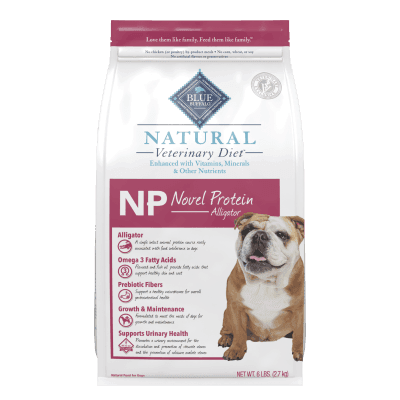
A veterinary alligator-protein diet for a veterinarian-directed food trial when appropriate. Follow the prescribed feeding plan and avoid extra proteins.
Petful may earn a commission when you click through to Chewy, at no extra cost to you.
BLUE Natural Veterinary Diet NP Novel Protein Alligator is a veterinary diet intended for selected dogs with adverse food reactions. It belongs in a veterinarian-directed feeding plan. It should not become a routine recommendation for every Bulldog with an itchy paw, occasional gas or a sensitive-sounding breed description.
The manufacturer lists 372 calories per cup and 3,568 calories per kilogram, with minimums of 22% crude protein and 14% crude fat. The actual nutritional adequacy statement covers all life stages, including growth of large-size dogs expected to reach 70 pounds or more as adults. That statement is more informative than a generic adult-dog label elsewhere on the page, but the veterinarian still decides whether this diet is appropriate for a particular puppy or adult.
Comparing Novel Protein and Hydrolyzed Diets
“Novel protein” means a protein that is new to the individual dog. Alligator is unusual in ordinary dog food, which can make it useful in the right history. It is not automatically novel if the dog has eaten it before. Nor does an unusual protein guarantee that every dog will tolerate every other ingredient in the recipe. The named protein here is alligator; do not assume a food labeled crocodile is the same recipe or an interchangeable choice for a diet trial.
BLUE NP Alligator is different from BLUE HF Hydrolyzed for Food Intolerance, which uses salmon hydrolysate. A novel-protein approach changes the protein source; a hydrolyzed approach uses proteins broken down into smaller components. Your veterinarian can choose between these approaches based on the dog's history and clinical needs. Petful's guide to novel protein dog food explains the broader distinction.
- If this food is being used in an elimination trial, the entire routine matters. A different-protein dental chew, flavored supplement, shared food bowl or scrap from another person's plate can interfere with the plan. Ask the veterinary team which treats and medications are compatible rather than assuming that small amounts do not count.
Keep a record of what was fed and how the dog did. The useful comparison is between a defined feeding period and the agreed follow-up, not between two individual meals. Skin and digestive signs can have different causes and response times. A food change alone does not confirm that a dog was allergic to the old diet.
6. Air-Dried Adult Choice: Badlands Ranch Superfood Complete Beef
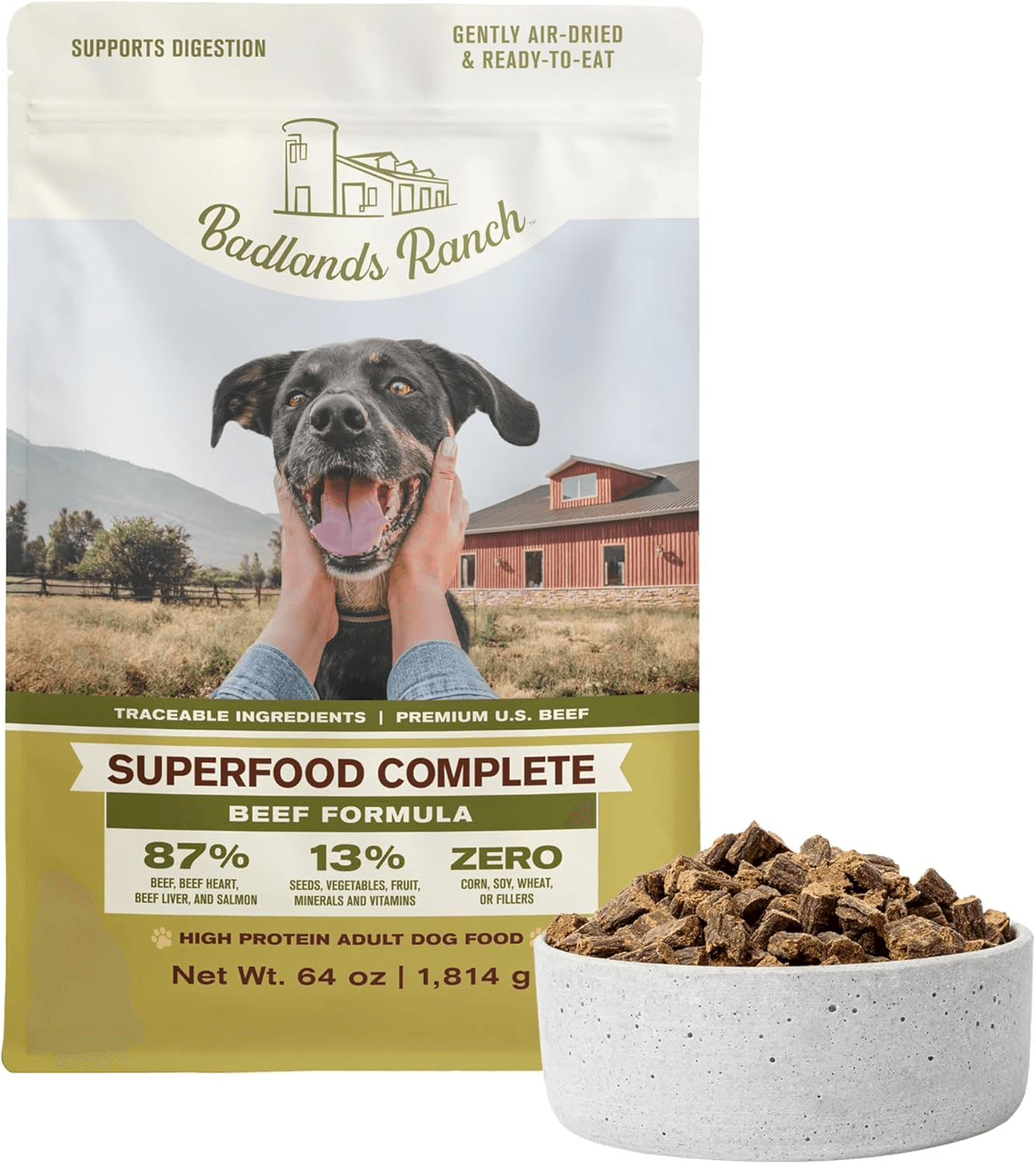
Earlier packaging shown. Select the package size and confirm the current ingredient and feeding information at the retailer.
Petful may earn a commission when you click through to Amazon, at no extra cost to you.
Badlands Ranch Superfood Complete Beef Formula offers an air-dried alternative to conventional kibble. The current manufacturer information lists 4,300 calories per kilogram and 430 calories per cup. The current back-of-package image shows minimums of 33% crude protein and 30% crude fat, with an adequacy statement for adult maintenance.
Energy density is the main feeding consideration. At the same weight of food, Badlands provides more calories than the other four foods compared here. That can be convenient when a suitable adult needs a smaller-volume meal, but it is not an advantage for every Bulldog. An owner trying to reduce calorie intake must measure it just as carefully as any other food.
- The current manufacturer page announces a new recipe and look. When reordering, compare the ingredient list, analysis, calories and directions on the bag you receive. Product reviews or older package photographs can describe a previous version. That matters particularly when a dog has an ingredient restriction or when a feeding plan was calculated from the old label.
The relatively high listed fat minimum is another reason to match the diet to the dog. Do not treat “air-dried” as a synonym for low fat, easy digestion or suitability for a medical condition. If the dog has been prescribed a particular fat restriction or therapeutic diet, ask the veterinarian whether this formula meets that requirement before changing foods.
Adult maintenance also means that this is not our choice for a growing puppy's sole diet. A product name containing “complete” does not erase its life-stage limitation. Read the adequacy statement on the package rather than carrying over the requirements from another recipe in the same brand or another air-dried food.
Some owners prefer to use an air-dried food as a topper. If you do that, count its calories and reduce the main food as appropriate. A handful added on top of a full ration is extra food, even if it contains appealing ingredients. If the topper becomes a substantial share of the diet, discuss how the overall combination meets the dog's nutritional needs.
7. Fish-Based Adult Choice: Canidae Under the Sun Grain Free Whitefish
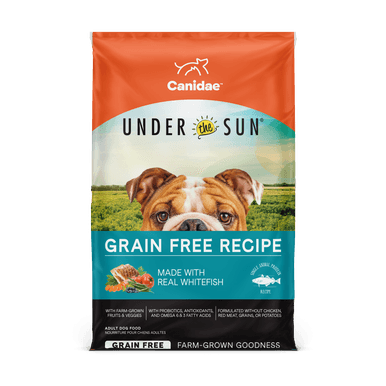
An adult-maintenance whitefish recipe. Compare the ingredients and calorie density with your dog’s needs; grain-free is not a medical requirement for Bulldogs.
Petful may earn a commission when you click through to PetSmart, at no extra cost to you.
Canidae Under the Sun Grain Free Whitefish Recipe is the exact whitefish formula in this guide, offered in a 23.5-pound bag. It should not be confused with a chicken recipe from the same range.
The published analysis lists at least 26% crude protein and 11% crude fat, with a maximum of 5.5% crude fiber. Its adequacy statement is for adult maintenance. Published energy information lists 3,398 calories per kilogram, which is useful for comparing a weighed ration with the other foods here.
Check the current bag's calorie and feeding information before calculating a portion in cups. We use the verified calories-per-kilogram figure here rather than assuming a cup has the same weight as a cup of another kibble. If the package and a website differ, ask the manufacturer which information applies to the lot you have.
Ingredient and Life-Stage Limits
This food may interest an owner looking for a fish-based adult diet, but whitefish is not a universal answer to Bulldog skin problems. A dog can react to a protein it has encountered before, and a complete recipe contains more than the named fish. Read the full label and take the dog's previous diet into account before treating a different protein as an allergy solution.
Grain-free is a formulation description, not a guarantee of better nutrition or less itching. Bulldogs do not need to avoid grains simply because of their breed. If a veterinarian has identified a dietary reason to avoid a specific ingredient, select around that actual reason. Otherwise, compare the overall nutritional suitability instead of treating the absence of grain as the deciding benefit.
An adult who does well on this food may have no reason to change merely because another option is fashionable. Conversely, an owner whose dog needs growth nutrition, a therapeutic diet or a particular weight-management approach should not assume that this adult formula meets those different needs. The adequacy statement and the dog's condition remain the first checks.
Choosing Food for Bulldog Puppies and Adults
The healthiest food to give your English Bulldog is a complete diet matched to the dog’s life stage and health needs. Fresh-looking ingredients or breed branding cannot establish that suitability. Begin with the nutritional adequacy statement, usually found near the feeding information. FDA explains complete and balanced pet food in terms of meeting appropriate nutrient profiles or substantiating adequacy through feeding trials. The statement should identify the life stage the diet supports. A treat, topper or food intended only for supplemental feeding is not interchangeable with a complete main diet.
For a puppy, look for growth or suitable all-life-stages adequacy and any large-size growth restriction. For an adult, maintenance may be appropriate. Neither phrase tells you the perfect daily quantity. Adequacy answers whether the food is intended to provide the needed nutrition when fed appropriately; the calorie plan answers how much of it this dog should receive.
Feeding an English Bulldog Puppy
A puppy needs a growth-appropriate food and a feeding plan that changes as the puppy grows. Avoid choosing an adult weight-control food just to keep growth “slow,” and do not add calcium or other supplements to a complete puppy food without veterinary direction. Bring the exact food label to puppy visits so the veterinary team can consider the actual diet alongside the growth record.

Expected adult size is relevant when a label distinguishes large-size growth. Do not decide solely from how heavy the puppy is today. Ask about the likely mature size, the food's growth statement and whether the formula fits the puppy's development. In this comparison, Open Farm has a large-size growth exclusion; the veterinary BLUE formula has different adequacy wording and a separate clinical-use decision.
Use the puppy's current body condition and growth progress to adjust feeding rather than following the printed chart indefinitely. A rapidly changing dog can outgrow a previous portion, while excessive extras can unbalance an otherwise careful plan. Recheck both the amount and the meal routine at scheduled visits instead of waiting until the puppy is clearly over- or underweight.
A puppy's enthusiasm at the bowl is not a reliable calorie calculator. Make sure the household agrees on who feeds each meal, how much is weighed out and which training rewards come from that allowance. A labeled daily container can prevent several family members from each providing what they believe is the only meal or snack.
Adults and Senior Bulldogs
For an adult, the first question is whether the current diet is working. Stable appropriate weight, acceptable stools, comfortable eating and no dietary restriction may support staying with a suitable food. Changing protein sources repeatedly without a reason can make it harder to identify what actually affected digestion or appetite.
Older dogs need an individual assessment. “Senior” on a bag does not tell you whether that dog needs fewer calories, a different texture or nutrition for a particular disease. Some older dogs gain weight as activity changes; others lose weight or muscle. Those situations should not receive the same automatic calorie reduction.
When an adult diet stops seeming suitable, note what changed. Is the dog receiving more treats, exercising less, leaving food, struggling to chew, or losing weight despite eating? Bring those observations to the veterinarian. A product switch can be part of the answer, but it should not hide a new health problem behind an assumption that the dog has become picky.
Food Allergies and Sensitive Stomachs
An English Bulldog with skin or digestive trouble needs an individual explanation, not a breed-wide banned-ingredient list. Itching, recurrent ear problems, loose stools and vomiting can have causes beyond food. The question is whether a diet change is appropriate and how to evaluate it without confusing the result.
For a broader comparison of diet approaches, see Petful's best dog food for allergies guide. Here, the useful distinction is between choosing an everyday food that the dog tolerates and conducting a veterinary elimination diet. The latter is a structured investigation, not simply trying the next bag advertised for sensitive skin.
Itching with a suspected yeast infection is not a reason to buy a supposedly “anti-yeast” food on your own. Merck describes secondary yeast infections as one possible cause of itching, alongside other infections, parasites and allergies. A veterinarian needs to identify and address the skin problem. If a food reaction is also suspected, follow the diet investigation separately; changing the bag alone does not establish the cause or replace treatment.
Record the Whole Diet Before Changing It
Before the appointment, record these details for everyone who feeds your Bulldog:
- The main food’s exact recipe, amount and measuring method, including who feeds each meal.
- Every treat, dental chew, topper, table scrap, supplement and food used to give medication.
- When signs occur, and the dates of changes in food, appetite or veterinary treatment.
- Accidental extras or access to another pet’s bowl. A fish-based main food can still come with other animal proteins.
Ask other household members about their contributions rather than relying on the main feeder’s memory. The aim is a usable history, not a self-diagnosis from one photograph of the skin or one unusual stool.
A diary helps the veterinary team choose the next step and helps you follow it. Keep the record simple enough to continue: food and amount, extras, relevant signs and the dates of changes. If you change several foods, supplements and medications at once, it becomes much harder to know which change mattered.

Novel Protein, Hydrolyzed Diets and Trial Rules
The Merck Veterinary Manual describes elimination trials as a way to investigate adverse food reactions. Skin-related trials can require eight to twelve weeks, while gastrointestinal cases may have different timelines. Your veterinarian should set the duration, permitted foods and follow-up for your dog.
A novel protein depends on previous exposure; hydrolyzed diets use a different approach to the protein. Do not assume that an over-the-counter food with the same headline ingredient is interchangeable with the diet selected for a trial. The full formulation and the way the trial is controlled matter. Ask for practical instructions before beginning. Which rewards can you use for training? Is a flavored medication compatible? Can the dog finish another pet's meal? What should you do after an accidental snack? Having answers makes a strict plan easier to follow without abandoning it after one difficult day.
Improvement during a change does not by itself identify the offending ingredient. The veterinarian may recommend a controlled challenge or another evaluation to interpret the response. Avoid declaring the dog “allergic to all chicken” or “allergic to grains” solely because signs improved after a switch that changed many ingredients at once.
When Sensitive-Stomach Marketing Is Not Enough
For a dog with mild food-related concerns, a measured transition and a consistent routine may be useful, but persistent vomiting, diarrhea, reduced appetite or weight loss warrants veterinary advice. Do not keep cycling through richer foods to tempt a dog whose usual eating pattern has changed.
The best food for a Bulldog with both skin problems and excess weight may require balancing several needs. A product that suits a particular protein restriction could be too energy-dense for the existing portion. A lower-calorie food may not meet the requirements of an elimination trial. Ask the veterinarian to set the priorities together rather than choosing one claim on the package and overlooking the rest.
How Much to Feed an English Bulldog
There is no single number of cups that suits every adult English Bulldog. The amount depends on the dog's calorie needs and the food's energy density. Age, activity, body condition, neuter status, health and extras all affect the feeding plan. Two Bulldogs of the same weight may need different daily amounts.
AAHA's feeding-plan guidance supports an individual plan that includes the diet, quantity, feeding frequency and allowance for extras. Ask for a daily calorie target or a measured amount of the exact food, then divide it into the meal routine that fits your dog.
Turn a Calorie Allowance Into a Weighed Portion
To calculate a weighed ration from a calorie allowance:
- Divide the food’s calories per kilogram by 1,000 to find calories per gram.
- Divide the calories allocated to that food by its calories per gram. This is a calculation method, not a recommended calorie allowance for every Bulldog.
- For example, suppose a veterinarian has allocated 600 calories a day to the main food after accounting for other intake. At 3,750 calories per kilogram, Open Farm provides 3.75 calories per gram, making the calculated amount 160 grams. At 2,979 calories per kilogram, Diamond CARE provides 2.979 calories per gram, making the amount about 201 grams. Both portions supply approximately the same calories despite weighing different amounts.
Use the same method when changing food formats. Air-dried pieces, dense kibble and a lighter-looking kibble do not have interchangeable spoonfuls. Reusing the old scoop quantity can increase or reduce calorie intake without an obvious change in bowl volume. Keep the current label available when calculating the new ration.
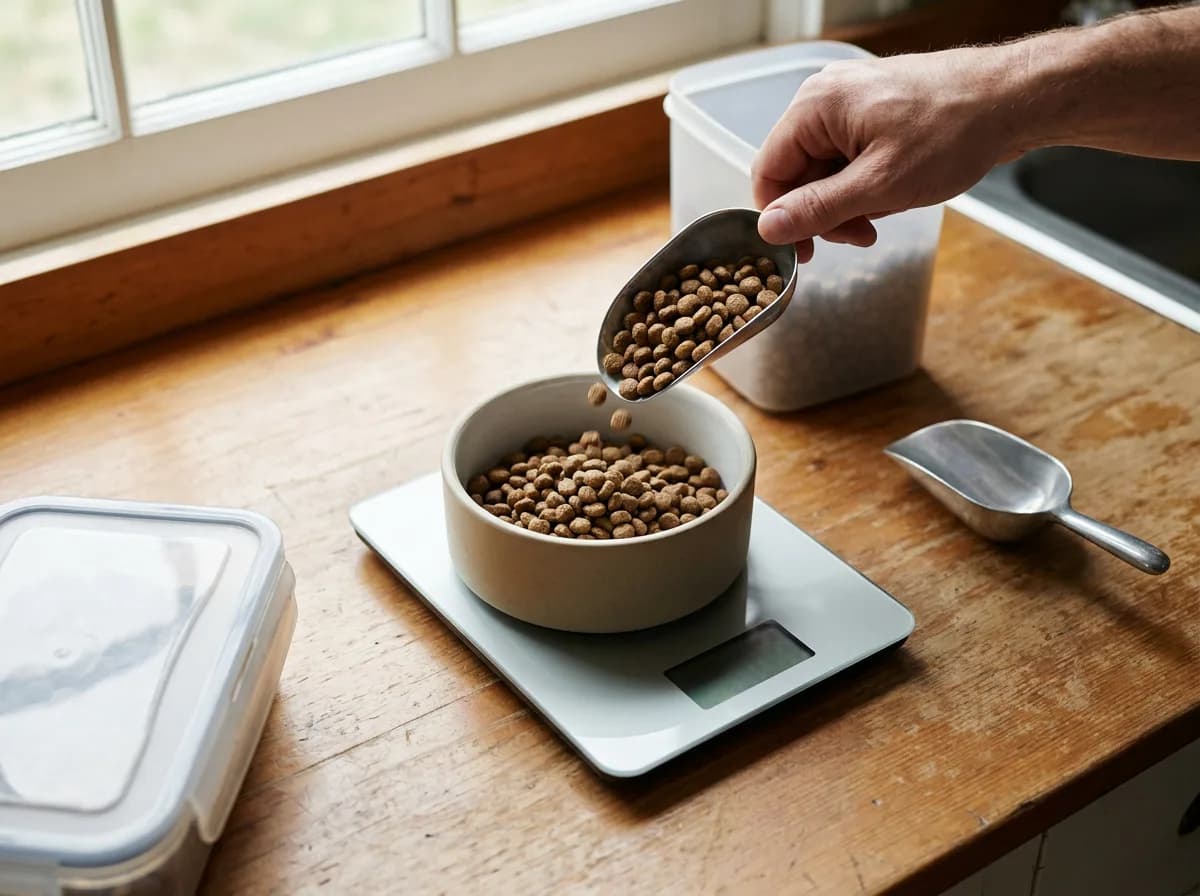
Tare the empty bowl on a digital kitchen scale before adding food. If you prepare a day's ration in advance, take meals and permitted training rewards from that container. Recheck the scale and serving routine when a different family member starts feeding or when the dog moves between homes, boarding care or a pet sitter.
Use Body Condition Alongside the Scale
Weight alone does not show how much of a dog's body is fat or muscle. Ask the veterinary team to demonstrate a body-condition assessment on your Bulldog, including how to feel the ribs and assess the waist. A broad chest or thick neck should not be used to dismiss excess body fat, and a photograph alone is not a diagnosis.

Track progress under similar conditions and use the follow-up schedule recommended by the veterinarian. Changes in body condition, appetite and muscle can affect the plan even when the number on the scale seems stable. Report unexpected weight loss as well as weight gain; neither should automatically be treated as a simple portion problem.
For weight loss, use a defined target and reassessment rather than repeatedly shrinking meals on your own. A lower-energy food may help make the portion practical, but substantial restriction of an ordinary diet can raise other nutritional concerns. The veterinarian can select the food, rate of change and monitoring that fit the dog's health.
What to Look for in the Best Dog Food for English Bulldogs
Once the life stage and any medical requirements are settled, compare the practical details that determine whether a diet will work in your home. A useful shortlist is small enough to evaluate carefully. It does not need to include every brand that uses the word natural or every food another Bulldog owner recommends.
Evaluate the Whole Food, Not Just the First Ingredient
An ingredient list tells you what is included, but it is not a complete measure of nutritional quality. WSAVA's food-selection guidance directs owners toward questions about nutritional expertise, quality control and the manufacturer's ability to provide useful information. These questions are more informative than deciding that an attractive ingredient name guarantees a better food.
Ask whether the manufacturer can explain the adequacy statement, calorie information and feeding directions for the exact recipe. If your dog has a special requirement, request the relevant nutritional details rather than assuming the guaranteed analysis answers everything. Minimum and maximum percentages are not the same as a complete typical nutrient analysis.
For example, a fat minimum does not tell you the highest possible fat content, while a veterinary low-fat decision may depend on a more precise comparison. Similarly, comparing protein percentages across dry and wet foods without considering moisture can be misleading. Bring the exact labels to the veterinary team when the nutrient comparison is part of a medical decision.
Treats and Bowl Access
AAHA advises keeping treats and other extras within 10% of daily calorie intake. A veterinary diet trial may be more restrictive because ingredient exposure matters as well as calories. Treats can include items people forget to count, such as a dental chew, a pill wrapped in food or the scraps given while cooking.
Calculate the extras first rather than subtracting an arbitrary handful from dinner afterward. If your veterinarian sets an 800-calorie daily plan, 10% would be 80 calories, not an additional 80 calories on top of an 800-calorie main ration. This example illustrates the allowance; it is not a universal target for the breed.
For Bulldog treats, choose a texture and piece size the individual dog can manage, compatible ingredients and calories that fit the daily allowance. A small portion of the permitted main food may work for training. Keep a shared record so several family members do not each spend the whole treat allowance. Petful’s single-ingredient dog treat guide compares real fish-treat formats and their limits; one ingredient does not make a treat suitable for every Bulldog or an elimination trial.
Choose a Bowl Your Bulldog Can Reach
Choose a stable bowl with enough opening and a pattern your Bulldog can reach comfortably. A shallow design may suit some short-muzzled dogs better than deep slow-feeder ridges; observe the dog eating rather than choosing by breed marketing alone. Petful’s stainless steel dog bowl guide compares grip, capacity and cleaning, including a flat-faced-dog limitation for slow feeders. Coughing, repeated regurgitation, trouble swallowing or a sudden reluctance to eat calls for veterinary advice rather than repeated changes of bowl or kibble size.
Royal Canin Bulldog: Adult, Puppy and Wet-Food Choices
Royal Canin Bulldog Adult is another grain-inclusive maintenance formula to compare. Its ingredients include brewers rice, oat groats, chicken by-product meal, brown rice, wheat gluten and pork meal. That makes it a different ingredient profile from the pork-focused Open Farm recipe, not a chicken-free or single-protein substitute. Royal Canin describes a wave-shaped kibble designed for the Bulldog's jaw; a shape feature still needs to work for the individual dog.
| Label detail | Bulldog Adult | Bulldog Puppy |
|---|---|---|
| Nutritional adequacy | Adult maintenance | Growth, including large-size dogs of 70 lb or more as adults |
| Minimum protein / fat | 22% / 12% | 28% / 15% |
| Calories per kilogram | 3,591 | 3,713 |
| Calories per cup | 277 | 338 |
The Bulldog Puppy formula is labeled for growth, including large-size dogs, while Adult is for maintenance. The US pages describe Puppy for 8 weeks to 15 months and Adult for 12 months onward. Because that age guidance overlaps, use growth progress and your veterinarian's advice to choose the transition, rather than switching automatically on a birthday. Puppy lists chicken by-product meal, brewers rice and brown rice first; it is not a veterinary elimination diet.
If you are looking for Royal Canin Bulldog wet food, check the full recipe name: the two Bulldog formulas compared here are dry foods. A can from another Royal Canin range is a separate formula, not the same food in a softer format. Check its life-stage statement, intended dog size and calories before choosing it or mixing it with kibble. Calculate both portions rather than adding a full can to an unchanged dry ration.
Nutra Complete vs. Badlands Ranch
Nutra Complete Premium Beef is freeze-dried raw; Badlands Ranch Superfood Complete Beef is air-dried. Both current beef labels are for adult maintenance. Nutra Complete lists 5,237 calories per kilogram and 35% minimum fat, compared with Badlands' 4,300 calories per kilogram and 30% minimum fat. Nutra's listed 246 calories per cup is lower than Badlands' 430, but it supplies more calories at the same food weight. Compare weighed portions, not equal scoops.
Neither of these beef foods is an automatic substitute for a weight-management or restricted-fat diet. Choose by the dog’s requirements, feeding instructions, handling needs and recurring daily cost. Nutra Complete’s raw format also belongs in the raw-food safety discussion below; drying is not a reason to ignore handling hygiene. This label comparison does not establish that either food produces better digestion, skin or weight outcomes.
Grain-Free, Raw, Wet and Breed-Specific Foods
- Grain-free food is not a standard requirement for an English Bulldog. FDA describes non-hereditary dilated cardiomyopathy as a complex condition that may involve diet alongside other factors; reported diets have included both grain-free and grain-containing foods. That does not establish a simple verdict from a single ingredient. Discuss the whole formulation and the dog's needs rather than choosing or rejecting a diet on the grain-free label alone.
- Raw food is another separate decision. FDA identifies a greater bacterial-contamination risk with raw pet foods. A raw format is not required for the breed, and an appealing meat-based recipe is not necessarily nutritionally complete. If you want a homemade diet, seek a properly formulated veterinary nutrition plan rather than assembling meat, vegetables and supplements by intuition.
- Wet food can be an appropriate main diet when its adequacy statement matches the dog. Compare calories per container or gram and total daily cost, including how opened food will be stored. Adding wet food to dry food can also work, but calculate both portions. A full dry ration plus an uncounted wet meal is still extra intake.
Compare Cost Per Day and Buying Practicalities
Compare the same package and formula when checking prices. A subscription discount, a first-order offer and a regular purchase price answer different budgeting questions. For a long-term plan, estimate the recurring cost you will actually pay and whether the formula is reliably obtainable through a source you can use. Account for veterinary authorization where needed, delivery timing and the time a bag will remain open. Buying a larger package can lower the price per pound while creating storage problems for a dog that eats a small ration. An affordable plan should be workable between purchases, not just on the day of a promotional sale.
- You can estimate daily cost from a weighed ration. Divide the bag's price by its food weight in grams to find cost per gram, then multiply by the daily grams. If a hypothetical 5,000-gram bag costs $50 and the planned portion is 200 grams daily, that is $2 per day. This is an arithmetic example, not a current price for one of our picks.
If a familiar product is unavailable, verify any alternative by its complete name, protein, life stage and calorie information. A retailer's suggested replacement may solve a stock problem without matching the original nutritional purpose. For a prescribed diet or a food trial, contact the veterinary team before substituting another recipe.
Choosing Dog Food for Your Bulldog at Walmart
If you are buying your Bulldog’s food at Walmart, choose the nutritional purpose first: growth for a puppy, an appropriate maintenance food for a healthy adult, or the exact diet specified in a veterinary plan. Then compare the full recipe name, adequacy statement, calories and recurring daily cost. The five-food comparison above helps identify those differences; a matching brand name alone does not establish that another formula serves the same purpose.
Check who sells the exact listing. Walmart identifies Marketplace sellers through its “Sold by” or “Sold and shipped by” information; a Walmart checkout does not necessarily mean Walmart is the seller. Confirm the recipe and package size, and compare the listing with the manufacturer’s current label before ordering.
Also check fulfillment for your location. Walmart explains that its online selection can include items not stocked in nearby stores, so shipping, delivery and pickup are separate checks. Do not count on a search result as proof of local shelf stock. If the intended food is unavailable, avoid accepting an automatic recipe substitution during a veterinary diet trial; arrange the alternative with the treating team.
Transition Food Gradually
For a routine change, use the transition instructions for the food and the veterinarian's advice for your dog. Prepare the old and new foods separately so you can track what is being combined. A transition is easier to interpret when you avoid introducing several new treats and supplements at the same time.
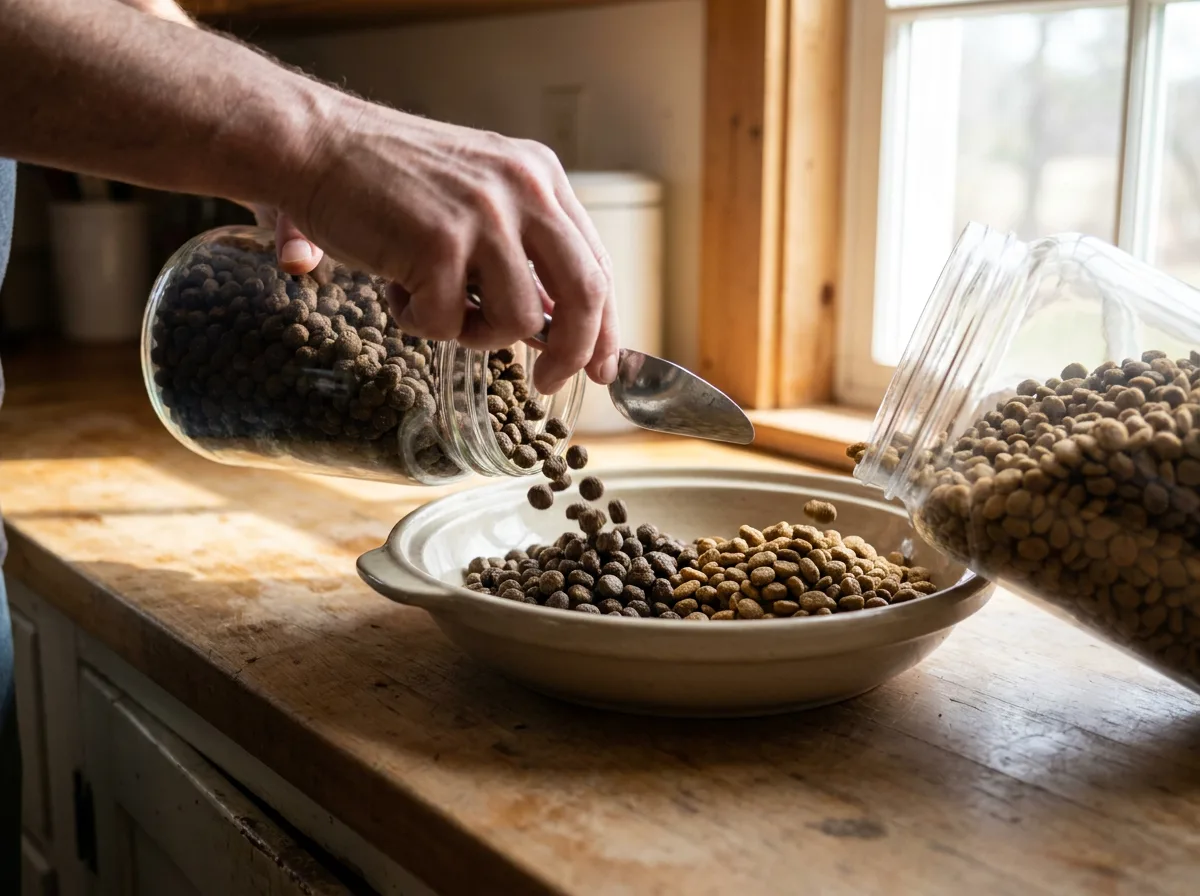
Increase the new food gradually as directed while reducing the old, keeping total calories in mind. Equal weights of two different foods may not supply equal calories. If a written plan gives proportions by weight or volume, follow that method consistently and ask for clarification when moving between very different formats.
Monitor appetite and stools and report persistent or significant problems rather than assuming they are a normal adjustment. A dog with a known medical condition, previous severe food reactions or an ongoing elimination trial may need a different transition plan. The veterinarian's instructions take priority over a generic schedule on a website.
Make Mealtimes and Storage Consistent
Keep food preparation simple and hygienic. Follow the package's storage instructions, retain the identifying bag information and wash bowls and utensils regularly. When changing products, keep enough of the old food to follow the intended transition if that is part of the plan. Do not wait until the last meal is gone to discover that the next bag is a different formula.
For multi-dog households, separate meals if dogs steal from one another. The measured ration has little meaning if a Bulldog finishes another dog's bowl afterward. This is especially important when one dog needs weight control or a veterinary diet, and it can make an otherwise confusing feeding problem much easier to assess.
How We Chose These Foods
We compared the five formulas by their stated nutritional adequacy, published energy information, intended use and practical feeding limits. The aim is to show which decisions each food can support, rather than treating an everyday kibble, weight-management formula and veterinary diet as equivalent choices.
This is a research-based comparison, not a report of hands-on feeding trials. We have not measured these foods' digestibility, palatability, weight-loss results or effects on Bulldog skin disease. Manufacturer information supports the recipe facts; it does not prove that a formula will outperform the others for your dog.
There is no single #1 recommendation here for every English Bulldog. For a healthy adult, start with an appropriate complete maintenance diet and a repeatable portion. For a puppy, prioritize growth adequacy. For weight loss or an adverse food reaction, use the veterinarian’s criteria to narrow the comparison. A food can lead on one criterion and fail another: the lowest calories per cup do not establish puppy suitability, and an unusual protein does not establish allergy control. These are choices by purpose, not a universal health ranking.
Frequently Asked Questions
Choose a complete dry food for the dog’s life stage and individual needs. Compare calories per cup or gram, the adequacy statement and any veterinary requirements before choosing a flavor. Open Farm offers a grain-inclusive option; Diamond CARE is aimed at adult weight management; BLUE NP Alligator serves a veterinary diet purpose. None is automatically best for every Bulldog. If the current suitable diet is working, there may be no need to change it.
Avoid toxic foods such as chocolate, grapes and raisins, onions, and products containing xylitol. These are hazards for dogs generally, not special Bulldog restrictions. Also avoid relying on unbalanced homemade diets, treats or toppers as the main diet. Keep foods that conflict with an individual veterinary plan out of the bowl. FDA lists common dangerous items; if your dog eats a potentially toxic item, contact a veterinarian promptly rather than waiting for signs.
There is no single food that all English Bulldogs are allergic to. The individual food history, including treats and extras, helps a veterinarian choose an appropriate investigation. A veterinary elimination diet may use a novel protein or a hydrolyzed food, followed by the planned reassessment. Changing to fish, alligator or grain-free food without that process does not establish the cause of itching or digestive signs.
Avoid making a treat, topper or food labeled only for intermittent or supplemental feeding your Bulldog’s sole everyday diet. Also avoid a formula that conflicts with the dog’s life stage or an established veterinary plan, even if it suits another dog. A puppy needs growth nutrition; an adult weight-management label does not provide that assurance. If the manufacturer cannot explain the food’s adequacy, calories or quality-control process, ask for that information before committing. This is a suitability check, not a blacklist based on a single ingredient.
We do not have a representative survey establishing what most veterinarians feed their own dogs, so we cannot honestly name a majority brand. An individual veterinarian’s personal choice also reflects that pet’s needs. For your Bulldog, ask why a specific formula fits the life stage, body condition and medical history, how much to feed, and what would prompt reassessment. WSAVA’s food-selection guidance offers questions about formulation expertise, quality control and nutritional information; it is more useful here than an unsupported popularity claim.

Emily Harris is a writer and passionate creative based in Pittsburgh, PA. She received a Bachelor’s degree with Honors in English from Penn State University in 2022. As a young professional, Emily served as a mentor, writing tutor, and community organizer. Today, her love for storytelling, learning new things, and empowering others through knowledge have led her to becoming a content writer dedicated to her craft. She’s a lifelong animal lover and strives to create articles that earn two paws up from her own loving furry friends.
Sign up for expert-backed reviews and safety alerts all in one place.