Bernese Mountain Dog Price: Puppy and Care Budget
Compare the price of a Bernese Mountain Dog with its full care commitment. Use a transparent first-year worksheet, check what fees include, and plan for recurring costs and unexpected veterinary bills.
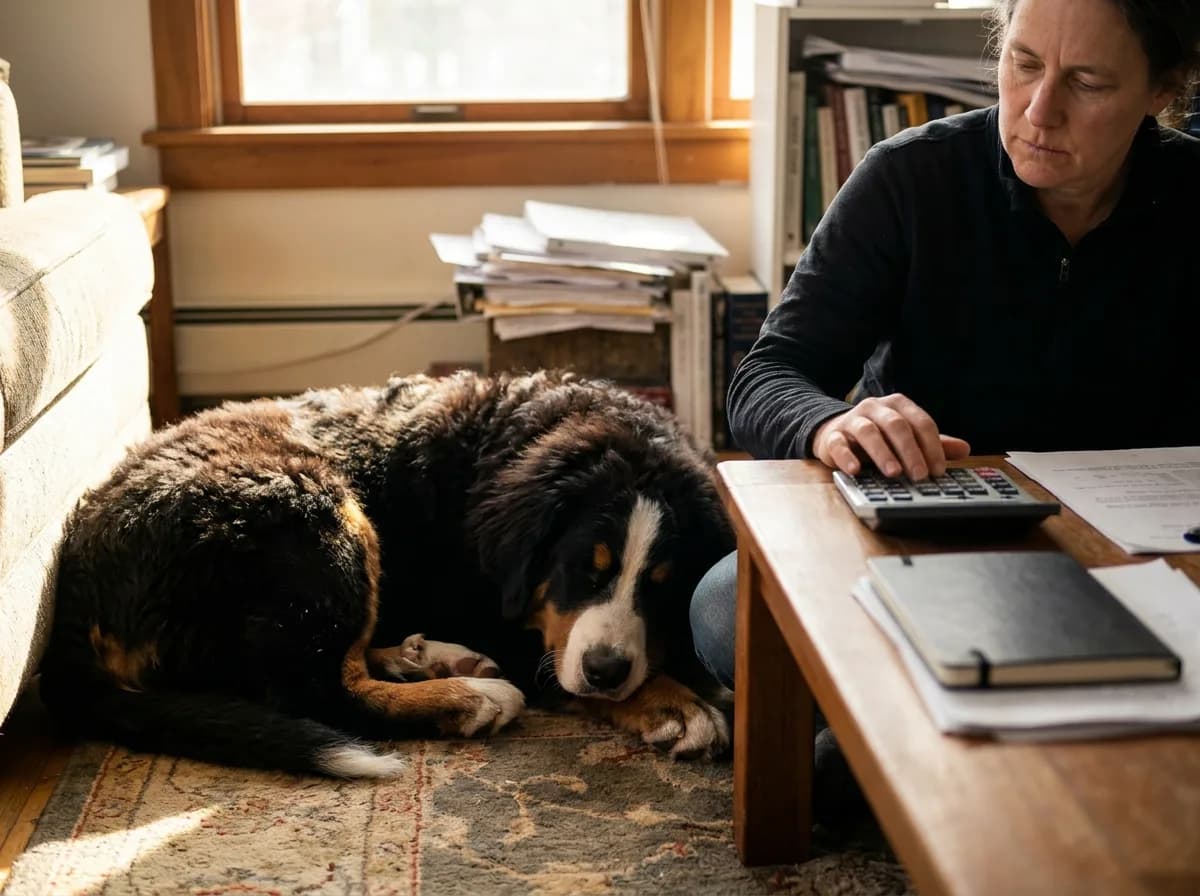
Bernese Mountain Dog resting beside an owner using a calculator at a desk.
Petful is reader supported. As an affiliate of platforms like Amazon and Chewy, we may earn a commission when you buy through links on this page. There is no extra cost to you.
Bernese Mountain Dog price estimates run from about $1,000 to $5,000 for a puppy from a breeder, according to Insurify's published guide. That is a source's broad estimate, not a verified national average or a quote for the dog you are considering.
A useful budget includes acquisition, setup, recurring care, and money available for unexpected bills. Below, a clearly labeled example totals $8,520 in the first year. Replace its assumptions with your own quotes before deciding what you can afford.

Sign up for expert-backed reviews and safety alerts all in one place.
How much does a Bernese Mountain Dog cost?
For a purebred Bernese puppy, the published $1,000 to $5,000 breeder range is a starting reference, not a test of quality. The same source lists adoption fees from $50 to $1,400. Actual availability, services, location, and the individual dog affect the quote. Obtain the exact fee and written terms from the breeder or rescue.
- 1Bernese Mountain Dog price includes more than acquisition.
- 2Compare what the fee includes, not just its size.
- 3The example below assumes $3,000 acquisition, $600 setup, and $410 monthly care.
- 4Screening records matter more than expensive marketing claims.
- 5Keep emergency cash flow separate from predictable recurring costs.
Separate the money you need before bringing the dog home from what you must support each month. Equipment, a first appointment, transport, or a training course can arrive close together. A monthly average can conceal that initial concentration of bills.

Petful may earn a commission when you click through to Chewy, at no extra cost to you.
For example, a crate belongs in the setup list if your care plan uses one. The Frisco Heavy Duty X-Large Wire Crate is one option to compare with your dog's measurements and the room available. Confirm usable dimensions before buying; paying once for a suitable fit is more useful than choosing a label and replacing it immediately.
An editable first-year Bernese Mountain Dog budget
This worksheet uses planning assumptions, not measured typical bills. Copy it and replace each amount with a quote that matches your location, intended services, and dog. Keep one-time items separate from recurring commitments so you can see both the arrival cost and the continuing obligation.
| Item | Assumed amount | Timing | Replace with |
|---|---|---|---|
| Purchase or adoption | $3,000 | One-time | Your written acquisition quote |
| Initial setup | $600 | One-time | Your equipment and setup list |
| Food | $100 | Monthly recurring | Food cost at the planned daily portion |
| Preventives | $40 | Monthly recurring | Veterinary prevention quote |
| Routine veterinary care | $50 | Monthly allocation | Annual planned services divided by 12 |
| Pet insurance | $80 | Monthly recurring | Quote for your dog and selected coverage |
| Grooming | $40 | Monthly allocation | Planned annual grooming divided by 12 |
| Paid care | $100 | Monthly allocation | Walking, sitting, or boarding plan |
| Recurring subtotal | $410 | Monthly | Sum of your revised monthly lines |
| First-year total | $8,520 | $3,000 + $600 + 12 × $410 | Recalculate with your quotes |
| Emergency reserve | Additional; not included | Available when needed | Decide separately from routine spending |
The arithmetic is $3,000 plus $600 plus $4,920 in recurring costs. Emergencies, insurance deductibles and other uncovered treatment, inflation, and expenses not listed in the worksheet are additional. Training, travel to collect the dog, licensing, and any taxes or specific procedures should be added if they apply to your situation.
Do not make a real quote fit the example. If regular paid care costs more than $100 per month, use that higher amount. If you groom at home, include the supplies and any professional help you will still need. If an annual expense is already covered by another line, remove the duplicate rather than counting it twice.
Build the setup list around what the dog will actually use:
- A safe sleeping and resting arrangement.
- Suitable lead, collar or harness, and identification.
- Food and water equipment, cleaning supplies, and initial food.
- Any barriers or home changes needed for safe access.
- Transport arrangements and the first training or veterinary appointments.
For bedding, compare a FurHaven NAP Orthopedic Bed in Jumbo with the dog's stretched-out measurements. Check the usable surface, not just the overall product dimensions. A washable cover may be convenient, but no bed removes the need to budget for veterinary assessment if the dog struggles to rise or settle.
Monthly allocations also need a timing check. Setting aside $50 a month produces $600 over a full year, but it does not put $600 in the account before an early appointment. Ask when the planned services are due and identify the money needed to cover those bills on their actual dates.
The same applies to a training course paid in advance or a boarding deposit for an upcoming trip. Write the due date beside the amount, then distinguish money already available from money you expect to save later. This makes a budget usable during the first few weeks, when several costs may arrive before the household has built up its monthly care fund.
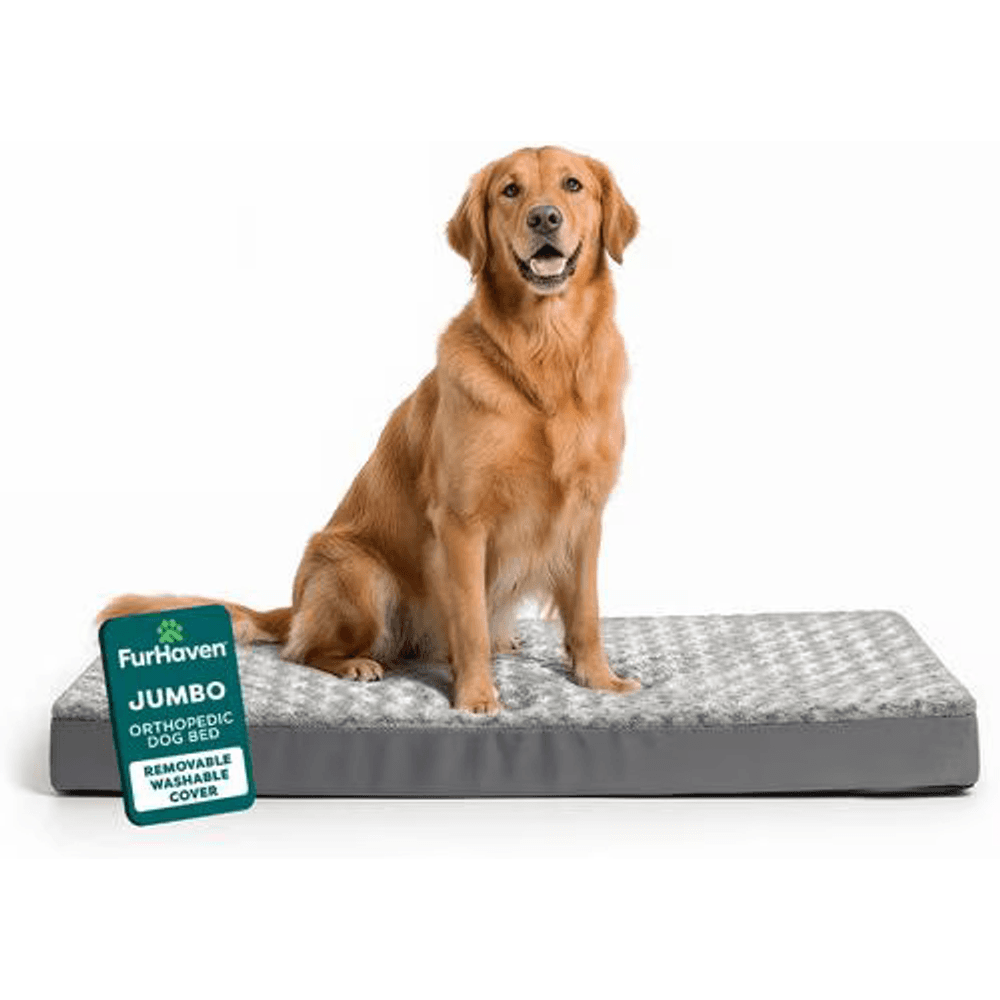
A plush orthopedic foam mattress that cushions aging joints and pressure points, giving a stiff or trembling senior dog warm, supportive rest.
Petful may earn a commission when you click through to Chewy, at no extra cost to you.
- Before arrival: Total the payments due before the dog comes home.
- Monthly saving: Calculate what you intend to set aside for continuing care.
- Emergency reserve: Keep this separate from both totals. An unused reserve remains available money, not a routine expense you must spend each year.
Why are Bernese Mountain Dogs expensive?
Bernese Mountain Dogs can be expensive because a breeder's costs may include health screening, veterinary care, facilities, food, time, and support for buyers. Demand and the seller's pricing decisions also affect the Bernese Mountain Dog price. A higher fee may reflect substantial work, but the amount alone does not show that the work occurred.
The BMDCA code of conduct calls for recommended health screening of breeding dogs. Ask for the actual results and an explanation of them, rather than accepting “health tested” as a complete answer. The price should be considered alongside that evidence and the written agreement.
Ask the seller to distinguish:
- Services already performed for the puppy.
- Testing performed on the parents.
- Supplies, registration, or support included in the fee.
- Costs you will take on after collection.
- Any conditions attached to a health-related promise.
Do not assume that a low price identifies an irresponsible seller or that a high price identifies a responsible one. A missing record is still missing at either price. If the seller will not explain the quote or permit time to read the agreement, pause the purchase decision rather than using the fee as a shortcut for trust.
What responsible breeder and rescue fees include
There is no universal package. A breeder's fee and a rescue adoption fee may include different care, records, and support, so compare them line by line. Ask for an itemized explanation of what is included and what you need to arrange yourself after the dog comes home.
For a puppy, request the parents' identities and review the BMDCA recommended-testing information. Berner-Garde can help you explore recorded family information, but the presence of a record is not a guarantee of health. Make sure you understand the actual result rather than only the fact that a test appears in a database.
For either route, request clear answers about:
- Veterinary examinations, vaccination records, and parasite care already provided.
- Microchip details and how registration is transferred or updated.
- Known medical or behavioral needs and records supporting the history.
- Follow-up obligations, support, and return or rehoming arrangements.
- Payment dates and how earlier payments are applied to the balance.
An adult rescue may have known needs that deserve their own care estimate. Conversely, an adult's observed size and behavior may make some planning easier. Ask the organization what is confirmed, what comes from a previous owner's report, and what remains unknown.

Petful may earn a commission when you click through to Chewy, at no extra cost to you.
Keep copies of the agreement, payment receipts, and supplied health records together. A verbal assurance is difficult to compare with another offer and easy to remember differently later. Read the complete document before money changes hands, including what a promised remedy would require from you and what costs it would leave unpaid.
Compare the cost of the same starting point
Consider two hypothetical quotes. Offer A asks $2,500, but collecting the dog would cost $450 and arranging services missing from the fee would cost another $200. Its comparable arrival cost is $3,150. Offer B asks $3,000, includes those same services, and requires $50 in travel, bringing its arrival cost to $3,050.
The second offer has the higher headline fee but the lower total in this example. That arithmetic does not establish which seller is responsible or which dog is the right match. It simply prevents an incomplete price comparison from deciding the question for you. Replace all of these illustrative figures with your own information.
Make sure the services are actually equivalent before counting them as included:
- Match each veterinary service to a dated record rather than a vague promise of “all care.”
- Check whether an included appointment is available at a clinic you can reasonably use.
- Distinguish a discount voucher from a service already paid for.
- Confirm that a supply package contains items you need in suitable sizes.
- Include required collection or delivery arrangements even when they are billed separately.
If a fee includes a service you would not otherwise choose, do not automatically value it at the advertised retail price. Decide whether it helps your plan, then assess the whole agreement. A large bundle of extras can still leave the important screening or care questions unanswered.
Monthly and annual costs after the first year
At the same illustrative assumptions, $410 per month becomes $4,920 per year once the initial $3,000 acquisition and $600 setup costs are removed. That is a calculation, not a prediction that every later year will cost less. Equipment replacement, changing care needs, and revised service or insurance prices can alter the total.
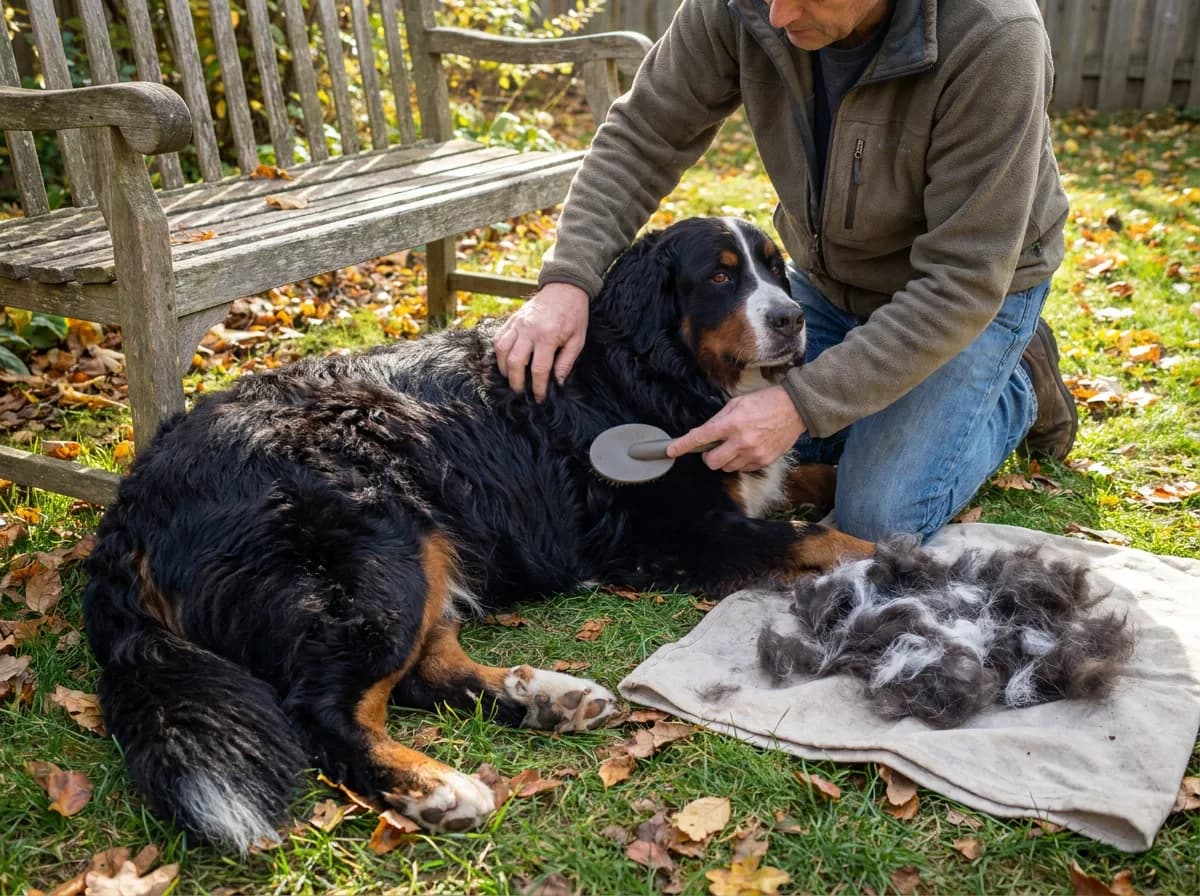
Large-dog food costs depend on the actual diet and portion. Price a bag against how long it lasts at the planned feeding amount, and review the portion with your veterinary team. A cheap bag that is used quickly is not automatically cheaper per month, and a higher-priced food does not by itself establish a health benefit.
Grooming quotes need the same care. Ask whether the price includes bathing, drying, brushing, nail care, and any extra charge for coat condition or handling needs. Confirm the expected visit schedule instead of multiplying one promotional quote by an arbitrary number of appointments.
Petful may earn a commission when you click through to Chewy, at no extra cost to you.
For between-visit nail care, a PATPET Steel Grit Nail Grinder is an option if your dog is comfortable with the method. Include replacement or maintenance costs if relevant. Buying a tool does not guarantee that you can replace a professional service, particularly when a dog is frightened or difficult to handle safely.
- For paid care, count the workdays on which a walker or sitter would be needed.
- Include trips when boarding or overnight care would replace the usual arrangement.
- Check whether the service can handle a large dog and any individual needs.
- Ask about travel, holiday, extra-dog, or medication charges that apply.
Review actual spending after the first few months. If the budget consistently misses a category, change the plan rather than assuming the next month will be unusually cheap. A small recurring difference matters: an extra $50 each month is another $600 over a year.
How to compare quotes without paying for marketing claims
Put competing quotes beside the same checklist. Confirm the dog's identity, the payment schedule, the services included, and the documents you can review. Then identify differences that matter to your decision. An impressive title or a fashionable label does not make two offers equivalent.
- A price, registration certificate, rare-color claim, or health promise does not guarantee a healthy dog. Ask what the quote includes, what records support the claims, and what the written agreement requires of each party.
Treat “mini,” “white,” or “rare” Bernese pricing as a reason to ask what the label means. A mini Berner may be a cross or a smaller dog marketed under that name; a Great Bernese refers to a different proposed pairing. Verify parentage instead of assuming those labels identify standardized varieties with predictable prices or health outcomes.
Likewise, a claim of vitiligo or another unusual appearance should not become an automatic premium. Ask for veterinary documentation when a medical explanation is offered. A photograph cannot establish a diagnosis, ancestry, or future care needs. Do not accept a coat-color story as a substitute for the ordinary records you would request for any dog.
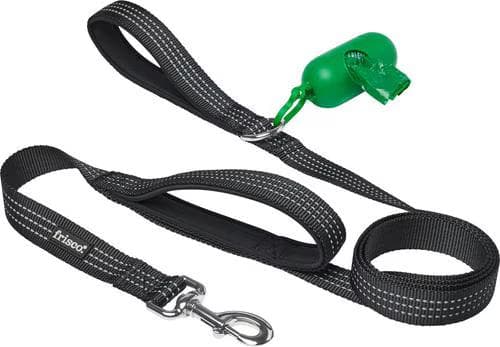
Apply the same value check to equipment. The Frisco six-foot Traffic Leash with Dual Padded Handles is one lead option; compare its attachment, condition, and suitability with your actual handling needs. Adding more accessories will not replace time spent teaching a large puppy to walk comfortably on a lead.
Questions to settle before paying
- Is the payment credited toward the final price, or is it an additional charge?
- What happens if no suitable puppy is available or circumstances change?
- Which records and identification details will you receive?
- What travel or collection costs remain your responsibility?
- Can you explain the agreement in your own words without relying on a sales message?
Health costs, insurance, and an emergency reserve
Health screening can inform a purchase decision, but it cannot remove the possibility of illness. The BMDCA's testing explanations show why results need interpretation. Plan for the individual dog's care instead of treating a screened pedigree as a reason to leave the veterinary budget empty.
The breed's commonly cited lifespan is seven to ten years, but that does not make lifetime cost a reliable multiplication exercise. A shorter life can still include substantial treatment or support needs. Our Bernese Mountain Dog lifespan guide explains the evidence and uncertainty behind those figures.
Pet insurance also needs more than a monthly premium comparison. The National Association of Insurance Commissioners explains that policies differ in coverage, exclusions, deductibles, limits, and reimbursement. Obtain the actual terms and ask how they apply to the dog you are considering. Check these points in writing:
- Treatment of pre-existing conditions and symptoms before coverage begins.
- Any waiting periods and condition-specific exclusions.
- The deductible, reimbursement percentage, and annual or other limits.
- Whether hereditary conditions and relevant diagnostics are covered.
- Whether you pay the clinic first and how reimbursement is handled.
The California Department of Insurance's consumer questions are another useful comparison aid. Ask the insurer to explain a sample claim using the policy you are considering. Do not assume that paying a premium means the entire bill will be reimbursed or that a recently purchased policy covers an existing problem.
Cash flow matters even when a claim is eligible. You may need to pay a clinic before reimbursement arrives, while deductibles, your share, and excluded services remain yours to cover. Decide how accessible funds would be available during an urgent visit instead of counting insurance as the only payment arrangement.
A wellness plan addresses a different part of the budget. WebVet's wellness plans versus pet insurance guide explains the distinction between routine-care benefits and protection for eligible unexpected expenses. Check that you are not paying for overlapping services without a clear reason.
Is a Bernese Mountain Dog the right fit?
An affordable acquisition price does not settle whether a Berner suits your household. Consider space, handling, time for coat care, barking, and daily company. Many enjoy close family contact, but an individual dog's preferences and behavior matter more than a promise that every Berner will cuddle or that one sex is always easier.
Our Bernese Mountain Dog breed profile covers appearance, temperament, care, and household fit. Use that assessment alongside the budget. If the plan works only while the dog remains inexpensive and needs little help, finish the missing arrangements before committing.
Bernese Mountain Dog price FAQs
Not necessarily. The written agreement should explain what each payment secures, whether it is credited toward the purchase price, and when a refund is available. Ask for unclear terms to be explained before paying; the label alone does not tell you how the arrangement works.
No. Look at screening results, parent identities, veterinary records, and the agreement's actual terms. A guarantee may describe a limited remedy after a problem occurs rather than promise that illness is impossible. Ongoing care and uncertainty remain part of owning the dog.
Possibly, especially if the acquisition fee and included services suit your circumstances. Compare the individual dog's known care needs, equipment, training, and veterinary plan as well. Adoption should be a suitable placement, not an assumption that every adult rescue will be cheaper over its lifetime.

Coreen Saito is a pet writer and longtime shelter volunteer with more than a decade in animal rescue. She covers cat behavior, breed care, and the small, ordinary science of sharing a life with companion animals, with a particular focus on honest takes about the products and decisions that actually matter. At home in Arizona, she's outranked by Mac (a dog with the loudest opinion in the house), Rebel (a cat who governs by quiet authority), and Meri (an orange tabby who runs the late shift and the laundry basket). She writes about all three, plus the rescues that keep coming through her life, at LifeWithMinty.com.
Sign up for expert-backed reviews and safety alerts all in one place.