Australian Shepherd vs Border Collie: Which Fits You?
Compare Australian Shepherds and Border Collies by everyday care, size, working style, and family needs, then use a practical checklist to assess the individual dog you may bring home.
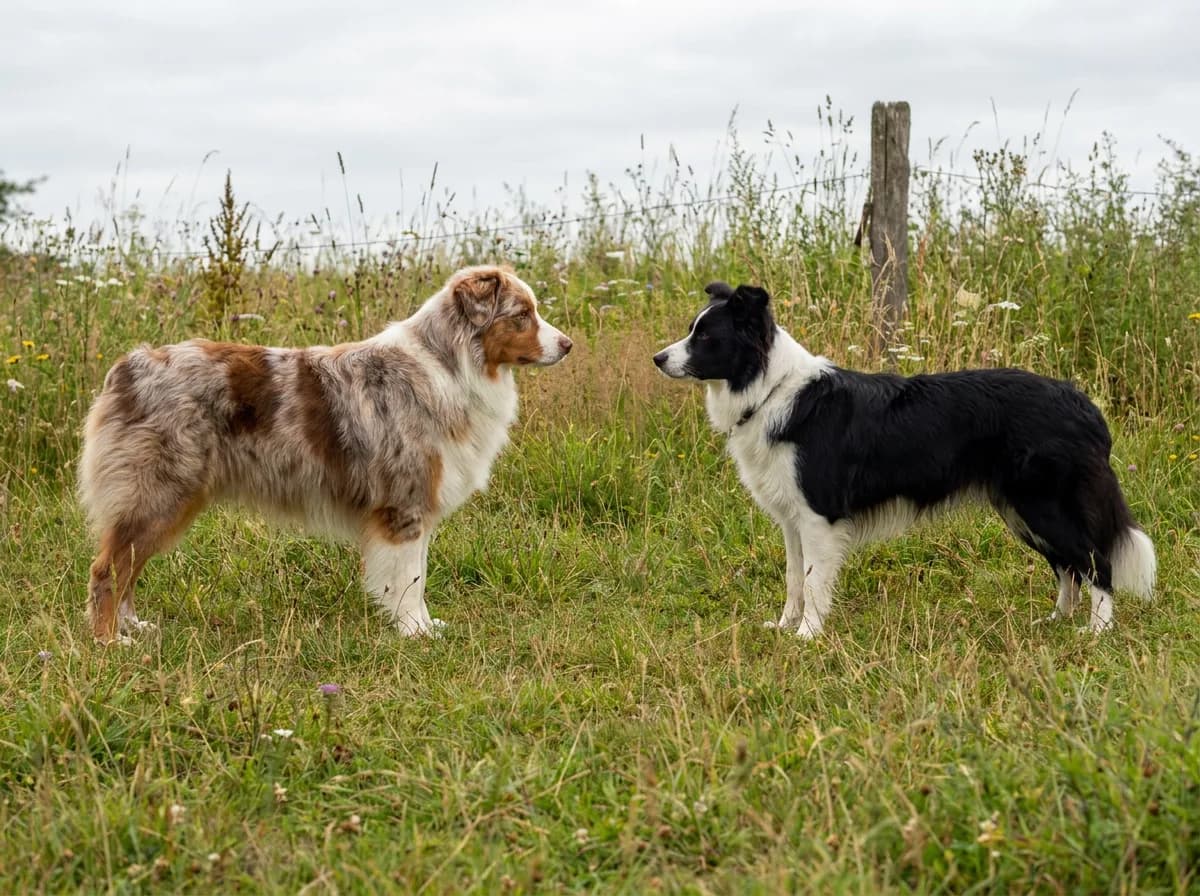
Australian Shepherd and Border Collie standing opposite each other in a grassy meadow.
Petful is reader supported. As an affiliate of platforms like Amazon and Chewy, we may earn a commission when you buy through links on this page. There is no extra cost to you.
The Australian Shepherd vs Border Collie decision comes down to the dog you can live with on an ordinary weekday. Both breeds can suit people who enjoy training and active companionship. Neither is a reliable shortcut to an easy family pet, and an intelligence ranking cannot tell you which individual will cope with your household.

Sign up for expert-backed reviews and safety alerts all in one place.
Australian Shepherd vs Border Collie at a glance
An Aussie is generally the heavier of these two medium-sized breeds. Their working traditions also differ: Australian Shepherds are associated with upright, close stock work, while Border Collies are known for gathering livestock using a focused gaze and crouching movement. Those differences help explain their histories; they do not assign every pet a personality.
- 1Australian Shepherd vs Border Collie is a comparison between two demanding, engaging herding breeds with considerable individual variation.
- 2Ask about recovery after excitement, comfort around your existing pets, and the actual daily routine.
- 3Choose the individual whose documented needs you can meet, including on your busiest days.
Before comparing puppies, identify what you enjoy doing with a dog. Practicing a new skill every evening is different from wanting a companion for occasional weekend hikes. Also identify your limit: barking through meetings, chasing a resident cat, or needing care during long shifts may matter more than coat color.
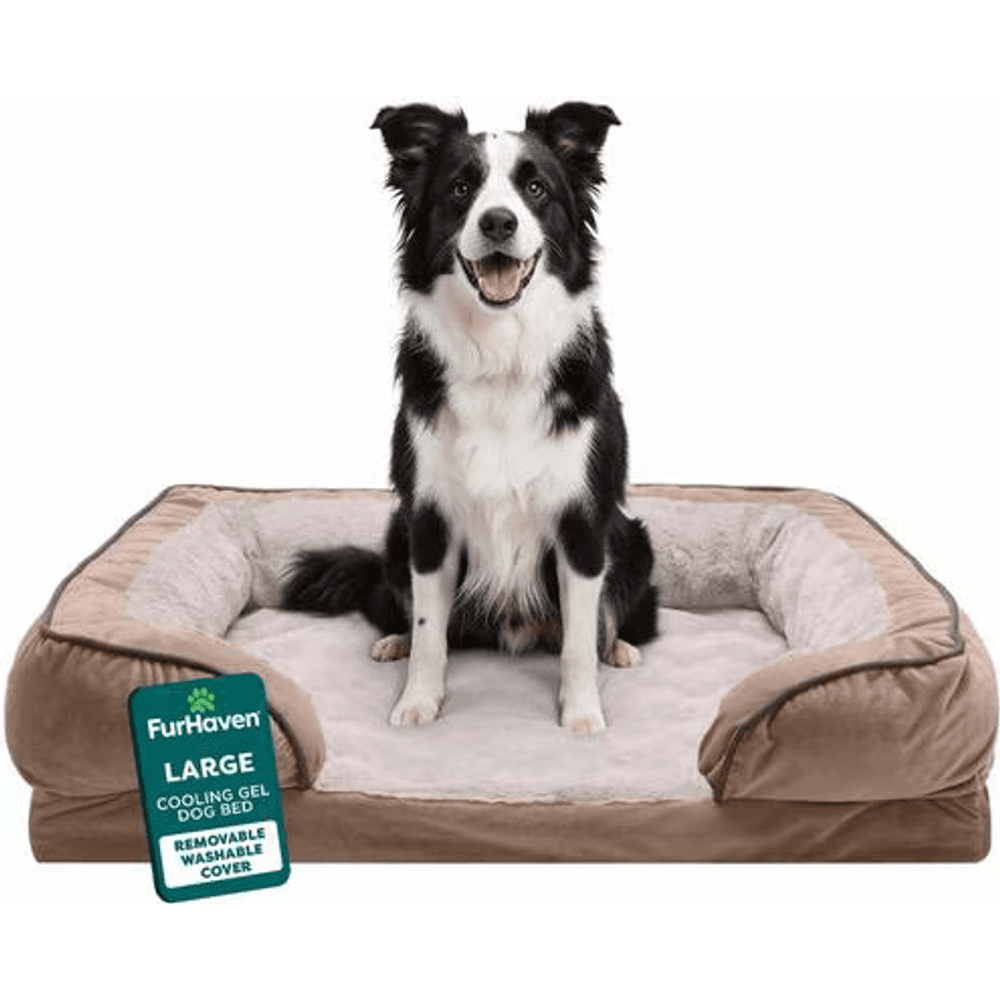
An orthopedic sofa bed with three bolstered sides for dogs who like to rest their head and joints against a cushion. The supportive foam base cradles hips and elbows, a comforting spot for an older or shaky dog to settle.
Petful may earn a commission when you click through to Chewy, at no extra cost to you.
A resting place belongs on either breed's equipment list. The FurHaven Velvet Waves Perfect Comfort Orthopedic Sofa Bed, Large, Brownstone is one option if its usable sleeping area fits your dog. A familiar mat you already own can also mark a quiet place; buying a bed does not teach relaxation.
Size, coat, and visible differences
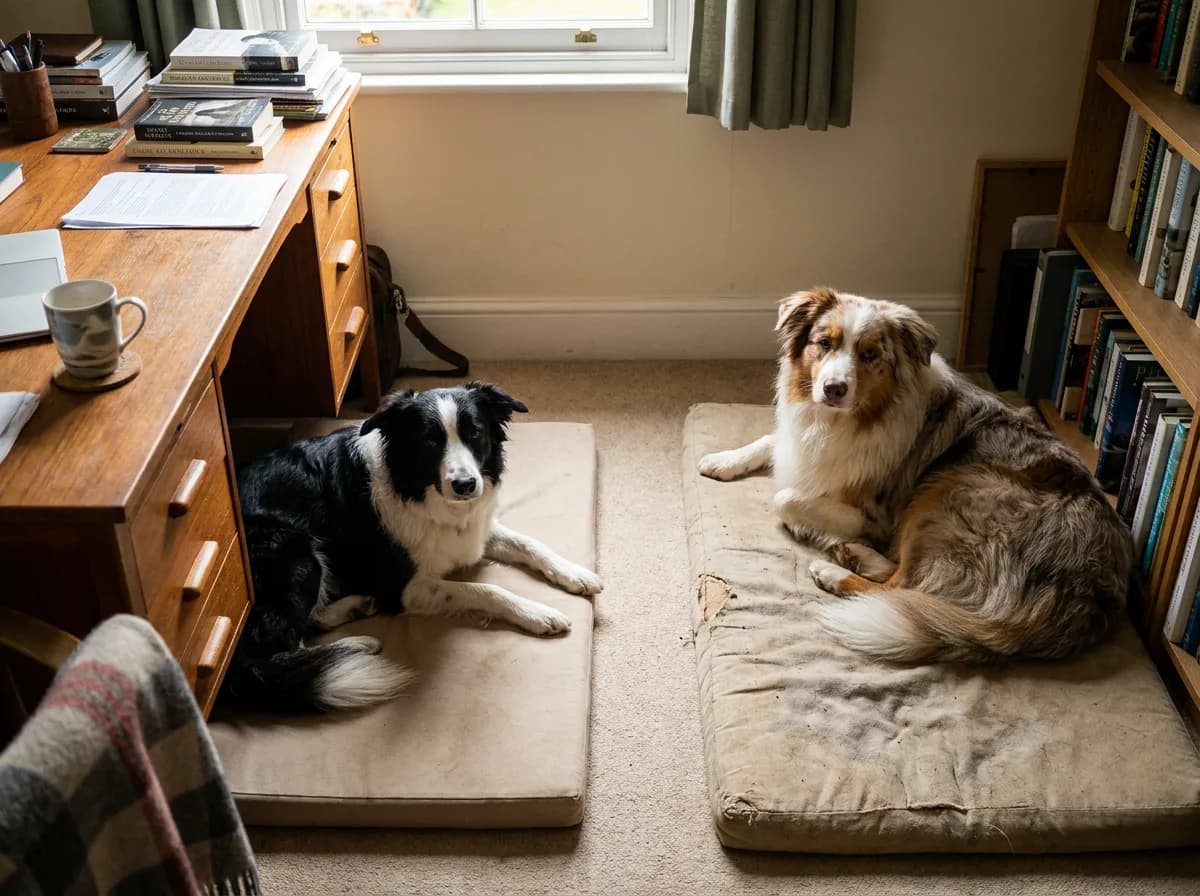
You cannot reliably identify an Aussie or Border Collie from a photograph alone. Their colors, markings, and outlines overlap, and mixed ancestry makes visual guesses less reliable. A black-and-white coat does not establish Border Collie ancestry; merle does not establish Australian Shepherd ancestry. Documented parentage is more useful than comparing an unfamiliar dog's face with an online picture.
These published breed measurements provide context, not a weight goal for every dog:
- Australian Shepherd: ASCA's preferred shoulder height is 20–23 inches for males and 18–21 inches for females. The AKC weight chart lists 40–65 pounds overall.
- Border Collie: the AKC standard gives 19–22 inches for males and 18–21 inches for females. Its weight chart lists 30–55 pounds.
Sources: ASCA Australian Shepherd standard, AKC Border Collie standard, and AKC breed weight chart.
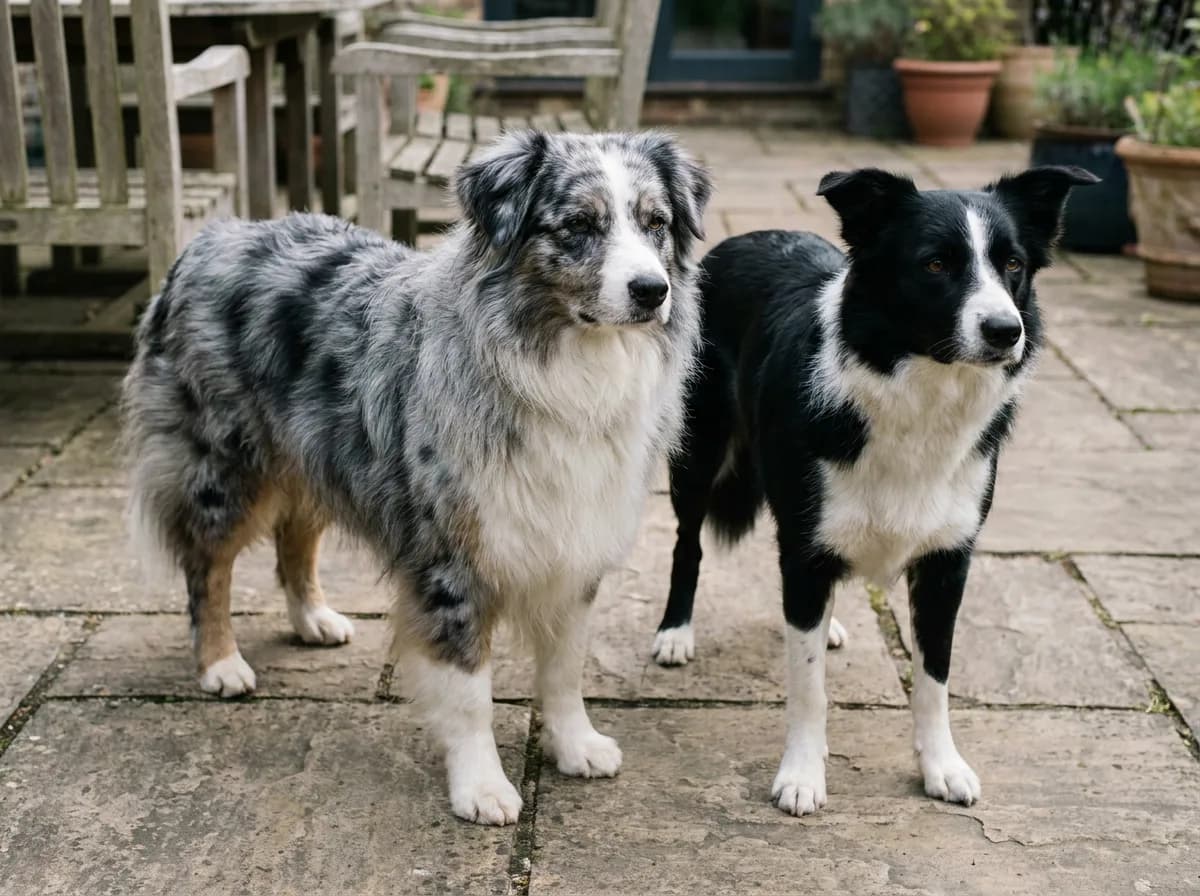
The Aussie standard describes a medium-length coat with feathering and a mane. Border Collies have rough or smooth double coats, so a short-coated Border Collie can look quite different from a heavily coated one. Both breeds have more color variation than their most familiar pictures suggest. Tail length is another clue that should never serve as proof of breed.
For equipment, measure the actual dog instead of shopping from these ranges. Two dogs of similar weight may need different harness shapes or sleeping space. If a listing says “mini Aussie,” clarify the registered breed and parentage before applying this comparison; the Miniature American Shepherd is a distinct breed.

Petful may earn a commission when you click through to Chewy, at no extra cost to you.
Working style, exercise, and the off switch
ASCA describes the Aussie as an upright, close-working, loose-eyed stockdog that can use its presence, movement, and sometimes bark to move livestock. The Border Collie standard describes gathering work, a concentrated gaze, and stalking movement. These are tendencies selected for stock work, not guarantees about how a pet will greet visitors or behave with children.
For either dog, plan a day with different kinds of activity:
- Movement: an appropriate walk or other activity matched to age, health, and conditioning.
- Thinking: a short training session, scent search, or manageable food puzzle.
- Recovery: a predictable opportunity to rest without repeated invitations to play.
Do not make constant stimulation the household rule. If every pause produces another ball throw, you have built a routine in which the person stays available for play. Deliberately practice ending activities, putting toys away, and moving into a quieter part of the day. A dog that cannot settle despite a suitable routine needs assessment, not automatically more running.
Walking equipment should support that routine. Consider the PetSafe Easy Walk Harness, Red/Black, Medium/Large only if the manufacturer's measurements and fit instructions suit your dog. Introduce equipment gradually and check comfortable movement; a harness does not replace teaching loose-leash walking.
Which breed is more intelligent?
There is no useful single score that tells you whether a Border Collie or Australian Shepherd will be the better dog for your life. Learning object names, responding to cues, solving unfamiliar problems, and coping with distractions are different tasks. Training history and motivation also change what a dog demonstrates.
Border Collie Chaser famously learned 1,022 object names during three years of intensive training. The published study demonstrates an extraordinary individual's abilities. It was not a head-to-head trial establishing that every Border Collie is smarter than every Aussie.
For a household, ask for examples that actually matter: Can this dog disengage from a passing bicycle? Recover after a visitor arrives? Rest while someone cooks? A quick learner may acquire an unwanted routine quickly too. Intelligence creates opportunities for teaching; it does not remove the time required to teach.
Petful may earn a commission when you click through to Chewy, at no extra cost to you.
Training, barking, and behavior challenges
Australian Shepherd behavior challenges can include chasing movement, nipping during excitement, alert barking, and difficulty switching off. Border Collies can also struggle with movement fixation or chasing. These behaviors are not inevitable, and the same outward behavior can have different causes. Do not dismiss fear, pain, or distress as “just the breed.”
ASCA emphasizes the Aussie's need for engagement and thoughtful management of herding instincts. For both breeds, use positive reinforcement to teach useful alternatives. The American Veterinary Society of Animal Behavior recommends reward-based training, rather than aversive methods, for training and behavior modification.
Start with a concrete problem and a manageable response:
- Window barking: change access to the trigger and practice moving away with you before the dog becomes overwhelmed.
- Chasing feet: use barriers and supervision; reward a suitable activity away from moving people.
- Pulling toward excitement: work at a distance where your dog can still respond, and reward checking in.
- Persistent distress or escalating behavior: involve your veterinarian and a qualified behavior professional rather than repeatedly testing the dog.
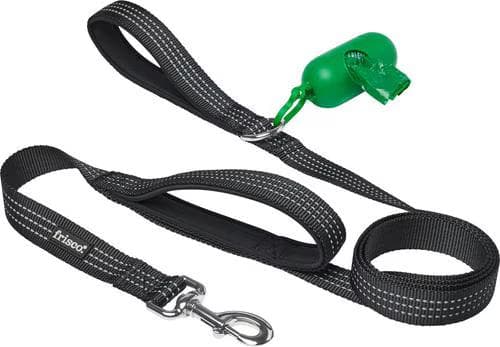
The Frisco Traffic Leash with Dual Padded Handles, Black, 6 feet is an option for supervised walks and training where its size suits the dog and handler. Use a comfortable length and safe distance from triggers instead of relying on a tight leash to contain excitement.
Family life, other pets, and time alone
Neither breed label establishes that a dog is safe with children, compatible with cats, or comfortable alone. Ask what has actually happened in the current home, including ages of children, the kinds of animals present, and how introductions were managed. “Good with kids” means little without those details.
Plan for protected resting areas, active adult supervision, and separation when supervision is unavailable. Do not ask a child or resident cat to test whether a prospective dog will chase. Early socialization should involve manageable, positive experiences, not forcing a worried dog into a busy gathering.

Small, soft chicken-recipe rewards for short adult-dog training sessions. Portion into tiny pieces and include treats in the daily calorie budget.
Petful may earn a commission when you click through to Chewy, at no extra cost to you.
Agree on household routines before arrival:
- Which adult handles morning care and the midday break?
- Where can each animal eat and rest without interruption?
- Who supervises introductions and practices the training plan?
- What happens when work, illness, or travel changes the schedule?
For food-motivated training, Zuke's Mini Naturals Chicken Recipe treats, 10-ounce pouch are one option if the ingredients fit your dog's diet. Account for treats in daily intake. Part of the dog's usual food may work for easy practice at home, so a separate purchase is optional.
Health, grooming, and ownership costs
Compare records rather than claims that one breed is inherently healthier. The American Border Collie Association urges buyers to confirm parental health screening. Ask breeders of either breed which relevant screening was performed, request the named dogs' results, and review uncertainties with your veterinarian. A generic “vet checked” statement is not a list of completed inherited-disease tests.
For Aussies, ask about MDR1 status and share available results with your veterinarian. Washington State University explains that this genetic variant can change sensitivity to certain drugs. The useful action is a veterinary medication plan; never change prescribed treatment based on a breed label.
Time and money for everyday care
Both coats need regular attention, and a smooth Border Collie still sheds. Before committing, ask the current carer to demonstrate that dog's brushing routine and handling tolerance. Include nail care and dental care in the conversation instead of estimating upkeep from a photograph.
Paid help can change the cost comparison more than a modest difference in food consumption. Price the dog walker, trainer, grooming support, and veterinary care you would actually use. Our Australian Shepherd price and ownership budget separates acquisition, setup, and recurring expenses so you can replace illustrative figures with your own quotes.
A household-fit checklist for choosing between them
Take these questions to a foster carer or breeder and ask for specific examples. Record what is known, what has not been observed, and the support you would need. This is an interview guide, not a validated temperament test or a breed scoring system.
| Household factor | Ask the foster carer or breeder | What the answer changes |
|---|---|---|
| Ordinary weekday | What does a normal day include, and who provides care? | Whether your actual schedule can provide similar support |
| Recovery and rest | What helps this dog settle after play or visitors? | The space, routines, and training you need |
| Noise | What happens with doorbells, traffic, or household sounds? | Whether your home adds frequent unmanaged triggers |
| Moving children or pets | What has been safely observed, and under what supervision? | Your supervision and separation plan |
| Time alone | What duration and setup have been observed without distress? | Whether you need gradual training and paid help |
| Training support | Which methods and cues does the dog know, and who can help after placement? | The continuity of your training plan |
An unknown answer is useful information. For example, a dog that has never lived with cats has an untested history, even if it is friendly with people. Do not fill that gap with a reassuring breed description. Discuss an appropriate assessment and management plan before making the commitment.
Consider a hypothetical choice between an adult Aussie whose foster carer reports quiet afternoons around a resident cat and a young Border Collie with no cat history. For a household with a cat and afternoon meetings, the documented routine gives the Aussie a practical advantage in that particular comparison. Reverse the histories and the conclusion may reverse too. Neither result establishes a breed-wide winner. Similarly, if both dogs need midday support you cannot arrange, choosing the slightly smaller dog does not resolve the gap. Write the missing support beside each candidate before deciding whether the placement is workable.
- Share your weekday routine, other pets, and biggest practical limit with the placement team. Ask them to explain why this individual fits. One pleasant meeting cannot establish how a dog will behave in every setting.
Meet the breeds before choosing a puppy
Visit dogs in settings relevant to your life, with the owner's permission and appropriate supervision. An impressive performance at a sporting event shows one part of the picture; ask what happens afterward and at home. Meet adult relatives when possible, while recognizing that a puppy's future behavior is not guaranteed by its parents.
For the broader Aussie care commitment, start with our Australian Shepherd breed profile. If your plan depends on either breed needing little interaction or reliably entertaining itself throughout long absences, reconsider the plan before choosing between puppies.
Australian Shepherd and Border Collie FAQs
An adult dog with detailed foster observations can give you more concrete information about current size, daily routines, and behavior in a home. Ask how long the foster carer has known the dog and which situations were actually observed. Adjustment to your home can still change behavior, so arrange follow-up support.
Many individuals can, but being home does not make you continuously available. Start with brief, achievable settle practice near your workspace, planned care breaks, and a resting area away from interruptions. Build duration gradually. If separation causes distress, seek professional help instead of requiring the dog to endure a full meeting immediately.
No. A mix does not reliably inherit a middle level of energy, barking, or sensitivity. Evaluate the individual and its known history rather than averaging two breed descriptions. For a puppy, be prepared for uncertainty about adult size and behavior, and ask what support is available as it grows.

Coreen Saito is a pet writer and longtime shelter volunteer with more than a decade in animal rescue. She covers cat behavior, breed care, and the small, ordinary science of sharing a life with companion animals, with a particular focus on honest takes about the products and decisions that actually matter. At home in Arizona, she's outranked by Mac (a dog with the loudest opinion in the house), Rebel (a cat who governs by quiet authority), and Meri (an orange tabby who runs the late shift and the laundry basket). She writes about all three, plus the rescues that keep coming through her life, at LifeWithMinty.com.
Sign up for expert-backed reviews and safety alerts all in one place.