Burmese vs Siamese: Which Cat Is Right for You?
Choosing between a Burmese and a Siamese cat? Both are affectionate, social, Southeast Asian breeds, but they look, sound, and behave very differently. Compare body, coat, eyes, voice, temperament, health, and price to find your fit.
Petful is reader supported. As an affiliate of platforms like Amazon and Chewy, we may earn a commission when you buy through links on this page. There is no extra cost to you.
Choosing between a burmese vs siamese cat comes down to one core question: do you want a quiet velcro lap cat or a loud, acrobatic chatterbox? Both breeds are intelligent, deeply affectionate, and descended from Southeast Asian cats, but they look and sound completely different, and they suit different households. The short answer: the Burmese cat is solid-coated, round-eyed, golden-eyed, and puppy-like in its clinginess; the Siamese cat is pointed, slender, blue-eyed, and famously (sometimes infamously) loud.
- 1Burmese cats are compact, solidly colored, golden-eyed, and crave lap time over conversation.
- 2Siamese cats are slender, pointed-coated, blue-eyed, and will tell you every single thing on their mind.
- 3Both are social cats that do poorly alone for long hours.
- 4If noise matters, the Burmese wins easily.
- 5If you want an athletic conversationalist, the Siamese is your match.

Sign up for expert-backed reviews and safety alerts all in one place.
Burmese vs Siamese at a Glance
| Trait | Burmese | Siamese |
|---|---|---|
| Origin | Burma (Myanmar), brought to US in 1930 by Dr. Joseph Thompson | Thailand (Siam), one of oldest recognized breeds |
| Body type | Compact, muscular, heavier than it looks ("a brick wrapped in silk") | Slender, tubular, long fine legs, wedge-shaped head |
| Weight | 8-15 lbs | 5-12 lbs |
| Height | 10-12 inches | 11-14 inches |
| Coat | Short, satin-smooth, solidly colored (no points) | Short, fine, with dark points on face, ears, paws, tail |
| Coat colors | Sable, champagne, blue, platinum (US standard) | Seal, chocolate, blue, lilac points |
| Eye color | Gold, yellow, or amber -- always warm-toned | Vivid deep blue -- always |
| Eye shape | Large, rounded | Almond-shaped, slightly slanted |
| Voice | Soft, musical, moderate | Loud, raspy, constant -- called "the Meezer" |
| Temperament | Puppy-like, velcro, affectionate, playful into adulthood | Extroverted, demanding, intensely bonded, theatrical |
| Energy level | High | High |
| Lifespan | 12-17 years | 11-15 years (some live to 20) |
| Price (kitten) | $600-$1,200 USD | $400-$1,000 USD |
| Grooming | Minimal -- weekly wipe-down | Minimal -- weekly brush |
| Good with kids | Yes | Yes, if children respect their need for interaction |
| Good with other pets | Yes | Yes, prefers another social cat |
| Health concerns | Hypokalemia, diabetes, CKD | Progressive retinal atrophy, heart disease, dental issues |
| Sheds | Low | Low-moderate |
History and Origins: Two Breeds, One Common Ancestor
The burmese vs siamese comparison has roots going back centuries to Southeast Asia. Both breeds trace their lineage to the same region: ancient Thailand (then Siam) and Burma (now Myanmar), where temple cats were revered companions.
The modern Burmese breed begins with a single cat named Wong Mau, a walnut-brown female brought from Burma to San Francisco in 1930 by Navy psychiatrist Dr. Joseph Cressman Thompson. Thompson bred her with a Siamese, and the distinctive, solidly colored Burmese we know today emerged from those crosses. Genetic analysis later confirmed that Wong Mau herself was likely a Burmese-Siamese hybrid, essentially a Tonkinese by today's standards.
- When you cross a Burmese with a Siamese, you get a Tonkinese, a breed that sits midway between the two in coat pattern (mink), body type, and temperament. The Cat Fanciers' Association notes that the Siamese gene creates dramatic dark points while the Burmese gene creates a softer, more uniformly pigmented coat. Tonkinese express both genes simultaneously. If you love traits from both breeds, the Tonkinese is worth considering.
Never Scoop Again® with the Whisker Litter-Robot, the smart self-cleaning automatic litter box. Monitor visits and track weights for better overall care in the Whisker® app. Multi-cat friendly.
Petful may earn a commission when you click through to Whisker, at no extra cost to you.
The Siamese, by contrast, is one of the oldest and most recognizable cat breeds in the world. Records of pointed cats appear in Thai manuscripts dating to the 14th century. Siamese cats arrived in the United Kingdom in the 1870s and the United States shortly after, quickly becoming one of the most popular pedigree breeds in North America.
Both breeds are registered and recognized by the Cat Fanciers' Association (CFA) and The International Cat Association (TICA).
Appearance: Night and Day
Body and Build
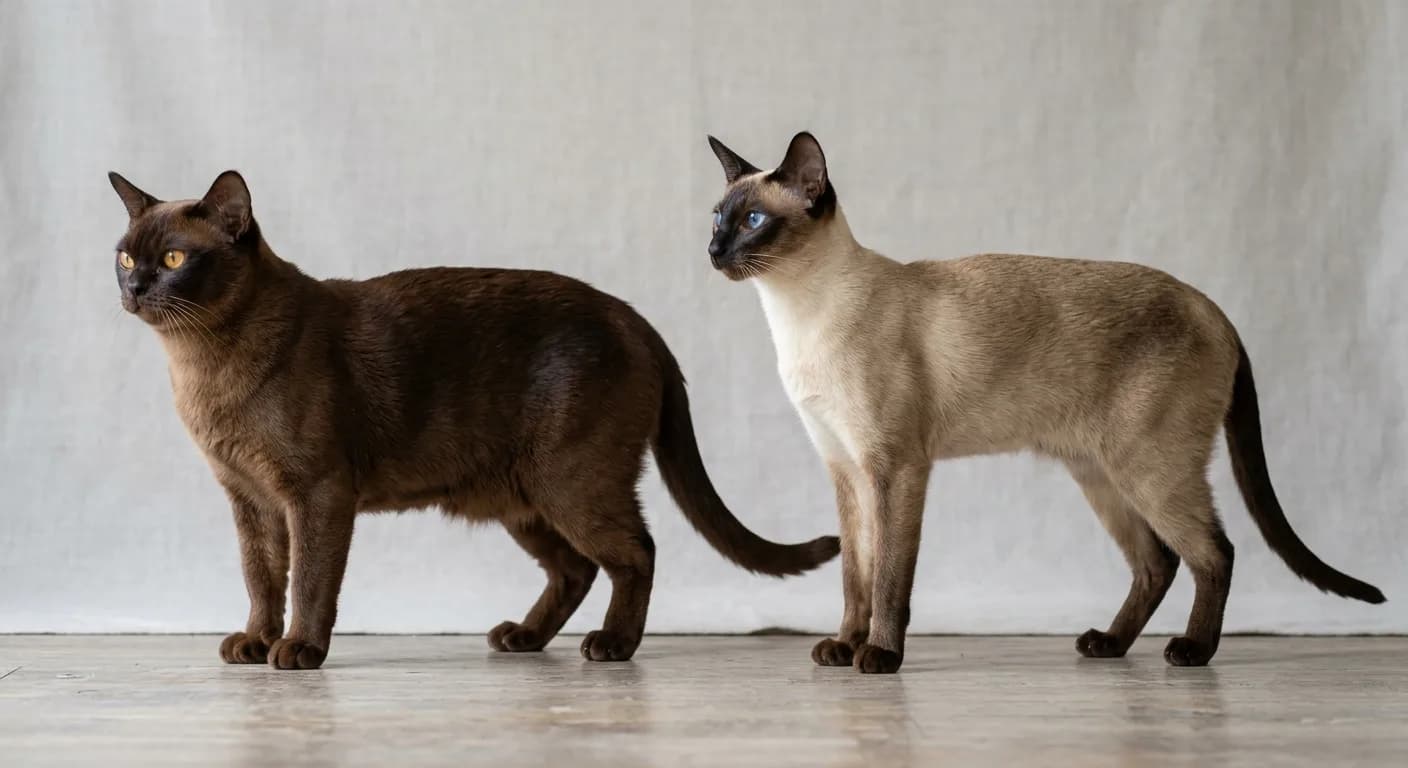
The physical differences between a Burmese and a Siamese are unmistakable once you know what to look for. The Burmese is compact and surprisingly heavy for its size: the classic description is "a brick wrapped in silk." Rounded head, broad chest, short muzzle, and a medium-length tail give the Burmese a sturdy, almost athletic bulldog quality in a small package.
The Siamese is the opposite: willowy, long, and angular. A tubular body, long fine legs, a long tapering tail, and a distinctly wedge-shaped head with large, flaring ears. Modern show Siamese have become progressively more extreme in their angular features over the decades, though "traditional" or "apple-head" Siamese retain a slightly rounder skull.
Coat and Color
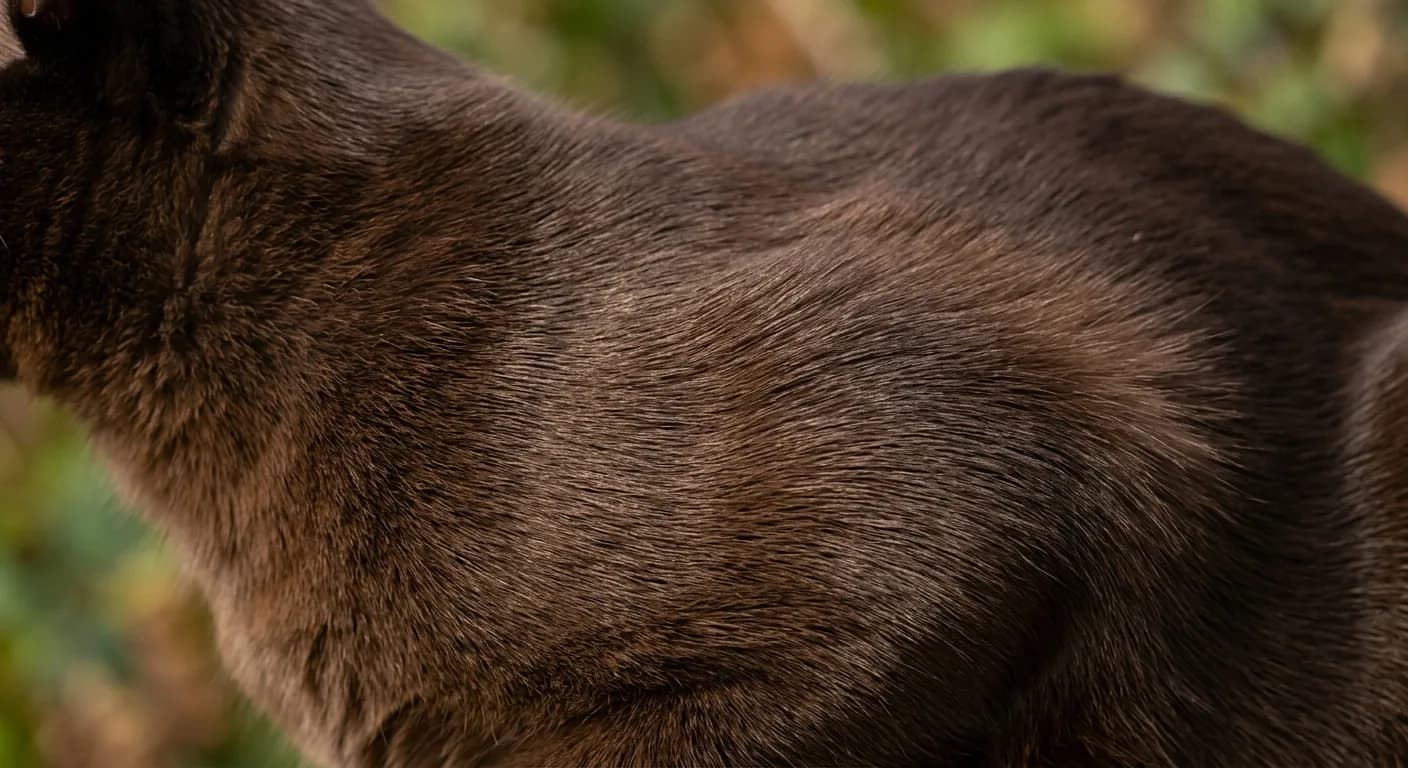
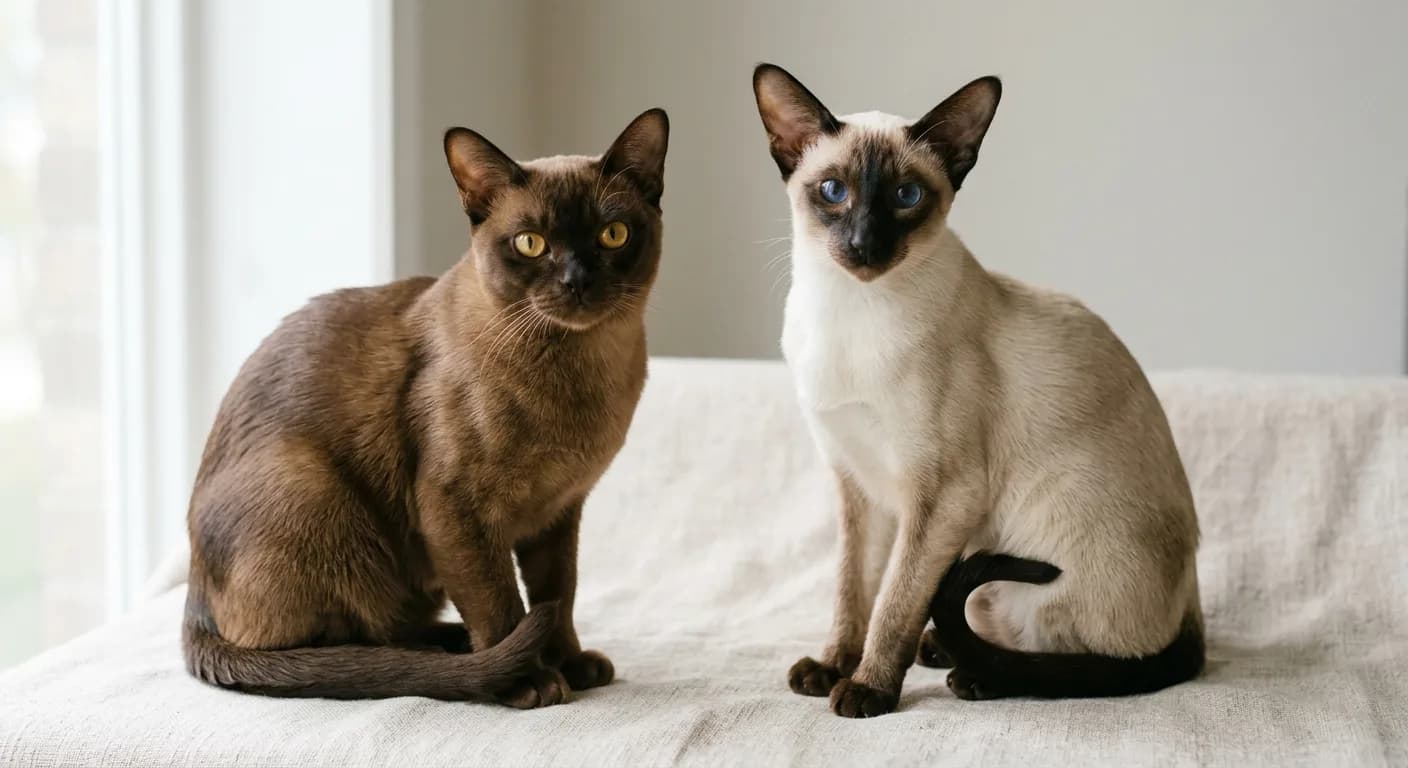
This is the single most visually striking difference between the two breeds. Burmese cats are solid-coated, with no points or contrast zones. Their short satin coat comes in four colors recognized by the CFA in the US standard: sable (a rich dark brown), champagne (warm beige), blue (soft blue-gray), and platinum (pale silvery lilac). The coat has an almost lacquered sheen when the cat is in peak condition. You can read more about the full range in our guide to Burmese coat colors.
Siamese cats are the textbook example of pointed coloration: a pale, cream-to-white body with sharply contrasting dark markings ("points") on the face, ears, paws, and tail. The four recognized point colors are seal (near-black), chocolate (warm brown), blue (cool gray), and lilac (frosty pinkish-gray). The pointing pattern is temperature-dependent: cooler body extremities produce the darkest color, which is why Siamese kittens are born all-white and develop their points over the first few weeks of life.
Eye Color
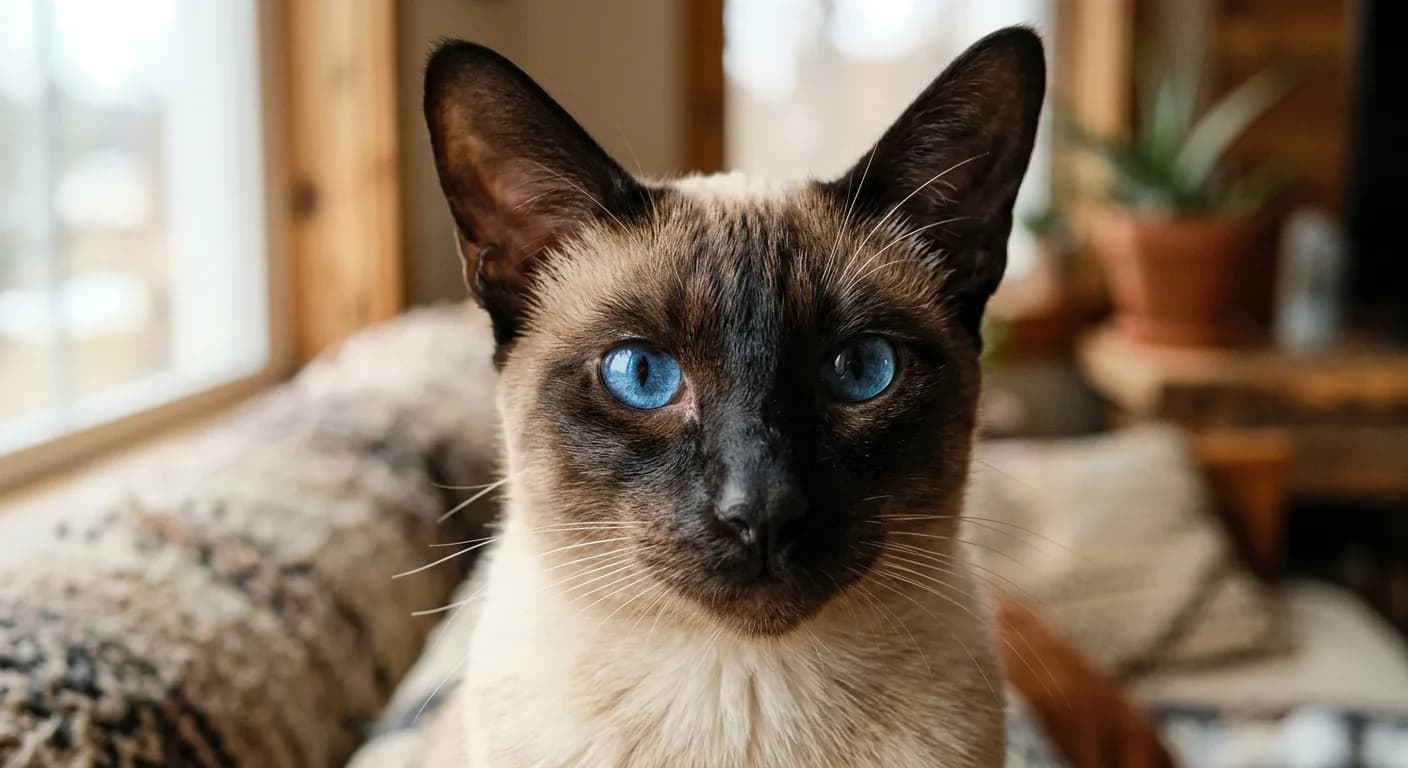
Eye color is another instant identifier. Burmese cats always have warm-toned eyes: gold, yellow, or amber. The eyes are large and rounded, giving the face an open, curious expression. Siamese cats always have vivid deep blue eyes, a hallmark of the breed and one of the most iconic features in the cat world. The Siamese eye color results from the same temperature-sensitive tyrosinase gene that creates the pointed coat pattern.
Temperament: Velcro vs Chatterbox
The Burmese Personality
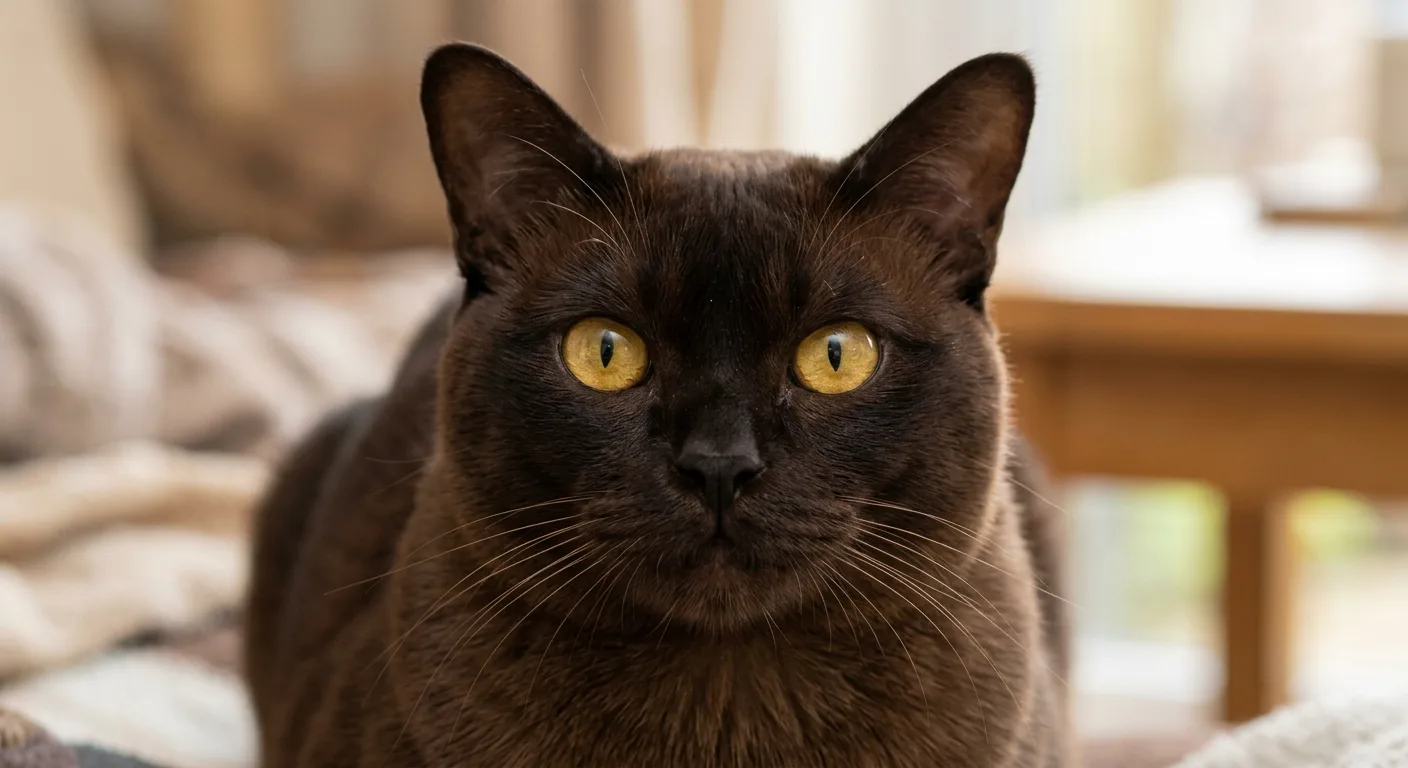
Burmese cats are consistently described as "dog-like," and the comparison is accurate. They follow their owners from room to room, greet them at the door, and have a strong preference for physical contact. The breed maintains kitten-like playfulness well into adulthood, and many Burmese will initiate games of fetch or chase with their owners for years. They form deep attachments that can border on obsession; this is not a cat that tolerates being ignored.
Vocally, Burmese are moderate. They will communicate with a soft, musical voice when they want something, but they are not incessant talkers. If you want a cat that is highly affectionate and interactive without the noise complaints, the Burmese delivers exactly that.
The Siamese Personality
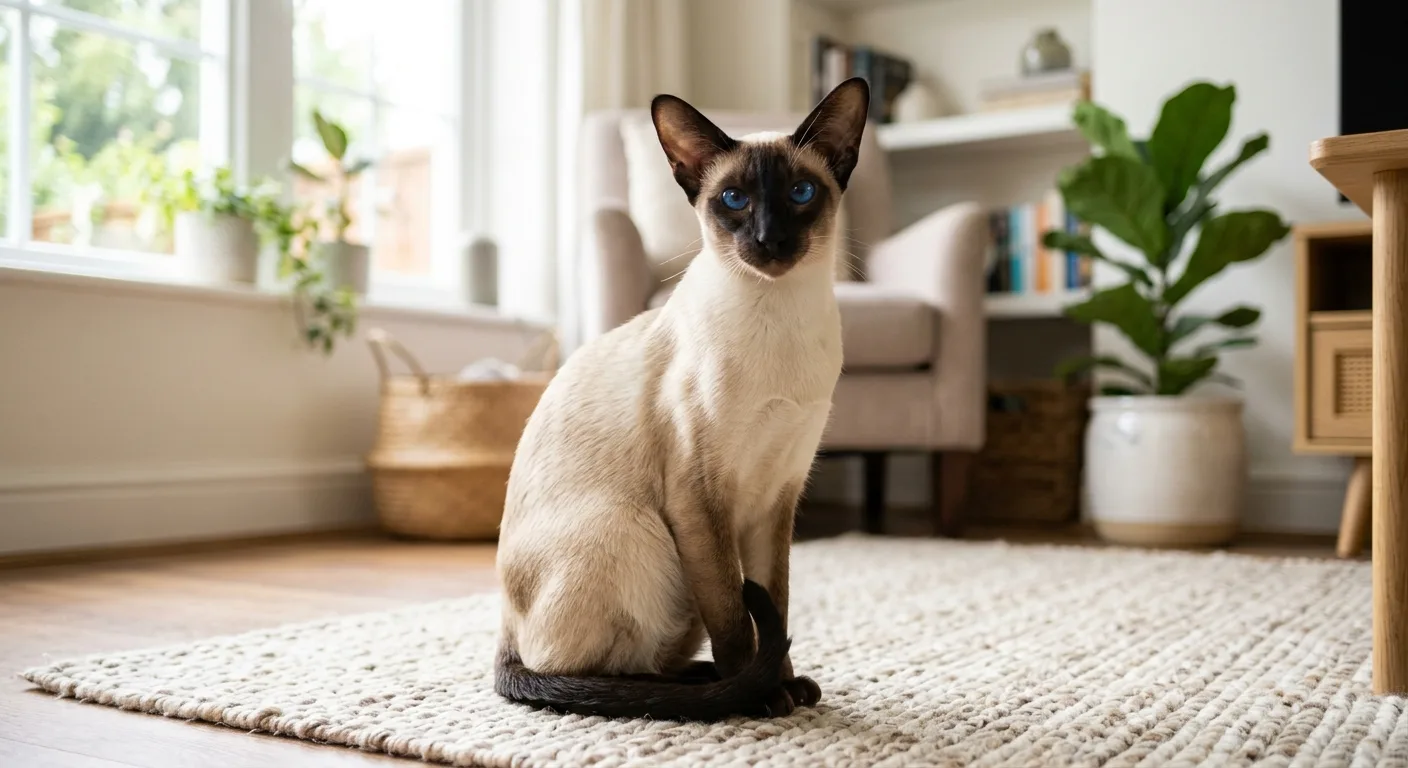
The Siamese temperament shares the social intensity of the Burmese but amplifies the vocal component dramatically. Siamese cats have the loudest, most distinctive voice in the cat world: a loud, raspy, insistent cry sometimes called a "meezer" that can be startling to new owners. They use this voice constantly: to demand attention, to express displeasure, to narrate their day. If you work long hours at home on calls, a Siamese in the background is noticeable.
Beyond the noise, Siamese are extraordinarily social and intelligent. They bond intensely with one or two people and can experience genuine distress when left alone for extended periods. They thrive in active households and do especially well with another social cat as a companion.

63-inch multi-level cat tree with scratch posts, hammock, plush perches, and dangling toys. Vertical territory is non-negotiable for high-energy climbing breeds like the Bengal.
Petful may earn a commission when you click through to Chewy, at no extra cost to you.
- Neither handles extended solitude well; both breeds are high-demand social cats. If you are away from home eight or more hours daily, both breeds benefit from a companion cat. The Siamese may show more pronounced stress behaviors (destructive behavior, weight loss, excessive vocalization) when chronically alone. The Burmese is only slightly more tolerant.
Health: What to Expect From Each Breed
Burmese Health Concerns
The Burmese cat has a moderate hereditary health profile. The primary concern is hypokalemia (low blood potassium), a genetic condition that can cause episodic muscle weakness. Responsible breeders screen for the genetic variant, and tested cats carry very low risk. Burmese are also somewhat predisposed to diabetes mellitus and chronic kidney disease (CKD) in later life, conditions that are common across many cat breeds but worth monitoring with annual bloodwork as the cat ages.
Flat-faced (brachycephalic) features in some Burmese lines can cause mild respiratory or dental crowding issues, though Burmese are far less extreme in facial structure than breeds like the Persian.
Siamese Health Concerns
The Siamese carries a genetic predisposition to progressive retinal atrophy (PRA), a degenerative eye condition that can lead to blindness. Genetic testing is available and ethical breeders screen breeding pairs. Siamese are also at elevated risk for hypertrophic cardiomyopathy (HCM), the most common heart disease in cats, and may be prone to dental issues due to their narrow jaw structure. Siamese tend to be vocal about health discomfort, so a sudden change in behavior or vocalization pattern is worth a vet visit.
Both breeds benefit from annual wellness exams, consistent dental care, and vaccination protocols appropriate for indoor cats.
Grooming and Care
Both breeds are low-maintenance groomers, which is one of the practical advantages of choosing either over a long-haired breed.
Burmese: The satin, close-lying coat requires minimal brushing: a weekly wipe with a chamois or soft cloth will keep it gleaming. Nails should be trimmed every two to three weeks, and ears checked monthly. The Burmese coat does not mat.

108-oz stainless steel pet fountain with quiet pump and water-level window. Bengals are notoriously water-obsessed; a flowing fountain encourages hydration and pulls them away from sinks and toilets.
Petful may earn a commission when you click through to Chewy, at no extra cost to you.
Siamese: Similarly low-maintenance. A soft bristle brush once a week removes loose hair and stimulates the coat. Siamese tend to be relatively low shedders compared to many breeds, though they shed more than a Burmese due to the slightly less dense coat texture.
Both breeds require the same dental care (regular brushing or dental treats), interactive playtime (puzzle feeders, wand toys), and vertical space (cat trees, shelves) to satisfy their active natures.
Price and Availability
The cost of a kitten from a reputable breeder is comparable for both breeds. You can read more about what drives Burmese pricing in our dedicated guide to Burmese cat price.
Burmese kittens from health-tested, CFA or TICA registered breeders typically range from $600 to $1,200 USD. Sable (the traditional color) is usually the most available; rarer colors like platinum may command a premium. Burmese are less common than Siamese in the US, so expect a waiting list from quality breeders.
Siamese kittens from registered breeders typically range from $400 to $1,000 USD. Traditional "apple-head" Siamese from breeders preserving the older body type may cost more than modern-style show cats. Siamese are more widely available, and rescue organizations occasionally have breed-specific cats available at lower adoption fees.
- Both breeds do appear in shelters and breed-specific rescues, though less frequently than mixed-breed cats. Searches on Petfinder.com or through the Siamese Rescue Center and Burmese breed club rescue networks can turn up adult cats needing homes, often at a fraction of kitten prices.
Burmese vs Siamese vs Tonkinese: The Third Option
If you love the idea of a cat that blends both breeds, the Tonkinese is worth a serious look. Developed in the 1960s from deliberate Burmese and Siamese crosses, the Tonkinese inherits a "mink" coat pattern that is intermediate between the solid Burmese and the pointed Siamese: darker than a Burmese but without the sharp contrast of a Siamese. Eye color is distinctive aquamarine, sitting midway between gold and blue.
In temperament, Tonkinese cats are typically as social and playful as both parent breeds, with a voice that is louder than the Burmese but slightly less intense than the Siamese. For buyers who cannot decide between the two and want a blend, the Tonkinese is a purpose-built answer to exactly that dilemma.
Which Breed Is Right for You?
Choose a Burmese if: You want a constant companion that is physical and affectionate without being loud. You have a quieter household, work from home, or live in an apartment where noise is a consideration. You prefer a solid-coated, rounded-eye aesthetic over the dramatic pointed look. See our full deep-dive on cat breeds to explore other options at this temperament level.
Choose a Siamese if: You are an active, talkative household that welcomes a cat with strong opinions. You want a dog-like cat that will meet you at the door, climb into every conversation, and perform for guests. You find the pointed coat pattern and blue eyes irresistible. You have or can provide another social cat for company.
The core differences are coat pattern and voice. Siamese cats have pointed coats (dark face, ears, paws, tail against a pale body) and vivid blue eyes. Burmese cats are solidly colored with no points and always have gold or amber eyes. Personality-wise, both breeds are social and affectionate, but Siamese are dramatically louder and more vocal, while Burmese are quieter and more physically clingy.
The modern Burmese breed descends from a single cat named Wong Mau, brought from Burma to the United States in 1930. Wong Mau was bred with a Siamese cat by Dr. Joseph Thompson, producing the foundation stock for the Burmese breed. Wong Mau herself was likely a natural Burmese-Siamese hybrid, genetically similar to what is now called a Tonkinese.
Several breeds can resemble Siamese cats but are distinct: the Balinese (long-haired Siamese), the Tonkinese (Burmese-Siamese cross with a mink coat), the Birman (pointed coat but heavier build and silky semi-long hair), the Ragdoll (large, pointed, and blue-eyed), and the Snowshoe. The Burmese is sometimes confused with Siamese by non-cat owners due to shared body proportions, but the lack of pointed coloring and the warm golden eyes make them easy to distinguish up close.
Burmese cats are generally quieter than Siamese and less likely to demand attention through loud vocalizations. Both breeds have high energy and strong social needs, so "calmer" mostly refers to noise level rather than activity level. If you need a truly quiet breed, the Burmese is the better choice of the two.
The main drawbacks of a Burmese are their high demand for human companionship (they do not do well alone for long periods), their tendency toward weight gain if not given adequate play, and their relatively limited color palette compared to some other breeds. They are also not ideal for owners who want an independent, low-maintenance cat.
Yes, Siamese and Burmese cats generally get along well when introduced properly. Both breeds are highly social and benefit from feline companionship. A Siamese and Burmese paired together often make excellent housemates: the Siamese provides the theatrical social energy, and the Burmese provides physical warmth and lap contact.
Burmese cats have a slightly longer average lifespan of 12 to 17 years, compared to 11 to 15 years for most Siamese. However, well-cared-for Siamese regularly live into their late teens, and some reach 20 years or more. Both breeds benefit from regular vet care, appropriate diet, and indoor-only status.
Both breeds are intelligent and respond to positive reinforcement. Siamese cats are often cited as easier to train for tricks and puzzle-solving due to their high energy and attention-seeking drive. Burmese cats are trainable but may be less motivated by food treats. Clicker training works well for both.
The four recognized point colors in Siamese cats are: seal point (near-black points on cream body), chocolate point (warm brown points on ivory body), blue point (cool gray-blue points on white body), and lilac point (frosty pinkish-gray points on glacial-white body). Breeders and registries also recognize additional point colors in some classifications, including red point, cream point, and tortie point.
Both breeds are good with children who are taught to interact respectfully with cats. The Siamese may be a better fit for high-energy households with active kids, as Siamese cats match that energy and engage in play readily. The Burmese is often preferred in quieter family settings where lap time and physical affection are the primary goal.

Coreen Saito is a pet writer and longtime shelter volunteer with more than a decade in animal rescue. She covers cat behavior, breed care, and the small, ordinary science of sharing a life with companion animals, with a particular focus on honest takes about the products and decisions that actually matter. At home in Arizona, she's outranked by Mac (a dog with the loudest opinion in the house), Rebel (a cat who governs by quiet authority), and Meri (an orange tabby who runs the late shift and the laundry basket). She writes about all three, plus the rescues that keep coming through her life, at LifeWithMinty.com.
Sign up for expert-backed reviews and safety alerts all in one place.