The Puppy Potty Training Schedule (Printable by Age)
A printable puppy potty training schedule by age, plus hour-by-hour daily and night routines, crate timing, signal-reading, and answers to every common question. Tape it to the fridge and follow it for two weeks.
Petful is reader supported. As an affiliate of platforms like Amazon and Chewy, we may earn a commission when you buy through links on this page. There is no extra cost to you.
A reliable puppy potty training schedule is the single fastest way to a house-trained dog, because puppies do not learn from lectures. They learn from repetition and timing. Get them to the right spot at the right moment often enough, reward it, and the habit forms itself. This guide gives you a printable by-age schedule you can tape to the fridge, plus the daily routines, night plan, and troubleshooting that turn a 10-week-old accident machine into a dog who asks to go out.
Below you will find age-specific intervals (how long a puppy can actually hold it), a full hour-by-hour sample day, a separate night schedule, a crate-time plan, and answers to every common question people ask. Print the table, follow it for two weeks, and adjust as your puppy grows.
- 1Take your puppy out on a timer, not a guess: roughly every hour at 8 to 10 weeks, stretching as they age.
- 2Always go out first thing in the morning, after every meal, after every nap, and after every play session.
- 3The rough holding limit is age in months plus one, so a 2-month-old maxes out near 3 hours while resting and far less while awake.
- 4Reward within 3 seconds of finishing outside, and never punish an accident you did not catch in the act.

Sign up for expert-backed reviews and safety alerts all in one place.
Why a Schedule Beats Everything Else
Puppies have tiny bladders and almost no muscle control early on. They cannot "hold it" the way an adult dog can, and they do not connect an accident from ten minutes ago with your reaction now. A puppy potty training schedule solves both problems at once. It gets your puppy outside before the bladder is full, and it stacks so many successful outdoor trips that going outside becomes the default.
Consistency is the active ingredient. The American Kennel Club and most veterinary trainers agree that a predictable rhythm of meals, naps, play, and potty breaks is what house-trains a dog, not any single trick. When food goes in at the same times, waste comes out at predictable times, and you can be standing on the grass when it happens.
There is a second reason to start structured on day one. The habits you build in the first few weeks are the habits your dog keeps. A puppy who learns that grass equals relief and reward rarely needs re-training later. A puppy left to figure it out on carpet learns the opposite lesson, and undoing it takes far longer than doing it right the first time.
- Puppies thrive on predictability. Feed, nap, play, and potty at the same times each day. When the daily rhythm is stable, elimination becomes predictable too, which means you can get your puppy to the right spot before an accident happens rather than cleaning up after one.
Keep a small notebook or a notes app open for the first week. Jot the time of every pee and poop, indoors and out. Within a few days you will see your own puppy's pattern (many go 15 to 30 minutes after eating, for example), and you can move your scheduled breaks to land just before those windows. Your printed schedule is the starting template. Your log is how you fine-tune it to your specific dog.

Petful may earn a commission when you click through to Chewy, at no extra cost to you.
How Long Can a Puppy Actually Hold It?
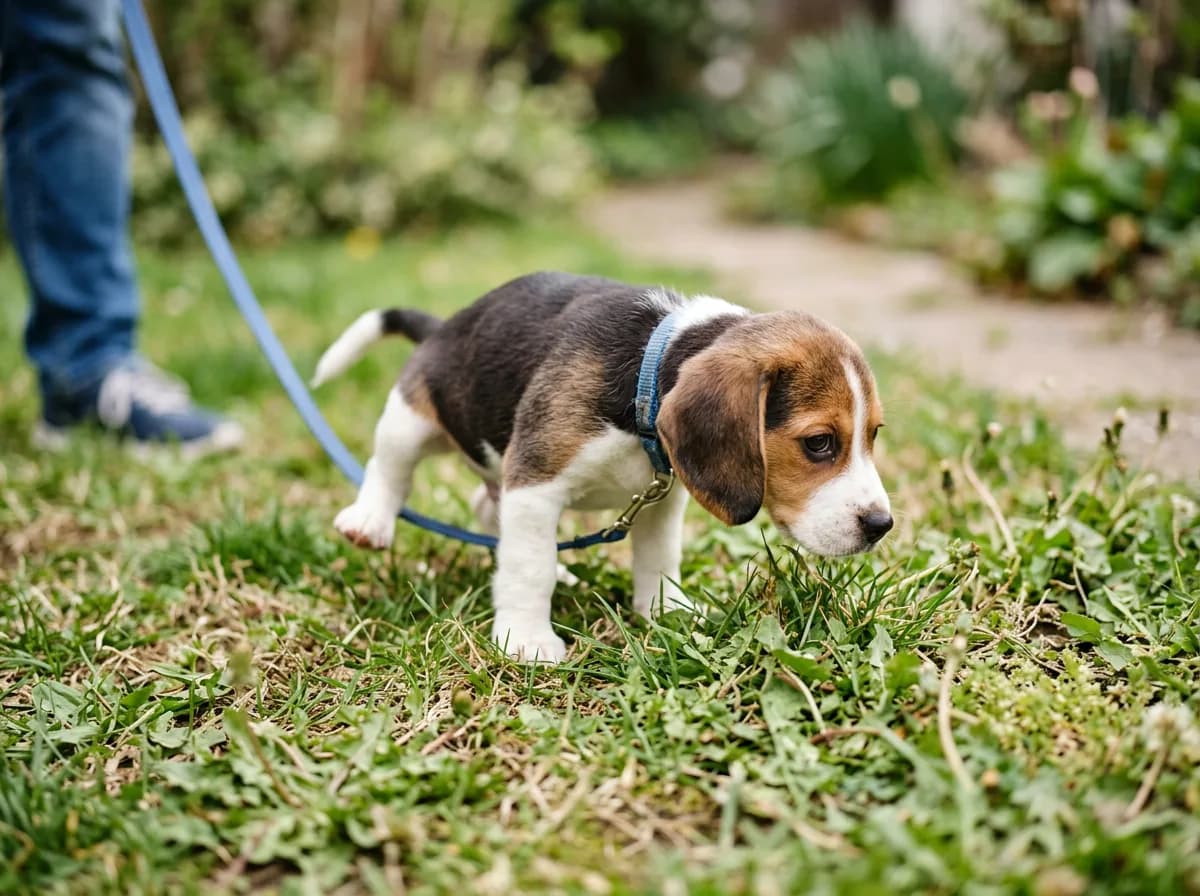
Before you can build a schedule, you need the golden rule of bladder control. The general guideline vets use is simple: a puppy can hold their bladder for about their age in months plus one, measured in hours. A 2-month-old puppy tops out around 3 hours, a 3-month-old around 4 hours, and so on.
Two important caveats keep this rule honest. First, that number is the maximum while the puppy is resting or asleep, not a target to aim for. During waking hours, especially right after drinking, eating, or a burst of play, a puppy needs to go far more often than the formula suggests. Second, the rule caps out. Even an adult dog should not be asked to hold it longer than 6 to 8 hours, and pushing a puppy to their theoretical maximum all day is a recipe for accidents and, over time, urinary discomfort.
Treat the age-plus-one number as a ceiling for overnight and crate rest, and treat waking hours as "take them out constantly." That combination is what the by-age table below is built on.
| Puppy Age | Daytime Potty Interval | Overnight Holding (resting) |
|---|---|---|
| 8 to 10 weeks | Every 30 to 60 minutes | 1 to 2 hours, expect 1 to 2 night breaks |
| 10 to 12 weeks | Every 60 to 90 minutes | 2 to 4 hours, expect 1 night break |
| 3 to 4 months | Every 2 hours | 4 to 6 hours |
| 4 to 6 months | Every 3 to 4 hours | 6 to 7 hours |
| 6 months and up | Every 4 to 6 hours | 7 to 8 hours |
Print that table. It is the backbone of the whole plan. Notice that the intervals stretch as the puppy grows, which is exactly why a schedule that worked at 8 weeks will have you going outside too often by 4 months. Re-check your puppy's age against the table every couple of weeks and lengthen the intervals accordingly.
- Toy and small breeds have smaller bladders relative to their bodies and often need breaks on the shorter end of every range above. If you have a Chihuahua or Yorkie puppy, lean toward the tighter interval in each age bracket rather than the looser one.
The Daily Puppy Potty Training Schedule (Hour by Hour)
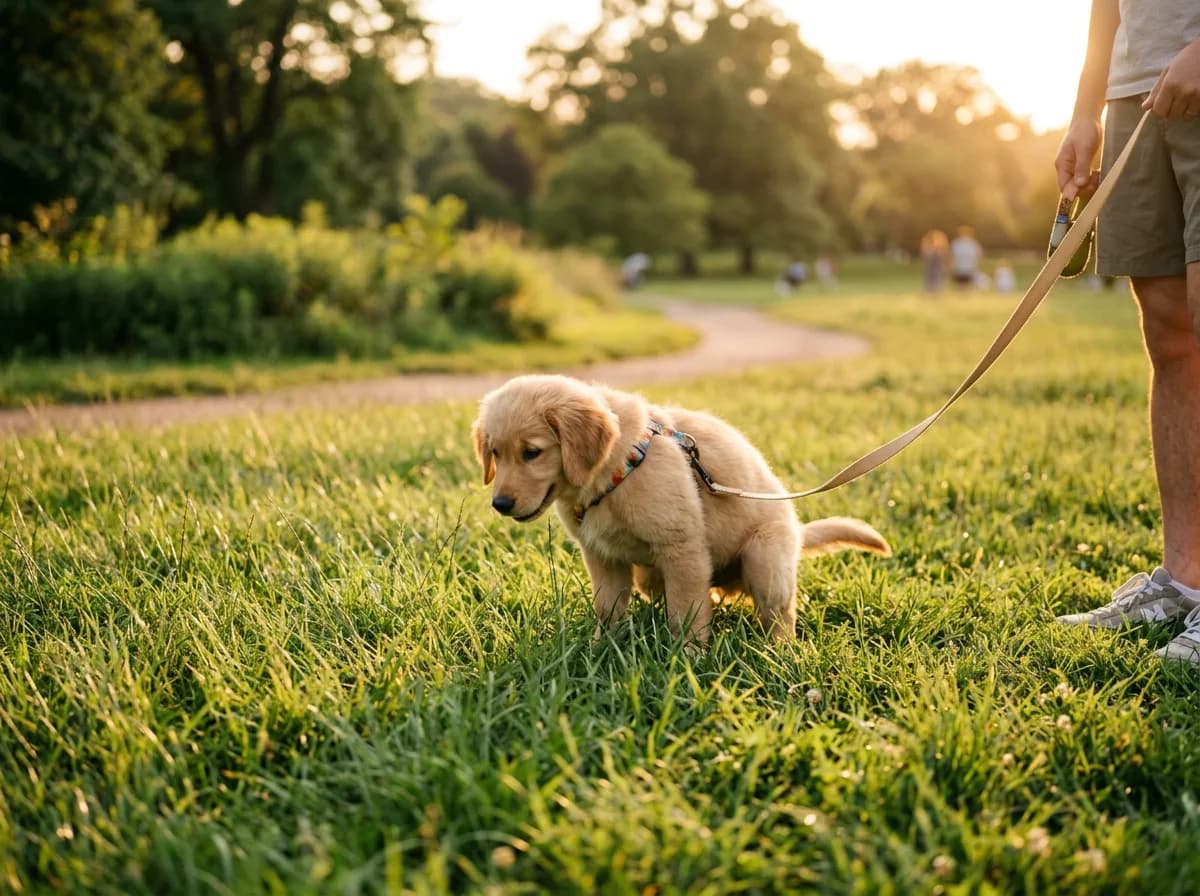
Intervals tell you how often. A daily schedule tells you when. Here is a full sample day for a puppy in the 10-to-16-week range, built around the non-negotiable trigger moments: waking, eating, napping, and playing. Shift the clock times to match your own wake-up, but keep the sequence and the spacing.
Petful may earn a commission when you click through to Chewy, at no extra cost to you.
Morning
- 7:00 AM Wake up. Carry or walk your puppy straight outside to the same potty spot before anything else. Do not stop for coffee.
- 7:20 AM Breakfast. Put the food down for 10 to 15 minutes, then pick it up.
- 7:40 AM Potty break (10 to 20 minutes after eating triggers the reflex).
- 8:30 AM Play and short training session, then a potty break right after.
- 9:00 AM Nap or crate rest.
Midday
- 10:30 AM Wake from nap, straight outside to potty.
- 11:00 AM Play, then potty.
- 12:00 PM Lunch (for young puppies on three meals a day), then a potty break 10 to 20 minutes later.
- 12:45 PM Nap or crate rest.
- 2:30 PM Wake, straight outside.
- 3:00 PM Play and training, then potty.
- 4:00 PM Nap or quiet time.
Evening
- 5:00 PM Wake, straight outside.
- 5:30 PM Dinner, then potty 10 to 20 minutes later.
- 6:30 PM Family play time, potty afterward.
- 7:30 PM Calm settle time, one more potty break.
- 8:30 PM Pick up the water bowl about two hours before bed to reduce overnight volume.
- 9:30 PM Final potty break of the night, right before the puppy goes into the crate to sleep.
That is roughly ten to twelve trips outside in a single day for a young puppy, and that is normal. Every one of those trips is a rep. The more successful reps, the faster the habit locks in. As your puppy ages and the by-age table allows longer intervals, you will naturally drop the mid-block breaks and keep the anchors: wake, meals, and bedtime.
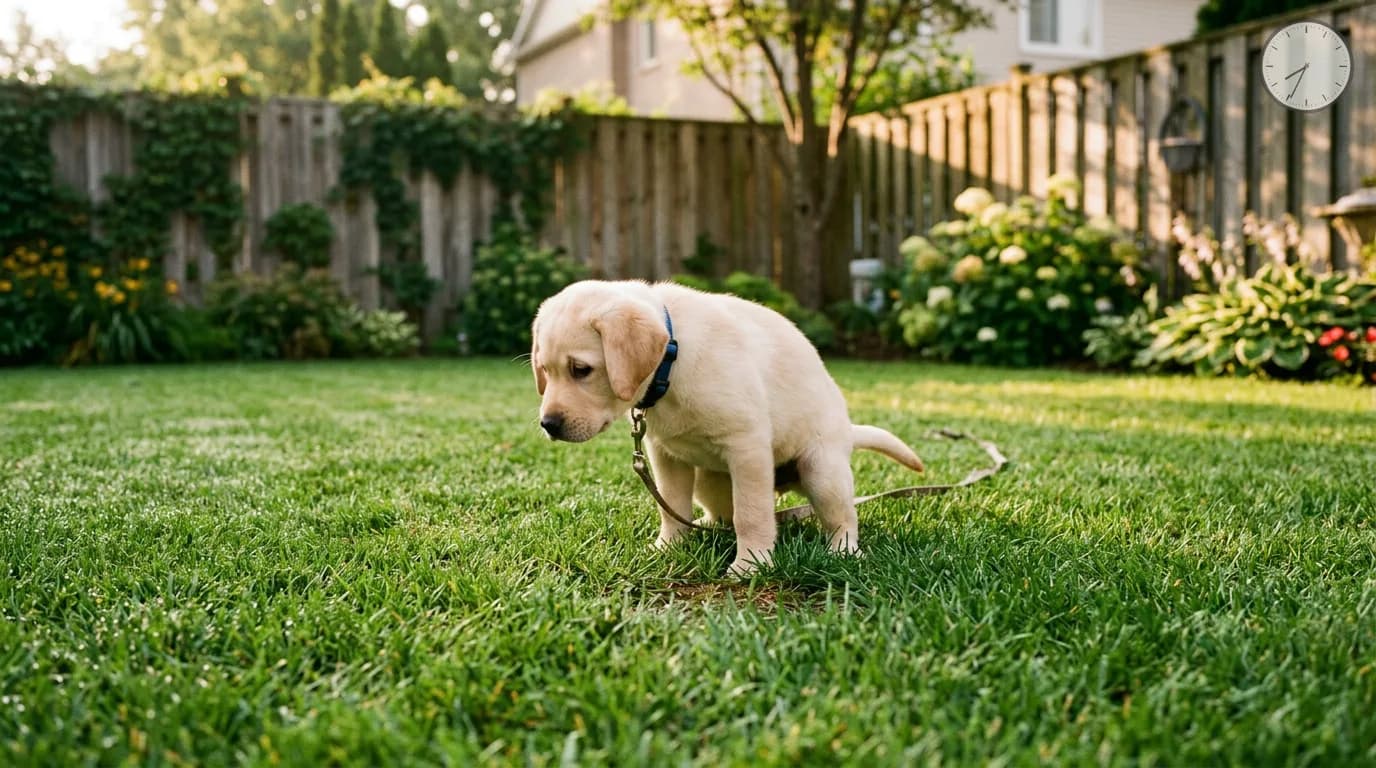
- First thing after waking, within 20 minutes after every meal, immediately after every nap, and right after every play session. If you take your puppy out at these four trigger moments every single time, you have done 80 percent of the work.
The Puppy Potty Training Night Schedule
Nights are their own challenge because your puppy is asleep and so are you, but an 8-week-old bladder cannot make it eight hours. The night schedule is short and strict: get them out, keep it boring, get everyone back to sleep.
Petful may earn a commission when you click through to Chewy, at no extra cost to you.
For a puppy under 12 weeks, expect one or two overnight trips. Set a phone alarm rather than waiting for whining to escalate, because a puppy who has already started crying has usually already had, or is about to have, an accident. A common pattern is a break around 3:00 AM for the youngest puppies, moving to a single 4:00 AM break, then eventually sleeping through.
Keep night breaks all business. No lights blazing, no talking, no play. Carry the puppy out, let them go, offer one quiet word of praise, and return them straight to the crate. If night trips turn into a party, your puppy learns that 3:00 AM is fun and will keep requesting it long after their bladder can hold. The goal is for the puppy to associate night with sleep and a quick, dull potty trip, nothing more.
- Pick up the water bowl roughly two hours before bedtime and offer a few sips if needed. Free access to water overnight guarantees a full bladder and more accidents. Always give unrestricted water during the day so your puppy stays well hydrated.
Most puppies can sleep through the night by around 16 weeks, some sooner, once their bladder catches up and the daytime routine is solid. When your puppy wakes dry for several mornings in a row and shows no urgency at their usual alarm time, you can start pushing the alarm later in 30-minute steps until you drop it entirely.
Crate Training Fits Inside the Schedule
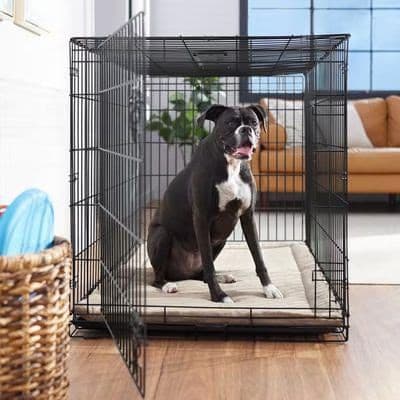
The crate is the schedule's best friend. Dogs instinctively avoid soiling the space they sleep in, so a correctly sized crate teaches a puppy to hold it a little longer and to signal when they need out. That instinct only works if the crate is the right size: just big enough to stand, turn around, and lie down. Too large and the puppy will simply pee in one corner and sleep in the other, which defeats the purpose. Use a divider panel and expand the usable space as the puppy grows.
Work the crate into the naps already on your daily schedule. Every "nap or crate rest" block above is a crate opportunity. The rule is airtight: the puppy goes potty immediately before going into the crate and immediately after coming out, every time, no exceptions. That bookend pattern is what makes the crate accelerate house-training instead of causing accidents.
Never use the age-plus-one holding rule to justify long crate stretches during the day. A crate is for sleep and short management windows, not for parking a puppy for six hours. If you work away from home, arrange a midday walker or a safe playpen with a pee pad, and keep the crate for actual rest.
- Buy one crate with a divider rather than a series of crates. Size the interior so your puppy can stand, turn, and lie down comfortably, and no larger. That snug fit is what triggers the natural instinct not to soil the sleeping area.
The Schedule at Each Age Stage
The printable table gives you the intervals, but each age stage has its own personality. Here is what to expect and what to prioritize as your puppy grows through the potty training months.
8 to 10 Weeks: Constant Trips, Zero Expectations
This is the most demanding stretch and the shortest bladder. At this age you are essentially living outside, taking your puppy out every 30 to 60 minutes while awake, plus the four trigger moments. Do not expect your puppy to signal or hold it. Your job is pure prevention: get them out before they need to go, reward every success, and confine them to a small, supervised space the rest of the time. Accidents are not misbehavior at this age, they are biology. Log everything so you start learning the pattern, and lean hard on the crate for naps so night training begins immediately.
10 to 12 Weeks: The Pattern Emerges
By now your log is showing a rhythm, and you can start trusting it. Intervals stretch to every 60 to 90 minutes while awake. This is the stage to nail the verbal cue, so say "go potty" every time your puppy starts to eliminate outside until the phrase reliably prompts the behavior. Night trips usually drop to one. Begin watching for the first faint signals, a pause in play or a drift toward the door, and reward any early attempt to communicate.
3 to 4 Months: Real Progress
Bladder control improves noticeably. Daytime intervals reach about every 2 hours, and many puppies now sleep through the night or nearly so. This is when the schedule starts feeling less relentless. Keep the anchors (wake, meals, naps, play, bedtime) rock solid, but you can relax the mid-block breaks. Start expanding freedom one room at a time, always supervised, and expect the occasional accident when the excitement of a new space overrides a still-developing bladder.

Petful may earn a commission when you click through to Chewy, at no extra cost to you.
4 to 6 Months: Reliability Sets In
Most puppies become genuinely reliable in this window. Intervals reach every 3 to 4 hours, and your puppy likely signals when they need out. This is the stage to generalize: practice at friends' houses, on trips, in the rain, so your dog learns that "outside" means outside anywhere, not just your one backyard spot. Do not get complacent. A run of clean weeks can tempt you to grant full house freedom overnight, and that is exactly when a regression happens. Loosen supervision gradually.
6 Months and Beyond: Maintenance
By six months, a well-scheduled puppy holds it for 4 to 6 hours and asks to go out. The training phase is winding down into a maintenance routine of morning, midday, evening, and bedtime breaks. Full bladder maturity continues developing to around a year, so keep the routine predictable and do not suddenly ask for eight-hour holds. If your puppy is still having frequent accidents at this age, that is a signal to revisit the earlier steps or consult your vet to rule out a medical cause.
- Puppies develop at their own pace. If your 4-month-old is still having regular accidents, drop back to the 3-month intervals for a week rather than pushing ahead. The table is a guide; the puppy in front of you is the authority.
The First Week, Day by Day
A schedule works best when you know what to focus on each day. Here is a realistic seven-day on-ramp. Nobody is fully house-trained in a week, but this sequence builds the foundation the rest of the plan stands on.
- Day 1 Establish the routine. Pick one potty spot, walk the full daily schedule above, and start your potty log. Expect accidents. Your only job today is repetition and supervision.
- Day 2 Reinforce timing. Add a verbal cue such as "go potty" the moment your puppy starts to eliminate outside, so the word eventually triggers the behavior. Reward within three seconds every single time.
- Day 3 Introduce or lean on the crate for naps. Potty immediately before and after each crate session. Watch for the pre-potty signals: circling, sniffing, sudden sniff-and-wander.
- Day 4 Begin stretching the daytime interval by 10 to 15 minutes if your puppy has had a clean run of trips. If accidents return, shorten it back.
- Day 5 Focus on catching signals early and reducing indoor accidents. Keep the puppy in the same room as you, tethered or gated, so you never lose track of them.
- Day 6 Practice the routine in a slightly new context: a different door, the front yard, a short trip. Generalizing early prevents a puppy who only goes in one exact spot.
- Day 7 Review your log, note the real intervals your puppy is showing, and adjust the printed schedule to fit the dog in front of you rather than the template.
Do not expect a finished product on Day 7. Most puppies are reliably house-trained somewhere between 4 and 6 months of age, and full bladder maturity comes even later. The first week is about momentum, not completion.

High-value training treats matter for a Belgian Malinois: the breed's drive demands a reward that genuinely earns the work. These triple-flavor kabobs (chicken, duck, chicken liver) hit the high-value tier without going to raw meat. 18-count bag carries a week of training sessions for a working-line Mal.
Petful may earn a commission when you click through to Chewy, at no extra cost to you.
Reading Your Puppy's Signals
The best schedule in the world still misses the moment a puppy needs to go off-cycle, so learn the tells. Classic pre-potty signals are circling, sniffing the floor intently, suddenly breaking off play, whining, heading toward a door, or squatting mid-sniff. The instant you see one, move. Scoop up a small puppy or clip the leash and get to the potty spot immediately, then reward if they go.
Many owners eventually teach a clearer signal by hanging bells on the door and ringing them with the puppy's paw or nose at every trip out. Within a couple of weeks, plenty of puppies start ringing the bells themselves to ask. It is optional, but it converts your puppy's vague signals into one unmistakable one.
The tighter you pair your schedule with signal-reading, the fewer accidents slip through. The schedule prevents most; watching your puppy catches the rest.
When Accidents Happen (and They Will)
Accidents are part of the process, not a failure of it. How you handle them decides whether your puppy learns faster or gets confused.
If you catch your puppy in the act, interrupt gently with a clap or a calm "ah-ah," scoop them up, and rush outside to finish. Reward the finish outdoors. That is the entire correction. If you find a puddle after the fact, say nothing and clean it up. Your puppy cannot connect your reaction to something they did minutes ago, and scolding after the fact only teaches them to hide when they eliminate, which makes training harder.
Clean every accident with an enzymatic cleaner, not a standard household spray. Regular cleaners leave scent markers a dog's nose still detects, and that residual smell invites a repeat performance in the same spot. Enzymatic cleaners break the odor down at the source.
- It does not teach the lesson you think it does. A puppy punished for an accident learns to fear eliminating in front of you, so they start sneaking off to go behind the couch instead. Reward outdoor success, ignore indoor mistakes you did not catch, and the math works in your favor.
A sudden spike in accidents from a puppy who was doing well can signal a urinary tract infection or other medical issue, especially if it comes with straining, frequent tiny puddles, or blood. If good habits regress overnight for no schedule-related reason, call your vet. Most regressions are behavioral or schedule-related, but ruling out a medical cause is worth a phone call.
Keep the Records That Come With Your Puppy
A potty schedule is one of several routines you are setting up in those first weeks, and the paperwork side matters more than most new owners expect. Your puppy's vaccine dates, deworming schedule, microchip number, and even the potty and feeding logs you are keeping now all become the record that follows your dog for life. Storing them in one place from day one, in a digital pet profile like MyPetID alongside your training notes, means you are never scrambling for a vaccine date at a boarding kennel or a vet visit. Set it up the same week you print the potty schedule, while everything is fresh.
That habit of tracking pays off directly in house-training too. The same log that captures a vaccine date can capture the exact times your puppy pees and poops, and that pattern is what lets you tune the schedule to your specific dog rather than the generic template.
Common Mistakes That Slow Everything Down
Even with a solid schedule, a few habits quietly sabotage progress. Watch for these.
- Too much freedom too soon. A young puppy given the run of the house will find a quiet corner to go. Gate them to one room, tether them to you, or use a crate. Earn freedom room by room as reliability grows.
- Punishing accidents. Covered above, but it is the single most common mistake, so it bears repeating. It backfires every time.
- Inconsistent potty spot. Take the puppy to the exact same patch of grass each time. The lingering scent cues them to go, and the consistency speeds the association.
- Rewarding too late. The treat and praise must land within about three seconds of the puppy finishing. Wait until you are back inside and the reward attaches to walking through the door, not to going potty. Compare treats for potty training by portion size and ease of use.
- Leaving water down at night. Guarantees a fuller bladder and more night trips. Pick it up a couple of hours before bed.
- Not adjusting the schedule as the puppy grows. The 8-week schedule will have you going out far too often by 4 months. Re-check the by-age table regularly.
Fix these and the schedule does its job. Most house-training frustration traces back to one of these six, not to the puppy.
Every Dog Is a Little Different
Breed, size, and individual temperament all nudge the timeline. Smaller breeds generally need more frequent trips and often take a bit longer to fully train because of their tiny bladders. Higher-energy breeds may need extra post-play breaks. None of this changes the framework, only the intervals. If you are still choosing a puppy and want to understand how breed traits shape day-to-day care, our guide to coat and color genetics in the Rhodesian Ridgeback is a good example of how much variation sits inside a single breed, let alone across breeds.
Whatever dog you have, the printable schedule at the top is your starting line. Follow the by-age intervals, hit the four trigger moments every time, keep nights boring, reward fast, and log the pattern. In a few weeks the accidents thin out, and one day your puppy walks to the door and asks. That is the whole goal, and a consistent schedule is how you get there.
Adapting the Schedule for Apartments and Pad Training
Not everyone has a backyard ten steps away. If you live in an apartment or a high-rise, the schedule stays identical, but the logistics change. The trip from crate to grass might take five minutes down an elevator, and a young puppy will not hold it that long. You have two workable options.
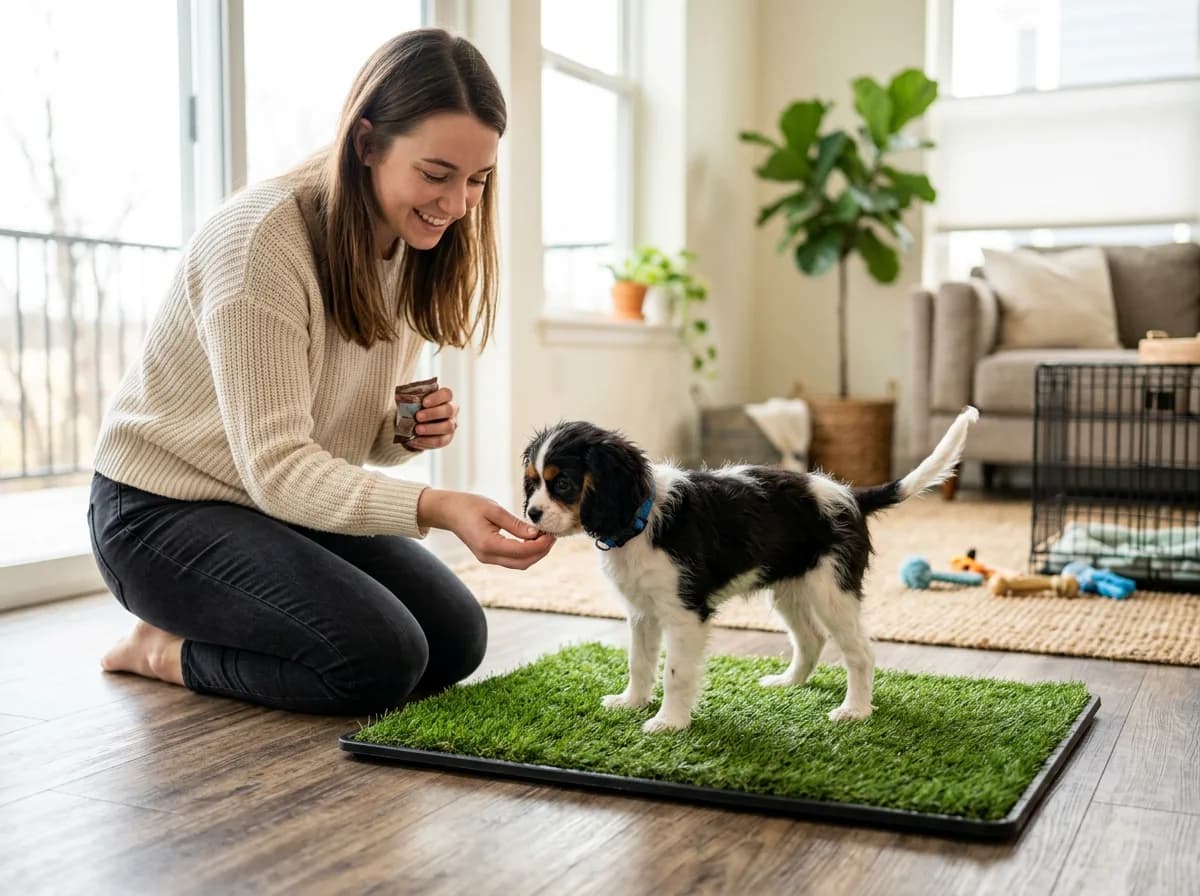
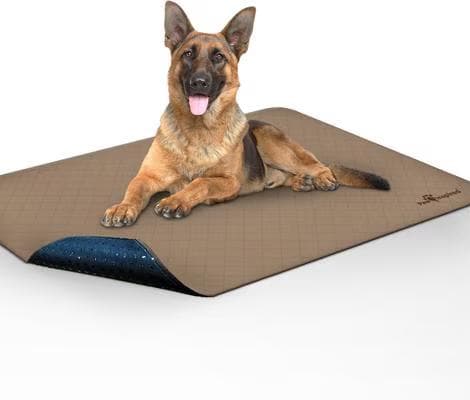
The first is a designated indoor potty station: pee pads or a real-grass indoor tray placed in a consistent spot, ideally near the door you will eventually use to go outside. Take your puppy to the pad on the exact same schedule you would use for the yard, reward success there, and gradually move the pad closer to the exit, then just outside it, until outdoor becomes the norm. The downside is that you are teaching two acceptable surfaces at once, which can slow full outdoor training, so many trainers use pads only as a bridge for the youngest puppies or for owners who genuinely cannot make the trip in time.
The second is to pre-empt the elevator problem by carrying your puppy (rather than walking them) from the door to the potty spot until they are old enough to hold it during the trip. Carrying prevents an accident in the hallway and keeps the whole trip associated with the outdoor destination. Whichever you choose, the timer and the trigger moments do not change, only where the puppy goes when the timer rings.
- If your goal is a fully outdoor-trained dog, treat indoor pads as temporary scaffolding for the youngest weeks and phase them out as your puppy's bladder matures. Puppies trained long-term on pads can find the eventual switch to outdoor-only confusing.
Weather, Travel, and Schedule Curveballs
Real life does not respect your printed schedule, so plan for the disruptions. Cold, rain, and snow make puppies reluctant to go, and a puppy who refuses to potty in bad weather will simply hold it until they get back inside and then have an accident. Keep bad-weather trips short and rewarding, use a covered spot if you have one, and consider a small sheltered area or a covered patio for the youngest puppies so weather never becomes a reason to skip a scheduled break.
Travel and schedule changes (a weekend away, a shift in your work hours, a move) throw puppies off because the routine they rely on suddenly changes. When you travel, bring the crate, keep the same feeding times, and take the puppy out on the same intervals in the new location. Expect a temporary uptick in accidents in any new environment; it is generalization in progress, not backsliding. Return to the normal schedule the moment you are home and the pattern re-establishes quickly.
Daylight saving time, guests, holidays, and busy days are the classic schedule-killers. On chaotic days, do not abandon the trigger moments. Even if you miss a mid-block break, never skip the wake, post-meal, post-nap, and bedtime trips. Those anchors are what hold the training together when the rest of the day falls apart.
Frequently Asked Questions
Related on Petful
- How to Potty Train a Puppy: The Schedule-First Guide
- Pee Pads vs Outside: Puppy Pad Training Guide
- Crate Training Schedule by Age: 8 Weeks to 6 Months
- Puppy Training 101: A Week-by-Week Guide
The 10-10-10 rule is a potty training method: take your puppy outside, wait up to 10 minutes for them to go, and if they do, reward and enjoy up to 10 minutes of freedom before the next cycle. Some trainers also use 10-10-10 to describe socialization goals (10 new people, 10 new places, 10 new experiences) in the first weeks, but in potty training it refers to the timer-and-wait routine.
The 7-7-7 rule is a socialization guideline suggesting that by 7 weeks of age a puppy should have experienced 7 different surfaces, 7 different objects, 7 different locations, 7 challenges, eaten from 7 types of containers, and met a range of new people. It is about early exposure and confidence, not potty training directly, though a well-socialized, confident puppy tends to house-train more smoothly.
The best schedule takes your puppy out first thing in the morning, within 10 to 20 minutes after every meal, immediately after every nap, right after every play session, and last thing before bed. For an 8 to 10 week old that means roughly every 30 to 60 minutes while awake, stretching to every 2 hours by 3 to 4 months and every 4 hours by 6 months. Use the printable by-age table in this article as your template.
Many owners find the first month home, often around 8 to 12 weeks, the hardest because of frequent night wakings, constant potty trips, and nipping. Others point to the adolescent stage around 6 to 12 months, when a puppy tests boundaries and may seem to forget training. For house-training specifically, the earliest weeks are toughest because bladder control is lowest; it gets steadily easier as the puppy matures.
Red flags worth a vet or trainer conversation include a sudden spike in accidents in a previously trained puppy (possible urinary tract infection), straining or blood when urinating, extreme fear or aggression, refusing to eat, or persistent inability to hold it far below the age-appropriate range. For potty training, the biggest red flag is regression paired with physical symptoms, which points to a medical cause rather than a training one.
In potty training, the 10-10-10 rule means you take the puppy to their spot, give them up to 10 minutes to eliminate, and if successful, allow up to 10 minutes of supervised freedom before returning to the crate or the next scheduled break. If they do not go within 10 minutes, put them back in the crate for a short spell and try again shortly, rather than giving free roam to an unemptied puppy.

Coreen Saito is a pet writer and longtime shelter volunteer with more than a decade in animal rescue. She covers cat behavior, breed care, and the small, ordinary science of sharing a life with companion animals, with a particular focus on honest takes about the products and decisions that actually matter. At home in Arizona, she's outranked by Mac (a dog with the loudest opinion in the house), Rebel (a cat who governs by quiet authority), and Meri (an orange tabby who runs the late shift and the laundry basket). She writes about all three, plus the rescues that keep coming through her life, at LifeWithMinty.com.
Sign up for expert-backed reviews and safety alerts all in one place.