Dog Food for Weight Management: What Vets Look For
See how veterinarians assess calories, nutrient density, portions, and body condition when choosing dog food for weight management.

Petful is reader supported. As an affiliate of platforms like Amazon and Chewy, we may earn a commission when you buy through links on this page. There is no extra cost to you.
This article is sponsored by JustFoodForDogs. Petful maintains editorial control over its educational content and may earn a commission from qualifying purchases, at no extra cost to you.
The best dog food for weight loss is not simply the package with the boldest “light” claim. Veterinarians look at the whole feeding plan: how many calories the dog actually needs, how much food provides those calories, whether the diet is complete and balanced, and whether the dog can lose fat without sacrificing muscle or essential nutrients.
That distinction matters. A dog can gain weight on a lower-calorie food if portions are too large, while a carefully measured amount of a more calorie-dense food may fit another dog’s plan. Age, activity, medications, reproductive status, orthopedic pain, and medical conditions can all change the target.
Start with a veterinary body-condition assessment and a daily calorie target. Then choose a complete-and-balanced food that makes the target practical, measure every meal, and adjust based on the dog’s weight and body condition, not the front of the bag alone.

Sign up for expert-backed reviews and safety alerts all in one place.
What vets look for in weight-management food
Veterinarians usually begin by confirming that weight loss is appropriate. A body-condition score, current weight, muscle-condition assessment, diet history, treat count, and activity review give more useful information than a scale number by itself. A dog who is losing muscle, drinking excessively, taking appetite-altering medication, or gaining weight unexpectedly may need diagnostic testing before the food plan changes.
Once the goal is clear, vets evaluate several features together.
What's the best food to give a dog to lose weight? It is the complete-and-balanced food that fits the veterinarian-set calorie target, preserves lean tissue, can be measured consistently, and supports scheduled body-condition rechecks. No format or brand replaces those checks.
| What vets evaluate | Why it matters | What owners can check |
|---|---|---|
| Calories per cup, can, ounce, or gram | Determines how much food fits the daily target | Use the calorie statement for the exact recipe and format |
| Complete-and-balanced status | Protects nutrient intake while portions are controlled | Look for the nutritional adequacy statement and correct life stage |
| Protein and overall nutrient density | Helps preserve lean tissue and meet nutrient needs | Ask the vet whether the formula suits the dog’s age and health |
| Fiber and food volume | May help some dogs feel satisfied between meals | Watch stool quality, comfort, and hunger rather than assuming more fiber is always better |
| Fat level and medical fit | Some conditions change what a dog can tolerate | Do not select a low-fat or veterinary diet by label alone |
| Palatability | A plan works only if the dog eats it consistently | Avoid repeated add-ons that erase the calorie deficit |
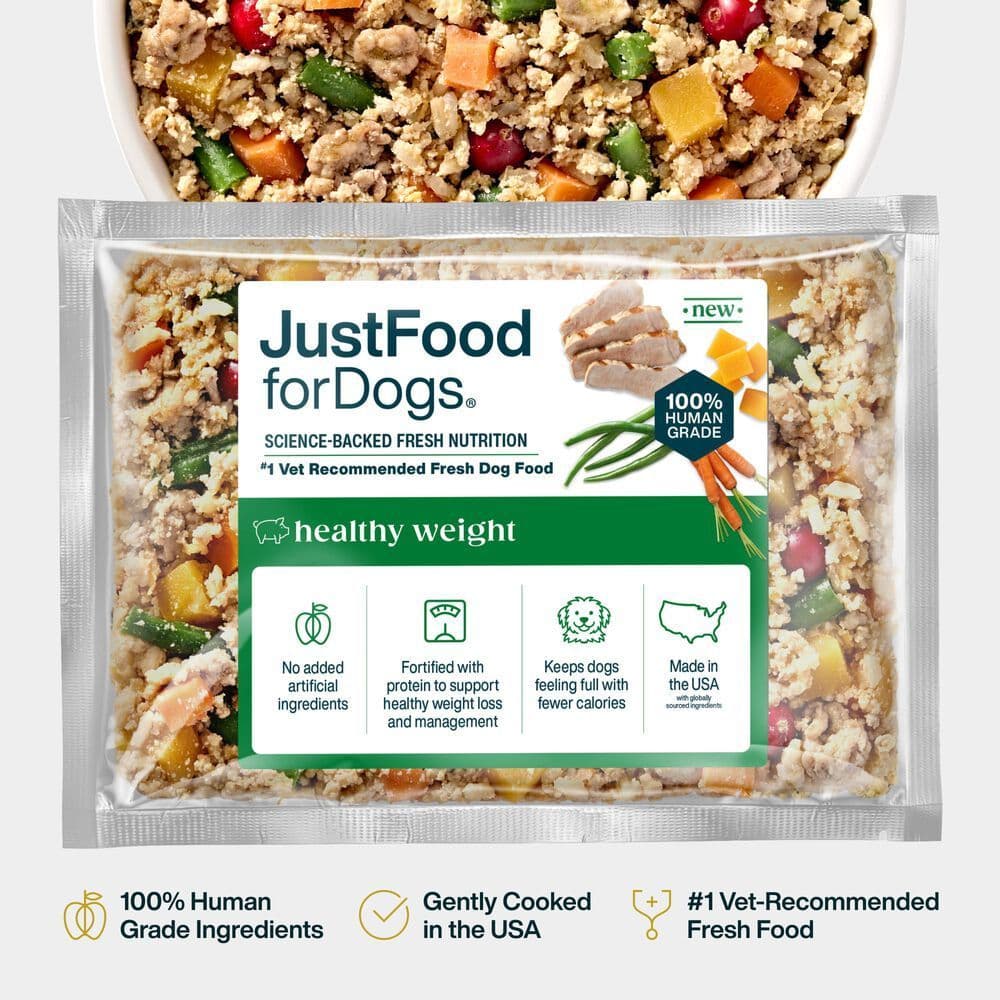
Use the exact recipe and feeding guidance when turning your dog’s calorie target into a measured portion.
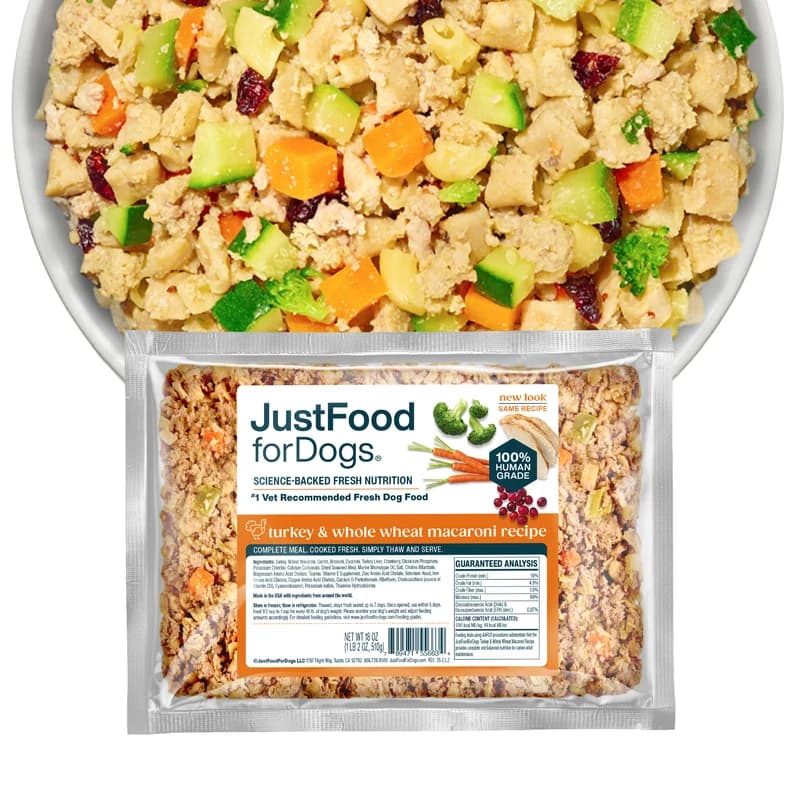
- Explore the everyday Healthy Weight formula
- Fresh Frozen meals with portion guidance
- Compare the recipe with your vet’s feeding plan
Veterinary Metabolic Support is a separate diet.
Petful may earn a commission when you click through to JustFoodForDogs, at no extra cost to you.
“Low fat,” “healthy weight,” and “weight management” are not interchangeable promises. Fat provides more calories per gram than protein or carbohydrate, but the finished food’s total calorie density is what determines portion size. Moisture also affects how much volume appears in the bowl. This is why comparisons should use calories for the exact serving, not percentages viewed in isolation.
How vets set a calorie target
A common starting point is resting energy requirement, or RER:
RER = 70 × body weight in kilograms^0.75
The veterinary team then adjusts that estimate for life stage, activity, reproductive status, body condition, health, and the desired rate of loss. Formula estimates are only starting points; individual dogs may vary substantially. JustFoodForDogs feeding guidance notes that real needs can differ from estimates by as much as 50%.
- The vet can also set a safe recheck schedule. A practical home plan records:
- the exact food and recipe;
- calories offered per day;
- treats, chews, toppers, and table food;
- weekly or veterinarian-scheduled weights;
- changes in body condition, muscle, stool, hunger, and activity.
Treats and toppers should generally stay at or below 10% of daily calories unless the veterinary team gives different instructions. “A little” cheese, peanut butter, dental chews, and training rewards can become a large share of a small dog’s calorie budget.
The nutrition assessment before choosing a food
A weight-management recommendation starts with more than a weigh-in. The 2021 AAHA Nutrition and Weight Management Guidelines call for a nutritional assessment that considers body weight, body-condition score, muscle-condition score, diet history, environment, activity, and physical examination findings. Together, those details help distinguish excess fat from other changes that can affect the scale.
The diet history should account for everything the dog receives during a normal week:
- the exact main food, recipe, and flavor;
- the amount offered and the measuring method;
- training treats, dental products, chews, and supplements;
- table food, food used for medications, and scavenged food;
- automatic feeders or free-choice bowls;
- food offered by other people in the household;
- recent food changes and the dog’s response;
- activity pattern, mobility limits, and appetite changes.
This inventory often reveals why a reasonable-looking meal plan is not producing the expected result. A measured dinner can be outweighed by several calorie-dense extras, and a package feeding range may exceed the needs of a less-active individual.
Body-condition score describes fat cover and body shape. Muscle-condition score looks separately at muscle mass. The two measures should not be collapsed into one. A dog may carry excess fat while also losing muscle, especially with age, reduced mobility, or disease. That combination calls for veterinary assessment, a careful calorie plan, and attention to adequate protein and activity rather than a simple portion cut.
For more background on why body condition matters, see Petful’s guide to obesity in dogs.
How to compare calorie density across dog foods
The guaranteed analysis is useful, but it does not directly tell how many calories the dog will eat. Compare the calorie statement for the exact product and serving unit. Depending on the format, the label may show kilocalories per cup, can, tray, package, kilogram, ounce, or gram.
To compare two foods fairly, convert them to the same practical unit. For example, calories per ounce can help compare fresh or canned foods, while calories per gram is useful when meals are weighed. A cup-to-cup comparison can mislead when kibble size and cup weight differ.
| Label information | What it answers | What it does not answer |
|---|---|---|
| Calories per cup, ounce, can, or package | How much energy is in that measured serving | Whether the stated serving fits a particular dog |
| Guaranteed-analysis fat percentage | Minimum or maximum nutrient concentration on the label’s stated basis | Total daily fat or calories without serving size and moisture context |
| Feeding directions | Manufacturer starting range | The dog’s individualized weight-loss target |
| “Light” or “healthy weight” wording | Product positioning | Whether the formula is appropriate for a medical condition |
| Nutritional adequacy statement | Life stage and whether the food is represented as complete and balanced | Whether the dog needs a therapeutic formulation |
Moisture changes how food volume looks. Fresh and canned foods contain more water than dry food, so a larger-looking portion can sometimes provide fewer calories than a smaller volume of kibble. That may help some dogs feel more satisfied, but volume alone is not proof of better weight control. Total calories, nutrient adequacy, tolerance, cost, storage, and the household’s ability to measure the food all matter.
What is the best wet food for dogs to lose weight? It is a complete-and-balanced wet food that fits the veterinarian-set calorie target, supplies adequate nutrients at the measured portion, suits the dog's medical needs, and can be served consistently. Wet format alone does not establish lower calories, better satiety, or safer weight loss.
Protein, fiber, fat, and nutrient density
Weight loss requires a calorie deficit, but the food still has to supply essential nutrients. As portions shrink, a general maintenance food may provide less of every nutrient. Veterinary weight-loss diets may be formulated with this restriction in mind, while everyday lower-calorie foods are designed for a broader maintenance role. The veterinarian decides how much restriction is appropriate and whether a purpose-formulated therapeutic option is warranted.
Protein and muscle condition
Adequate protein supports lean tissue, but the ideal amount depends on the whole dog and the complete diet. A higher number on a label does not automatically make a food better. The veterinary team considers life stage, kidney and liver status, current muscle condition, calorie intake, food digestibility, and how much of the food will be fed.
Muscle preservation deserves its own checkpoint at every recheck. The goal is not merely a lower number on the scale. If the dog’s spine, skull, shoulder blades, or hips become more prominent while fat loss is limited, the plan needs reassessment.
Fiber and satiety
Fiber can increase food volume and may help some dogs feel satisfied, but different fibers behave differently. More fiber can also change stool volume, texture, gas, and nutrient digestibility. Judge the formula by the dog’s overall response rather than assuming that the highest fiber percentage is always best.
Psyllium is included in JustFoodForDogs Metabolic Support as part of its vet-directed formulation. That does not mean adding household psyllium to another food will reproduce the diet. The ingredient amount, complete formulation, water intake, medications, and the dog’s gastrointestinal health all matter.
Fat and total calories
Fat is energy dense, so controlled fat can help reduce calorie density. Yet “low fat” and “weight loss” remain different clinical questions. A dog with a history of pancreatitis may need a specific fat target; a healthy overweight dog may need a calorie-controlled plan without the same therapeutic restriction. Product names cannot replace the veterinarian’s assessment.
Vitamins, minerals, and essential fatty acids
When calories are restricted, the diet must still cover nutrient needs. This is one reason not to create a weight-loss diet by feeding a dramatically smaller amount of an arbitrary food or replacing meals with vegetables. Low-calorie additions can be useful within a plan, but they should not displace enough complete food to unbalance the diet.
A six-point weight-management food scorecard
Use this scorecard with the veterinarian rather than as a brand ranking. A strong candidate should satisfy all six questions.
- Is it complete and balanced for the dog’s life stage? Check the nutritional adequacy statement and verify that the food is intended as a main diet.
- Does the calorie density make the target portion practical? Calculate the amount needed to deliver the prescribed daily calories.
- Does the formula support muscle preservation? Review protein and overall nutrient density in the context of the dog’s health.
- Can the dog eat it consistently? Palatability, texture, dental comfort, and digestive tolerance affect adherence.
- Does it fit the medical history? Pancreatitis, diabetes, endocrine disease, kidney or liver disease, food reactions, and medications can change the choice.
- Can the household measure and monitor it accurately? The best formula will not work if multiple caregivers estimate portions or add uncounted extras.
The scorecard also helps explain why there is no single best dog food for weight loss. Two dogs at the same weight can have different calorie needs, medical concerns, food preferences, and household constraints.
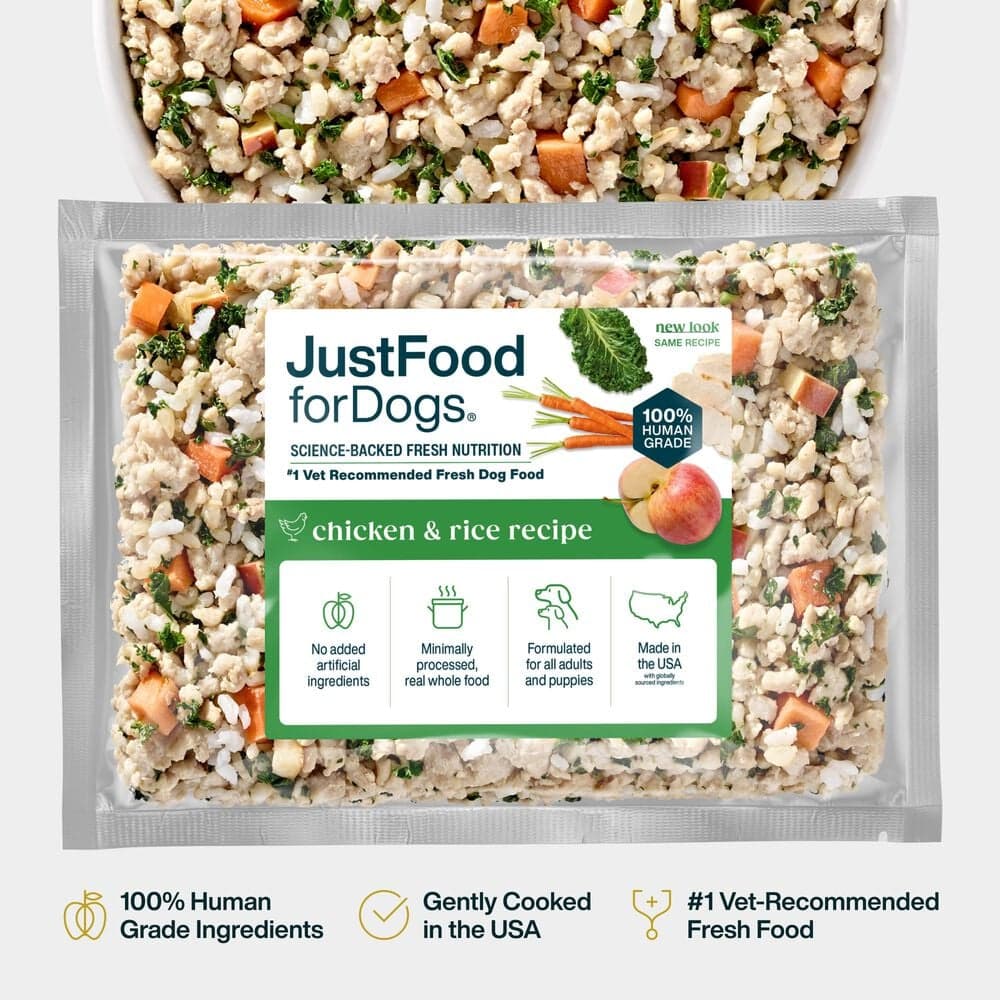
Use the exact recipe and feeding guidance when turning your dog’s calorie target into a measured portion.
- Enter your dog’s weight and activity
- Compare fresh-food feeding options
- Use your vet’s calorie target for medical needs
Petful may earn a commission when you click through to JustFoodForDogs, at no extra cost to you.
This label-reading scorecard works across formats because every complete food must still answer the same practical questions: adequacy, calories, nutrient delivery, tolerance, medical fit, and measurable portions. Fresh, wet, and dry foods may express serving information differently, but the veterinary decision does not change.
Everyday weight food vs veterinary metabolic diet
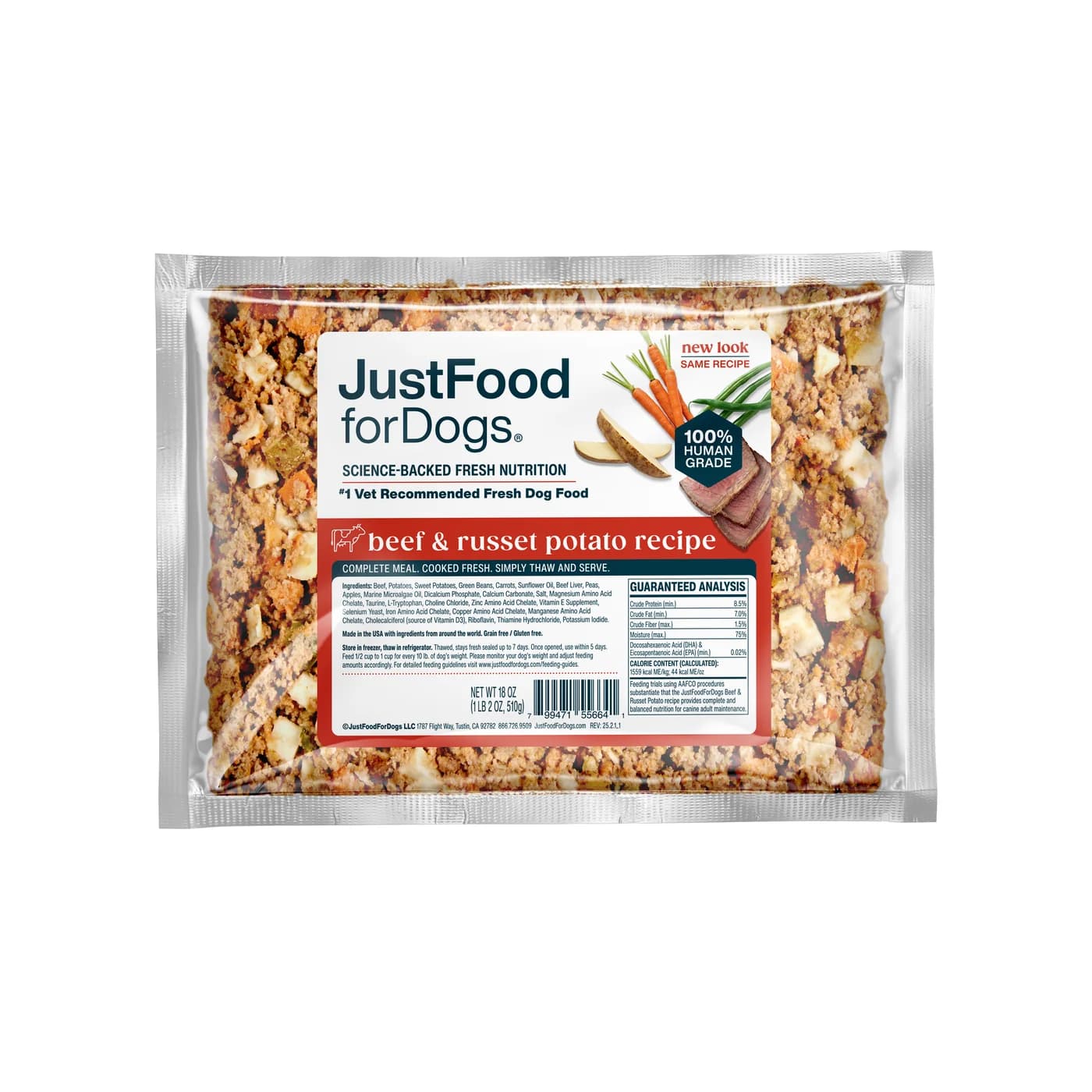
JustFoodForDogs offers two clearly differentiated weight-management paths. Healthy Weight is the everyday option, formulated to provide satisfying food volume at a lower calorie density, which can help bring total calories down or help a dog maintain a lean body condition. Use the current package or official feeding calculator for its latest calorie density and portion guidance.
Metabolic Support is the veterinarian-directed option, with a distinct role and approval process. It is made with ground turkey, oats, butternut squash, beef liver, and whole psyllium husk. Its controlled fat, added fiber, and complex carbohydrates are formulated to support satiety. Current product information lists 52 kcal per ounce and an as-fed crude-fat range of 5.5% minimum to 7% maximum.
Metabolic Support requires veterinarian information before shipping. It is moderate fat rather than ultra-low fat, so a dog with pancreatitis history or another diagnosed condition needs an individualized veterinary decision. It should not be treated as a universal upgrade from an everyday weight-management food.
- An everyday weight management dog food can make modest calorie control more practical for an otherwise healthy adult. A veterinary metabolic diet is selected when the clinician needs a therapeutic formulation, closer oversight, or a more structured satiety plan. The deciding factors are diagnosis, target calories, expected portion, nutrient intake at that portion, hunger, tolerance, and the monitoring schedule, not which package sounds more intensive.
Before choosing either route, verify the current calorie statement and calculate the amount the dog would actually eat. Then compare cost per day, storage, measuring method, meal volume, and caregiver adherence. A clinically suitable food that cannot be served consistently is not a workable plan, while an easy-to-serve food still must meet the dog's nutrient and medical needs.
Comparing retail and clinical options this way keeps the product role clear. The retail option supports an everyday calorie-control plan; the clinical option belongs to veterinarian-directed metabolic management. Neither category removes the need to count treats, preserve muscle, and recheck progress.
Use the exact recipe and feeding guidance when turning your dog’s calorie target into a measured portion.
- Explore the everyday Healthy Weight formula
- Fresh Frozen meals with portion guidance
- Compare the recipe with your vet’s feeding plan
Veterinary Metabolic Support is a separate diet.
Petful may earn a commission when you click through to JustFoodForDogs, at no extra cost to you.
- An everyday retail food and a veterinarian-directed clinical diet can both qualify in the right case, but they are not interchangeable categories.
| Situation | Starting conversation |
|---|---|
| Healthy adult needs fewer daily calories | Ask whether an everyday lower-calorie-density recipe such as Healthy Weight fits |
| Obesity plus a diagnosed medical issue | Ask whether a veterinarian-directed therapeutic plan is appropriate |
| History of pancreatitis or fat intolerance | Do not assume “metabolic” means sufficiently low fat; confirm the exact diet |
| Weight loss with declining muscle | Reassess calories, protein, disease, and rate of loss promptly |
- Unexpected gain, muscle loss, lethargy, excessive thirst, or medication-related appetite changes deserve veterinary review.
When an everyday weight food may be enough
An everyday lower-calorie-density food may fit when an otherwise healthy adult needs modest calorie control or help maintaining a lean condition. The veterinarian may recommend this route when the required portion remains nutritionally adequate and practical, hunger is manageable, and there is no condition calling for a therapeutic diet.
JustFoodForDogs Healthy Weight is the everyday fresh-food option featured in this guide. It is a complete recipe formulated for healthy weight support, not a treatment for obesity or an underlying disease. Use the current feeding calculator or package information for portioning because calorie values and guidance can change.
Everyday weight management still needs a written plan. Record the current food, daily calorie target, measured amount, allowed extras, activity goal, and recheck date. Without those controls, changing the label on the food may have little effect.
When a veterinary metabolic diet may be appropriate
A vet-directed diet may be considered when a dog needs more substantial calorie restriction, has repeatedly failed a well-measured plan, has a concurrent medical issue, or needs a formulation designed to support satiety during weight loss. The choice is based on the entire clinical picture, not a body weight cutoff.
JustFoodForDogs Metabolic Support requires veterinarian information before shipping. Current product information lists 52 kcal per ounce, controlled fat, added fiber, and complex carbohydrates. It should be used under veterinary direction, with a specific portion and monitoring schedule.
Veterinary oversight remains important after the food arrives. A therapeutic product is not a set-and-forget solution. Weight, body condition, muscle condition, appetite, stool, activity, and relevant medical findings determine whether the calorie target and food choice continue to fit.
Turn a calorie target into a measured portion
The portion calculation is straightforward once two verified numbers are available:
Daily amount = veterinarian-set daily calories ÷ calories per serving unit
If the food provides calories per ounce, the result is ounces per day. If the label provides calories per cup, the result is cups per day, though weighing the food can be more repeatable. Divide the daily amount among meals without adding calories.
- This is arithmetic, not a recommendation for any dog. The veterinarian must set the calorie target, and the current label must confirm the calorie density.
Petful’s vet-backed dog feeding chart explains resting energy calculations, life-stage factors, and food-label math in more detail.
Recalculate when the product, recipe, format, or calorie density changes. “One package” or “one cup” is not a universal nutritional unit. If two foods are mixed, calculate calories from each part and keep the daily total within the plan.
Treat calories without ending training or enrichment
Keeping extras to no more than about 10% of daily calories leaves most of the calorie budget for complete food. For a small dog, that allowance can be surprisingly small. Count each dental chew, spoonful used for medication, lick-mat ingredient, and family handout.
Training does not need to stop. Options include:
- reserving part of the measured meal for rewards;
- breaking approved treats into very small pieces;
- rewarding with play, sniffing, praise, or access to a favorite activity;
- using a portion of the meal in a puzzle feeder;
- choosing low-calorie produce approved by the veterinarian and counting it;
- creating one household treat container that represents the entire day’s allowance.
Do not add a “healthy” topper without counting it. Peanut butter, cheese, oil, meat scraps, and commercial toppers can be calorie dense. Even low-calorie vegetables can cause digestive upset or displace balanced food when used in large quantities.
Use the exact recipe and feeding guidance when turning your dog’s calorie target into a measured portion.
- Enter your dog’s weight and activity
- Compare fresh-food feeding options
- Use your vet’s calorie target for medical needs
Petful may earn a commission when you click through to JustFoodForDogs, at no extra cost to you.
Hunger, begging, and food-seeking behavior
Begging does not always mean the calorie target is inadequate. Dogs learn routines, respond to food cues, and may seek interaction rather than energy. Before increasing food, examine meal timing, enrichment, exercise, access to other food, and whether every caregiver follows the plan.
The veterinarian may suggest dividing the daily food into more meals, adding water when appropriate, using a puzzle feeder, or choosing a different complete formula with a more practical volume or fiber profile. Changes should preserve the daily calorie target unless the veterinary team revises it.
Sudden intense hunger, scavenging, thirst, urination, panting, or weight change can also be associated with disease or medication effects. Report a new appetite pattern rather than assuming it is a behavioral problem.
Activity and mobility are part of the plan
Food controls calorie intake, while appropriate activity supports fitness, mobility, enrichment, and lean tissue. The activity plan should match the dog’s orthopedic, heart, respiratory, neurologic, and general health.
A dog with arthritis may benefit from shorter controlled walks, rehabilitation exercises, or low-impact activity instead of abrupt strenuous exercise. A severely deconditioned dog needs gradual progression. Ask the veterinarian to define safe frequency, duration, surface, and intensity.
Non-food enrichment matters too. Sniff walks, training with reserved meal portions, search games, and appropriately chosen toys can replace some food-centered interaction. Activity calories should not be “eaten back” with larger portions unless the veterinary team changes the plan.
Calories, treats, body condition, and rechecks
Use the same scale and similar timing when possible. Day-to-day weight can shift with hydration, meals, and elimination, so the veterinarian sets a useful recheck interval and interprets the trend.
At home, record:
- date and body weight;
- measured food and total daily calories;
- treats and unplanned extras;
- appetite and food-seeking behavior;
- stool quality and digestive signs;
- activity and mobility;
- medication changes;
- photographs from the side and above at consistent intervals.
At the clinic, body-condition and muscle-condition scores add context. A slower-than-expected trend does not automatically call for a major food cut. First confirm measuring accuracy, hidden calories, and changes in activity or health. A faster-than-expected drop, weakness, muscle loss, or poor appetite requires prompt reassessment.
Calories, treats, body condition, and rechecks must be interpreted together. The question “What is the best brand of dog food for weight loss?” skips the evidence that determines success: verified calorie density, a measured serving, adequate nutrient intake, preserved muscle, and a trend the veterinarian considers safe. A weight management dog food earns its place by making those targets practical and repeatable, not by winning a name-recognition contest.
What to do when weight loss stalls
A plateau is information, not failure. Work through the plan in order:
- Reweigh the actual meal amount rather than relying on the written scoop size.
- Recount treats, chews, medication foods, table scraps, and food from other caregivers.
- Confirm the current calorie density for the exact recipe and format.
- Review activity, pain, mobility, and environmental changes.
- Check the weight and body-condition trend on the veterinary schedule.
- Ask whether medications or disease could be affecting appetite, metabolism, or movement.
- Let the veterinarian adjust calories or diet rather than making a severe cut at home.
If adherence is difficult because the portion looks too small or the dog is persistently hungry, a different complete formula may make the target easier to sustain. Long-term success depends on a plan the household can execute accurately.
Weight management for small dogs
Small dogs have small calorie budgets, so individual extras have a larger proportional effect. A dental chew or cheese cube that seems minor to a person can represent a substantial part of the day’s calories for a toy breed.
Use a gram scale, record every extra, and choose rewards that can be divided into tiny pieces. Store the daily allowance separately so all caregivers can see what remains. Do not use a large-breed feeding cup or visual comparison to judge a small dog’s meal.
The calorie target still depends on the individual dog, not breed size alone. Petful’s Yorkie food guide applies the same calorie-density and portion principles to a toy-breed context.
Weight management for senior dogs
Energy needs often change with age and activity, but senior dogs are not all alike. Some gain fat as movement decreases; others lose weight or muscle because of dental disease, reduced appetite, poor digestion, or another medical problem.
Do not assume that every older dog needs fewer calories. A nutrition assessment should separate excess body fat from muscle loss. The food and activity plan may need to protect muscle, accommodate dental comfort, and address disease while still controlling calories.
Unexpected weight loss in a senior dog is not a successful diet result. It requires veterinary evaluation, especially when accompanied by reduced appetite, vomiting, diarrhea, increased thirst, coughing, weakness, or behavior change.
Managing meals in a multi-dog household
Shared bowls and free-choice feeding make individual calorie control difficult. Feed dogs separately, measure each ration, remove bowls after the meal, and prevent access to unfinished food. Keep a visible daily checklist when more than one person feeds the dogs.
Different dogs may need different foods or calorie targets. Matching bowl colors, labeled containers, and separate feeding locations reduce mistakes. If one dog eats slowly, use a closed room or barrier so another dog cannot finish the meal.
Multi-dog treat routines also need structure. Prepare each dog’s daily allowance in separate containers. This avoids giving the weight-loss dog the same size reward as a much larger or more active housemate.
Maintaining weight after the goal is reached
Reaching the target condition ends the calorie-deficit phase, not the need for monitoring. The veterinarian can establish a maintenance calorie starting point and decide whether the dog should stay on the same food at a different portion or transition to another complete formula.
Increase calories in measured steps rather than returning to the pre-diet routine. Keep weighing food and counting treats while the new maintenance amount is tested. Recheck weight, body condition, and muscle condition on the schedule the clinic recommends.
The habits that produced success remain useful:
- one documented daily calorie allowance;
- weighed meals rather than visual estimates;
- a defined treat budget;
- separate feeding in multi-pet homes;
- activity suited to mobility and health;
- regular weight, body-condition, and muscle checks;
- early adjustment after a small upward trend.
Maintenance also needs a plan for holidays, boarding, travel, injury, and reduced activity. Give pet sitters the exact food and measured portions, and avoid sending an open-ended treat bag. Contact the veterinarian when an illness, medication, or activity restriction changes appetite or energy use. Dogs rebuilding weight after surgery or illness have the opposite problem; a high-calorie recovery feeding plan covers that side.
A troubleshooting matrix for common setbacks
| Setback | Check first | Appropriate next step |
|---|---|---|
| Dog is not losing | Weigh meals and recount every extra | Share the verified intake and weight trend with the veterinarian |
| Dog seems hungry | Meal timing, enrichment, formula volume, new medical signs | Ask about a more practical complete formula or feeding schedule |
| Weight is dropping quickly | Appetite, stool, muscle, medication, measurement accuracy | Contact the clinic before offering more or less food |
| Stool changed after the switch | Transition pace, treats, product, medical signs | Slow or stop only according to veterinary guidance and report persistent signs |
| Family cannot follow the plan | Scoops, shared treats, multiple feeders, unclear instructions | Use weighed pre-portions and one visible daily checklist |
| Dog steals another pet’s food | Bowl access and feeding location | Separate meals and remove unfinished food |
| Progress stalls after activity drops | Pain, mobility, exercise restriction, unchanged calories | Ask the veterinarian to revise both the movement and calorie plan |
This matrix keeps the response proportional. One flat week does not justify starvation, and one hungry evening does not prove the target is wrong. Confirm the data, identify the barrier, and make one measured change with the veterinary team.
Questions to ask before buying a weight-management food
Bring the exact product or label to the appointment and ask:
- Is this complete and balanced for my dog’s life stage?
- How many calories should my dog receive per day?
- How much of this exact food supplies that target?
- Does the formula support adequate protein and nutrient intake at the planned portion?
- Does the fat and fiber profile fit my dog’s medical and digestive history?
- What treats or toppers are allowed, and how many calories may they supply?
- How often should weight, body condition, and muscle be rechecked?
- What result or sign should trigger an earlier call?
A clear answer to those questions is more useful than a universal “best” list. It converts product selection into an executable plan and defines how the plan will be evaluated.
Compare two candidate foods side by side
When two foods both appear reasonable, compare the daily plan instead of comparing package claims. Write down each food's calorie density, the amount needed for the veterinary target, the expected meal volume, nutritional adequacy statement, protein and fiber information available from the manufacturer, and every relevant medical limitation. Include treats because a food that leaves no workable reward budget may be difficult for the household to sustain.
| Decision | Food A | Food B |
|---|---|---|
| Calories in the exact daily portion | Calculate from current label | Calculate from current label |
| Portion measured by weight | Record grams or ounces | Record grams or ounces |
| Complete-and-balanced statement | Verify life-stage fit | Verify life-stage fit |
| Protein and muscle plan | Review with veterinarian | Review with veterinarian |
| Fiber, stool, and satiety | Define what will be monitored | Define what will be monitored |
| Medical fit | List relevant diagnoses and medications | List relevant diagnoses and medications |
| Practical fit | Cost, storage, serving, acceptance | Cost, storage, serving, acceptance |
If the foods use different formats, compare calories per day rather than the apparent amount in the bowl. Wet or fresh food may look larger because of moisture, while dry food may pack more calories into a smaller volume. What is the best wet food for dogs to lose weight? It is a complete option that fits the veterinary calorie target, medical needs, and monitoring plan; “wet” alone does not establish that fit.
Choose one starting plan, document it, and avoid changing food, treats, and activity at the same time unless the veterinarian instructs you to. A clean baseline makes it easier to interpret weight, appetite, stool, and muscle changes at the recheck.
Portion control makes the food work
Use a gram scale when possible. Measuring cups vary with kibble shape and the person filling them; scoops and visual estimates drift even more. For fresh food, divide the veterinarian’s calorie target by the recipe’s current calories per ounce, then weigh or portion that amount consistently.
Keep all caregivers on the same plan. A simple refrigerator log prevents duplicate breakfasts and invisible snacks. If the dog seems hungry, ask about meal frequency, fiber tolerance, enrichment, and low-calorie rewards before simply adding food.
Recheck the plan instead of making large cuts at home. A plateau can reflect uncounted extras, inaccurate portions, reduced activity, or a calorie target that needs adjustment. It is not a reason to starve the dog.
Transition gradually and monitor tolerance
Unless the veterinarian recommends another schedule, transition over about 7 to 10 days:
- Days 1–3: 25% new food and 75% current food
- Days 4–6: 50% new and 50% current
- Days 7–9: 75% new and 25% current
- Around day 10: 100% new food
Slower transitions may suit dogs with sensitive digestion. Contact the veterinary team if vomiting, repeated diarrhea, refusal to eat, marked lethargy, abdominal pain, or rapid weight change occurs.
A simple weight-management check-in
At each recheck, bring the food label or product name, the measured daily amount, a treat list, and the home weight log. Ask four questions:
- Is the dog losing at an appropriate rate?
- Is muscle condition being preserved?
- Is the dog comfortable, active, and producing normal stool?
- Does the calorie target or food choice need to change?
The best plan is not the most restrictive one. It is the one that creates steady progress while the dog remains nourished, comfortable, and able to maintain lean tissue.
Frequently Asked Questions
There is no universal winner. The best food is complete and balanced for the dog’s life stage, fits the veterinarian-set calorie target in a practical portion, supports lean tissue, and is tolerated consistently. What's the best food to give a dog to lose weight? Start with the food that meets all of those requirements and can be measured accurately every day. The brand matters less than verified calories, medical fit, nutrient adequacy, portion control, treat accounting, and a scheduled veterinary recheck.
No. Fat level influences calories, but total calorie density and portion size determine daily intake. Medical history also matters, so compare the whole formula with veterinary guidance.
The veterinarian should set and monitor the rate based on the dog’s starting condition, muscle mass, and health. Rapid or unexpected loss requires reassessment.
Grain-free status does not determine calorie density or weight-loss suitability. Compare the complete formula, calories in the measured portion, nutritional adequacy, medical fit, and the dog’s response.
A modest measured adjustment may be appropriate, but substantial restriction can reduce intake of essential nutrients along with calories. Ask the veterinarian whether the current food remains suitable at the target portion or whether a weight-management formulation is a better fit.
Some veterinarian-approved vegetables can replace a portion of higher-calorie treats, but they should be counted and introduced carefully. Large amounts can upset digestion or displace complete food. They do not replace a balanced calorie plan.
Look at the pattern. Begging tied to routines or human meals may be learned behavior, while a sudden change in appetite can signal a medical or medication issue. Review enrichment and meal timing, then ask the veterinarian before increasing calories.
Meal frequency does not replace calorie control. Many dogs do well with the daily ration divided into two or more measured meals. The best schedule depends on medical needs, medications, household routine, and the dog’s comfort.
Bring the exact product name and label, measured daily amount, treat list, weight log, medication list, and notes about appetite, stool, mobility, and adherence. This lets the veterinary team adjust the real plan rather than an estimate.

Coreen Saito is a pet writer and longtime shelter volunteer with more than a decade in animal rescue. She covers cat behavior, breed care, and the small, ordinary science of sharing a life with companion animals, with a particular focus on honest takes about the products and decisions that actually matter. At home in Arizona, she's outranked by Mac (a dog with the loudest opinion in the house), Rebel (a cat who governs by quiet authority), and Meri (an orange tabby who runs the late shift and the laundry basket). She writes about all three, plus the rescues that keep coming through her life, at LifeWithMinty.com.
Sign up for expert-backed reviews and safety alerts all in one place.



A Final Word (Disclaimer)
At Petful, our review integrity is paramount; we never exchange special treatment in our reviews for monetary or material rewards.
Nonetheless, when our readers click through to online merchants (including Chewy or Amazon), we receive a referral commission. This supports the running of our free blog, and we appreciate your backing.