How Much Should You Feed Your Dog? A Vet-Backed Feeding Chart
Use a vet-backed feeding chart to estimate daily calories, measure the exact food, and adjust portions using body-condition feedback.
Petful is reader supported. As an affiliate of platforms like Amazon and Chewy, we may earn a commission when you buy through links on this page. There is no extra cost to you.
This article is sponsored by JustFoodForDogs. Petful maintains editorial control over its educational content and may earn a commission from qualifying purchases, at no extra cost to you.
If you are asking, "how much should I feed my dog," start with daily calorie needs and the calorie density of the specific food, not simply the dog's weight or a universal number of cups. A feeding chart can provide a useful starting point, but the final portion should be adjusted for life stage, activity, body condition, treats, and your veterinarian's guidance.
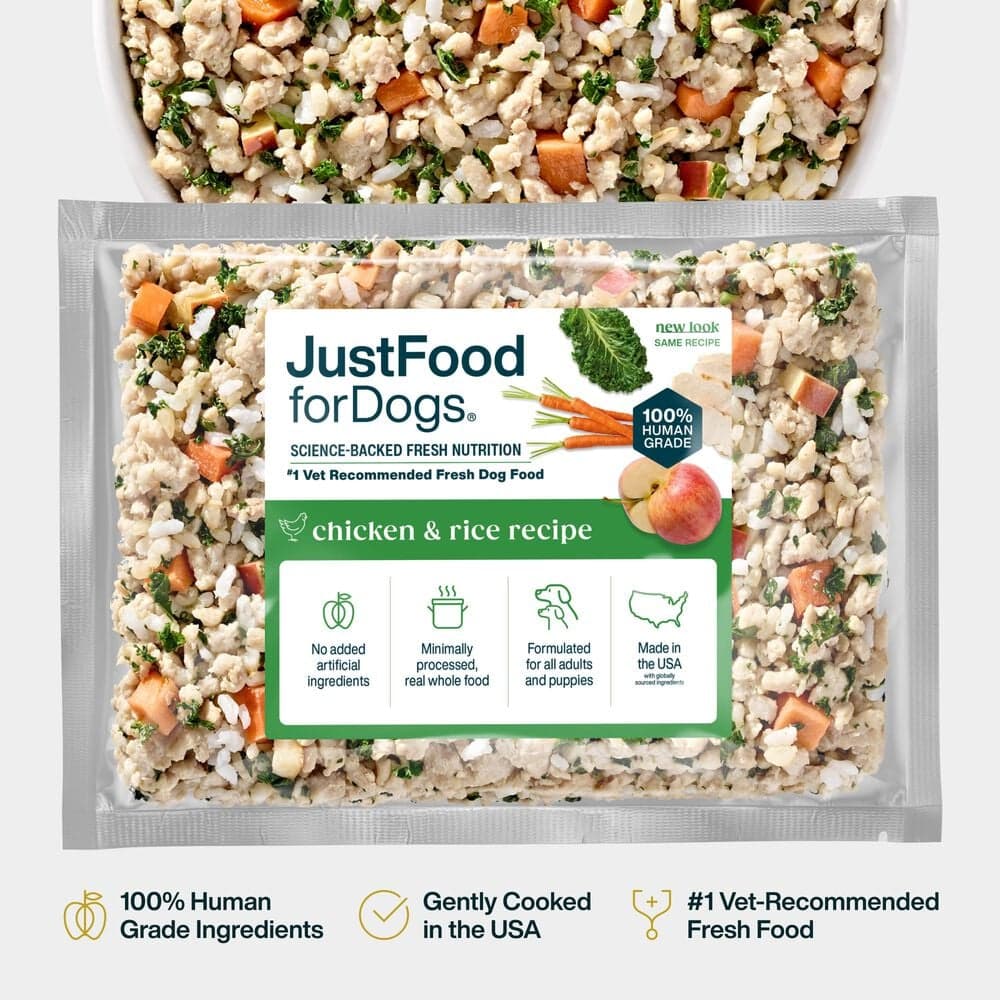
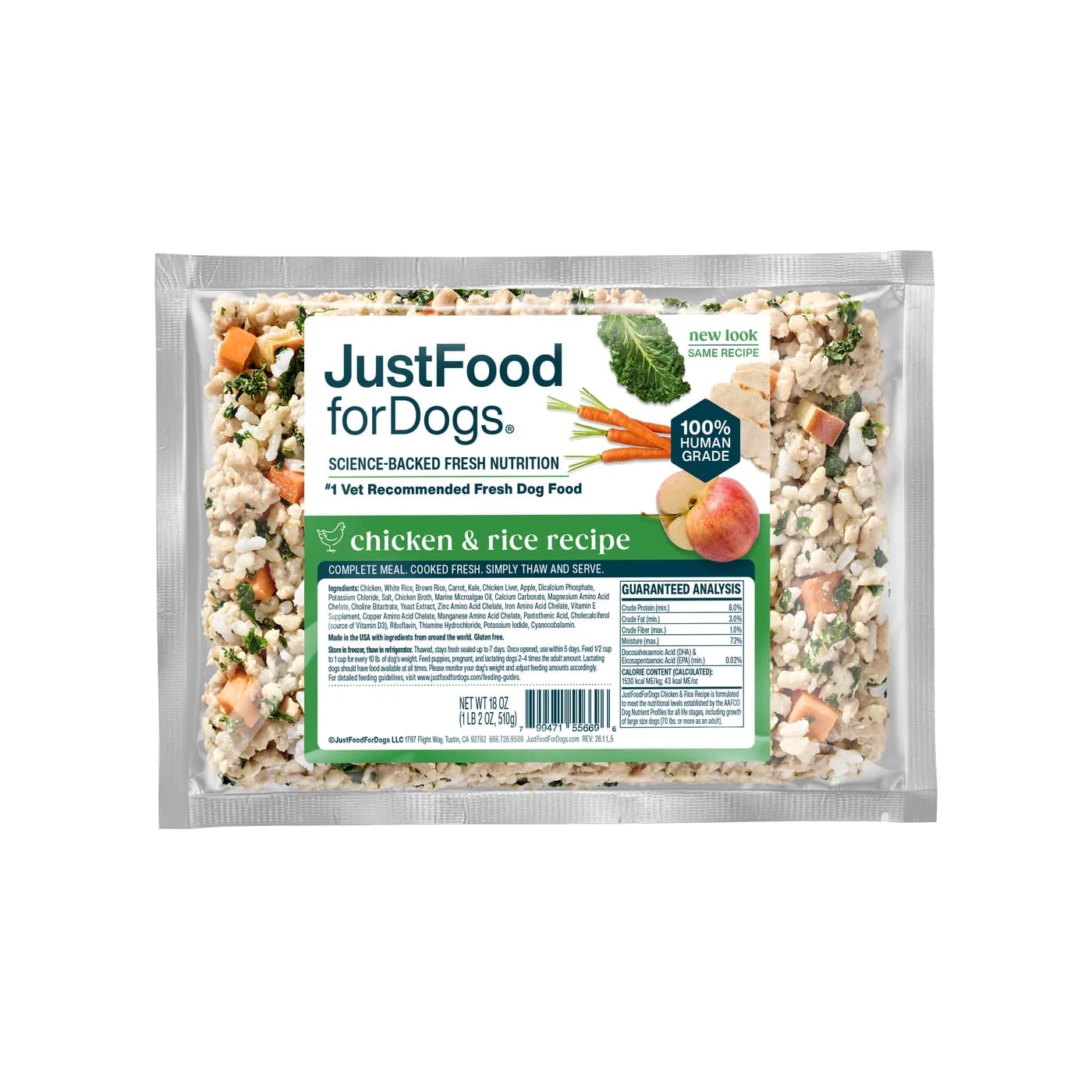
JustFoodForDogs makes this portioning process easier to see because its recipes provide calorie information by a measurable unit and the company offers a recipe-specific feeding calculator. The chart below uses Fresh Frozen Chicken & White Rice at 43 calories per ounce as a transparent example. If your dog's food has a different calorie density, the ounce amounts will be different even when the daily calorie target stays the same.
Set a daily calorie starting point, divide it by the exact food's calories per ounce or cup, and then adjust gradually according to your dog's weight and body condition.

Sign up for expert-backed reviews and safety alerts all in one place.
Vet-backed dog feeding chart by weight
These ranges are healthy-adult starting points, not prescriptions. The portion column converts the calorie range using 43 calories per ounce. Weigh food in ounces for the most direct match to the calculation.
| Adult dog weight | Daily calorie starting range | Example daily amount at 43 calories/oz |
|---|---|---|
| 10 lb | 260–350 kcal | 6–8 oz |
| 20 lb | 440–590 kcal | 10–14 oz |
| 30 lb | 600–790 kcal | 14–18 oz |
| 50 lb | 870–1,170 kcal | 20–27 oz |
| 70 lb | 1,120–1,500 kcal | 26–35 oz |
| 90 lb | 1,350–1,800 kcal | 31–42 oz |
The calorie ranges allow for meaningful differences among dogs of the same weight. A calm, neutered adult may begin nearer the lower end, while a more active dog may need more. Dogs can vary in energy needs by as much as 50%, so the chart is the beginning of the process rather than the final answer.
Do not apply this table unchanged to puppies, pregnant or nursing dogs, seniors losing weight or muscle, or dogs on a veterinary diet. Their targets should be individualized.
Is 2 cups a day enough for a dog? The chart cannot answer in cups until the exact food's calories per cup are known. A dog feeding chart supplies a calorie starting range; the food label supplies the conversion. That separation is the core safety feature. It lets two dogs at the same weight receive different measured portions when their life stage, body condition, activity, or recipe calorie density differs.
Turn the feeding chart’s calorie example into a starting portion for your dog’s actual recipe.
- Chicken with rice and whole-food ingredients
- Fresh Frozen recipe
- View the recipe and feeding guide
Petful may earn a commission when you click through to JustFoodForDogs, at no extra cost to you.
Why a feeding chart gives a range, not one answer
Body weight is only one input. Two healthy 30-pound dogs may need different amounts because one is young and active while the other is older, neutered, and sedentary. Coat, environment, work, recovery, and individual metabolism can also affect energy use.
The chart therefore answers a narrow question: what is a reasonable healthy-adult calorie starting range at this weight? It does not diagnose why a dog is gaining or losing, select a therapeutic diet, or replace the feeding directions for a growing puppy.
Use the range with three checkpoints:
- Choose a starting point. The veterinarian can place the dog within or outside the range based on life stage, body and muscle condition, activity, and health.
- Convert calories to the exact food. Use the current calorie statement for the recipe and format being served.
- Recheck the result. Weight trend, body condition, muscle condition, appetite, stool, and health determine whether the portion needs a measured adjustment.
A range also protects against false precision. A calculation that produces 742 calories does not prove that 742 is the dog’s exact biological requirement. It is a testable starting amount.
Turn calories into a recipe-specific portion
Package amounts can look inconsistent because different foods deliver different calories per ounce or cup. Use the calorie statement for the exact recipe you are feeding.
If you are asking “how much should I feed my dog,” use three verified numbers: the dog's daily calorie starting target, the exact food's calories per measurable unit, and the number of meals served. Divide the target by calories per ounce, gram, cup, can, or package, then divide the daily amount among meals. Recalculate whenever the recipe, format, target, or treat budget changes.
What is the 7 7 7 rule for dogs? There is no standard veterinary 7-7-7 feeding rule that replaces calorie and body-condition assessment. Do not apply a social-media ratio or schedule without knowing what its numbers mean. The transparent method is calorie target divided by the exact food's calorie density, followed by measured monitoring.
The portion formula
Daily portion = daily calorie target ÷ calories per unit of food
If an adult dog's starting target is 700 calories per day and the food contains 43 calories per ounce:
700 ÷ 43 = about 16.3 ounces per day
- If feeding twice daily, each meal would begin at about 8.2 ounces. Weighing the food is more repeatable than estimating a partial cup.
Why the exact recipe matters
A practical advantage of the JustFoodForDogs lineup is that each recipe's calorie density can be used to calculate a specific starting portion instead of relying on a generic cup count:
| Product line and recipe | Calories per ounce |
|---|---|
| Fresh Frozen Turkey & Whole Wheat Macaroni | 49 |
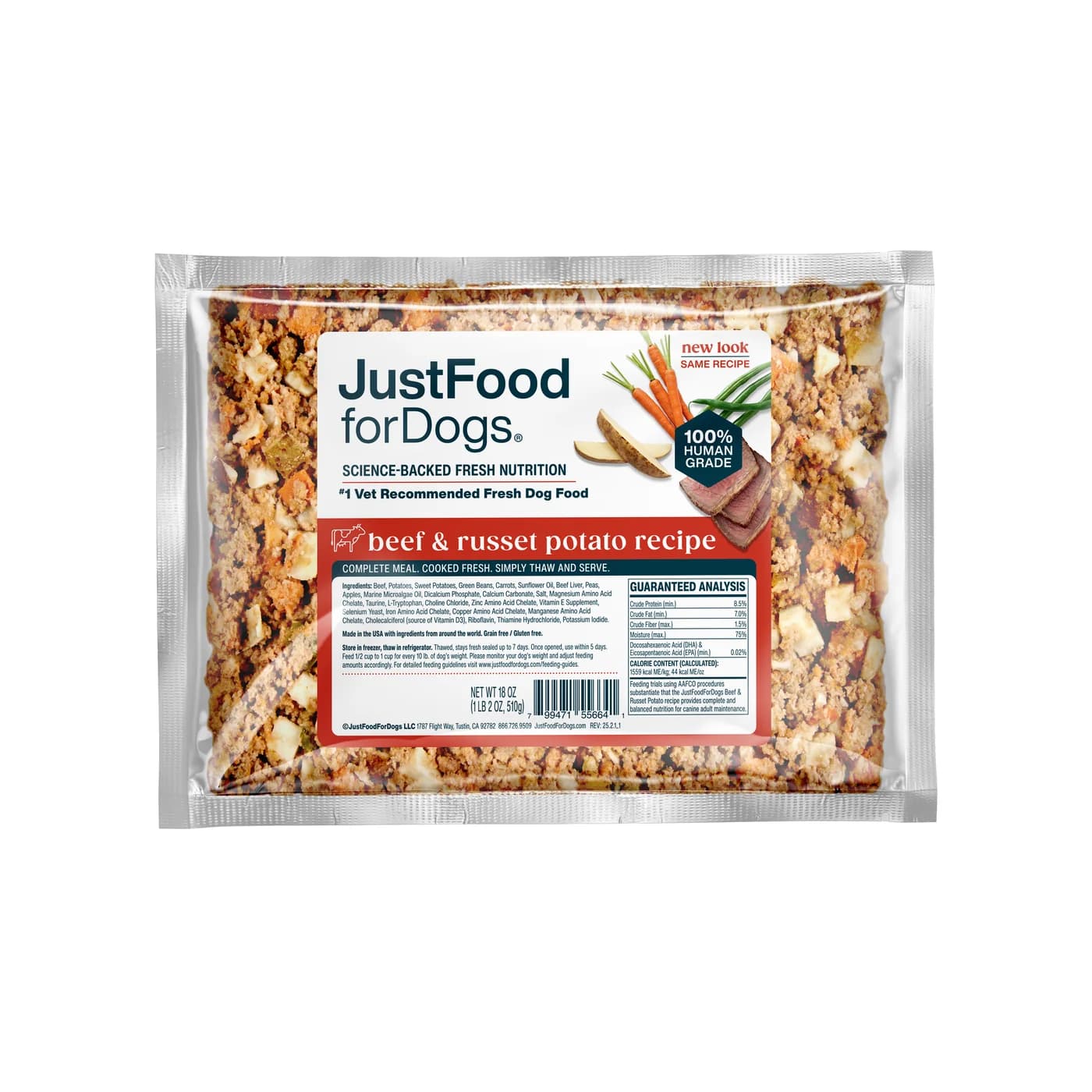
| Fresh Frozen Beef & Russet Potato | 44 |
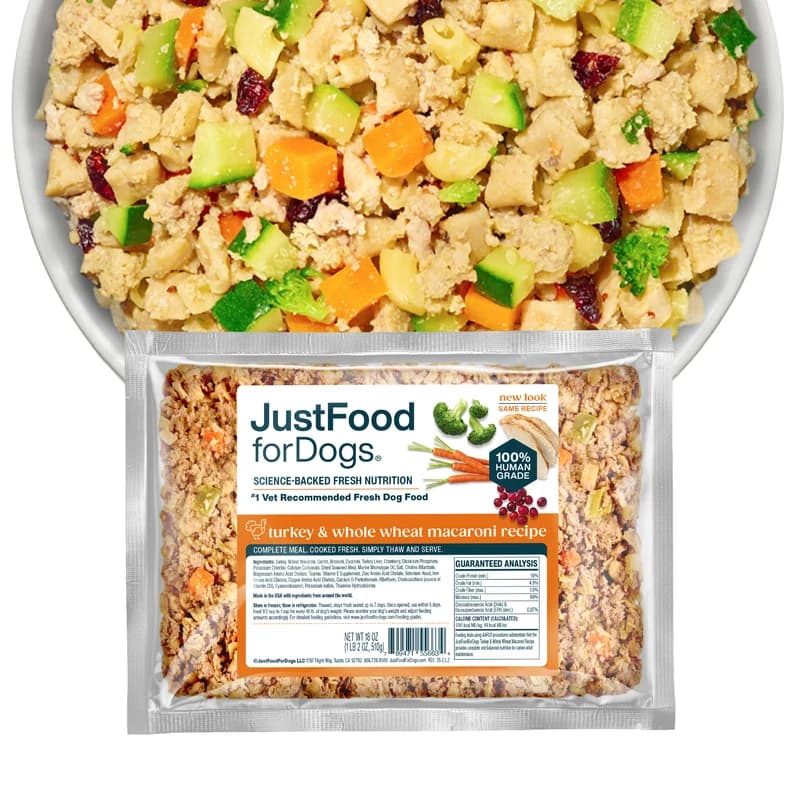
| Fresh Frozen Chicken & White Rice | 43 |
| Fresh Frozen Lamb & Brown Rice | 42 |
| Fresh Frozen Fish & Sweet Potato | 26 |
| Fresh Frozen Venison & Squash | 25 |
| Pantry Fresh Lamb & Brown Rice | 38 |
| Pantry Fresh Beef & Russet Potato | 36 |
| Pantry Fresh Turkey & Whole Wheat Macaroni | 35 |
| Pantry Fresh Chicken & White Rice | 31 |
| JustFresh Beef | 46 |
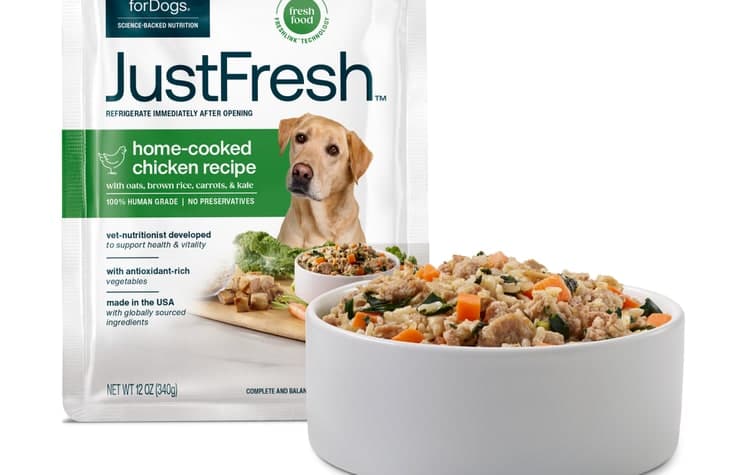
| JustFresh Chicken | 36 |
| JustFresh Pork | 35 |
| JustFresh Turkey | 34 |
At a target of 700 calories, a 49-calorie-per-ounce recipe would start near 14.3 ounces daily, while a 25-calorie-per-ounce recipe would start near 28 ounces. That does not make one food “better” than the other; it shows why ounces are meaningful only when paired with calorie density. This recipe-level transparency lets families compare formats and measure fresh food precisely while keeping the veterinarian-set calorie target consistent.
You can also use the official JustFoodForDogs dog food calculator as a product-specific starting point, then monitor your dog's response.
Three worked portion examples
The examples below use the same 700-calorie starting target to isolate the effect of calorie density. They are arithmetic demonstrations, not feeding recommendations for a particular dog.
| Example recipe | Verified campaign calorie density | Calculation | Starting daily amount |
|---|---|---|---|
| Fresh Frozen Turkey & Whole Wheat Macaroni | 49 kcal/oz | 700 ÷ 49 | About 14.3 oz |
| Fresh Frozen Chicken & White Rice | 43 kcal/oz | 700 ÷ 43 | About 16.3 oz |
| Fresh Frozen Fish & Sweet Potato | 26 kcal/oz | 700 ÷ 26 | About 26.9 oz |
The lower-calorie-density food produces a larger ounce portion for the same calorie target. That difference may be useful for some dogs, but it does not make the recipe universally better. Ingredients, life-stage adequacy, medical fit, tolerance, storage, and cost still matter.
If two recipes are mixed, calculate each portion separately. For example, a 700-calorie day split evenly by calories would provide 350 calories from each recipe, not necessarily equal ounces of each. Divide 350 by each recipe’s calorie density, then measure the two amounts.
Recalculate whenever the recipe or format changes. Pantry Fresh and Fresh Frozen versions with the same flavor name can have different calorie densities.
How to find calorie information on dog food
Look for a calorie-content statement on the label or the manufacturer’s current product information. It may list kilocalories per kilogram and per familiar unit such as cup, can, tray, package, or ounce.
Turn the feeding chart’s calorie example into a starting portion for your dog’s actual recipe.
- Enter your dog’s weight and activity
- Compare fresh-food feeding options
- Use your vet’s calorie target for medical needs
Petful may earn a commission when you click through to JustFoodForDogs, at no extra cost to you.
Use the unit that can be measured consistently:
- Dry food: calories per cup can set the starting amount, but weighing the portion in grams is often more repeatable.
- Fresh or refrigerated food: calories per ounce or gram allow direct scale measurement.
- Canned food: calories per can plus the can’s net weight can be used for whole or partial cans.
- Mixed feeding: convert each food separately and add the calories, not the serving volumes.
Do not use the guaranteed analysis to calculate calories unless a veterinary professional is doing a full formulation. Protein, fat, fiber, and moisture percentages do not translate directly into a household portion without more information.
Package feeding directions remain a useful starting reference, but they are designed for a range of dogs. Compare them with the veterinary calorie target and adjust from observed body condition rather than assuming the package amount is exact.
Estimate a healthy adult dog calorie starting point
Veterinary calorie estimates commonly begin with resting energy requirement, or RER:
RER = 70 × body weight in kilograms^0.75
RER estimates the energy used for basic body functions at rest. It is not usually the final daily feeding target. A life-stage factor is applied to account for maintenance, activity, growth, reproduction, or another condition. Your veterinarian can choose the appropriate factor and refine the result.
- The formula is most useful for understanding why weight alone cannot provide one exact portion and why a veterinarian may give a different target.
How much food should I feed my dog? The chart provides a daily calorie starting point, while the label converts that target into food. Find calories per cup or ounce for the exact recipe, divide the daily target by that number, and measure the result. How much food should I feed my dog chart results must then be checked against weight, body condition, muscle condition, activity, treats, and health.
Turn the feeding chart’s calorie example into a starting portion for your dog’s actual recipe.
- Chicken with rice and whole-food ingredients
- Fresh Frozen recipe
- View the recipe and feeding guide
Petful may earn a commission when you click through to JustFoodForDogs, at no extra cost to you.
Daily calorie needs can move in either direction as life stage, reproductive status, workload, recovery, medications, and body condition change. Treat the first calculation as a measured trial. Keep the food and extras consistent long enough to interpret the trend, and ask the veterinary team for the recheck interval and size of any adjustment.
Convert pounds to kilograms first
RER uses kilograms. Divide body weight in pounds by 2.2 before applying the formula. A 22-pound dog weighs about 10 kilograms. The RER calculation for that dog is approximately 70 × 10^0.75, or about 394 calories at rest.
That is not yet the maintenance portion. The veterinary team applies an appropriate factor and clinical judgment to estimate the full daily requirement. Using RER alone as the daily allowance can underfeed a healthy dog.
Why life-stage factors matter
Growth, pregnancy, nursing, work, recovery, neuter status, and activity change energy needs. A puppy needs calories and nutrients for tissue growth, not merely a scaled-down adult meal. A nursing dog may have markedly increased needs. A less-active adult may require fewer calories than an intact, highly active dog at the same weight.
The factor should fit the dog’s real condition rather than a preferred label. “Active” should describe sustained energy expenditure, not a dog who enjoys a short daily walk. When uncertain, start with veterinary guidance and let the weight and body-condition trend refine the estimate.
Feeding by body condition, not breed averages
Breed charts can describe common weight ranges, but they cannot identify an individual dog’s ideal condition. A compact, muscular dog and a lightly built dog may both be healthy at different weights.
On a dog near ideal condition, the ribs should be easy to feel under a light fat covering, a waist should be visible from above, and the abdomen should tuck behind the rib cage when viewed from the side. Thick coats and breed shape can obscure visual cues, so hands-on assessment matters.
Muscle condition is separate. Check the temples, shoulder blades, spine, and pelvis for muscle loss, especially in senior dogs. A dog can have excess body fat and reduced muscle at the same time. Cutting calories aggressively without recognizing muscle loss can worsen the wrong problem.
- Photographs from the side and above, taken in the same stance and lighting, can help track gradual changes between visits.
Portions for puppies
The adult chart should not be used as a puppy feeding plan. Growing dogs need a complete food formulated for growth and enough energy to support controlled development. Large-breed puppies also require attention to growth rate and mineral balance.
Puppies are commonly fed more frequently because of their smaller stomachs and growth demands. JustFoodForDogs feeding guidance uses four meals daily through about four months, three meals daily through about six months, and about two meals daily after that. A veterinarian may recommend a different schedule for a toy-breed puppy, a large-breed puppy, or a puppy with a health concern.
Monitor growth and body condition rather than trying to make a puppy grow as quickly as possible. Rapid growth is not the goal. Bring the exact food, measured daily amount, treat intake, and weight history to puppy visits so the plan can be adjusted.
Portions for senior dogs
Age does not create one senior calorie factor. Many dogs become less active and need fewer calories, while others lose weight or muscle because of dental disease, chronic illness, poor appetite, or reduced digestion.
An older dog who is gaining fat may need a lower calorie intake and an activity plan that fits mobility. An older dog who is losing weight needs evaluation before the bowl is simply made larger. The veterinarian may review dental comfort, medications, laboratory findings, muscle condition, and the food’s digestibility and nutrient profile.
Turn the feeding chart’s calorie example into a starting portion for your dog’s actual recipe.
- Enter your dog’s weight and activity
- Compare fresh-food feeding options
- Use your vet’s calorie target for medical needs
Petful may earn a commission when you click through to JustFoodForDogs, at no extra cost to you.
Weigh senior dogs regularly and report reduced appetite, swallowing difficulty, vomiting, diarrhea, increased thirst or urination, weakness, or unexplained weight change.
Portions for spayed or neutered dogs
Energy needs can change after spaying or neutering, but the amount varies. Do not reduce food by an arbitrary percentage on the day of surgery. Keep the recovery instructions and appetite in view, then monitor weight and body condition as normal activity resumes. For dogs that need to regain weight afterward, high-calorie feeding during recovery works differently from maintenance portioning.
If the dog begins gaining, verify the measured meal and all extras before changing foods. A smaller portion, a lower-calorie-density complete food, or an activity adjustment may be appropriate. The veterinary team can help preserve adequate nutrient intake while calories are controlled.
Portions for active and working dogs
Dogs performing sustained work may need more calories than household maintenance ranges suggest. Work type, duration, intensity, climate, conditioning, and season matter. Calorie needs can also change across training and rest days.
Increase intake in measured steps and monitor weight, body and muscle condition, recovery, stool, and performance. Avoid making a large meal change immediately before intense activity. A veterinarian familiar with the dog’s work can guide meal timing and diet selection.
Portions for weight loss or weight gain
Intentional weight change should begin with a health assessment. For weight loss, the veterinarian sets a target that creates a controlled calorie deficit while protecting nutrient intake and muscle. For weight gain, the team should identify why the dog is thin or losing weight before recommending more calories.
Petful’s guide to dog food for weight management explains calorie density, protein, fiber, treats, and the difference between an everyday weight food and a veterinarian-directed metabolic diet.
Do not create rapid change by making severe cuts or adding large amounts of fatty human food. Both approaches can cause problems and can hide an underlying disease.
- Include calories from treats and toppers, recheck weight and body condition consistently, and contact your veterinarian if the dog is gaining or losing unexpectedly.
Use body condition to fine-tune the portion
A healthy target is about more than the number on the scale. Dogs of the same weight can have different frames and muscle mass. Body condition helps show whether energy intake is supporting an appropriate amount of body fat.
Look for a visible waist from above and an abdominal tuck from the side. You should be able to feel the ribs with a light covering rather than pressing through a thick layer. Breed, coat, age, and build affect what you can see, so ask your veterinary team to demonstrate body-condition scoring on your dog.
If weight and body condition trend upward, reduce total calories gradually. If they trend downward in a dog who should maintain weight, increase gradually and rule out medical causes. Keep the food type, treats, and measuring method consistent while evaluating the change.
Count treats and toppers
Treats, chews, table food, and toppers all contribute calories. A practical ceiling is to keep treats and extras to no more than about 10% of daily calories so most nutrition still comes from the complete and balanced diet.
For a dog eating 700 calories daily, that means roughly 70 calories from treats and about 630 from the primary food. If you do not subtract those calories, extras can quietly turn a maintenance portion into a weight-gain portion.
Create a daily treat allowance instead of counting from memory. Place that amount in one container each morning so everyone in the household uses the same supply. A portion of the measured meal can be reserved for training or puzzle toys.
- Cheese, peanut butter, deli meat, pill wraps, dental chews, and lick mats may be small in volume but substantial in calories. Check labels and use the smallest practical amount approved for the dog.
Toppers can also dilute the nutrient balance when they displace a meaningful amount of complete food. “Fresh” or “healthy” does not make an extra calorie-free or nutritionally complete.
Do dogs need to eat twice a day?
Do dogs need to eat twice a day? Many healthy adult dogs are fed about twice daily. Meal timing can support a predictable routine and makes it easier to divide the daily calorie allowance. Your veterinarian may recommend a different schedule for an individual dog.
Puppies need more frequent feeding while growing. JustFoodForDogs feeding guidance uses four meals daily through about four months, three meals daily through about six months, and then approximately two meals daily. Puppies also need a growth-appropriate complete diet and individualized calorie guidance; do not use the adult maintenance chart as their plan.
The daily total matters more than simply increasing the number of meals. If 700 calories are divided into two meals, each starts at 350 calories; if divided into three, each starts near 233 calories. Extra meals should not become extra daily calories.
- Diabetes management, medications, gastrointestinal disease, and recovery may require specific timing. Follow the treating veterinarian’s instructions instead of moving meals based on convenience.
Make the plan consistent across the household
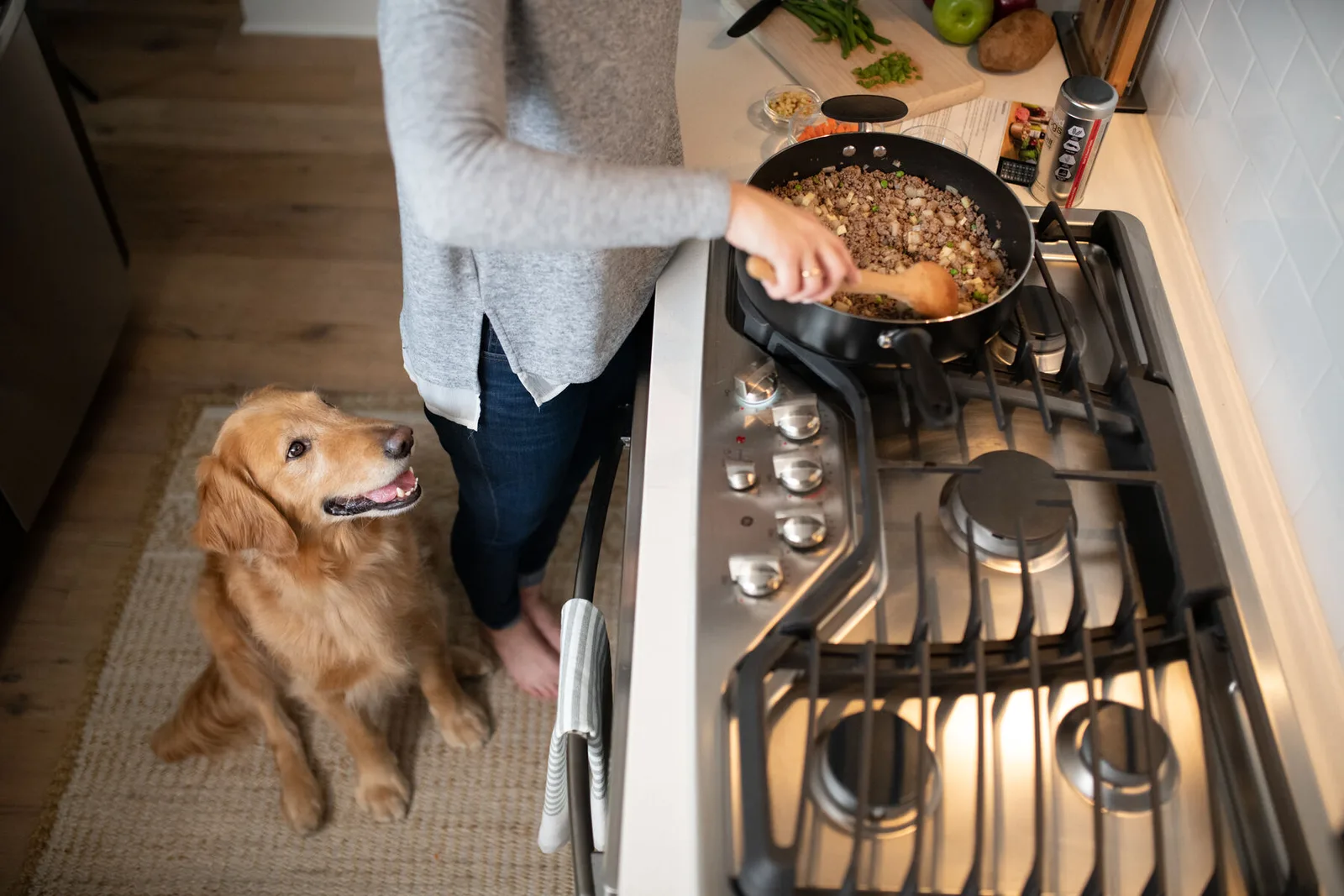
Feeding errors often come from duplicated meals and invisible extras. Write down the exact product, measured amount per meal, meal times, treat allowance, and who fed the dog.
For multi-dog homes:
- feed dogs separately when portions or foods differ;
- remove unfinished bowls after the meal;
- prevent access to another pet’s food;
- label food containers and scoops;
- keep separate daily treat allowances;
- record medication foods and training rewards.
Do not leave one dog’s prescription or calorie-controlled food where another can eat it. A simple refrigerator checklist can prevent two breakfasts and show the veterinary team how closely the plan was followed.
A two-week portion check
Unless the veterinarian sets another interval, establish a consistent observation period before making repeated small changes. Record the measured portion, treats, appetite, stool, activity, and any unplanned food. Weigh the dog under similar conditions when possible.
At the review point, ask:
- Is weight moving in the intended direction?
- Does body condition look and feel appropriate?
- Is muscle condition stable?
- Is the dog eating comfortably and producing normal stool?
- Did the household measure accurately and count extras?
- Has health, medication, or activity changed?
Adjust one variable at a time with veterinary guidance. Changing food, portion, treats, and exercise simultaneously makes it difficult to understand the result.
Transition to a new food gradually
Unless your veterinarian advises otherwise, transition over about seven to 10 days. A simple schedule is:
- Days 1–3: 25% new food and 75% current food
- Days 4–6: 50% new food and 50% current food
- Days 7–9: 75% new food and 25% current food
- Day 10 onward: 100% new food
Some dogs need a slower transition. Pause and contact your veterinarian if vomiting, persistent diarrhea, marked appetite changes, or another concerning sign develops.
Signs your dog's portion needs adjusting
Mealtime enthusiasm is not a reliable calorie meter. Some dogs continue to seek food after meeting their energy needs, while illness can reduce appetite even when the offered portion is appropriate.
How do I know if my dog is hungry? Look for a sustained pattern rather than one request for food. Compare measured intake with weight, body condition, activity, and health. Sudden intense hunger, especially with weight loss, increased thirst, or increased urination, deserves veterinary assessment instead of an automatic portion increase.
Use a combination of evidence:
- Body weight measured under similar conditions
- Body-condition score and waistline
- Muscle condition, especially in older dogs
- Activity level and stamina
- Stool quality and digestive comfort
- The measured calories from meals, treats, and toppers
Seek veterinary help for rapid or unexplained weight change, persistent hunger with weight loss, reduced appetite, vomiting or diarrhea, increased thirst or urination, weakness, or loss of muscle. Those changes should not be managed by adjusting food alone.
For a broader explanation of body condition and calorie control, read Petful's obesity in dogs guide.
Do dogs stop eating when full?
Some dogs stop when satisfied, but many will continue eating highly palatable food or accept treats after meeting their energy needs. Others may stop because of nausea, pain, dental disease, stress, or illness.
Appetite alone cannot distinguish adequate calories from overfeeding or a medical problem. Use measured portions, track weight and body condition, and investigate meaningful appetite changes with the veterinary team.
Dog feeding questions
There is no universal answer because cups do not contain a fixed number of calories. Find the exact food's calories per cup, determine the dog's daily calorie starting point, and divide. Two cups could be too little, appropriate, or too much depending on the food and the dog. So, is 2 cups a day enough for a dog? Only the calorie calculation and the dog's response can tell. Record the grams or ounces in those two cups, count all treats and toppers, and recheck weight and body condition rather than assuming a round cup number is correct.
For healthy adult maintenance, the chart gives a starting range of about 440–590 calories daily. At 43 calories per ounce, that is roughly 10–14 ounces per day. Adjust for the exact food, body condition, activity, treats, and veterinary guidance.
Many healthy adults do well with two meals, but there is no single schedule for every dog. Puppies usually need more frequent meals, and medical conditions may require a veterinarian-directed schedule.
Some do, but appetite behavior is not a dependable portioning system. Measured calories, body weight, and body condition provide better feedback. Do dogs stop eating when full? Many dogs will continue eating highly palatable food or accept treats after meeting their energy needs. Others may stop because of nausea, pain, dental disease, stress, or illness. Appetite alone cannot distinguish adequate calories from overfeeding or a medical problem, so use measured portions and investigate meaningful appetite changes.
Divide the dog’s daily calorie target by the exact food’s calories per ounce. The result changes when either number changes. Do not use ounces from another recipe without recalculating.
The conversion depends on the weight of one level cup of that exact food. Use the manufacturer’s gram-per-cup information when available or weigh a carefully leveled cup several times. Once the daily amount is set, feeding by grams is more repeatable.
That depends on whether the dog should maintain, lose, gain, grow, or recover. Ask the veterinarian to set the calorie target rather than choosing a package row without context.
Sustained work can increase energy needs, but casual activity labels are imprecise. Track body and muscle condition and let the veterinary team adjust calories to the dog’s actual workload and response.
Call for rapid or unexplained weight change, refusal to eat, repeated vomiting or diarrhea, weakness, increased thirst or urination, difficulty chewing or swallowing, loss of muscle, or persistent hunger with weight loss.

Coreen Saito is a pet writer and longtime shelter volunteer with more than a decade in animal rescue. She covers cat behavior, breed care, and the small, ordinary science of sharing a life with companion animals, with a particular focus on honest takes about the products and decisions that actually matter. At home in Arizona, she's outranked by Mac (a dog with the loudest opinion in the house), Rebel (a cat who governs by quiet authority), and Meri (an orange tabby who runs the late shift and the laundry basket). She writes about all three, plus the rescues that keep coming through her life, at LifeWithMinty.com.
Sign up for expert-backed reviews and safety alerts all in one place.


A Final Word (Disclaimer)
At Petful, our review integrity is paramount; we never exchange special treatment in our reviews for monetary or material rewards.
Nonetheless, when our readers click through to online merchants (including Chewy or Amazon), we receive a referral commission. This supports the running of our free blog, and we appreciate your backing.