Wellness Dog Food Review: Is Complete Health Good for Dogs?
Wellness dog food review: Complete Health Chicken & Oatmeal earns 7.8/10 for guaranteed probiotics and complete adult nutrition, plus honest caveats.

BVMS, MRCVS
Veterinarian · BVMS, MRCVS
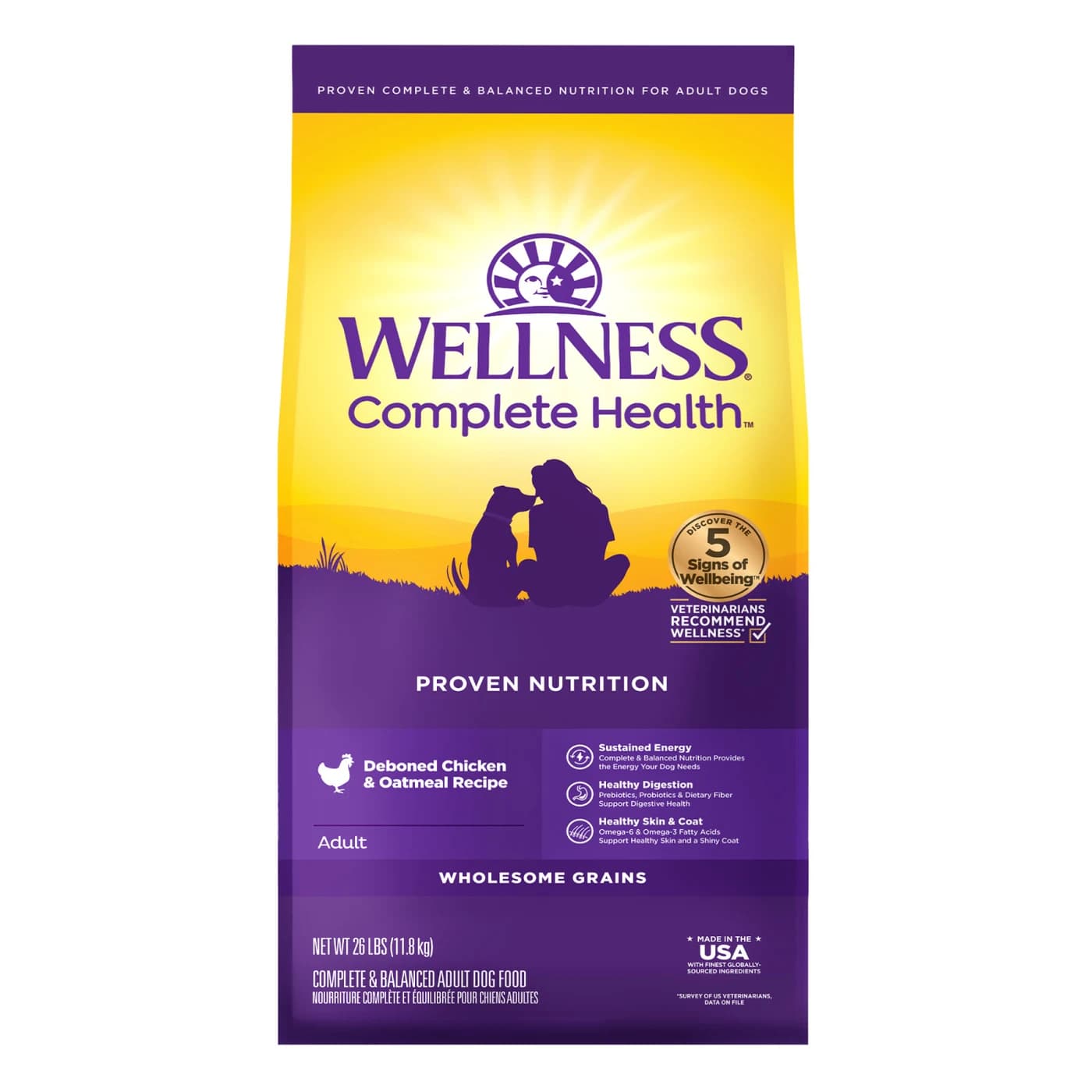
Wellness
Complete Health Adult Deboned Chicken & Oatmeal
The sensible middle of the premium aisle: chicken and chicken meal lead a grain-inclusive deck, and the panel guarantees probiotics, taurine, glucosamine and omegas that most rivals only imply. Watch the 427 kcal/cup calorie density and the vague sourcing story. 7.8/10.
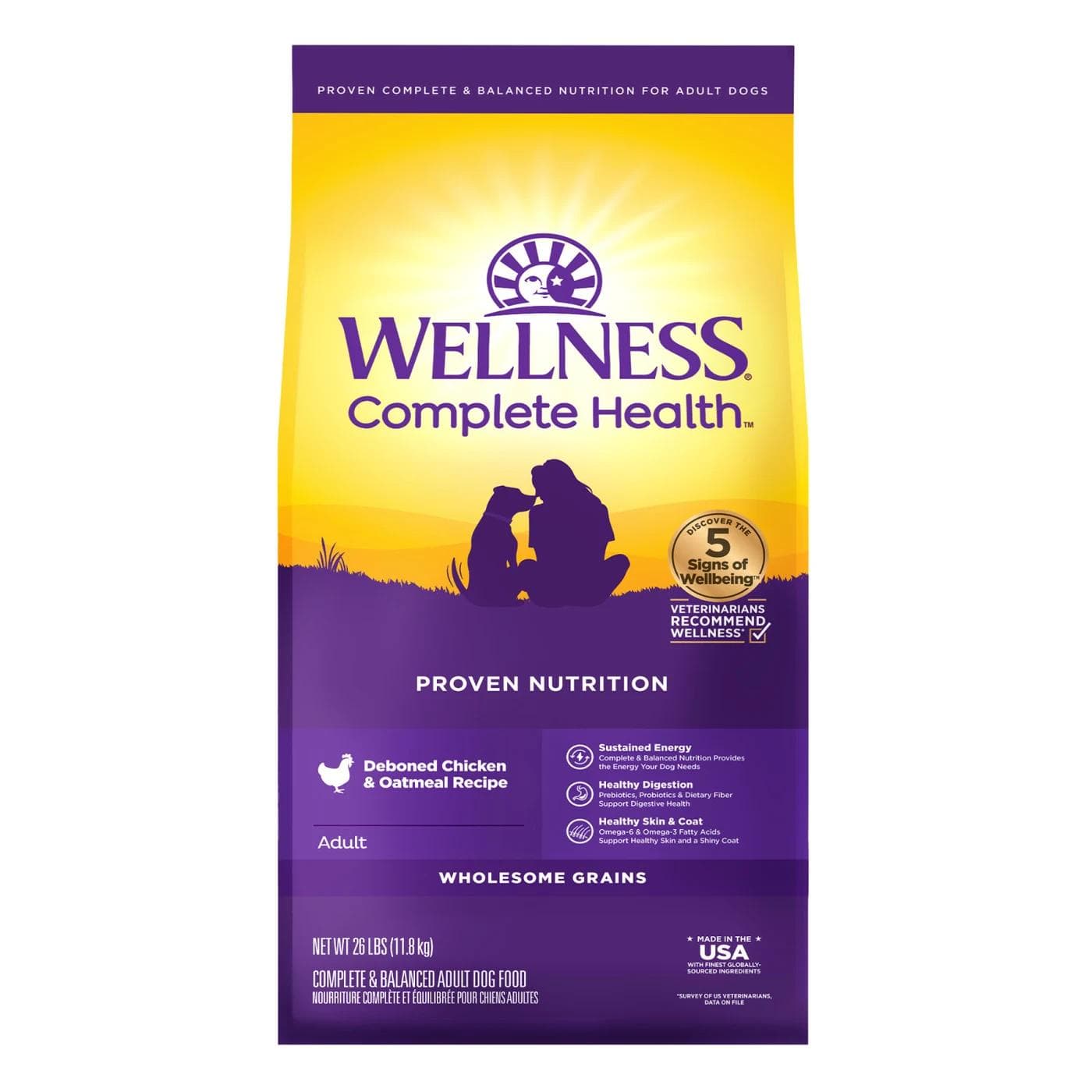
Deboned chicken and whole grains with guaranteed probiotics, taurine, and omegas. The sensible middle of the premium aisle for everyday adult dogs.
Petful may earn a commission when you click through to Chewy, at no extra cost to you.
Petful is reader supported. As an affiliate of platforms like Amazon and Chewy, we may earn a commission when you buy through links on this page.
Quick Verdict
The sensible middle of the premium aisle: chicken and chicken meal lead a grain-inclusive deck, and the panel guarantees probiotics, taurine, glucosamine and omegas that most rivals only imply. Watch the 427 kcal/cup calorie density and the vague sourcing story. 7.8/10.
Score Breakdown
Tap any (i) for sourcesPros
- Healthy adult dogs of any breed size whose owners want premium ingredients at a mid-tier price
- Dogs that need digestive support, with guaranteed probiotics plus prebiotic chicory root and beet pulp
- Dull-coated dogs: salmon meal, salmon oil and flaxseed back a guaranteed 4:1 omega-6 to omega-3 ratio
- Owners moving away from grain-free who still want to avoid corn, wheat and soy
Cons
- You have a puppy or a pregnant or nursing dog; this is an adult-maintenance formula only
- Your dog is chicken-sensitive; chicken, chicken meal and chicken fat anchor the recipe
- Your dog gains weight easily and you free-feed; 427 kcal/cup punishes sloppy portions
- You require plant-level sourcing transparency or AAFCO feeding-trial proof before you buy
- Your vet has prescribed a therapeutic diet such as low-fat or renal; this is not one
- 1Complete Health Chicken & Oatmeal is a complete adult-maintenance kibble that guarantees probiotics (20,000,000 CFU/lb), taurine, glucosamine and omega fatty acids on its panel.
- 2Ingredient quality is honest but not elite: deboned chicken, chicken meal and salmon meal lead, while dried yeast and peas sit ahead of the namesake oatmeal.
- 3At 427 kcal/cup it runs denser than most grain-inclusive rivals, so measure portions or a healthy dog gains weight quietly.
- 4At $2.31 to $2.34 per pound in large bags it undercuts Hill's, and its recall sheet is short for a 25-year-old brand: three dog-food recalls, none since 2017.
Wellness Complete Health Adult Deboned Chicken & Oatmeal earns a 7.8/10 from us: a genuinely complete adult kibble that puts guaranteed probiotics, taurine and glucosamine on its panel, prices its big bags near $2.31 to $2.34 per pound, and asks you to forgive two honest flaws. It is the sensible middle of the premium aisle. You get clearly better-than-mass-market ingredients without boutique-brand risk or a boutique invoice.
This Wellness dog food review is built the way we build all of them. We walk the exact ingredient deck as sold, captured from the current Chewy listing on July 2, 2026, verify every number on the guaranteed analysis, check the recall record against FDA's recall database, and read the court filings other reviews skip. Where Wellness earns its reputation, we say so. Where the marketing outruns the label, we say that too.
- Adult-maintenance dry food for all breeds; 24% protein and 11% fat minimums; 3,584 kcal/kg (427 kcal/cup); probiotics guaranteed at 20,000,000 CFU/lb; made in the USA from globally sourced ingredients; 4.5/5 stars across 2,232 Chewy ratings; $2.31-$4.00 per pound depending on bag size.
Wellness Complete Health Chicken & Oatmeal review: our verdict (7.8/10)
Our score is a weighted average of six criteria, and Complete Health's 7.8 is the profile of a food that does the important things very well and the impressive things only adequately. Nothing on this label alarms us. Nothing on it dazzles us either, and the gap between those two sentences is exactly where the score lands.
Nutritional Adequacy (9.0/10, 25% of the score) is the headline. This is complete adult-maintenance nutrition with the extras written into the guaranteed analysis rather than the ad copy: live probiotics at 20,000,000 CFU/lb, taurine at 0.09%, glucosamine and chondroitin at 600 mg/kg each, and both omega fatty acid families at guaranteed minimums. Wellness also publishes calories both ways, 3,584 kcal/kg and 427 kcal/cup, which sounds trivial until you try to find both numbers on a competitor's bag.
Palatability & Transparency (8.6/10, 15%) is the other pillar. The panel discloses more than most rivals at this price, down to the named probiotic species behind the CFU guarantee, and dogs eat the food: 4.5 stars across 2,232 Chewy ratings is a deep, consistent sample rather than a launch-week bump. Ingredient Quality (7.4/10, 20%) sits a tier lower. Deboned chicken, chicken meal and salmon meal give the deck a real protein spine, but dried yeast and peas outrank the oatmeal on the front of the bag, and the fruit-and-vegetable list is garnish.
The back half of the rubric is where the 8s slip away. Sourcing & Transparency (6.8/10, 20%) reflects a company that says "made in the USA with globally sourced ingredients" and then declines to name origins or plants the way ORIJEN's supplier-level storytelling does. Scientific & Brand Integrity (7.2/10, 15%) credits a modest, openly handled recall history but marks the absence of any feeding-trial program or WSAVA-tier research organization. Environmental Responsibility (6.0/10, 5%) finds corporate sustainability language with moderate specificity and no ingredient-level accountability.
A word on how to read that number, because dog food scores suffer badly from grade inflation. Sites that hand five stars to half the market make every food sound like a valedictorian, and that helps nobody. Our 7.8 means this food does its core job excellently, communicates honestly on the panel, and loses points only where the company chooses opacity over proof.
Two things would move the score. Upward: published feeding trials, named formulators with credentials, and origin disclosure for the protein and grain inputs, none of which requires reformulating a single kibble. Downward: another recall, a formula change that demotes the named proteins, or price creep past the Hill's line. None of the downward risks look imminent.
Weight it all and you get 7.8/10: the best food in our dry dog food review index for the shopper who wants a meaningful upgrade from grocery kibble while spending closer to $2.30 than $4.50 per pound. It is a shortlist food, not a trophy food. For most healthy adult dogs, that is precisely the point.
See today's Chewy price and available bag sizes for Wellness Complete Health Chicken & Oatmeal.
Petful may earn a commission when you click through to Chewy, at no extra cost to you.
The five signs of wellbeing: what Complete Health actually delivers
Wellness markets Complete Health against a framework it calls the 5 Signs of Wellbeing: sustained energy, healthy digestion, healthy skin and coat, immune health, and healthy teeth and bones. Marketing frameworks are usually where our skepticism starts. The fair test is how much of the framework survives contact with the guaranteed analysis, because a promise on the panel is enforceable and a promise in a brochure is not.
More of it survives than we expected. Digestion is backed by a guaranteed 20,000,000 CFU/lb of three named live microorganisms plus prebiotic chicory root and beet pulp, a complete gut package at a price point where most brands sprinkle unquantified "probiotic coating" language. Skin and coat rest on guaranteed omega-6 at 2.40% and omega-3 at 0.60%, a tidy 4:1 ratio fed by salmon meal, salmon oil and flaxseed. Immune health leans on a vitamin E guarantee of 200 IU/kg, several times the typical adult minimum, and teeth and bones on calcium and phosphorus minimums of 0.80% and 0.60%.
Only "sustained energy" is pure brochure, since every complete food provides energy, and this one provides rather a lot of it per cup. The company says the recipe is "scientifically crafted by our team of veterinarians and scientists" on its product page, and we found no published feeding trials or peer-reviewed studies behind the line. Wellness also leans on a vet-recommendation claim sourced to a "survey of US veterinarians, data on file," which is the kind of citation you should read as marketing until the data leaves the filing cabinet. The five signs framework itself, though, turns out to be a decent honesty audit, and Complete Health passes four of five with label evidence.
Understand what Complete Health is within the Wellness catalog and the food makes more sense. It is the brand's foundation line, the everyday grain-inclusive range that predates and outsells the high-protein CORE family launched in 2007, spanning puppy through senior recipes across proteins and breed sizes. This Deboned Chicken & Oatmeal adult recipe is the line's flagship and its best seller. Flagship status matters practically: it is the recipe the company can least afford to get wrong, and its long, deep review history reflects a formula that has been fed at scale for two decades.
Complete Health earns trust the boring way: it writes its promises into the guaranteed analysis, where regulators can hold it to them.
One more thing the marketing does not advertise: the recipe itself has quietly evolved. This line now carries "Wholesome Grains" branding, and the deck on the current bag is not the deck longtime buyers remember, or even the one still shown on parts of the brand's own site, which lists barley and no salmon meal. The bag Chewy ships today drops barley, promotes brown rice and sorghum, and adds salmon meal, dried yeast and salmon oil. We review the food as sold, so the walk below follows the current Chewy-listed deck, captured July 2, 2026.

Ingredients: the current deck, top to bottom
Deboned chicken leads, and it earns the poster spot with an asterisk every fresh-meat-first food carries: chicken is roughly 70% water before cooking, so its finished-kibble contribution shrinks. The engine of the recipe is chicken meal at #2, a rendered concentrate that is mostly protein by weight. Brown rice and sorghum at #3 and #4 are the first two grains, and sorghum is a quietly good pick: a slow-digesting cereal that steadies the glycemic curve. This is the "Wholesome Grains" identity doing real work rather than label decoration.

A note on that chicken math, because it decides how you should read the whole deck. Ingredient lists are ordered by pre-cooking weight, so water-heavy fresh chicken buys the top slot while contributing less finished protein than the meal beneath it. That is not a scam, it is labeling physics, and Wellness plays it the same way nearly every competitor does. The honest summary is that this recipe's protein comes primarily from rendered chicken and salmon concentrates, with fresh chicken as a quality-signaling minority partner.
Then comes the deck's most interesting stretch. Dried yeast at #5 is protein-rich and palatable, and it likely does some of the taste-drive work here, but fifth position is high for what is fundamentally a flavor and B-vitamin ingredient. Yeast is also one of the ingredients sensitive dogs occasionally react to, worth knowing if you are troubleshooting itching.
Salmon meal at #6 is the quality counterweight, a concentrated animal protein that brings EPA and DHA, the omega-3s that actually reach skin and joints. Peas sit at #7, the recipe's single pulse ingredient, present but not deck-dominating the way pea-heavy grain-free formulas stack them.
Oatmeal, the ingredient on the front of the bag, appears at #8. It is a fine, gentle fiber-bearing grain, and its placement is a lesson in reading decks rather than bag art.
A recipe named Chicken & Oatmeal that lists oatmeal eighth is not lying to you, but it is marketing to you.
Dried plain beet pulp at #9 tends to get sneered at as filler, and the sneer is mostly wrong. It is a well-studied moderately fermentable fiber that feeds colon cells and firms stool, and paired with chicory root further down it gives the guaranteed probiotics something to work with. Chicken fat at #10 (naturally preserved; the deck's mixed tocopherols handle freshness) supplies linoleic acid and flavor, and flaxseed and salmon oil at #11 and #12 finish the fat stack that makes the 4:1 omega ratio credible.
The tail of the deck is long and mostly reassuring. Salt appears after natural flavor, a normal position, and dried kelp contributes trace iodine ahead of the chicory. Taurine is added explicitly and guaranteed on the panel, a heart-health hedge we wish every brand copied, and yucca schidigera extract far down the list is the industry's quiet trick for reducing stool odor. The produce parade of spinach, broccoli, carrots, parsley, apples, blueberries and kale reads beautifully, but everything after choline chloride exists in garnish quantities; treat it as antioxidant seasoning, not nutrition.
The mineral and preservation chemistry deserves a paragraph, because it is where cheap foods cut corners invisibly. Wellness runs minerals in paired forms, sulfates alongside proteinates, and the proteinate (chelated) versions of zinc, iron, copper and manganese are the better-absorbed, more expensive option; carrying both is a mixed but respectable approach. Preservation is entirely natural: mixed tocopherols, rosemary extract, green tea extract and spearmint, with no BHA, BHT or ethoxyquin anywhere.
Three named probiotic organisms close the list: dried Enterococcus faecium, Bacillus licheniformis and Bacillus subtilis fermentation products, the species behind the CFU guarantee. Just as important is what never appears. There is no corn, wheat or soy, no meat by-products, no artificial colors or preservatives, and no menadione, the controversial synthetic vitamin K that still hides in many mid-priced decks.
Deboned chicken and whole grains with guaranteed probiotics, taurine, and omegas. The sensible middle of the premium aisle for everyday adult dogs.
Petful may earn a commission when you click through to Chewy, at no extra cost to you.
For a mid-priced kibble this is an honest, above-average ingredient list, and 7.4/10 is exactly what it deserves. The docked points are for the yeast-and-pea placement ahead of the namesake grain, the garnish produce, and a protein plan that leans harder on concentrates than the fresh-chicken lead suggests. None of that is a safety story. All of it is a truth-in-advertising story.
- Transition over 5-7 days as the feeding directions instruct, mixing in a little more Wellness each day. The probiotic and fiber package here usually smooths the switch, but rushing any diet change is the most common cause of the loose stools owners then blame on the new food.
Ingredient Analysis
Named whole-protein source at position 1
Named meat meal, a concentrated protein source
Digestible grain carbohydrate source
Digestible grain carbohydrate source
Vitamin, mineral, or preservation component
Named meat meal, a concentrated protein source
Legume in a grain-free style deck; the pattern named in FDA's DCM inquiry
Digestible grain carbohydrate source
Fermentable fiber that supports stool quality
Named fat source supplying essential fatty acids
Full Ingredient List (from label)
Deboned Chicken, Chicken Meal, Brown Rice, Sorghum, Dried Yeast, Salmon Meal, Peas, Oatmeal, Dried Plain Beet Pulp, Chicken Fat, Flaxseed, Salmon Oil, Natural Flavor, Salt, Dried Kelp, Dried Chicory Root, Taurine, Choline Chloride, Spinach, Broccoli, Vitamin E Supplement, Carrots, Parsley, Apples, Blueberries, Kale, Mixed Tocopherols (added to preserve freshness), Niacin, Zinc Proteinate, Zinc Sulfate, Ferrous Sulfate, Iron Proteinate, Vitamin A Supplement, Vitamin C (Ascorbic Acid), Thiamine Mononitrate, Copper Sulfate, d-Calcium Pantothenate, Copper Proteinate, Sodium Selenite, Pyridoxine Hydrochloride, Manganese Sulfate, Riboflavin, Manganese Proteinate, Biotin, Vitamin D3 Supplement, Yucca Schidigera Extract, Vitamin B12 Supplement, Calcium Iodate, Folic Acid, Dried Enterococcus faecium Fermentation Product, Dried Bacillus licheniformis Fermentation Product, Dried Bacillus subtilis Fermentation Product, Rosemary Extract, Green Tea Extract, Spearmint.
Nutrition by the numbers
The guaranteed analysis reads 24.0% protein minimum, 11.0% fat minimum, 4.0% fiber maximum and 10.0% moisture maximum. Converted to dry matter and translated into where the calories actually come from, the profile looks like this:
| Nutrient | As fed (guaranteed) | Dry matter (est.) | Share of calories (est.) |
|---|---|---|---|
| Crude protein | 24.0% min | 26.7% | 25% |
| Crude fat | 11.0% min | 12.2% | 28% |
| Crude fiber | 4.0% max | 4.4% | n/a |
| Carbohydrate (NFE, est.) | ~44% | ~49% | 47% |
Estimates assume 7% ash and use modified Atwater factors; Wellness does not publish an ash value. The shape that emerges is classic grain-inclusive maintenance: moderate protein, moderate fat, and roughly half the calories from carbohydrate. At about 67 grams of protein per 1,000 kcal, the recipe clears AAFCO's adult-maintenance minimum of 45 g/1,000 kcal by roughly half again; AAFCO's labeling guide explains how those minimums and the adequacy statement work.
Two ratios in the fine print are quietly right. Calcium to phosphorus sits at 1.33:1 on the minimums (0.80% to 0.60%), inside the band veterinary nutritionists want for adult dogs; the elevated-calcium criticism that circulates about some premium brands concerns large-breed puppies, and this is not a puppy food. Fiber at a 4.0% maximum is moderate, enough with the beet pulp to do stool-quality work without diluting calories. The omega-6 to omega-3 ratio of 4:1 is tighter than the 10:1 or worse typical of chicken-and-grain budget formulas.
On adequacy, the practical reading is straightforward. The food is sold as complete and balanced for adult maintenance for all breed sizes, and nothing Wellness publishes claims the stricter AAFCO feeding-trial pathway, so treat this as a formulated-to-meet diet. That is the industry norm, including at far higher prices, but it is worth knowing which claim your bag makes, because feeding trials remain the higher standard of proof.
The micronutrient guarantees are the panel's flex. Vitamin A at 25,000 IU/kg and vitamin E at 200 IU/kg lead, and then come the items most brands leave unguaranteed: taurine 0.09%, omega-6 2.40%, omega-3 0.60%, glucosamine and chondroitin sulfate at 600 mg/kg each, and total microorganisms at 20,000,000 CFU/lb. The asterisked footnote is honest too: AAFCO does not recognize those extras as essential nutrients, so guaranteeing them is voluntary. Voluntary guarantees are precisely the transparency behavior our scorecard pays for, and they are the spine of the 9.0/10 for Nutritional Adequacy.

Now the number that cuts the other way: 3,584 kcal/kg is 427 kcal per 119-gram cup, and that is dense for a grain-inclusive adult food. The two published numbers cross-check cleanly (427 divided by 119 grams scales to almost exactly 3,584 per kilogram), which tells you the label math is real rather than rounded marketing. Density is not a defect; it means smaller serving volumes and a bag that lasts longer. It only becomes a problem when nobody measures.
The feeding chart runs from a half cup daily for the smallest adults to about 4.75 cups at 115 pounds, with a third of a cup added per 10 pounds beyond that, and the math is unforgiving. A 60-lb dog eating the chart's roughly 3 cups gets about 1,281 kcal, appropriate for many, generous for a couch specialist. Charts are starting points calibrated for average activity, so treat the low end of each band as the default for neutered or indoor dogs. Weigh the dog monthly and let the waistline, not the bag, cast the deciding vote.
- At 427 kcal/cup, one careless extra half cup a day adds about 214 calories, roughly a 15-20% surplus for a typical 50-60 lb dog. Feed by weight or a level measuring cup, and rebalance whenever wet food tops the bowl: the label itself says to cut a third of a cup of kibble per 6 oz of wet food.
Nutritional Analysis
| Nutrient | As-Fed (GA) |
|---|---|
| Crude Protein | 24% min |
| Crude Fat | 11% min |
| Crude Fiber | 4% max |
| Moisture | 10% max |
Calories, peas and one lawsuit: the honest risk file
Every food this popular accumulates a risk file, and honesty means sizing the risks rather than listing them. The largest one here is the least dramatic: energy density. Nearly 430 calories per cup with strong palatability is a weight-gain mechanism in any home that free-feeds, and quiet weight gain shortens dog lives more reliably than almost anything else owners control. If your dog inhales meals and begs well, this recipe demands a measuring cup and a monthly look at the waistline.
We put this risk first deliberately. The AVMA's healthy-weight guidance treats excess weight as one of the most common and most preventable health problems in US dogs, with consequences running from arthritis to shortened lifespan. A well-formulated dense food fed carelessly does more real-world harm than any trace-ingredient controversy on this label. The fix costs nothing: a level cup and a body-condition check at every vet visit.
Second, the grain-free question this food mostly sidesteps. The FDA's investigation into diet-associated dilated cardiomyopathy centered on grain-free, pulse-heavy diets, and the agency has established no causal link and stopped routine updates after 2022. Complete Health Chicken & Oatmeal is grain-inclusive, carries peas as its only pulse at #7, guarantees added taurine, and Wellness was not among the 16 brands the FDA named most frequently in its 2019 case summary. On DCM risk factors as currently understood, this recipe is positioned about as conservatively as a modern premium kibble can be.
Third, the lawsuit most Wellness reviews never mention. In 2017, a proposed class action, Zeiger v. WellPet LLC, alleged that three Wellness recipes, including a Complete Health whitefish formula, contained undisclosed trace arsenic, lead and BPA. In the March 2021 ruling, the federal court threw out the BPA theory for lack of evidence of risk, declined to certify a damages class, and allowed only a narrow injunctive claim forward.
No recall, no regulatory action and no liability finding ever followed. Context matters here: trace heavy metals occur naturally in agricultural ingredients across the entire industry, and the dispute was fundamentally about disclosure, not poisoning. We read the docket so you do not have to, and we found a nuisance-grade case, not a safety scandal.
Last, the mundane one: this is a chicken, chicken meal and chicken fat recipe. For the minority of dogs with genuine poultry allergies, nothing else on the label matters. Wellness sells whitefish and salmon versions of Complete Health for exactly that reason, and a true elimination diet needs veterinary guidance either way.
Compare current Chewy pricing, autoship savings, and shipping.
Petful may earn a commission when you click through to Chewy, at no extra cost to you.
Who makes Wellness, and the recall record
Wellness is the flagship of Wellness Pet Company, a business with deeper roots than its 1997 birth year suggests. It descends from Old Mother Hubbard, a Gloucester, Massachusetts dog-biscuit baker with origins in an 1873 hardtack bakery, bought by animal nutritionist Jim Scott in 1961; his son led the team of veterinarians and nutrition scientists that launched Wellness as a "natural" super-premium line in 1997, per the company's own history. Berwind Corporation assembled WellPet LLC from Old Mother Hubbard/Wellness and Eagle Pack in 2008, and private-equity firm Clearlake Capital acquired the company in late 2020, renaming it Wellness Pet Company. Headquarters remain in Tewksbury, Massachusetts.
Manufacturing is the transparency soft spot our 6.8/10 Sourcing & Transparency score prices in. The company states this recipe is made in the USA with globally sourced ingredients, and its corporate history references US facilities such as the South St. Paul, Minnesota plant that came with the Sojos acquisition. What it does not publish is a plant-by-plant map for its kibble or country-of-origin detail for key inputs, the granularity that separates the transparency leaders from everyone else. "Various," the sourcing answer on this product's own spec sheet, is technically an answer.
Two ownership realities are worth naming plainly, because the brand's homespun story invites you to miss them. This is a private-equity-owned company that still markets itself with family-business warmth, and its portfolio spans Wellness, Old Mother Hubbard, Eagle Pack, Holistic Select and the WHIMZEES dental brand. Neither fact is a criticism of the kibble. Both are reasons to grade the marketing's folksiness on the same curve you would grade anyone else's.
The recall record is short for a brand this old and this large, and Wellness handled each event with public notices. In May 2012, WellPet recalled one batch of Complete Health Super5Mix Large Breed Puppy as a precaution because it was produced at the Diamond Pet Foods plant behind that year's multi-brand salmonella event; no Wellness-linked illnesses were confirmed. In October 2012, it recalled one small-breed dry recipe over excess moisture that could allow mold. In March 2017, it recalled a canned 95% beef topper for elevated naturally occurring beef thyroid hormone, and the cat side adds a 2011 canned recipe pulled over thiamine levels.
Read as a pattern, those events say something useful: two of the three dog recalls were proactive and precautionary, none stemmed from the chronic quality failures that sink brands, and the longest-running dry recipes, this one included, have never been recalled. A 25-year manufacturing history with that sheet is genuinely better than average for the category.
- No Wellness dog food has been recalled since March 2017, and none of the three dog-side events involved confirmed widespread illness. Verify live status anytime in [FDA's recall database](https://www.fda.gov/animal-veterinary/safety-health/recalls-withdrawals) and our own [pet food recalls tracker](https://www.petful.com/pet-food-recalls/).
That record supports the 7.2/10 for Scientific & Brand Integrity, and the ceiling on that score is structural. Judged against the WSAVA's guidance on selecting foods, which asks who formulates the diet, what research the company conducts and whether feeding trials substantiate claims, Wellness answers thinly: "veterinarians and scientists" without published names, credentials or peer-reviewed output. The 6.0/10 for Environmental Responsibility follows the same pattern, corporate sustainability language without the measurable, ingredient-level commitments the best-scoring brands now publish.

Who it's for (and who should skip it)
This food is built for the unfussy middle of dog ownership, and we mean that as a compliment. If you have a healthy adult dog, any breed size, and you want a visibly better ingredient list than grocery brands offer without paying fresh-food or ORIJEN prices, Complete Health Chicken & Oatmeal is one of the easiest recommendations in the category. It particularly suits dogs with unremarkable but imperfect digestion, where the guaranteed probiotic-plus-prebiotic package does quiet work, and dull-coated dogs, where the omega guarantees usually show up in the mirror within eight weeks.
The palatability picture deserves its own sentence, because our 8.6/10 leans on it. Across 2,232 Chewy ratings the food holds 4.5 stars, and the failure mode owners report is rarely refusal. Picky-dog households tend to succeed here; portion-blind households tend to succeed too well.

Seniors are a judgment call worth a sentence. A healthy older dog can absolutely stay on an adult-maintenance formula, and the guaranteed glucosamine here is senior-relevant, but aging dogs usually need fewer calories, which makes a 427 kcal/cup food a portion-discipline test. Multi-dog households like this recipe for the opposite reason: one all-breed adult bag feeds the terrier and the shepherd without stocking two formulas.
Skip it in four situations. Puppies and pregnant or nursing dogs need a growth or all-life-stages formula, and this is adult maintenance only. Chicken-allergic dogs are out for obvious reasons, and dogs on medical diets, from hyperlipidemia to kidney disease, need therapeutic nutrition rather than a premium maintenance kibble. Finally, if your buying standard demands feeding-trial proof or research-backed pedigree, this label will not satisfy you, and Purina Pro Plan or Hill's will.
Easy-keeper breeds deserve one more flag. Labs, beagles, and every dog whose metabolism treats calories as a suggestion will find 427 kcal/cup an efficient path to a vet lecture. The food is not wrong for them, but the measuring cup is not optional.
Check availability and the latest Chewy price before you buy.
Petful may earn a commission when you click through to Chewy, at no extra cost to you.
Price and how it compares
Chewy pricing at capture (July 2, 2026) breaks down like this:
| Bag size | Price per lb |
|---|---|
| 5-lb bag | $4.00 |
| 15-lb bag | $3.00 |
| 26-lb bag | $2.31 |
| 30-lb bag | $2.34 ($69.98) |
Two useful numbers fall out of the 30-lb bag. It holds about 114 cups, so a 60-lb dog eating roughly 3 cups daily costs about $1.84 per day, and the bag lasts about five and a half weeks. Per unit of energy, the food runs about $1.43 per 1,000 kcal, and calorie density quietly improves its value: dense foods feed smaller volumes than their per-pound price implies.
Treat the captured prices as a snapshot rather than a promise. Chewy adjusts pricing and runs recurring autoship discounts that routinely shave several percent off the numbers above, and the same recipe drifts a few dimes per pound across other retailers. What holds steady is the structure: small bags near $4 per pound, big bags in the low $2.30s. Never judge this food, or any food, by the 5-lb trial bag's unit price.
- At $2.31/lb it undercuts the 30-lb bag's $2.34/lb, a rare case where the biggest bag is not the best unit price. Two 26-lb bags beat one 30-lb plus a 15-lb on price per pound every time.
Against the other dry foods we have reviewed in depth, Complete Health sits exactly where its scorecard says it should:
| Food | Price per lb |
|---|---|
| [Taste of the Wild High Prairie](https://www.petful.com/reviews/dry-dog-food/taste-of-the-wild/high-prairie-bison-venison/) | $2.11 |
| [Purina Pro Plan Adult Chicken & Rice](https://www.petful.com/reviews/dry-dog-food/purina-pro-plan/adult-chicken-rice/) | $2.13 |
| [Blue Buffalo Life Protection Chicken & Brown Rice](https://www.petful.com/reviews/dry-dog-food/blue-buffalo/life-protection-adult-chicken-brown-rice/) | $2.27 |
| **Wellness Complete Health Chicken & Oatmeal** | **$2.31-$2.34** |
| [Hill's Science Diet Adult Chicken & Barley](https://www.petful.com/reviews/dry-dog-food/hills-science-diet/adult-chicken-barley/) | $2.49 |
| [ORIJEN Original](https://www.petful.com/reviews/dry-dog-food/orijen/orijen-original/) | $4.56 |
The pricing tells the positioning story better than any brochure. Wellness charges a small premium over Purina Pro Plan and Blue Buffalo, undercuts Hill's, and costs half of ORIJEN, and the label justifies the slot: more voluntary guarantees than the cheaper foods, less research pedigree than Purina and Hill's, and nowhere near ORIJEN's fresh-animal-inclusion ambition. You are paying roughly 20 cents a pound over the value leaders for guaranteed probiotics, taurine, joint support and a cleaner deck. That is a fair trade, which is this food's entire personality.
- Wellness Complete Health Chicken & Oatmeal is the rational default for healthy adult dogs, a 7.8/10 food that guarantees what matters, prices itself honestly and hides nothing worse than vague sourcing and a heavy calorie cup. Buy it with a measuring cup, and it will probably be the least dramatic decision in your dog's life.
- Three named animal proteins (deboned chicken, chicken meal, salmon meal) in the top six ingredients
- Guaranteed extras most brands only imply: probiotics at 20,000,000 CFU/lb, 0.09% taurine, 600 mg/kg each of glucosamine and chondroitin
- Grain-inclusive carb stack of brown rice, sorghum and oatmeal with no corn, wheat, soy or by-products
- Calories published both ways (3,584 kcal/kg and 427 kcal/cup), a transparency habit many rivals skip
- No menadione, no BHA/BHT; preserved naturally with mixed tocopherols, rosemary and green tea extract
- 4.5/5 stars across 2,232 Chewy ratings, with consistent owner reports on digestion and coat
- Calorie-dense at 427 kcal/cup; easy to overfeed without a measuring cup
- Dried yeast (#5) and peas (#7) outrank the namesake oatmeal (#8) on the deck
- "Made in the USA with globally sourced ingredients" comes with no plant-level or origin detail
- Adequacy is formulation-based; no published AAFCO feeding-trial program or peer-reviewed research
- Two dog-food recalls in 2012 and one in 2017, plus a 2017 heavy-metals class action that ended with no liability finding
- The 30-lb bag costs more per pound than the 26-lb bag
Yes, for healthy adult dogs. Wellness Complete Health delivers complete adult-maintenance nutrition with named animal proteins, guaranteed probiotics, taurine, glucosamine and omega fatty acids, and it avoids corn, wheat, soy and by-products. Its weaknesses are transparency-shaped, not safety-shaped: vague ingredient origins and no published feeding trials. We score this recipe 7.8/10, a strong mid-premium pick rather than a category leader.
Many do for healthy adults, and Wellness itself cites an internal survey of US veterinarians on its marketing pages. That said, Wellness does not publish peer-reviewed research or AAFCO feeding-trial results the way Purina, Hill's and Royal Canin do, so vets who follow WSAVA's selection guidelines often rank those brands first. For an otherwise healthy dog, most vets consider Complete Health a sound choice.
They are close, and both are grain-inclusive chicken-first recipes. Wellness Complete Health guarantees more on its panel: probiotics at 20,000,000 CFU/lb, 0.09% taurine and 600 mg/kg glucosamine, which Blue Buffalo's comparable Life Protection formula does not match line for line. Blue Buffalo costs slightly less at about $2.27/lb versus $2.31 to $2.34/lb. If you want guaranteed extras, Wellness edges it; if budget rules, Blue Buffalo.
Dogs with diagnosed hyperlipidemia need a genuinely low-fat diet chosen with a veterinarian, often a therapeutic formula such as Hill's Prescription Diet i/d Low Fat or Royal Canin Gastrointestinal Low Fat. Wellness Complete Health Chicken & Oatmeal is moderate in fat at 11% minimum as fed, which is lower than many premium kibbles but not therapeutic-low. Do not manage hyperlipidemia with an over-the-counter food without veterinary supervision.
There is no single healthiest dog food, and any list claiming one is selling something. The healthiest food for your dog is complete and balanced for its life stage per AAFCO, made by a company with strong quality control, suited to your dog's medical needs, and fed in measured portions. Complete Health checks the adult-maintenance boxes well; sporting dogs, puppies and dogs with health conditions need different answers.
The recipe provides 3,584 kcal/kg, which works out to 427 kcal per standard 4.2-oz (119 g) cup of kibble. That is metabolizable energy, the number that matters for feeding math. It is a calorie-dense food for the grain-inclusive category, so a level measuring cup matters: a casual extra half cup adds roughly 214 calories, a meaningful surplus for a mid-sized dog.
Yes, three times on the dog side. In May 2012, one batch of a large-breed puppy recipe was recalled as a precaution during the salmonella event at a Diamond Pet Foods plant. In October 2012, one small-breed dry recipe was pulled for excess moisture that risked mold. In March 2017, a canned beef topper was recalled for elevated naturally occurring beef thyroid hormone. No Wellness dog food recalls have occurred since 2017; verify current status in FDA's recall database.

Sign up for expert-backed reviews and safety alerts all in one place.
Also worth considering
Strong alternatives we reviewed in the same dry dog food category.
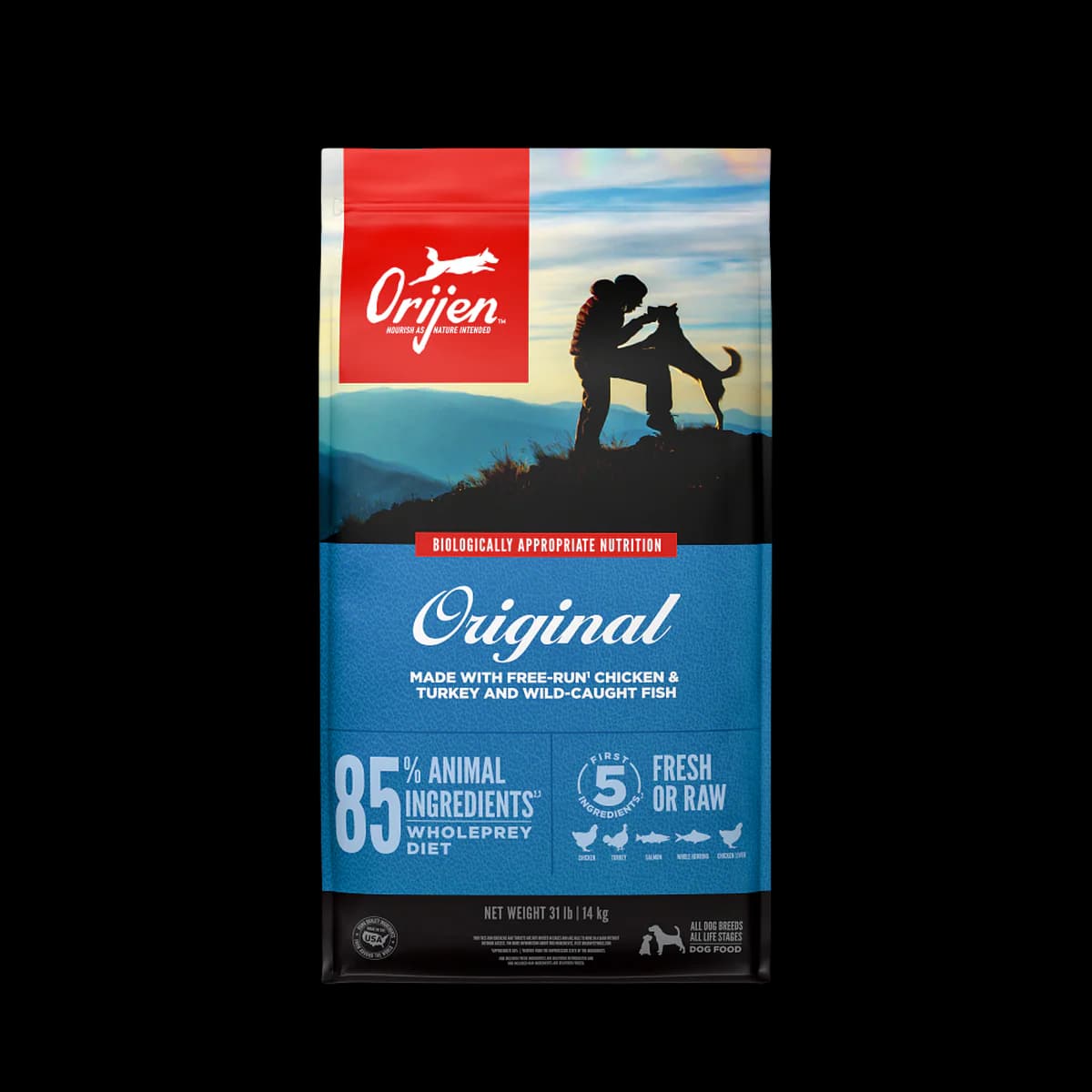
ORIJEN
Original Grain-Free High-Protein
ORIJEN Original earns 8.3/10: the first 11 ingredients are all animal, protein hits 38% as fed, and no US recall is on record. Trade-offs: premium price, six legumes in a grain-free design, 473 kcal per cup. Best for active adult dogs; skip it for sedentary or overweight ones.
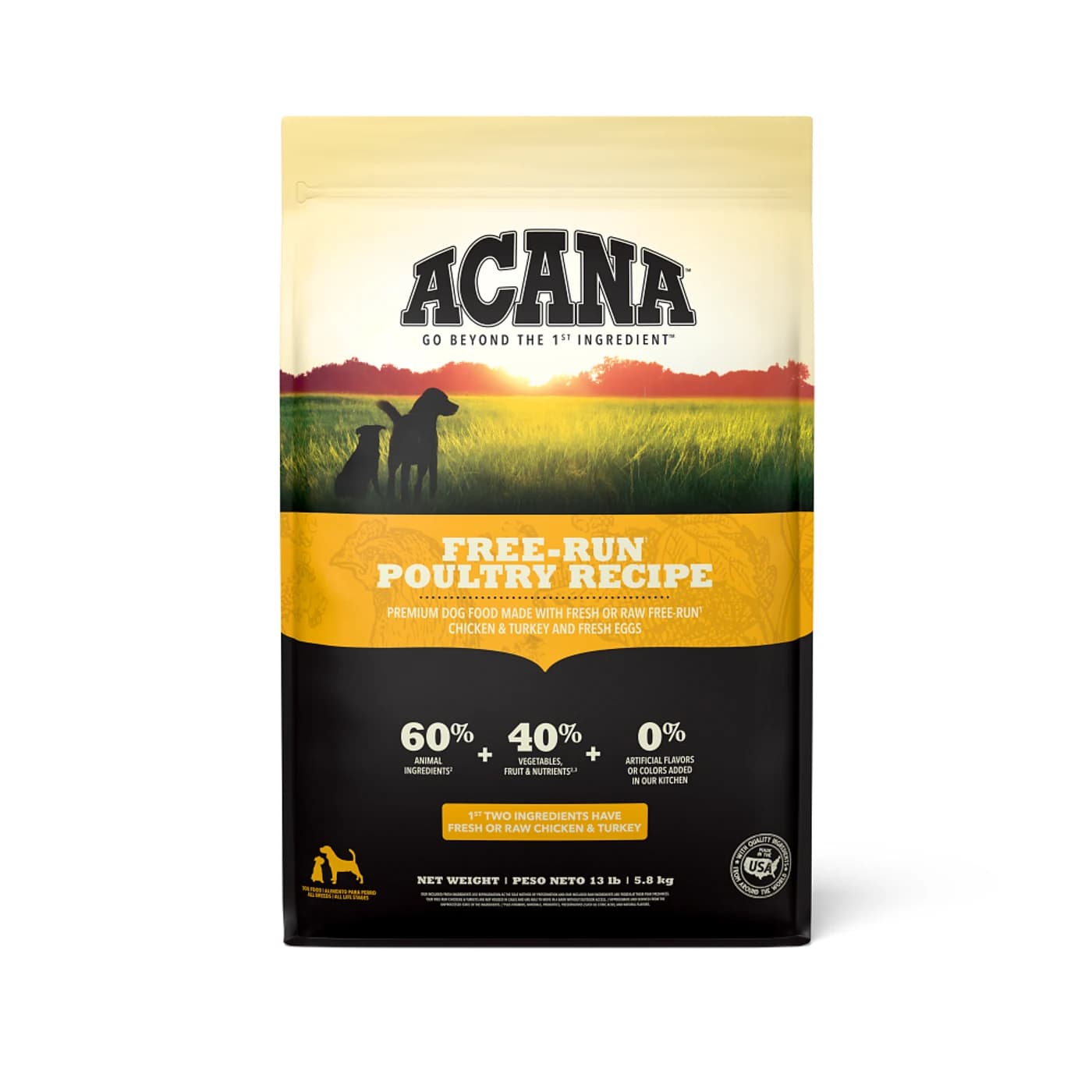
ACANA
Free-Run Poultry
ACANA Free-Run Poultry earns 8.1/10: three named poultry proteins up top, rare starch and sugar disclosure, ORIJEN's own Kentucky kitchen, and a clean US recall record at $3.20/lb. The ceiling is a legume block at positions 4-6, sitting higher in the deck than ORIJEN allows.
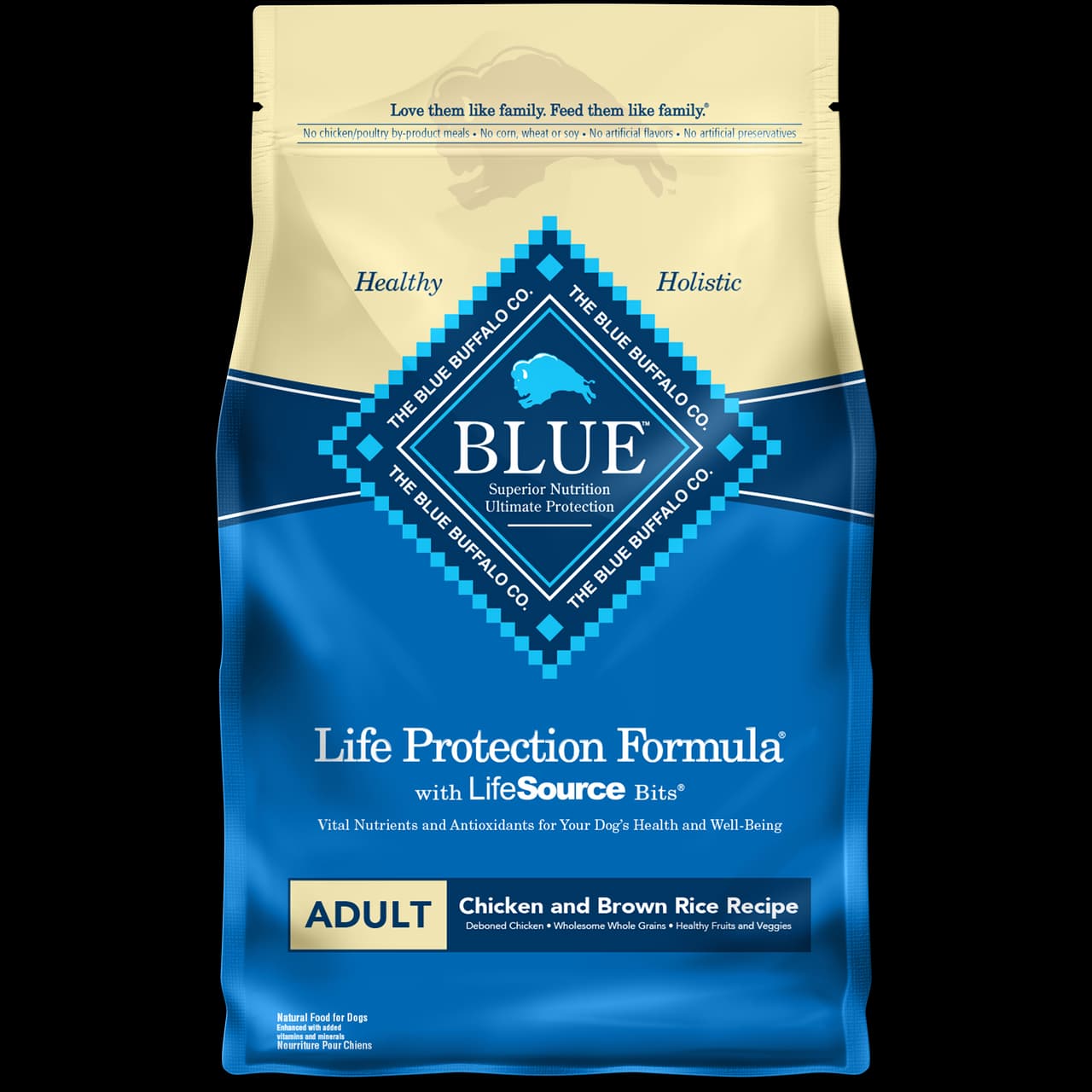
Blue Buffalo
Life Protection Formula Adult Chicken & Brown Rice
A genuinely strong grain-inclusive kibble led by real deboned chicken at a fair mid-tier price, scoring 8.1/10, with a single legume flag and a recall history worth knowing.
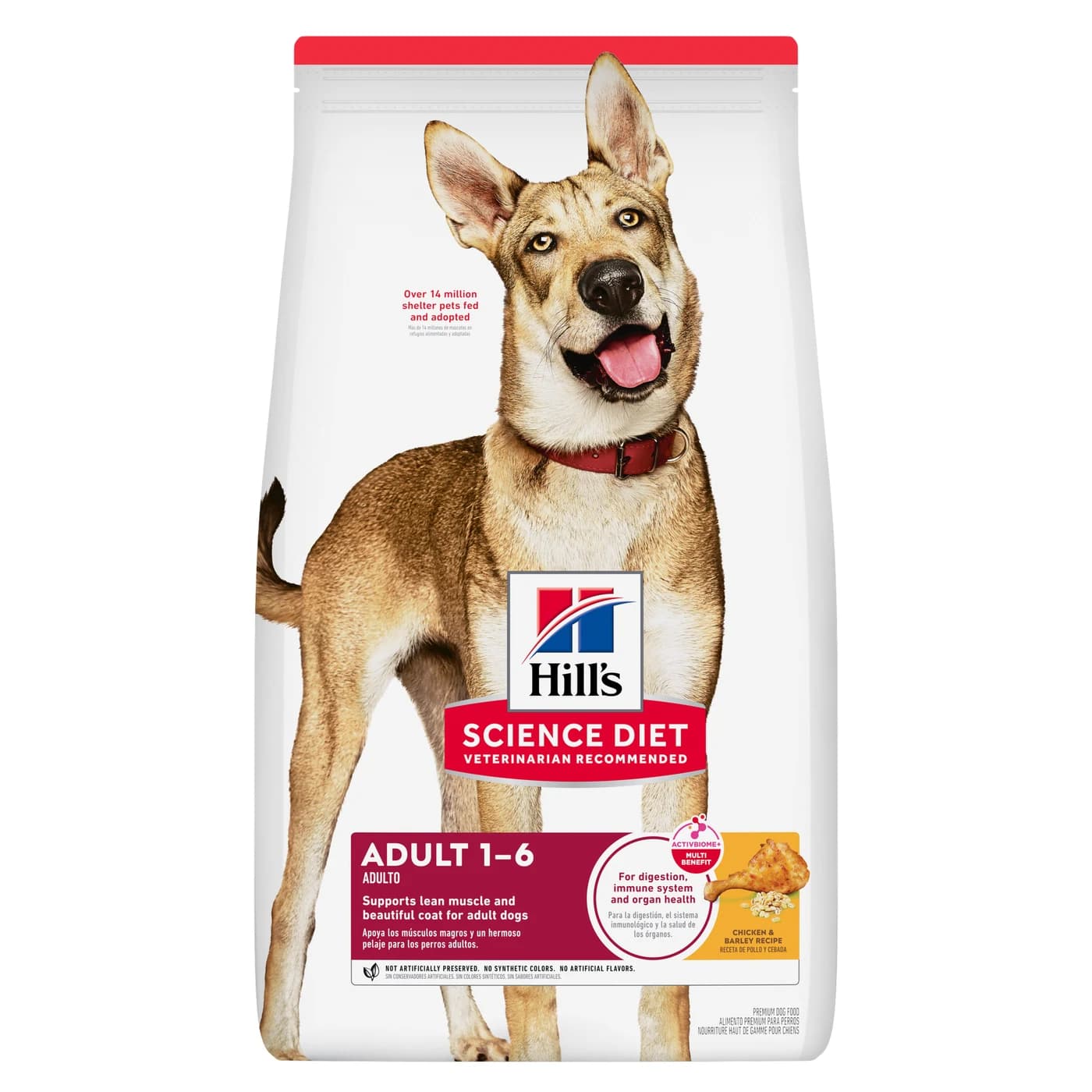
Hill's Science Diet
Adult Chicken & Barley Recipe
A vet-channel adult-maintenance kibble with gold-standard AAFCO feeding-trial backing and elite brand integrity, held back by a grain-heavy, soy-flagged ingredient deck and leaner-than-average protein.
Jump to Section
Specifications
- Brand
- Wellness
- Manufacturer
- WellPet LLC
- Made In
- USA
- Food Form
- dry
- Life Stage
- adult maintenance
- Price
- $2.34/lb
Don't Guess When It Comes To Your Pet's Care
Sign up for expert-backed reviews and safety alerts all in one place.