How to Remove Plaque From Dog Teeth at Home
A vet-led at-home guide to removing plaque from dog teeth with brushing, dental powder, water additives, and chews, plus the hardened tartar you should never scrape yourself.
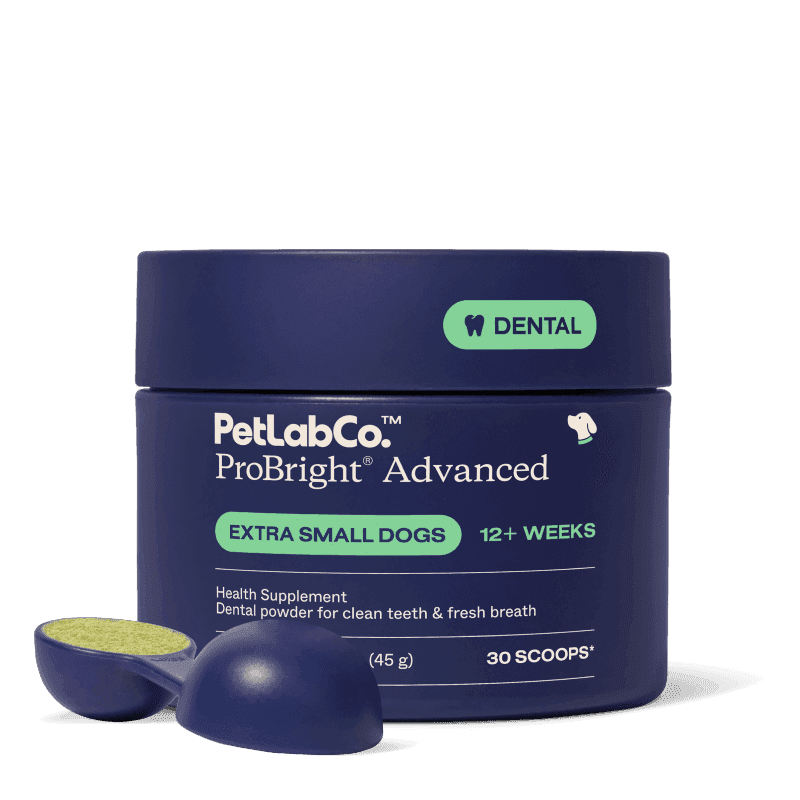
PetLabCo.® ProBright® Advanced dental powder tub, from the current PetLabCo.® product page.
Petful is reader supported. As an affiliate of platforms like Amazon and Chewy, we may earn a commission when you buy through links on this page. There is no extra cost to you.
Learning how to remove plaque from dog teeth at home comes down to one principle: plaque is soft and removable, tartar is hard and is not. Daily brushing physically wipes plaque off the tooth surface, and a dental powder, a water additive, and a dental chew each help keep those surfaces cleaner between brushings. Once plaque mineralizes into tartar, only a veterinary cleaning removes it safely.
This guide lays out a step-by-step method in the order a veterinarian would build it, with realistic timelines, the current label directions for PetLabCo.®'s ProBright® Advanced powder, Dental Formula water additive, and Prebiotic Dental Sticks, and a daily plaque-control plan by dog size. It also says plainly where home care stops and professional care begins.

Sign up for expert-backed reviews and safety alerts all in one place.
💡Key Takeaways
- 1Plaque comes off at home, tartar does not: the whole method rests on a plaque-versus-tartar boundary that separates soft film you can wipe away from mineralized buildup only a veterinarian can remove.
- 2Brush first, then layer: daily brushing with a dog toothpaste is the most effective home step, and every other format supports it rather than replaces it.
- 3Powder is an easy add-on: ProBright® Advanced is a once-daily meal topper for dogs 12 weeks and older, and PetLabCo.® reports a plaque index score 25% lower than control after 90 days of daily use.
- 4Additive and chew fill the gaps: Dental Formula goes into the water bowl for dogs of any size, and Prebiotic Dental Sticks add mechanical cleaning with a weight-based serving.
- 5Never scrape: scraping hardened tartar at home is unsafe for the tooth, the gum, and the person holding the tool.
- 6Expect weeks, not days: plaque control shows up as fresher breath and less new buildup over 4 to 12 weeks, not as tartar disappearing overnight.
- 7Veterinary guidance comes first: brown or gray buildup, changes in gum color or texture, or bad breath that persists needs an exam, and existing tartar needs professional scaling before the home plan can hold the result, so veterinary guidance sets the ceiling on what home care achieves.
Plaque vs. tartar: what you can actually remove at home
You can remove plaque from your dog's teeth at home because plaque is a soft bacterial film that wipes away with a toothbrush, and daily products help keep it from re-forming. You cannot remove tartar at home. Tartar is mineralized plaque bonded to the tooth, and a veterinarian removes it by scaling under anesthesia.
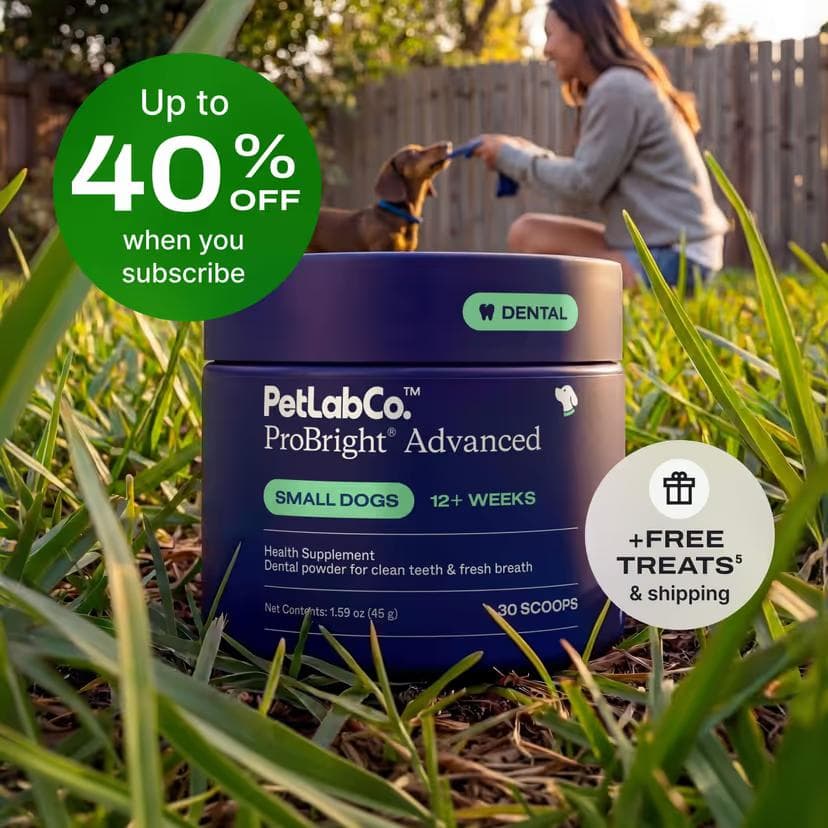
An at-home dental powder that targets tartar buildup and helps reduce bad breath in dogs. Sprinkle one scoop over food daily, 30 scoops per tub.
Petful may earn a commission when you click through to PetLabCo.®, at no extra cost to you.
That is the hardened tartar boundary, and it decides which of the methods below are worth your effort. Everything in the four steps targets plaque: the film that forms within hours of eating, coats the enamel, and starts absorbing calcium salts from saliva. The Merck Veterinary Manual describes calculus (the clinical term for tartar) as plaque that has mineralized, a process that begins within days when plaque is left in place.
Dog plaque vs tartar: how the stages progress
The difference between dog teeth plaque vs tartar is easiest to see as a timeline. Dog teeth tartar stages run roughly like this:
- Hours after a meal: a thin protein film coats the enamel and bacteria begin attaching to it. This is plaque. It is colorless or faintly white and comes off with a brush.
- 24 to 72 hours: undisturbed plaque begins to mineralize. It feels slightly rough and may look off-white or yellow near the gumline.
- Days to weeks: the mineralized layer thickens into visible yellow or tan tartar, usually first on the upper back teeth and canines where saliva pools.
- Weeks to months: tartar creeps under the gumline, the gums redden and bleed (gingivitis), and the rough surface holds even more plaque.
- Months to years: tartar left in place can cause dental health conditions to progress that many dogs hide - it is vital to regularly check your dog’s mouth for signs, and to attend regular veterinary cleanings.
What removes hard plaque from dogs' teeth?
Hard plaque on a dog's teeth is tartar, and the only safe thing that removes it is a professional scaling by a veterinarian, usually under general anesthesia so the surfaces above and below the gumline can be cleaned and polished. No brush, powder, additive, chew, or home remedy dissolves calculus once it has set. What home products can do is target the fresh plaque that would otherwise become the next layer of tartar, which is why a dog with existing buildup usually needs a cleaning first and a daily plan second.
Can you soften dog tartar?
Owners searching for how to soften dog tartar are usually hoping a gel or powder will loosen buildup enough to wipe off. It does not work that way. Ingredients such as sodium hexametaphosphate are used in dental products to target new buildup as it forms, not to release calculus that is already bonded to enamel. If the buildup is thick enough to see from across the room, take that as a sign to book an exam, not as a reason to buy a stronger product.
Can you scrape plaque off your dog's teeth?
No, you should not scrape plaque or tartar off your dog's teeth at home, and scraping hardened tartar at home is unsafe. A metal scaler can gouge enamel, cut the gum, push bacteria under the gumline, and leave a rough surface that collects plaque faster than before. Dogs also do not hold still for sharp tools near the mouth, so a sudden movement can injure the dog or the person. Soft plaque does not need scraping at all, because a toothbrush removes it, and hardened tartar needs a veterinarian.
- What the available evidence shows is not the same as a treatment claim. Ingredient research and brand-reported findings support daily use as part of routine care; they do not prove that a supplement treats disease, guarantees a result, or replaces veterinary care. Read every evidence limit with your veterinarian in mind.
Here is what home care can and cannot do, so the direct answer is not misread:
- Home care can: disrupt plaque every day, keep new tartar from accumulating as quickly, freshen breath, and hold the result after a professional cleaning.
- Home care cannot: remove tartar that has already mineralized, clean below the gumline, or assess potential dental health concerns.
- The evidence limit: dental powders, additives, and chews are supported by product and ingredient studies, not by evidence that they remove established calculus. None of them replace a veterinary cleaning.
- Veterinary boundary: any product in this guide supports a daily routine and does not replace veterinary care.
Dogs that already have visible tartar should see a veterinarian before you invest in a home plan, because the step-by-step method order below assumes you are starting with a clean or nearly clean mouth. Scaling first, then daily control, is the sequence that works.
Step 1: Brush daily with a dog toothpaste
Brushing is the foundation of dog plaque removal because it is the only home method that physically wipes the film off every surface you can reach. The AAHA dental care guidelines describe daily brushing as the gold standard for home care, and a dog toothpaste (enzymatic or otherwise) adds flavor the dog accepts and ingredients that help break down the plaque film. This section carries the core of how to remove plaque from dog teeth, and the three product steps after it exist to make this one easier to sustain.
What stops tartar buildup?
Daily removal of plaque stops tartar buildup, because tartar can only form from plaque that stays on the tooth long enough to mineralize. If the film is wiped away every 24 hours, there is nothing left to harden. That is why frequency matters more than technique: a 30-second brush every day protects more teeth than a thorough 5-minute session once a week. Water additives, powders, and chews extend that protection between brushings, but the brush is what resets the clock.
How to get plaque off dog teeth with a brush
- Choose the tool. A soft-bristled dog toothbrush, a finger brush, or gauze wrapped around a finger all work. Match the head size to the dog's mouth.
- Use a dog toothpaste only. Human toothpaste contains fluoride and often xylitol, both of which are toxic if swallowed, and dogs swallow everything you put in their mouths.
- Start with the flavor. For the first few days, let the dog lick the toothpaste from your finger and touch the outside of the lips. No brushing yet.
- Brush the outside surfaces. Lift the lip, angle the bristles toward the gumline, and use small circles on the cheek side of the upper teeth. The upper back molars and canines collect the most plaque.
- Add the inside surfaces later. The tongue side is less important because the tongue keeps it cleaner, so skip it until the dog is calm with the outside.
- Keep it short. Aim for 30 to 60 seconds, end on praise, and stop before the dog struggles.
Realistic timeline for brushing
Expect a two-week ramp-up to a full daily brush, because dogs need time to accept the toothbrush before they accept the routine. Once brushing is daily, breath usually improves within one to two weeks and the yellow tinge along the gumline of new plaque fades over four to eight weeks. Tartar that was already there will not change. Petful's dog teeth care guide covers positioning and handling for dogs that resist.
Remove tartar from dog teeth at home: what brushing cannot do
Brushing removes soft plaque, but it cannot lift hardened tartar. Plaque can be removed with daily home care; established tartar needs professional removal by a veterinarian.
That also reframes the shopping question. The best dog tartar removal products are not scrapers or "tartar dissolvers." They are the daily formats that keep new plaque from becoming tartar: a brush, a dog toothpaste, a dental powder, a water additive, and a dental chew. If you want a dog plaque remover that works, choose one that you will actually use every day.
Step 2: Add a dental powder to meals
A dental powder is the second step because it takes seconds, rides along with a meal the dog already eats, and reaches the back teeth that many owners never brush well. ProBright® Advanced is PetLabCo.®'s once-daily powder for dogs 12 weeks and older, sprinkled over food at mealtime. For a full product-level walkthrough, see Petful's ProBright® Advanced review.
An at-home dental powder that targets tartar buildup and helps reduce bad breath in dogs. Sprinkle one scoop over food daily, 30 scoops per tub.
Petful may earn a commission when you click through to PetLabCo.®, at no extra cost to you.
How can I get plaque off my dog's teeth without brushing?
You can reduce plaque on your dog's teeth without brushing by using a daily dental powder at meals, a water additive in the bowl, and a dental chew for mechanical contact, then having a veterinarian handle anything that has already hardened. None of these formats scrubs the tooth the way a brush does, so they will not match daily brushing. They do help maintain cleaner surfaces in dogs that will not tolerate a toothbrush, and in the brand's 90-day study, ProBright® Advanced alone was associated with a lower plaque index than control.
What is in ProBright® Advanced
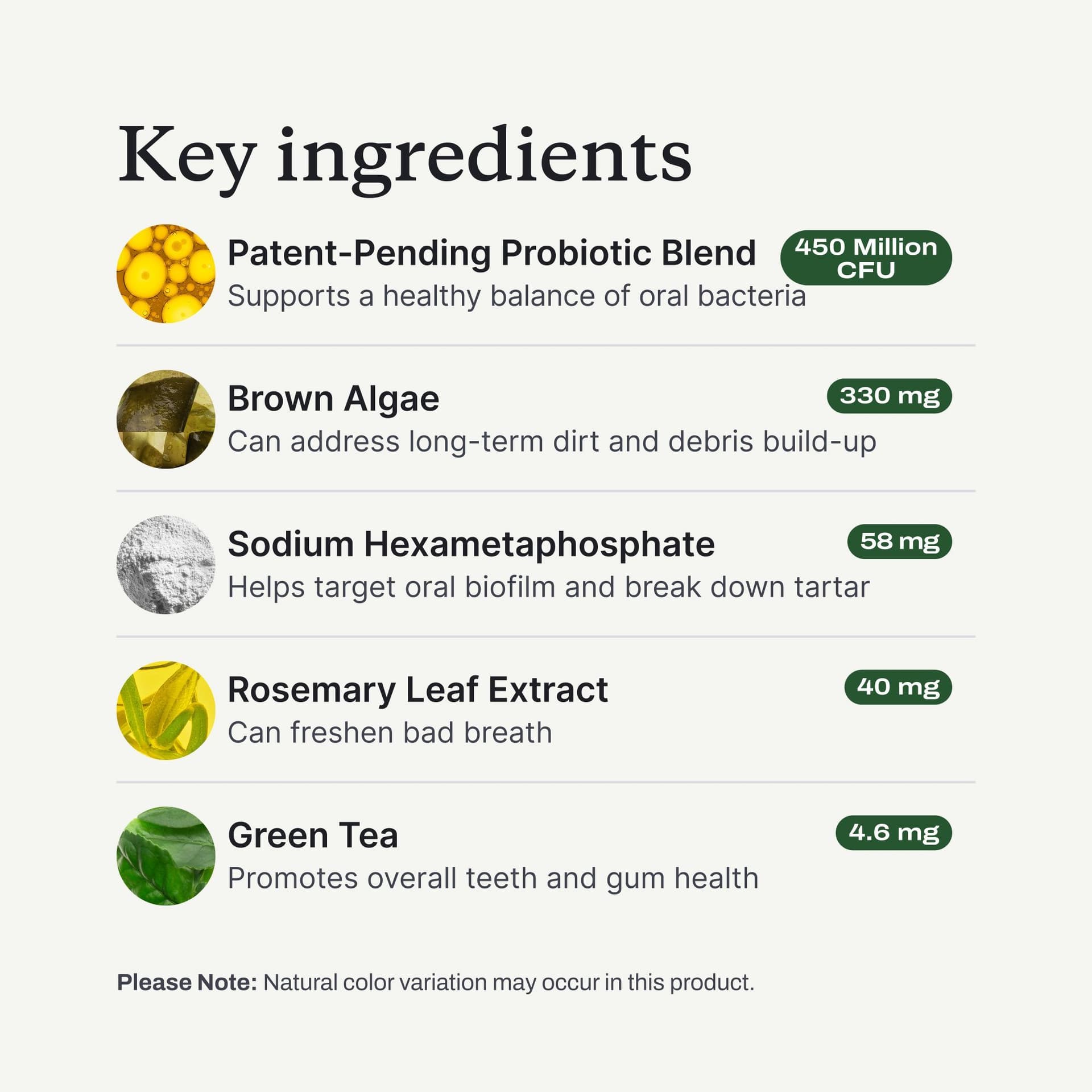
The current label lists five active ingredients, with amounts that rise across five weight bands:
- A proprietary probiotic blend (Pediococcus pentosaceus and Lactiplantibacillus plantarum), 112.5 million to 1.2 billion CFU per serving
- Brown algae (Ascophyllum nodosum), 82.5 mg to 1,510 mg
- Sodium hexametaphosphate, 14.5 mg to 125 mg
- Rosemary leaf extract, 10 mg to 79 mg
- Decaffeinated green tea, 1.15 mg to 9.3 mg
Inactive ingredients are calcium bentonite, dried brewer's yeast, hydrolyzed chicken liver flavor, and spinach powder. The chicken liver flavor is what makes most dogs eat it without noticing.
Label directions and cautions
- Give once daily at mealtime with the scoop supplied in the tub for the dog's weight range. Do not add it to water.
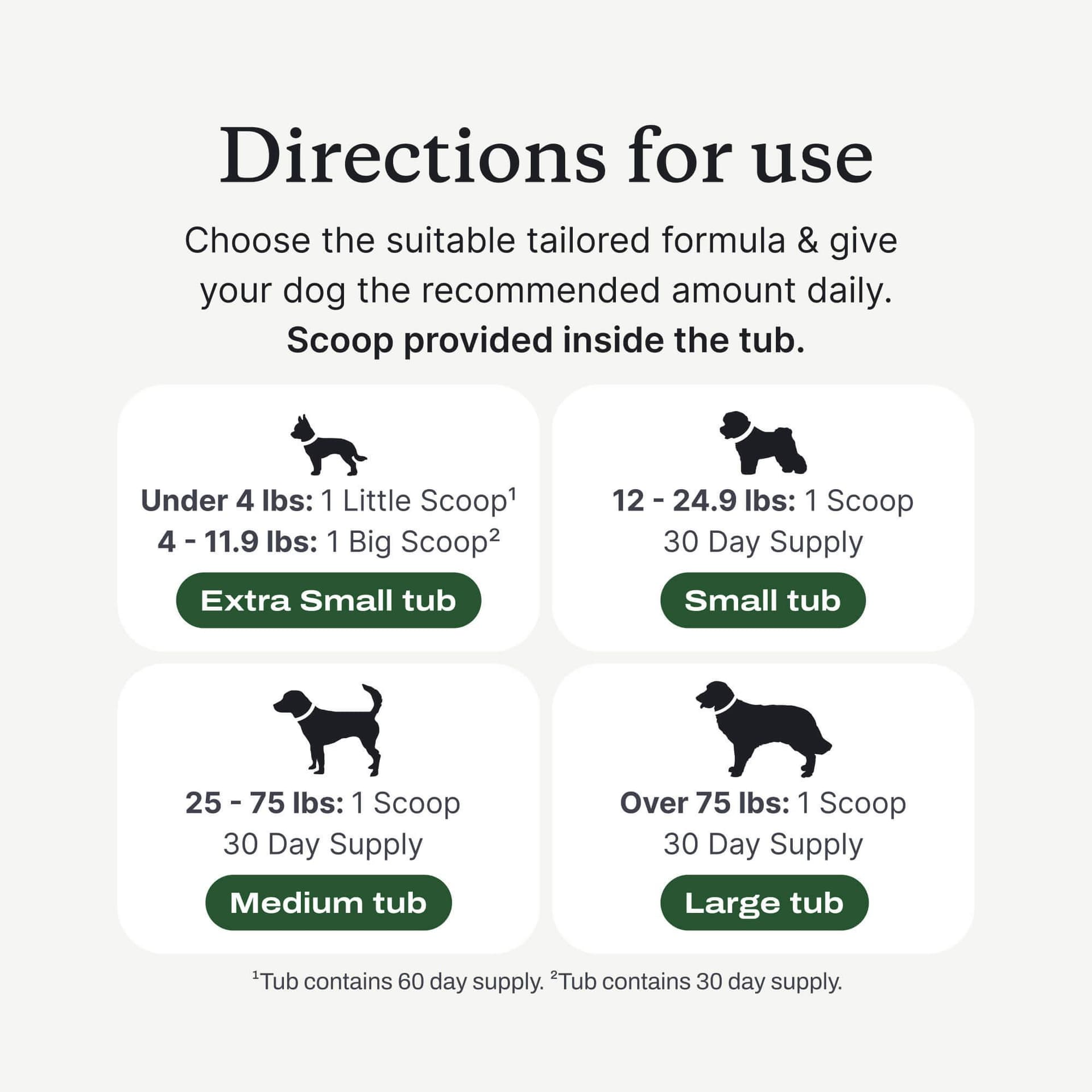
- Serving sizes run from one Little Scoop (0.75 g) for dogs under 4 lb to one large-tub scoop (3 g) for dogs over 75 lb. The size-based plan below lists every band.
- The label recommends a veterinary examination before starting, giving the powder during or after eating to reduce the chance of stomach upset, and caution in dogs with hyperthyroid disease because brown algae contains iodine.
- Safe use in pregnant dogs or dogs intended for breeding has not been proven. Stop and call your veterinarian if the dog's condition worsens or does not improve.
- Store the tub sealed in a cool, dry place away from sunlight.
What the brand-reported studies found
PetLabCo.® has published two clinical statements on its ProBright® Advanced study page. A 28-day clinical study found ProBright® Advanced significantly reduced hydrogen sulfide, a common bad-breath compound, by 40%. A 90-day clinical study found dogs taking ProBright® Advanced daily had a plaque index score 25% lower than the control group, a statement attributed to Dr. Jan Bellows, a board-certified veterinary dentist and PetLabCo.® consultant.
Both are brand-reported studies, and individual results vary. They support describing the powder as a daily plaque-control supplement with measured outcomes at 28 and 90 days. They do not support describing it as something that removes tartar, and the label itself says the powder does not replace brushing or professional cleaning. The realistic timeline is the study timeline: fresher breath in about a month, and less new plaque over three months of daily use.
Step 3: Use a water additive between brushings
A water additive is the third step because it works passively, every time the dog drinks, in a household that cannot brush daily or wants to cover the hours between meals. Dental Formula is PetLabCo.®'s tasteless, odorless liquid for the water bowl, labeled for dogs and cats of all sizes.
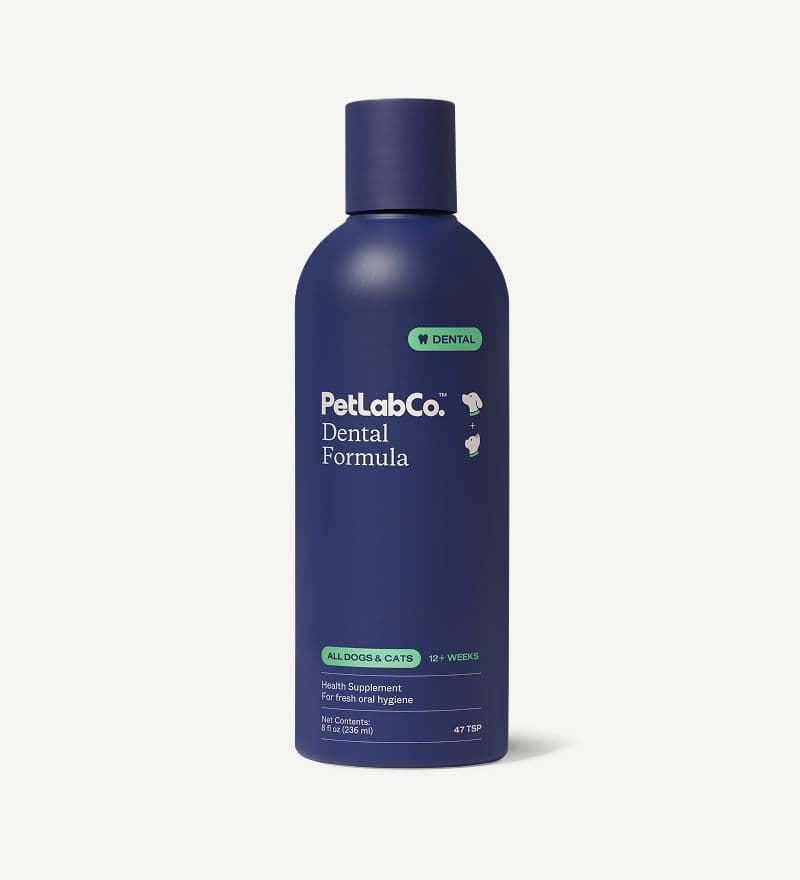
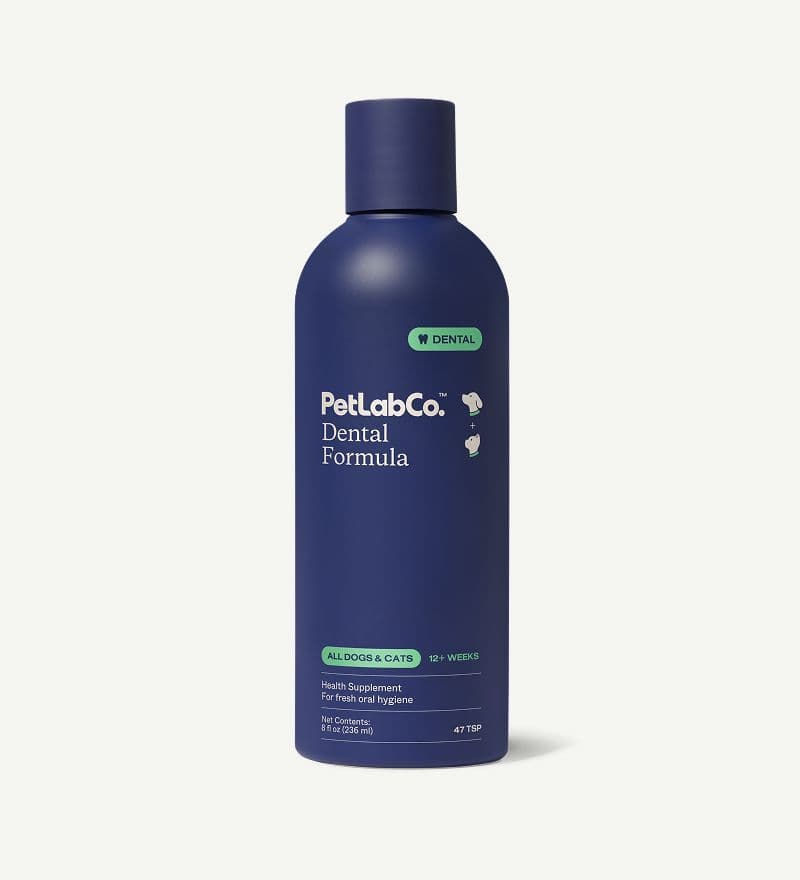
A tasteless, odorless add-to-water dental formula with stabilized chlorine dioxide that helps target tartar buildup and freshen breath. One teaspoon in 8 ounces of water daily, 47 servings per bottle.
Petful may earn a commission when you click through to PetLabCo.®, at no extra cost to you.
Label directions and cautions
- Mix 1 teaspoon (5 ml) into 8 ounces of fresh water once daily and shake the bottle before use. One bottle holds 47 servings.
- The active ingredient is stabilized chlorine dioxide, 7 mg per teaspoon, which the brand includes to target the volatile sulfur compounds associated with bad breath and to help support a healthy balance of oral bacteria.
- Inactive ingredients are methyl paraben, potassium sorbate, purified water, sodium benzoate, sodium bicarbonate, and tetrasodium EDTA.
- The label advises caution during pregnancy, says not to use it in animals with chronic diarrhea, and recommends giving it during or after eating to reduce the chance of stomach upset.
- Keep the bottle in its original container below 86°F, away from direct sunlight.
How to fit it into the routine
Refresh the bowl with the measured dose each morning rather than topping up, so the concentration stays where the label sets it. In multi-dog homes, every dog drinking from the bowl receives the same dilution, which is why the label uses a single direction for all sizes. Watch water intake for the first few days: a dog that suddenly drinks less may be objecting to the change, and the fix is to go back to plain water and reintroduce it gradually.
Think of the additive as breath and bacteria support, not a scrubbing agent. It reaches surfaces a brush misses, but it has no mechanical action, so it belongs alongside brushing and the powder rather than in place of them.
Step 4: Give a dental chew for mechanical cleaning
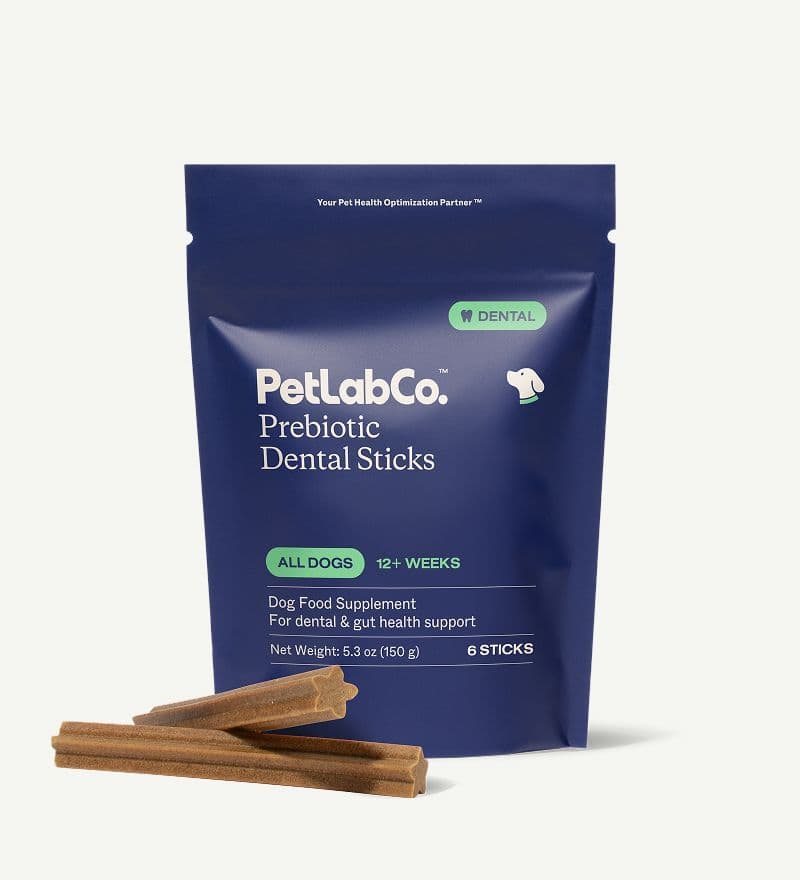
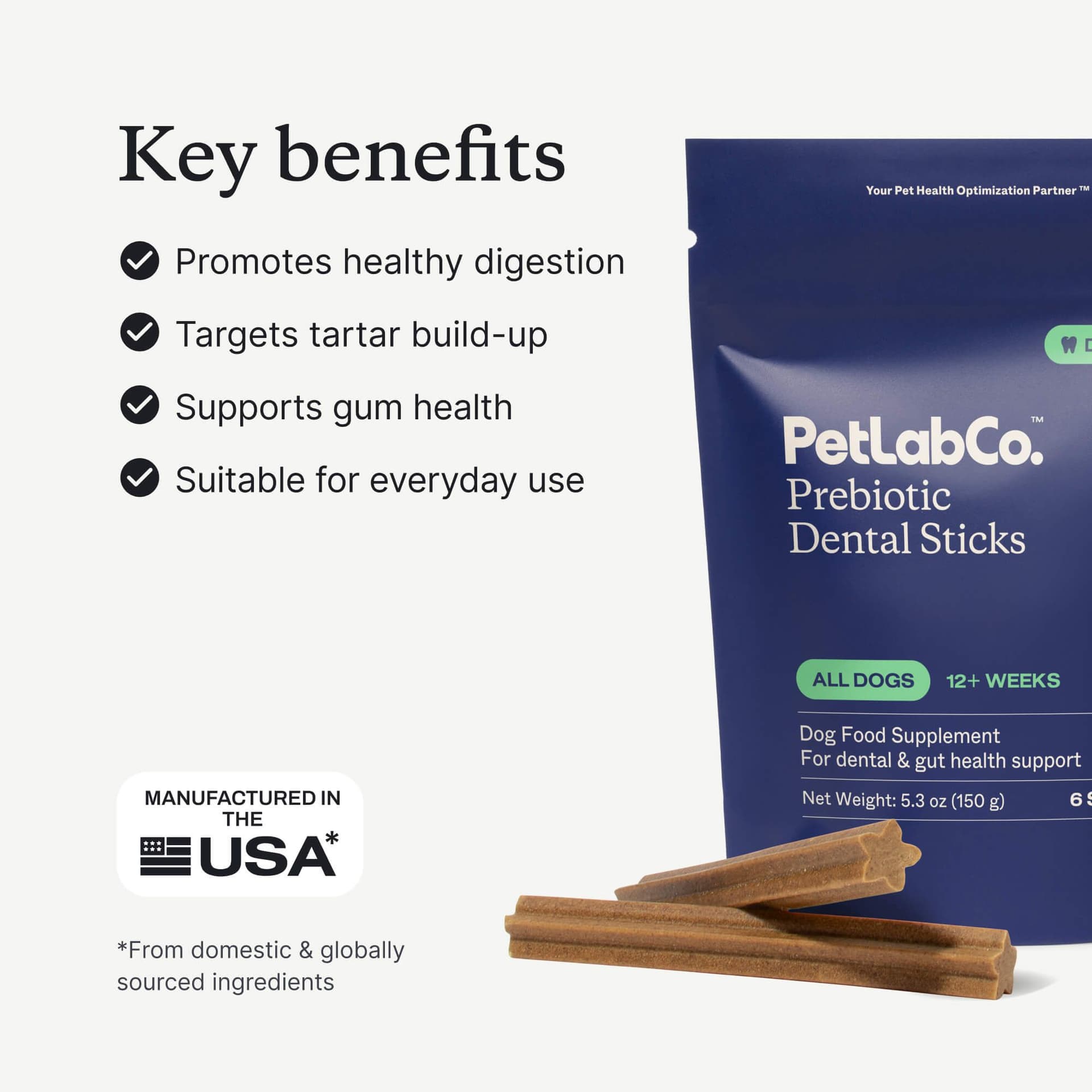
A dental chew is the fourth step because chewing adds friction, and friction is the only thing besides a brush that physically disturbs plaque. Prebiotic Dental Sticks are PetLabCo.®'s ridged dog dental chews, shaped so the surface scrapes against the teeth as the dog works through the stick. They are suitable for dogs 12 weeks and older and are part of the brand's wider dental collection.
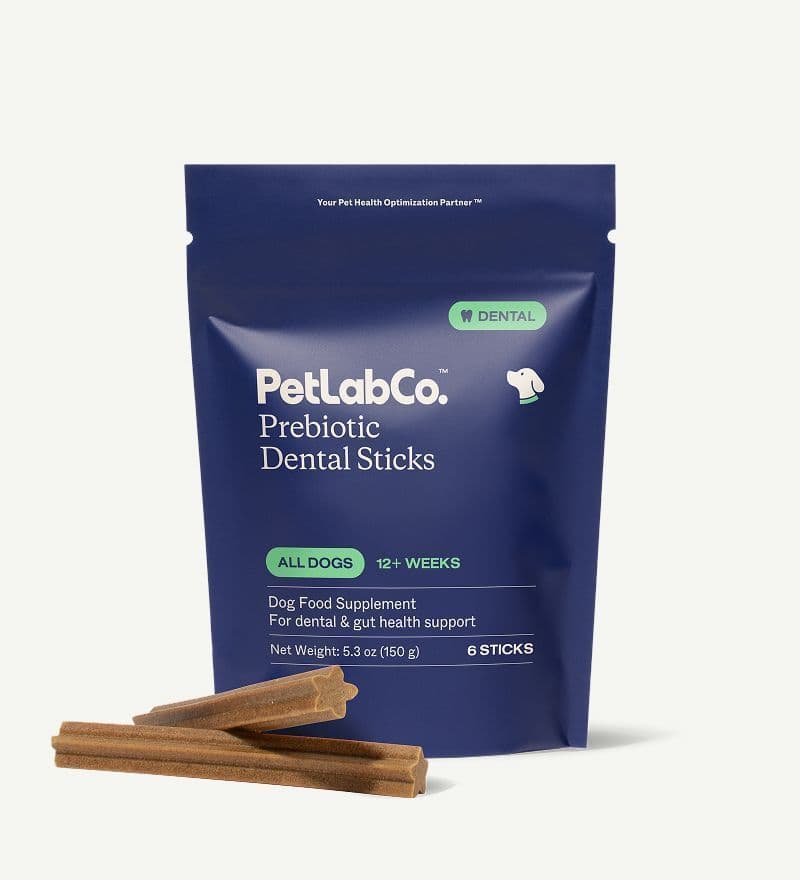
Ridged daily dental chews that use abrasive action to target plaque and tartar, with chicory root prebiotic for gut support and peppermint oil for fresher breath. For dogs 12 weeks and older.
Petful may earn a commission when you click through to PetLabCo.®, at no extra cost to you.
Label feeding guide and cautions
- Dogs under 25 lb: 1/2 stick daily
- Dogs 25 to 50 lb: 1 stick daily
- Dogs 51 to 75 lb: 1 1/2 sticks daily
- Dogs over 75 lb: 2 sticks daily
- Each stick weighs 25 g, with a guaranteed analysis of 6% crude protein (min), 2.5% crude fat (min), 3.0% crude fiber (max), 18% moisture (max), 4.0% ash (max), and 0.5% inulin (min).
- Key ingredients include dried chicory root (a prebiotic rich in inulin) for digestive support and peppermint oil for a fresh scent. The full list starts with dried potato, vegetable glycerin, and gelatin by-products from bovine sources.
- The sticks are for supplemental feeding only. Keep fresh water available, supervise the dog until the stick is completely chewed, and count the calories toward the daily total.
What a chew can and cannot do
Chews work best on the teeth the dog actually uses to chew, which means the back premolars and molars get the most contact and the front teeth get the least. That is the opposite of brushing, where owners tend to clean the front teeth well and the back teeth poorly, so the two methods cover each other's blind spots. A chew targets soft plaque; like every other home format, it does not remove tartar that has already set.
The Veterinary Oral Health Council maintains a list of products that have earned its seal for plaque or tartar control after review of submitted data. Checking that list is a reasonable habit for any dental product, and absence from it does not mean a product is ineffective, only that it should not be described as VOHC Accepted unless it appears there.
The three formats side by side
| Detail | ProBright® Advanced | Dental Formula | Prebiotic Dental Sticks |
|---|---|---|---|
| Format | Chicken-liver-flavored powder in weight-specific tubs | Tasteless, odorless liquid for the water bowl | Ridged 25 g dental chew |
| How it works | Probiotic blend, brown algae, and sodium hexametaphosphate given at meals | Stabilized chlorine dioxide, 7 mg per teaspoon, in drinking water | Mechanical abrasion while chewing, plus chicory root prebiotic |
| Daily serving | One scoop by weight band, 0.75 g to 3 g | 1 teaspoon (5 ml) in 8 oz of water, all sizes | 1/2 to 2 sticks by weight |
| Labeled age | Dogs 12 weeks and older | Dogs and cats of all sizes | Dogs 12 weeks and older |
| Main cautions | Hyperthyroid disease, pregnancy or breeding, give with food | Pregnancy, chronic diarrhea, give with food | Supervise chewing, supplemental feeding only |
| Price checked September 14, 2026 | From $28.95 with subscription or $36.19 one-time | From $29.95 with subscription or $37.44 one-time | From $15.92 with subscription or $19.90 one-time |
Prices, promotions, and labels can change. Check the current listing before ordering.
Home remedies that do not remove plaque
Many owners search for how to remove plaque from dog teeth naturally, or how to remove dog tartar naturally at home, hoping to skip both the toothbrush and the veterinarian. The honest answer is that nothing in the kitchen removes plaque as well as a brush, and nothing in the kitchen removes tartar at all.
What dissolves plaque naturally?
Nothing dissolves plaque naturally in a way you can rely on, because plaque is a living bacterial film anchored to a protein layer on the tooth, and it is removed by physical disruption, not by soaking. Rinses and oils can reduce some surface bacteria for a short time, but they leave the film intact, and once that film mineralizes into tartar, no natural plaque remover for dogs will loosen it. The natural approach that works is the mechanical one: brush the plaque away daily and let the dog chew.
Common home remedies and why they fall short
- Coconut oil on a brush: dogs enjoy the taste, and the brushing motion does the work, not the oil. It is a passable toothpaste substitute, not a plaque remover on its own.
- Baking soda: abrasive enough to irritate gums, unpleasant enough that most dogs fight it, and unsafe in quantity because of the sodium.
- Hydrogen peroxide: not a tartar solvent, foams unpleasantly, and can cause vomiting if swallowed. Leave it out of the mouth entirely.
- Apple cider vinegar or lemon: acids that soften enamel rather than tartar and can worsen gum irritation.
- Raw bones, antlers, and hooves: hard enough to fracture teeth, which turns a plaque problem into an extraction.
- Human toothpaste or mouthwash: fluoride, xylitol, and alcohol are all toxic to dogs when swallowed.
- Online scaler kits and "tartar softening" gels: the scalers cause the injuries described above, and no gel has shown that it loosens set calculus.
The natural method that does work
If your goal is how to remove plaque from dog teeth naturally at home, the plan is the same as the one in this article with the products removed: a brush, a dog-safe toothpaste, daily frequency, and safe chewing. Searches for how to soften dog tartar naturally at home end at the same place. Tartar does not soften. It gets scaled off by a veterinarian, and then the daily routine keeps it from coming back as fast.
When plaque needs a professional cleaning
How can I remove tartar from my dog's teeth?
You remove tartar from your dog's teeth by scheduling a professional dental cleaning, where a veterinarian scales the calculus above and below the gumline under general anesthesia, polishes the enamel so plaque has a harder time re-attaching, and takes dental radiographs to check the roots and bone that a visual exam cannot see. That is the only method that safely removes established tartar. Home care restarts the day after the cleaning to slow the next round of buildup.
Signs the home plan is no longer enough
Book a veterinary exam if you notice changes to the texture or color of your dog's gums or teeth, discomfort when eating, or changes to their regular habits.
The AAHA dental care guidelines recommend a professional oral evaluation and cleaning on a schedule set by the veterinarian, typically starting around one to two years of age for most dogs and earlier for small breeds that build tartar quickly. Anesthesia-free "cleanings" offered outside a veterinary clinic scale only the visible crown, miss the disease under the gumline, and are not recommended by AAHA.
What to expect and what it costs
A cleaning day usually includes pre-anesthetic bloodwork, the scaling and polishing itself, full-mouth radiographs, and any extractions the radiographs reveal. Petful's guide to dog teeth cleaning cost breaks down what drives the bill. The important budgeting point is that a consistent home plan lengthens the interval between cleanings, which is where most of the long-term savings come from.
A daily plaque-control plan by dog size
A daily plaque-control plan combines all four formats so plaque is disrupted at several points in the day: the brush at bedtime, the powder at breakfast, the additive in every drink, and the chew in the evening. The plan below is a size-based daily schedule built from the current label directions for ProBright® Advanced, Dental Formula, and Prebiotic Dental Sticks, alongside brushing. Weight bands follow each label, so the ProBright® Advanced tub and the stick count change at different thresholds.
| Dog's weight | Brushing | ProBright® Advanced (current label) | Dental Formula (current label) | Prebiotic Dental Sticks (current label) |
|---|---|---|---|---|
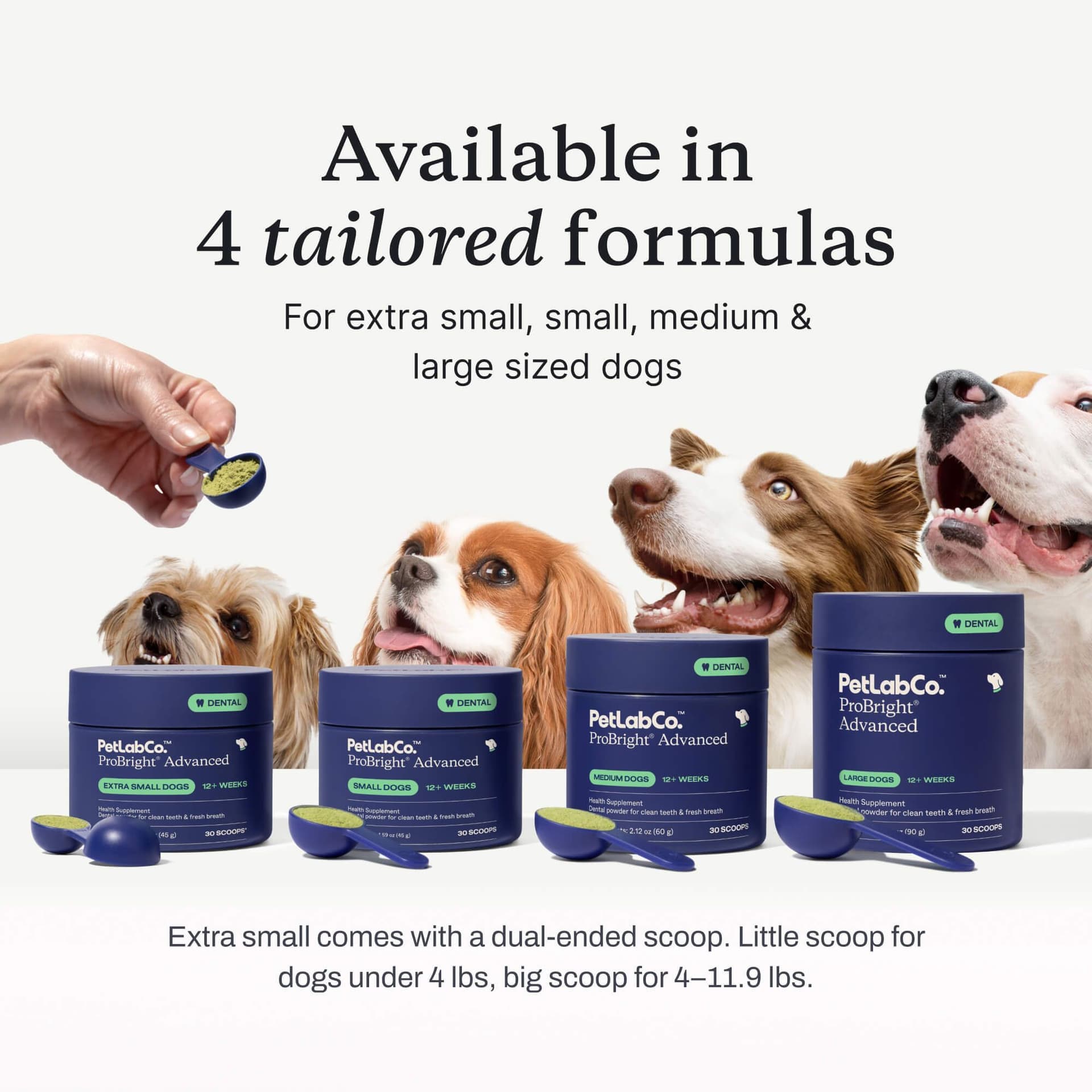
| Under 4 lb | Daily, 30 to 60 seconds | 1 Little Scoop from the extra-small tub, 0.75 g, at mealtime | 1 tsp (5 ml) in 8 oz of water daily | 1/2 stick daily |
| 4 to 11.9 lb | Daily, 30 to 60 seconds | 1 big scoop from the extra-small tub, 1.5 g, at mealtime | 1 tsp (5 ml) in 8 oz of water daily | 1/2 stick daily |
| 12 to 24.9 lb | Daily, 30 to 60 seconds | 1 scoop from the small tub, 1.5 g, at mealtime | 1 tsp (5 ml) in 8 oz of water daily | 1/2 stick daily |
| 25 to 50 lb | Daily, 60 seconds | 1 scoop from the medium tub, 2 g, at mealtime | 1 tsp (5 ml) in 8 oz of water daily | 1 stick daily |
| 51 to 75 lb | Daily, 60 seconds | 1 scoop from the medium tub, 2 g, at mealtime | 1 tsp (5 ml) in 8 oz of water daily | 1 1/2 sticks daily |
| Over 75 lb | Daily, 60 to 90 seconds | 1 scoop from the large tub, 3 g, at mealtime | 1 tsp (5 ml) in 8 oz of water daily | 2 sticks daily |
How to run the plan day to day
- Morning: refresh the water bowl with the measured Dental Formula dose, then sprinkle the ProBright® Advanced scoop over breakfast.
- Evening: offer the Prebiotic Dental Sticks serving after dinner while the dog is settled and you can supervise the chew.
- Bedtime: brush the outside surfaces of the upper teeth, ending on the back molars. Brushing last means the teeth stay clean through the longest gap between meals.
- Weekly: lift the lip on both sides under good light and look for new yellow film at the gumline, redness, or a change in breath. Take a phone photo so you can compare month to month.
- Every 6 to 12 months: have the veterinarian check the mouth and decide whether a cleaning is due.
What a realistic result looks like
Give the plan 4 weeks before judging breath and 12 weeks before judging the look of the teeth, which lines up with the 28-day and 90-day windows in the brand's ProBright® Advanced studies. Small dogs and flat-faced breeds build tartar faster and may need the chew count adjusted by the veterinarian or an earlier cleaning. Large dogs on two sticks a day should have the calories counted toward their daily total. If breath or gum color worsens at any point despite the routine, that is an exam, not a product change.
Consistency is the variable that matters most. A plan followed six days a week outperforms a perfect plan followed for two weeks and abandoned, and the formats were chosen for this guide because each takes under a minute.
Frequently Asked Questions
Nothing you can use at home removes tartar from a dog's teeth; it takes professional scaling under anesthesia by a veterinarian, who cleans above and below the gumline and polishes the enamel. What you can use at home is a daily routine of brushing with a dog toothpaste, a dental powder such as ProBright® Advanced at meals, a water additive, and a dental chew. Those daily products slow new buildup so the next cleaning is further away.
No. In a dog's mouth, hydrogen peroxide is not a tartar solvent, and calculus does not dissolve in it any more than it dissolves in water. In a dog's mouth it foams, tastes foul, irritates the gums, and carries a vomiting risk if swallowed, which it will be. Keep it for cleaning cuts on your own skin, and remove tartar the only safe way: a veterinary cleaning followed by daily plaque control.
The difference between plaque and tartar is time and hardness. Plaque is the soft bacterial film that forms on a dog's teeth within hours of eating. It is colorless, sticky, and comes off with a toothbrush. Tartar is what plaque becomes when it is left in place: it mineralizes within days as it absorbs calcium from saliva, hardens, bonds to the enamel, and turns yellow or brown. Plaque is a home-care job. Tartar is a veterinary job.
Yes. Tartar, or calculus, is plaque that has hardened by absorbing calcium salts from saliva. It is not a different substance, but the change matters because a brush cannot lift it, and its rough surface holds more plaque than smooth enamel does, so buildup accelerates once tartar is present. That is why a dog with tartar usually needs a cleaning before a daily plan can hold.
Yes, a chunk of tartar can fall off a dog's teeth on its own, often while the dog chews something hard, and owners sometimes find a brown fragment on the floor or in the water bowl. Do not assume it is good news; check the tooth and gum underneath, because a piece that breaks away may have been holding onto a damaged surface. Mention it at the next exam.
No toothpaste removes tartar. An enzymatic dog toothpaste helps break down the plaque film and makes daily brushing more effective, which is how it earns its place, but it works on plaque, not on mineralized calculus. And never use human toothpaste on a dog: fluoride and xylitol are toxic when swallowed. Pick a dog-formulated paste, brush daily, and leave existing tartar to the veterinarian.
Sources
- American Animal Hospital Association. Dental Care Guidelines: Home Care. Accessed September 14, 2026.
- Merck Veterinary Manual. Periodontal Disease in Small Animals. Accessed September 14, 2026.
- Veterinary Oral Health Council. VOHC Accepted Products. Accessed September 14, 2026.
- PetLabCo.® Does PetLabCo.® ProBright® Advanced Work? Clinical study summary. Accessed September 14, 2026.
- PetLabCo.® Dental Formula: current product facts, directions, and cautions. Accessed September 14, 2026.
- PetLabCo.® Prebiotic Dental Sticks: current product facts, feeding guide, and cautions. Accessed September 14, 2026.
PetLabCo.® products are not intended to diagnose, treat, cure, or prevent any disease. Consult your veterinarian before starting supplements, especially if your dog has a health condition, takes medication, is pregnant or nursing, or has persistent symptoms.

DVM
Athena Gaffud, DVM, is a board-certified veterinarian and writer based in the Cagayan Valley of the northern Philippines. She runs the website countryvetmom.com Dr. Gaffud earned her Doctor of Veterinary Medicine degree from the University of the Philippines Los Baños in 2011, ranking in the top 10 and receiving the Best Undergraduate Thesis Award in Large Animals. With over a decade of experience, she has worked as a researcher, a practitioner for small and large animals, and in veterinary technical sales, marketing, and pet insurance. A published author, Dr. Gaffud promotes responsible pet ownership and combats misinformation on animal care through her platforms, including the DocAthena Facebook Page and DocAthena YouTube channel. She is a writer and editor for various pet-related websites such as Total Vet, Honest Paws, PangoVet, Dogster, Catster, My Best PH, Paw Origins, Bully Max, Not a Bully, Paws and Claws CBD, many others. She was also cited in different pet-related media articles such as The Dog People, USA Today, Newsweek, New York Post, Reader’s Digest, Smithsonian Magazine, Woman’s World, Dog Time, Patch, Kinship, Martha Stewart, and many others. Moreover, she is also a published fiction author on Kindle.
Sign up for expert-backed reviews and safety alerts all in one place.

A Final Word (Disclaimer)
At Petful, our review integrity is paramount; we never exchange special treatment in our reviews for monetary or material rewards.
Nonetheless, when our readers click through to online merchants (including Chewy or Amazon), we receive a referral commission. This supports the running of our free blog, and we appreciate your backing.