Flea Treatment for Puppies: Vet-Approved Safe Picks
Most flea preventives are safe from 7 to 8 weeks of age and a minimum weight; some tablets work from 4 weeks. A vet shares the age and weight minimums for every major puppy flea product, plus a safe plan for puppies too young to treat.

BVMS, MRCVS
Petful is reader supported. As an affiliate of platforms like Amazon and Chewy, we may earn a commission when you buy through links on this page. There is no extra cost to you.
Safe flea treatment for puppies comes down to two numbers printed on every label: the minimum age and the minimum weight. The Companion Animal Parasite Council (CAPC) recommends year-round flea control for dogs, yet only about 5 percent of an infestation lives on your puppy as adult fleas; the other 95 percent is hiding in your home as eggs, larvae, and pupae. As a veterinarian, I see more product injuries in puppies and small dogs than in any other group, almost always because an adult product was used on a pet that was too young or too light for it. This guide ranks the picks that are genuinely safe for puppies, by exact age and weight.
- 1Nitenpyram tablets (Capstar) are safe from 4 weeks of age and 2 lbs; most monthly preventives start at 7 to 8 weeks plus a minimum weight
- 2Never split an adult dose or apply a higher weight band to a small puppy
- 3Puppies under 8 weeks rely on a flea comb, a warm bath, and a treated mother; the only product labeled that young is Capstar, from 4 weeks and 2 lbs, after a vet call

Sign up for expert-backed reviews and safety alerts all in one place.
When can puppies start flea treatment?
When should a puppy start flea treatment? Nitenpyram tablets such as Capstar can be given from 4 weeks of age and 2 lbs of body weight. Most monthly preventives, whether topicals, collars, or chewables, are labeled for puppies 7 to 8 weeks old and over, and every one also carries a minimum weight, typically 3 to 5 lbs. Your puppy must clear both numbers before any product goes on or in them.
That second number is the one owners miss. A 9 week old toy-breed puppy may be old enough for Frontline Plus but still under its 5 lb minimum weight, so always weigh the puppy on the day you dose, not the week you bought the product. If you are building a longer-term parasite plan for the whole household, our pillar guide to flea treatment for dogs covers adult dogs, ticks, and year-round scheduling.
Here is the quick age ladder for flea medicine for puppies:
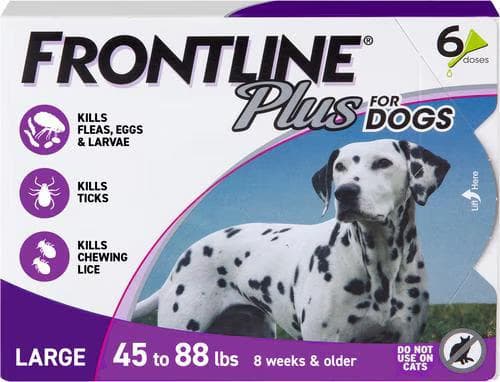
A monthly topical spot-on for large dogs 45 to 88 lbs that kills fleas, ticks, and chewing lice. A waterproof pick for dogs who do better with a topical than an oral chew.
Petful may earn a commission when you click through to Chewy, at no extra cost to you.
- Under 4 weeks: no flea products of any kind; use the comb-and-bath protocol below and call your veterinarian
- 4 to 6 weeks: Capstar (nitenpyram) only, and only if the puppy weighs at least 2 lbs; flea treatment for puppies under 6 weeks should always involve a vet call first
- 7 weeks: Advantage II (from 3 lbs) and the Seresto collar become options
- 8 weeks: Frontline Plus (from 5 lbs) and prescription NexGard (from 4 lbs) join the list
- 12 weeks and up: flea treatment for puppies under 12 weeks is the tricky window; flea treatment for puppies 3 months old and beyond is nearly unrestricted as long as the weight minimum is met

 Sponsored
Need flea, tick, or parasite care for your dog?
A licensed vet at Dutch can recommend the right preventive and prescribe it when it's appropriate. Annual members get 20% off their first flea and tick order.
Use code Pets60
Plans start at $12/month · covers up to 5 pets
- Licensed vets in most states
- Rx for 150+ conditions
- 4.7 on Trustpilot
The best flea treatments for puppies, by age and weight
The best flea treatment for puppies is the one your puppy is actually eligible for, so this roundup leads with the numbers instead of burying them. The eligibility table below maps each pick's minimum age and minimum weight at a glance; the write-ups that follow cover speed, coverage, and the safety caveats that matter for small bodies.
| Product | Type | Minimum age | Minimum weight | Speed of action |
|---|---|---|---|---|
| Capstar (nitenpyram) | Oral tablet, OTC | 4 weeks | 2 lbs | Starts killing adult fleas in about 30 minutes |
| Advantage II | Monthly topical, OTC | 7 weeks | 3 lbs | Kills fleas within 12 hours |
| Seresto | Collar, OTC | 7 weeks | No label minimum, fit-dependent | Kills and repels within 24 to 48 hours |
| Frontline Plus | Monthly topical, OTC | 8 weeks | 5 lbs | Kills fleas within 12 to 24 hours |
| NexGard | Monthly chewable, Rx | 8 weeks | 4 lbs | Starts killing within 4 to 8 hours |
Capstar (nitenpyram): fastest OTC relief from 4 weeks and 2 lbs
Capstar is the earliest product a puppy can legally have and the fastest to act: the nitenpyram tablet starts killing adult fleas within about 30 minutes and works for roughly 24 hours. The 11.4 mg tablet covers the 2-25 lb dosing band, which fits almost every puppy, and the label allows a repeat dose once daily if fleas keep jumping back on.
The trade-off is that Capstar has no residual effect. Treat it as a rescue tool for a flea-covered puppy, then move to a monthly preventive as soon as your puppy meets one of the eligibility lines below.
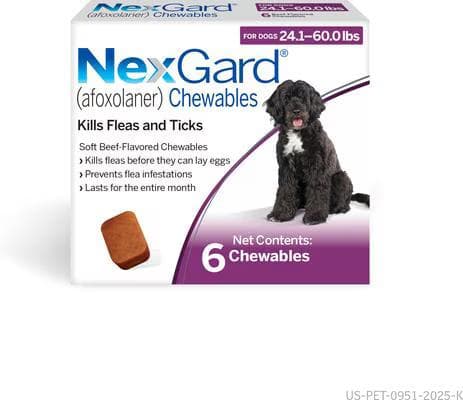
A monthly beef-flavored prescription chew (afoxolaner) that kills fleas before they lay eggs and kills ticks. A popular oral pick for dogs who do better with a chew than a topical.
Petful may earn a commission when you click through to Chewy, at no extra cost to you.
Advantage II: monthly topical from 7 weeks and 3 lbs
Advantage II combines imidacloprid, which kills adult fleas within 12 hours, with pyriproxyfen, an insect growth regulator that stops eggs and larvae from developing. The small-dog version is labeled from 7 weeks of age and 3 lbs, one of the lowest weight minimums of any monthly topical, which makes it a strong fit for toy breeds.
Note that it treats fleas only. If ticks are a concern in your area, pair it with tick checks or choose a combination product once your puppy is old enough.
Seresto collar: up to 8 months of protection from 7 weeks
The Seresto collar releases imidacloprid and flumethrin slowly through the skin's oils and protects for up to 8 months, killing and repelling fleas within the first 24 to 48 hours of wear. It is labeled for puppies 7 weeks and older with no stated weight minimum, but fit does the work: you should be able to slide two fingers under the collar, and a fast-growing puppy needs that fit rechecked weekly.
Like all flea collars and topicals, Seresto is regulated by the EPA rather than the FDA, and the small-dog size is the correct choice for any puppy.
Frontline Plus: flea and tick topical from 8 weeks and 5 lbs
Frontline Plus pairs fipronil, which kills adult fleas within 12 to 24 hours, with (S)-methoprene, a growth regulator that breaks the flea life cycle at the egg and larval stages. It also covers ticks and chewing lice, which most puppy-eligible OTC options do not.
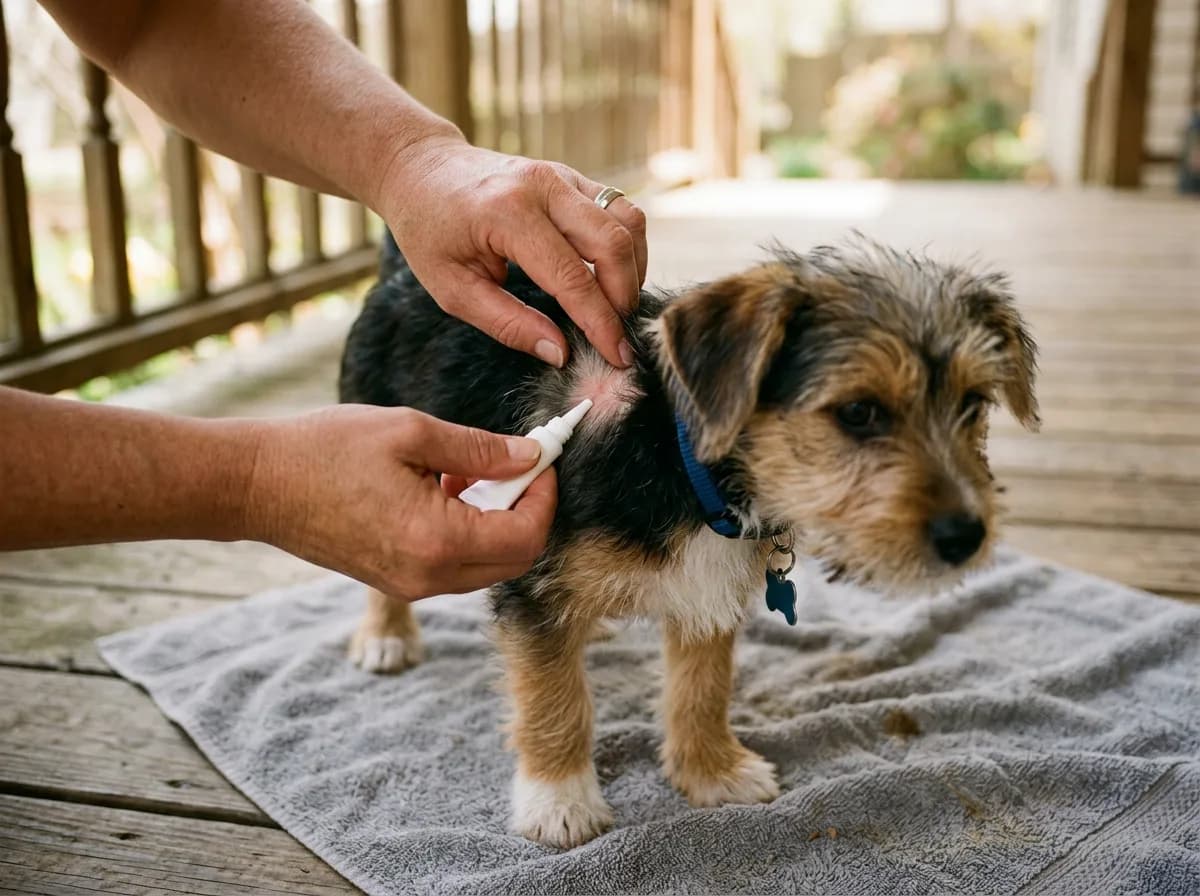
The catch for small puppies is the weight line: the smallest dose band starts at 5 lbs, so a tiny 8 week old may need Advantage II or a vet-guided alternative until they grow into it. Apply the full pipette directly to the skin between the shoulder blades, where the puppy cannot lick it.
NexGard: prescription chewable from 8 weeks and 4 lbs
NexGard (afoxolaner) is a monthly beef-flavored chew that starts killing fleas within 4 to 8 hours and also covers several tick species. It is labeled from 8 weeks of age and 4 lbs, and it requires a vet prescription, which is a feature rather than a hassle for a puppy: your veterinarian confirms the age, the weight, and the health history before the first dose.
NexGard belongs to the isoxazoline class, and the FDA has flagged that class for rare neurologic side effects. I do not prescribe isoxazolines for puppies with any history of seizures or tremors; the full caution is in the safety section below.
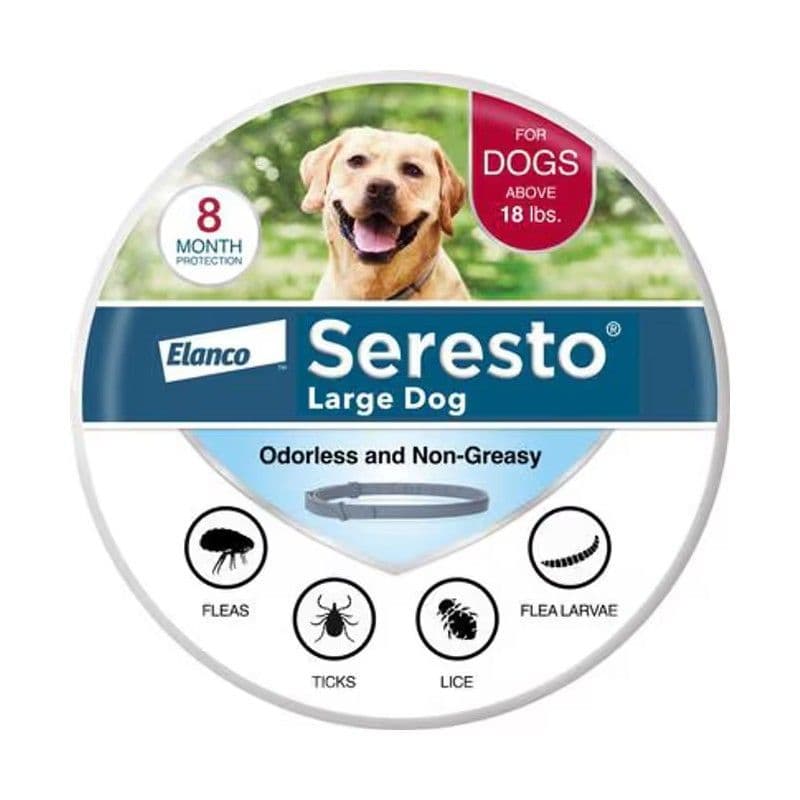
Odorless, non-greasy 8-month flea and tick collar for dogs over 18 lbs that kills and repels fleas and ticks and also kills lice and flea larvae.
Petful may earn a commission when you click through to Chewy, at no extra cost to you.
Weight-band safety: small-dog dosing dangers

Puppy flea treatment by weight is where most poisonings start, because topical doses are calibrated to the weight band printed on the box, not to common sense. Flea treatment for puppies under 5 lbs is genuinely limited: Capstar from 2 lbs, Advantage II from 3 lbs, NexGard from 4 lbs by prescription, and Seresto by fit. Flea treatment for small dogs follows the same rule even in adulthood: the label band is the dose, full stop.
These are the mistakes that put puppies in emergency rooms:
- Never split an adult dose. The active ingredient is not evenly distributed through a topical tube, so "half a pipette" can deliver a full overdose
- Never use a higher weight band because the store was out of the small size; wait or choose a different product
- Never use dog products on cats or cat products on dogs. Dog-only topicals such as K9 Advantix II contain permethrin, which is toxic to cats; in a cat household, keep the cat away from a treated puppy until the application is fully dry
- Never stack two products (for example, a collar plus a topical) without your veterinarian's explicit sign-off
- Re-weigh before every dose. A growing puppy can cross into the next weight band in a single month
- Isoxazoline products, including NexGard, Simparica, Bravecto, and Credelio, have been associated with muscle tremors, ataxia, and seizures in some dogs, including dogs with no prior neurologic history. Tell your veterinarian about any seizure or tremor history before starting a puppy on this class.
The FDA's animal drug safety communications on the isoxazoline class are published at fda.gov/animal-veterinary, and they are worth a read before your puppy's first prescription chew.
 Sponsored
Vet care that's always there
Unlimited video calls and messaging with licensed vets for less than a typical vet visit. One membership covers up to five pets.
Use code Pets60
Plans start at $12/month · covers up to 5 pets
- Licensed vets in most states
- Rx for 150+ conditions
- 4.7 on Trustpilot
What kills fleas on puppies fast?
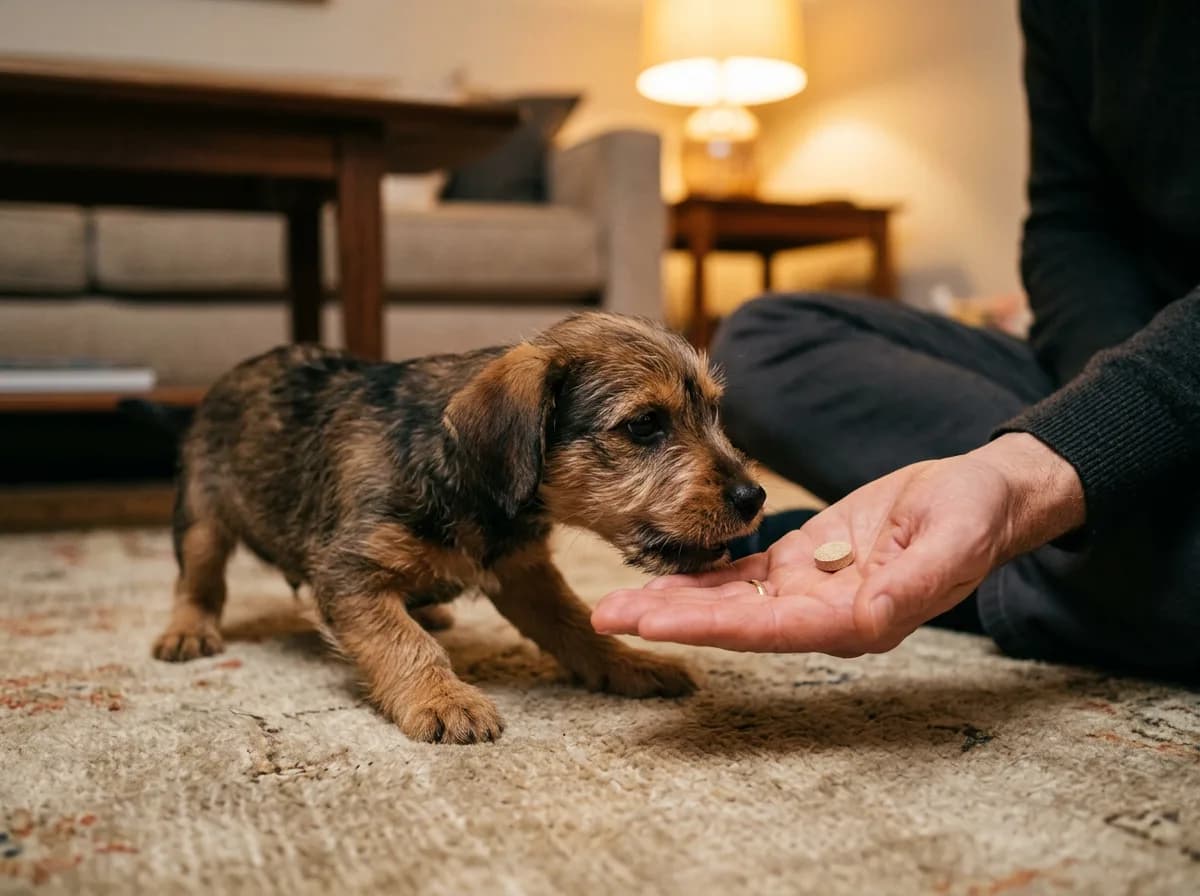
A nitenpyram tablet (Capstar) kills adult fleas faster than anything else a puppy can safely have: it starts working within about 30 minutes, and most fleas on the puppy are dead within a few hours. It lasts only about 24 hours, so it is a rescue treatment, not prevention.
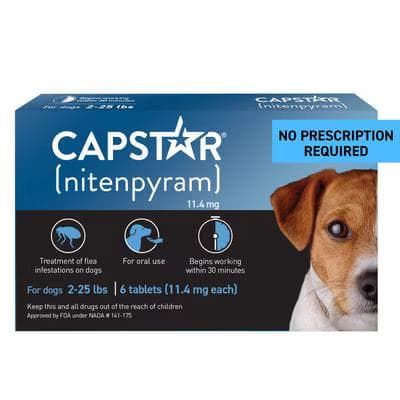
An over-the-counter nitenpyram tablet that starts killing adult fleas within 30 minutes. A fast knockdown for an active infestation, no prescription required, useful alongside a longer-term preventive.
Petful may earn a commission when you click through to Chewy, at no extra cost to you.
Fast-kill is the right tool in exactly two situations: a heavy infestation on an eligible puppy, and a newly adopted puppy carrying fleas into your home. A fast acting flea treatment for puppies buys you a clean 24 hours to bathe, comb, and start a monthly preventive. For a puppy too young for tablets, a warm bath with mild shampoo followed by a fine-toothed flea comb removes live fleas mechanically almost as fast. For the adult dogs in the household, see what kills fleas on dogs instantly.
- Killing the adult fleas on your puppy solves about 5 percent of the problem. The eggs, larvae, and pupae in your carpets and bedding will keep reseeding the coat until the environment is treated too.
How often to treat puppies for fleas
How often do you treat puppies for fleas? For every monthly preventive in this roundup (Advantage II, Frontline Plus, NexGard), the answer is every 30 days, and the Seresto collar is replaced every 8 months. Capstar is the exception: the label allows one tablet daily as needed, because it clears in about a day.
How often can you give a puppy flea treatment beyond the label interval? You cannot. Re-dosing a topical early because you still see fleas is the second most common product misuse I see after dose-splitting. Instead, follow these rules:
- Re-weigh your puppy before every monthly dose and move up a band only when the label says so
- Mark the dosing date and re-dose on schedule, not when you spot a flea
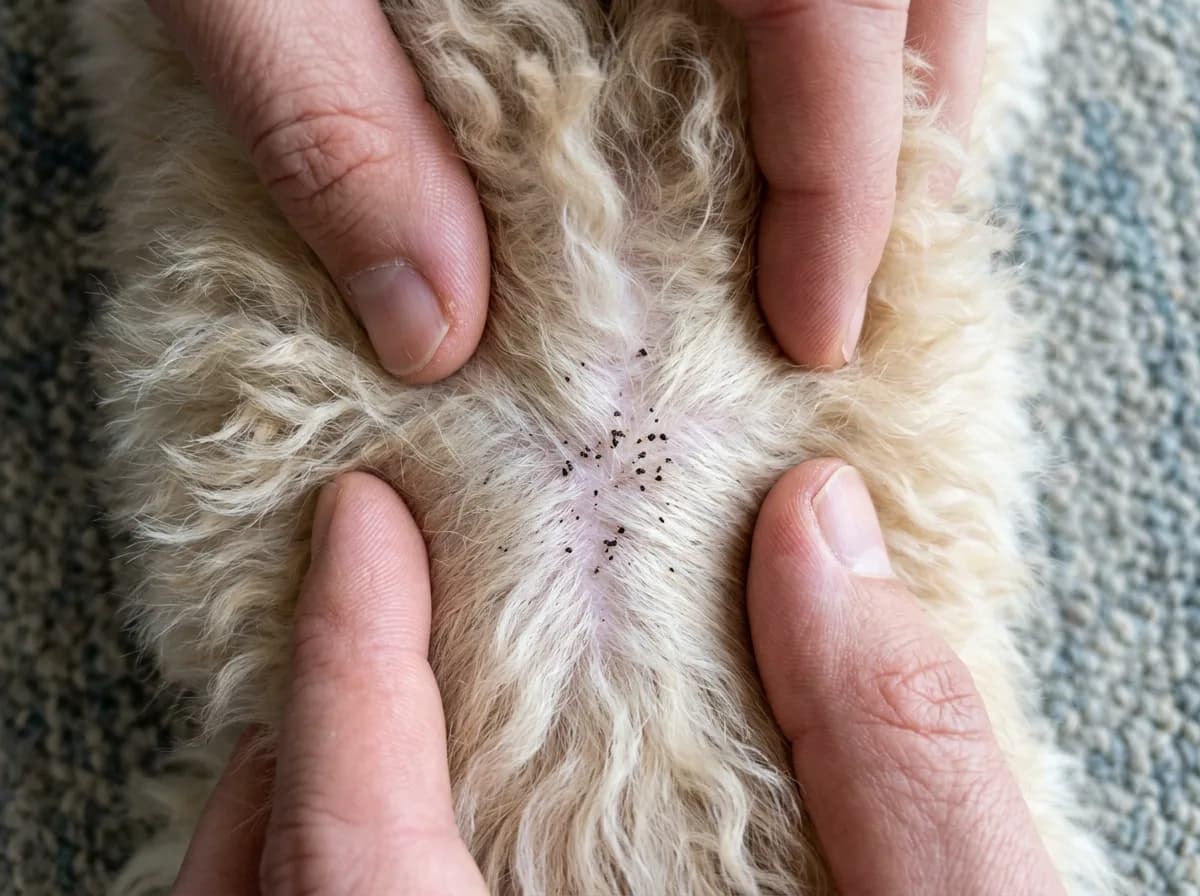
- If you still see fleas 24 to 48 hours after a correctly applied dose, treat the environment: hot-wash bedding, vacuum daily for 2 weeks, and treat every pet in the home
- If fleas persist past 3 to 4 weeks of correct use, call your veterinarian to rule out application errors or reinfestation from an untreated source
CAPC's flea guidelines, published at capcvet.org, back year-round prevention because pupae in the home can keep emerging for weeks after the pet is treated. Consistency is the whole game, and it is easy to lose track across products with different intervals; a free MyPetID profile lets you log each flea treatment, the dosing frequency, and automatic reminders for the next dose so a growing puppy never misses a window.
Too young for treatment? What to do for puppies under 8 weeks
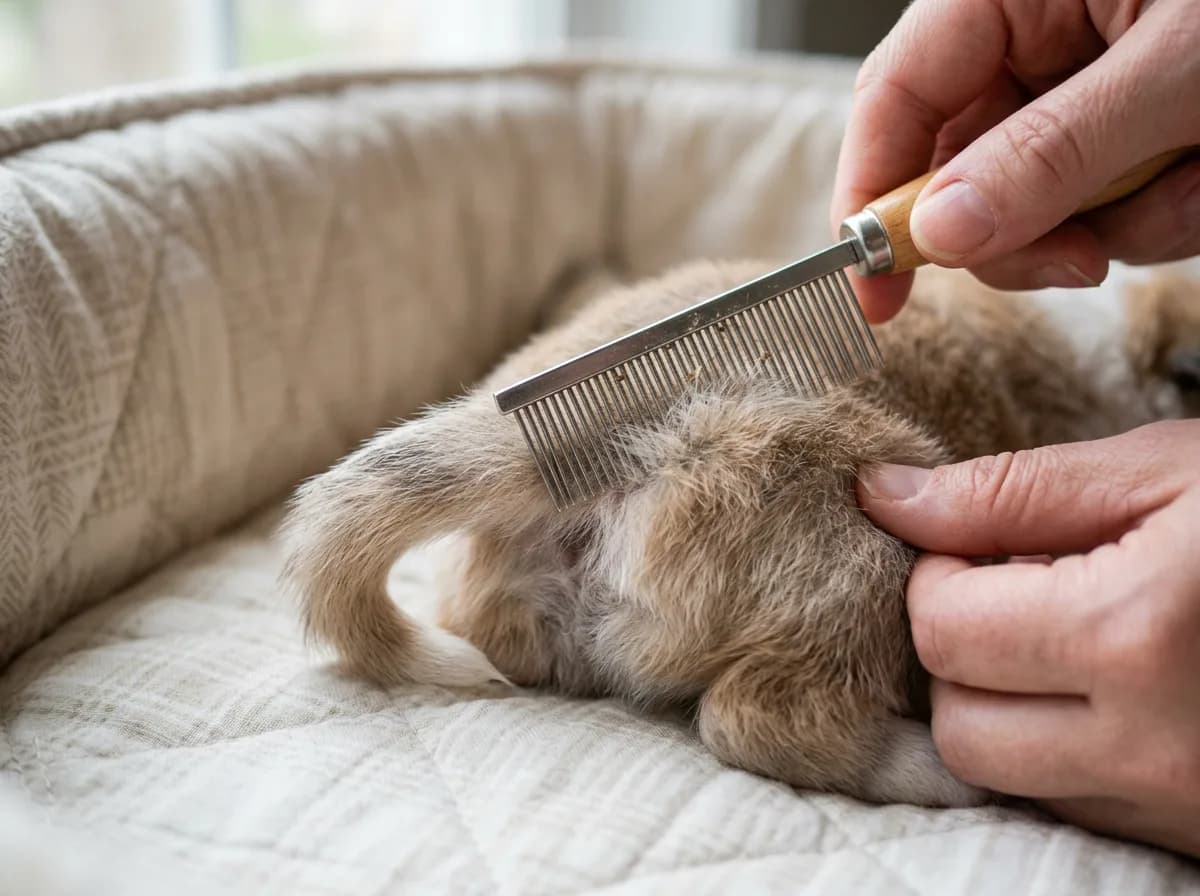
How do I treat my 8 week old puppy for fleas, or a younger one? At exactly 8 weeks, most products above become available if the weight minimum is met. Flea treatment for puppies under 8 weeks means mechanical control, not products: no monthly preventive is labeled this young, and none at all under 6 weeks. That leaves flea-bite anemia as the real danger. Per the Merck Veterinary Manual (merckvetmanual.com), heavy flea burdens can cause life-threatening blood loss in very young animals.
Here is the safe, product-free protocol I give breeders and foster homes:
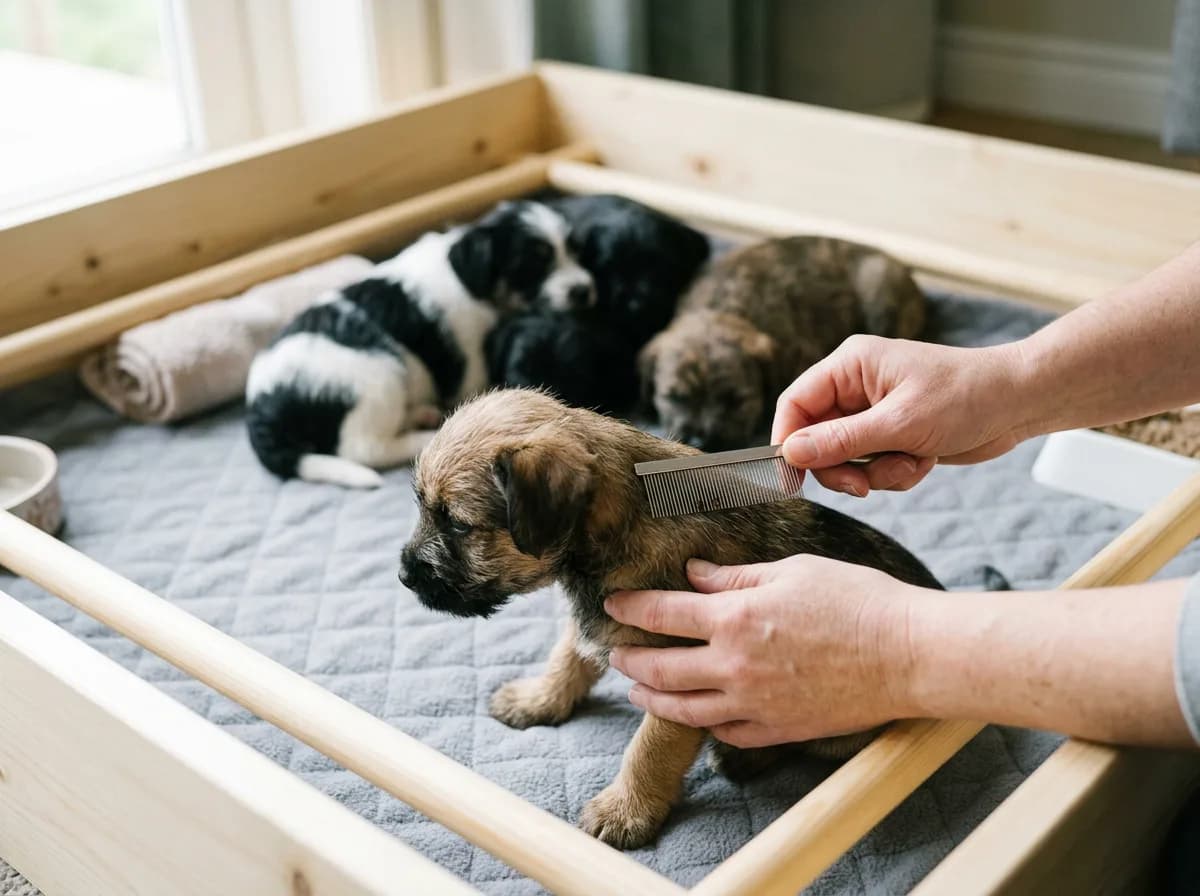
- Flea comb twice daily. Work a fine-toothed flea comb through the coat, concentrating on the neck, groin, and tail base, and dip the comb in warm soapy water between strokes to drown captured fleas
- Give a warm bath with a mild shampoo. Plain puppy shampoo or a fragrance-free gentle dish soap drowns most remaining fleas; keep the water warm, work quickly, and towel-dry thoroughly so the puppy does not chill
- Treat the mother. A nursing dam can safely wear an age-appropriate preventive chosen with your vet, and clearing her fleas stops the litter from being constantly reseeded
- Treat the environment. Hot-wash all bedding, vacuum floors and furniture daily, and discard the vacuum contents outside, because 95 percent of the infestation lives off the puppy
- Call your veterinarian and check the gums. Pale gums in a flea-infested young puppy suggest anemia and are an emergency, not a wait-and-see
Repeat the comb-and-bath cycle daily until the puppy reaches a product's minimum age and minimum weight, then transition to a labeled preventive.
What about kittens?
Kittens are not small puppies: several dog ingredients, permethrin above all, are toxic to cats at any dose, so nothing in this roundup should ever touch a kitten. Age and weight minimums, safe ingredients, and a too-young protocol for cats are covered in our dedicated guide to kitten flea treatment.
When your puppy grows up: adult dog options
Once your puppy is past roughly 6 months and well over every weight minimum, the full adult market opens up, including some stronger OTC combinations that never made this puppy-safe list. Our roundup of flea medicine for dogs without a prescription ranks every worthwhile OTC flea treatment for dogs by value and coverage.
Looking for the safest option overall?
If your question is less "what can my puppy have" and more "what is the gentlest choice for any dog," that is its own ranking with different criteria, including ingredient safety records and side-effect profiles across breeds. We keep that analysis current in our guide to the safest flea treatment for dogs.
Natural and home remedies: proceed with caution
Natural flea treatment for puppies sounds gentler, but puppies are the worst candidates for DIY flea control: essential oils, garlic, and undiluted vinegar rinses have all injured young dogs, and none has evidence behind it beyond the mechanical comb-and-bath steps already in the under-8-weeks protocol. If you want to know which gentle approaches actually help and which are dangerous, our guide to home remedies for fleas separates the two.
Most medicated flea shampoos are labeled for 12 weeks and older. For younger puppies, a warm bath with mild puppy shampoo plus a flea comb removes fleas mechanically without pesticide exposure.
Only nitenpyram (Capstar) is labeled that young, from 4 weeks and 2 lbs, and I still recommend a vet call first. All monthly preventives start at 7 to 8 weeks.
No. Topical doses are not evenly distributed through the tube, so a split dose can deliver a concentrated overdose to a small body. Buy the correct weight band every time.
Yes. CAPC recommends year-round control because fleas survive indoors in heated homes all winter, and pupae in carpets can emerge for weeks after you stop seeing adults.
BVMS, MRCVS
Dr. Pippa Elliott, BVMS, MRCVS, is a veterinarian with nearly 30 years of experience in companion animal practice. Dr. Elliott earned her Bachelor of Veterinary Medicine and Surgery from the University of Glasgow. She was also designated a Member of the Royal College of Veterinary Surgeons. Married with 2 grown-up kids, Dr. Elliott has a naughty Puggle named Poggle, 3 cats and a bearded dragon.
Sign up for expert-backed reviews and safety alerts all in one place.