Scottish Fold Colors: Every Coat Color and Pattern, With Pictures
A complete visual guide to Scottish Fold colors: the full color and pattern chart, popular shades like blue, white, black, and chocolate, eye colors, the rarest colors, and the long-haired Highland Fold, plus the honest note on color and health.
Petful is reader supported. As an affiliate of platforms like Amazon and Chewy, we may earn a commission when you buy through links on this page. There is no extra cost to you.
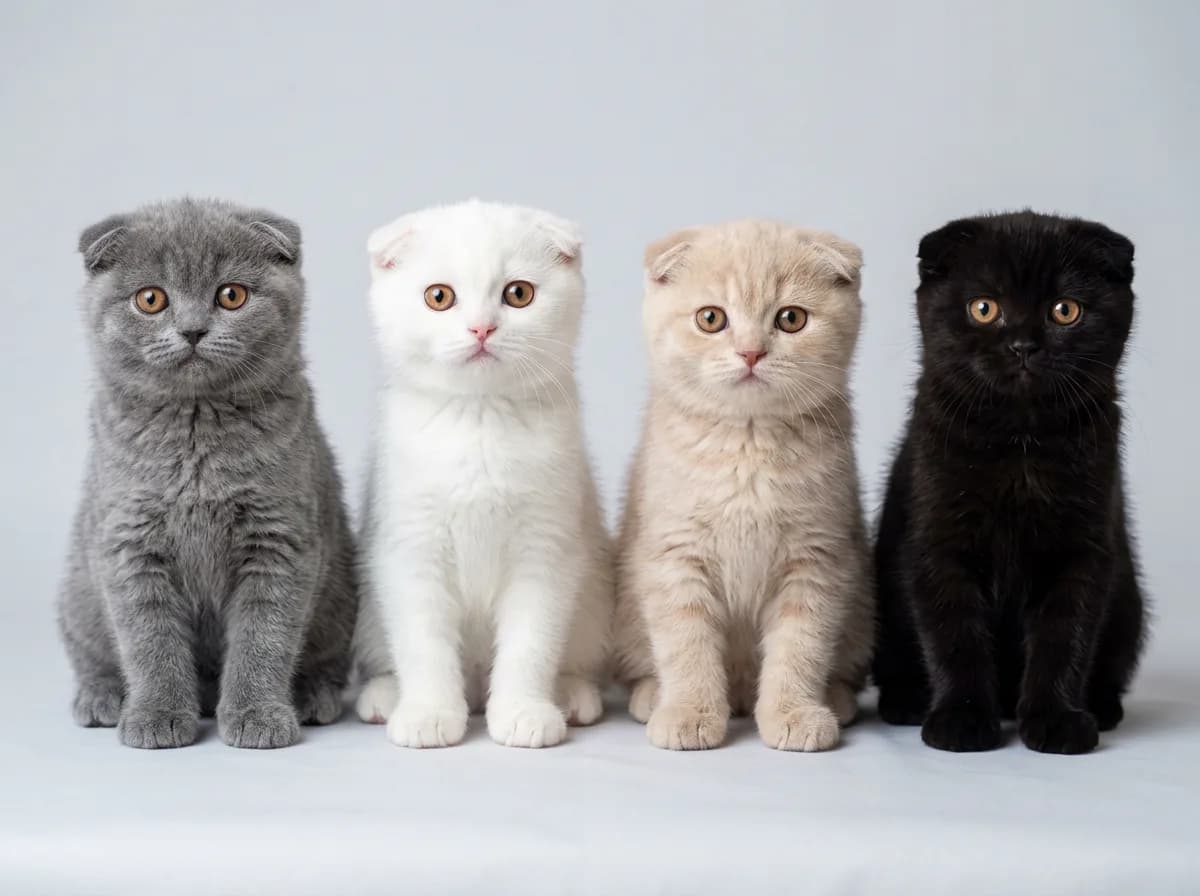
Scottish Fold colors span nearly the entire feline rainbow: the Cat Fanciers' Association (CFA) recognizes this breed in well over 60 color and pattern combinations, from solid blue and white to tabby, tortoiseshell, calico, smoke, silver, and colorpoint, in both short hair and the long-haired Highland Fold. Whatever color you picture, a Scottish Fold almost certainly comes in it. Below is the full chart, a gallery of the most popular shades (blue, the iconic grey fold, leads), the eye colors that pair with each coat, and an honest note on what color does and does not change about this breed.
- 1Scottish Folds come in almost every color and pattern, in both short hair and long hair (the Highland Fold).
- 2Blue (grey) is the most iconic and most-searched color; white, black, and chocolate are also hugely popular.
- 3The rarest colors are chocolate, lilac, cinnamon, and fawn, because those genes are uncommon in the breed's foundation lines.
- 4Eye color follows coat color: most Folds have copper or gold eyes, white and bicolor Folds can have blue or odd eyes, and silver or golden Folds have green eyes.
- 5Color is purely cosmetic: every Scottish Fold, in every color, still carries osteochondrodysplasia, the cartilage condition behind the folded ears.

Sign up for expert-backed reviews and safety alerts all in one place.
How Many Colors Do Scottish Folds Come In?
The honest short answer is: almost all of them. Because the Scottish Fold descends from ordinary farm cats (it began in 1961 with a white barn cat named Susie in Tayside, Scotland) and is still outcrossed to British Shorthairs and American Shorthairs, the breed carries a huge range of color genes. Both the CFA and TICA accept the Scottish Fold in essentially every recognized coat color and pattern, across the solid, tabby, particolor, shaded, smoke, and pointed divisions, and in both coat lengths.
That means you will find Scottish Folds described in five big buckets:
- Solid colors: white, black, blue (grey), red (ginger), cream, and the rarer chocolate, lilac, cinnamon, and fawn.
- Tabby patterns: classic (blotched), mackerel, spotted, and ticked, in brown, blue, red, silver, and cream.
- Tortoiseshell, calico, and bicolor: any solid or tabby color combined with red, cream, or white.
- Shaded, smoke, and silver: chinchilla silver, shaded silver, chinchilla golden, shaded golden, shell and shaded cameo, and the smoke colors.
- Colorpoint: a Siamese-style pattern (darker ears, mask, legs, and tail) accepted in some registries.
Color and pattern do not affect a Scottish Fold's temperament, and they do not change the breed's built-in health picture (more on that below). They are a matter of looks and, sometimes, price. If you like comparing feline palettes, the breakdown of Persian cat colors follows the same naming system (blue, cream, chocolate, calico, and so on) used here.

Never Scoop Again® with the Whisker Litter-Robot, the smart self-cleaning automatic litter box. Monitor visits and track weights for better overall care in the Whisker® app. Multi-cat friendly.
Petful may earn a commission when you click through to Whisker, at no extra cost to you.
- "Scottish Fold" describes the folded ears and round build, not the coat. A blue Fold, a calico Fold, and a chocolate Highland Fold are all the same breed with the same sweet, placid temperament. Color is just the paint job.
Scottish Fold Color Chart
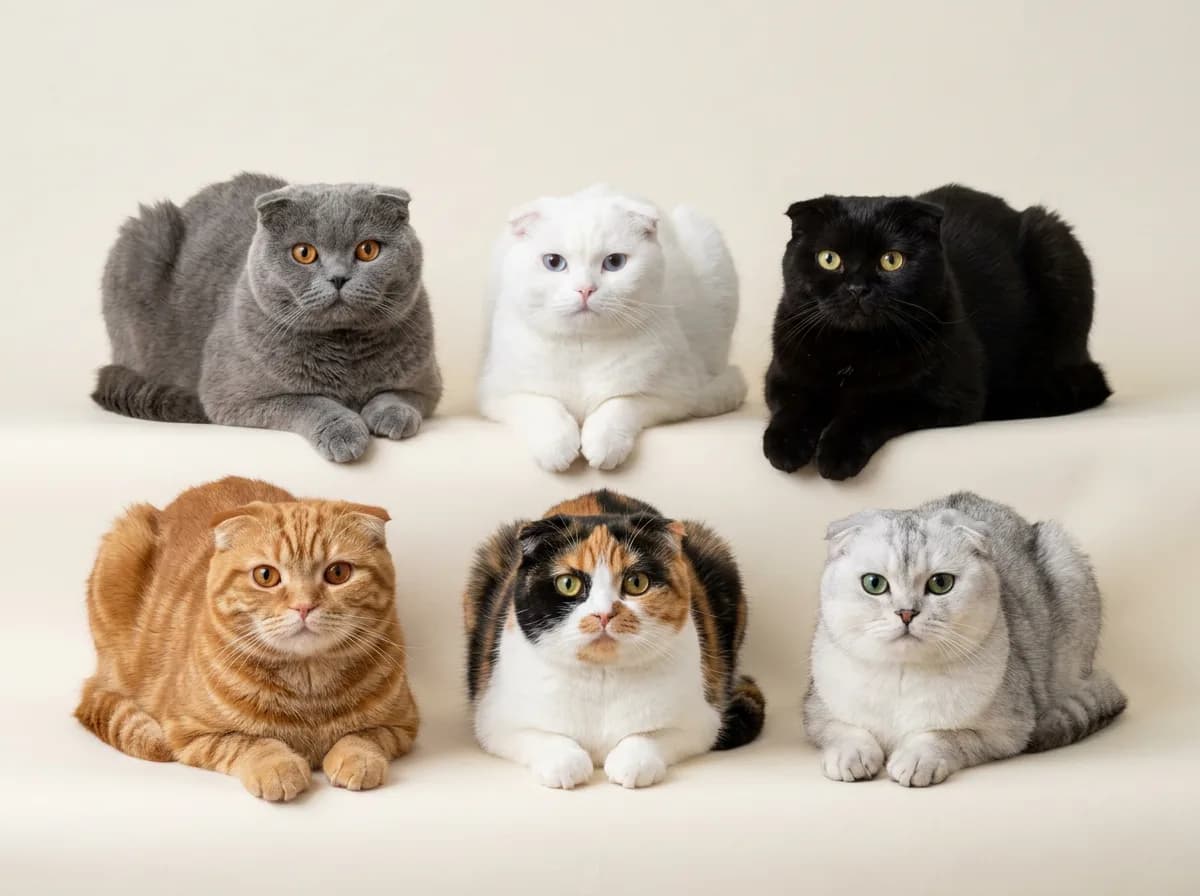
Here is the at-a-glance reference for the most common Scottish Fold colors and the eye, nose, and paw coloring that typically goes with each, drawn from the CFA breed standard. Use it to identify a cat or to picture a litter.
| Color or Pattern | What It Looks Like | Typical Eye Color | How Common |
|---|---|---|---|
| Blue (grey) | Solid bluish-grey from roots to tip, the classic "grey fold" | Copper or gold | Very common, most popular |
| White | Pure glistening white, no other color | Blue, copper, gold, or odd-eyed | Common |
| Black | Dense coal black, sound to the roots | Copper or gold | Common |
| Red (ginger) | Warm orange, usually with faint tabby ghost markings | Copper or gold | Common |
| Cream | Pale, buff dilute of red | Copper or gold | Fairly common |
| Chocolate | Rich chestnut brown throughout | Copper or gold | Rare |
| Lilac | Frosty pinkish-grey (dilute chocolate) | Copper or gold | Rare |
| Cinnamon / Fawn | Warm reddish-brown / pale dilute of cinnamon | Copper or gold | Very rare |
| Tabby | Classic, mackerel, spotted, or ticked stripes | Copper or gold (green on silver) | Very common |
| Tortoiseshell | Mottled black and red (or blue and cream) | Copper or gold | Common (mostly females) |
| Calico | Tortoiseshell plus large white patches | Copper or gold | Common (mostly females) |
| Silver / Chinchilla | White undercoat tipped with black or gold | Green or blue-green | Uncommon, prized |
| Colorpoint | Pale body, darker ears, face, legs, and tail | Blue | Uncommon |
Blue (Grey) Scottish Fold: The Iconic One
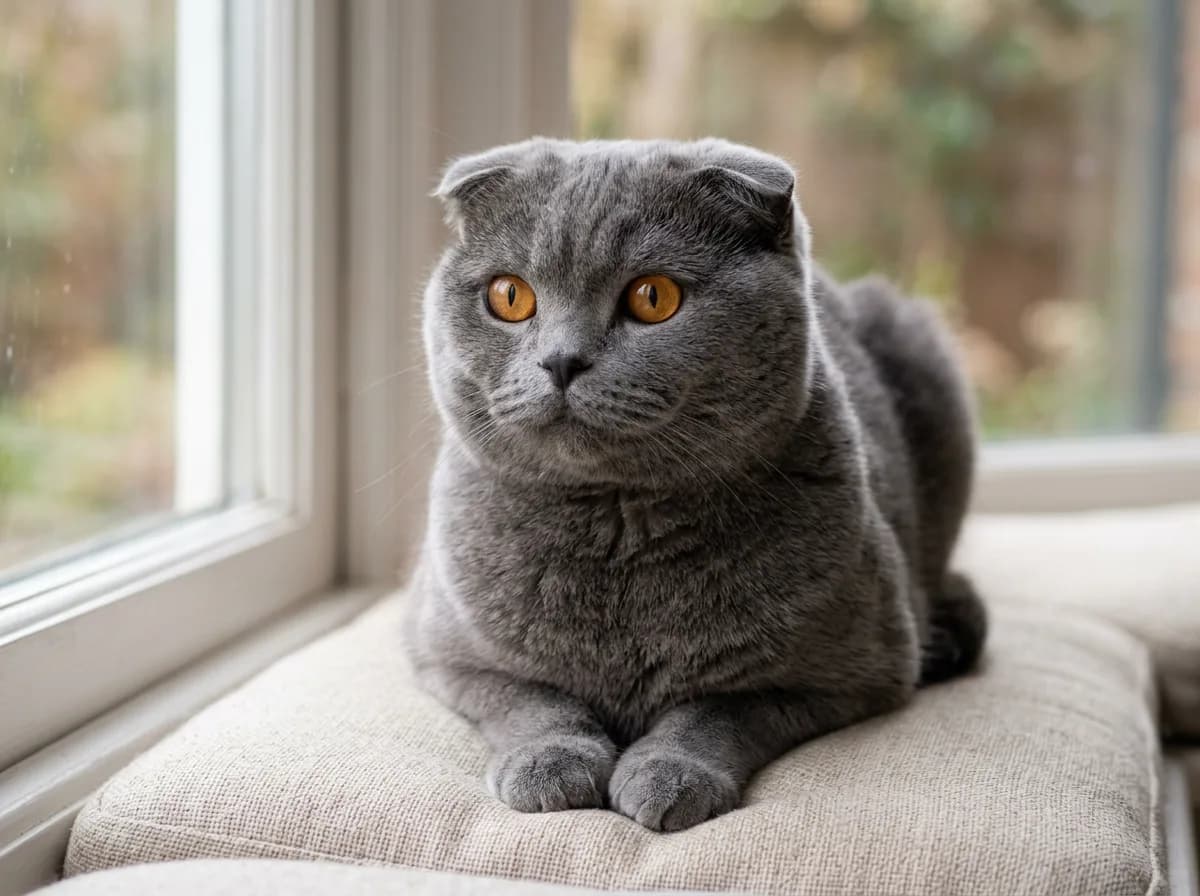
When most people picture a Scottish Fold, they picture a blue one. "Blue" in cat terms means a soft, even bluish-grey, and the blue Scottish Fold (often just called the grey fold) is the breed's signature look: a plush grey coat, a round owl-like face, and large copper or gold eyes. It is by far the most searched color, and the page you are reading already ranks at the top for it.
Blue is a dilute of black, so blue Folds come from the same color family as black ones and are widely available from breeders. Their nose leather and paw pads are a matching blue-grey. The same bluish-grey coat is the calling card of the British Shorthair, the round, plush breed the Scottish Fold was largely built on, so a blue Fold and a "British Blue" share more than a color. A blue Highland Fold (the long-haired version) trades the sleek plush coat for a soft, flowing one but keeps the same grey color and sweet expression.
- There is no separate "grey Scottish Fold" color. What casual buyers call grey is officially called blue. If a listing says grey, blue, or even "Russian blue color," they all mean the same soft bluish-grey coat.
White Scottish Fold
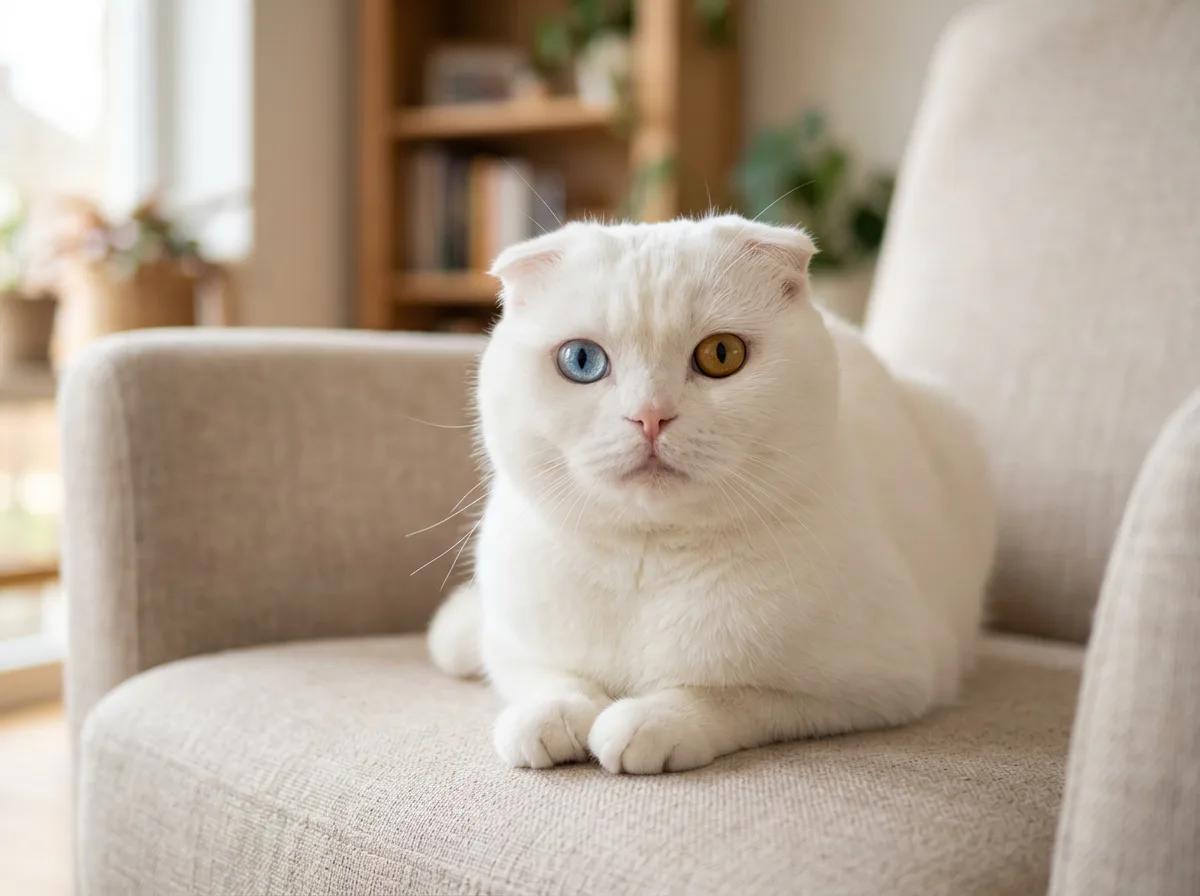
The white Scottish Fold is pure, glistening white with no other color in the coat. White is the color of Susie, the founding cat of the whole breed, so it has a special place in Scottish Fold history. White Folds have pink nose leather and paw pads, and they are the one color where blue eyes are common: a white Fold may have blue eyes, gold or copper eyes, or odd eyes (one blue and one gold), which is called heterochromia.

Petful may earn a commission when you click through to Chewy, at no extra cost to you.
White is a masking gene, so a "white" Fold is genetically another color underneath with the white simply covering it. That is why white Folds can produce kittens of many other colors.
Black Scottish Fold
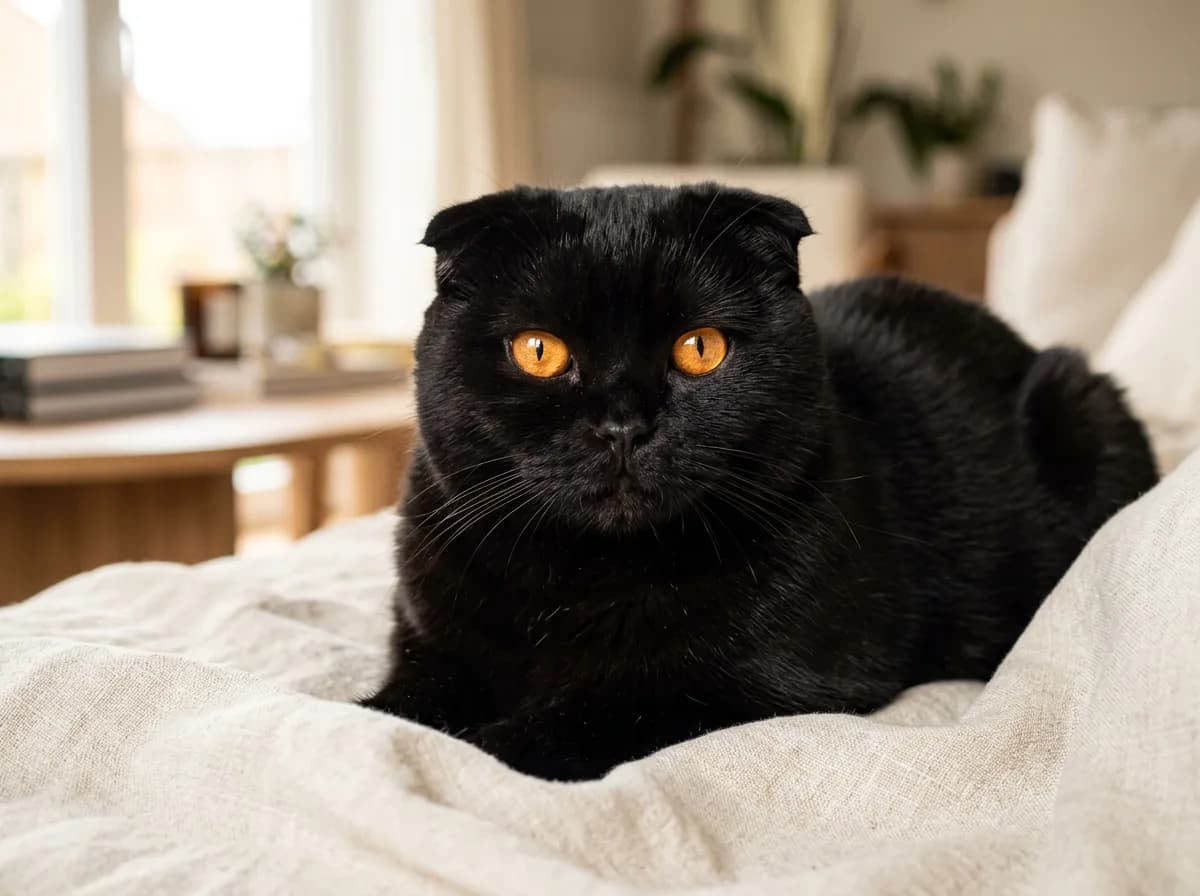
The black Scottish Fold is dense, solid coal black from root to tip, with black or brown nose leather and black paw pads, and copper or gold eyes. It is one of the most popular and most photographed Scottish Fold colors, partly because the deep black coat makes the round folded ears and big eyes stand out so dramatically.
A close cousin is the black smoke Fold, which looks solid black in repose but reveals a white undercoat when it moves, giving a shimmering effect.
Chocolate Scottish Fold (and Lilac)
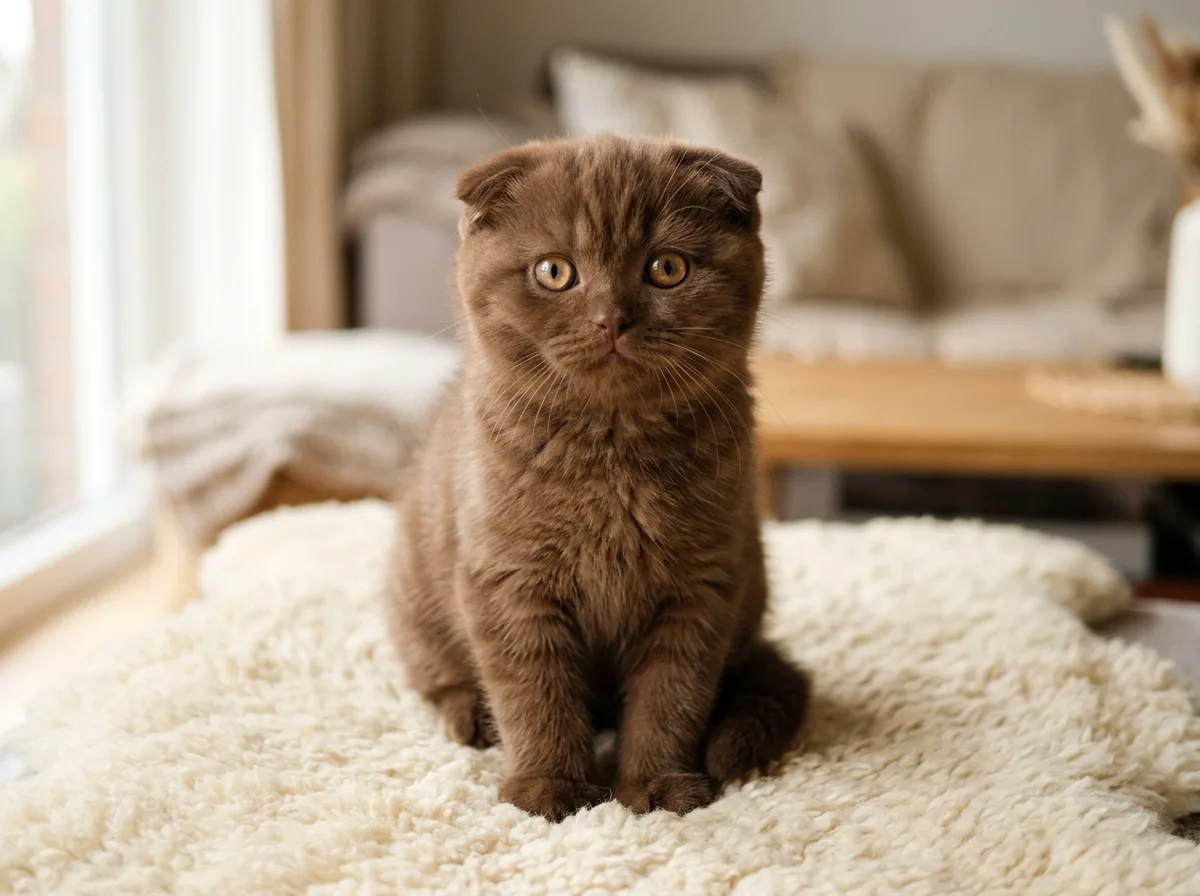
The chocolate Scottish Fold is one of the rarest and most coveted colors: a rich, warm chestnut brown all over, with brown nose leather and copper or gold eyes. Chocolate is genuinely uncommon because the chocolate gene is recessive and not widely present in Scottish Fold lines, so breeders who produce it often charge a premium and advertise it as a "rare color." A common point of confusion (you will see it asked on forums) is that a dark chocolate kitten can look almost black in some light, but a true chocolate has a clear warm brown tone in daylight.
Lilac is the dilute of chocolate: a delicate, frosty pinkish-grey. It is equally rare and equally prized. Both chocolate and lilac also appear in pointed and tabby versions.

63-inch multi-level cat tree with scratch posts, hammock, plush perches, and dangling toys. Vertical territory is non-negotiable for high-energy climbing breeds like the Bengal.
Petful may earn a commission when you click through to Chewy, at no extra cost to you.
- Chocolate, lilac, cinnamon, and fawn Folds command higher prices for their scarcity, but a rare coat color does not make a cat healthier. Every one of them still inherits osteochondrodysplasia along with the fold. Pay for a responsible breeder and health screening, not for a color label.
Cream and Red (Ginger) Scottish Fold
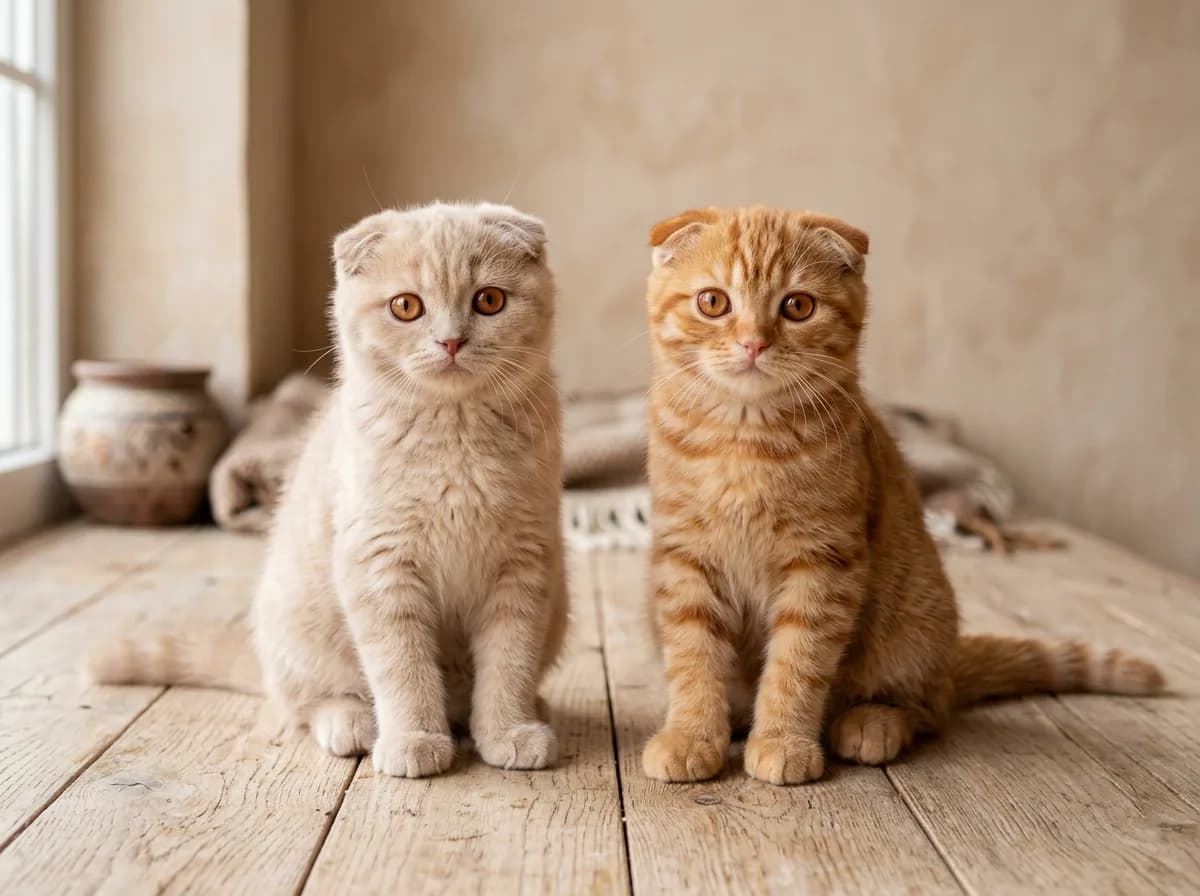
The red Scottish Fold (most people call it ginger or orange) is a warm, rich orange. Because of how the red gene works, nearly all red Folds show at least faint tabby "ghost" markings even when they are meant to be solid, so a truly clear solid red is uncommon. Cream is the dilute of red: a soft, pale buff that looks like a watered-down ginger. Both have copper or gold eyes and pink or brick-colored noses, and both are popular, cheerful-looking coats.
Tabby Scottish Fold
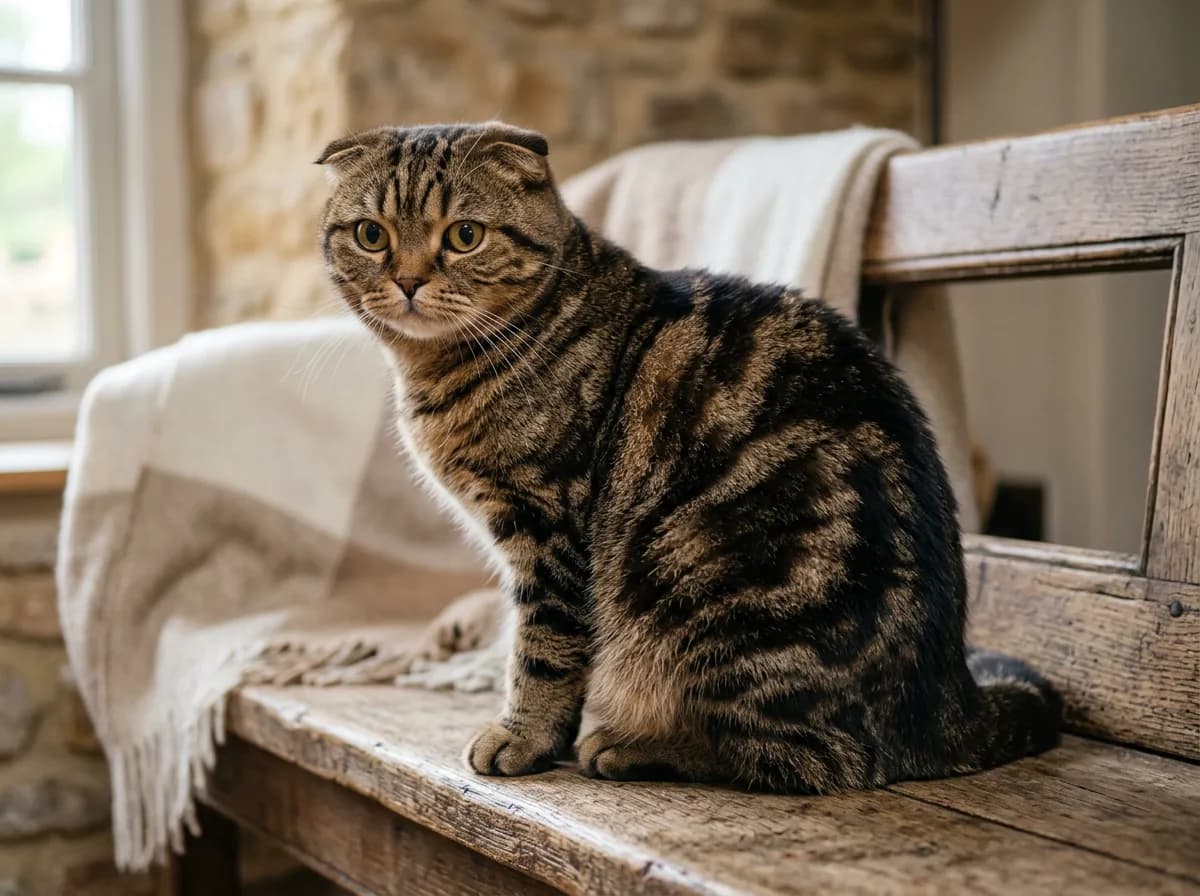
Tabby is a pattern, not a single color, and it is one of the most common ways a Scottish Fold's coat shows up. Tabby Folds come in four pattern types: classic (bold swirls and a "bullseye" on the flank), mackerel (narrow vertical stripes like a fishbone), spotted (broken stripes that form spots), and ticked (color banded on each hair, with little patterning on the body). Tabbies appear in brown, blue, red, cream, and silver, and a silver tabby Fold often has the breed's striking green eyes rather than copper.
Tortoiseshell and Calico Scottish Fold
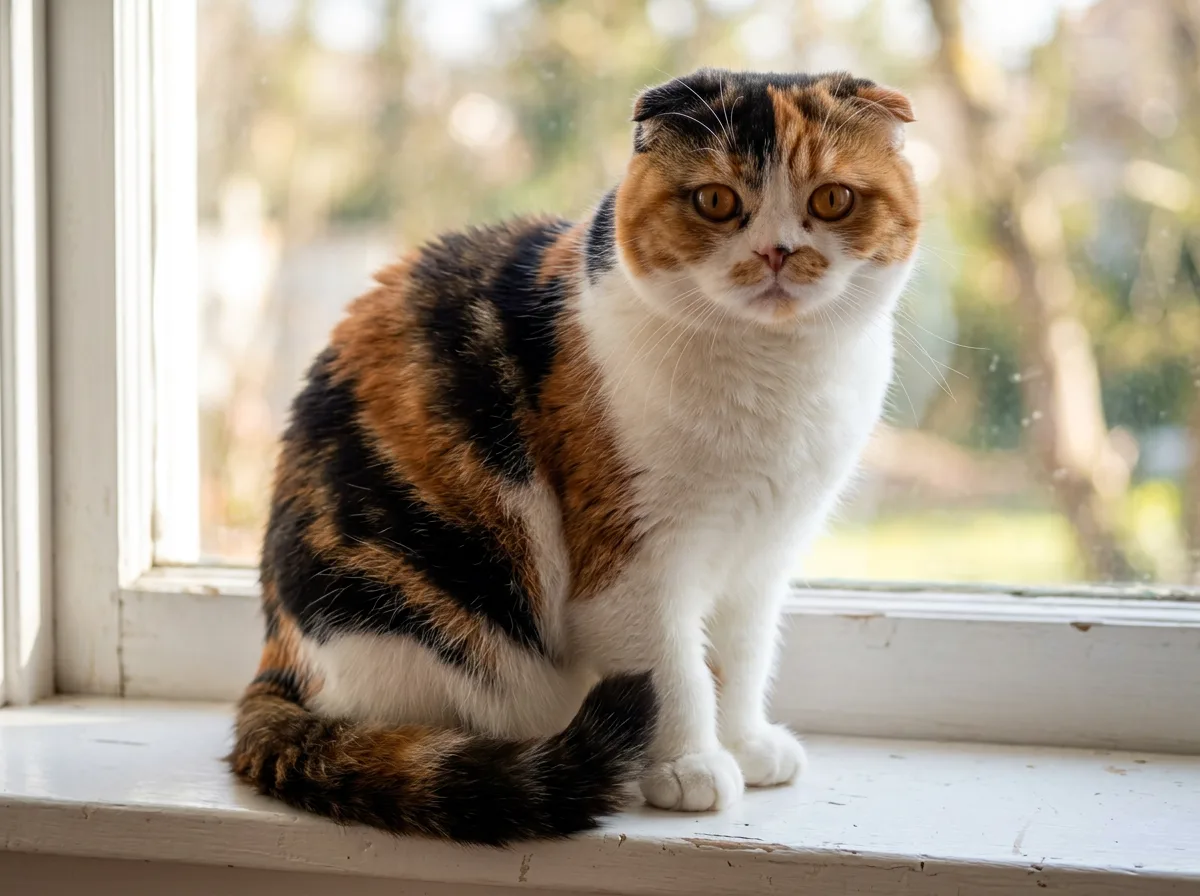
A tortoiseshell Scottish Fold (a "tortie") has a mottled, marbled mix of black and red, or in the dilute version, blue and cream (a "blue-cream"). A calico is a tortie plus large patches of white, the classic tri-color cat. Because the genetics that create these patterns are tied to the female sex chromosomes, tortie and calico Folds are almost always female. A male tortoiseshell is a genetic rarity. Both patterns have copper or gold eyes.
Silver, Smoke, and Colorpoint Scottish Fold
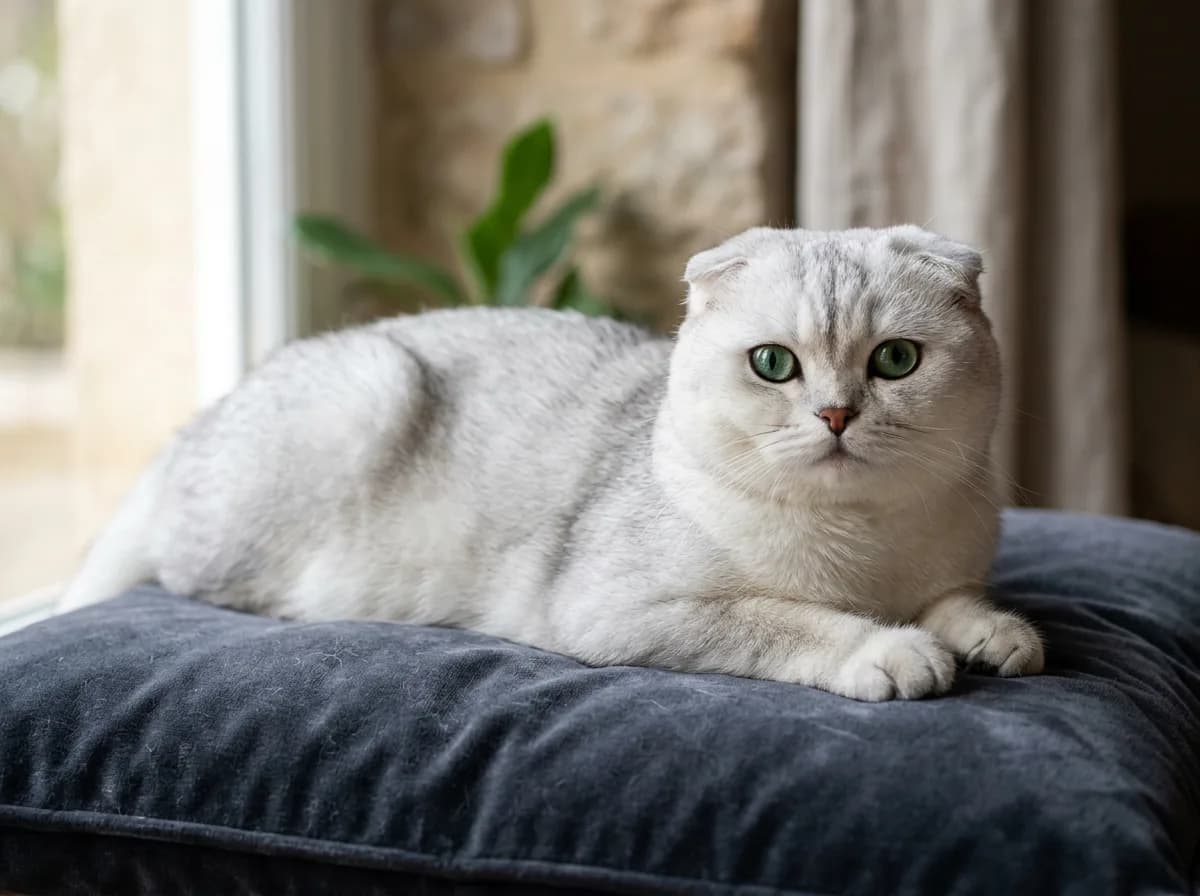
This group covers the most dramatic Scottish Fold colors. Silver and chinchilla Folds have a sparkling white undercoat tipped with black (chinchilla silver and shaded silver) or warm gold (chinchilla golden and shaded golden); these are the coats famous for bright green or blue-green eyes, a different look from the usual copper. Smoke colors look solid (black smoke, blue smoke) until the cat moves and the white roots flash through. Colorpoint Folds wear a Siamese-style pattern, with a pale body and darker ears, mask, legs, and tail, and they have blue eyes; this is the look behind names like "blue point" or "seal point" Scottish Fold. It is the same blue-eyed pointed pattern that makes the Ragdoll so recognizable, on a smaller, folded-ear frame.
Short Hair vs. Long Hair (the Highland Fold)
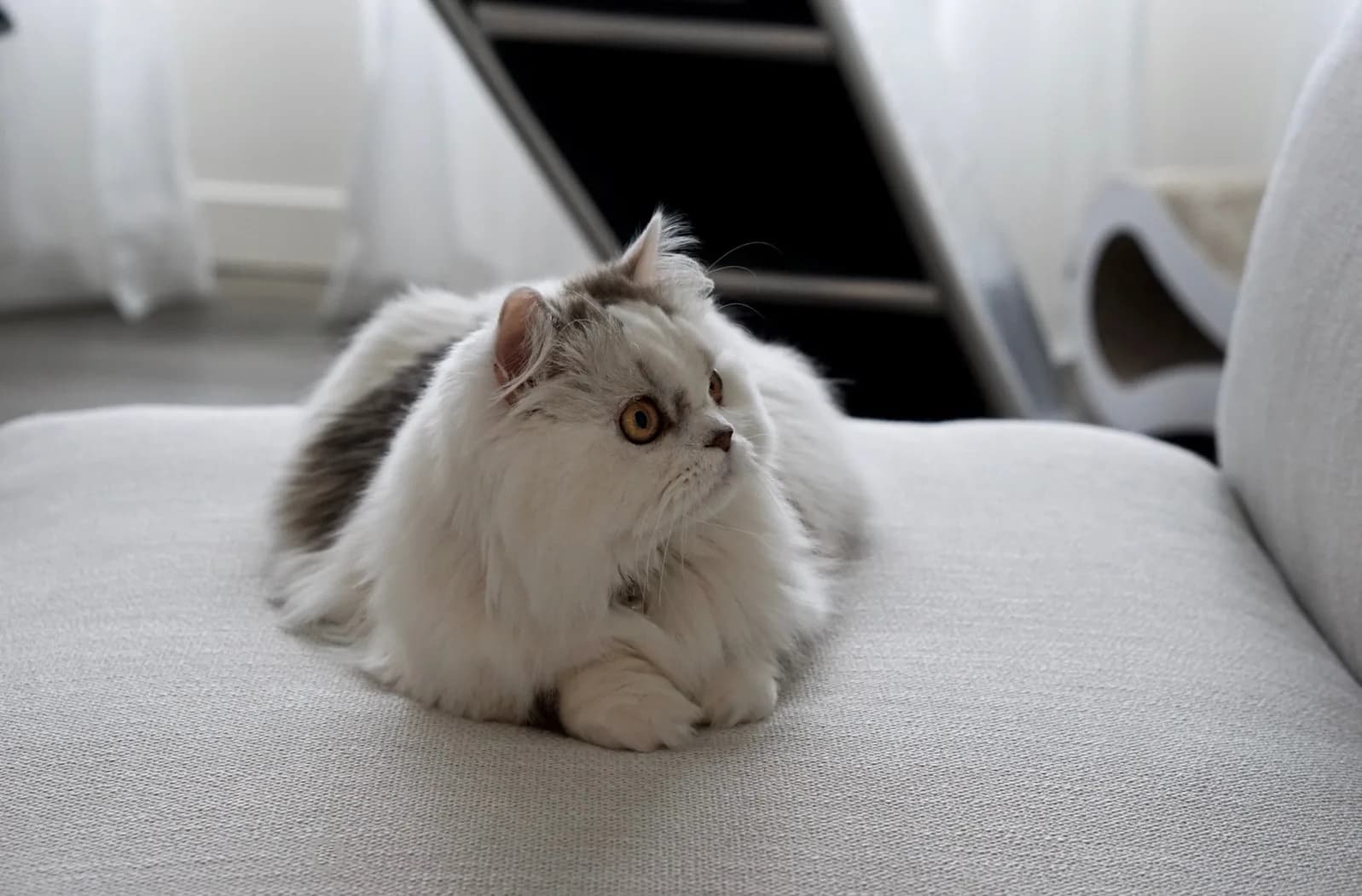
Every color above comes in two coat lengths. The standard short-haired cat is the Scottish Fold, with a dense, plush, springy coat. The long-haired version is most often called the Highland Fold, though depending on the registry you will also see it called the Scottish Fold Longhair, the Longhair Fold, or the Coupari. It is the exact same breed with the exact same folded ears and the exact same color range, just with a longer, softer, flowing coat, feathered tail, and tufted toes and ears. If you love that dense, plush, round-faced look in general, the Exotic Shorthair shares the same cobby teddy-bear build and shows up in many of the same colors.
So a "blue Highland Fold" is simply a long-haired blue Scottish Fold, and a "chocolate Highland Fold" is a long-haired chocolate. The long coat is a separate gene from the fold, which is why a single litter can contain short-haired and long-haired kittens, with folded and straight ears, in a mix of colors.

108-oz stainless steel pet fountain with quiet pump and water-level window. Bengals are notoriously water-obsessed; a flowing fountain encourages hydration and pulls them away from sinks and toilets.
Petful may earn a commission when you click through to Chewy, at no extra cost to you.
- Not every kitten in a Scottish Fold litter has folded ears. The ones born with normal straight ears are called Scottish Straights, and they come in all the same colors. They look like a Fold from the neck down and are the healthier-eared sibling of the breed.
Eye Colors
Eye color in a Scottish Fold is tied to coat color rather than chosen separately:
- Copper or gold is the default for the large majority of colors, including blue, black, red, cream, chocolate, lilac, tabby, tortie, and calico.
- Blue or odd-eyed (one blue, one gold) shows up in white and in some bicolor Folds.
- Blue is the rule for colorpoint Folds, the same as a Siamese.
- Green or blue-green is the signature of the silver, golden, and chinchilla coats.
The breed's large, round, wide-set eyes are a big part of the famous "owl" or "teddy bear" expression, whatever their color.
Rarest vs. Most Common Scottish Fold Colors
If you are wondering which colors are easy to find and which are a needle in a haystack, here is the honest ranking.
Most common and easy to find: blue (grey), black, brown tabby, red and cream, tortoiseshell, and calico. Blue is both common and the most in demand, which is why it is the face of the breed.
Rarest and most expensive: chocolate, lilac, cinnamon, and fawn are the genuinely rare solid colors, because those genes are scarce in Scottish Fold lines. Cinnamon and fawn are the rarest of all and are seldom seen. The silver and golden chinchilla coats are not as rare genetically but are highly prized for their green eyes and glamorous look, so they also fetch a premium. A solid, clearly marked color (a true solid red with no tabby ghost striping, for example) is harder to breed than a patterned one.
- Whether you want a common blue Fold or a rare chocolate one, vet the breeder the same way: ask about osteochondrodysplasia, confirm they never pair two folded cats, and ask for PKD and HCM screening on the parents. A rare color is no substitute for a healthy line.
Does Color Change a Scottish Fold's Health or Price?
Price: yes. Color is one of the things breeders price on. Common colors like blue or brown tabby sit at the lower end of the range, while rare chocolate, lilac, cinnamon, fawn, and the silver and golden chinchillas command a premium and are often advertised as "rare." A blue or white Fold from a good breeder might run roughly $1,000 to $2,500, while a rare-colored kitten can climb toward the $2,500 to $3,500 end or beyond. Coat length (a long-haired Highland Fold) can also nudge the price.
Health: no. This is the part that matters most. Coat color is cosmetic and has no bearing on the condition that defines this breed. Every Scottish Fold, in every single color, inherits osteochondrodysplasia, the same cartilage-and-bone disorder that folds the ears and also causes painful, progressive arthritis throughout the body. A rare chocolate Fold is no healthier than a common grey one. That is why many veterinarians and welfare bodies (including Cats Protection and International Cat Care) advise against breeding the Fold at all, why several countries have restricted it, and why the kindest, healthiest version of the look is often a straight-eared Scottish Straight or a British Shorthair, which share the round teddy-bear build without the skeletal condition. Choose a Scottish Fold on the strength of the breeder and the cat's health, not the rarity of its color.
Almost every color and pattern. That includes solid white, black, blue (grey), red, cream, chocolate, lilac, cinnamon, and fawn; every tabby pattern; tortoiseshell, calico, and bicolor; silver, golden, shaded, and smoke; and colorpoint. All of these come in both short hair (Scottish Fold) and long hair (Highland Fold).
The rarest solid colors are chocolate, lilac, cinnamon, and fawn, because those genes are uncommon in the breed's lines. Cinnamon and fawn are the rarest of all. Silver and golden chinchilla coats are also highly prized and command a premium, even though they are not as genetically rare.
A blue Scottish Fold is the iconic grey one. "Blue" is the cat-fancy term for a soft, even bluish-grey coat. It is a dilute of black, comes with copper or gold eyes and a matching blue-grey nose and paws, and is the most popular and most-searched Scottish Fold color.
Yes. The white Scottish Fold is pure white (the same color as Susie, the breed's founding cat) and is the one color where blue eyes or odd eyes (one blue, one gold) are common. White is a masking gene, so a white Fold is genetically another color underneath.
A chocolate Scottish Fold is a rich, warm chestnut-brown cat with copper or gold eyes. It is one of the rarest colors because the chocolate gene is recessive and scarce in the breed, so chocolate kittens are uncommon and usually more expensive. A very dark chocolate can look almost black indoors but shows a clear brown tone in daylight.
Yes. The long-haired Scottish Fold is usually called the Highland Fold (also the Scottish Fold Longhair, Longhair Fold, or Coupari). It is the same breed with the same folded ears and the same full color range, just with a longer, flowing coat, a plumed tail, and tufted ears and toes.
Color affects price but not health. Rare colors (chocolate, lilac, cinnamon, fawn) and prized silver or golden coats cost more than common blue or tabby. But coat color is purely cosmetic: every Scottish Fold of every color still inherits osteochondrodysplasia, the cartilage condition that folds the ears and causes arthritis, so a rare color never means a healthier cat.
The Bottom Line on Scottish Fold Colors
Scottish Fold colors are about as varied as cats get: solids from grey to ginger to chocolate, every tabby pattern, tortie and calico, glamorous silvers, and colorpoints, all in short hair or the long-haired Highland Fold, and all paired with those big round copper, blue, or green eyes. Blue leads the popularity contest, while chocolate, lilac, cinnamon, and fawn are the rare ones worth a premium. Just keep the one honest fact front and center: the color is only the wrapping. Underneath, every Scottish Fold carries the same folded-ear genetics and the same built-in joint condition, so pick your cat for the quality of its breeder and its health, and enjoy the beautiful coat as a bonus.

Coreen Saito is a pet writer and longtime shelter volunteer with more than a decade in animal rescue. She covers cat behavior, breed care, and the small, ordinary science of sharing a life with companion animals, with a particular focus on honest takes about the products and decisions that actually matter. At home in Arizona, she's outranked by Mac (a dog with the loudest opinion in the house), Rebel (a cat who governs by quiet authority), and Meri (an orange tabby who runs the late shift and the laundry basket). She writes about all three, plus the rescues that keep coming through her life, at LifeWithMinty.com.
Sign up for expert-backed reviews and safety alerts all in one place.