Russian Blue vs British Shorthair: How to Tell the Two Blue Cats Apart
Russian Blue vs British Shorthair, compared trait by trait. The Russian Blue is slender with emerald-green eyes; the British Shorthair is stocky with copper eyes and many colors. Here is how to tell them apart.
Petful is reader supported. As an affiliate of platforms like Amazon and Chewy, we may earn a commission when you buy through links on this page. There is no extra cost to you.
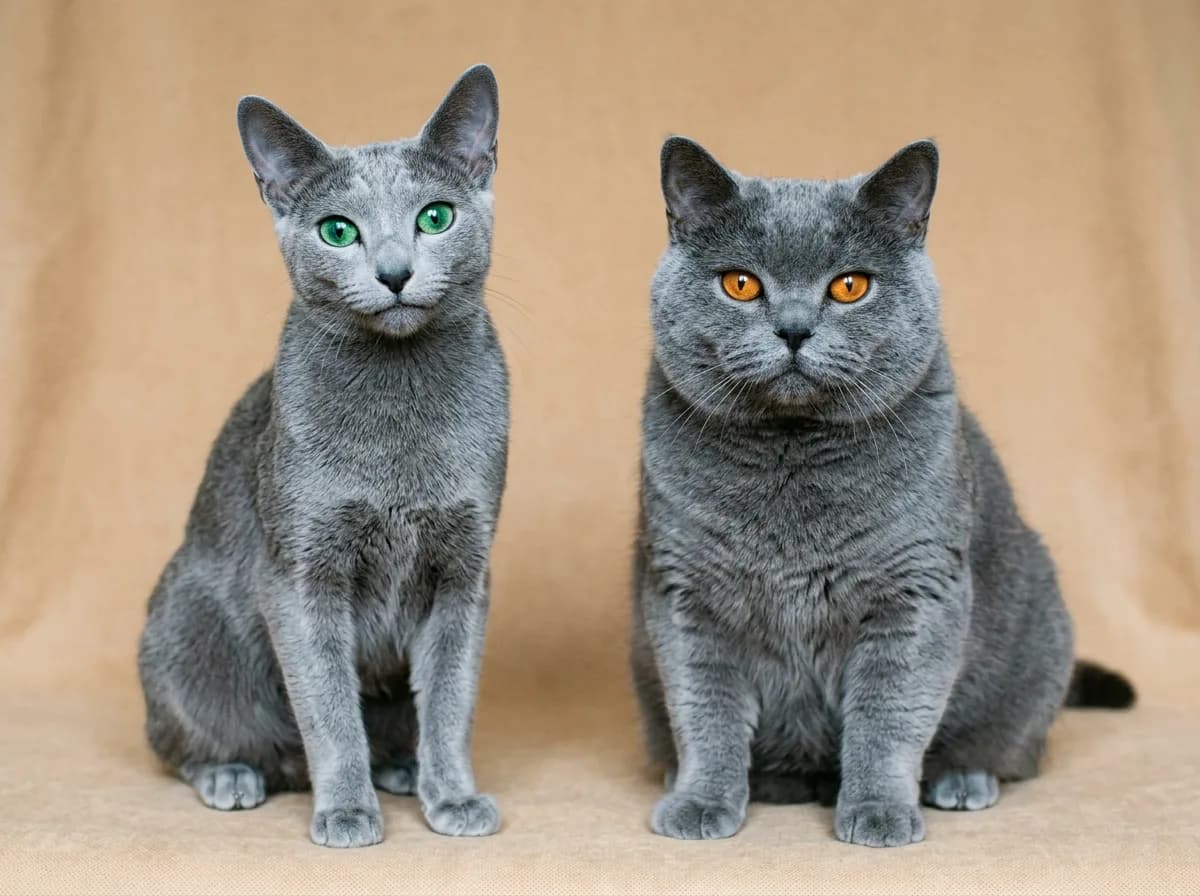
In a russian blue vs british shorthair comparison, the fastest tell is body type plus eye color: the Russian Blue is slender and fine-boned with vivid emerald-green eyes, while the British Shorthair is stocky and cobby with round copper or orange eyes. Both registries (CFA and TICA) recognize a blue-grey coat, and that shared color is exactly why these two breeds get confused. Once you know what to look at, though, they are easy to separate, and they make very different pets.
- 1Russian Blue = slender, fine-boned body and emerald-GREEN eyes, plush stand-out double coat, blue only, shy and reserved
- 2British Shorthair = stocky, cobby "teddy bear" build and COPPER or orange eyes, dense crisp coat, dozens of colors, calm and easygoing
- 3The single quickest check is eye color (green vs copper) combined with build (slim vs round)
- 4Personality is the real deciding factor: a devoted one-person cat versus a laid-back family cat
- 5Other blue look-alikes (Chartreux, Korat, Nebelung) round out the gray-cat lineup

Sign up for expert-backed reviews and safety alerts all in one place.
The Quick Answer: Two Different Cats in One Color
It is easy to see why people mix these breeds up. Both wear the cat-fancy "blue" (a soft blue-grey), both are short-haired, and both have a calm reputation. But the resemblance is mostly skin deep.
The Russian Blue is a naturally occurring breed from northern Russia, tied to the port of Arkhangelsk (which is why it is nicknamed the "Archangel cat"). It is built like a dancer: long, lean, and fine-boned. The British Shorthair descends from the common domestic cats of Britain and was developed into a sturdy, round, heavy-boned breed, the original "British Blue." Put them side by side and the difference in build is obvious even before you reach the eyes.
- Look at the eyes and the build together. Bright green eyes on a slim, elegant cat point to a Russian Blue. Copper or orange eyes on a round, chunky "teddy bear" cat point to a British Shorthair. Coat color alone will not tell you, because both can be blue-grey.
Full Side-by-Side Comparison
Here is the head-to-head on every trait that matters, using CFA and TICA breed-standard descriptions for build and color.
Never Scoop Again® with the Whisker Litter-Robot, the smart self-cleaning automatic litter box. Monitor visits and track weights for better overall care in the Whisker® app. Multi-cat friendly.
Petful may earn a commission when you click through to Whisker, at no extra cost to you.
| Trait | Russian Blue | British Shorthair |
|---|---|---|
| Size | Medium, 7-12 lb | Medium to large, 9-17 lb |
| Body type | Slender, long, fine-boned but muscular | Stocky, cobby, round and heavy-boned |
| Coat | Short, dense, plush DOUBLE coat that stands out from the body, silver-tipped | Short, very dense, crisp single coat with a firm "crisp" break |
| Eye color | Vivid emerald GREEN | Deep COPPER or orange (in the blue) |
| Colors available | Blue only (in CFA) | Dozens of colors and patterns; solid blue is most familiar |
| Head shape | Wedge-shaped with a subtle "Mona Lisa smile" | Round, broad, with full cheeks and jowls |
| Temperament | Shy with strangers, devoted and "velcro" with family | Calm, easygoing, independent, tolerant |
| Lifespan | 12-15 years (commonly 15-20) | 12-16 years |
| Grooming | Low; comb a few times a month | Low to moderate; weekly brushing, heavier in seasonal sheds |
| Price (reputable breeder) | $500-1,500 pet quality | $1,500-3,000 pet quality |
- Photos online are unreliable because lighting changes how grey reads and because many "Russian Blue" listings are actually mixes. The trait combination in this table (especially green eyes plus a stand-out double coat) is what separates a true Russian Blue from a British Shorthair or a grey domestic cat.
Body Type and Size
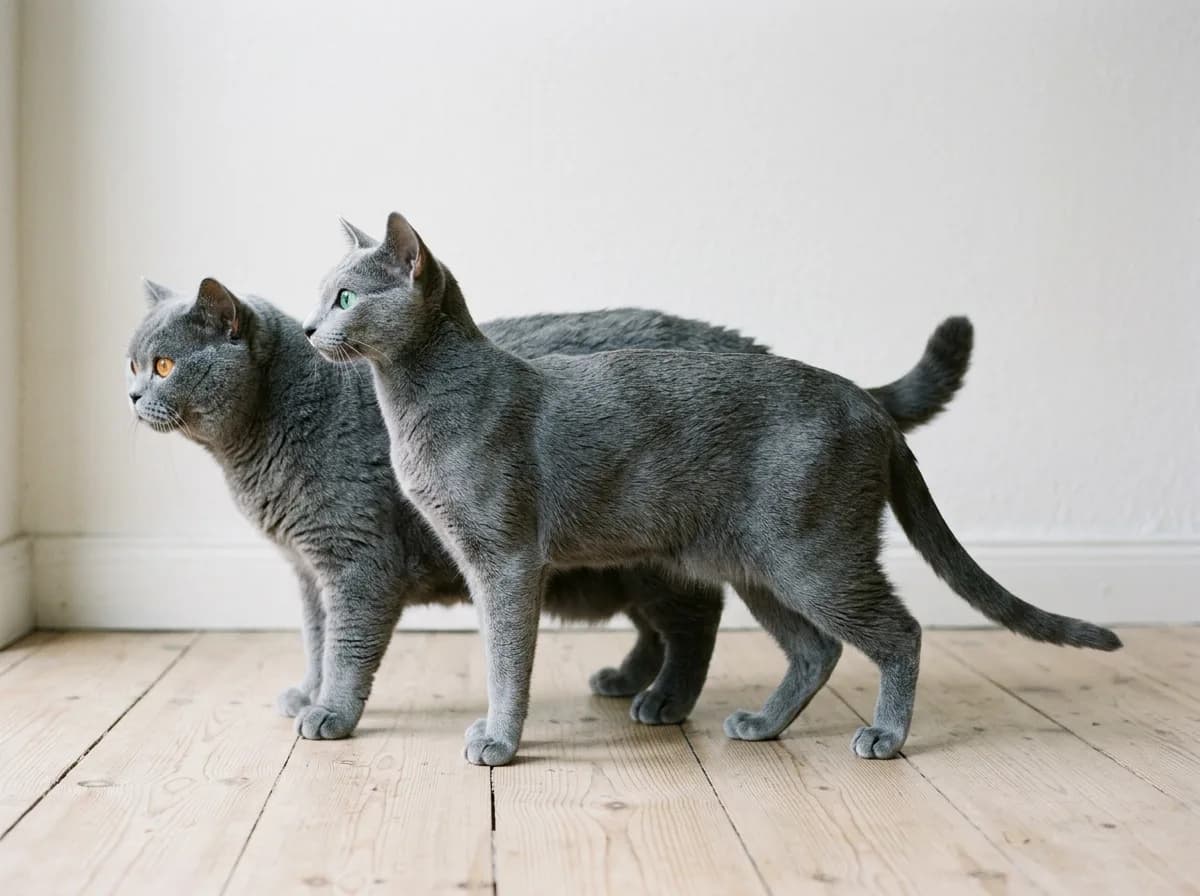
This is the difference you can spot from across a room. The Russian Blue is fine-boned and graceful, with long legs and a lithe, athletic frame. It typically weighs 7 to 12 pounds, with males at the top of that range. The dense coat makes it look bigger than it actually is.
The British Shorthair is the opposite silhouette: broad-chested, short-legged, and cobby, with a famously round "teddy bear" look. Males commonly reach 12 to 17 pounds, so a big British Shorthair can outweigh a Russian Blue by half again as much. The British Shorthair is also a slow-maturing breed and may not reach full size until three to five years old.
Coat: Stand-Out Double vs Crisp Dense
Both coats are short and plush, but they feel different in the hand. The Russian Blue has a true double coat (a soft undercoat plus guard hairs) that is so dense it stands out from the body at a 45-degree angle. You can trace a line in it with your finger and the line stays. The guard hairs are silver-tipped, which gives the breed its signature frosted, shimmering sheen.
The British Shorthair coat is also very dense but is described in the standard as "crisp," meaning it breaks over the body and has a firmer, more wool-like feel rather than a plush stand-out. Both shed, but neither is high-maintenance.
- A real Russian Blue coat looks frosted or "tipped" with silver because the very ends of the guard hairs are lighter. That shimmer is part of the breed standard. A flat, solid-grey coat with no sheen is more typical of a British Shorthair or a grey domestic shorthair.
Eye Color: Green vs Copper
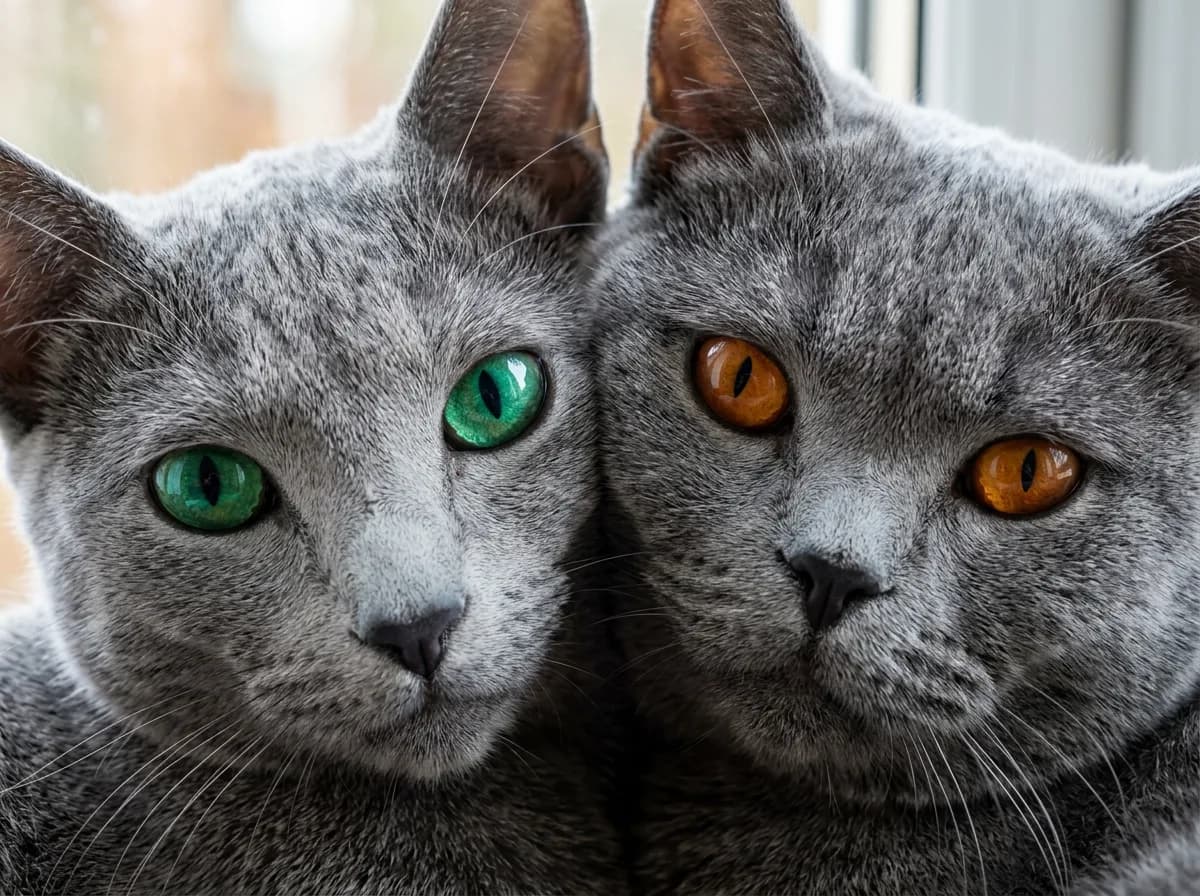
If you only check one thing, check the eyes. Adult Russian Blues have vivid emerald-green eyes (kittens are born with yellow eyes that turn green as they mature). It is one of the most defining features of the breed.
British Shorthairs in the blue color have deep copper or orange eyes. The contrast of orange eyes against a blue-grey coat is part of what makes the British Blue so striking. If you are looking at a grey cat with gold or copper eyes, it is far more likely a British Shorthair (or a domestic shorthair) than a Russian Blue.
Colors Available
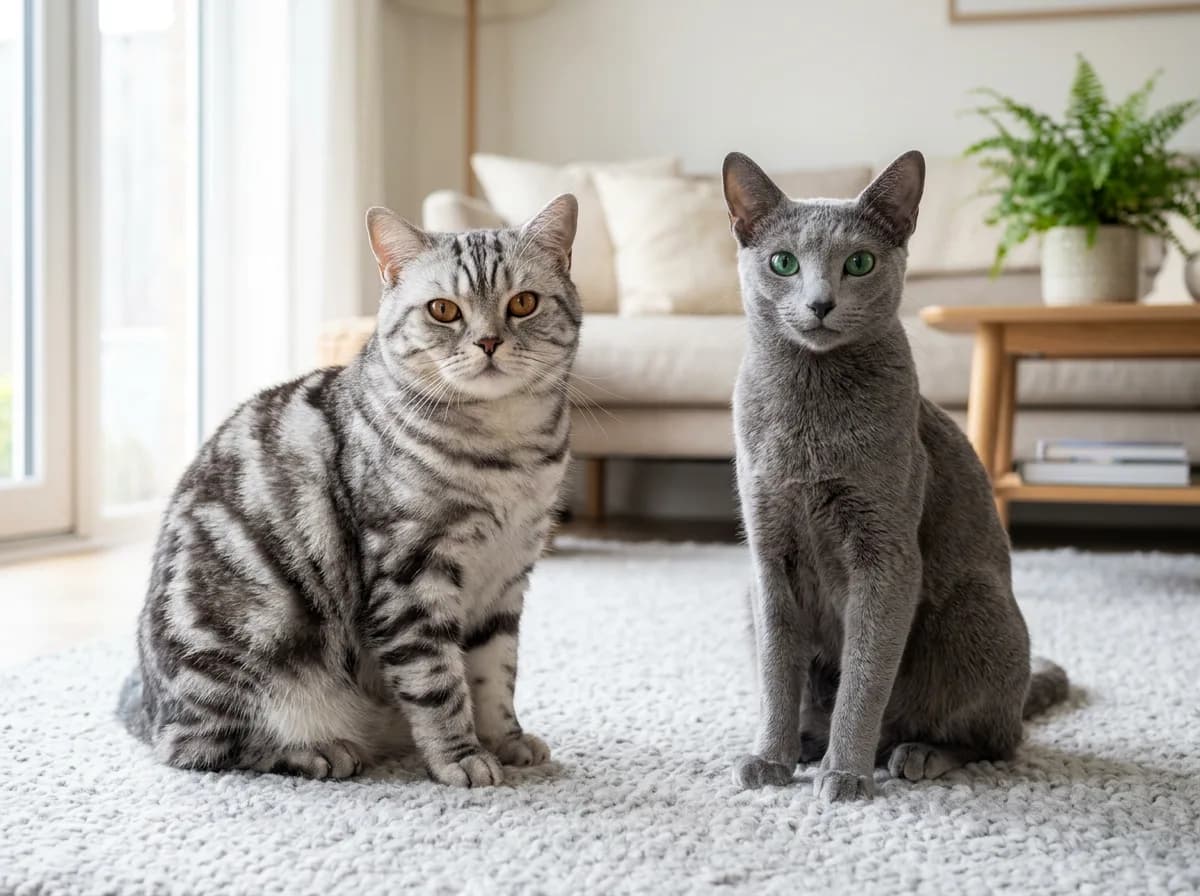
The Russian Blue is, by the CFA standard, blue only. (A few registries recognize black and white "Russians," but the classic show cat is blue.) That single-color rule is a useful shortcut: a chocolate, cream, tabby, or colorpoint cat is not a Russian Blue.
The British Shorthair, by contrast, comes in dozens of colors and patterns, including solid colors, tabbies, colorpoints, bicolors, and the popular "golden" and "silver" lines. The solid blue-grey is just the most familiar.
Temperament: Shy Companion vs Easygoing Roommate
For most people, this is the real decision, because the two breeds want very different relationships with you.
The Russian Blue is gentle, quiet, and reserved. It is typically shy with strangers and will often hide when guests arrive, but it bonds intensely with its own family, frequently attaching hardest to one person. Russian Blues are clever and genuinely playful (many learn to fetch), they love routine, and they dislike loud chaos and sudden change. They are sensitive to their owner's moods.
The British Shorthair is calm, easygoing, and independent. It is famously laid-back, tolerant of children and other pets, and content to nap while you are at work. It is affectionate but on its own terms, and it is not usually a lap-glued "velcro" cat. Both breeds are quiet and undemanding vocally.

63-inch multi-level cat tree with scratch posts, hammock, plush perches, and dangling toys. Vertical territory is non-negotiable for high-energy climbing breeds like the Bengal.
Petful may earn a commission when you click through to Chewy, at no extra cost to you.
- If you want a devoted shadow that interacts closely with you and you can offer a calm, predictable home, lean Russian Blue. If you want a relaxed, low-drama family cat that tolerates kids, dogs, and a busy household without much fuss, lean British Shorthair.
Health and Lifespan
Both are hardy, long-lived breeds. The Russian Blue averages 12 to 15 years and commonly reaches 15 to 20, making it one of the longer-lived pedigreed cats. Its number-one practical health risk is obesity, because the breed is famously food-motivated, so portion control is essential. Less common concerns include bladder or urinary stones and, in some lines, progressive retinal atrophy and polycystic kidney disease.
The British Shorthair typically lives 12 to 16 years. Its breed-specific concern to ask a breeder about is hypertrophic cardiomyopathy (a heart condition), along with the same weight-management caution, since this breed also gains weight easily. Responsible breeders of both should screen their lines.
Allergies: Is Either One Hypoallergenic?
Neither breed is truly hypoallergenic, but the Russian Blue has the better reputation. It is often reported to produce somewhat lower levels of the Fel d 1 allergen, and its dense double coat tends to trap dander close to the skin so less is shed into the air. The British Shorthair produces roughly average allergen levels. Petful’s guide to Russian Blue hypoallergenic has the full breakdown.
Important honesty check: every cat, including the Russian Blue, produces some Fel d 1 (in saliva and skin), so no cat is allergen-free. If allergies are a concern, spend time with an adult cat of the breed before committing.
Price: Which Costs More?
Pricing overlaps but tilts toward the British Shorthair at the top end, largely because of demand for specific colors. For a Russian Blue, expect roughly $75-200 to adopt, $500-1,500 for a pet-quality kitten from a reputable breeder, and $1,500-3,000 for show or breeding quality. British Shorthair pet kittens commonly start around $1,500-3,000, with rare colors (golden, silver) climbing well past that.
Because true purebred Russian Blues are far less common than the many grey domestic cats mistaken for them, well-bred kittens of either breed carry a real premium and often a waitlist. Always insist on papers and meeting the parents.

108-oz stainless steel pet fountain with quiet pump and water-level window. Bengals are notoriously water-obsessed; a flowing fountain encourages hydration and pulls them away from sinks and toilets.
Petful may earn a commission when you click through to Chewy, at no extra cost to you.
- Most grey cats are not purebred Russian Blues; they are grey domestic shorthairs or Russian Blue mixes. A true Russian Blue should show ALL the tells together: the stand-out silver-tipped double coat, emerald-green eyes, mauve or lavender paw pads, a fine-boned wedge-shaped body, and registration papers. Gold eyes and a thin single coat almost always mean a domestic shorthair, not a Russian Blue.
The Other Blue Look-Alikes
The Russian Blue and British Shorthair are not the only grey cats that get mixed up. Three more are worth knowing so you do not misidentify your cat.
Chartreux
The Chartreux is a French breed, stockier and more robust than the Russian Blue, with a woolly water-resistant blue coat and gold or copper eyes (not green). Think of it as closer to the British Shorthair in build but with its own rounded, "smiling" face and a famously quiet voice.
Korat
The Korat is an ancient Thai breed, slender like the Russian Blue but with a distinctive heart-shaped face and large peridot-green eyes. Crucially, the Korat has a single coat (no plush double undercoat), so it lacks the stand-out frosted texture of a Russian Blue. Petful’s guide to Korat cat has the full breakdown.
Nebelung
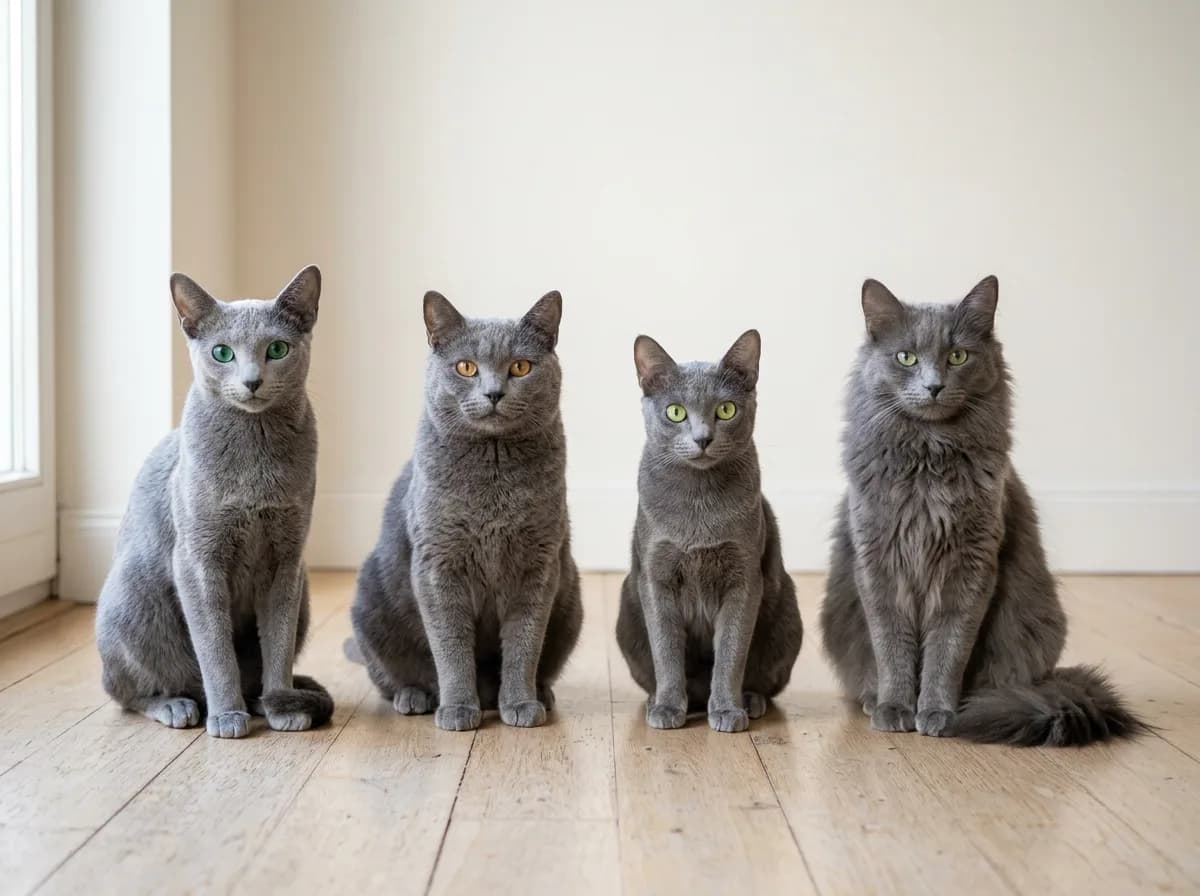
The Nebelung is essentially the long-haired Russian Blue: the same elegant type, the same blue color with silver tipping, the same green eyes, but with a semi-long, silky coat. If you love the Russian Blue look but want flowing fur, the Nebelung is the breed you are picturing.
Which Should You Choose?
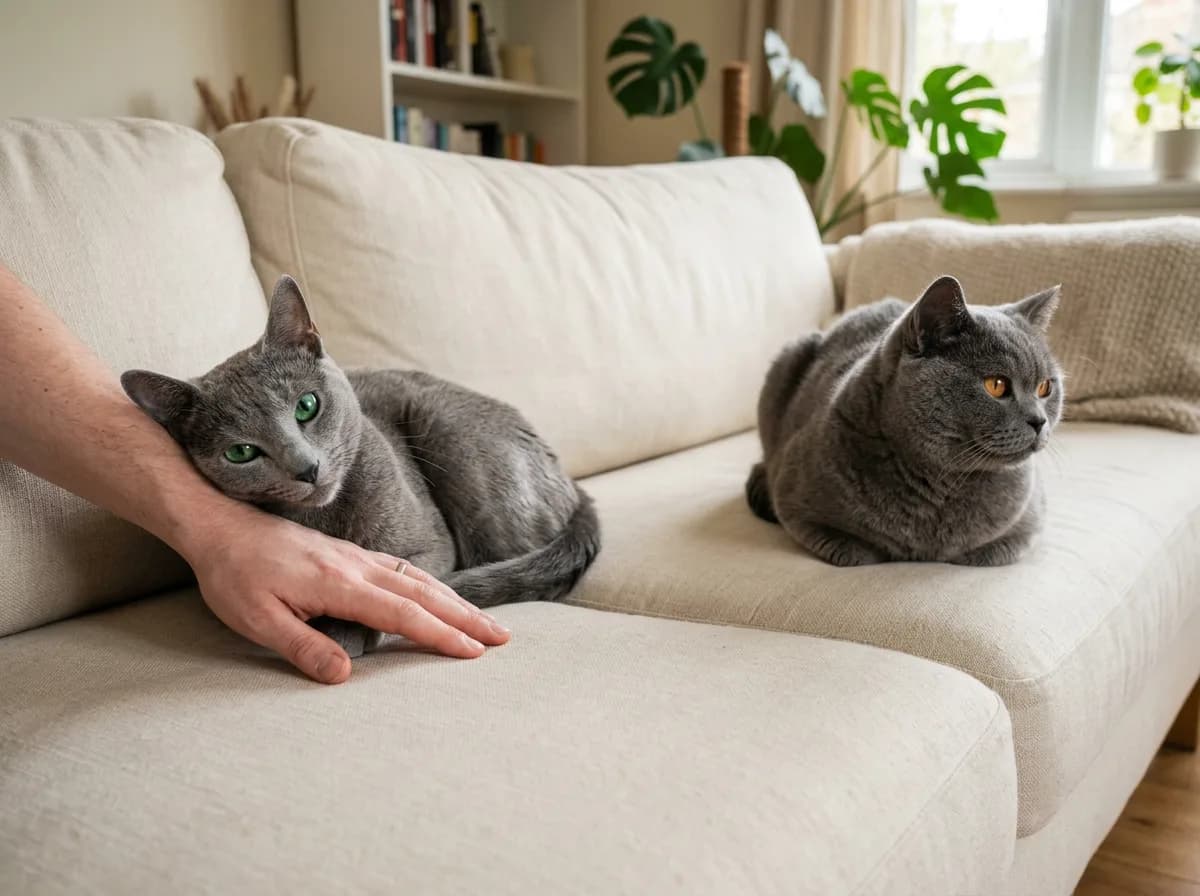
There is no "better" breed, only a better fit for your home.
Choose the Russian Blue if you want a quiet, sensitive, deeply devoted companion, you keep a calm and fairly predictable household, and you would enjoy a cat that bonds closely (often to one person) and may be shy with guests. Its lower-allergen reputation is a bonus if you have mild allergies.
Choose the British Shorthair if you want an easygoing, independent cat that fits a busy family, tolerates children and other pets well, and is happy to nap solo while you are out. If you also want a specific coat color or pattern, the British Shorthair offers far more options.
Both are clean, quiet, low-grooming, long-lived cats, so either way you are getting a calm, handsome housemate. The decision really comes down to closeness versus independence, and whether green eyes on a slim cat or copper eyes on a round one is the face you want to come home to.
If you are weighing other plush, round-faced or blue-grey breeds, it is worth reading the full profiles before deciding. The British Shorthair breed profile is the essential companion to this comparison, and the Chartreux profile covers the third famous blue-gray breed in detail. For plush-coated, easygoing alternatives, the Scottish Fold profile is a popular round-faced option, and if a quiet, allergy-friendlier reputation is your priority, the Siberian cat profile is worth a look.
Frequently Asked Questions
The Russian Blue is slender and fine-boned with a plush stand-out double coat and vivid green eyes, and comes in blue only. The British Shorthair is stocky and round with a denser crisp coat, copper or orange eyes, and dozens of color options. Their temperaments also differ: the Russian Blue is shy and devoted, while the British Shorthair is calm and easygoing.
Check eye color and build together. Green eyes on a slim, elegant cat with a frosted silver-tipped coat means Russian Blue. Copper or orange eyes on a round, chunky cat means British Shorthair. Coat color alone will not tell you because both are blue-grey.
Neither is better overall; it depends on what you want. The Russian Blue suits people who want a quiet, deeply devoted cat in a calm home. The British Shorthair suits busy families wanting a relaxed, independent cat that tolerates kids and other pets.
Only historically. After the World Wars nearly wiped out the Russian Blue, breeders outcrossed it to the British Shorthair (and the Siamese) to rebuild the breed before breeding it back to type. They are separate breeds today, but that postwar reconstruction is part of why they share a blue coat.
The Russian Blue is more intensely bonded, often a "velcro" cat that attaches to one person, but it can be shy with everyone else. The British Shorthair is affectionate in a more relaxed, independent way and is friendlier toward strangers and children.
They overlap, but the British Shorthair often costs more at the top end, especially in rare colors like golden or silver. Russian Blue pet kittens from a reputable breeder typically run $500-1,500, while British Shorthair pet kittens commonly start around $1,500-3,000.
The closest look-alikes are the British Shorthair (stocky, copper eyes), the Chartreux (French, woolly coat, gold eyes), the Korat (Thai, heart-shaped face, single coat, green eyes), and the Nebelung (essentially a long-haired Russian Blue). Most grey shelter cats are domestic shorthairs, not any of these breeds.

Coreen Saito is a pet writer and longtime shelter volunteer with more than a decade in animal rescue. She covers cat behavior, breed care, and the small, ordinary science of sharing a life with companion animals, with a particular focus on honest takes about the products and decisions that actually matter. At home in Arizona, she's outranked by Mac (a dog with the loudest opinion in the house), Rebel (a cat who governs by quiet authority), and Meri (an orange tabby who runs the late shift and the laundry basket). She writes about all three, plus the rescues that keep coming through her life, at LifeWithMinty.com.
Sign up for expert-backed reviews and safety alerts all in one place.