Norwegian Forest Cat vs Maine Coon: How to Tell Them Apart
Norwegian Forest cat vs Maine Coon, compared head to head: the straight-vs-square head test, plus size, coat, ears, eyes, temperament, price, and a plain-language guide to identifying which giant you have.
Petful is reader supported. As an affiliate of platforms like Amazon and Chewy, we may earn a commission when you buy through links on this page. There is no extra cost to you.
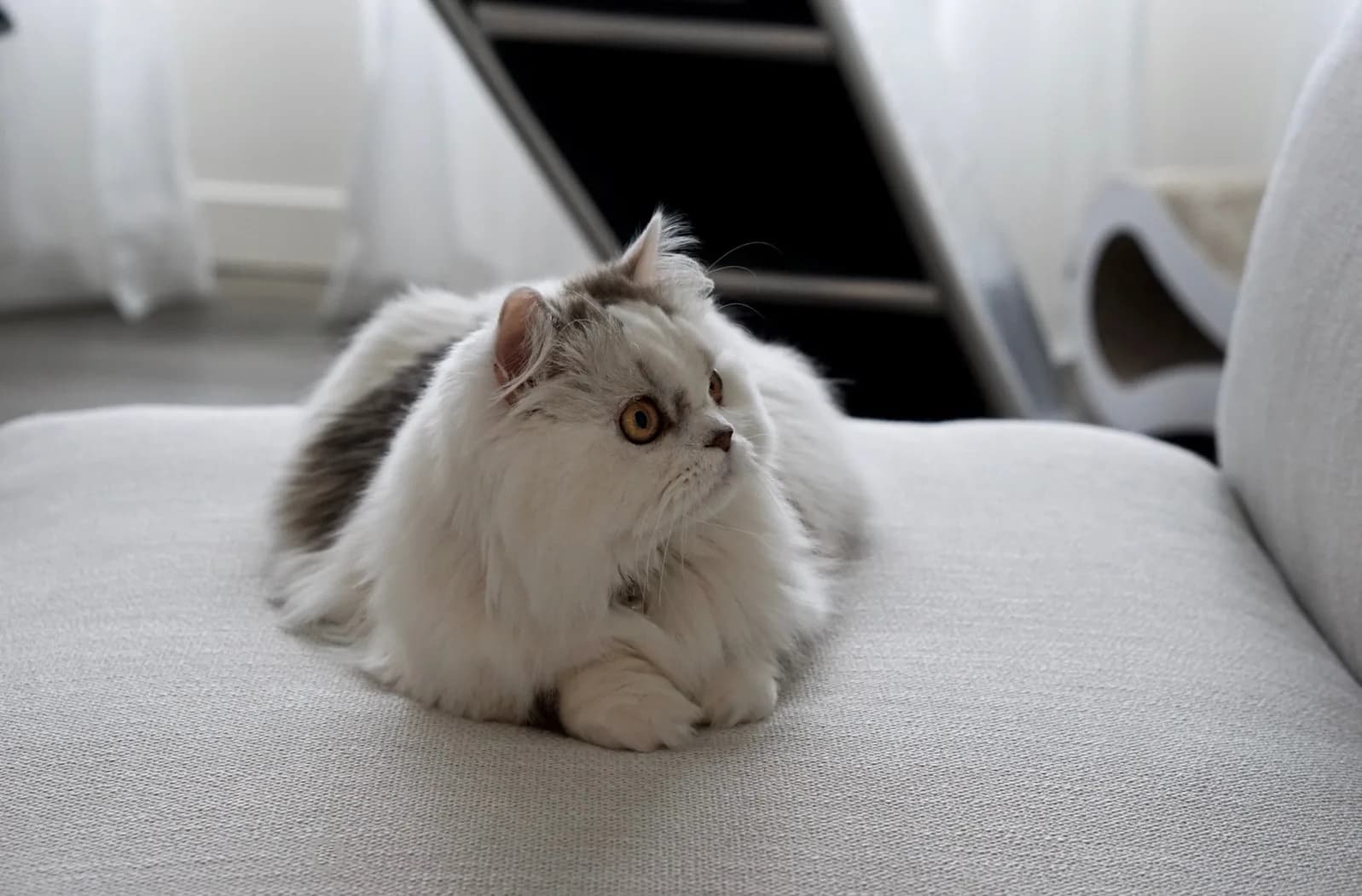
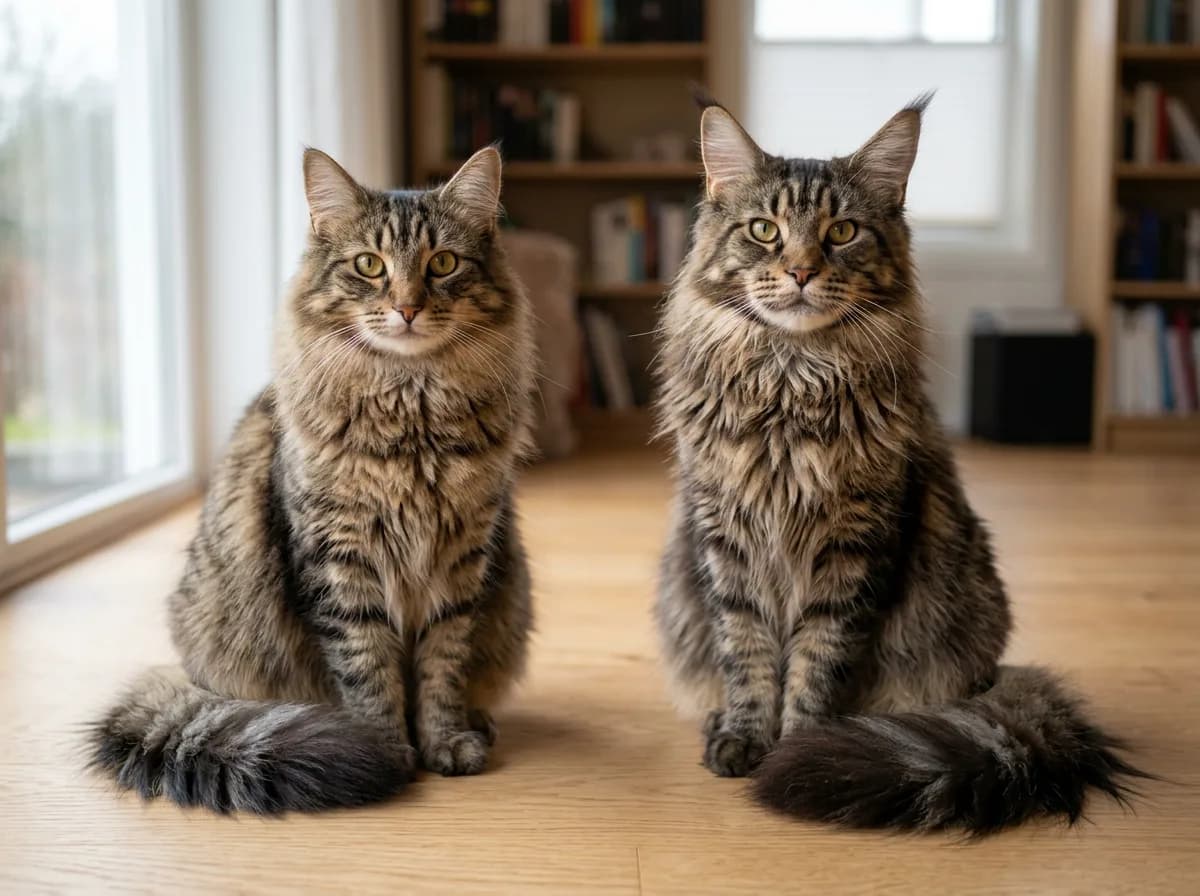
In the norwegian forest cat vs maine coon debate, the single fastest way to tell these two giant, fluffy breeds apart is the head: per the Cat Fanciers' Association (CFA), the Norwegian Forest Cat has a straight nose profile set into an equilateral triangle, while the Maine Coon has a squared-off muzzle on a head "reminiscent of a rectangle." Both are large, double-coated "gentle giants" that look nearly identical in a thumbnail photo, which is exactly why people mix them up. Look at the face in profile, the ear tips, and the body length and the two breeds separate quickly. This guide breaks down every tell, with a quick side-by-side and a plain-language identification checklist, so you can name the cat in front of you with confidence.
- 1The fastest tell is the head in profile: the Norwegian Forest Cat has a straight nose line and a triangular face, while the Maine Coon has a gentle concave curve, a square muzzle, and a more rectangular head
- 2The Maine Coon is usually the larger, longer cat with more pronounced lynx tips on the ears; the Wegie is large but typically a bit smaller, with a smoother water-resistant coat
- 3Temperament differs too: Maine Coons are famously dog-like and people-following, Norwegian Forest Cats are affectionate but more independent and reserved
- 4A third look-alike, the Siberian, is built in soft rounded curves with no straight lines, which sets it apart from both

Sign up for expert-backed reviews and safety alerts all in one place.
Norwegian Forest Cat vs Maine Coon at a Glance
Before the deep dive, here is the quick side-by-side. The figures below reflect typical ranges from the CFA and The International Cat Association (TICA) breed standards and from experienced breeders. Individual cats vary, and a big Wegie can outweigh a small Maine Coon, so use these as guidance, not law.
| Trait | Norwegian Forest Cat | Maine Coon |
|---|---|---|
| Adult weight (male) | 13-22 lb | 15-25 lb |
| Adult weight (female) | 8-12 lb | 8-14 lb |
| Overall size | Large, but usually a bit smaller | Larger and longer (often the bigger cat) |
| Head shape | Equilateral triangle | Rectangular, broad and powerful |
| Profile | Straight line from brow to nose tip | Gentle concave curve, square muzzle |
| Ears | Large and tufted, set to continue the triangle | Large, set higher, more pronounced lynx tips |
| Coat | Smooth, glossy, water-resistant double coat | Shaggier, more uneven double coat |
| Eyes | Almond-shaped, slightly slanted | Large, slightly oval to round |
| Temperament | Affectionate but independent and reserved | Dog-like, social, people-following |
| Lifespan | 12-16 years | 12-15 years |
| Pet-quality price | 800-1,800 USD | 1,000-2,800 USD |
- Unlike most look-alike pairs, these two might share a thread of ancestry. The CFA notes the Norwegian Forest Cat "may have contributed the gene for long hair to the Maine Coon Cat's ancestral mix," likely carried across the Atlantic by seafaring cats. It is lore supported by plausibility, not proven pedigree, but it helps explain why they look so alike.
The Single Fastest Tell: Head and Profile
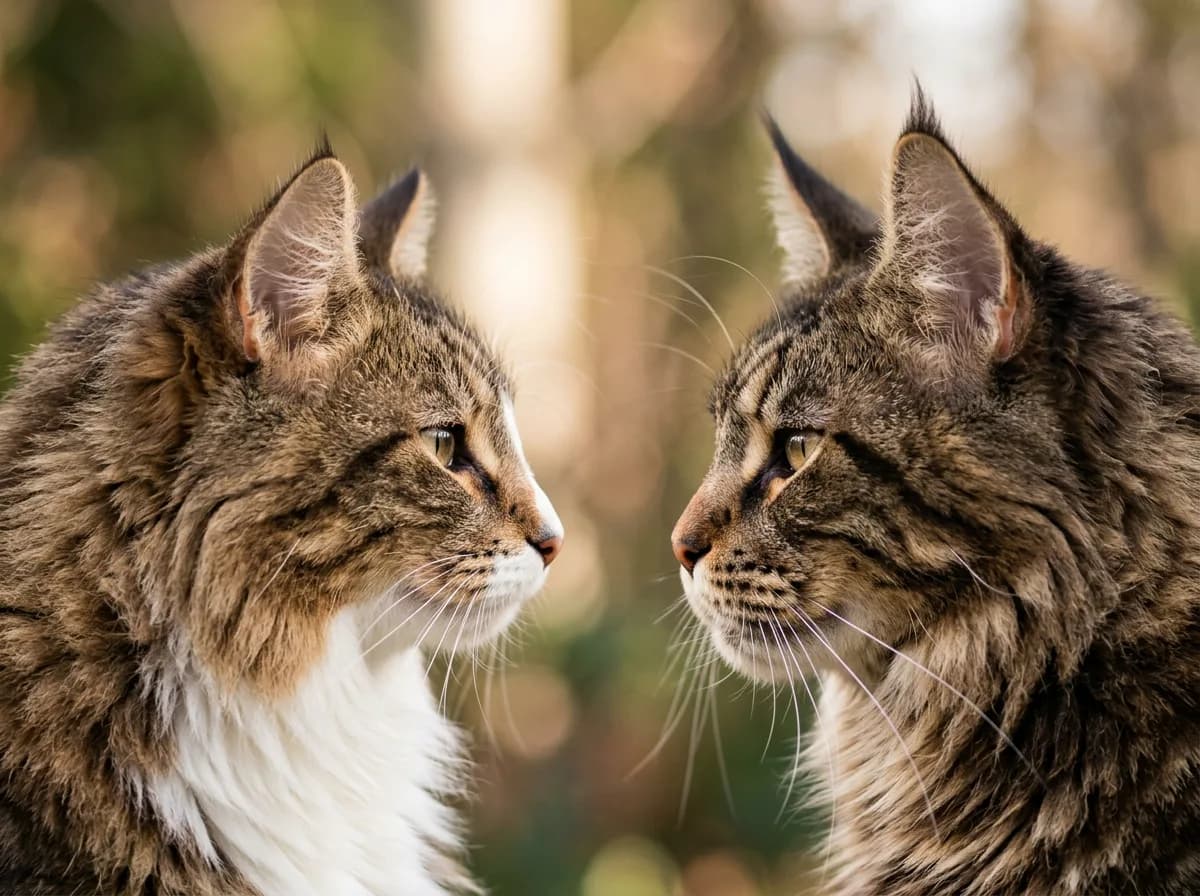
If you only check one thing, check the face in profile. This is the difference breed judges lean on, and it holds up even when both cats are fluffy brown tabbies.
Never Scoop Again® with the Whisker Litter-Robot, the smart self-cleaning automatic litter box. Monitor visits and track weights for better overall care in the Whisker® app. Multi-cat friendly.
Petful may earn a commission when you click through to Whisker, at no extra cost to you.
The Norwegian Forest Cat has a straight profile, a single clean line running from the brow to the tip of the nose with no break or dip. Its head forms an equilateral triangle, and the CFA considers that triangle so important that "the outer edges of the ears continue the line of the triangle." The eyes are almond-shaped and set at a slight angle, adding to the sweet, alert expression Wegie owners describe.
The Maine Coon is built more like a rectangle. The muzzle is distinctly squared-off, the jawline is broad and powerful, and there is a gentle concave curve, a soft dip, where the forehead meets the nose. The CFA describes the "broad, powerful jawline and strong chin" that give the Maine Coon its leonine, lion-like look. The eyes are large and lean oval to round rather than almond.
- Imagine a ruler laid along the cat's face from forehead to nose tip: if the line is dead straight, you are likely looking at a Norwegian Forest Cat; if the line dips and the muzzle looks like a box, it is a Maine Coon.
Size: Which Gentle Giant Is Bigger?
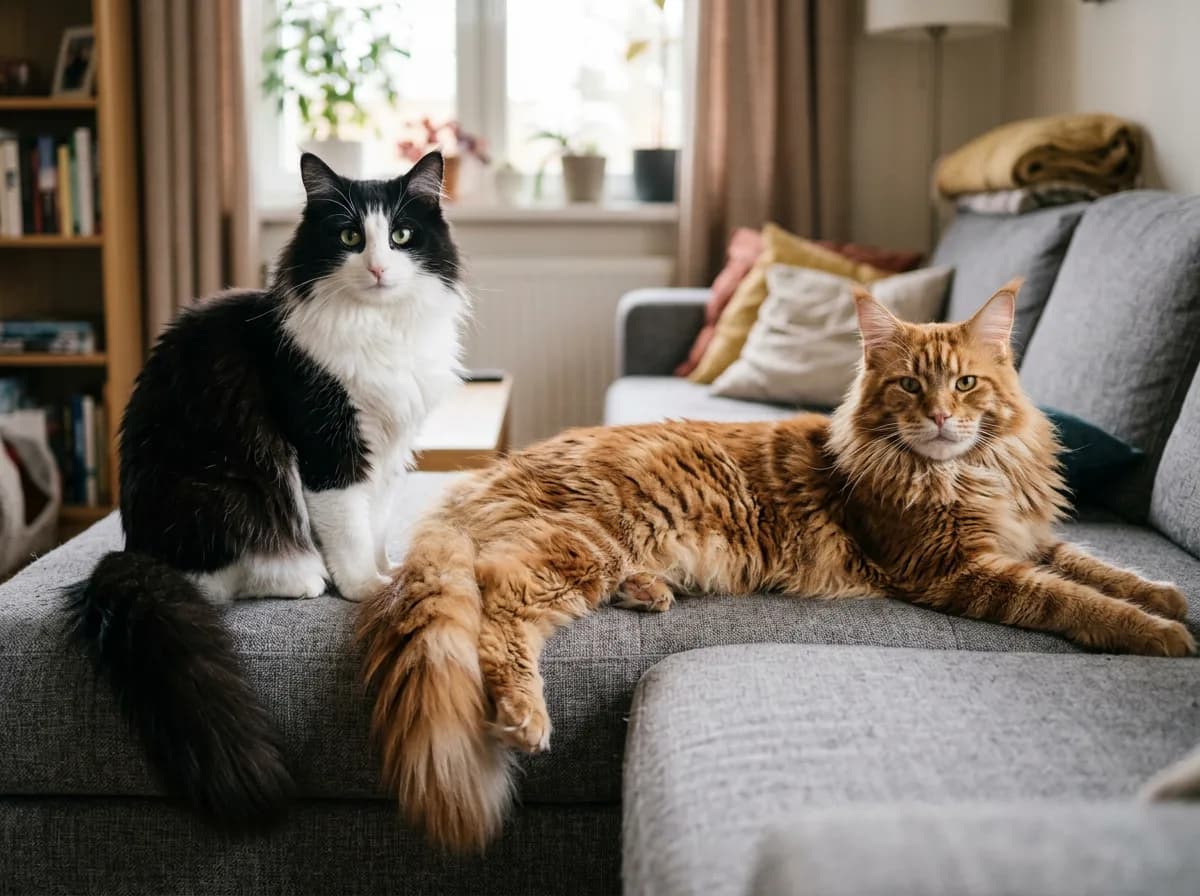
Both breeds dwarf the average 8-to-10-pound housecat, but in a direct comparison the Maine Coon usually wins the tape measure. The Maine Coon is officially the largest domestic cat breed recognized in North America, with males commonly 15-25 pounds and bodies stretching up to 40 inches nose to tail. The Norwegian Forest Cat is genuinely large, males roughly 13-22 pounds and females 8-12 pounds, but it tends to run a touch smaller and shorter than a big Maine Coon.
Both breeds are also famously slow to mature. A Norwegian Forest Cat reaches full size around five years of age, and Maine Coons fill out over three to five years, far later than the typical cat that finishes growing near its first birthday. That long runway is part of why both look so imposing as adults. For the full growth curve, history, and care details on the larger breed, see our Maine Coon breed profile. There is more on this in Petful’s guide to Norwegian Forest Cat size.
Petful may earn a commission when you click through to Chewy, at no extra cost to you.
- Both breeds carry a dense double coat with a full ruff, so a lot of that "giant" silhouette is fur, not cat. A heavy molt or a wet-down bath can shrink the apparent size dramatically. Judge real size by length and bone structure, and never let a breeder use a fluffed coat to justify a "giant" price tag.
Ears and Lynx Tips
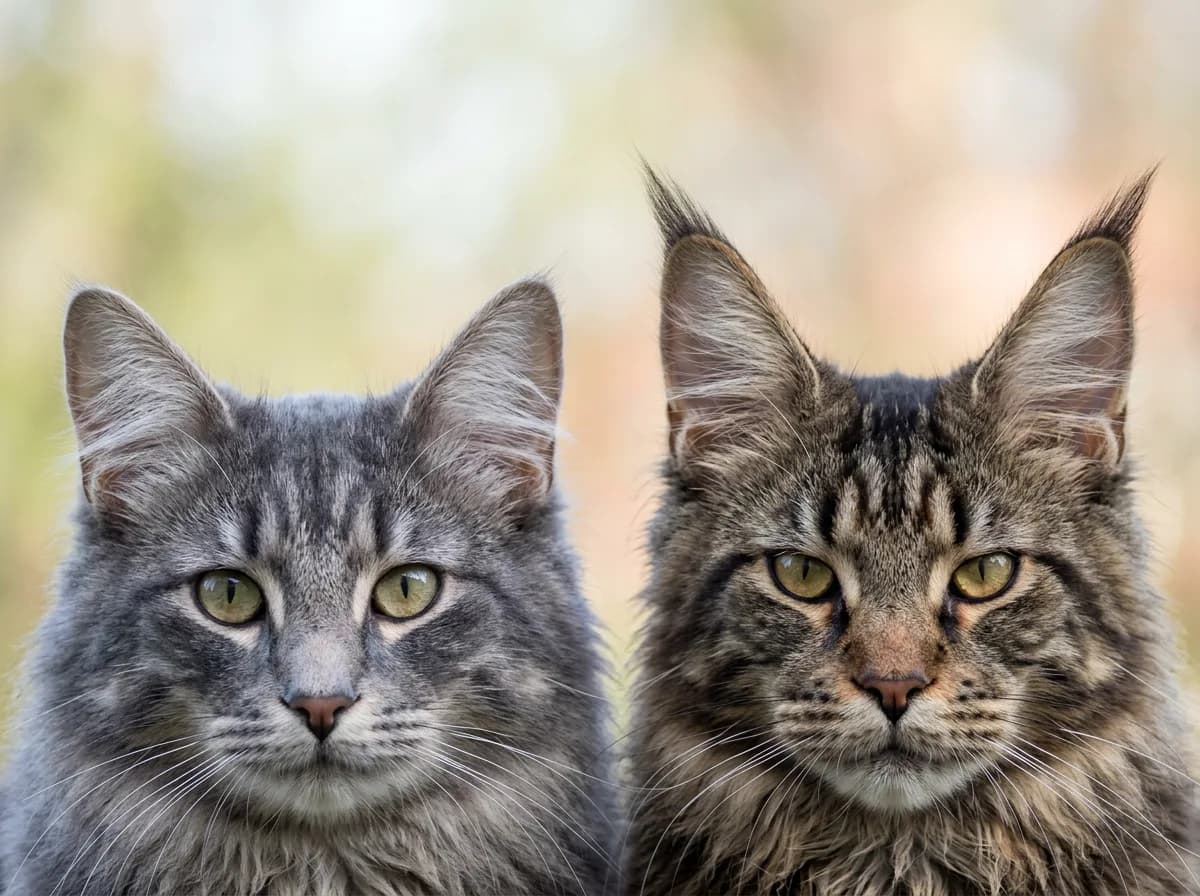
Both breeds wear large, tufted, upright ears, but the details differ. The Maine Coon sets its ears a little higher on the head and tends to show more dramatic lynx tips, the wispy points of fur extending from the ear tips, along with heavier furnishings (the fur inside the ear). The Norwegian Forest Cat has large ears too, but they are positioned to continue the line of that signature facial triangle, and the lynx tips are usually present but a bit more restrained. Lynx tips alone are not a perfect tell (both breeds can have them) but stronger, more flamboyant tips lean Maine Coon.
Coat and Grooming
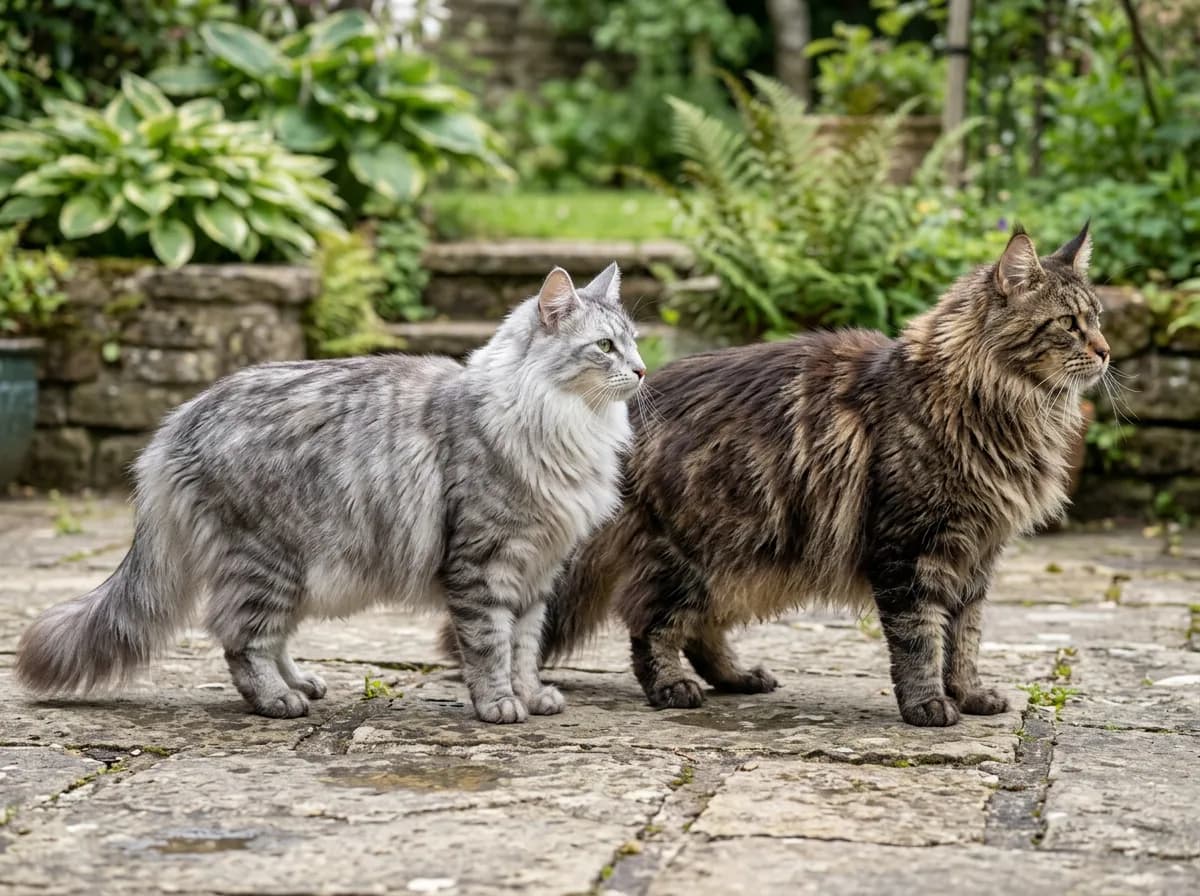
This is a close call because both breeds have a long, weather-proof double coat built for brutal northern winters. The difference is texture and evenness.
The Norwegian Forest Cat coat is smoother and more uniform: a glossy, water-shedding overcoat over a woolly insulating undercoat, with a full frontal ruff, long fur "britches" on the hind legs, and a long bushy tail. Its defining trait is that the topcoat is distinctly water-resistant, an adaptation that famously lets many Wegies tolerate, even enjoy, water. The Maine Coon coat is shaggier and more uneven in length, shorter over the shoulders and longer on the belly and ruff, giving it a rugged, slightly tousled look rather than the Wegie's sleeker finish.
- Both breeds shed heavily, especially during the spring molt, and both produce the Fel d 1 allergen like any cat. No long-haired double-coated breed is hypoallergenic. Plan on combing once or twice a week year-round (more during seasonal sheds) for either cat, and do not buy on a "hypoallergenic" claim.
Eyes and Expression
Look at the eye shape and set. The Norwegian Forest Cat has almond-shaped eyes set at a slight slant, which pairs with the triangular face for an alert, sweet look. The Maine Coon has large eyes that read more oval to round and wide open, contributing to its open, expressive, slightly more "wild" face. Eye color is not a reliable tell, both breeds come in greens, golds, and coppers, with blue or odd eyes possible in white cats, so use eye shape, not color.

63-inch multi-level cat tree with scratch posts, hammock, plush perches, and dangling toys. Vertical territory is non-negotiable for high-energy climbing breeds like the Bengal.
Petful may earn a commission when you click through to Chewy, at no extra cost to you.
Temperament: Dog-Like vs Independent
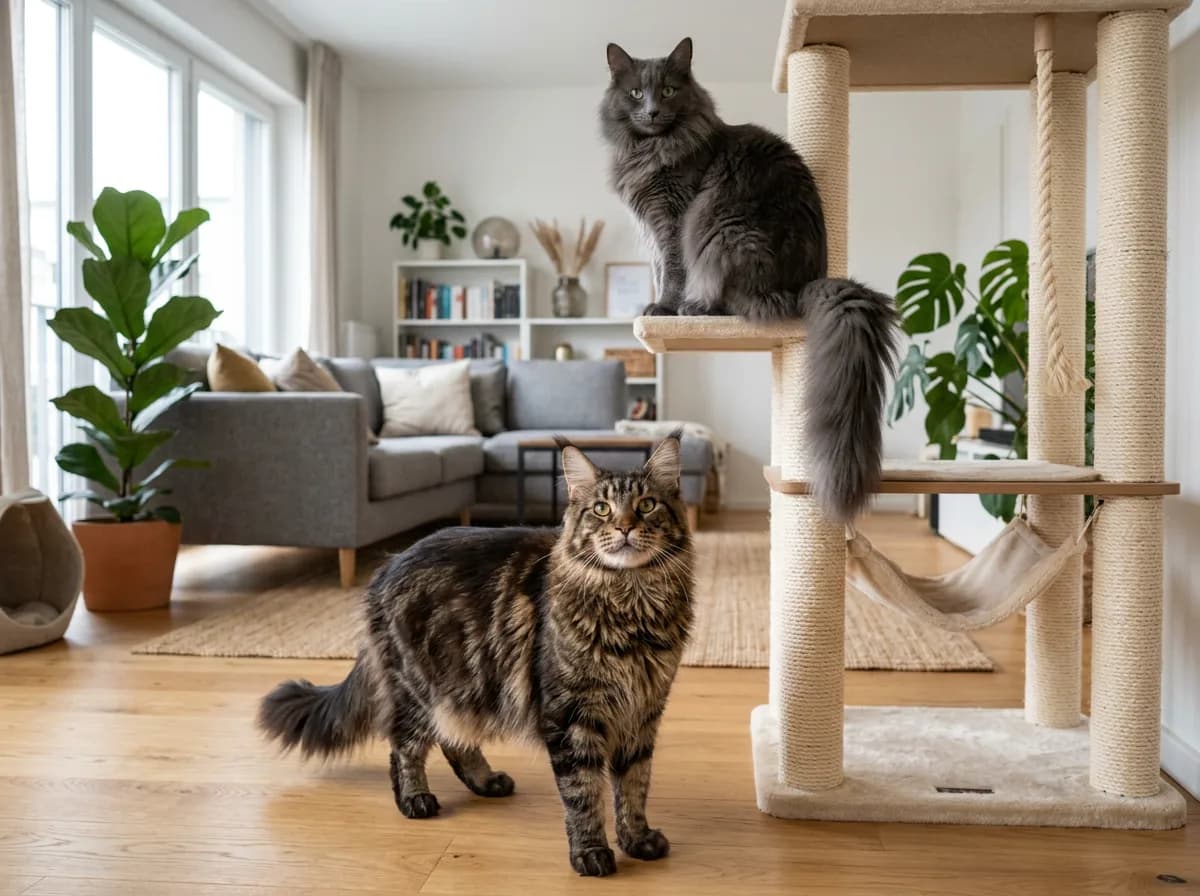
Both breeds are gentle, intelligent, family-friendly companions that get along with respectful children, dogs, and other pets. The difference is how they show affection.
The Maine Coon is the classic "dog of the cat world": highly social, people-following, often happy to be carried, and famous for chirps and trills it uses to chat with its humans. It generally prefers to keep all four paws on the ground rather than scale the bookcase. The Norwegian Forest Cat is affectionate but more independent and reserved, more of a "be in the same room with you" cat than a clingy lap cat, and generally quieter (a soft chirp or trill rather than constant conversation). It is also a relentless, enthusiastic climber that gravitates to the highest perch in the house. Both bond deeply with family; a Maine Coon wants to be involved in everything you do and will tell you about it, while a Wegie keeps you company on its own terms and comes in for affection when it chooses.
Is My Cat a Maine Coon or a Norwegian Forest Cat? A Quick ID Guide
Most people land here holding a big fluffy cat (often a shelter adoptee with no papers) trying to figure out which giant they have. Without a pedigree you cannot be certain, but you can make a strong, evidence-based guess. Work down this checklist and tally which side wins more points.

108-oz stainless steel pet fountain with quiet pump and water-level window. Bengals are notoriously water-obsessed; a flowing fountain encourages hydration and pulls them away from sinks and toilets.
Petful may earn a commission when you click through to Chewy, at no extra cost to you.
- Profile: straight line, brow to nose, points to Norwegian Forest Cat. A dip or gentle concave curve points to Maine Coon.
- Head shape: an even triangle leans Wegie. A boxy, rectangular head with a square muzzle leans Maine Coon.
- Eyes: almond and slightly slanted leans Wegie. Large and oval-to-round leans Maine Coon.
- Ears and lynx tips: dramatic lynx tips and heavy furnishings, set high, lean Maine Coon. Tidier tips that continue the face triangle lean Wegie.
- Coat texture: a smooth, sleek, water-shedding coat leans Wegie. A shaggy, uneven, tousled coat leans Maine Coon.
- Size and length: an exceptionally long, rangy body (40-plus inches) leans Maine Coon, the usually larger breed.
If most of your checks point one way, that is your likely breed. If they split, you may well have a gorgeous mixed-breed domestic longhair, which is extremely common and absolutely nothing to be disappointed about. A true breed call requires registered parentage, and a DNA breed test can offer hints but is not definitive for these landrace breeds.
- Plenty of "is it a Maine Coon?" cats are domestic longhairs that simply inherited the big, fluffy look. If your cat scores points on both sides and has no pedigree, a mixed heritage is the most likely answer. It changes nothing about how wonderful the cat is, only the label.
The Third Look-Alike: the Siberian
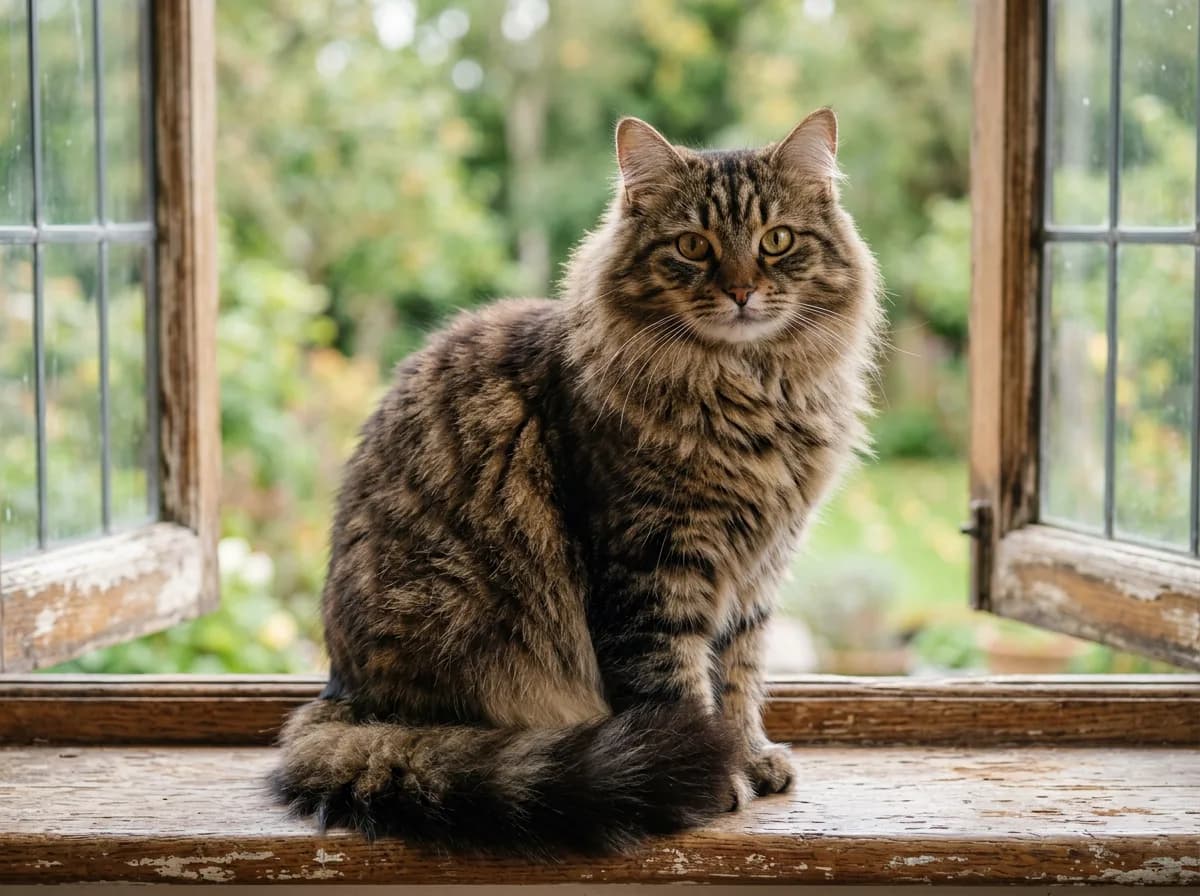
If a big fluffy cat does not cleanly fit either profile above, consider a third "forest cat": the Siberian, Russia's native longhair. The CFA describes Siberians as built "in a series of gentle curves," so much so that "you likely won't see anything that even suggests a straight line." That is the key contrast: where the Norwegian Forest Cat is all straight lines and triangles and the Maine Coon is rectangles and squares, the Siberian is soft and rounded, with a modified-wedge head and a rounded rather than squared muzzle. Siberians are also famously associated (though not guaranteed) with somewhat lower Fel d 1 levels. If your cat looks like a Wegie or Maine Coon but reads "rounder" and softer in the face, read our Siberian cat breed profile to compare. For yet another plush, dense-coated breed people confuse with these giants, the stocky British Shorthair is worth a look, though its short coat usually gives it away.
Price: Which Costs More?
Both breeds sit in the premium pedigreed tier, and prices overlap heavily, but the Maine Coon often runs a little higher on average, driven by its popularity and show demand. A pet-quality Norwegian Forest Cat from a reputable, health-testing breeder generally runs about 800 to 1,800 USD, with show or breeding-quality lines reaching 1,800 to 3,000 USD and up. A pet-quality Maine Coon typically runs about 1,000 to 2,800 USD, with top show lines higher still. Adoption or rescue is far cheaper for either breed (commonly 100 to 300 USD) because shelters are not breeders. Whichever you choose, insist on documented health screening (see below), and treat a "registered" giant priced far below these ranges as a red flag for a backyard operation or scam.
- The Norwegian Forest Cat's signature genetic disease is Glycogen Storage Disease type IV (GSD IV), which is DNA-testable; responsible Wegie breeders test to avoid it. Both breeds also carry a risk for hypertrophic cardiomyopathy (HCM), the most common feline heart disease. Ask any breeder for GSD IV results (Wegie) and HCM screening (both), and have your own veterinarian advise on what to verify before you buy.
Which Breed Is Right for You?
Both are magnificent, affectionate, family-friendly giants, so the choice comes down to lifestyle and temperament rather than looks. Lean Maine Coon if you want a big, sociable, dog-like companion that participates in your day, rides on a shoulder, chats back, and wants to be involved in everything. Lean Norwegian Forest Cat if you want an equally loving but more independent cat that keeps you company on its own terms, climbs to the highest shelf, and may turn out to love water. Both need space to climb, a consistent grooming routine, and a breeder (or rescue) who can speak to health testing. For the deepest dive on the larger of the two, our full Maine Coon breed profile covers everything from history to care. And if a calmer lap cat appeals more than either climber, the plush, easygoing Ragdoll is a third gentle-giant option worth weighing.
Norwegian Forest Cat vs Maine Coon: Frequently Asked Questions
The biggest differences are head shape and size. A Norwegian Forest Cat has a straight nose profile and a triangular face, while a Maine Coon has a square muzzle, a more rectangular head, and a gentle concave dip in profile. The Maine Coon is usually the larger, longer cat with more pronounced lynx tips, and it is more dog-like and social, while the Wegie is large but a bit smaller, smoother-coated, and more independent.
The Maine Coon is usually bigger. It is the largest domestic cat breed recognized in North America, with males commonly 15-25 pounds and bodies up to 40 inches nose to tail. Norwegian Forest Cat males run about 13-22 pounds. Both breeds overlap, so a large Wegie can outweigh a small Maine Coon, but on average the Maine Coon is the larger, longer cat.
Look at the face in profile. A perfectly straight line from brow to nose tip plus a triangular head means Norwegian Forest Cat; a square muzzle, rectangular head, and a slight concave dip mean Maine Coon. Other tells: the Maine Coon usually has bigger lynx tips and a shaggier, more uneven coat, while the Wegie has almond-shaped slanted eyes and a smoother, sleeker water-resistant coat.
Without registered parentage you cannot be certain, but you can make a strong guess by checking the profile (straight equals Wegie, dipped equals Maine Coon), head shape (triangle versus rectangle), eye shape (almond versus oval), lynx tips (bigger leans Maine Coon), and coat texture (smoother leans Wegie). If the clues split evenly, your cat is most likely a domestic longhair mix that simply inherited the big, fluffy look.
Possibly, but distantly. The CFA notes the Norwegian Forest Cat may have contributed the gene for long hair to the Maine Coon's ancestral mix, likely carried over by seafaring cats. It is plausible lore rather than proven pedigree. Both are natural landrace breeds (Norway and the northeastern United States) that developed long, weatherproof coats for cold climates, which is the main reason they look so alike.
Both are very affectionate, but they show it differently. The Maine Coon is more overtly dog-like, social, and people-following, often happy to be carried and quick to chat. The Norwegian Forest Cat is just as loving but more independent and reserved, preferring to keep you company nearby and come in for affection on its own terms. Neither is warmer; they simply express it at different volumes.
The Maine Coon usually costs a bit more on average because of its popularity and show demand. Pet-quality Norwegian Forest Cats typically run about 800 to 1,800 USD from a reputable breeder, while pet-quality Maine Coons run about 1,000 to 2,800 USD, with show lines of either breed higher. Adoption is far cheaper for both, often 100 to 300 USD. Always insist on documented health testing before buying.

Coreen Saito is a pet writer and longtime shelter volunteer with more than a decade in animal rescue. She covers cat behavior, breed care, and the small, ordinary science of sharing a life with companion animals, with a particular focus on honest takes about the products and decisions that actually matter. At home in Arizona, she's outranked by Mac (a dog with the loudest opinion in the house), Rebel (a cat who governs by quiet authority), and Meri (an orange tabby who runs the late shift and the laundry basket). She writes about all three, plus the rescues that keep coming through her life, at LifeWithMinty.com.
Sign up for expert-backed reviews and safety alerts all in one place.