Birman vs Ragdoll: Which Gentle Giant Belongs in Your Home?
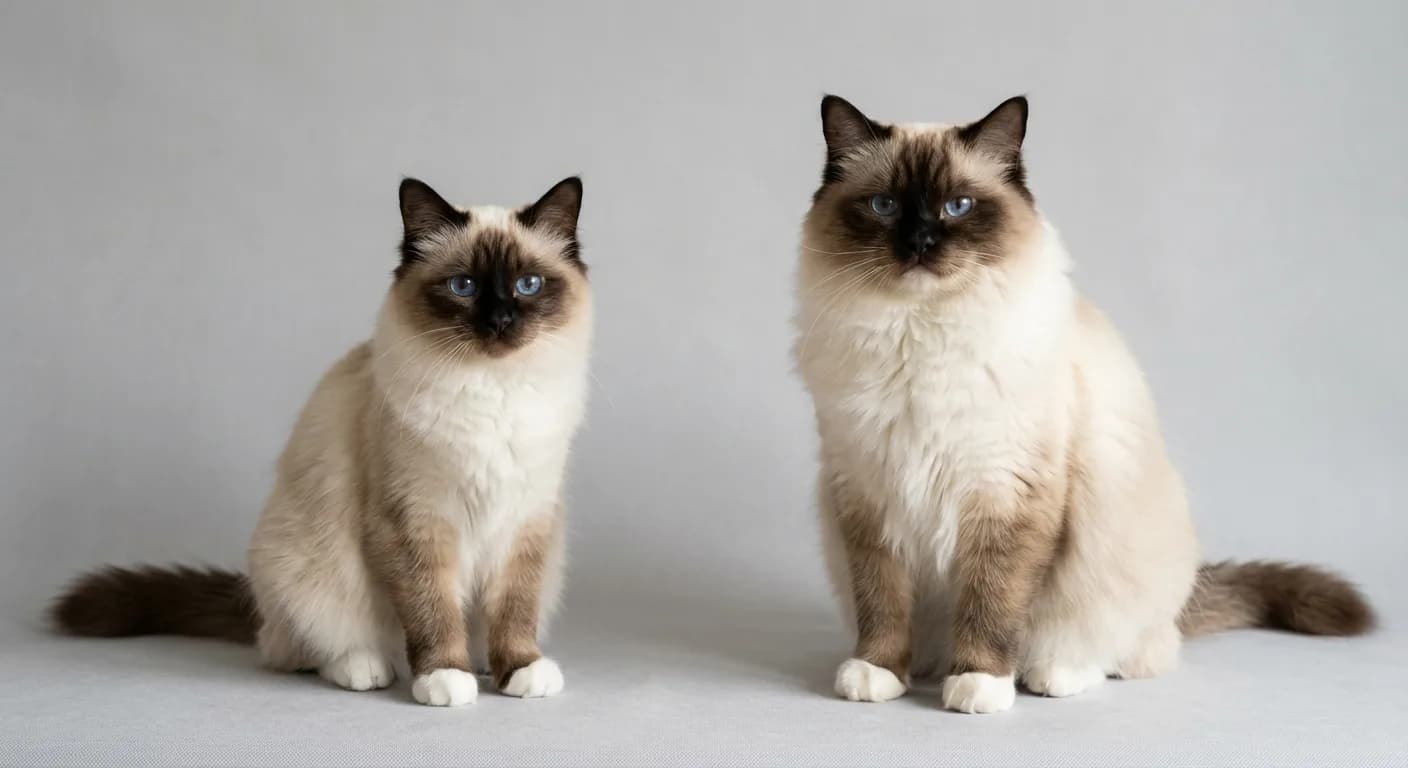
The Birman has white gloves on all four paws; the Ragdoll is one of the largest domestic breeds and goes limp when held. Both share blue eyes and colorpoint coats but suit very different households.
Petful is reader supported. As an affiliate of platforms like Amazon and Chewy, we may earn a commission when you buy through links on this page. There is no extra cost to you.
The birman vs ragdoll debate is one of the most common questions among cat lovers drawn to blue-eyed, colorpoint breeds, and the honest one-sentence verdict is this: both are calm, affectionate lap cats, but the Birman is a medium-sized cat with a silky single-layer coat and the breed's signature crisp white gloves on every paw, while the Ragdoll is one of the largest domestic breeds, goes famously limp when held, and carries no white on its paws at all. Understanding those core differences, plus temperament, grooming, health, and cost, makes the choice clear once you know what you actually want.
- 1The Birman's white-gloved paws are the easiest visual tell (Ragdolls have none)
- 2Ragdolls outweigh Birmans by up to 8 pounds and are considered one of the largest domestic breeds
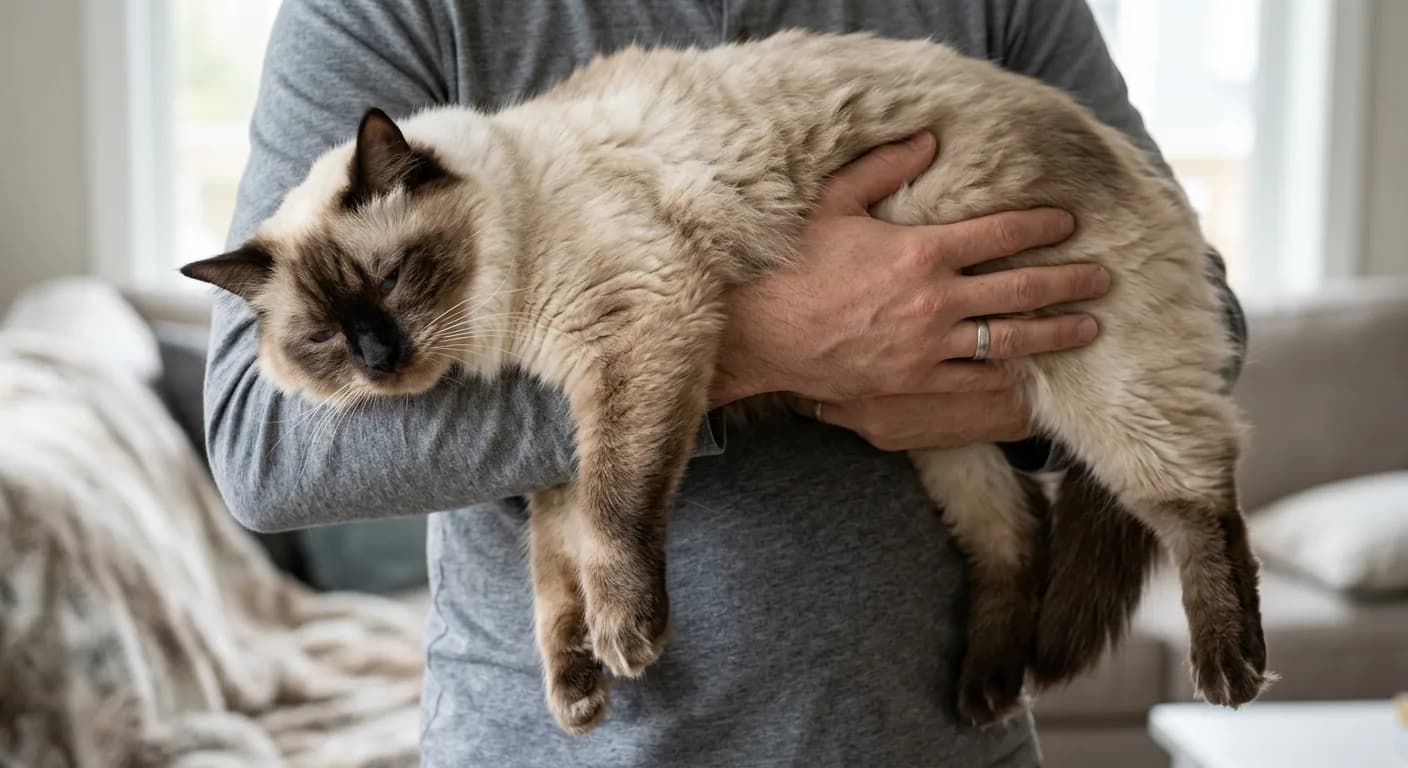
- 3Ragdolls go notoriously limp when picked up; Birmans stay gentle but hold their own posture
- 4Both breeds share blue eyes and colorpoint patterns, so coat and size are your best differentiators
- 5Ragdolls typically cost more at purchase; both breeds have similar long-term care costs

Sign up for expert-backed reviews and safety alerts all in one place.
Quick Comparison: Birman vs Ragdoll at a Glance
| Trait | Birman | Ragdoll |
|---|---|---|
| Weight | 6-12 lb | 10-20 lb |
| Height | 8-10 in | 9-11 in |
| Coat length | Semi-long, single layer | Semi-long, soft plush |
| White gloves | Yes, all four paws | No |
| Eye color | Always blue | Always blue |
| Colorpoint pattern | Yes | Yes |
| Temperament | Gentle, curious, social | Ultra-docile, floppy, calm |
| Vocal level | Soft, moderate | Very quiet, occasional |
| Grooming | Weekly brushing | Twice-weekly brushing |
| Lifespan | 12-16 years | 12-15 years |
| Kitten price | $600-$2,000 | $800-$2,500 |
| Good with kids | Yes | Yes |
| Good with other pets | Yes | Yes |
Origins: Two Very Different Stories
The Birman: Sacred Cat of Burma
The Birman, officially recognized as the Sacred Cat of Burma by the Cat Fanciers' Association (CFA), carries one of the most romantic origin legends in the cat world. According to Burmese temple lore, Birmans descended from a white cat named Sinh whose paws turned gold and eyes turned blue at the moment his master died, with the white tips of his paws remaining pure as a symbol of the priest's virtue. The modern breed was developed in France in the early 20th century and received official recognition from the CFA in 1967. Geneticists believe Birmans share ancestry with Siamese and Persian lines, which explains the colorpoint coat and silky texture. For more, see Petful’s guide to Birman cat colors.

At-home urine test strips that screen for glucose, blood, pH, and protein in seconds, so you can catch early signs of diabetes, kidney disease, or a UTI and bring real numbers to your vet.
Petful may earn a commission when you click through to Chewy, at no extra cost to you.
For a deeper look at the breed, see our full Birman cat breed profile.
The Ragdoll: A California Creation
The Ragdoll is a purely American invention. Breeder Ann Baker of Riverside, California, developed the breed in the 1960s from a white domestic longhair named Josephine and her offspring. Baker selected specifically for the breed's now-famous "floppiness" when held, calm temperament, and large size. The International Cat Association (TICA) granted full recognition in 1979. Unlike the Birman's ancient temple mythology, the Ragdoll's history is documented and recent, which also means the breed has a more uniform genetic base.
Never Scoop Again® with the Whisker Litter-Robot, the smart self-cleaning automatic litter box. Monitor visits and track weights for better overall care in the Whisker® app. Multi-cat friendly.
Petful may earn a commission when you click through to Whisker, at no extra cost to you.
- Both breeds carry colorpoint genetics, but the Birman's ancient lineage and the Ragdoll's 1960s California roots give them very different breed histories. The Ragdoll's relatively narrow genetic base is one reason breeders screen heavily for HCM.
Appearance: Spotting the Difference in Seconds
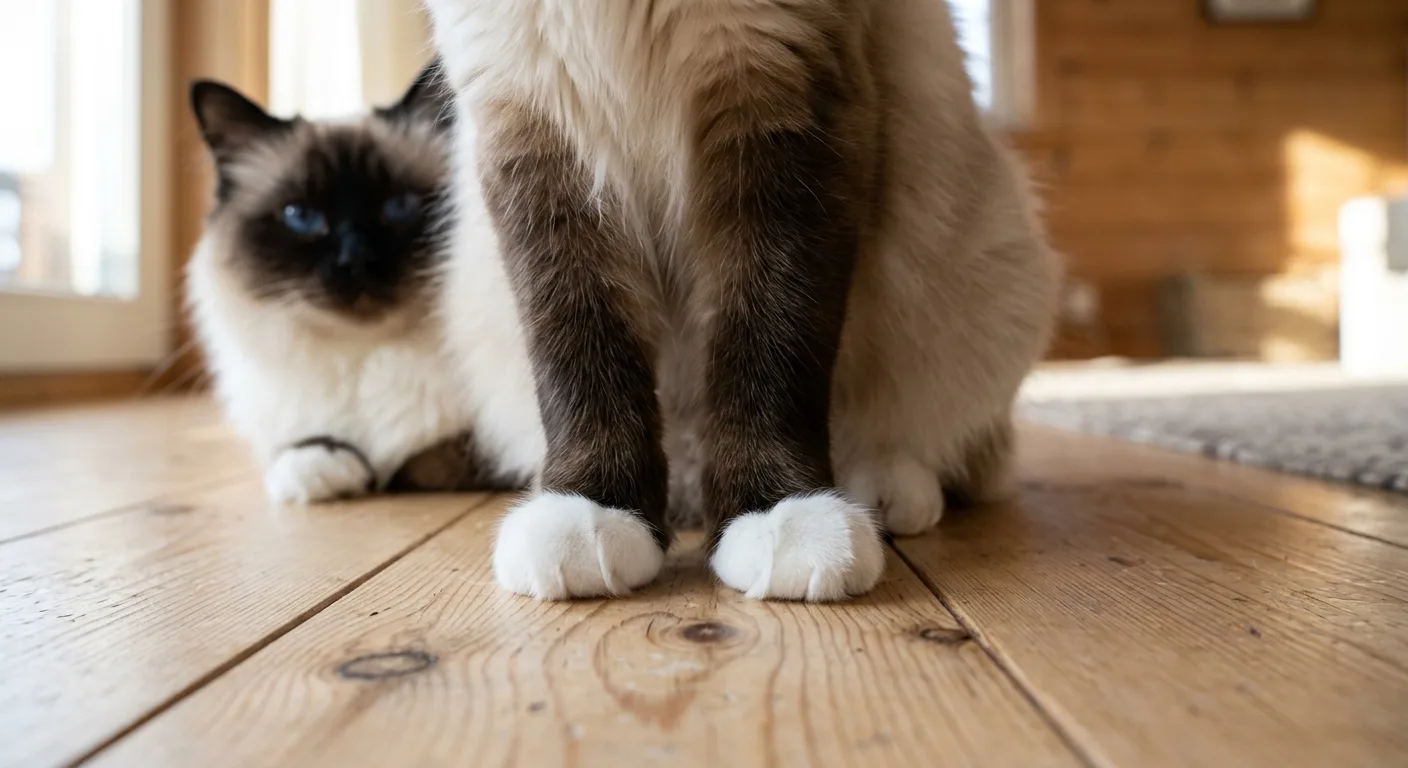
The single fastest way to tell a Birman from a Ragdoll is to look at the paws. Birmans have pure white "gloves" on all four feet, a trait that is written into the breed standard and required for show qualification. The gloves on the front paws are symmetrical and end in a clean line; the back paws have longer "laces" that extend partway up the leg. No white on the paws means the cat is not a Birman.
Ragdolls have no such marking. Their colorpoint pattern is limited to the face mask, ears, legs, and tail, and their paws match the body's lighter ground color rather than being white.
Beyond the gloves:
- Size: Ragdolls are substantially larger. Males commonly reach 15-20 pounds; females 10-15 pounds. Birmans top out around 12 pounds for large males, with females typically in the 6-10 pound range. For more, see Petful’s guide to Ragdoll cat size.
- Coat texture: The Birman coat is silky and single-layered (no dense undercoat), which makes it less prone to matting than you might expect for a semi-long coat. The Ragdoll coat is plush and rabbit-soft with a moderate undercoat.
- Color options: Both come in the classic colorpoint palette: seal, blue, chocolate, lilac, red, and cream points, plus tortie and lynx (tabby) variants. Neither breed has a solid-color option.
- Body type: Birmans are medium-sized with a rounded head and stocky legs. Ragdolls are large-boned with a broad chest and a proportionally large, broad head.
- Paws white? Birman. Paws not white but cat is enormous and floppy? Ragdoll. Both have blue eyes, so eye color alone tells you nothing.
Personality and Temperament: Gentle vs Genuinely Limp
Both breeds are famously gentle and good with children, but they express that gentleness differently.
Birman Temperament
Birmans are social and curious without being hyperactive. They follow their people from room to room (earning the "velcro cat" nickname), will greet strangers rather than hide, and want to be near you rather than necessarily on you. They play actively as kittens and retain moderate energy into adulthood. Unlike Siamese relatives, Birmans are not demanding or loud, though they do communicate in soft chirps and quiet trills. They adapt well to households with children and other pets, including dogs, because they're confident without being aggressive.
Ragdoll Temperament
The Ragdoll's defining behavioral trait is the "flop": when picked up, they relax their muscles completely and go limp, like picking up a beanbag. This is not trained behavior but a genuine breed characteristic that breeders selected for across generations. Ragdolls are more passive than Birmans. They tend to stay at floor level rather than jumping to high perches, follow their owners with less energy, and can become lonely and mopey if left alone for long periods. They are extremely quiet, rarely vocalizing, and are considered one of the easiest breeds to train basic commands because they are food-motivated and eager to please.
- Both breeds are affectionate, but they show it differently. Birmans want closeness and engagement. Ragdolls want to be held and will physically go limp in your arms. If you want a cat you can cradle like a baby, the Ragdoll wins. If you want an active companion who stays nearby and plays, the Birman is the better fit.
Grooming and Care
Both breeds have semi-long coats that require regular maintenance, but the Birman is easier to manage.
The Birman's single-layer coat lacks a dense undercoat, which means it mats less readily. Weekly brushing with a wide-tooth comb or slicker brush is sufficient for most of the year, with slightly more attention during seasonal shedding. The Ragdoll's plush coat has more undercoat and typically needs brushing twice a week. Neither breed requires professional grooming as a routine, though both benefit from a quarterly bath if they will tolerate it.
Both breeds need the same standard care: nail trims every 2-3 weeks, ear checks monthly, and dental brushing. Birman breeders specifically flag dental hygiene because the breed can be prone to periodontal disease.
- Ragdolls shed more than Birmans overall because of their denser undercoat. If you have light-colored furniture or allergies in the household, the Birman's single-layer coat is the lower-maintenance option.
Health and Lifespan
Both breeds are generally robust but share one significant hereditary risk: hypertrophic cardiomyopathy (HCM), a thickening of the heart muscle that is the leading cause of cardiac death in cats. Reputable breeders of both breeds should screen breeding stock for HCM annually via echocardiogram; ask for proof before purchasing.
Birman-specific concerns:

63-inch multi-level cat tree with scratch posts, hammock, plush perches, and dangling toys. Vertical territory is non-negotiable for high-energy climbing breeds like the Bengal.
Petful may earn a commission when you click through to Chewy, at no extra cost to you.
- HCM (moderate prevalence in the breed)
- Kidney disease
- Congenital hypotrichosis (a rare inherited condition causing hair loss)
Ragdoll-specific concerns:
- HCM (higher prevalence; a specific FHB-related mutation is documented in Ragdolls and can be DNA-tested)
- Polycystic kidney disease (PKD) in some lines
- Urinary tract issues
- Bladder stones
The Ragdoll HCM situation is worth calling out: a specific mutation (MYBPC3) has been identified in the breed and a DNA test exists. Ethical Ragdoll breeders test for this mutation and should provide the result. This is a meaningful differentiator in breed health management.
Lifespan: Birmans typically live 12-16 years with good care; Ragdolls 12-15 years. Both are relatively long-lived breeds. Petful’s guide to Ragdoll cat lifespan has the full breakdown.
- For both breeds, ask your breeder for annual HCM echocardiogram results on both parents before committing. For Ragdolls, also ask for the MYBPC3 DNA test result. A breeder who cannot or will not provide these results is not breeding responsibly.
Price Comparison
The Birman is notably less expensive to acquire than the Ragdoll at the kitten stage.
A Birman kitten from a reputable CFA- or TICA-registered breeder typically costs $600-$2,000 in the United States, with show-quality cats at the upper end. For context on what affects the Birman price, see our full Birman cat price guide.

108-oz stainless steel pet fountain with quiet pump and water-level window. Bengals are notoriously water-obsessed; a flowing fountain encourages hydration and pulls them away from sinks and toilets.
Petful may earn a commission when you click through to Chewy, at no extra cost to you.
A Ragdoll kitten from a registered breeder runs $800-$2,500, with some championship lines reaching higher. The higher price reflects the Ragdoll's popularity (consistently a top-5 breed by TICA registration numbers) and the cost of the additional health testing ethical breeders perform.
Ongoing costs are similar for both breeds: premium food, annual vet visits, and routine care.
- Both breeds appear in breed-specific rescues. Birman Rescue and the Ragdoll Rescue network (RescueMe.org lists both) often have adult cats available for $75-$200. An adult rescue cat's personality is already established, which makes temperament matching easier than with a kitten.
Which Breed Is Right for You?
Choose the Birman if:
- You want a moderately active companion who plays and explores
- You prefer easier grooming (single-layer coat, less shedding)
- Budget matters at the purchase stage
- You want the distinctive white gloves as a visual hallmark
- You have a busy household with kids, other cats, or dogs
Choose the Ragdoll if:
- You want the most docile, floppy lap cat possible
- You love the idea of a cat you can carry like a baby
- You prefer a quieter cat that almost never vocalizes
- You want one of the largest domestic breeds
- You have the time and budget for twice-weekly grooming and thorough health screening
Both breeds are excellent with families and other pets. Neither is a good choice for an owner who will be away from home for long stretches without a companion animal, as both are social and can develop anxiety when isolated.
For those interested in other large colorpoint breeds, our RagaMuffin vs Ragdoll comparison covers another close relative. For a broader overview of cat breeds in this category, visit the cat breeds section.
Frequently Asked Questions
The key differences are size, paw markings, and temperament. Birmans are medium-sized cats (6-12 lb) with distinctive white gloves on all four paws. Ragdolls are one of the largest domestic breeds (10-20 lb), have no white gloves, and go completely limp when held, a behavior called the "flop." Both are colorpoint breeds with blue eyes and gentle personalities.
The Ragdoll is significantly larger. Male Ragdolls commonly reach 15-20 pounds, and females 10-15 pounds. Birmans top out around 10-12 pounds for large males. Ragdolls are also tall and long-bodied, making them visually much more substantial cats.
Both are affectionate, but in different ways. The Birman is a "velcro cat" that follows you from room to room and wants to be near you at all times. The Ragdoll goes physically limp when held and is more suited to being cradled. If you want active companionship, the Birman; if you want a cat that melts into your arms, the Ragdoll.
No. White paws (called "gloves") are exclusive to the Birman and are a required trait in the breed standard. All four paws must have white gloves for a Birman to be show-eligible. Ragdolls have no white on their paws at all; their paws are the same lighter ground color as the rest of the body.
Both are excellent family cats. Birmans are slightly more active and better suited to households where children want a playful companion. Ragdolls are more passive and ideal for families who want a calm, gentle cat they can carry and cuddle. Both are tolerant of children and typically get along well with other pets including dogs.
Ragdolls are more expensive. Birman kittens from reputable breeders typically cost $600-$2,000. Ragdoll kittens run $800-$2,500, with some championship lines going higher. The Ragdoll's higher price reflects its consistent popularity and the additional genetic health testing (particularly the HCM MYBPC3 DNA test) that responsible breeders perform.
Yes, generally well. Both breeds are sociable and non-aggressive. Housed together, they typically coexist peacefully, though the Ragdoll's passivity sometimes means it defers to the more confident Birman. Introducing them gradually using scent-swapping before a face-to-face meeting gives the best result regardless of breed pairing.
Ragdolls shed more. Their plush coat has a denser undercoat compared to the Birman's single-layer silky coat. Both breeds shed seasonally, but Ragdoll owners typically report more fur on furniture and clothing. Weekly vacuuming is standard with either breed, but Ragdoll households usually need it more frequently.

Coreen Saito is a pet writer and longtime shelter volunteer with more than a decade in animal rescue. She covers cat behavior, breed care, and the small, ordinary science of sharing a life with companion animals, with a particular focus on honest takes about the products and decisions that actually matter. At home in Arizona, she's outranked by Mac (a dog with the loudest opinion in the house), Rebel (a cat who governs by quiet authority), and Meri (an orange tabby who runs the late shift and the laundry basket). She writes about all three, plus the rescues that keep coming through her life, at LifeWithMinty.com.
Sign up for expert-backed reviews and safety alerts all in one place.