Best Dog Puzzle Toys: 6 Picks From Easy to Expert
Choose a dog puzzle your pet can learn. Compare six Chewy picks by difficulty, opening action, cleaning and food capacity, with a practical plan for starting easy and deciding when to level up.
Petful is reader supported. As an affiliate of platforms like Amazon and Chewy, we may earn a commission when you buy through links on this page. There is no extra cost to you.
The best dog puzzle toys give your dog a challenge it can learn, with a clear way to reach the reward. A beginner may need just one peg to move. An experienced puzzle solver may enjoy sliding pieces in sequence. A dog that prefers pushing with its nose might take to a different game than one that paws at everything.
These six picks cover that progression, from a simple starter board to an expert puzzle and a layered feeder for meals. We compare the documented mechanics, difficulty, cleaning requirements and limitations of each exact model. These are research-based recommendations, not hands-on test results.

Sign up for expert-backed reviews and safety alerts all in one place.
Compare the dog puzzle toys
Start with Dog Smart if your dog has never used a puzzle board. Choose TRIXIE’s Flip Board for several ways to uncover treats at a low catalog price, or Mad Scientist for rotating beakers instead of another flat board. Challenge Slider and MultiPuzzle are options for dogs already comfortable with increasingly complex games. Lickin’ Layers is the meal-oriented choice.
A higher difficulty level is not automatically better. Nor does a top-rated puzzle guarantee a good fit for a particular dog. Watch how your dog interacts with food puzzles, then choose the next skill to introduce. High-energy dogs still need an achievable game rather than the hardest puzzle you can find.
The comparison lists each exact model and variant, its best use, the maker’s difficulty level, how the dog opens it, cleaning per maker and its main limitation.
- TRIXIE’s Level 2 labels below come from the selected retailer listings; they should not be treated as identical to Nina Ottosson’s published levels.
- Catalog prices were observed October 18, 2026, for the selected Chewy variants. Prices and availability can change.
| Exact model and variant | Best use | Catalog price | Maker’s difficulty level | How the dog opens it | Cleaning per maker | Main limitation |
|---|---|---|---|---|---|---|
| Outward Hound Dog Smart Composite Dog Toy | First puzzle board | $12.74 | Level 1 in the maker’s level guide | Moves pegs covering nine compartments | Warm water and mild soap | Removable pieces; not a chew toy |
| TRIXIE Activity Flip Board X-Large Level 2 Strategy Game,Enrichment & Interactive Play, Treat Intermediate Dog Puzzle Toy, Blue | Budget board with varied actions | $9.77 | Retailer labels it Level 2; maker does not assign a level on the reviewed page | Opens hinged lids, moves sliders and removes cones | Dishwasher suitable | Loose cones; size label does not establish fit for every large dog |
| TRIXIE Mad Scientist Turn Around Activity Strategy Game Dog Toy, Level 2 | Learning a rotating-beaker game | $16.39 | Retailer Level 2; maker describes two lid settings | Turns cups with nose or paw until treats fall out | Rotating elements are dishwasher suitable | Treats must pass through the selected lid holes |
| Outward Hound Nina Ottosson Challenge Slider Dog Toy, Blue & Orange | A sliding challenge after simpler boards | $27.49 | Level 3 | Slides tiles in sequence to reach food | Mild soap and warm water | Removable underside tray; supervise dogs that lift or flip boards |
| Outward Hound Nina Ottosson Multipuzzle Dog Toy, Green & Blue | Experienced puzzle solvers | $26.99 | Level 4 | Combines tiles, a wheel, locks and sliders | Hand wash | Too complex as a first puzzle |
| Outward Hound Nina Ottosson Lickin’ Layers Interactive Puzzle Game & Slow Feeder, Multicolor, One-Size, 2 cup | Serving food through a layered puzzle | $20.99 | Level 2 | Spins three layers to reveal food compartments | Follow the included instructions; maker’s reviewed page does not specify a washing method | “2 cup” is the retailer’s listing description, not a verified manufacturer capacity |
The easiest way to make dog puzzles harder is to use the model’s intended adjustments after your dog understands the basic action. More hidden food or more closed compartments should introduce a manageable change, not leave the reward unreachable. Cleaning matters just as much: a treat dispenser or puzzle box needs a care method you can follow after food has been inside it.
Our dog puzzle toy picks
Best first puzzle: Outward Hound Dog Smart Composite Dog Toy
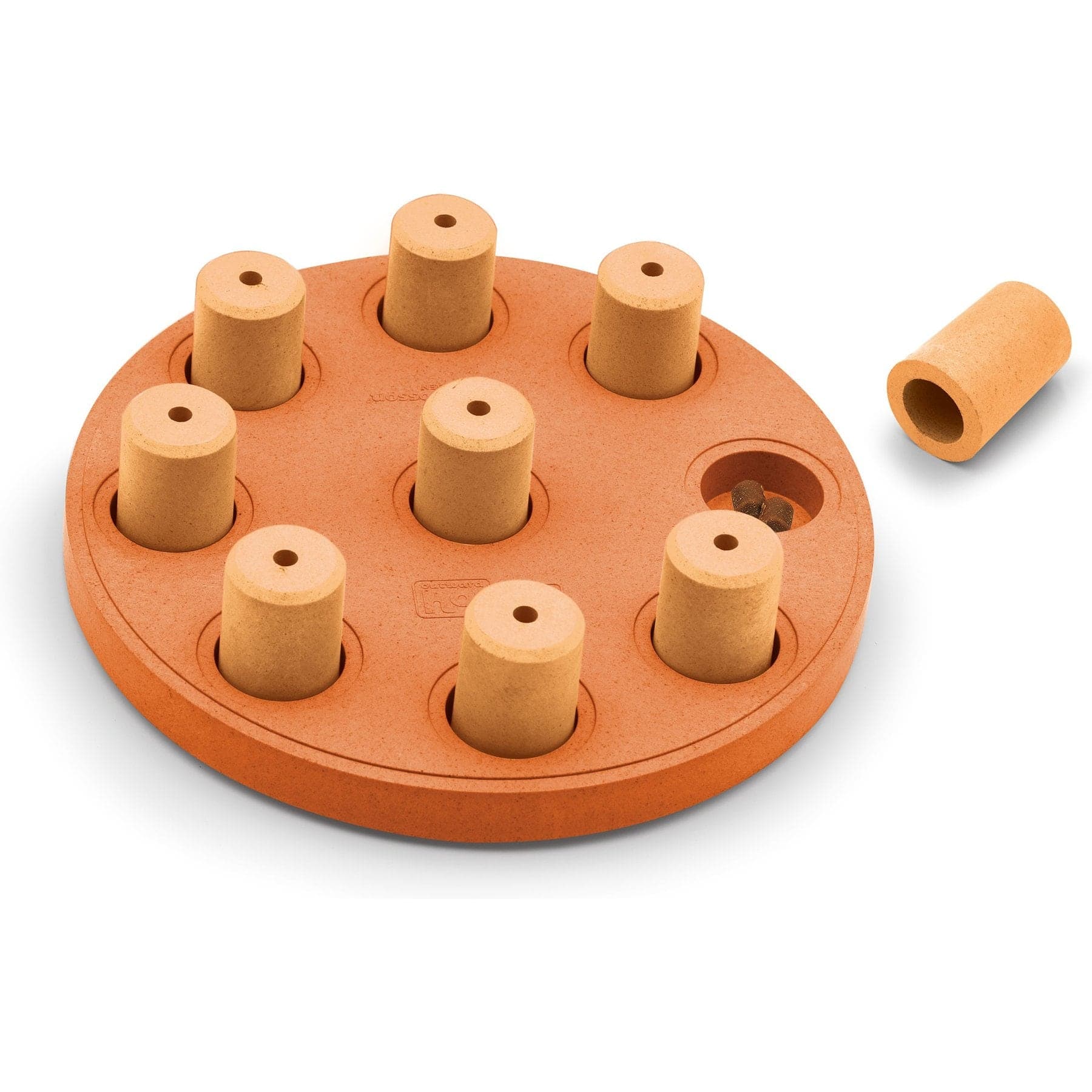
Start with a beginner puzzle featuring nine covered compartments. Make the first attempts easy by leaving some pegs off.
Petful may earn a commission when you click through to Chewy, at no extra cost to you.
Dog Smart is our starting choice because it introduces a simple relationship: move an obstacle and find food underneath. Its nine covered compartments give a beginner repeated opportunities to try that action without learning a whole sequence at once.
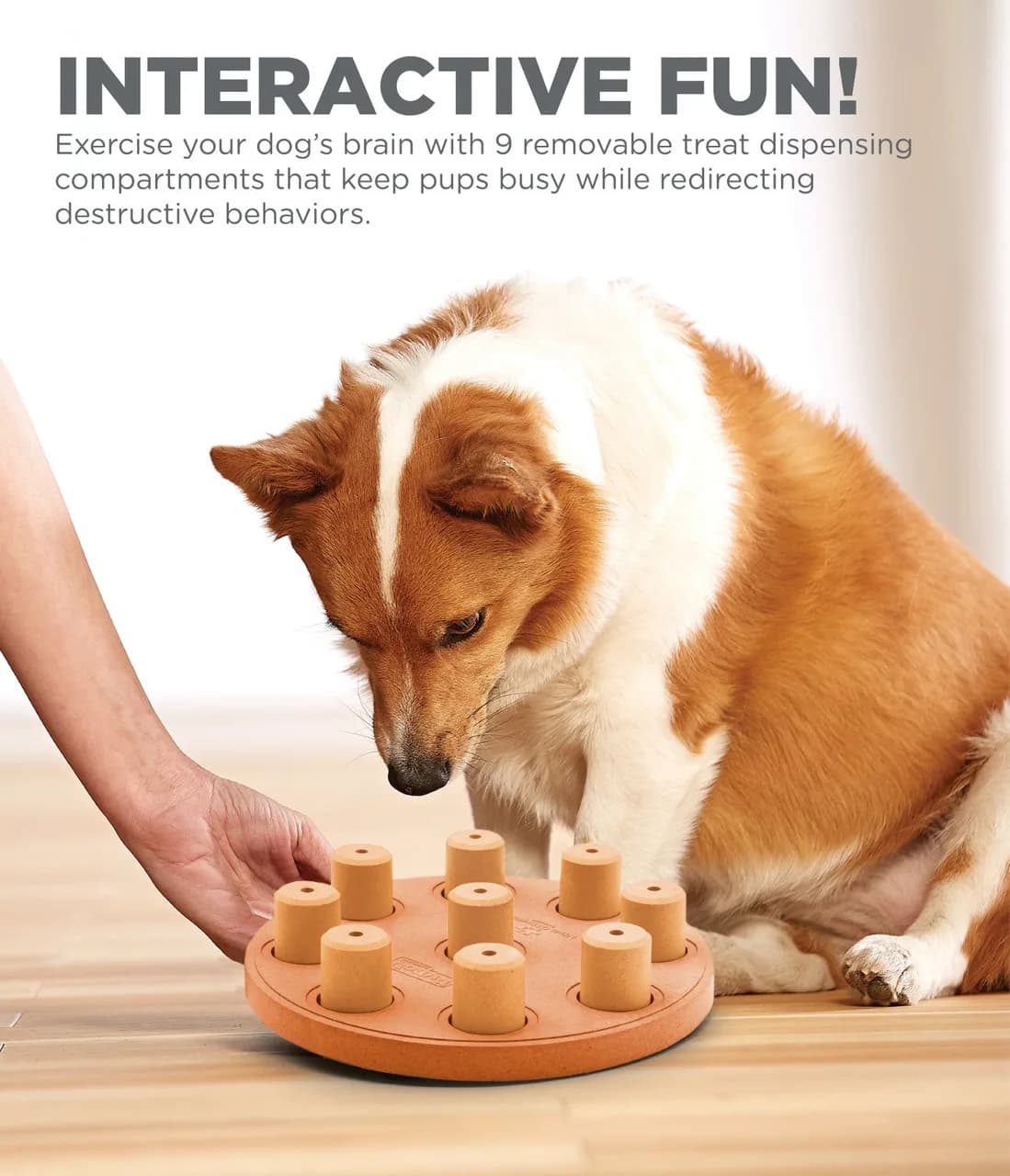
Outward Hound’s product information identifies the composite construction and advises washing with warm water and mild soap. Its difficulty guide places Dog Smart Composite in Level 1. That guide is the clearer reference because the individual product page contains conflicting level wording.
- Best match: A dog new to puzzle boards or one that needs an easy success.
- Useful feature: A straightforward action you can demonstrate.
- Main tradeoff: A dog familiar with removable covers may solve it quickly.
- Supervision point: Collect the removable pieces rather than letting the dog carry them away to chew.
You do not need to make every compartment difficult on the first attempt. Show your dog the food, demonstrate the movement and follow the included introduction instructions. An easy finish is useful feedback that your dog understands the game.
The Dog Smart Composite also makes a more sensible first gift than an expert puzzle when you do not know the recipient dog’s experience. Ask the owner whether the dog solves food games or tends to grab and chew them before choosing any board with loose pieces.
Best budget board: TRIXIE Activity Flip Board X-Large, Blue
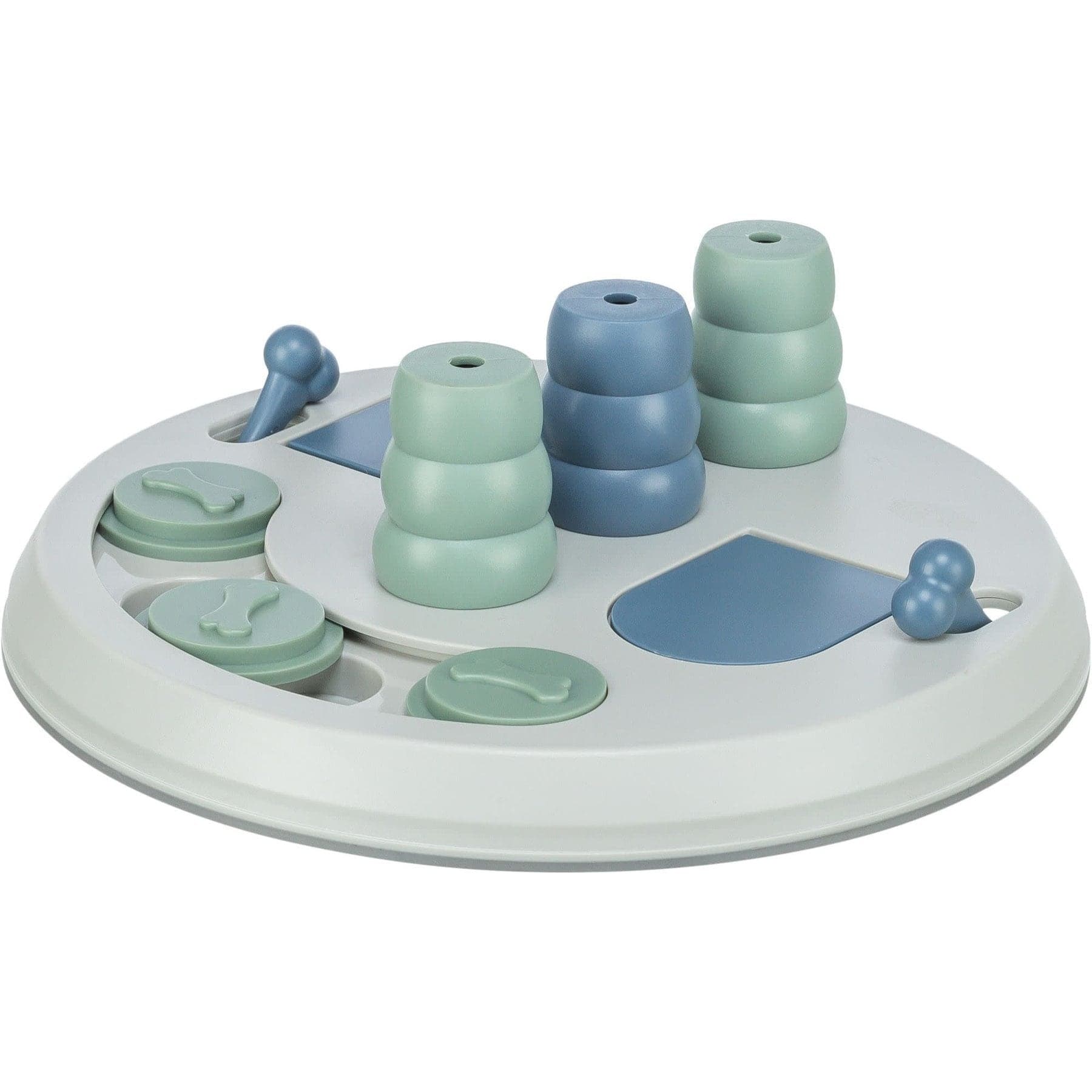
A board with cones, lids and sliders for several ways to uncover treats. TRIXIE permits dishwasher cleaning for this model.
Petful may earn a commission when you click through to Chewy, at no extra cost to you.
The selected TRIXIE Flip Board was the least expensive of our six picks at $9.77. It offers more than one type of action, with hinged lids, sliders and three removable cones. That makes it useful for discovering whether your dog prefers nudging, lifting or moving a piece sideways.
TRIXIE calls this manufacturer model the Flip Board XXL, item 32053, and lists a 28-centimeter diameter. Chewy’s selected product name uses X-Large and Level 2. Those naming differences are why the exact model matters more than a size word alone.
- Best match: A dog ready to try several food-finding actions.
- Useful feature: The manufacturer says the board is dishwasher suitable.
- Main tradeoff: Some components are loose and need to be gathered after play.
- Fit point: Check whether your dog can work the mechanisms comfortably instead of relying on “X-Large.”
The manufacturer’s description confirms a rubber base ring, which helps keep the board in place. It does not make the toy impossible to flip or turn it into a chew-resistant product.
Use the training instructions to introduce one mechanism at a time. Filling every closed area immediately gives you less information about which action your dog understands. A slower introduction makes this varied board more useful than simply handing over a fully loaded puzzle and waiting.
Best adjustable bridge: TRIXIE Mad Scientist Turn Around, Level 2
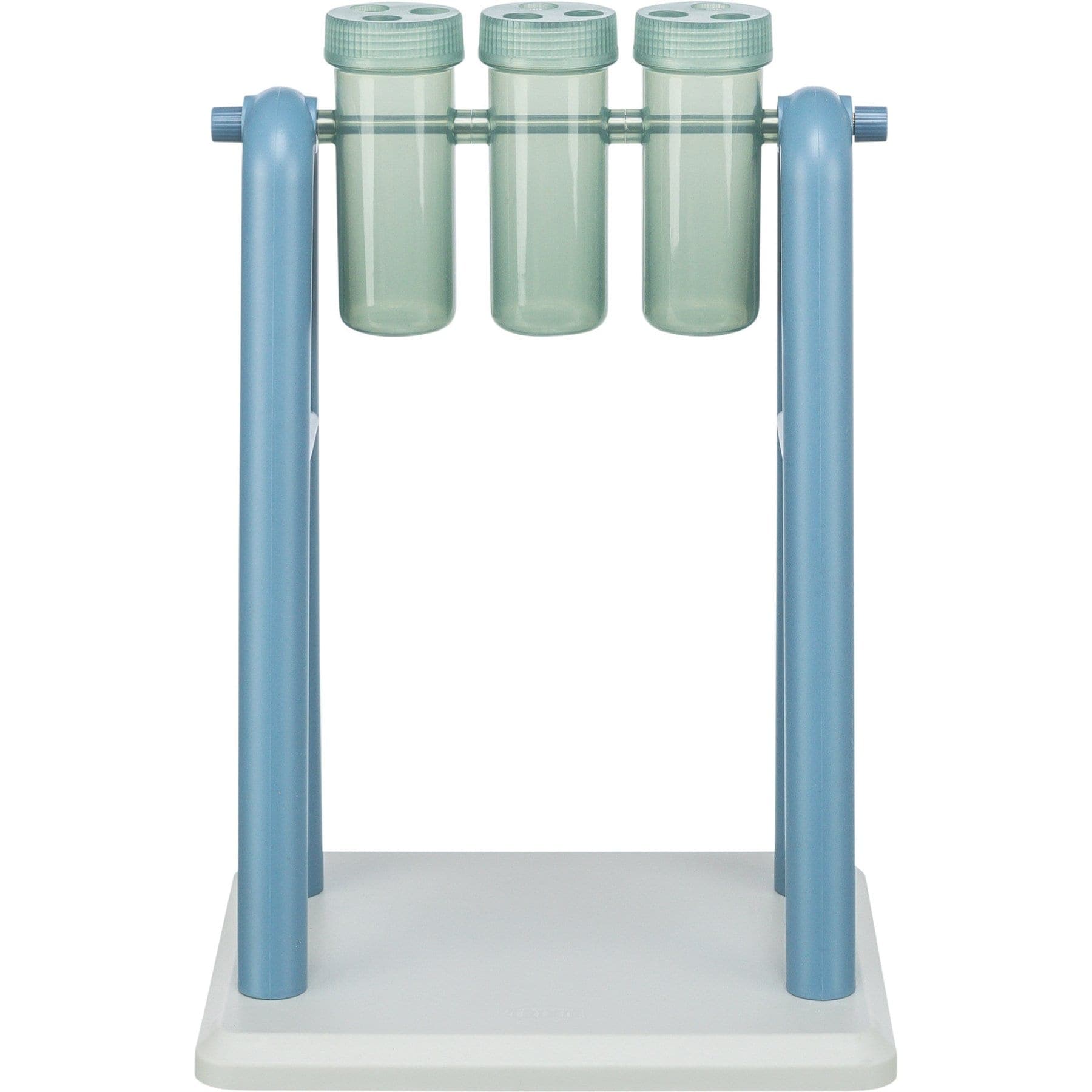
Three turning beakers offer a different challenge from flat puzzle boards. Begin with an easy opening configuration.
Petful may earn a commission when you click through to Chewy, at no extra cost to you.
Mad Scientist changes the problem from uncovering a compartment to turning a cup. Three rotating beakers sit on a stand, and the dog moves them with its nose or paw until food falls out. It is a good alternative when you want a different action rather than another lid-and-slider board.
TRIXIE’s Turn Around product information describes two lid settings. A lid with three smaller openings increases the challenge compared with the one-hole version. The manufacturer lists rubber feet and says the rotating elements are dishwasher suitable.
- Best match: A dog that enjoys making something move to release food.
- Useful feature: You can change the lid openings within the same toy.
- Main tradeoff: Food must fit through the openings for the game to work.
- Supervision point: Redirect chewing on the cups or frame and put the toy away after use.
Test the food’s fit yourself before presenting the puzzle. A treat that cannot pass through the lid does not create a harder game; it creates a reward the dog cannot obtain by performing the intended action.
Choose the Mad Scientist Turn Around when your dog is comfortable exploring a moving object. A dog that already understands sliding covers may still need help learning to rotate a beaker. Familiarity with one kind of Level 2 game does not mean every other intermediate mechanism will be obvious.
Best Level 3 challenge: Outward Hound Nina Ottosson Challenge Slider, Blue & Orange
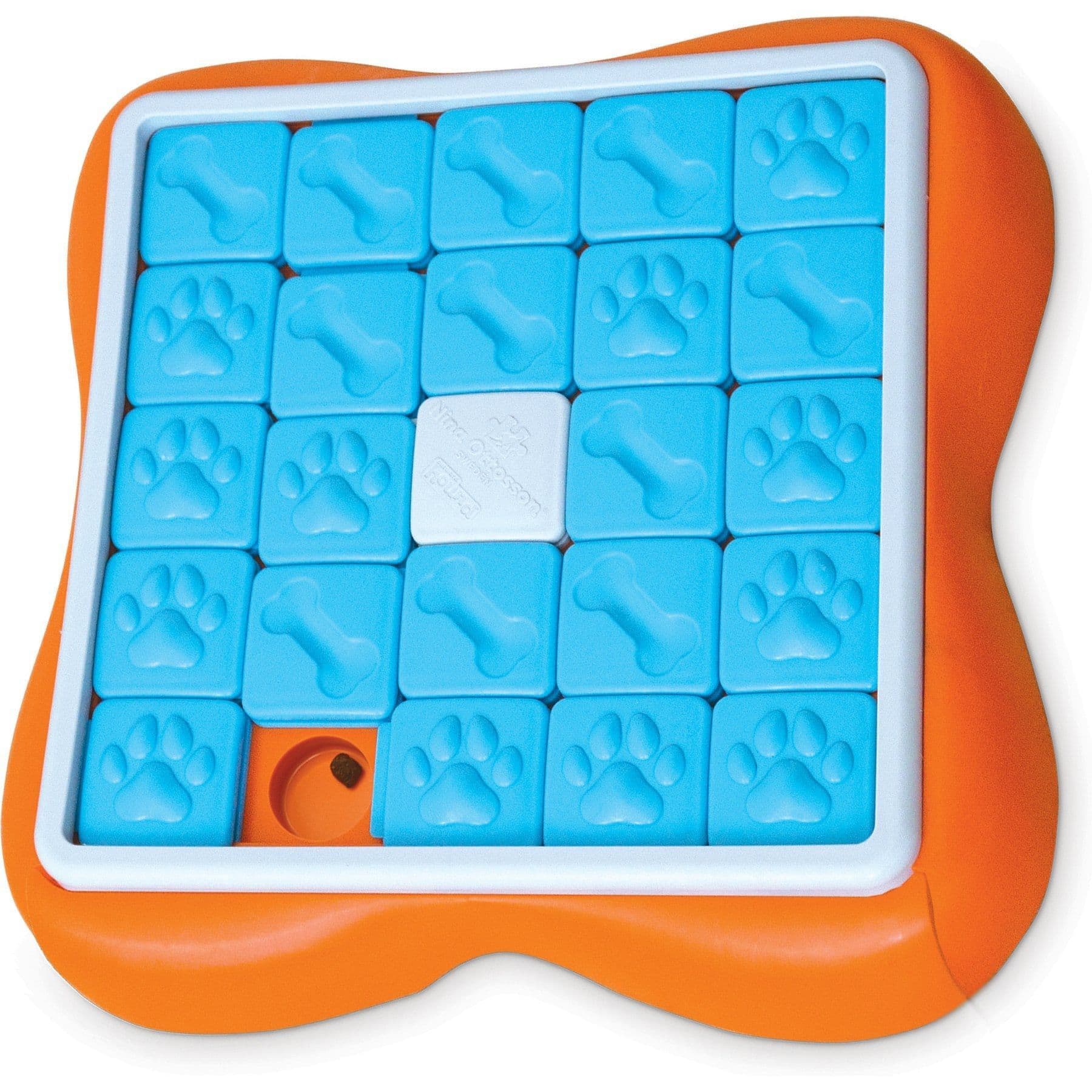
Sliding tiles cover 24 treat compartments. A next-step puzzle for dogs already comfortable moving pieces.
Petful may earn a commission when you click through to Chewy, at no extra cost to you.
Challenge Slider suits a dog that already understands simpler food boards and is ready to move tiles in sequence. Its built-in play pieces stay attached during normal play, reducing the loose pieces you need to collect compared with a removable-peg board.
The manufacturer lists 24 compartments in a removable tray with room for up to 1 cup of food. The tray comes out from underneath for filling. That is convenient for preparation, but it also means the underside is part of the design you need to watch when a dog tries lifting or turning the board.
- Best match: A dog that deliberately moves pieces rather than grabbing the board.
- Useful feature: Multiple food compartments and attached sliding pieces.
- Main tradeoff: A new sequence may require demonstration even for an experienced dog.
- Care: Wash with mild soap and warm water as directed.
The extra challenge comes from the movement needed to expose each reward, not simply from having more food wells. Give your dog time to notice how one opening allows another tile to move. You can help reveal the next action without turning every session into a test.
This is our pick for a sliding challenge, not a promise that it will occupy a dog for a particular number of minutes. A dog may learn the pattern quickly and still enjoy repeating it.
Best expert puzzle: Outward Hound Nina Ottosson Multipuzzle, Green & Blue
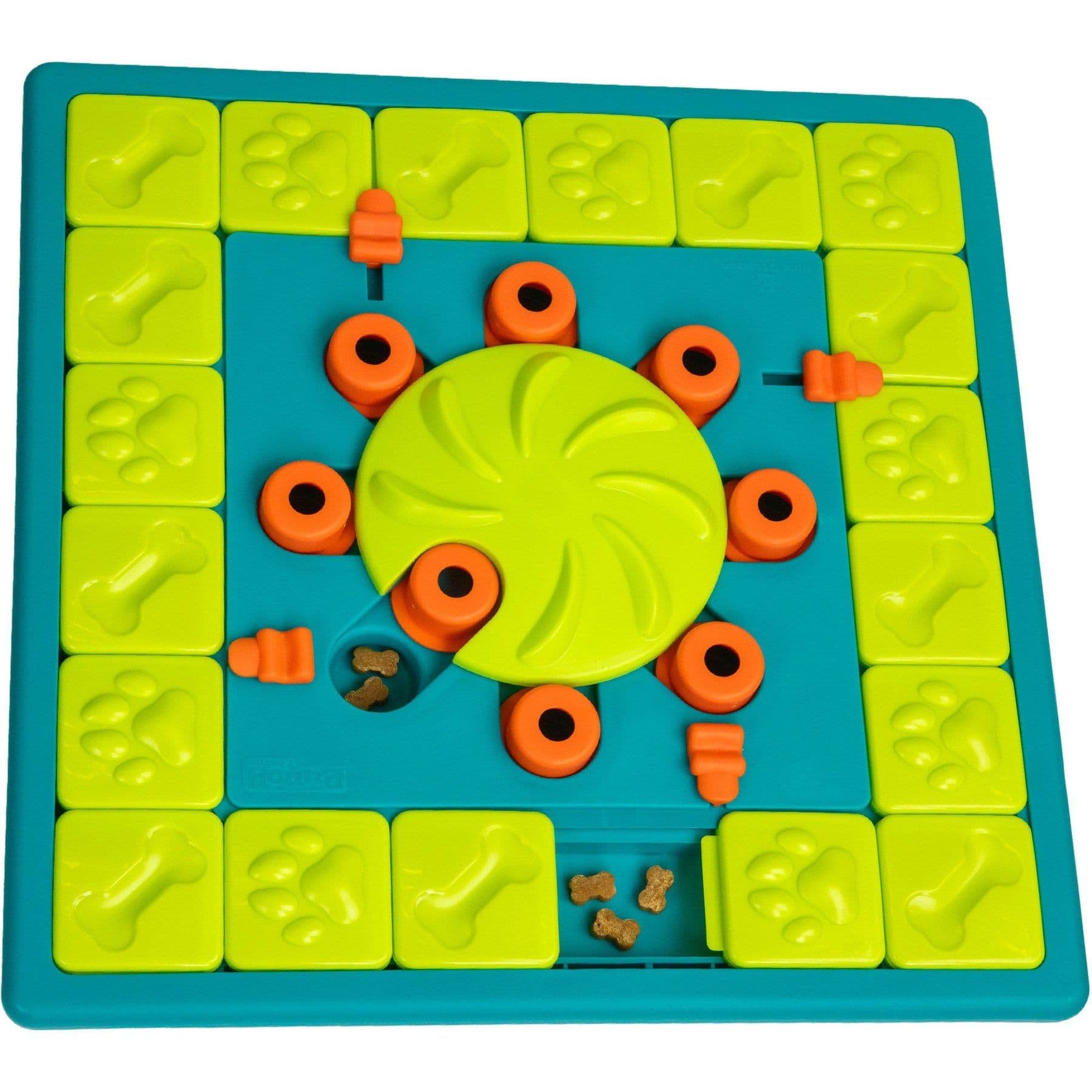
A multi-step board for experienced puzzle users. Introduce its actions separately before combining the challenges.
Petful may earn a commission when you click through to Chewy, at no extra cost to you.
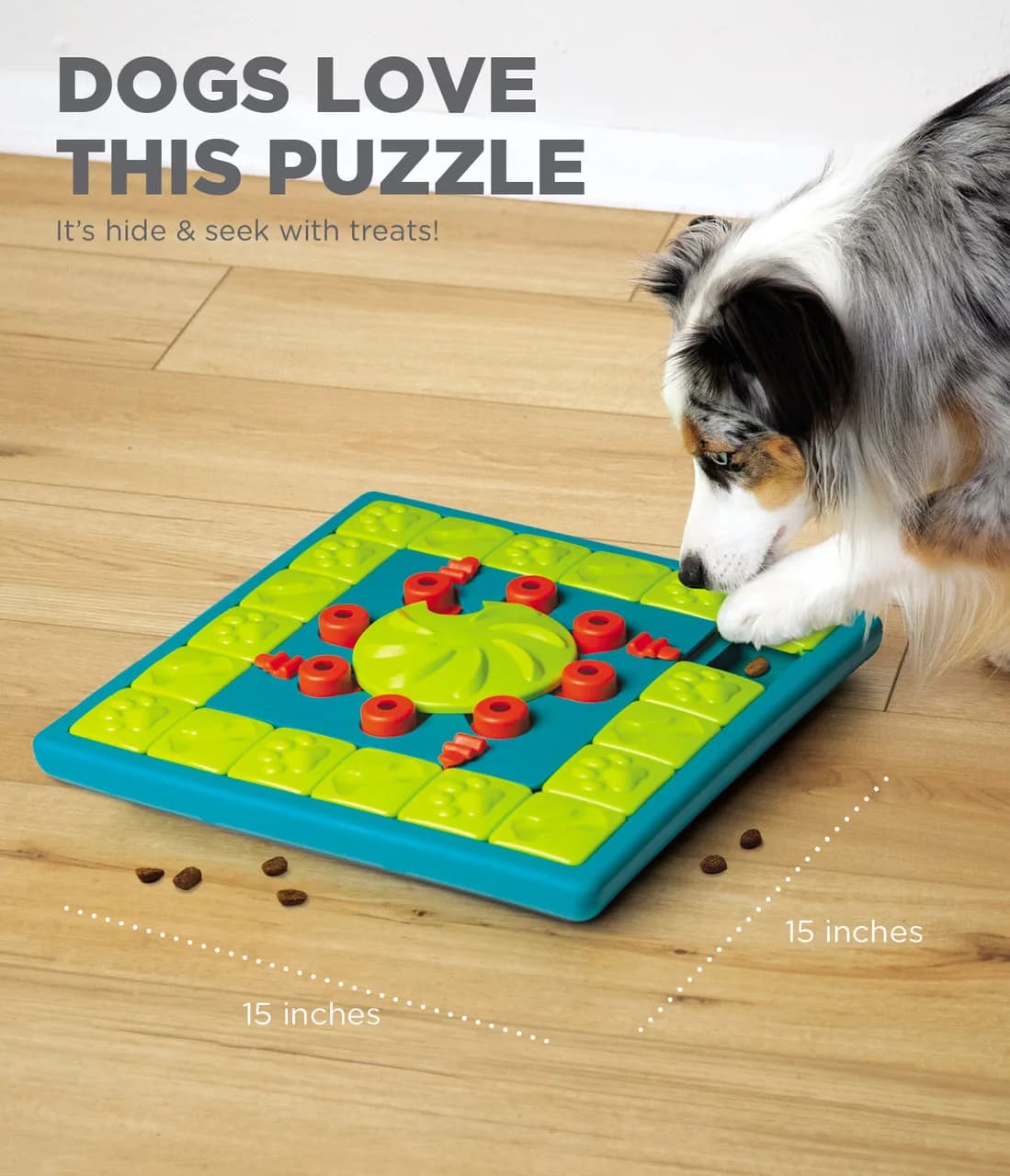
MultiPuzzle is the expert option for a dog that has mastered easier games and continues to engage with deliberate problem-solving. It combines movable tiles, a spinning wheel, locks and central sliders, so there is more to learn than repeating one action across a board.
Outward Hound identifies it as Level 4 and positions it after Levels 1 through 3. The manufacturer’s product page also describes adjustable difficulty. That makes it possible to introduce the mechanisms progressively instead of presenting every obstacle at once.
- Best match: An experienced dog whose owner enjoys teaching new puzzle sequences.
- Useful feature: Several mechanisms and adjustable setups.
- Main tradeoff: It can be too difficult if your dog has not learned the preceding skills.
- Care and use: Hand wash and supervise; it is not intended for chewing.
A dog that solves a beginner puzzle rapidly does not necessarily need the hardest available model next. Speed may mean it understands that particular action very well. Watch whether it also learns new actions calmly before choosing an expert board.
At the observed $26.99 catalog price, MultiPuzzle cost slightly less than Challenge Slider. That does not make it the better bargain for every dog. The more useful purchase is the one your dog can engage with successfully at its current skill level.
Best puzzle feeder for meals: Outward Hound Nina Ottosson Lickin’ Layers, Multicolor, One-Size, 2 cup
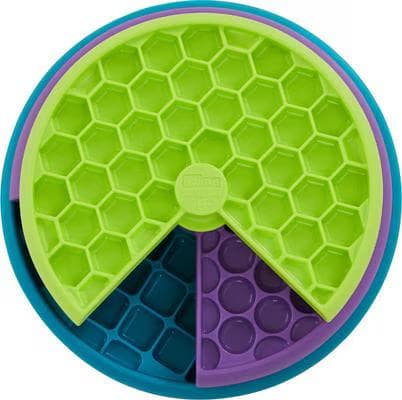
Three rotating layers hold food in small compartments. A feeding activity for dogs that enjoy nosing a moving surface.
Petful may earn a commission when you click through to Chewy, at no extra cost to you.
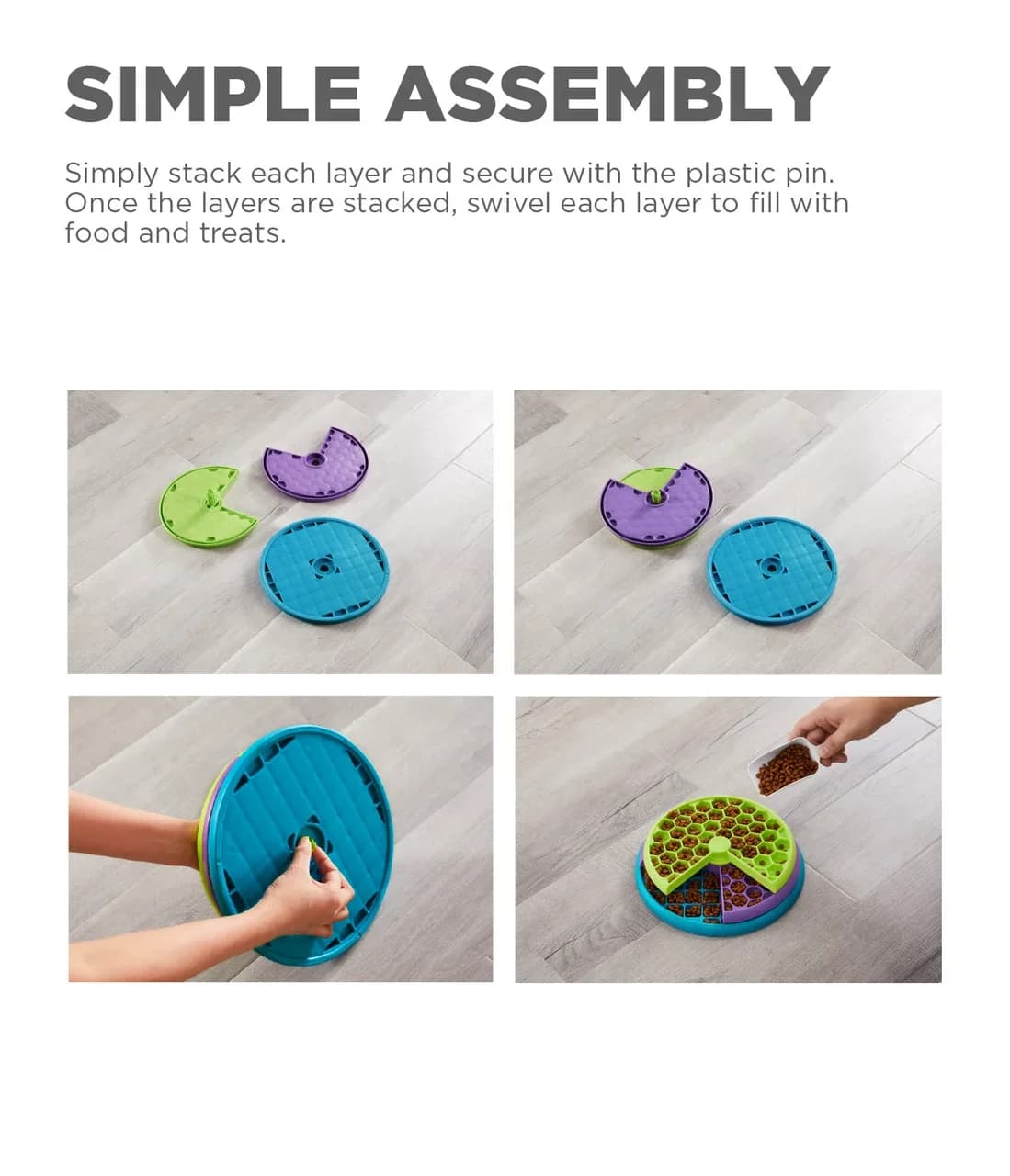
Lickin’ Layers combines food compartments with three rotating layers. It is the strongest fit here when you want a puzzle that can be part of feeding rather than a board loaded with a few separate treats.
Outward Hound rates it Level 2 and describes more than 100 compartments. Its product information says the layers can be used as a slow feeder. Chewy’s selected listing calls it “2 cup,” but the manufacturer page reviewed does not provide a capacity, so check the included directions against the amount you plan to serve.
- Best match: A dog that can turn the layers and retrieve food from the ridges.
- Useful feature: Food is spread through a layered activity.
- Main tradeoff: Many compartments mean more surfaces to inspect after feeding.
- Care limit: Follow the exact model’s instructions; a manufacturer washing method was not confirmed from the reviewed page.
The manufacturer allows certain soft foods and freezing preparations, but start with a setup your dog can already manage. Changing food texture and difficulty simultaneously makes it harder to see why a dog stops engaging. If your dog eats fresh food, a measured portion of JustFoodForDogs Chicken & Rice spreads across the layers and counts toward the day's meal.
The Lickin’ Layers puzzle feeder is not interchangeable with a plain slow-feeder bowl. Its turning layers add a mechanical task. That distinction matters when deciding whether you want a food game or simply a different bowl layout.
How we selected these dog puzzle toys
We retained the useful selection questions from our earlier guide: how the toy works, how difficult it is, whether it fits the dog, what it is made from and how it can be cleaned. We applied those questions to six exact products using manufacturer information and the selected Chewy catalog records.
This comparison does not claim that we tested durability, measured solving times or evaluated customer-review scores. We also do not treat a material description as proof that a toy is safe for every dog. Food-contact construction, loose parts and chewing behavior are separate considerations.
Our selection criteria were:
- A distinct action: Removing a peg, opening a lid, turning a cup, sliding tiles or rotating layers.
- A useful difficulty progression: A beginner entry point plus options for dogs ready for new skills.
- Clear product identity: The actual model and selected retailer variant.
- Practical preparation: How food is loaded and whether it can come out as intended.
- Cleaning information: Maker guidance where published, with missing information identified.
- Supervision requirements: Especially loose pieces and the risk of treating a puzzle as a chew toy.
Four picks come from Nina Ottosson by Outward Hound because its published level system provides a useful progression. Two TRIXIE designs add different mechanisms and cleaning options. The recommendations are about those particular features, not a claim that one brand is best at every kind of enrichment.
Are puzzle toys good for dogs?
Dog puzzle toys hide or restrict access to food until the dog performs an action. Depending on the game, that might mean nudging a peg, sliding a cover or rotating a layer. The activity gives a dog something specific to investigate and gives you an opportunity to observe and help it learn.
That can be useful when you want to add mental stimulation to an ordinary day. It also creates shared playtime: you prepare the puzzle, demonstrate an action if necessary and watch how the dog responds. The interaction is part of the value, not merely a way to keep the dog occupied elsewhere.
- 1Maker’s difficulty level is a starting point, not a score for your dog’s intelligence.
- 2How the dog opens it matters: pawing, nudging, lifting and rotating are different skills.
- 3A simple puzzle used successfully is more useful than an expert board your dog only bites.
Are puzzle toys really good for dogs?
They can be a useful enrichment activity when the dog can access the food, the difficulty is appropriate and play remains supervised. Their value is in providing an achievable task and variety. They do not replace exercise, social interaction or rest, and the product information does not establish that a particular puzzle will improve every dog’s behavior.
Destructive behavior, barking, whining, restlessness and digging can prompt owners to look for more enrichment. Those behaviors can have several causes, however, so do not assume a puzzle purchase explains or fixes them. Notice when the behavior occurs and whether the dog appears comfortable during the activity.
Boredom, anxiety and breed expectations
A food puzzle can be one part of a boredom-reduction routine, but it should not be presented as treatment for separation anxiety. These selected games require supervision, which also makes them a poor answer to “What can I leave with my dog while I am away?”
Petful’s guide to extreme anxiety in dogs addresses that separate concern. A dog that is distressed or too unsettled to engage needs more than a harder food game.
Breed reputation does not establish a starting level either. A Border Collie or Husky new to puzzle boards still has to learn the mechanics. Choose according to experience, motivation and play style rather than assuming a “smart” breed should begin with an advanced model.
Dog puzzle toy levels explained
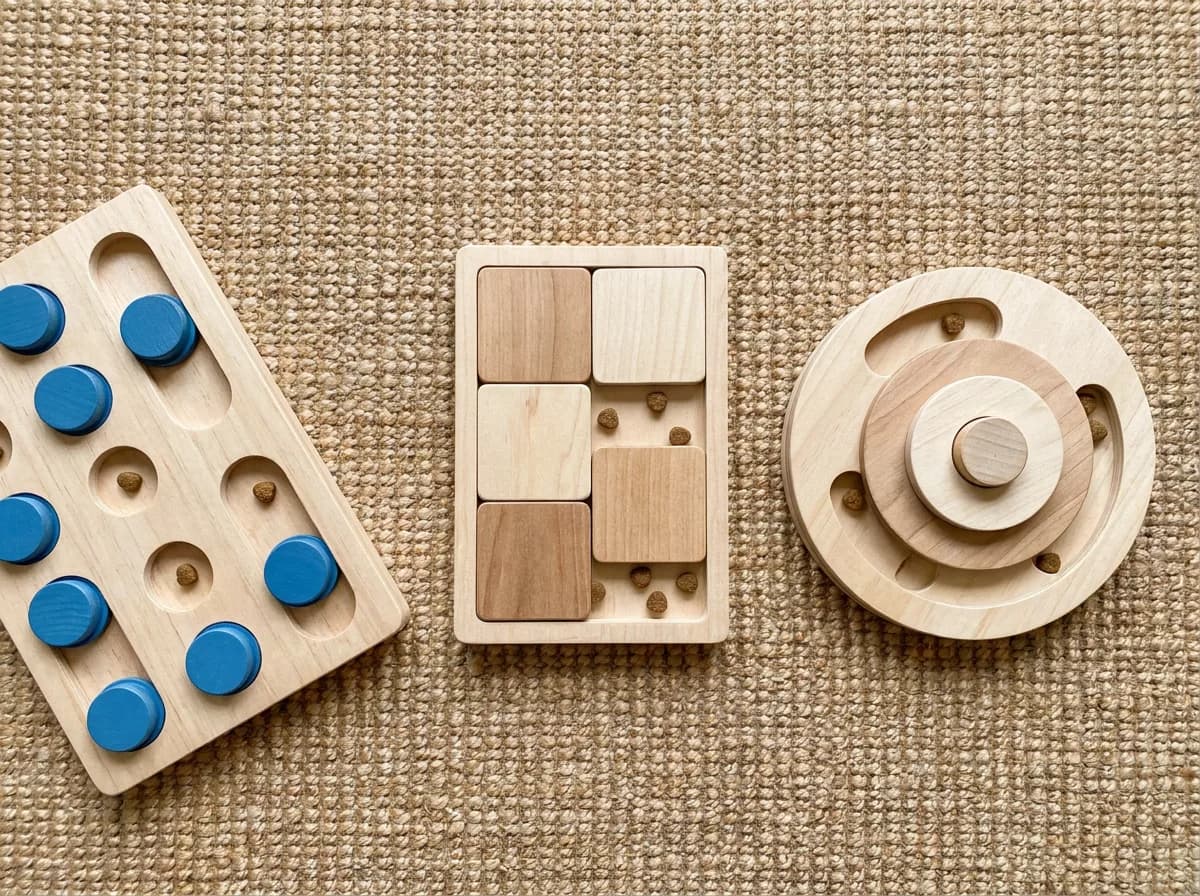
Nina Ottosson by Outward Hound uses four difficulty levels. The numbering is useful within that system, but it is not a universal scale shared by every dog-toy manufacturer. TRIXIE’s selected retailer listings also use Level 2, while its manufacturer pages describe the actual mechanisms and adjustments.
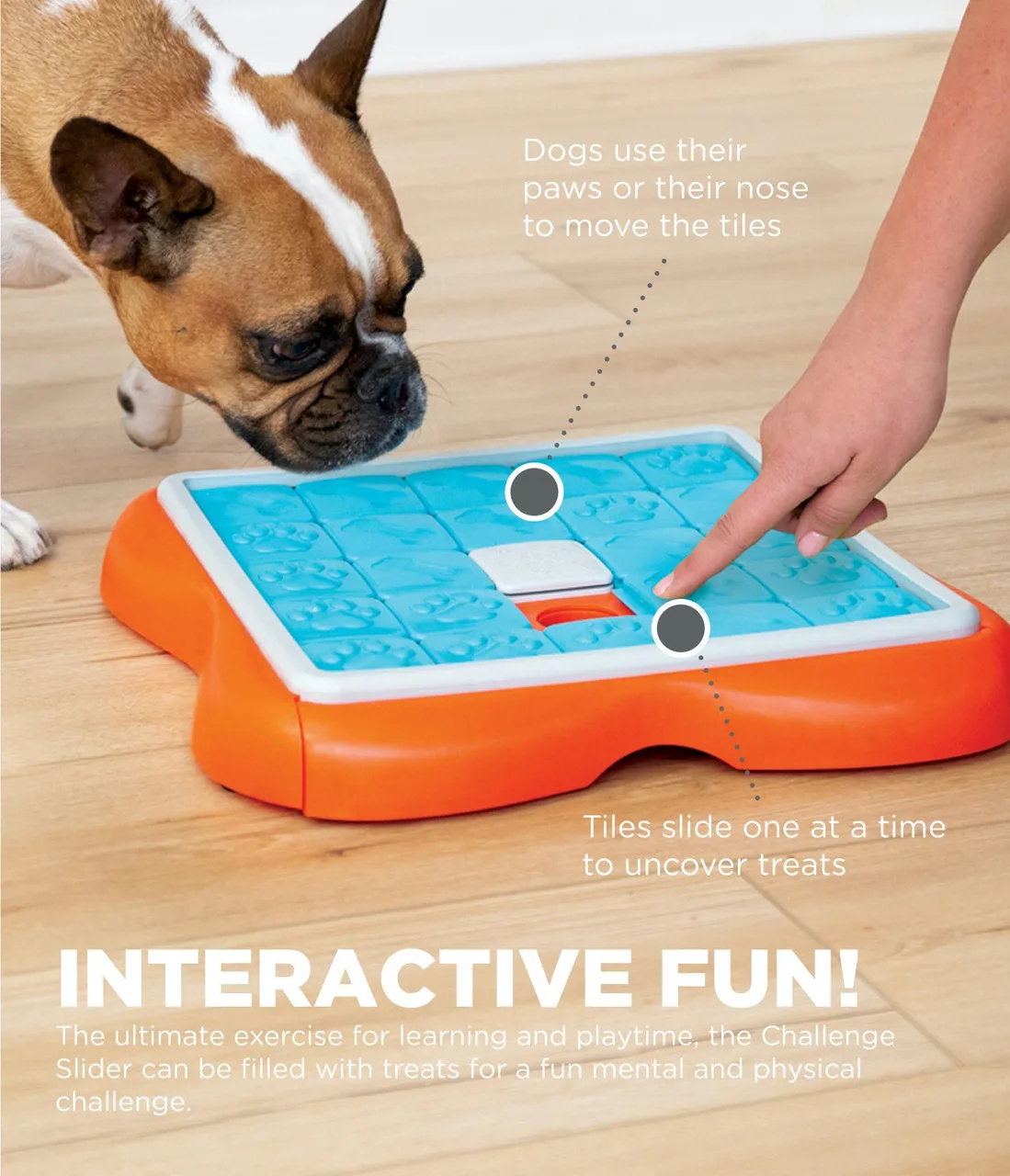
Use the level to narrow your options, then look at the task. A dog confident with a sliding board may need an introduction to a rotating beaker. Likewise, a dog that prefers its nose may approach a game differently from one that naturally uses its paws.
Level 1: learn the connection between an action and a reward
Level 1 games use a straightforward action to reveal food. Dog Smart Composite is our pick for that introduction. The aim is for your dog to discover that moving a component, rather than chewing it, opens the way to the treat.
A beginner puzzle is still worthwhile after the dog understands it. You can keep it in a rotation for easy sessions instead of treating it as a product that becomes useless once solved.
Level 2: introduce a new movement
Intermediate games can add lifting, sliding, turning or other movements that benefit from demonstration. Lickin’ Layers is the Level 2 Nina Ottosson pick here. The two TRIXIE alternatives offer different experiences: mixed board mechanisms on Flip Board and turning cups on Mad Scientist.
Other Nina Ottosson names you may encounter include Dog Brick, Dog Tornado and Puppy Hide N’ Slide. They illustrate why the mechanism matters within a level. A spinning game and a sliding game can both be intermediate while asking the dog to do different things.
Level 3: work through a sequence
Advanced games require the dog to connect actions. Challenge Slider is our Level 3 pick because revealing food involves sequential tile movement. Outward Hound also places games such as Dog Casino in its advanced group, although their mechanisms differ.
Before choosing a hard puzzle, watch whether your dog moves pieces intentionally on its current board. Pawing randomly can uncover food, but it may not show readiness for a sequence where one move enables another.
Level 4: combine several learned actions
MultiPuzzle is the expert Level 4 option in the published system. Choose it when your dog already understands easier games and remains interested while learning new combinations.
Searches for “Level 5 dog puzzles” do not establish another level in this manufacturer’s published scale. Compare the described actions rather than treating a larger number in a listing as evidence of a better or more demanding product.
- The main limitation of these games is that they are supervised food puzzles, not chew toys. Cleaning per maker also varies by model and component. A higher level does not mean stronger material, fewer loose parts or dishwasher-safe construction.
What is the best puzzle game for dogs?
For a first board, Dog Smart is the clearest starting point in this selection. For a dog learning varied actions, consider Flip Board or Mad Scientist. Challenge Slider and MultiPuzzle suit progressively experienced dogs, while Lickin’ Layers serves the feeding use case. The best choice is the game your dog can engage with successfully while learning one manageable next step.
How to introduce a puzzle and level up
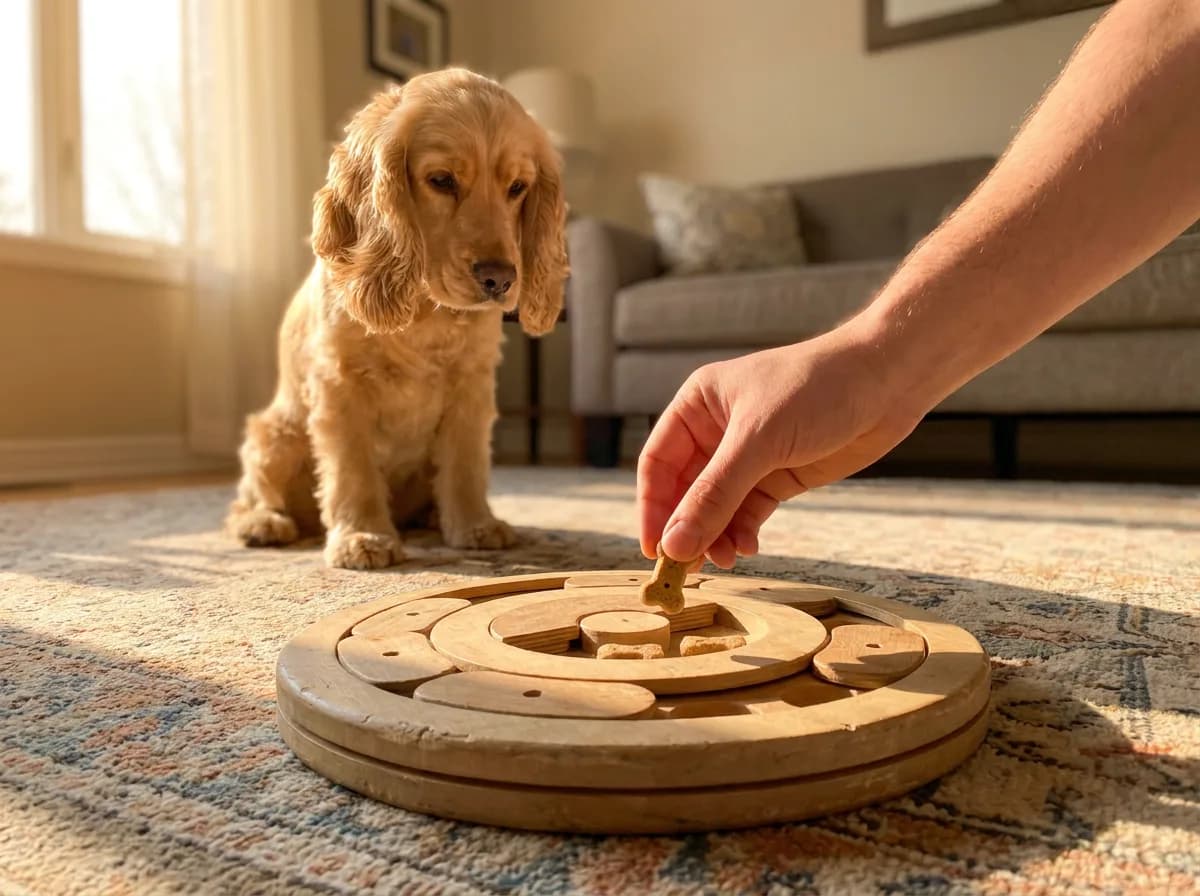
Introduce the game when you can stay nearby and the dog is willing to investigate. Choose a place where the board can sit securely and you can see what the dog is doing. Read the manufacturer’s training instructions before deciding how much food or how many closed compartments to use.
Make a dog puzzle harder only after your dog can repeat the current action comfortably. Add one cover, use another manufacturer-approved setting or introduce the next mechanism, rather than changing several things at once. Showing the dog a movement first does not spoil the puzzle; it helps you distinguish an unfamiliar action from an unsuitable setup.
- Check the food. Confirm it fits the wells, channels or openings and can be retrieved.
- Show an easy reward. Let the dog investigate a simple setup before adding every obstacle.
- Demonstrate the movement. Move a peg, lid or layer slowly enough for the dog to follow.
- Pause and observe. Give the dog an opportunity to try rather than completing every action for it.
- Adjust one thing. Add a cover or change a manufacturer-approved setting once the current task is understood.
- Finish and put it away. Collect pieces, clean as directed and store the game after the supervised session.
Move up, stay or step back
Move up when your dog repeatedly performs the intended action and remains interested in exploring. The next step can be another setting on the same toy rather than a new purchase.
Stay at the current level when the dog is still learning or enjoys the familiar task. There is no requirement to progress to Level 4. Repeating a successful game can remain useful even when it no longer takes much time.
Step back when the dog repeatedly abandons the puzzle, tries to force it apart or cannot obtain food despite attempting the intended movement. First check for a practical problem, such as a treat stuck in an opening. Then simplify the setup or return to a more familiar game.
| What you observe | Useful next step |
|---|---|
| Deliberate successful movements | Introduce one additional mechanism or approved adjustment |
| Interest, but inconsistent success | Keep the same setup and demonstrate again |
| Food stays trapped despite the correct action | Change the food size or loading before increasing difficulty |
| Repeated biting, lifting or forceful frustration | Stop, simplify and reassess whether that toy suits the dog |
Do not measure success only by how long the game lasts. A fast, purposeful solve and a long period of unsuccessful pawing are different experiences. The goal is engagement with an attainable task, not keeping food inaccessible for the longest possible time.
Choosing a safe puzzle by size, age and chewing style
The safest choice is the one that fits both the dog and the intended supervised activity. A large board is not automatically suitable for every large breed, and a small dog is not automatically limited to the easiest level.
Check the mechanisms as well as the overall dimensions. Can the dog reach the compartments, turn the cups and move the pieces? Does it work calmly with the toy, or immediately attempt to pick it up? Product photos can help you understand the design, but they do not establish a universal fit.
Small dogs and large dogs
TRIXIE publishes a 28-centimeter diameter for the selected Flip Board XXL. It also offers a smaller 23-centimeter standard Flip Board described as especially suitable for small dogs. That gives you a meaningful size comparison without assuming the larger model suits all big dogs.
For other boards, avoid relying on an unrelated “Large” variant or dimensions from a similar-looking puzzle. The selected Challenge Slider is the exact Blue & Orange product in this guide. A different Outward Hound puzzle, such as Hide N’ Slide or Dog Tornado, should be assessed using its own specifications.
- Check the toy’s overall footprint and the space needed to work around it.
- Look at openings and moving parts, not just the advertised size.
- Make sure loose pieces are not treated as carry-away toys.
- Watch the first sessions before assuming a model suits your dog.
Puppies and senior dogs
For puppies, prioritize a simple introduction and close supervision. A puppy that treats every object as something to bite may need a different activity from a removable-piece food puzzle. An adult difficulty label does not tell you whether the particular mechanics are appropriate for your puppy.
For senior dogs, consider the position needed to use the game. A low board and a rotating stand present different physical arrangements. Choose a setup the dog can reach comfortably and simplify it when necessary rather than using age alone to decide how clever or capable the dog will be.
Strong chewers and crate use
None of these six picks is recommended here as an indestructible puzzle for aggressive chewers. Attached pieces reduce the number of loose parts during intended play, but they do not make a plastic board a chew toy.
If your dog seeks sustained chewing rather than uncovering food, compare that different need in Petful’s guide to the best indestructible dog toy options, remembering that no toy is literally indestructible.
These selected puzzles also are not recommendations for unsupervised crate use. Outward Hound’s guidance says to supervise and store its games after use. Do not leave a difficult board in a crate as a way to make the dog work on it without help.
Puzzle feeders vs slow feeders and snuffle mats
A dog food puzzle adds a task between the dog and its food. That task might be moving a cover, turning a layer or shifting tiles. A slow-feeder bowl generally changes the route to accessible food through fixed ridges or channels.
The distinction is useful when choosing a regular feeding setup. A puzzle dish may require teaching before the dog can retrieve its meal. A bowl can have a challenging shape without requiring a separate opening action. Neither description alone tells you the right capacity or fit for your dog.
What are some good feeding puzzles for dogs?
Lickin’ Layers is the most feeding-focused option in this selection because its three layers distribute food through many compartments. Challenge Slider is another option when its manufacturer-stated capacity of up to 1 cup suits the portion you intend to use. Other boards work better as small treat games than as replacements for a full bowl.
Measure food from the amount you intend to serve rather than filling every well automatically. You can use a puzzle for part of a meal and serve the remainder separately. A board does not need to hold the whole portion to be useful.
- Choose by the mechanism your dog understands.
- Check actual capacity where the manufacturer publishes it.
- Account for food used in the puzzle when preparing the meal.
- Match the food texture to the exact model’s instructions.
- Make cleanup part of the feeding routine.
Snuffle mats
Snuffle mats hide food within fabric folds so the dog searches by scent. That creates a different task from opening a rigid lid or working a sequence of sliders. A dog interested in sniffing may enjoy that format even if it shows little interest in a mechanical board.
See our snuffle mat comparison for that separate choice. Fabric mats still need suitable food, supervision and cleaning, especially when a dog starts pulling at the material rather than finding the reward.
Lick mats
Lick mats use a textured surface to hold a thin layer of suitable food. They do not usually ask the dog to uncover compartments in a sequence, so the activity differs from the board puzzles reviewed here.
Our guide to lick mats for dogs covers those products. Choose according to the activity you want: licking from a surface, searching through fabric or moving parts to expose food.
Slow feeder bowls
What are the differences between a slow feeder and a puzzle feeder for dogs?
A slow feeder usually presents food among fixed obstacles, while a puzzle feeder asks the dog to manipulate something to reach it. Some products combine both approaches, including Lickin’ Layers. If your main aim is choosing an everyday bowl rather than teaching a game, start with Petful’s best slow feeder dog bowls.
Capacity, access and cleaning remain important whichever format you choose. Do not assume a puzzle is a better bowl simply because it has a higher difficulty rating, and do not treat a feeding product’s marketing claims as proof that it will improve digestion.
Treat balls and plush hide-and-seek toys
Treat balls, wobblers and KONG-style stuffable toys use rolling, movement or access to a filling rather than a board’s compartments. Plush hide-and-seek toys ask the dog to find or remove soft pieces. Those can be useful alternatives when your dog prefers carrying, chasing or exploring a moving toy.
We keep those choices in Petful’s best interactive dog toys comparison. Here, the six picks focus on mechanical food puzzles and a layered puzzle feeder. Choose the activity first, then compare products designed for it.
Dog puzzle toy questions
Small dry kibble is a practical starting point when it fits the compartments and falls through any openings. Use suitable xylitol-free treats and check every ingredient before adding a spread or soft filling. Follow the exact toy’s food instructions; a preparation approved for Lickin’ Layers is not automatically appropriate for a composite board or rotating beaker.
Follow the exact model’s instructions and clean food-contact areas after use. Dog Smart and Challenge Slider specify warm soapy water using mild soap, while TRIXIE permits dishwasher cleaning for the Flip Board and the Turn Around’s rotating elements. Do not assume “dishwasher suitable” means any cycle, or invent a top-rack dishwasher instruction where the maker does not provide one.
No puzzle in this comparison comes with a reliable promise of hours of entertainment. Use supervised puzzle sessions as one activity within the day, and let the dog finish without repeatedly making the reward harder to reach. Do not leave these games with an unattended dog: supervise their use, collect components and store them afterward.

Kirsten Adams is a writer and educator based in the Philadelphia area. With a background in English and education—earning a bachelor's degree from the University of Massachusetts and a master's from Lancaster University in England—Kirsten has built a career around creating engaging, informative, and educational content. In addition to contributing articles to pet websites, Kirsten develops courses for professionals working toward certification or continuing education credits in a variety of fields. She also helps businesses craft compelling marketing materials for their audience. At home, life is filled with the joyful chaos of three beloved dogs, fueling Kirsten’s enthusiasm for all things pet-related. Whether writing about training tips, pet health, or the special bond between people and their animals, Kirsten loves sharing insights that both help and entertain pet parents. Website: kadamswrites.com.
Sign up for expert-backed reviews and safety alerts all in one place.