Normal Respiratory Rate for Dogs: How to Count and Track It at Home
A dog's resting respiratory rate is most useful when it is counted during calm sleep and interpreted with breathing effort, other symptoms, and the dog's own baseline.

BVMS, MRCVS
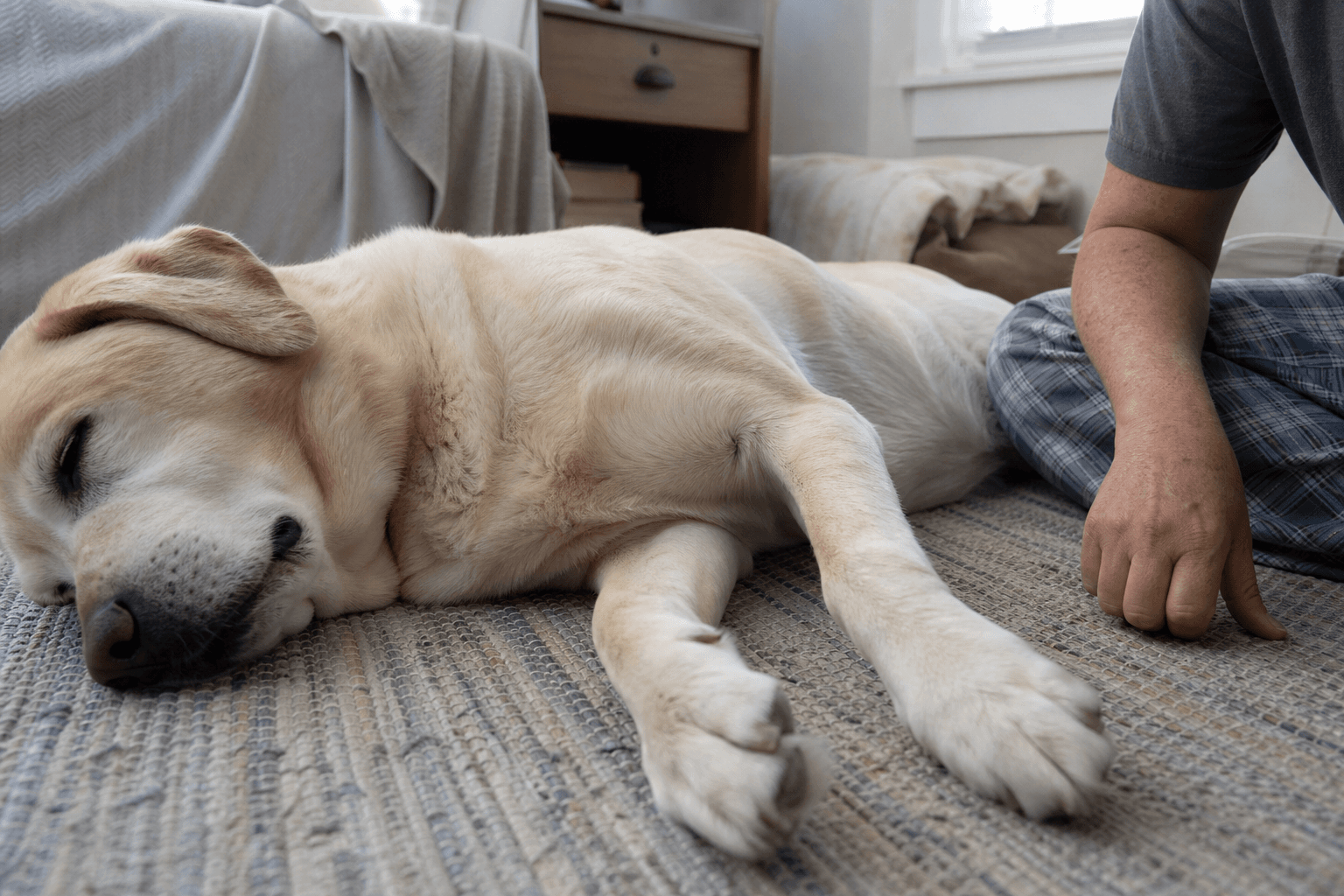
Resting measurements are most useful when a dog is fully relaxed or asleep.
Petful is reader supported. As an affiliate of platforms like Amazon and Chewy, we may earn a commission when you buy through links on this page. There is no extra cost to you.
The normal respiratory rate for dogs is most useful when it is measured while a dog is calmly resting or asleep, not after exercise, during panting, or when the dog is excited. One gentle rise and fall of the chest counts as one breath.
Published reference ranges are not identical. The Merck Veterinary Manual lists 18 to 34 breaths per minute for a resting dog, while Cornell notes that a normal resting rate is often 15 to 30. The number is only part of the picture. Breathing effort, posture, gum color, other symptoms, and a dog's usual baseline can matter more than one isolated count.

Sign up for expert-backed reviews and safety alerts all in one place.
Normal respiratory rate for dogs at rest
- 1Count only when your dog is fully relaxed or sleeping and not panting.
- 2Many healthy resting dogs fall somewhere around the high teens to low 30s, but published ranges vary.
- 3Ask your veterinarian which resting or sleeping range should trigger a call for your individual dog.
A healthy reference range describes a population, not a promise about one dog. Puppies, heat, recent movement, stress, pain, medication, body condition, and illness can all affect breathing. A dog with heart or lung disease may also have a veterinarian-set alert threshold that is narrower than a general online range.
Healthy reference ranges vary, so a dog's resting respiratory rate is safest to interpret as a personal baseline plus an individual veterinary threshold, not a single universal chart. Maven Pet, a health monitoring system built with veterinarians, continuously tracks resting respiratory rate and compares changes with that dog's own baseline. That trend can help owners recognize a sustained shift and share clearer information with their veterinarian, but an obvious change in breathing effort, gum color, posture, or behavior still takes priority over any chart.
The most useful question is not simply, “Is this number in a chart?” It is, “Was the count taken under the right conditions, is it repeatable, has it changed from my dog's normal pattern, and does the breathing look easy?”

A collar-mounted sensor and app for activity, rest, sleep, respiratory rate, heart-rate trends, itch behaviors, and more.
- Builds a personalized baseline over time
- Tracks trends between veterinary visits
- Generates a month-long shareable report
Health monitoring for dogs and cats
Petful may earn a commission when you click through to Maven Pet, at no extra cost to you.
How to count a dog's respiratory rate
Choose a time when your dog is sleeping comfortably in a normal position. Do not count immediately after a walk, play, eating, barking, a warm car ride, or any event that causes panting. If your dog is awake, wait until the body is loose and the breathing has settled.
For owners learning how to count dog respiratory rate readings, the goal is to give readers a repeatable home counting and logging method instead of encouraging a rushed single count. To count dog breaths per minute consistently, use the same calm condition, watch the same part of the chest, time the same interval, and write down the result with enough context to make a later comparison useful.

Use this method:
- Watch the chest or flank without touching or waking your dog.
- Count one complete rise and fall as one breath.
- Count for 30 seconds and multiply by two for breaths per minute.
- If the pattern is irregular or the result surprises you, count for a full 60 seconds.
- Wait a few minutes and repeat the measurement under the same calm conditions.
Tufts advises counting while a pet is calm or asleep and considering breathing effort as well as rate. A video of the chest can help if it is hard to watch and operate a timer at the same time, but recording should never delay care when breathing looks difficult.
How to count one breath
Do not count the rise and fall separately. Together they equal one respiratory cycle. Watch the same area for the entire count, usually the ribcage just behind the front legs or the flank in front of the hind legs. The chest rise and fall should remain your reference for the full timed interval.
Short pauses, small dream movements, or a position change can make a 15-second count misleading. A longer count is worth the extra time when the rhythm is uneven.
A collar-mounted sensor and app for activity, rest, sleep, respiratory rate, heart-rate trends, itch behaviors, and more.
- Builds a personalized baseline over time
- Tracks trends between veterinary visits
- Generates a month-long shareable report
Health monitoring for dogs and cats
Petful may earn a commission when you click through to Maven Pet, at no extra cost to you.
Sleeping rate and a personal baseline
A sleeping respiratory rate dog owners record several times under similar conditions is more informative than a number taken only when something seems wrong. Try collecting three to seven calm readings over several days when your dog appears well. Record the date, time, rate, position, room temperature if unusual, and anything that could have affected the result.
Your dog's baseline is the repeatable pattern that emerges. It is not the lowest number you can find. A baseline can help you and your veterinarian notice a persistent shift, especially when a dog is being monitored for known heart or lung disease.

Home measurements are not perfectly identical. A difference of a few breaths can come from counting technique, sleep stage, position, or normal biological variation. Repeat measurements and trends matter more than reacting to every small change. A dog sleeping respiratory rate becomes meaningful when several calm readings show a stable personal pattern or a persistent change under comparable conditions, not when one number is chosen in isolation.
What can change a resting respiratory rate
Some increases are expected and temporary. Others deserve veterinary attention, especially when they persist at true rest or occur with a change in effort.
Common context to record includes:
- Recent exercise, play, barking, or excitement
- Warm temperature, panting, or lying in direct sun
- Dreaming or brief REM sleep movements
- Stress, fear, or travel
- Pain, fever, or recent surgery
- Medication changes
- Coughing, reduced stamina, fainting, appetite change, or abdominal swelling
- Known heart, airway, or lung disease
What are the first signs of heart failure in dogs? They are not identical in every case. A rising sleeping respiratory trend, coughing, lower exercise tolerance, weakness, or collapse can be important, but these signs have many possible causes. A veterinarian must interpret them in context.
A collar-mounted sensor and app for activity, rest, sleep, respiratory rate, heart-rate trends, itch behaviors, and more.
- Builds a personalized baseline over time
- Tracks trends between veterinary visits
- Generates a month-long shareable report
Health monitoring for dogs and cats
Petful may earn a commission when you click through to Maven Pet, at no extra cost to you.
When sleep breathing becomes a symptom
A few quicker breaths during a dream can be normal. Sustained fast breathing, repeated high counts, or visible effort is different. Our dedicated guide to a dog breathing fast while sleeping explains how REM sleep, panting, rapid breathing, and respiratory distress differ.
If your dog is comfortable, wake them gently and allow the breathing to settle before repeating the count. Do not force a dog to stand, walk, or change position when breathing looks difficult.
The exact phrase dog respiratory rate while sleeping describes a symptom-led search, not a diagnosis. Duration, repeatability, effort, color, and the dog's response after waking determine the safest next step.
When a respiratory rate is concerning
What is a concerning respiratory rate for a dog? There is no single number that safely answers every situation. Cornell advises contacting a veterinarian when a dog's resting rate is consistently above 35 breaths per minute. A cardiologist may give a different personal threshold for a dog with known disease.
| What you observe | What it may mean | What to do |
|---|---|---|
| One higher count after activity, warmth, or a dream | The conditions were not truly resting | Let the dog settle fully, then repeat the count |
| Repeated elevation during calm sleep, with easy breathing | A meaningful change may be developing | Record the rate and context, then call your veterinarian promptly |
| Rapid breathing with increased effort, abnormal gum color, collapse, or inability to settle | Possible respiratory emergency | Seek emergency veterinary care now |
A rate of 70 breaths per minute at rest
Why is my dog breathing 70 breaths per minute? Heat, recent activity, pain, fever, heart or lung disease, anemia, and other problems can raise the rate, but 70 during true rest needs prompt veterinary advice. Recheck only if the dog is comfortable and the repeat does not delay help. Breathing effort or other emergency signs make the situation urgent now.
Senior dogs and a resting rate of 60
Is a respiratory rate of 60 for a senior dog normal? A resting rate of 60 is not considered safe simply because a dog is older. Senior dogs can have more chronic disease and medication changes, which makes a new rate more meaningful, not less. Use the senior dog baseline and veterinarian-set veterinary threshold, then seek prompt advice.
This rate-plus-effort decision framework separates one imperfect count from a repeatable baseline and an urgent breathing problem. It combines the repeat measurement with posture, color, associated signs, and the dog's ability to settle.
A collar-mounted sensor and app for activity, rest, sleep, respiratory rate, heart-rate trends, itch behaviors, and more.
- Builds a personalized baseline over time
- Tracks trends between veterinary visits
- Generates a month-long shareable report
Health monitoring for dogs and cats
Petful may earn a commission when you click through to Maven Pet, at no extra cost to you.
Emergency signs matter more than the number
How to tell if a dog is in respiratory distress begins with visible work, not a timer. Increased breathing effort, a gum color change, an unusual posture, or collapse means the dog needs urgent assessment even if the exact count is uncertain.
Emergency respiratory red flags include strong abdominal effort, open-mouth breathing outside ordinary panting, abnormal gums or tongue, collapse, severe weakness, an extended neck, elbows held away from the body, or an inability to settle. Those signs mean the dog may be struggling to move air, so the priority is calm transport and emergency veterinary care rather than finishing a count, offering food or water, or waiting for a device alert.
Go to an emergency veterinarian immediately if you see any of the following:
- Open-mouth breathing that is not ordinary panting
- Strong abdominal push with each breath
- Neck extended or elbows held away from the body to breathe
- Blue, gray, very pale, or purple gums or tongue
- Collapse, severe weakness, confusion, or inability to settle
- Noisy breathing with obvious distress
- Rapid worsening over minutes
Do not keep counting, offer food or water, or attempt a long home examination when a dog is struggling for air. Keep the dog cool and calm, minimize handling, call the emergency hospital while you are leaving, and follow its transport instructions.
How a pet health tracker can support a trend
A wearable can reduce the burden of remembering every observation, but it does not replace a manual safety check or veterinary examination. Maven Pet is a health monitoring system built with veterinarians that continuously tracks a dog's resting respiratory rate alongside heart rate, sleep, activity, and rest. It can flag sustained changes so owners have clearer trend data to share at a veterinary visit. It is a monitoring aid, not a diagnostic tool. Maven Pet measures trends but does not diagnose disease: it can show that something has shifted, not determine the cause.
- A 2025 veterinary study compared Maven-derived respiratory measurements with simultaneous manual counts in 19 healthy dogs and found a measurement agreement range at the group level. That supports measurement validation in the studied conditions, while the diagnostic limitation remains: it does not prove disease, treatment decisions, or outcomes in a sick individual dog.
The study included 120 paired observations and reported a mean bias of -0.78 breaths per minute, with 95% limits of agreement from -6.81 to 5.26. That spread is another reason to use trends and clinical context instead of treating one automated value as exact.
If you are evaluating the system itself, see our hands-on Maven Pet Smart Collar review. For an appointment, bring a concise pattern rather than a data dump. Our guide to dog health data to bring to the vet shows how to organize dates, symptoms, medications, and home measurements.
Frequently asked questions
A resting count of 70 breaths per minute needs prompt veterinary advice because it is well above commonly cited resting ranges. If your dog is comfortable and breathing without effort, repeat the count once under true resting conditions and record the context. Abnormal gum color, collapse, visible struggle, inability to settle, or rapid worsening makes this an emergency and means you should leave for care rather than continue counting.
To tell if a dog is in respiratory distress, look for increased breathing effort, abnormal gums, an extended neck, elbows held away from the body, strong abdominal movement, open-mouth breathing outside ordinary panting, collapse, confusion, or an inability to settle. Those signs show that breathing is difficult, regardless of the exact rate. Keep your dog cool and calm, minimize handling, call the emergency hospital, and seek urgent veterinary assessment instead of repeating measurements.
A persistent resting elevation above the dog's personal baseline is concerning, especially when it repeats during calm sleep or comes with cough, weakness, behavior change, or extra effort. Cornell advises consulting a veterinarian when the resting rate is consistently above 35 breaths per minute. A dog with known disease may have a different personal veterinary threshold, so follow the action plan provided by that dog's veterinarian or cardiologist.
Possible early changes include a rising resting respiratory trend, coughing, an exercise tolerance change, weakness, nighttime restlessness, fainting, reduced appetite, or abdominal swelling. None of those signs is specific enough to diagnose heart failure at home, and some dogs show different patterns. Record when the change began and contact a veterinarian, who can examine the dog and determine whether the heart, lungs, pain, infection, or another problem is responsible.
A rate of 60 during true rest is not considered normal simply because a dog is older. Compare the result with the senior dog baseline and the veterinary threshold set for that individual, then contact the veterinary team promptly. If the count comes with increased effort, abnormal gum color, collapse, an inability to settle, or rapid worsening, seek emergency care now and do not delay transport to collect more measurements.
BVMS, MRCVS
Dr. Pippa Elliott, BVMS, MRCVS, is a veterinarian with nearly 30 years of experience in companion animal practice. Dr. Elliott earned her Bachelor of Veterinary Medicine and Surgery from the University of Glasgow. She was also designated a Member of the Royal College of Veterinary Surgeons. Married with 2 grown-up kids, Dr. Elliott has a naughty Puggle named Poggle, 3 cats and a bearded dragon.
Sign up for expert-backed reviews and safety alerts all in one place.


A Final Word (Disclaimer)
At Petful, our review integrity is paramount; we never exchange special treatment in our reviews for monetary or material rewards.
Nonetheless, when our readers click through to online merchants (including Chewy or Amazon), we receive a referral commission. This supports the running of our free blog, and we appreciate your backing.