CBD for Calming Dogs: What Pet Parents Should Know About Stressful Situations
Considering CBD before fireworks, storms or travel? Learn what research shows, how calming oils and chews differ, and how to plan a veterinarian-guided trial before a stressful event.

BVMS, MRCVS
Petful is reader supported. As an affiliate of platforms like Amazon and Chewy, we may earn a commission when you buy through links on this page. There is no extra cost to you.
CBD for calming dogs is often considered before fireworks, thunderstorms, car journeys or another predictable disruption. Some canine research is encouraging, but CBD is not a guaranteed way to make a frightened dog comfortable. A useful plan starts with identifying the trigger, making the situation easier and asking your veterinarian whether a particular product is appropriate.
Oil and soft chews offer different ways to administer CBD. Choosing between them involves more than convenience: the amount per serving, additional ingredients, product testing and your dog's health all matter. Here is how to put those choices in context and prepare for a stressful event without relying on a last-minute experiment.
- 1CBD research shows some encouraging stress results, but individual responses and retail formulas vary.
- 2Discuss the product, amount and timing with your veterinarian before a trial day.
- 3Use an event plan that includes environmental support and specific signs to monitor.

Sign up for expert-backed reviews and safety alerts all in one place.
Why do dogs become stressed or overstimulated?
A dog may struggle when something feels unpredictable, unfamiliar or difficult to escape. Loud noises, a moving car, a crowded waiting room or a sudden change in routine can create different problems, even when the outward behavior looks similar. A trembling dog in a car may be frightened, nauseated or uncomfortable for another reason; “needs calming” is a description, not a diagnosis.
Look at what happens before, during and after the behavior. Useful observations include the trigger, the distance from it, whether the dog can take food, and how long recovery takes. A short video recorded safely can help your veterinarian understand a pattern that disappears by the time you reach the clinic.
Common situations to plan around include:
- Fireworks, thunder and other sudden sounds.
- Travel, boarding or time away from familiar people.
- Grooming and veterinary visits.
- Visitors, parties and busy household activity.
- Moving home or a change in the daily routine.
The goal is better coping, not simply less visible movement. A dog that freezes or becomes very sleepy may look quieter without necessarily feeling more secure.
Petful may earn a commission when you click through to Bailey's CBD, at no extra cost to you.
Does CBD really help calm dogs?
CBD, short for cannabidiol, may influence some measures of canine stress, but the available evidence does not support a promise that it will calm every dog or resolve an anxiety disorder. One controlled study published in 2023 examined a single CBD dose before separation or car travel. Researchers found improvements in some stress measures, rather than a uniform effect across every outcome.
That distinction matters for everyday decisions. The study's conditions, formulation and selected dogs differ from a dog facing repeated neighborhood fireworks or a pet with a longstanding fear of being alone. It also did not test Bailey's finished calming products. Evidence about CBD as an ingredient should not be presented as a clinical trial of every chew or bottle that contains it.
When reading a calming claim, separate three questions:
- Ingredient evidence: What did researchers find about the particular CBD preparation they studied?
- Product evidence: Does the retail formula match that preparation, or has it been studied separately?
- Your dog's response: Does the agreed plan improve specific signs without creating unwanted effects?
For broader background on the ingredient and its limitations, see Petful's guide to CBD oil for dogs and cats. This article focuses on the practical decisions surrounding occasional stressful situations.
A newer 2025 study of 54 dogs tested CBD treats and a CBD, L-tryptophan and alpha-casozepine blend before ten minutes of car travel. The blend produced a smaller cortisol increase than placebo, while other treatment effects were not significant. Bailey's formulas differ from that study blend. The useful takeaway is to evaluate each complete formula and its evidence, rather than treating every calming ingredient combination as interchangeable.
Occasional stress and an anxiety disorder need different plans. A dog briefly unsettled by visitors is different from one repeatedly panicking, trying to escape or being unable to eat when alone. The event-focused steps below help organize everyday support. Repeated or severe distress warrants a veterinary behavior assessment even when an owner is also interested in CBD.
Petful may earn a commission when you click through to Bailey's CBD, at no extra cost to you.
Start with the situation, not the supplement
Reduce the difficulty of the event wherever possible. For a noise-sensitive dog, this may mean staying indoors, closing curtains and preparing a comfortable retreat before the noise begins. For travel, it may mean discussing motion sickness and gradually building familiarity with the car. A product cannot compensate for repeatedly placing a dog in an overwhelming situation.
Choose a few changes you can apply consistently:
- Give the dog access to a familiar, quiet space.
- Keep departure and household routines as predictable as practical.
- Arrange exercise and toileting before a known disruption, when conditions are safe.
- Use comfortable, secure restraint appropriate to travel or the setting.
- Avoid forcing the dog toward a trigger to “get used to it.”
Background sound may be one part of a noise-management routine. Petful's dog calming music guide discusses that option. Music, enrichment and CBD should each be judged by what they contribute to the plan, rather than assumed to work equally well for every dog.
If fear is severe, recurring or affecting normal life, ask about a veterinary behavior plan. Waiting until the night of an event can limit the practical options available.
CBD oil vs. calming chews: which format fits?
The most useful format is one you can give consistently according to the agreed instructions and that your dog accepts. CBD oil for calming dogs allows a measured liquid serving; CBD calming chews for dogs provide a chew format with its own specified CBD content. Neither format automatically acts faster or works better simply because it is a liquid or a treat.
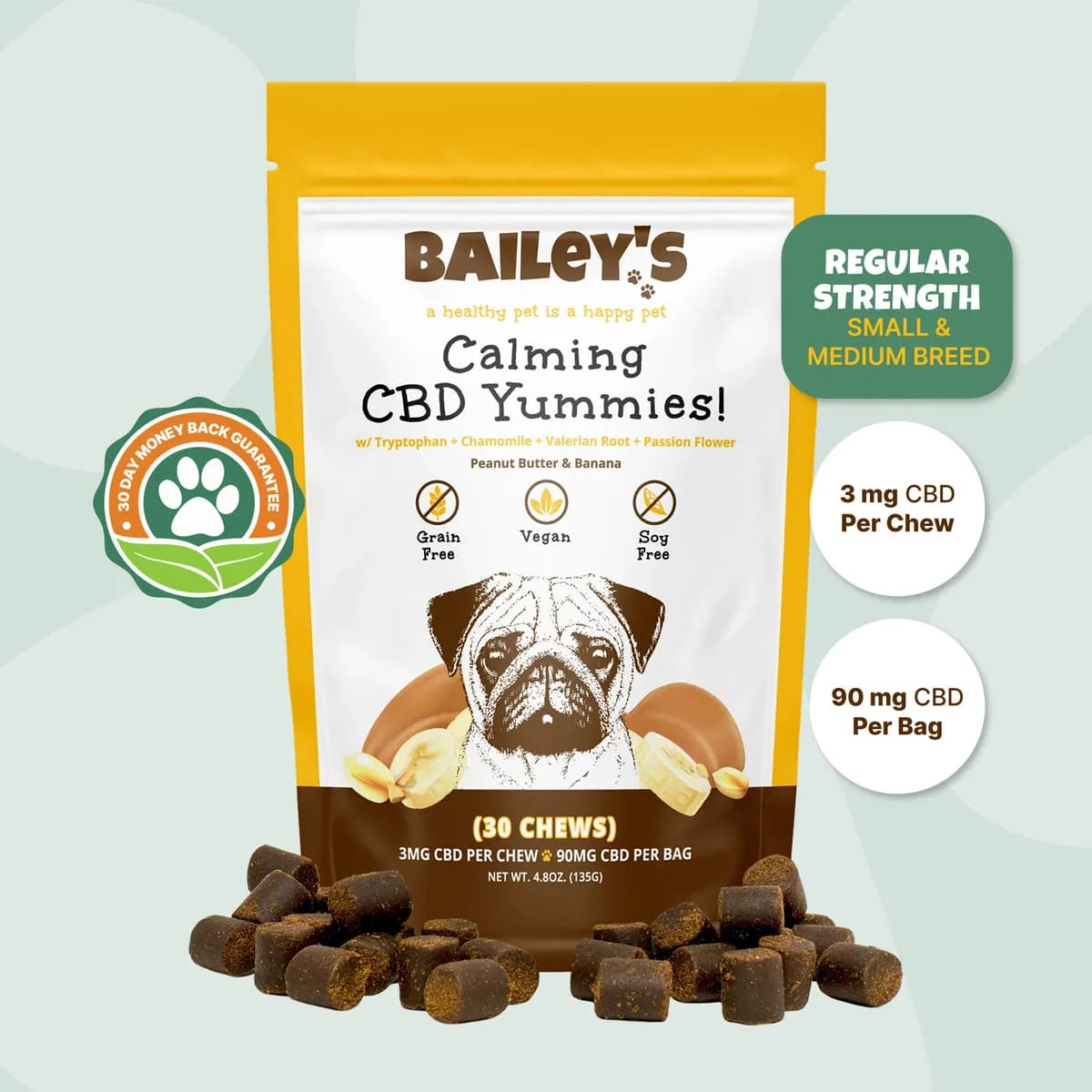
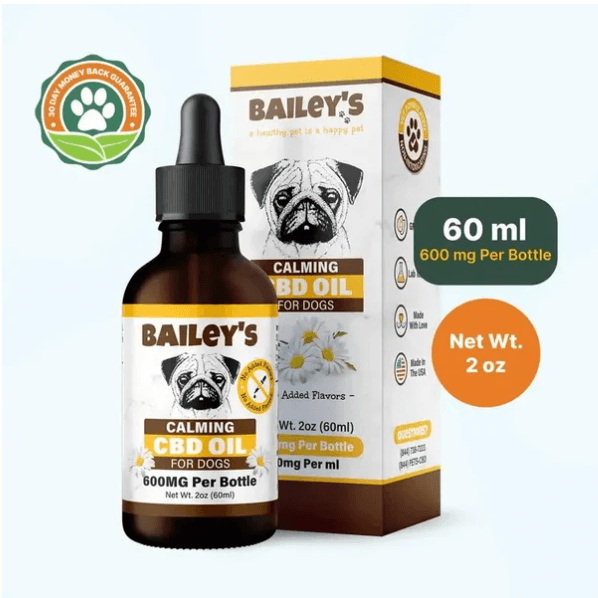
When comparing calming CBD treats for dogs, pay attention to the formula behind the familiar treat format. Bailey's provides two distinct options: a liquid combining CBD, chamomile and L-theanine, and Calming CBD Yummies with L-tryptophan, chamomile, valerian and passionflower. Their different ingredient combinations give owners a useful basis for discussion beyond “oil or treat.”
| Comparison | Bailey's Calming CBD Oil | Bailey's Calming CBD Yummies |
|---|---|---|
| Administration | Measured liquid | Soft chew |
| CBD declaration | 10 mg per mL in the listed 300 mg/30 mL and 600 mg/60 mL bottles | Check the regular or extra-strength amount per chew |
| Other ingredients to compare | Chamomile and L-theanine; MCT carrier | L-tryptophan, chamomile, valerian and passionflower |
| Everyday convenience | A graduated measuring device helps track volume | A chew may be convenient when the dog accepts the flavor |
Use a measured serving that matches the agreed instructions. Neither format requires adding the other, and ingredient overlap matters when your dog already receives another calming supplement.
Choosing an oil
An oil may suit an owner who is comfortable reading a dropper and measuring the specified volume. Check both the total CBD in the bottle and the CBD concentration per milliliter. A larger bottle is not necessarily more concentrated, and a familiar-looking dropper does not guarantee the same serving as another brand.
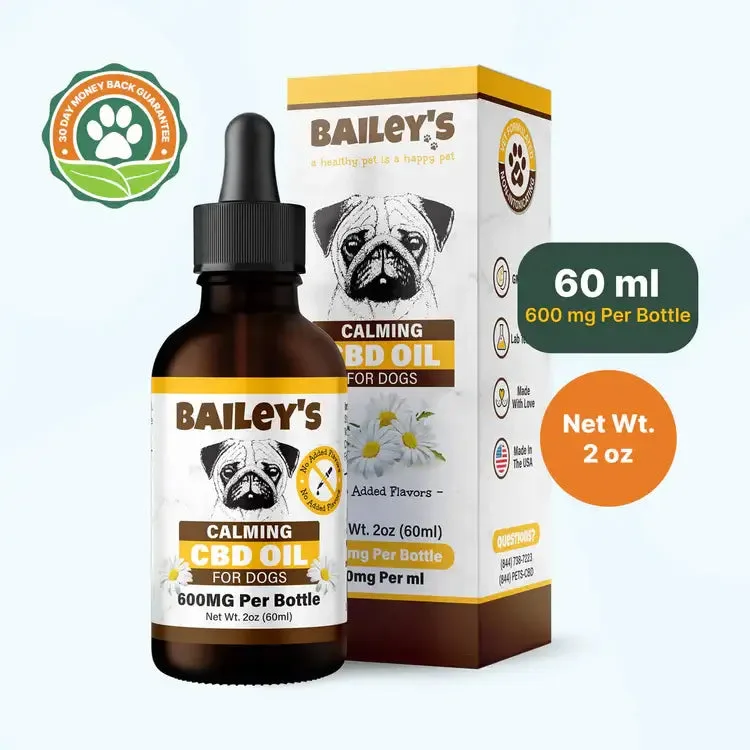
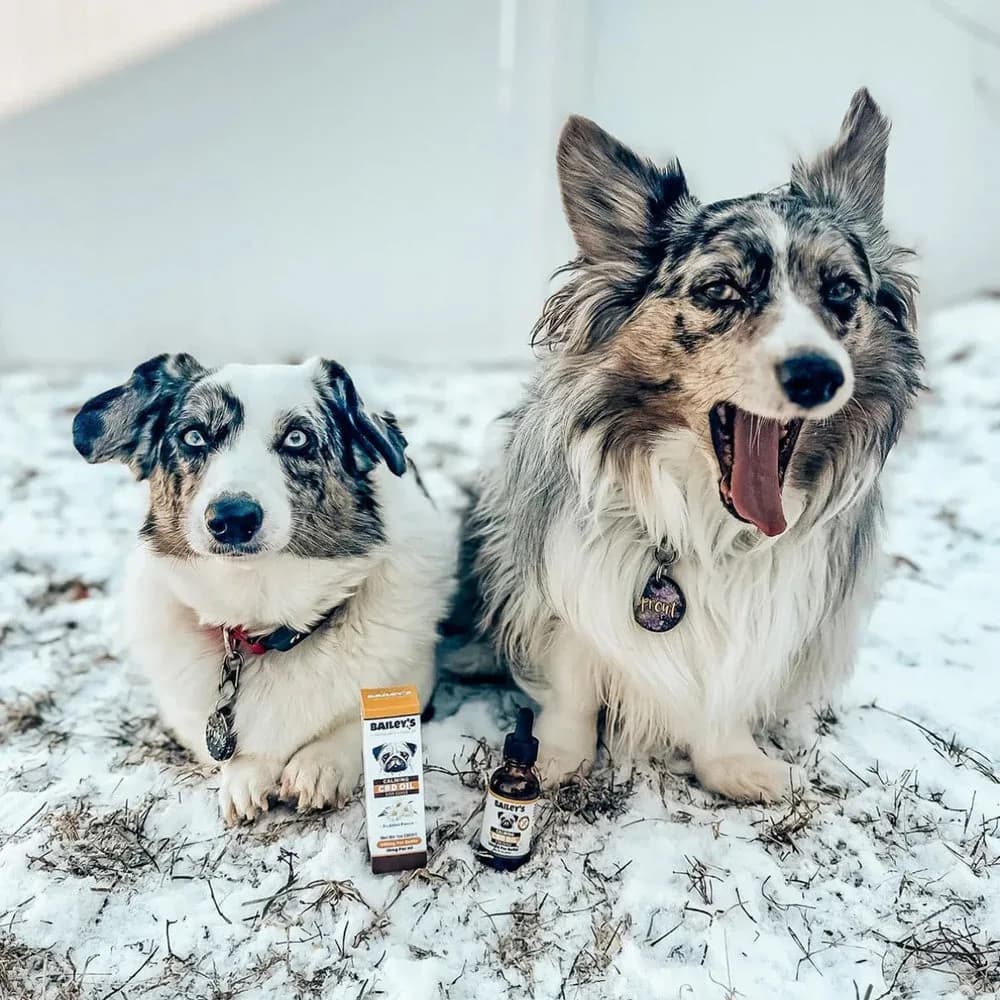
Bailey's Calming CBD Oil for Dogs is one option in the brand's calming range. Review the exact size, current ingredient list and suggested-use panel rather than transferring instructions from a different Bailey's oil. If you give an approved serving with food, make sure you know whether the dog consumed the full portion.
Choosing a chew
A chew may be convenient for a dog that readily eats soft treats. Read the CBD amount per chew, the number of chews in the package and the strength designation. Also check added ingredients, flavorings and anything relevant to a dietary restriction. “Calming” on the package is not a standardized ingredient list.
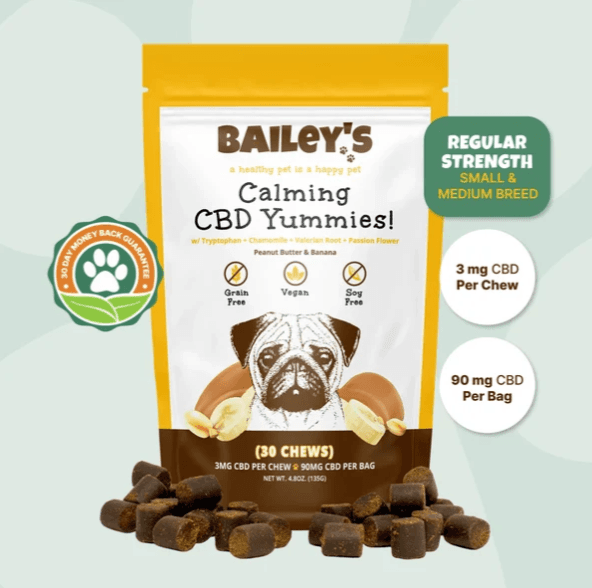
Bailey's Calming CBD Yummies provide the soft-chew side of that comparison. The practical choice is whether the exact formula and serving instructions fit your dog and your veterinarian's plan. Do not automatically give an oil and a chew together; doing so can make the total CBD and overlapping ingredients harder to track.
Petful may earn a commission when you click through to Bailey's CBD, at no extra cost to you.
Compare the same four details in either format: CBD per serving, all other ingredients, the matching laboratory report and how reliably your dog will consume the intended amount.
Planning for fireworks, thunderstorms and travel
A two-stage plan is more useful than deciding what to do while your dog is already distressed. If your veterinarian agrees to a CBD trial, separate a quiet trial day from the event day. The trial is an opportunity to assess administration and tolerability; it does not recreate every aspect of a storm or fireworks display.
| Situation | Prepare the environment | Observe afterward |
|---|---|---|
| Fireworks | Arrange toileting before the expected noise; prepare an indoor retreat and secure exits | Ability to settle, escape attempts and recovery once the noise ends |
| Thunderstorms | Make the retreat familiar on quiet days and keep support available for unpredictable weather | Whether the dog voluntarily uses the space and how long distress lasts |
| Car travel | Discuss nausea, practice manageable journeys and use appropriate restraint | Drooling, vomiting, willingness to enter the car and recovery after arrival |
If you are considering CBD for dogs before fireworks, make the plan while there is still time for a trial day. Discuss the exact formula, measured serving, expected noise window and a fallback if distress continues. Fireworks can last much longer than a laboratory stress test, so do not assume a product will cover the whole evening. For journeys, Petful's dog car anxiety guide offers additional travel-specific context.
There is no established CBD dosage specifically for fireworks, and an oil is not automatically a better choice for a scared dog. Ask for instructions that fit the exact product and your dog's health.
Before the event
- Discuss the trigger and your dog's history with your veterinarian early.
- Choose one product and record its strength and serving instructions.
- Ask when to administer it and when to reassess, rather than borrowing timing from another product or a research study.
- Set up the retreat, travel arrangements or other environmental support.
- Decide which observable signs would count as improvement.
For fireworks, plan around the likely noise window and keep the dog safely indoors. For thunderstorms, unpredictability makes an ongoing management plan especially useful. For car travel, tell the veterinarian about drooling, vomiting or other signs that might point to nausea as well as fear.
Petful may earn a commission when you click through to Bailey's CBD, at no extra cost to you.
On the event day
Follow the agreed instructions and keep a simple record. Avoid adding an extra serving because the first one did not create an obvious effect. If the dog remains highly distressed, contact your veterinary team about the next step rather than layering products without guidance.
Your record can include the time of administration, event duration, appetite, restlessness and recovery. Note the environment too: a quieter room or shorter car journey can change the response independently of a product. A comparison is more useful when you know what else changed.
Afterward
Review both benefits and unwanted effects. Was the dog able to settle and return to normal activities, or merely sleepy? Was the trigger less intense than last time? Share those details before deciding whether to repeat the approach. A single good evening is encouraging, but it is not proof that the same plan will manage every future event.
How long does calming CBD take to work, and how long does it last?
There is no established onset or duration that applies to every calming oil, chew and dog. In the 2025 travel study, treats were given two hours before the test. That was the study's protocol, not a demonstrated two-hour onset for Bailey's products or a promise of all-evening coverage. The researchers also found substantial variation in blood CBD levels between dogs.
Ask for a product-specific administration and reassessment plan before the event. If the first trial does not help, record what happened instead of immediately increasing the serving. Useful questions include whether the dog consumed the measured amount, whether the trigger was more intense, and whether nausea or pain may have contributed.
- Record product, strength, serving and time.
- Record the trigger and approximate start and end of distress.
- Describe one useful outcome, such as settling in the retreat or returning to ordinary activity.
- Record unwanted changes, including excessive sleepiness or digestive upset.
Share the result with the veterinary team before repeating an unsuccessful approach. A different environment, behavior plan or prescribed support may better address the underlying problem.
What about other ingredients in calming products?
Calming products can combine CBD with other substances, so two products with similar front labels may be quite different. Read the ingredient panel for the exact formula. Do not assume that an ingredient included in a chew has the same evidence, amount or effect as that ingredient studied on its own.
When comparing formulas, ask:
- Does the label identify all added ingredients clearly?
- Are amounts supplied for ingredients where that information affects the decision?
- Is there overlap with another supplement your dog already receives?
- Does the formula fit the dog's food restrictions or prior reactions?
This is particularly relevant when using several “natural” products at once. Natural origin does not remove the possibility of adverse effects or interactions. Bring the full list to your veterinarian so the complete combination can be considered.
How do you check product quality?
A useful quality check starts with the actual label and a relevant certificate of analysis, not a general badge on a website. Identify the CBD amount, look for THC results, and establish which contaminants were tested. The report should be traceable to the product or batch you intend to use.
Bailey's publishes a lab-results resource. Use it to locate the applicable report, and ask the company for help if the product name, strength or batch does not line up clearly. A potency result shows what was measured in the sample; it does not establish that the product will calm a particular dog.
Keep this checklist with the product:
- Product name, format and strength.
- Batch or lot number and expiration information.
- CBD amount per measured serving.
- THC result and the report's detection limit where stated.
- Full ingredient list and any relevant contaminant panels.
Avoid using human CBD gummies as a substitute for a dog product. Human products may have unsuitable ingredients or cannabinoid content, and their serving instructions are not designed for dogs.
What should you watch for after giving CBD?
Watch your dog's comfort, alertness, coordination, appetite and digestion. Record the exact product and amount so that a change can be interpreted. If your dog seems unwell, withhold further doses and ask your veterinarian what to do. Significant wobbliness, profound sleepiness, tremors or other marked changes warrant prompt veterinary advice.
The FDA notes that cannabis products are not approved for animal use. A product being widely available does not eliminate the need for individualized assessment, especially when a dog takes medication or has an underlying health condition.
Do not confuse quietness with success. A useful outcome is a dog coping better and recovering appropriately, with no concerning change in normal function. That is a more meaningful goal than making a dog appear still.
When should stress prompt a veterinary visit?
Seek advice when distress is intense, frequent, worsening or interfering with eating, sleeping, travel or being left alone. New behavior changes also deserve attention, particularly if they appear alongside pain, disorientation or other physical signs. A veterinarian can help distinguish a predictable situational response from a problem that needs a broader treatment plan.
Useful information to bring includes:
- A description or safely recorded video of the behavior.
- The triggers and how long recovery takes.
- Changes in health, routine or medication.
- Every calming product already tried and what happened.
Bailey's calming oil and chews can be evaluated as specific product options within that discussion. The strongest plan combines a suitable product decision with environmental support and professional care when the dog's needs go beyond an occasional stressful event.
There is no universally best product for an anxious dog. Look for clear CBD content, complete ingredients and a relevant laboratory report, then review the specific formula with your veterinarian. For ongoing or severe anxiety, product selection should be part of a behavior assessment. Bailey's calming oil and Yummies offer two formats to compare without assuming either is a treatment for an anxiety disorder.
Vets recommend ways to calm dogs based on the cause and severity of the behavior. A plan may include environmental changes, gradual behavior work and, when appropriate, prescribed treatment. Tell your veterinarian what triggers the distress and what you have already tried. CBD is one product question to discuss, rather than a substitute for finding out why the dog is struggling.
Vets do not universally approve CBD for dogs across every condition and formulation. Some may discuss selected products in an individualized plan; others may advise against them in a particular case. “Vet-formulated” on a brand's website is different from your own veterinarian recommending that product. Ask directly and provide the label, laboratory report and medication list.
Neither gabapentin nor CBD is universally better for dogs. They are different products with different roles and should not be treated as interchangeable calming options. A veterinarian may prescribe gabapentin for a specific reason, while retail CBD formulations vary. Do not stop a prescription, substitute CBD or combine the two without discussing the exact plan with your veterinarian. The underlying problem should guide the decision.
Dog products commonly use soft chews rather than human-style gummies. Bailey's Calming CBD Yummies are an example of a pet-specific chew format. Check the current strength and ingredients and follow the veterinarian-agreed plan. Human CBD gummies are not an equivalent substitute because their ingredients, cannabinoid content and serving sizes may be unsuitable for dogs.
Whether it is safe to give dogs CBD every day needs a separate conversation from occasional-event use. The appropriate duration and monitoring depend on your dog's health, medications and the specific formula. Discuss whether there is a clear benefit to track and when to reassess. Do not continue indefinitely simply because a product is tolerated or because an occasional stressful event went well.
BVMS, MRCVS
Dr. Pippa Elliott, BVMS, MRCVS, is a veterinarian with nearly 30 years of experience in companion animal practice. Dr. Elliott earned her Bachelor of Veterinary Medicine and Surgery from the University of Glasgow. She was also designated a Member of the Royal College of Veterinary Surgeons. Married with 2 grown-up kids, Dr. Elliott has a naughty Puggle named Poggle, 3 cats and a bearded dragon.
Sign up for expert-backed reviews and safety alerts all in one place.



A Final Word (Disclaimer)
At Petful, our review integrity is paramount; we never exchange special treatment in our reviews for monetary or material rewards.
Nonetheless, when our readers click through to online merchants (including Chewy or Amazon), we receive a referral commission. This supports the running of our free blog, and we appreciate your backing.